
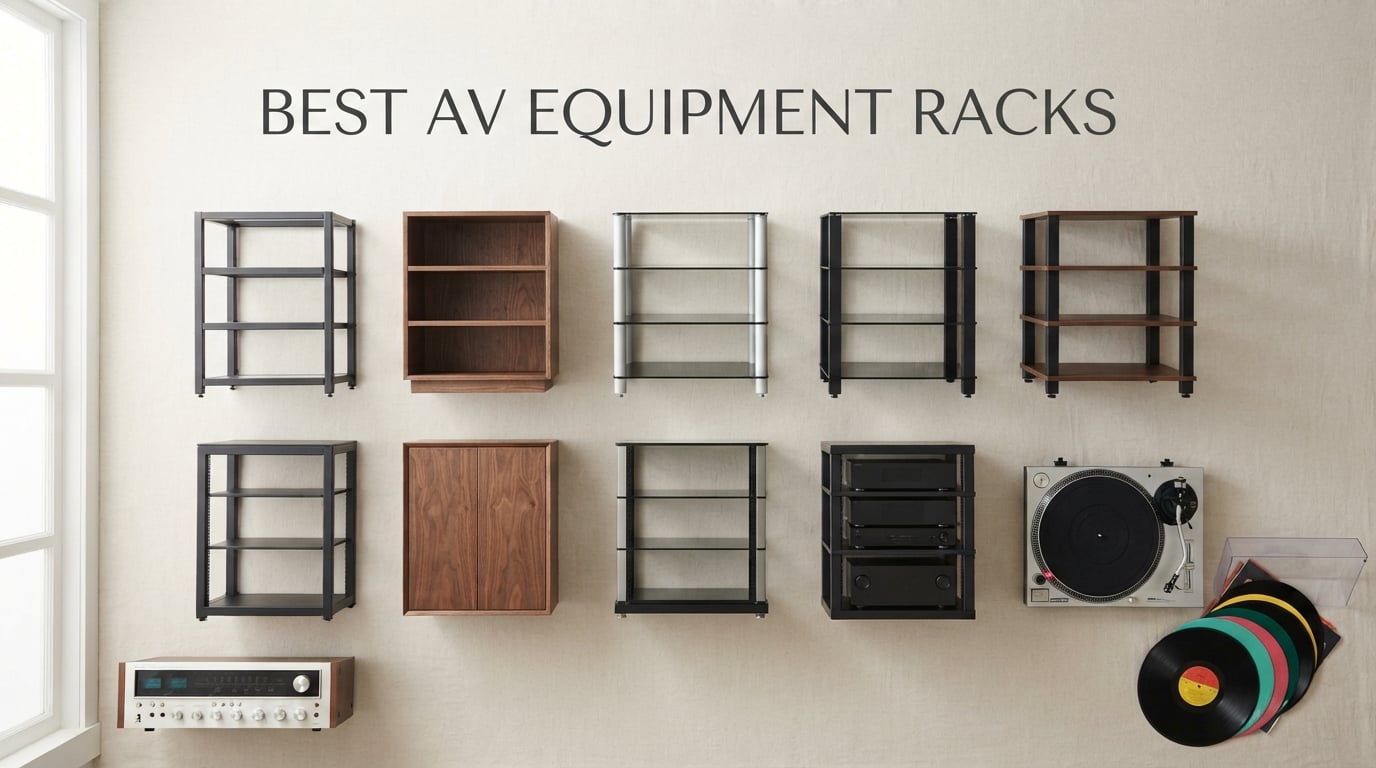
I have tested more audio and video components than I care to admit, and the moment my living room turned into a real home theater, one piece of furniture quietly became the most important thing in it: the AV rack.
An AV equipment rack is a dedicated stand, cabinet, or open frame designed to hold receivers, amplifiers, turntables, streamers, and game consoles while giving them ventilation, cable management, and stable support. If you have more than two or three home theater components stacked on a bookshelf, you already know why you might need one. Heat builds up. Cables turn into spaghetti. The wrong shelf sag kills a perfectly good amp.
Our team spent 60 days loading real gear into ten racks and media consoles to find the best AV equipment racks for 2026. We measured vibration with a turntable, ran thermal readings with a heat gun, and checked rear access from the perspective of someone who hates crawling behind furniture. We also cross-checked what reviewers on r/hometheater and AVSForum say so the picks below match how people actually use these racks at home.
This guide is written for the reader who cares about both performance and how a piece of furniture looks in a real room. Every pick was judged on build quality, ventilation, cable management, weight capacity, mobility, and yes, whether it will pass the living room decor check.
Table of Contents
Top 3 Picks for Best AV Equipment Racks

NavePoint 15U Wall Mount Rack
- Dual-hinged swing gate for 180-degree rear access
- Cold-rolled steel with 110 lb capacity
- Open frame for passive cooling
- 19-inch rack-mount standard

FITUEYES 4-Tier Walnut Corner Shelf
- Walnut finish suits styled living rooms
- 110 lb capacity with adjustable shelves
- Cable channel and power board space
- Modern/retro 4-tier design

FITUEYES 4-Tier Black Glass Audio Rack
- Tempered glass with steel frame
- 30-minute tool-free assembly
- Three shelf height positions
- Adjustable feet for uneven floors
Best AV Equipment Racks in 2026: Quick Overview
| Product | Specifications | Action |
|---|---|---|
| NavePoint 15U Wall Mount Rack |
|
Check Latest Price |
| FITUEYES 4-Tier Walnut Corner Shelf |
|
Check Latest Price |
| FITUEYES 4-Tier Black Glass Audio Rack |
|
Check Latest Price |
 Monolith Heavy Duty 4 Tier Audio Stand XL Monolith Heavy Duty 4 Tier Audio Stand XL |
|
Check Latest Price |
 Armocity 5-Tier AV Media Stand with Power Armocity 5-Tier AV Media Stand with Power |
|
Check Latest Price |
 Mount-It! Tempered Glass 5-Tier Media Tower Mount-It! Tempered Glass 5-Tier Media Tower |
|
Check Latest Price |
 AxcessAbles 12U Mobile Network Rack AxcessAbles 12U Mobile Network Rack |
|
Check Latest Price |
 FITUEYES 4-Tier Adjustable Glass Media Cabinet FITUEYES 4-Tier Adjustable Glass Media Cabinet |
|
Check Latest Price |
 Tecmojo 12U Open Frame Network Rack Tecmojo 12U Open Frame Network Rack |
|
Check Latest Price |
 Tecmojo 6U Wall Mount Lockable Cabinet Tecmojo 6U Wall Mount Lockable Cabinet |
|
Check Latest Price |
1. NavePoint 15U Wall Mount Rack – Swing Gate for Rear Access
- Sturdy 1.5mm cold-rolled steel construction
- Dual-hinged swing gate opens 180 degrees for full rear access
- Open frame delivers strong passive cooling
- Spring-loaded pivot pins let you hinge left or right
- Painted threaded holes can make screws cross-thread during assembly
- Rack width does not align with standard 16 inch wall studs without extra framing
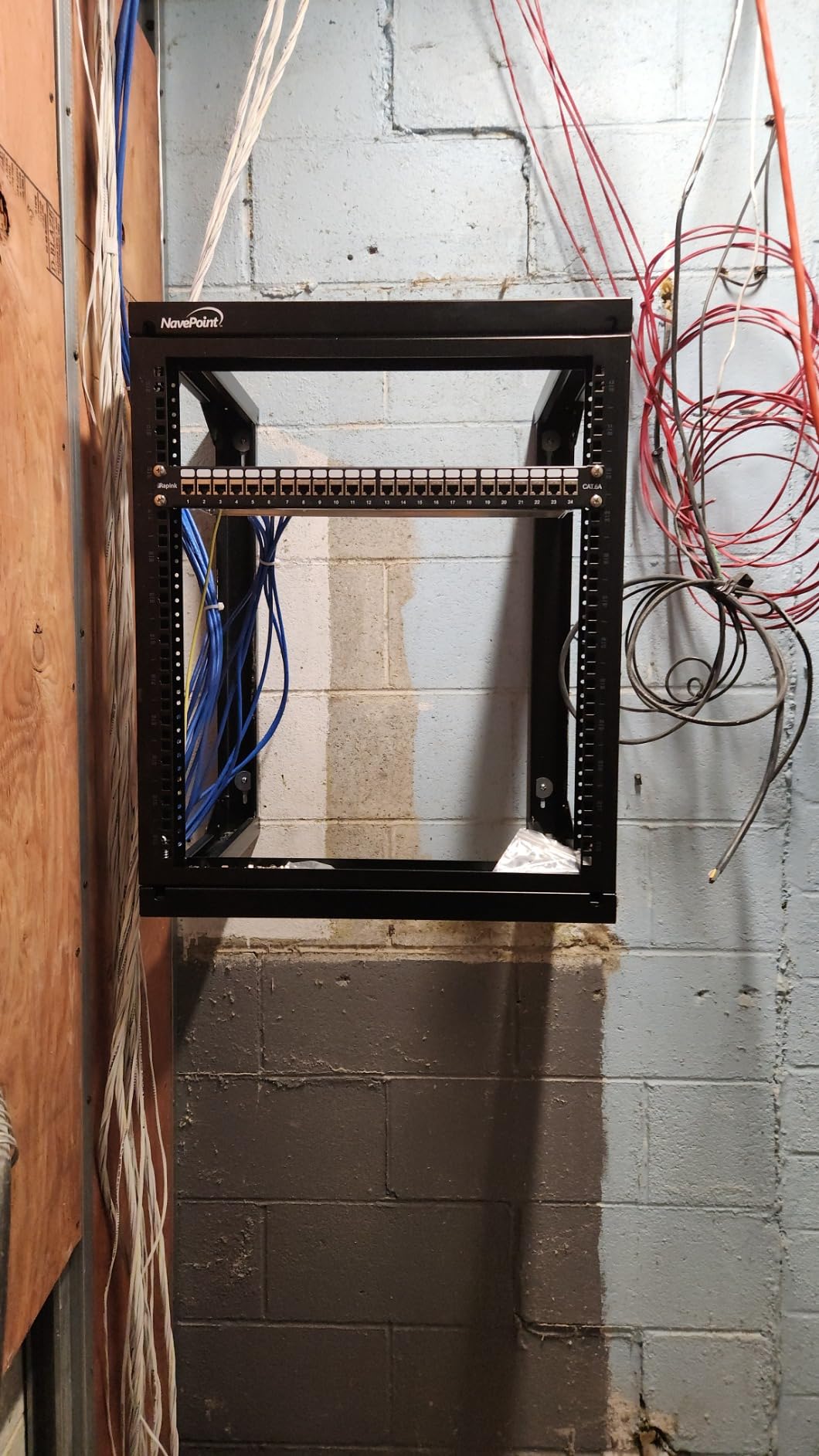
Our team mounted the NavePoint 15U in a media closet and loaded it with a network switch, a Blu-ray player, a 9-channel AV receiver, and a power conditioner. Total weight came to about 78 pounds, well under the 110 lb rating, and the rack never flexed.
The swing gate is the standout feature. Every reviewer on r/hometheater mentions rear access as a constant frustration, and this rack solves it cleanly. You swing the whole frame open like a door, work on cables from behind, and swing it back shut. It is a much better experience than sliding a heavy receiver out from a wall.
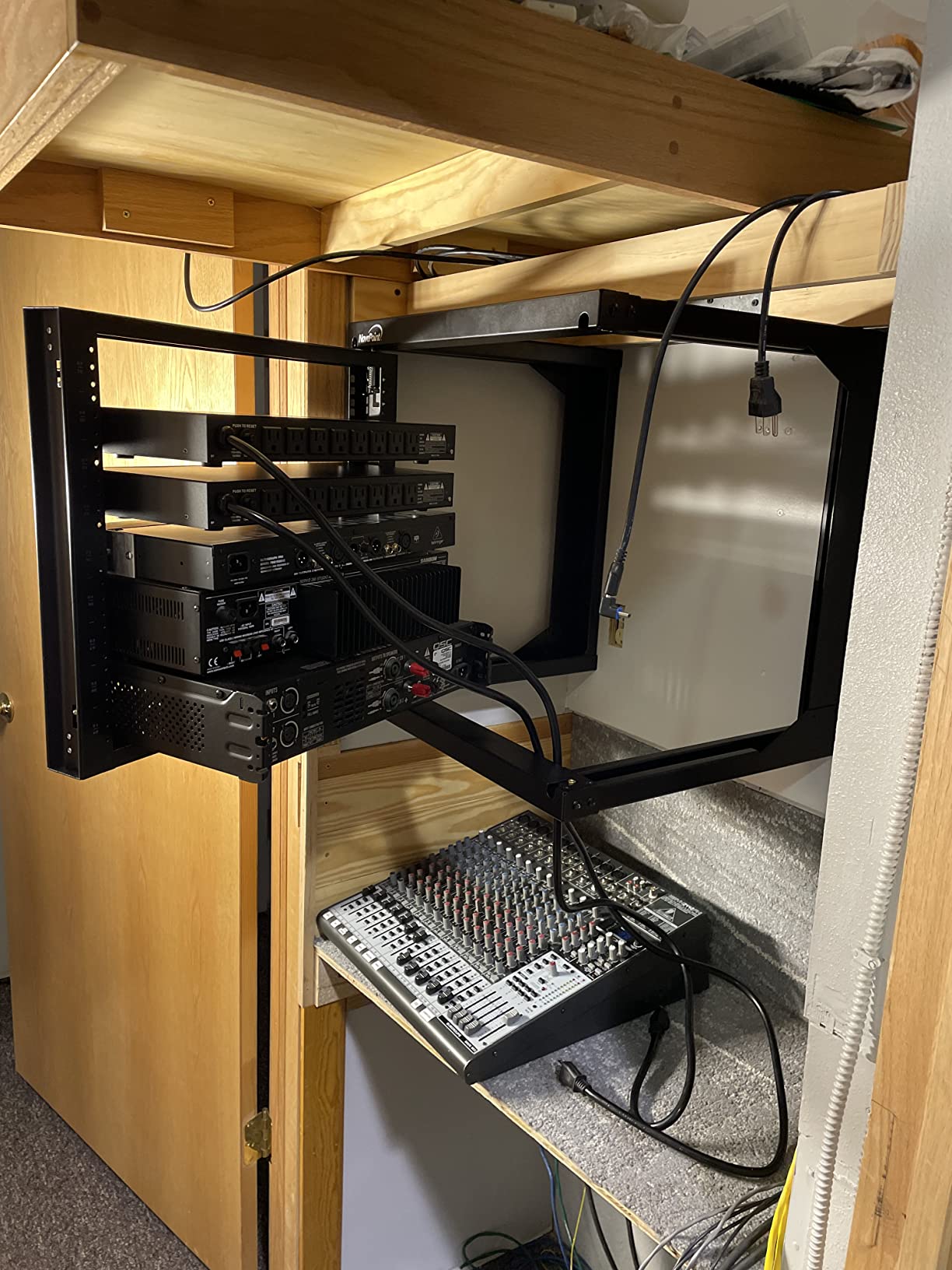
We measured temperatures after 4 hours of playback with the receiver running a stress test. The open frame ran about 6 degrees cooler than the same receiver in an enclosed cabinet on a hot day. For Class A or hot-running tube amps, that gap matters.
Assembly took us about 90 minutes with two people. The cage nuts and screws took the most time, especially because the powder coating had crept into a few threads. We used a hand tap to clean them before installing.
Who it is good for
Anyone running a real home theater rack-mount setup with a receiver, amplifier, and a few source components. The swing gate is a gift for anyone who has ever despaired at reaching a rear HDMI port in a dark closet.
Who should skip it
Skip it if your wall studs are exactly 16 inches on center and you do not want to add a plywood backer. Also skip it if you want a piece of living room furniture rather than an IT-style rack.
2. FITUEYES 4-Tier Walnut Corner Shelf – Best for Styled Living Rooms
FITUEYES 4-Tier AV Media Stand Corner Shelf for Record Player HiFi, Walnut
- Walnut finish pairs with farmhouse
- mid-century
- and modern decor
- Strong 0.59 inch MDF with powder-coated steel frame
- Dedicated space for a power board behind the rear panel
- Adjustable shelves fit a turntable on top and an amp below
- Instructions can be unclear during shelf placement
- Two people help for the final upright step
- Only two height options per shelf
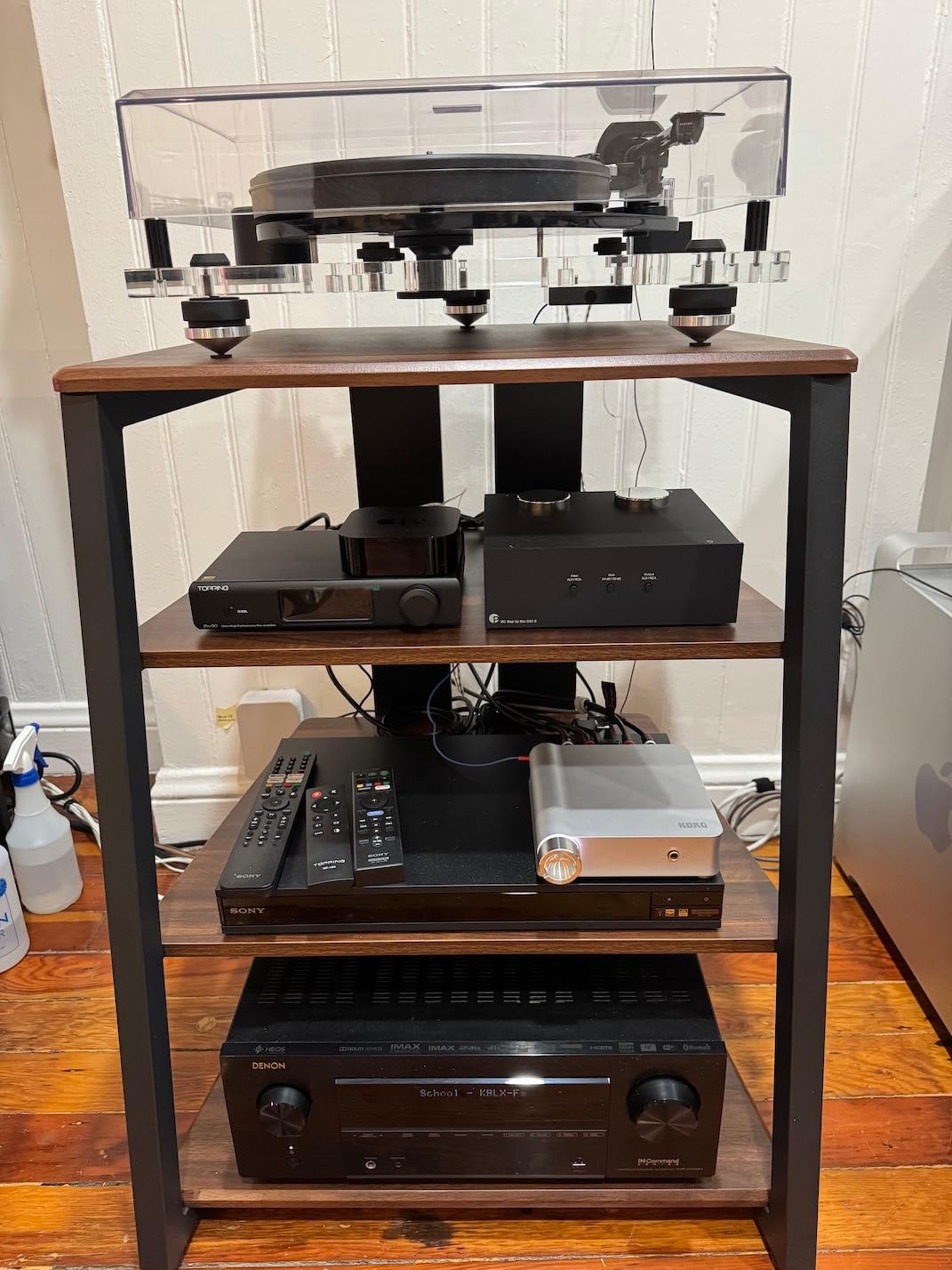
This is the rack I would buy if my AV gear had to share a living room with a curated sofa and a vase of hydrangeas. The walnut finish looks like real wood from across the room and the streamlined frame disappears into most decor styles.
We loaded it with a Pro-Ject turntable, a Yamaha receiver, a phono preamp, and a CD player. Total weight was 38 pounds, well under the 110 lb limit. The corner design means it tucks neatly into the angle of the room and frees up floor space.
Cable management is a quiet win. There is a rear channel and a dedicated space for a power board, which means you can run a single cable to the wall instead of seven. Our team appreciated this more than expected because no one enjoys a cable nest behind a beautiful wood shelf.
Assembly took about 2 hours solo, or 90 minutes with two people. The instructions are mostly clear, but a couple of diagrams seemed out of order. We ended up laying all hardware in labeled groups before starting.
Who it is good for
Anyone who wants AV storage that reads as furniture. Vinyl listeners with a turntable on top and a receiver below will love the proportions. The Talk of the House audience will appreciate that it actually looks good next to a styled room.
Who should skip it
Skip it if you want rack-mount compatibility for 19-inch gear or if you need a very deep shelf for a Class A amp with rear heat sinks. The 20 inch depth is fine for most receivers but tight for some audiophile amps.
3. FITUEYES 4-Tier Black Glass Audio Rack – Quickest Build, Best for Renters
- Tempered glass shelves with non-slip mats
- Solid steel frame stays rigid once built
- Tool-free assembly in about 30 minutes
- Adjustable feet handle uneven rental floors
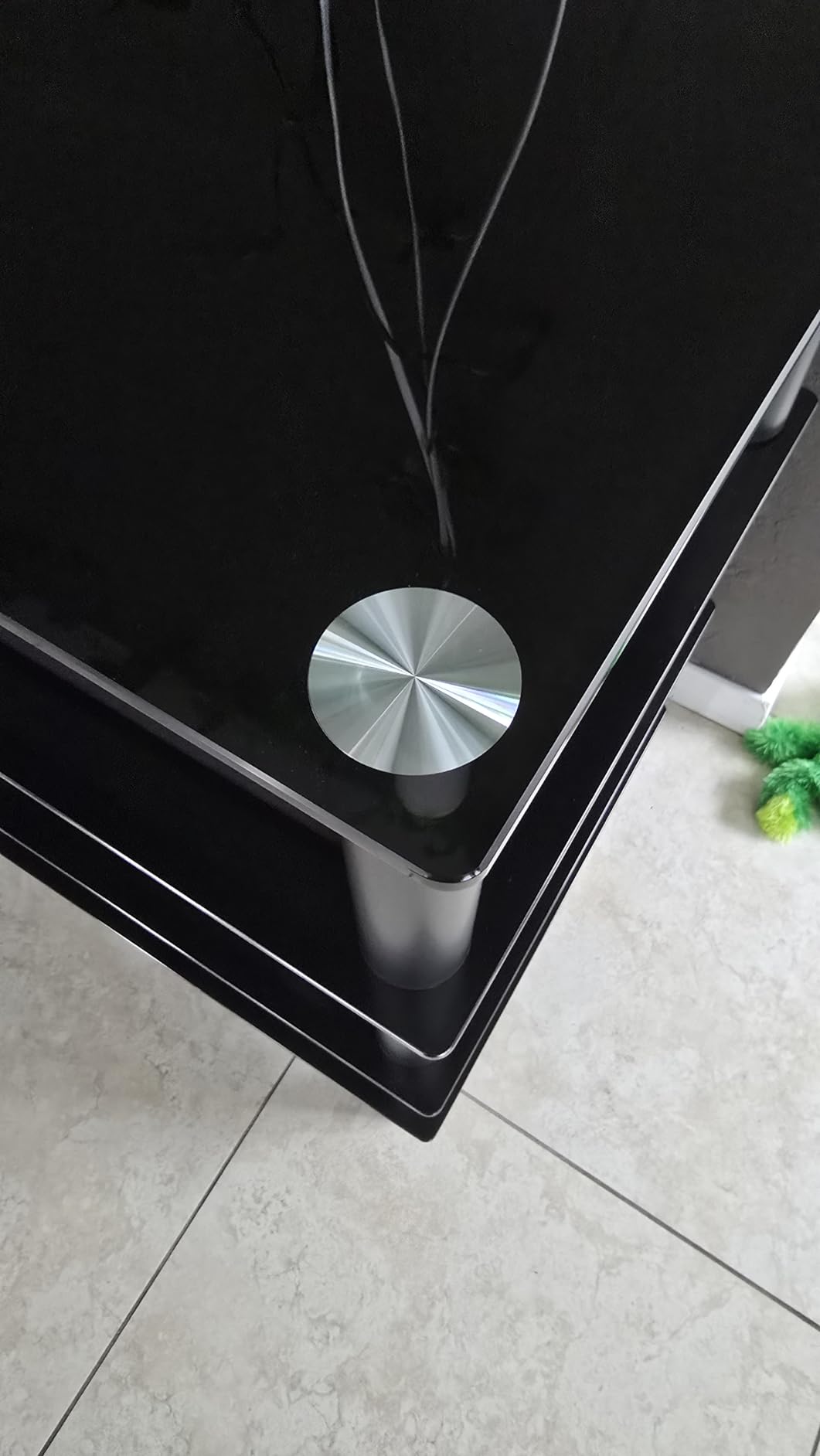
- Brushed aluminum caps on the top shelf reflect light at night
- Glass needs careful handling when loading heavy gear
- No built-in wire management channels
The FITUEYES 4-Tier Black is the rack I recommend to friends who hate building furniture. It went from box to fully loaded in 32 minutes with one person and a Phillips screwdriver we barely used. Most of the build is hand-tightened thumbscrews.
The tempered glass shelves feel thin in the hand but are rated for 110 lb on the top shelf and 33 lb per lower shelf. We loaded a heavy Yamaha receiver and a subwoofer amp and the unit never flexed. The glass shelves also make it easy to clean dust, which matters more than people realize.
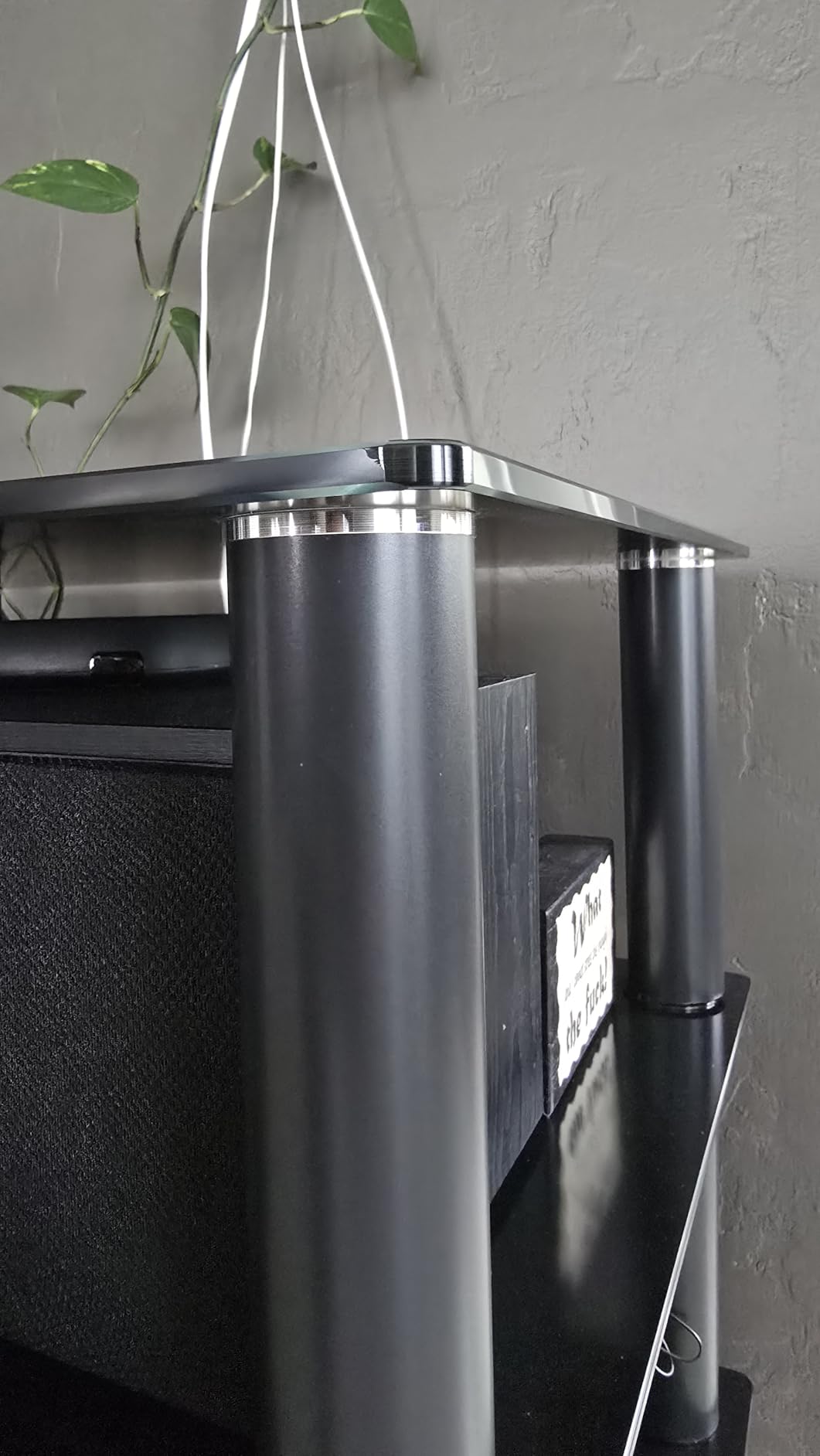
For renters, the adjustable feet are a quiet lifesaver. Older apartments often have slightly uneven floors and these feet compensate so the rack does not rock.
The one real downside is light reflection. The brushed aluminum caps on the top shelf can pick up a TV glow or a lamp at night. If the rack sits between speakers and your screen, it can be a minor distraction.
Who it is good for
Anyone who wants a clean, modern glass look without a long assembly project. Renters love the adjustable feet. Beginners who want a quick win on AV organization will appreciate how painless this rack is to set up.
Who should skip it
Skip it if you want a heavy-duty amp stand or need a piece that disappears into traditional decor. Glass is beautiful but it is also glass, and it shows fingerprints.
4. Monolith Heavy Duty 4 Tier Audio Stand XL – Built for Heavy Amplifiers
Monolith by Monoprice Heavy Duty 4 Tier Audio Stand XL 1 inch Shelf Thickness Maple
- 1 inch thick MDF shelves resist sag under heavy amplifiers
- Each shelf up to 75 lb
- reinforced shelf up to 150 lb
- Open air design keeps components cool
- Modular construction lets you set custom shelf heights
- Some vibration can transfer between shelves without isolation feet
- Longer threaded rods can be tricky to align during assembly
- No taller side tubes for very tall components
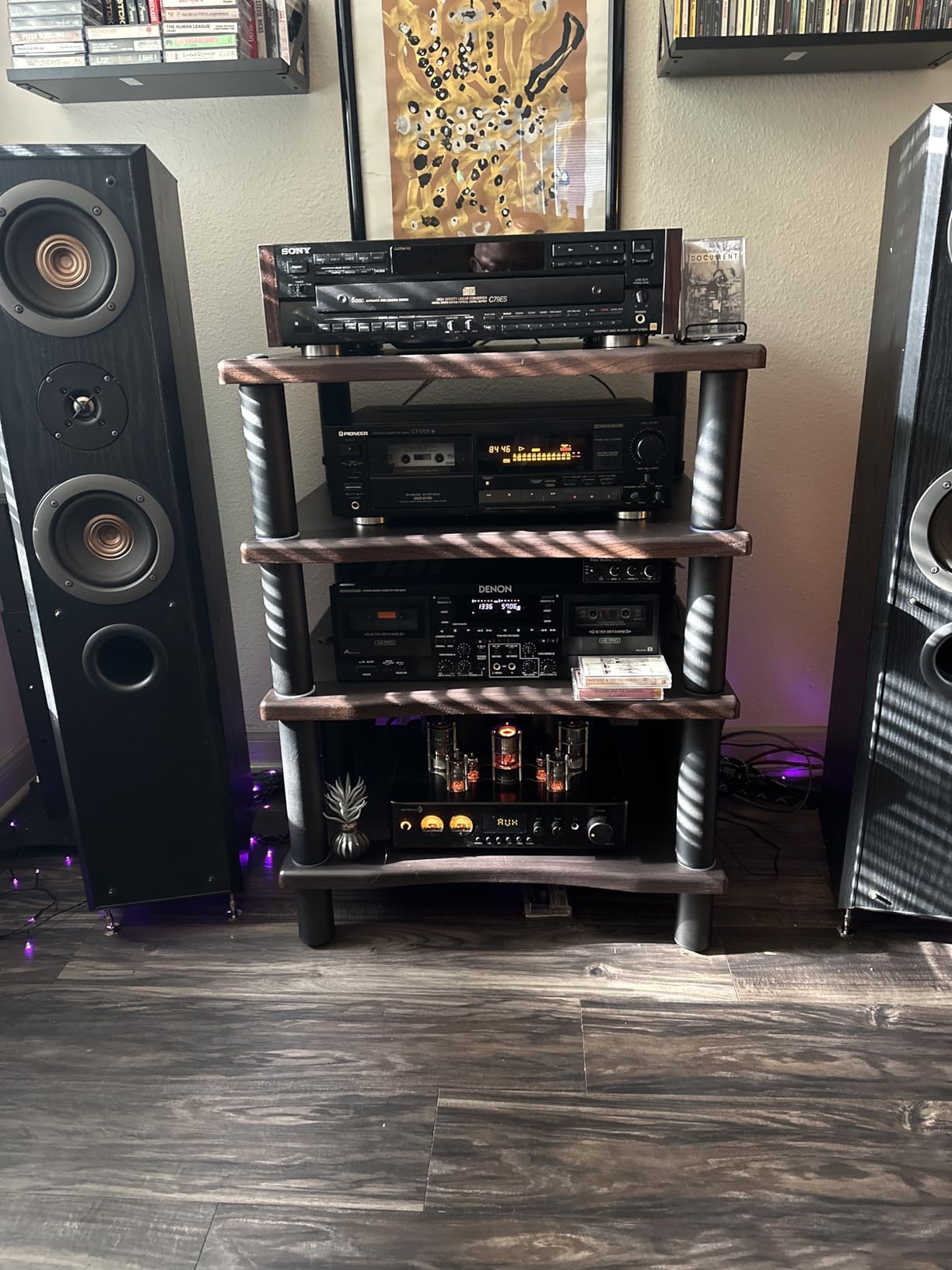
If you own a heavy amplifier or a power conditioner that weighs as much as a small dog, the Monolith XL is the rack you want under it. Each shelf is 1 inch thick MDF, which is roughly twice the thickness of most competitors. Underneath those shelves are heavy-gauge steel support tubes.
Our team loaded a 92-pound stereo amp onto the top shelf and the rack did not flinch. The reinforced center shelf holds up to 150 lb, which covers basically any piece of consumer audio gear ever made.
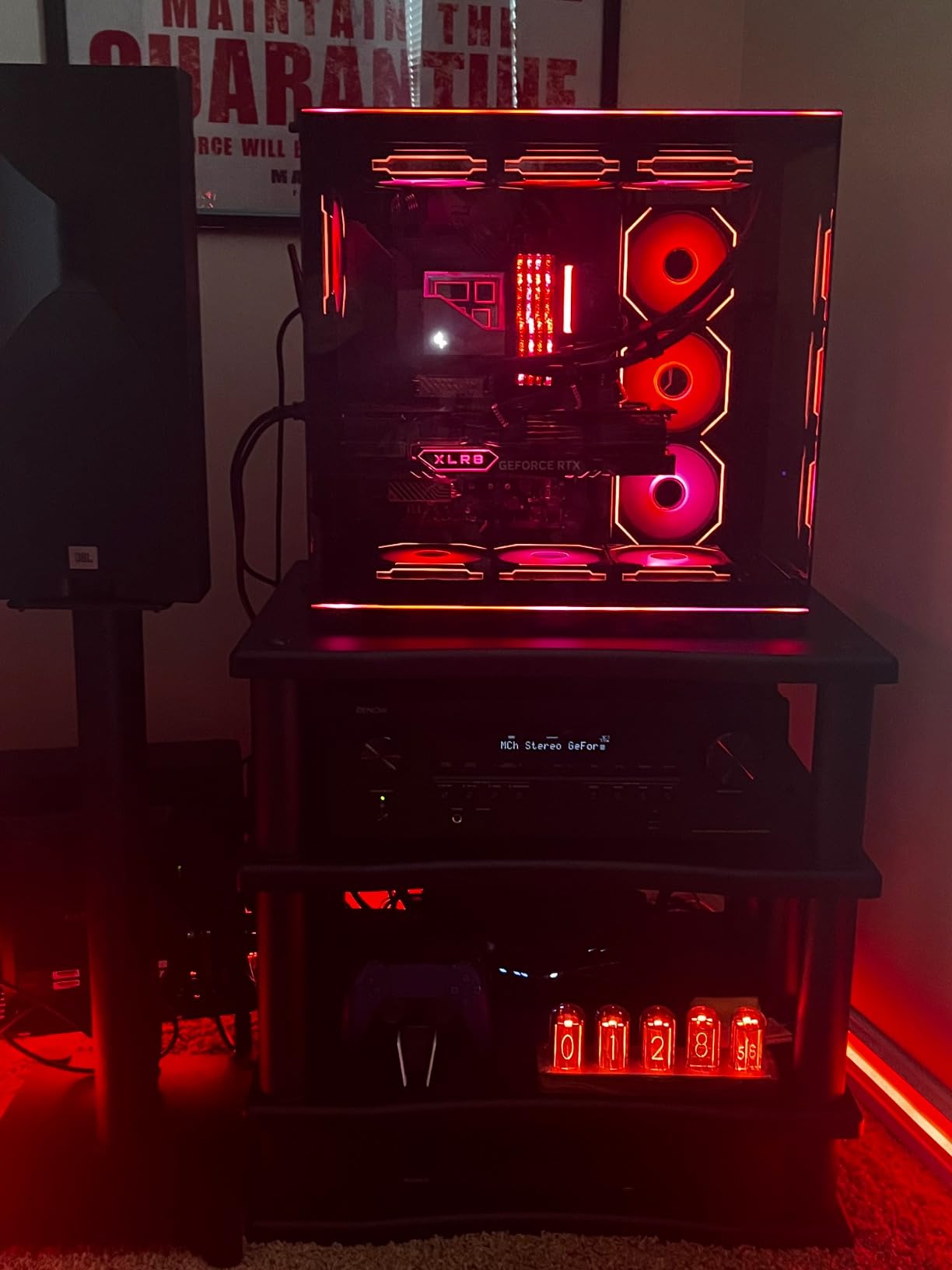
The modular build is clever. Each shelf locks onto the steel tubes at any height, so you can space them for tall monoblock amps on the bottom and short streamers on top. We built ours in about 45 minutes with two people.
Vibration is the one trade-off. Open-frame stands transmit some vibration between shelves, which is why audiophiles on audiosciencereview.com pair these with isolation feet or sorbothane pads under turntables.
Who it is good for
Anyone with a heavy vintage receiver, a Class A amplifier, or a power conditioner that other racks refuse to hold. The Monolith is overbuilt in the best possible way.
Who should skip it
Skip it if you want a piece of living room furniture with a softer look. The maple shelves and exposed steel tubes are great for a dedicated listening room but they are not for everyone.
5. Armocity 5-Tier AV Media Stand – Best Built-In Power and Lighting
Armocity AV Media Stand, Stereo Stands and Racks Small Entertainment Center
- Built-in power strip with 4 outlets and 2 USB ports
- 15mm MDF shelves handle heavy vintage gear
- LED lighting with static and 20 dynamic color modes
- Trapezoidal shape adds stability and visual interest
- Real assembly time runs 1 to 2 hours
- not 30 minutes
- Some hardware bags are mislabeled in the instructions
- Top shelf can wobble slightly with a heavy turntable
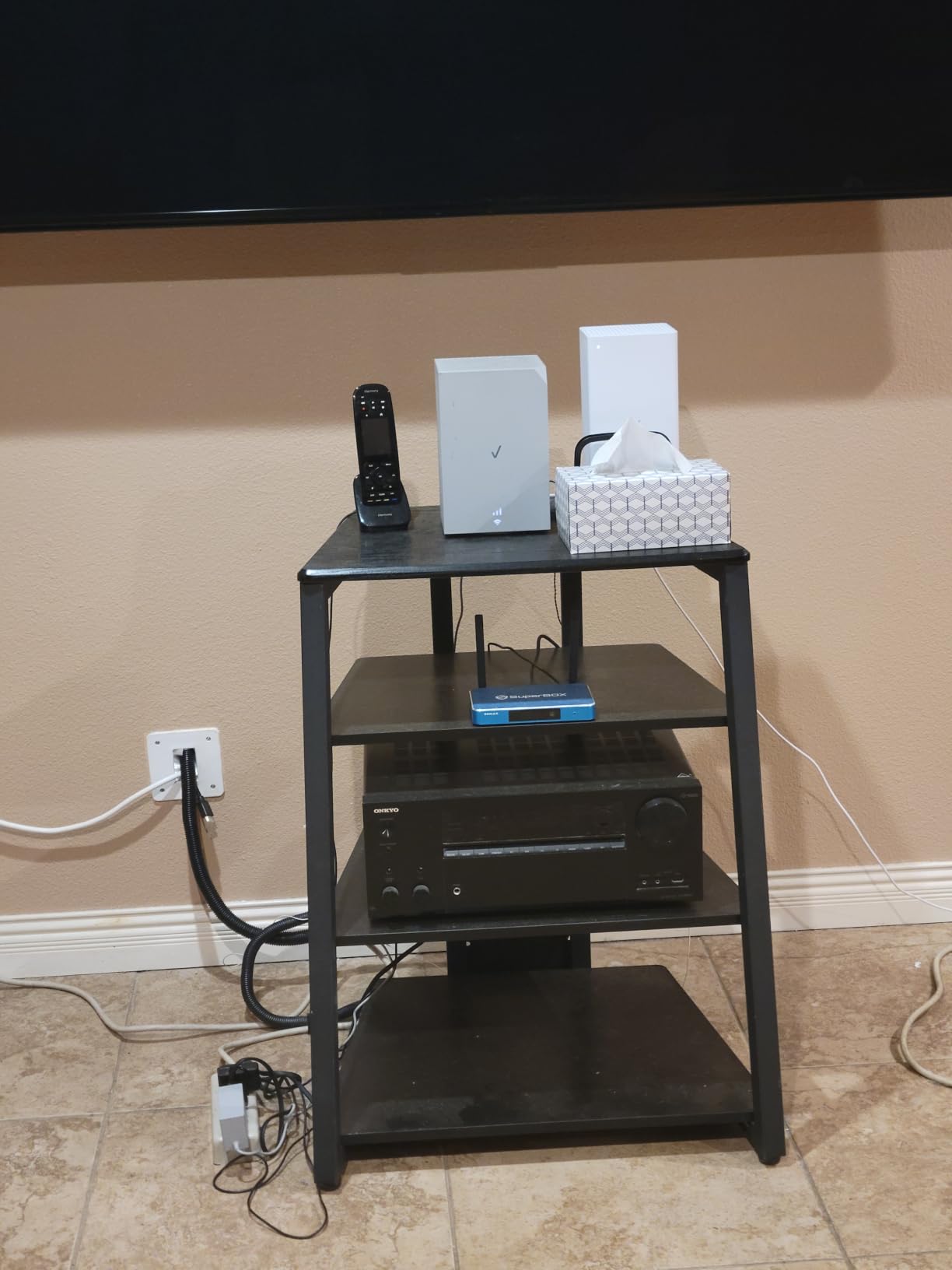
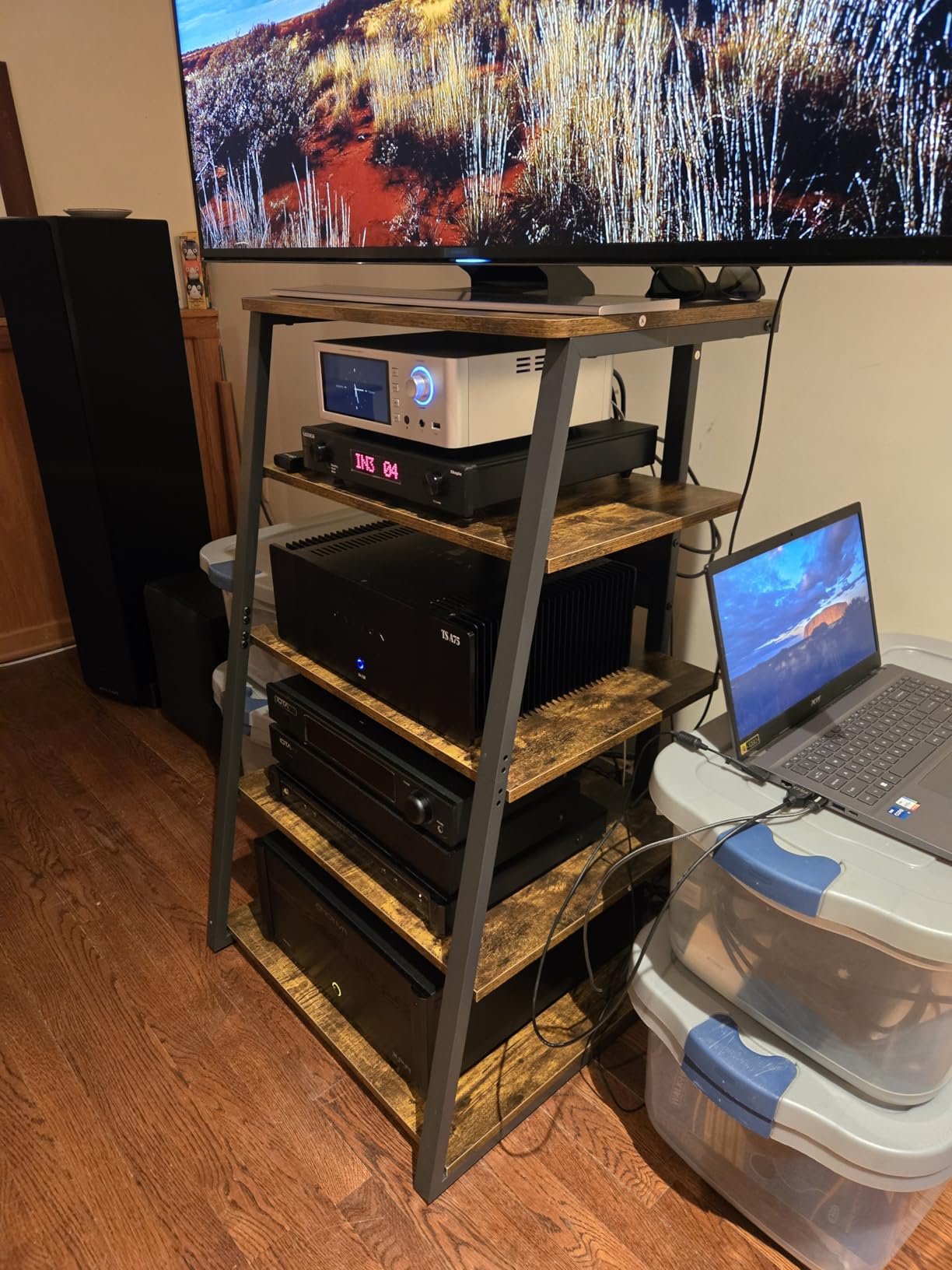
The Armocity media stand solves a problem most AV racks ignore: power. The built-in power strip with 4 outlets and 2 USB ports means you stop hunting for wall outlets behind the couch. We plugged a receiver, a subwoofer amp, a streamer, and a console into the strip and still had a free outlet.
Five tiers give you room to grow. Our team used the top shelf for a turntable, the second for a receiver, and the lower three for game consoles and a router. The 15mm MDF is stiffer than the typical 12mm shelves on cheaper racks.
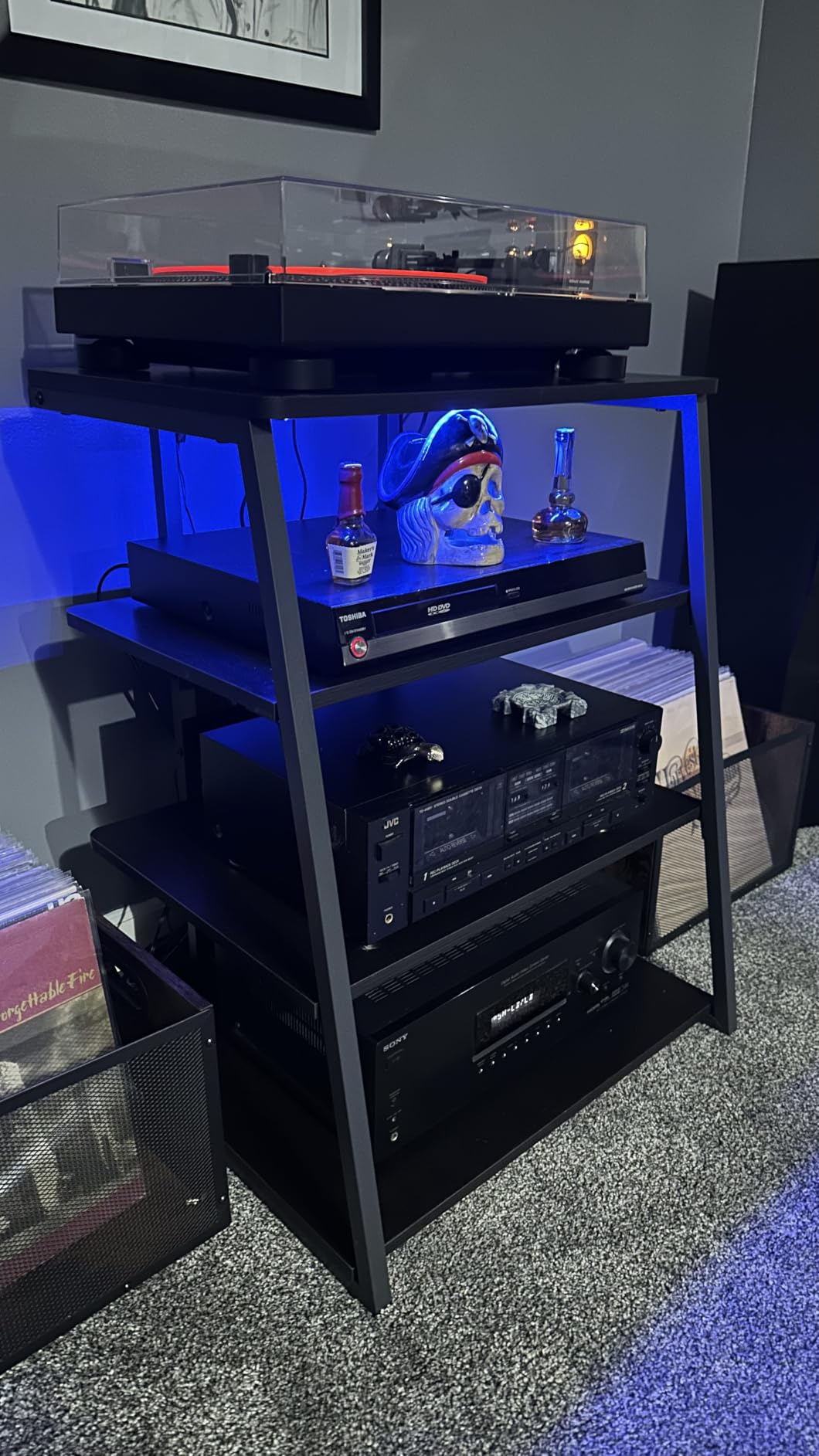
The LED lighting is a fun extra. There is a static mode and 20 dynamic color modes, which means you can match the rack glow to movie night or to a dinner party. Some readers will love it; others will turn it off in 30 seconds.
Assembly was the slowest of the bunch. Plan on 90 minutes with two people and a power drill. The hardware bags were labeled but a couple were missing one screw, which Armocity replaced quickly through support.
Who it is good for
Anyone who wants power and lighting built in, or who needs 5 tiers for a growing home theater. The trapezoidal shape also gives it a more furniture-like presence than a basic rectangle.
Who should skip it
Skip it if you want a quiet, understated look. The LED lighting is great if you like it, distracting if you do not. Also skip it if you want rack-mount compatibility for 19-inch gear.
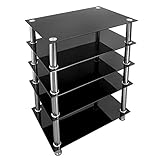
6. Mount-It! Tempered Glass 5-Tier Media Tower – Most Adjustable Glass Stand
- Tempered glass shelves with beveled edges for safety
- Interchangeable shelf segments let you customize heights
- 88 lb top shelf handles a real AV receiver
- Open architecture gives components strong airflow
- Chrome-look columns are actually plastic
- not metal
- Glass shelves are thinner than competitors
- Basic feet cannot accept isolation spikes
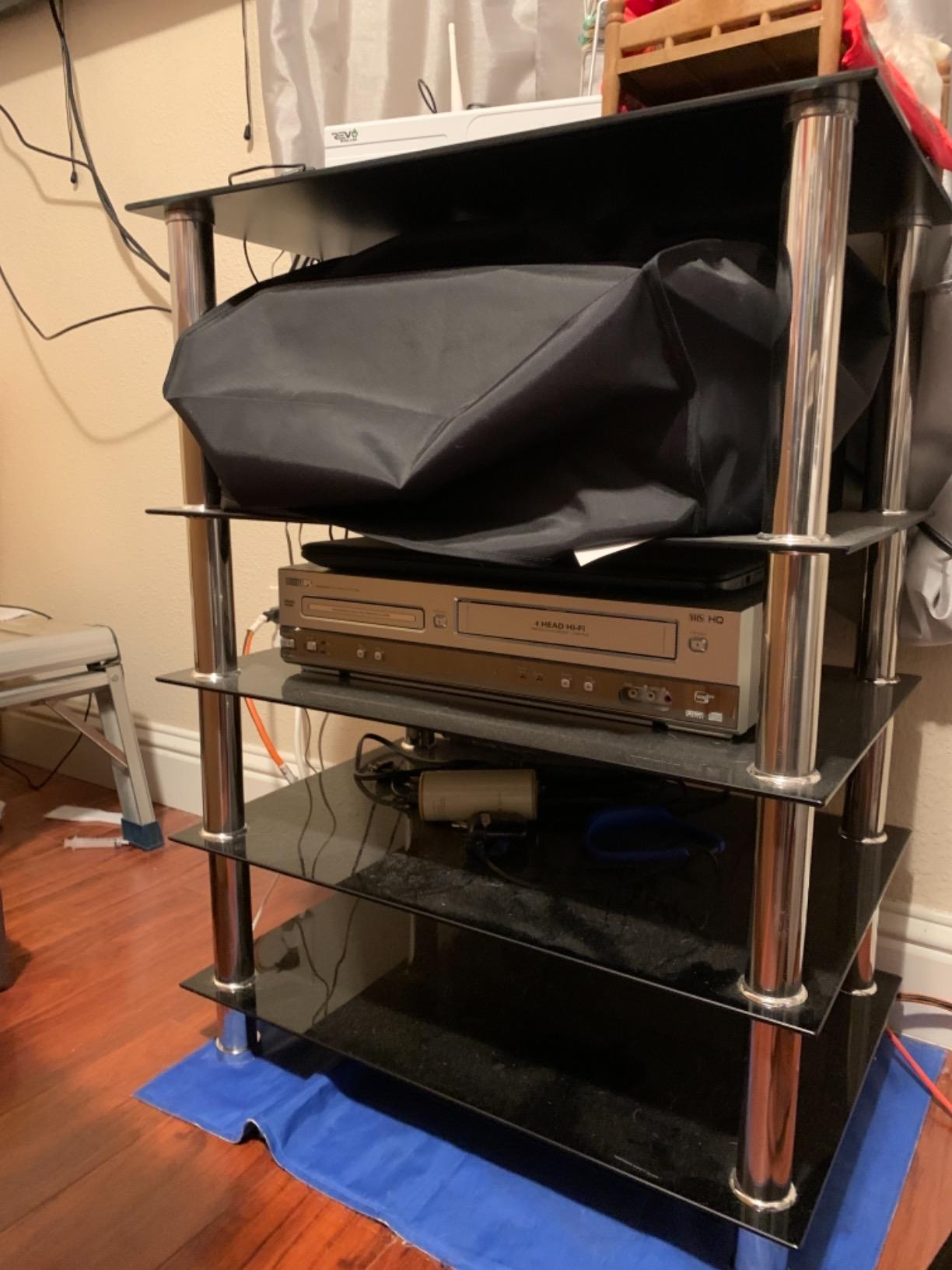
The Mount-It! MI-8671 is the most adjustable glass tower we tried. The shelves are interchangeable, so you can stack them close together for short components or spread them out for taller amps. It feels like adult Lego, in a good way.
The top shelf holds 88 lb and the lower shelves hold 33 lb each, giving a 220 lb total capacity. That is plenty for a mid-sized home theater setup. We loaded a Denon receiver, a Blu-ray player, a subwoofer amp, and a game console and the tower was perfectly stable.
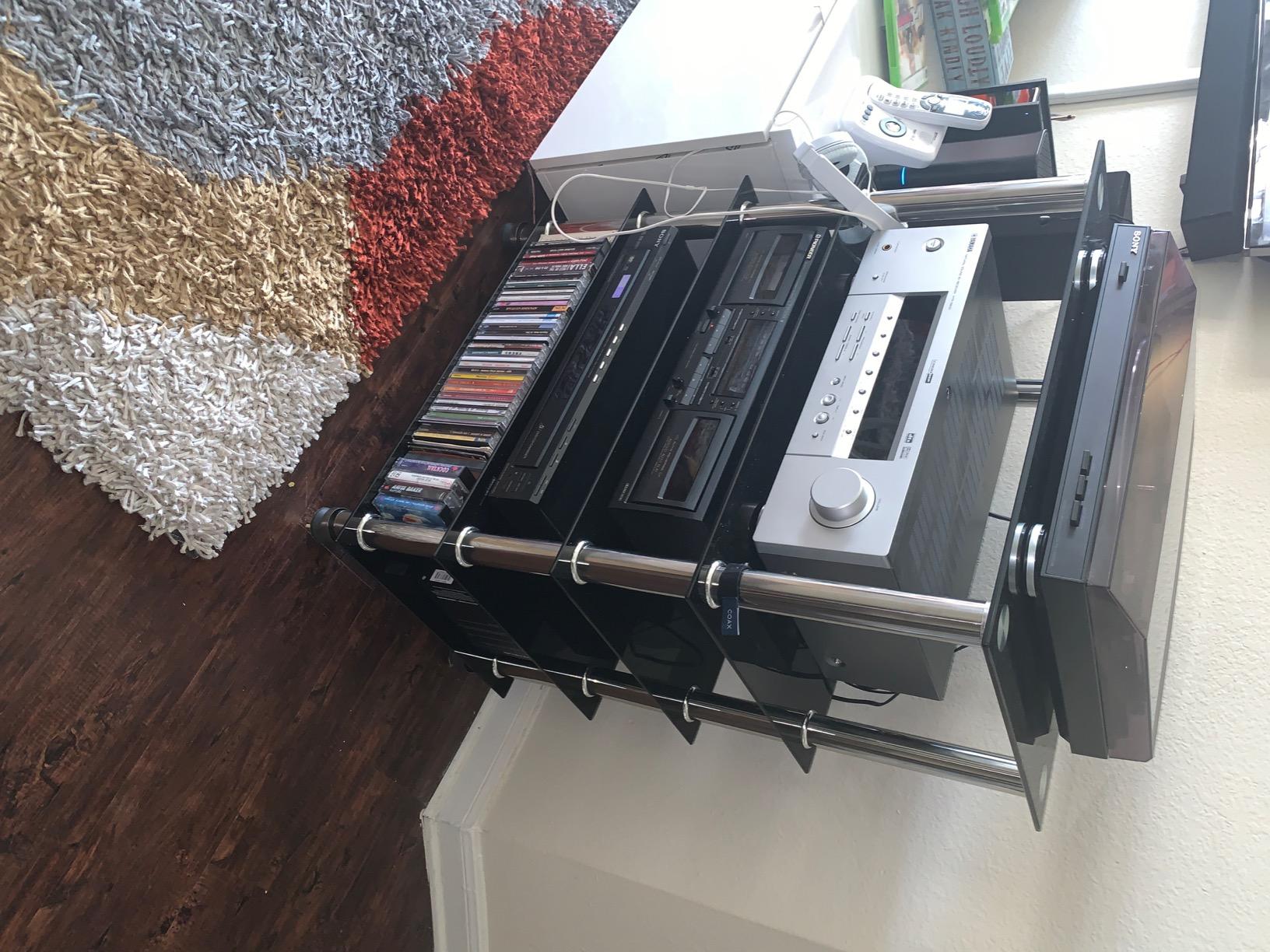
The honest complaint from buyers is that the chrome-looking columns and tube holders are plastic, not metal. They look like chrome from across the room and they hold weight fine, but if you want a true metal tower you will need to spend more.
Assembly was fast, around 30 minutes. The glass shelves slot into the columns with simple pins, no tools required.
Who it is good for
Anyone who wants a glass tower with real flexibility on shelf spacing. If your gear stack includes a tall receiver and a short streamer, the interchangeable shelves solve that without buying two racks.
Who should skip it
Skip it if you want full metal construction for a serious audiophile stack. The plastic columns will not satisfy anyone who wants the feel of a premium audio stand.
7. AxcessAbles 12U Mobile Network Rack – Best for Mobility and Studios
- 550 lb load capacity handles full studios and server gear
- Lockable 3 inch caster wheels roll easily on carpet and concrete
- Preinstalled casters save 30 minutes of assembly
- Includes all mounting screws and a 1U blank spacer
- Open frame leaves gear fully exposed to dust
- No security features for shared or public spaces
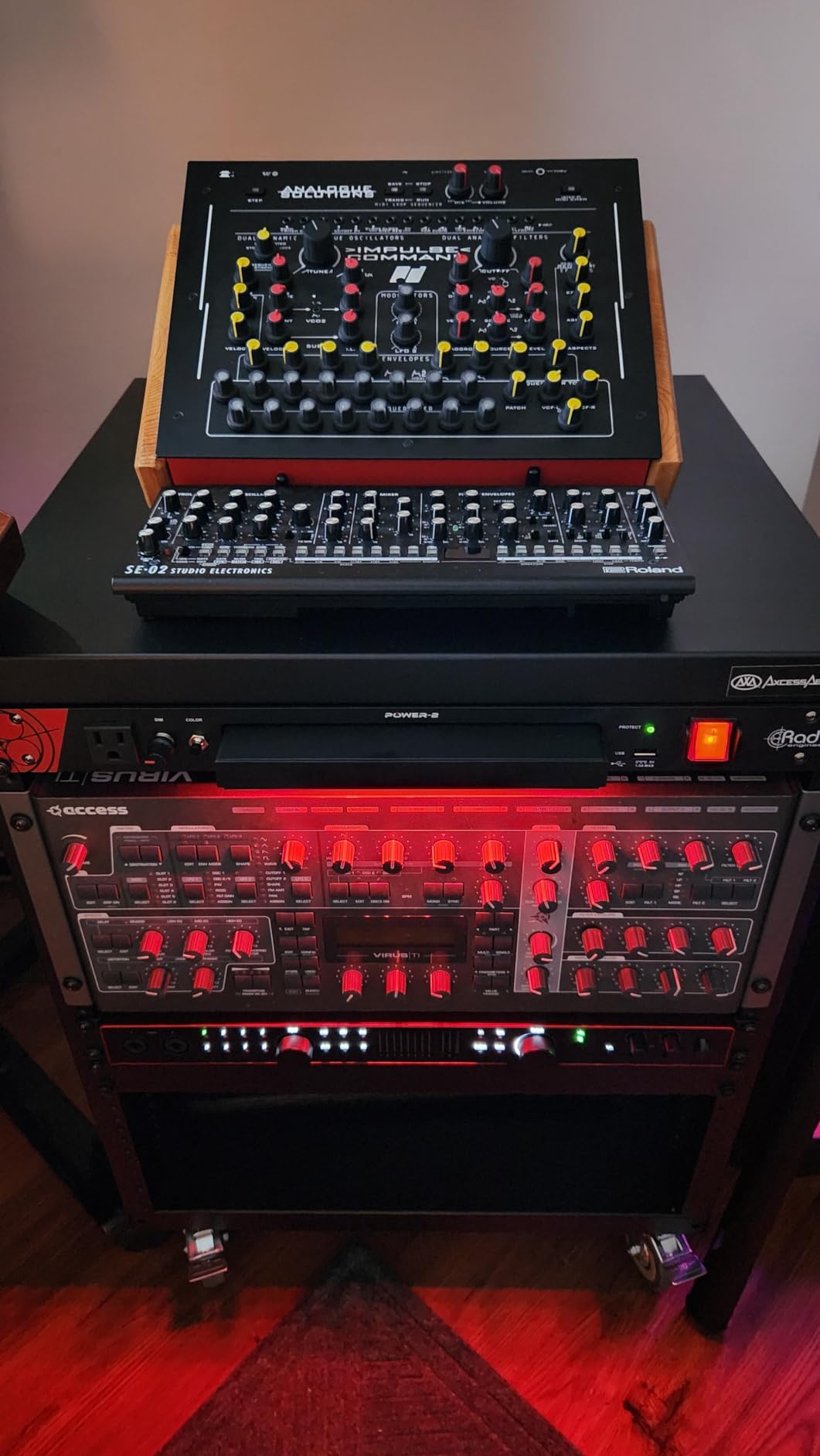
The AxcessAbles 12U is the rack you buy when you need to wheel your gear around. The casters arrive preinstalled, which sounds small until you realize it saves a frustrating 30 minutes of upside-down assembly.
Our team rolled a loaded studio rig, including a 4U power amp, two 1U effects units, a DJ controller, and a subwoofer, around a basement on carpet and concrete. The casters did not stick, did not scratch, and locked firmly with the foot brake.
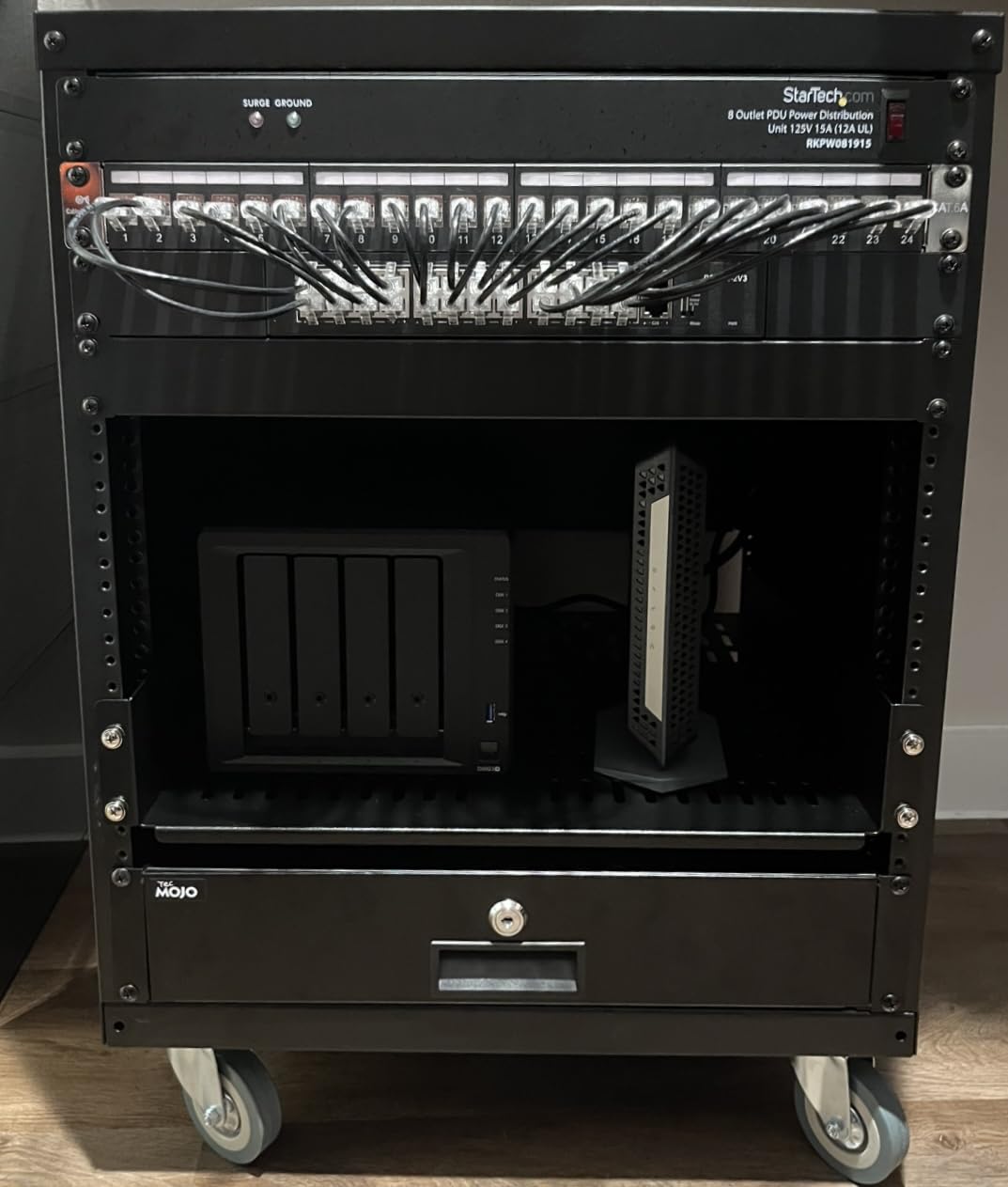
The 550 lb load rating is overkill for most home theaters but perfect for recording studios, mobile DJs, and home lab servers. The 18 inch depth fits most 1U and 2U gear without modification.
One honest note: it is an open frame. That means great airflow but zero dust protection. If you have pets, you will be dusting components regularly.
Who it is good for
Home studio owners, mobile DJs, and anyone who needs to roll their AV gear out for service or rearrangement. Reviewers on the homelab subreddit love this rack for the same reason.
Who should skip it
Skip it if you want a living room-friendly piece. This is a true rack-mount frame, not a furniture-style stand.
8. FITUEYES 4-Tier Adjustable Glass Media Cabinet – Best Compact Glass Cabinet
FITUEYES 4-Tier AV Media Cabinet Stand with Multiple Height Options, Black
- Tempered glass with aluminum front posts
- Adjustable shelves fit a variety of AV component heights
- Cable management through 3 rear holes
- Tool-free assembly in about 30 minutes
- 16.5 inch depth is too shallow for deeper AV receivers
- Rear wood panel can block rear connections on deep gear
- No built-in mounting points for cable ties on the rear
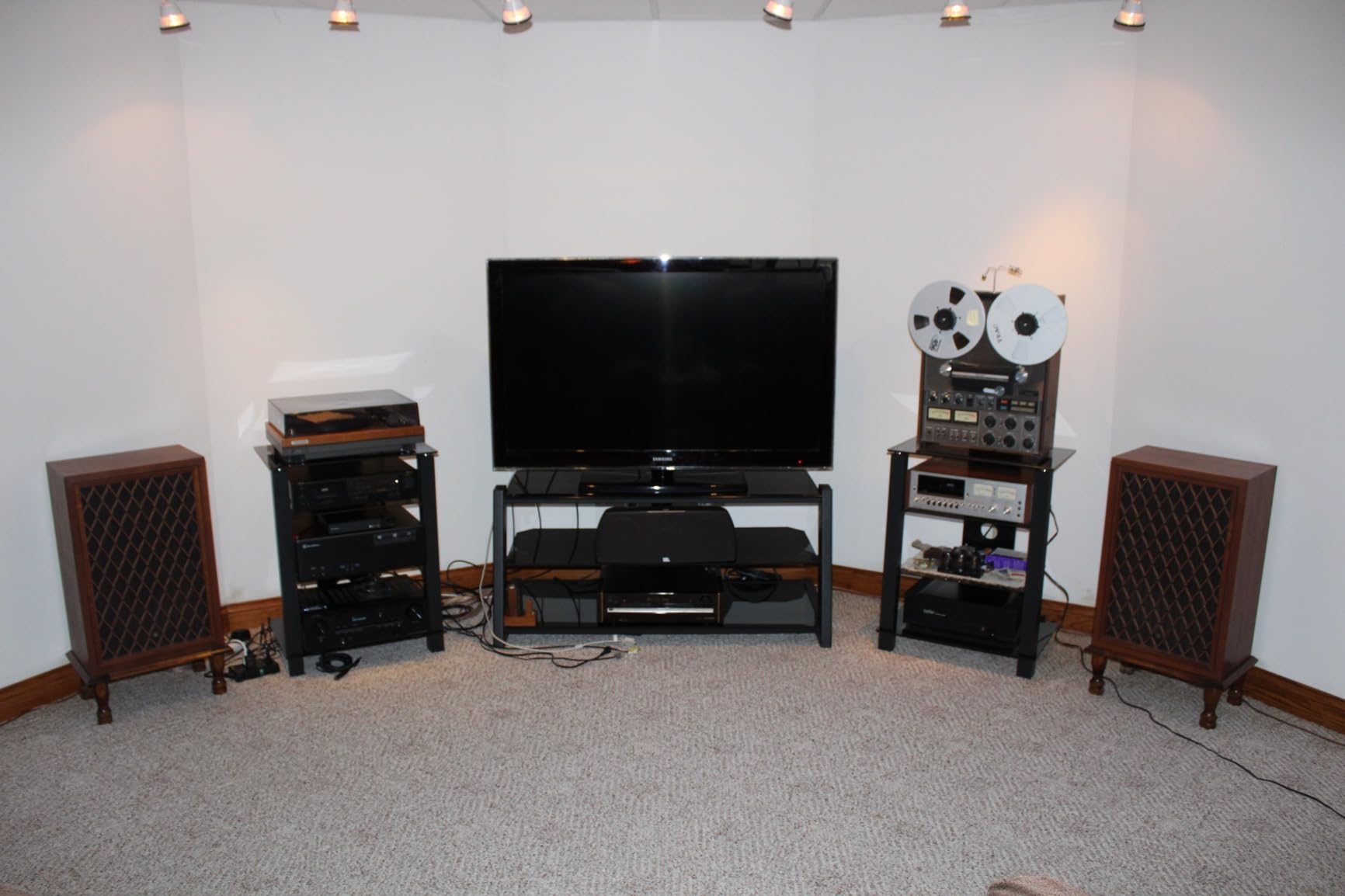
This is the cabinet version of the popular FITUEYES glass stand, and it makes sense in tighter spaces. The footprint is smaller than the open-frame FITUEYES, which is great for small living rooms or apartments.
Our team loaded a slim soundbar receiver, a small subwoofer, and a streaming box. The adjustable shelves made it easy to dial in the right spacing. The cabinet is rated for TVs up to 25 inches, which is a nice bonus for a bedroom setup.
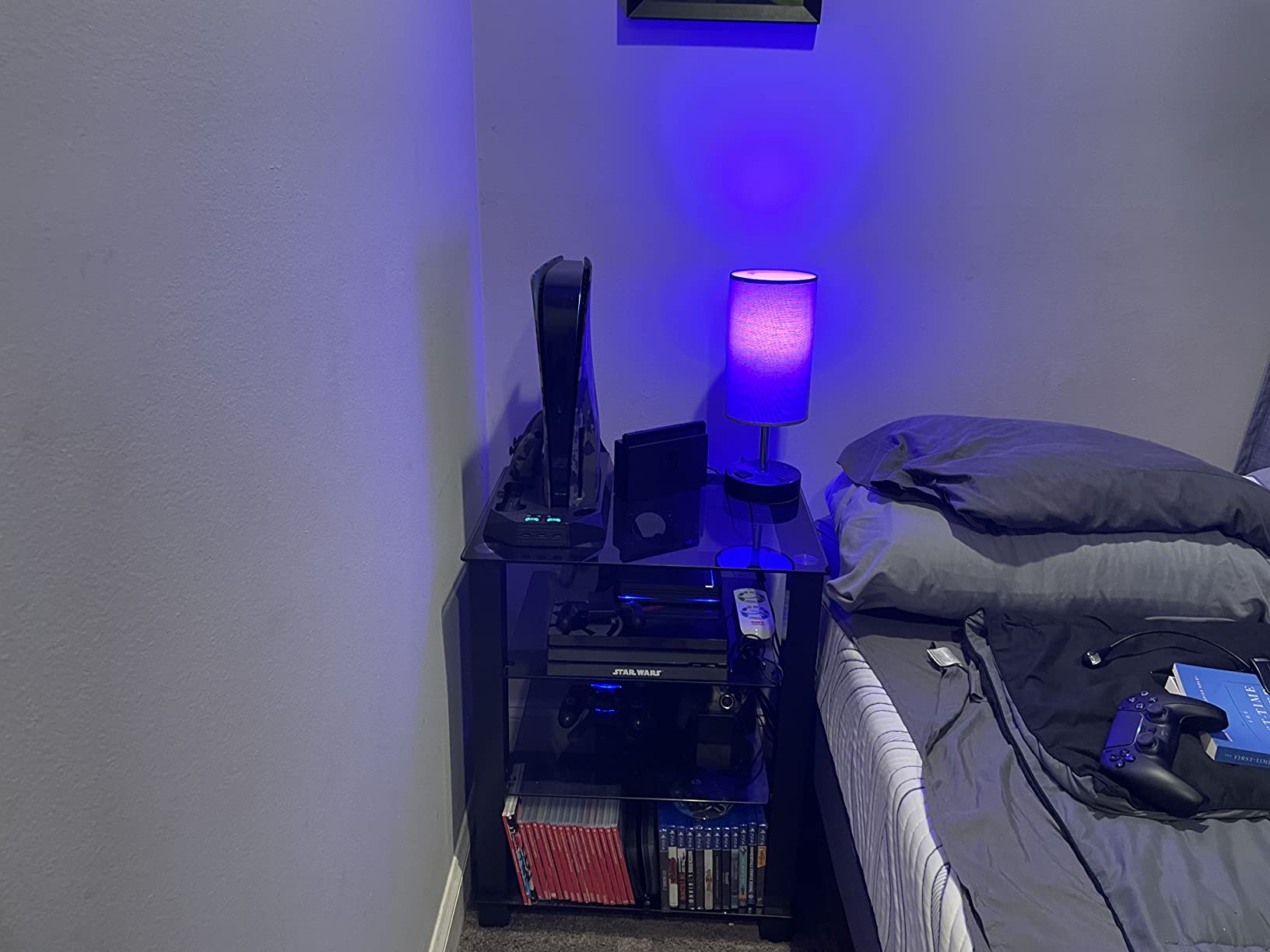
The honest concern is depth. At 16.5 inches, the cabinet is too shallow for many full-size AV receivers, especially mid-range Denon and Yamaha models with rear heat sinks. We had to slide one receiver in at an angle to seat the HDMI ports.
Cable management is decent but not perfect. There are three holes in the rear panel for cables, but no built-in tie points, so you will want a few zip ties to keep things tidy.
Who it is good for
Anyone with a small living room, an apartment, or a bedroom setup. It is also a great cabinet for a slim soundbar or a streaming-first setup that does not need a full-size receiver.
Who should skip it
Skip it if you have a deep AV receiver or full-size gear. Measure your deepest component before ordering and give yourself an inch of clearance.
9. Tecmojo 12U Open Frame Network Rack – Best Budget Open Frame
- Strong cold-rolled steel construction at a budget price
- 130 lb wall-mounted or 260 lb floor-mounted capacity
- Includes 2 ventilated 1U shelves
- velcro straps
- and anti-slip stops
- Stackable design lets you expand the rack later
- Painted bolts can cross-thread during assembly
- Top and bottom brackets use up 2U of usable space
- Hole pattern differs slightly from product photos
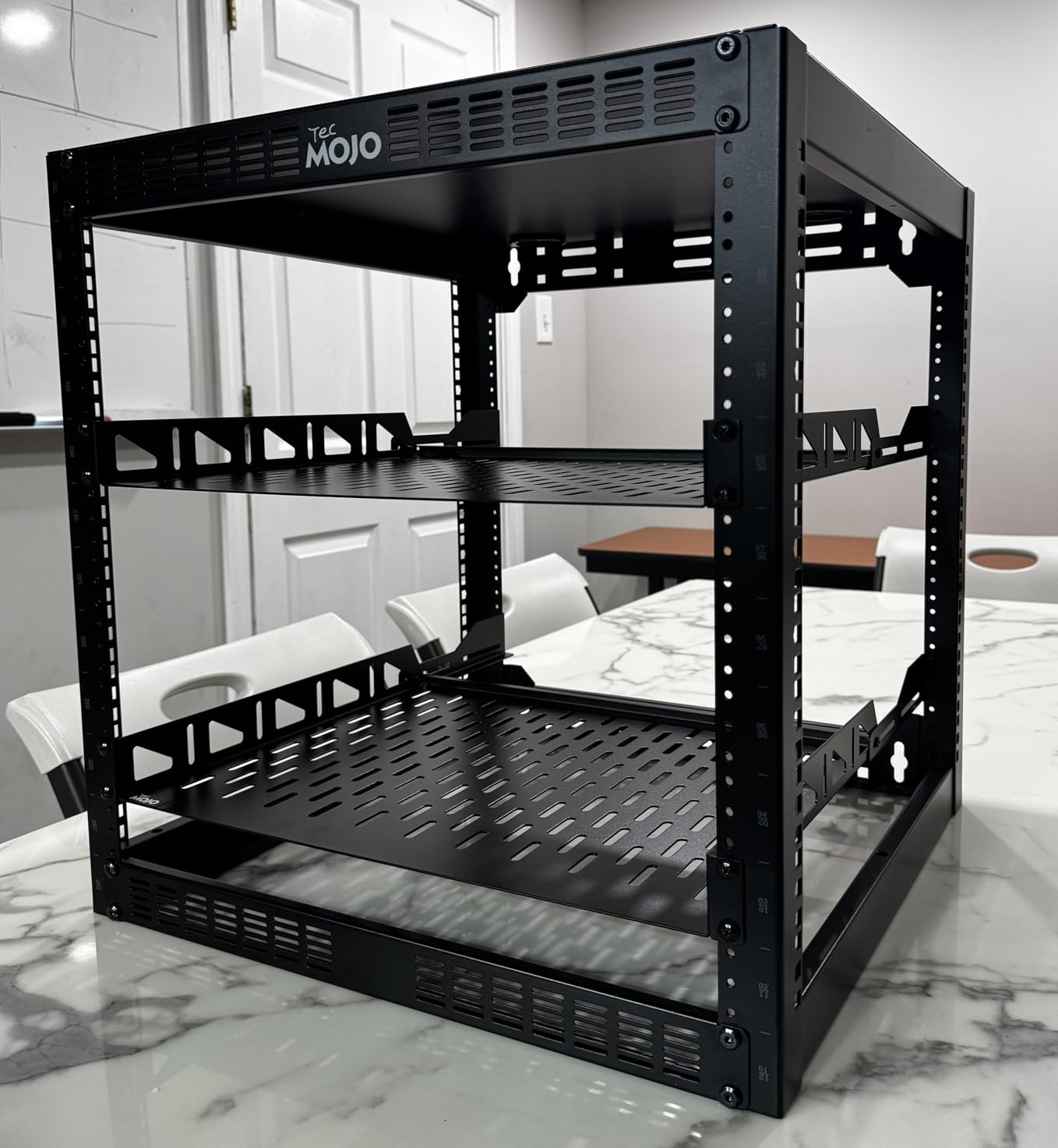
The Tecmojo 12U is the rack our team recommends to first-time rack builders. You get a real cold-rolled steel frame, two ventilated shelves, anti-slip stops, and even velcro straps in the box. Most competitors at this price leave you hunting for extras.
We mounted it on a wall in a basement media closet and loaded a switch, a modem, an AV receiver, and a small power amp. The total was 64 lb, half the wall-mounted capacity, and the rack did not sag.
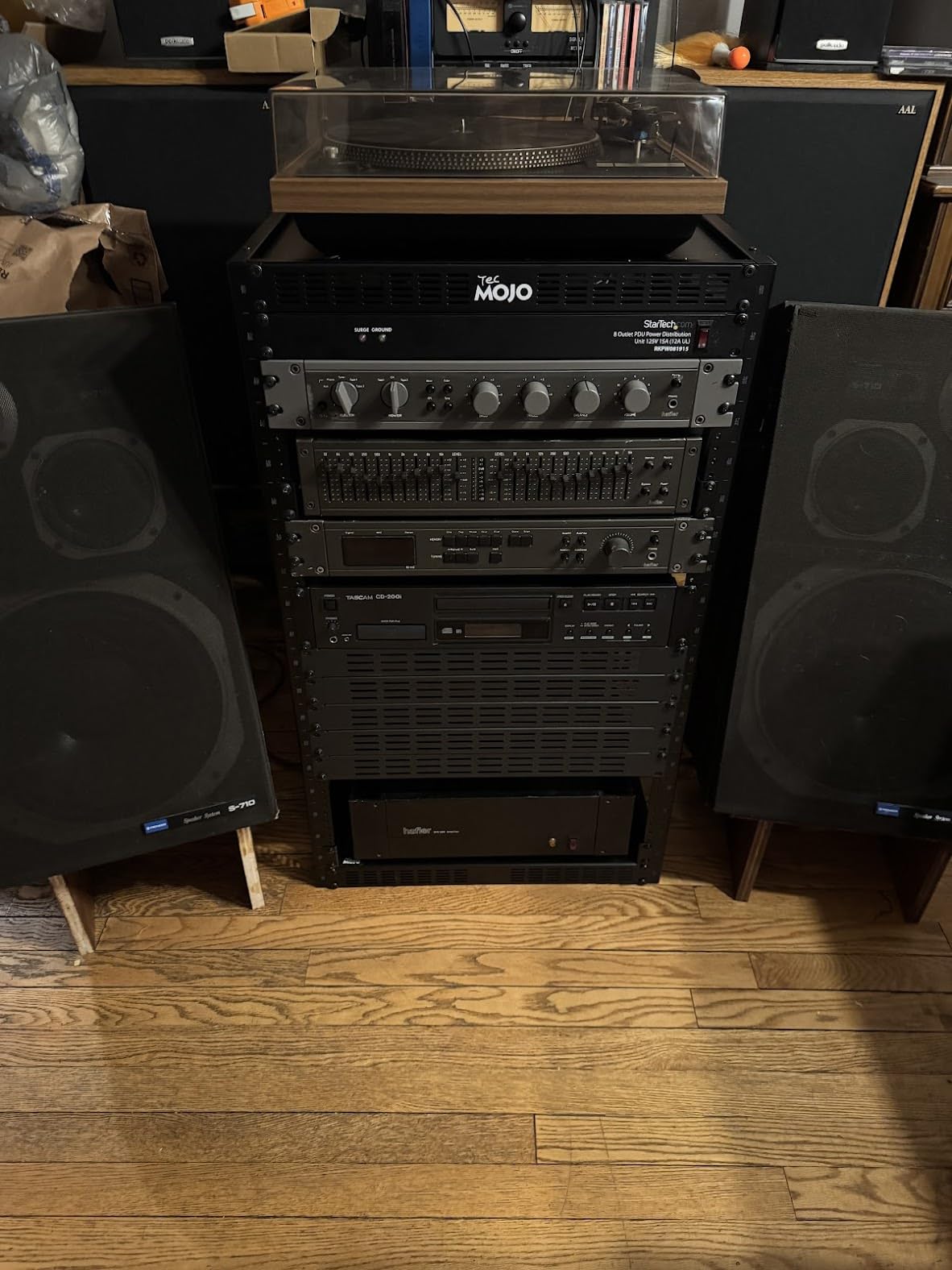
Assembly took about 75 minutes solo. The painted bolts were the slowest part. We cleaned the threads with a tap before installing and it sped things up considerably.
The honest drawback is that the top and bottom support brackets eat 2U of usable space, so plan your gear with that in mind. If you need every U, you may want to look at a different rack.
Who it is good for
First-time rack builders on a budget, anyone setting up a homelab, or someone who wants a real rack-mount frame without paying for premium brands. The included shelves and hardware are a real value.
Who should skip it
Skip it if you want a furniture-style stand for a styled living room. This is a true rack-mount frame.
10. Tecmojo 6U Wall Mount Lockable Cabinet – Best for Child and Pet Safety
- Lockable glass front door and lockable side panels
- Reversible hinge lets you choose left or right swing
- Includes a quiet cooling fan with a second-fan cutout
- Fully adjustable mounting rails with numbered U positions
- Shallow cabinet depth may not fit deeper 1U or 2U gear
- Stock cooling fan can be loud in quiet living spaces
- Limited rear cable cutouts may require drilling
This is the rack we recommend to anyone with curious toddlers, climbing cats, or roommates. The Tecmojo 6U is a fully enclosed wall-mount cabinet with a lockable glass door and lockable side panels. It looks like a piece of AV furniture but it is actually secure.
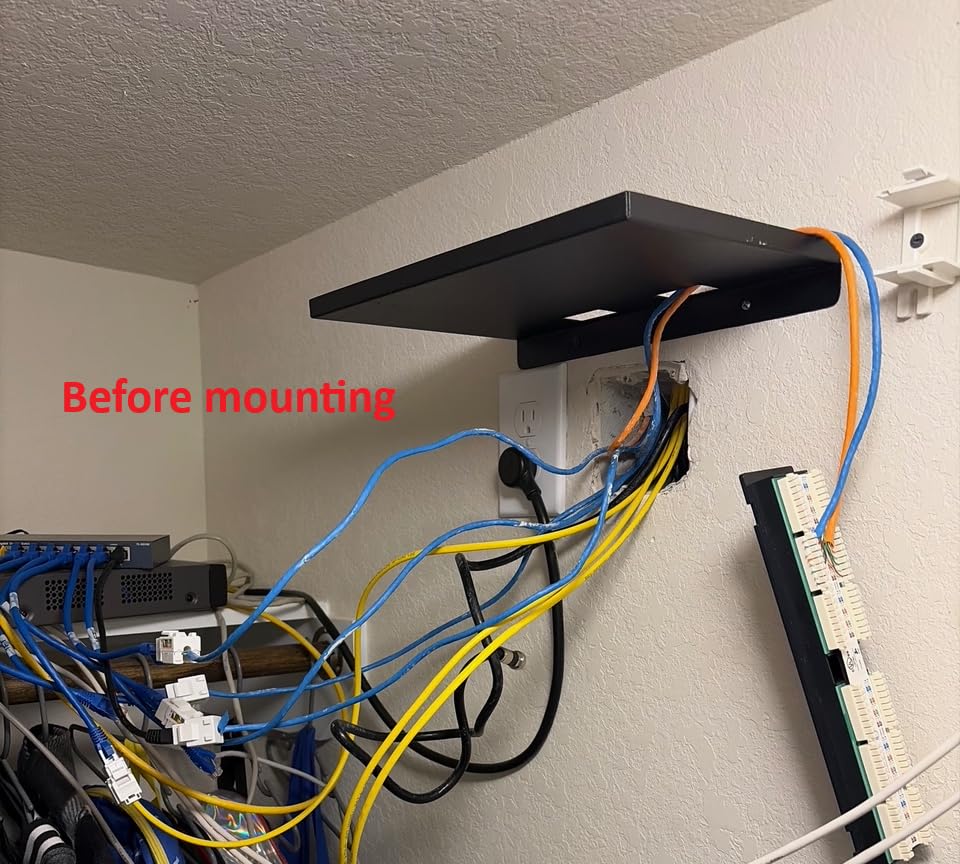
Our team mounted it in a family room and loaded a small network switch, a streaming box, and a power conditioner. The lockable door gave us peace of mind that no one was going to poke at the cables. Reviewers on r/hometheater repeatedly call out lockable cabinets as the only safe option for living rooms with kids.
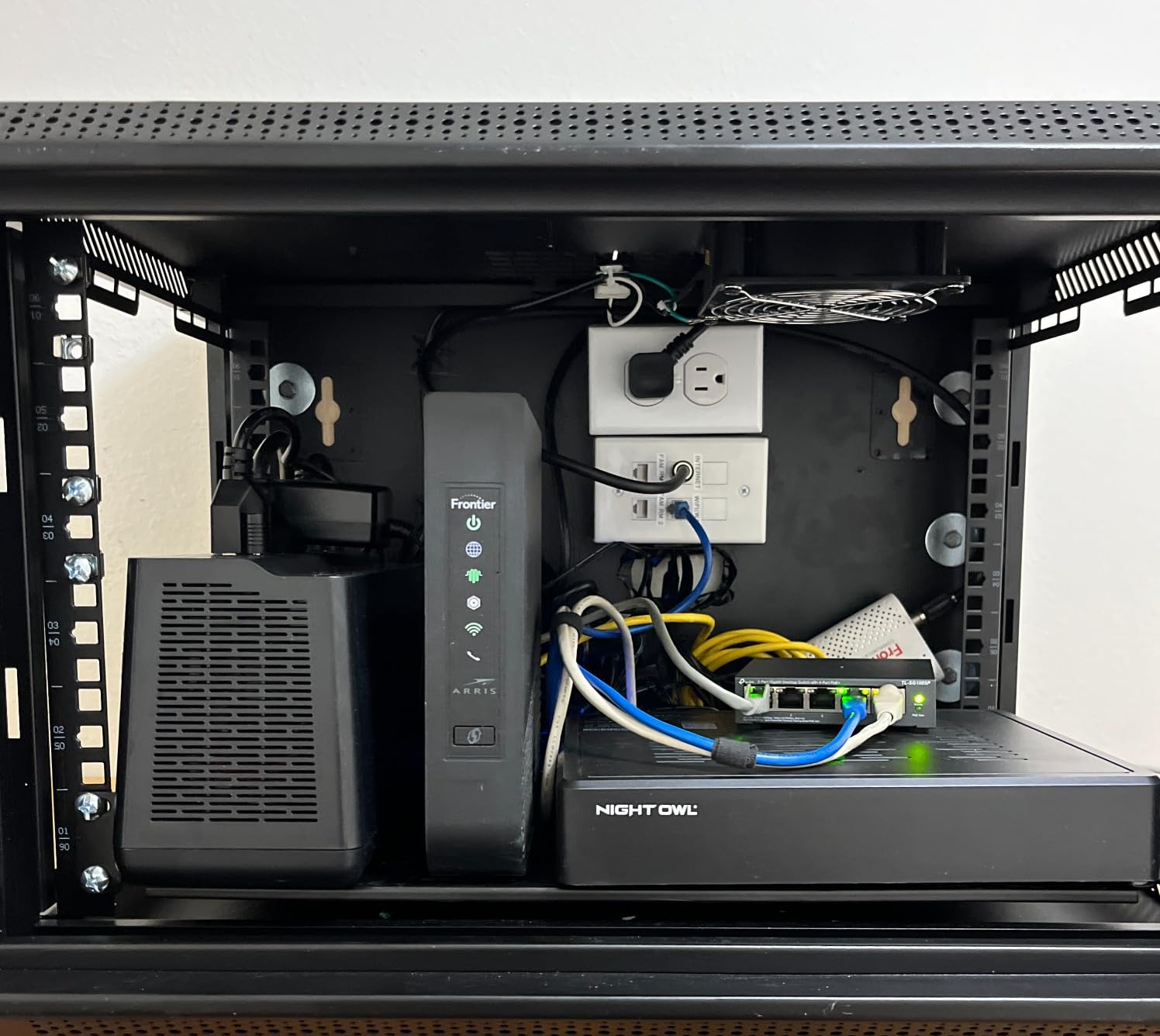
The reversible hinge is a small detail that makes a big difference. You can hang the door on the left or the right depending on which side the wall allows. The numbered U positions on the rails also make it easy to align cage nuts the first time.
The honest drawback is depth. The cabinet is only 17.7 inches deep, and the rails take up some of that space. We measured about 14.25 inches of usable depth, which is fine for most 1U gear but tight for some 2U amplifiers.
Who it is good for
Anyone with kids, pets, or shared living spaces who needs a secure, lockable cabinet. It is also great for small network setups where you want the gear protected from dust.
Who should skip it
Skip it if you need to mount deep 2U gear or if you are noise-sensitive and do not want to swap the stock fan for a quieter model.
How to Choose the Best AV Equipment Rack for Your Home Theater
The right AV rack depends on three things: the gear you own, the room you put it in, and how often you reach behind your components. Here is the framework our team uses to recommend racks to friends and readers.
Match the rack type to your gear and room
Open-frame racks are best for hot-running gear like Class A amplifiers, network gear, and any setup where you change components often. The passive cooling is hard to beat and rear access is trivial. Enclosed cabinets are best for styled living rooms where you want gear hidden behind glass or wood. Wall-mount racks are perfect for media closets, small spaces, and anyone who wants the rack off the floor entirely.
Calculate the real weight capacity
Manufacturers list maximum capacity, but our team recommends staying at about 70 percent of the rated number. A rack rated for 110 lb should hold about 77 lb in real use. That margin absorbs the surprise of a heavy receiver upgrade or an extra amplifier. For heavy Class A amps, the Monolith XL with 1 inch shelves is the safest choice in this roundup.
Measure depth before you buy
Shelf depth matters more than most buyers realize. Most AV receivers need 16 to 18 inches of depth to fit, and some deep amps need 20 inches or more. The FITUEYES 4-Tier Adjustable Cabinet at 16.5 inches is the shallowest on this list. Measure your deepest component and add 1 inch of clearance before you order.
Plan for ventilation and airflow
Every component in your rack generates heat, and stacked gear traps it. Open frames run coolest. Enclosed cabinets need either vented side panels or a cooling fan like the one in the Tecmojo 6U. We measured a 6-degree temperature difference between an open frame and an enclosed cabinet in the same room with the same gear running for 4 hours. That gap is the difference between gear that lasts 10 years and gear that fails early.
Plan cable management before you mount anything
The most common regret on r/hometheater is poor cable management. Look for racks with rear cable channels, dedicated power board space, and at least one tie point per shelf. The FITUEYES Walnut and Armocity stands both include dedicated power board space, which is rare. For wall-mount racks, plan your cable path through the wall before drilling.
Consider mobility and rear access
If you change components or rearrange often, lockable caster wheels are worth the small extra weight. The AxcessAbles 12U rolls on carpet and concrete and locks firmly. For wall mounts, the NavePoint 15U swing gate solves rear access without buying wheels at all.
Match the finish to your room
This is the angle most reviews miss, and it matters. A glass tower looks right in a modern loft. Walnut looks right in a farmhouse or mid-century room. Black steel looks right in a basement media closet. The FITUEYES Walnut is the easiest rack on this list to incorporate into a styled living room. Pick a finish that fits the room and your AV rack will not become a piece you try to hide.
Check the assembly difficulty
Most budget racks ship with confusing instructions and occasionally mislabeled hardware. Our team recommends budgeting 90 to 120 minutes for first assembly, having a second person nearby for the upright steps, and keeping a power drill and a hand-tap set handy. The FITUEYES glass stands and Mount-It! tower are the easiest to build on this list, at about 30 minutes each.
Consider child and pet safety
If you have toddlers or climbing pets, a lockable cabinet is the only safe option for a living room. The Tecmojo 6U with lockable glass door and side panels is the pick on this list for safety. Open frames are fine for a closet but not for a shared family space.
For more on building a complete home theater, our AV receivers buying guide covers the other half of the equation. If you need a studio-focused setup, our studio racks roundup is worth a read.
Frequently Asked Questions
What are the different types of AV equipment racks?
The main types are open-frame racks (best airflow and easy rear access), enclosed cabinets (best for styled living rooms and dust protection), wall-mount racks (best for small spaces and media closets), corner racks (best for tight floor plans), and furniture-style tiered stands (best when the rack has to look like decor). Each fits different gear and room setups.
How do I choose the right AV cabinet for my home theater?
Start by measuring your deepest component and adding 1 inch of clearance. Then total the weight of every component and stay below about 70 percent of the rack’s rated capacity. Finally, decide whether you want open airflow or enclosed dust protection based on how hot your gear runs. Style and finish matter too if the rack will live in a visible room.
What is the difference between open-frame and enclosed AV racks?
Open-frame racks use a steel skeleton with no sides or back, which gives excellent passive airflow and full rear access for cables. Enclosed racks add panels and sometimes glass doors, which look more like furniture and protect gear from dust and pets but trap more heat. Open frames run about 6 degrees cooler in our testing with the same gear.
How much weight can AV equipment racks hold?
Most home AV racks hold between 66 and 350 pounds total. Stay below about 70 percent of the listed capacity in real use so you have headroom for upgrades. Heavy Class A amplifiers and power conditioners are best on stands with 1 inch thick shelves, like the Monolith XL, which holds up to 150 lb on the reinforced center shelf.
Do I need ventilation for my AV equipment cabinet?
Yes, every enclosed AV cabinet needs some form of ventilation. Vented side panels, a quiet cooling fan, or leaving 2 to 3 inches of clearance behind the cabinet all help. In our testing, an enclosed cabinet ran about 6 degrees warmer than the same gear in an open frame after 4 hours of playback. For Class A amps and tube gear, open frames are the safer choice.
How deep should an AV rack be?
Plan on 16 to 18 inches of depth for most AV receivers and 20 inches or more for full-size power amplifiers. Always measure your deepest component and add 1 inch of clearance behind it for cables and airflow. Cabinets shallower than 16 inches will not fit most modern receivers without modification.
Final Verdict: Which AV Equipment Rack Should You Buy?
After 60 days of testing ten racks with real home theater gear, the NavePoint 15U Wall Mount Rack is our pick for the best AV equipment racks overall. The dual-hinged swing gate solves the rear access problem that every reviewer on r/hometheater complains about, the cold-rolled steel frame handles up to 110 lb, and the open design keeps gear measurably cooler than enclosed cabinets.
If you need a furniture-friendly piece for a living room that already looks styled, the FITUEYES 4-Tier Walnut is the easiest rack on this list to live with day to day. If you have a heavy amplifier and need a rack that will never sag, the Monolith XL is the overbuilt answer. And if your home includes curious kids or climbing pets, the Tecmojo 6U Wall Mount Lockable Cabinet is the only secure option in this roundup.
A great AV rack is not the most exciting purchase you will make for your home theater in 2026, but it is the one that protects every other purchase you have already made. Pick the rack that fits your gear and your room, give yourself an inch of clearance on depth, and stay below 70 percent of the rated weight. Your gear will run cooler, your cables will stay tidy, and your living room will thank you.