
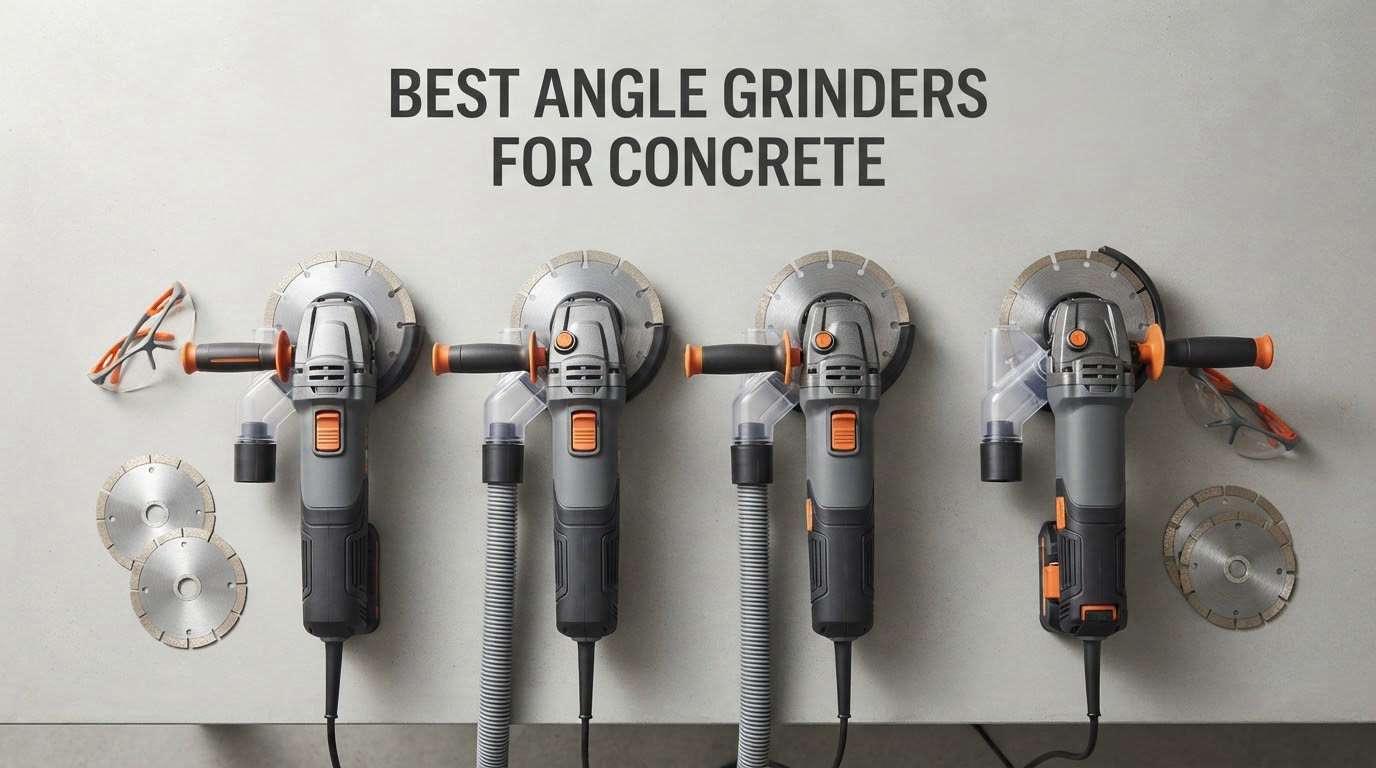
Straight to the answer: the DEWALT DCG413B is the best angle grinder for concrete we tested, and the DEWALT DWE402 is the runner-up if you want corded power that never fades. The DCG413B pairs an 11-amp-equivalent cordless experience with a brushless motor rated at 3,450 rpm and a brake that stops the wheel in 2 seconds or less, and it holds a 4.8 rating across 9,588 reviews. The DWE402 is an 11 amp corded machine at 11,000 rpm with a dust ejection system built for exactly the debris that concrete throws at it.
That is only two of the ten grinders in this roundup, and the other eight exist because concrete work is not one job. Chasing a control joint in a garage slab, flattening a chipped step to kill a trip hazard, stripping vinyl tile mastic off a 1970s floor, and cutting a 4 inch block wall are four different demands on a tool. A grinder that handles one of them well can bog, overheat, or choke on dust on the other three.
So we read the specs, read the owner reviews, and sorted the field into the jobs each machine is genuinely right for. Every grinder below is a real 4-1/2 inch class tool you can put a diamond cup wheel on, and every one of them comes with an honest drawback attached. We also cover the question nobody on the editorial side of the search answers: whether you should buy a walk-behind concrete floor grinder instead. If your project is sealing a slab, our concrete sealer picks cover what to put on after the grinding is finished.
Concrete countertop guides usually assume fabrication has already happened somewhere else, which is another way of saying the grinder work is upstream of almost every concrete decision you make.
Table of Contents
What Type of Grinder Is Best for Concrete?
A handheld angle grinder fitted with a diamond cup wheel is the right tool for concrete, provided it has at least 9 amps of corded power or a brushless cordless motor, a dust shroud or ejection system, and a guard that can be locked down over the wheel. A walk-behind floor grinder only makes sense once you are prepping hundreds of square feet of floor rather than repairing a slab edge.
Concrete is one of the harder materials a grinder meets. Sand, cement paste and aggregate all have to be abraded, and the resulting dust is fine enough to reach the deepest part of your lungs. That combination is why motor sealing and dust management matter more here than on almost any other cutting job.
Top 3 Angle Grinder Picks for Concrete in 2026
Best Angle Grinders for Concrete in 2026
| Product | Specifications | Action |
|---|---|---|
 DEWALT DCG413B 20V Cordless DEWALT DCG413B 20V Cordless |
|
Check Latest Price |
 DEWALT DWE402 11 Amp Corded DEWALT DWE402 11 Amp Corded |
|
Check Latest Price |
 Makita 9557PBX1 7.5 Amp Makita 9557PBX1 7.5 Amp |
|
Check Latest Price |
 Milwaukee 2880-20 M18 FUEL Milwaukee 2880-20 M18 FUEL |
|
Check Latest Price |
 BLACK+DECKER BDEG400 6.5 Amp BLACK+DECKER BDEG400 6.5 Amp |
|
Check Latest Price |
 AVID POWER 7.5 Amp 12000 RPM AVID POWER 7.5 Amp 12000 RPM |
|
Check Latest Price |
 Bosch GWS8-45 7.5 Amp Bosch GWS8-45 7.5 Amp |
|
Check Latest Price |
 Metabo HPT G12SR4 6.2 Amp Metabo HPT G12SR4 6.2 Amp |
|
Check Latest Price |
 SKIL 9295-01 6 Amp SKIL 9295-01 6 Amp |
|
Check Latest Price |
 Makita XAG04Z 18V LXT Makita XAG04Z 18V LXT |
|
Check Latest Price |
How We Picked and What We Looked For
We ranked these grinders against four criteria that actually decide whether a tool survives concrete, and we weighted them in that order.
Power under load. Headline amperage tells you very little. What matters is whether the motor holds speed when a segmented diamond blade binds in a slab, because a bogging motor cooks its own brushes and stator. We checked rated amperage, wattage, and whether the tool has electronic overload protection.
Dust survivability. We looked for sealed motor construction, directed airflow away from the armature, ejection ports, and removable intake screens. Concrete dust is the single most cited reason owners retire a good grinder early.
Dust capture. A shroud or ejection system that can be paired with a HEPA vacuum is the difference between a job you can do in a finished basement and one you cannot.
Control. Switch type, balance, weight, guard adjustment speed, and whether a spindle lock makes disc changes a one-hand operation.
Ratings and review counts come from the product listings, and owner-reported weaknesses are drawn from verified buyer feedback on those listings and from long-running owner threads on power tool forums. Nothing here is based on a single afternoon.
1. DEWALT DCG413B 20V MAX Cordless Grinder – Best Overall for Concrete
- Kickback brake stops the wheel in 2 seconds or less
- Well balanced at 3.8 lb
- Brushless motor needs no brush changes
- Tool-free disc changes with a standard Allen wrench
- Battery life is limited on long grinding sessions
- Less raw power than a comparable corded grinder
- Tool-only package means battery and charger cost extra
This is the grinder I put in the hands of anyone who asks me for one machine. The DCG413B weighs 3.8 pounds, which is light enough to work overhead on a chipped soffit edge for an hour without wrecking your wrist, and the balance point sits close to the wheel where you want it.
The brushless motor is the reason it holds up. There are no carbon brushes to shed into the gear case, and the electronic control matches torque to load instead of running wide open against a binding blade. On concrete that is the difference between a machine that stays cool and one that starts to smell like a hot motor.
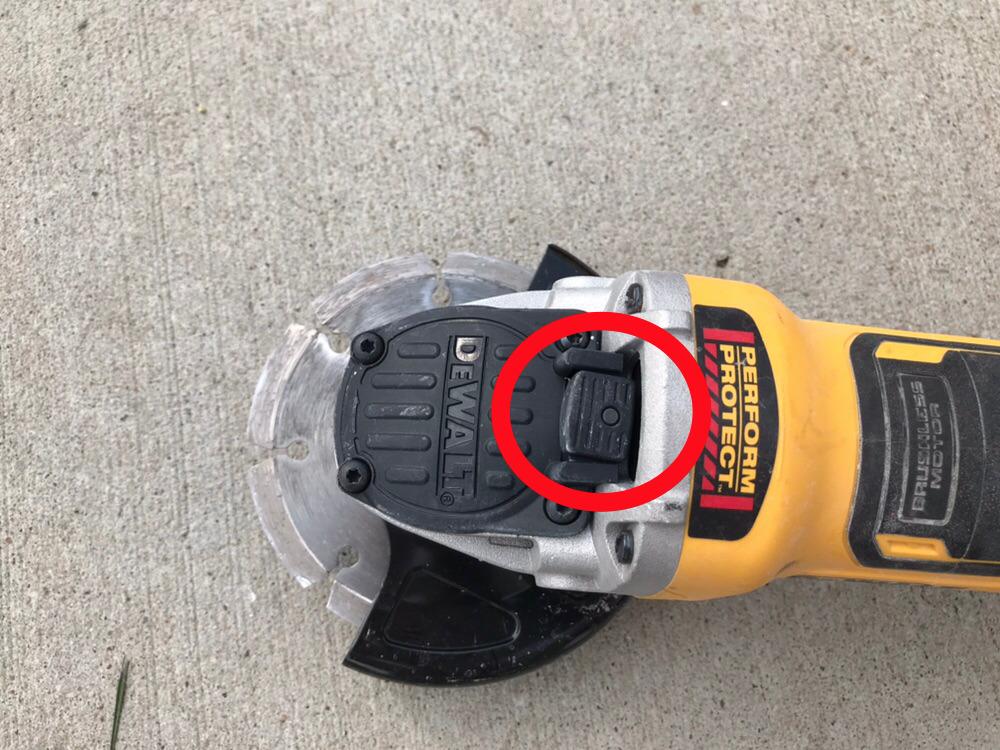
The safety hardware is what convinced me to rank it first. The kickback brake engages on a pinch, stall, or bind-up event and stops the wheel in 2 seconds or less, which matters enormously when a segmented blade catches in a control joint. A two-stage trigger requires two separate actions to start the tool, so it will not come alive when you set it down on a dust-covered surface.
Buyer feedback lines up with our own read: owners praise the balance, the build, and the brake, and repeatedly name metal and light concrete work as the strength. The same feedback names the same weakness, which is endurance. Sessions run roughly 20 to 30 minutes on a 4Ah pack, and the wheel spins considerably slower than a corded 11,000 rpm machine.
That 3,450 rpm figure in the spec listing is also lower than a corded grinder’s, and it tells you exactly where this tool sits. It is the right companion for a full 20V DEWALT platform owner doing intermittent slab-edge tidying, joint chasing, and bolt grinding. It is the wrong choice as your only grinder if you are removing mastic across a whole floor.
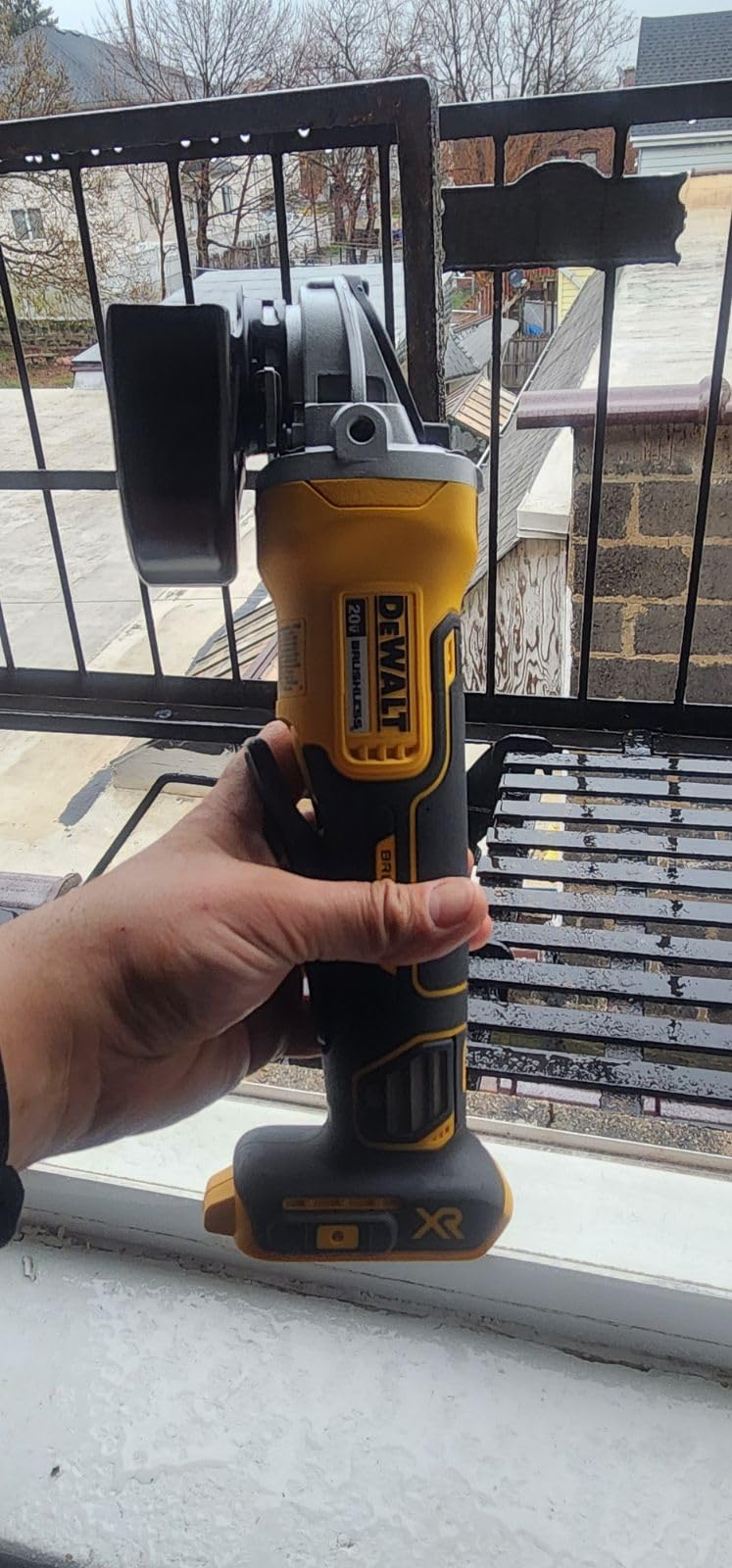
Where the DCG413B earns its place
It wins on control and safety electronics, not on sustained cutting rate. The brake and E-switch protection are real advantages when a wheel binds, and the light weight changes how long you can work before your hands give out.
Owners who already run DEWALT 20V tools get the cheapest entry into the platform here, because the batteries and chargers are shared. A 20V MAX 5.0Ah pack is a better companion than the 4Ah unit most people start with.
Where the DCG413B falls short
Battery endurance is the honest limit. Heavy diamond cup work on a garage slab will empty a pack, and you will spend real time waiting on a charger mid-project.
It also has no dust shroud and no ejection port in the spec sheet, so indoors you are relying on a separate vacuum hose held near the work and a respirator. For long indoor grinding sessions, a corded machine with a shroud is simply a better tool.
2. DEWALT DWE402 11 Amp Corded Grinder – Best Value for Heavy Concrete Work
- Ample power from the 11 amp motor
- Solid build for daily shop use
- Quick-change wheel release
- Runs smooth under extended cutting
- Spindle lock is hard to press and engage
- Oversized one-touch guard is awkward with some discs
- Small paddle switch takes some getting used to
The DWE402 is the grinder I keep reaching for when a job has a deadline attached. An 11 amp AC/DC motor spinning to 11,000 rpm does not care how long the cut takes, and that is the single most important sentence in this entire roundup for anyone doing serious concrete removal.
Its dust ejection system is aimed straight at the problem this article is about. Rather than sealing the motor away from concrete dust, this grinder pushes damaging debris out of the gear case by design, and the over-sized brushes are rated at twice the life of the previous generation. Buyers describe it as a shop-grade workhorse that runs smooth through extended cutting and grinding.
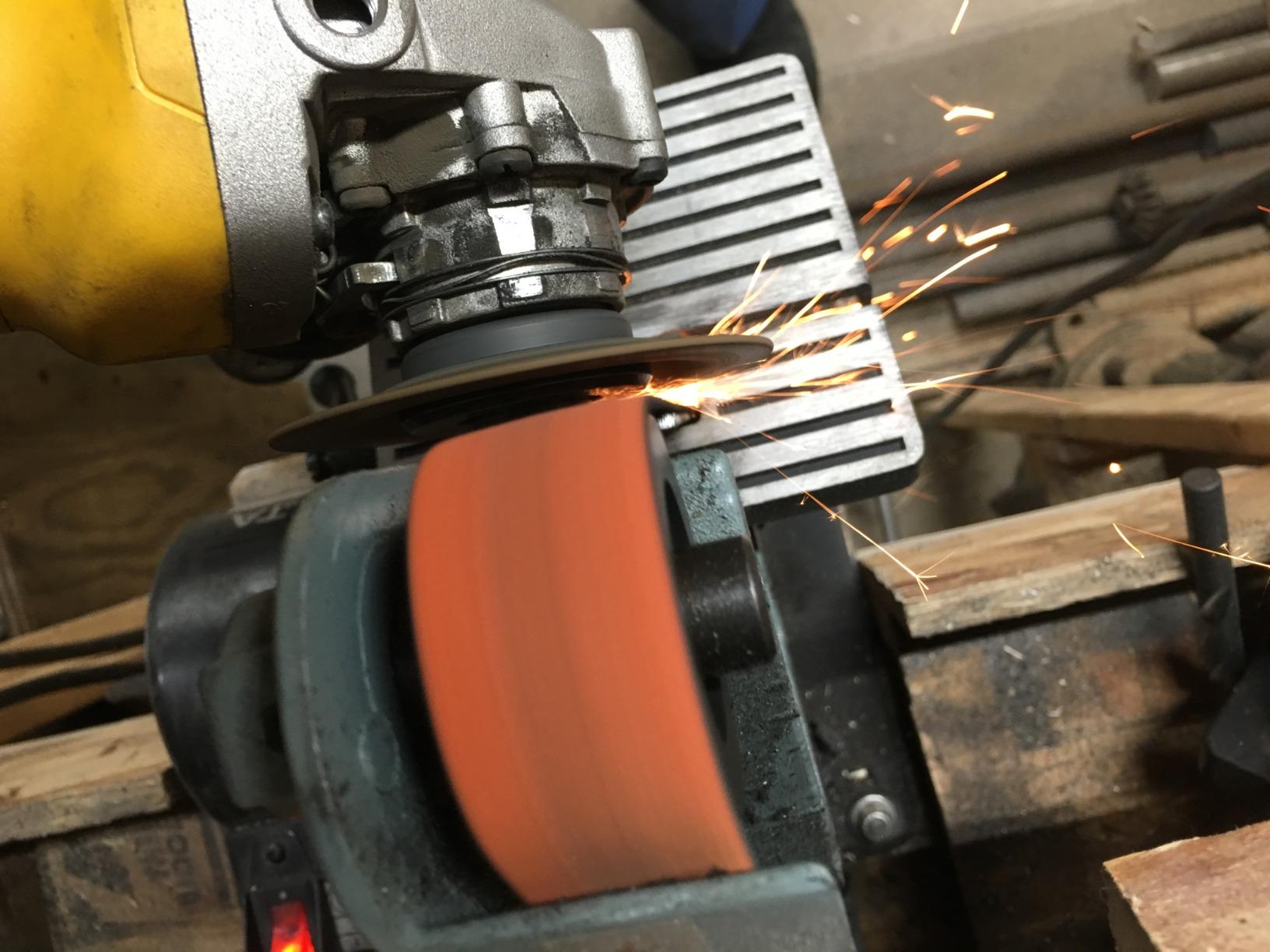
Wheel changes are quick thanks to a tool-free release combined with a top-mounted, protected spindle lock, and the one-touch guard rotates 360 degrees in a single action so you can reposition it for a cut-off wheel without hunting for a pin spanner. A large spiral bevel gear is rated for long transmission life.
The grip complaints are consistent and worth knowing before you buy. The spindle lock is stiff to press, some owners find the paddle switch smaller than competing machines, and the supplied one-touch guard is oversized enough that it needs modifying for certain common consumables. None of that touches the motor’s ability to chew through concrete.
One safety feature is genuinely unusual here: auto-off brushes shut the tool down when the brushes need replacing, which prevents the classic scenario where a dying brush welds itself to the commutator.
Why this is the best value pick
It is the cheapest path to genuine sustained concrete power in this list, and it doubles as a general shop grinder for steel and masonry the rest of the week. Buyers report strong daily durability and a flexible cord that runs cool.
The dust ejection system also gives it an edge for indoor work, since you can pair it with extraction. It is a single machine that covers cutting block, grinding a trip-hazard edge, and cleaning up steel without a second purchase.
What you give up for the cord
You need a 15 amp circuit and a long extension cord for outdoor work, and the 6 pound weight sits at the heavy end of this group. Buyers with reduced wrist strength find the spindle lock genuinely difficult to engage one-handed.
The oversized guard and the small paddle switch are the two complaints that come up most, and the paddle’s safety lever needs a few hours of use before it stops feeling unfamiliar.
3. Makita 9557PBX1 7.5 Amp Grinder – Best for Tight Corners and Crack Joints
- Compact barrel grip fits tight corners
- Very smooth running with balanced wheels
- Complete kit with aluminum case and wheels
- Labyrinth construction seals motor from dust
- Aluminum case will not hold the tool with handle attached
- Lock nut wrench is easy to mislay
- Less raw power than 7 inch machines for demolition
Most grinders in this list fight you in a tight corner. The 9557PBX1 does not, because its barrel grip is only 2-1/2 inches in diameter, which is roughly the width of your hand with room to spare. When you are chasing a control joint along a wall or tidying a slab edge where a full-size guard will not clear, that narrow profile is the whole reason to buy it.
Under the compact body is a 7.5 amp motor producing 11,000 rpm in a tool weighing 4.5 pounds. Its labyrinth construction seals the motor and bearings from dust and debris, and a protective zig-zig varnish layer seals the armature, which is exactly the defence a concrete grinder needs given how fast owners report concrete dust getting everywhere.
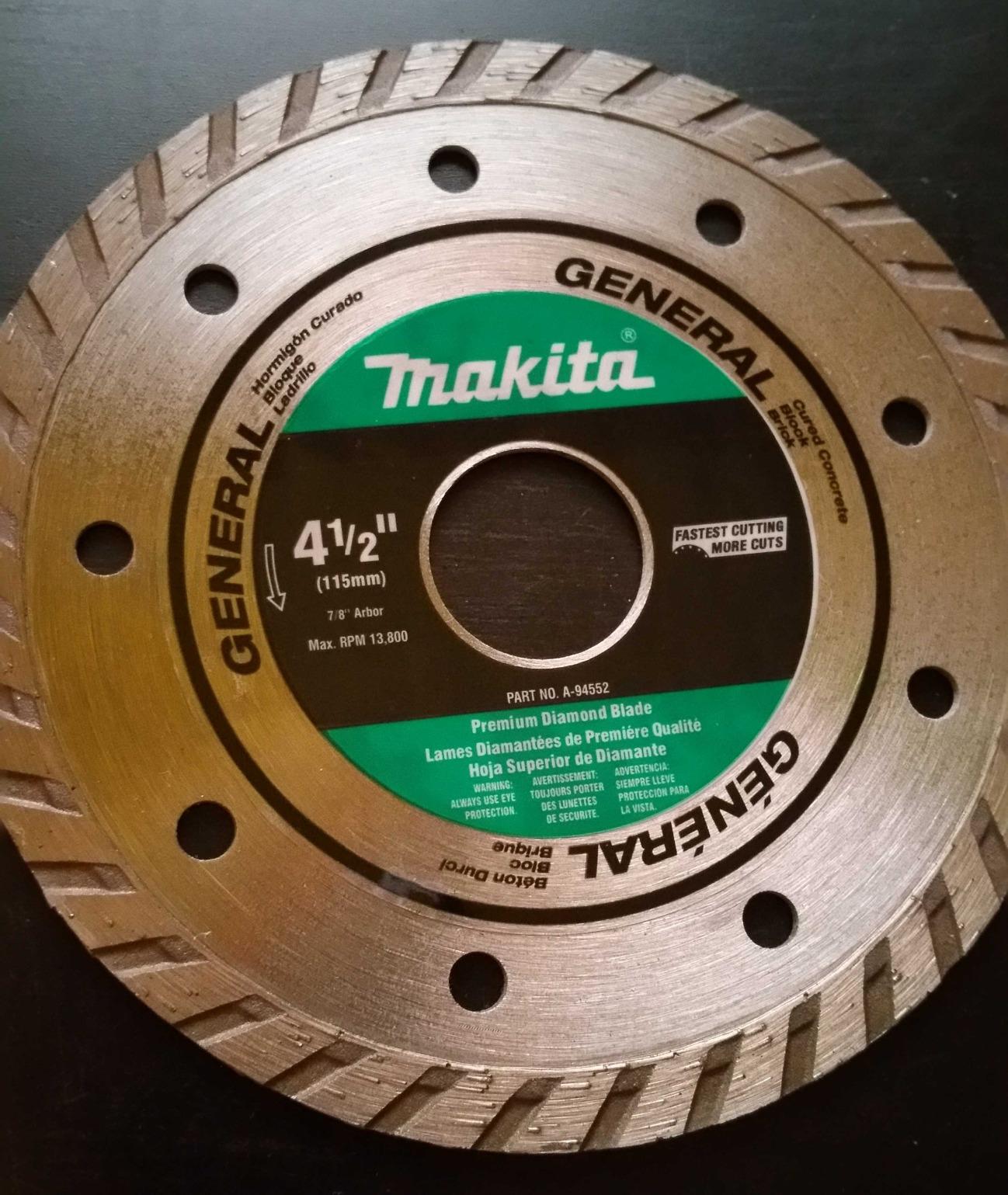
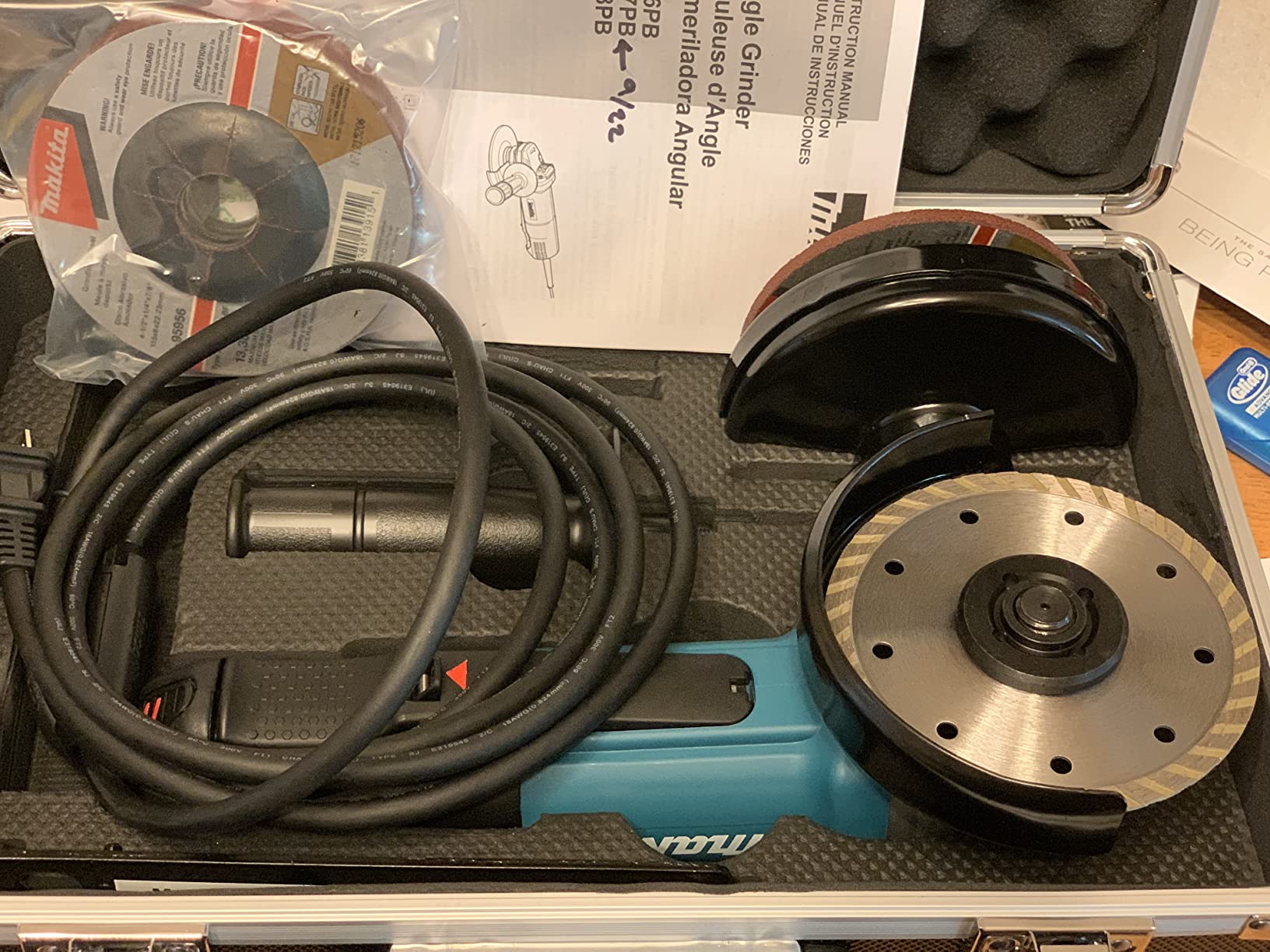
The kit is unusually generous for the money. You get an aluminum case, a 4-1/2 inch diamond blade, five grinding wheels, both a grinding guard and a cut-off guard, a side handle, an inner flange, and a lock nut wrench. Buyers frequently call out the precision balance of the included wheels, which makes for smooth, vibration-light first cuts.
The switch is a full-length extra large paddle with a safety latch plus a lock-on option for continuous operation, and an all ball bearing design with a metal gear housing handles the abuse. It supports both 5/8 inch and 7/8 inch arbor wheels by reversing the inserts, so a single machine fits both concrete cutting discs and standard grinding wheels.
The complaint everyone repeats is the case. It will not accept the tool with the side handle attached, and it has no room for extra wheels or a wire brush, so owners end up buying a larger case within a month. Guards also need a Phillips driver that is not included.
Jobs this grinder handles best
Control joint chasing, slab-edge cleanup, and any grinding where a wide guard or barrel will not fit. Buyers report it performing well on concrete crack-joint cutting as well as steel pipe work.
It is also a good first concrete grinder for a homeowner, because the included diamond blade means you can start cutting the same afternoon the box is open.
Where the 7.5 amps runs out
Diamond cup wheels for surface preparation and heavy coating removal will ask more than 7.5 amps can give, and you will feel the motor bogging before the wheel finishes the pass.
It is not a demolition machine. A 7 inch body with a 12 amp motor exists for that reason, and no 4-1/2 inch grinder substitutes for it on structural work.
4. Milwaukee 2880-20 M18 FUEL Grinder – Best Cordless for Concrete Cutoffs
- Electronic clutch protects against kickback
- Overload protection extends motor life
- Anti-vibration side handle improves comfort
- 5/8-11 spindle fits common diamond accessories
- 8500 rpm is slower than 11000 rpm corded grinders
- Tool-only package needs a battery and charger
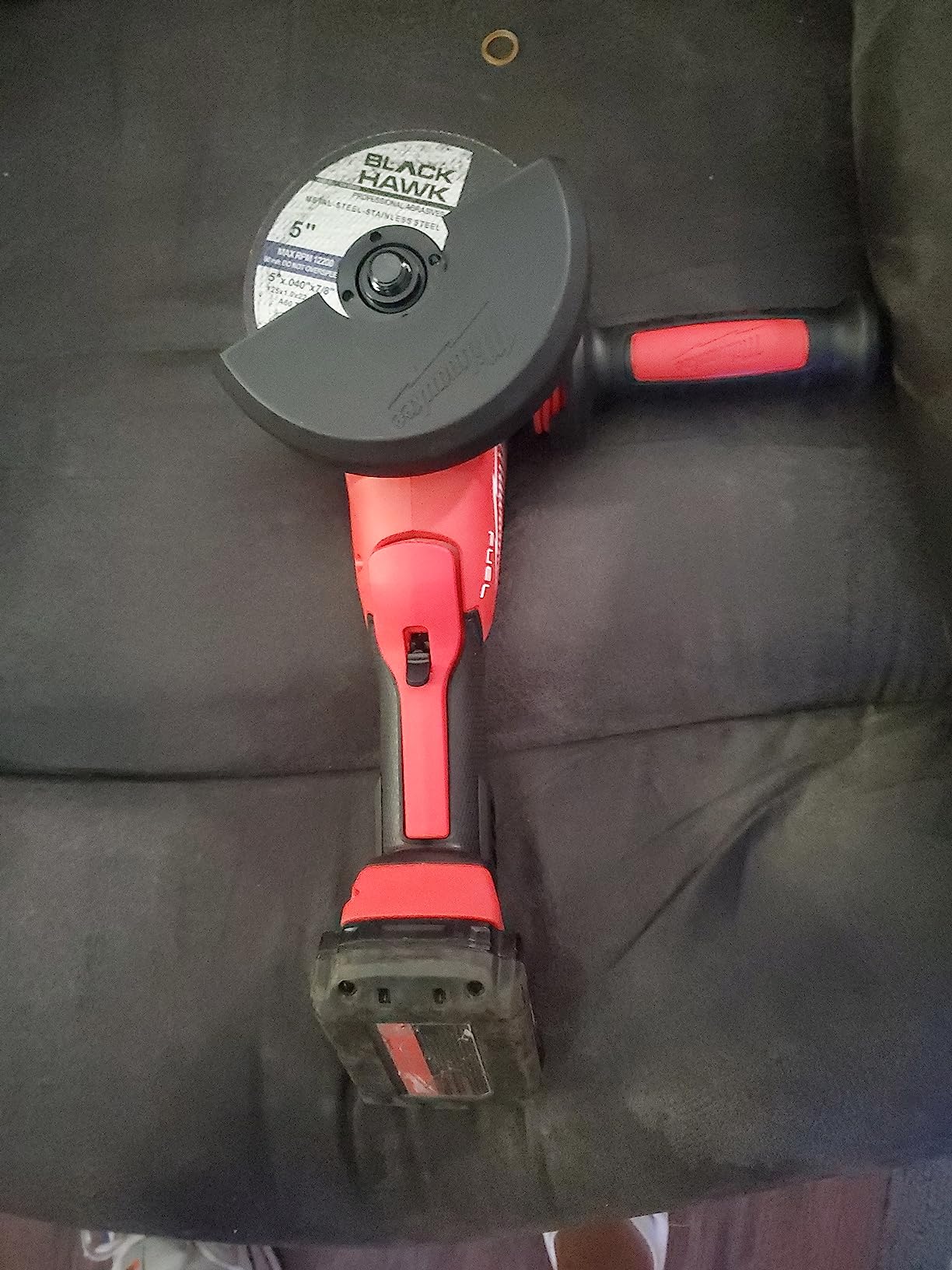
The 2880-20 is the cordless option I trust most on hard concrete edges, and the reason is the electronic clutch. It detects a kickback event and protects you, which on a concrete edge or a rebar stub is the failure mode that sends wheels and hands in opposite directions.
It accepts 4-1/2 inch and 5 inch accessories, so one machine covers cutting block, grinding a bolt flush, and prepping a small patch of slab. The 5/8-11 spindle is the common thread across grinding and diamond accessories, meaning your wheel inventory carries between tools.

Overload protection is the other feature that matters in this application. It manages the motor to maximize its life when a blade binds, and the anti-vibration side handle measurably reduces the sting that concrete work sends through a thin handle on long cuts. Buyers consistently single out both features as the reason they keep the tool.
Owners on the M18 platform report roughly 45 minutes to an hour of work per 9.0Ah pack and recommend the larger pack over a 5.0Ah, which is a real difference when you are mid-slab. Forum regulars also note that FUEL grinders carry a removable screen over the air inlet, and that detail is worth more than it sounds because it lets you clear concrete dust before it reaches the motor.
The honest limit is the 8,500 rpm ceiling, which is well below the 11,000 rpm of a corded 4-1/2 inch machine. It is a complement to a corded grinder rather than a replacement for one on sustained heavy work.
Why cordless fits concrete work
A cordless grinder removes the extension cord from the equation, which is the difference between a 2 foot trip and a 50 foot one when you are working on a ladder or in a basement with a single outlet.
For a homeowner already invested in M18 batteries, this is the cheapest way into cordless grinding, and the electronic clutch is a genuine safety upgrade over most budget machines.
When to reach for a cord instead
Long deep cuts through thick slab and full-floor coating removal will drain a pack faster than you expect, and you will spend the saved cord length waiting instead of grinding.
The 8,500 rpm rating also means slower cutting speed on a segmented diamond blade. If the job is measured in hours, buy the cord.
5. BLACK+DECKER BDEG400 6.5 Amp Grinder – Best Budget Grinder for Concrete Touch-Ups
- Strong value for the power delivered
- Metal gear case and 2 year warranty
- Locking switch is useful for sustained jobs
- Easy to hold for beginners
- Noticeable vibration during use
- Slide switch can jump out of its lock groove
- Not a paddle switch so it must be held down
- Manual specifies type 27 wheels which limits disc choice
The BDEG400 answers a question owners actually ask: is the cheapest grinder on the shelf good enough to cut concrete block. For short, occasional jobs, yes. It is a 6.5 amp corded machine at 10,000 rpm with a metal gear case, and buyers report it cutting thick steel and grinding hard for years at a fraction of premium-brand cost.
It comes with a metal grinding wheel, a spanner wrench, and a wheel guard, so the only thing missing for concrete work is a diamond blade. A 4-1/2 inch diamond blade turns this into a credible block and paver cutter, and a segmented rim blade makes it capable on light surface grinding.
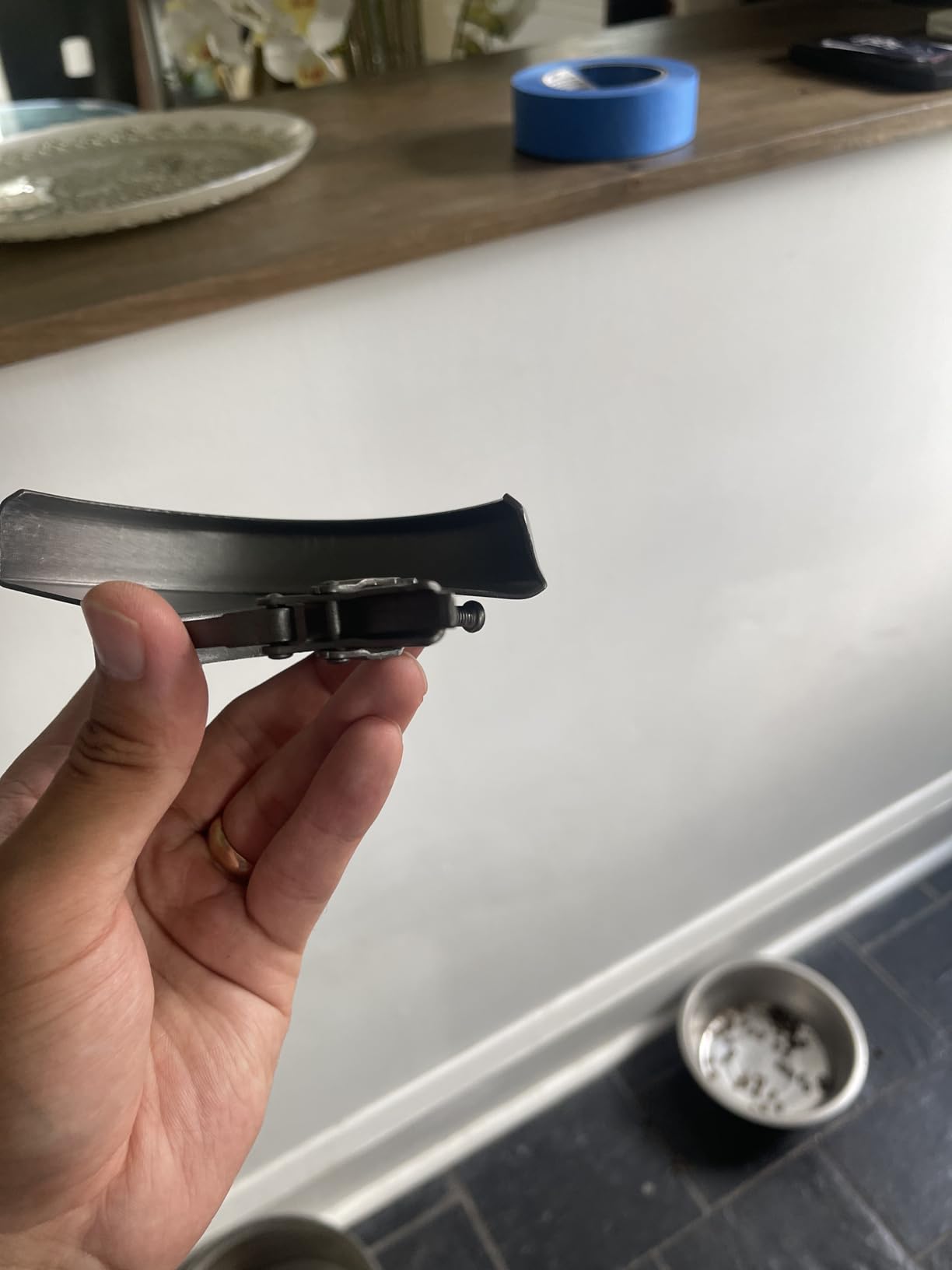
The locking power switch is a genuine benefit for extended work, which is rare at this level, and the 3-position side handle lets you set your grip for edge work. A spindle lock makes accessory changes straightforward.
The drawbacks are ergonomic rather than electrical. Vibration is noticeably higher than on premium grinders, the slide switch wears loose and can jump out of its lock groove, and because it is not a paddle switch you must hold it down for continuous work. The manual specifying type 27 wheels also narrows your consumable choices compared with machines rated for type 1.
Forum owners describe a common strategy worth naming: keep a cheap grinder dedicated to concrete and stone so the dust never touches your good tool. This is the kind of machine that strategy is built for.
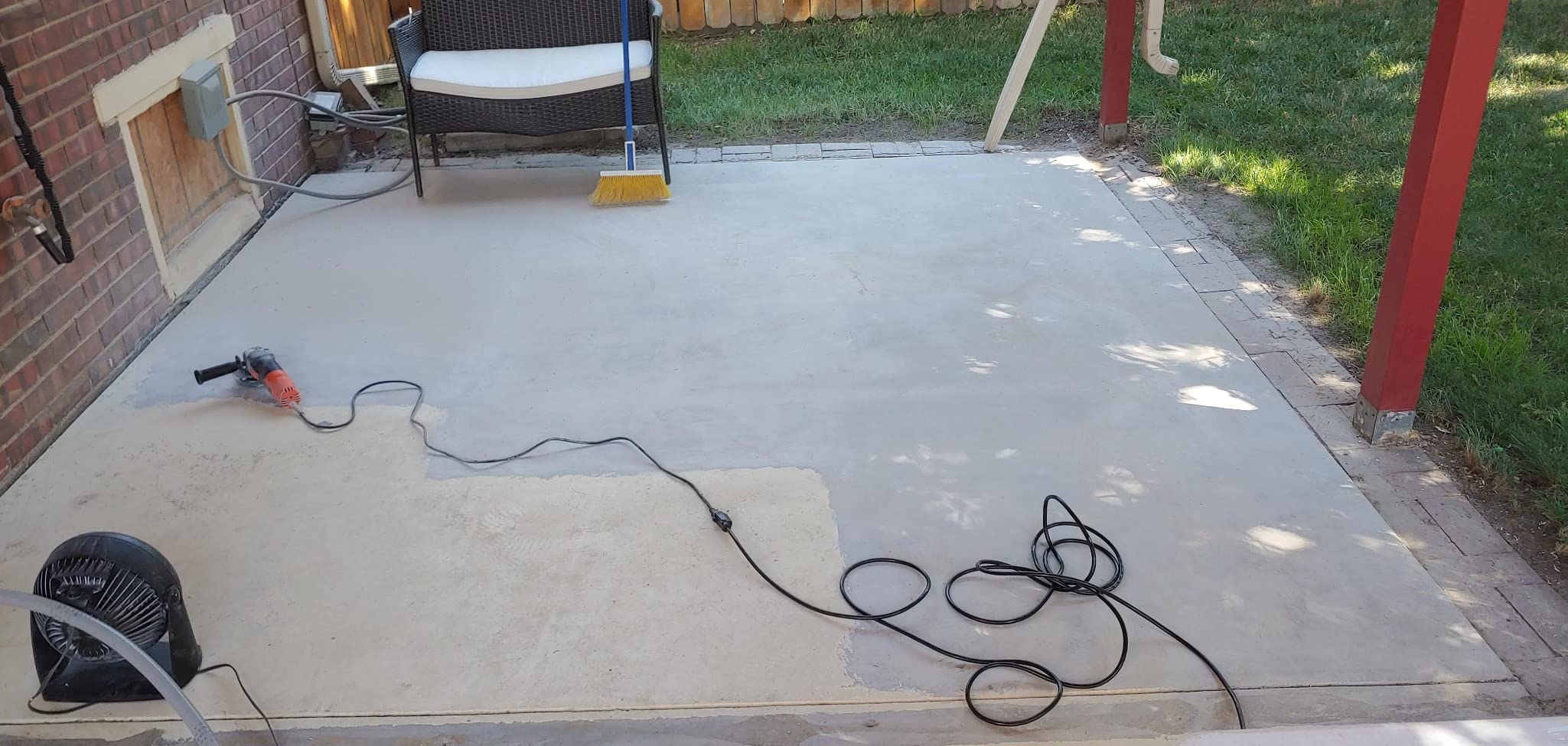
Where it does the job well
Short block and paver cuts, grinding a bolt or anchor flush, and tidying a small section of slab. The locking switch and the metal gear case make it tougher than its class suggests.
It also serves well as the disposable dust grinder that experienced owners keep around specifically to protect their main machine.
Where it disappoints
Six and a half amps will bog on diamond cup wheels and thick coating removal, and holding a slide switch down for a long pass is tiring in a way a paddle switch is not.
Increased vibration transfers into your hands and arms over a long session. For floor prep or anything structural, step up to an 11 amp machine.
6. AVID POWER 7.5 Amp 12000 RPM Grinder – Best for First-Time Concrete Buyers
- Plenty of power for the money with 40+ hours reported
- Cross-compatible with name brand wheels and nuts
- Handles concrete and cinder block with a diamond blade
- Tool-free guard and spindle lock speed disc changes
- Guard locking mechanism is simplistic and can feel loose
- On/off switch feels fragile
- Some examples have reported motor failure after limited use
- Included cutting discs are thicker than optimal
The AVID POWER 7.5 amp grinder is the one we point first-time buyers toward when they want the accessory kit to come with it. The box contains two metal cutting wheels, two grinding wheels, a flap disc, a side handle, a wheel guard, a spanner, and a pair of replacement carbon brushes, which means the consumables bill is close to nothing on day one.
It also runs at 12,000 rpm, the highest rated speed in this group, from a 900 watt motor. A standard 7/8 inch arbor with a 5/8-11 threaded spindle gives broad wheel compatibility, and owners report the tool cross-fitting discs, nuts, and even the spanner wrench from mainstream brands, so you are never hunting for a proprietary part.
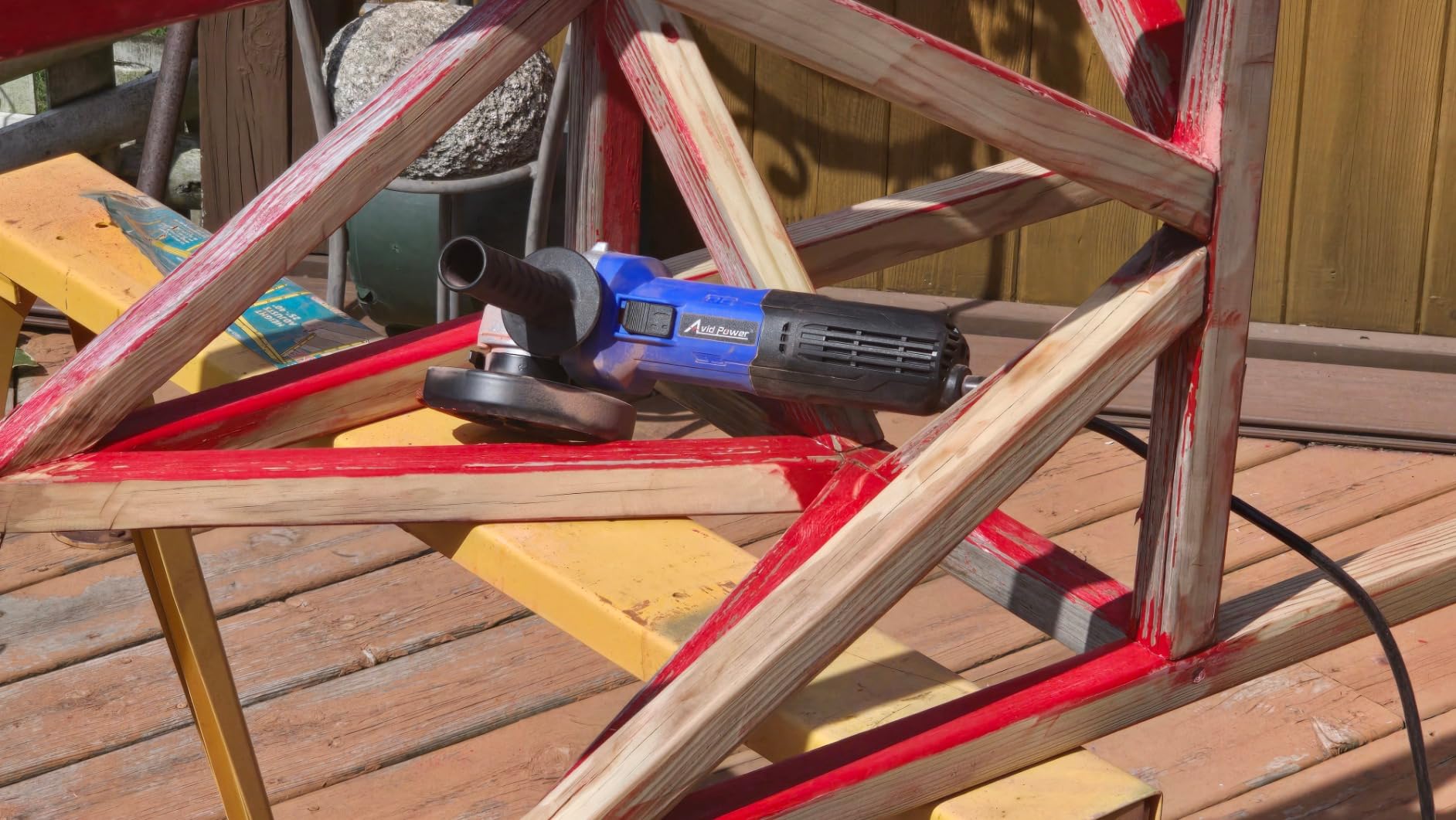
For concrete specifically, the 7/8 inch arbor accepts the same diamond blades used on larger machines, which is unusual in a compact 4-1/2 inch body. Buyers report cutting cinder block and handling concrete dust with a diamond blade without complaint, and many log 40 or more hours of work before issues.
The small body fits tight spots and is lighter than a 7 inch machine, which matters when you are working along a wall or in a basement. The tool-free adjustable guard and integrated spindle lock make disc changes quick, and the 2-position side handle threads on for either hand.
The reservations are real. The guard locking mechanism is simplistic and can feel loose to cautious users, the on/off switch feels fragile and is hard to depress, and the included cutting discs are thicker than optimal, which slows cuts. A small number of examples have failed after limited use, though the manufacturer replaced those under warranty.
Why it suits a beginner
Everything needed to start a concrete job arrives in the box, including a spanner wrench and spare brushes, so there is no first-trip to a hardware store before you can cut a block.
The 7/8 inch arbor means you can buy diamond wheels that also fit a larger grinder later, which protects your consumable investment.
Where caution is warranted
The switch and guard are the two parts that feel thin under hand pressure, and both matter when a wheel catches. Inspect the guard locks before every concrete cut.
Reports of early motor failure exist, though they are uncommon against a large volume of positive feedback. If you cannot accept any risk of a mid-project failure, pick a machine with a longer warranty.
7. Bosch GWS8-45 7.5 Amp Grinder – Best for Overhead and One-Handed Work
- Motor punches above its 7.5 amp rating
- Light enough to run one-handed including overhead
- Ran 15 minute stretches without overheating
- Two-position side handle with constant-on switch
- Large spindle lock is easy to reach
- Guard needs an Allen key and adjusts in discrete positions
- Manual states the tool is not approved for cut-off applications
- Handle placement feels awkward above waist height
- Less suited to very heavy continuous work
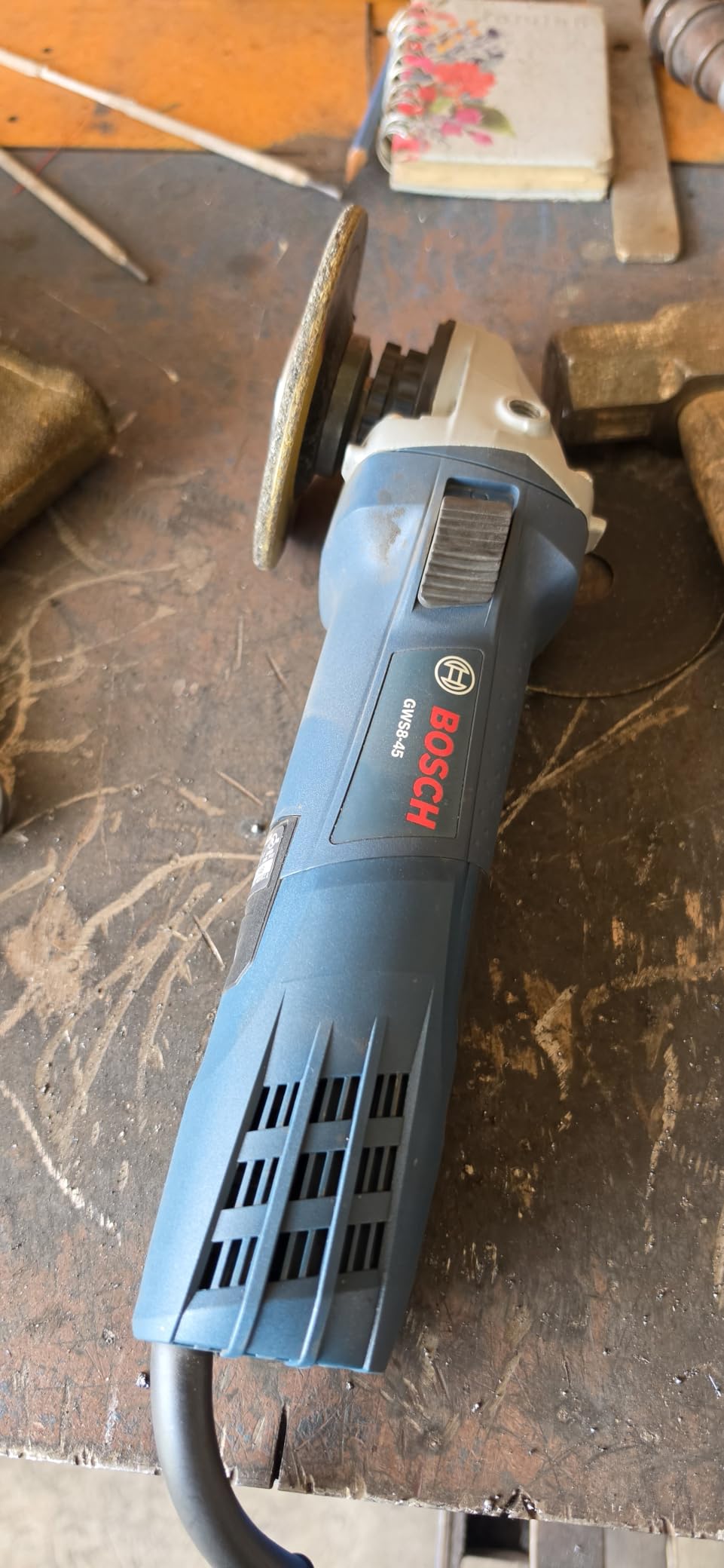
The Bosch GWS8-45 is the one I trust for work above shoulder height, and that is purely a weight decision. At 4.2 pounds with a slim-grip barrel, you can hold it one-handed on a ladder or overhead on a soffit without the arm fatigue that stops you partway through the job.
The 7.5 amp motor produces 11,000 no-load rpm and punches above what that rating suggests. Buyers report 15-minute stretches through multiple abrasive discs without overheating, which is the thermal behaviour you want when a blade is cutting concrete rather than mild steel.
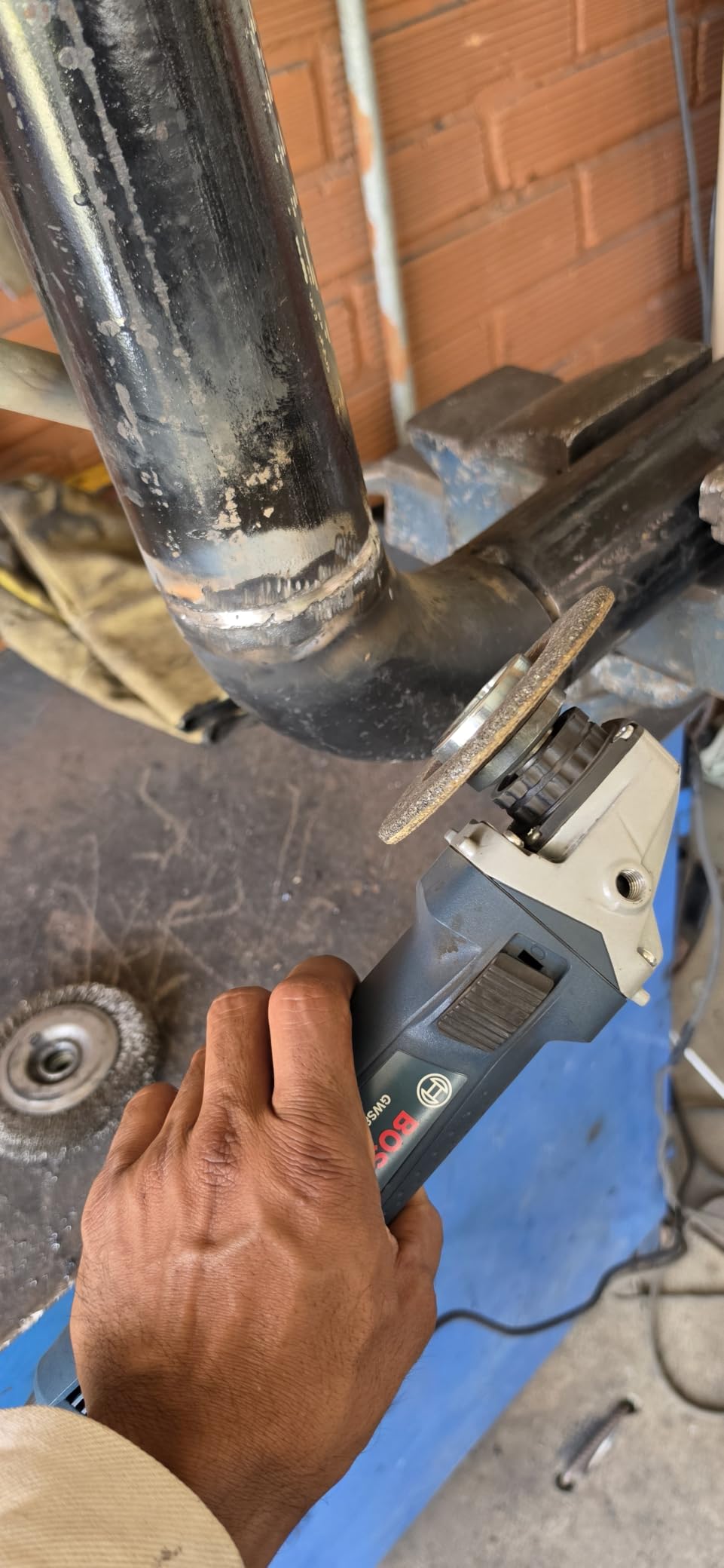
Dust handling here is proactive rather than reactive. Directed airflow diverts dust away from vital components, the burst-protection guard allows quick adjustments, and the Service Minder brushes stop the grinder when maintenance is required, which is a genuinely useful feature on a tool that lives near concrete.
The one-piece wrench, Allen key, and nut tool combined into a single part means you are far less likely to lose the thing you need to change a disc. That detail sounds trivial until you are on a roof with a missing spanner.
There is one item to read before buying. The manual states the tool is not approved for cut-off applications, though many owners report using it for that anyway. If your concrete plan involves slicing block or slab, treat that as a manufacturer boundary and choose a cut-rated machine.
Where the Bosch earns its slot
Overhead grinding, ladder work, and one-handed control on a chipped edge or step. The light body and long-run cooling make it a genuinely comfortable tool for delicate access jobs.
It is also a strong choice for a garage that shares time between metal work and concrete cleanup, where the directed airflow matters on both.
Where it is not the answer
The guard requires an Allen key and moves in discrete positions, so adjustments are tedious when you are changing between grinding and finishing work.
It is also the least suited to very heavy continuous removal. Seven and a half amps will not replace a 12 or 15 amp machine when you are grinding through coating and slab.
8. Metabo HPT G12SR4 6.2 Amp Grinder – Best All-in-One Kit with Case
Metabo HPT 4-1/2-Inch Angle Grinder, Includes 5 Grinding Wheels & Hard Case, 6.2-Amp Motor, Compact & Lightweight, G12SR4
- 980W of output from a compact 4 lb body
- 12000 rpm is high for a 4-1/2 inch grinder
- Low-profile gear case reaches tight corners
- Spindle lock makes accessory changes quick
- Five grinding wheels and a hard case included
- Slide switch is not a paddle switch so it must be held for continuous work
- 6.2 amps is modest for sustained heavy concrete removal
- Only a 1 year base warranty
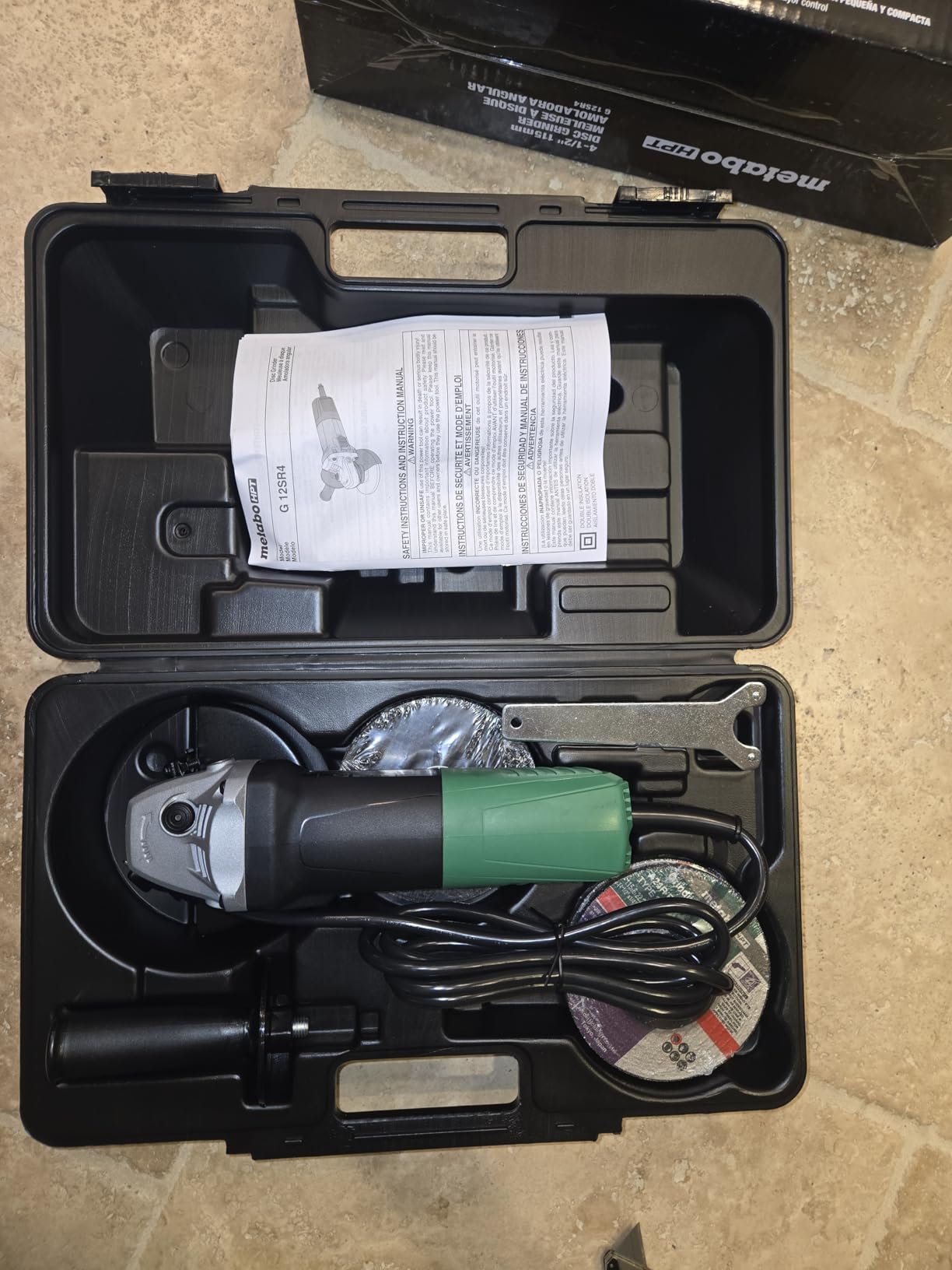
The Metabo HPT G12SR4 is bought for the package. It comes with five grinding wheels and a hard case, which is more consumable value than most premium grinders include at twice the tier, and the case is the right size for the tool as sold.
Output is 980W from a 6.2 amp motor running to 12,000 rpm, in a body weighing 4 pounds. That speed class is high for a 4-1/2 inch grinder and it is why owners report the machine feeling quicker than its amperage suggests on lighter grinding.
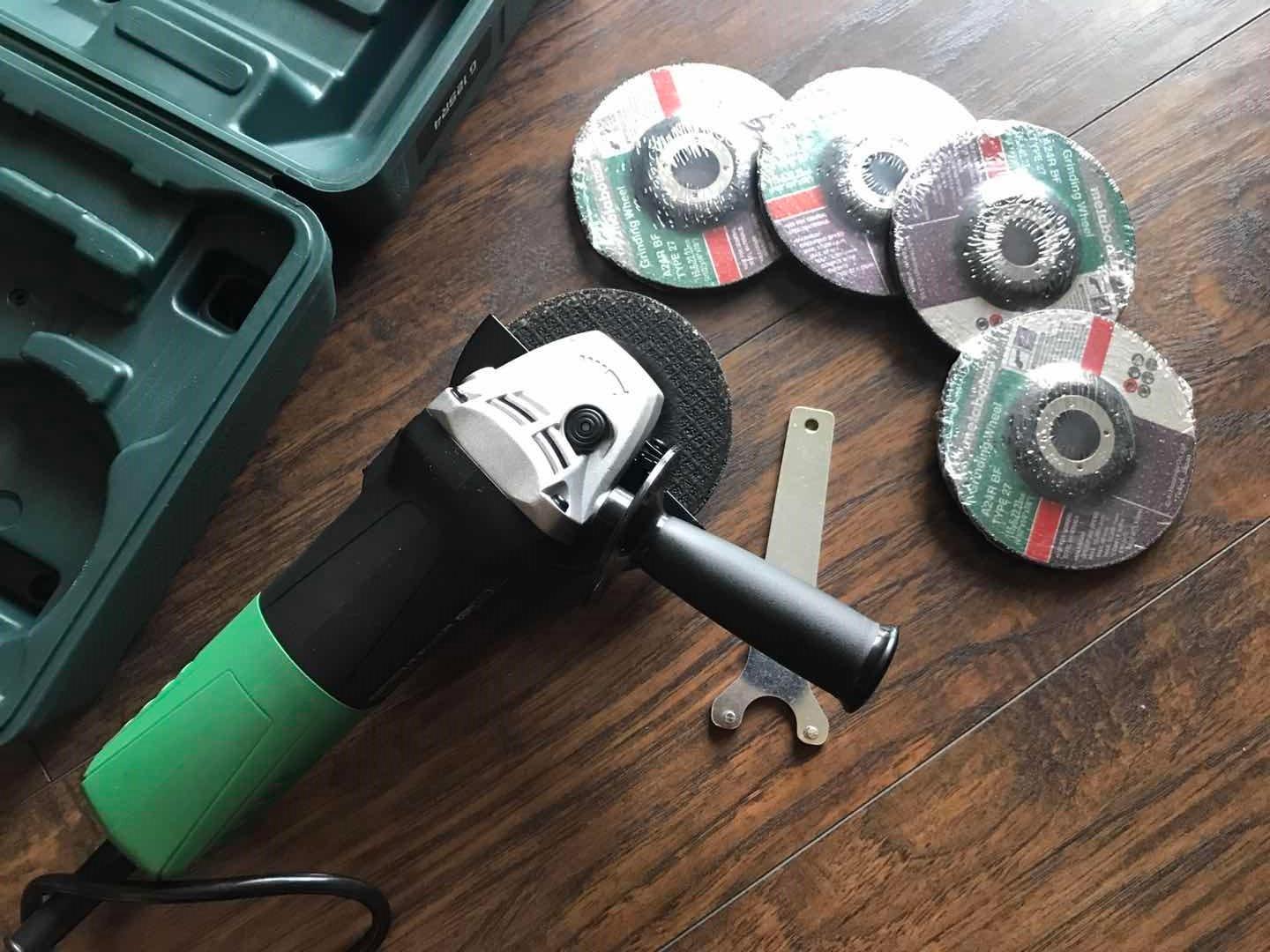
Two design details suit concrete specifically. The low-profile gear case reaches into tight corners and along edges where a full barrel will not clear, and the new labyrinth design improves dust and debris durability, which is exactly the failure point on a tool used around concrete.
The spindle lock makes disc and accessory changes quick, and the removable forward-canted side handle works for either hand. A mounted slide switch with quick-off is simple to operate.
Where it falls short is control. A slide switch must be held for continuous work, which is a genuine ergonomic step down from a paddle switch on a long pass, and 6.2 amps is modest when you are removing coating or grinding a full floor patch.
Why the kit matters for concrete
Five wheels and a hard case cover a beginner’s first few concrete jobs without a separate consumable purchase, and the case protects the tool between trips to the job site.
Long-running owner threads frequently name Metabo as a durability tier, and the labyrinth design on this model is the same dust-sealing idea carried down into a compact body.
What the lower amperage costs you
On heavy coating removal you will feel the motor slow before the wheel finishes the pass, and repeating that wears brushes faster.
The slide switch also means you cannot set the tool down mid-grind without releasing it, which on an incline or a ladder is a small but real inconvenience.
9. SKIL 9295-01 6 Amp Corded Grinder – Best for Occasional Concrete Jobs
- Cuts thin gauge metal and half inch rod cleanly
- Light and smooth running
- Handle threads on three positions and stores the wrench inside
- Locking switch powers off quickly
- Long track record with 25 year ownership reports
- Body can feel awkward to hold
- Slide switch is cumbersome at first
- Limited for continuous professional duty at 6 amps
- Does not include a case
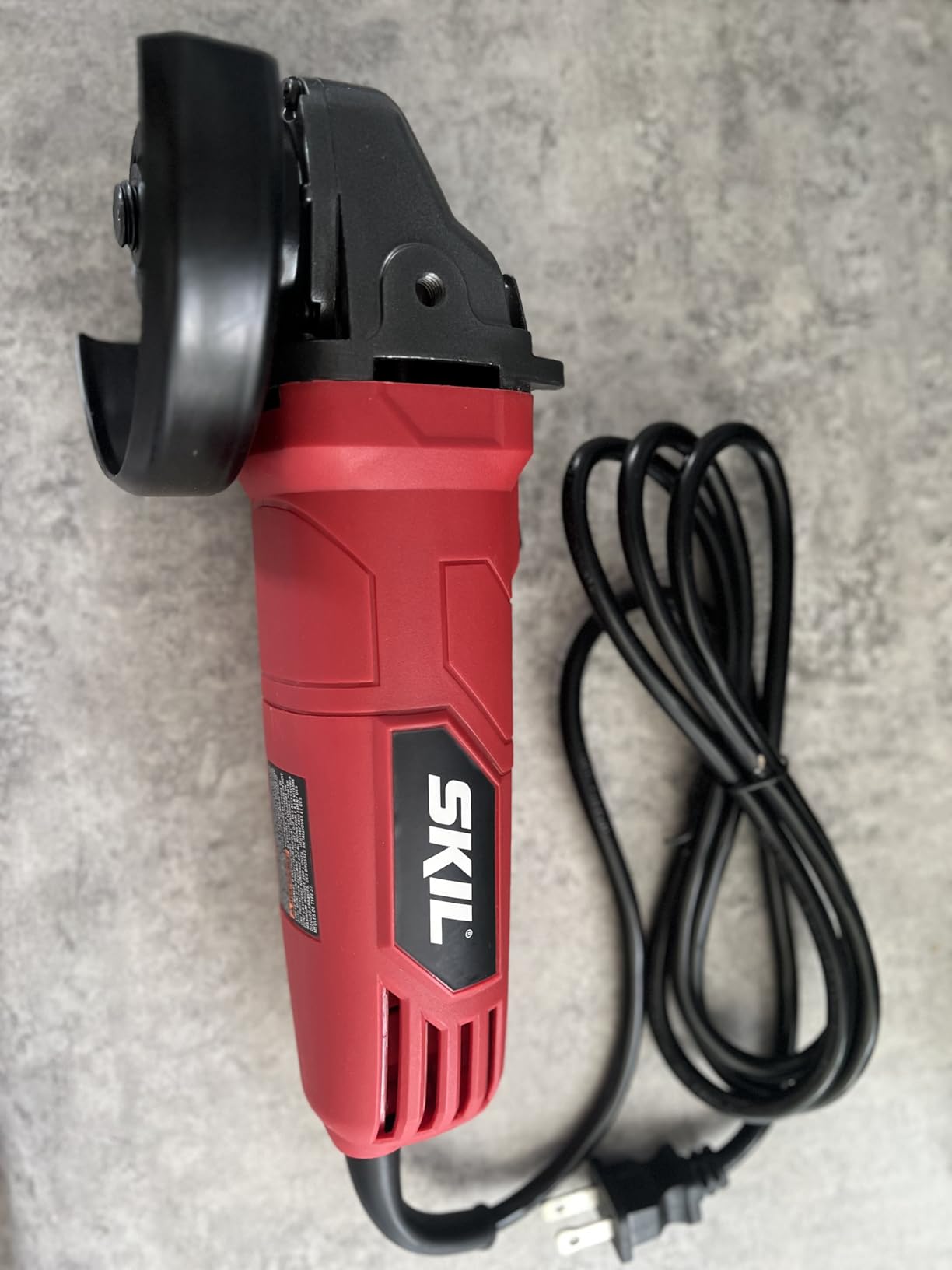
The SKIL 9295-01 is the model you buy when concrete work shows up once a year. A 6 amp motor at 11,000 rpm in a 4 pound body is enough to cut thin gauge metal and half-inch rod cleanly, and a diamond blade extends that to light block and paver work.
The signature feature is the vibration-reducing handle with built-in wrench storage. It attaches to the tool from three positions, so you can get the grip you need along a wall or in a corner, and the disc wrench lives inside the handle instead of disappearing in a toolbox.
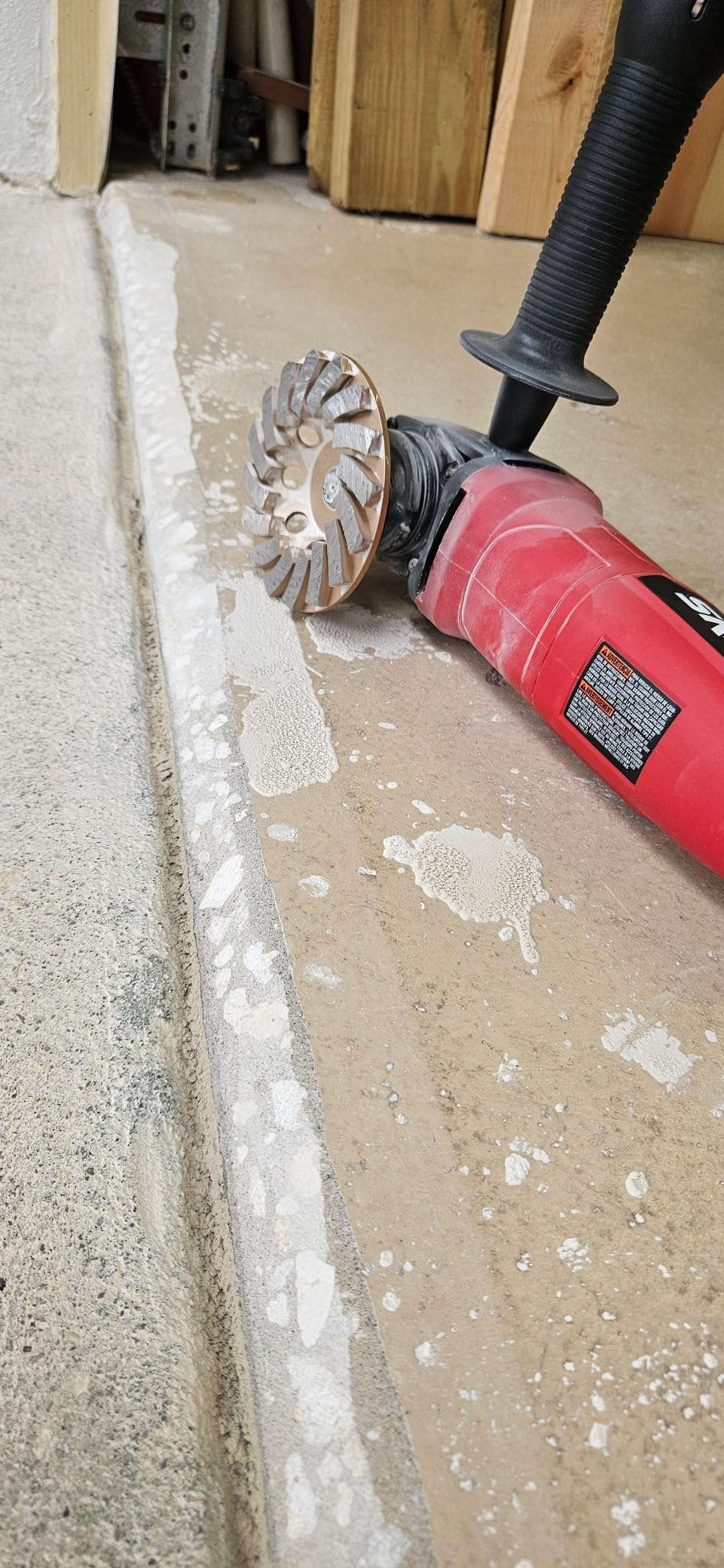
It has a heavy duty metal gear housing and a tool-less guard for quick adjustments, and the locking switch makes it very easy to power off in a hurry, which is a safety point rather than just a convenience.
Durability is the quiet story here. Owners report the same model lasting 25 years, and that track record is unusual for a tool in this class. The compact grip design works well for controlled work, though some find the body awkward to hold for extended periods.
Six amps is the ceiling, and it is a real one. Continuous professional duty is outside what this motor is built for, and the compact body will not suit tight overhead access as well as a slim-grip design.
Where it is genuinely the right tool
Occasional jobs, a garage that mostly does metal, and a household that wants a grinder capable of concrete without a dedicated machine in the corner. Owners rate it easy to grip and smooth running.
It also works well as a second or dedicated dusty tool that you do not mind being exposed to concrete grit.
Where it runs out of road
Six amps cannot sustain diamond cup work on a floor, and it will bog well before a segmented blade finishes a deep cut through thick block.
The slide switch takes some practice, and the absence of a case means the tool lives in a drawer rather than a van. Plan on upgrading eventually if concrete becomes a regular task.
10. Makita XAG04Z 18V LXT Cordless Grinder – Best for Makita Platform Owners
Makita XAG04Z 18V LXT® Lithium-Ion Brushless Cordless 4-1/2” / 5″ Cut-Off/Angle Grinder, Tool Only
- Active Feedback sensing shuts the tool off if the wheel stops
- Brushless motor runs cooler with up to 50 percent longer runtime
- Automatic speed change tunes speed and torque to the load
- Includes both a cut-off guard and a tool-less guard
- 8500 rpm is slower than 11000 rpm corded grinders
- Tool-only purchase means battery and charger cost extra
- Cordless output drops on sustained heavy grinding
The Makita XAG04Z covers 4-1/2 inch and 5 inch work on a single 18V LXT battery, and the feature that makes it distinctive is safety electronics rather than raw output. Active Feedback-sensing Technology turns the motor off if wheel rotation is suddenly stopped, which on a bind-up in a control joint is the difference between a stopped tool and a thrown one.
Automatic Speed Change adjusts speed and torque during operation so the motor matches the changing demands of the application, and the brushless motor runs cooler and more efficiently. Makita rates the efficiency gain at up to 50 percent longer run time per charge, which matters on exactly the kind of intermittent work a cordless grinder is good at.
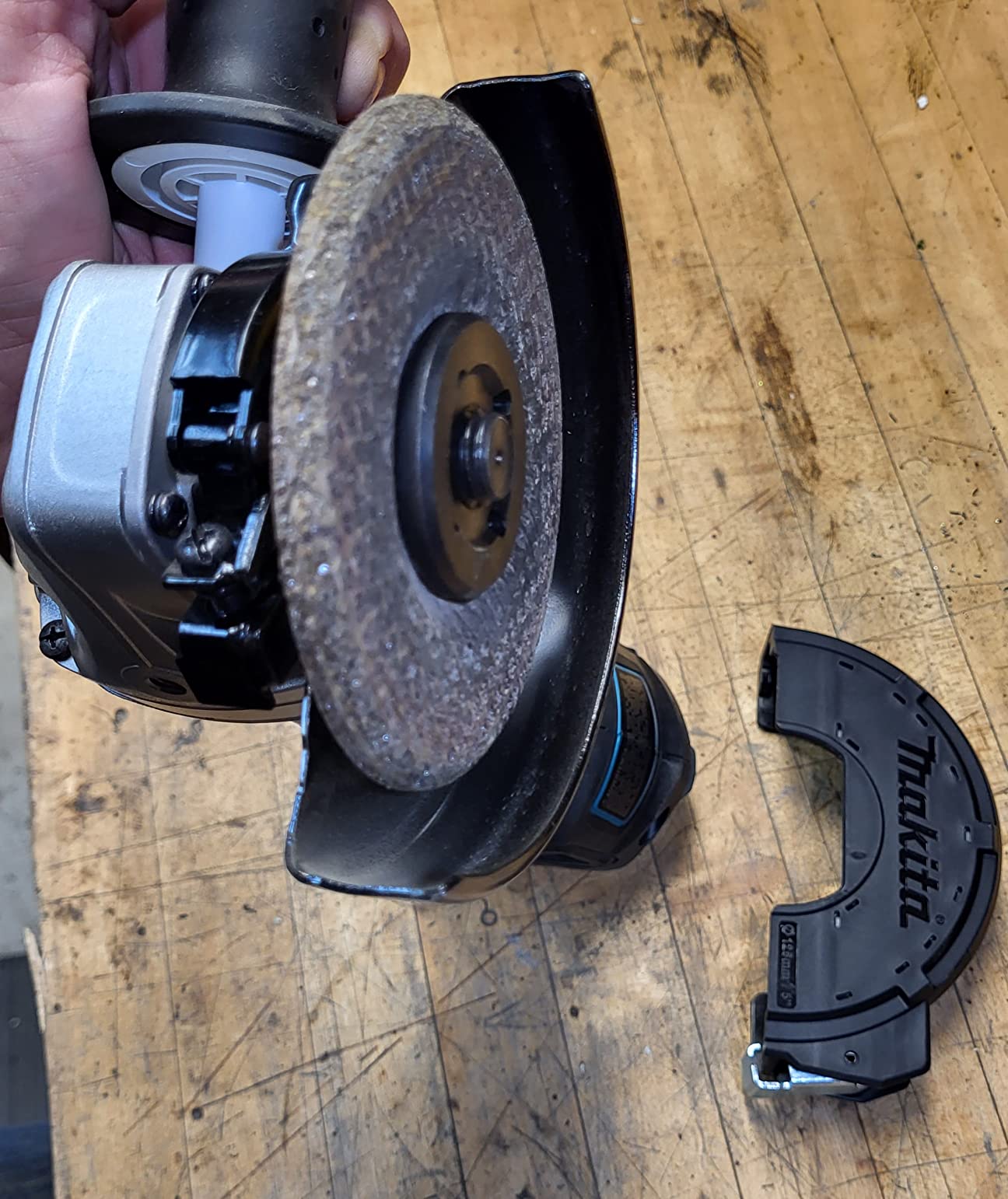
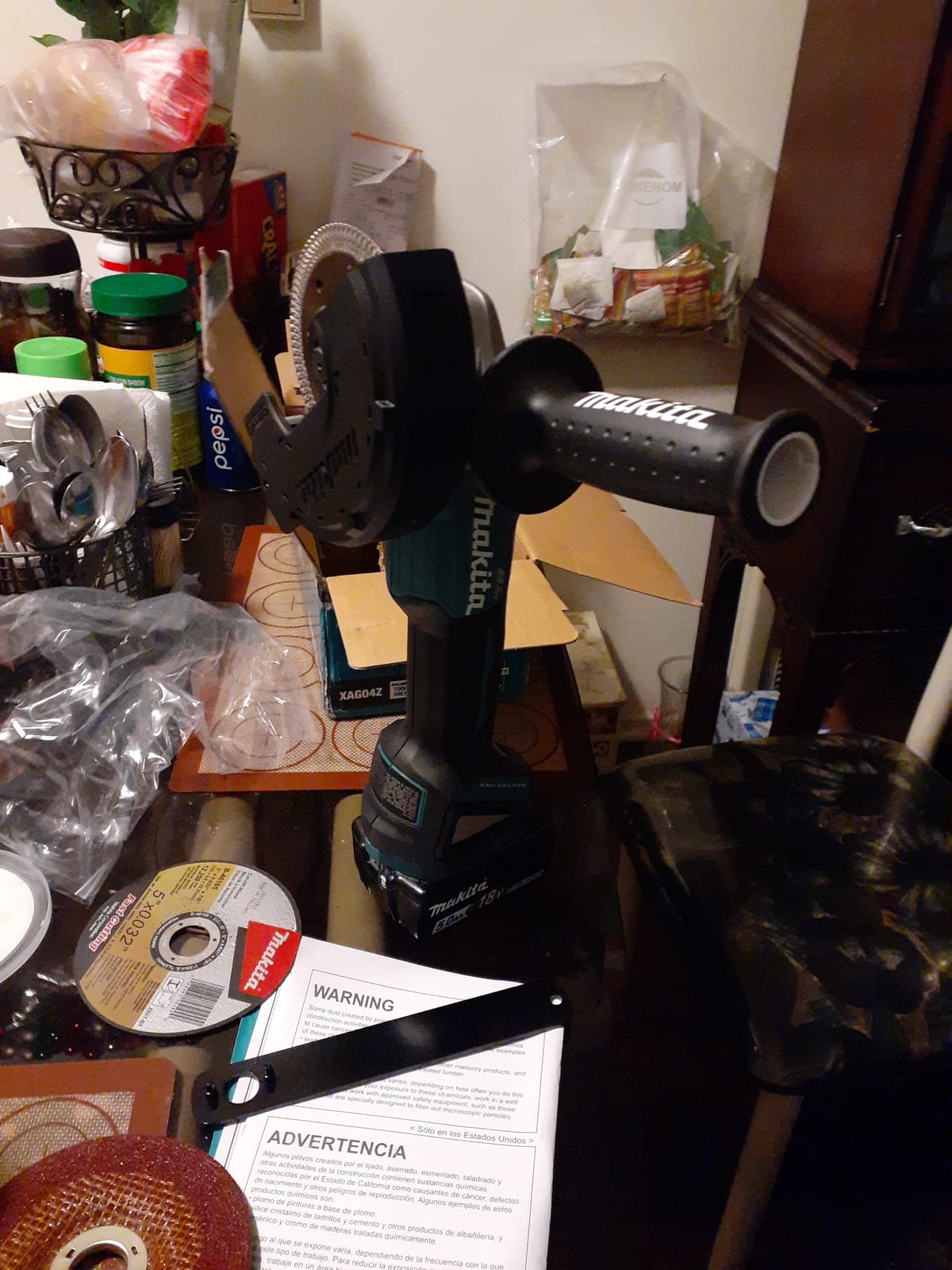
The box contents are unusually complete for a tool-only listing. You get a 5 inch cut-off wheel guard, a 5 inch tool-less wheel guard, a 5 inch ultra thin cut-off wheel, a 5 inch 36 grit grinding wheel, and a lock nut wrench, which is more than most tool-only packages include.
It attaches to any Makita 18V LXT battery, so for existing LXT owners this is a straightforward platform addition. Buyers single out the shutoff and the automatic speed adjustment as the features that justify the purchase.
At 8,500 rpm it is slower than an 11,000 rpm corded 4-1/2 inch machine, and output drops on sustained heavy grinding compared with a corded tool. Owners also note that wheel changes are not tool-free here, which is a step down from several rivals.
Why LXT owners should look here first
If you already run 18V LXT tools, the battery cost of entry is already paid. The included guard set and wheels make it usable straight away.
The active feedback shutoff is the best argument for it on hard concrete edges, where bind-ups are routine rather than exceptional.
Where corded still wins
Sustained heavy grinding drains the output, and the 8,500 rpm ceiling slows cutting speed on a segmented diamond blade.
Non-tool-free wheel changes add a step on a tool you may change discs often, and the tool-only package means battery and charger are separate purchases.
Should You Buy an Angle Grinder or a Walk-Behind Concrete Floor Grinder?
Buy an angle grinder for anything under roughly 200 square feet, for edges, joints, and detail work, and buy a walk-behind floor grinder only when you are prepping a whole room or a large slab. A walk-behind machine levels a floor across its full width in a single pass and captures dust far more effectively, but it costs several times more, needs a circuit you may not have, and is impractical to store in a suburban garage.
The practical test is the surface area. Repairing a chipped step, grinding a trip-hazard edge, or chasing a control joint is an angle grinder job. Removing mastic and paint across an entire 400 square foot basement floor is a floor grinder job, because an angle grinder means hundreds of passes and a dust problem that follows you around the whole time.
If you fall into the second category, it is often worth renting the walk-behind machine for a day rather than buying one. If you are finishing the job with a coating, our concrete sealer guide covers the next step once the surface is ready.
How to Choose an Angle Grinder for Concrete
Which disc and wheel should you use?
For cutting, use a diamond blade with a segmented rim, which has gaps between segments that dissipate heat and prevent the wheel from loading up. For grinding a surface flat or removing coating, use a diamond cup wheel with a flat or angled rim. A continuous rim blade gives the smoothest finish but generates more heat and is intended for wet grinding, and none of these wheels are interchangeable with a grinding disc on the same tool.
Grit matters too. A 30 to 40 grit diamond cup wheel is aggressive material removal, 60 to 80 grit is general surface preparation, and anything above 100 grit is for finishing. Match the grit to the job rather than buying the cheapest wheel available.
Is 4-1/2 inch enough, or do you need 5 inch or 7 inch?
A 4-1/2 inch grinder is genuinely enough for chasing a channel, tidying a slab edge, grinding bolts and anchors flush, and cutting ordinary block. One owner with six years of solo renovation put it plainly: for chasing a channel or tidying a slab edge, yes with a diamond wheel, but anything structural wants a bigger machine and a dust shroud.
A 5 inch wheel covers more ground per pass, which helps on open floor work. A 7 inch machine cuts deeper and faster, and it is the only answer for deep cuts through thick slab, but forum owners describe 7 inch grinders as unwieldy and tiring, so the extra capability comes with a real ergonomic cost.
How much power do you need?
Match amperage to the job rather than to the price. Six amps covers light touch-up cutting and grinding. Nine to 11 amps handles general concrete work including coating removal and edge repair. Twelve to 15 amps is for heavy removal and deep cuts, and there is no version of this where a small motor substitutes.
For cordless, the equivalent question is battery capacity rather than amperage. Owners report 20 to 30 minutes on a smaller pack, and roughly 45 minutes to an hour on a 9.0Ah pack for real masonry work, so pack capacity matters more than the motor label.
Do you need a dust shroud for grinding concrete indoors?
Yes, if the work is indoors, and a dust shroud or ejection system that connects to a HEPA vacuum should be near the top of your criteria. Owners repeatedly describe concrete dust getting everywhere within a handful of sessions, and the most experienced owners keep a separate cheap grinder for concrete specifically so their good tool never ingests silica.
For grinding, a shroud around the wheel beats ejection ports because it captures dust at the source. For cutting, ejection ports work well. If your machine has neither, plan on a respirator and on cleaning the tool thoroughly afterwards.
What does a paddle switch versus a slide switch change?
A paddle switch is held to run and releases the moment you let go, which means a stop happens instantly if the tool drops or your grip slips. A slide switch locks on and stays running, which is convenient for long passes and genuinely more dangerous, and there is a direct safety objection to lock-on switches among experienced owners who have seen what a locked-on grinder does to fingers.
For concrete work specifically, favour a paddle with a safety lock-off. When a segmented blade binds in a slab, the seconds matter.
Corded or cordless for concrete?
Corded wins decisively for sustained work, because the motor does not fade as the job runs. Cordless wins for access work, ladders, basements with a single outlet, and anything where a 50 foot extension cord is a hazard.
Many owners now use a cordless grinder as their primary and report not touching a corded machine for months, which tells you how far cordless has come for intermittent concrete jobs.
How do you maintain a grinder after cutting concrete?
Blow the air intake vents out with compressed air after every session, and clean the removable mesh intake screens if your model has one. Rotate the tool to different angles while you do it so dust in the brush housings clears.
Check the carbon brushes on brushed machines and replace them before they wear down, since a FUEL or brushless machine simply removes the issue. Keep the guard adjustment mechanism free of grit, and wipe the spindle and flange before a disc goes on so abrasive dust does not score the mating surfaces.
Finally, store concrete-dusted tools away from anything you care about, and do not blow dust out with a compressor at full blast indoors, where you simply relocate the silica to the rest of the room.
Silica Dust and Why It Matters When You Cut Concrete
Yes, silica dust is found in concrete, because concrete is largely made of sand, and quartz sand is the source of respirable crystalline silica. When a diamond blade grinds or cuts concrete, it creates dust fine enough to reach deep into the lungs, where it accumulates permanently, and long-term exposure is associated with silicosis and lung cancer.
This is why the shroud matters and why a vacuum is not optional for indoor work. Use a HEPA-rated vacuum connected to the grinder’s dust port or shroud, keep a respirator on hand even with extraction running, and consider wet cutting with a diamond blade rated for wet use if the job allows it.
Wet cutting reduces airborne dust considerably, but it does not eliminate the exposure, and slurry has its own cleanup and tool-corrosion issues. If you are working indoors in a finished space, the combination of a shrouded grinder, HEPA extraction, a respirator, and cleaning before the dust settles is the responsible approach.
For outdoor work, keeping dust downwind of yourself and away from open windows and neighbours covers most of the practical risk. If your project involves a whole floor rather than a repair, plan for a concrete hauling setup as well as for grinding, because debris removal generates its own dust.
Frequently Asked Questions
What type of grinder is best for concrete?
A handheld angle grinder with a diamond cup wheel is best for most concrete repair work. Choose at least 9 amps of corded power or a brushless cordless motor, plus a dust shroud or ejection system. A walk-behind floor grinder only makes sense for prepping large floor areas rather than repairing edges and joints.
Do angle grinders work on concrete?
Yes, angle grinders cut and grind concrete efficiently when fitted with a diamond blade or diamond cup wheel, never a standard metal cutting disc. Concrete grinds far harder than steel, so use a blade rated for masonry, keep the tool moving, and expect the wheel to wear down faster than it would on metal.
What type of angle grinder disc is best for cutting concrete?
A segmented rim diamond blade is the best choice for cutting concrete, because the gaps between segments dissipate heat and stop the wheel loading up. Use a continuous rim blade for the smoothest finish, and note that continuous rim blades are generally intended for wet grinding. Match grit to the job rather than to the price.
How much power do I need to grind concrete effectively?
Six amps covers light touch-up work, 9 to 11 amps handles general concrete work including coating removal and edge repair, and 12 to 15 amps is for heavy removal and deep cuts. On cordless tools, battery capacity matters more than the motor label, with 9.0Ah packs giving roughly 45 to 60 minutes of real masonry work.
Do I need a dust shroud for grinding concrete indoors?
Yes, for indoor grinding you want a shroud that captures dust at the wheel, paired with a HEPA-rated vacuum. Ejection ports work well for cutting. Even with extraction running, wear a respirator and clean up before dust settles, since respirable crystalline silica from concrete settles quickly and stays in the air.
Is silica dust found in concrete?
Yes. Concrete is made largely of sand, and quartz sand is the source of respirable crystalline silica, which is a serious long-term inhalation risk that accumulates in the lungs permanently. Outdoor work is mainly a matter of keeping dust away from yourself and neighbours. Indoor work needs a shroud, HEPA extraction and a respirator together.
The Best Angle Grinders for Concrete: Our Final Word
The DEWALT DCG413B is our best angle grinder for concrete in 2026, and its kickback brake is the reason. If you need one machine that never loses speed, choose the DEWALT DWE402 for its 11 amp motor and dust ejection system. Makita 9557PBX1 owners get the best access in tight corners, and 18V LXT or M18 platform owners should look at the Makita XAG04Z or Milwaukee 2880-20 before buying a second battery system.
Whatever you pick, buy the diamond wheel and the dust control on the same shopping list. A grinder without a shroud is a bad purchase for indoor concrete work, and if you are covering a concrete patio, sorting the grinding and sealing steps in advance saves doing the work twice.