

The best infrared patio heaters for covered decks solve a problem most people only discover after the first cold September evening: the roof over your deck is exactly what makes a gas heater dangerous and a fan heater useless. Radiant infrared units send heat straight to your skin and furniture in a straight beam, so they work under a roof, in wind, and without the carbon monoxide question that pushes propane out of a covered space entirely.
We spent weeks comparing the electric infrared units that actually fit a residential covered deck, sorted by mounting type, element style, weather rating and how much real heat each one puts on a seated person. Along the way we worked out the clearance numbers most manufacturer pages bury, the difference between a 120V plug-in and a 240V hardwired install, and the honest temperature range where a patio heater earns its place.
If you want the short version, the wall-mounted infrared space heaters we tested share a design with the outdoor units here, and our general patio heater roundup covers the gas side of the market for anyone comparing fuel types.
Table of Contents
Top 3 Picks for Covered Decks

Best Infrared Patio Heaters for Covered Decks in 2026
| Product | Specifications | Action |
|---|---|---|
| Heat Storm HS-1500-PHX-WIFI |
|
Check Latest Price |
 Dr Infrared DR-239 3000W Dr Infrared DR-239 3000W |
|
Check Latest Price |
| Briza 1500W Infrared |
|
Check Latest Price |
 SereneLife 1500W IP65 SereneLife 1500W IP65 |
|
Check Latest Price |
 Nfccra 34 Inch Motion Sensor Nfccra 34 Inch Motion Sensor |
|
Check Latest Price |
 PowerScale 1500W PowerScale 1500W |
|
Check Latest Price |
 blessny 1500W Carbon Fiber blessny 1500W Carbon Fiber |
|
Check Latest Price |
 ThermoMate 1500W Ceiling Chain ThermoMate 1500W Ceiling Chain |
|
Check Latest Price |
1. Heat Storm HS-1500-PHX-WIFI – Best All-Round Pick With App Control
- WiFi phone app control from your seating area
- Wall mount keeps the floor clear
- Tip-over shutoff plus digital thermostat
- Remote included in the box
- 1500W and 5200 BTU on a standard outlet
- Listed for indoor use only so it is not weather-rated
- Wall mount only and feet are not included
- Draws 12.5A so it wants its own circuit
This is the most proven unit in the group by a wide margin, with roughly 13,950 reviews averaging 4.4 stars, and the app control is the feature that actually changes how you use it. We could start heating from a phone while still sitting at the table, which is the whole argument for infrared in the first place.
The cabinet is 4 inches deep, 19 inches wide and 16 inches tall, and it weighs 9 pounds, so it needs solid mounting into a stud or a joist rather than drywall alone. The neat trick is that the cord can be routed inside the unit when you install it directly over an outlet.
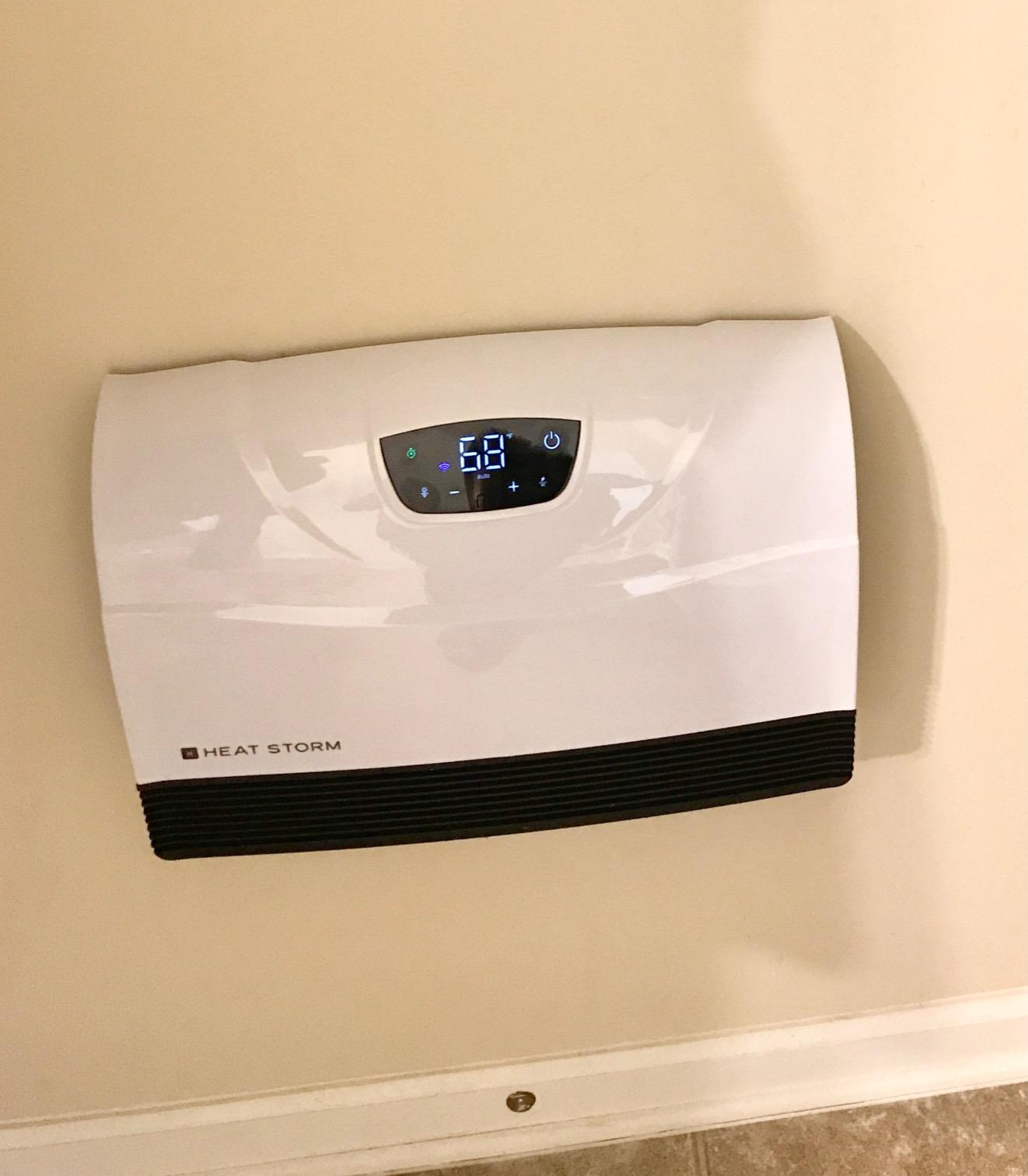
The one thing you need to know before you buy: the listing specifies indoor use. It is not weather-rated, so a covered deck is only appropriate if yours is genuinely sheltered and you bring it in when weather turns. We include it because the build quality, thermostat and control set are excellent, and because it works as a garage or porch-room heater.
Owners consistently praise the safe-to-touch grill and the cool cabinet, which matters when children are around a wall-mounted unit at head height. Coverage is listed at 150 square feet primary and 750 square feet secondary, though you should expect a comfortable seated zone rather than a warm room.
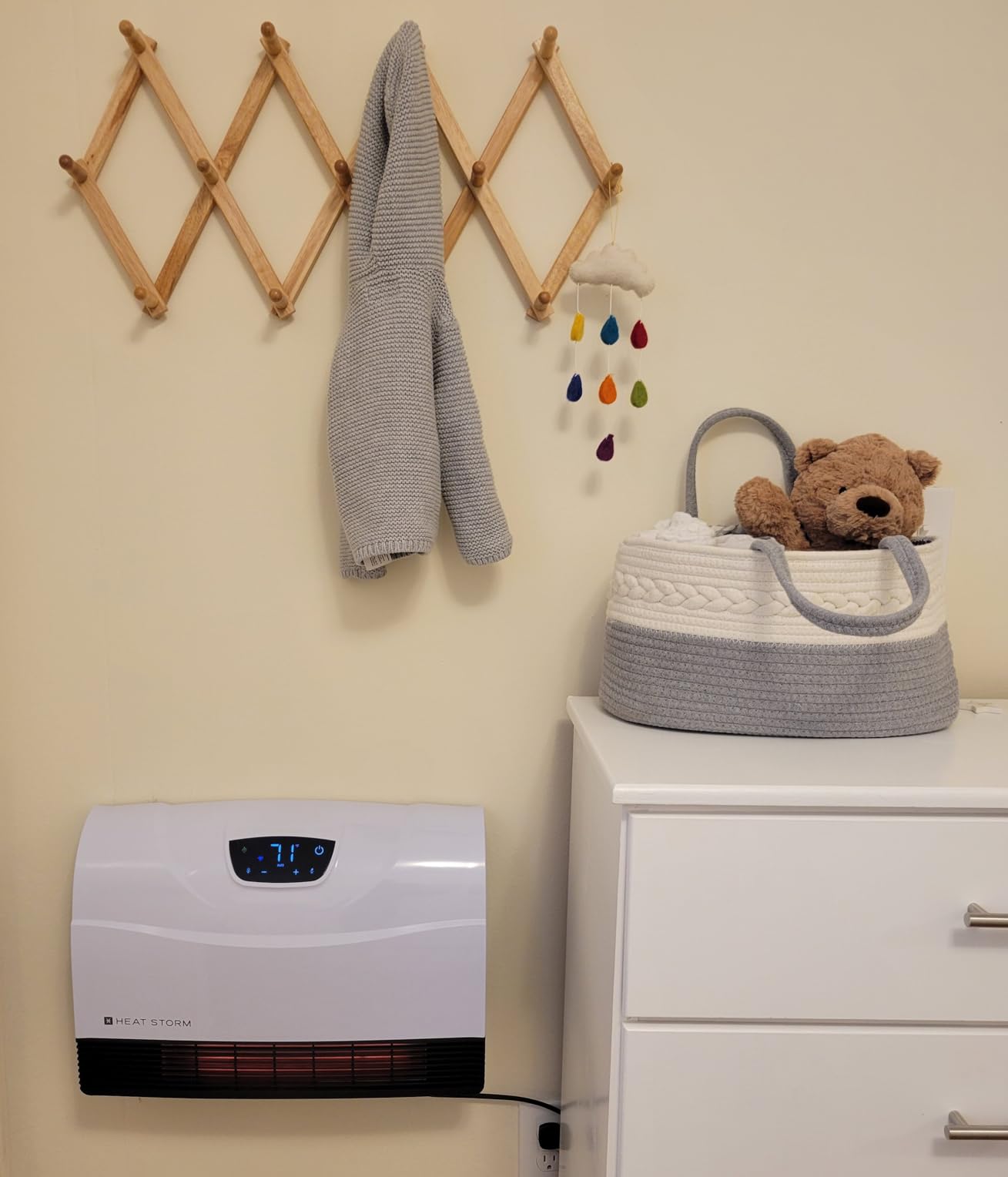
What you get for the outlet draw
At 1500W on 110V it pulls 12.5A, which is close to the 15A limit of a standard household circuit. Plan on a dedicated outlet, and put it on a GFCI-protected receptacle if the location is anywhere near a deck.
Where it fits badly
Because the manufacturer specifies indoor use only, this is the wrong pick for a deck that takes rain blowing in from the side. It is also wall-mount only, with no feet in the box, so it is not a renter-friendly option unless you own a stud finder.
2. Dr Infrared DR-239 3000W – Most Heat From a Single Hardwired Unit
- 3000W of instant radiant heat with no warm-up
- IP55 rated for covered patios and gazebos
- Wall and ceiling brackets in the box
- Remote with power levels and standby
- Overheat protection and silent running
- Requires a 220V-240V dedicated circuit
- Very directional so warmth fades a few feet out
- Some buyers report units that stopped heating
About 6,096 reviews at 4.3 stars, and the 3000W output is the reason this one earns its place. Long-term owners in garages, kennels and gazebos describe it as a first-class unit with mounting hardware that installs cleanly and service that holds up for years.
It is a long, slim bar, 41.2 inches deep by 3.4 inches wide, and the brackets let you mount it on a wall or hang it from a ceiling over a table. It is ETL Listed with a NEMA 6-15P plug, so on a 240V circuit it plugs in rather than requiring a hardwired box.
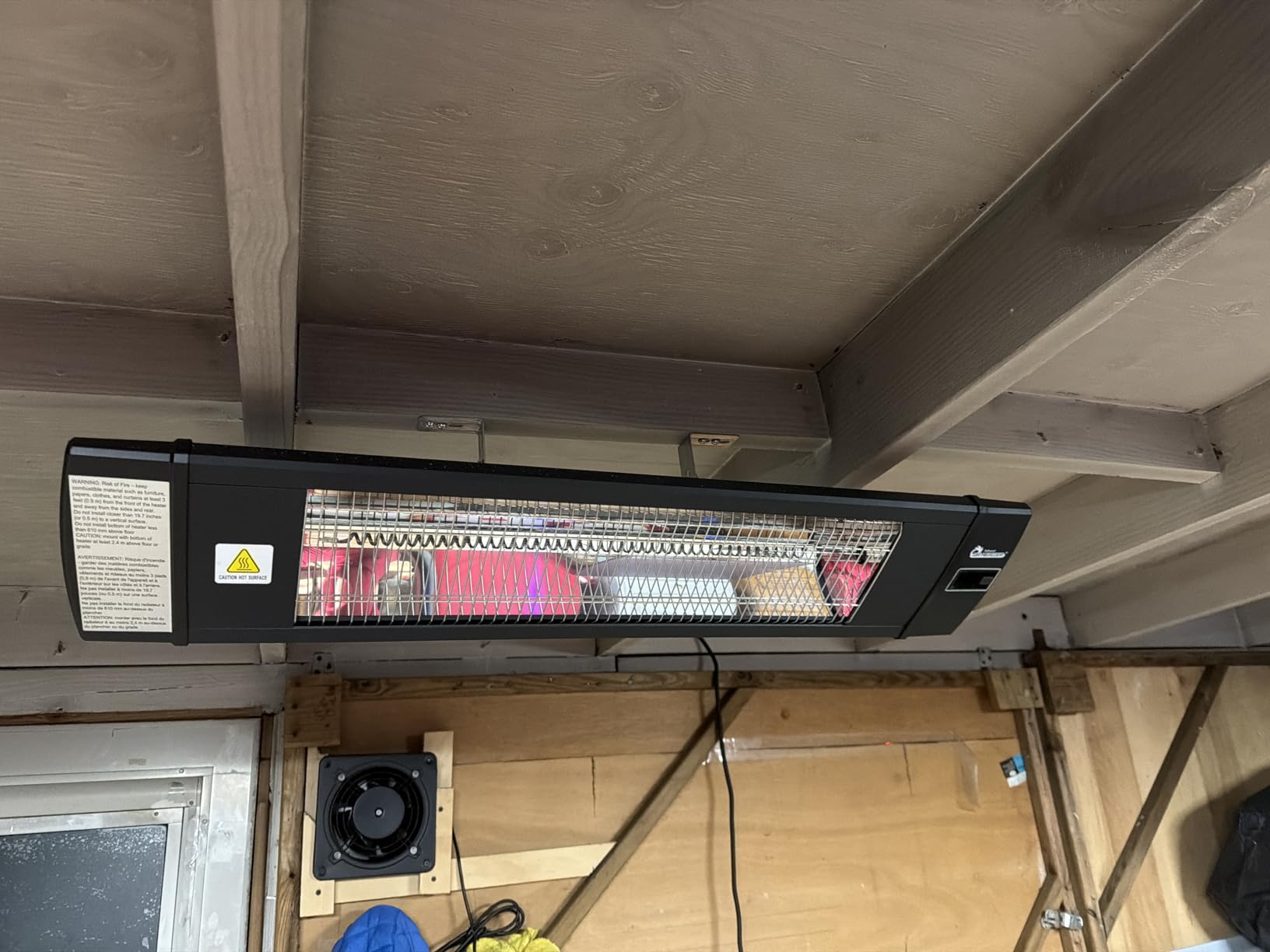
The catch is electrical. It draws 12.5A at 240V, which means a dedicated 240V circuit and an electrician for most homeowners. If your panel cannot take it, this is the point where people give up on electric and reach for propane, which is a worse trade under a roof.
Reviewers note that it heats objects and bodies rather than air, so it will not raise the ambient temperature in an open deck. Placement close to where people sit matters far more than any square footage figure, and the remote lets you set power levels without walking over to the unit.
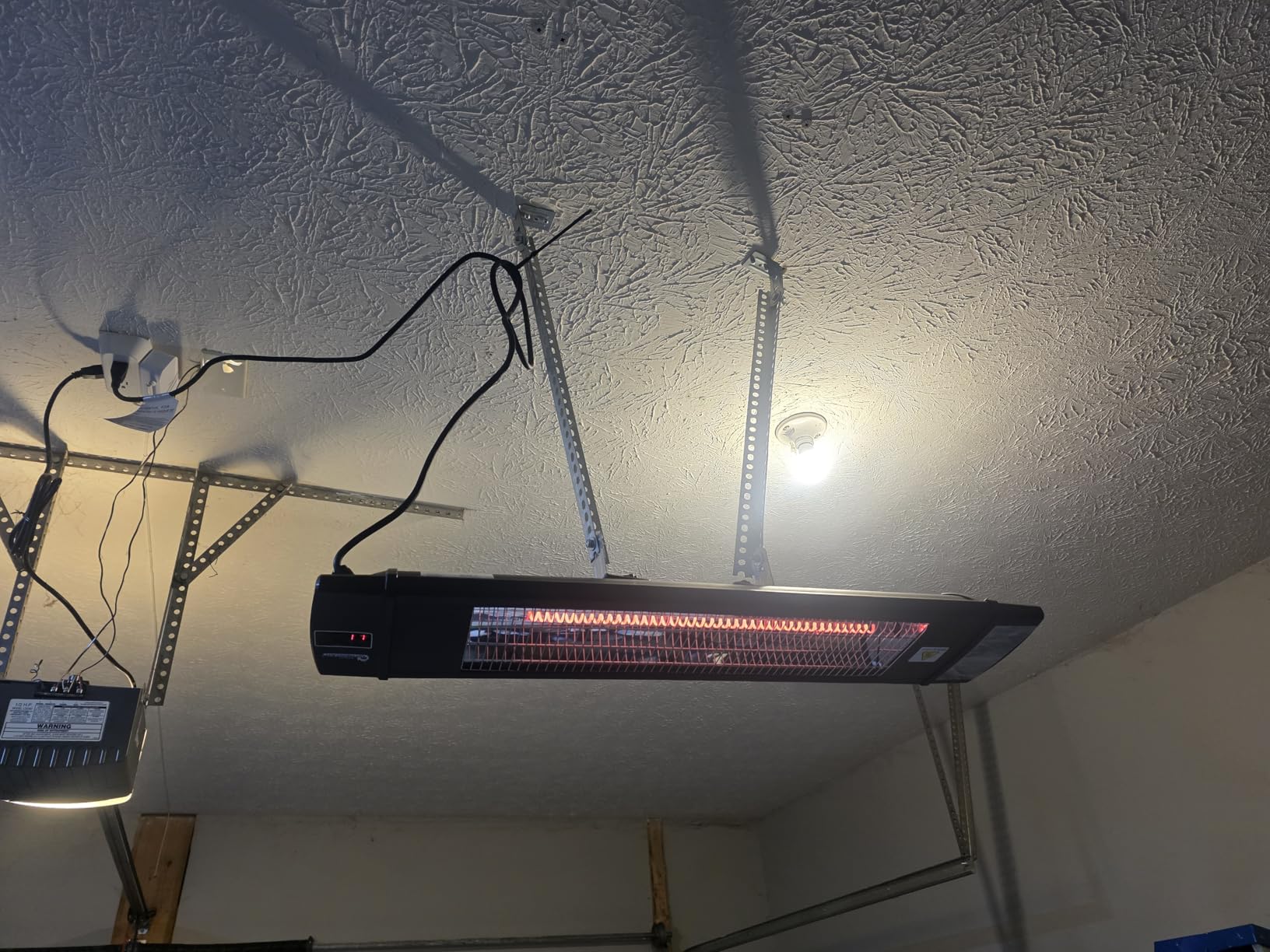
When 3000W is worth the install
If you already have 240V capacity, or you are planning a bigger project such as several units on a new circuit, this is the most heat you can get from a single electric bar. Two settings and a standby mode cover most evenings.
Where it disappoints
A handful of buyers report units that stopped producing heat after a few months, and the unit does not restore its last setting after a power interruption. The 1-year limited component warranty is shorter than the multi-year coverage on some of the units below.
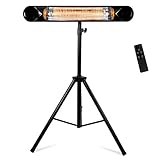
3. Briza 1500W – The Only Three-in-One Mount In The List
- Wall ceiling or tripod mounting from one box
- IP55 rated for year-round outdoor use
- Three levels at 900W 1200W and 1500W
- Remote timer settable from 1 to 9 hours
- Tip-over sensor cuts power automatically
- Tripod extends to about six feet which is tall when seated
- Heats people in line of sight rather than room air
- About one review in eight is a one star
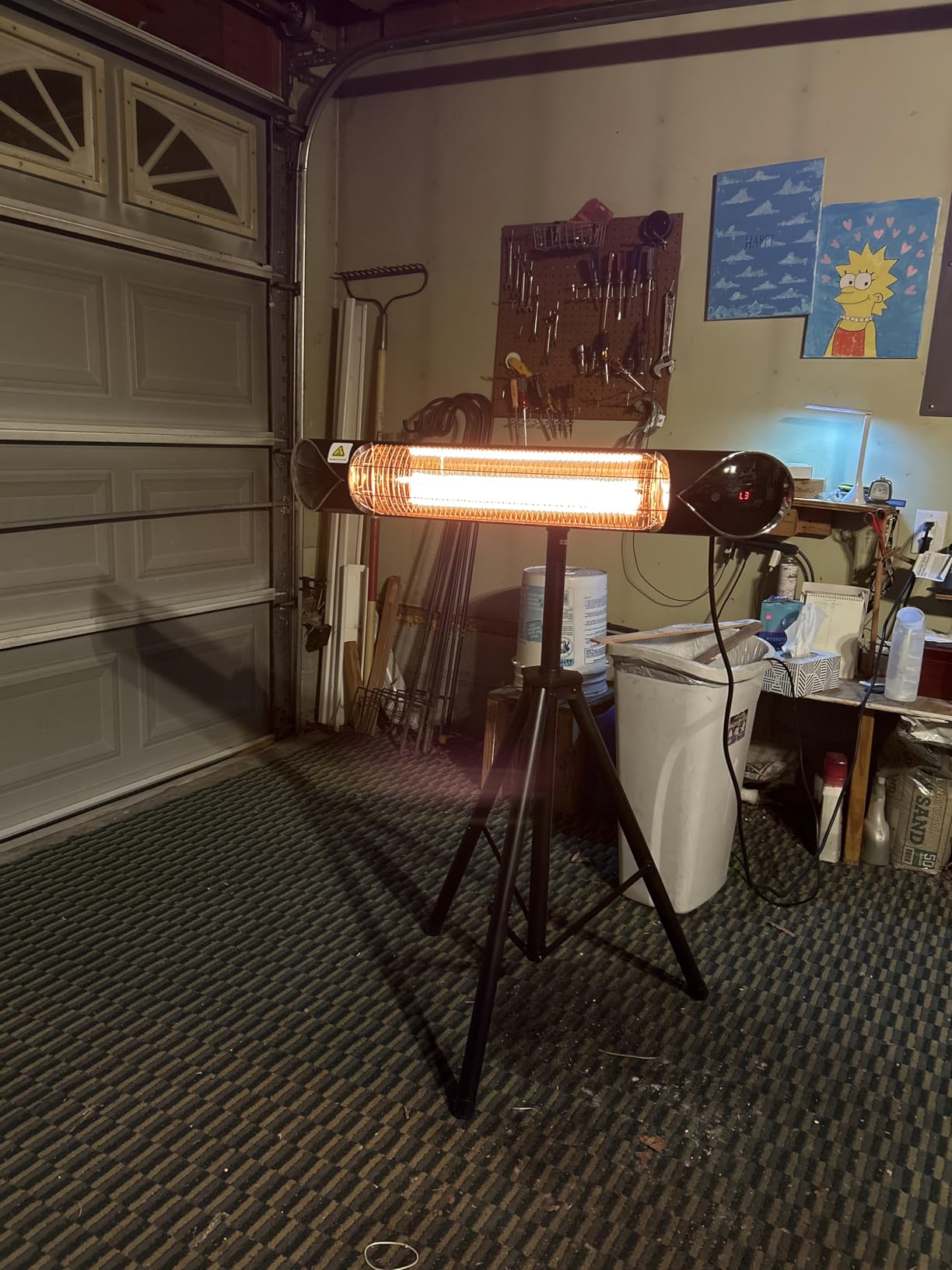
The reason this unit is on the list is flexibility. It ships with wall hardware, ceiling hardware and an adjustable tripod stand, which means you can move it between the deck, the garage and an indoor room without buying anything else. That also makes it the easy answer if you are not ready to drill into a ceiling joist.
Coverage is listed as 800 to 1000 square feet indoors and 100 square feet outdoors, and that outdoor figure is the one to believe. The 84-inch cord reaches a standard outdoor receptacle, and three heat levels plus a remote timer let you ramp it down as the evening goes on.
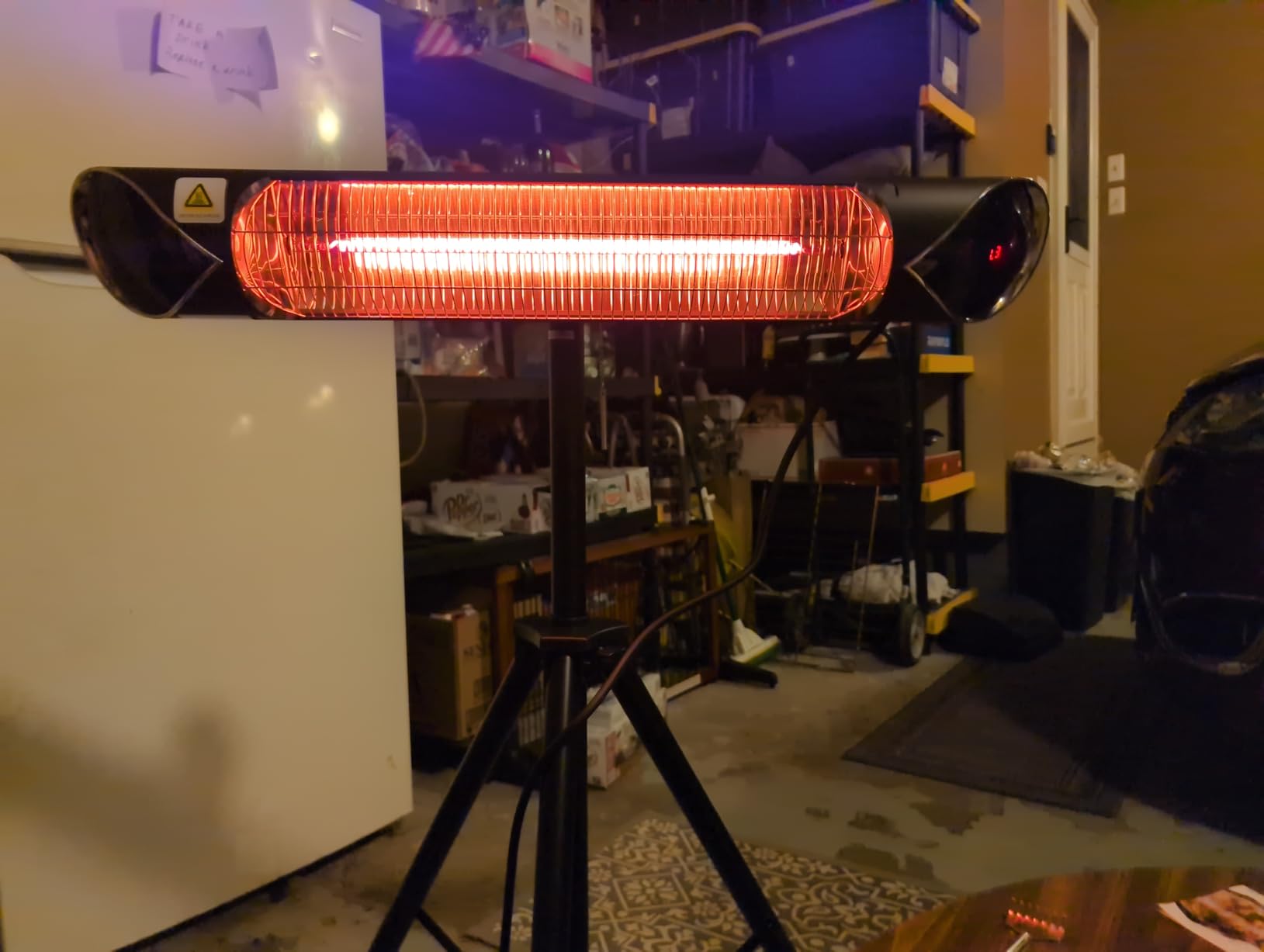
At 120V and 12.5A it draws enough current that other devices on the same outlet can trip the breaker, so keep it on a circuit of its own. The tip-over sensor is genuinely useful with the tripod configuration, and it is silent because there is no fan.
Reviewers are split in a predictable way. People who understand radiant heat rate it highly for garages, balconies and patios, while a noticeable share of one-star reviews come from buyers expecting a whole-room space heater. Know which one you are before you order.
Best for renters and first-time installs
Nothing else here converts between three mounting styles, so this is the one to buy if drilling overhead feels like a commitment. The adjustable tripod also lets you change height between a standing conversation area and a seated table.
Where it falls short
The tripod extends to roughly six feet, which is tall for seated use and needs adjusting on every move. And the specification data lists indoor usage despite the outdoor marketing, so confirm the IP 55 enclosure with the seller before you install it outside.
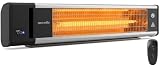
4. SereneLife 1500W IP65 – Best Low-Cost Hanging Unit
- IP65 aluminum frame that owners report survives rain
- Wall or ceiling hanging keeps it above kids and pets
- Carbon fiber element heats up in seconds
- Simple two-button remote is easy to operate
- Lightweight body with brackets that do not sag
- Standby light flashes blue and the remote cannot switch it off
- Only a single heat level which limits usable area
- Foam packing inserts must be removed before first use
This is the most weather-sealed unit relative to its size, with an IP65 rating on an aluminum alloy frame, and owners confirm it has survived being left out in rain. The carbon fiber element is rated at 88 percent efficiency and heats in seconds with no warm-up delay.
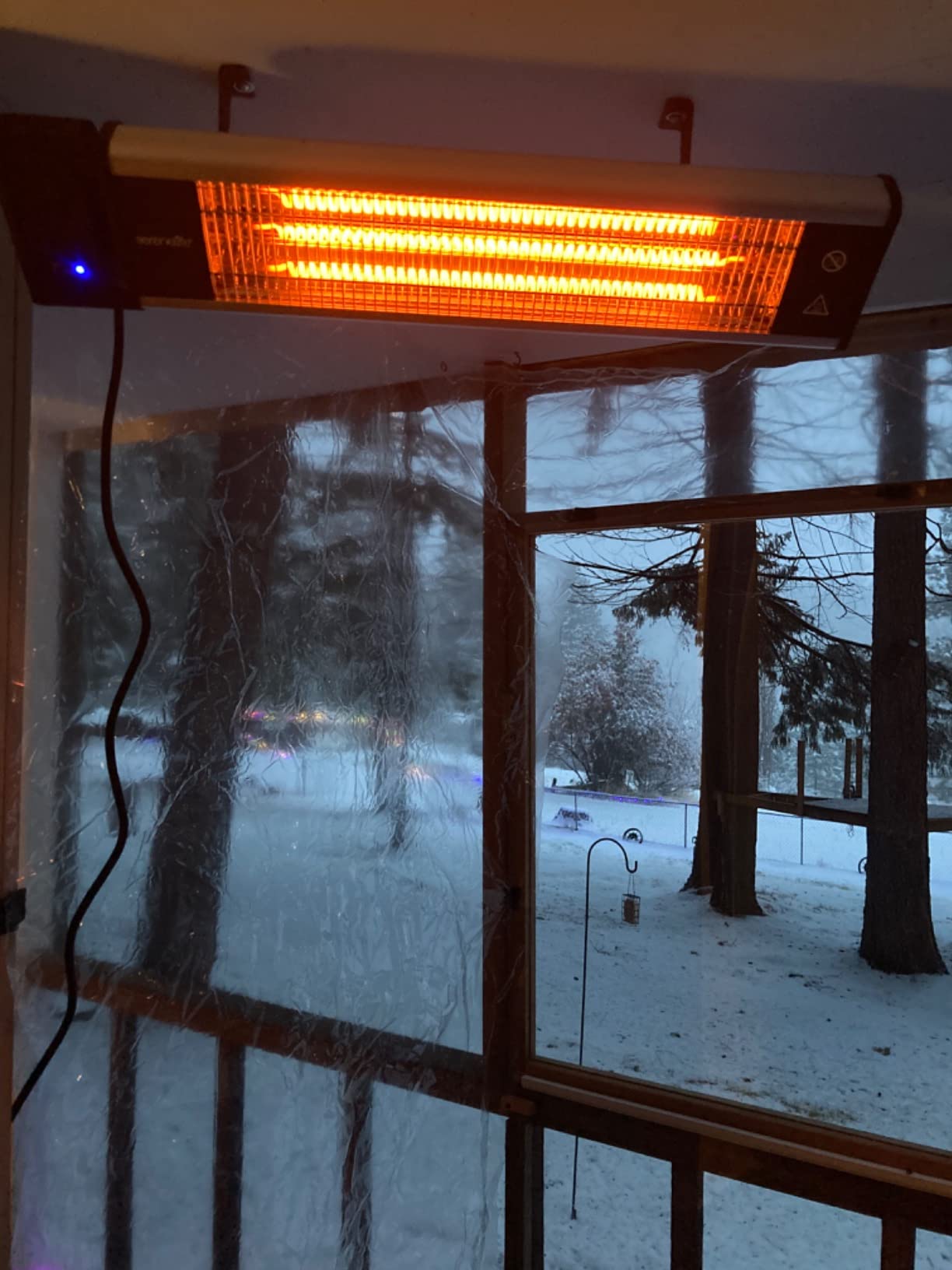
It hangs from the ceiling or mounts on a wall, and the brackets hold without sagging despite the unit weighing only 6.2 pounds. For a covered deck where the ceiling is the only surface you can safely drill into, that is a genuine advantage.
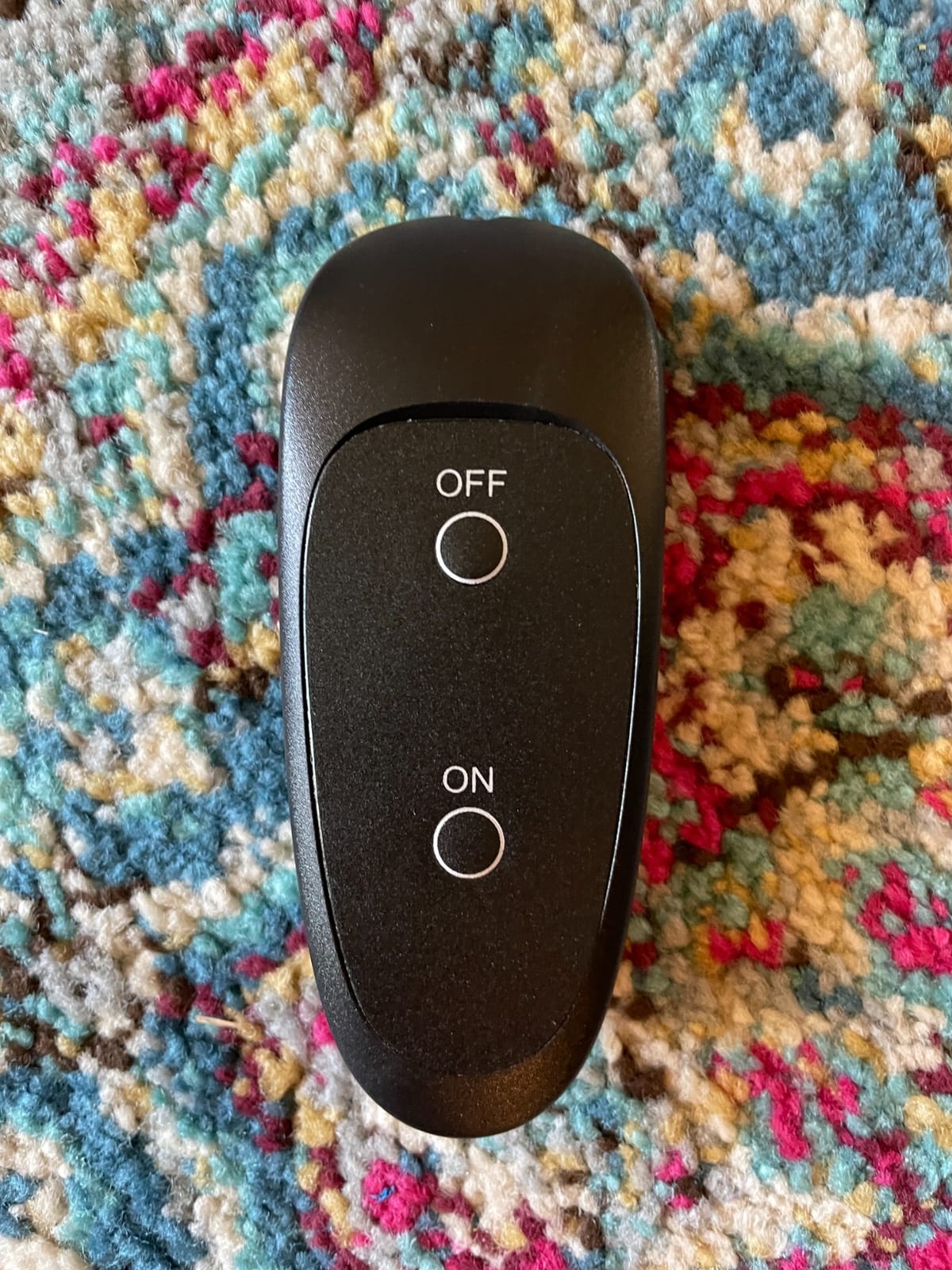
The listed coverage is 18 square feet, which sounds small and is honest. This is a close-range personal heater that works in a contained seating area, not a unit meant to warm a whole deck. The 120V plug and 12.5A draw mean no electrician is needed.
Two gripes recur. Standby mode shows a constant flashing blue light the remote cannot switch off, which matters in an evening setting, and a single heat level makes it hard to tune as the temperature drops through the night.
Best for a small seating nook
If your covered deck has one defined spot where people sit, the tight coverage is a feature rather than a limitation. It throws heat downward, so the people closest to it feel it first.
Where it falls short
Read the manual before first use. It ships with foam packing inserts, and owners report that leaving them in will burn the unit. The instructions are metric-only, and the mounting hardware is basic.
5. Nfccra 34-Inch Motion Sensor Heater – Best For Garages And Workshops
- Motion sensor switches off after five idle minutes
- Nine heat levels plus a nine-hour timer
- Vertical body is harder to tip than a horizontal one
- IPX5 waterproof frame that has run through winter
- Mounting template and built-in level gauge included
- Included mounting bolts can rust within months
- Some units have failed after about a month of use
- Base is not weighted so a breeze can knock it over
The motion sensor is the reason this one is worth knowing about. It switches on when people approach and cuts off after five minutes of no activity, which makes it the least wasteful unit here if your deck or garage is only used intermittently.
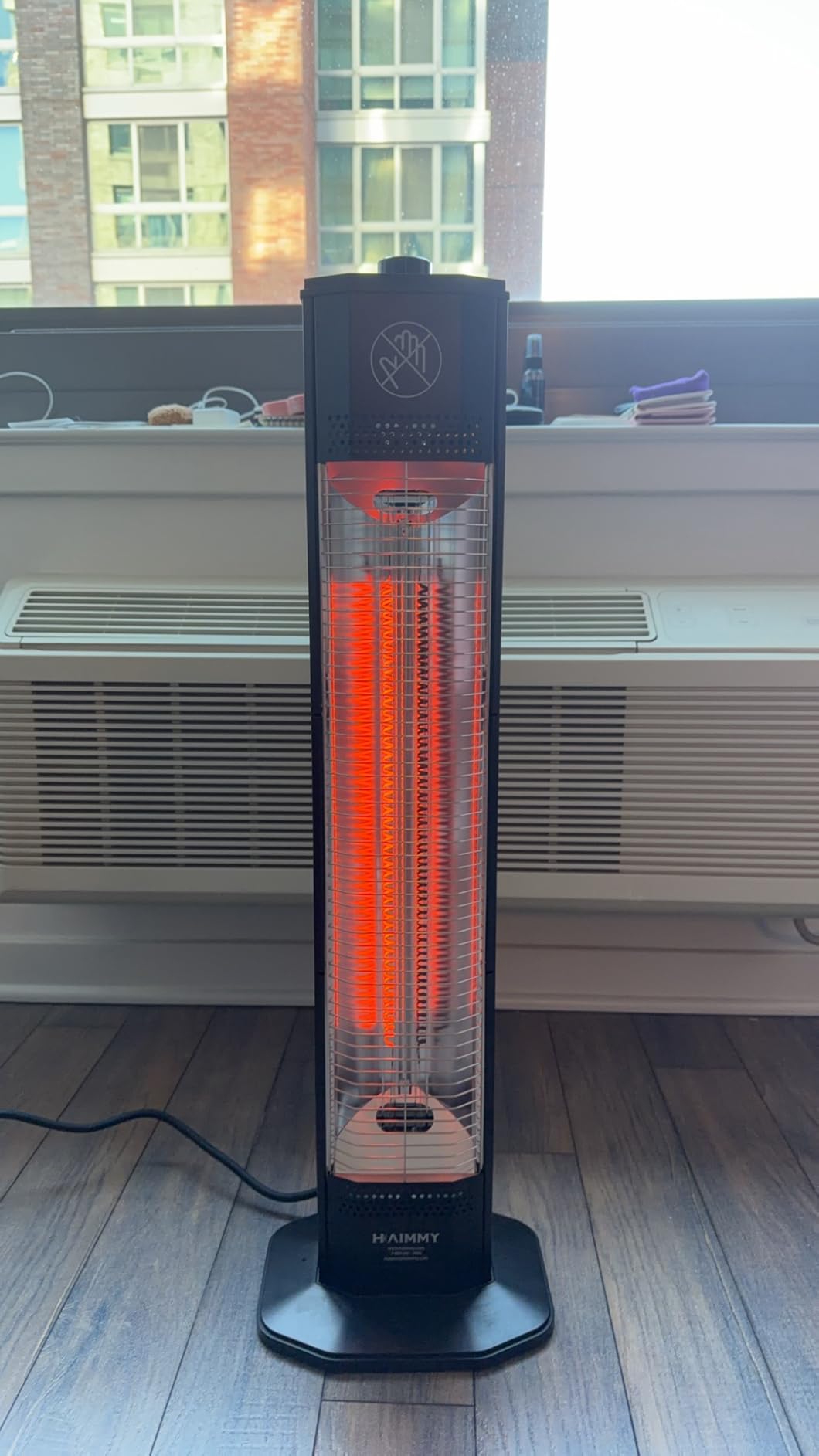
Control is unusually granular for a patio unit, with nine heat levels and a nine-hour timer, plus overheat protection and a UL-certified 6.6 foot flame-retardant cord. The vertical 34-inch format is also narrower than a typical bar heater, which suits a wall between a window and a door.
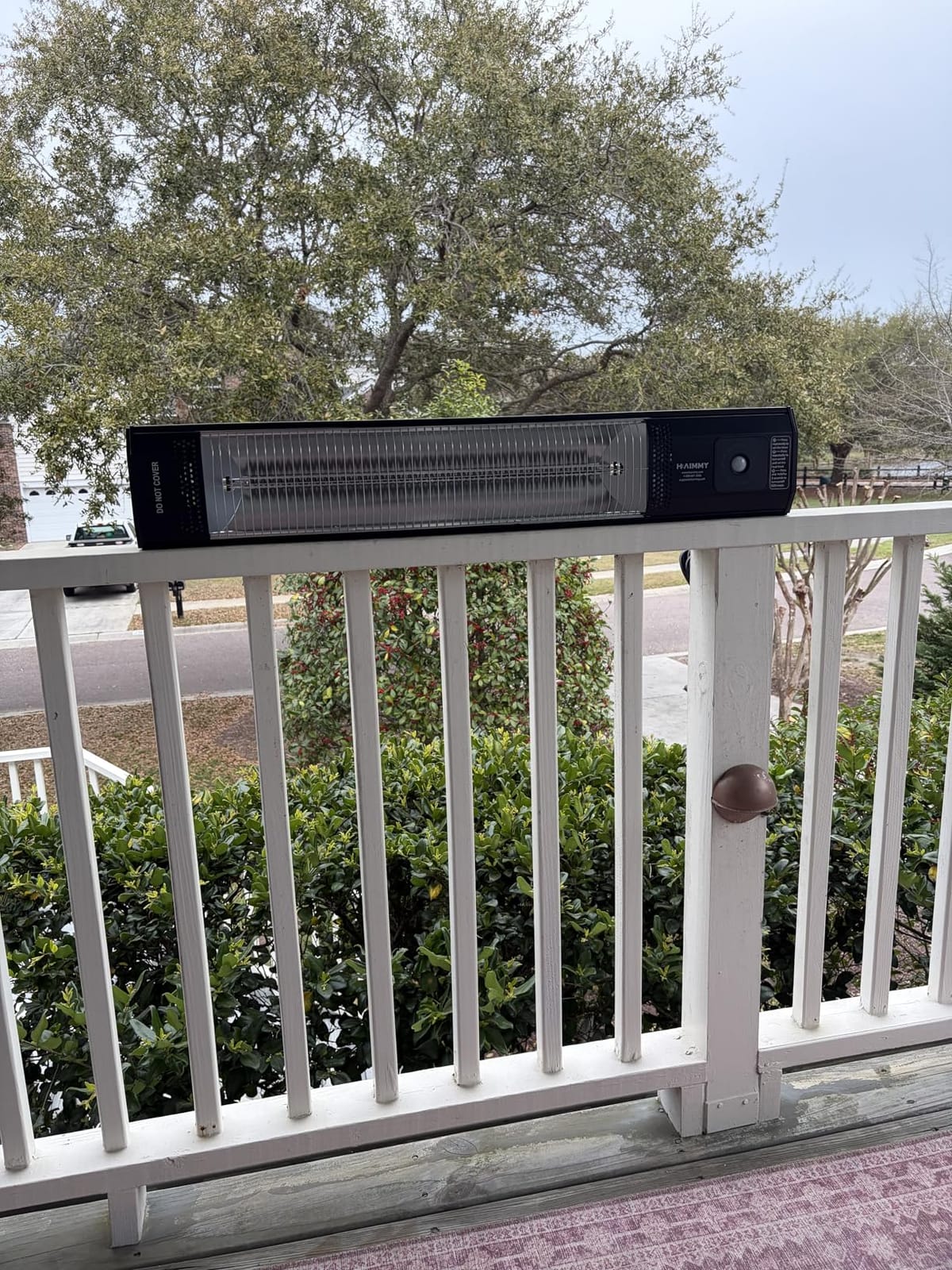
Be realistic about the pattern: 174 reviews at 4.2 stars, and the negative reviews concentrate on hardware rather than heat output. Owners in garages, basements and greenhouses report fast, even heating, but the supplied bolts are not stainless steel and can corrode within months.
Heat reaches roughly six feet in a narrow cone rather than a wide area, so aim it at a workbench or a specific seat rather than the middle of an open floor. The warranty is three years, replacement only.
Best when usage is unpredictable
A deck used on a whim wastes money on a fixed timer. This unit only draws power when the space is occupied, and the nine-level control lets you dial in a low output for a mild evening and full output when the temperature drops.
Where it falls short
The base is not weighted, so wind across an open deck can knock it over if it is not firmly bracketed. A small share of buyers also report units failing after about a month, which is worth weighing against the three-year replacement-only warranty.
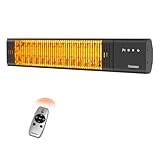
6. PowerScale 1500W – Best For Set-And-Forget Scheduling
- Heats in about two and a half seconds across four levels
- Memory function restores your last setting after a cut
- 24-hour timer with remote and touchscreen display
- IP65 waterproof build for four-season use
- Mounts on walls ceilings or gazebo frames
- Heat falloff is steep so you must sit close
- Power cord is shorter than ideal for some mounts
- Draws 14A which is close to a 15A outlet limit
The 24-hour timer and memory function are the story here. Set the heater to start an hour before guests arrive, and the memory function brings back your last setting after a power interruption instead of resetting to cold.
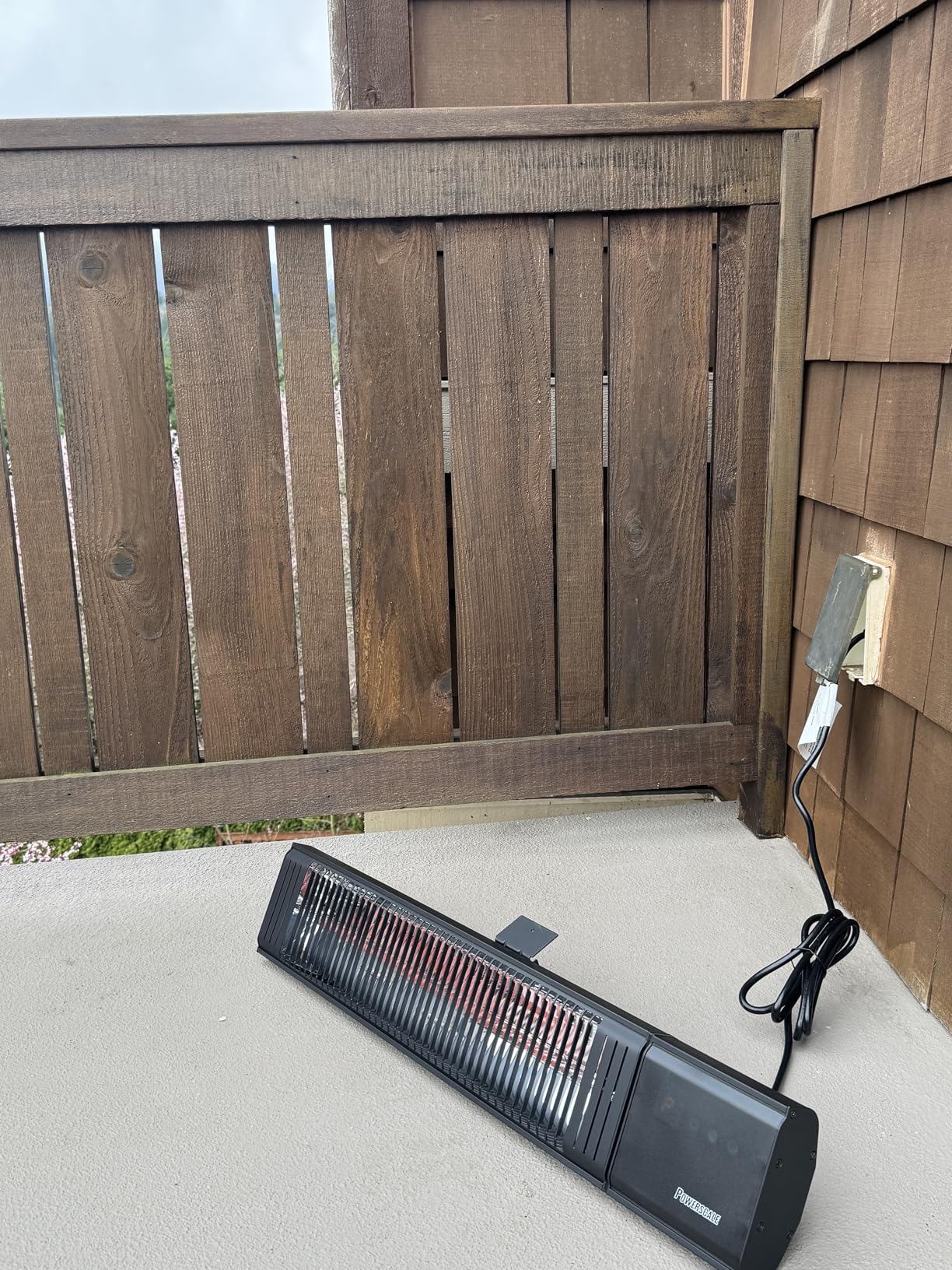
It is a 30 inch bar that mounts on a wall or a ceiling, rated IP65, and it runs four heat levels on a touchscreen with a remote in the box. Most buyers use it on a balcony or a small patio and value the instant heat over anything else.
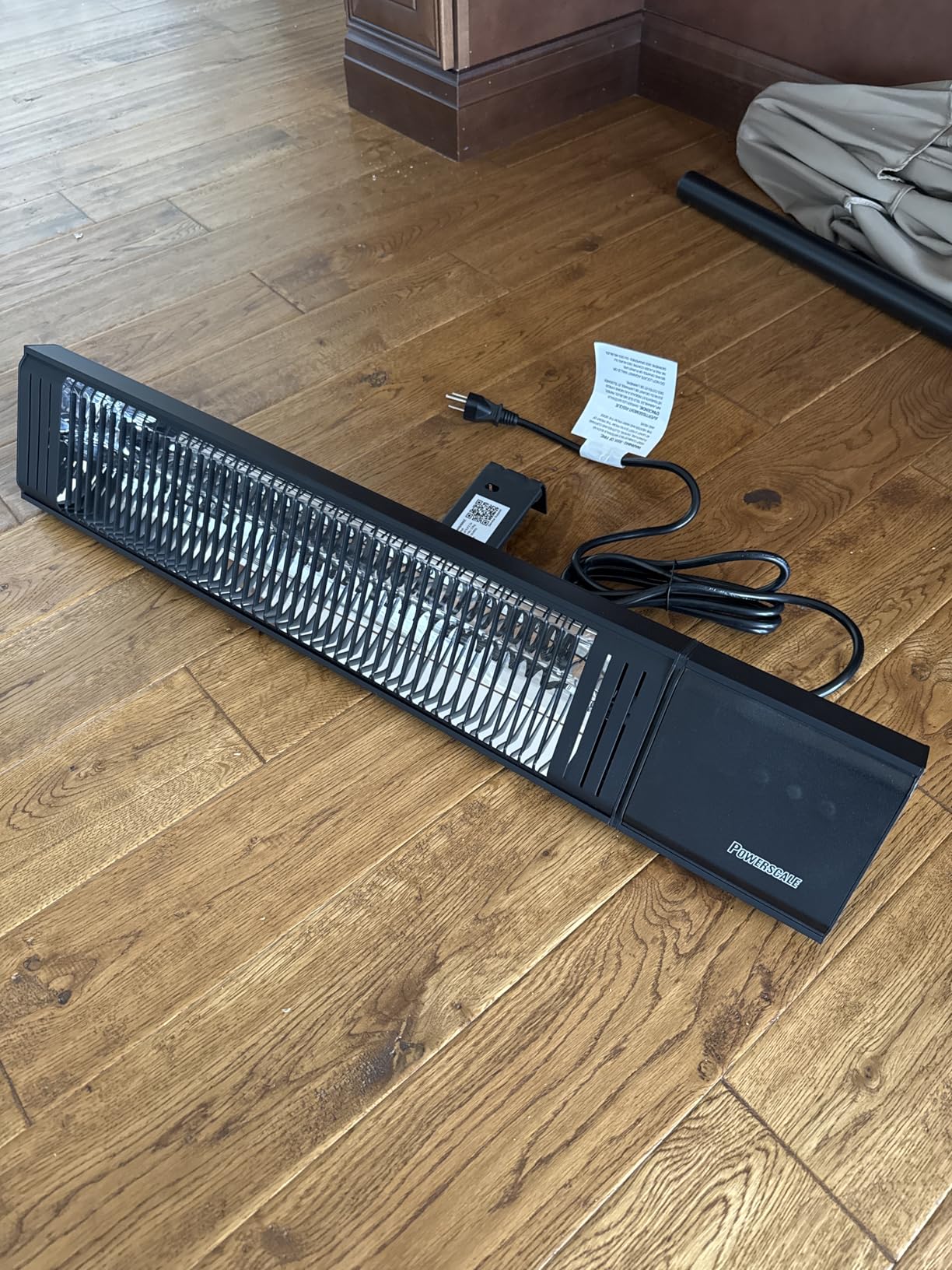
There is a real electrical caution here. At 14 amps on 110V it sits right at the edge of a standard 15A receptacle, and the critical reviews focus on that draw as much as on output. Use a dedicated circuit, not a shared one with a kettle or a sound system.
The other recurring note is that falloff is steep, so this is a sit-close heater rather than a deck-wide one. One buyer also reported a unit that stopped working within a week and got no response to a replacement request, which is a fair warning to keep your receipt.
Best for a predictable evening routine
If your deck use follows a pattern, scheduling is worth more than raw throw distance. This is the only unit in the group with a full 24-hour timer, and the memory function means a brief power blip does not end the evening.
Where it falls short
Four levels are fewer than some competitors, and the cord is short enough that outlet placement dictates the mounting spot. At 14A it is the least forgiving unit here on an existing circuit.
7. blessny 1500W Carbon Fiber – Best For Adjustable Wall Angles
blessny 1500W Wall Mounted Electric Heater for Outdoor Patio & Garage
- Heats in about three seconds with a carbon fiber tube
- IP65 waterproof aluminum shell and carbon fiber element
- Adjustable brackets allow diagonal positioning
- Completely silent operation
- Remote and touch control with a 24-hour timer
- No built-in thermostat
- only three fixed power ranges
- Remote needs two AAA batteries that are not included
- Heat is felt within roughly two to four feet
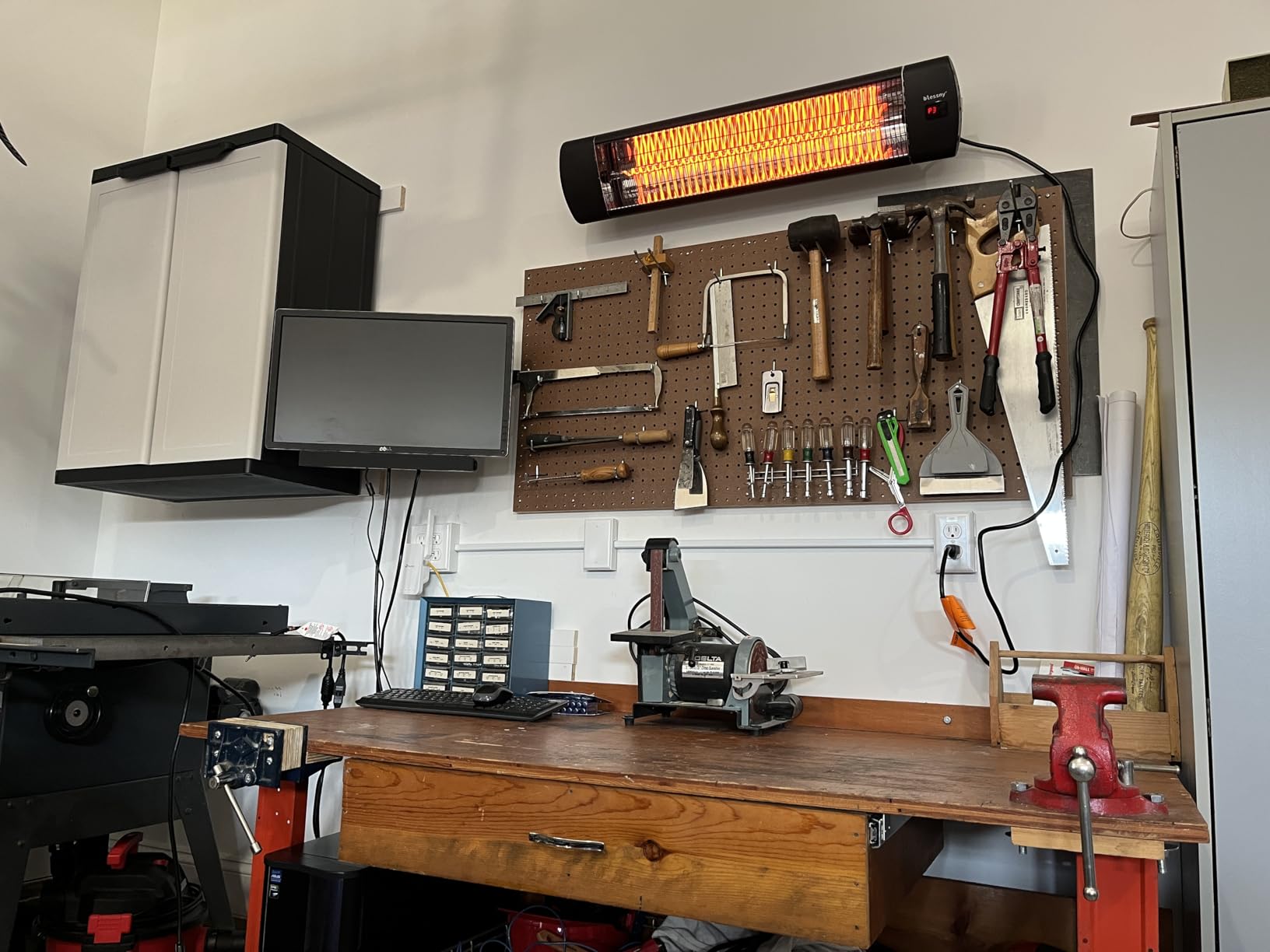
What stands out is the mounting hardware. The adjustable brackets let you install the unit at an angle, which matters on a deck where the best wall is not square to the seating. Owners describe build quality as better than the price suggests.
It is a vertical 34.3 inch unit with an IP65 waterproofed aluminum shell and a carbon fiber tube, rated at 1500W, and it heats in about three seconds. The 6 foot cord reaches a typical outdoor receptacle, and the three levels plus a 24-hour timer cover most evenings.
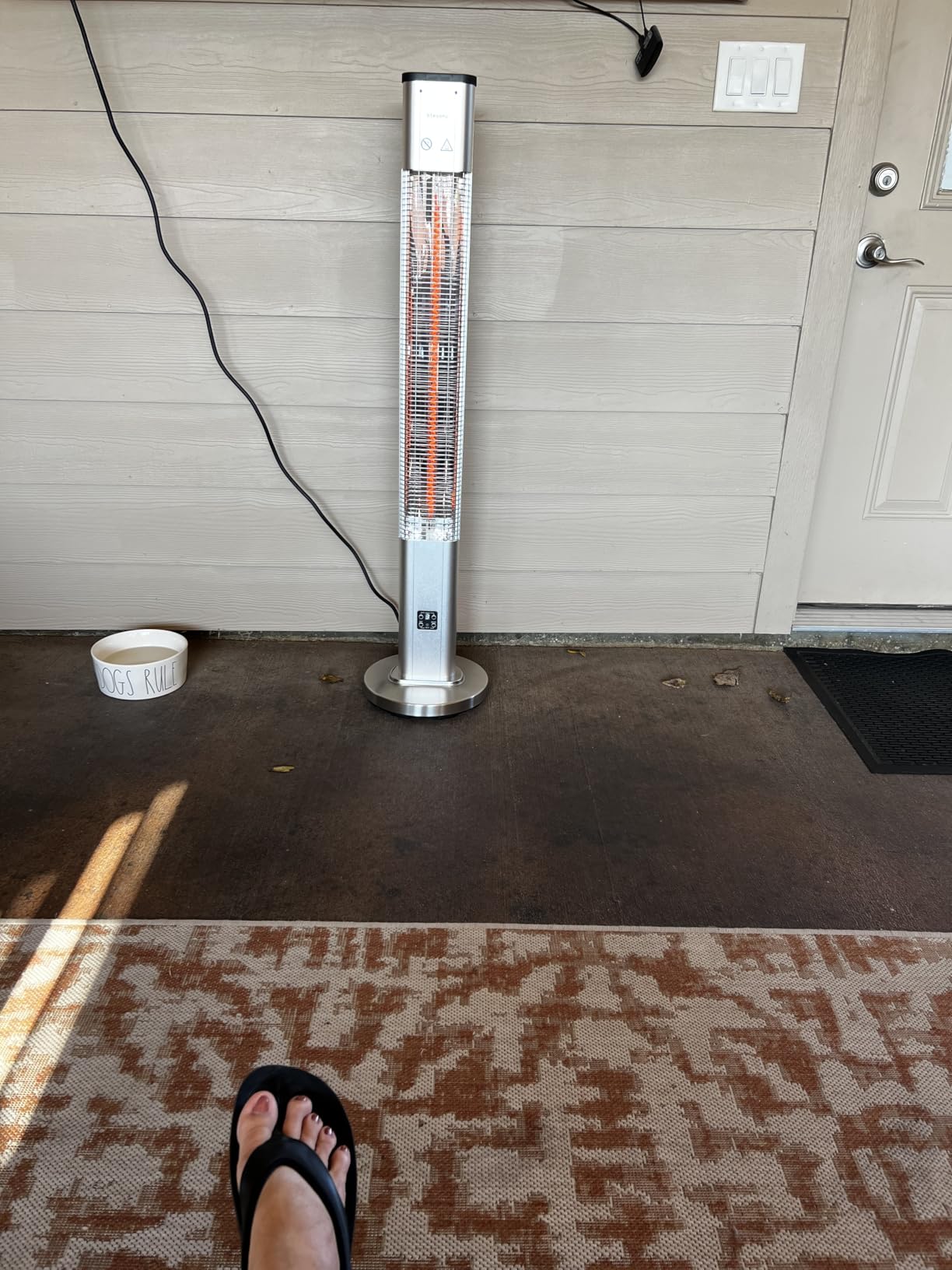
The most-cited limitation is the absence of a thermostat. Three fixed power ranges means you are choosing a level and living with it, and on a mild evening a lower setting exists only as a compromise rather than a controlled target.
Reviewers also use it to keep an unheated garage usable in winter and to warm an outdoor kitchen sink area, which tells you the real range is short. The documentation covers vertical-surface mounting only, with nothing on ceiling or overhead installs.
Best when the wall is not square to the table
Diagonal aiming solves the placement problem that owners on patio forums describe most often: mounting over windows heats your head awkwardly, and mounting square-on means the beam misses the seating. Angled brackets give you a third option.
Where it falls short
With only three fixed ranges and no thermostat, you cannot hold a steady comfortable temperature as the evening cools. The remote also needs two AAA batteries that are not in the box.
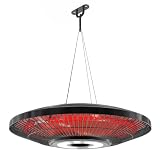
8. ThermoMate 1500W Ceiling Chain – Best For Hanging Over A Dining Table
Electric Patio Heater Outdoor, ThermoMate 1500W Infrared Hanging Heater Ceiling Mounted with Chain, IP65 Waterproof Outdoor Heater for Porch, Gazebo, Balcony, Black
- Ceiling chain mounting clears all floor space
- Carbon fiber element delivers fast quiet radiant heat
- IP65 housing has held up in rain snow and mist
- Adjustable chain sets the height the heat lands at
- Runs on a standard 120V outlet with no electrician
- Power cord is short at 3.2 feet so outlet placement matters
- Round housing is bulkier than a slim wall unit
- No smart or app connectivity
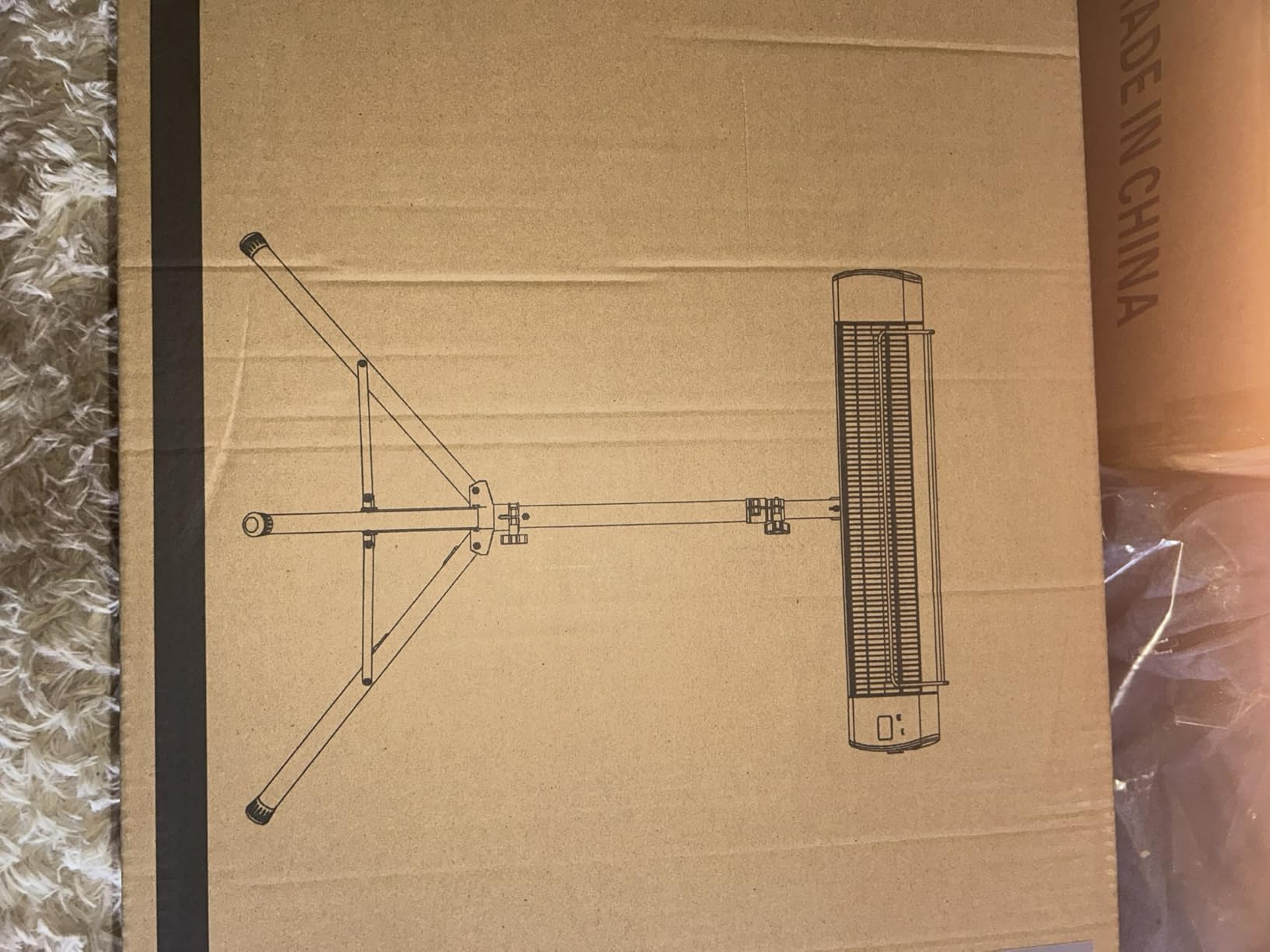
This is the only true ceiling-hung unit in the group, and the chain mount is the feature owners value most. On a covered deck, hanging it above the table keeps the entire floor clear, which matters when the same space has to work as a dining area and a walkway.
It carries the highest average rating in the roundup at 4.3 stars, and it uses a 1500W carbon fiber element with 360-degree dispersion, so the heat lands on the table rather than on one wall. Coverage is listed at 100 square feet, silent fanless running, two heat settings and a 24-hour timer.
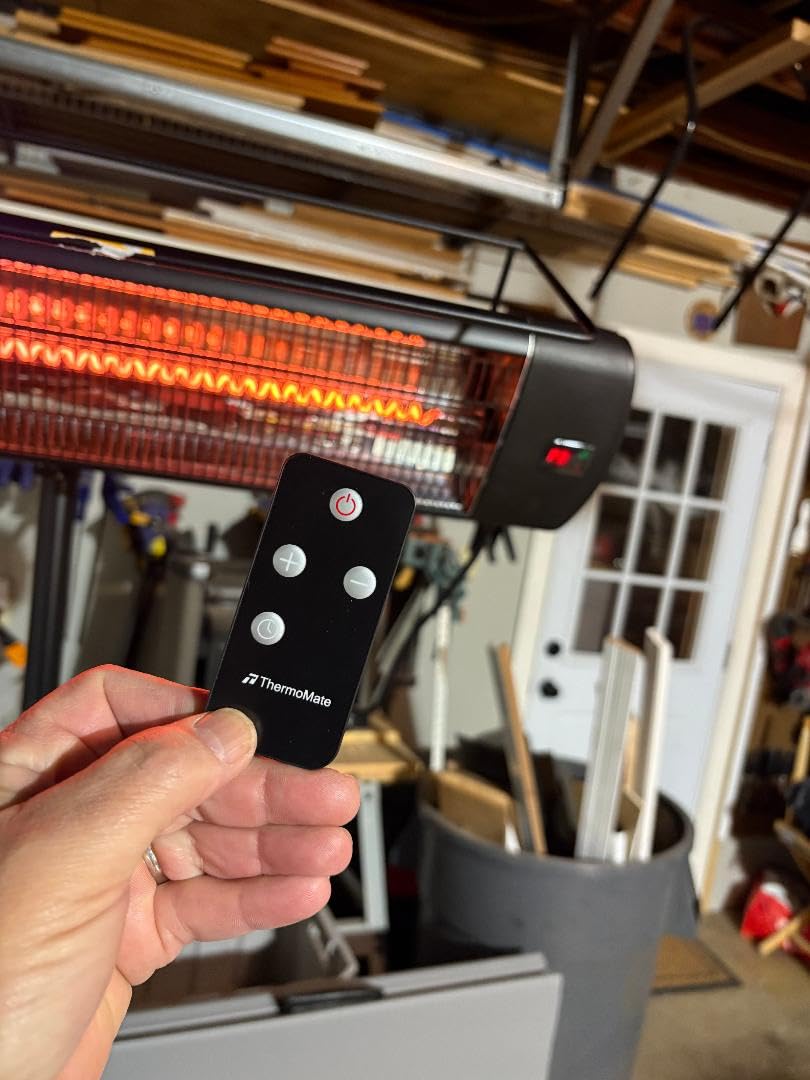
The adjustable chain is genuinely useful because it controls how close the heat lands. Hang it high and you warm a wide area gently; drop it lower over the table and the warmth concentrates on whoever is eating. It is a 120V plug-in unit, so no electrician is involved.
Owners do note that best results come from aiming directly at the seating, and several suggest running two of them to cover a larger area. The 3.2 foot cord is the practical snag, since you need a receptacle near the mount point.
Best when floor space is the constraint
If your covered deck doubles as a walkway or you have a tight dining zone, overhead mounting is the only option that leaves the floor free. The round housing is bulkier than a slim wall unit, so check it clears your beams.
Where it falls short
There is no app or smart connectivity, only the remote and the control panel. And with 63 reviews the sample is the thinnest here, so treat the claims as promising rather than proven over many seasons.
How Much Clearance Does An Infrared Patio Heater Need?
Electric infrared wall units commonly specify around 36 inches of clearance above the unit and 24 inches to each side, while flush-style electric models are sometimes approved for much tighter gaps. A purpose-built heat deflector can reduce the required distance substantially, sometimes by more than half. Always check the manual for the exact model, because the numbers conflict across brands and a forum poster on r/homeimprovementideas put it plainly: the clearance guidelines across these manufacturers are vague and inconsistent.
The practical rule for a covered deck is that the heat needs somewhere to go. If you have timber beams, composite decking or a fabric awning overhead, treat the nearest combustible surface as your ceiling measurement, and never rely on a vendor blog to override the manual in your unit.
A deck owner on r/Iowa with a 13 by 16 foot covered space considered three or four infrared units and was explicitly unsure the added weeks were worth the money. A poster running a heater with only 12 inches of clearance to a beam reported the beam reaching warm but not hot at chest height while everything else showed negligible change, which suggests tight clearances are workable in practice when output is right. The safer approach is to drop the mounting height or add a deflector rather than to ignore the spec.
120V Plug-In Or 240V Hardwired For A Covered Deck?
Choose 120V plug-in if you want this done in an afternoon. Every 1500W unit here runs at about 12.5A on 110V, which fits a standard household circuit, and our electric patio heater picks lean that way for good reason. You need a GFCI-protected receptacle for any damp location, and a dedicated circuit is still the right call.
Choose 240V when you want more heat from one box or you are wiring several units. A 3000W bar at 240V draws half the current that the same heat would at 120V, which means lighter wiring and less load on a crowded panel, but it does mean an electrician and a permit in most jurisdictions.
The common failure point is a panel that cannot take the load. A homeowner on r/Iowa described having no amperage capacity for electric heating, which pushed the decision toward propane, and that is a trade most people should refuse in an enclosed space because of the carbon monoxide question. If your panel is full, budget for a subpanel or install fewer, lower-wattage heaters instead.
One caution on extension cords: avoid them for fixed installations. If you must use one temporarily, it needs to be a heavy-duty outdoor-rated cord on their own circuit, and it is a stopgap rather than a permanent answer.
How Many Watts And How Many Units Does A Covered Deck Need?
Plan for 1500W per seating zone, not per square foot, because infrared heat works on line of sight. Listed coverage figures in this roundup range from 18 square feet for the SereneLife up to 100 square feet for the ThermoMate and 150 square feet primary for the Heat Storm, and outdoor coverage is always the smaller number.
Two smaller heaters flanking the seating area generally beat one large heater mounted at the end of the table. The people closest to the beam are the ones who get warm, and a wide deck has dead corners that no amount of wattage at one end will fix.
You can shorten the effective height of any ceiling-hung unit by lowering the chain, which concentrates the heat where people sit. That is the cheapest coverage improvement available, and it costs nothing beyond a pair of pliers.
Wattage tiers, honestly: 900W is a mild evening at close range, 1500W is the practical default for a 120V install, 2000W to 3000W is a 240V decision, and 4000W commercial heaters are for restaurant patios rather than residential decks.
IP Ratings Decoded For Covered Decks
IP ratings come in two halves. The first number rates solid particle protection and the second rates water ingress, so IP34 blocks objects above 1mm and splashing water, IP44 adds protection against water sprayed from any direction, IP55 protects against water jets, and IP65 adds dust-tight sealing and protection against powerful water jets. A covered deck needs at least IP44, and IP55 or above is the sensible target if rain blows in from the side.
Marketing copy that says outdoor rated is not a substitute for a printed rating, so check the spec sheet. Our editor’s choice is a good example of why: it is an excellent unit that the manufacturer lists for indoor use only.
Element type is the second decision. Carbon fiber elements run cooler to the eye and warm in seconds, which suits long evenings. Quartz and halogen elements throw more heat per watt with a brighter glow. Low-glare gold tube designs exist for people who dislike the orange light, and none of the units in this roundup uses one.
Are Infrared Patio Heaters Worth It? The Honest Temperature Check
Yes, in roughly the 45 to 70F band, which is exactly the range patio heaters are bought for. Below about 40F the output you can buy for a residential deck is not enough to make an uncovered-feeling space comfortable, and no amount of wattage changes the physics of radiant heat in a large open volume.
Running cost is easy to estimate without a table. A 1500W unit at 900W draws 0.9 kW, so three hours of evening use is about 2.7 kWh, and a full 1500W evening of four hours is 6 kWh. Electric radiant heat has no fuel tank, no maintenance visits and no carbon monoxide output, which is why it is the only sensible choice under a roof.
Storage is the part nobody mentions. Even an IP65 unit is rated to survive weather, not to sit wet and unpowered for a winter with debris in the reflector. Wipe the element and housing down, run it briefly to dry the internals, and cover it before it goes into storage.
If propane keeps coming up in your research, read our propane patio heater guide for the fuel-side comparison, but note that a combustion heater under a roof brings ventilation and clearance rules that electric avoids entirely.
Frequently Asked Questions
What is the best patio heater for a covered porch?
For most covered porches, a 1500W wall-mounted or ceiling-hung carbon fiber infrared unit on a standard 120V circuit is the best balance of heat, safety and easy installation. Electric radiant heaters produce no combustion gases, which makes them the only heater type we would use under a roof, and a 120V plug-in avoids hiring an electrician.
Are patio heaters safe on a covered porch?
Electric infrared heaters are the safest option for a covered porch because they have no flame and produce no carbon monoxide. Safety still depends on correct mounting: keep the manufacturer clearance above the unit and to each side, treat timber beams as the effective ceiling, mount on a GFCI-protected outlet, and never use a gas heater in an enclosed covered space without ventilation.
How much clearance do you need above a patio heater?
Electric infrared wall units commonly specify about 36 inches of clearance above the unit and 24 inches to each side, though flush-style electric models can be approved for tighter gaps and a purpose-built heat deflector can cut the required distance substantially. Always follow the manual for your exact model, and measure to the nearest combustible surface such as a beam or fabric awning.
How many square feet does a 1500 watt infrared heater cover?
Realistic outdoor coverage for a 1500W infrared unit is roughly 20 to 100 square feet of usable seating area, and the listed figure depends on the mounting. SereneLife lists 18 square feet for its hanging unit, ThermoMate lists 100 square feet for its ceiling chain model, and Heat Storm lists 150 square feet primary for its indoor-rated wall cabinet. Treat the smallest figure as the honest one for outdoor use.
Does a 1500 watt infrared heater use a lot of electricity?
A 1500W heater on its highest setting draws 1.5 kW, so three hours of use is about 4.5 kWh. That is modest for a room heater because radiant units are commonly run at a lower level or switched off once people are warm. Most 120V models draw roughly 12.5A, so plan a dedicated circuit and a GFCI-protected outlet.
Are infrared patio heaters worth it?
They are worth it in the 45 to 70F range, which is what patio heaters are actually for. Below roughly 40F no residential electric heater makes a large open deck comfortable, because radiant heat warms people in line of sight rather than raising air temperature. Two heaters flanking a seating area work better than one large heater, and electric costs far less than propane over a season.
The Best Infrared Patio Heaters For Covered Decks In 2026
Our editor’s choice, the Heat Storm HS-1500-PHX-WIFI, pairs the most proven build in the group with app control and a thermostat, which makes it the easiest unit to live with, and you should only deploy it under a roof that is genuinely sheltered. For real outdoor duty, the Dr Infrared DR-239 at 3000W delivers the most heat per box if your panel can take a 240V circuit, and the Briza wins on flexibility with its three mounting styles.
For hanging above a table, the ThermoMate ceiling chain is the one to buy, and for a close-range budget install the SereneLife covers a small seating nook at IP65. Check your circuit, measure to the nearest beam, and then enjoy the best infrared patio heaters for covered decks through another season of shoulder evenings.