
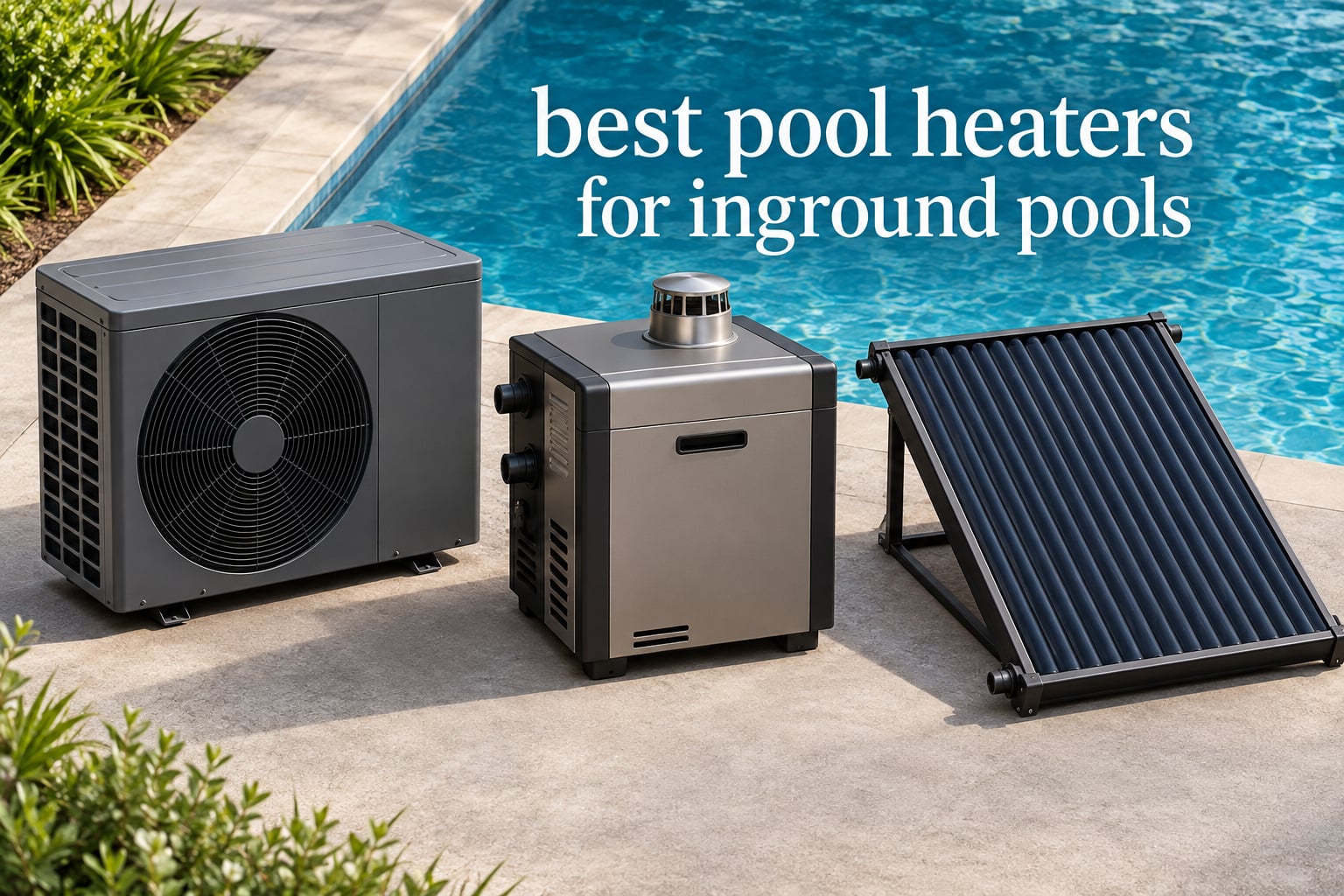
If you want the short answer before you read anything else, the AQUASTRONG HEX100 inverter heat pump is the best all-around pick among the best pool heaters for inground pools we looked at, and the Raypak 266,000 BTU digital gas heater is what to buy when you want the water warm tonight rather than warm next week. What we would skip is any small electric element heater sold for above ground pools, because element units run at roughly the same energy cost as electric heat and have the worst owner ratings in this group.
I have maintained inground pools on both coasts for years, and this roundup is built the way I actually make these decisions: published specifications, manufacturer documentation, service-network reality and a large body of owner reports. To be straight with you, we did not lab-test ten heaters in a test tank. Nobody does. These picks come from specs plus what thousands of owners report after living with the same equipment, which is the honest basis for a purchase at this level.
Ten heaters made the cut, split across the classes that actually work for an inground pool: air-source heat pumps, gas heaters, and solar collectors. Each review below covers who it suits, who it does not, and the practical detail that decides whether it installs cleanly on your pad. If you have not looked at our broader pool heater overview, start there for the fuel-type fundamentals, then come back for the model-by-model detail.
Top 3 Inground Pool Heaters for 2026
These three are the ones I keep coming back to, and each wins for a different reason. The AQUASTRONG is the best balance of capacity, efficiency and features. The Varpoolfaye is the quietest large-unit option with the biggest gallon rating. The Raypak is the only pick here that gets a mid-sized pool genuinely warm in an afternoon.

AQUASTRONG HEX100 Heat Pump
- DC inverter compressor
- 15.8 COP
- Heating and cooling
- App control

Raypak 266000 BTU Gas
- 266000 BTU natural gas
- Digital spark ignition
- No residual heat retention
All 10 Pool Heaters for Inground Pools at a Glance (2026)
Every pick in one place, with the specification that matters most for each. Fuel type is the first filter, because a gas heater and a heat pump are not substitutes for one another in cold climates.
| Product | Specifications | Action |
|---|---|---|
| AQUASTRONG HEX100 Inverter Heat Pump |
|
Check Latest Price |
 Varpoolfaye 140000 BTU Inverter Heat Pump Varpoolfaye 140000 BTU Inverter Heat Pump |
|
Check Latest Price |
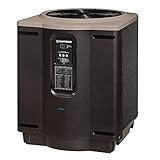 Hayward HeatPro 140000 BTU Heat Pump Hayward HeatPro 140000 BTU Heat Pump |
|
Check Latest Price |
 Hayward HeatPro W3HP50HA2 Heat Pump Hayward HeatPro W3HP50HA2 Heat Pump |
|
Check Latest Price |
 WARMBLU 28000 Gallon Inverter Heat Pump WARMBLU 28000 Gallon Inverter Heat Pump |
|
Check Latest Price |
 MICOE 100000 BTU Inverter Heat Pump MICOE 100000 BTU Inverter Heat Pump |
|
Check Latest Price |
 FibroPool FH270 70000 BTU Heat Pump FibroPool FH270 70000 BTU Heat Pump |
|
Check Latest Price |
| Raypak 266000 BTU Digital Gas Heater |
|
Check Latest Price |
 Hayward H-Series 250000 BTU Gas Heater Hayward H-Series 250000 BTU Gas Heater |
|
Check Latest Price |
 SolarPoolSupply DIY Solar Heater Kit SolarPoolSupply DIY Solar Heater Kit |
|
Check Latest Price |
Best Heat Pump Pool Heaters for Inground Pools
Heat pumps are the default choice for almost every inground pool owner, and the reason is simple physics. A compressor pulls heat from ambient air and moves it into the water, so a model advertising a COP of 12 to 16 delivers roughly that many units of heat per unit of electricity consumed. Gas heaters make heat from scratch, which is fast but expensive to run. The trade-off is speed: a heat pump adds temperature slowly on a cold day, while a gas burner recovers heat in hours.
Two practical limits shape every recommendation in this group. Heat pumps draw on outside air, so their output falls as the air gets colder. And most residential heat pumps top out around 140,000 BTU, which is well below what a large pool needs to come up from 60 degrees in a weekend. Both limits are why heat pumps extend a season rather than create one.
1. AQUASTRONG HEX100 Inverter Heat Pump – Best Overall
- Largest owner feedback base of any heater here at 534 reviews
- Heating and cooling in one cabinet
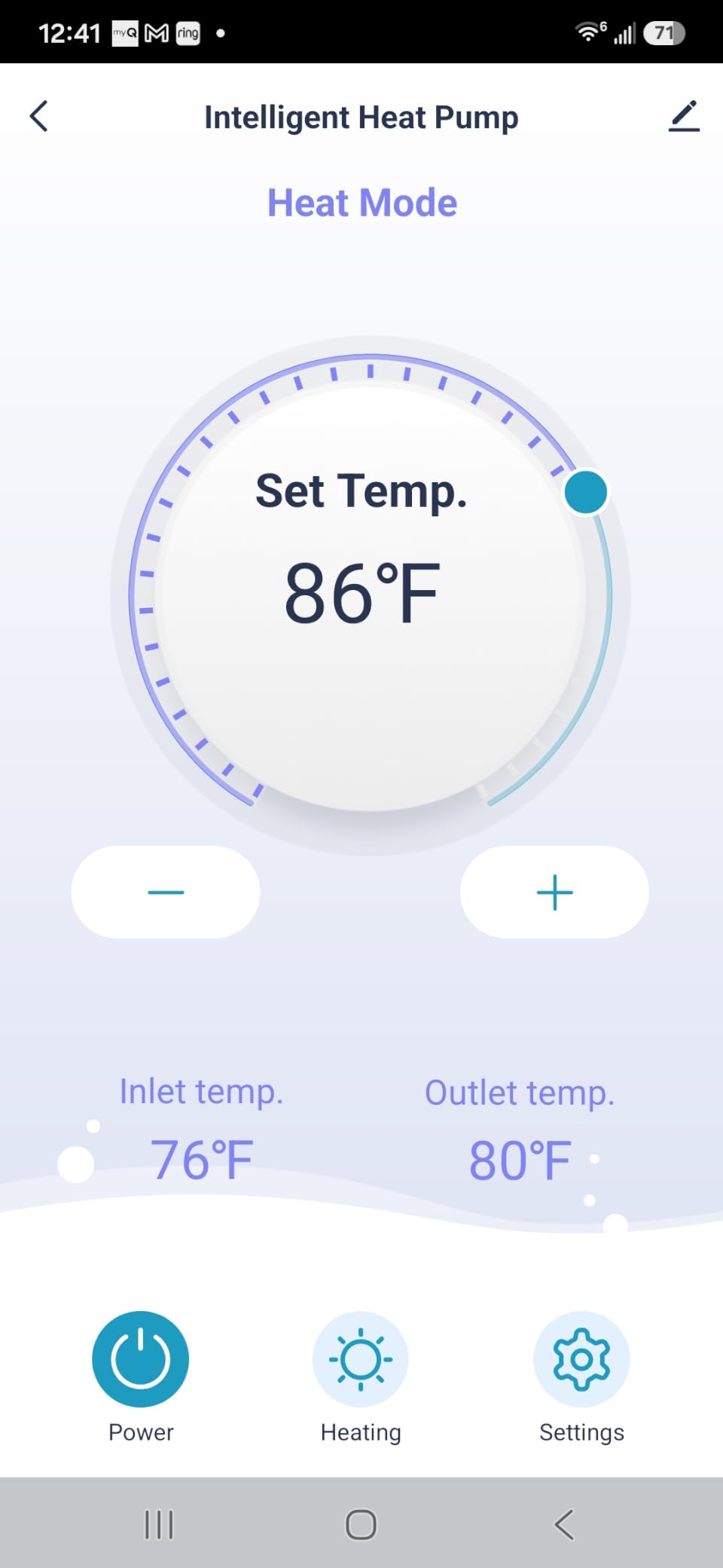
- App and control panel for remote scheduling
- Full DC variable frequency inverter for steady output
- Weighs 116.8 lb
- the lightest large heat pump in this group
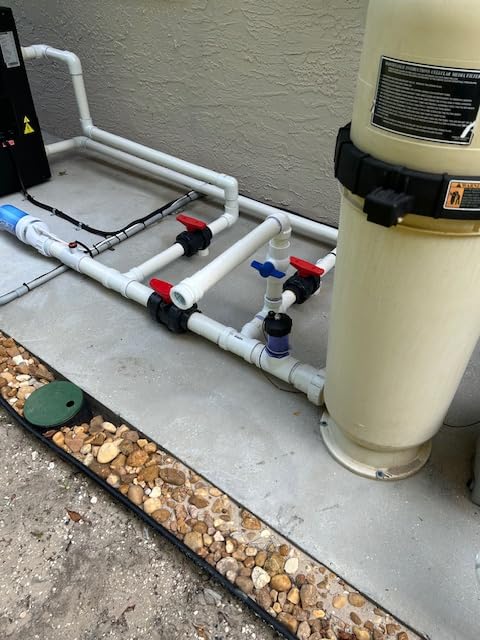
- Needs a discharge valve to set flow rate or it sweats heavily
- WiFi pairing is fiddly on the first attempt
- 11% of reviews are 1-star
The HEX100 ranks at the top of the swimming pool heat pumps category, and the reason is not marketing. It is a full DC variable frequency inverter compressor with a claimed COP of 15.8, which puts it among the most efficient hardware you can put behind a pool. It runs at 55 dB, so it does not carry across a yard the way a refrigeration compressor does.
What I like most is the dual-mode side of it. It heats from 47F up to 104F and cools from 47F down to 83F, which means one cabinet handles both the cold shoulder season and a Florida August when the water goes past comfortable. Most competitors in this list are heating-only.
The owner feedback base is the strongest signal here. With 534 reviews averaging 4.3 stars and 74% at five stars, this is the pick with the largest body of real installations behind it, and 74% of owners reporting five stars is not a pattern you see on a lottery ticket. The recurring positive notes are genuine heat gain, app control and quiet inverter running.
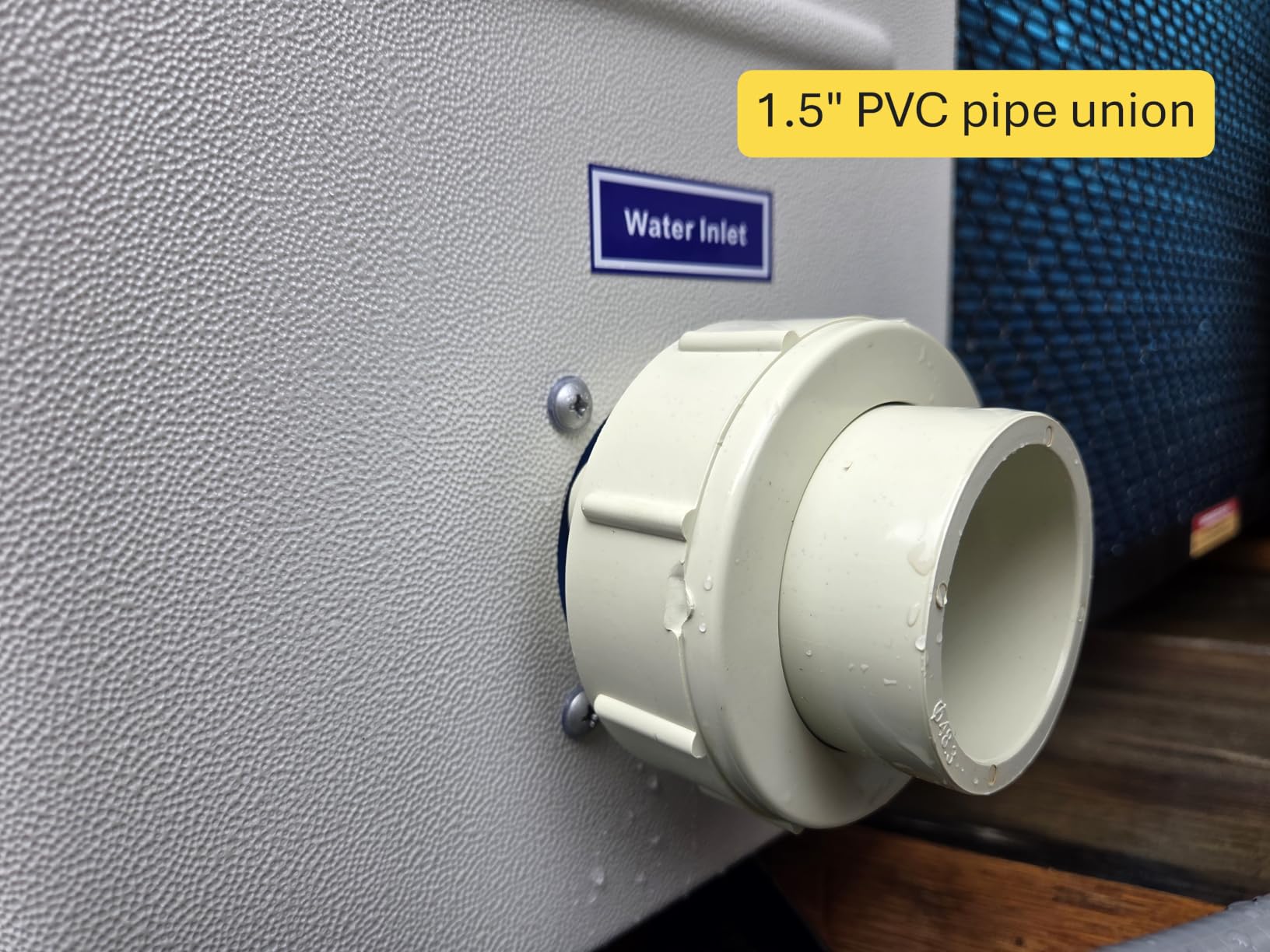
The single most useful piece of advice owners repeat is about flow. If water moves through the unit too quickly, it condenses and drains out of the bottom. Fit a discharge valve and set it properly during install and you remove that problem entirely. Then there is the app WiFi pairing, which takes a couple of attempts for most people on day one and works fine forever after.
Why this one wins our top spot
Three things put it ahead of the field: the largest owner review base in the group, the only heater here that both heats and cools, and inverter compressor efficiency at a level usually reserved for higher-priced hardware. Add the app control and you get a heater you can set once and mostly forget.
The catch is honest but manageable. Eleven percent one-star reviews is not negligible, and most of those trace back to installation and flow rate rather than a dead unit. Get the plumbing right and this is the safest purchase in the roundup.
Where it is the wrong choice
If your pool sits above roughly 26,000 gallons, an inverter heat pump in this class will not get you a fast heat-up in early spring. The owner-reported reality is days of running, not hours, and that matters when you have a booked weekend coming up.
It is also not for anyone without somewhere to run plumbing and power. There is no fuel option, so the pad, the plumbing and a dedicated circuit are the whole installation.
2. Varpoolfaye 140000 BTU Inverter Heat Pump – Most Compact Large Inground Option
- Quietest operating noise here at 47 dB
- 140000 BTU at the top of the residential heat pump range
- Works in both freshwater and saltwater pools
- Inverter mode intended to extend compressor life
- WiFi app for scheduling and mode switching
- 336 lb
- the heaviest in this roundup
- Needs a properly built 220 V circuit
- Condensation draining from the base is normal and needs planning
This is the one I would put next to a bedroom wall. At 47 dB it is the quietest unit in the roundup by a clear margin, and the top-mounted air outlet is the reason. If your equipment pad sits close to a house or a neighbor’s fence, that number is worth real money in complaints avoided.
Capacity is the other headline. At 140,000 BTU with a claimed COP of 12.8, it sits at the practical ceiling of what a residential air-source heat pump can deliver. Owners rate it 4.4 stars from 149 reviews with 78% at five stars, which is one of the cleanest profiles among the large-capacity models here.
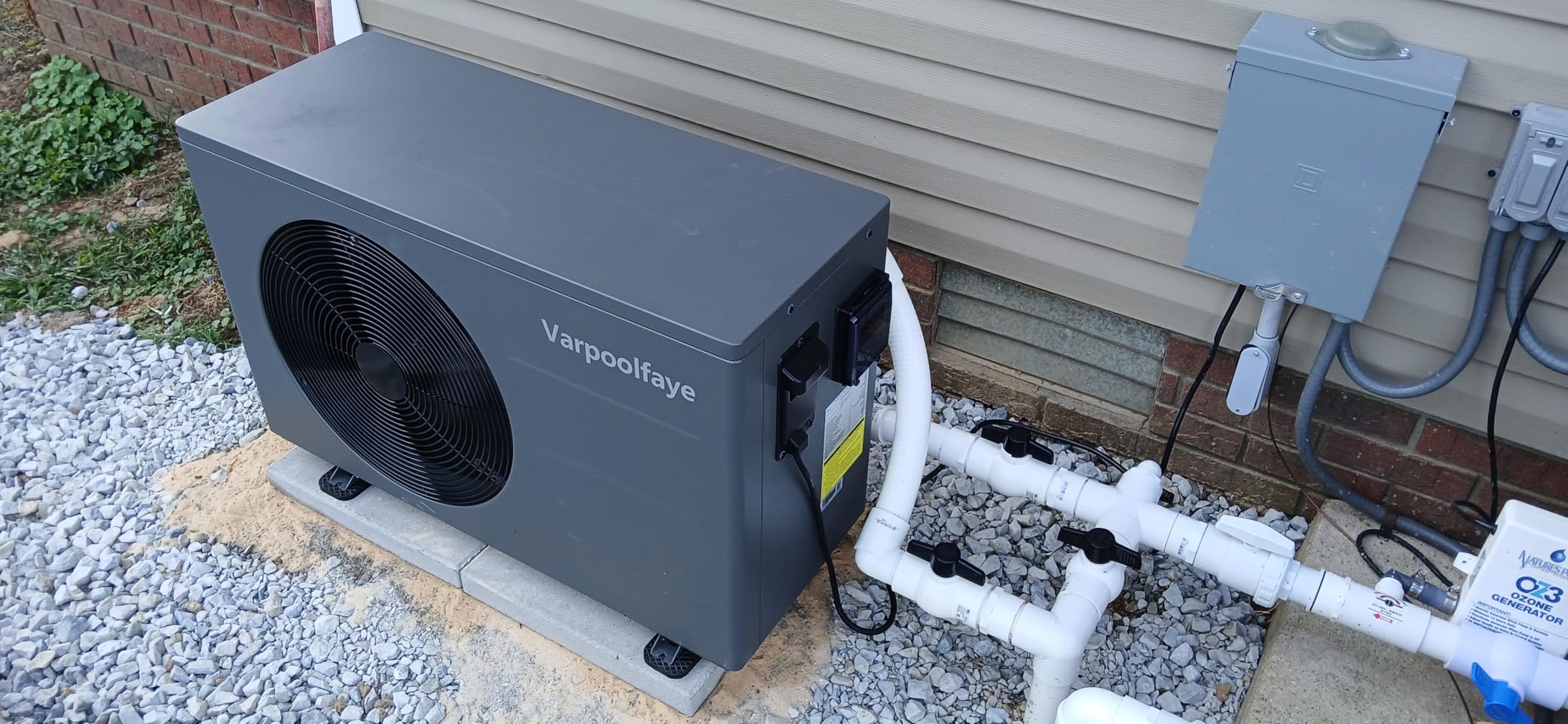
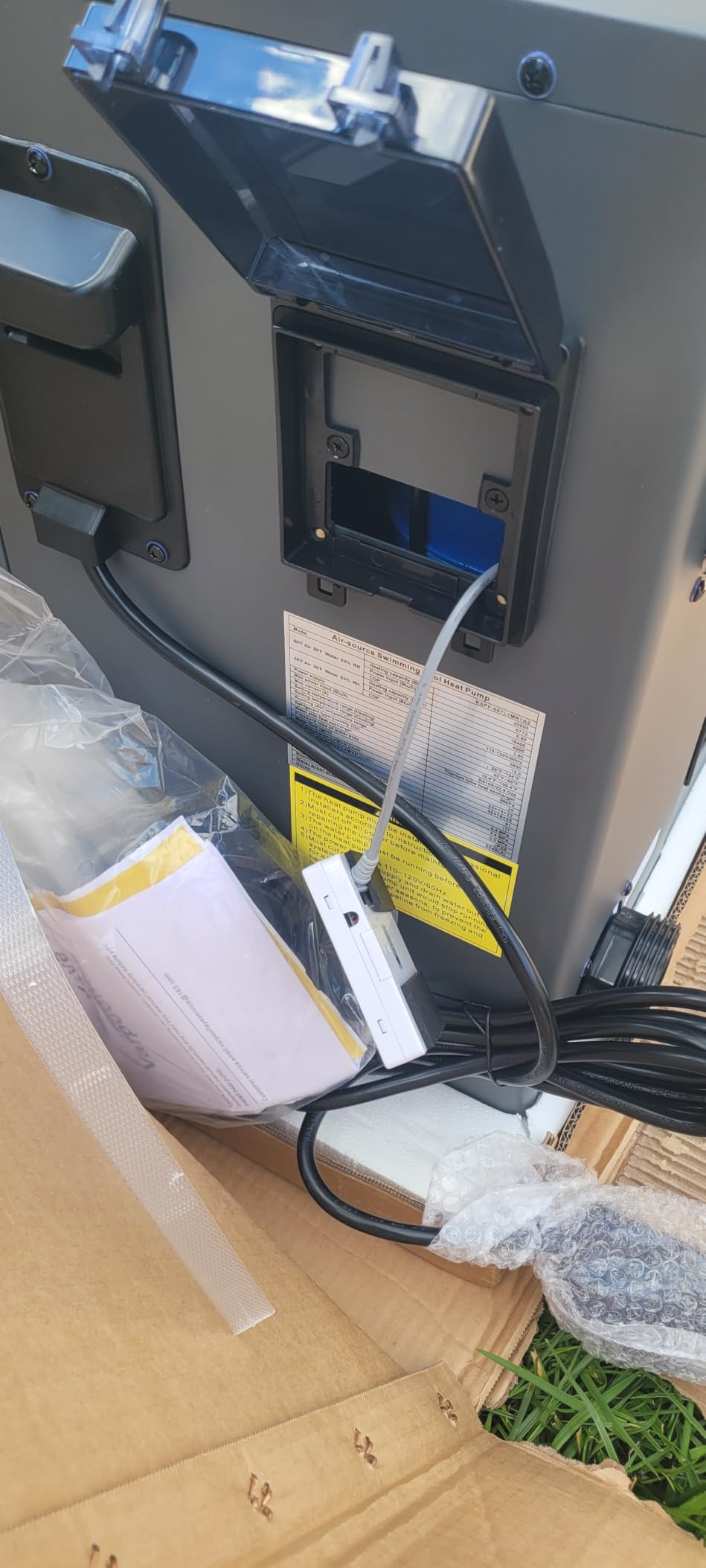
Two details make it more interesting than the spec sheet suggests. It is rated for both freshwater and saltwater, which removes the guesswork for chlorinated salt pools. And the included 1.5-inch connectors mean fewer trips to the supply house mid-install, which is where weekend installs usually go wrong.
The honest drawback is weight. At 336 pounds this needs two people and a dolly to get onto the pad, and you should plan the plumbing path before it arrives rather than after. The manufacturer also recommends professional installation given the circuit requirements, which is good advice.
Best fit for large pools and noise-sensitive pads
If you have a big residential pool, a saltwater system, or neighbors within earshot of the equipment pad, this is the pick. The gallon variants run up to 42,000 gallons, well past what the other heat pumps in this list claim to cover.
The 47 dB figure is not marketing rounding. Owners consistently describe it as near-silent compared with older heat pumps, and the variable-speed inverter means it does not cycle on and off loudly the way single-speed compressors do.
Where owners report friction
Condensation coming out of the bottom of the unit is normal, not a fault. Decide in advance where that water goes, because a puddle that drains toward your pool shell is a chemistry problem you did not ask for.
Heat output still falls in cold ambient air. Without a cover, the difference between a covered and uncovered pool is the difference between extending your season and watching the compressor struggle.
3. Hayward HeatPro 140000 BTU Heat Pump – Best for Saltwater and Coastal Pools
Hayward HeatPro Pool Water Heat Pump Heater for Inground Pools, 140,000 BTU
- Titanium heat exchanger resists salt water and chemical corrosion
- Built specifically for coastal and harsh environments
- No gas line
- propane tank or venting to install
- Large 140000 BTU output for regular inground use
- 320 lb and physically large on the equipment pad
- 4.1 stars with 14% of reviews at 1 star
- No app connectivity or smart control listed
This is the one to buy if your pool is within a few miles of salt water. The titanium heat exchanger and Ultra Gold corrosion-resistant body are not marketing language here, they are the reason to spend more than a generic heat pump in a coastal zip code. Salt-laden air destroys cheaper cabinets in a few seasons.
At 140,000 BTU it also solves the capacity problem better than most. Hayward built it for inground pools used regularly, which means it is designed for the maintenance-heat job of holding a temperature rather than chasing a fast recovery.
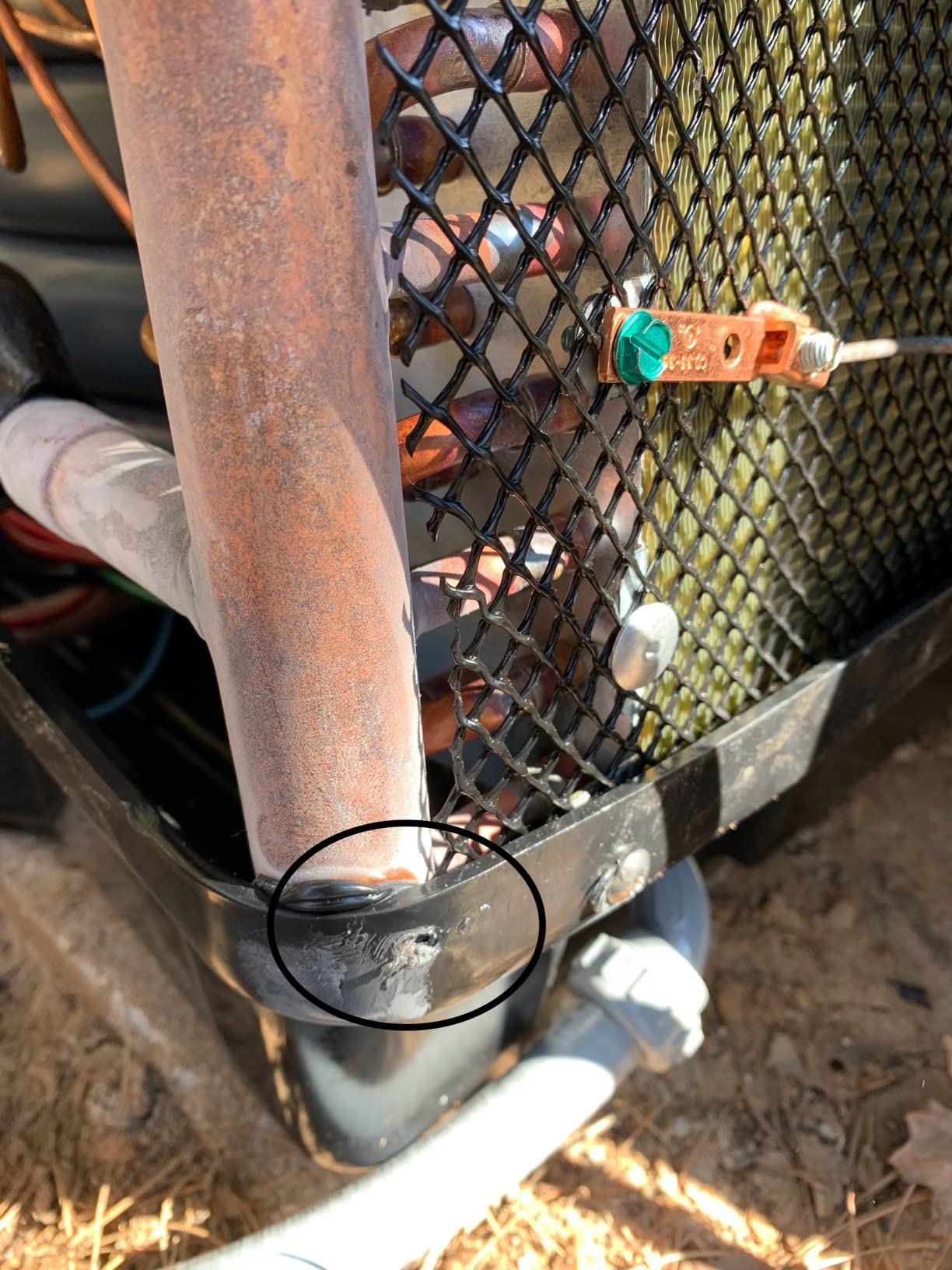
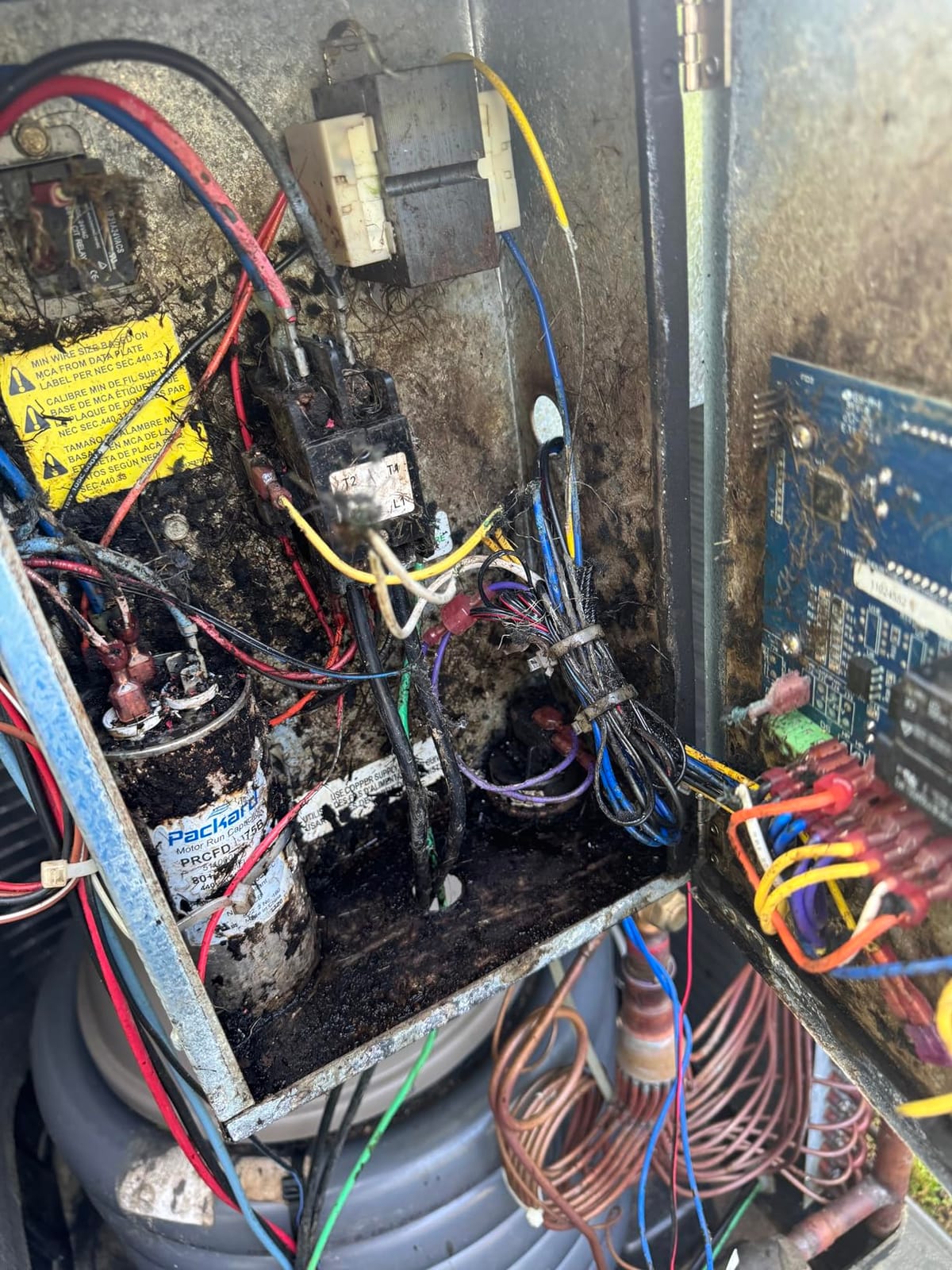
Owner feedback splits in an interesting way. Seventy percent of the 114 reviews are five stars and the praise centers on economical air-source heating and the corrosion-resistant construction. The 14% one-star cluster is mostly about long-term durability in demanding service, which is the honest downside of putting any large compressor outdoors year after year.
One thing you will not get here is app control. There is a digital display, but no listed WiFi or smart features. If you have already wired your pool equipment into a home automation system, that is a real gap in this pick.
Best pick for salt spray and coastal air
Choose this if you are within a mile or two of the ocean, or if your pool uses a saltwater chlorinator. The titanium exchanger and corrosion-resistant panels are the differentiator, and no other heat pump in this roundup markets to that environment this explicitly.
It is also a good fit for anyone who wants a heater with no fuel infrastructure at all. No gas line, no propane tank, no venting, no combustion air.
Where it falls short
At 320 pounds and 40 by 31.5 by 50 inches, it is one of the bigger boxes on the list. Make sure your pad has the footprint before the truck arrives, because moving it later is a two-person job.
Its 4.1 average sits at the lower end of this group, and the one-star share suggests some owners hit reliability problems later in life.
4. Hayward HeatPro W3HP50HA2 Heat Pump – Best for Modest Inground Pools
- Quiet rotary compressor and low noise fan
- Titanium heat exchanger resists corrosion
- Digital panel with temperature display
- AHRI certified and independently lab tested
- Recognizable brand with an established service network
- Lower capacity than the larger HeatPro in this roundup
- Air source output drops as ambient air cools
- 11% of reviews are 1-star
This is the smaller sibling of the Hayward HeatPro above, and for a modest inground pool it may be the smarter buy. The rotary compressor and low-noise fan make it genuinely quiet, and the titanium exchanger gives you the same corrosion story in a lighter package at 159.7 pounds.
AHRI certification and independent lab testing matter more here than most spec sheets suggest. It means the published performance was verified by a third party, which is a useful anchor when you are comparing against brands that only print marketing numbers.
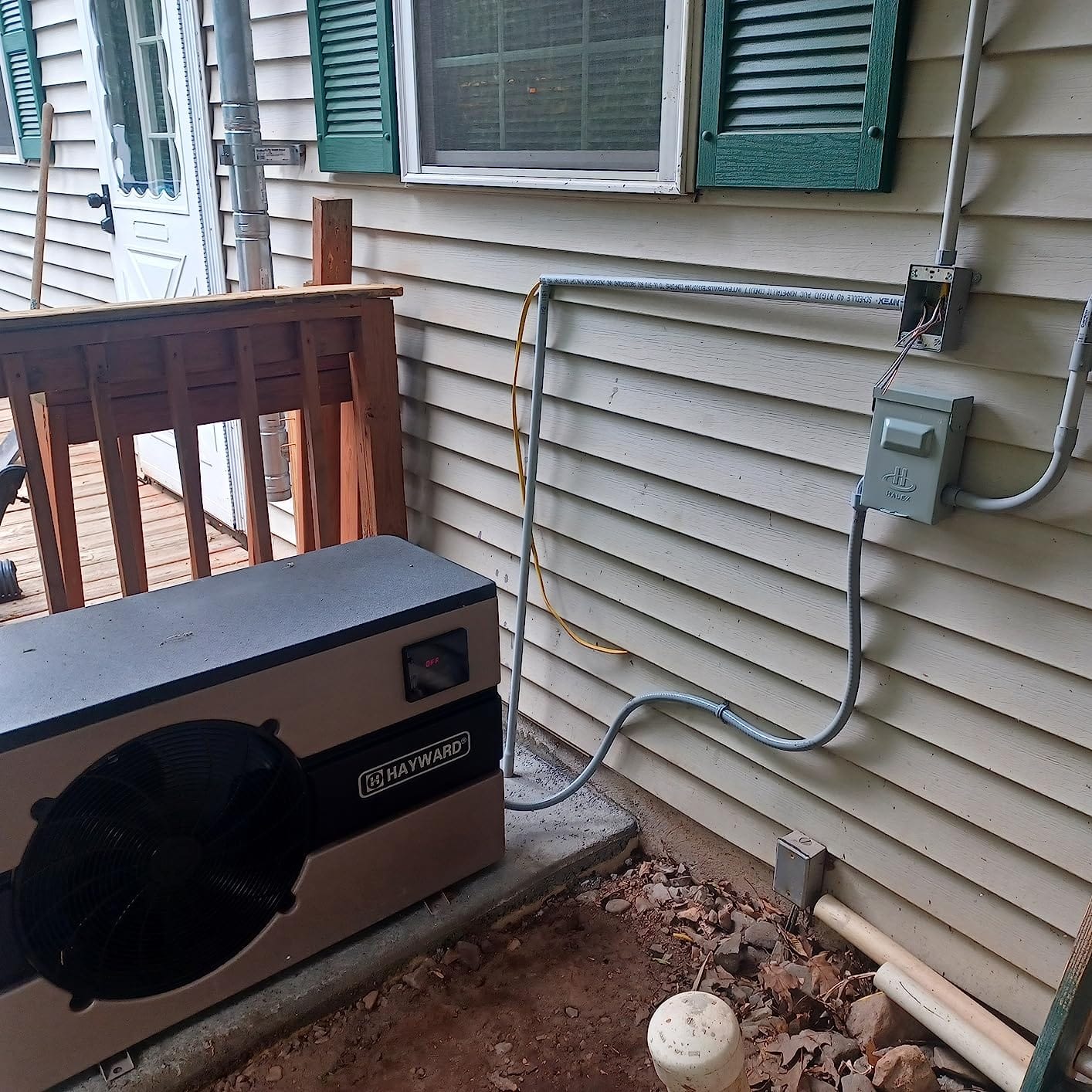
Owners rate it 4.2 stars from 76 reviews, with 72% at five stars. The value argument is the quiet compressor and the simple digital panel, plus the fact that Hayward service parts are easy to find anywhere in the trade. That last point matters more than people expect when something fails.
The limitation is capacity and nothing else. This is a moderate-pool heater, not a large-residential one, so if your pool is above roughly 15,000 to 20,000 gallons you will want more output than this provides. And like every air-source unit, its output shrinks in cold weather.
Best value for mid-size inground pools
Pick this when your pool is on the smaller side and quiet operation is the priority. The 159.7-pound weight is a fraction of the 320-pound Hayward above, which matters if your pad access is tight or your installer charges by the lift.
The AHRI certification and the well-known brand also make parts and service easier to source years from now. That long-term support is underrated until the first repair.
Where it will disappoint
If you have been planning to heat a full-size residential pool fast, this will not do it. Output is sized for a modest inground pool, and stretching a small heat pump across a big pool means watching it run for days.
Expect reduced performance on a genuinely cold day. Air-source heaters draw on ambient heat, so a heat pump’s weakest showing is always in the shoulder season when you most want it.
5. WARMBLU 28000 Gallon Inverter Heat Pump – Best for Large Residential Pools
WARMBLU 28,000 Gallons Inverter Pool Heat Pump for Inground Pools 220V
- Explicitly rated for pools up to 28000 gallons
- Pure titanium heat exchanger with COP up to 16.0
- Draws about 1.3 kW or 6 amps while heating
- Under 50 dB
- quieter than a refrigerator
- Responsive customer service including parts replacements
- Roughly 220 lb
- needs two people to move
- Flow must be regulated with a discharge valve
- Smart Life app WiFi pairing is frustrating
- 12-month warranty is short for the class
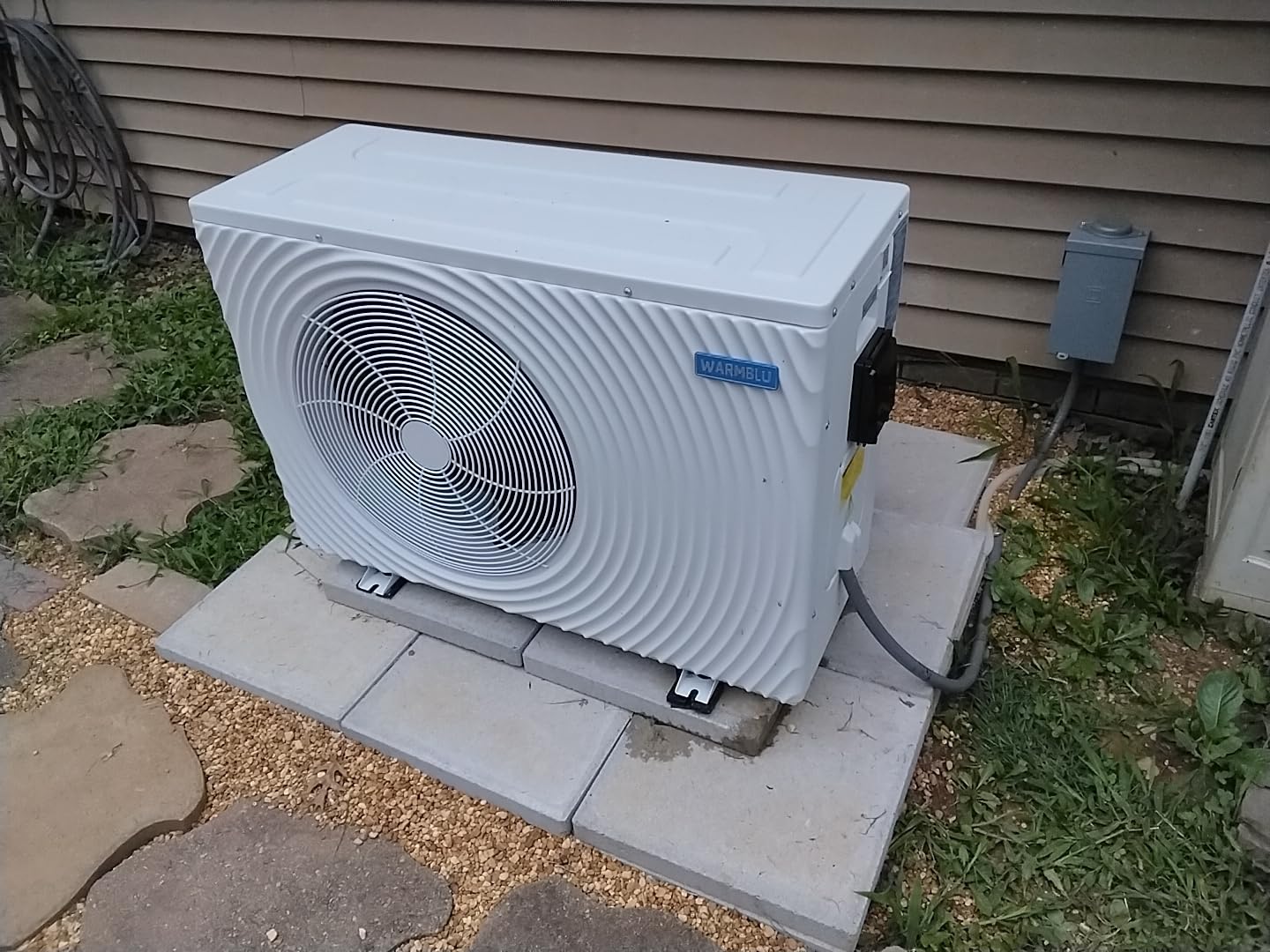
The WARMBLU claims a 28,000-gallon capacity, which covers the large inground pools that most 70,000 and 100,000 BTU models cannot reach. Owners report lifting a 13,000 to 15,000 gallon pool from the high 60s into the mid-80s in roughly a day.
The efficiency claim is the part I would scrutinize. A claimed COP up to 16.0 and a real-world draw of about 1.3 kW while heating are the numbers to check against your own utility bill after a month, because a COP of 16 only shows up in mild, dry conditions.
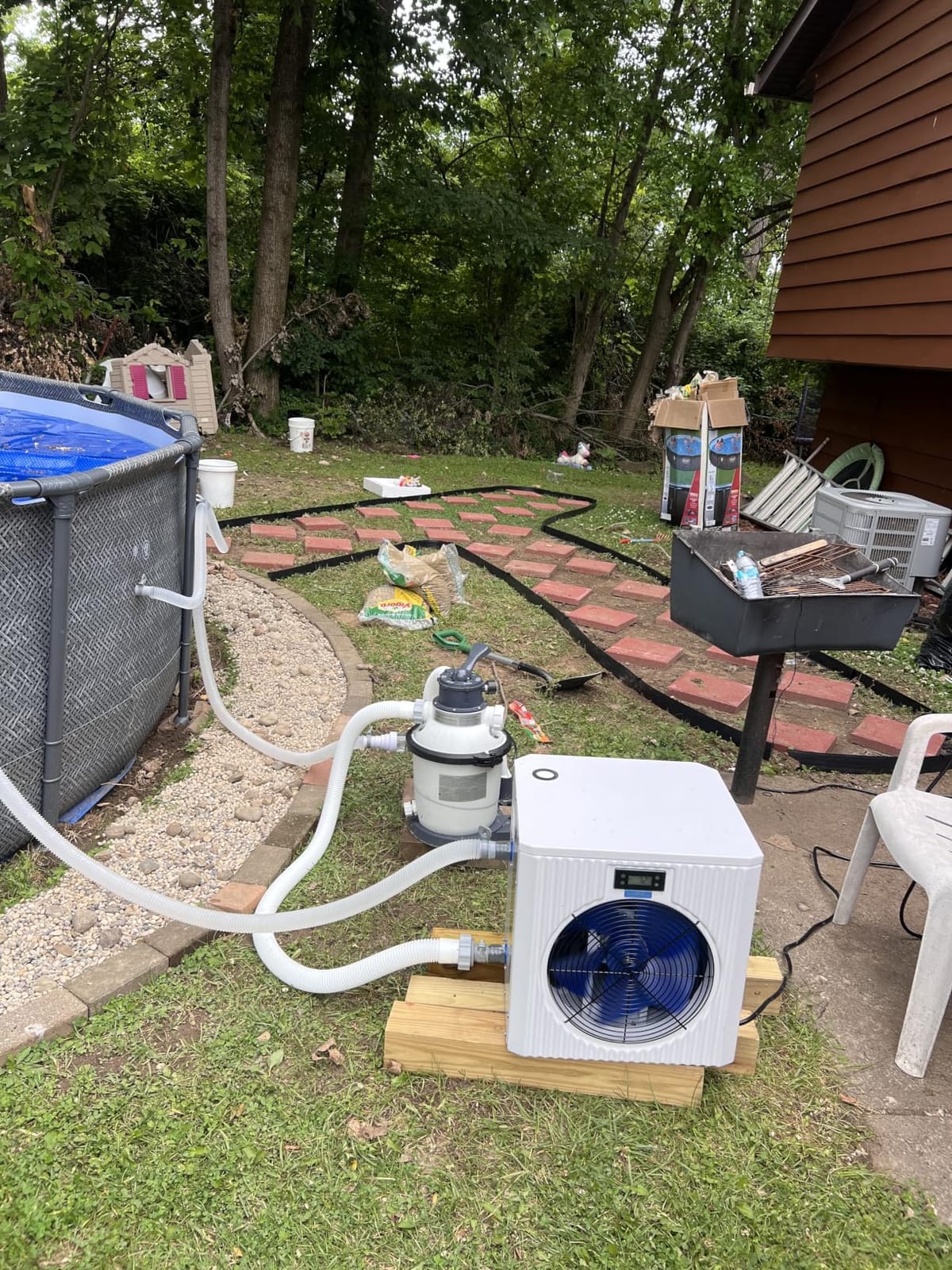
Three things stand out in the owner reports. It runs below 50 dB and owners compare it favorably to a refrigerator hum. It heats and cools in one cabinet, which matters in Florida where keeping water under control in summer is half the battle. And customer service is repeatedly described as responsive, including replacements for a broken fan blade and a faulty unit.
There are real drawbacks, and the warranty is the biggest. Twelve months is short next to the three-year coverage on the AQUASTRONG and the two-year parts warranty on the MICOE. On a compressor of this size, that difference is worth thinking about before you pick a winner.
Best fit when gallons are the constraint
Owners of large pools should look here first. The 28,000-gallon rating covers pools where the 70,000 and 100,000 BTU models simply stop short, and the 1.3 kW draw keeps the running demand modest.
It is also a good dual-season pick for warm states, where the heating and cooling modes in one cabinet simplify the equipment pad.
Where owners report friction
Install a flow-regulating discharge valve or the unit produces condensation that drains out the bottom. Several owners learned this the hard way and it is the single most common complaint pattern with this style of machine.
Expect app setup friction with the Smart Life app, and budget for a two-person lift at 220 pounds. A small number of these also failed with a 3e error code, including one factory replacement.
6. MICOE 100000 BTU Inverter Heat Pump – Best for Heating and Cooling Control
MICOE 100,000 BTU Inverter Pool Heat Pump for 26,000 Gallon Pools
- Heating and cooling from 46F to 104F and 45F to 82F
- Automatic defrost for cold weather operation
- Very quiet variable speed running at about 54 dB
- Support described as unusually responsive with 24/7 live chat
- Two year parts replacement warranty
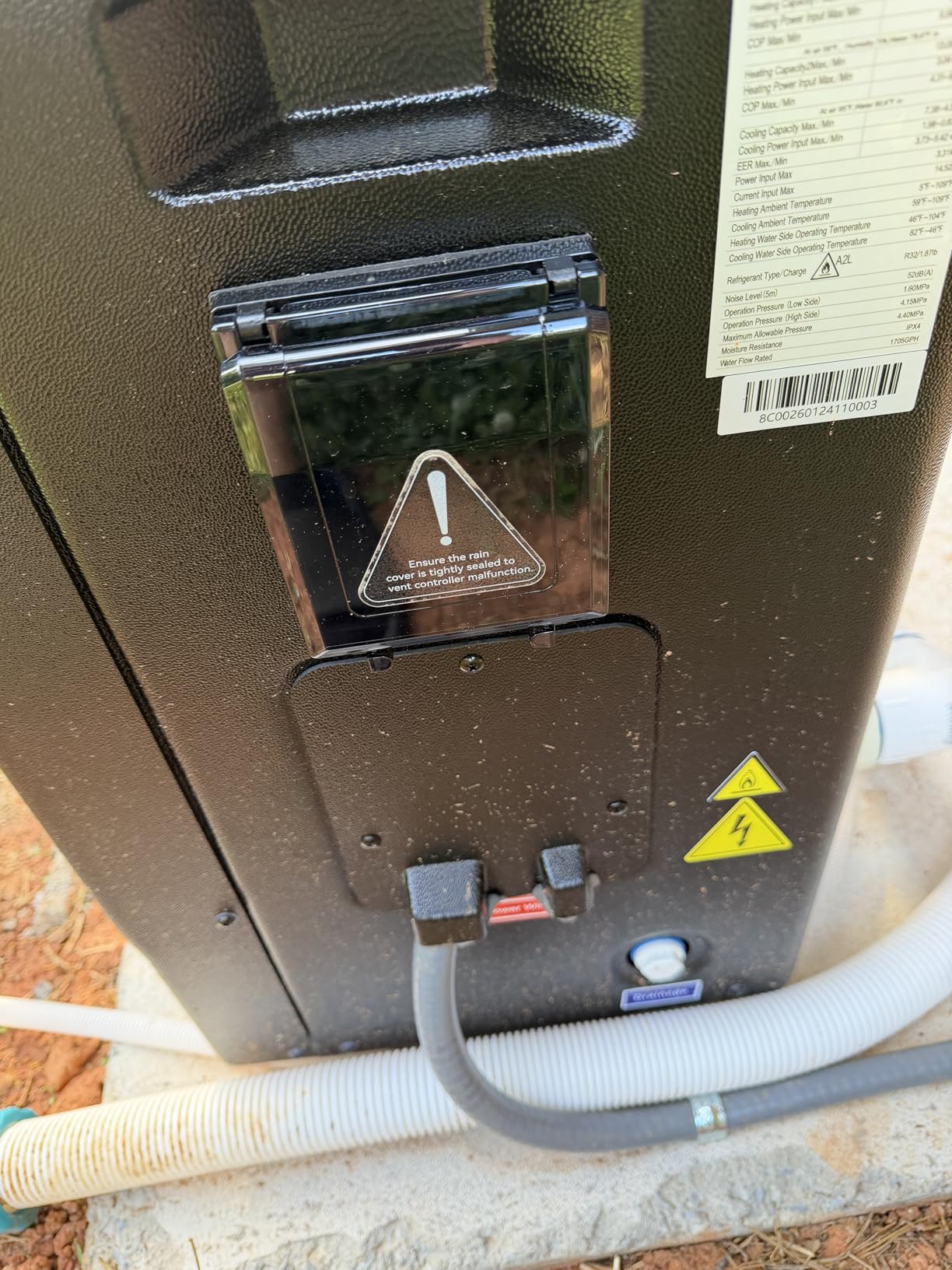
- Requires a 50 amp breaker and confusing wiring diagrams
- Supplied wiring cover plate is flimsy for outdoor use
- Titanium exchanger is rated for freshwater pools only
- Slower to heat than a large gas unit in cool weather
The MICOE is the pick for anyone who wants one box to handle both ends of the temperature range. It heats from 46F to 104F and cools from 45F to 82F, with automatic defrost so it keeps working when the air turns cold. Owners value the cooling mode for summer water that overheats.
Owner results are encouraging. One owner lifted a 15 by 30 semi-inground pool from 58F to 82F in four days of 12-hour runs in 60F weather. Another reached 99F within a day of startup on a 10,000-gallon pool. Both are consistent with a 100,000 BTU inverter doing honest work.
Support is the standout. Multiple owners describe written answers within hours and free parts sent out to resolve an electrical bonding requirement. That kind of service response is unusual for a brand at this stage and it counts when something goes sideways.
The electrical install is the weak point and owners are direct about it. Diagrams are confusing, the supplied cover plate is too thin for a proper outdoor installation, and a 50-amp breaker is required. Plan for an electrician rather than a handyman on this one.
Best fit when you need heat and cool from one unit
The dual-mode range is genuinely wide, from 45F cooling to 104F heating. If your pool overheats in summer or freezes in a mild winter, this is the pick that covers both without a second appliance.
At 54 dB it stays among the quietest options here, and automatic defrost keeps it working in cold conditions where some cheaper units simply stall.
Where it falls short
The titanium heat exchanger is rated for freshwater pools. If your pool uses a saltwater chlorinator, this is the wrong model and you should step up to one rated for salt.
It is also slower than a big gas heater in cool weather, with owners reporting roughly a modest daily electricity figure for a 15,000-gallon pool. That is fine for maintenance heat and wrong for a weekend deadline.
7. FibroPool FH270 70000 BTU Heat Pump – Best Budget Heat Pump
- Lowest running demand of the heat pumps here at 70000 BTU
- Titanium heat exchanger resists corrosion
- Slim 38 x 15 x 26 inch body fits tight pads
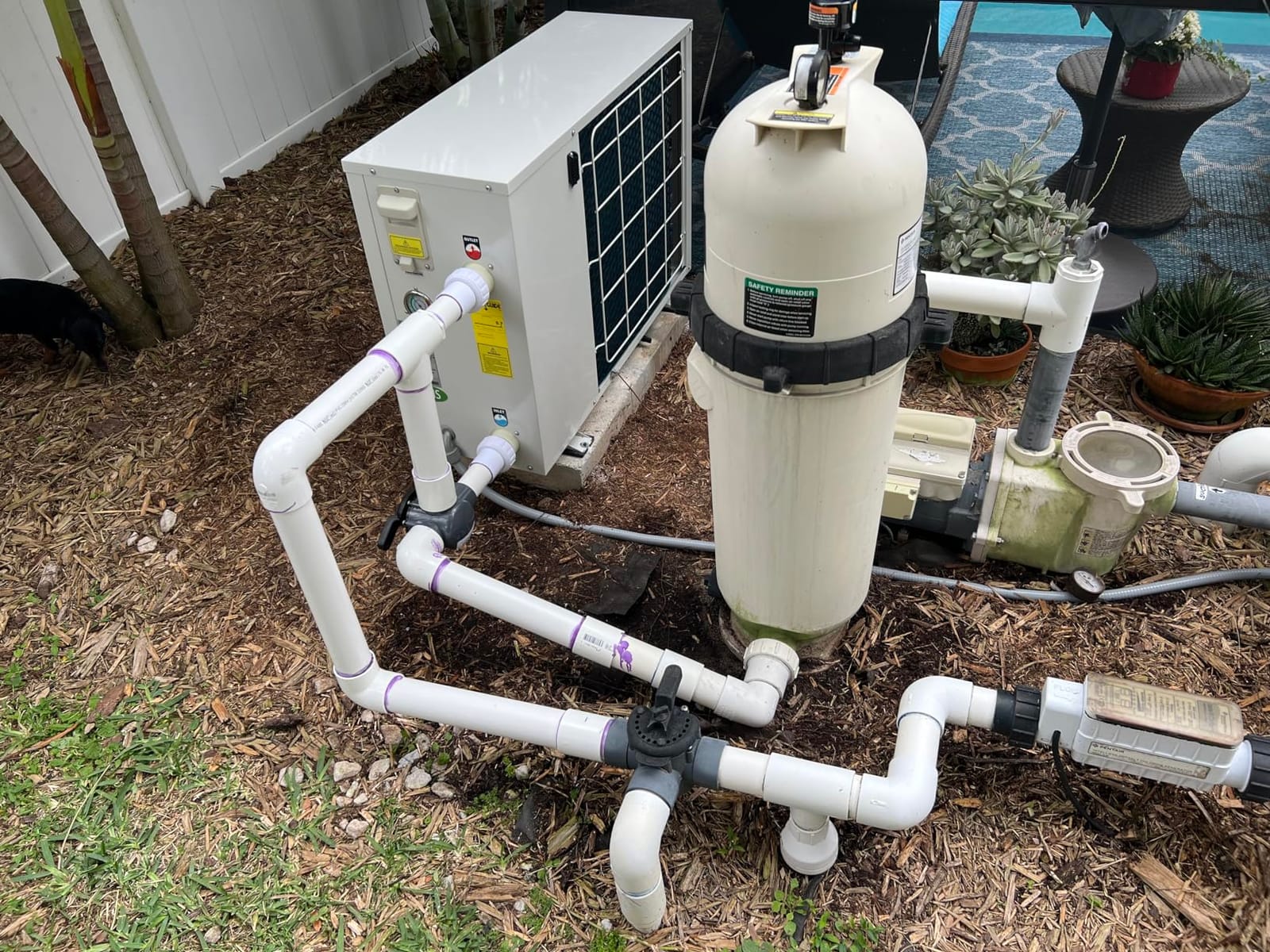
- Includes 1-1/2 inch fittings and installs on a standard 240 V circuit
- Capacity tops out around 15000 gallon pools
- Loses output as ambient air temperature drops
- Mild climate sizing caveat for above ground pools
Not every inground pool needs a 100,000 BTU machine. If yours runs to about 15,000 gallons, the FibroPool FH270 does the maintenance heating job at a fraction of the electrical demand of the bigger units, and it costs materially less to buy than the 100,000 BTU inverter models.
The physical design is the underrated part. At 38 by 15 by 26 inches and 157 pounds, it is a slim box that fits tight equipment pads where the 300-pound models will not go. The titanium exchanger and enamel-coated steel cabinet handle weather exposure without complaint.
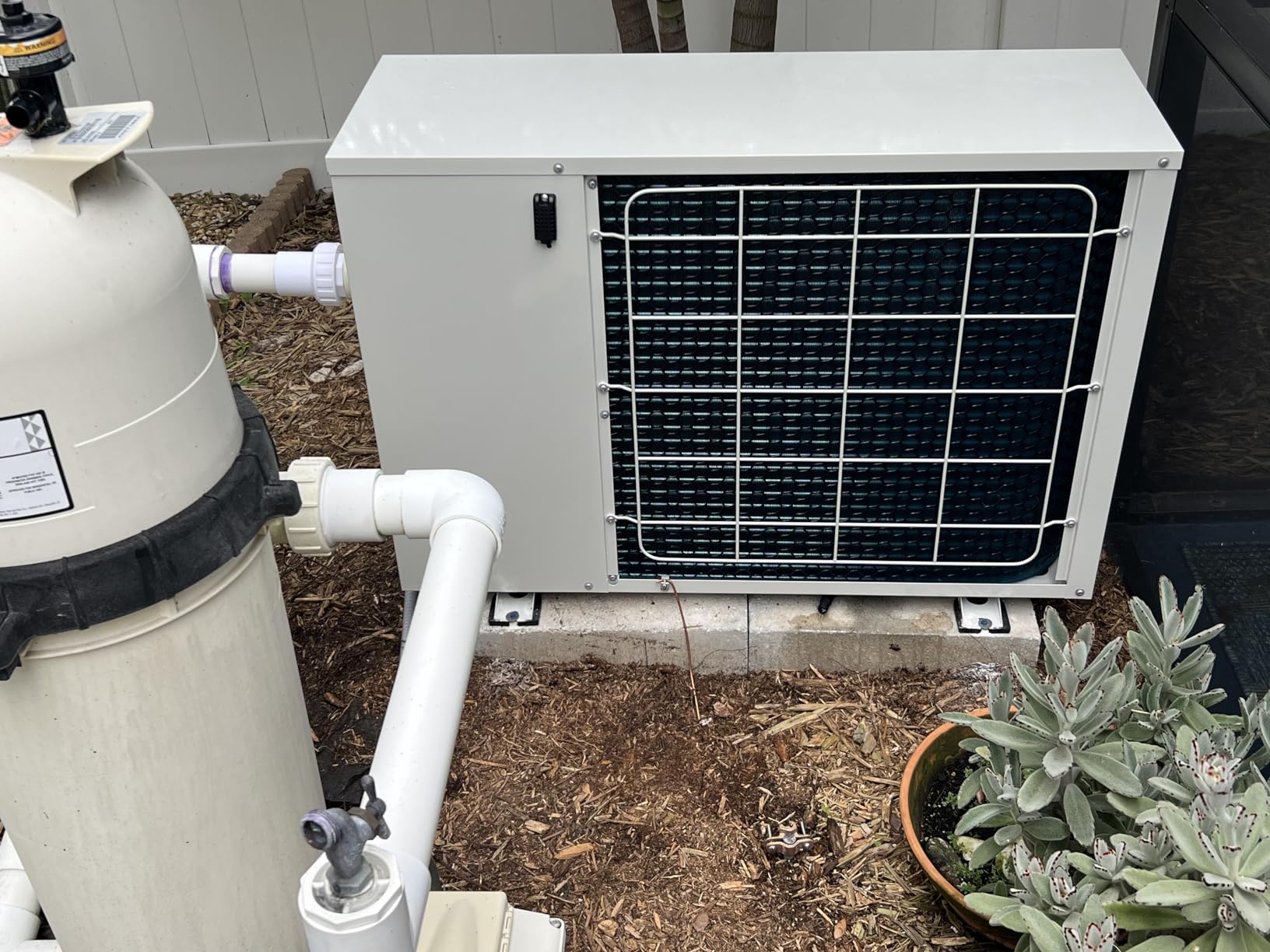
Owners rate it 4.3 stars from 135 reviews with 72% at five stars. The digital set-and-monitor display is simple, and the 1-1/2 inch fittings are included, so the install does not become a supply run.
The capacity ceiling is the whole story. Seventy thousand BTU suits inground pools up to about 15,000 gallons. Above that, you are asking a small unit to do a large pool’s job and it will run for days without ever catching up.
Best value for smaller inground pools
Smaller pools, rental cabins and pool houses are the ideal fit. The low electrical draw keeps monthly operating demand small, and there is no fuel line to run.
Owners who bought it treat it as a strong value choice, and the 4.3 average across 135 reviews shows that view is shared rather than exceptional.
Where it will disappoint
On a 25,000-gallon pool it is simply undersized. Do not stretch a 70,000 BTU heat pump to a large pool and expect recovery, because you will be disappointed by the results.
Cold air still costs you output, as it does with every air-source heater. In the Northeast this model maintains a temperature rather than delivering a rapid heat-up.
Best Gas Pool Heaters for Inground Pools
Gas heaters do one thing better than heat pumps, and that is speed. A 250,000 to 266,000 BTU burner can add real temperature to a mid-sized pool in an afternoon, which matters when you have a weekend plan or a rental booking. The cost is fuel: gas makes every unit of heat from scratch, so the running bill is the highest of any category here.
They also need real infrastructure. A gas heater requires a properly sized gas line, a licensed gas fitter in most jurisdictions and a venting plan. Several manufacturers void the warranty if the unit is not installed by a licensed technician, even for factory defects, so this is not the place to save money on labor.
8. Raypak 266000 BTU Digital Gas Heater – Best for Fast Heating
Raypak 266,000 BTU Digital Electronic Ignition Natural Gas Pool Heater
- Raises temperature quickly
- around 3 degrees per hour on a 32x16 pool with a 2 hp pump
- Intermittent spark pilot only fires on a call for heat
- Cabinet does not retain residual heat so no metal heat sink is needed
- Drop in fit over an older Raypak without re-running lines
- Parts are publicly available for DIY troubleshooting
- 210 lb and needs two people to position
- Warranty void if not installed by a licensed technician
- Ports sit close together and need a bypass loop with elbows
- One owner reported sensor or board failure after about a year
This is the heater to buy when you want a swim tonight. At 266,000 BTU it is the highest-output natural gas option here, and owners report it climbing roughly three degrees an hour on a 32 by 16 inground pool with a 2 hp pump running. That is a different order of speed from any heat pump on this list.
Raypak is also the brand owners mention most often as still working years later. A pool owner on r/swimmingpools described running a Raypak heater installed three years ago and reporting that the heater works great while noting the cost to heat the pool as the drawback. That combination, long service life and high fuel bill, is the honest Raypak story.
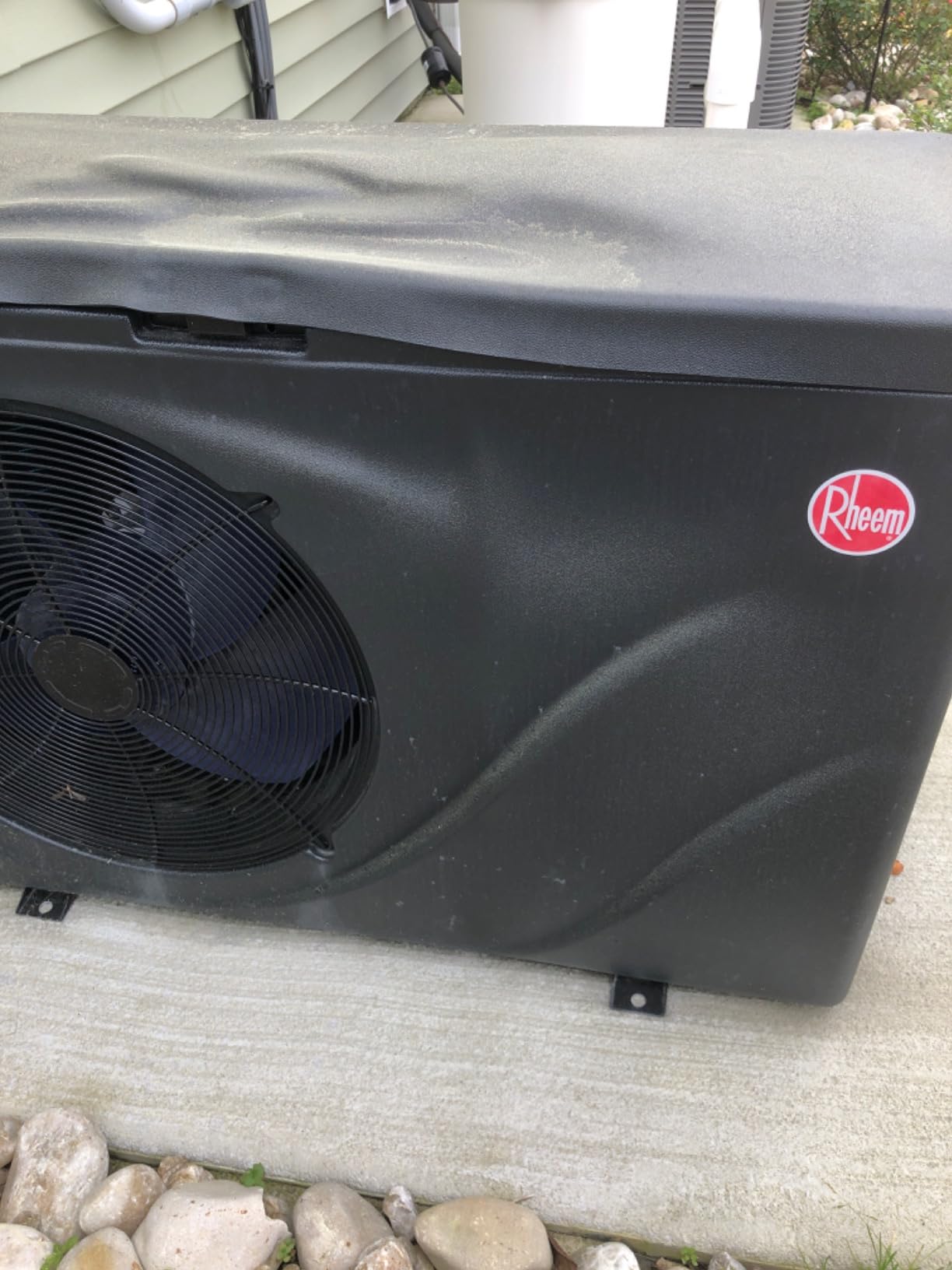
The digital electronic ignition is worth calling out. The intermittent spark pilot only energizes on a call for heat, so it does not sit burning pilot fuel all summer. The cabinet material also does not retain residual heat after shutdown, which means it can go straight onto a pad without a metal heat sink underneath.
Owners replacing an older Raypak report a genuinely easy swap, because the inlet and outlet connections drop into place without reconfiguring gas, electric or water lines. Several report it heating as fast as a 400,000 BTU Hayward despite the lower input rating.
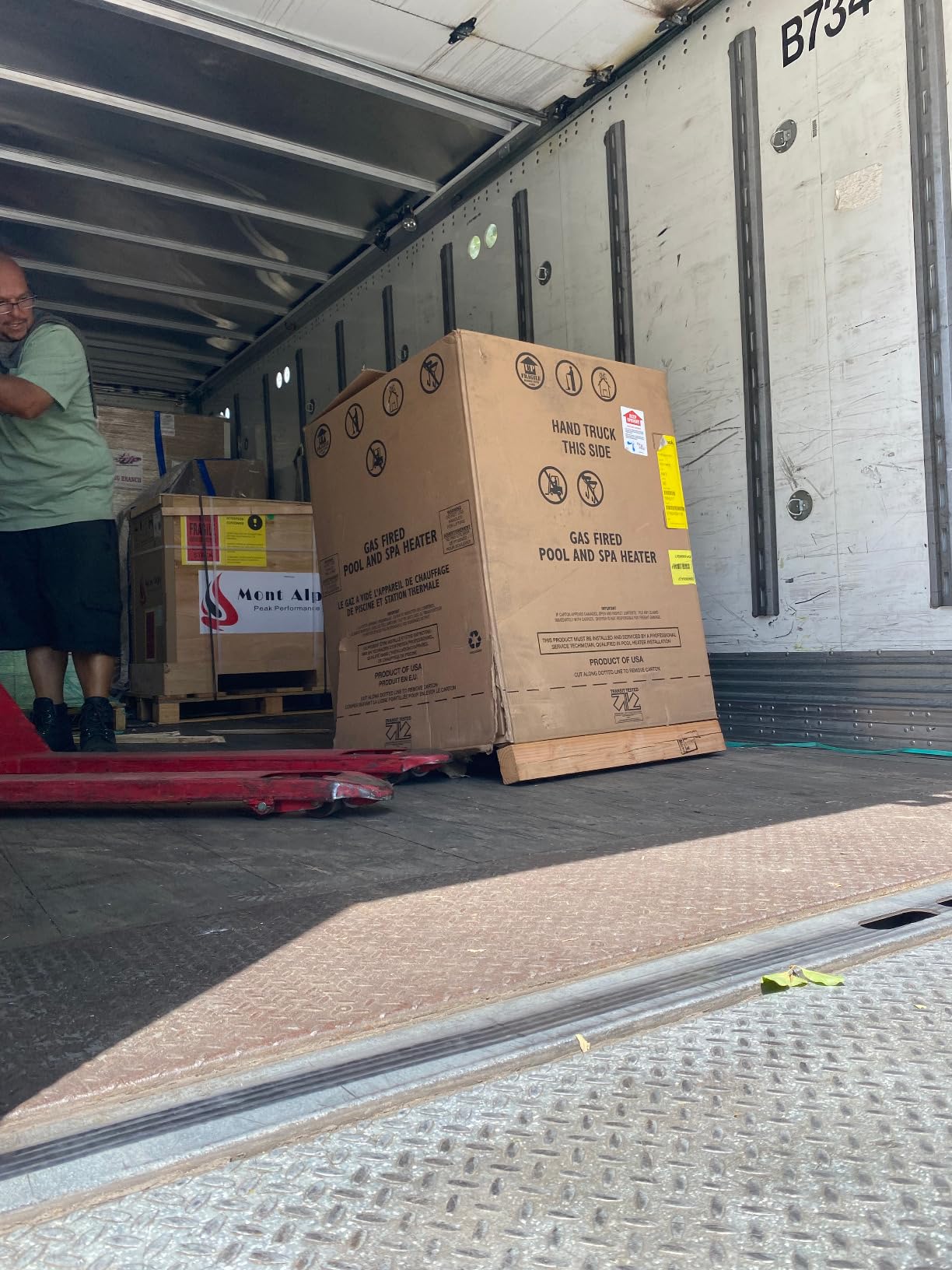
Best pick when recovery speed is the priority
Choose this for weekend deadlines, rental turnover and cold spring openings. Nothing else in this roundup moves that much water temperature that quickly.
The pilot design also saves fuel in shoulder months when the heater is off most of the time but you want it available instantly.
Where owners report friction
Installation is non-negotiable. The warranty is void if a licensed technician does not install it, which matters because factory failures have been reported and still faced warranty refusal.
The inlet and outlet ports sit close together, so you need a bypass plumb loop with several elbows that costs pressure and space. And at 210 pounds this is a two-person job before it is a plumbing job.
9. Hayward H-Series 250000 BTU Gas Heater – Best Gas Heater Value
Hayward H-Series Natural Gas Pool Heater for Inground Pools 250,000 BTU
- Self diagnosing LED control panel simplifies monitoring
- Flexible gas and electrical connections on either side simplify the pad
- Built in 3/4 inch gas connection streamlines fuel hookup
- Designed to resist corrosion from unbalanced water chemistry
- Low NOx certified for areas with emissions limits
- 4.0 average with 20% of reviews at 1 star
- Requires on site gas infrastructure and ongoing fuel cost
- Output depends on correct water chemistry
It is the standard residential natural gas installation, and it covers pools and spas up to 750 square feet with the 250,000 BTU version. Other models in the line cover 400, 600 and 1,200 square foot pools, so the family scales if you outgrow the unit.
What owners like most is the control panel. The digital LED display with self-diagnostic performance monitoring tells you what is wrong instead of leaving you guessing, which is the difference between a small weekend fix and a service call. The flexible connections on either side also make pad layout much easier.
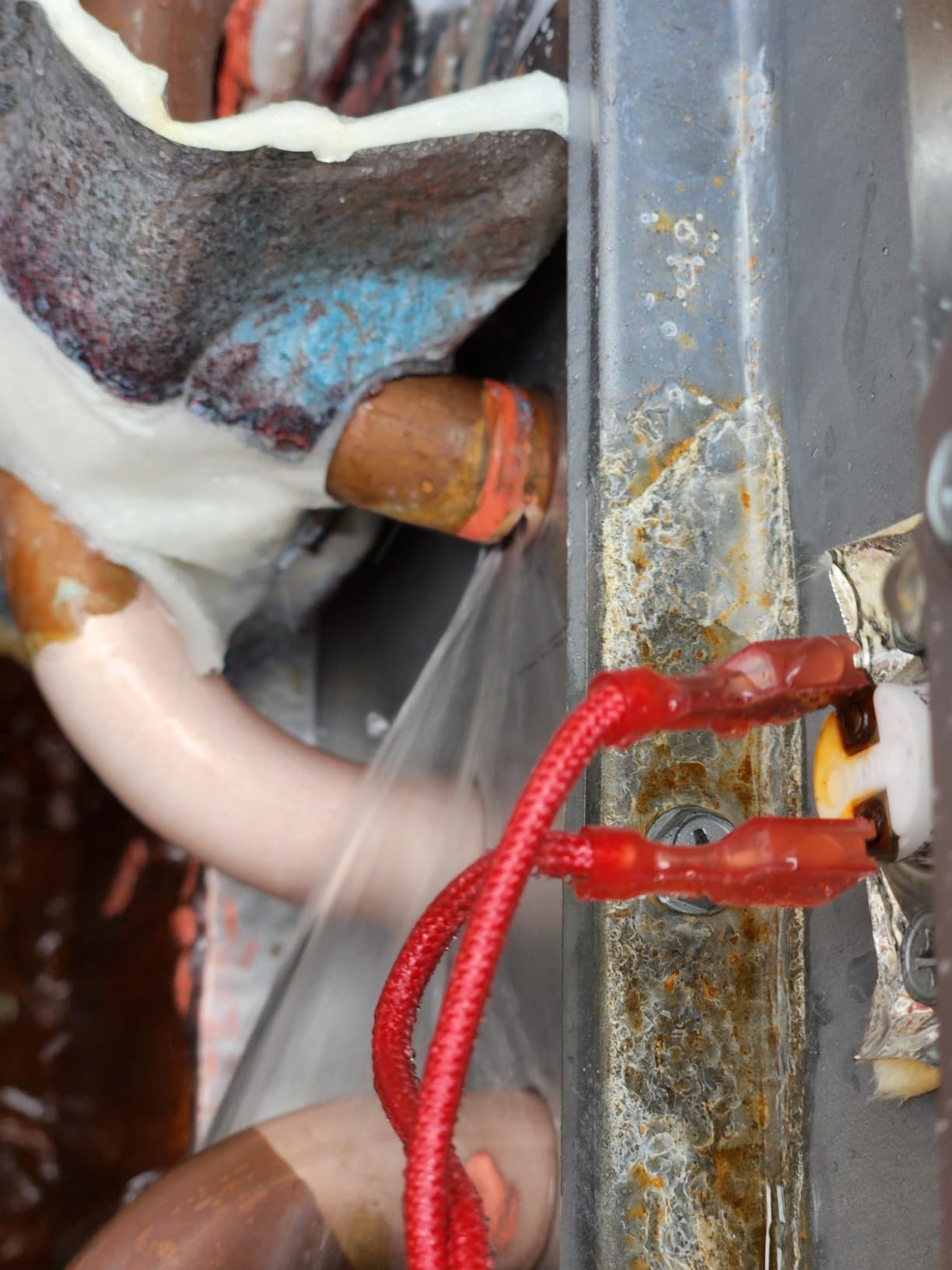
At 171 pounds it is the lightest of the gas heaters here, which is meaningful because gas heaters arrive on skids and get positioned before the plumbing is finished. Low-NOx certification also matters if you live under an emissions restriction.
The 4.0 rating from 195 reviews carries a 20% one-star share, the highest of the three Hayward models here. Owners who installed it correctly report solid performance, and the critical reviews cluster around long-term durability in demanding service.
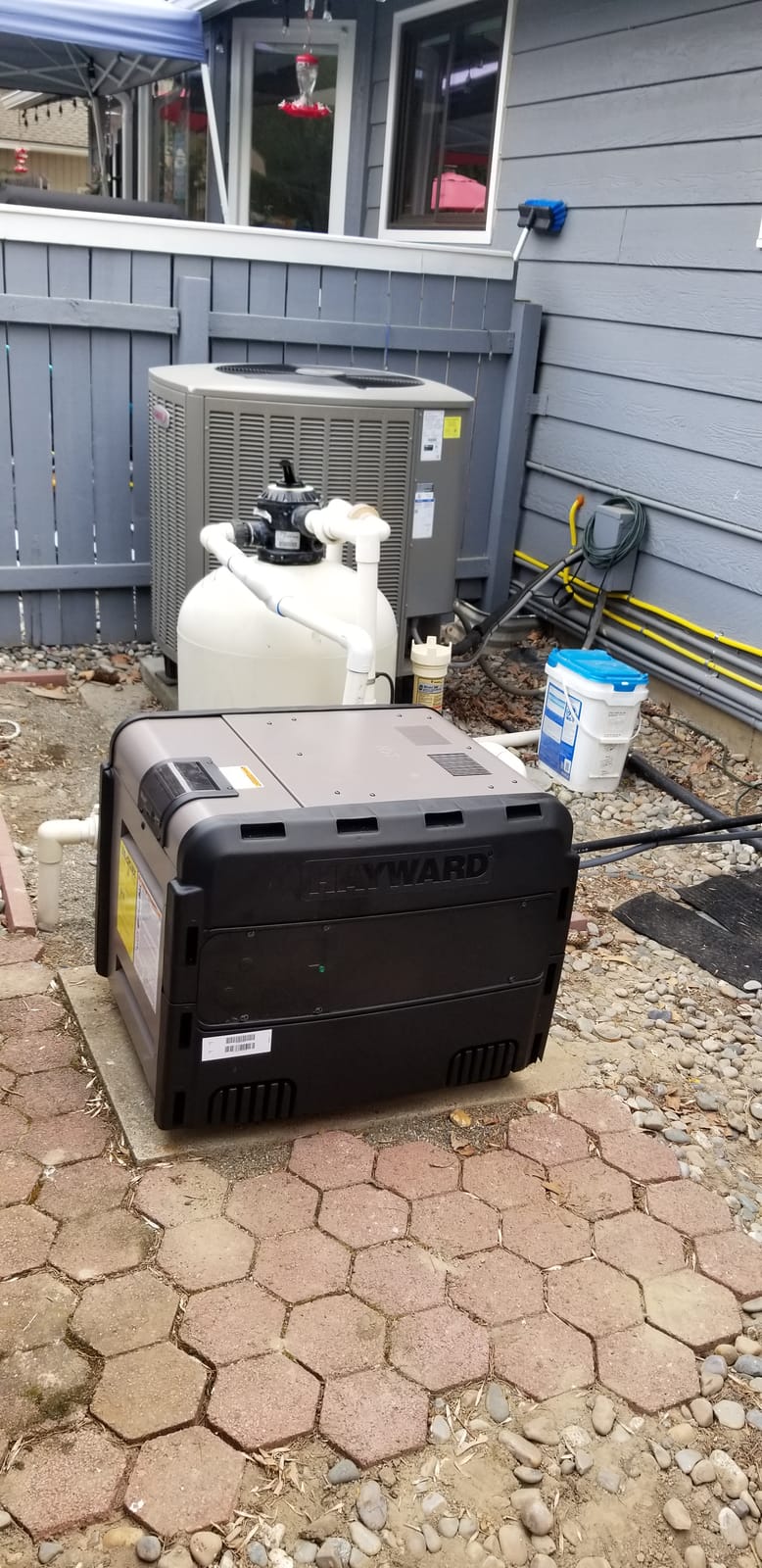
Best gas pick for a standard residential pool
For a typical inground pool under about 750 square feet, this is the sensible gas choice. The self-diagnosing panel and either-side connections are the features that save money on install day.
Low-NOx certification makes it the pick if your municipality restricts emissions, which several do in the denser parts of the Northeast.
Where it falls short
It needs a gas line, a licensed fitter and ongoing fuel spending. If you do not already have gas infrastructure at the equipment pad, that cost can rival the heater itself.
Performance depends on balanced water chemistry. Unbalanced water corrodes the heat exchanger, and this model is specifically engineered to slow that damage rather than eliminate it.
Best Solar Pool Heaters for Inground Pools
Solar collectors are the fourth class, and they are the one most roundups leave out. A solar kit runs pool water through sun-warmed panels on your existing pump, adding a few degrees on sunny days at no fuel cost whatsoever. That makes it a supplement almost everywhere and a genuine primary heat source in warm, sunny climates. If you want more on this class, our guide to the best solar pool heaters goes deeper on panel sizing and plumbing.
10. SolarPoolSupply DIY Solar Heater Kit – Best for Sunny Climates
Highest Performing Design – DIY Solar Pool Heater Kit – 15-20 Year Life Expectancy (4-4×10 / 1.5″ I.D. Header)
- Highest average rating in this roundup at 4.7 stars from 69 reviews
- Adds heat at no fuel cost during sunny periods
- Over molded header removes flow barriers for better heat transfer
- Made in the US with UV stabilizers and a 15 to 20 year design life
- Complete kit with mounting hardware plumbing fittings and expert support
- Only collects heat when the sun is out and the air is warm
- Needs roof or ground space for four 4x10 ft collectors
- DIY plumbing work is required to tie into the return line
This kit is the highest rated item in the roundup, at 4.7 stars from 69 reviews with 87% at five stars. That number reflects a simple fact: a well-made solar collector either works or it does not, and this one has a design life of 15 to 20 years.
The engineering detail that matters is the over-molded header, which is molded directly around the absorber tubes. That removes flow barriers at the manifold so more water passes through the collectors and more heat transfers into the pool. It is a small design choice that shows up directly in your water temperature.
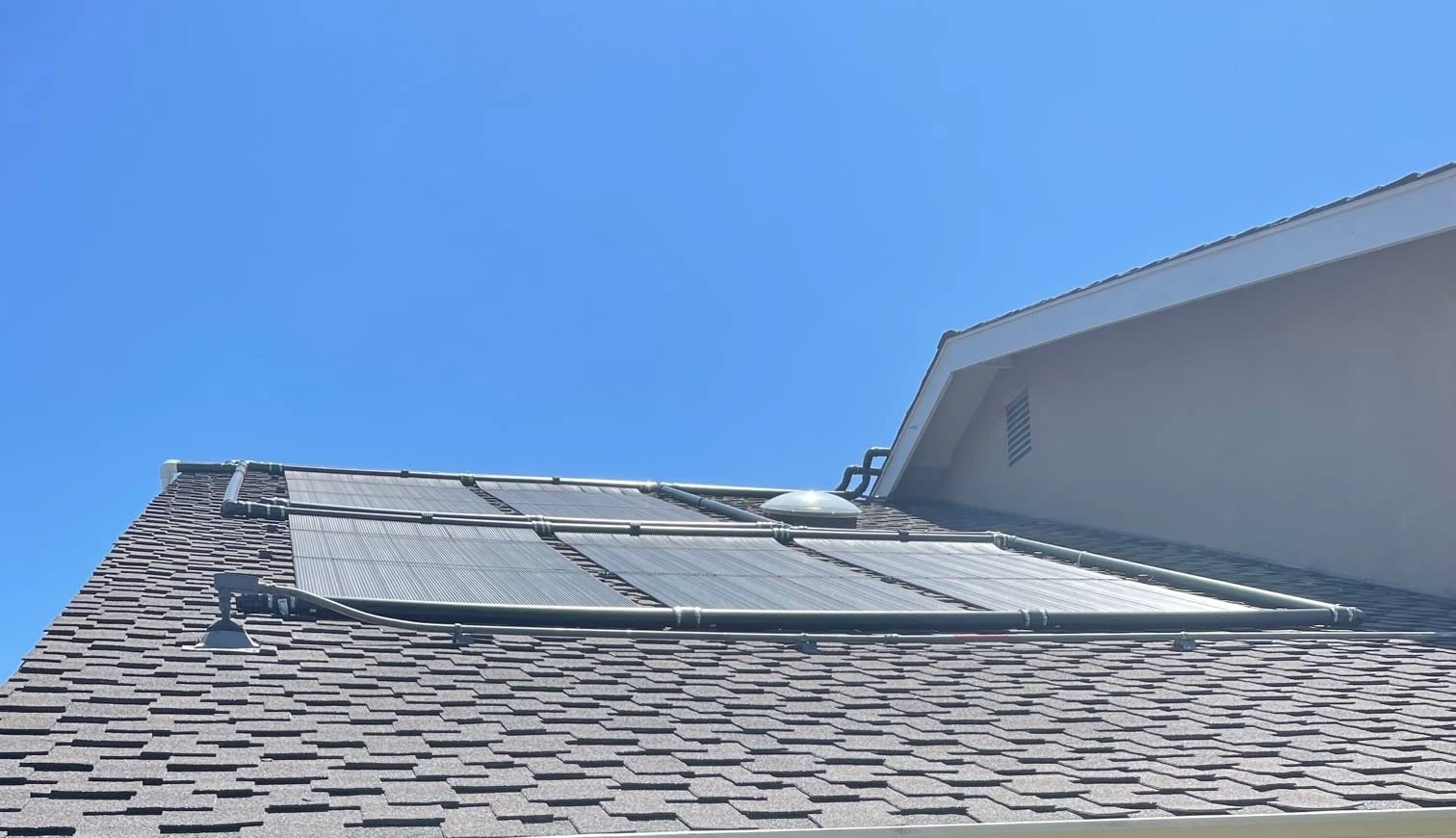
Everything you need is in the box: mounting hardware, a tie-down strap, inter-panel connectors and both supply and return plumbing fittings. It ties into your existing pump and filtration system, and the manufacturer backs it with unlimited expert installation support, which matters for a DIY kit.
Owners report real heat gain in sunny conditions and appreciation for US manufacturing with UV stabilizers. The single-piece header is also designed to resist leaks over that long service life, which is the failure mode that usually kills plastic solar kits.
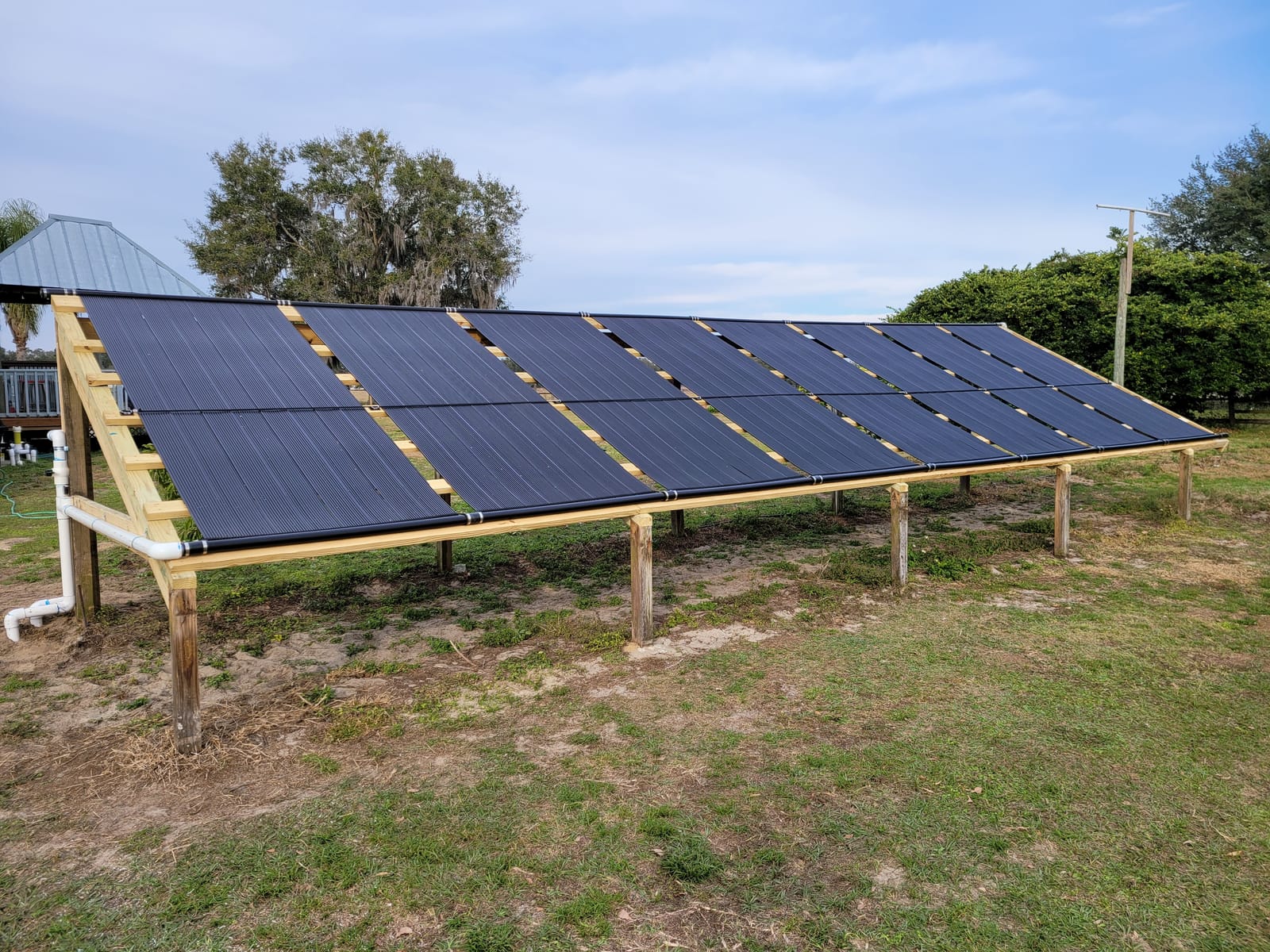
Best fit for warm sunny climates and low fuel budgets
If your region gets strong sun and you want to cut fuel use rather than eliminate it, this is a strong complement to any heater on this list. It adds heat during the day for no fuel cost and covers partly overnight depending on conditions.
For a family that swims in the shoulder months and wants zero ongoing fuel spend, this alone can be enough. Forum discussion often dismisses solar as a gimmick, and in a cold climate that is fair.
Where it will disappoint
Cloudy days and cold ambient air mean no heat gain at all. This is not a device you switch on when you feel like swimming, which is the single biggest reason people are disappointed with solar.
You also need physical space for four 4 by 10 foot collectors, ideally on a south-facing roof, and you need to plumb the panels into your return line. If you are not comfortable with pool plumbing, budget for a plumber.
How to Size a Pool Heater for Gallons and Climate
Almost every sizing thread online starts with the same missing number: gallons. Get that first, because everything else follows from it. Multiply your pool’s length by width, multiply by average depth, then by 7.5 gallons per cubic foot. A 16 by 32 foot pool averaging 8 feet deep holds about 30,720 gallons.
Next comes the BTU question, and here is the rule of thumb most pool professionals use. For a gas heater in a mild climate, budget about 100,000 BTU per 10,000 gallons. In a cold climate, go higher, closer to 120,000 BTU per 10,000 gallons. For a heat pump, the same logic applies but the numbers are lower because you are not trying to recover overnight.
So for a 16 by 32 pool at roughly 30,000 gallons, a gas heater in the Northeast wants to be in the 300,000 to 400,000 BTU range, which is why models like the Raypak 266,000 BTU and the larger Hayward examples exist. In a warm climate, 250,000 BTU is usually adequate for the same pool.
For a heat pump, be realistic about the ceiling. Residential air-source heat pumps top out around 140,000 BTU, so one cabinet can hold temperature but cannot heat 30,000 gallons quickly. Plan on a heat pump for daily maintenance and something else for opening day.
For saltwater pools, size up slightly and choose a titanium exchanger, because salt water corrodes metal components faster than chlorine does.
Gas vs Heat Pump vs Solar: What It Costs to Run
This is the question people most want a number for, and the honest answer is that it depends on your utility rate, your fuel rate and your climate. What we can give you is the physics, which is enough to work out your own number.
Compare the demand directly. The WARMBLU draws about 1.3 kW, or 6 amps, while heating, which is roughly 936 kWh over a month of continuous running. A COP of 12 to 16 means each unit of electricity moves three to five times as much heat into the pool.
A gas heater at 266,000 BTU input running for one hour consumes roughly 78,000 BTU of natural gas. Roughly a quarter of that ends up in the pool once exhaust losses and standing losses are counted. Do the same comparison with a heat pump and you will find that the electricity path delivers about four units of heat per unit consumed.
The practical rule that follows: a heat pump wins on running cost for maintenance heating in almost every climate, and a gas heater wins when you need a fast recovery. Solar wins on running cost whenever the sun is out, and never wins on speed. Where running cost is the deciding factor, that is the whole calculation.
Installation Requirements: Gas Line, Breaker and Permits
This is where most owner projects stall, and it is worth understanding before you buy anything. Gas heaters and heat pumps are not interchangeable from an installation standpoint, and the two require different trades.
Gas heaters need a properly sized gas line, and both gas heaters here specify a 3/4 inch connection. That means a licensed gas fitter, not a general handyman, and in many jurisdictions a permit. Both the Raypak and the Hayward carry warranty terms that require installation by a licensed technician, so a cheap install can void the warranty on day one and leave you paying for a factory defect.
Heat pumps need a dedicated circuit, and the MICOE specifically requires a 50-amp breaker. That is an electrician, and several models here run on 220V rather than 240V, so confirm the supply arrangement before the heater is delivered.
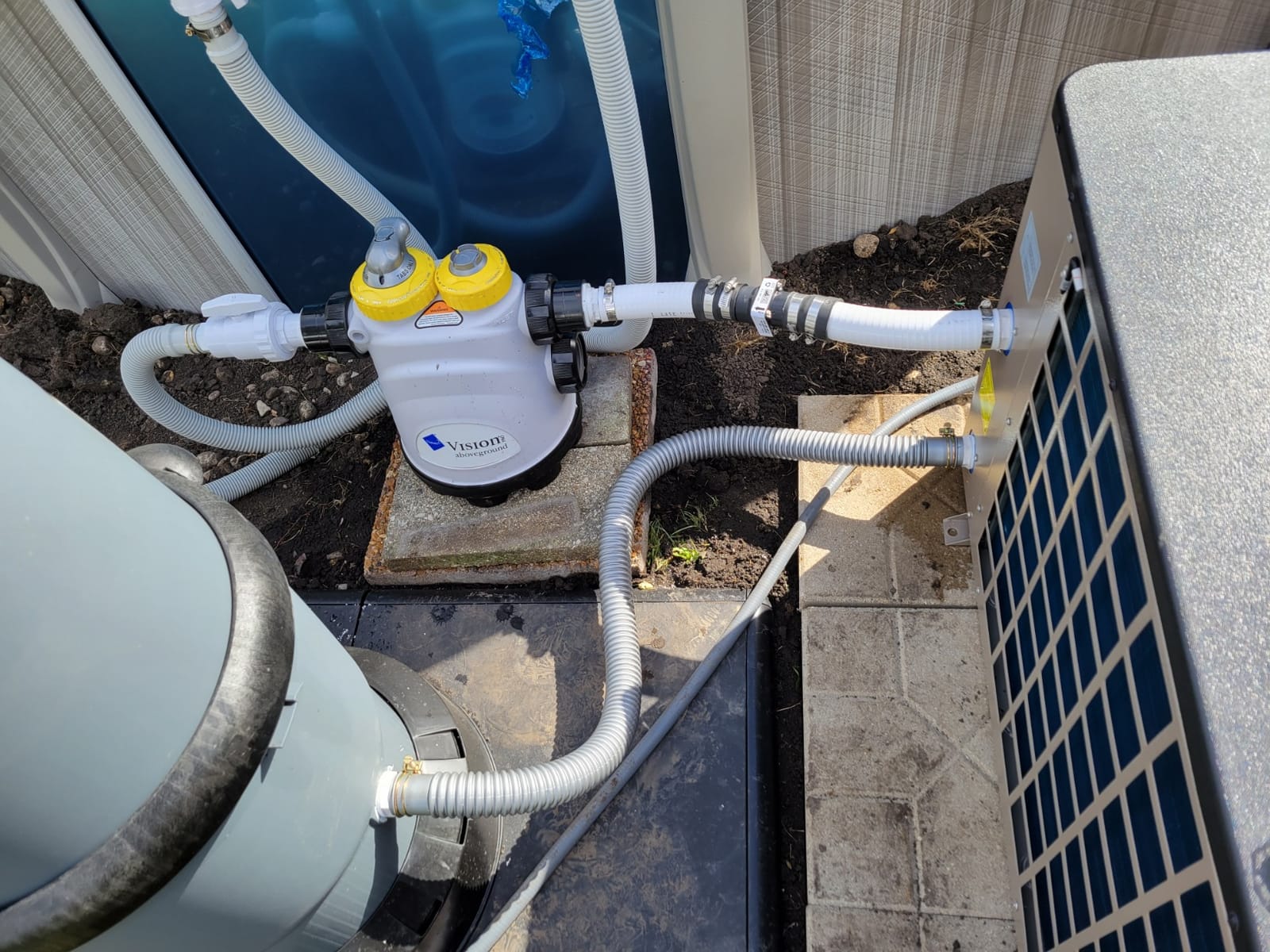
Heat pumps also need a discharge valve to regulate flow. Get the flow wrong and the unit condenses so heavily that water drains out of the base, which owners report repeatedly on the AQUASTRONG, the WARMBLU and the Varpoolfaye. It is a small part with an outsized effect on whether the machine works properly.
Solar kits need neither power nor gas, but they do need mounting space, a south-facing roof or open ground, and plumbing work to tie into your return line. That is the most DIY-friendly install in the roundup if you are comfortable with pool plumbing.
What Actually Breaks: Lifespan, Maintenance and Failure Modes
Nobody publishes failure data for this category, so we went to the owner reviews. The patterns are consistent across brands.
Electronics and sensors are the leading long-term complaint. One Raypak owner reported a temperature sensor or main board failure after about a year and a half. Hayward heat pumps carry a 14% and 11% one-star share respectively, and owners describe reliability reservations that appear in later seasons rather than on day one.
Flow rate is the most common installation error. Three separate inverter models here produce heavy condensation when flow is not regulated with a discharge valve. It shows up as water pooling under the unit, and it is avoidable at install time for the cost of a valve.
Water chemistry damages gas heaters specifically. The Hayward H-Series is engineered to resist corrosion from unbalanced water, but no design fully survives it. Keeping calcium hardness, alkalinity and sanitizer in range is the cheapest maintenance you will ever do.
Defrost cycles are a wear item on heat pumps that run in cold climates, and freezing temperatures with a unit not winterized is the fastest way to destroy one. Manufacturer warranties vary widely here, from the 12 months on the WARMBLU to the three years on the AQUASTRONG, which is a real difference on a compressor this size.
Pool Covers and Heat Loss: The Cheapest Efficiency You Can Buy
No heater on this list will perform as designed on an uncovered pool. Heat loss scales with the surface area exposed to the air, and an open inground pool can lose the majority of its heat overnight on a cool night. A pool cover is the highest-return accessory in this entire article.
It matters most for heat pumps, because their output is already tied to ambient temperature and a covered pool takes less energy to hold. It matters for gas heaters too, since a covered pool needs far fewer burner cycles to hold a setpoint. On a solar kit, a cover slows the overnight loss that would otherwise erase the daytime gain.
If you buy a heater from this roundup and nothing else, buy a cover. It costs a fraction of the heater and it changes how the heater performs every single day.
Hybrid Setups: When a Heat Pump Needs Gas Backup
The gas versus heat pump debate is framed as a false binary, and experienced owners have moved past it. The common cold-climate configuration is a heat pump as the primary unit with a gas heater on standby for opening day and cold snaps, controlled from the same panel or a smart controller.
The reason is the 140,000 BTU ceiling. Once a pool passes roughly 25,000 gallons or the climate drops into the shoulder season, a single heat pump can hold temperature but never recover quickly. A gas unit in reserve solves exactly that problem without forcing you to run expensive fuel all season.
If you are in New York, Pennsylvania or anywhere with a short swimming season, this is the configuration worth designing for. Ask your installer about switching both units from one control rather than buying the largest gas unit you can afford.
Five Mistakes That Ruin a New Pool Heater Install
1. Skipping the flow rate calculation. It causes the condensation and draining issue reported on three of the heat pumps here. Fit and set a discharge valve during install.
2. Using an unlicensed installer on a gas heater. Both gas models here carry licensed-installer warranty terms, and a factory defect can still be refused under them.
3. Under-sizing the electrical supply. The MICOE needs a 50-amp breaker. Confirm your panel has a slot and the load headroom before the heater is delivered.
4. Ignoring water chemistry before install. Salt and unbalanced water corrode heat exchangers, and a saltwater pool needs a titanium exchanger.
5. Buying before measuring the pad. These heaters range from 116 pounds to 336 pounds and from a 15-inch slim profile to a 40-inch box. Measure the footprint and the access path first.
Frequently Asked Questions
How many BTU do I need for a 16×32 inground pool?
A 16 by 32 foot pool averaging 8 feet deep holds roughly 30,000 gallons. In a mild climate, budget about 300,000 BTU for a gas heater or 100,000 BTU per 10,000 gallons. In a cold climate go closer to 350,000 to 400,000 BTU. For a heat pump, expect to hold temperature rather than heat quickly, because residential air-source heat pumps top out around 140,000 BTU.
What type of heater is best for an inground pool?
For most inground pool owners, a heat pump is best. It draws roughly a quarter of the energy a gas heater uses for maintenance heating and needs no gas line. Choose a gas heater only when you need a fast recovery in a few hours or when your pool is very large and the climate is cold. Solar works as a supplement in sunny climates.
What size pool heater do I need for a 30,000 gallon pool?
For a 30,000 gallon pool, a gas heater needs to be in the 300,000 to 400,000 BTU range in most climates, which is why units like the Raypak 266,000 BTU are common. A single residential heat pump cannot heat that much water quickly, since most top out near 140,000 BTU. Plan on a heat pump for daily holding and a gas unit or hybrid setup for opening day.
Is it cheaper to run a gas or electric pool heater?
Yes, an electric heat pump is cheaper to run for maintenance heating. A gas heater at 266,000 BTU burns roughly 78,000 BTU of gas per hour and delivers about a quarter of that to the pool. A heat pump advertising a COP of 12 to 16 moves three to five times more heat per unit of energy consumed. Gas only wins when speed is what you are paying for.
How much does it cost to keep a 15,000 gallon pool heated with a gas heater?
It depends on your gas rate and how often you run the burner, which is why the number varies so widely between households. The physics is fixed though: a 266,000 BTU unit running for one hour consumes about 78,000 BTU of natural gas. Multiply by your local fuel rate and by your typical weekly run time to get your figure, then compare it against a heat pump covering the same pool for a fraction of the energy.
Which pool heater brand is more reliable, Pentair or Hayward?
Within this roundup, Hayward has the broader range of models, from the W3HP50HA2 heat pump to the 250,000 BTU H-Series gas heater, and Hayward parts and service networks are easy to find. Raypak earns marks for long-lasting gas heaters, with owners reporting units still running after three years. The most reliable brand is usually the one with the closest authorized service, not the one with the highest rating.
What are the most common problems with Hayward pool heaters?
Owners of the Hayward HeatPro heat pumps report a 4.1 and a 4.2 average rating, with roughly 11 to 14 percent of reviews at one star. The recurring themes are long-term reliability problems in demanding outdoor service, reduced output as ambient air temperature drops, and unit size being larger than expected on a tight equipment pad. Gas models add water chemistry corrosion as a failure driver.
Do I need a permit to install a pool heater?
Most jurisdictions require a permit for a gas pool heater and often for a new 240V circuit. Gas work typically must be done by a licensed gas fitter and electrical work by a licensed electrician. Both gas heaters in this roundup carry warranty terms requiring installation by a licensed technician, so check locally before hiring anyone and get the permit before work starts.
Which Inground Pool Heater Should You Buy?
Start with the AQUASTRONG HEX100 if you want the best overall balance of efficiency, capacity, features and owner history. It heats and cools, runs quietly, has app control, and carries the deepest review base in the group. For a big pool, add the WARMBLU for its 28,000-gallon rating. For a coastal or saltwater setup, the Hayward HeatPro 140,000 BTU is the corrosion answer. When you want water warm the same afternoon, the Raypak 266,000 BTU is the pick, and budget honestly for the fuel. For a small pool, the FibroPool FH270 does the job at a fraction of the demand.
Whatever you choose, measure your gallons first, confirm your pad and electrical capacity, and buy a pool cover. Those three steps prevent almost every complaint we read in the reviews.