
Yes, welding magnets are worth buying for home fabrication, with three qualifiers attached. They are a genuine third hand for positioning and tacking mild steel, they do not replace a C-clamp or vise on heavy plate or a hot joint, and they must come out of the joint before the final pass. Buy the first one and you will wonder how you managed without it; buy a magnet that stays in the bead and you will spend an afternoon chipping slag off a ruined plate.
The hardest part of a first weld is rarely striking an arc. It is holding two pieces of steel in exactly the right place while you do it. A welding magnet buries rare-earth magnets in a steel body that grips the workpiece through the metal itself, so both hands stay free for the torch or MIG gun. That single fact is why the best welding magnets for home fabrication rank so highly with people building square tube plant stands, trailer brackets, pipe racks and sheet metal boxes in a garage rather than in a fab shop.
This roundup covers ten magnets chosen by project type instead of by skill level, because a magnet that is wrong for 1/8 inch plate can be exactly right for a 16 gauge planter box. I compared the ten options in the list below across pull force, angle coverage, switch mechanism, body size and pack quantity, and framed each one around a build a homeowner would actually attempt. If you are still outfitting a workspace, our home tools guide covers the rest of the bench-side basics.
One safety rule before anything else: can you weld with a magnet in the joint? No. Tack with the magnet, then pull it out and knock off the slag before the final pass. A magnet sitting in molten steel distorts the arc path, produces a wide C-scroll bead, and can lose its magnetism permanently from the heat. The same applies to swarf and steel filings, which jump to a live magnet face and then land in your weld pool.
We earn from qualifying purchases at no additional cost to you, and the ratings and review counts below come from the manufacturer listings as analyzed for this guide.
Table of Contents
Top 3 Welding Magnets for Home Fabrication
The V-Pad kit takes the top slot on the strength of the largest verified review base in the group and a shape that fits round, flat and square stock. The YESWELDER arrow set is the highest-rated option here and the most direct route into 50 lb hold. The MSA46-HD is the one to buy if you want a mechanical on and off switch, which is the feature the most experienced owners single out.
All 10 Welding Magnets Compared Side by Side
| Product | Specifications | Action |
|---|---|---|
| Strong Hand MagHold V-Pad Kit, 4 Piece |
|
Check Latest Price |
 YESWELDER 4-Pc 50 lb Arrow Set YESWELDER 4-Pc 50 lb Arrow Set |
|
Check Latest Price |
 Strong Hand MSA46-HD Adjust-O Square Strong Hand MSA46-HD Adjust-O Square |
|
Check Latest Price |
 Hobart 770566 Magnetic Ground Clamp Hobart 770566 Magnetic Ground Clamp |
|
Check Latest Price |
 Strong Hand AGK320 Hole Plug Magnet Strong Hand AGK320 Hole Plug Magnet |
|
Check Latest Price |
 Magswitch MagSquare 150 Magswitch MagSquare 150 |
|
Check Latest Price |
 Hobart 770662 Mini Holder Set Hobart 770662 Mini Holder Set |
|
Check Latest Price |
 Pit Bull TAIM806 Magnet Set Pit Bull TAIM806 Magnet Set |
|
Check Latest Price |
 TOOLIOM Arrow Magnets 25 lb TOOLIOM Arrow Magnets 25 lb |
|
Check Latest Price |
 YESWELDER Adjustable Angle Magnet YESWELDER Adjustable Angle Magnet |
|
Check Latest Price |
1. Strong Hand MagHold V-Pad Kit – Best Overall for Home Fabrication Projects
- Holds round
- flat and square steel in tight spots
- Two pull strengths in one kit
- Magnets on both the face and the underside
- Light enough to reposition with one hand
- Holding power suits light and medium parts rather than heavy stock
- Demagnetizes if left near the arc
- Adhesive can soften with heat
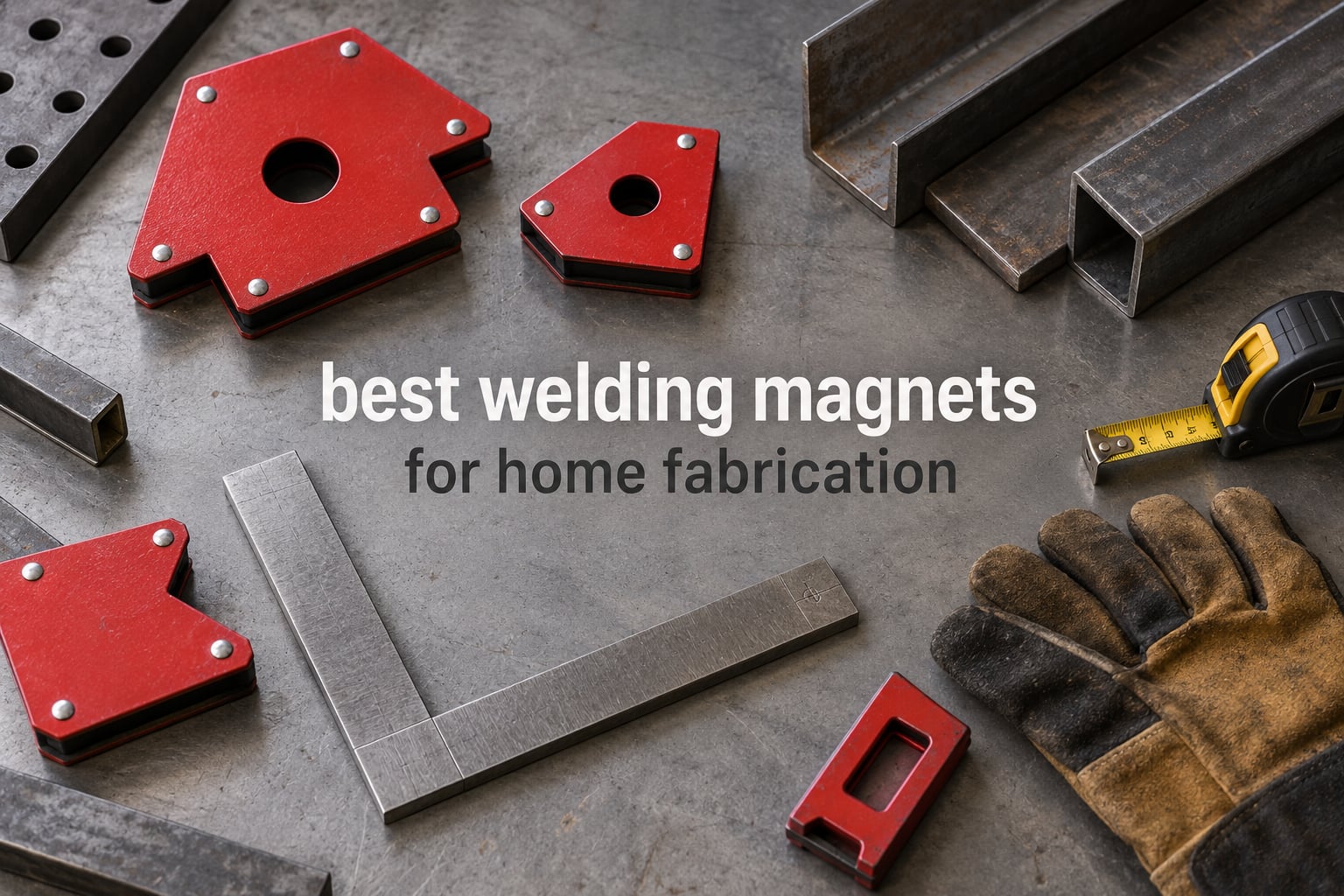
This is the kit I reach for first, and the reason is shape rather than strength. The V-Pad profile nests into the corner where a round tube meets a flat plate, which is the joint that appears in almost every first home build, from a plant stand leg to a trailer cross brace. Four thousand verified reviews at a 4.6 average makes it the most proven tool in this group by a wide margin.
What you get is a matched set: two small V-Pads rated at 12 lb of pull and two medium ones at 18 lb, with magnets sitting on the pad face and the bottom. That two-sided layout is genuinely useful. Flip the pad and you can hold a bracket from underneath while welding up to it, or clamp a piece down flat on the bench for a fillet pass.
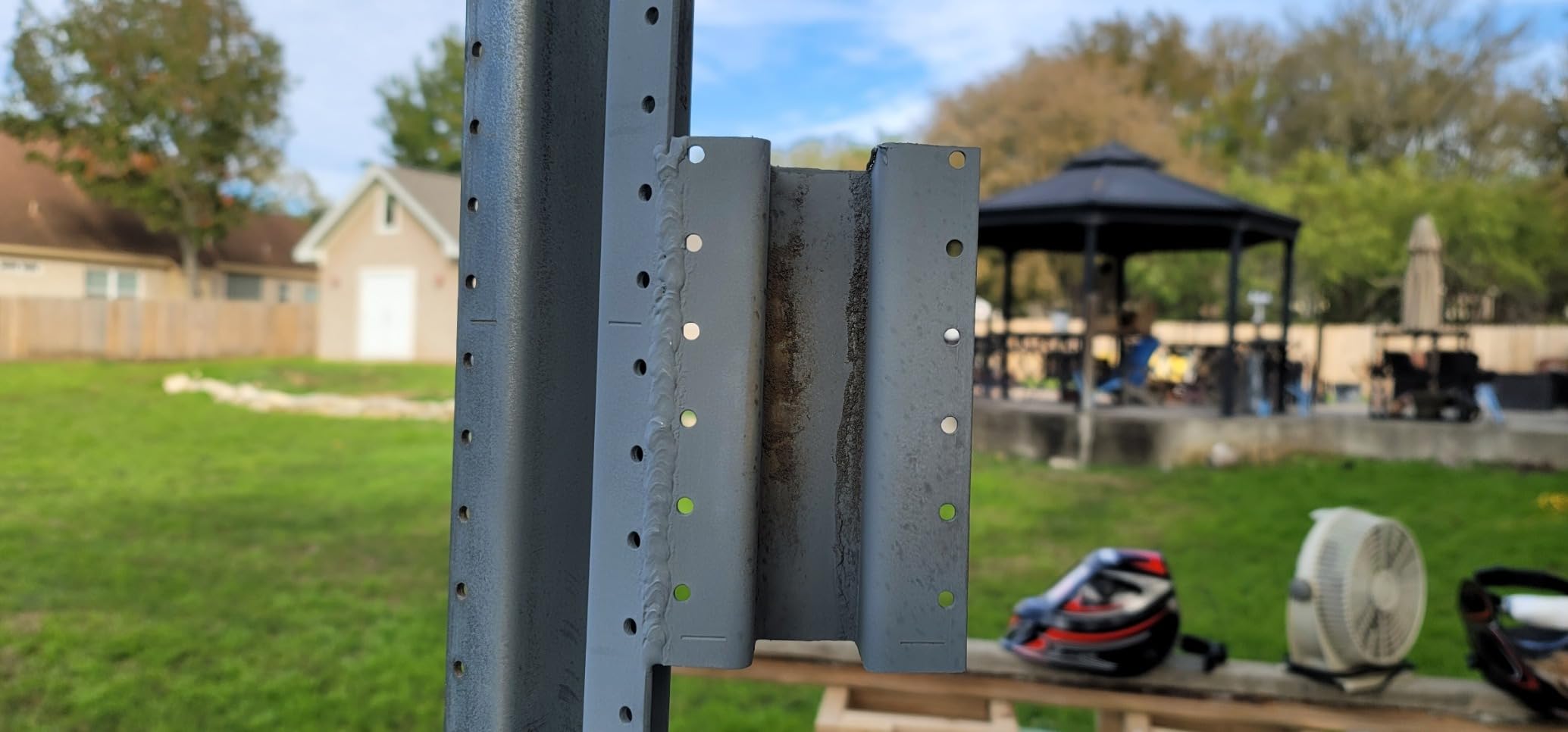
On a square tube frame I usually run two pads at one corner, one small and one medium, which combined gives more effective hold than a single larger magnet in the same spot. The whole kit weighs 0.9 lb, so you can slide it into a partially assembled joint without shifting the workpiece, which is the moment a heavy tool becomes a liability.
Two details from the listing worth knowing. The stated 18 lb figure is a maximum pull measured on clean, flat, unpainted steel in ideal contact, so treat it as an upper bound rather than a promise on a scaled or curved tube. And the model guidance is to avoid prolonged high heat exposure, because a magnet that gets cooked can lose holding strength permanently.
Where it earns its keep on a home project
For a welded plant stand or a wall shelf with gussets, this is the magnet that lets you work with one hand while the other holds the gun. Small tabs and brackets that a full-size square cannot straddle are exactly the right size for the 12 lb pads, and the face-and-bottom magnet layout keeps a part from dropping the moment you let go of the bench.
Owners also value the kit for sub-assembly, holding a short stub of tube square against a longer piece before the full joint is made. The stated rating distribution supports that, with 76% of reviews at five stars, so the common experience is a solid, predictable tool rather than a clever one that occasionally misbehaves.
Where it falls short
This is not the magnet to reach for when you are tacking 1/4 inch plate or a chunky solid bar, where the 12 lb and 18 lb ratings leave no margin. If the joint is heavy enough that you are bracing it with your knee, the magnet is not adding much beyond letting you set the torch down.
It also is not a switchable tool. You pry or slide the pads free every time, and because the magnets stay live, filings and swarf cling to the face during grinding and will find their way into the bead if you do not clean up between passes.
2. YESWELDER 4-Pc 50 lb Set – Best Arrow Magnet for Square Tube Frames
- Highest average rating in this group
- Strong fit-up hold on square tube
- Three working angles from one body
- Four magnets allow doubling up on heavy pieces
- Real hold commonly falls short of the 50 lb label
- Cast angles are not consistently true to 90 degrees
- Grips in specific orientations only
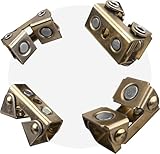
This is the highest-rated product in the roundup at 4.7, with 80% of reviews at five stars, and it is the set I would hand someone building a square tube trailer frame or a welded table base. The arrow body presents three faces at 45, 90 and 135 degrees, so a single magnet can square a joint, hold an inside corner, or pull a 45 degree gusset into place without being reconfigured.
At 4.76 by 3.26 inches and 0.7 inch thick, it is a substantial magnet, not a pocket-sized helper, which is what you want when the workpiece is a 2 inch tube and you are trying to keep the ends plumb.
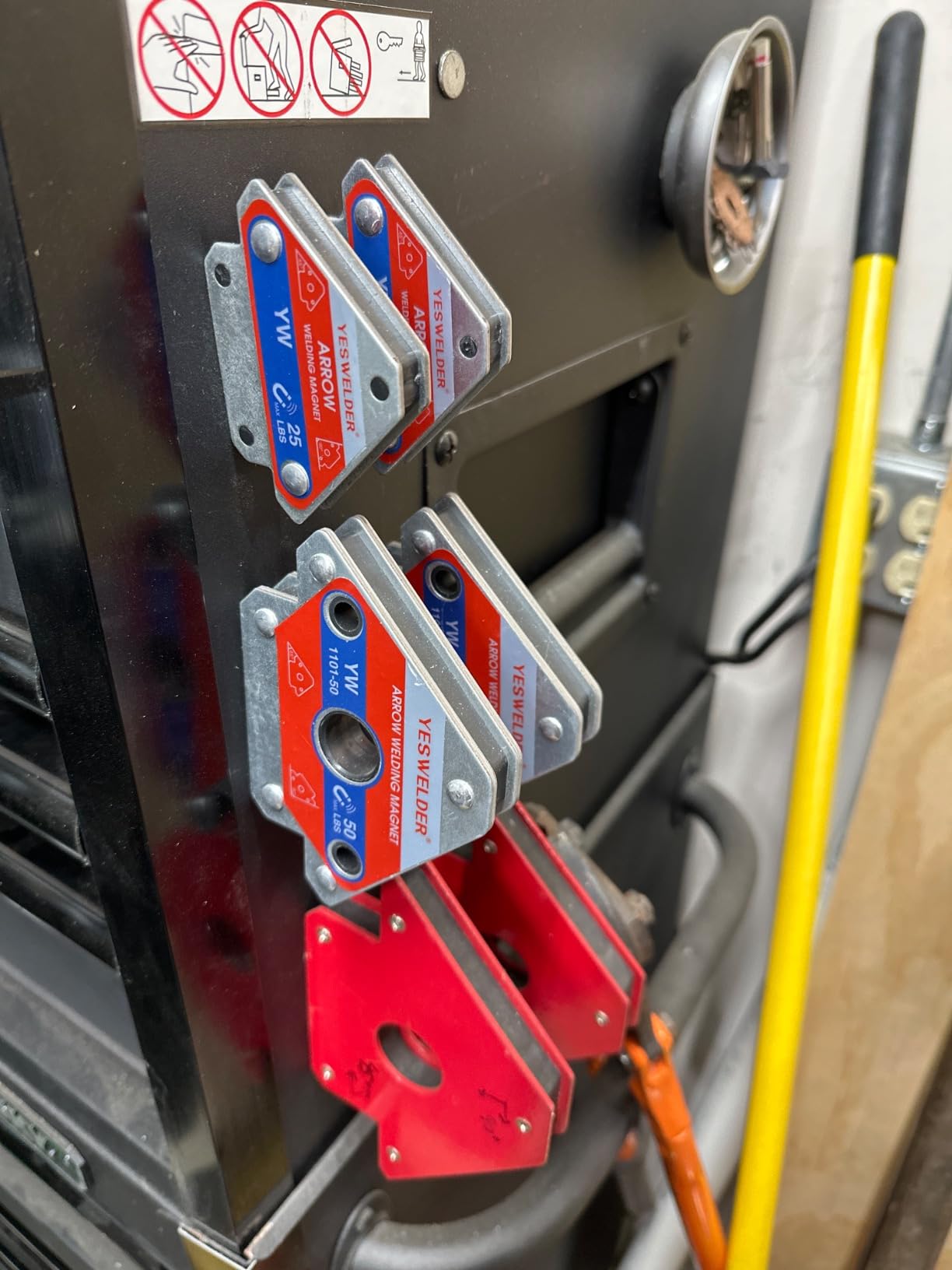
Four pieces is the number that matters here. The rated hold is quoted per magnet, and owners routinely describe doubling up, which is how you get a stable joint on longer spans. The same four-magnet approach explains the recurring feedback that these outperform a single larger magnet on a multi-point assembly, because four hold points beat one hold point every time.
Reviewers also report continued hold after a year of daily use, and the iron and magnet construction is listed as wear resistant. Construction material matters more than it sounds: a magnet that chips or cracks around the rivets loses alignment long before the steel body wears out.
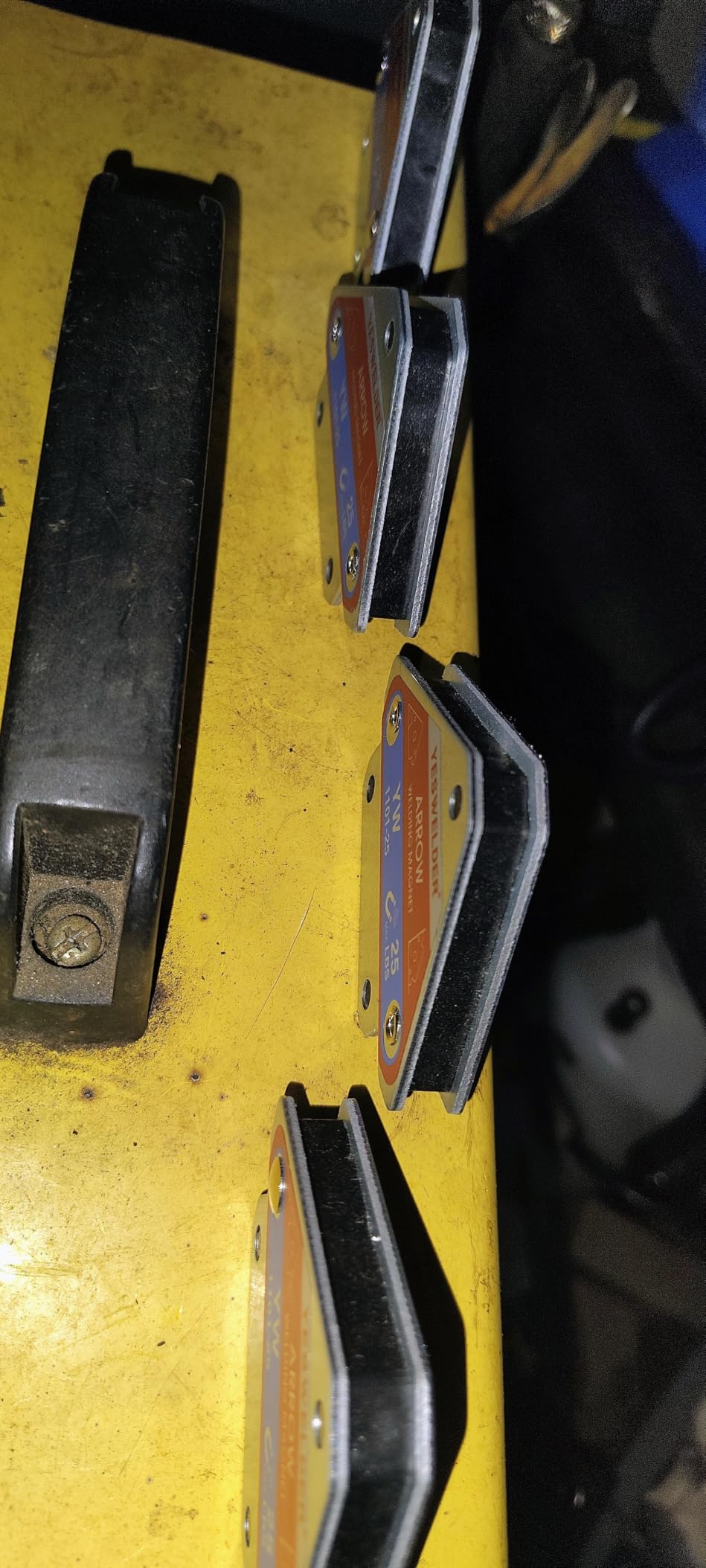
Where it earns its keep on a home project
Square tube is where an arrow magnet earns its rating. Building the legs and rails of a table, a stand or a trailer, you can square each corner, tack it, and move on while the joint holds itself. The three angles also make this a good set for a handrail, where a rail meets a post at whatever angle your stair measurement turns out to be.
Owners call it a second pair of hands repeatedly, and they use it beyond welding, for soldering, marking off and pipe installation. That versatility matters in a home shop where the same jig gets dragged out for layout as often as for fit-up.
Where it falls short
The advertised 50 lb is the ideal-condition figure, and many owners report real hold closer to 30 lb. If your joint is heavy enough that you can feel the magnet slipping, doubling up is the fix, not buying a bigger label.
Second, the cast angles are not always a true 90 degrees, and that is the most common complaint in the reviews. If a project depends on the joint being visibly plumb, verify the corner with a machinist square after tacking rather than trusting the body shape.
3. Strong Hand MSA46-HD Adjust-O – Best Switchable Magnet for Steady Setups
- Releases workpieces without prying or pulling
- Handles round and square tubing plus angle and flat stock
- Switches off so chips and debris wipe away
- Heaviest hold among the compact squares
- Bulky compared with simple arrow magnets
- Switched off means it cannot act as a fixed stop
- Fixed at 45 and 90 degrees only
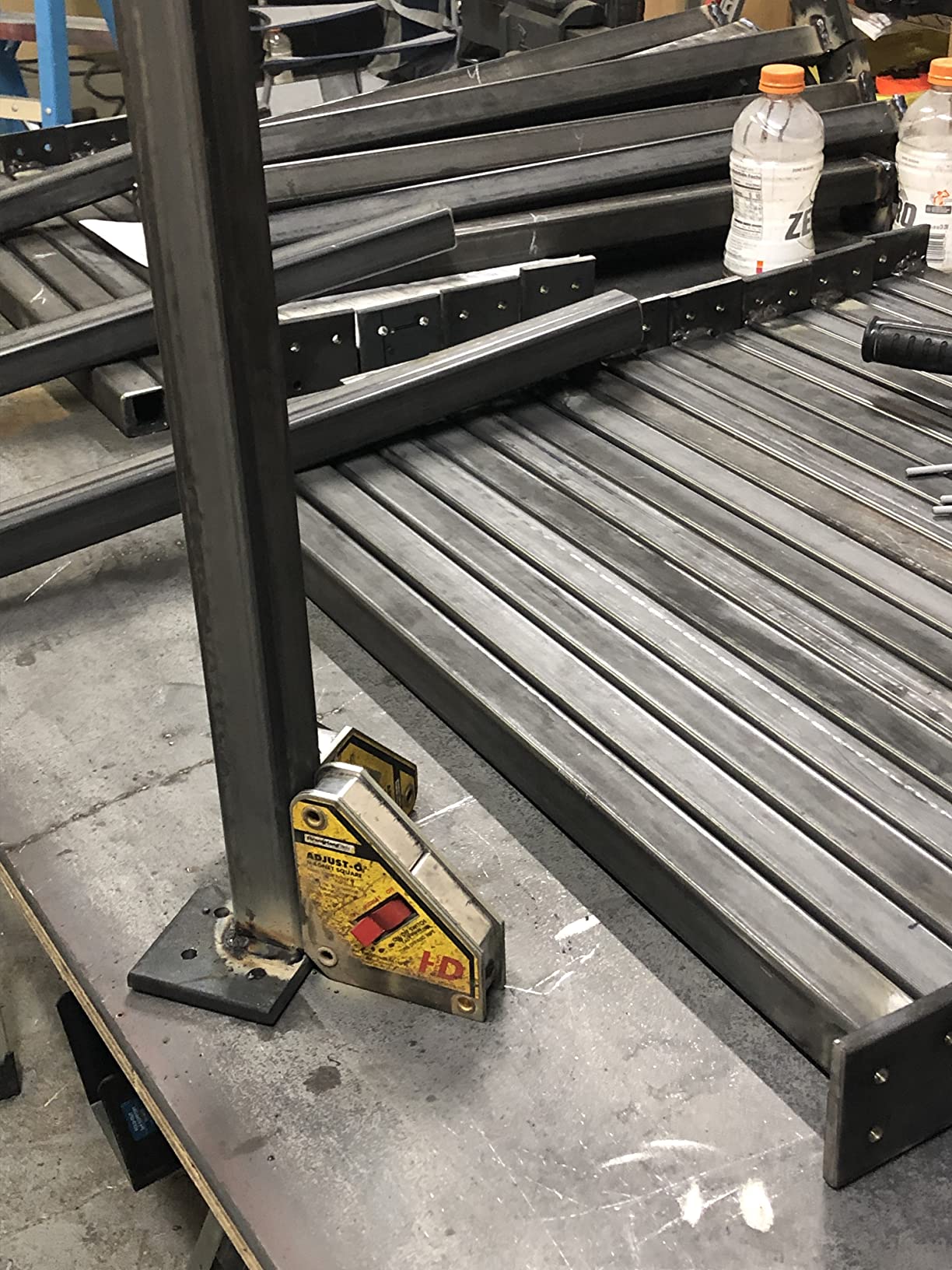
The single most repeated owner recommendation in this whole category is that you should buy a switchable magnet, and this is the version of that idea most people end up owning. A mechanical control slides the magnets off the pole pieces, so you position the joint with the tool loose, throw the switch, and feel the workpiece lock. No prying, no sliding a heavy magnet down a tube by feel.
The second benefit is cleanup. With the magnet off, steel filings and grinding swarf fall away instead of clinging to the face, which solves the most common home-shop complaint about magnets of this type. The 65 lb rating gives it more hold than any other compact square in the list.
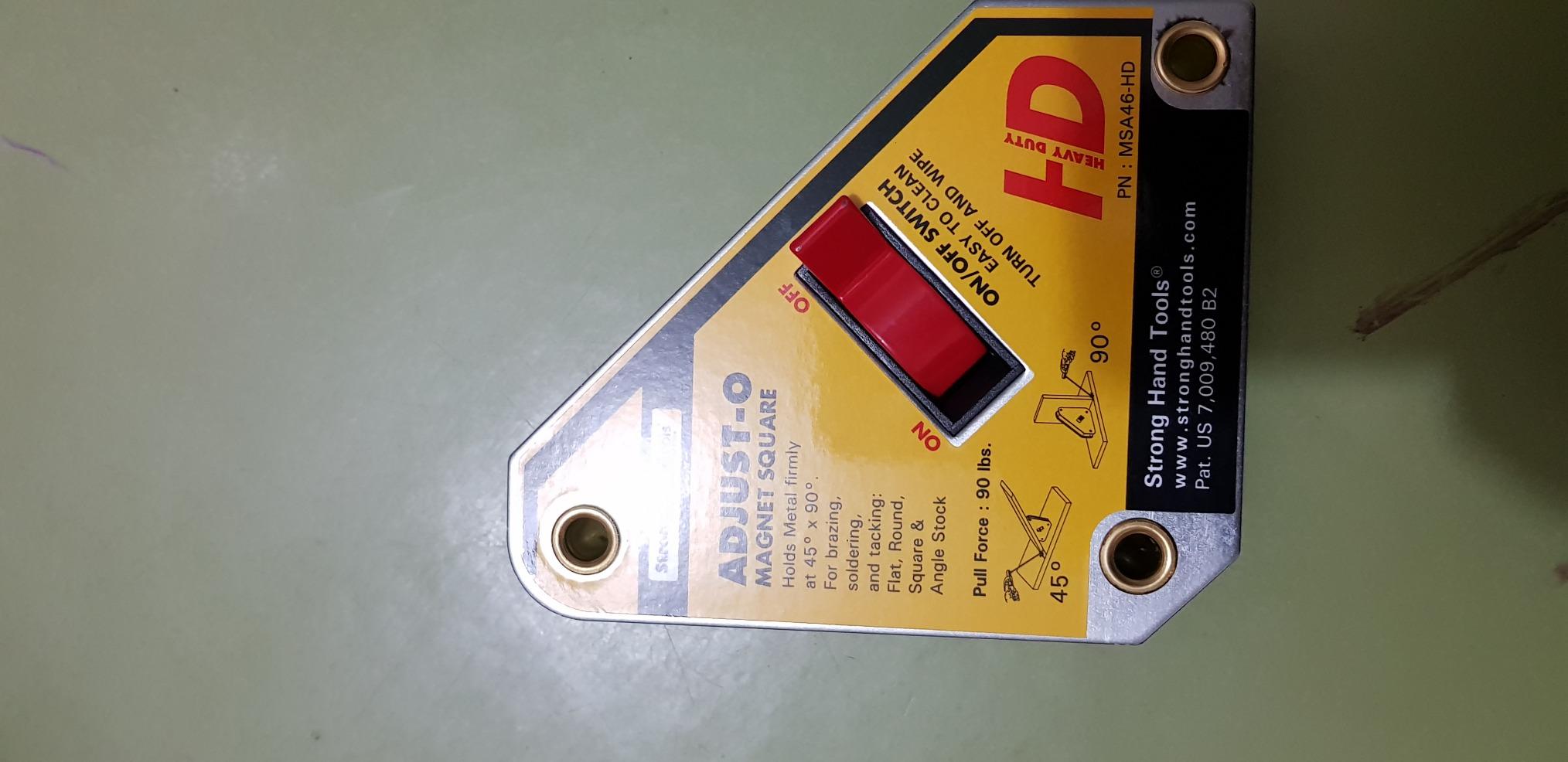
It measures 4.38 by 3.75 by 1.13 inch and weighs 0.7 kg, so it is a bench tool rather than a pocket tool. The 74% five-star share in the rating distribution reflects a mature product that does one job well, with 1117 reviews behind the average.
It is built for round and square tubing, angle iron and flat stock at 45 and 90 degrees. Note the specification discrepancy in the listing itself, which quotes 65 lb in the product details while the feature bullets cite 90 lb, or 40 kg. That gap is a good reminder to treat any published pull figure as a ceiling.
Where it earns its keep on a home project
Assemblies with several similar joints are where switching pays. A steel shelving unit with four identical gussets, or a frame with four identical corners, means you set the same position four times, and being able to release the workpiece to check it against a pencil line changes the quality of the finished frame.
It also handles the mixed-material jobs common to home builds, where a round tube leg meets an angle iron brace and the shape changes between joints. The 45 and 90 degree faces cover most of what a garage weld produces.
Where it falls short
At 0.7 kg it is noticeably bulkier than the arrow magnets, and on a small bracket that weight is dead weight in your hand. If your work is mostly 16 gauge sheet and small brackets, this is more tool than the job needs.
Because it must be switched off to release, it cannot be used as a fixed stop, block or spacer, which is a real limitation if you have ever leaned on a magnet to resist a force rather than hold a joint. It is also fixed at two angles, so a 30 or 60 degree setup means a different tool.
4. Hobart 770566 Magnetic Ground Clamp – Best Companion Buy for Grounding the Circuit
- Attaches straight to the workpiece with no loose lead
- Quick release makes swapping cables fast
- Handles stick and MIG work at 500 amps
- Long jaw reaches larger or curved pieces
- Grounds the workpiece and does not position it
- Needs a thick flat ferrous surface to seat properly
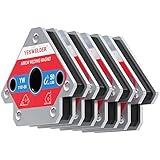
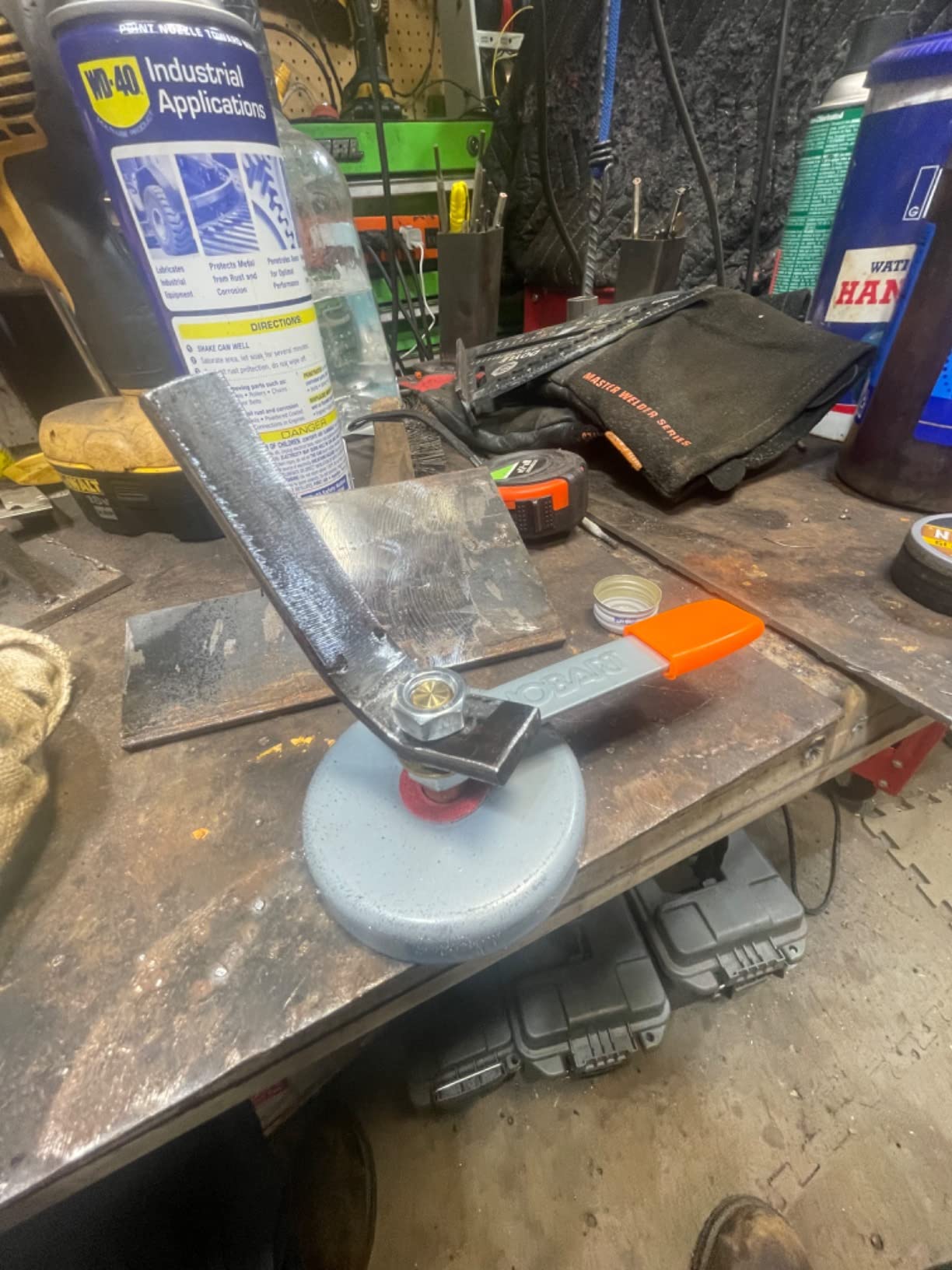
This is a grounding tool, not a positioning tool, and confusing the two is the most common buying mistake in this category. The Hobart 770566 clamps the return cable directly to the workpiece with a magnetic base, which means no loose ground lead whipping around your bench and no second hand occupied holding a copper jaw on a dirty panel.
That matters more than it sounds. A ground lead attached loosely or at a single point creates circuit noise, and on a garage floor with a welder kicking back, it is the difference between a clean bead and a spatter-bright one. If your machine struggles with the work clamp or you keep reattaching the lead, this is often the actual fix.
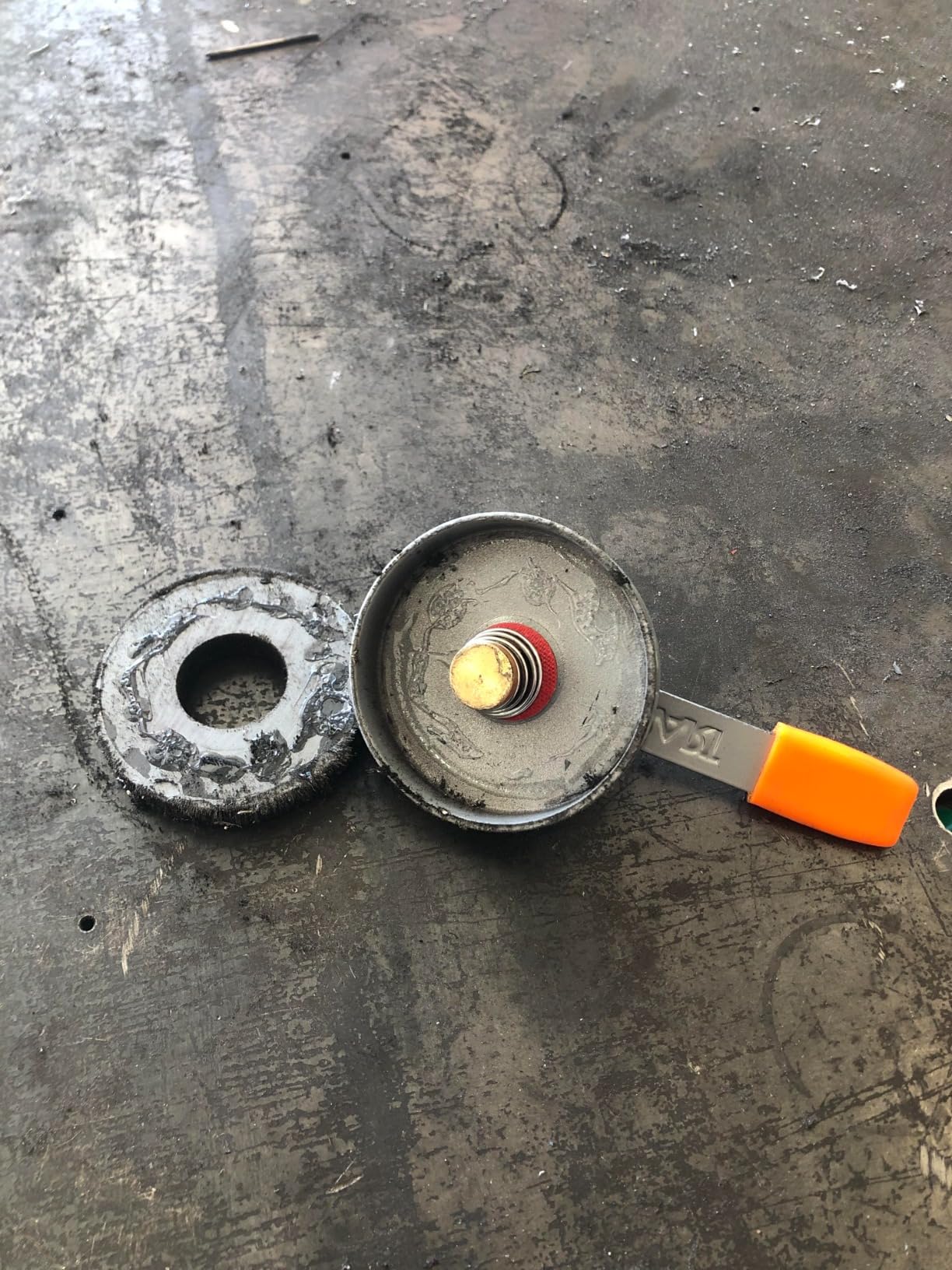
It is rated to 500 amps, which covers both stick and MIG work including the higher amperage jobs a home shop eventually takes on. The quick release means connecting and swapping the welding lead takes a second, and at 9.2 by 4 by 2.3 inches the long jaw has reach for larger or curved pieces.
It weighs 1.3 lb and carries a manufacturer warranty. At 895 reviews and 74% five stars, the owner consensus is straightforward: it does the grounding job cleanly and nobody expects more from it.
Where it earns its keep on a home project
Any job where you cannot clamp a ground to a bench. A trailer frame on stands, a vehicle panel, a planter box built on the lawn, or a frame that is itself the only large ferrous mass in the room. In those situations a copper clamp needs something to bite into, and a magnet only needs a flat steel surface.
It is also the right answer for anyone whose machine has a work clamp lead that is too short to reach the workpiece. The long jaw reach is the practical reason owners keep it in the cart rather than on the shelf.
Where it falls short
It will not hold two pieces of steel in position, and it will not square anything. If you buy it expecting a welding magnet, you will be disappointed, and if you buy a positioning magnet expecting grounding, your ground lead will still be dragging across the bench.
It also needs a thick, flat ferrous surface to seat properly. On thin sheet, on a curved tube, or on a painted surface with a thick coating, the contact is unreliable and the connection suffers, so keep a conventional clamp for those cases.
5. Strong Hand AGK320 Hole Plug Magnet – Best for Plug Welding Steel Panels
- Purpose-built for plug and hole welds
- Base mounts on curved steel panels
- Spring arm means place and weld without repositioning
- Thick copper pad sheds heat and will not stick to the weld
- Specialized and limited to plug and hole work
- Needs a flat magnetic seat on a panel
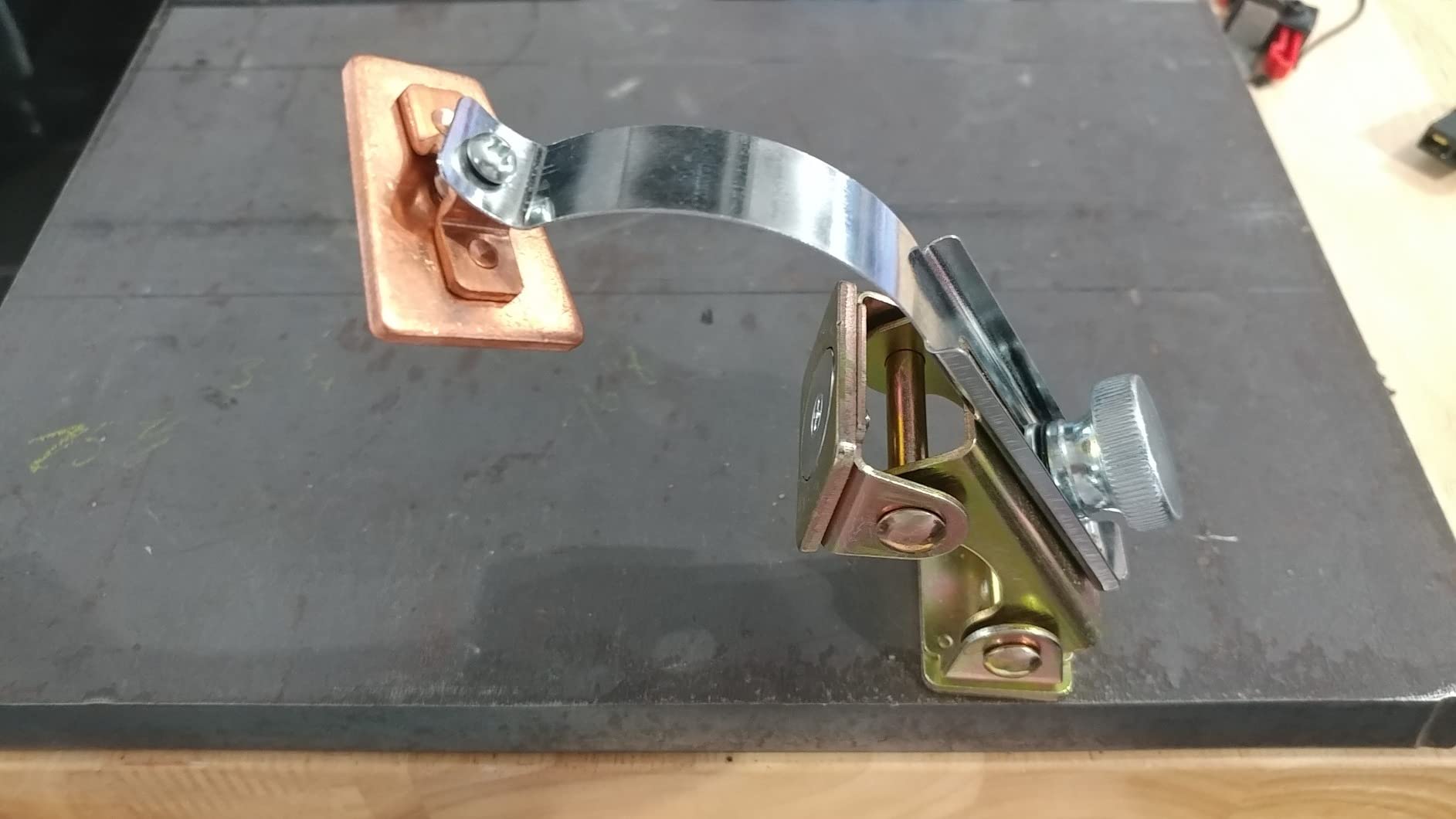
A plug weld is a hole filled with molten metal rather than a joint between two parts, and it is how sheet metal boxes get closed and how flanges get attached. It is also, in plain terms, a weld that is hard to hold by hand because both your hands are occupied. The AGK320 exists for that specific problem and does it better than a general-purpose magnet can.
The pivoting magnetic V-pad base seats itself on the panel, which means it works on a curved or vertical surface where a flat-faced magnet would simply slide off. The spring-loaded arm applies the plug for you. You position the hole, press the arm down, and weld hands-free.
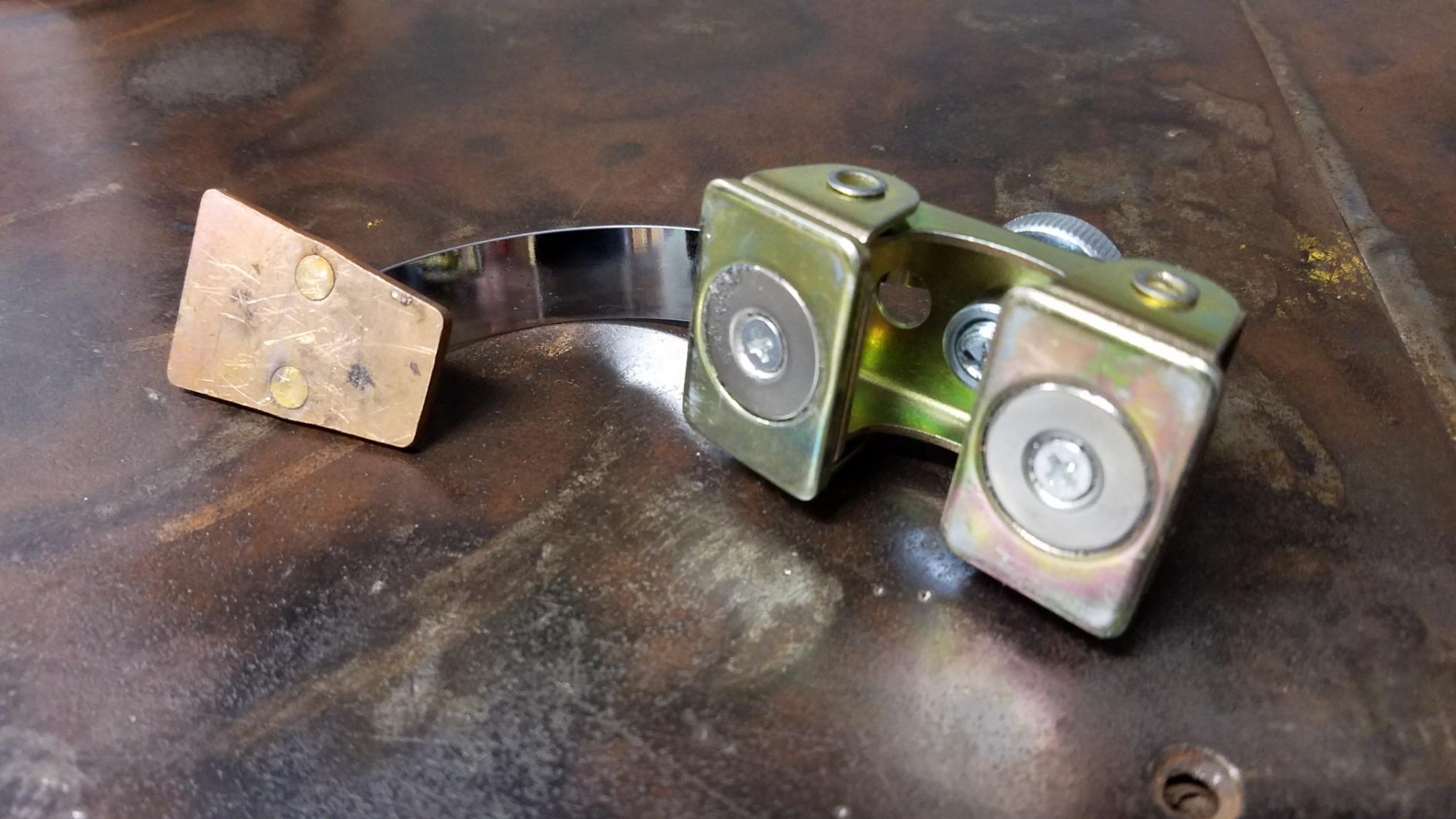
Two design details are what make it worth the dedicated purchase. The thick copper pad dissipates heat and will not stick to the weld, so you are not fighting a magnet welded to your part, and the long arm keeps the magnetic base far enough from the arc to protect it, which is the normal failure mode for magnets used near a hot joint.
Rated pull force is 35 lb and the body measures 5.5 by 1.6 by 1.6 inch, which is compact for a 35 lb tool. The 4.6 rating across 754 reviews reflects owners who bought it for one job and found it does that job extremely well.
Where it earns its keep on a home project
Sheet metal work. A planter box, a duct transition, a toolbox or a small enclosure, where you need to fill a row of holes rather than run a bead along an edge. It is also how flanges get welded to a flat plate without a press brake, which is a very common garage-only approach.
The curved-panel capability is the detail that widens the range. Exhaust sections, round bodies and vehicle panels all present a surface where a flat magnet face has nothing to grab, and the pivoting V-pad base handles it.
Where it falls short
If you only make fillet and butt joints, this magnet will sit on the shelf. It is a single-purpose tool, and a general arrow magnet or a switchable square will serve you better across mixed work for the same outlay.
It also requires a flat magnetic seat on the panel. On a thin, rusty or heavily painted surface the base cannot find consistent contact, so clean the seat area before you press down or you will get a plug weld with inconsistent penetration.
6. Magswitch MagSquare 150 – Best for Precision Fixturing and Layout Stops
Magswitch MagSquare 165 Switchable Magnetic Square – 165 lb Hold
- Strongest rated hold here at a fraction of the weight
- On and off switch means clean release and chips shed freely
- Pre-tapped mounting holes for custom fixtures
- Works with TIG
- spot
- stick and fiber welders
- Rated hold drops well below 150 lb on thin sheet
- Compact footprint disappoints buyers expecting a large square
- Magnetic field can interfere with the arc if left near the bead
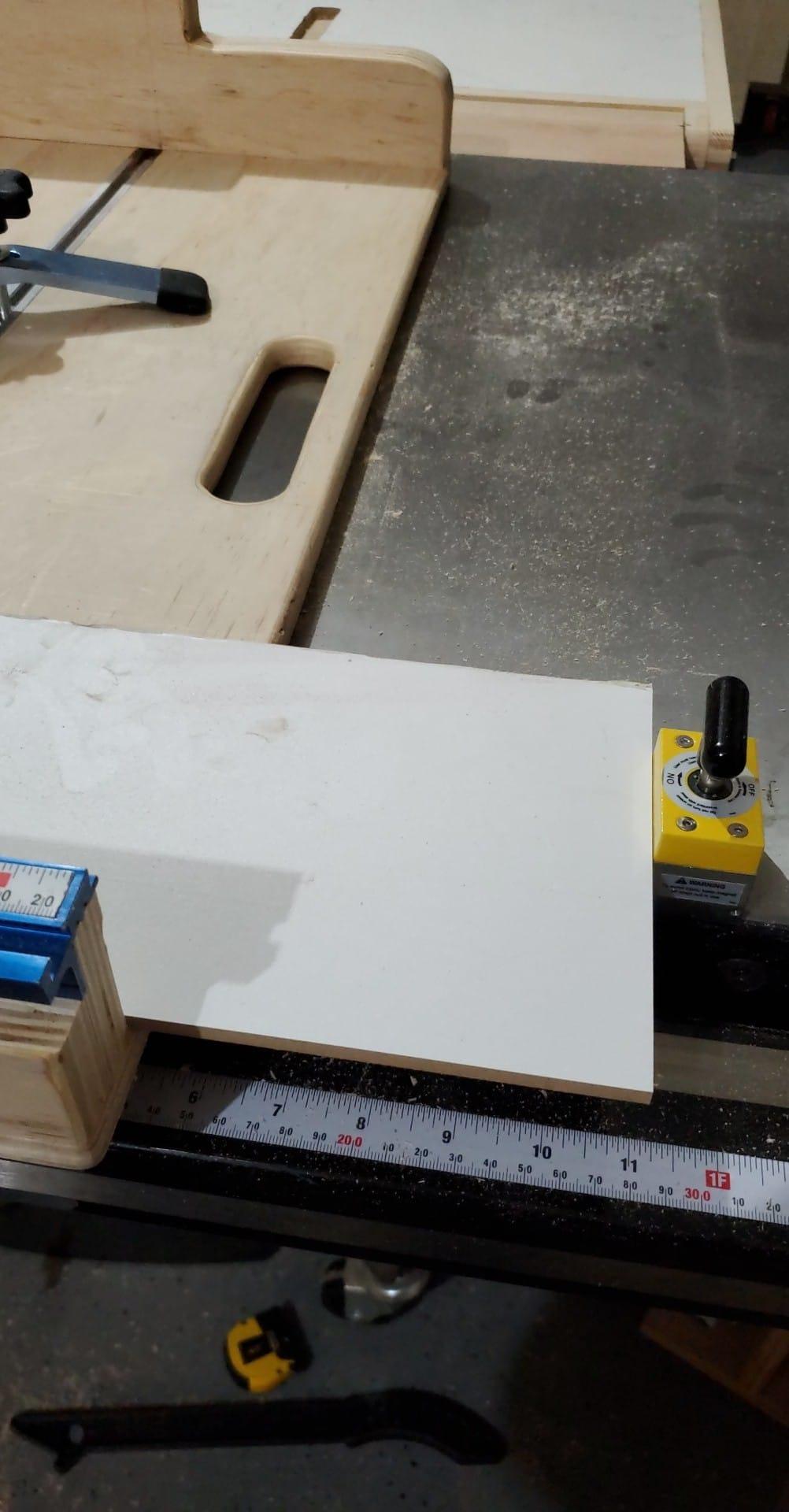
This is the pick for people whose home shop runs more fabrication projects than repair jobs. The Magswitch MagSquare 150 carries a 150 lb rating at 11.2 ounces, which is a genuinely unusual combination, and the multi-plane grip works on five faces. That means you can mount it to the side of a fixture, hang a part off it, or use it as a layout stop, which no other magnet in this roundup can do.
The pre-tapped mounting holes are the feature that separates a workholding tool from a welding accessory. Bolt it to a wooden or steel jig and it becomes a permanent part of your setup, holding the same part in the same place every time. For someone building a repeatable bracket or a series of identical tabs, that repeatability is worth more than raw pull.
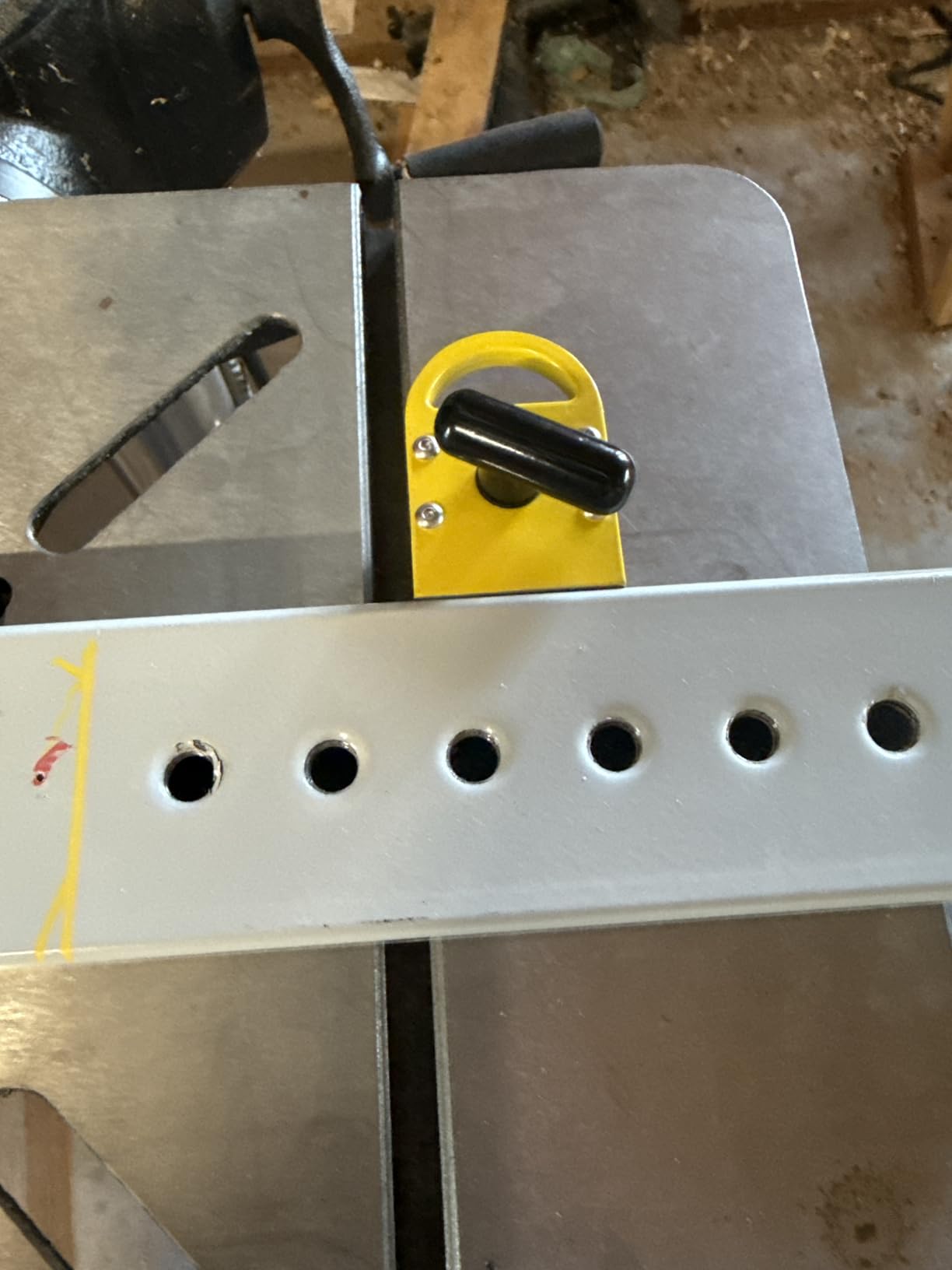
It requires no power source, the mechanism is purely mechanical, and the 1 year manufacturer defect-only warranty is the shortest formal commitment in this group. Professional fabricators describe it as indispensable for setup, grounding and cleanup, and the 580 reviews at 4.6 back that up.
Owners also use it for sheet leveling and de-stacking, which is where the five sided grip pays off in a home shop full of cut parts. Debris sheds once it is switched off, so cleanup does not involve picking swarf off the face with a glove.
Where it earns its keep on a home project
Anything you build more than once. A jig for a bracket you are making six of, a stop for repeatable cuts, a way to hold sheet flat while you weld a flange. Because it can be mounted, you set the position once and stop re-measuring on every piece.
It also handles the odd jobs a general square struggles with, such as holding a part at a height off the bench, or clamping two sheets side by side along a long seam where a single contact point would not do.
Where it falls short
The 150 lb figure only applies to thick, flat steel. On thin sheet metal the limit is the workpiece itself, not the magnet, and owners report hold well below the rating. Do not buy it expecting to clamp 16 gauge and be surprised.
The footprint is compact, closer to a 1 by 2 inch shape than to a traditional square, and buyers expecting a large tool are disappointed by the size. It also carries the highest per-unit commitment in this lineup, so for occasional positioning a simple arrow magnet covers the same job without the outlay.
7. Hobart 770662 Mini Holder Set – Best for Tight Joints and Sheet Metal
- Smallest body for joints a full-size magnet cannot straddle
- Four units let you hold several points at once
- Useful for sheet metal and short offcuts
- Easy to pull filings off before welding
- Light duty and not meant to hold meaningful weight
- Side plates can arrive misaligned and hurt squareness
- Units sometimes arrive scratched
The reason to own mini magnets is reach, not strength. A 3/4 inch square bracket welded inside a frame, a small gusset on the back of a leg, a short tab at the end of a rail, these are joints where a full-size magnet physically cannot sit. The Hobart 770662 set gives you four of them in a 4-piece pack, which is what makes it useful rather than a single novelty piece.
Owners report the same effect described across the category: several small magnets at several hold points outperform one large magnet, because a fit-up has more than one place it can move. On sheet metal, where a full-size arrow magnet would tip the workpiece as it attaches, a mini magnet is the correct tool.
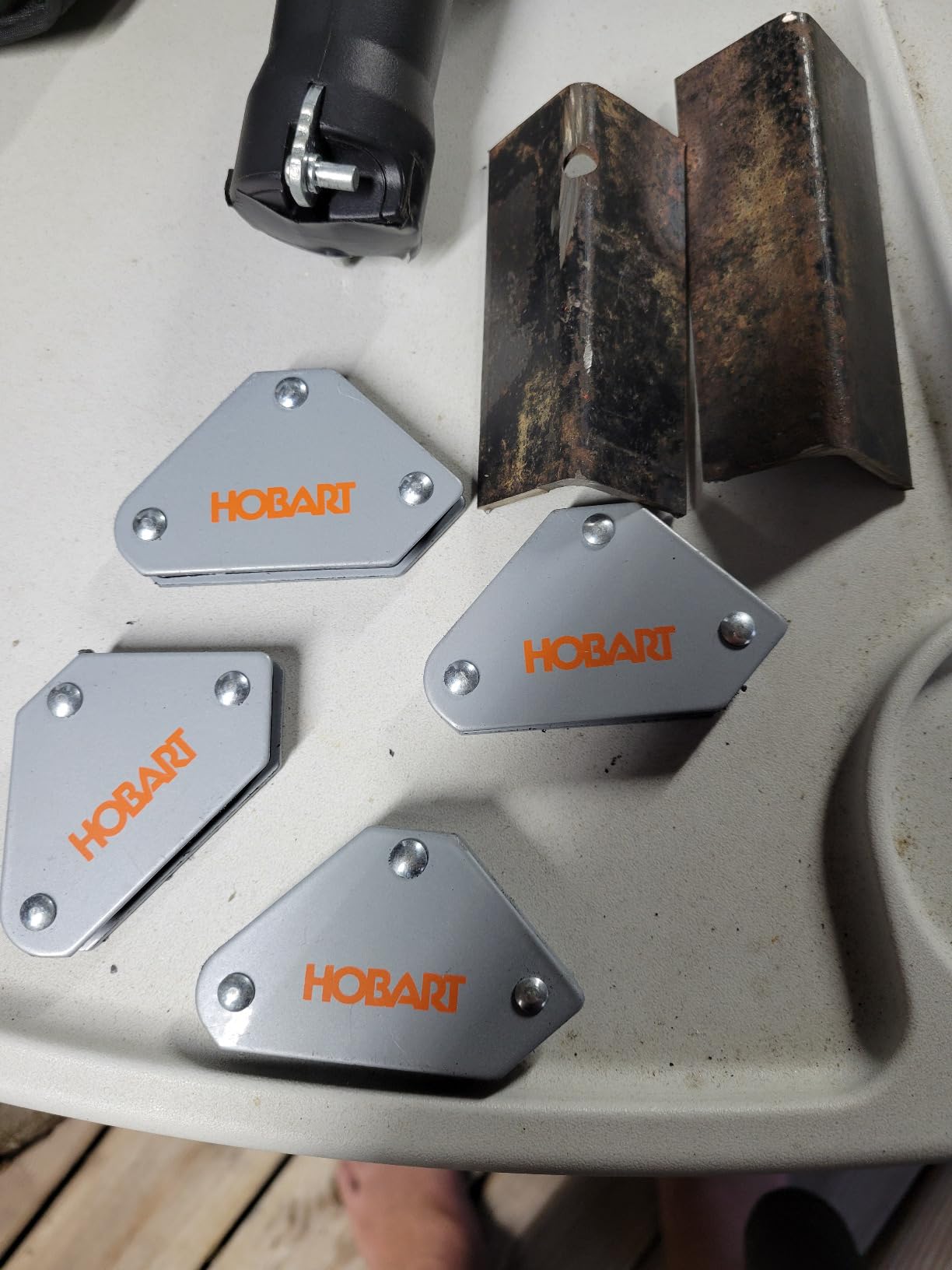
They hold at 45, 90 and 135 degrees, are hand powered with no consumables, and the package measures 8.5 by 5.5 by 0.7 inch at 12.3 ounces. At a 4.3 average with 67% five stars, this is the lowest-rated pick here, and the gap comes almost entirely from build consistency rather than from the concept failing.
The specific complaint is misalignment: side plates arriving with loose tolerances, which shows up as a magnet that will not hold a true 90 degree. It is worth checking the corner with a square on arrival, before you trust it on a visible joint.
Where it earns its keep on a home project
Small sheet metal work and short sections of tube. A fabricated shelf bracket, a small box, a patch panel, or the little tabs and clips that decorate a larger frame. Reach is the whole point, and at this size they fit where nothing else will.
Four in a pack also makes them a practical way to hold an assembly at multiple points while you tack. If you are assembling something with six small joints, two packs leave you a magnet at each one and still give you a hand free.
Where it falls short
They are light duty by design and are not intended to hold meaningful weight. On 1/8 inch stock or solid bar they will simply let go, and no arrangement of several of them changes that limit.
The build quality inconsistency is the real drawback. If you need a squareness guarantee for a visible structural joint, spend the extra money on a heavier magnet with a tighter body, and keep these for the joints nobody can see.
8. Pit Bull TAIM806 4-Piece Set – Most Versatile for First Time Welders
- Compact 2 inch body fits short tube and small brackets
- Three holding angles for squaring small joints
- High-gloss enamel plates resist weld spatter
- Four pieces at an entry-level outlay
- Rated to only 10 lb
- Build quality varies and side plates can be misaligned
- Collects steel filings quickly during grinding
If you have just bought a welder and you are not sure whether you will use it, this set answers that question at a modest outlay. The Pit Bull TAIM806 is a four-piece set of 2 inch magnets holding at 45, 90 and 135 degrees, and at a 10 lb maximum capacity it is built for small tube, short brackets and light sheet rather than anything structural.
It has been on the market since 2009, which tells you something useful about the form factor. Mini magnets of this size are not going away, because the joints they reach are exactly the joints a homeowner hits first when building something small and fiddly.
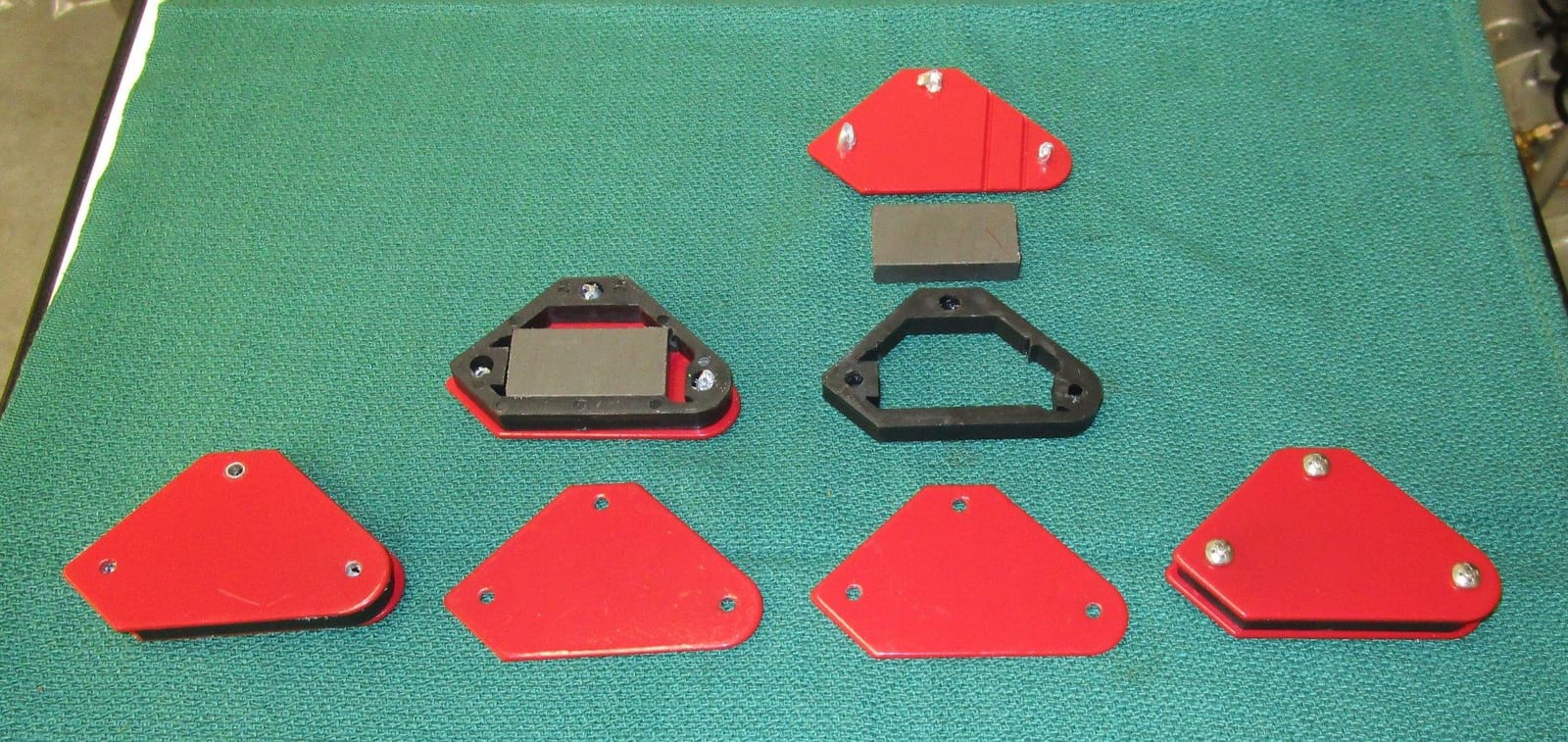
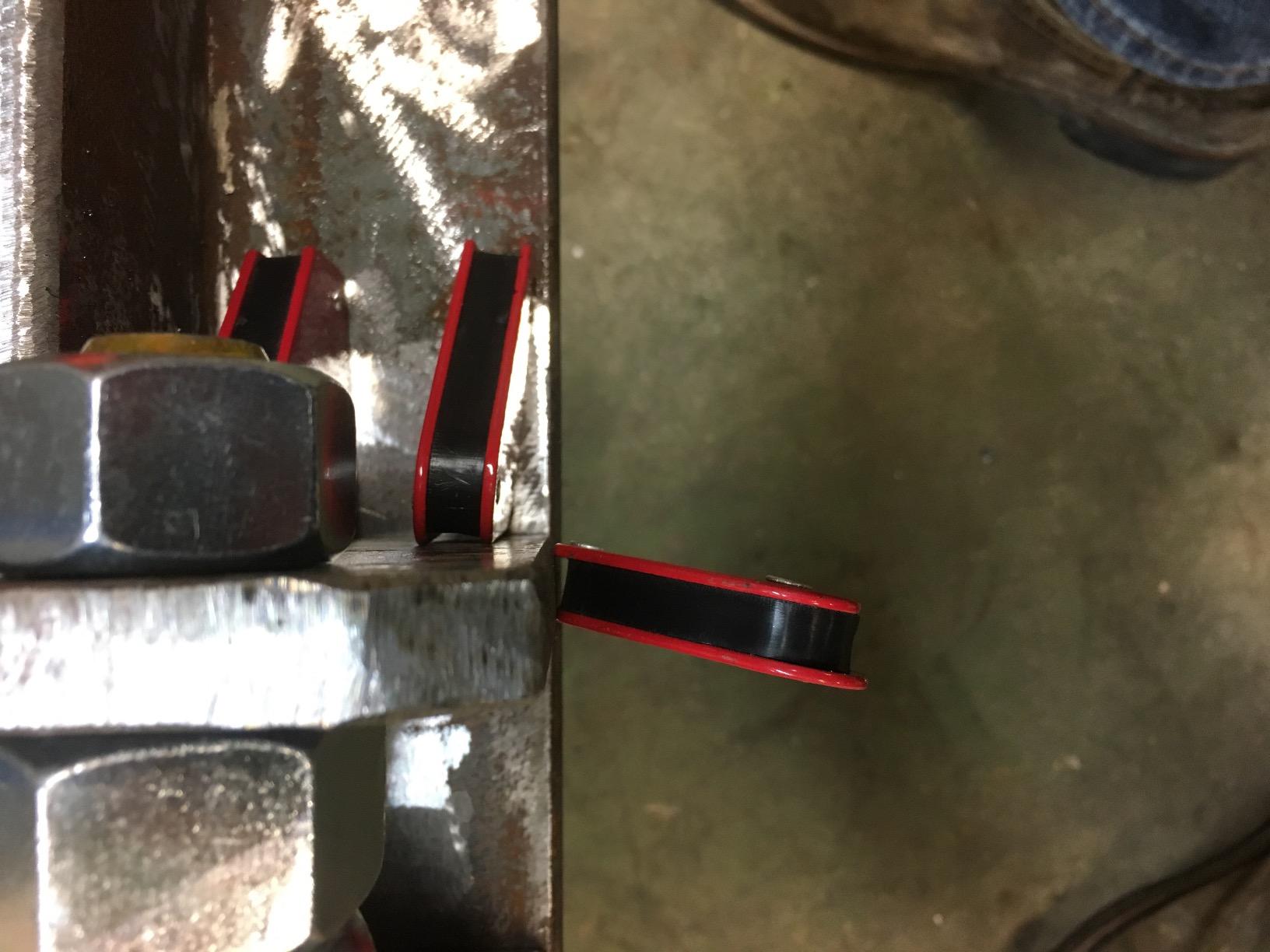
The rating is 4.2, the lowest average in this roundup, and 11% of reviews land at three stars with a 5% one-star share. The complaints are consistent enough to plan around: several buyers report riveted side plates arriving misaligned, leaving them unable to hold anything square until they reworked the assembly with screws.
That is not a reason to skip it, but it is a reason to inspect it on arrival. Two minutes with a square tells you whether your particular set is usable, and the high-gloss enamel end plates do resist spatter, which matters more than you would think on a cheap tool.
Where it earns its keep on a home project
First projects, small projects, and anything involving short pieces of small tube. A simple metal shelf, a small stand, a bracket for a shelf board, a repair to a piece of garden equipment. Ten pounds of hold is genuinely enough when the parts weigh a pound.
Four pieces means you can hold more than one joint at a time, and the three angles cover the majority of layouts a beginner encounters. It also works for TIG, MIG and arc work, so it is not tied to one process.
Where it falls short
Ten lb is the ceiling and there is no margin above it. On 1/4 inch material or anything with real mass, you will be holding the piece with one hand and fighting the magnet with the other.
The quality control is the second limitation, and it is the one that decides whether the set is useful to you. The filings issue is manageable, since a quick wipe clears it, but misaligned plates are not something you can work around at the same price point. Check squareness before your first visible joint.
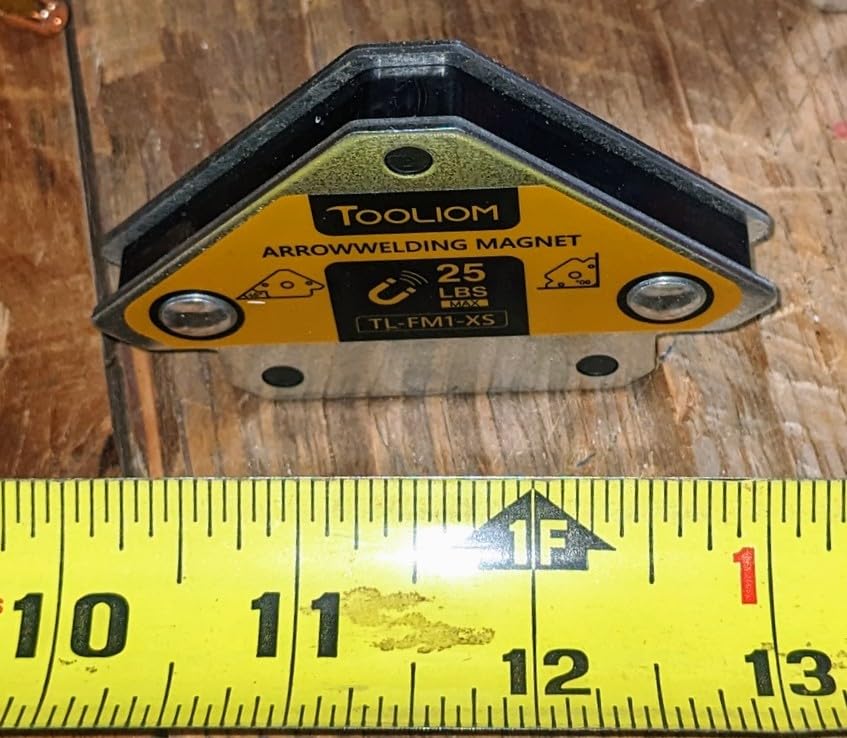
9. TOOLIOM Arrow Magnets 25 lb 4-Pc – Best Middle-Ground Arrow Set for Small Tube
TOOLIOM Arrow Welding Magnets, 4-Pc 25 lb Holding Force Welding Accessories
- Three working angles for accurate joint alignment
- 25 lb sits between mini magnets and the heavy sets
- Small body fits into tight joints
- Metal construction for durable daily use
- 25 lb is modest and large stock needs two magnets
- No on and off switch so parts must be pried free
The TOOLIOM set occupies the middle of this lineup in a way that turns out to be genuinely useful rather than a compromise. At 25 lb per magnet and 2.12 by 3.15 inches, it is lighter than a 50 lb arrow magnet but with the same three-angle body, which makes it the right pick for 1 inch square tube and lighter flat bar where a big magnet is either too heavy or too large to seat properly.
Small tube is the gap this fills. Mini sets top out around 10 lb and cannot hold a 1 inch tube square against gravity, while 50 lb sets overhang the joint and get in the way of the torch on a short piece. The 25 lb body sits in the gap.
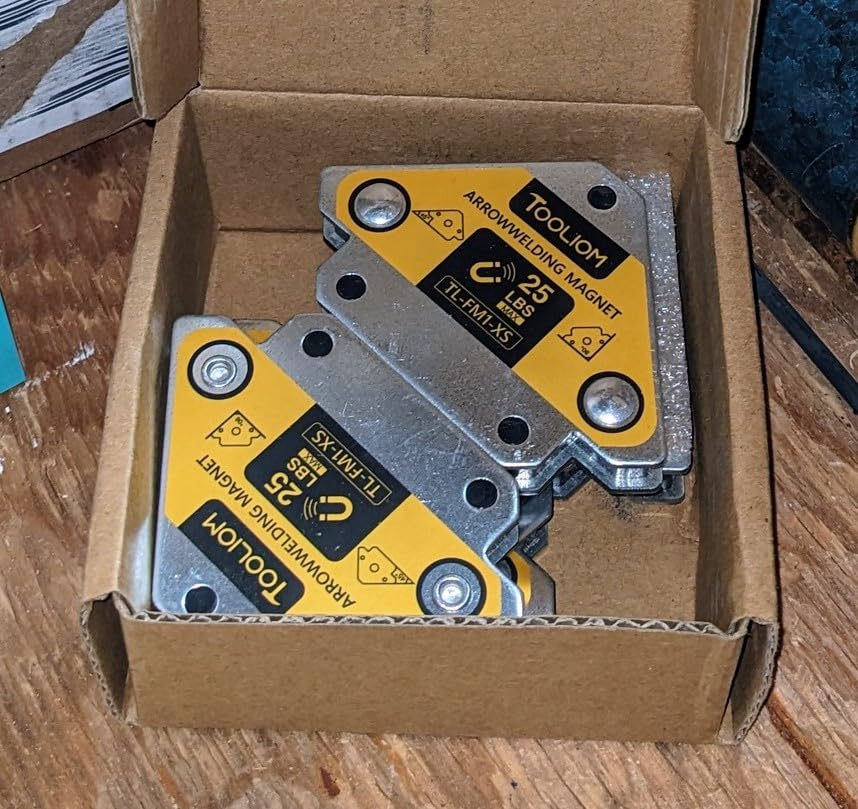
The 73% five-star share and 4.5 average across 358 reviews describe a well-liked tool with a modest reputation, which is what a middle-of-the-market product should look like. Reviewers credit the angle accuracy and the compact body for tight joints, and describe the holding power as adequate rather than impressive.
At 0.47 inch thick it is noticeably slimmer than a 50 lb arrow magnet, and that thinness is the reason it fits into a narrow joint at all. It suits welding, soldering and pipe fitting work as well as welding alone.
Where it earns its keep on a home project
A 1 inch square tube plant stand, a small shelving frame, a handrail section, a bracket made from flat bar. Anywhere the joint is tight and the stock is light enough that 25 lb is plenty. Four of them at four corners is a stable fit-up on a small frame.
It is also a good first upgrade from a mini set. When you outgrow 10 lb, this is the step up, and the 25 lb figure is closer to real-world performance on clean mild steel than the 50 lb claim on the heavier arrow sets.
Where it falls short
For larger tube or heavy flat stock, 25 lb means two magnets, and on a long span you end up fighting to keep them both in contact with the workpiece. Know your material thickness before you buy on the assumption that one magnet is enough.
There is no on and off switch, so parts have to be pried or slid free, and the always-on field means filings cling to the face during grinding. If you are welding a lot in one session, the cleanup adds up compared with a switchable tool.
10. YESWELDER Adjustable Angle Magnet 20-200 Degrees – Best for Angled Furniture and Tapered Parts
YESWELDER Adjustable Angle Welding Magnet 20-200° Welding Magnet of 77LBs
- Widest angle coverage of any pick in this roundup
- Graduated scale and hex wrench let you repeat a set angle
- 77 lb rated hold in a small body
- Iron construction suits daily shop use
- Real pull is well below the 77 lb claim on long stock
- Dial markings are small and hard to read
- No safety on the release mechanism
Almost every home metal furniture project hits an angle that is not 45, 90 or 135. A table with splayed legs, a chair frame with a compound taper, a bracket that has to meet a sloped post, an A-frame stand. This magnet is the one built for that, adjusting continuously from 20 to 200 degrees, which is wider coverage than anything else in the roundup.
The graduated scale and included hex wrench are what turn it from a gadget into a repeatable tool. You dial the angle, tighten it, and the joint stays at that setting while you tack, which means the second leg matches the first.
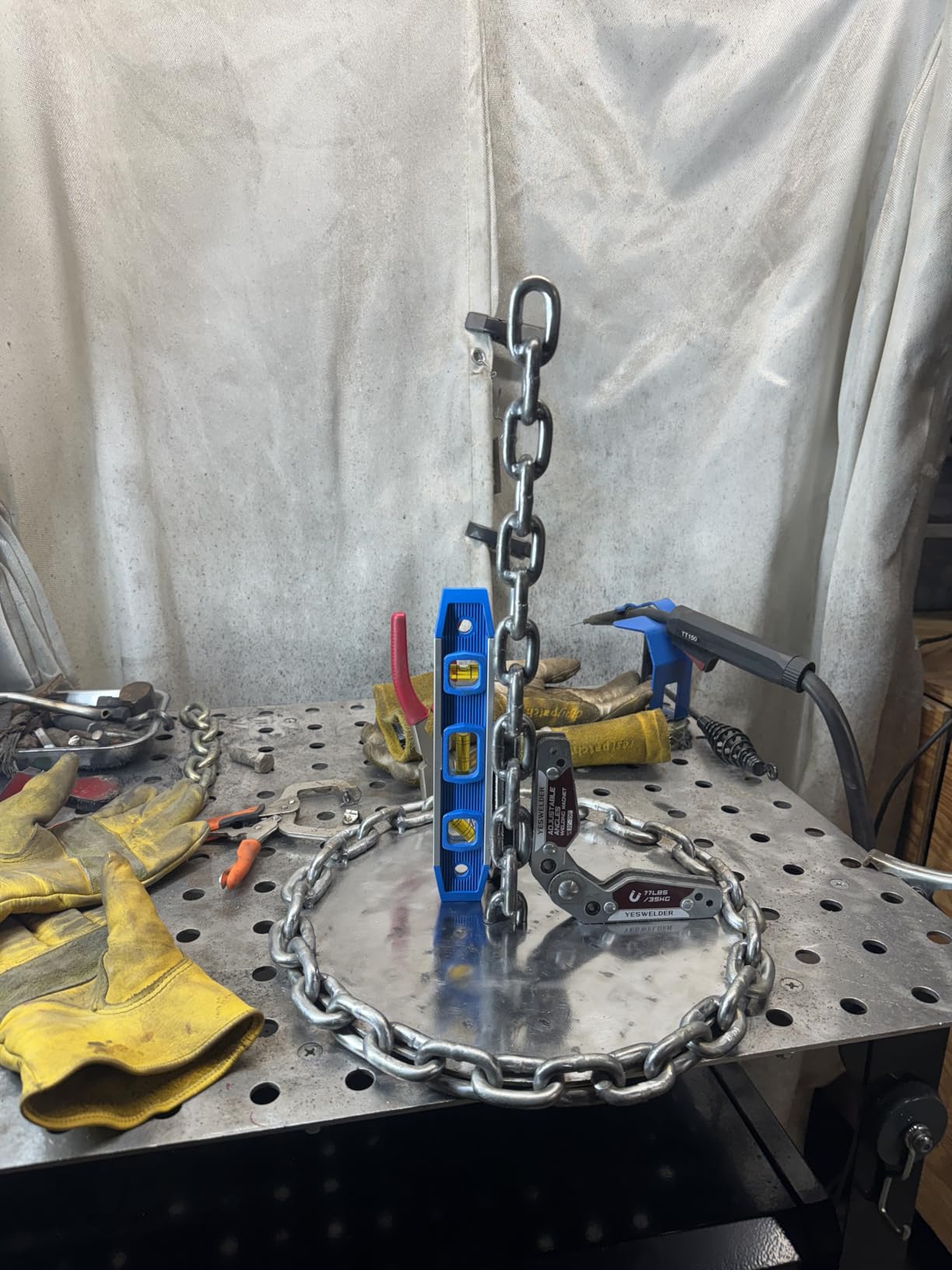
Owners treat it as a set-once-per-job tool rather than something repositioned constantly, and report accuracy within a degree when it is planned that way. The 74% five-star share across 304 reviews supports that, along with a 4.6 average.
It weighs 15.8 ounces, which is light for a 77 lb rated magnet, and the body is iron construction, which holds up to daily shop use. The listing notes the range as 20 to 200 degrees with 77 lb or 35 kg of holding force, and owners are clear that the real pull is more modest than that on long or heavy material.
Where it earns its keep on a home project
Angled and tapered work, which is where arrow magnets simply cannot go. A four-leg plant stand with splayed legs, a diagonal brace on a frame, a metal stand with a sloped top, a handrail where the post angle was not 90. The wide range also covers inside and outside corner angles a fixed 45 or 135 body cannot.
It is useful beyond welding too. Owners use it for pipe supports, brackets and general assembly, and any time you need two pieces to meet at a repeatable non-standard angle on a bench.
Where it falls short
The 77 lb claim is generous, and on long or heavy stock the real pull is well below it. If the workpiece is a 2 inch tube, plan on a second support rather than trusting the rating.
The dial markings are small and hard to read, which matters more than it sounds when you are trying to hit a specific angle in poor light, and there is no safety on the release mechanism, so keep it well clear of a hot arc. For a first project on 90 degree work it is more tool than you need.
How to Choose a Welding Magnet for a Home Shop
Pull force is the maximum holding force in pounds, always measured on clean, flat, unpainted steel in direct contact. Treat every published figure as a ceiling. A painted tube, a curved surface, mill scale or a single narrow contact patch can cut real hold by a large fraction of the label, which is why the same 50 lb magnet that feels unbreakable on bare plate can creep on a rusty trailer frame.
How much pull force you actually need
Match the magnet to the thinnest metal in the joint, not the thickest, because the thin piece is what defines the contact area. For 16 to 20 gauge sheet and small brackets, anything from 10 to 25 lb is genuinely sufficient. For 1/8 inch plate, 1 inch square tube and angle iron, look for 25 lb and up. For 1/4 inch plate and solid bar, you are past what a small magnet handles well, and a C-clamp is the right tool.
If you find yourself adding a second magnet to a joint, that is the answer telling you the first one was undersized for the material.
Stated pull force versus real holding power
Every figure in this roundup is a laboratory-style number on an ideal surface. The gap between stated and real hold is the single most useful thing to understand before you buy, and the pattern across owner feedback is consistent.
On clean, flat, bare mild steel with full face contact, expect to get close to the label. On painted stock, expect a noticeable drop. On mill scale or light rust, more. On round tube and curved surfaces, the contact patch is smaller than the pad, so the drop is structural rather than a defect. On thin sheet metal, the workpiece itself becomes the limit, because the force has to pass through a very short path of material.
Switchable on and off versus permanent magnets
A permanent magnet is always on. A switchable magnet has a mechanical control that disengages the magnetic circuit, so you position the joint loose, then lock it. Two benefits follow, and they are the reason switchable models come up so often in owner feedback.
First, setup speed: you place the workpiece without fighting a live magnet that keeps grabbing the part before it is where you want it. Second, cleanup: with the magnet off, steel filings and swarf fall away instead of clinging to the face, which directly reduces the chance of contamination in your weld. If you grind and weld in the same session, that second benefit alone justifies the switch.
Welding magnet versus C-clamp, toggle clamp and vise
These are not competitors so much as colleagues. A C-clamp or vise grips with mechanical force and holds heavy plate, but it occupies a corner of the joint and can block the torch or the bead. A toggle clamp applies serious force quickly, at the cost of clearance around the work.
A magnet wins on access, speed and non-orthogonal geometry, and loses on raw clamping force and on anything non-ferrous. Experienced fabricators still default to clamps for structural work and treat magnets as a convenience for odd angles and tacking. If you find a joint where the magnet is the weak link, stop and clamp it.
Which magnet type fits which home project
Match the shape to the geometry and you will rarely need more than two or three magnets. A V-Pad nests into the corner where round meets flat, which is a plant stand or a trailer brace. An arrow magnet at 45, 90 and 135 handles square tube frames, gussets and flat bar. A mini set covers the small tabs and inside corners a full-size body cannot reach. An adjustable 20 to 200 degree holder covers splayed legs, tapered parts and anything non-orthogonal. A switchable square covers repeated identical joints where release and cleanup speed matter.
For a starter path, buy one switchable square and one arrow set. Add a mini set when you hit the joints they can reach, and an adjustable holder when your first project stops being square.
Welding magnet versus magnetic ground clamp
A positioning magnet holds two pieces of steel at a set angle so you can weld them. A magnetic ground clamp attaches the welding return cable to the workpiece so current completes its circuit. They are not interchangeable, and buying one when you needed the other is the most common wasted purchase in this category.
You need a positioning magnet when parts move. You need a ground clamp when you cannot attach a ground lead to a bench, when you are welding a frame that is itself the only large steel mass nearby, or when your machine is fighting the circuit. Plenty of people need both, and a copper ground clamp is still the right answer for a flat bench top or a heavy rigid fixture.
Keeping magnets clean and away from the heat
Switch off or remove the magnet, then blow or vacuum the face before you weld. Never brush filings off with a grinder, because a spinning wheel near a live magnetic field pulls swarf into the wheel and into the workpiece. Wipe the face before storing, and let a heated magnet cool fully before judging whether it still holds, because a magnet that gets hot enough to lose strength is already partly damaged.
If a magnet does end up stuck in a cooled joint, do not hammer it. Run the workpiece down to metal with a grinder, which takes the trapped material away and lets the magnet release on its own, and keep the wheel clear of the magnet body so you do not launch it. If the magnet is bonded to the finished part and you want to keep it, a flat pry bar against the joint with a light tap is safer than a chisel, which will mark the bead.
Frequently Asked Questions
Are welding magnets worth buying?
Yes, for home fabrication, with three qualifiers. They are excellent for positioning and tacking mild steel and freeing both hands, they are not a replacement for a C-clamp on heavy plate, and they must be removed before the final pass so the arc and heat do not ruin the bead or the magnet.
What is the best brand of welding magnet?
The on and off switch matters more than the brand name. A switchable magnet lets you position the joint released, then lock it, and it lets filings fall away for cleanup. Beyond that feature, Strong Hand Tools and Magswitch cover the widest range of shapes, YESWELDER and TOOLIOM cover the arrow sets, and Hobart covers both mini holders and magnetic ground clamps.
How much pull force do I need for a welding magnet?
Match the magnet to the thinnest metal in the joint. Light gauge sheet and small brackets need 10 to 25 lb, 1/8 inch plate and 1 inch square tube need 25 lb and up, and 1/4 inch plate or solid bar is better handled by a clamp. Remember the label is measured on clean, flat, unpainted steel, so real hold on scaled, painted or curved stock is lower.
Can you weld with a magnet in the joint?
No. Tack with the magnet in place, then pull it out and remove the slag before the final pass. A magnet sitting in molten steel distorts the arc path, produces a wide C-scroll bead, and can be permanently demagnetized by the heat.
Should I buy a switchable or permanent welding magnet?
Buy switchable if you set up repeatedly, because you can position the joint with the magnet released and lock it once it is where you want it, and because filings fall off the face when the magnet is off. Permanent arrow magnets are fine for one-off tacks and for corners where nothing needs to be released until the bead is finished.
Do welding magnets work on aluminum?
No. Magnets hold only on ferrous metals such as mild steel and cast iron, and do nothing on aluminum, copper, brass or stainless. For aluminum you need clamps or a fixture, because no magnetic approach will work.
The Best Welding Magnets for Home Fabrication: Final Verdict
For most people building something in a garage, the best welding magnets for home fabrication come down to shape rather than strength. Start with the Strong Hand MagHold V-Pad Kit if your projects involve round and flat steel meeting at corners, which is most of what a home shop produces. Add an arrow set, either the YESWELDER 50 lb for heavier square tube or the TOOLIOM 25 lb for lighter stock, and you have covered almost every joint in a typical build.
If you make the same part more than once, buy the switchable route instead: the Magswitch MagSquare 150 for repeatable fixturing, or the Strong Hand MSA46-HD if you want release speed without mounting. For angled furniture and tapered legs, the YESWELDER 20 to 200 degree holder is the only tool here that does the job. For sheet metal and plug welds, the AGK320 earns its place. For grounding, the Hobart 500 amp magnetic clamp is a companion buy, not a substitute.
Whichever you choose, verify squareness on arrival, treat every published pull force as a ceiling, and get the magnet out of the joint before the final pass. If you are still building out the workspace, our home upgrade tools guide covers the surrounding bench setup.