
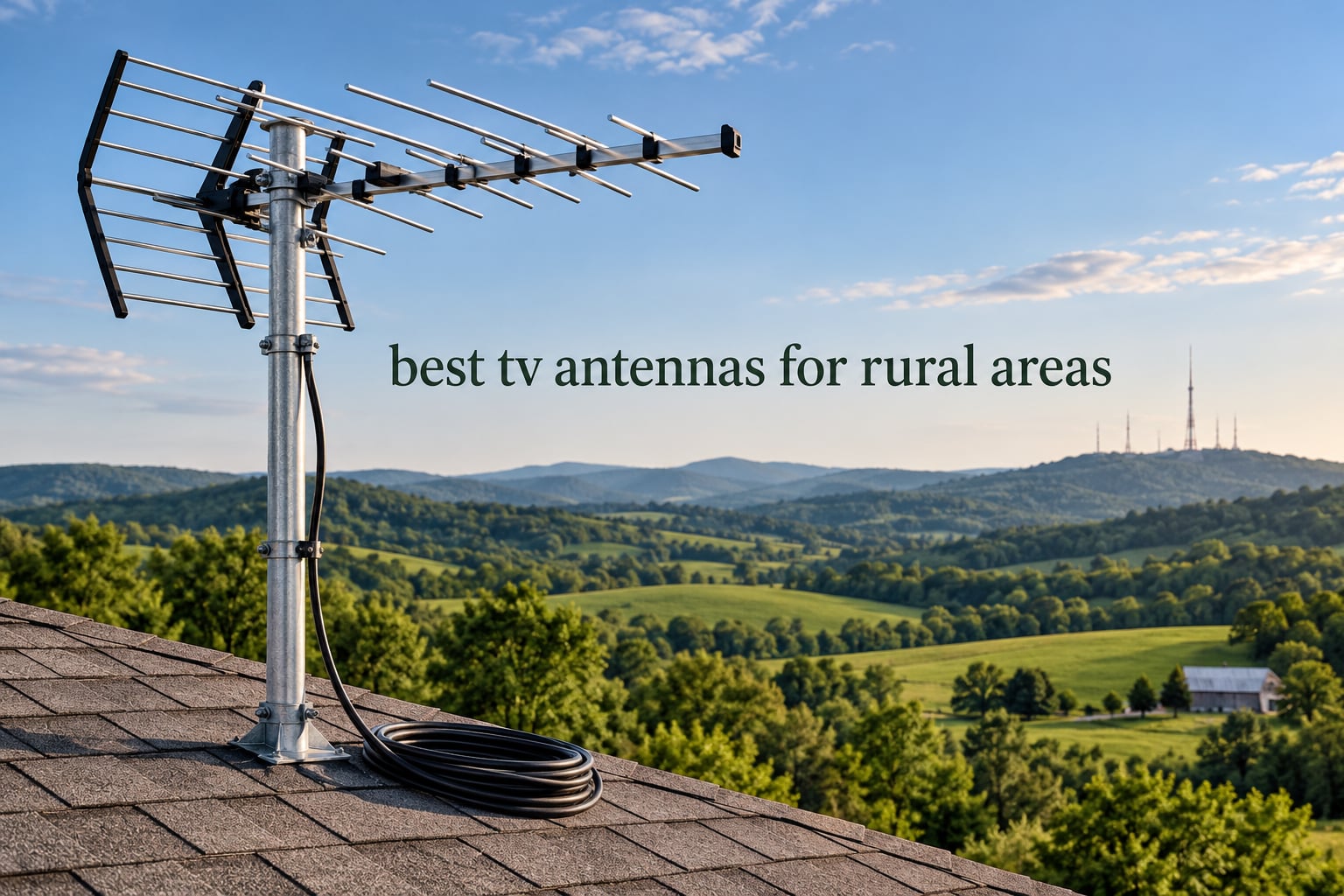
The GE Outdoor HD Digital TV Antenna is the best TV antenna for rural areas overall, because it pairs a 70-mile stated range with a VHF and UHF element array, a J-mount and a limited lifetime replacement pledge at a price that keeps it accessible. If your towers sit beyond about 70 miles or sit in two different directions, step up to the Antennas Direct ClearStream 4V, which has the strongest multi-band hardware in this group.
Living rurally means your broadcast towers are far away, often behind a ridge, a stand of trees or a metal roof. An indoor stick or a paper-thin flat panel simply never sees the signal, so a house that is 20 miles from a transmitter can end up with zero channels while a neighbour on the next hill receives forty.
We spent weeks reading the review data on the eight antennas that dominate the shopping results for this topic, then sorted them by what actually decides reception: band coverage, beam width, amplification, mounting hardware and how the antenna behaves in bad weather. Nothing here is a lab test with a signal meter. Everything here is a read of the manufacturer specifications, the aggregate ratings and the pattern of what several thousand buyers say after installation, and we tell you which is which in each review.
Before you read further, note that the antenna market barely changes. The same models have been sold for years, so treat this guide as current for 2026 rather than something you need to re-check every spring. If you also need mounting hardware, a new television, or a deal on either, our guides to the best TV wall mounts, Sony versus Samsung TVs and TV deals worth watching cover the rest of the setup.
Quick Picks: Best TV Antennas for Rural Areas in 2026
GE Outdoor HD Digital TV Antenna – Best overall for rural homes, with VHF and UHF elements, a 70-mile stated range and a J-mount in the box.
PBD Amplified Outdoor Antenna – Best value, because motorized 360-degree rotation, a low-noise amplifier and two TV outputs cost less than most unamplified antennas.
Antennas Direct ClearStream 4V – Best for multi-band stability, with four loop elements, dedicated Hi-VHF elements and reflector panels that reject rear-side interference.
Antennas Direct ClearStream 2V – Best for a wide beam, because its roughly 70-degree pattern is far more forgiving of imperfect aiming than a Yagi design.
Five Star Yagi Outdoor Antenna – Best for 60 to 70 mile pulls, with a metal directional array, sharp side nulls and an included mounting pole and 40ft of coax.
Five Star Amplified Outdoor Antenna – Best for five televisions, since the kit includes a 4-way splitter alongside the rotor, mast and coax.
McDuory Amplified Outdoor Antenna – Budget pick for moderate-signal areas, offering dual TV outputs and tool-free assembly for less than most alternatives.
1byone Outdoor Omni-Directional Antenna – Best when you refuse to aim anything, because it pulls from 360 degrees with a built-in preamplifier and LTE filter.
For the indoor side of the equation, our VHF antenna guide explains why channels 2 through 13 behave so differently from the rest of the spectrum.
Top 3 TV Antenna Picks for Rural Homes

GE Outdoor HD Digital TV Antenna
- 70+ mile stated range
- VHF and UHF element array
- J-mount included

PBD Amplified Outdoor Antenna
- Motorized 360 degree rotation
- Built-in low-noise amplifier
- Dual TV outputs

Antennas Direct ClearStream 4V
- Four loop element array
- Dedicated Hi-VHF elements
- Reflector panels
Those three cover the realistic decision range. The GE is the safest single purchase for a typical farm or ranch 20 to 50 miles out, the PBD wins when you want remote rotation and multiple sets, and the ClearStream 4V earns its place when your VHF and UHF stations come from genuinely different bearings and stability matters more than price.
All 8 Antennas Compared Side by Side in 2026
| Product | Specifications | Action |
|---|---|---|
| GE Outdoor HD Digital TV Antenna |
|
Check Latest Price |
| PBD Amplified Outdoor Antenna |
|
Check Latest Price |
| Antennas Direct ClearStream 4V |
|
Check Latest Price |
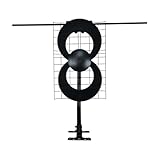 Antennas Direct ClearStream 2V Antennas Direct ClearStream 2V |
|
Check Latest Price |
 Five Star Yagi Outdoor Antenna Five Star Yagi Outdoor Antenna |
|
Check Latest Price |
 Five Star Amplified Outdoor Antenna Five Star Amplified Outdoor Antenna |
|
Check Latest Price |
 McDuory Amplified Outdoor Antenna McDuory Amplified Outdoor Antenna |
|
Check Latest Price |
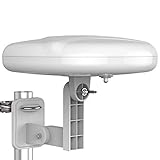 1byone Outdoor Omni-Directional Antenna 1byone Outdoor Omni-Directional Antenna |
|
Check Latest Price |
Two details in that table matter more than the rest. The GE is passive, meaning it has no amplifier at all, so a long cable run or a second television may leave you wanting an in-line booster. The two Antennas Direct models come without coax and without an amplifier, so budget for both if you take them outside.
How We Picked These Antennas
Our selection criteria were simple and deliberately narrow. We wanted outdoor-capable antennas with a large enough body of customer feedback to make the aggregate rating meaningful, and we weighted band coverage, beam width, amplification design, included mounting hardware and warranty length over headline range numbers.
On the limits: we did not physically install these antennas, so every channel count, distance and reception result we mention comes from buyer reports or from the manufacturer’s own specification sheet. Where those two sources disagree, we say so inside the review. We also skipped every no-name amplified unit in the shopping carousel with a single-digit or sub-3-star rating, because a large volume of one-star feedback is itself a signal about a product.
1. GE Outdoor HD Digital TV Antenna – Best Overall for Rural Homes
- 4.4 average across more than 10000 ratings
- the largest reviewed unit in this roundup
- Supports NEXTGEN TV plus 4K and 8K UHD where broadcast
- All mounting hardware including the J-mount is in the box
- Limited lifetime replacement pledge with free US-based support
- Very narrow beamwidth
- so a small rotation can drop channels
- No built-in amplifier for long runs or splitters
- Coax cable not included
- Lightweight aluminum may need bracing in high wind
The GE is the antenna our whole roundup is built around, and the reason is a combination of rating, review volume and completeness of the package. Jasco builds it as model 29884-PK1, and it arrives as a passive, unamplified Yagi-style array with a stated 70-plus mile range and a J-mount already assembled.
What stands out is how consistently buyers report a dramatic channel-count jump the day they move from an indoor antenna to this one on a mast. Sixty to 100-plus channels is the commonly reported figure in suburban and semi-rural locations, and the 69% five-star share is the highest share of any antenna we looked at outside the premium Antennas Direct units.
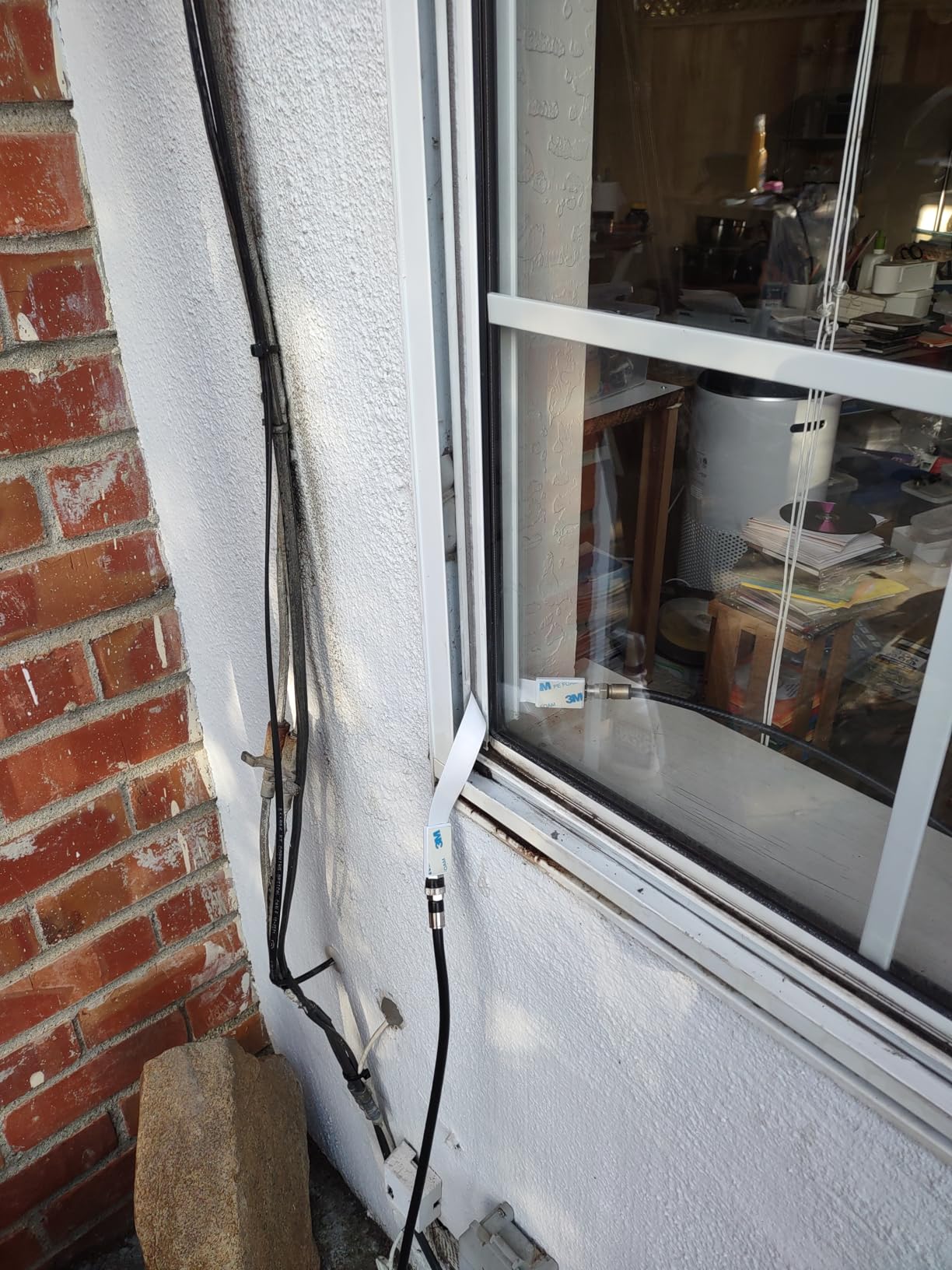
The one behaviour that catches new owners out is how directional it is. The beam is narrow enough that a couple of degrees of extra fine-tuning can lock in one more channel than a sloppy install. That is a feature for anyone chasing a distant subchannel, but it means the first hour of aiming matters more here than with a wide-beam design.
Being passive is the second surprise. The GE will not amplify anything, so if you plan to feed two televisions or run 100ft of coax into the house, you will want an in-line amplifier, and a mast-mounted preamplifier is the correct place for it rather than an inline booster at the far end of the run. Forum consensus on the antenna boards is consistent on that point: a booster at the wrong end of the chain adds noise along with signal.
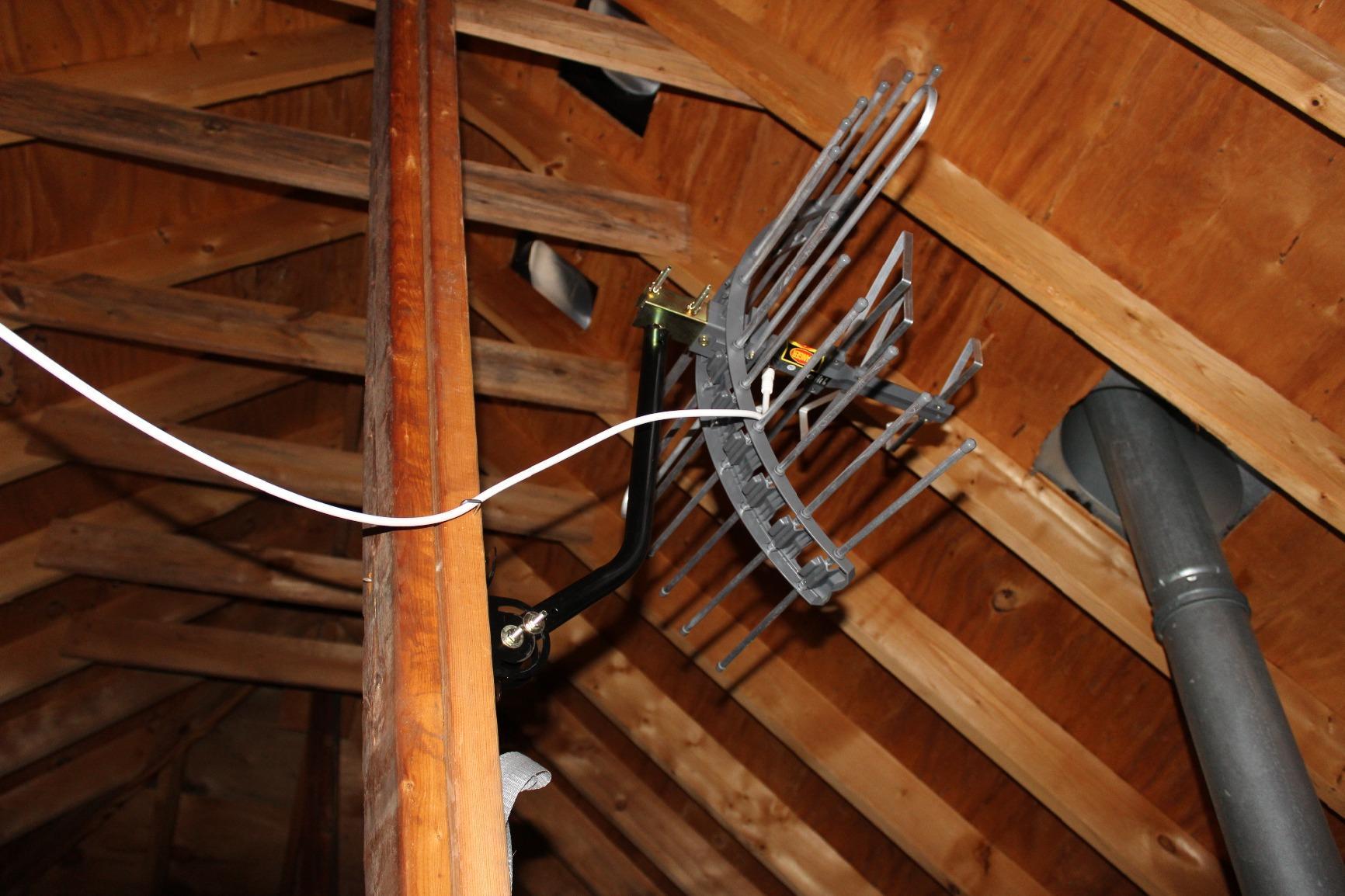
What the GE antenna does well in a real rural install
It handles a roof, chimney, eave or mast mount with the included hardware, and the J-mount makes the aiming step a one-person job. Reviewers who installed it professionally tend to describe it as the most-installed of the group, which is a fair proxy for how forgiving it is in practice.
It also accepts any television or converter box over a standard coax connection, and it will pass NEXTGEN TV, 4K and 8K UHD where those are actually broadcast. The 29 by 15 by 20.5 inch footprint and 3 pound weight are small enough for a modest roof section without a serious structural conversation.
Where the GE antenna will disappoint you
If your VHF and UHF stations sit in different directions, the narrow beam forces you to compromise or to re-aim seasonally, and users in split-market areas report exactly that frustration. The review data also notes a real ceiling: some owners in genuinely marginal locations find the passive design runs out of signal margin before it runs out of channels.
It is also the model most likely to need a second purchase. No coax is included, and if you are splitting to a bedroom and a living room television, the missing amplifier becomes a requirement rather than an option. Budget for a mast preamplifier and quality RG6 at the same time.
2. PBD Amplified Outdoor Antenna – Best Value
- Motorized rotation lets you re-aim without climbing the mast
- Built-in low-noise amplifier locks in many distant channels cleanly
- Dual TV outputs mean no splitter purchase
- Complete kit with 40ft RG6
- pole and hardware
- Lifetime warranty with responsive replacement support
- Lightweight plastic and aluminum elements feel flimsy during assembly
- Remote rotation can overshoot to non-repeatable positions
- Pre-amp draws power through the rotor box so it only works when connected
- Bundled lag bolts have stripped when driven with an impact driver
The PBD WA-2608 carries the largest review base in this roundup at more than 19,000 ratings and holds a 4.3 average with 68% five-star scores, which makes it the most-proven budget purchase here. It is also one of the cheaper ways to get motorized rotation, and that feature is worth more in the countryside than the price difference suggests.
The reason is geography. On a farm with stations in two clusters 30 miles apart, a fixed antenna is either aimed wrong for half your channels or you are climbing a ladder in bad weather. A rotor turns that into a remote operation, and the low-noise amplifier built into the unit is the reason the PBD can hold a channel lock where a comparable unamplified antenna pixelates.
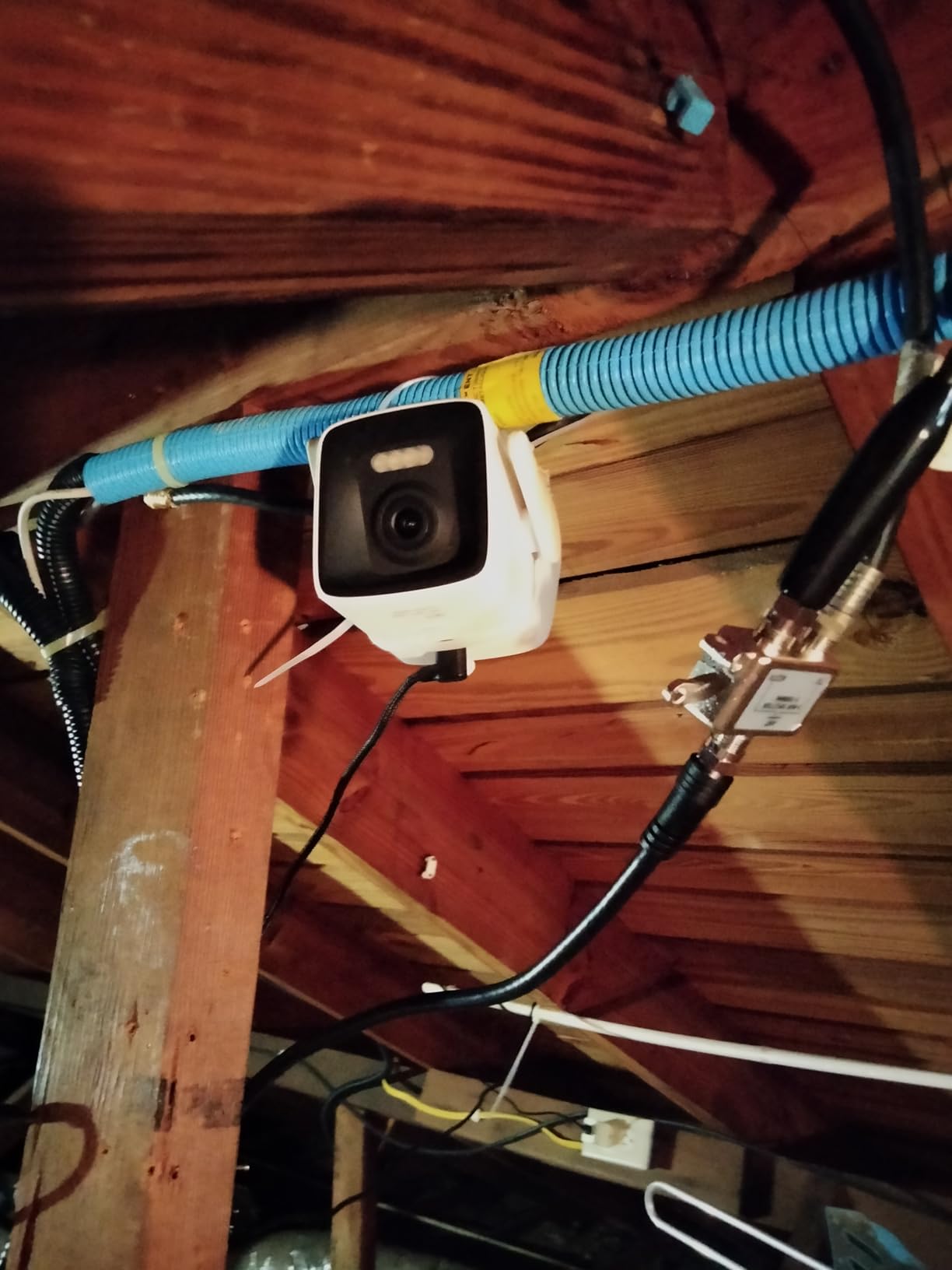
Two TV outputs are a genuinely useful detail for a household that wants a living room set and a bedroom set without a splitter eating signal. The kit also includes 40ft of RG6, a mounting pole and the hardware, so the parts list is short. It is NEXTGEN TV ready, which matters if your market has started adding ATSC 3.0 simulcasts.
The flaws are real and worth knowing before you buy. The elements themselves are light, and several reviewers describe the assembly as needing a careful hand rather than brute force. The rotor has no position readout, so aiming is trial and error with repeated channel rescans, and the preamplifier is powered through the rotor control box, meaning the amp goes dead if you disconnect the rotor.
Why the PBD works for a first rural antenna
It removes the two decisions that stall most first-time installers. You do not have to decide the tower bearing correctly before you climb anything, and you do not have to decide how many televisions you will ever want. Both of those are easy to get wrong and expensive to change after the antenna is on the roof.
Support is also worth mentioning. Owners who received faulty units or damaged cables report fast replacement from the manufacturer, and the unit carries a lifetime warranty with round-the-clock customer service. For hardware that lives on a roof through ice storms, that is a meaningful part of the purchase.
Where the PBD will let you down
The rotor is the weak point. Overshoot and non-repeatable positions are the most common complaints, which means every aim change needs a rescan cycle to confirm. The stripped lag bolts are a smaller problem but a real one if you use an impact driver instead of a hand ratchet.
And the amplifier dependency matters in a specific failure case. If the rotor control box fails or you decide you do not need rotation and remove it, you also lose the preamplifier unless you rewire power. For a fixed-direction install, an unamplified antenna or a mast preamplifier is the cleaner build.
3. Antennas Direct ClearStream 4V – Best for Multi-Band Stability
- Dedicated UHF and Hi-VHF sections give the most stable multi-band reception here
- Reflector array adds forward gain and blocks rear-side interference
- Highest five-star share of any unit in the group at 71%
- Lifetime manufacturer warranty on the antenna itself
- Heavier metal build than most plastic amplified antennas
- Narrow 43 degree beam demands careful aiming
- Coax and amplifier are not included on this variant
- Higher cost than most of the roundup
- Some owners report a 2V plus a mast amplifier performing as well
The ClearStream 4V is the antenna I would put on a roof in a market where a couple of your stations are VHF and the rest are UHF, because it treats those as two separate jobs rather than one compromise. Four patented loop elements, dedicated Hi-VHF elements and a set of reflectors give it the most stable band-by-band behaviour in this group.
Those reflectors are the part casual shoppers miss. They add forward gain toward your towers and reject interference arriving from behind the antenna, which is exactly the multipath and cellular noise problem that shows up as pixelation on a marginal channel. On a ridge-top site with transmitters to both the front and the back, that rear rejection is the difference between a clean picture and a fluctuating one.
The build is noticeably heavier at 4.1 pounds, which is a good sign outdoors. It ships with a 20-inch mast on a pivoting base, all-weather hardware and an adjustable mast clamp, and it carries a lifetime manufacturer warranty on the antenna. Roughly 71% of its reviews are five-star, the highest share in the roundup.
It is also the clearest example of a premium antenna earning its place. The 43-degree horizontal pattern is tight, so aiming takes patience, and the coax and amplifier are not part of this package. Both of those are real costs, and both are recoverable if your signal is genuinely marginal.
What the ClearStream 4V handles that cheaper units cannot
Hi-VHF. Channels 7 through 13 are the classic rural failure, and the 4V is one of the few antennas here with elements dedicated to that band rather than a single shared element doing a poor job on all frequencies. If a run of channels 2 through 13 in your market is non-negotiable, that is the reason to move up.
It is equally the right pick in hilly terrain where signal arrives from a valley, because the rear rejection keeps the strong nearby transmitter from swamping the weak distant one. Antenna engineers describe this as front-to-back ratio, and it is the single most under-appreciated specification on a product page.
Where the ClearStream 4V is the wrong spend
If every station you want is UHF and all of them come from one bearing, the 2V below will likely give you an equally usable picture for considerably less. Several buyers report exactly that comparison, having added a mast amplifier to the 2V, and the finding is consistent enough that we would not call the 4V wrong, only more than some locations need.
Accessory cost is the other catch. You still need coax, and you still need a preamplifier if your TVFool report shows a weak signal rating on the channels you care about. Buyers who skip both are the ones leaving reviews that look like a product failure and are really a shopping-list failure.
4. Antennas Direct ClearStream 2V – Best for a Wide Beam
- Reflector panel noticeably blocks interference arriving from behind
- Reported channel counts range from about 50 to 144 depending on distance and height
- Wide beam is forgiving of slightly imperfect aiming
- Light enough for a balcony or attic without a large mast
- Lifetime manufacturer warranty
- Coax and amplifier are not included
- Single Hi-VHF dipole can struggle with channels 7 and 9
- Instructions cover roof mounting only so indoor setups need improvising
- Roof sealing pads have been reported fused in the packaging
The 2V is the compromise antenna, and for a lot of rural homes it is the right compromise. It is a double-loop multi-directional design with UHF and Hi-VHF elements and a grid reflector, and it delivers an approximately 70-degree beam instead of the 43-degree pattern of its bigger sibling.
That beam width is the entire reason to choose it. A 70-degree pattern means you can be 20 degrees off your true bearing and still catch everything, which is what happens when you are eyeballing an install from a ladder in the dark or when your towers are 60 miles out and the horizon is not where you thought. Buyers report channel counts anywhere from about 50 to 144 depending on tower distance and mounting height.
At 2 pounds and 31.4 inches long, it is light enough for a balcony, an attic wall or a small roof section without a serious mast. The 20-inch mast has a pivoting base that works on vertical or horizontal surfaces, and the antenna itself carries a lifetime manufacturer warranty with a 90-day accessory warranty.
The reflector still does its job. Users consistently credit it with stopping a strong nearby transmitter from degrading a distant one, so you are not giving up interference rejection entirely by widening the beam. You are simply trading some off-axis rejection for a much easier aiming job.

When the wide beam is the right call
Choose the 2V when your towers are spread across a wide arc rather than clustered, when you are installing alone without a signal meter, or when you plan to move the antenna between an attic and a rooftop position. In each of those cases the forgiving pattern saves more time than the extra gain of the 4V would earn you.
It is also a strong choice for a second location. The same 2V pattern that works from a farmhouse roof can work on a hunting cabin or a camper park site, because a wide beam needs less precision than a mast on uneven ground will ever give you.
When you should upgrade past the 2V
High-band VHF is the honest limit. The single Hi-VHF dipole can struggle with channels 7 and 9 specifically, so if your local affiliate is on one of those channels and you need it, the 4V or a genuine all-band Yagi is the safer purchase. Channel count and the fact that you want it to be the one antenna in the yard both argue the same way.
Accessories are still missing. No coax, no amplifier, and instructions that assume a roof. Indoor and attic installs need a plan of your own, and if you are going outdoors, add RG6 and a grounding block to the same order.
5. Five Star Yagi Outdoor Antenna – Best for 60 to 70 Mile Pulls
- All-metal construction is more durable outdoors than plastic amplified antennas
- Buyers commonly report 60 to 86 channels from towers roughly 60 to 70 miles away
- Includes 40ft coax and a 20 inch mounting pole
- Sharp side nulls reject unwanted directions
- Small footprint and light weight
- The 200-mile stated range is unrealistic for an antenna of this size
- Listing calls it a satellite antenna and it is not
- Single U-bolt mount makes precise aiming hard because the antenna droops when loosened
- Plain steel hardware will rust and wing nuts are stamped rather than cast
- Assembly instructions are thin
This is the budget Yagi, model FSA-5812, and the honest version of its pitch is a 60 to 70 mile antenna rather than the 200 miles printed on the box. Buyers repeatedly report 60 to 86 channels from towers about 60 to 70 miles away, which puts it in the same real-world territory as antennas costing several times more.
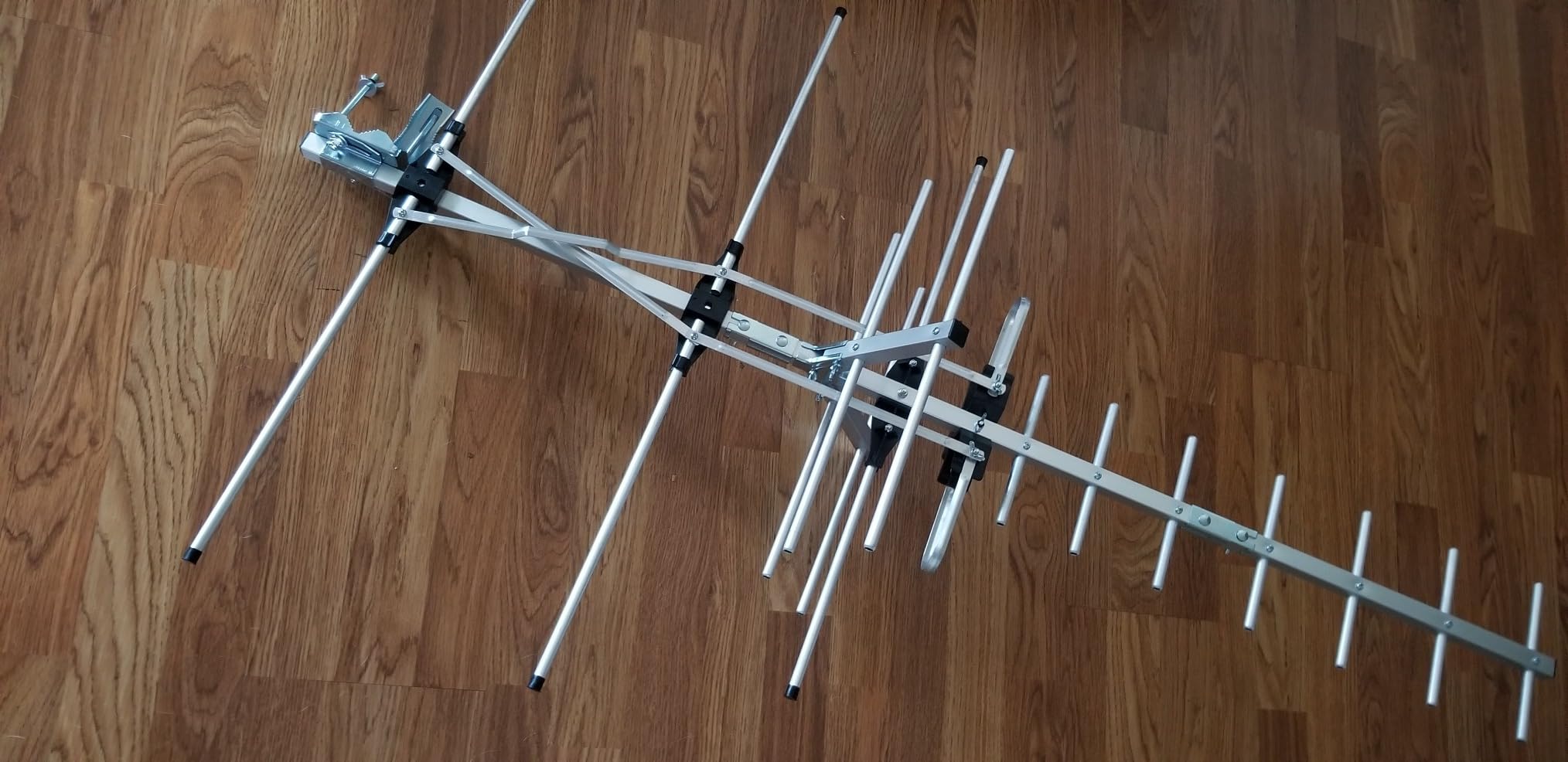
The Yagi element array covers both VHF and UHF, and the extended element length is what produces the extra gain and the more stable signal compared with a shorter-budget design. The sharp nulls to the sides are a real advantage in a valley or behind a hill where you do not want the neighbouring transmitter at all.
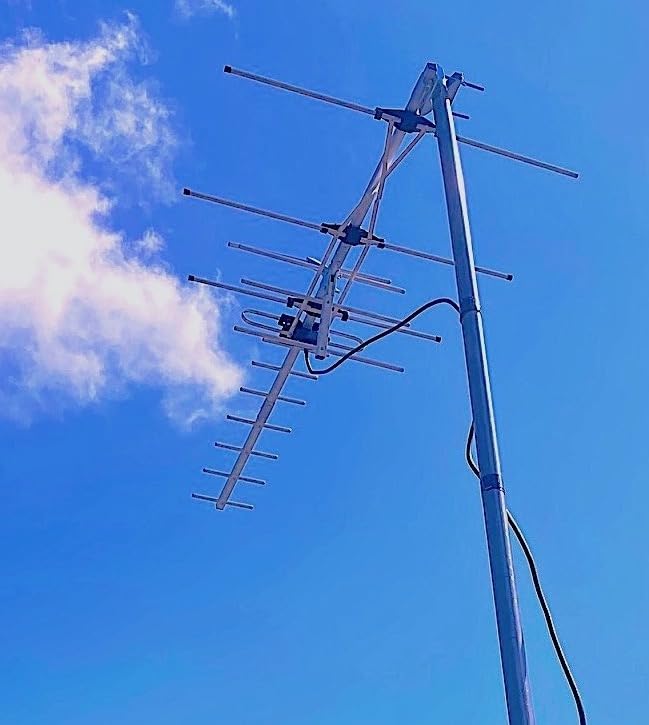
It is also the sturdiest budget option here. Everything in the array is metal, and one reviewer reports it holding up through a windstorm, which is not something we can say about the plastic amplified units. It mounts on a chimney, an eave, a roof, in the attic or on a mast, and the kit includes 40ft of coax and a 20-inch pole.
Be clear on what it is. Despite the listing wording, this is a broadcast over-the-air antenna, not a satellite dish, and the design includes lightning protection and grounding provisions. It also picks up FM radio, which sounds trivial until you remember that a rural FM signal is just as hard to reach as a television one.
Why a metal Yagi still beats plastic at this tier
Aluminium and steel do not become brittle in cold weather, do not lose alignment in a heat wave, and do not fail because a plastic tab snapped. For a device expected to sit on a roof for a decade, that durability argument often outweighs the gain difference between a budget Yagi and a premium loop array.
It is also the simplest antenna to reason about. One U-bolt, one mast, one direction. There is no rotor to aim, no amplifier to power and no electronics to fail in a wet barn, which is why we still see it recommended for hunting cabins and outbuildings where maintenance visits are rare.
Where the marketing will annoy you
Ignore the 200-mile claim. Owners in the review data are blunt that it is unrealistic for an antenna of this size, and the listing calling it a satellite antenna is a copy-paste error that tells you how much attention the marketing copy received. Judge it against a 60 to 70 mile expectation and it performs well.
Aiming is the real practical issue. A single U-bolt means the antenna droops when the bolt is loosened, so every adjustment starts from a re-aim rather than a tweak. If you lack a helper, that is a two-person job, and the thin assembly instructions mean you will likely be following a video tutorial.
6. Five Star Amplified Outdoor Antenna – Best for Five TVs
- Rotation lets you sweep toward tower groups 60 to 90 miles away
- Amplifier makes a noticeable difference in marginal signal areas
- Complete kit with pole
- 40ft coax
- splitter and cable clips
- Many users report 25 to 40-plus channels from towers about 25 miles away
- Covers VHF 40-230MHz and UHF 470-860MHz plus FM
- Rotor drifts on its own and reorients after the remote is released
- Control box has no position readout so you cannot tell where it is aimed
- Light aluminum elements feel flimsy for outdoor duty
- Bundled 40ft coax is often too short and the weather boot is hard to seat
- Power supply is 110V only
The other Five Star unit trades the budget Yagi simplicity for a rotor, an amplifier and a splitter, and the 4-way splitter in the box is the reason it earns its place in a household with a living room, two bedrooms, a kitchen and a garage workshop.
Technically it is a six-element reflector design with a V-band element for VHF, covering 40 to 230MHz and 470 to 860MHz, with an auto gain control chip offering a 15 to 35dB range. Buyers in marginal areas report the amplifier making a real difference, and users pulling from towers 60 to 90 miles away value being able to sweep the rotor toward a distant cluster.
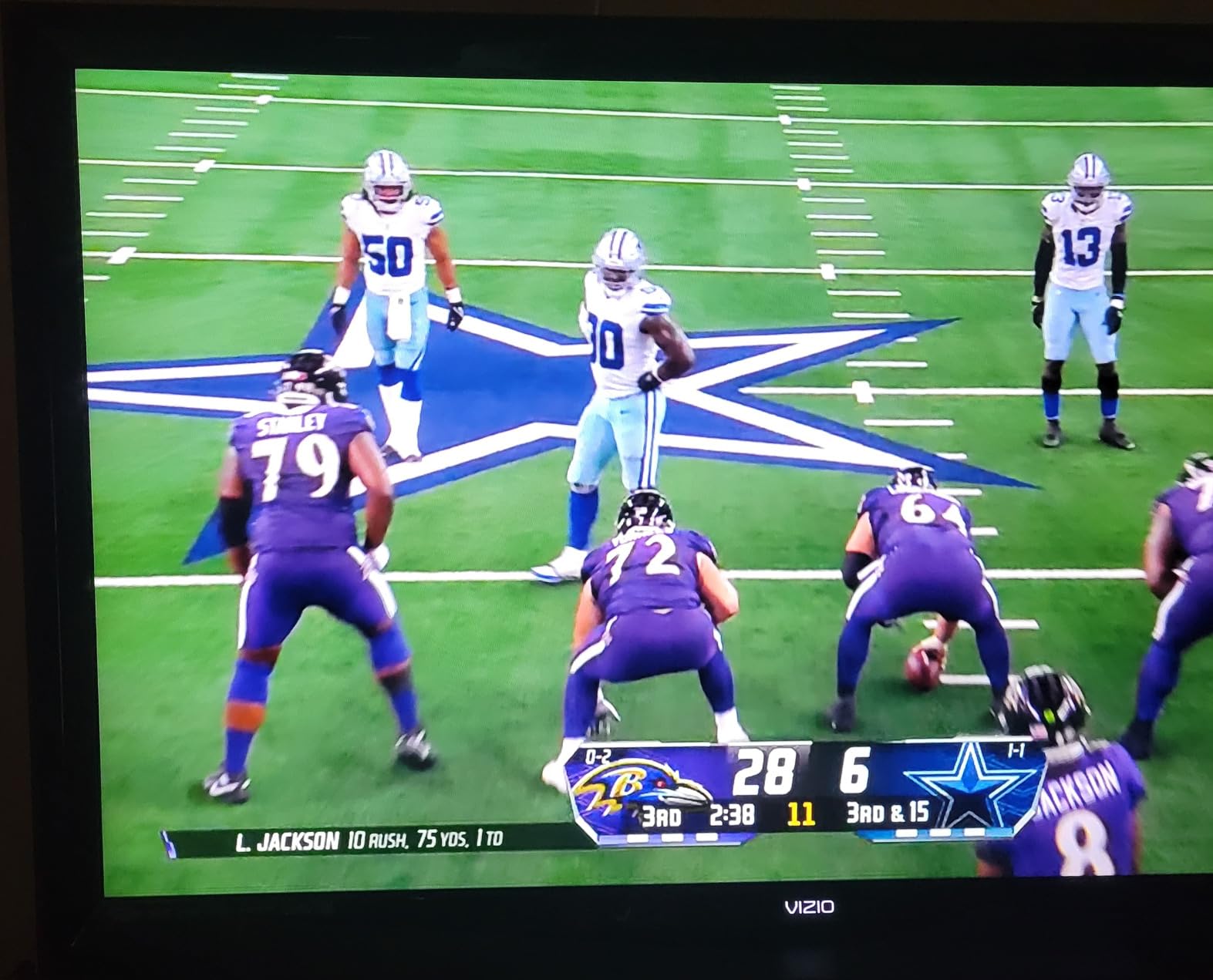
At the closer end of the range, 25 to 40-plus channels from towers about 25 miles away is the most commonly reported result, which is a useful reality check against the 200-mile figure on the box. The kit includes a J pole, 40ft of coax, a 4-way splitter and 15 cable clips, so the install list is short.
Auto gain control is a sensible feature on a multi-TV install because it means the unit is not pushing maximum gain into a splitter that is already costing you signal. It is not a cure for a weak antenna, but it is a sensible default when the output is being divided four ways.
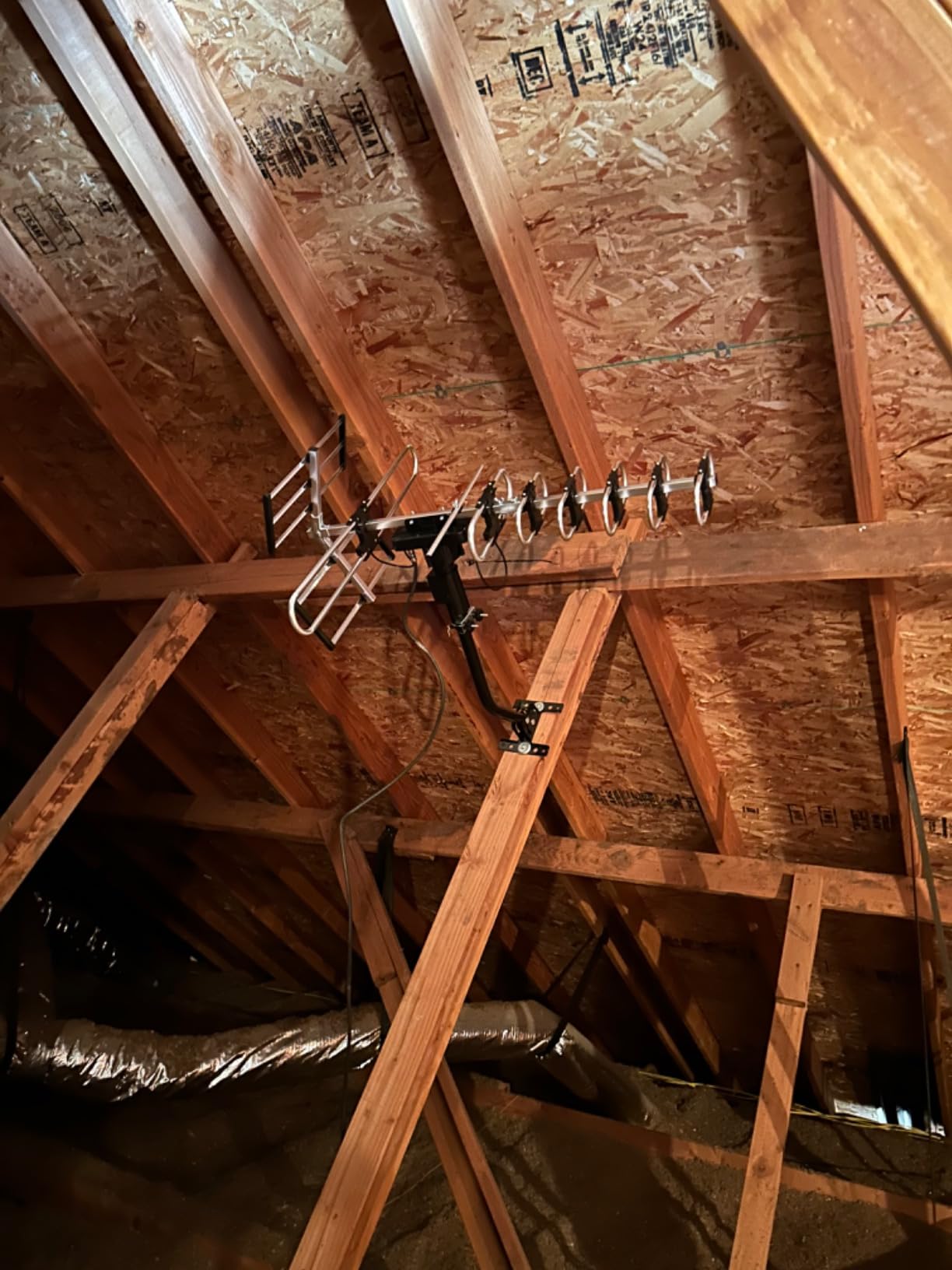
Where the Five Star amplifier setup earns its kit
Multi-TV households. The alternative to a bundled splitter is buying a splitter, running four coax runs and hoping the signal survives the division, and the ownership cost of that route is a lower channel count on every set. Having the splitter in the box removes the temptation to skip it and rely on a cheap inline booster instead.
It also covers FM broadcast alongside the television bands, which matters if you are building one antenna for the whole house rather than one television. The included cable clips are a small touch that prevents the kind of cable strain that produces intermittent pixelation in wind.
The rotor problem you should expect
The single most common complaint across the reviews is that the rotor drifts on its own after you release the remote, reorients the antenna and forces you to rescan. Combined with a control box that gives no position readout, that is a frustrating aiming loop, and it is the reason we place the GE ahead of this unit despite the richer feature set.
Then there is the hardware. The aluminum elements feel light for permanent outdoor duty, the included coax is frequently reported as too short, and the weather boot is hard to seat without a heat gun. The 110V-only power supply also rules it out for off-grid use without an inverter.
7. McDuory Amplified Outdoor Antenna – Budget Pick
- Low cost per channel of any unit in the roundup
- Dual TV outputs remove the need for a splitter
- Tool-free snap-together element assembly
- Strong clear pictures reported from towers 30 to 50 miles away
- Customer service replaced a faulty control unit quickly
- Rotor has no position readout and moves in unpredictable directions
- Mounting pole is not included despite being positioned for outdoor use
- Signal fades badly in wind and rain
- One long-term reviewer reports poor element-to-element electrical connections
- Channel list can drop from solid to a handful within hours
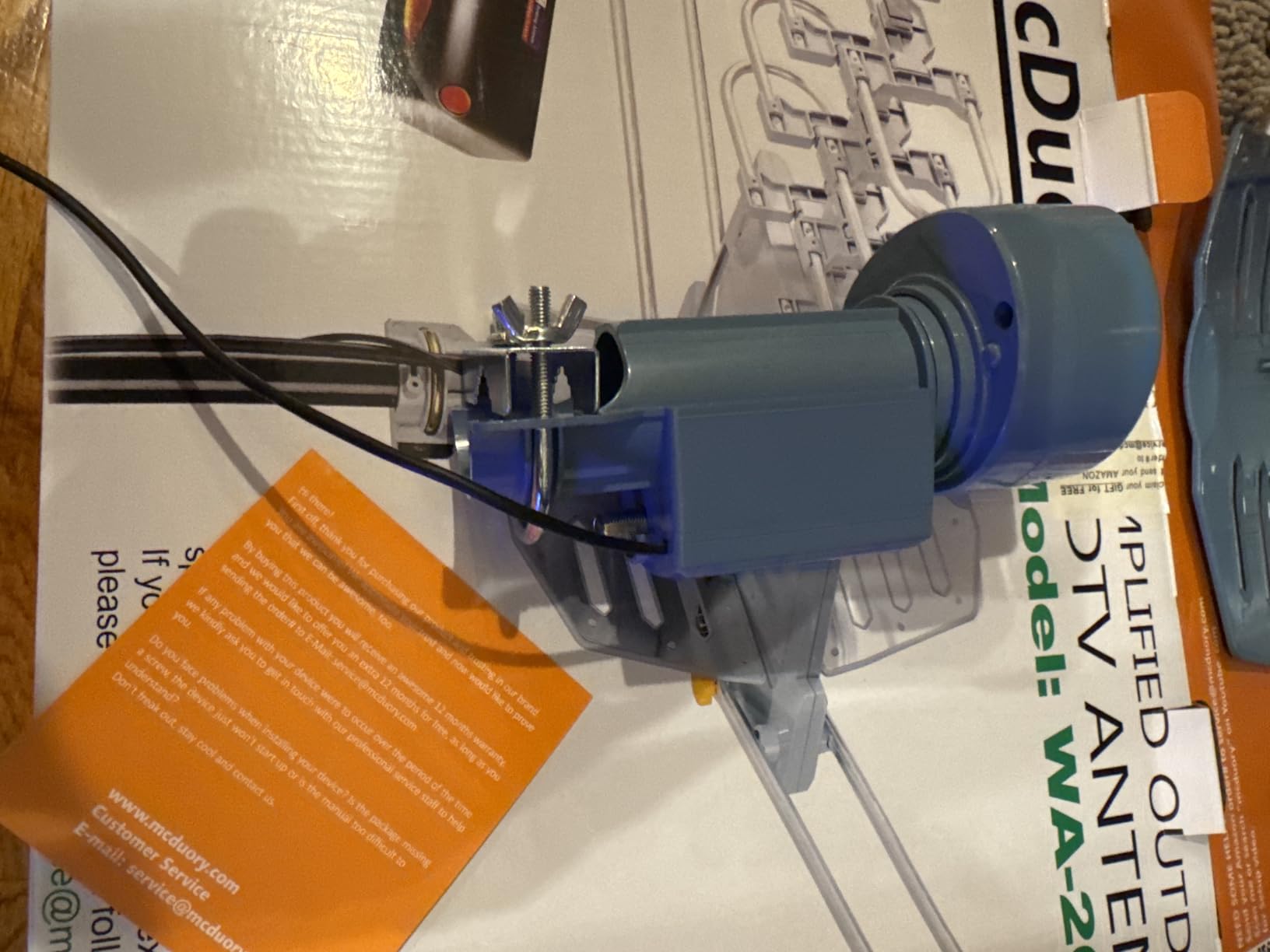
The McDuory 2608B costs less than most of the unamplified antennas in this roundup and it is the route to an amplified outdoor antenna with a rotor and two outputs. At 30 to 50 miles from towers that is genuinely all most households need, and the 4.3 average across more than 3,500 ratings says the majority of buyers agree.
It covers VHF 170 to 230MHz and UHF 470 to 860MHz, and the snap-together elements mean no tools are needed for assembly at all. The high-gain, low-noise amplifier is built in, and the caveat buyers most often discover is that reception drops sharply if the amplifier loses power, so it is not a good candidate for an off-grid location without reliable power.
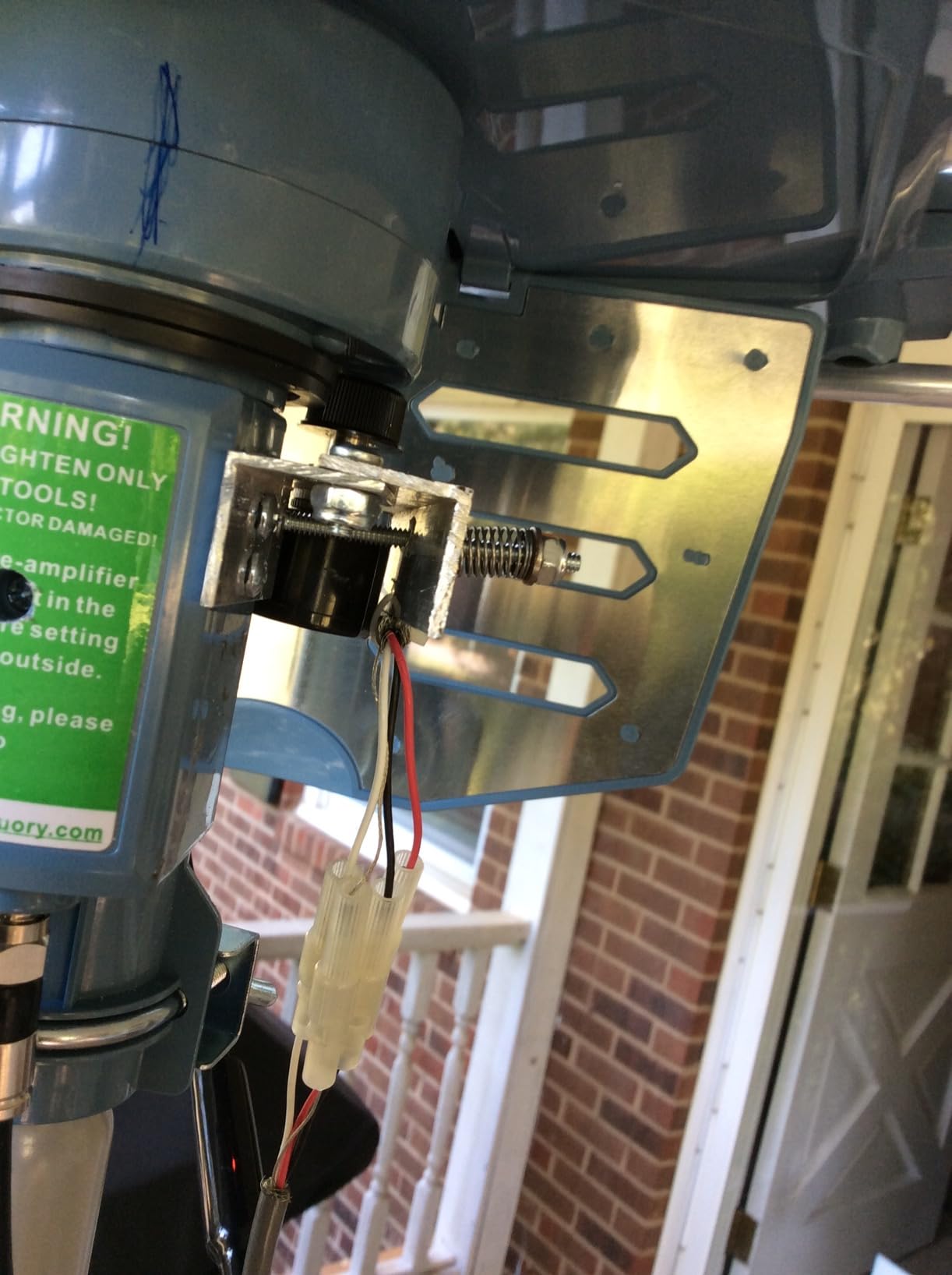
Two TV outputs is the feature that quietly makes it a better value than its price suggests, because it avoids the splitter that would otherwise cost you channels on both sets. Forty feet of outdoor coax is included, and the tool-free assembly means a single person can put it together on the ground before going up.
Read the range figure carefully. The 150-mile claim on this model sits alongside a stated 12-channel capacity, which is a good illustration of why headline numbers and useful numbers are different things. Judge it as a 30 to 50 mile antenna, which is where the actual buyer reports cluster.
Where the McDuory makes sense
It makes sense for a moderate-signal rural home, or a first antenna for a household that has never tried over-the-air reception and wants to find out whether a mast and rotor are worth the effort at all. The tool-free build also makes it the most accessible option for a single installer.
For households planning ahead, the dual outputs mean you can start with two televisions and add a proper distribution amplifier later without replacing the antenna. Customer service is also responsive, with at least one owner reporting a fast control-unit replacement.
Where the McDuory will frustrate you
The mounting pole is not included, which is the first thing you will discover on install day despite the outdoor positioning. The rotor shares the same design weaknesses as the Five Star amplified unit, with no position readout and unpredictable movement, so budget time for repeated rescans.
More seriously, the reports of wind and rain signal fade and of a channel list dropping from solid to a handful within hours are the kind of long-term reliability problem that never shows up in the first month. One owner also reports poor electrical connections between elements, which is a manufacturing consistency issue rather than a design one. If you have heavy tree cover or an exposed ridge, spend up on the GE or the ClearStream 2V instead.
8. 1byone Outdoor Omni-Directional Antenna – Best for No-Rotating Setups
1byone Outdoor TV Antenna, 360°Omni-Directional Reception, 100+ Miles Range
- Omni-directional 360 degree reception removes any need for rotation or a rotor box
- Built-in preamplifier and LTE filter help hold signal over long cable runs
- Compact 11.81 inch square footprint installs without tools
- Moisture-proof and flame-retardant housing rated for outdoor
- attic
- RV and marine use
- Includes 32ft RG6U coaxial cable
- Single TV output
- so a second set needs a splitter that costs channels
- 3.8 average rating is the lowest here and reflects a high share of one-star reviews
- Some users report inconsistent performance in fringe or heavily obstructed locations
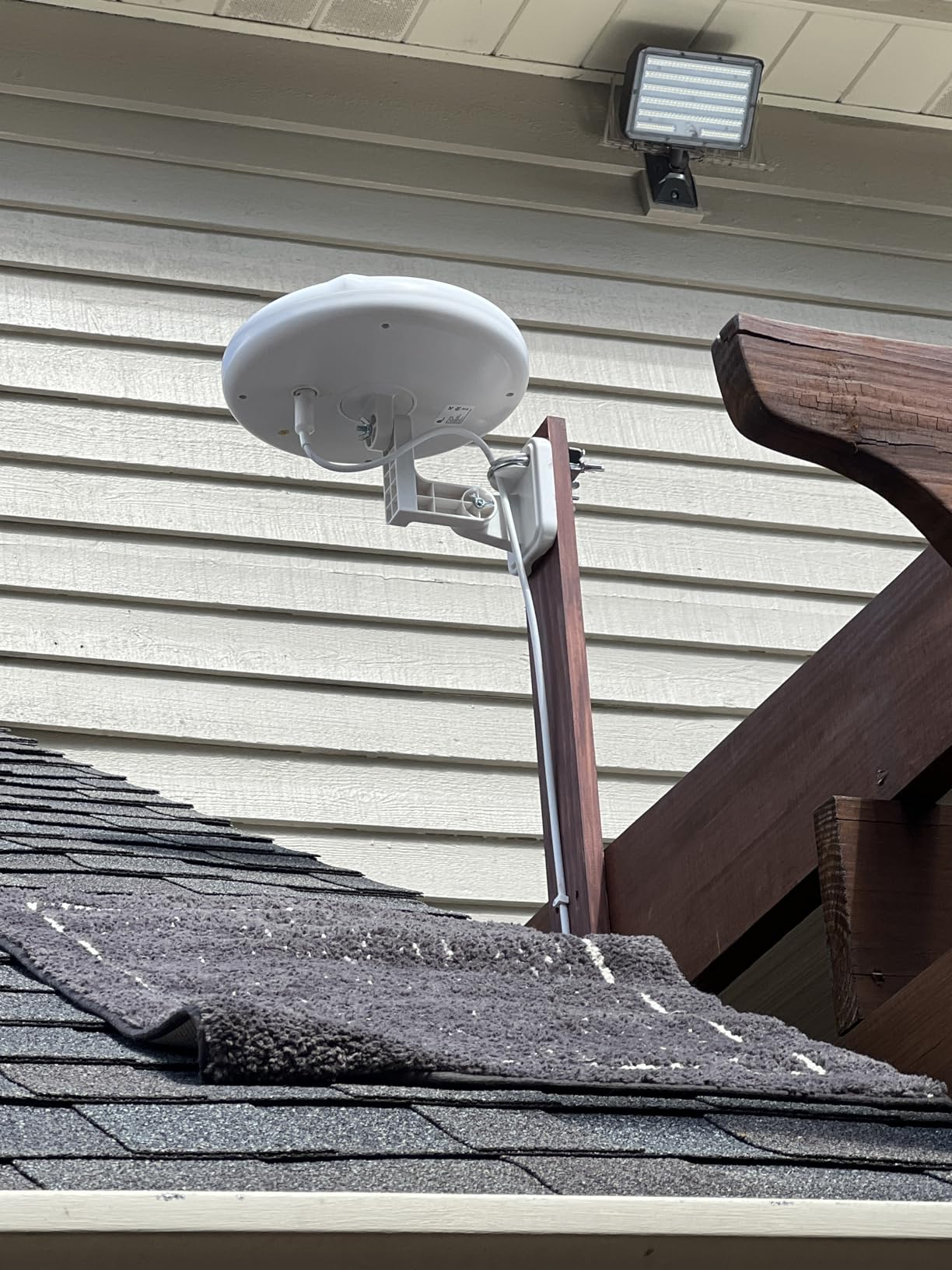
The 1byone is the only true omnidirectional outdoor antenna in this group, and that is a genuine feature for specific rural situations. If your towers ring you rather than sit in one direction, or your channels are spread across a 90-degree arc, an omni is the only design that receives all of them without a rotor.
It carries a built-in preamplifier with Smart Pass amplifier technology and a 4G LTE filter, which cuts the cellular and noise-band interference that increasingly shows up on the lower UHF channels. The housing is moisture-proof and flame-retardant and the listing rates it for outdoor, attic, RV and marine use, so it is a natural fit for a camper or a boat cabin as well as a house.
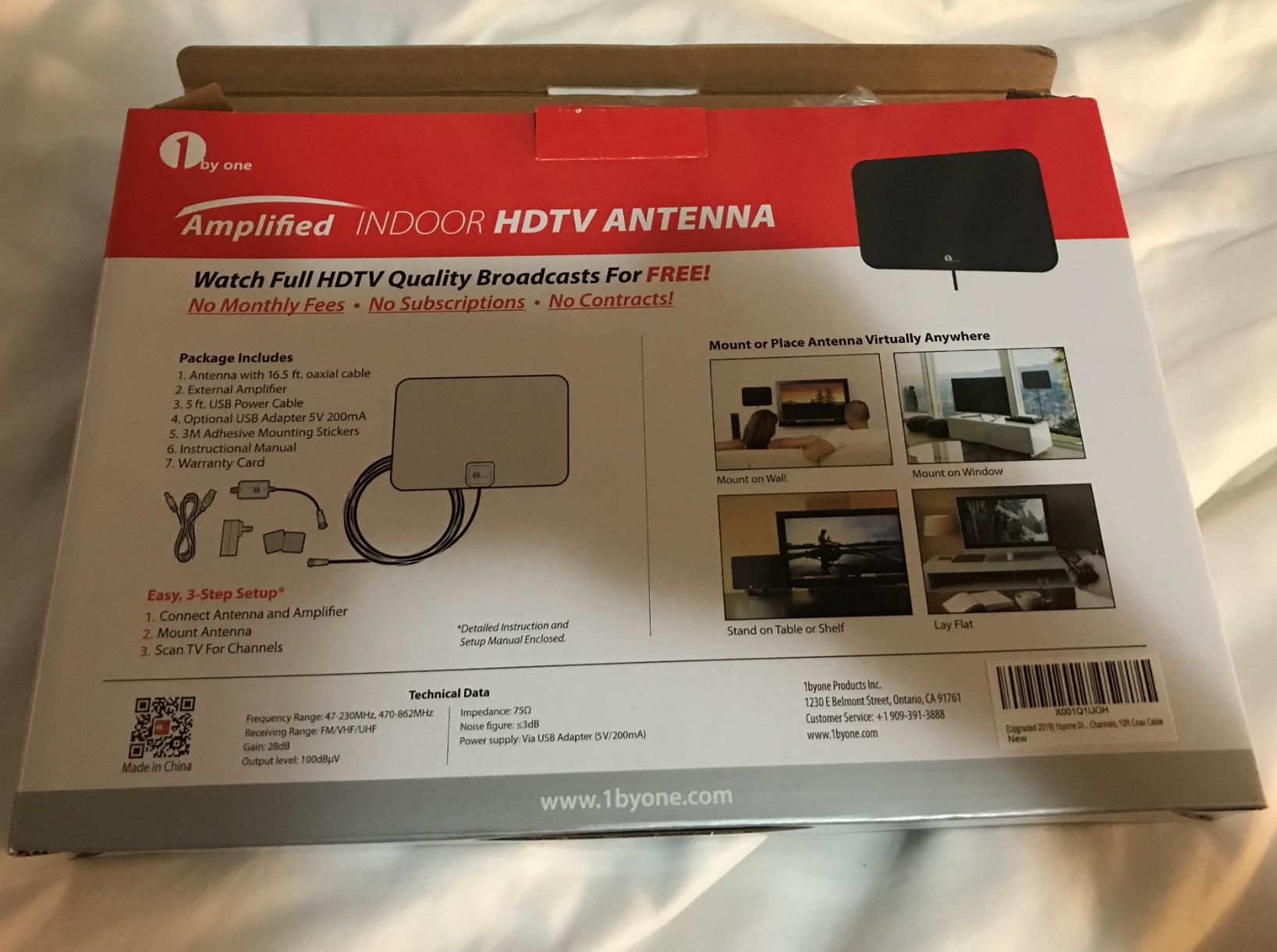
It installs without tools, weighs little and measures about 11.8 inches square, and 32 feet of RG6U coax is included. All of that makes it a fast, low-friction install that one person can complete without a second pair of hands, which is a real advantage if you are putting it on a cabin or an RV mast.
I want to be straight about the ratings here. At 3.8 across more than 10,700 reviews it is the lowest-rated antenna in the roundup, and the review data attributes that to a high share of one-star feedback. A large review base is usually a good sign, but a large base combined with the lowest score in the group is a flag, and buyers in fringe or heavily obstructed locations report inconsistent results.
When an omnidirectional antenna is the right answer
It is right when your market genuinely surrounds you, which happens more often than antenna marketing suggests. Run a TVFool report and check the azimuths. If everything falls within about 60 degrees, a directional antenna with reflectors will beat this on gain. If stations sit at 40, 140 and 250 degrees, the geometry argues for omni.
It is also right for temporary and mobile use. An RV, a hunting cabin or a rented place where you cannot mount a fixed directional array benefits from a unit that works the moment it is plugged in, and the RV and marine rating is a specific feature rather than a generic weather-resistance claim.
Where the 1byone will frustrate you
One TV output is the hard limitation. Every other antenna here gives you two or five, and here a second television means a splitter, and a splitter on a single-output amplified antenna is exactly the configuration that produces a lower channel count on both sets. Plan on one screen, or plan on a distribution amplifier as a deliberate second purchase.
Gain is the other limit. An omnidirectional antenna spreads its gain across 360 degrees, so the signal arriving from your one strong bearing is weaker than it would be from a directional array aimed at it. In a deep fringe location past roughly 40 miles, that difference is the difference between locking a channel and searching for it.
TV Antenna Buying Guide for Rural Areas
Directional or omnidirectional: which one you actually need
A directional antenna concentrates its gain toward your broadcast towers and rejects signal from everywhere else, which is why every serious rural install points at a bearing rather than spinning. An omnidirectional antenna receives from all directions but splits its gain across the full circle, so it delivers a weaker signal to any single tower.
Decide by looking at your map, not by guessing. If your channels cluster inside a 60-degree arc, directional wins and an omni is a waste of signal. If your channels genuinely surround the house, an omni is the only design that receives them all without a motorised rotor. The reflector-equipped antennas here also give you front-to-back rejection, which is what keeps a strong nearby transmitter from swamping a weak distant one.
Matching the antenna to your tower distance
Under 30 miles with a clear view of the tower, almost any outdoor antenna works and the GE is more than enough. Between 30 and 50 miles, gain and reflectors start to matter, which is where the ClearStream 2V, the Five Star Yagi and the PBD earn their place. Between 50 and 70 miles, you want dedicated Hi-VHF elements if any of your channels are 7 through 13, which is the ClearStream 4V’s argument.
Beyond 70 miles, treat the number as a question rather than a promise. Line of sight over flat ground is one thing; a ridge, a stand of trees or a valley floor makes distance nearly irrelevant. At that range, height matters more than antenna model, and the most common ceiling we see reported for a well-chosen all-band antenna with good height is roughly 60 to 70 miles of reliable pull.
VHF and UHF: the mistake that ruins rural installs
Channels 2 through 6 are VHF low band, 7 through 13 are VHF high band, and 14 through 36 are UHF. The distinction decides which antennas work, and it is the most repeated misunderstanding in this entire category. Flat panels, paper-thin indoor sheets and stick antennas are efficient UHF collectors and near-useless VHF collectors, which is why a person can receive 30 UHF channels and still be unable to get the local CBS or ABC affiliate.
Check your own market before buying. If a channel you want is VHF, confirm the antenna has Hi-VHF elements, and if the station is on channel 7 or 9 specifically, be careful, because a single shared dipole often struggles with high-band VHF. This is also why an amplifier alone never rescues a flat panel: boosting a signal the antenna cannot efficiently collect just amplifies noise.
Amplification: preamplifier versus distribution amplifier
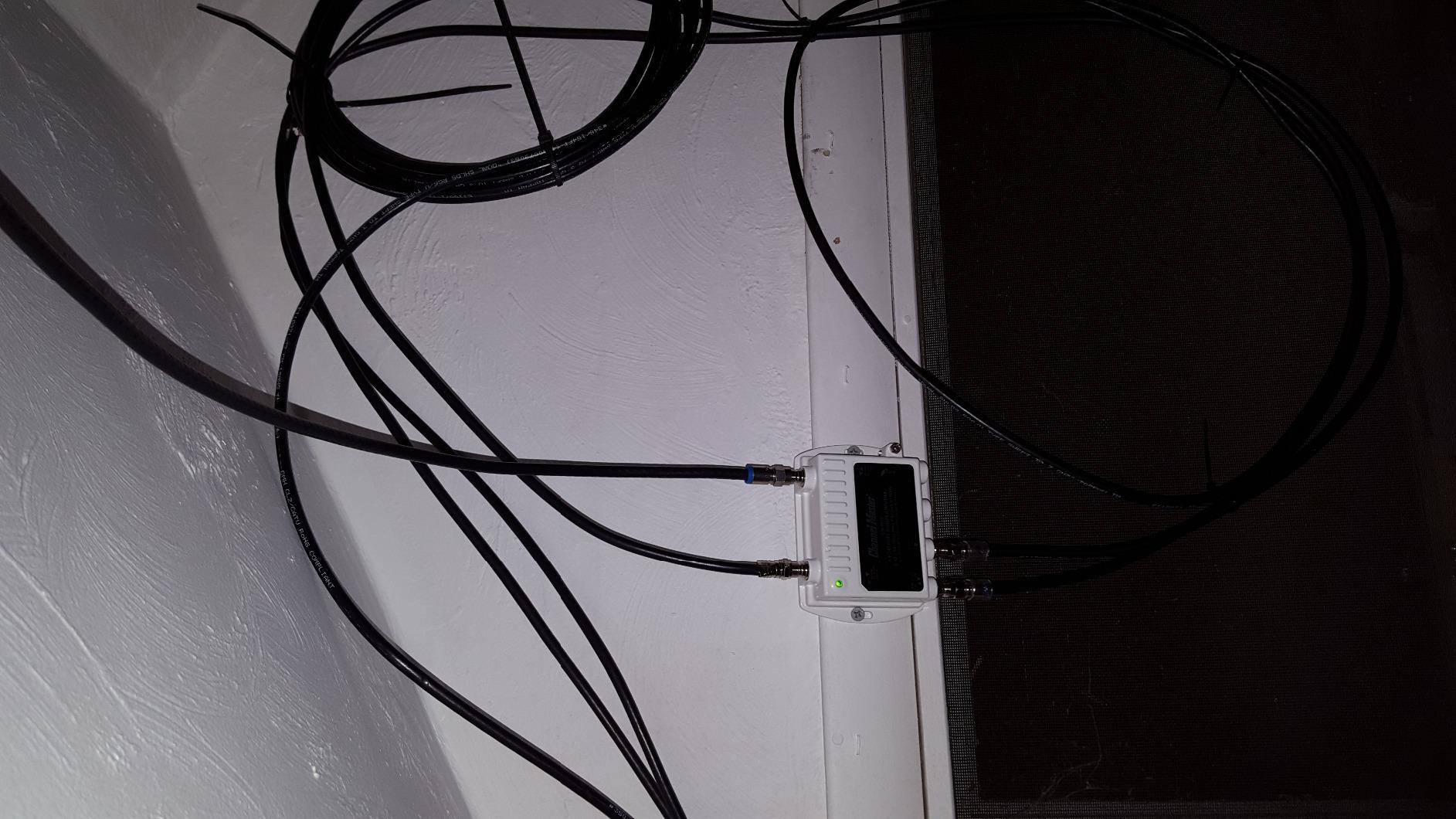
A preamplifier, also called a mast amplifier, goes at the antenna before the long cable run. Its job is to amplify the signal while the signal-to-noise ratio is still good, so the noise the cable picks up on its trip down the mast is added after the gain instead of drowning in it. That is the correct position for a weak station in a rural install.
A distribution amplifier goes after the antenna, typically in the attic or a closet, and its job is to overcome the loss of short cable runs and a splitter so a hard second television can still get a usable signal. Putting a distribution amp where a preamp belongs, or running a long unamplified feed into one, is the classic error that reduces channel count. And yes, over-amplification is real: push too much gain into a tuner and it can overload and lose channels it was previously locking.
On the four questions that come up constantly: a good-quality mast preamplifier is the answer to which preamplifier to buy, and a low-noise figure matters more than raw gain. Amplifiers do wear out, mostly as failing power supplies and corroded connectors rather than tired transistors, and the seasonal symptom is channels that come and go. On acceptable signal loss, use quality RG6 and keep every run short; if a 3dB loss per 100 feet is costing you a marginal channel, the fix is a preamplifier at the top of the mast, not a booster at the bottom of the run.
The 5000-mile range claim, and why it is not real
You will see indoor amplified antennas advertised with a 5000-mile range, and a few outdoor models claiming 120 miles for hardware the size of a baking tray. Here is what is actually happening. Broadcast radio waves behave like light in one important way: they do not bend around the Earth. Line of sight is a hard physical limit, and a transmitter’s coverage is deliberately built to end at a certain radius, partly so the same channel can be reused in the next market.
Add the near-universal misspecification of those figures. Several antennas in this roundup list a 150 or 200-mile range alongside a stated channel capacity of 1 or 12, which is a combination nobody should believe on its face. Range numbers are also measured under ideal lab conditions with a clean line of sight, whereas your result depends on terrain, tree cover, the VHF and UHF mix of your market, mast height and how well you aim. Use them to sort a shortlist, never to set expectations.
What to avoid in cheap amplified antennas
Avoid the no-name amplified units that dominate the shopping results with a handful of reviews and a rating near the bottom of the scale. A 1-star rating from a single review and a 2.8-star rating from a handful of reviews both mean the same thing: the people who actually installed it were not happy with it. A four-digit review count with a 3.8 average, as with the 1byone, is a more honest picture than a 5-star average from 17 reviews.
Also avoid any antenna whose headline feature is a very large number rather than a band, a beam pattern or a noise figure, and any product that calls a broadcast antenna a satellite antenna. The Five Star listing makes that exact mistake, and it is a reliable signal that the rest of the marketing has not been checked either.
Attic, rooftop or mast: what each placement costs you
Attic installs are the quietest and the easiest, and they lose real signal. Roof sheathing, foil-backed insulation, metal roofing and metal siding all attenuate, and an attic antenna sitting near the roof deck can be several decibels below the same antenna on a mast above it. In a strong-signal area nobody notices. Past 40 miles, the difference is frequently the difference between a channel list and no channel list.
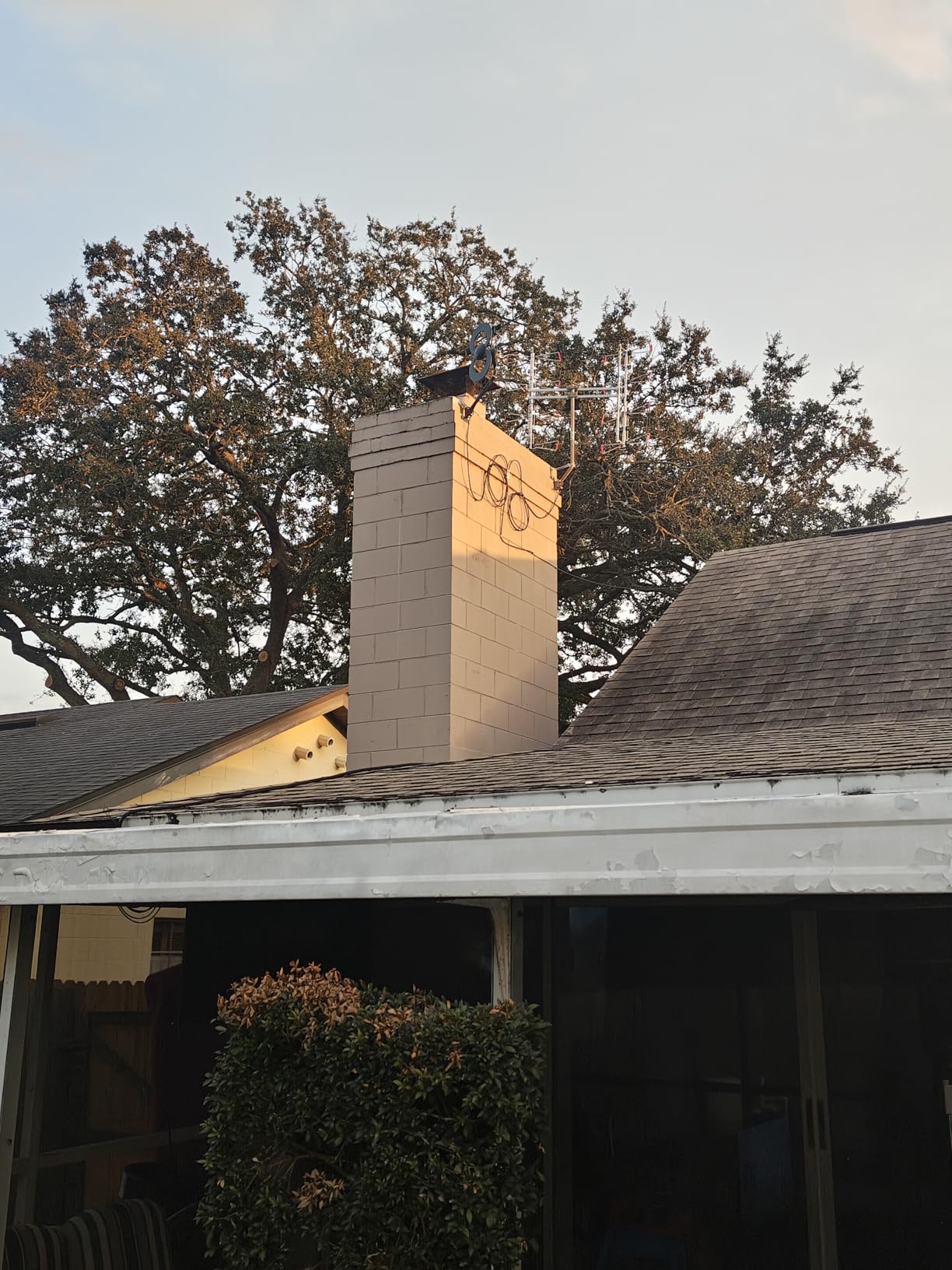
A rooftop or eave mount is the sweet spot for most rural homes, and the J-mount included with the GE and the ClearStream units makes a two-person install straightforward. A ground or pole mount is best when you have clear line of sight to the towers from the side yard but not from the roof, which is a common situation on a long property with a rise to one side.
Whatever you choose, go as high as you reasonably can. Height is the cheapest gain available, it costs nothing to add, and it is the single most effective change a rural household can make before trading up to a bigger antenna.
How to Check Which TV Stations You Can Receive
Two free tools answer the question that decides your purchase, and using them first takes about two minutes and can save you from returning the wrong antenna.
- Run the FCC DTV Maps lookup. Enter your address on the FCC DTV Maps site to see the licensed facilities that cover your location. This is the authoritative list of what exists, though it does not account for your terrain.
- Run a TVFool report for your exact address. TVFool adds terrain modelling, distance, bearing and predicted signal strength for each channel, which is the tool the antenna community actually uses when comparing antennas.
- Read the channel list and note two things per channel. First, the band. Anything in channels 2 through 13 is VHF and dictates your antenna choice. Anything in 14 through 36 is UHF, which almost every antenna here handles well.
- Note the azimuths. If every station falls within about 60 degrees, choose a directional antenna. If stations sit in several directions, you need either an omni or a rotor.
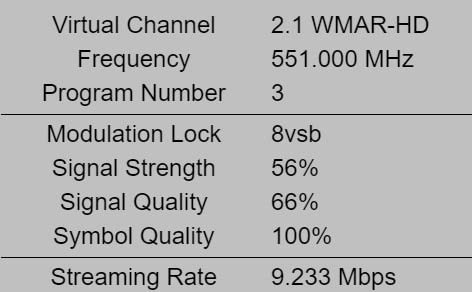
- Note the signal strength ratings. Strong ratings mean gain is not your problem and an unamplified antenna is fine. Marginal ratings mean you want reflectors, height and possibly a mast preamplifier. Very weak ratings mean height and line of sight are the problem, and no antenna fixes what the terrain blocks.
- Count realistically. Compare the channel count on the report to what the FCC map says is licensed in your area. If there are only 14 stations available, an antenna that finds 20 is not magic, and one that finds 8 has a problem worth fixing.
For indoor-only setups, the same logic applies with a caveat: a TVFool report for a rooftop antenna tells you nothing about what a stick in a window will pull. Antenna forums advise starting with the cheapest possible indoor unit to find out whether any usable signal reaches the house at all before committing to rooftop hardware.
How to Mount, Aim and Ground Your Antenna
- Choose the site for line of sight, not for convenience. Look from each candidate point toward your tower bearing and check what is in the way. A clear view beats a convenient view every time.
- Get it as high as you can safely manage. Height is free gain. Every foot matters most in marginal locations, and it is the cheapest improvement available to you.
- Mount on the J-mount or pole and aim at the bearing from your report. Start from the azimuth, then fine-tune. Watch a channel scan rather than judging by eye, because a small rotation can add or drop channels on a narrow-beam antenna.
- Place the preamplifier at the antenna if you use one. Then run the shortest practical length of quality RG6 to the house. Remember that every 100 feet of good coax costs you roughly 3dB.
- Ground the mast and the coax. Bond the mast to a grounding block with a proper ground wire, bond the coax shield at that block, and follow local code. This is both a safety requirement and what protects your electronics from lightning-induced surge, and it is the step most often skipped in a rural install.
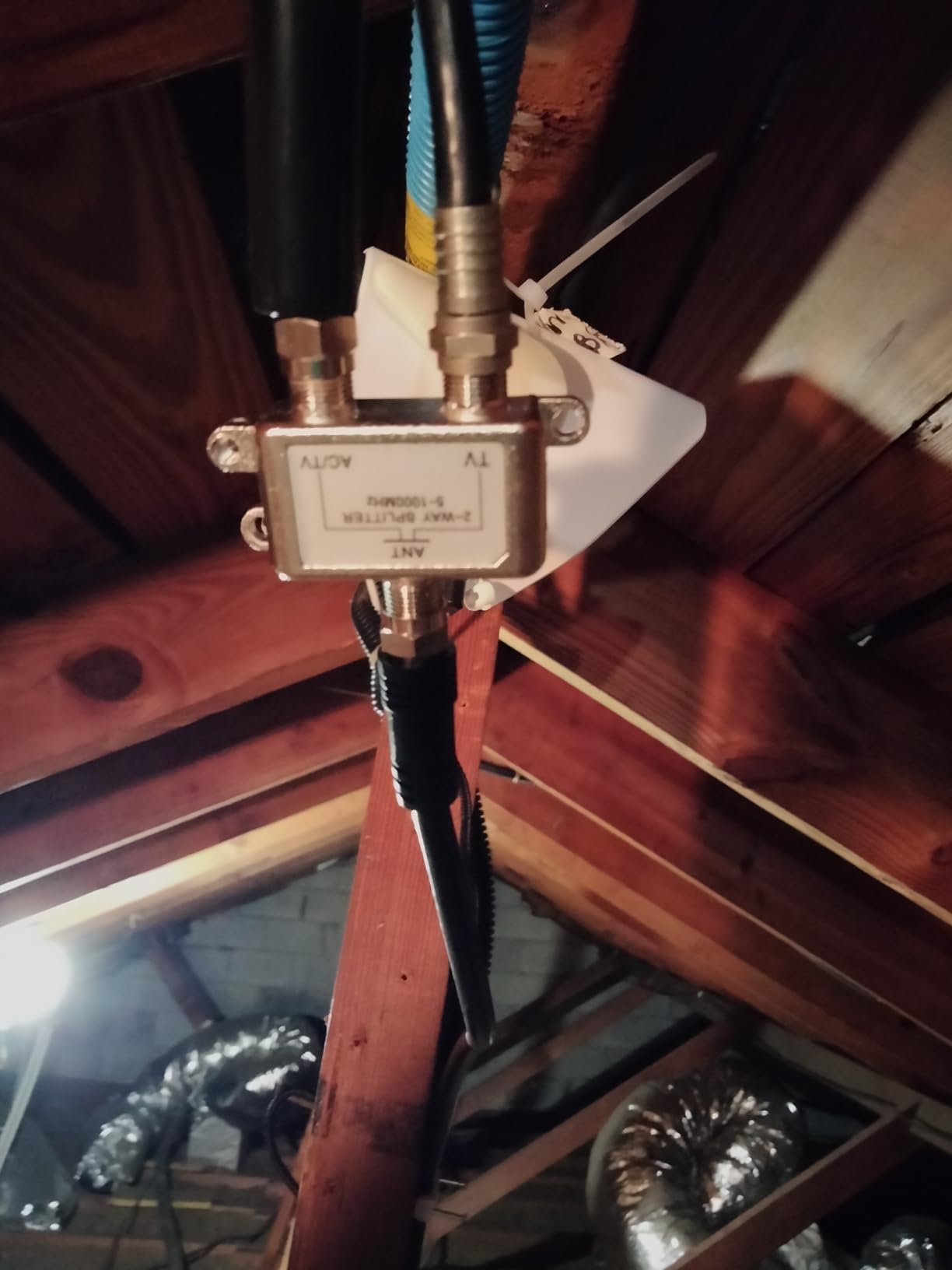
- For two or more TVs, plan the distribution. A splitter takes the same signal to several sets and costs you signal on all of them, so a splitter only works if your signal has real margin. A distribution amplifier exists to restore that margin, and a channelizer is the better answer when a household only wants a handful of channels on a secondary set. Combining amplifier outputs on the same band is the approach the antenna forums warn against most consistently.
- Rescan, then wait for a season to judge. Run a full channel scan after every aim change. And before you conclude your setup is broken, remember that reception changes with leaf cover, so test again after the trees drop and again in spring.
Two safety points specific to rural rooftops. Never work on a roof in wet conditions or near overhead power lines, and if you are not comfortable with height, a professional install is cheaper than an injury or a damaged roof. For tall masts, a properly installed tower with a grounding system is safer and lasts longer than an improvised pole on an eave.
Frequently Asked Questions
What is the best long-distance TV antenna for rural areas?
The GE Outdoor HD Digital TV Antenna is the best all-round choice for most rural homes, with a 70-mile stated range, VHF and UHF elements, a J-mount in the box and a 4.4 average across more than 10,000 ratings. If your towers are beyond about 70 miles or sit in different directions, step up to the Antennas Direct ClearStream 4V, which has the strongest multi-band hardware in this roundup. Check your FCC DTV Maps and TVFool report before buying either one.
What is the longest range outdoor TV antenna?
Of the antennas we reviewed, the Five Star amplified outdoor antenna and the Five Star Yagi both carry a 200-mile stated range, and the McDuory claims 150 miles. Those are marketing figures, not guarantees, and the same products list a channel capacity of 1 or 12. In real use, a well-chosen all-band antenna with good mast height reliably pulls roughly 60 to 70 miles, which is why we rank the GE and the ClearStream 4V above the bigger-numbered models.
What is the best outdoor TV antenna for a 100 mile range?
None of these antennas will promise you 100 miles, and you should be sceptical of anyone who does. Broadcast signals do not bend around the Earth, and transmitter coverage is deliberately limited so the same channel can be reused in the next market. Past roughly 70 miles, terrain and mast height matter far more than antenna model. Run a TVFool report for your address: if your channels rate as strong or moderate, the GE or the ClearStream 4V on a tall mast will do more for you than a more expensive antenna on a short pole.
Which TV antenna has a 70 mile range?
Three of the antennas here state a 70-mile range: the GE Outdoor HD Digital TV Antenna, the Antennas Direct ClearStream 4V and, at 60-plus miles, the ClearStream 2V. All three are directional designs with VHF and UHF coverage. The GE is the simplest, the 2V has the widest beam and the easiest aiming, and the 4V has the best high-band VHF and interference rejection. Treat 70 miles as a lab figure under ideal conditions, not a guarantee for your address.
What is the best TV antenna for a 50 mile range?
At 30 to 50 miles with a clear line of sight, the Antennas Direct ClearStream 2V and the Five Star Yagi are both strong choices, and the PBD amplified unit adds motorized rotation if your towers are spread out. Our best value pick is the PBD, because the rotor lets you re-aim without climbing the mast and the two TV outputs avoid a splitter. Whatever you choose, get it high: at this distance height often matters more than model.
How can I get better TV reception in rural areas?
Five steps, in order. Run a TVFool report for your address to learn your band mix, tower bearings and signal strength. Choose an outdoor antenna with Hi-VHF elements if any channel you want is 2 through 13. Mount it as high as you safely can, because height is the cheapest gain available. Run the shortest practical length of quality RG6 and put any preamplifier at the antenna rather than at the end of the cable. Finally, ground the mast and coax properly, then rescan and re-test after leaf drop.
What TV antenna gives you the most channels?
Channel count comes from your market, not from the antenna. Run the FCC DTV Maps for your address and count the licensed stations first, then use TVFool to see how many of them are realistically receivable. A high-gain outdoor antenna with reflectors such as the GE or the ClearStream 4V will capture more of the available channels than any indoor unit, but if only 14 stations are licensed near you, no antenna produces 100. Our ClearStream 2V owners report counts ranging from about 50 to 144 depending on distance and mounting height.
Do I need an amplifier, and do they wear out?
You need amplification only when your signal is genuinely weak at the antenna or when long cable runs and splitters eat the margin, and the correct device is a low-noise mast preamplifier mounted at the antenna. A distribution amplifier belongs near the television to overcome short runs and splitters. Putting a booster at the wrong end of the chain adds noise and can reduce your channel count. Amplifiers do fail over time, usually through power supplies and corroded connectors, and the symptom is channels that come and go rather than a clean failure.
The Best TV Antenna for Your Rural Home
The GE Outdoor HD Digital TV Antenna is our pick for the best TV antennas for rural areas in 2026, because it combines a rating at the top of this group with the largest body of practical feedback, covers both VHF and UHF, and includes the mount you need. It is passive, so plan on adding a mast preamplifier if you are running long cable or feeding more than one television.
Buy the PBD amplified outdoor antenna if you want remote rotation and two outputs at the lowest sensible cost, and buy the Antennas Direct ClearStream 4V if high-band VHF and stable multi-band reception are the deciding factors. The Five Star Yagi is the sturdiest metal option for a 60 to 70 mile pull, the Five Star amplified unit is the one to choose when five televisions need feeding, and the McDuory and 1byone cover the low-cost and omnidirectional ends of the market.
Before you order anything, spend two minutes with the FCC DTV Maps and a TVFool report for your address. Your band mix and tower bearings will tell you which of these eight you actually need, and mounting height will do more for your reception than any model on this list. And when you set it up, ground the mast, run quality RG6, put the amplifier at the antenna, and give the trees a season to drop before you decide the setup is not working.