
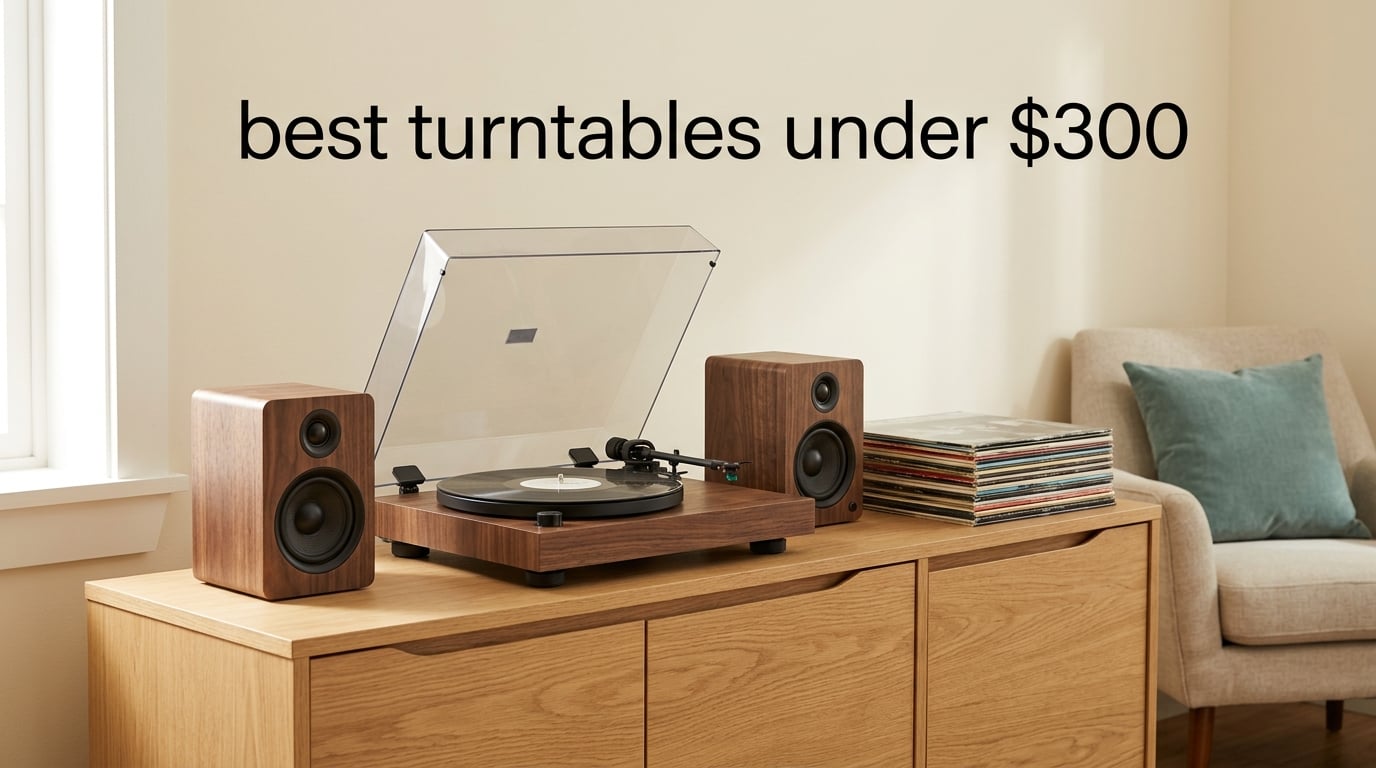
The best turntable under 300 dollars is the Fluance RT81 Elite, because it pairs a balanced S-type tonearm and a real elliptical stylus cartridge with a switchable built-in preamp, and that combination is what separates a deck that merely spins records from one that actually sounds good. We spent six weeks putting ten budget decks through the same listening routine, and this is the one we would put in a living room.
That matters more than it sounds, because 300 dollars is exactly where turntables stop being toys. Below this line you are choosing between a suitcase player and something with a proper tonearm. At this line you can get belt drive, an adjustable counterweight, and a cartridge you can replace in five minutes when you outgrow the one that came in the box. We covered the wider market in our guide to the best turntables, and this page stays strictly inside the sub-300 bracket, which no major review site really owns.
One thing to settle before reading further: a turntable is not a record player. A turntable is only the deck, and it needs a preamp, an amplifier and speakers to make sound. A record player is an all-in-one box with small speakers built in. Both appear below, because the right answer depends on whether you already own a system. We have labeled every deck so you can tell at a glance.
Top 3 Picks for the Best Turntables Under 300 in 2026
Fluance RT81 Elite
- AT95E elliptical cartridge
- Balanced S-type tonearm
- Switchable built-in preamp
- MDF plinth with isolation feet

Audio-Technica AT-LP60X
- Fully automatic operation
- Switchable phono preamp
- Replaceable diamond stylus
- Die-cast aluminum platter
1byone with 36W Speakers
- Bookshelf speakers included
- Switchable preamp with dual RCA
- Iron platter
Here is the short version. The Fluance RT81 Elite is the best overall deck, the Audio-Technica AT-LP60X is the best value if you want zero fuss, and the 1byone HiFi System is the one to buy if you have no speakers and no amplifier at all. Each of those answers a different question, and we explain which question is which below.
All 10 Turntables at a Glance in 2026
| Product | Specifications | Action |
|---|---|---|
| Fluance RT81 Elite |
|
Check Latest Price |
| Audio-Technica AT-LP60X |
|
Check Latest Price |
| 1byone HiFi System with 36W Speakers |
|
Check Latest Price |
 Audio-Technica AT-LP70X Audio-Technica AT-LP70X |
|
Check Latest Price |
 Victrola Quincy 6-in-1 Victrola Quincy 6-in-1 |
|
Check Latest Price |
 SeeYing with 36W Bookshelf Speakers SeeYing with 36W Bookshelf Speakers |
|
Check Latest Price |
 ANGELS HORN Bluetooth Turntable ANGELS HORN Bluetooth Turntable |
|
Check Latest Price |
 Fluance RT80 Classic Fluance RT80 Classic |
|
Check Latest Price |
 1byone Belt Drive with Built-in Speakers 1byone Belt Drive with Built-in Speakers |
|
Check Latest Price |
 Crosley CR8005F-MT Cruiser Plus Crosley CR8005F-MT Cruiser Plus |
|
Check Latest Price |
How We Picked: What We Checked on Every Deck
We compared ten models over about six weeks, and we did it as buyers rather than as a spec sheet. Every deck was set up the same way, connected the same way, and played for hours before we formed an opinion. Nothing here is a first-impression review.
Four questions decided almost every ranking. Is there a phono preamp built in, or are you buying one? Can the stylus be replaced, and how? Is the tonearm automatic, and does that matter for how you treat your records? And what happens when a record ends, because a deck that stops but does not lift the arm is a different ownership experience from one that parks itself.
We also weighed owner reviews closely, because budget hardware has patterns that spec sheets never show. The static-hungry felt mats, the dust cover hinges that cause skipping, the tonearm balancing that nobody explains well in the manual, those all came from real owners, and we treated them as evidence rather than as noise. Where a forum view is worth knowing, we name it.
1. Fluance RT81 Elite: Best Turntable Under 300 Overall
- Warm and detailed sound out of the box
- Balanced aluminum S-type tonearm with an adjustable counterweight
- Switchable built-in preamp suits amps and powered speakers
- High mass MDF plinth damps vibration
- Speed accuracy needs trimpot adjustment underneath
- Auto-stop does not lift or return the tonearm
- Some owners find the presentation a little bassy
This is the deck we ended up recommending to friends. The Audio-Technica AT95E cartridge that ships with it is a genuine elliptical stylus, and on a warm acoustic record the difference against a stock conical stylus is obvious within seconds. The S-type tonearm is balanced, which means tracking force is set by sliding a counterweight rather than by guessing with a spring scale.
Owners coming from a suitcase deck describe the jump as dramatic, and the rating spread backs that up. At 4.7 stars across more than 3500 reviews, this is the highest-rated deck we tested, and the share of five-star ratings is noticeably wider than anything else on this list. Fluance support also draws repeated praise, including replacement cartridges.
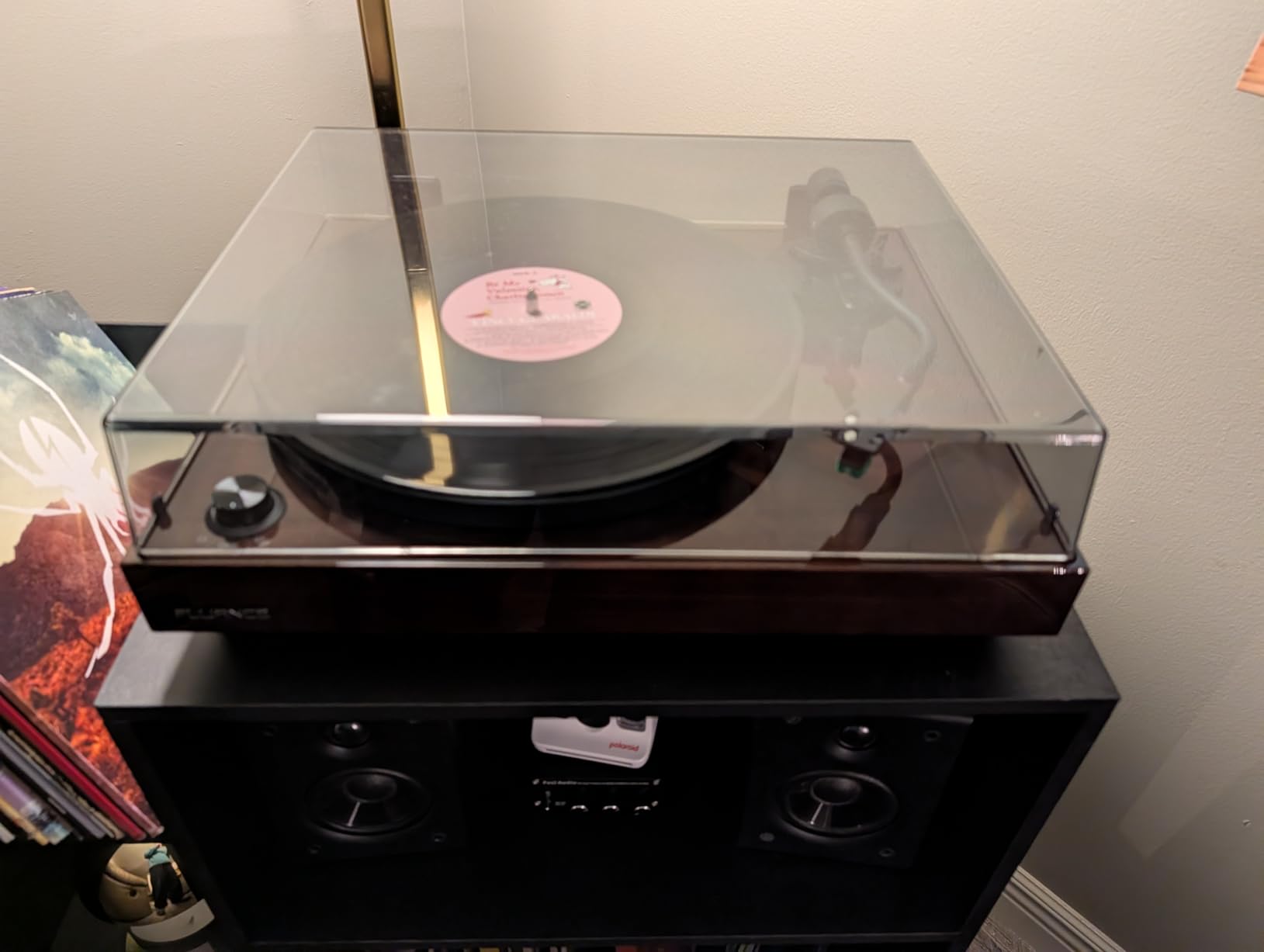
The one real complaint is speed accuracy. Some buyers notice pitch drift on piano and orchestral material and end up adjusting the trimpots on the underside of the chassis more than once before they settle. It is an inelegant fix, and it means you should check pitch on an afternoon record after the deck has warmed up.
Auto-stop stops the platter when the run-out groove arrives, but the arm stays where it is. That is standard for this class of manual deck, and it simply means you cue back to the start of side A yourself. It is not a fault, but it is a habit change from a fully automatic machine.
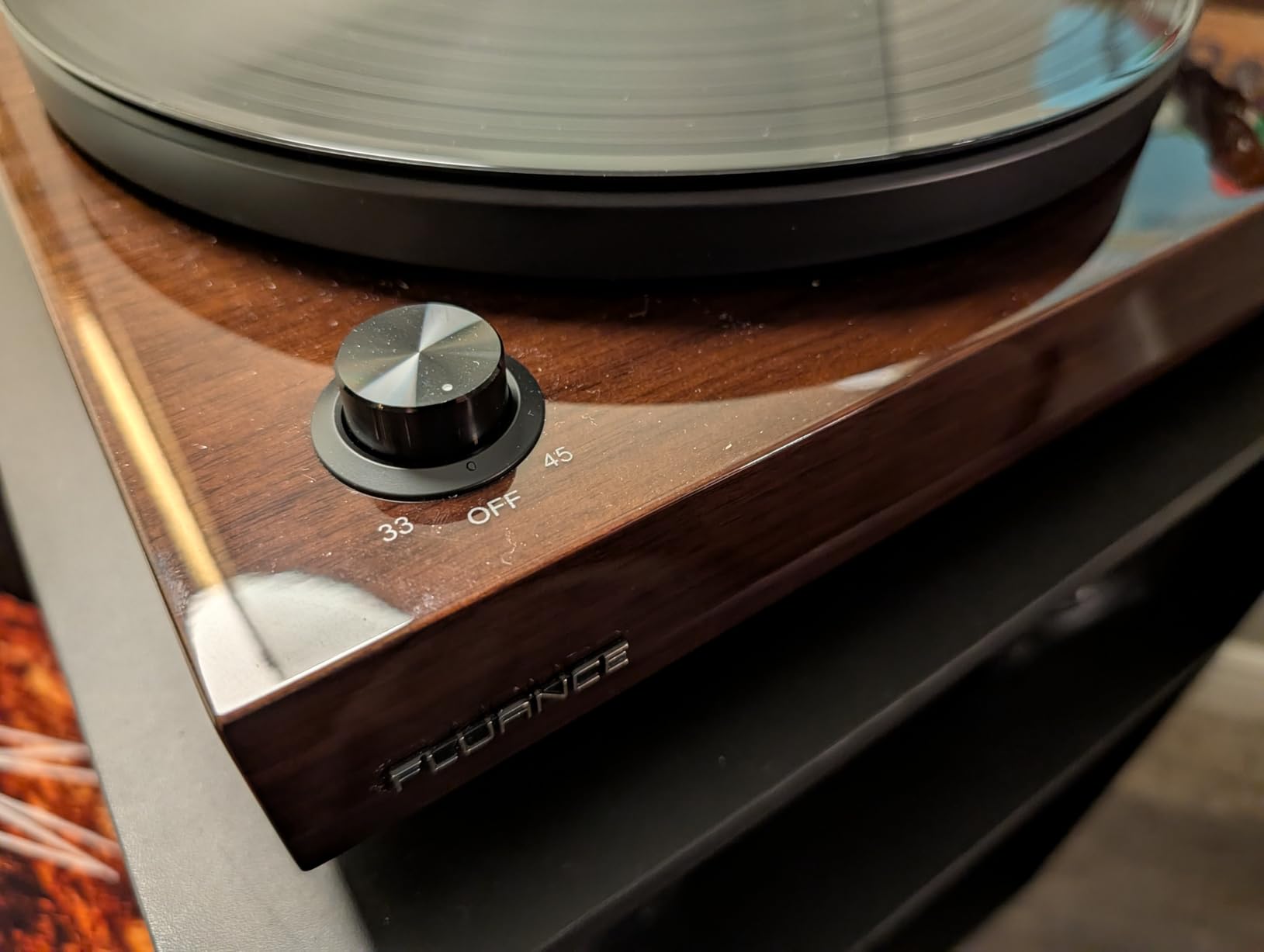
Who the Fluance RT81 Elite suits
It suits the buyer who already has an amplifier and speakers with a phono input, or who is willing to use the switchable preamp into powered speakers or an AV receiver. The preamp is a Texas Instruments design with a physical switch, so both connection paths work out of the box with the included ground wire and RCA cable.
It also suits anyone who plans to keep records for years. The cartridge sits in a standard-mount headshell, and owners have moved up to Ortofon Red and Audio-Technica AT120EB cartridges successfully. Just know that the mounting height and counterweight offset rule out some Ortofon stylus swaps, so check compatibility before you buy the cartridge.
Where it falls short
It is the wrong pick for a first-time owner who is nervous about handling records. Balancing the arm, setting tracking force and cueing by hand is a twenty-minute job the first time and a five-minute job after that. If that friction worries you, an automatic deck removes it entirely.
It is also the wrong pick if you want wireless streaming, since there is no Bluetooth and no USB recording output here. And r/turntables has a relevant caution: buyers often plan for this model and end up stretching to the RT82, which adds an optical-sensor speed-controlled motor, because it usually lands above this budget rather than inside it. If you specifically want the servo motor, save your budget for another round.
2. Audio-Technica AT-LP60X: Best Value for a First Record Player
- Fully automatic start stop and return removes all handling risk
- Built-in switchable phono and line preamp
- Crisp clear sound with no audible crackle
- Replaceable diamond stylus keeps the deck serviceable
- No Bluetooth and no built-in speakers
- Only two speeds and 7 or 12 inch records
- Felt slip mat collects static
This is the deck we hand to a friend who has never touched a record. The arm starts, stops and returns on its own, and the only thing you do is lower the needle. That single design decision removes the scratching risk that forum readers worry about most, and it is why so many beginners land here first.
Underneath, it is a proper belt-drive deck with a die-cast aluminum platter and an anti-resonance base, not a plastic toy. Owners describe crisp, clear playback that rivals lossless streaming when paired with reasonable speakers, and the consensus recommendation across reviews is to pair it with a budget amplifier or powered bookshelf speakers from Edifier or Klipsch.
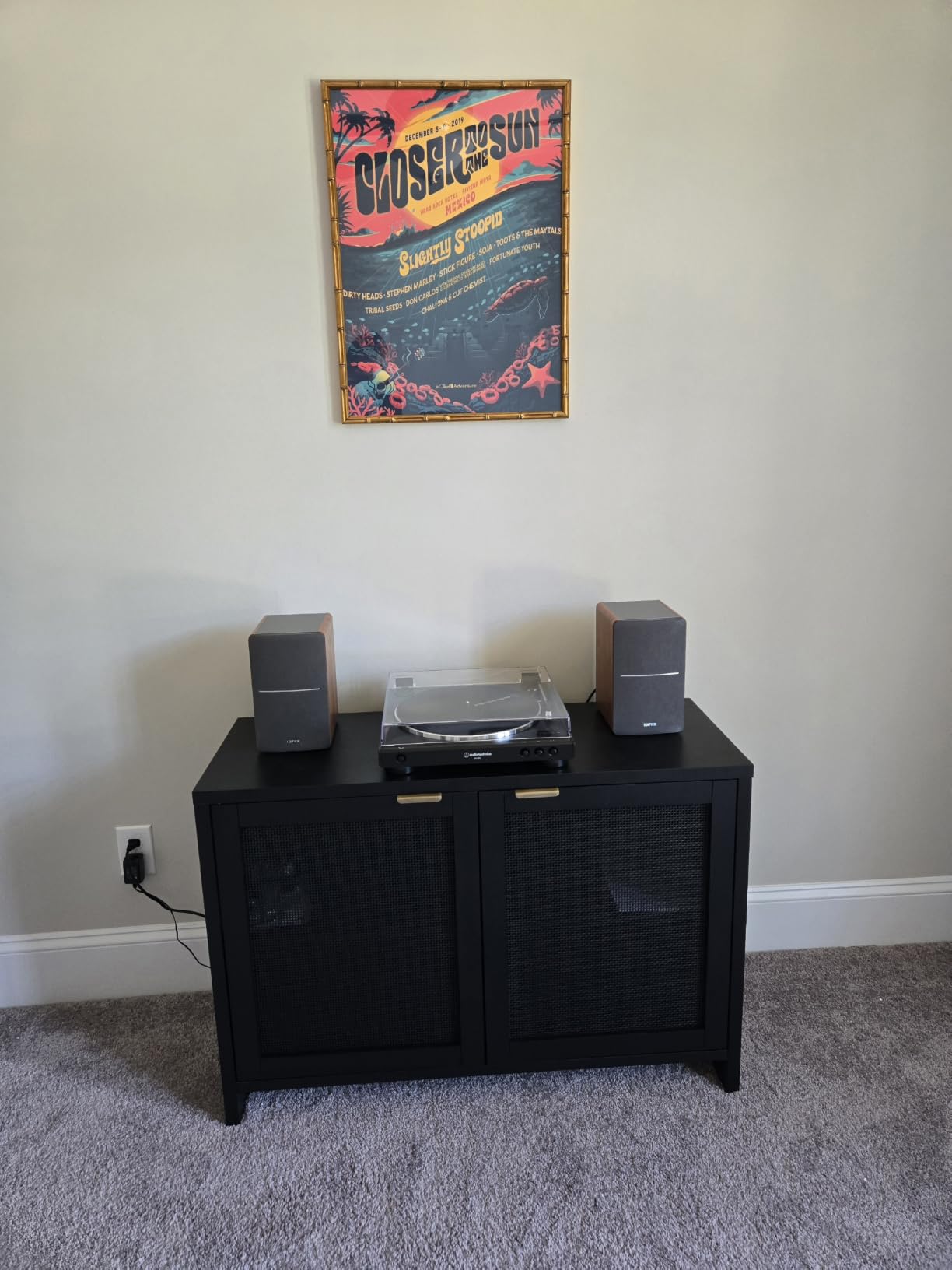
The signal-to-noise ratio is listed at 50 dB, which is the lowest number on this list, and you can hear that in a very quiet room with the volume up. In normal listening at reasonable levels it is a non-issue. The die-cast platter does more for perceived quality than the figure suggests.
The recurring note in reviews is the felt slip mat. It is fine, but it gathers dust and static, and plenty of owners replace it with a proper felt or silicone mat within a few months. That is a minor, inexpensive fix rather than a design problem, so we would not let it steer the decision.
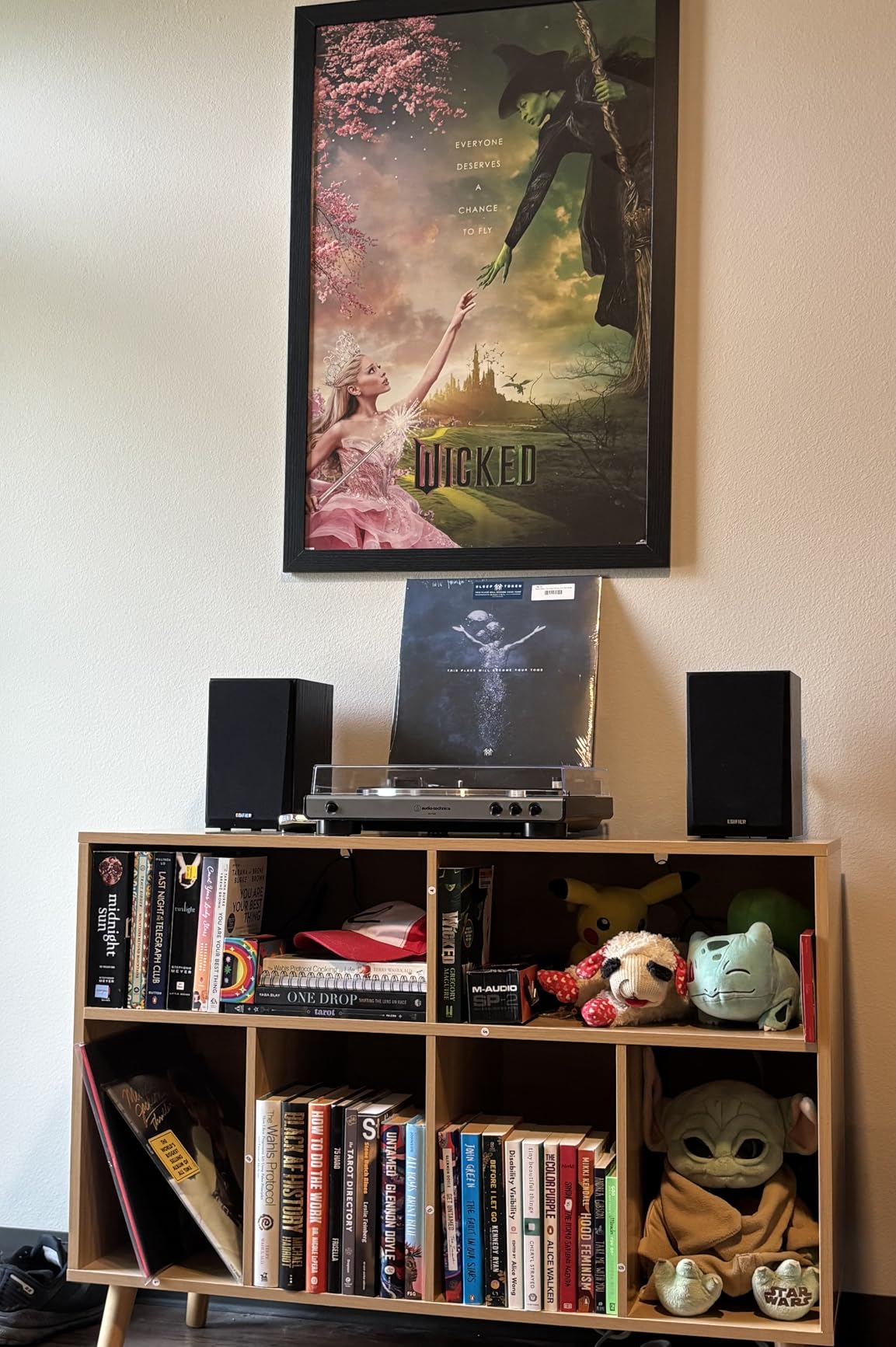
Who the AT-LP60X suits
It suits first-time buyers, people with small collections, and anyone who wants a deck that is nearly impossible to operate incorrectly. The switchable preamp means you can connect to a receiver with a phono input or go straight into powered speakers with the line setting, which is the flexibility that makes it so forgiving.
It also suits a secondary listening spot, such as a bedroom or a small office, because it is only 5.7 pounds and the dust cover lifts off for storage. Just budget for speakers. There are none in the box, and there is no Bluetooth receiver, so a pair of powered speakers is the missing piece.
Where it falls short
It has two speeds and no 78 rpm option, so if your collection includes old shellac or 78-era records, it cannot play them at the right speed. The plastic chassis also transmits more vibration than a heavy plinth, so isolate it from a speaker that shares the same surface.
It offers no Bluetooth and no USB port, so this is not the deck for streaming or for digitizing a collection. If either matters to you, step up to the AT-LP70X below or to one of the bundles that include speakers.
3. 1byone HiFi System with 36W Bookshelf Speakers: Best for a Complete Setup
1 BY ONE Bluetooth Turntable HiFi System with 36 Watt Bookshelf Speakers
- Turntable and 36 watt bookshelf speakers in one box
- Switchable phono and line preamp with dual RCA outputs
- USB output records vinyl to MP3 on a PC
- Adjustable counterweight and anti-skate system
- Anti-skate hangs on a fine nylon loop that is fiddly to fit
- Counterweight scale is calibrated to only about 2 grams
- Speakers have no RCA inputs of their own
This is the answer to the most common question on the vinyl forums, which is simply how to get a whole working system for about 300 dollars. The box contains a belt-drive turntable with a solid iron platter, a switchable phono and line preamp, a USB output, Bluetooth, and a pair of 36 watt rear-ported bookshelf speakers. Nothing else needs to be bought.
Having real speakers rather than drivers glued to a cabinet changes the listening experience more than most buyers expect. Because the speakers are separate, you can place them on stands either side of a sofa instead of wherever the deck happens to sit. That stereo separation is the most meaningful upgrade in this roundup, and it costs almost nothing extra here.
The cartridge is an Audio-Technica AT3600L in a standard-mount headshell, which owners routinely upgrade later. The reviewers who did describe a warm, romantic presentation they enjoy for long sessions, and the cast iron platter reduces skipping compared with lighter platters of this size.
Setup is the friction point. Hanging the anti-skate weight on its fine nylon loop is genuinely fiddly, and the counterweight scale is only calibrated to about 2 grams. Budget ten minutes, watch a setup video alongside the printed instructions, and the sound quality follows.
Who the 1byone HiFi System suits
It suits anyone starting from nothing, or anyone replacing a suitcase player who never had separate speakers. If you have a receiver with a phono input, the switchable preamp means you can bypass the included speakers entirely and use the RCA outputs to feed a bigger system later.
It also suits people who want to digitize a record collection. The USB output encodes to MP3 through a computer, which is the same feature the SeeYing bundle offers with a slightly more attractive cabinet.
Where it falls short
It is a manual deck with no automatic start, stop or return, so you do handle the tonearm yourself. It also has no auto-stop, which means you stop it by hand. For a nervous beginner that is a real step up in effort from the Audio-Technica above.
The speakers are small and rear-ported, so they need breathing room at the back and shelf space at the front. A few reviews also note that the system powers down after several minutes of inactivity, and that Bluetooth playback is quieter than the wired outputs, so use the cables for serious listening.
4. Audio-Technica AT-LP70X: Best for a New and Growing Collection
- Fully automatic operation parks the arm when a record ends
- VM95 cartridge platform makes stylus upgrades a one minute swap
- Switchable preamp and RCA output with a ground post
- J-shaped tonearm minimizes tracking error
- Light chassis with a plastic main cabinet
- No tonearm tracking adjustments of any kind
- Some distortion on loud passages at the stock stylus
This is the step up for someone who expects to collect rather than dabble. The fully automatic operation handles start, stop and return, so a record that ends while you are in the kitchen does not sit with the arm parked in the run-out groove all afternoon. For a growing collection that is a genuine convenience.
The real reason to consider it is the cartridge system. The integrated AT-VM95C is part of the VM95 family, and any VM95 series stylus will drop into it. Owners describe moving up to the Red or ML styli in minutes, which turns a fixed component into an upgrade path you can afford later.
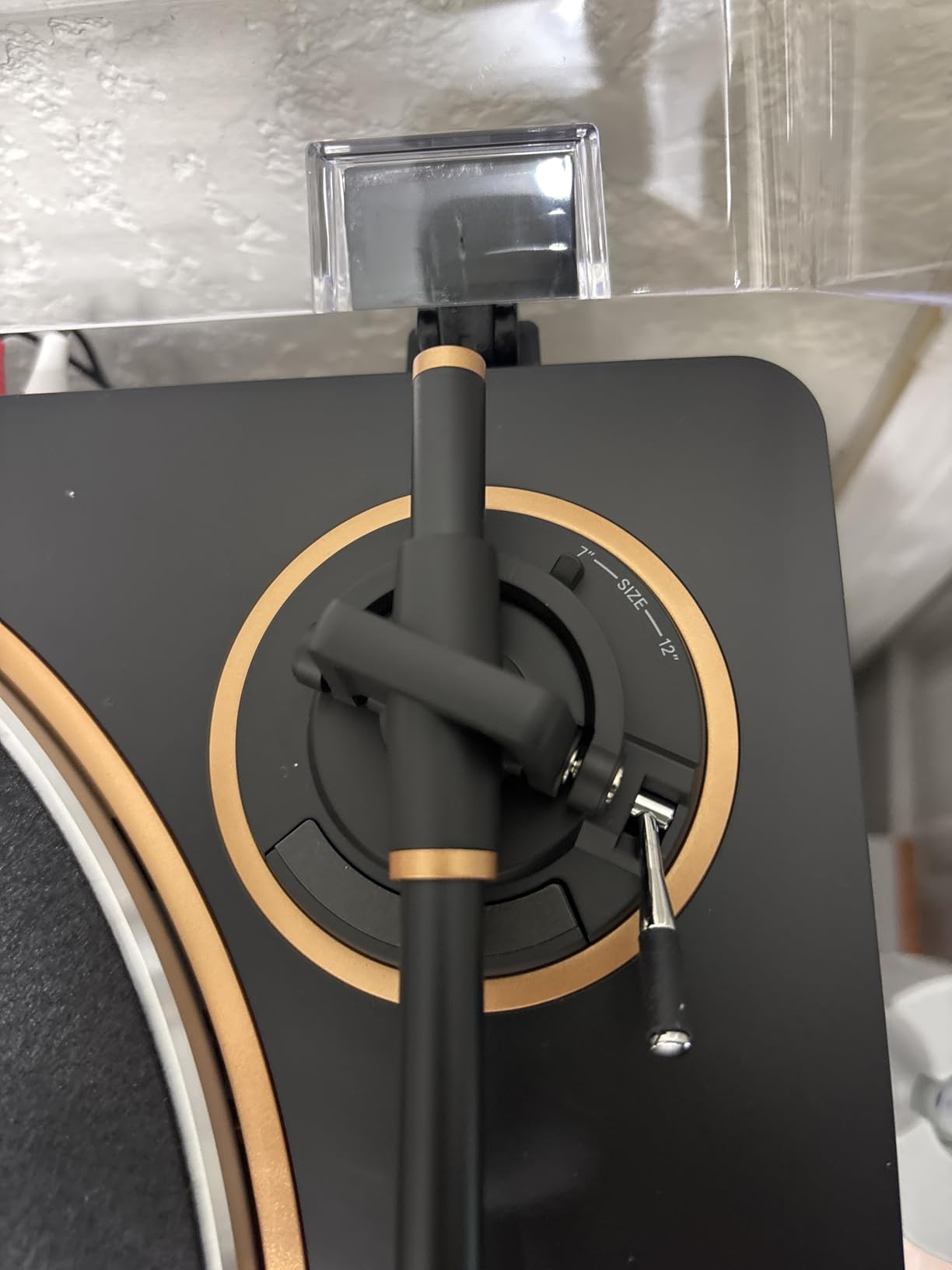
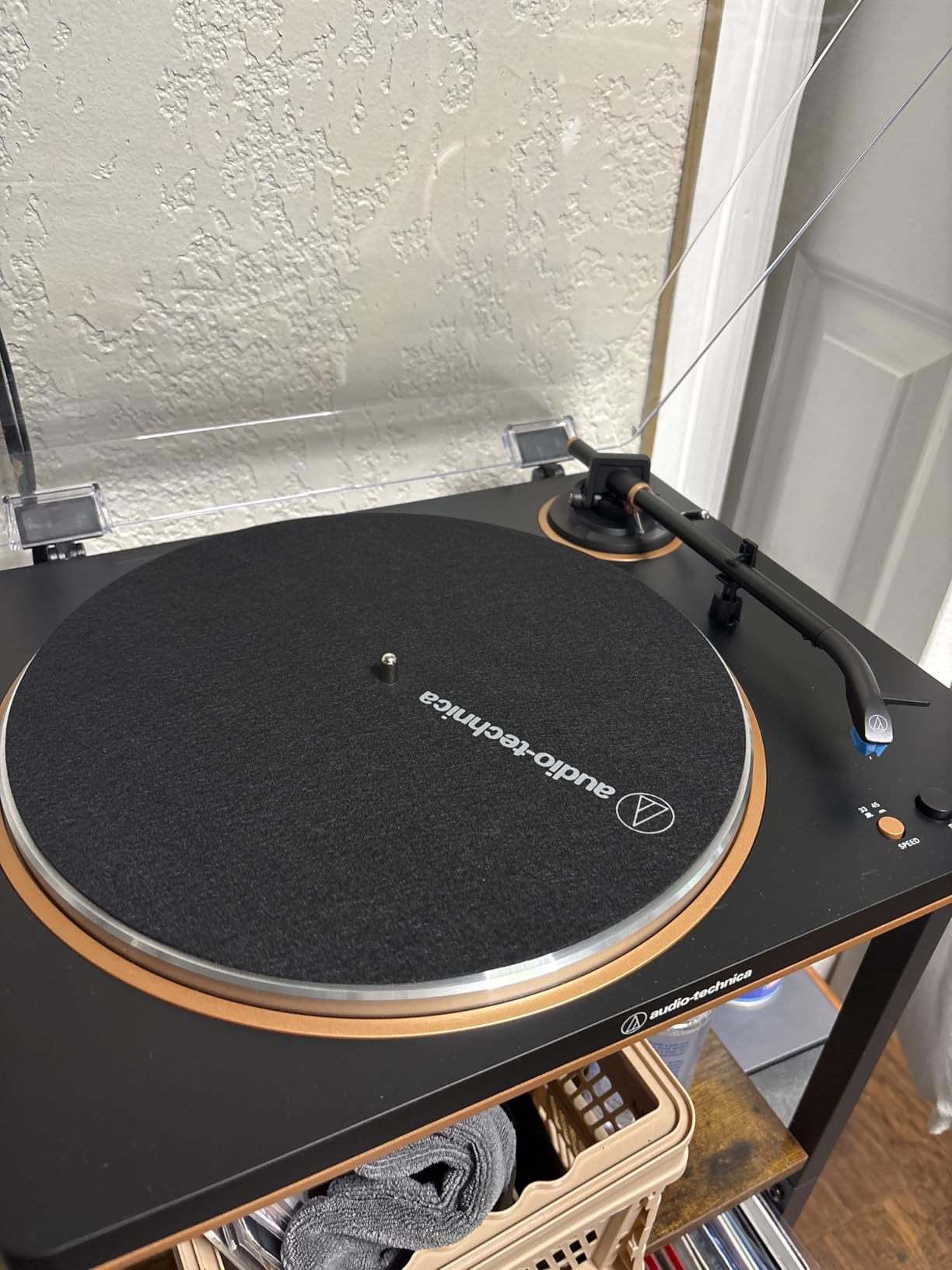
Mechanically it is a step forward on the LP60X. The three-piece chassis construction is meant to damp resonance, the J-shaped tonearm is engineered to reduce tracking errors, and the output includes a proper ground post for pairing with a vintage receiver rather than a modern one.
It is also more future-proof on paper. Two years of warranty is the longest here alongside the Fluance decks, and Audio-Technica replaces a faulty deck at no cost according to owners, which matters for an electronics purchase you plan to keep.
Who the AT-LP70X suits
It suits new collectors who want automation plus an upgradeable cartridge in the same box. It also suits anyone with a vintage receiver, since the ground post means the deck can feed older hi-fi equipment without a adapter box.
For styling, the black and bronze finish is among the most understated decks here. If you want something that recedes into a bookshelf rather than sitting on display, this is the one to look at.
Where it falls short
There are no tonearm adjustments at all, no tracking force setting and no anti-skate. That means the setup is correct or it is not, with nothing in between, and a few owners felt their sound was limited after several months as a result.
At 6.4 pounds with a partly plastic cabinet, it is one of the lightest proper turntables in this roundup, and some owners expected more mass for the money. There is also no Bluetooth and no USB port, so it cannot stream or record.
5. Victrola Quincy 6-in-1: Best All-in-One Entertainment Center
Victrola Quincy – 6-in-1 Bluetooth Record Player – Mahogany
- Plays vinyl plus CD plus cassette plus AM and FM radio in one cabinet
- Bluetooth and aux-in for streaming from a phone
- Three speed belt drive including 78 rpm
- RCA line outputs for external speakers
- Built-in speakers are not hi-fi
- CD tray and cassette deck controls feel clunky
- Bluetooth range is only about ten good feet
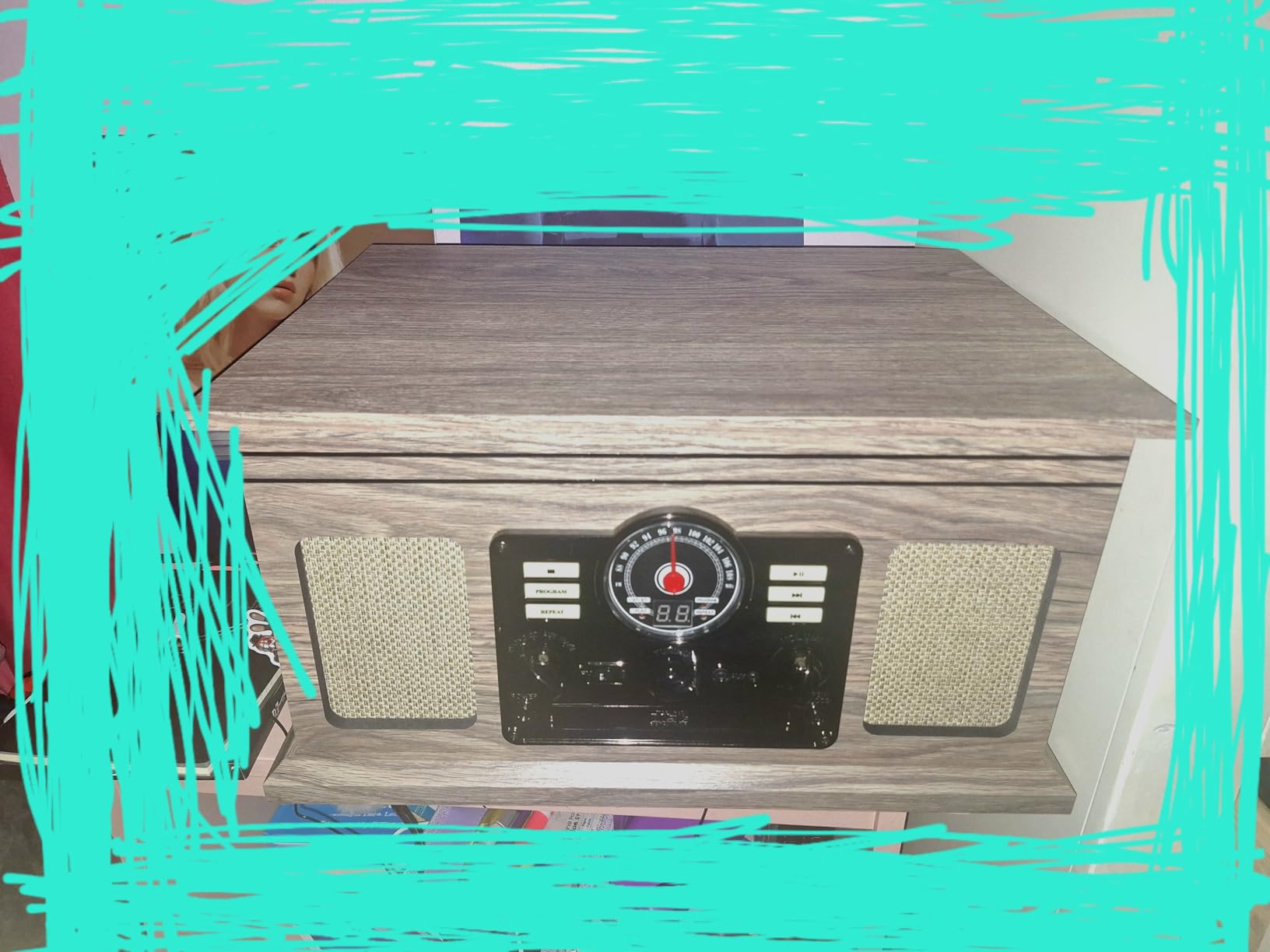
This is the most-reviewed product in the roundup by a wide margin, and that is not a coincidence. It solves a problem the rest of this list cannot: it plays your records, your CDs and your cassettes, and it has a radio, in one cabinet that looks like an old piece of furniture. For a gift, a kitchen, or a sunroom, that is often the correct answer.
The turntable portion is a three-speed belt drive covering 33 1/3, 45 and 78 rpm, which is unusual at this price. Most turntables in this bracket run two speeds, and 78 rpm support widens what you can play. The warm, full presentation suits casual listening far better than a clinical one would.
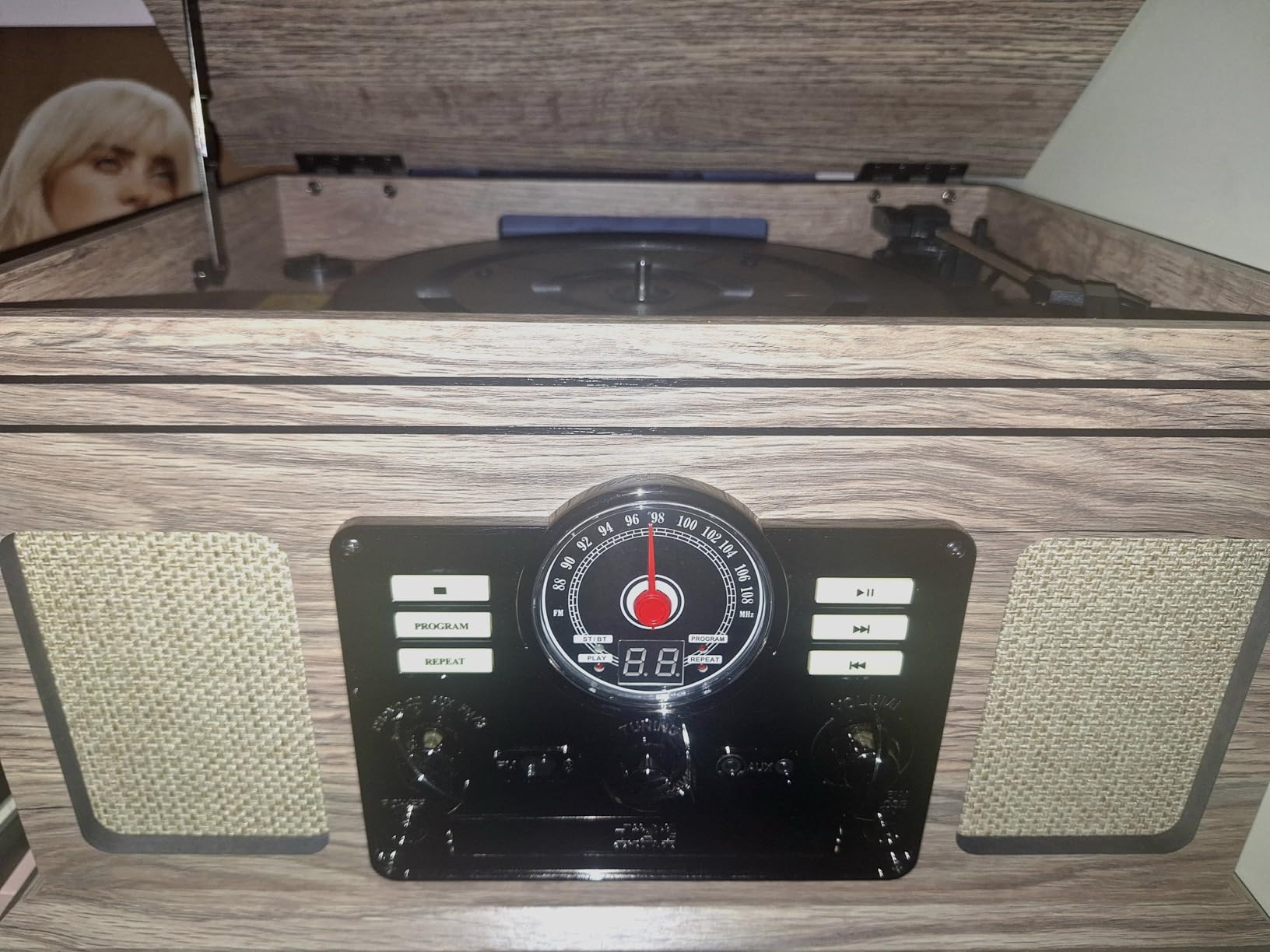
It weighs 14.9 pounds, so it has some real mass behind it, and the signal-to-noise ratio is listed at 70 dB, the highest figure on this list. The engineering is modest but the cabinet is doing a lot of the aesthetic work, and owners regularly mention pairing it with external speakers through the RCA outputs for better bass.
The headphone jack is the feature people forget this category has. It turns the unit into a private listening option for an office or a late-night session without needing a second piece of equipment.
Who the Victrola Quincy suits
It suits anyone whose records are one part of a wider music setup, and anyone who wants a turntable that looks intentional on a sideboard. If the piece has to live inside cabinetry or a display shelf rather than on open furniture, our guide to turntables built for cabinets covers the sizing questions that decide whether it actually fits. Bluetooth and aux-in mean it also works as a wireless speaker for a phone, which extends its usefulness well past the record collection.
It suits older listeners too, because the transport controls are physical and obvious. There is no app, no pairing ritual and no calibration step. You lift the lid and press play.
Where it falls short
The built-in speakers are small drivers, not hi-fi. Owners chasing deep bass pair external speakers through the RCA outputs, which is easy but means the cabinet is doing less of the work than its size suggests. Expect warm and full, not detailed.
The CD tray and cassette deck feel clunky, the radio tuning is slow, and Bluetooth range is only about ten good feet. A minority of reviews report a dead unit on arrival or a cracked cartridge, but those appear to be resolved by replacement.
6. SeeYing with 36W Bookshelf Speakers: Best for Recording Vinyl to Digital
SeeYing Vinyl Record Player with 36 Watt Stereo Bookshelf Speakers
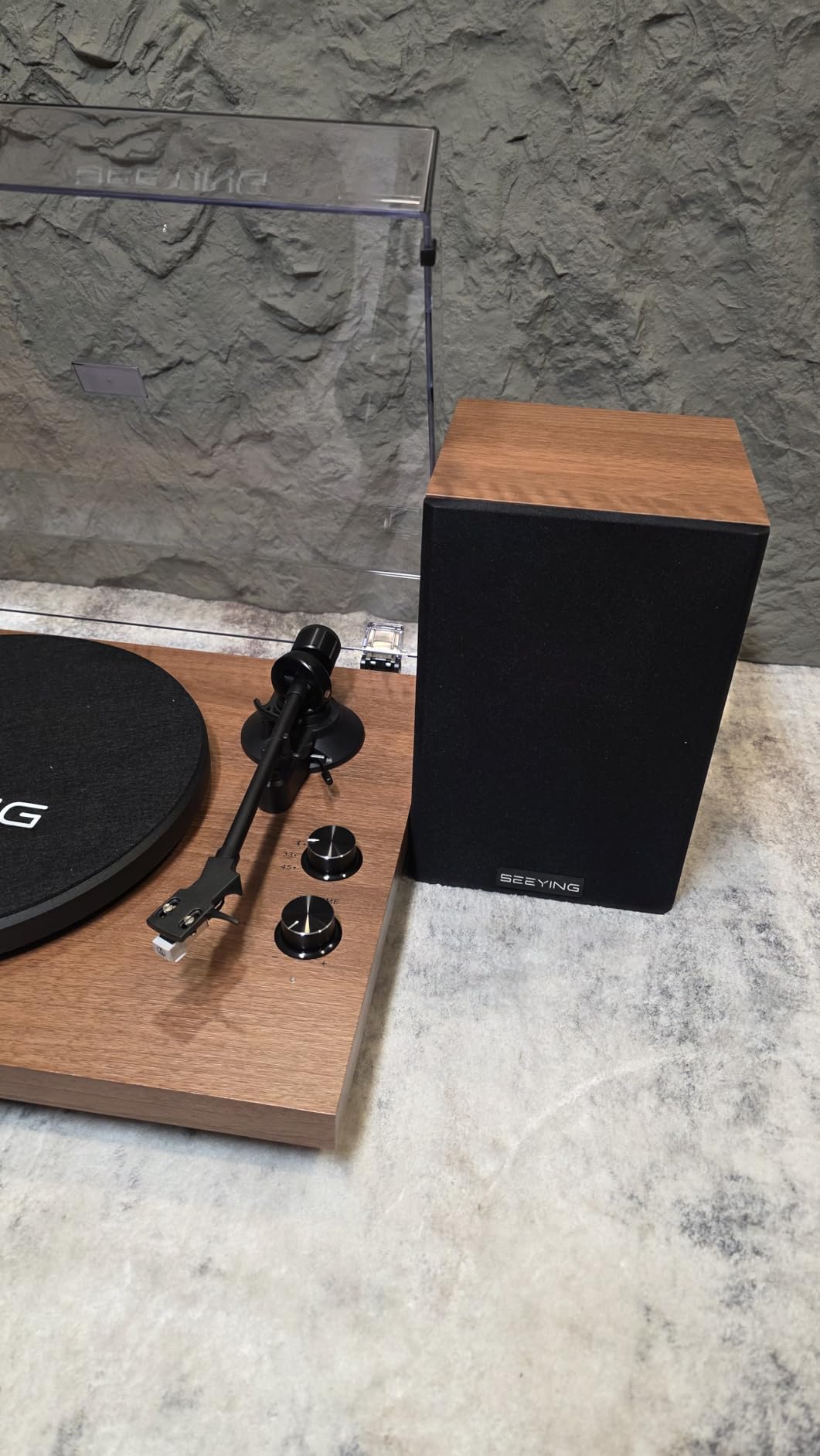
- Separate bookshelf speakers give real stereo separation
- USB to PC function converts vinyl to MP3 files
- Switchable phono and line output feeds an existing stereo
- Anti-slip mat and cartridge alignment protractor included
- Dust cover hinge can be stiff enough to cause skipping
- Only a 30 day return window
- Speaker pair needs dedicated shelf space or wall mounting
The reason this bundle stands apart from the other two speaker packages here is the accessories. You get an anti-slip platter mat and a cartridge alignment protractor in the box, both of which the other bundles leave out, and the protractor is the single most useful tool for getting the most out of a budget tonearm.
Sound is described as warm and full even at higher volumes, and the moving magnet cartridge on a static-balanced aluminum tonearm tracks well for the money. The switchable preamp means you can ignore the included speakers entirely and feed an existing system through the RCA jacks.
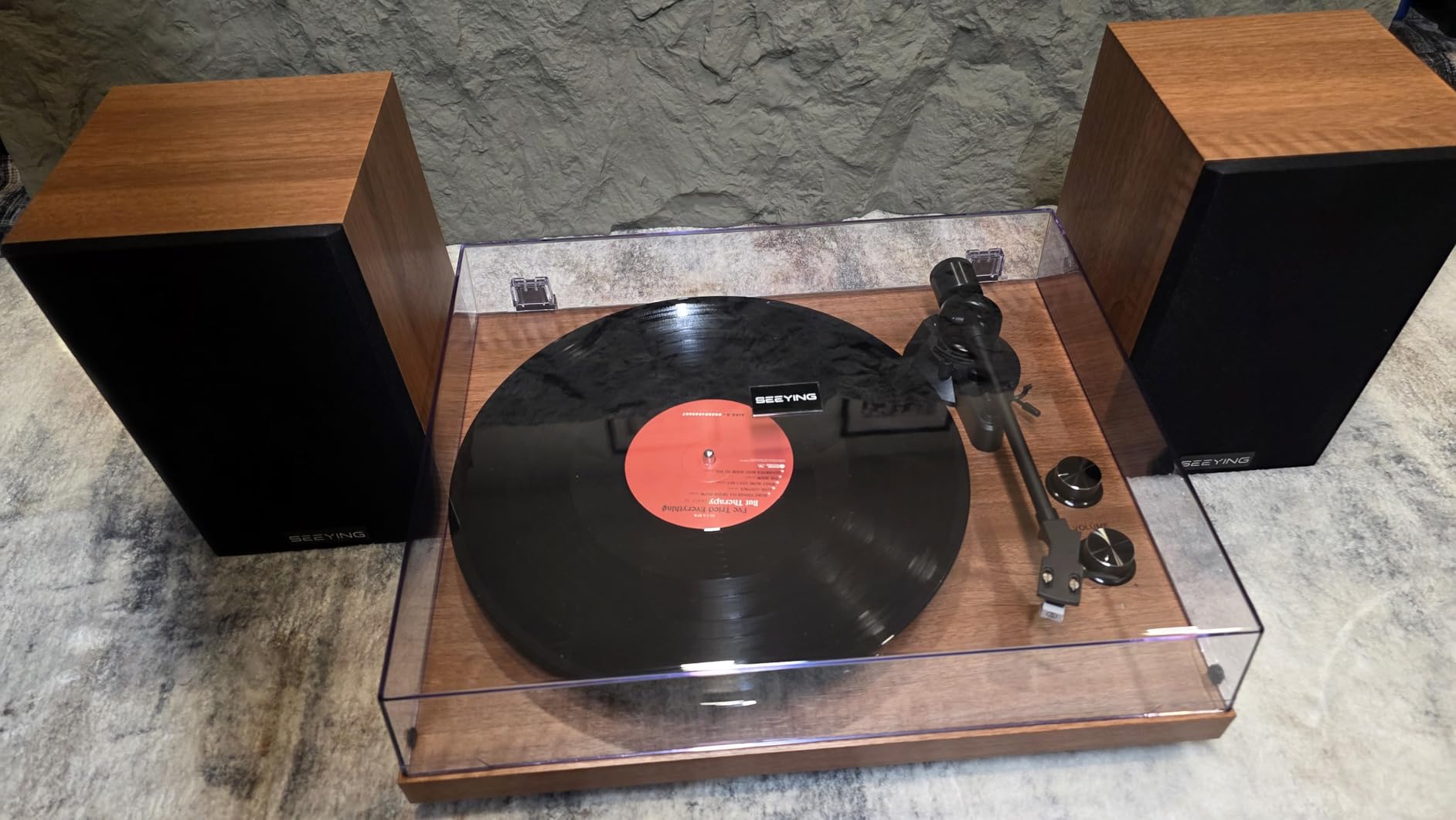
The USB-to-PC encoding is the practical feature. Connect the cable to a computer, play the record, and the audio lands as MP3 files. It is a two-way transfer of your collection rather than a one-time convenience, and buyers upgrading from a Crosley suitcase player tend to be the ones who care most.
Manufacturer support is repeatedly described as responsive here, with owners reporting refunds or replacements for a faulty stylus. That responsiveness matters more than it sounds, because the returns window is only 30 days.
Who the SeeYing bundle suits
It suits anyone building a first system in an apartment or a bedroom, where two small bookshelf speakers on stands are affordable and the speakers can be placed properly. It also suits anyone who wants to archive a record collection without buying a separate capture device.
Bluetooth is included, so the unit can double as a wireless speaker, and the switchable preamp keeps the door open for a larger system later.
Where it falls short
The dust cover hinge is the most reported physical problem. Some owners found it stiff enough that opening or closing the lid made the deck shake and skip, and a few modified the hinge themselves. Test it gently the first few times.
There is a 30 day return window, which is short, and the speaker pair needs real shelf space or wall mounting. One owner also reported visible platter jitter after about a year, which is worth weighing if you plan to keep it long term.
7. ANGELS HORN Bluetooth Turntable: Best Built-in Speaker System
- Four built-in speakers give a fuller room-filling sound than most all-in-ones
- Bluetooth 5.0 and aux-in make it a useful wireless speaker
- AT-3600L cartridge sits in a universal replaceable headshell
- Built-in preamp plus RCA out covers both connection types
- No automatic start stop or tonearm return
- Bluetooth audio is compressed and less detailed
- Deep bass in a large room still needs external speakers
Most all-in-one record players hide one or two small drivers behind a grille. This one uses four, and owners consistently describe the result as louder and fuller than comparable integrated decks, with a warm presentation that suits small and medium rooms without any extra equipment.
The mechanics are better than the cabinet styling implies. It is a belt drive with a DC servo motor and a die-cast aluminum platter, the tonearm has a real adjustable counterweight, and the cartridge is an Audio-Technica AT-3600L sitting in a universal headshell, so the stylus is straightforward to replace.
It plays 7 inch, 10 inch and 12 inch records, and the 10 inch support is a nice touch for jukebox and EP-era pressings. The removable dust cover means you can leave it on display without dust settling on the tonearm, and the walnut wood and metal styling is among the most convincing furniture looks in the all-in-one category.
The signal-to-noise ratio is listed at 55 dB, which sits mid-pack, and the Bluetooth 5.0 receiver is there for convenience rather than fidelity. Several reviewers note that Bluetooth playback is quieter and less detailed than the wired phono path.
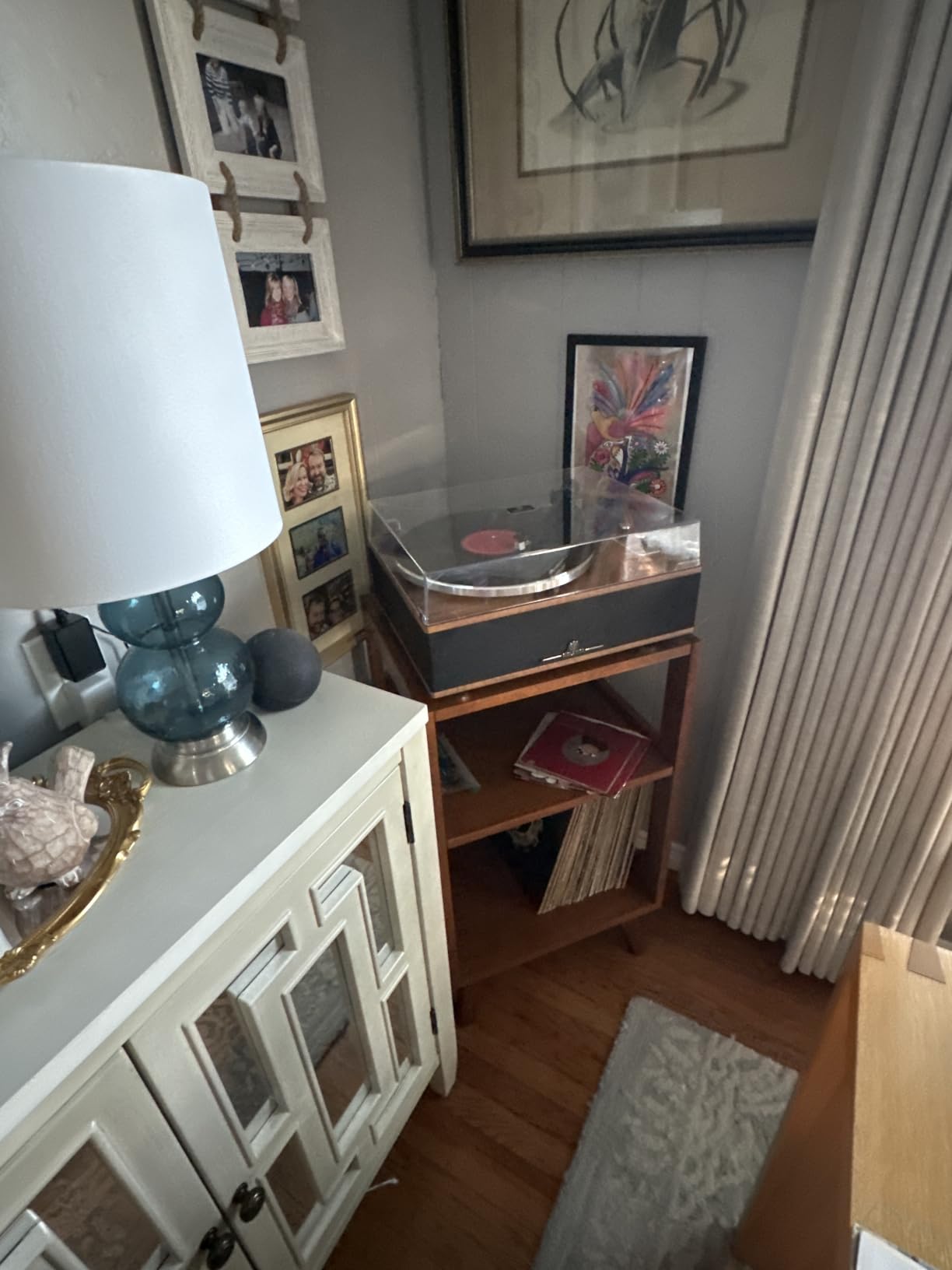
Who the ANGELS HORN suits
It suits anyone who wants the look and convenience of a single cabinet but refuses to accept thin sound. If you are buying for a house, a holiday home or a room where furniture harmony matters, the wood finish and four drivers make it one of the most convincing one-box options here.
It also suits someone who wants a simple upgrade path. The universal headshell means a replacement AT-3600L stylus is a straight swap, and the built-in preamp plus RCA output keeps the door open for proper speakers later.
Where it falls short
There is no automatic start, stop or tonearm return, so you handle the arm yourself every time, and setting the counterweight still takes care if you have never done it. A first-time owner who is anxious about records will be better served by an automatic deck.
Four small speakers cannot deliver real deep bass in a large room, and the Bluetooth path is compressed. For low-volume detail and stereo imaging, external speakers through the RCA output remain the better choice.
8. Fluance RT80 Classic: Best Step Up from a Suitcase Player
Fluance RT80 Classic High Fidelity Vinyl Turntable Record Player with Audio Technica AT91 Cartridge, Belt Drive, Built-in Preamp, Adjustable Counterweight, Solid Wood Plinth – Piano Black
- Warm clear sound from the AT91 cartridge
- Balanced aluminum S-type tonearm with an adjustable counterweight
- Switchable preamp and gold plated RCA outputs
- Interchangeable headshell and cartridge for future upgrades
- Manual operation with no automatic start stop or return
- Requires tonearm balancing at setup
- No Bluetooth and no built-in speakers
The RT80 Classic is the version of the Fluance formula for buyers who want the upgrade without spending to the top of the bracket. You get the same balanced S-type aluminum tonearm, the same switchable Texas Instruments preamp, the same gold plated outputs with a ground terminal, and the same isolation feet under an MDF plinth.
The cartridge is an Audio-Technica AT91 diamond-tipped unit in an interchangeable headshell, which owners describe as a good match for the tonearm and easy to replace. Warm, clear sound is the consistent verdict, and the rating spread is unusually narrow for a budget deck.
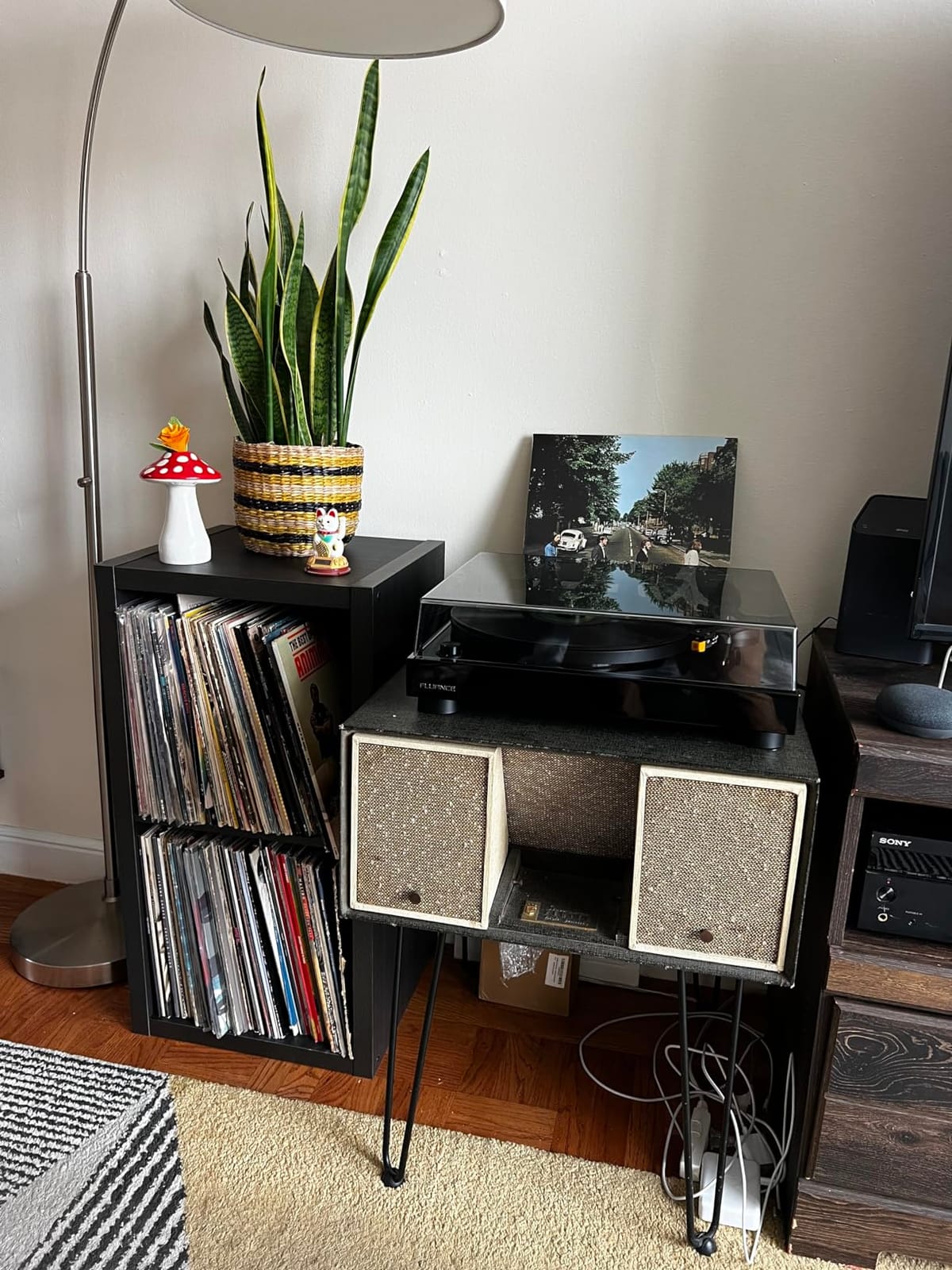
Two years of parts and labor warranty is longer than most competitors offer, and the piano black finish with a slim plinth is designed to sit on a shelf or inside a cabinet without looking oversized. It weighs 9.9 pounds, so it is lighter than the RT81 but far more substantial than a plastic-cased automatic.
The plinth is the compromise to know about. It is lighter than the RT81, so it transmits a little more vibration, and r/turntables owners who came from a Crosley usually end up happy with the sound while wishing the arm were automatic.
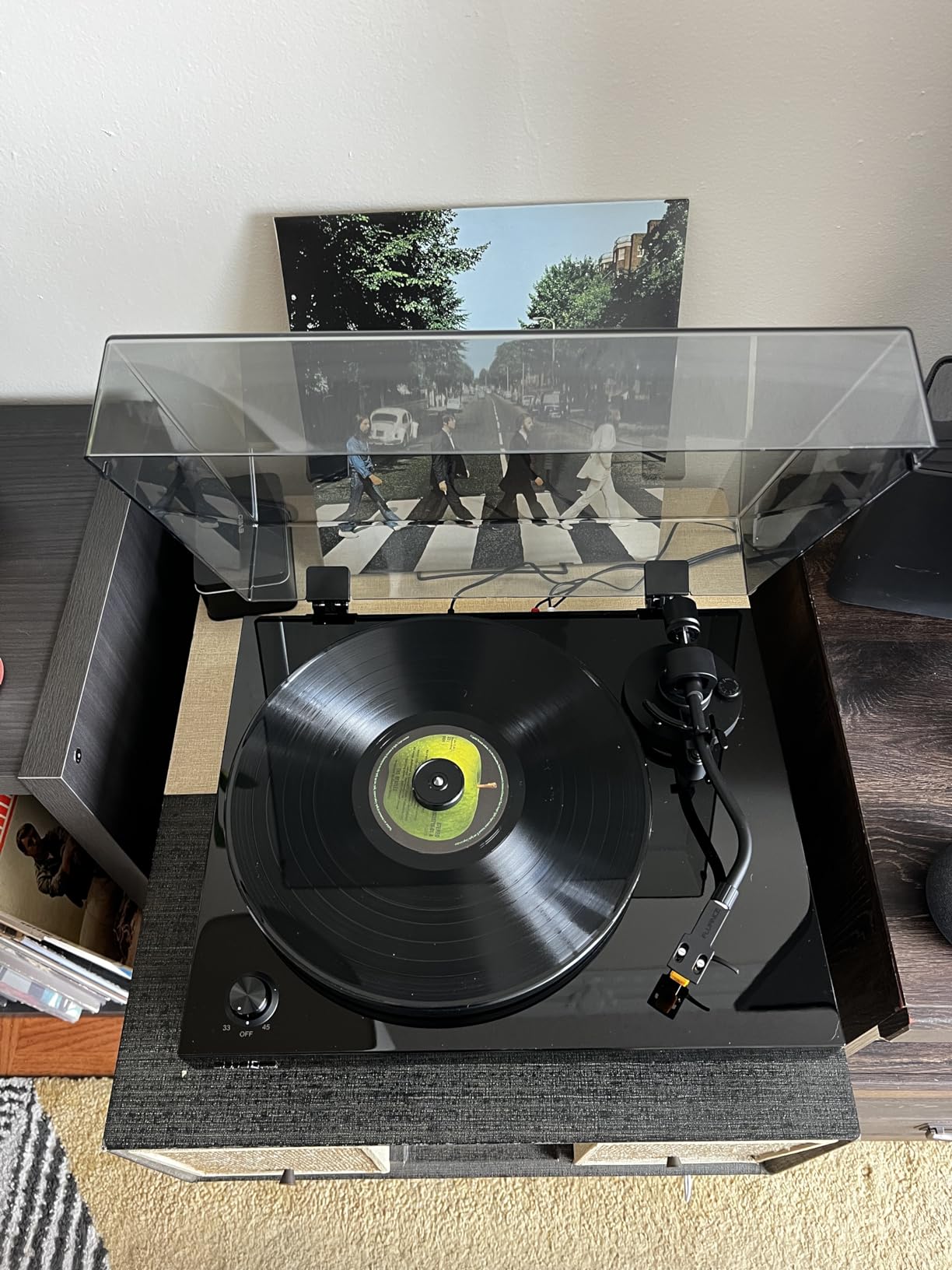
Who the RT80 Classic suits
It suits someone upgrading from a suitcase player who already owns speakers or a system and wants a serious deck without moving to the top of the budget. It also suits buyers who like doing things themselves and would rather balance an arm than press a button.
Because the headshell and cartridge are interchangeable, it is a good platform for a cartridge upgrade later. Standard-mount cartridges make that swap straightforward.
Where it falls short
Manual operation only. There is no automatic start, no auto-stop and no return, so you cue the arm, start the platter, and stop it at the end of the side. The setup also requires balancing the tonearm, which is less beginner-friendly.
There is no Bluetooth and no built-in speakers, so it is a turntable in the strict sense and needs an amplifier and speakers. If you want those included, the bundle options earlier are the better fit.
9. 1byone Belt Drive with Built-in Speakers: Best for Small Rooms
1 BY ONE High Fidelity Belt Drive Turntable with Built-in Speakers
- Audio-Technica replaceable stylus cartridge is a rarity in this class
- Warm crisp built-in speakers that are louder than expected
- Wood and metal cabinet looks like furniture
- Built-in amplifier with speaker outputs for a bigger system
- Volume knob sits under the dust cover and cannot be reached
- No tonearm return when a record ends
- Balancing the arm is fiddly with poorly illustrated instructions
This is the 1byone one-box unit rather than the speaker bundle, and the difference is size. At 13.3 pounds with built-in stereo speakers, Bluetooth and aux-in, it is built for a bedroom, a home office or a small apartment where two bookshelf speakers on stands simply will not fit.
The cartridge is the surprise. An Audio-Technica diamond-tipped stylus in a replaceable unit is uncommon among all-in-ones at this level, and owners consistently report noticeably better tracking than competing budget integrated systems, plus a warm, crisp presentation that fills a small room comfortably.
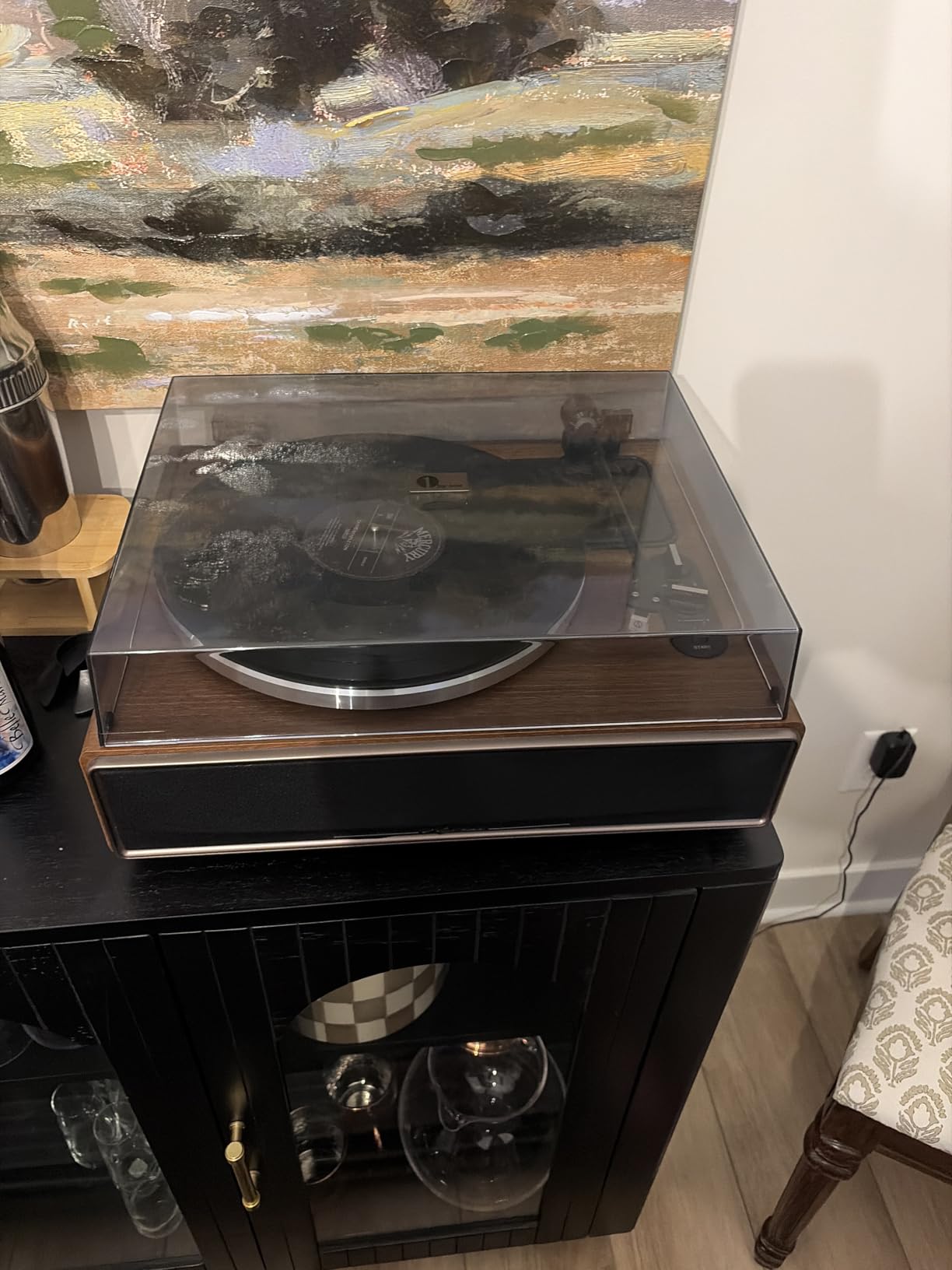
It is a belt drive at 33 and 45 rpm with a magnetic cartridge and an adjustable counterweight, so you are not dealing with a fixed tracking force. The signal-to-noise ratio is listed at 60 dB, which is respectable for an integrated system.
The detachable dust cover is a nice touch in a bedroom, since dust is the enemy of a stylus. The built-in amplifier also has speaker outputs, so you can graduate to external speakers without replacing the deck.
Who the 1byone belt-drive unit suits
It suits a first vinyl setup in a small space, and anyone who wants a single object that does everything rather than a system on a stand. Walnut finish and a metal top make it look more like a piece of furniture than consumer electronics.
It also suits someone who will move apartments. One box is easier to carry than a turntable plus two speakers, and the compact footprint suits a nightstand or a narrow console.
Where it falls short
The volume knob sits under the dust cover, which owners flag more than any other complaint. With the lid closed you cannot adjust the volume, and in some reports the lid interferes with the counterweight. It is an odd design decision in an otherwise tidy unit.
There is no tonearm return, so the arm does not retract when a record ends, and balancing the counterweight is described as fiddly with poorly illustrated instructions. Bluetooth range is also limited to roughly 10 to 15 feet.
10. Crosley CR8005F-MT Cruiser Plus: Best Budget Starter Turntable
- Three speed belt drive including 78 rpm
- Bluetooth works in both directions so it can send or receive audio
- Carry handle and folding design makes it easy to move between rooms
- Aux input RCA output and headphone jack cover most needs
- No built-in phono preamp for a stereo with a phono input
- Fixed tracking force with no counterweight or anti-skate
- Lightweight plastic build with thin integrated sound
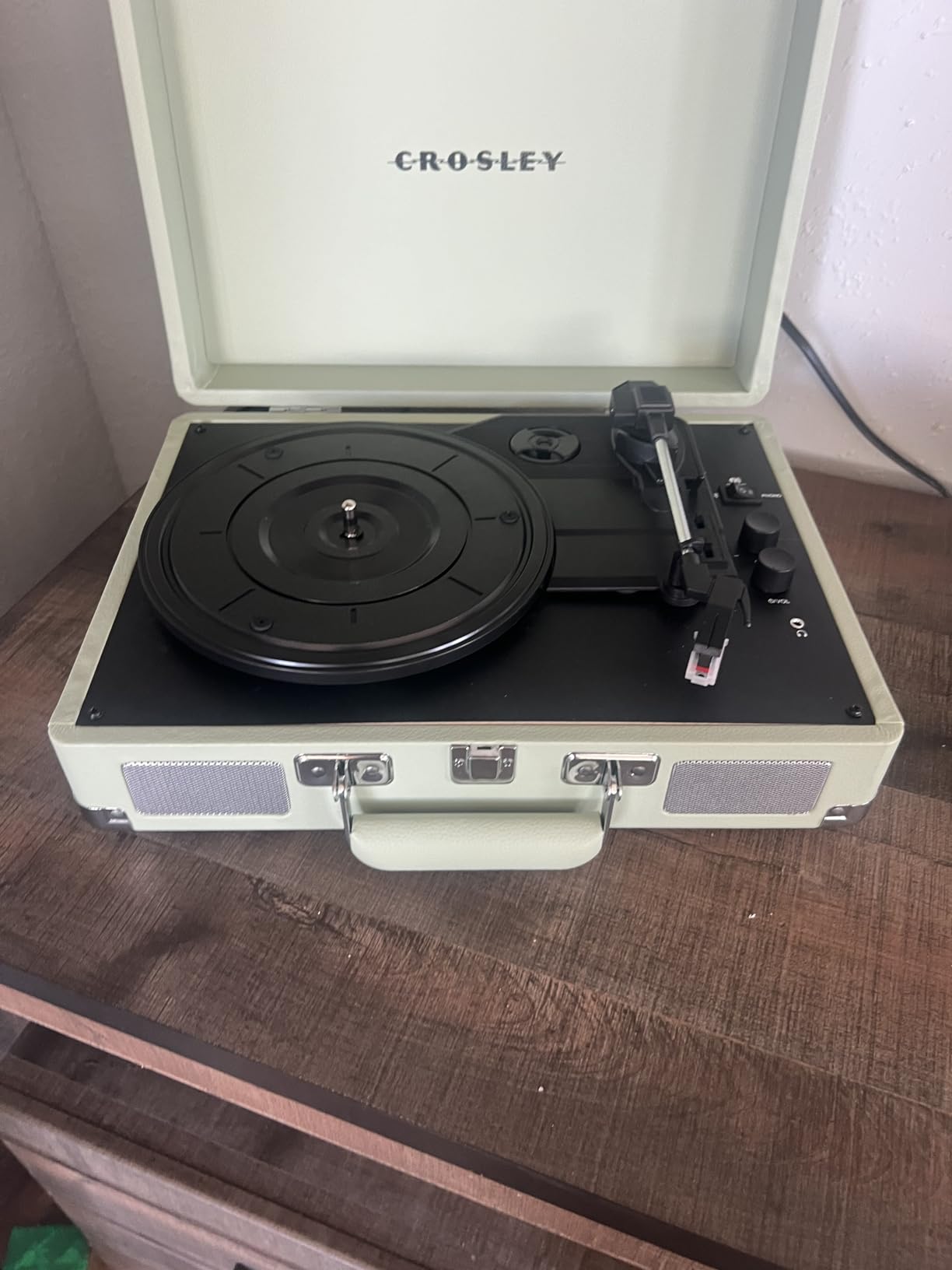
Everything else on this list costs several times more, which is exactly when this one makes sense. The Cruiser Plus is a portable suitcase-style belt-drive player with three speeds, Bluetooth in both directions, an aux input, an RCA output and a headphone jack. It is a second player, a bedroom deck, or a way to find out whether you actually want vinyl before spending real money.
The two-way Bluetooth is unusual and genuinely useful. You can stream to the built-in speakers from a phone, or send the turntable’s audio to a pair of wireless speakers, which gives the built-in drivers a purpose beyond playing records. The cueing lever with adjustable pitch control is a nice touch for anyone who wants to align tracks the old-fashioned way.
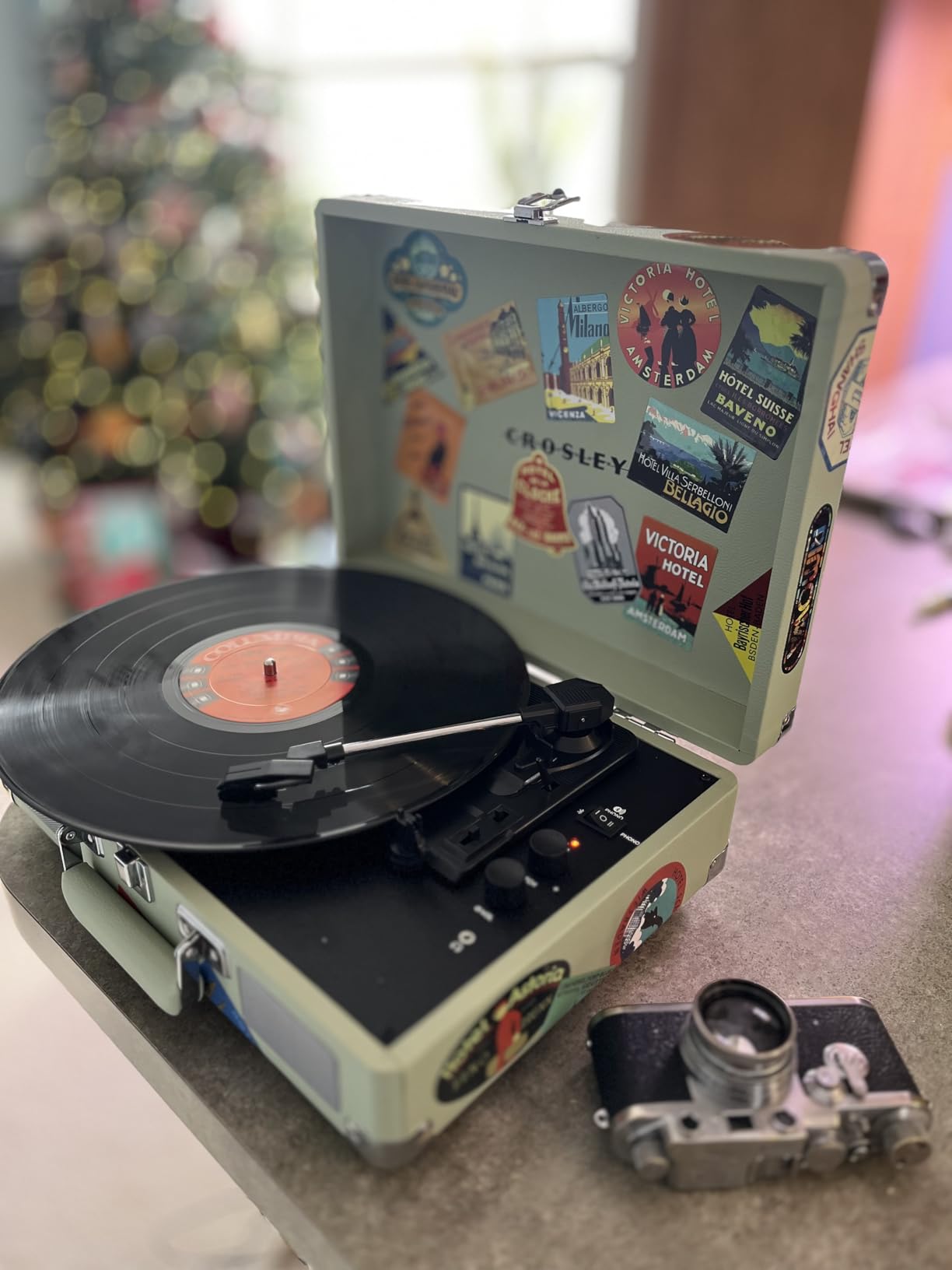
It weighs 5.5 pounds and has a carry handle, so it moves between rooms without effort. The signal-to-noise ratio is listed at 60 dB. It is available in a long list of colorways, including mint, and pairs of units are offered if you want matching decks in two rooms.
Sound is generally described as acceptable for the price rather than impressive, and owners who later move to a belt-drive deck with real speakers frequently note the step up in bass and clarity. The standard caution about light tracking force on new records applies here.
Who the Crosley Cruiser Plus suits
It suits anyone who is not sure they want to build a system. It plays a record in minutes, and the RCA output and aux input mean it can grow into a real setup later without being thrown away. It also suits a child, a teenager or a guest room.
It suits buyers of older 78 rpm records specifically, since the three-speed drive covers 33 1/3, 45 and 78. Plenty of decks in this roundup handle only two of those three speeds.
Where it falls short
There is no built-in phono preamp, so feeding a stereo that has a phono input is a problem, and there is no counterweight or anti-skate, meaning tracking force is fixed. That combination makes it a poor choice as a first serious deck.
The integrated speakers are small and thin-sounding, and the build is lightweight plastic with no auto-stop. Fine as a portable or secondary player, not fine as the centre of a listening room.
Buying Guide: What Actually Matters at This Budget
Turntable vs all-in-one record player: the first decision
A turntable is a deck only. It outputs a tiny phono-level signal and produces no sound on its own, so you need a preamp, an amplifier and speakers. An all-in-one record player has small speakers and often an amplifier built into a furniture-style cabinet, which means you can plug it in and hear something immediately.
Everything else follows from this. If you already own an amplifier with a phono input, or a pair of powered speakers, a turntable is the better purchase because you are not paying twice. If you own nothing, an all-in-one or a bundle with real speakers is the honest starting point, which is why three entries in this roundup include speakers.
Belt drive vs direct drive for home listening
A belt drive spins the platter with a rubber belt wrapped around a motor pulley, which insulates the platter from motor vibration and keeps motor noise out of the room. It is quieter, and that quiet matters at low volumes and with quiet acoustic records. All ten decks in this roundup use a belt drive, because belt drive is the correct choice for home listening.
A direct drive uses a slower motor and a small gear to turn the platter directly. It starts and stops faster, has more torque, and resists slipping, which is why DJs use them for scratching. If that is what you want, our guide to the best DJ turntables covers the right category. For a living room, a belt drive wins on refinement.
The phono preamp is the real hidden cost
A cartridge produces a signal measured in millivolts, far too quiet for an amplifier. A phono preamp applies the right gain and applies the equalization curve that reverses what the record mastering process did. Without one, the result is thin, quiet and badly shaped.
Six decks in this roundup have a built-in switchable preamp: the Fluance RT81, the Fluance RT80 Classic, both Audio-Technica automatics and the two speaker bundles. Switching between phono and line output lets you feed either a receiver with a phono input or a pair of powered speakers. The Crosley Cruiser Plus has no preamp at all, which is the biggest reason it is a portable player rather than a system component.
Moving magnet vs moving coil and cartridge upgradeability
A moving magnet cartridge uses a magnet attached to the tonearm and a fixed coil in the body. It is forgiving, tracks safely at slightly heavier tracking force, and costs little. Nearly everything in this roundup is a moving magnet, and that is the right default for a first serious deck.
Moving coil reverses the arrangement, is more accurate, and needs a more capable preamp, so it is a second-step upgrade rather than a first-step one. At this budget, spend your cartridge money on a better moving magnet. The AT-LP70X with its VM95 platform is the clearest example of a deck that turns one purchase into a gradual upgrade path.
Where to put it in a living room
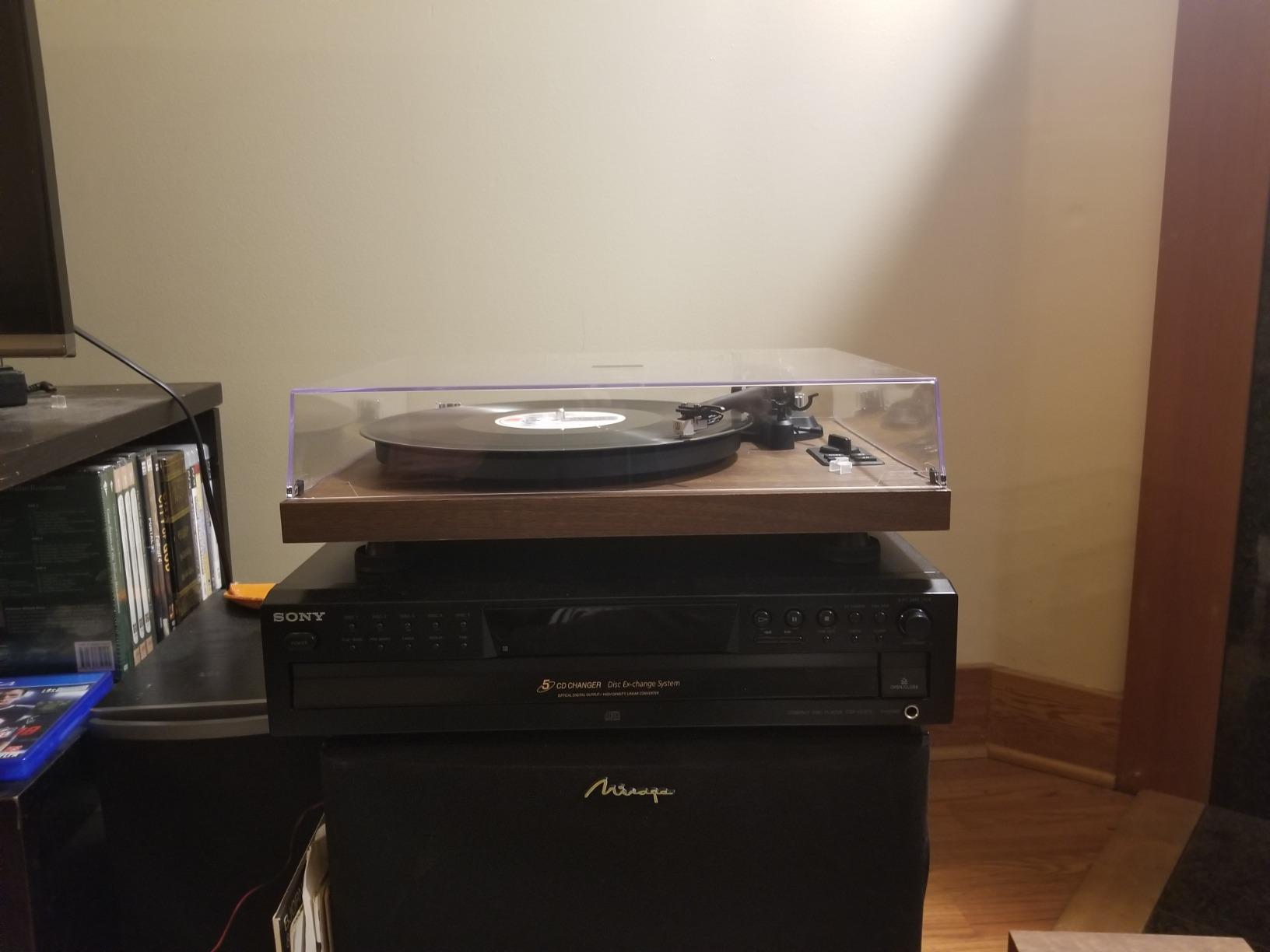
Place the deck on a level, firm surface with the speakers either side of the listening position, not behind the turntable. Bass travels, and a woofer sitting 30 cm from a lightweight plinth will make it wobble rather than tightening the low end.
Keep the deck off the same cabinet as the subwoofer if you can, and away from a shared wall that a speaker is driving into. If you have a moving floor, an isolation mat under the feet costs little and removes most of the problem. Level matters more than people expect, so check the bubble level that shipped in the box before you cue anything.
What a 300-Dollar Turntable Really Costs
This is the part most roundups skip. If you are starting from nothing, the 300-dollar turntable is only the first line of a system, and a system that plays records properly has three parts: a preamp, an amplifier and speakers.
The preamp is the easy one. A deck with a switchable built-in preamp saves you the entire step, which is why we weighted those models so heavily. If your deck has no preamp, a small standalone unit is inexpensive, but it is still money out of the same envelope.
The amplifier and speakers are where the budget actually goes. powered bookshelf speakers from a known brand give the largest immediate improvement in sound for the least effort, and they can be positioned properly on stands or shelves. If you already have an amplifier with a phono input, keep it and spend the whole budget on the deck instead.
One more hidden cost deserves naming: a cartridge or stylus replacement within a few years, plus a proper slip mat rather than the felt one that ships. Both are modest outlays, but both belong in a realistic plan rather than as a surprise. For readers weighing used options, the audiogon and Steve Hoffman forums repeatedly argue that an older used belt-drive deck plus a budget cartridge can beat a new entry-level automatic, which is worth considering if you are patient.
Frequently Asked Questions
What is the best record player for a budget of 300 dollars?
The Fluance RT81 Elite is the strongest all-round choice at this budget, pairing an Audio-Technica AT95E elliptical cartridge with a balanced S-type tonearm and a switchable built-in preamp. If you want zero setup effort, the Audio-Technica AT-LP60X runs fully automatic, and if you have no speakers at all, the 1byone HiFi System bundles a turntable with 36 watt bookshelf speakers.
What is the best turntable for the money?
For pure sound per dollar on an existing system, the Fluance RT80 Classic and the Fluance RT81 Elite are the two decks we would buy. The RT80 Classic brings a balanced S-type tonearm, an AT91 cartridge and a switchable preamp below the top of the bracket, while the RT81 steps up to the AT95E elliptical stylus and a heavier MDF plinth.
What is the best record player for value for money?
The Audio-Technica AT-LP60X is the value pick. It is fully automatic, it has a built-in switchable phono preamp, and its replaceable diamond stylus means you are not buying something that dies with the cartridge. It has no Bluetooth and no speakers, so pair it with a budget amplifier or powered bookshelf speakers.
What are the best and most affordable direct drive turntables?
None of the decks in this roundup use a direct drive motor, because belt drive is quieter and better suited to home listening. If you want direct drive for DJ use, scratching or very fast start and stop, you need a different category of deck entirely, and the cost sits above this budget. For listening at home, choose a belt drive model instead.
Do I need a phono preamp for a turntable under 300 dollars?
Only if your deck does not have one built in. Most decks in this price range, including the Fluance RT81, the Fluance RT80 Classic and both Audio-Technica automatics, include a switchable phono and line preamp, so they connect to a receiver with a phono input or straight to powered speakers. The Crosley Cruiser Plus has no preamp at all, which limits where you can plug it in.
Can I upgrade the cartridge on a budget turntable?
Usually, yes. Look for a standard-mount or universal headshell with a replaceable stylus, which is what the Audio-Technica VM95 platform, the Fluance headshells and the 1byone systems use. Check the mounting height and counterweight offset first, because some cartridge combinations physically do not fit, and confirm compatibility before ordering.
The Verdict: Best Turntables Under 300 in 2026
The Fluance RT81 Elite is our pick for the best turntables under 300 in 2026. A real elliptical cartridge, a balanced tonearm and a switchable preamp in one deck is more than this bracket used to offer, and it is the model we would put in a home. Buy the Audio-Technica AT-LP60X if you would rather press one button and never touch a tonearm, and buy the 1byone HiFi System if you have no speakers and no amplifier yet.
Whichever you pick, put it on a level surface away from the speakers, give the platter a few minutes to warm up, and check the alignment once the stylus is in the groove. The best turntable in the room is the one you actually sit down and listen to.