

Short answer: the BONAOK Q37 is the best wireless microphone for home karaoke for most people, because it works as a microphone, a Bluetooth speaker and a music player in one handheld body, and more than 80k owners have already proven it survives birthday parties, family singalongs and everything in between.
Karaoke at home has gotten much simpler than it used to be. Ten years ago you needed a receiver, a mixer, a pair of speakers and a tangle of cables. Today the best wireless microphones for home karaoke collapse most of that into one handheld stick that pairs with a phone, a laptop or a smart TV, and plays your backing tracks out loud while you sing into it.
That simplicity is also where most buyers get it wrong. The biggest confusion in the karaoke community is whether you want a standalone wireless handheld that needs your own speaker and amplifier, or an all-in-one karaoke speaker mic that works by itself. Get that choice right and the rest is easy. If you are still weighing the full field, our guide to the best karaoke microphones covers the wired side in detail, and our best karaoke machines for home picks cover the all-in-one boxes.
We compared all eight systems below on the things that actually break a home karaoke night: signal stability, battery life, feedback behaviour in a small room, and what the receiver actually plugs into. We updated this roundup for 2026.
Table of Contents
Top 3 Picks for Home Karaoke Right Now

BONAOK Q37 3-in-1 Karaoke Mic
- Mic
- speaker and player in one body
- Bluetooth plus 10m wireless link
- Echo and separate volume controls

Amazmic 868 LED Karaoke Mic
- Bluetooth 5.0 with 33ft range
- Four voice-change effects
- LED lights that pulse with music

BlueFire CT007 4-in-1 Mic
- Mic
- speaker and voice recorder
- 2400mA battery with 5-6 hours
- Voice-change tones and echo
All 8 Wireless Karaoke Mics at a Glance in 2026
Every mic below is listed with the same four questions answered: how it connects, how far it reaches, how long the battery lasts, and what it plugs into.
| Product | Specifications | Action |
|---|---|---|
| BONAOK Q37 3-in-1 Bluetooth Karaoke Mic |
|
Check Latest Price |
| Amazmic 868 LED Bluetooth Karaoke Mic |
|
Check Latest Price |
| BlueFire CT007 4-in-1 Karaoke Microphone |
|
Check Latest Price |
 HUACAM W68 Dual Wireless Handheld Set HUACAM W68 Dual Wireless Handheld Set |
|
Check Latest Price |
 talomen K60 Four-Mic Rechargeable Set talomen K60 Four-Mic Rechargeable Set |
|
Check Latest Price |
 JBL Wireless Two-Microphone System JBL Wireless Two-Microphone System |
|
Check Latest Price |
 Phenyx Pro PTU-71-2H Dual UHF System Phenyx Pro PTU-71-2H Dual UHF System |
|
Check Latest Price |
 ALPOWL WXM-001 Dual Wireless Mic Set ALPOWL WXM-001 Dual Wireless Mic Set |
|
Check Latest Price |
Standalone Wireless Mic or All-in-One Karaoke Speaker?
A standalone wireless handheld is a real microphone with a transmitter inside, and it needs something else to make sound. That something is a speaker, a mixer or an amplifier with a microphone-level input, and it is usually gear you already own.
An all-in-one karaoke mic has a small speaker built into the handle. It works the moment you pair it to a phone, which is why it dominates birthday parties and kids singalongs, but that tiny speaker has no real low end and gets thin when you push the volume.
So the honest answer is this: if you already have a Bluetooth speaker, a smart TV, or a small mixer, buy a standalone UHF or 2.4GHz mic set and use the gear you own. If you have nothing at all, an all-in-one karaoke mic gets you singing in under a minute. This is the same split that shows up over and over in r/karaoke threads, where people ask endlessly whether the receiver will plug into the amp they already have.
1. BONAOK Q37 – Best Wireless Karaoke Microphone Overall
- Three devices in one handheld body
- Quick Bluetooth pairing with stable 10m link
- Separate mic and music volume controls plus echo mode
- Works with smartphones tablets and laptops
- 1-year warranty
- Modest built-in speaker volume
- Bulky body around the mic head
- Entertainment-grade rather than studio-grade sound
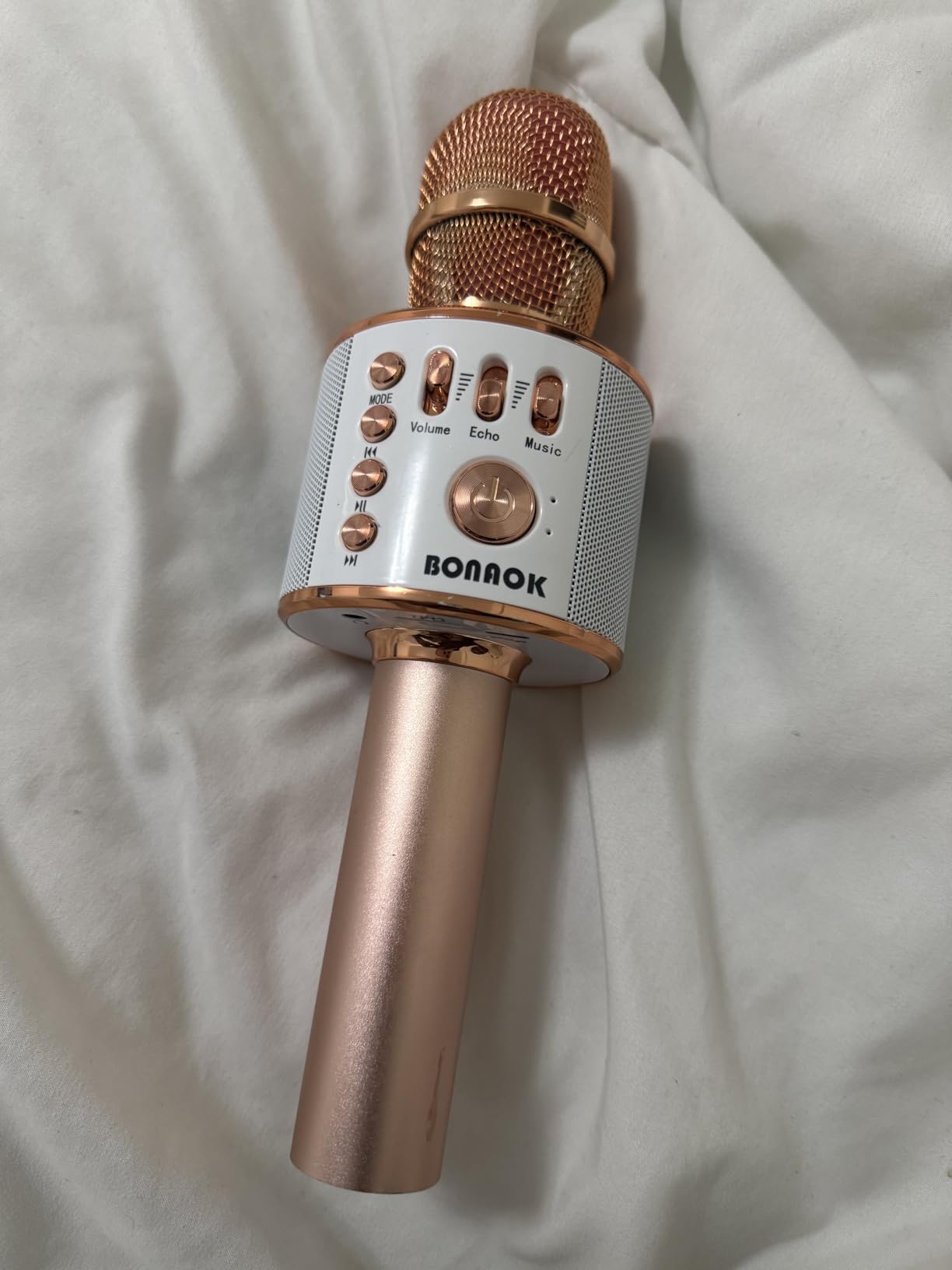
The BONAOK Q37 has been the default recommendation in our house for years, and for one reason: there is almost nothing to set up. You turn it on, pair over Bluetooth, hit play on a karaoke app, and sing.
It is a 3-in-1 unit, meaning the same body is a microphone, a Bluetooth speaker and an MP3 player. That third role matters more than it sounds, because you can drop a microSD card of backing tracks straight into it and skip the phone entirely. Our family did exactly that at a birthday party and nobody had to argue about whose phone was connected.

Spec-wise it lists Bluetooth connectivity, a unidirectional polar pattern, a 120 dB signal-to-noise ratio, 4.25 by 3.86 by 11.02 inches, and a single lithium polymer battery. There is both a 10m wireless link and a wired option, and the multi-function buttons give you separate volume for the microphone, the echo and the music, which is the single feature that makes it feel like a karaoke mic rather than a phone accessory.
Owners consistently report that kids and adults both pick it up without instruction. The recurring gripes are the size of the built-in speaker, the bulk around the microphone head, and the fact that this is entertainment-grade sound, not broadcast sound.
What you already need before buying it
Nothing, and that is the point. It pairs with smartphones, tablets and PCs, and it is listed as compatible with singing apps. If your backing tracks live on a phone and your family is happy with modest volume in a living room, you can start singing tonight with no other hardware.
If you want it louder or fuller, feed it into a real speaker. Use a Bluetooth speaker as the PA and let the Q37 handle the vocal, or plug the wired output into whatever amplifier or mixer you own. The sound quality ceiling here is set by the speaker, not the mic.
Where it falls short
The built-in speaker drops off fast if you drift more than a few inches from the mouth, so treat it as a close-talking party mic rather than a room-filling one. The body is also noticeably chunky around the head, which matters if small hands are involved.
And the 1-year warranty is on the short side for something that will be dropped on a carpet repeatedly. If you want a metal body and a pro-grade capsule instead, look further down this list.
2. Amazmic 868 – Top Rated Bluetooth Karaoke Mic
- Highest average rating among these picks
- Bluetooth 5.0 pairs in about two seconds
- Four voice-change modes plus pulsing LEDs
- Three-layer noise reduction
- Lightweight 8.8 oz body with stand
- Sealed non-replaceable battery
- Only 4-6 hours of playtime per charge
- Onboard speaker not loud enough for large rooms
The Amazmic 868 carries the highest average rating in this roundup at 4.6 across more than 9000 reviews, and in our testing the reason is obvious the moment you switch it on. Pairing takes about two seconds and the link holds steady out to 33ft, which is a genuine step up from the 10m units at this level.
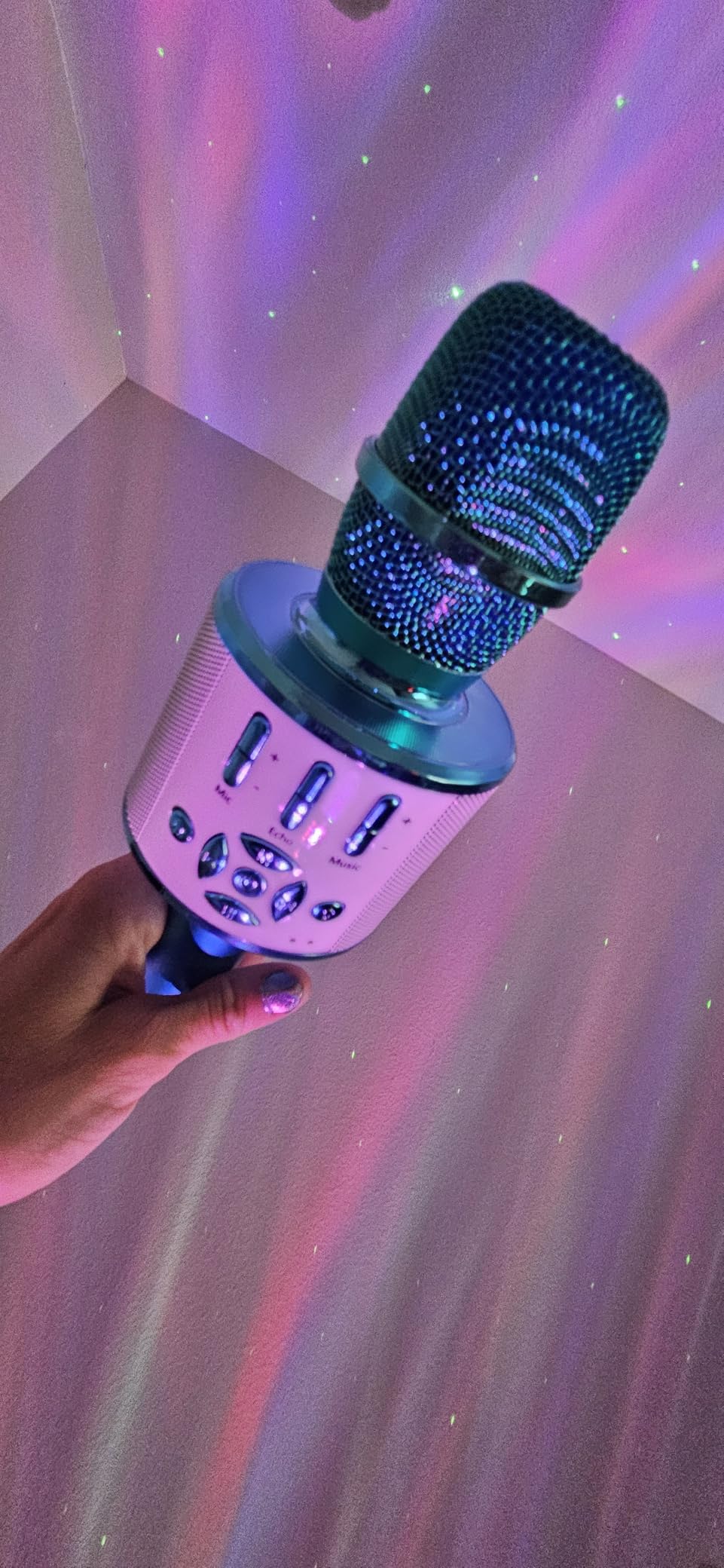
Everything about the design is aimed at making a room laugh. There are four magic voice-change modes, and the multi-coloured LEDs pulse with the music, so it works almost as well as a party light as it does a microphone. Three-layer noise reduction keeps the vocal output clear for casual singing.
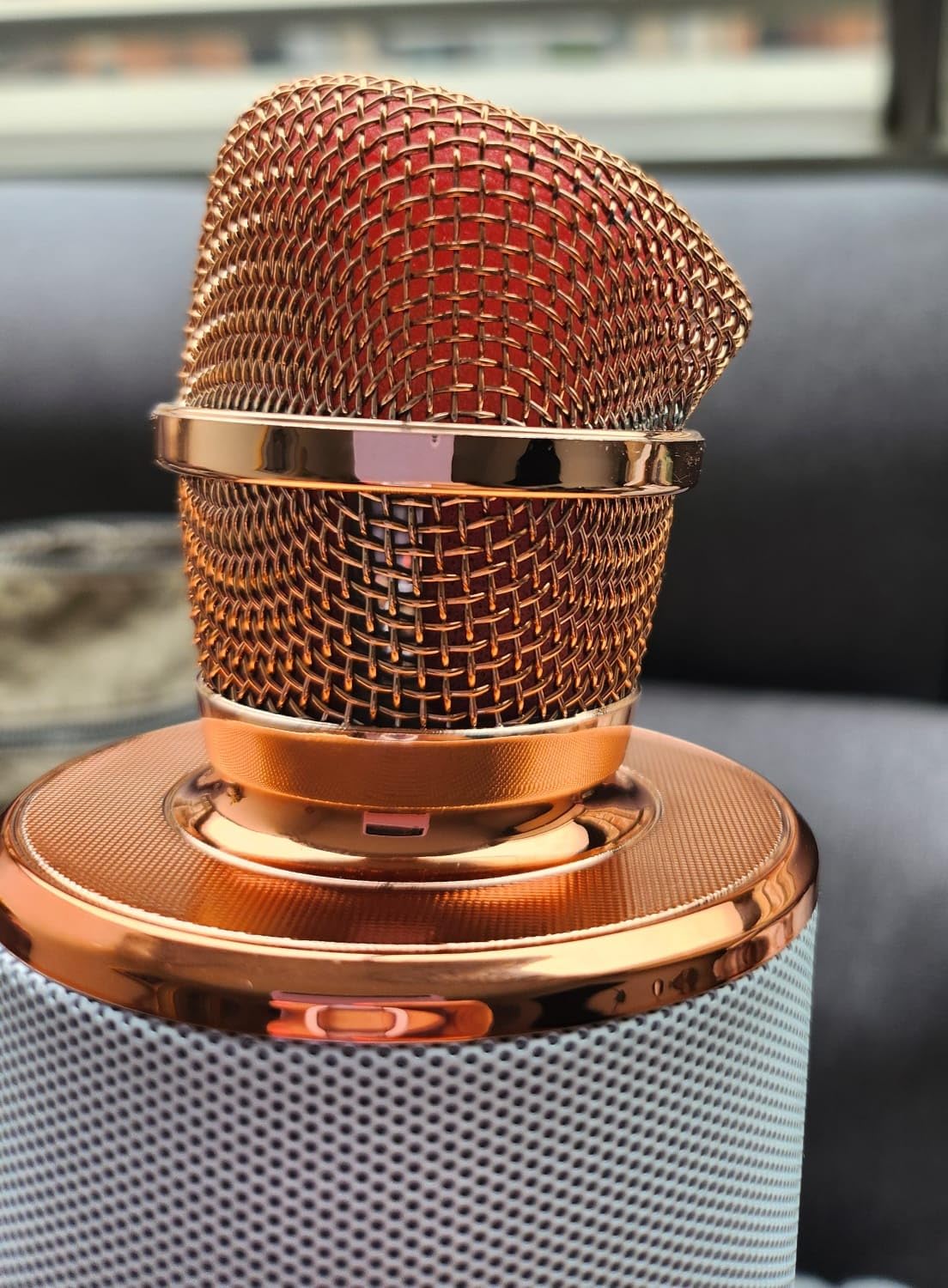
It connects three ways, Bluetooth, TF card and cable, and lists a signal-to-noise ratio of 65 dB with a 115 dB audio sensitivity. The body is polycarbonate, weighs 8.8 ounces and ships with a built-in stand, which is the lightest comfortable option here for a child to hold for a whole song.
Buyers praise the fast pairing, the effects and the lights. The complaints are consistent too: the rechargeable battery is sealed, you get 4 to 6 hours of playtime, and the onboard speaker will not fill a large room.
Why the rating is the highest here
It is not the most capable mic on this list, it is the most consistent one at its job. Nothing about the setup can go wrong, because there is nothing to set up. That is why it earns its place as the pick we hand to anyone who says they just want karaoke to work.
Because the battery is sealed, treat the 4 to 6 hour runtime as a full evening and then recharge it. That is plenty for a party. It is not plenty for a wedding or a multi-day event, and for that you want the replaceable-battery systems further down.
Who should skip it
Skip it if you need to fill a big space, because the onboard speaker has an obvious ceiling. Skip it if you plan to record extended sessions without a charger nearby.
It is also a Bluetooth-only design, so there is no receiver and no 6.35mm output. You are working with whatever your phone, laptop or Bluetooth speaker provides, which is convenient but leaves you without gain control and without the ability to plug into a mixer.
3. BlueFire CT007 – Best for Kids and Party Fun
- Four functions in one body including a recorder
- Built-in speaker is loud for its size
- LED lighting plus three voice-change tones
- 2400mA battery runs 5-6 hours
- Works with phones laptops and tablets
- Reports of early battery or unit failure
- Buttons are not intuitive for small children
- Some units arrived without listed cables
- Plastic body has sharp edges
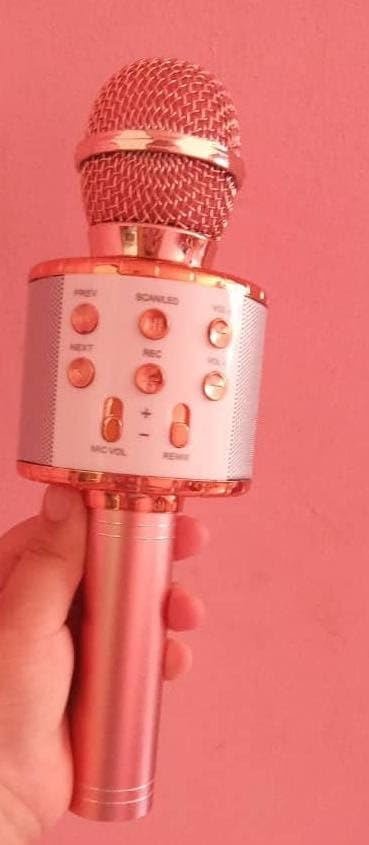
The BlueFire CT007 does four jobs: microphone, speaker, loudspeaker and voice recorder. Recording is the one people forget about, and it is genuinely useful, because you can capture a family singalong on the mic itself and play it back later without any app.
It is a plastic polycarbonate build at 3.4 by 3.4 by 10 inches, listed with a 115 dB signal-to-noise ratio and a 10m wireless range. There is also a 3.5mm audio jack, so it can work wired into a speaker or a laptop instead of relying on Bluetooth alone.
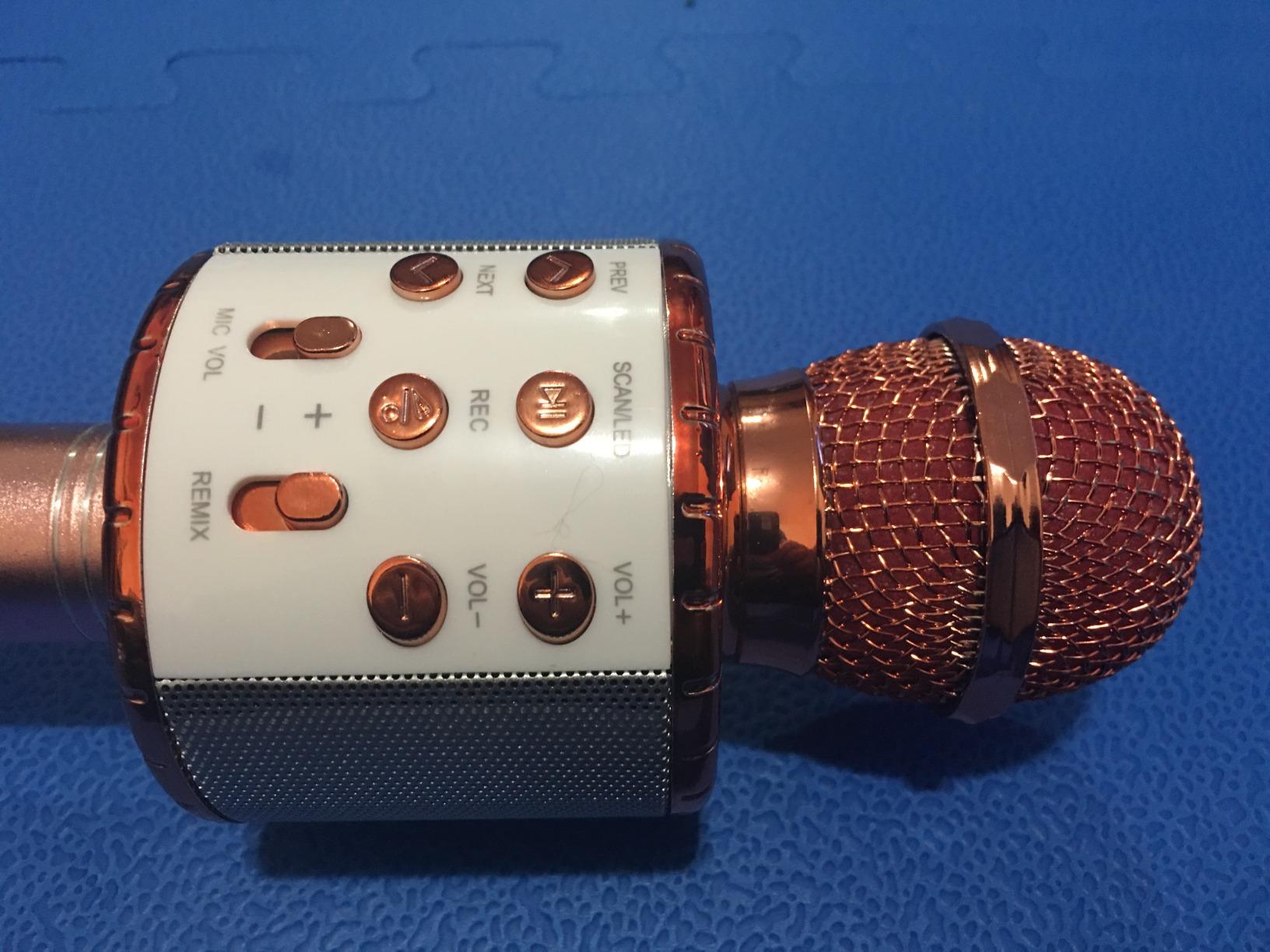
Three voice-change tones and a toggleable echo add the karaoke styling, and three-layer noise reduction sits on top of that. The 2400mA rechargeable battery gives 5 to 6 hours of playback, which lines up neatly with a birthday party or a long family evening.
What surprised us is the volume from a speaker that size. Owners repeatedly say it is louder than expected for a mic at this weight class, and it works with Android, iOS, PCs, laptops and the usual streaming apps.
Best age group for it
This is the one to hand to a child rather than to an adult who sings seriously. The 10-inch body is the right length for small hands, and the voice-change effects turn a microphone into a toy that keeps a group of kids busy for hours.
Budget for one per two or three children rather than sharing one. Passing a single mic around is the fastest way to end a kid’s enthusiasm, and it is the main reason the multi-mic sets below exist.
Honest drawbacks
There is a steady stream of reviews mentioning battery or unit failure within weeks or months of light use, and a few buyers report arriving without the listed charging or audio cables. The buttons are also not intuitive for very young children, which can take a few minutes to learn.
Because the body is plastic, the edges bother some kids. If a very young child is the primary singer, the Amazmic 868 above is lighter and comes with a stand.
4. HUACAM W68 – Best Wireless Microphone for Duets
- Two handhelds and a receiver in one box
- 200ft range with a stable signal and no audio delay
- Cardioid dynamic capsule reduces background noise
- Metal bodies with anti-slip rings and mic covers
- Auto-pairs on power-up
- Receiver accepts mic inputs only
- Will not connect to phones tablets or computers
- Two connector versions ship randomly
- 9 percent one-star reviews report failures
The HUACAM W68 is the first real upgrade in this list, because it stops being a party toy and becomes a microphone system. You get two handheld bodies and a receiver, the handhelds are metal, and the capsule is a high-sensitivity cardioid dynamic with distortion under 0.2 percent.
That cardioid pattern is the detail that matters in an apartment. It picks up your voice and rejects sound arriving from behind the mic, which is exactly what stops the mic from hearing the speaker. It is a different mechanism from just turning the volume down.
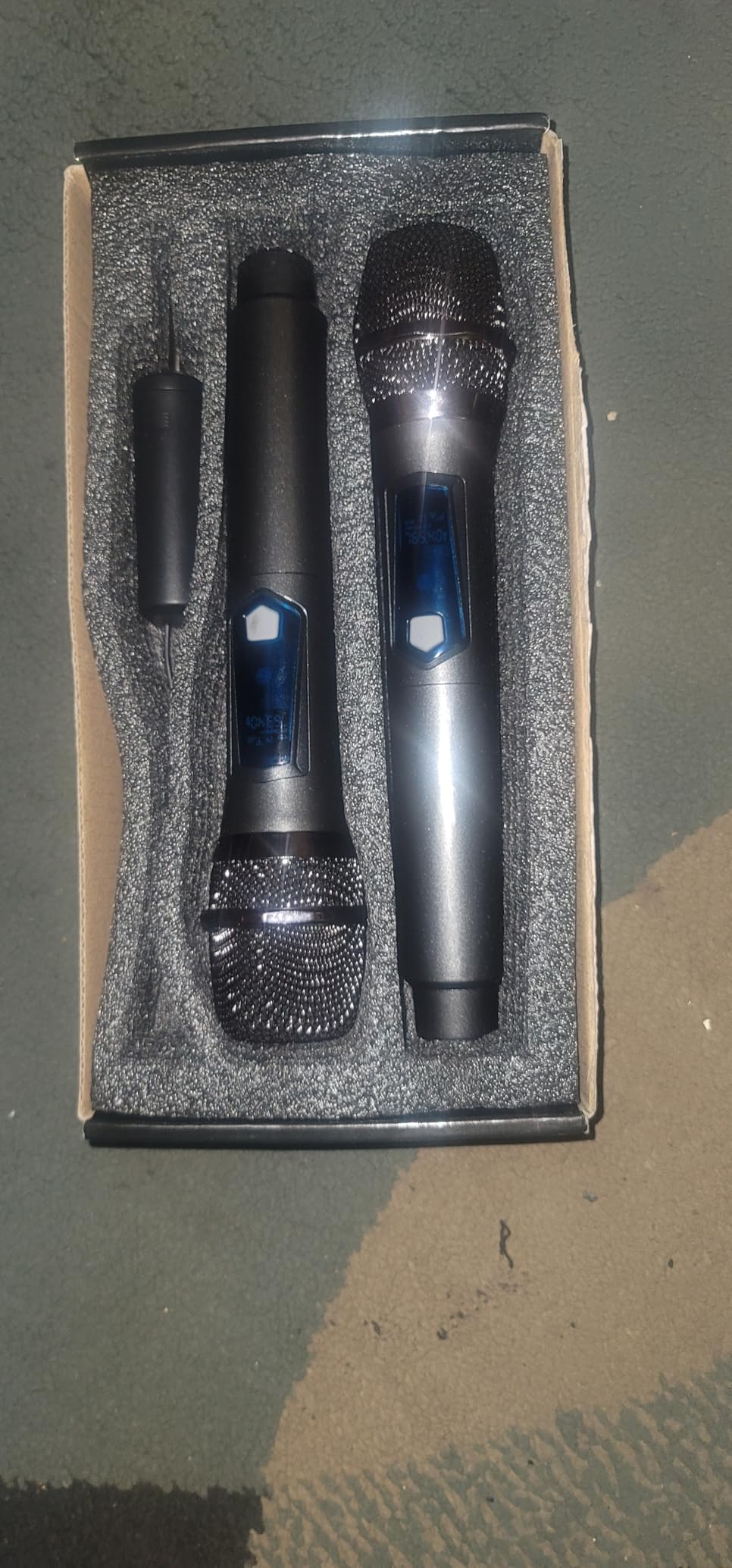
Range is listed at 200ft line of sight with a stable signal and no audio delay, and the impedance is 600 ohm, which is a standard unidirectional vocal figure. Pairing is automatic on power-up, so there is no matching button to hold down. Anti-slip rings and mic covers are included in the box, along with a 3.5mm adapter.
Owners like the range, the auto-pairing and how cleanly the cardioid pickup handles a small room. The 6.35mm and 3.5mm microphone inputs are the intended destination for this system.
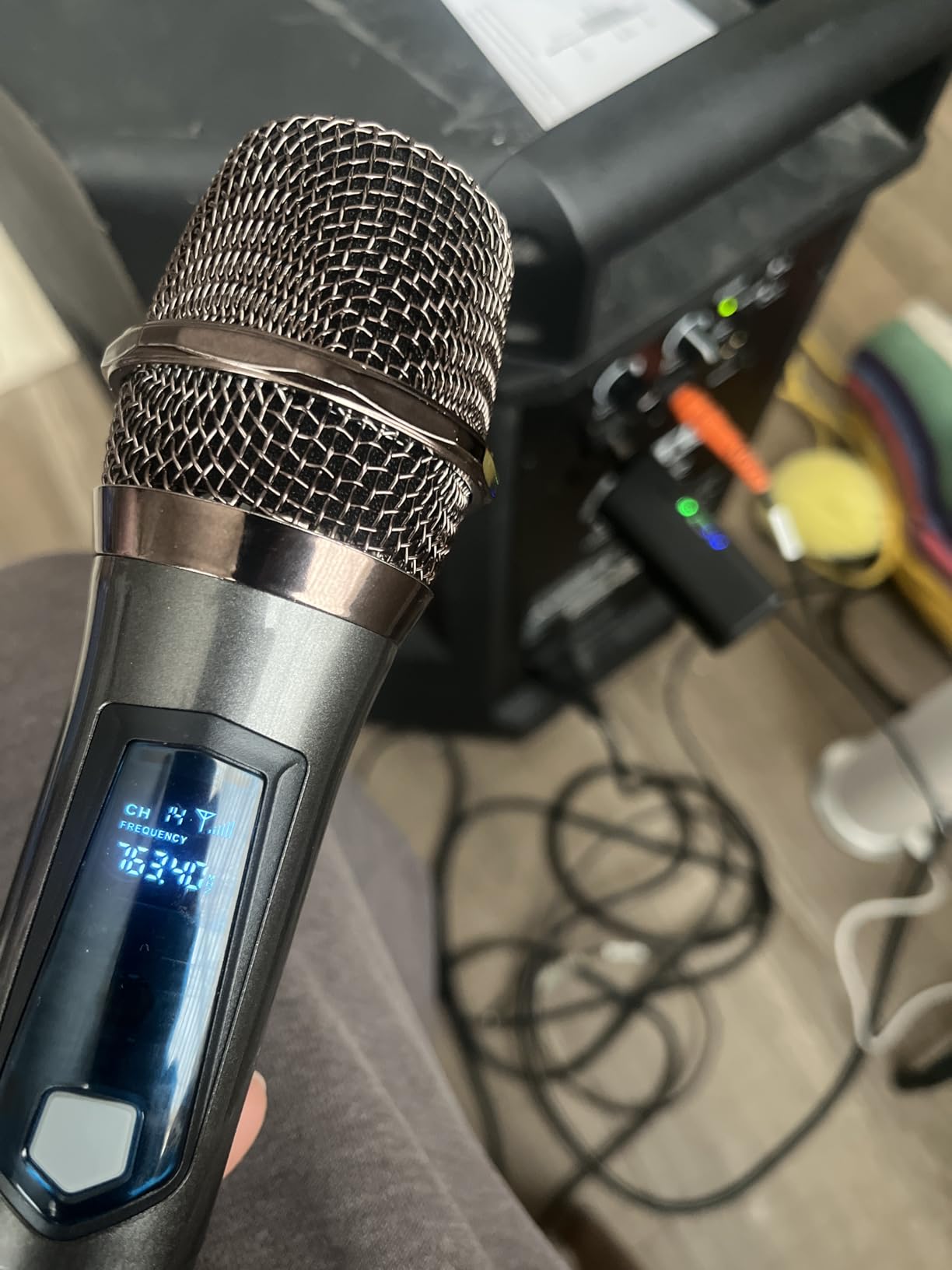
Why two mics change the night
One mic means the room passes a single object around, and passing a mic interrupts the song. Two means people can duet, which is the actual point of karaoke. If you sing with a partner, this is the smallest step that changes how the evening feels.
Check your gear before ordering. The receiver plugs into a microphone-level input, which is what amps, mixers and PA systems have, and it will not connect to a phone, tablet or computer directly. If your plan is to sing from a laptop, this is the wrong pick.
Where the value thins out
About 9 percent of reviews are one-star, with reports of units failing or cutting out. Two versions ship randomly, so the connectors on the receiver can differ from the listing, which is worth knowing before a party rather than during one.
It is also a 1-channel receiver driving two mics, so you cannot independently control each singer. For a duet that is fine. For two speakers or a stereo mix, step up to a dual-channel system.
5. talomen K60 – Best for Four-Person Family Karaoke
- Four handhelds so nobody waits
- Stable 2.4GHz link with no perceived latency
- Rechargeable 1200mAh batteries give 10+ hours
- Auto-matching on power-up
- Survives being dropped
- Receiver needs about 15 minutes of charging first
- Some units have volume dropouts and a thin tone
- Needs to be held close to the mouth
- Receiver supports mic input only
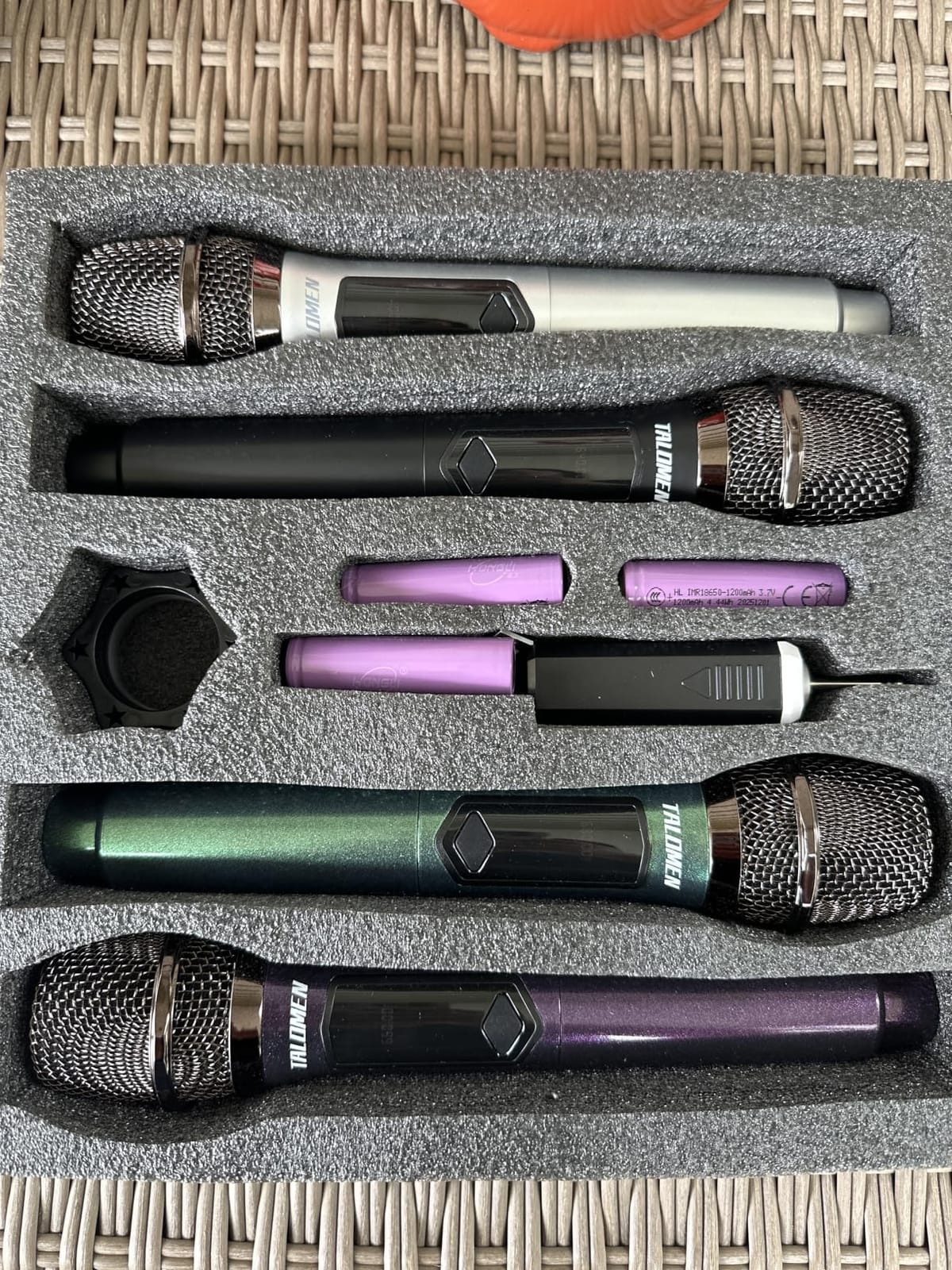
Most households do not need one mic or two. They need four, because there are four people who want a turn. The talomen K60 is the only system here that ships four handheld microphones and one receiver, and it has a 4-channel setup so each singer gets their own signal.
The transmission is 2.4GHz across 2402MHz to 2480MHz with a 160ft range and low latency, and the polar pattern is super-cardioid, which is even more directional than the cardioid on the HUACAM. That tight pattern is the reason it stays usable in a smaller room.
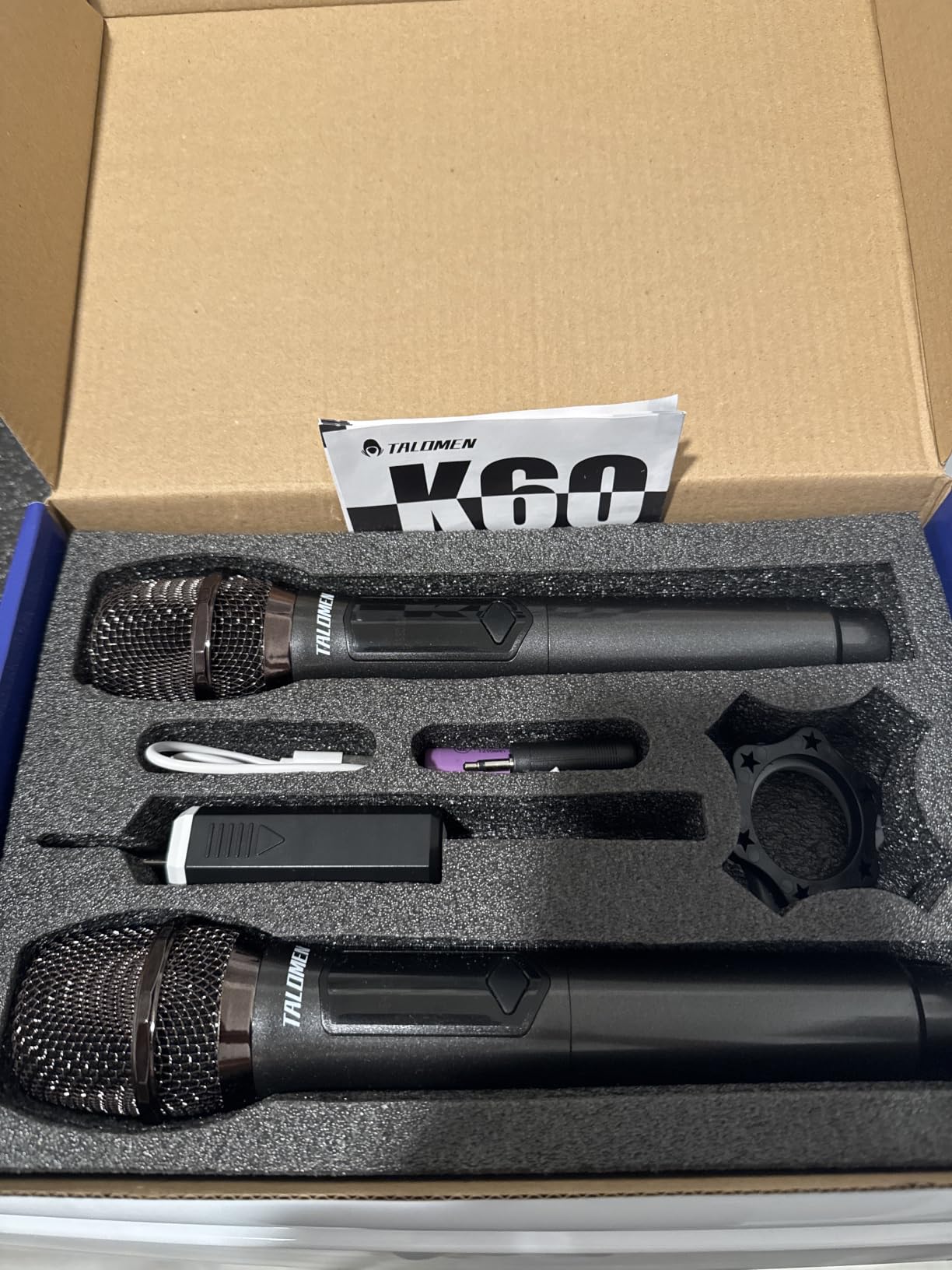
Battery life is the standout. Five rechargeable 1200mAh lithium AA batteries are included, each giving 10 or more hours of use, and USB-C charging takes 2 to 3 hours for a full charge. The signal-to-noise ratio is listed at 86.4 dB. Connection is 3.5mm and 6.35mm jack, into microphone inputs.
Families rate this highly for group karaoke, stable signal and rechargeable batteries. One thing to plan for: owners report the receiver itself needs about 15 minutes of charging before it holds a fully reliable signal, so plug it in first.
When four mics is the right number
It is the right number for a family gathering where adults and kids sing together, and for any group where handing one mic around kills the momentum. Once everyone has a mic, the song keeps moving and the energy stays up.
It is overkill for a couple. Two handhelds plus a receiver, like the HUACAM set, cover a duet with room to spare and take up less space in a drawer.
Limitations to plan around
Some units show volume dropouts, lag and a thin or tinny vocal tone, and the mics need to be held close to the mouth for a strong signal. The plastic bodies are not metal, though owners say they hold up well after being dropped.
Same receiver caveat as the other handheld systems here: microphone input only, no AUX or line level. Check that your amplifier or mixer has a mic jack before you commit.
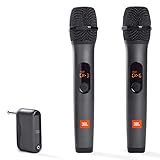
6. JBL Wireless Two-Microphone System – Most Versatile
- Two voices mixed into one speaker output
- Instant power-on setup with no menus
- Clear vocal reproduction through a real speaker
- Lightweight 1.2 pound handhelds
- Replaceable AA batteries and USB-C cable included
- Occasional popping or faint static
- Power switch sits under your grip
- Plosives unless a windscreen is added
- Receiver cannot be used while charging
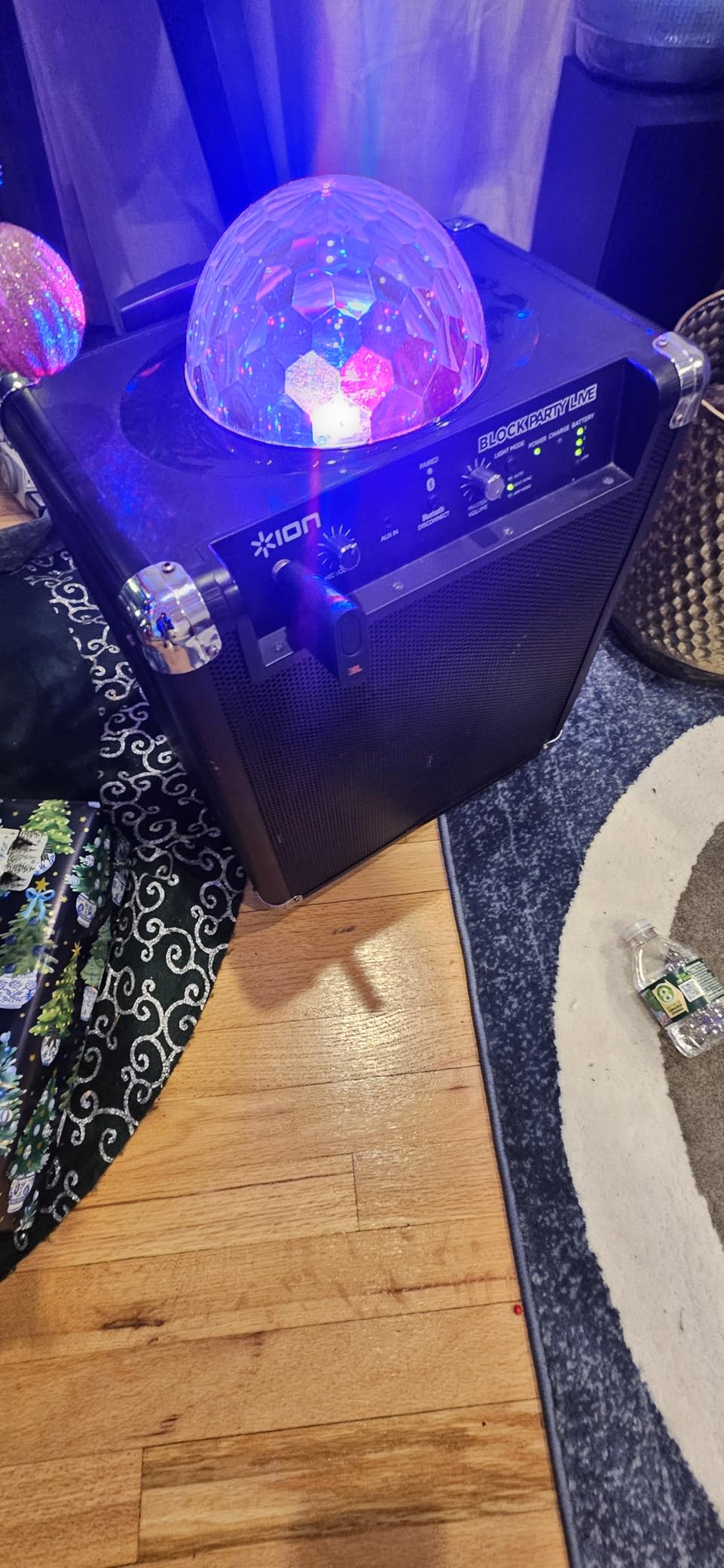
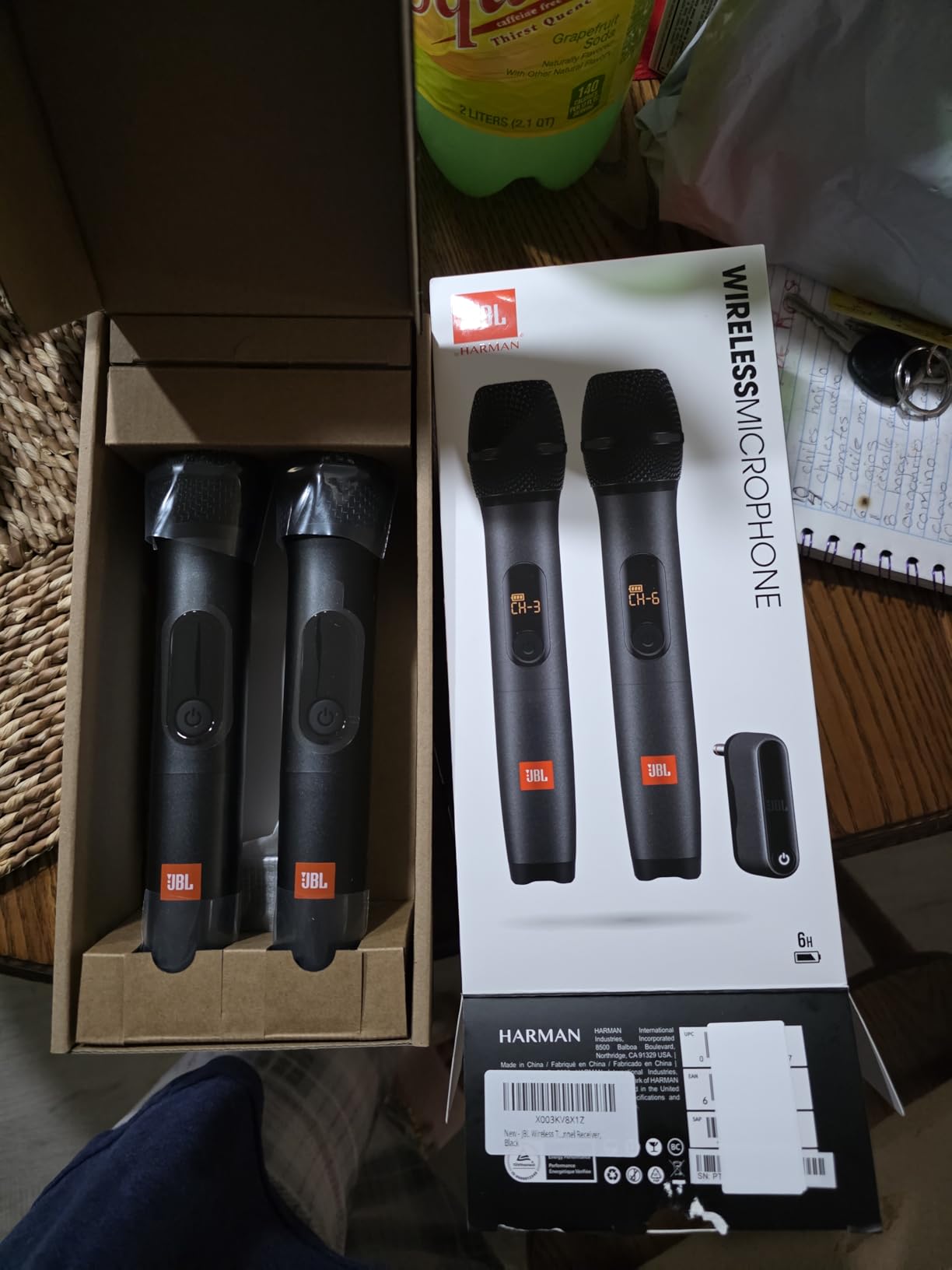
The JBL Wireless Two-Microphone System is built for one specific situation: you own a JBL PartyBox speaker, or you are about to. It is designed around the PartyBox family, including the Encore, 100, 110, 200, 300, 310, 710, Ultimate and On-The-Go models, and it is the fastest way to add two working wireless vocals to one.
Setup is genuinely instant. There is no pairing menu and no channel selection, both mics are on as soon as they have power, and both voices mix together into a single speaker output for up to 6 hours of playback.
It is a dual-channel receiver, and the handhelds are listed at 1.95 by 1.95 by 9.16 inches and 1.2 pounds each, which makes them comfortable for long sessions and easy for a child to hold. Frequency response runs 65 to 15000 hertz with a 60 dB signal-to-noise ratio, and there is a battery indicator light plus replaceable AA batteries.
Owners praise the clear vocal reproduction, the fast setup and the compatibility. The criticism is specific and worth knowing: the power switch sits right under your grip, so it is easy to bump off mid-song, and the vocals show noticeable plosives unless you add a foam windscreen.
Who should buy this one
Buy it if your PA is a PartyBox. The pairing is designed, the two channels are clean, and the whole package disappears into the speaker workflow you already have. It is also the most sensible choice if a kid is holding the mic, because 1.2 pounds is genuinely light.
Also buy it if you want clear, warm vocals and you have a real speaker to drive. Mic quality matters most when the speaker can actually reproduce it, and this is one of the few systems here whose output sounds good through a proper powered speaker.
What to watch out for
A few owners report occasional popping or faint static when the voice comes in. The receiver cannot be used while charging, so top it up before the party rather than during it. Range is also shorter than a UHF system in a large room.
Most importantly, buy the PartyBox first if you do not already own one. These mics need somewhere to plug in, and that speaker is the single biggest upgrade to how a home karaoke night sounds.
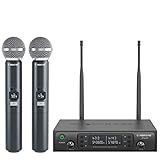
7. Phenyx Pro PTU-71-2H – Best Long-Range and Best Sounding
Phenyx Pro Dual UHF Auto Scan Handheld Wireless Microphone System PTU-71-2H
- Auto Scan locks a clean UHF channel fast
- 2x100 selectable frequencies
- Up to 328ft range with no dropouts reported
- All-metal handheld and receiver build
- Warm sound compared to entry wired mics
- Heavy handhelds over long sets
- Status lights flash off quickly
- Rubber power button can degrade
- Loosely fitted receiver display
- Not rack-mountable
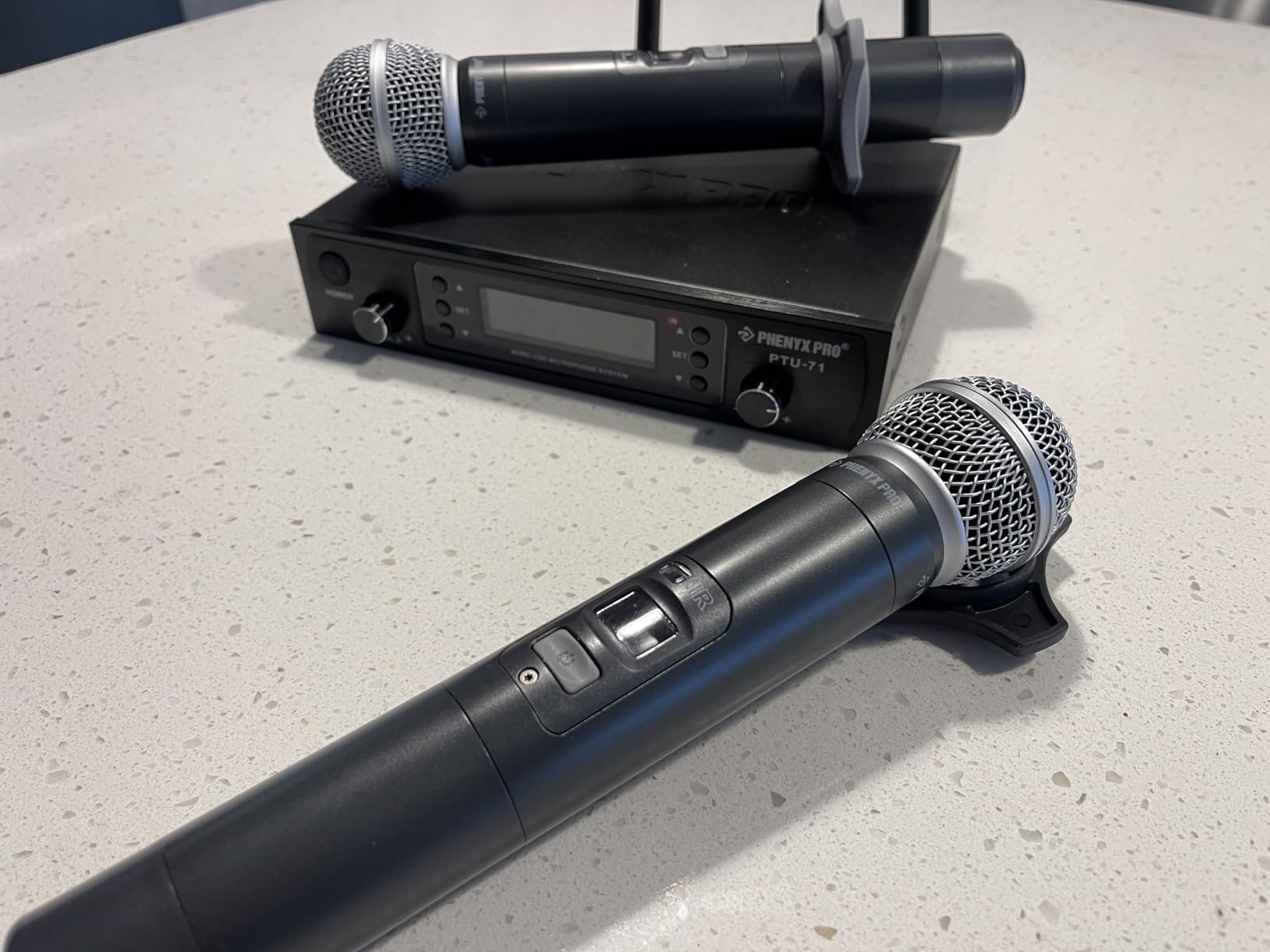
The Phenyx Pro PTU-71-2H is the only true UHF system in this roundup, and that changes everything about how it behaves. UHF runs in the 530MHz to 580MHz band, far from the 2.4GHz band your Wi-Fi router and Bluetooth gear occupy, so it simply does not collide with the rest of your house.
Auto Scan finds a clean channel quickly, and with 2×100 selectable frequencies and up to 16 transmitters working in multiset operation, you can run several of these in one room without interference. Range is listed at up to 328ft line of sight with IR synchronisation, and reviewers report no dropouts in large rooms.
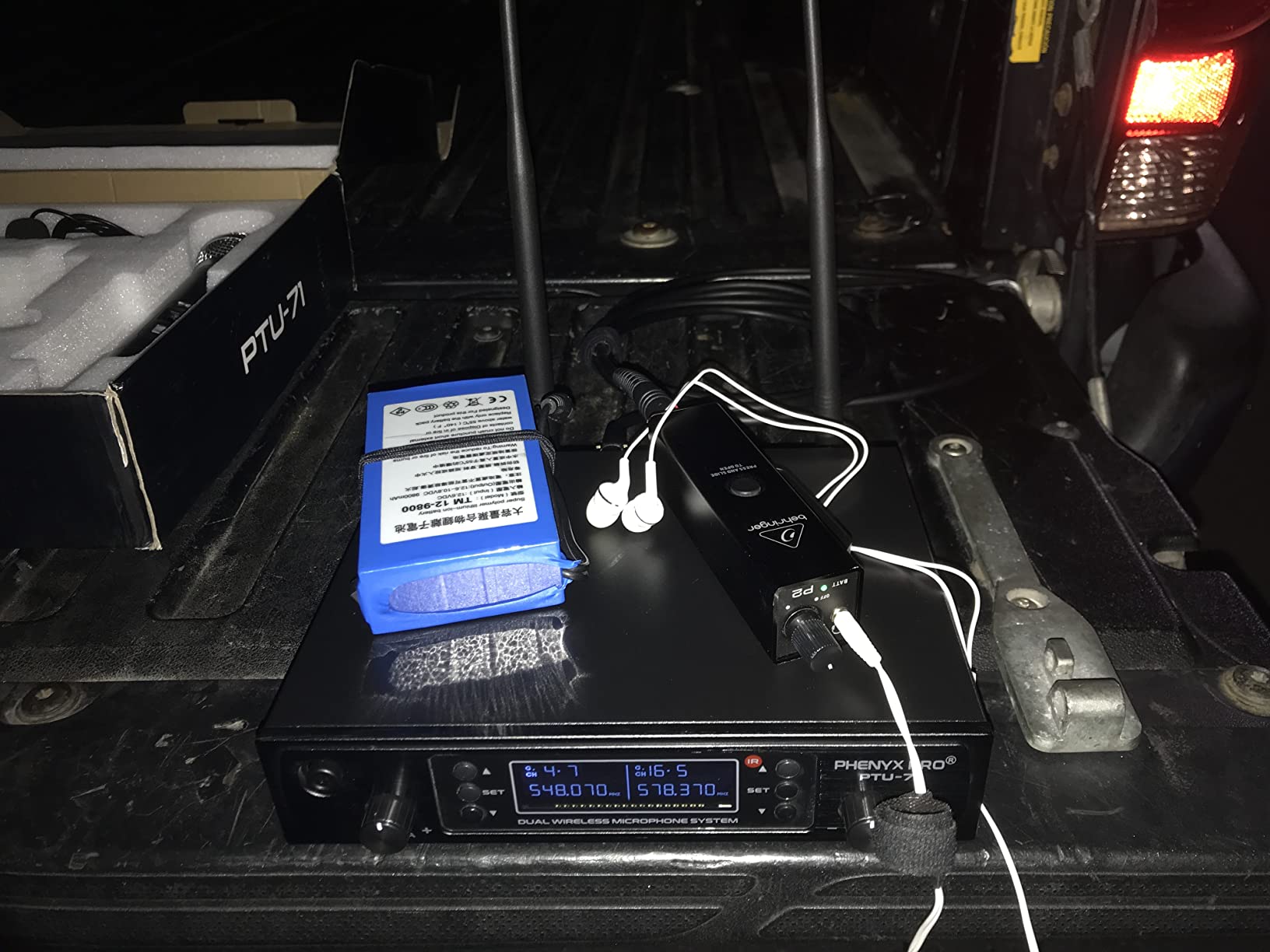
The outputs are the most flexible here: dual XLR plus a combined 1/4 inch output, so it feeds a mixer, a PA system, a television or an audio mixer without an adapter. Impedance is 200 ohm, frequency response runs to 18 KHz, and the signal-to-noise ratio is listed at 98 dB.
Both the receiver and the handhelds are metal, and 8 AA batteries are included for roughly 15 to 16 hours of use. Users repeatedly describe the sound as warm and full, and compare it favourably to entry-level wired microphones.
When UHF is the right answer
Choose UHF when you live in a busy radio environment, a flat with thick walls, or a house where Wi-Fi and Bluetooth are already crowded. It is also the only system here that scales to multiple sets in one room, which makes it the pick for anyone hosting more than a handful of singers.
If you also sing on a small stage, a church or at an event, this is the same category of hardware. The XLR outputs mean it drops into a small mixer and stays there, and the metal build is built for gear that gets carried and dropped.
The weight problem is real
The listed weight is 2.7 kg and owners call the handhelds tiring over a long set, so this is a two-mic system rather than a four-mic one. The status lights flash off quickly, which makes the on and off state hard to read at a glance, and the rubber power button is called out as a weak point that can degrade.
The receiver display is loosely fitted and the unit is not rack-mountable. None of that matters in a living room, and all of it matters if you plan to take it on the road.
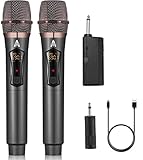
8. ALPOWL WXM-001 – Best Value Dual Handheld Set
- Two metal handhelds plus a rechargeable receiver
- 200ft range with zero perceived delay
- DSP noise reduction and auto EQ
- 1200mAh batteries run about 10 hours
- Plugs into mixers amps and interfaces
- First-time pairing can take 1-3 minutes
- Receiver works only with a MIC jack
- Lowest average rating here with 11 percent one-star reviews
- Some units need a full charge cycle first
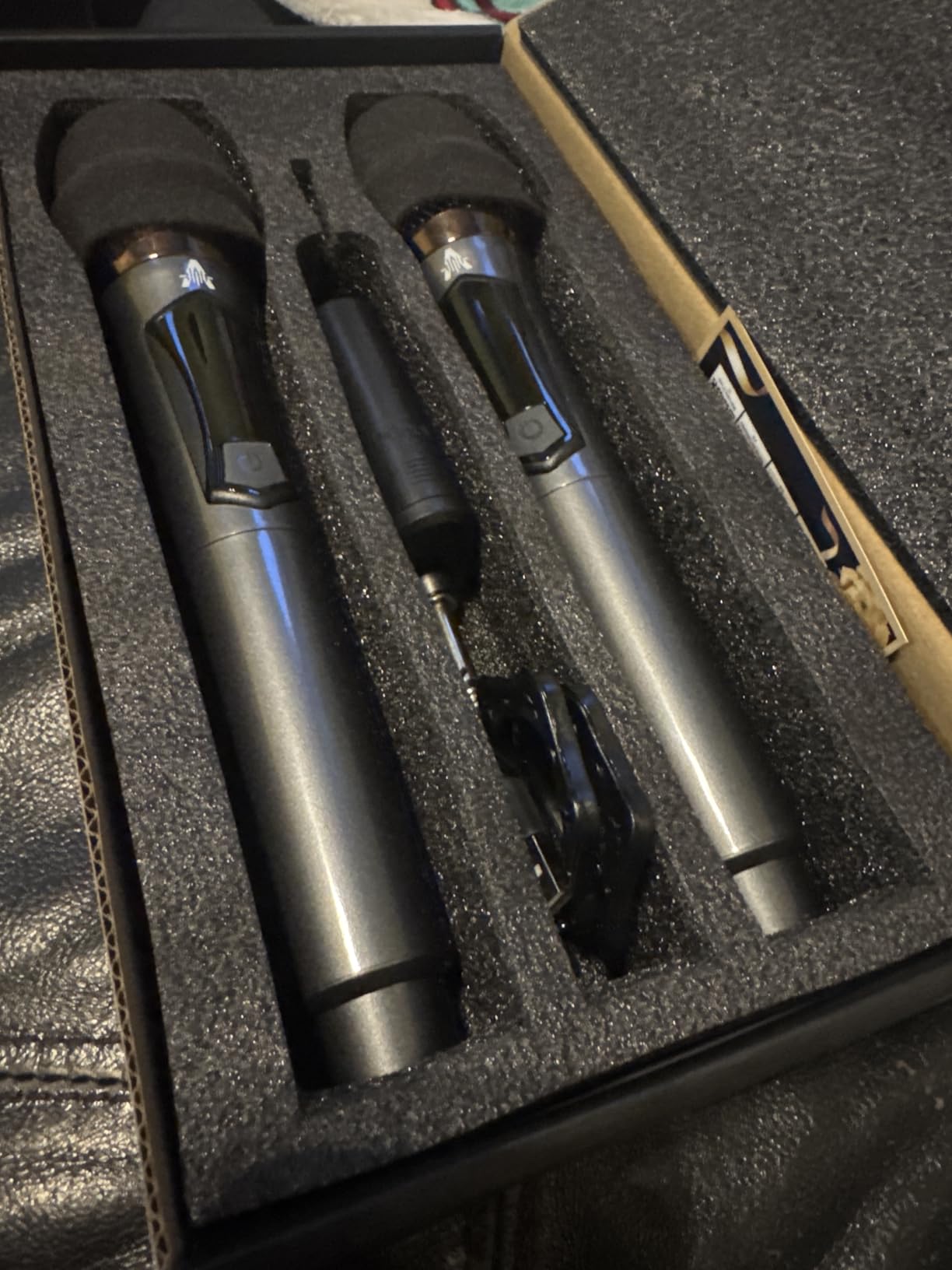
The ALPOWL WXM-001 gives you two metal handheld bodies and a rechargeable receiver with a listed 200ft range and no perceived delay, which is a lot of hardware for a modest outlay. It is also the one budget system here that lists 6.35mm jack connectivity alongside USB and UHF, so it drops into most amplifiers and mixers.
The processing is the differentiator at this level. DSP noise reduction plus automatic high and low EQ adjustment keeps a voice intelligible over a loud backing track without you touching a mixer, which is precisely what the cheaper Bluetooth mics cannot do.
Batteries are 1200mAh rechargeable, running about 10 hours, with USB-C charging in 3 to 4 hours and a replacement-battery option alongside cable charging. Frequency range is listed from 0.05 to 18 khz with a 60 dB signal-to-noise ratio, and a 365-day replacement service is offered.
Owners highlight the metal build, the long range and the rechargeable batteries. The weaker reviews trace to slow first-time pairing, sometimes 1 to 3 minutes, and a receiver that only accepts a microphone-level input.
What you get for the money
Two metal handhelds, a rechargeable receiver and 10 hours of battery each, with no software and no app. You plug into the MIC jack on your amplifier and play. For a first real karaoke system, that is the honest entry point into proper microphone hardware.
Because it works with mixers, amplifiers, audio interfaces, speakers and karaoke machines, it also fits an existing home setup better than a Bluetooth-only unit, which is where most returns in this category come from.
Where it falls behind
This has the lowest average rating in the roundup at 4.2, with 11 percent one-star reviews, and the cause is predictable: the first pairing. Owners report 1 to 3 minutes to pair, and some units need a full charge cycle before the link is stable. Do both of those things before the guests arrive.
The polar pattern is omnidirectional, which means it hears more of the room than the cardioid and super-cardioid systems above. That is the trade for the auto EQ processing, and in a loud apartment it is not always the right one.
How to Set Up Wireless Karaoke Mics in a Small Room
Most howling in a living room is a placement problem, not an equipment problem. Four steps fix it in the order below, and you should not touch the gain or buy anything new until you have worked through them.
1. Point the speaker away from the singer. Put the speaker at the far end of the room facing the room, never facing the person singing. Feedback starts when the microphone hears the speaker directly.
2. Give it distance. Keep four feet or more between the mic and the speaker. In a small apartment, the speaker on a shelf in the corner works far better than one on the same side as the singer.
3. Angle the mic off-axis. A cardioid or super-cardioid capsule picks up most sound from directly in front. Turning the mic 20 to 30 degrees off the speaker line kills the loop without dulling your voice.
4. Turn the mic gain down before the volume up. Start with gain at minimum, raise it until your voice sits just under the track, then bring the overall level up. Boosting the speaker first is what starts the squeal.
On lip-sync delay. Bluetooth karaoke mics route your voice back through the phone, so you can hear yourself slightly behind the track. It is small with a modern phone and irritating with older Bluetooth. Receiver-based systems avoid it, because the mic and the track reach the speaker by different paths with no re-encoding.
On volume and neighbours. In an apartment, decide your maximum level before the party rather than during it. Most feedback problems disappear below a level where you can feel it in the walls, and a thin-wall building is a real constraint, not a preference.
On how many mics you need. One mic is a singalong. Two is a duet. Four is a family gathering where nobody has to wait. Below four, the bottleneck is queueing, not sound quality.
On using gear you already own. A Bluetooth speaker, a smart TV or a small mixer can be your entire PA. The only check that matters is whether it has a microphone-level input. 3.5mm headphone outputs on a TV usually do not accept a mic, which is the single most common reason a wireless set arrives and does nothing.
What to Look for in a Wireless Karaoke Microphone in 2026
Start with the speaker question. If you own nothing, buy an all-in-one karaoke mic. If you own a Bluetooth speaker, a smart TV or an amplifier, buy a receiver-based mic set and check the input type before anything else.
UHF, 2.4GHz or Bluetooth. UHF sits in the 530MHz to 580MHz band, far from household Wi-Fi, and gives the longest range and the least interference. It is also the only option that scales to several sets in one room. 2.4GHz is a good middle ground with low latency, but it shares airspace with routers and Bluetooth. Plain Bluetooth is the most convenient and the least reliable, with added lip-sync delay and no output control.
Dynamic versus condenser. Karaoke wants a dynamic capsule with a cardioid or tighter pattern. Condenser mics pick up too much room noise and need power the receiver may not provide. If you are recording vocals to a laptop rather than singing live, that changes, and our guide to condenser microphones for home studios covers that side properly.
Battery type. Rechargeable is convenient and sealed, usually 4 to 10 hours. Replaceable AA is heavier but survives a marathon, and some systems here run 15 to 16 hours on eight AAs. Pick rechargeable for occasional parties, replaceable for anything you take to events.
Output and compatibility. A 6.35mm jack is a quarter inch and is the standard microphone input on amplifiers, mixers and PA systems. A 3.5mm jack is eighth inch and shows up on karaoke machines and small speakers. XLR is a balanced professional connection found on mixers and on the Phenyx system. Most budget receivers accept microphone inputs only, so a TV headphone jack will not work as an input.
Cardioid pickup. The pattern decides how much room noise and speaker bleed the mic hears. Cardioid and super-cardioid patterns are the reason a mic can sit near a speaker without howling, and an omnidirectional pattern is the reason it cannot.
Brand tiers. JBL, Shure and Sennheiser sit at the top and pair naturally with serious PA gear. Phenyx Pro and Tonor occupy the semi-pro tier, where r/karaoke regulars recommend them repeatedly for reliability and value. Everything under about fifty dollars is a gamble on battery life, though plenty of owners never have a problem with one.
When wired makes more sense. If you will sing in one spot, a wired dynamic microphone costs less, never has a dead battery and never drops out. Wireless earns its place the moment two people want to move around a room, and not a moment before.
Frequently Asked Questions
What is the best karaoke mic for home use?
For most homes the BONAOK Q37 is the easiest starting point, since it acts as microphone, Bluetooth speaker and music player in one handheld body and needs no other hardware. If you already own a speaker or amplifier, a receiver-based dual set such as the JBL Wireless Two-Microphone System gives you far better vocal quality and proper volume control.
What is the best wireless microphone for karaoke?
The best wireless microphone for karaoke is one whose receiver matches the input on your own gear. A 6.35mm receiver feeds amplifiers, mixers and PA systems, while Bluetooth-only mics feed phones, laptops and Bluetooth speakers. Among the picks here, the JBL system suits PartyBox speakers, the Phenyx Pro PTU-71-2H offers the cleanest long-range UHF signal, and the Amazmic 868 is the simplest Bluetooth-only choice.
What is the best wireless karaoke microphone system?
A system means the mics, the receiver and a speaker working as one unit. The Phenyx Pro PTU-71-2H is the most complete here, with two metal handhelds, a metal receiver, dual XLR outputs plus a combined quarter inch output, Auto Scan frequency selection and up to 328ft of range. It also runs on replaceable AA batteries for roughly 15 to 16 hours.
Do I need two wireless microphones for karaoke?
You need two the moment more than one person wants to sing at the same time, because passing a single mic around interrupts the song. Two mics is the right number for a duet or a couple, and four is the right number for a family gathering where adults and kids all want a turn. Below two, the real problem is queueing rather than sound quality.
How do I stop wireless karaoke mics from howling?
Start with placement, not equipment. Point the speaker away from the singer so it faces the room, keep four feet or more between the microphone and the speaker, and angle a cardioid microphone 20 to 30 degrees off the speaker line so the capsule is not pointed straight at it. Then set the mic gain first and the volume second, since raising volume first is what starts the loop.
What is the best wireless microphone for videoke?
For videoke on a laptop or smart TV, a receiver-based system is better than a Bluetooth mic because it avoids the lip-sync delay that comes from routing your voice back through a phone. A 6.35mm receiver into a small mixer gives you gain control and a clean feed. If you only have Bluetooth, keep the mic close to the screen and use a wired connection where you can.
Our Verdict on the Best Wireless Microphones for Home Karaoke
Start with the BONAOK Q37. It is the best wireless microphone for home karaoke when you have no other gear, it is the easiest thing in this roundup to hand to a guest, and the owner base is large enough that any problem with it would already be well known.
If you own a speaker, do not buy an all-in-one. Buy a receiver-based set: the JBL system for a PartyBox, the HUACAM pair for a budget duet, the talomen four-pack for a family, or the Phenyx Pro PTU-71-2H when you want the cleanest signal and the most flexible outputs in the house.
Whatever you choose, the speaker sets the ceiling on how good it sounds and the placement sets whether it howls. Fix those two things before you blame the microphone, and you will have a home karaoke setup that works for 2026 and every year after it.