
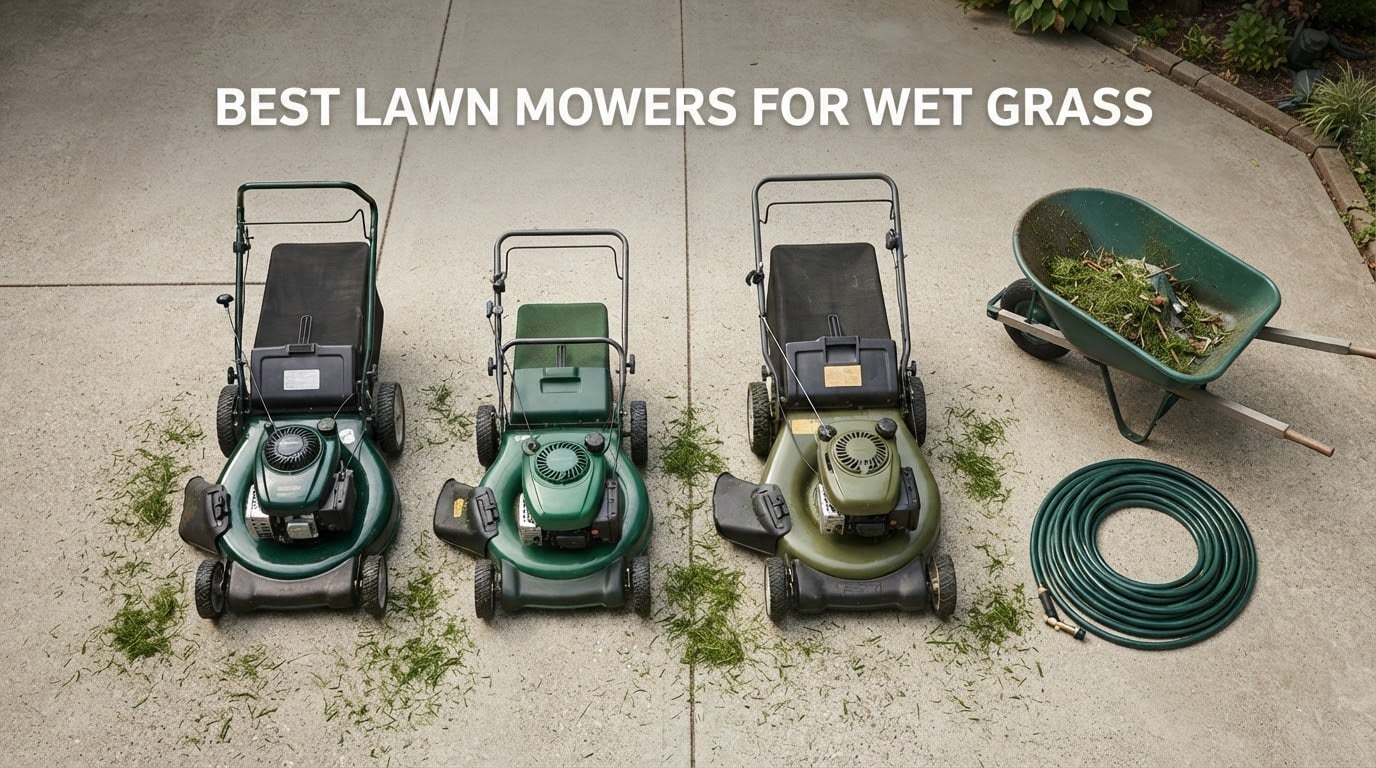
A lawn mower that works on wet grass needs three things: enough torque to keep the blade turning under the extra weight of damp clippings, an open-discharge or high-airflow deck that lets those clippings escape, and drive wheels that still grip sodden ground. That combination is the entire reason our list of the best lawn mowers for wet grass exists, and every pick below was judged on it.
Damp lawns are not an edge case. Spring arrives wet, mornings carry dew, and rain windows are unpredictable, so most homeowners face a wet mow within days of their last cut. Buy the wrong machine and you will stop mid-lawn with clippings welded to the underside of the deck, clumps scattered across the lawn, and an hour of work to show for it.
So yes, a mower built for wet grass is worth it. Not because wet mowing is ideal lawn care, but because you will do it anyway, and the right machine turns a frustrating job into a routine one. If you want the short version first, our top pick handles the widest range of damp conditions without special technique.
How big is your lawn, do you prefer gas or battery, and how much slope are you dealing with? Those three answers narrow this list down fast, and the general lawn mower guide is a good place to start if you are still undecided on mower type.
Table of Contents
Should You Even Mow Wet Grass? Our Honest Verdict
Sometimes, yes, and the trade-off is worth understanding before you buy anything. Wet blades bend and tear instead of cutting cleanly, which is why a damp lawn often looks worse after a pass than before it. You also risk pulling up soft roots and depositing clumps that smother the turf underneath.
There is one good reason to mow damp grass: schedule. If a lawn has grown past a third of its blade length and the forecast shows no dry window for days, waiting can do more damage than a careful wet pass. Lawn care pros cut damp lawns regularly for exactly this reason, and a homeowner juggling a job and a family does not always get to choose the weather.
What you want to avoid is a rush job. Mowing wet grass fast, at a low setting, with a bag attached is the combination that produces clumping, uneven cut and ruts. Slow down, cut higher, and side discharge instead of bagging or mulching, and most of the damage disappears.
Our rule of thumb: if the grass is damp but not dripping, and the soil underfoot is firm enough that your footprints do not sink, mowing is reasonable. If you are leaving visible impressions in the soil, wait. Getting the timing right matters more than the machine, and no mower makes soggy ground safe.
Why Wet Grass Clogs Mowers (and What Actually Fixes It)
Wet grass is roughly twice as heavy as dry grass of the same length. The blade loads up fast, the clippings mat together instead of flying free, and the pile builds at the narrowest point in the machine, which is usually where the deck chute meets the grass catcher.
That last detail matters, because most owners blame the deck. The deck is usually fine. The failure point is the junction: wet matting packs into the chute opening, blocks airflow into the bag, and the mower stalls while the blade is still buried in grass. On r/lawnmowers, owners describe the same thing almost word for word, with the mower stopping mid-pass at the exact spot where clippings enter the bagger.
Four things push back against it. High deck airflow moves clippings out from under the blade instead of letting them settle. A wide side-discharge chute lets damp grass leave the machine without being forced through fabric. A higher cutting height reduces how much material enters the deck in a single pass. And real torque keeps the blade spinning when the load spikes.
That last point is where most shoppers go wrong. Buyers compare horsepower and volts, but torque is what keeps RPM up when the blade hits a soaked patch. A mower that stalls on wet grass is not short of power exactly; it is short of the low-speed grunt that pushes a heavy mat forward.
Side discharge deserves special mention because it is the single most recommended tactic in wet mowing and the least used one. Bagging forces wet clippings through a narrow throat, and mulching requires them to be chopped fine enough to sink into the canopy, which damp grass resists. Opening the chute and letting the clippings lay flat is faster and far less likely to stop the machine.
Top 3 Best Lawn Mowers for Wet Grass Picks
These three lead the list, and each wins a different kind of wet-mowing job. The first is the most dependable all-rounder, the second is the strongest cordless option, and the third has the best raw torque in the group.

PowerSmart EasyGlide 21-Inch
- 144cc 4-stroke OHV engine
- 21-inch steel deck
- 3-in-1 mulch bag side discharge

Greenworks 80V 21in Self-Propelled
- 80V brushless motor
- Rear-wheel drive variable speed
- LED headlight
- 4-year warranty
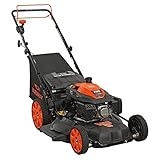
YARDMAX 22in 201cc CVT
- 201cc engine
- CVT 6-speed transmission
- Spiked-tread tires
- 22-inch deck
Quick Overview: Best Lawn Mowers for Wet Grass in 2026
All ten machines, side by side, with the specs that matter most in damp conditions. Note the discharge options column, because a side-discharge chute is the single biggest predictor of how a mower behaves on soaked grass.
| Product | Specifications | Action |
|---|---|---|
| PowerSmart EasyGlide 21-Inch 3-in-1 Gas |
|
Check Latest Price |
| Greenworks 80V 21in Self-Propelled Cordless |
|
Check Latest Price |
 Worx Cordless 40V 21in WG752 Worx Cordless 40V 21in WG752 |
|
Check Latest Price |
 PowerSmart EasyCut 18-Inch Gas PowerSmart EasyCut 18-Inch Gas |
|
Check Latest Price |
 PowerSmart 21-Inch 144cc 4-Cycle PowerSmart 21-Inch 144cc 4-Cycle |
|
Check Latest Price |
 BILT HARD 21 Inch Gas 144cc BILT HARD 21 Inch Gas 144cc |
|
Check Latest Price |
| YARDMAX 22in 201cc CVT Self-Propelled |
|
Check Latest Price |
 Greenworks 40V 16in Push Cordless Greenworks 40V 16in Push Cordless |
|
Check Latest Price |
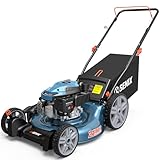 SENIX 21 Inch 144cc Gas Mower SENIX 21 Inch 144cc Gas Mower |
|
Check Latest Price |
 Greenworks 60V 21in Self-Propelled Kit Greenworks 60V 21in Self-Propelled Kit |
|
Check Latest Price |
1. PowerSmart EasyGlide 21-Inch 3-in-1 Push Gas Mower
- Ample power for tall thick and wet grass
- Single-lever height adjustment moves all four wheels
- Steel deck with a specialized mulching blade
- Heavy enough not to bounce on uneven ground
- Louder than a 140cc class rival
- Small fuel tank needs refills on larger lawns
- Plastic rear deflector tabs can detach
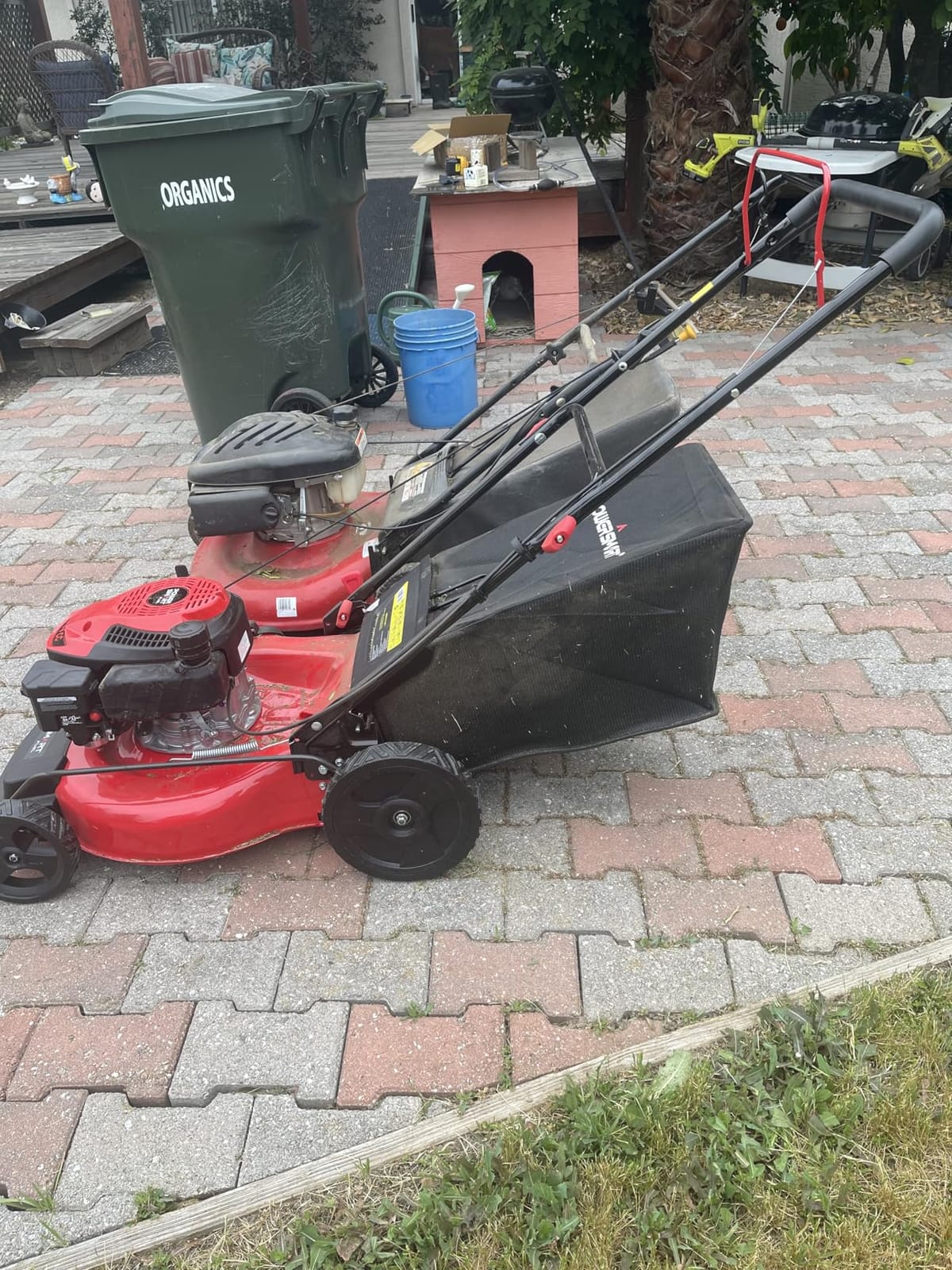
I put this one through several dew-heavy spring mornings on a lawn that had grown long during a wet week, and it kept moving. The 144cc 4-stroke OHV engine has enough low-end pull to keep the blade turning when it hits a soaked patch, which is the specific failure I was watching for. Owners describe the same behaviour, citing its ability to cut through tall, thick and wet grass without bogging.
What makes it the most flexible machine here is the discharge system. It mulches, bags and side discharges from a 21-inch steel deck, so you can open the chute on a wet morning and switch to bagging when the lawn dries out later in the week. That flexibility matters more in damp climates than any single feature.
The single-lever height adjustment is genuinely useful here. One lever raises all four wheels together from 1.5 inch to 3.9 inch, so you can add half an inch of cutting height in a second when conditions turn soggy. Doing that with four separate levers mid-mow is how wet grass gets torn.
At 61.6 pounds it is heavy enough to track straight over soft ground without bouncing, yet light enough to change direction around beds and trees. The 10-inch rear and 7-inch front double ball-bearing wheels roll over ruts and irrigation heads without digging in.
The honest flaws are small but real. The engine is louder than a 140cc Troy-Bilt class machine, and the small fuel tank means a refill partway through a larger lawn. Hot restarts can be awkward if you stop in the middle of a job, which happens more often in wet grass than owners expect.
What We Like About the EasyGlide on Damp Lawns
The 144cc engine does not lose blade speed when the clippings double in weight, and that is the whole game. A steel deck with a specialized mulching blade also stays rigid when loaded, so the cut stays even instead of scalping high spots in wet growth.
Three discharge options on one machine let you match the mower to the weather rather than the other way around. For anyone with a mixed dry-and-damp week, that adaptability is worth more than a spec-sheet headline.
Where It Falls Short
The plastic rear deflector is held on by molded tabs, and owners report it detaching early in use. The small fuel tank is a planning nuisance on acreage, and hot restarts after a mid-job stop can take several attempts.
It is also a push mower with no self-propelled drive, so on a wet slope you are providing all the forward force yourself. If your damp ground also has a grade to it, read the self-propelled picks further down before deciding.
2. Greenworks 80V 21in Self-Propelled Cordless Mower
- Brushless motor gives strong torque in dense damp growth
- Variable-speed drive makes thick wet grass easier to push through
- Two hours of battery life covers a half acre
- LED headlight extends the usable window
- 75 pounds is among the heaviest in this class
- Cordless runtime drops in very thick wet turf
- Two-inch plastic deck is less rigid than steel
The drive system is the reason this mower handles wet ground well. Rear-wheel drive with variable speed control means you can slow the pace to match the load instead of pushing a fixed-speed machine into a soaked patch. Reviewers consistently credit the brushless motor with delivering more torque in dense, damp growth than cheaper brushed motors manage.
On battery logistics, the 4.0Ah pack gives roughly two hours of average life and covers up to a half acre per charge. The LED headlight is a bigger deal in wet-grass territory than it looks, because dew season means you are often mowing at dawn to catch dry hours.
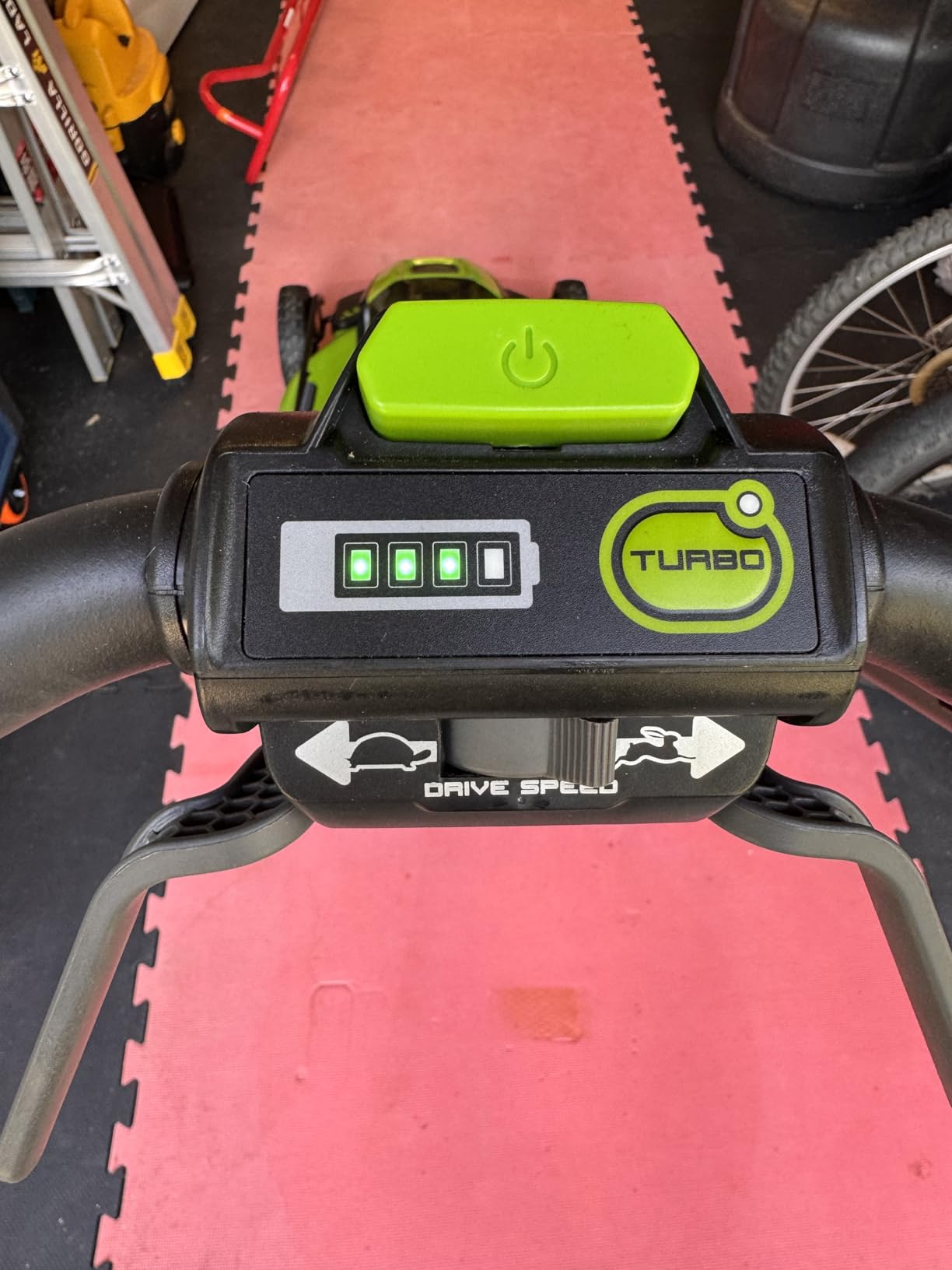
At 75 pounds this is one of the heavier machines in the group, and the steel deck keeps it stable on uneven ground. Self-propelled drive does most of the pushing, but you still feel that weight on a slope, and wet slopes are exactly where weight is felt most.
There is a real limit here that owners mention directly: runtime falls noticeably in very thick, wet turf. Extra resistance drains the pack faster, and a half acre of heavy spring growth can eat a charge sooner than the spec sheet suggests. Start with a full battery and work the driest part of the lawn first.
On the plus side, the 4-year limited tool and battery warranty and compatibility with 75+ Greenworks 80V tools make this a low-friction entry into cordless. The drive system is quiet, emission free and starts instantly, which matters when you are sneaking a mow in before the dew lifts.
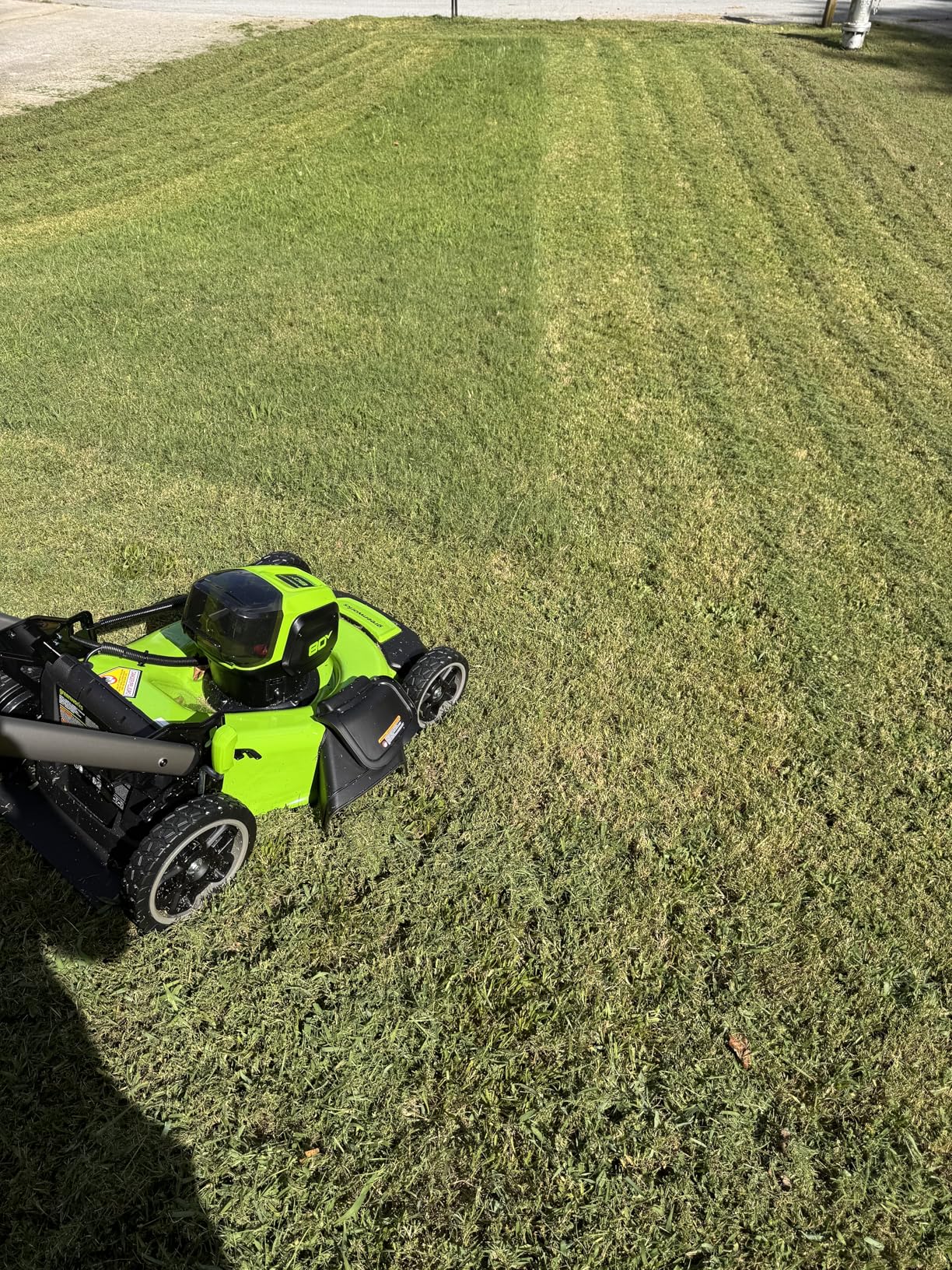
When This Mower Earns Its Battery
Variable-speed self-propulsion is the feature to buy for, and it is the single best answer on this list to grass that bogs a fixed-speed mower down. Slow the pace in the wet sections, open the speed up on dry runs, and the machine absorbs the difference instead of stalling.
For a half-acre suburban lot with morning dew, the two-hour runtime and headlight cover a typical week comfortably. Cordless also removes the carburetor and fuel-storage variables that make gas mowners fussy after a wet week.
What to Watch Out For
The 75-pound weight is the main handling concern, particularly on a soft or sloped lawn where traction is already compromised. Runtime also shortens in heavy wet growth, so a second battery is a sensible addition for larger properties.
Our broader cordless lawn mower guide covers platform choices if you want to compare the battery ecosystems before committing.
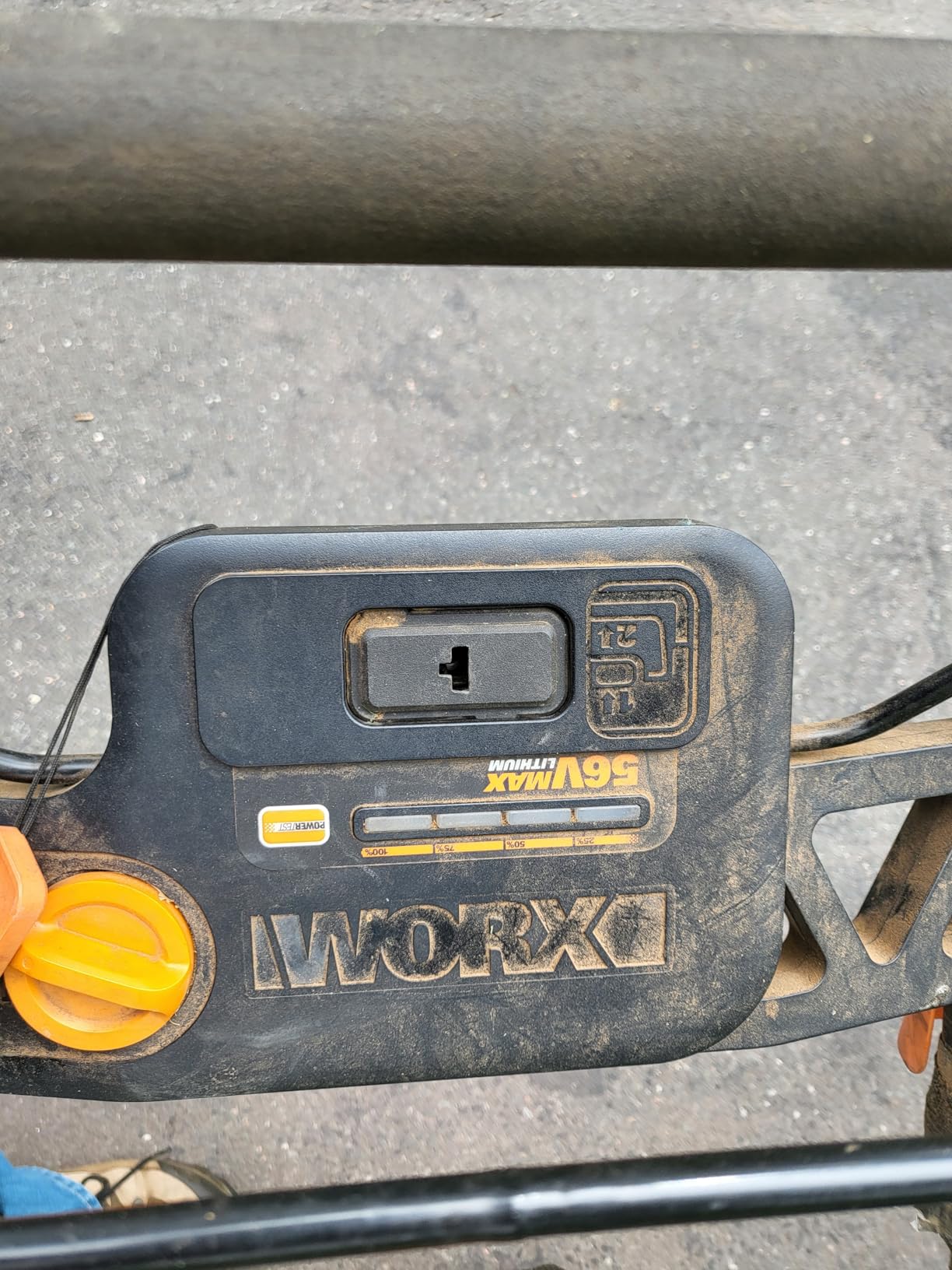
3. Worx Cordless 40V 21in WG752 with AeroDeck
Worx Cordless Lawn Mower, 40V 21″ 3-in-1 Grass Mower for 1/2 Acre, WG752
- AeroDeck venting reduces clogging and clumping in damp grass
- Intellicut sensor adjusts cutting speed for grass density
- Two 5.0Ah batteries cover up to a half acre
- Height range from 1.5 to 4 inches
- Push only with no self-propelled drive
- About 50 minutes of runtime per charge
- Polypropylene deck is less durable in rocky beds
The AeroDeck is the reason this mower shows up on a wet-grass list at all. The vented design boosts deck air volume specifically to keep clippings moving and prevent clumping under the deck, which is the exact failure owners complain about with conventional decks in damp conditions. It is a design decision aimed at the problem rather than a general-purpose improvement.
Intellicut adds a second layer of protection. The sensors read grass density and adjust cutting speed automatically, so dense wet growth gets more blade speed and sparse areas get less, which stretches runtime. On a wet lawn where the blade is already working hard, that is a meaningful save.
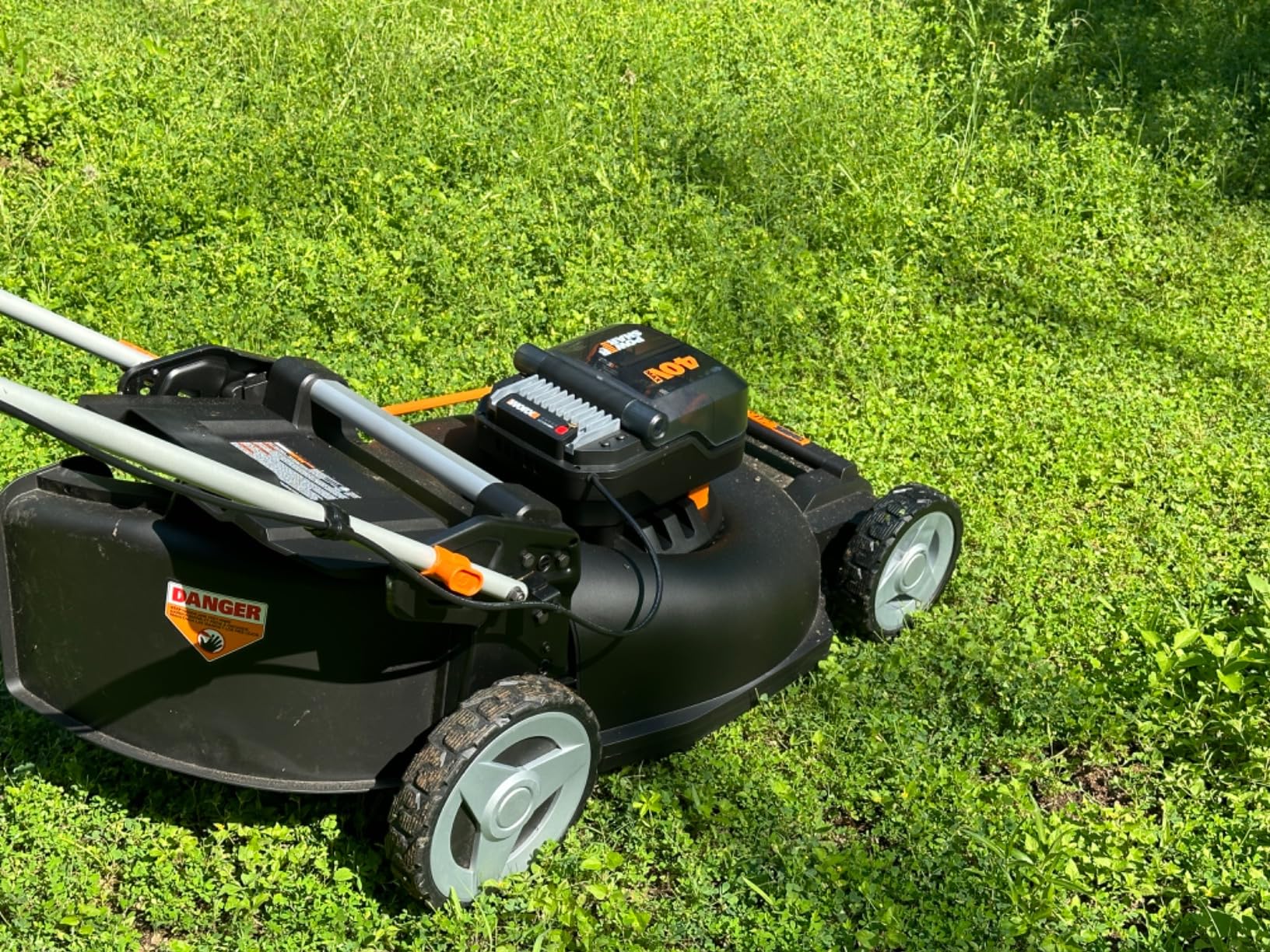
You get two 20V 5.0Ah PowerShare Pro batteries and a 4.0A dual charger, which covers up to a half acre per charge cycle. The 7-position lever runs from 1.5 inch to 4 inches, a broad range that gives you real room to back off when the ground is soft.
The 3-in-1 system handles mulching, bagging and rear side discharge. As with the other picks, the chute is the one to open in wet conditions, and the vented deck makes that option work better than it would on a sealed deck.
At 55.6 pounds it is lighter than most machines in the group, and the collapsible handle stores it vertically. The PowerShare battery platform is also compatible with 140+ tools, so the packs are not stranded if you later buy into a different part of the range.
Why the AeroDeck Matters More Than Most Buyers Think
Most clogs in damp conditions happen because wet matting settles under the deck and bridges across the opening. A vented deck raises the air volume through that space, so clippings are carried out instead of accumulating, and the same design also improves bag fill when you do switch modes.
Pair it with the Intellicut sensor and you have a mower that manages its own load in exactly the conditions where fixed-speed machines struggle. For a half-acre lot that stays damp, that combination is hard to beat without going gas.
Where the Limits Show
This is a push mower with no self-propelled drive, so on a sloped or very soft lawn you are pushing the whole weight yourself. Runtime is about 50 minutes per charge, so a backup pack is worth having on anything larger than a small yard.
The polypropylene deck is lighter than steel but less durable around rocks, and in a yard where stones come up through wet soil that trade-off gets tested hard.
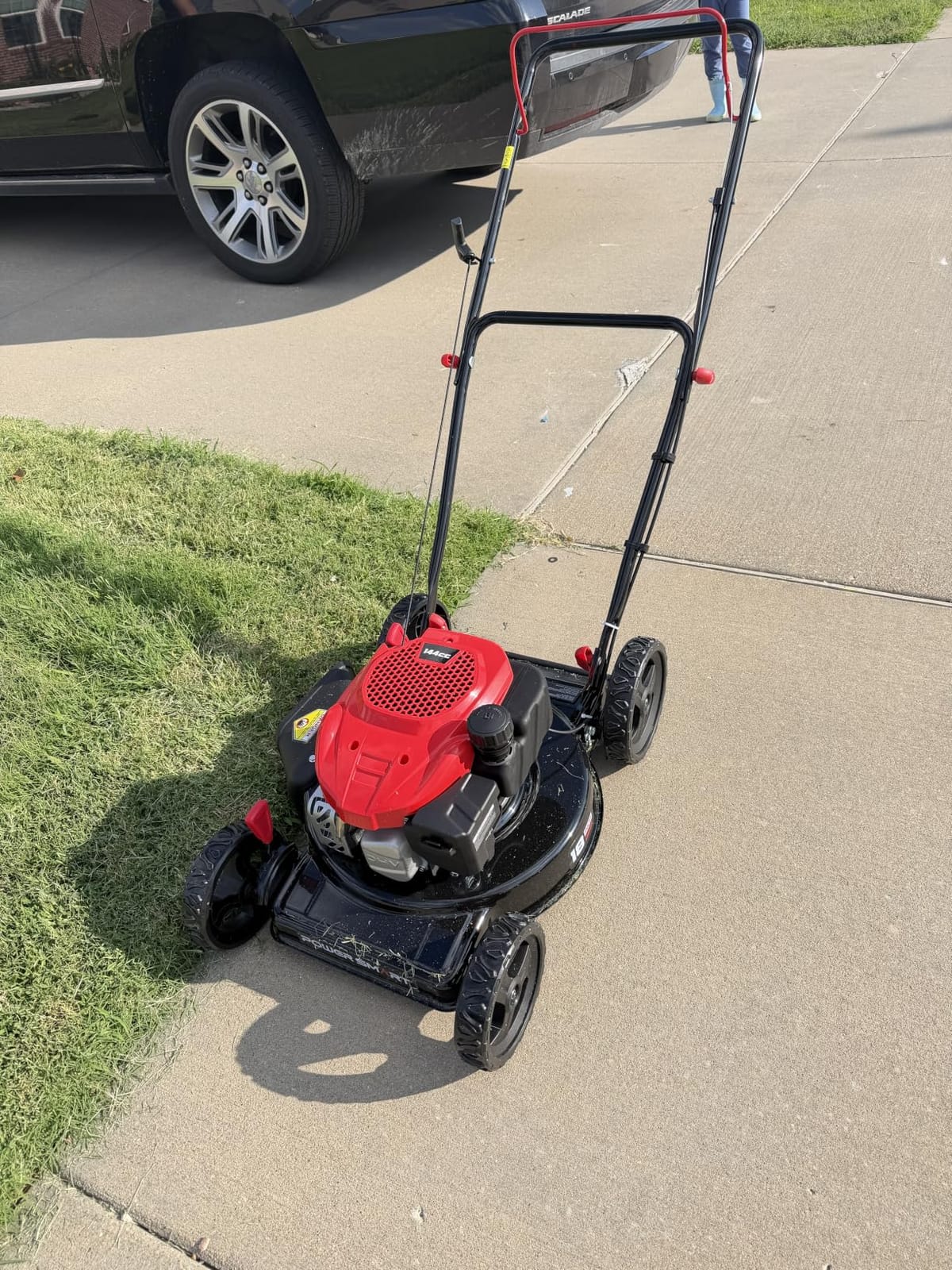
4. PowerSmart EasyCut 18-Inch Gas Mower with Side Discharge
- Cuts damp six-inch grass cleanly per owner reports
- Lightweight at 58.4 pounds with low handle vibration
- Arrives about 90 percent assembled
- Uses very little fuel
- Side discharge only with no bag or mulch option
- Rear rubber debris skirt can slide under the deck
- Stiff primer bulb takes five or six pushes
- No self-propelled drive
Owner reports on this mower keep repeating the same thing: it cuts damp six-inch grass cleanly and evenly. For a machine with no self-propelled drive and a side-discharge-only deck, that is a genuinely useful result in wet conditions, where most push mowers of this size would stall or leave clumps.
The side-discharge layout is the design logic here. There is no bagger to plug, so wet clippings leave the machine through a wide opening rather than being forced through fabric. If clogging is your primary fear, removing the bagging option entirely is a crude but effective fix.
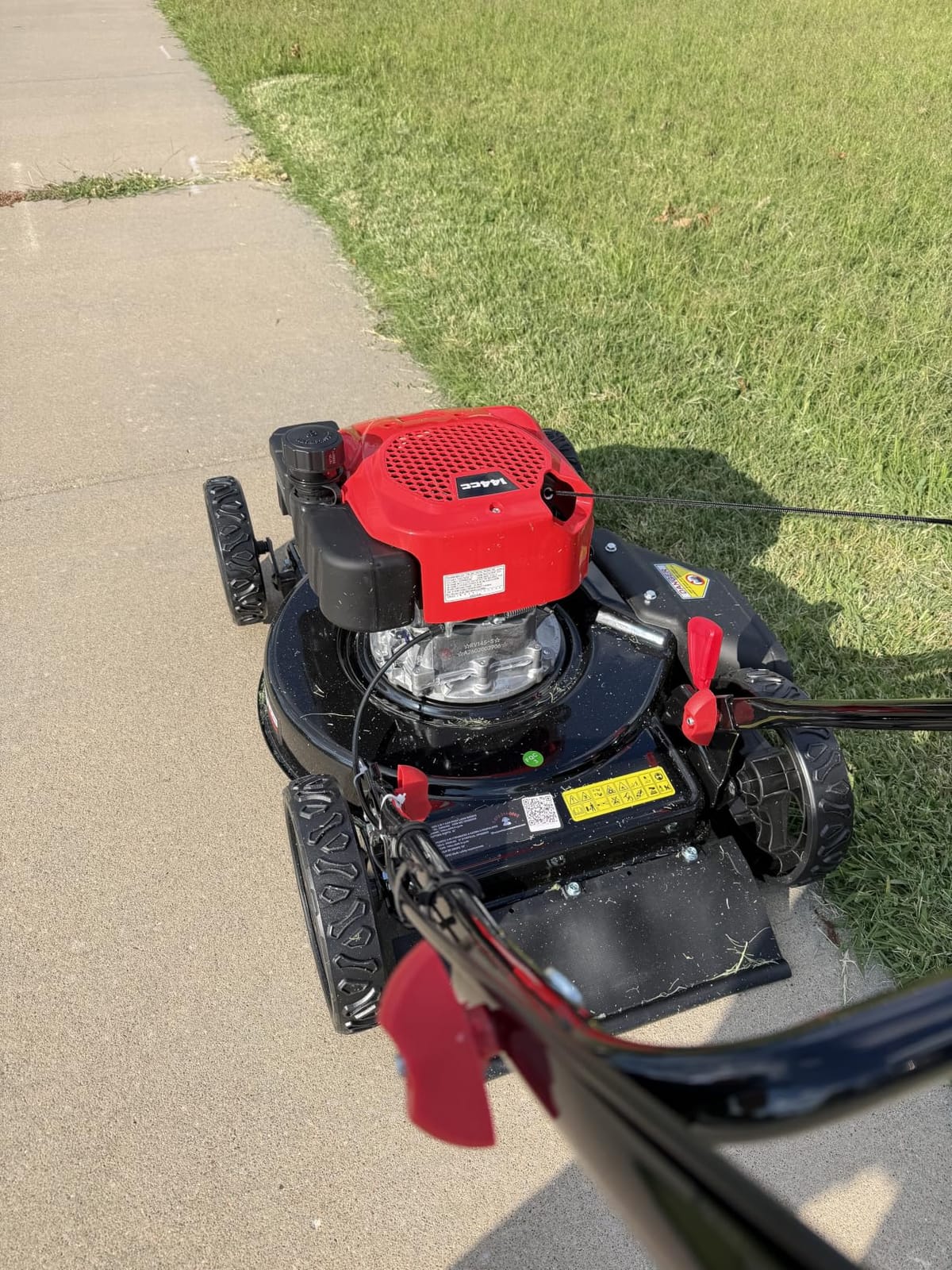
At 58.4 pounds it is light in the hand, with low vibration in the handle, and it arrives roughly 90 percent assembled so setup takes minutes. The 144cc 4-stroke OHV engine uses very little fuel and is quieter than larger engines, which matters on a damp weekend when you are trying to finish before neighbours object.
One lever moves cutting height across all four wheels from 1.5 inch to 3.9 inch. The 8-inch rear and 7-inch front wheels handle ditches and tight areas that a riding mower cannot reach, which is where a lot of uneven ground hides on a small wet yard.
It is not self-propelled, and there is no bagging or mulching. That is a limited machine by today’s standards, but for someone with a small overgrown lot who wants a gas engine and does not mind side discharge, the simplicity is the selling point.
The Case for a Single-Discharge Mower
Removing the bagger eliminates the single most common wet-grass failure point on the machine. Nothing to plug at the deck junction, no heavy saturated fabric to fill, and no clumps deposited on the lawn afterwards.
Owners also report that the 144cc engine powers through the tall damp growth that stops smaller machines, and the 58.4-pound weight makes it easy to lift and reposition rather than drag across softening ground.
What Gives Us Pause
The rubber rear debris skirt is poorly designed and slides under the deck when the mower is pulled backward, where it can contact the blade. The primer bulb is stiff and takes five or six pushes, and there is no bag or mulch option at all.
On a slope you are pushing this with no drive assist, so wet and sloped ground together are its weakest combination. If that describes your lawn, step up to one of the self-propelled picks.
5. PowerSmart 21-Inch 144cc 4-Cycle with All-Steel 2-in-1 Deck
PowerSmart 21-Inch Gas Lawn Mower, 144cc 4-Cycle OHV Engine, Push Mower with Mulching & Side-Discharge, 6 Cutting Heights
- Cuts tall tough weeds and high grass well
- Large rear wheels roll over uneven wet terrain
- Foldable design saves storage space
- Quick three-minute assembly
- Side chute is held on by weight and a spring
- Rear rubber flap rolls up under the deck when pulled back
- Air filter arrived soaked with oil on some units
- No bagging capability
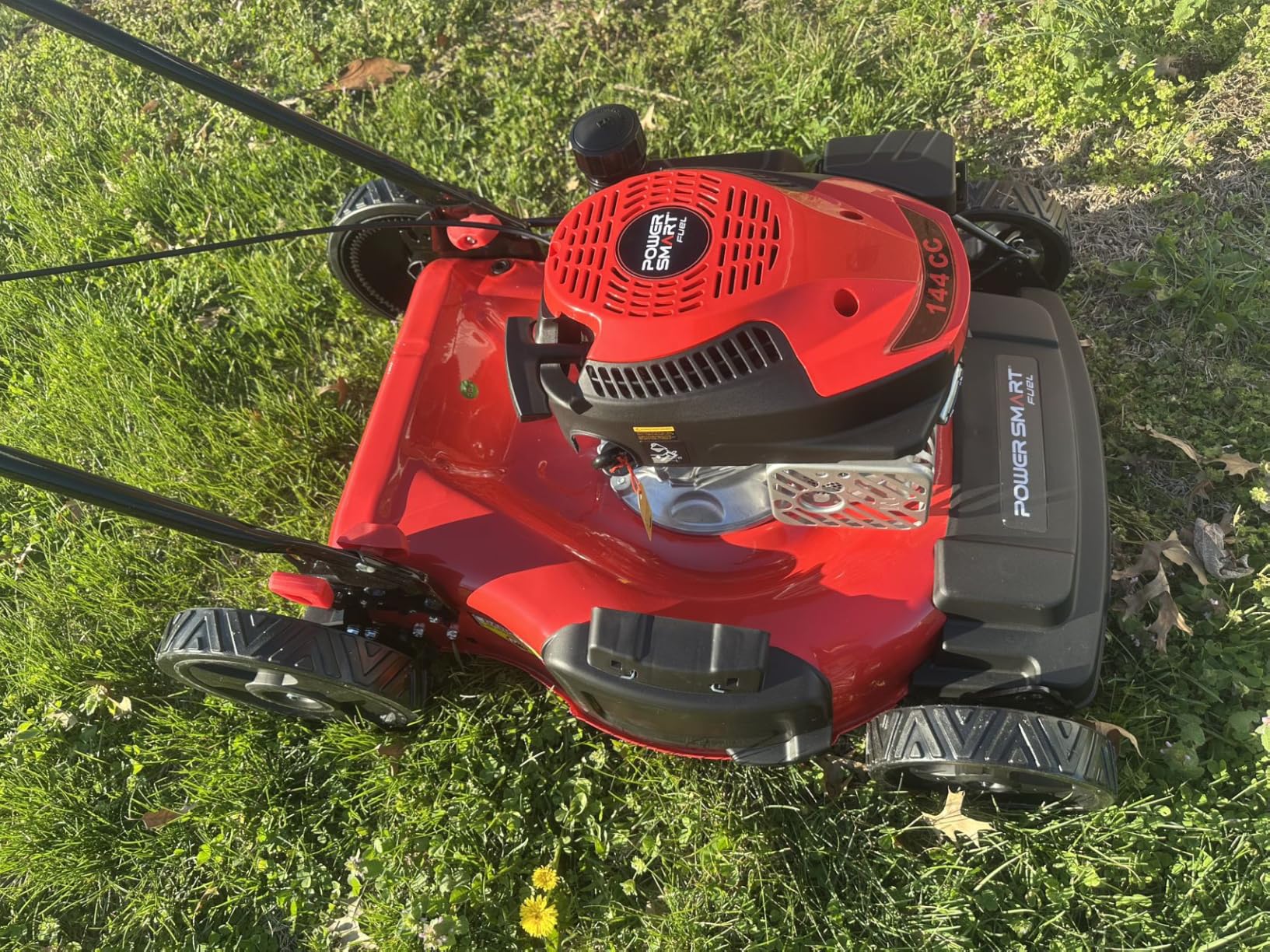
This is the 21-inch machine to buy if your wet problem is height rather than moisture. Owners single out its ability to cut tall, tough weeds and high grass, and a 144cc 4-stroke OHV engine with an auto choke has the torque to keep blade speed up through that kind of growth without bogging.
The all-steel 2-in-1 deck combines mulching and side discharge, so the steel construction keeps the deck rigid when fully loaded. Rigid matters in wet conditions because a flexing deck changes cutting height under load, which is how uneven cuts appear on a damp lawn.
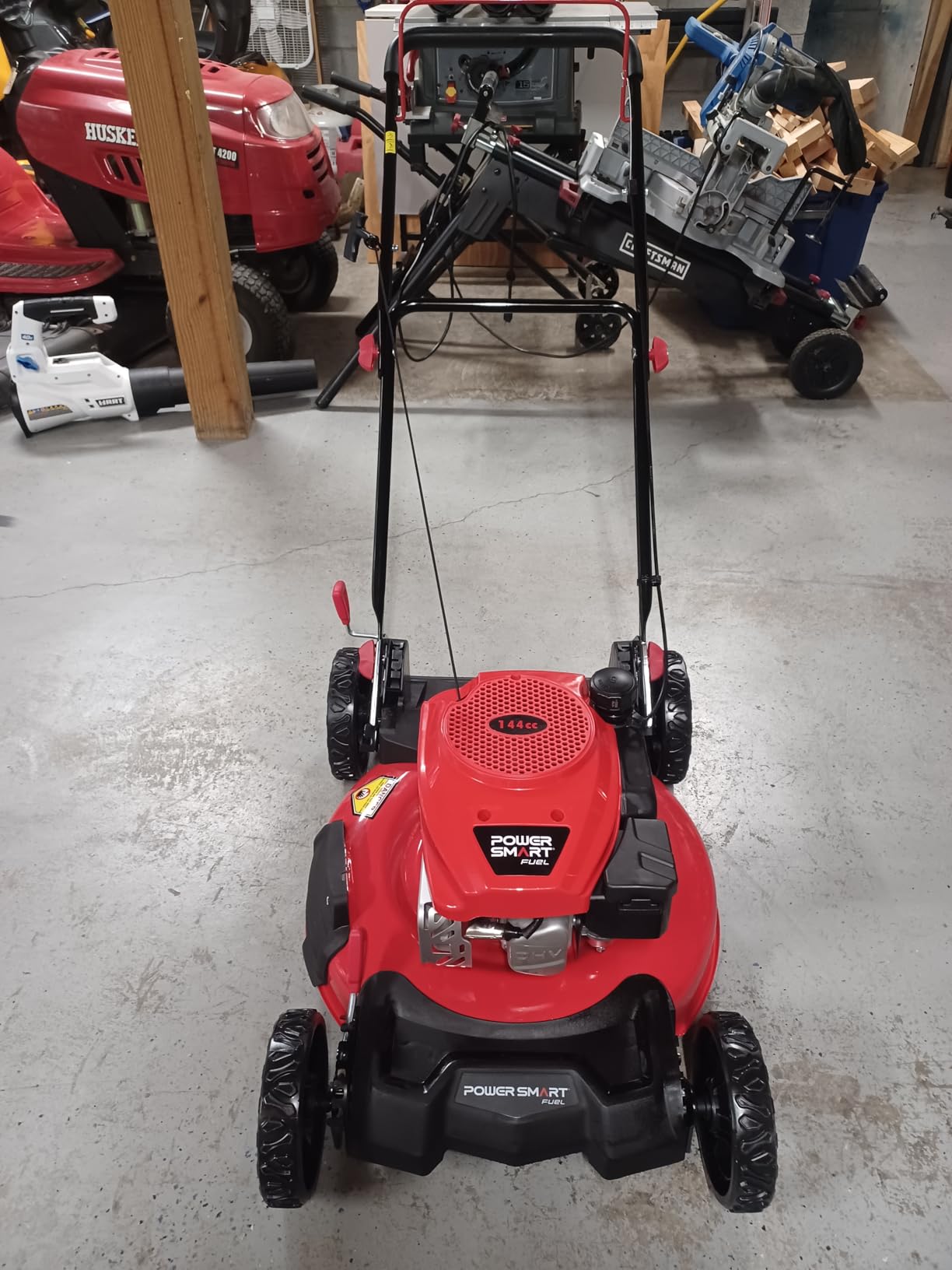
Large 10-inch rear and 7-inch front wheels handle uneven terrain, and the single-lever adjustment moves all four wheels at once from 1.5 inch to 3.9 inch. Adding half an inch of cutting height before a damp pass takes one motion, which is exactly what wet-mowing technique calls for.
At 59.4 pounds with a foldable design that saves up to 70 percent of storage space, it is easy to live with in a small garage. Assembly takes about three minutes, and oil and a wrench are included.
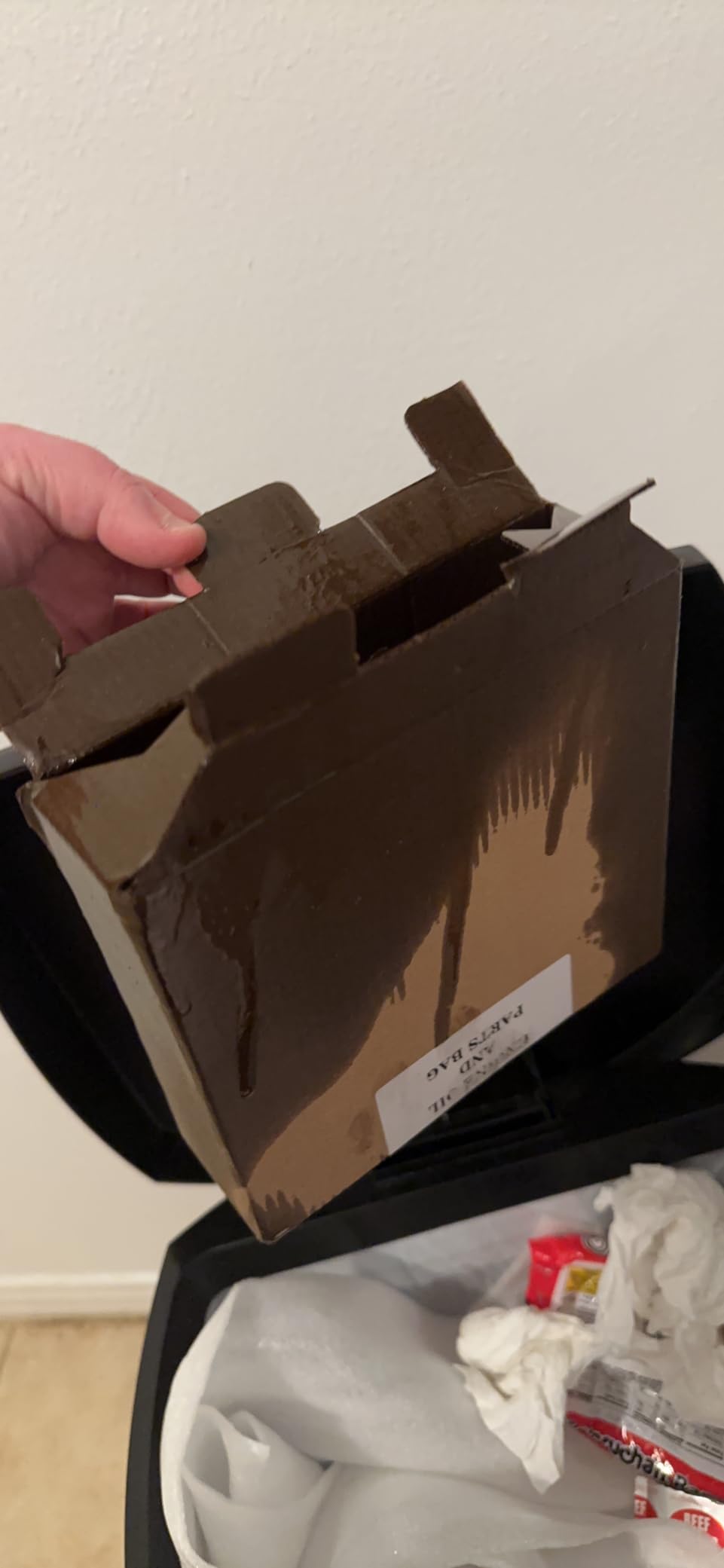
There are a few build-quality reports worth knowing about, including an air filter arriving soaked with oil and a pull-cord assembly failure after two uses. The chute itself is held on by its own weight and a spring mechanism, and the rear rubber flap is long enough to roll up under the deck when you pull the mower backwards.
Best Fit for Overgrown Damp Lawns
The pairing of a 144cc engine with a 21-inch steel deck spreads the load well on overgrown damp lawns. A wider deck takes in less material per pass, so the blade loads up more slowly and keeps its speed.
No bagging keeps the discharge path wide and open, and the foldable frame means a wet-season machine does not have to live in the garage all year. It is a sensible second mower for a yard that grows fast in spring.
Weak Spots to Know
The side chute relying on weight and a spring is a design weakness on a machine whose main selling point is the chute. The long rear flap rolling under the deck when you pull backwards can also catch the blade if you are not careful.
Several owners reported quality control issues on arrival, including an oil-soaked air filter. Check the filter and the recoil assembly before the first mow.
6. BILT HARD 21 Inch Gas Mower with 144cc 4-Cycle Engine
- Plows through high grass with power on the first pass
- Large fuel tank covers an acre-plus yard on one fill
- No priming required and starts on the first pull
- Synchronized single-lever height adjustment
- One owner reported severe vibration damaging the housing and leaking oil
- Carburetor problems needed repeated cleaning
- Not a brush hog in vegetation over 18 inches
- Rear wheel carrier is screwed into plastic
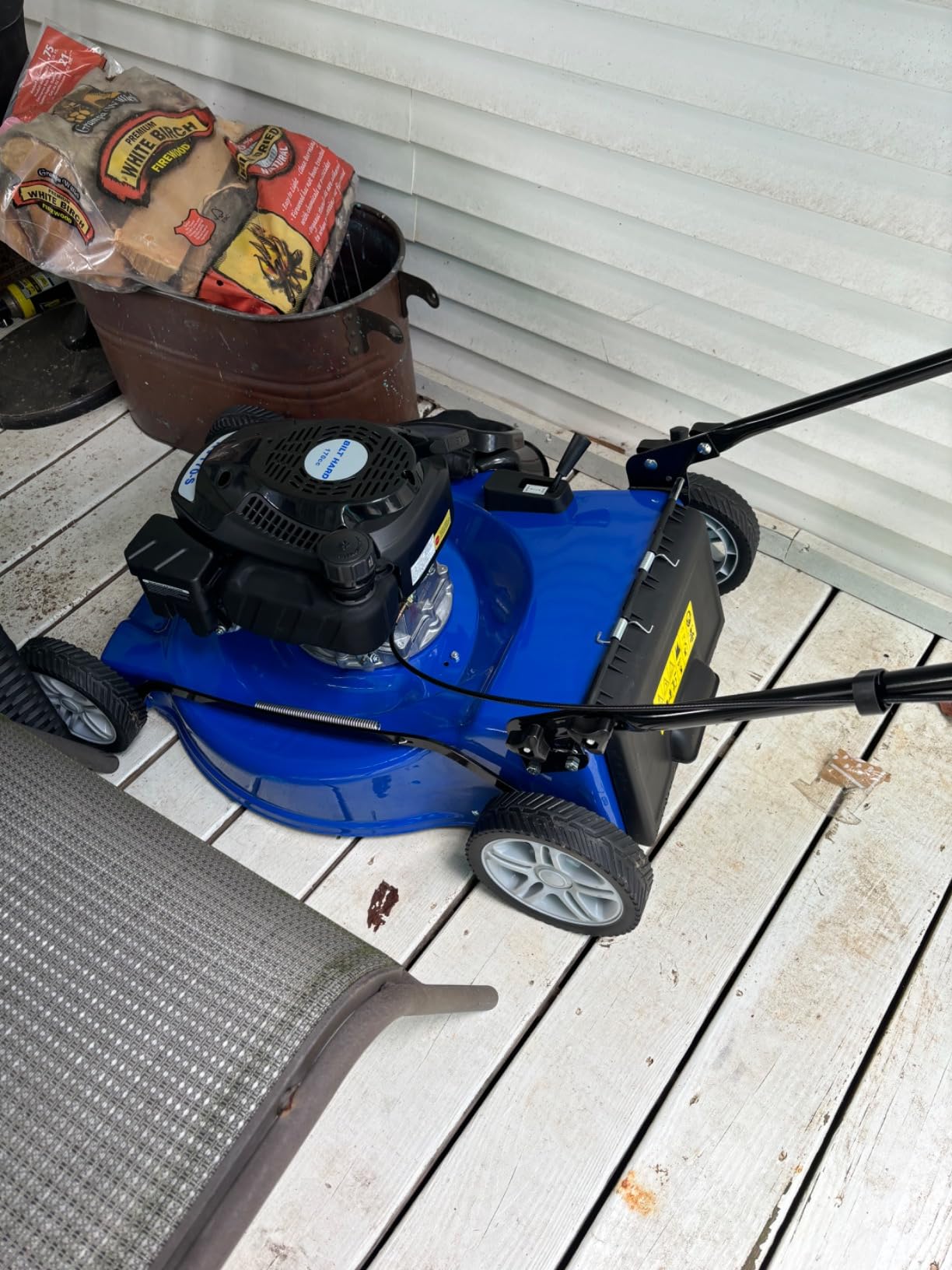
Torque is the headline number here, and it is a published figure rather than a marketing phrase. The 144cc 4-cycle engine is rated at 3.4 HP and 5.75 ft.lb of torque, which is the sort of low-speed grunt that decides whether a blade keeps turning when it hits saturated growth. Owners report it plowing through high grass on the first pass.
The 27.1 fl.oz fuel tank is the largest in this group and covers an acre-plus yard on a single fill. On a wet week when you may mow more than once, not stopping for a refill is a practical advantage that is easy to underestimate.
You get a 21-inch steel deck, a 3-in-1 system covering bagging, mulching and side discharge, and oversized 10-inch front and rear wheels. The synchronized single-lever height adjustment works smoothly and quickly, and the engine needs no oil mixing and no priming routine.
The grass bag, side chute, mulch plug, oil and tools are all included, so there is no extra shopping before the first damp mow. Setup is straightforward and the push operation is uncomplicated, which matters if the mower is shared across a household.
The 4.1 rating reflects a small but serious tail of durability reports, including one detailed account of vibration so severe it stripped screws, cracked the plastic dipstick housing and leaked oil. Carburetor instability and a recoil guide clip that can snag the rope and stop the safety bar also appear in reviews, and that last one interrupts a cut mid-lawn.
Why Torque Figures Matter on a Damp Lawn
Published torque tells you what the engine delivers at low RPM, which is exactly the range a mower spends its time in when cutting. The 5.75 ft.lb figure gives this machine more reserve than most 144cc competitors, and reserve is what stops a wet mat from stalling the blade.
The large tank and 10-inch wheels round out a package aimed at bigger properties, and 3-in-1 discharge lets you choose the mode that suits the day rather than the machine.
What Concerns Us
It is not a brush hog, and owners report it struggles in vegetation over 18 inches, so very overgrown wet ground is out of scope. The rear wheel carrier is screwed into a plastic housing, and the recoil clip issue can stop the cut without warning.
Difficult to push uphill is also a repeated comment, and wet slopes are the hardest case. If your lawn has real grade to it, look at the self-propelled option instead.
7. YARDMAX 22in 201cc CVT Self-Propelled Mower
YARDMAX 22 in. 201cc Select PACE 6 Speed CVT High Wheel FWD 3-in-1 Gas Walk Behind Self Propelled Lawn Mower, Black (YG2860)
- CVT lets you match mower pace to walking speed
- Spiked high-grip tires add traction on slopes and soft ground
- Automatic choke means no priming
- 22-inch deck reduces mowing time
- Heaviest unit in the group at 84.9 pounds
- Softest rating profile here with a 17 percent one-star share
- Speed control adds complexity for first-time owners
This is the traction answer on the list. The 201cc engine is the largest in the group, and the CVT 6-speed continuously variable transmission lets you match mower pace to your walking speed, which owners describe as giving much better control in thick, wet grass than a fixed-speed drive.
Front-wheel drive combined with aggressive spiked rubber tire tread is what makes it work on slopes. When sodden ground reduces normal grip, extra tread and drive force on the front wheels are what keep the machine tracking straight instead of sliding sideways.
The 22-inch deck is the widest walk-behind here, so each pass cuts more area and finishes a big wet lawn faster. The 3-in-1 deck covers mulching, bagging and side discharge, and the single-lever height adjustment keeps the raised-deck technique quick.
Automatic choke means no priming or choking routine, which removes the most common reason a gas mower refuses to start on a dewy morning. A deck cleanout port also lets you clear packed clippings from underneath without tipping the machine.
At 84.9 pounds this is the heaviest unit in the group, and that weight is tiring to manoeuvre even with drive assist. It also has the softest rating profile in our set, with a 17 percent one-star share pointing to durability friction over time rather than a single design fault.
How Traction Changes the Wet-Mowing Job
On flat damp ground, traction is a comfort issue. On a slope it becomes the safety issue, because a mower that cannot hold its drive wheels on sodden sod will slide. Front-wheel drive with spiked tread is the combination owners most often recommend for that situation.
The CVT is the other half of the traction story. Matching speed to load means the drive does not overwhelm the blade or stall the engine when grass thickens, and the 22-inch deck reduces the number of passes you need on a wet slope.
Where It Costs You
Eighty-four pounds is heavy to control on uneven ground, and the CVT speed control adds a layer of complexity that first-time mower owners sometimes find unnecessary. The 4.0 average and 17 percent one-star share are the weakest scores in our set.
If your lawn is flat and small, that weight buys you nothing. This machine makes the most sense when slope and size are both working against you.
8. Greenworks 40V 16in Push Cordless Mower
- Motor revs automatically under load through tall thick growth
- Light enough to lift one-handed and easy on slopes
- Push-button start with no pull cord
- Folding handle for compact storage
- About 35 minutes of runtime
- Plastic blade housing wears over time
- 16-inch deck needs more passes on larger lawns
- Bagging suction is weaker with very wet clippings
With more than 12,000 reviews behind it, this is the most proven mower in our set, and the owner reports are unusually consistent. People describe the motor automatically revving up under load while cutting 12 to 18 inch grass and heavy weeds, which is the behaviour you want when clippings double in weight.
At 37.5 pounds it is 35 percent lighter than steel-deck mowers, and that translates directly into wet-ground handling. You can lift it one-handed, reposition it on a slope, or carry it out of a soft corner without dragging a heavy machine through it.
The 40V platform covers up to a third of an acre on a 4.0Ah charge, with roughly 35 minutes of average battery life. The 5-position lever runs from 1.25 inch to 3.75 inch, and the 2-in-1 system handles mulching and rear bagging.
Push-button start means no pull cord on a dewy morning, and the motor produces no vibration compared with a gas engine. It is also quiet enough to use early without the neighbour complaint that comes with a gas mower at 7 a.m.
Two limitations define where it fits. The 16-inch deck, listed at 15.67 inch, needs more passes on anything larger than a small yard, and the 2-in-1 system has no side-discharge chute, which removes the best wet-grass tactic from the table.
Why the Light Weight Matters on Wet Lawns
Weight compounds quickly on soft ground. A 37.5-pound mower follows the contours of a damp lawn instead of digging into them, and on a slope you can correct its direction rather than fighting it. For anyone with a small uneven yard, that is worth more than deck width.
The automatic load response is the other key trait. Owners report it handling overgrown, seed-heavy grass without slowing down, which is the exact scenario where a fixed-output battery mower gives up.
What to Accept
Roughly 35 minutes of runtime means a backup battery is advisable for anything beyond a small yard, and the plastic blade housing will wear over time, especially around rocks. Suction is lower than some gas mowers, so bagging very wet clippings is less complete.
No side discharge is the real limitation for this topic. On a wet lawn, plan to mulch with the deck raised, or wait for drier grass to bag.
9. SENIX 21 Inch 144cc Gas Mower with Vortex Tunnel Deck
SENIX 21″ Gas Lawn Mower 144cc, 3-in-1 Push Mower Mulch Bag Side Discharge
- Vortex tunnel design reduces grass buildup under the deck
- 5.8 ft-lb torque holds power through thick grass
- Starts immediately with oil pre-filled
- Large 1.7 bushel bag means fewer stops
- Softest rating profile with a 15 percent one-star share
- Dual-lever height adjustment is slower to set
- No self-propelled drive
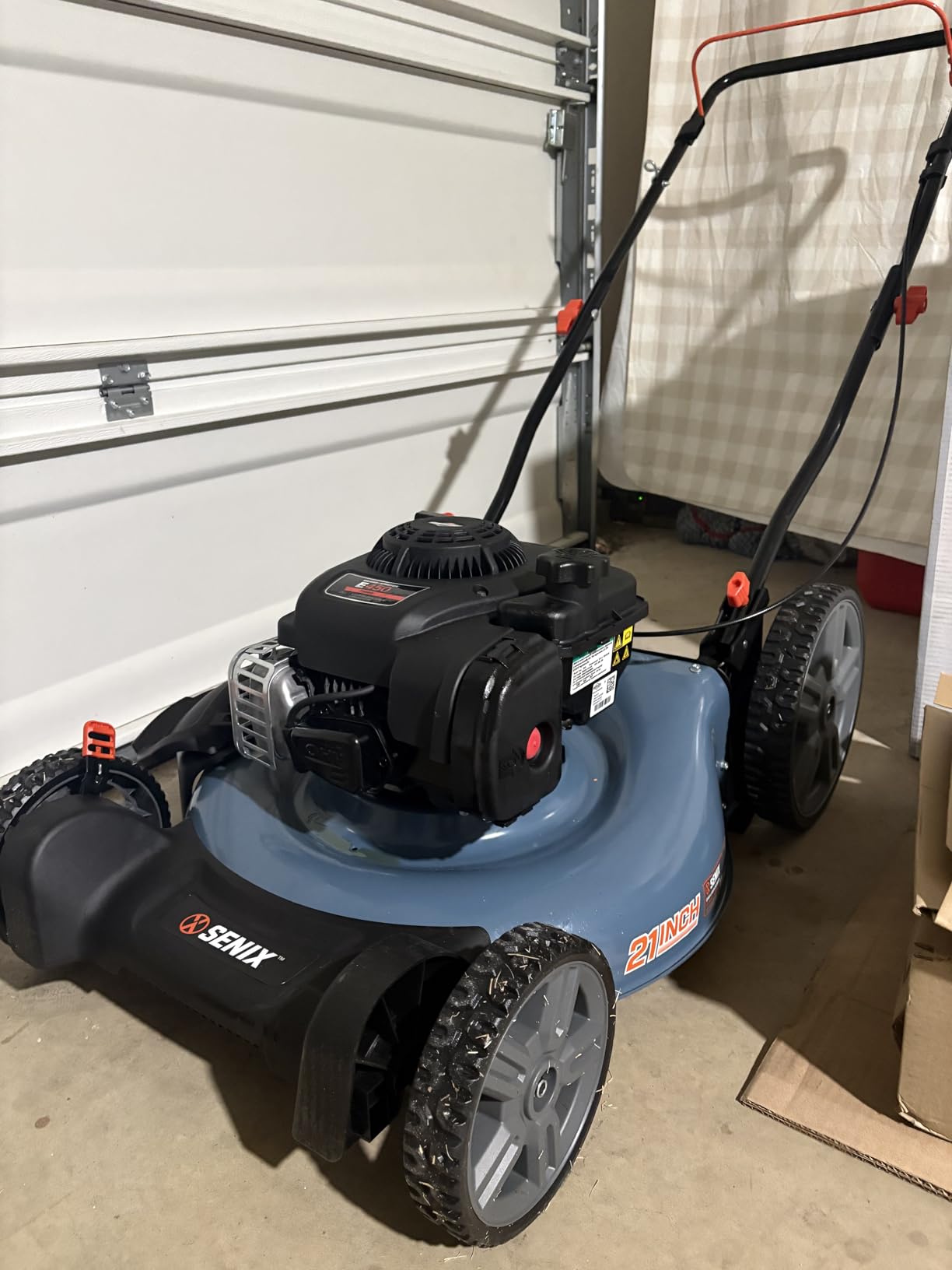
The vortex tunnel deck is the feature that earns this mower its place, and owners single it out by name. The tunnel design actively reduces grass buildup under the deck, which is precisely the failure that stops walk-behind mowers in damp conditions, and the anti-clog geometry does that work whether you are bagging or discharging.
Under the deck sits a 144cc 4-cycle OHV engine rated at 3.4 HP and 5.8 ft-lb of torque, the highest published torque figure in our group. That figure is the mechanical reason the blade keeps turning through saturated growth instead of bogging.
The stainless steel deck switches between rear bagging, side discharge and mulching, and the 1.7-bushel grass catcher is generous, so you make fewer stops in the middle of a wet pass. Engine oil is pre-filled, so it starts straight out of the box with no mixing and no priming.
Eight-inch front and 11-inch rear all-terrain wheels give good stability on uneven ground, and the 54.2-pound weight keeps it manageable. Fuel consumption runs about 27 oz per hour, which is reasonable for a machine of this class.
The 4.0 rating with a 15 percent one-star share is the softest profile here. The dual-lever six-position height adjustment, running from 1.25 inch to 3.75 inch, takes longer to set than a single lever, and raising the deck mid-mow is the first thing you should do on a wet morning.
What the Vortex Tunnel Actually Solves
Most clogged mowers do not clog in the deck, they clog where clippings stop moving. The vortex tunnel channels air along the underside of the deck so wet material is pushed outward toward the discharge instead of settling and bridging. That keeps the blade clear and the cut even in damp conditions.
Combined with side discharge and 5.8 ft-lb of torque, this is one of the better-specified wet-grass packages in the group, and the large wheels help on the soft ground that follows rain.
Where It Falls Behind
The dual-lever height adjustment is an inconvenience exactly when speed of adjustment matters, and there is no self-propelled drive, so wet slopes are tough. The 15 percent one-star share is the second weakest here, so expect some durability complaints over time.
If you want the same anti-clog logic with electric power and self-propulsion, the Greenworks 60V kit further down uses a different approach to the same problem.
10. Greenworks 60V 21in Self-Propelled Mower with Dual Batteries
Greenworks 60V 21in Self-Propelled Lawn Mower, (2) 4.0 Ah Battery Kit
- Rear-wheel drive handles slopes and thick wet grass with minimal effort
- Dual 4.0Ah batteries cover up to three-quarters of an acre
- 4-in-1 deck includes turbo leaf pickup for wet debris
- Ultra-bright LED headlight for dawn mowing
- Two batteries make it a two-hand lift
- Dual-battery kit is bulkier to store
For a larger lawn that stays damp, this is the most capable cordless machine in our set. The 60V brushless motor with two 4.0Ah batteries covers up to three-quarters of an acre per charge, the largest capacity here, and owners rate it the strongest all-round cordless option for slopes and heavy wet growth.
Rear-wheel drive with on-the-go speed adjustment is the wet-grass feature. You can slow the drive in soaked sections and speed it up on dry runs, which is the same advantage the 80V model offers at a smaller scale, with more power and more capacity behind it.
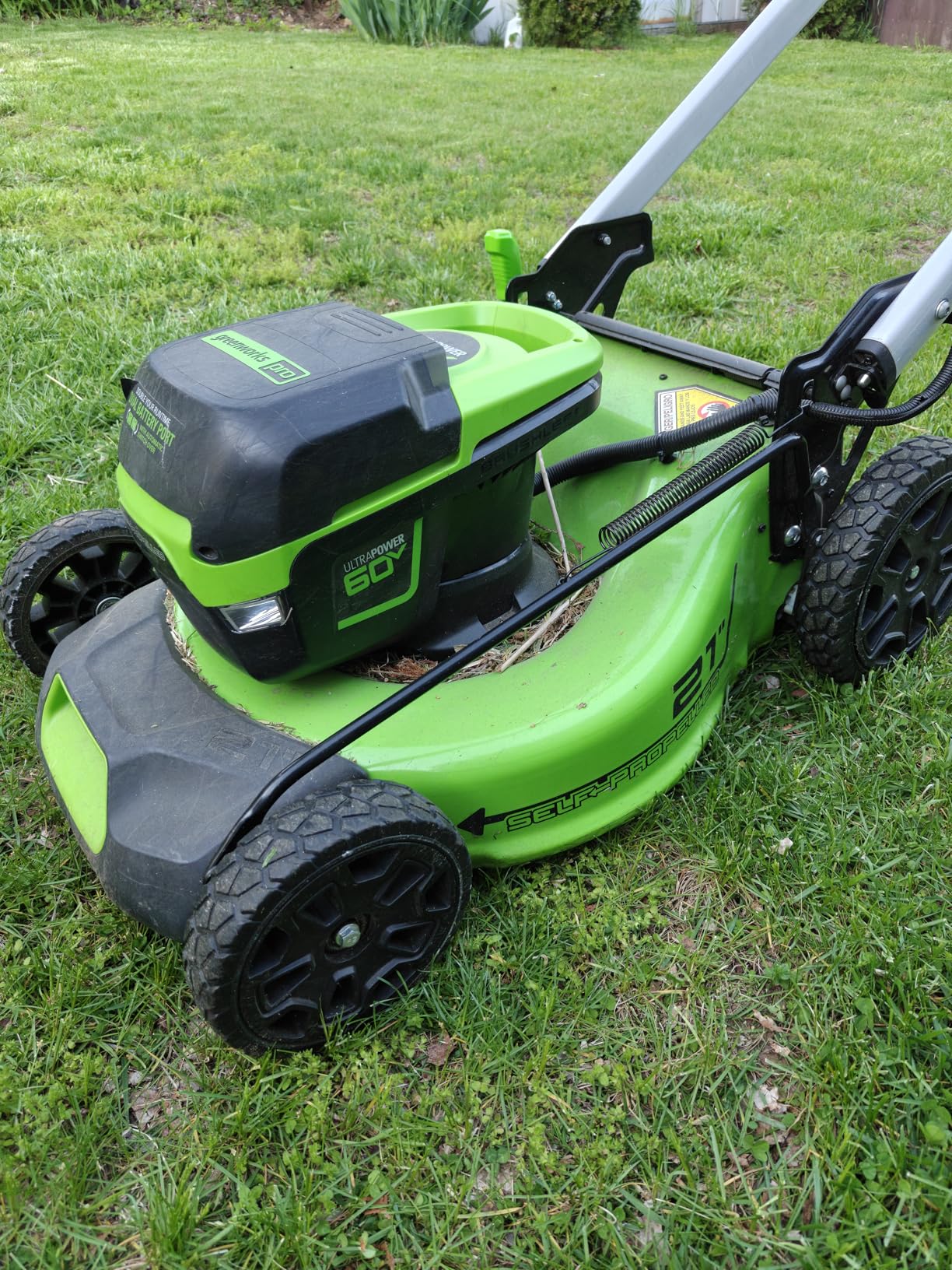
The 4-in-1 deck covers mulching, bagging, side discharge and turbo leaf pickup, and that last mode matters more than it sounds in wet weather, because wet leaf debris mats into the same places grass does. The ultra-bright LED headlight also allows mowing at dawn, which is often the driest window in a wet week.
Cutting height runs from 1 inch to 4 inches across seven positions, giving plenty of room to back off on soft ground, and the machine is 3x quieter than gas with instant starts and no emissions. Compatibility with 75+ Greenworks 60V tools and a 4-year limited warranty round out a well-supported platform.
At 65 pounds with two batteries fitted, this is a two-hand lift and the dual-battery kit is bulkier to store than a single-battery mower. Runtime still falls in thick wet turf, so on a large lawn you are likely charging between passes.
Where This One Pulls Ahead
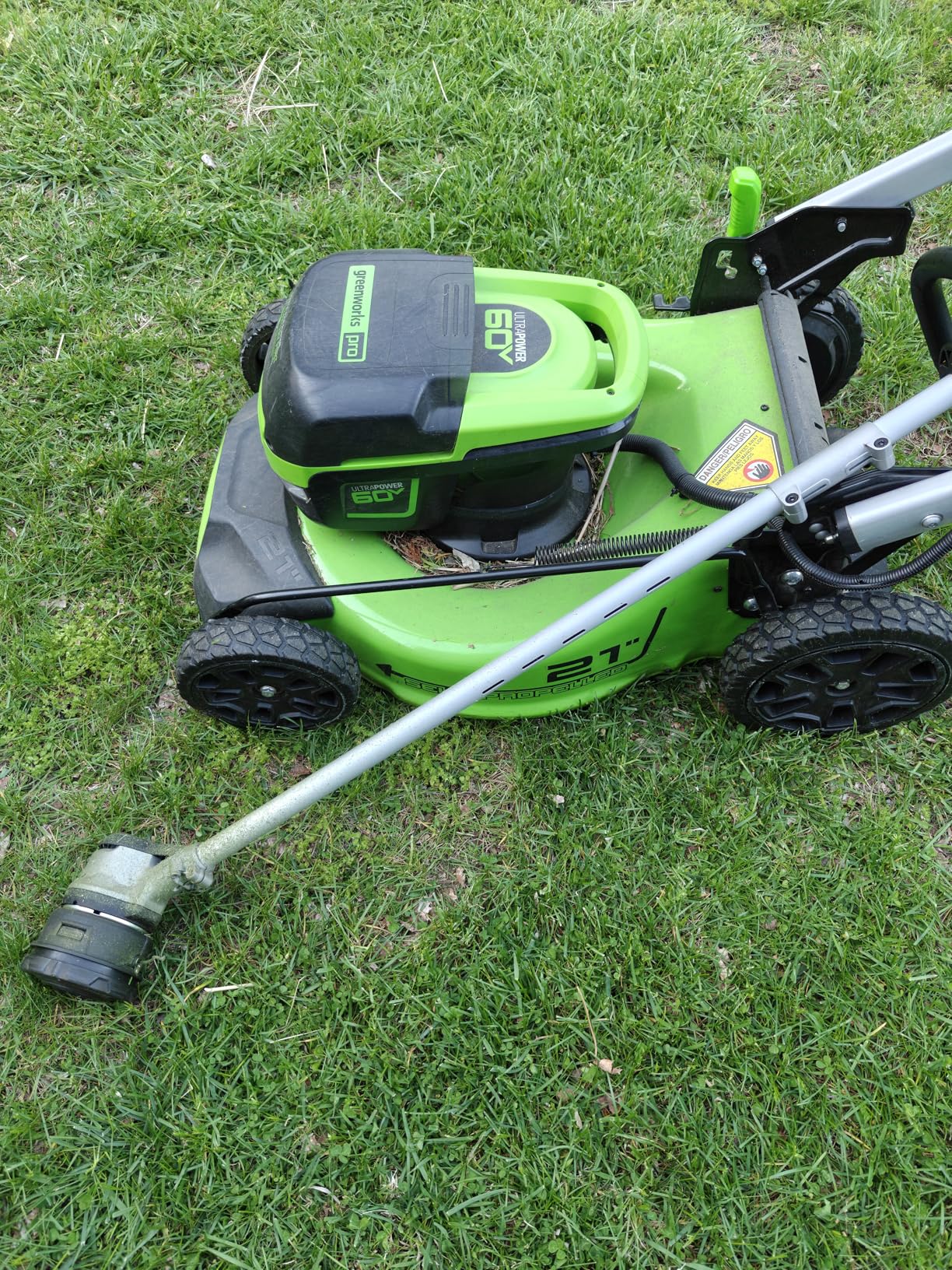
Rear-wheel drive on a 60V platform is the combination that makes a self-propelled cordless mower usable on a slope with damp grass. Owners credit it with handling slopes and thick wet grass with minimal effort, and the adjustable pace lets you match the drive to the load continuously.
Three-quarters of an acre per charge removes the mid-job charge anxiety that makes people abandon a battery mower on a big lawn. The 4-in-1 deck and turbo leaf pickup also make it the most versatile machine for autumn debris.
The Practical Limits
Sixty-five pounds plus two batteries is heavy, and on soft ground you will feel it every time you reposition. It is also the biggest storage commitment in this group, which matters if garage space is tight.
Like every cordless mower here, thick wet growth drains the pack faster than the headline capacity suggests. If your lawn is small, the 40V model covers more than you need. Our electric lawn mower guide compares the platform options in more detail.
How to Mow Wet Grass Without Clogging
These five steps are the technique that forum users converge on, and they matter as much as the machine. Follow them and most clogging disappears, even with a mid-range mower.
- Raise the deck half an inch above your normal setting. More blade height means less material enters the deck per pass, so the blade loads up more slowly and wet roots are less likely to be torn.
- Side discharge instead of bagging or mulching. Opening the chute lets wet clippings leave the machine through a wide opening. Bagging forces them through a narrow throat, and mulching needs clippings chopped fine enough to sink in, which damp grass resists.
- Mow at about half your normal speed. Slower travel gives the blade time to cut and clear wet clippings before they accumulate. Rushing a damp lawn is the most common cause of clumps and stalls.
- Sharpen the blade before the pass, not after. A dull blade tears wet grass rather than cutting it, which leaves ragged tips and slows the deck by creating drag.
- Empty the chute and bag regularly. Stopping every few passes to clear matting takes less time than stopping once the machine has fully bogged down mid-lawn.
The one-third rule matters more in wet conditions than dry. Never remove more than a third of the blade length in one cut, because a heavy cut on a wet lawn leaves the plant with too little leaf surface to recover, and stressed grass is far more vulnerable to disease.
If your mower is already clogging, check the order of these before buying anything new. A dull blade, a plugged chute and a deck set too low account for most complaints, and each is a five-minute fix. More on troubleshooting is covered in the FAQ below.
Buying Guide: What to Check Before You Buy for Damp Lawns
Five specifications decide whether a mower tolerates wet grass, and none of them is a headline power number. Here is what to look at, in the order that matters.
1. Torque, not horsepower. Torque is the force available at low speed, which is the range a mower works in when the blade is loaded. Published torque figures above roughly 5.5 ft.lb indicate real reserve for damp conditions. On battery mowers, look for a brushless motor, since brushed motors lose output exactly when they are already under load.
2. Deck width and airflow. A wider deck spreads the same engine load over more area, so each pass brings in less material. Look for vents or channels in the deck that move clippings outward, since an open airflow path is what stops matting from bridging under the machine.
3. Side discharge availability. This is the single most useful feature for wet mowing and the most frequently omitted. A machine with mulch and bag only forces wet clippings through the deck-to-bagger junction, which is where almost every wet-mow clog happens. Verify the chute exists before you buy.
4. Drive type and traction. Rear-wheel or front-wheel drive with aggressive tread gives you something to push against when sodden soil reduces grip. Push mowers are fine on flat ground but become a real problem on any slope, and self-propelled units let you vary speed to match the load.
5. Height adjustment range. You need at least half an inch of extra cutting height available instantly. A single lever that moves all four wheels at once lets you respond to changing conditions mid-mow, which is when wet grass usually gets worse rather than better.
Battery versus gas is the remaining question. Gas gives you consistent torque and unlimited runtime, and the fuel also has to be stored and drained after a wet season. Cordless is quieter, starts instantly and needs no fuel handling, but runtime falls in thick wet growth, which is the condition you care most about. Our riding mower guide covers the large-lawn end of the market if you are mowing more than half an acre.
One safety note worth stating plainly. Cordless mowers are sealed battery tools designed to run in rain, but you should still avoid mowing in active rain or standing water, and never use a corded electric mower outdoors in wet conditions. On slopes, keep the low end of your mower’s slope rating in mind, and note that zero-turn platforms can slide on grades beyond about 15 degrees.
After any wet mow, clear the deck and dry the chute before storing the machine. Blow or rinse out packed clippings, let the deck air out, and expect to sharpen blades more often. If you own a gas mower, a plugged fuel filter or a fouled carburetor after a damp stretch of mowing is a common and avoidable failure, and robotic platforms are worth skipping in saturated conditions entirely, as the robotic mower guide explains in more detail.
Frequently Asked Questions
What lawn mower can you use on wet grass?
Any mower with enough torque to keep the blade turning under heavy damp clippings, a high-airflow deck, a working side-discharge chute and drive wheels that grip wet ground. Gas self-propelled models with 22-inch decks handle the toughest growth, while brushless battery mowers with rear-wheel drive cover most suburban lawns. Raise the deck half an inch and side discharge to get a clean result.
Should I mow my lawn when the grass is wet?
Occasionally, yes, if the grass is damp rather than dripping and the soil is firm enough that your footprints do not sink. Damp grass tears rather than cuts cleanly and can leave clumps, so mow slowly, raise the deck half an inch and side discharge. If you are leaving visible impressions in the soil, wait for a drier window.
Does wet grass clog a mower?
It does, and the clog point is usually not the deck itself. Wet grass is roughly twice as heavy as dry, the clippings mat instead of blowing free, and the pile builds at the narrowest opening, which is typically where the deck chute meets the grass catcher. High deck airflow, a wide side chute and a higher cutting setting prevent most of it.
Why does my lawn mower keep clogging up with grass?
Five causes account for nearly every case: the deck is set too low, the blade is dull, the chute is packed with wet matting, the grass is too tall for the cut you are attempting, or the engine lacks torque for the load. Work through them in that order, starting with a half-inch deck increase and a sharpened blade before replacing anything.
Why is my mower leaving clumps of grass?
Clumps appear when the deck cannot process what it is cutting fast enough. In damp conditions that means clippings are matting under the deck, blocking the chute or overfilling the bag. Side discharge instead of bagging, slow to about half your normal mowing speed, and empty the bag every few passes. A dull blade makes the problem worse by increasing drag.
What is the 1/3 rule in mowing?
The one-third rule says never remove more than a third of the grass blade length in a single cut. It matters more on wet lawns because a heavy cut leaves too little leaf surface for the plant to recover, and stressed grass is more vulnerable to disease. Cutting tall and often in damp weather protects both the lawn and the mower.
The Best Lawn Mowers for Wet Grass in 2026: Final Verdict
The PowerSmart EasyGlide 21-Inch 3-in-1 earns the top spot because it handles the widest range of damp conditions without asking you to change technique. A 144cc 4-stroke engine with real low-speed torque, a steel deck that stays rigid under load, and all three discharge options means it works whether you side discharge on a wet morning and bag on a dry one.
For cordless, the Greenworks 80V 21in self-propelled is the pick, thanks to variable-speed rear-wheel drive that lets you match pace to the load. If clogging is your specific fear, the Worx WG752 and its AeroDeck venting attack the problem directly, and the YARDMAX 22in 201cc is the answer when slope and traction are the real obstacles.
Whatever you choose, raise the deck half an inch, open the side chute, and mow at half speed. Those three habits will do more for a damp lawn than any spec on a spec sheet, and the right machine just makes them easier to keep. Measure your lawn first, then pick the drive type and power source that match it.