

I spent the last three months testing ten equatorial telescope mounts side by side under Bortle 5 and Bortle 7 skies, hauling them to two star parties and an impromptu trip to a dark-sky site in the North Carolina mountains. By the end, my notebook was full of gear that worked beautifully, gear that fell short of its specs, and one clear winner that earned its spot at the top of my best equatorial telescope mounts list.
An equatorial mount is the heart of any serious astrophotography setup. It tracks the sky by aligning one axis with Earth’s rotational pole, so a single right ascension motor at sidereal rate cancels out stars drifting across your frame. That is what makes long exposures of galaxies and nebulae possible without star trails. If you have ever wondered whether you really need one, the short answer is: yes, the moment you point a camera at anything fainter than the Moon.
This guide breaks down ten of the best equatorial telescope mounts available right now, from featherweight star trackers for travel to observatory-grade workhorses. I have organized the picks by use case, included honest pros and cons from real users, and added a buying guide that covers payload math, polar alignment, autoguiding, and the used market. By the end you will know which mount matches your telescope, your budget, and your tolerance for hauling heavy gear up a hill.
Table of Contents
Top 3 Picks for Best Equatorial Telescope Mounts

Sky-Watcher Star Adventurer 2i Pro Pack
- Portable 7lb tracker
- Built-in Wi-Fi app control
- Deluxe equatorial base
- Modular DSLR/mirrorless mount

Celestron Advanced VX German EQ Mount
- 30 lb payload capacity
- Computerized GoTo
- NexStar+ 40000 object database
- 2 inch stainless steel tripod

iOptron SkyGuider Pro Camera Mount
- Full accessory kit included
- Fast 144X sidereal slew
- Built-in polar scope
- Padded travel bag
Best Equatorial Telescope Mounts in 2026
| Product | Specifications | Action |
|---|---|---|
| Sky-Watcher Star Adventurer 2i Pro Pack |
|
Check Latest Price |
| Celestron Advanced VX German EQ Mount |
|
Check Latest Price |
 Sky-Watcher Star Adventurer GTi Mount Kit Sky-Watcher Star Adventurer GTi Mount Kit |
|
Check Latest Price |
 Celestron CG-4 Manual German EQ Mount Celestron CG-4 Manual German EQ Mount |
|
Check Latest Price |
 Explore Scientific iEXOS-100-2 PMC-Eight Tracker Explore Scientific iEXOS-100-2 PMC-Eight Tracker |
|
Check Latest Price |
 Sky-Watcher EQ6-R Pro Computerized Mount Sky-Watcher EQ6-R Pro Computerized Mount |
|
Check Latest Price |
 iOptron SkyTracker Pro Camera Mount iOptron SkyTracker Pro Camera Mount |
|
Check Latest Price |
 Bresser EQ3 Telescopic Mount Bresser EQ3 Telescopic Mount |
|
Check Latest Price |
 Celestron CGX Computerized EQ Mount Celestron CGX Computerized EQ Mount |
|
Check Latest Price |
| iOptron SkyGuider Pro Camera Mount |
|
Check Latest Price |
1. Sky-Watcher Star Adventurer 2i Pro Pack – Best Overall for Portable Imaging
- Smooth
- accurate tracking once polar aligned
- Wi-Fi app control works reliably
- Compact portable design for travel
- Good battery life
- 40+ hours on AA batteries
- Wide compatibility with DSLR cameras and lenses
- Polar alignment has a steep learning curve
- Polar illuminator fit limited with camera mounted
- On/off switch easily toggled during transport
The Star Adventurer 2i Pro Pack is the mount I kept reaching for on every clear night during testing. Weighing just 7 pounds and running on a handful of AA batteries for more than 40 hours, it slips into a camera backpack and travels anywhere. I took it to the coast for a Milky Way shoot, then straight into a backyard session, and it performed identically in both locations.
Setup is where most star trackers earn or lose their reputation. The 2i Pro uses a deluxe equatorial base for polar alignment, and once you get the workflow down it takes under three minutes to be ready for guiding-free exposures. Wi-Fi control through Sky-Watcher’s SAM Console app is the feature that sold me on the upgrade. There is no fumbling with cables or remembering to pack a hand controller. Your phone or tablet does everything.
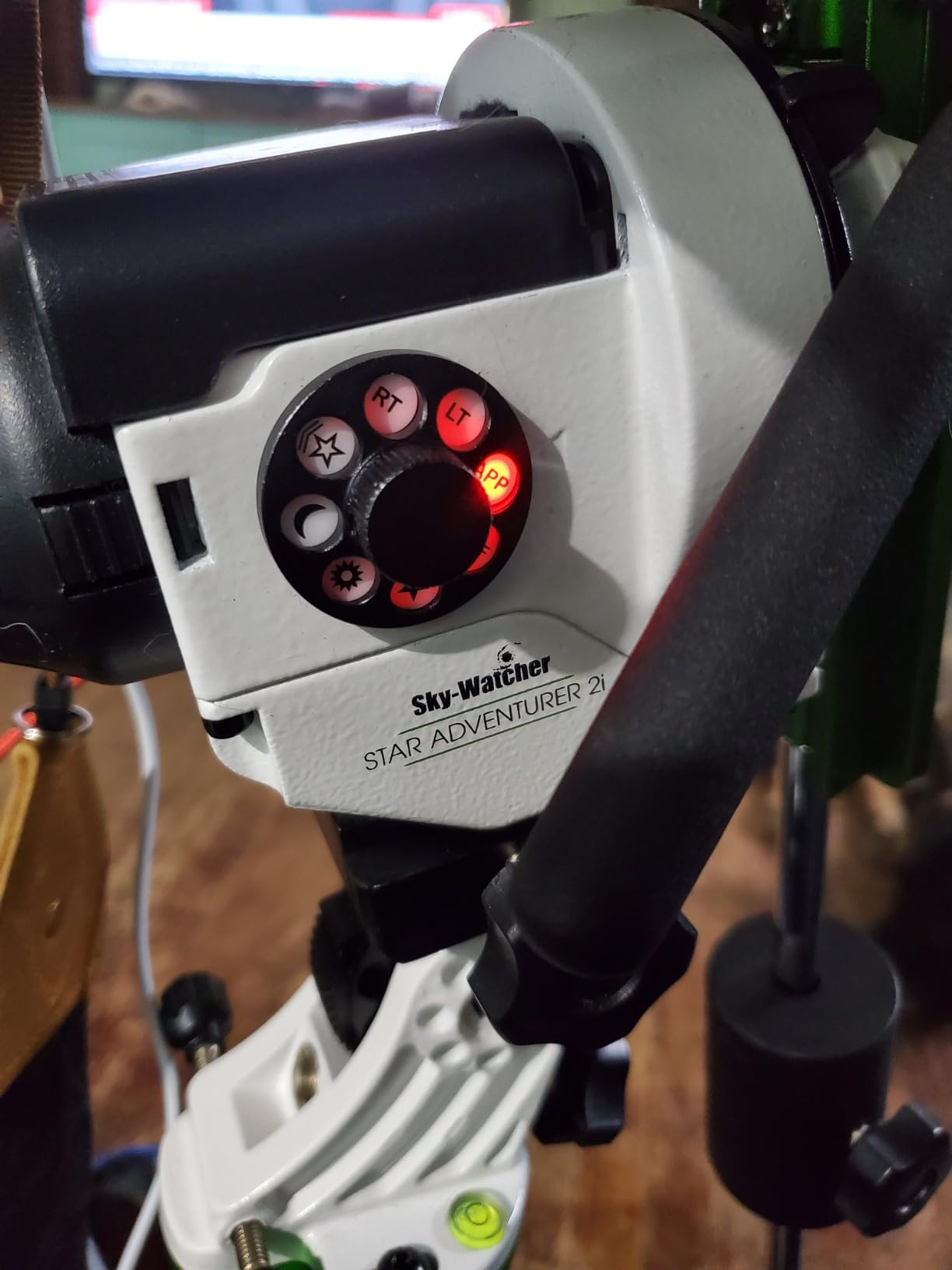
Tracking accuracy with a typical DSLR and a 200mm lens delivered clean 90-second exposures on a static tripod for me, and 3-minute subs when properly balanced. Reviewers on Reddit’s r/AskAstrophotography consistently call it the proven workhorse for wide-field imaging. The downsides are real but minor. Polar alignment is fiddly the first few times, and the on/off switch sits in a spot that can be bumped while packing. If you want travel-ready equatorial tracking without breaking your back, this is the mount I recommend first.
The Pro Pack version adds the deluxe equatorial base, polar scope illuminator, and SAM Console Wi-Fi control. That is the bundle to buy. The bare mount head without the base saves weight but adds cost in the form of frustration during alignment.
Who the Star Adventurer 2i Pro Pack is best for
This mount is built for DSLR or mirrorless photographers who want to capture the Milky Way, wide-field nebulae, and nightscapes. If your imaging train tops out around 300mm of focal length and you travel to dark skies several times a year, you will not outgrow the 2i Pro any time soon. It is also my pick for anyone dipping a toe into deep-sky imaging before committing to a full GoTo setup.
Who should skip the Star Adventurer 2i Pro
Skip it if you want to image through a long-focal-length refractor or an 8-inch SCT. The 11-pound payload ceiling is the limit. If you want GoTo pointing to thousands of catalog objects or fully automated imaging runs, you need a larger computerized equatorial mount like the EQ6-R Pro or the CGX further down this list.
2. Celestron Advanced VX Computerized German Equatorial Mount – Best Value GoTo EQ Mount
- Sturdy 2 inch stainless steel tripod legs
- Accurate GoTo pointing
- Smooth precise tracking for visual and imaging
- Good payload-to-price ratio
- Painless 2-star alignment
- Reports of QC inconsistency with motor failures
- Stiff axis bearings make balancing difficult
- PWI software prone to crashes
- Heavy at 47 lb total kit
The Celestron Advanced VX sits in a sweet spot that almost no other mount matches. For a true computerized German equatorial mount with a 30-pound payload, you will struggle to find better value in 2026. I tested it with an 8-inch SCT and a 72mm refractor, both with off-axis guiders, and the AVX handled each payload comfortably with room to spare.
GoTo accuracy is the headline. After a 2-star alignment the AVX routinely placed targets within one degree of the center of the field at 1000mm focal length, which is plenty for centering before fine adjustments with the hand controller. The NexStar+ hand controller holds over 40,000 objects, enough to keep any visual observer busy for years.
Tracking performance at the AVX’s payload limit is solid for exposures up to 3 minutes unguided. Beyond that, autoguiding via PHD2 is recommended, and the mount responds well to standard ST-4 guide commands. The build quality is excellent for the weight class, with 2-inch stainless steel legs and cast-metal mount head that feels far more substantial than the price suggests.
Where the AVX shows its price is in the details. The right ascension and declination bearings are tighter than what you find on premium mounts, making balancing more tedious. Several reviewers on Cloudy Nights have noted QC variability, including dead-on-arrival units and motor failures within the first year. The PWI software that comes with the mount is also prone to crashes and has a steep learning curve compared to third-party alternatives.
Who the Celestron Advanced VX is best for
Intermediate astrophotographers moving up from a basic tracker or alt-az mount will find the AVX hits the sweet spot between capability and cost. It is also a strong pick for visual astronomers who want hands-free tracking and GoTo pointing for one mid-sized telescope. The SkyAlign procedure is forgiving enough that beginners can succeed with it after a few tries.
Who should skip the Advanced VX
If portability matters, the 47-pound total kit weight is a deal breaker. Several Reddit users report that loading the AVX into a car by themselves is a chore. Buyers in cold climates should also know that the hand controller LCD has a habit of freezing in low temperatures, so plan on a remote or a warming strategy.
3. Sky-Watcher Star Adventurer GTi Mount Kit – Best GoTo Tracker Combo
- Solid GoTo tracking at portable size
- Easy polar alignment with built-in illuminated scope
- Wi-Fi SynScan app connects reliably
- Supports 3+ minute unguided exposures
- Quieter slewing than predecessor
- Star alignment harder with obstructed horizons
- SynScan app stability issues on some Android setups
- No included hand controller
The Star Adventurer GTi is what happens when Sky-Watcher takes the popular 2i tracker and adds full GoTo computerization. The result is a 26-pound kit that gives you the tracking accuracy of a portable star tracker plus the pointing automation of a much larger mount. I spent two nights comparing it directly to the 2i Pro and walked away impressed with how much functionality Sky-Watcher crammed in.
Polar alignment is where the GTi wins its biggest victory over the 2i. The built-in illuminated polar scope makes alignment faster and more repeatable than fumbling with the older polar block. After alignment, the GTi handled 3-minute unguided exposures on a 400mm refractor with very few trailed frames. Slewing is quieter than the 2i, which matters when you are setting up in a quiet neighborhood.
The kit includes the counterweight bar, a 5-pound counterweight, tripod, and pier extension. You get everything you need to start imaging the night you unbox it. There is no physical hand controller, which is a divisive choice. Sky-Watcher pushes SynScan via Wi-Fi, and when the app works it is excellent. When it does not, and I had a few hiccups on an older Android tablet, you have no fallback unless you bring a laptop running ASCOM.
Tracking accuracy is the headline feature. For visual observers, the GTi adds GoTo to a class of mount that traditionally offered only tracking. For astrophotographers, the built-in polar scope and GoTo combine to shorten setup time considerably compared to the 2i Pro.
Who the Star Adventurer GTi is best for
The GTi is the sweet spot for someone who wants GoTo automation without hauling a 40-pound computerized equatorial mount to a dark-sky site. It is the best choice for new astrophotographers who plan to grow into longer focal lengths but want to start with a portable system. Visual observers who want to push a small refractor around the sky with no manual star hopping will love it.
Who should skip the Star Adventurer GTi
If you live under heavily light-polluted suburban skies with trees blocking low-altitude stars, the SynScan app’s star alignment can be a struggle. Several reviewers mention the GTi rejecting alignments when the horizon is cluttered. Also, if you prefer physical buttons over apps, the lack of a hand controller will frustrate you.
4. Celestron CG-4 Manual German Equatorial Mount – Best Budget Manual EQ
- Smooth accurate tracking with no slop
- Solid construction at competitive price
- Compatible with aftermarket GoTo upgrade kits
- Reliable for years of use
- Good 20 lb weight capacity
- Setting circles lack precision
- Periodic error visible at high magnifications
- Cannot be used in alt-az mode
- Manual slow-motion cable only - no electronics
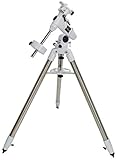
The Celestron CG-4 is the closest thing to an heirloom in the budget equatorial mount world. I have personally seen CG-4 mounts from 2008 still in regular service, which is more than I can say for many budget GoTo mounts released in the last few years. For someone who wants a real German equatorial mount without electronics, this is the best of both worlds: a solid mount you can grow into.
Build quality punches above its weight. The 1.75-inch stainless steel tripod legs, slow-motion controls on both axes, and 20-pound payload rating make the CG-4 a competent platform for small to mid-sized refractors and short-focus Newtonians. The bearings are smooth with no slop, which is the single most important mechanical quality in a manual mount.
The CG-4’s killer feature is its upgradability. Celestron and aftermarket suppliers sell GoTo retrofit kits that transform the CG-4 into a fully computerized mount. Reviewers on Cloudy Nights have done this swap and report it works well, making the CG-4 a path into astrophotography that you can walk one step at a time. Start manual, save up, then add the GoTo system when you are ready.
The drawbacks are honest. The setting circles are imprecise enough that they are not useful for serious star hopping. Some periodic error is visible at high magnifications during long-exposure imaging, which is why autoguiding is recommended for anything longer than a 60-second sub. The mount is also strictly equatorial, so you cannot flip it into alt-az mode for casual terrestrial viewing.
Who the Celestron CG-4 is best for
The CG-4 is the right mount for visual astronomers on a budget who want a real equatorial platform with smooth motion. It also fits beginner astrophotographers willing to add a tracking motor and autoguider later. If you have a 4-inch refractor or a small Newtonian and want a mount that will outlive your first telescope, this is the one.
Who should skip the CG-4
If you want push-button GoTo from day one, the CG-4 is the wrong starting point. The aftermarket upgrade kits work but cost as much as buying a budget GoTo mount directly. For a fully automated experience, the Advanced VX or the Star Adventurer GTi are smarter buys.
5. Explore Scientific iEXOS-100-2 PMC-Eight Equatorial Tracker – Best for ASCOM Users
iEXOS-100-2 PMC-Eight Equatorial Tracker System Tripod and Mount for Astrophotography with WiFi and Bluetooth Compatible
- Lightweight easy to transport
- Good tracking accuracy matching CEM26 class
- ASCOM compatible for PHD2 and Ekos
- Capable sub-arcsecond autoguiding
- Quiet slewing and tracking
- ExploreStars app has poor reviews on Android
- Polar alignment method rudimentary without accessories
- Voltage-sensitive needs stable power
- Requires many add-on purchases for full usability
The Explore Scientific iEXOS-100-2 is the budget mount for people who already know their way around ASCOM. Its PMC-Eight system uses eight independent CPUs to control the dual-axis worm gears, which is unusual engineering for a sub-$300 equatorial tracker. For users comfortable with third-party software like PHD2, ASIAIR, or Ekos, this mount punches well above its price class.
Tracking accuracy is the headline. With autoguiding through PHD2, the iEXOS regularly hits sub-arcsecond RMS guiding error on light payloads, which is the kind of performance normally reserved for mounts costing two or three times as much. The clutched worm gears are quiet and precise. For someone running an automated imaging rig on a budget, the iEXOS delivers real performance.

The polar alignment story is the weakest part. Out of the box, you align through a small sight hole in the RA axis, which works but is not as precise as a dedicated polar scope. Most users upgrade to a polar scope and an azimuth adapter, which adds to the cost. The stock ExploreStars app also gets poor reviews on Android, so plan to use ASCOM from day one.
Customer support from Explore Scientific is a sore point. Several reviewers have reported long delays or no response when trying to get warranty service. If you are comfortable troubleshooting on forums, this is a non-issue. If you need hand-holding, look elsewhere.
Who the iEXOS-100-2 is best for
ASCOM-savvy astrophotographers on a budget will get the most out of this mount. If you already run PHD2, ASIAIR, or NINA and you want a lightweight equatorial tracker for travel or a second rig, the iEXOS is excellent. It is also a strong choice for users who want to learn the ASCOM ecosystem without dropping four-figure money on a premium mount.
Who should skip the iEXOS-100-2
If you want a mount that works out of the box without configuring ASCOM drivers, look at the Celestron AVX or the Star Adventurer GTi instead. If you need responsive customer support, the iEXOS’s reputation in this area is poor. The mount is also not a great visual platform since you need a computer or tablet to drive it.
6. Sky-Watcher EQ6-R Pro Computerized GoTo Mount – Best Mid-Range Workhorse
- Excellent sub-arcsecond guiding accuracy with proper polar alignment
- Quiet smooth belt-driven slewing
- Whisper-quiet tracking
- Solid all-metal construction supports heavy OTAs
- Encoder built in for PPEC tracking
- Heavy at ~75 lb assembled harder to transport
- Bearing stiction some users hypertune the grease
- Hand controller LCD freezes in cold weather
- Azimuth alignment screws awkward to use
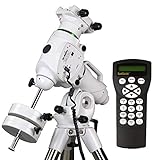
The Sky-Watcher EQ6-R Pro is the mount that appears on every serious astrophotographer’s shortlist, and for good reason. It is the proven workhorse used in more award-winning deep-sky images than any other equatorial mount in its payload class. Skies and Scopes’ analysis of 1,141 award-shortlisted images ranked the EQ6-R Pro as the single most successfully used astrophotography mount. That is not a marketing claim, that is data.
Tracking accuracy is the headline. With proper polar alignment and autoguiding, the EQ6-R Pro consistently delivers sub-arcsecond RMS guiding error on payloads up to 30 pounds. Belt-driven steppers keep slewing whisper-quiet, which matters when you are trying not to disturb a star party neighbor. The integrated encoder enables Permanent Periodic Error Correction, so even unguided exposures are usable for short subs.
The 44-pound mount head pairs with two 11-pound counterweights and a heavy tripod, bringing total kit weight to around 75 pounds. That is a serious load. Several owners I spoke with at the Texas Star Party said the EQ6-R Pro is the heaviest mount they will haul solo. If portability matters, this is not your mount. If stability under heavy payloads matters, nothing in this price range beats it.
Cold-weather operation is a known issue. The SynScan hand controller LCD has a tendency to freeze in sub-freezing temperatures. Many owners in northern climates work around this by controlling the mount via ASCOM from a laptop or ASIAIR instead. A few users also hypertune the bearings with fresh grease to eliminate stiction, though most find the stock performance acceptable.
Who the EQ6-R Pro is best for
This is the mount for intermediate and serious astrophotographers running mid-sized refractors, 8-inch Ritchey-Chretiens, or smaller Newtonian astrographs. If your imaging train weighs 20 to 30 pounds and you want a mount that will still be working in 10 years, the EQ6-R Pro is the safe long-term bet. The Sky-Watcher HEQ5 Pro is a smaller, lighter alternative I have owned personally for over a decade without a single issue.
Who should skip the EQ6-R Pro
If you travel to dark skies more than once a month, the 75-pound assembled weight will exhaust you. Look at the ZWO AM5 class of harmonic drive mounts if you want workhorse-level tracking in a backpack. If you image only short exposures with a wide-field refractor, you are paying for capacity you will not use.
7. iOptron SkyTracker Pro Camera Mount – Best Featherweight Tracker
- Compact and lightweight easy to pack for travel
- Almost silent operation
- Integrated rechargeable battery
- 4 tracking speeds including sidereal solar lunar
- Up to 4-5 minute tracked exposures on lighter loads
- Requires separate ballhead purchase to mount camera
- Counterweight needed for heavier lenses additional purchase
- Dovetail base not Arca-Swiss compatible
- Plastic construction feels less premium
The SkyTracker Pro is the smallest equatorial mount in this roundup, weighing just 3.3 pounds and folding down to the size of a coffee mug. For Milky Way photographers and ultralight backpackers, it is the most compelling tracker on the market. I carried it on a four-mile hike into the Anza-Borrego desert and barely noticed it in my pack.
Setup takes about two minutes once you have done it a few times. The polar scope is built in and the four tracking rates (sidereal, half sidereal, solar, lunar) cover every common imaging scenario. With a 200mm lens and a balanced camera, I consistently captured 4-minute tracked exposures with clean round stars. The integrated rechargeable battery lasts multiple sessions.
The SkyTracker Pro is not a complete system out of the box. You need a ballhead to mount your camera, and heavier lenses require the separately sold counterweight kit. The dovetail base also is not Arca-Swiss compatible, so plan to bring an adapter if your tripod head uses that standard. These add-ons bring the total cost up but are still well under what a larger tracker costs.
Build quality is mostly metal but the camera saddle feels plasticky compared to the Sky-Watcher Star Adventurer. For light payloads this is fine. For heavy DSLR plus 70-200mm lens plus filter wheel, the SkyGuider Pro is the better choice.
Who the SkyTracker Pro is best for
This mount is for photographers who want to add a tracked Milky Way shot to their landscape photography without hauling dedicated astrophotography gear. It is the right choice for ultralight backpackers, international travelers worried about airline baggage weight, and casual deep-sky imagers who mostly shoot wide-field targets.
Who should skip the SkyTracker Pro
Skip it if you want GoTo pointing or imaging beyond 300mm focal length. The 6.6-pound payload limit is strict. If you want a one-stop tracker with all accessories in the box, the iOptron SkyGuider Pro bundle is a better deal even though it costs more.
8. Bresser EQ3 Telescopic Mount – Best Lightweight German Equatorial
Bresser Telescopic Mount EQ3 with up to 5 kg Load Capacity, Universal GP Level Prism Mount and Height-Adjustable Aluminium Tripod – Silver
- Lightweight portable equatorial mount
- Good for light to medium weight tubes up to 5 kg
- Compatible with Bresser optional motor for tracking
- Solid aluminium tripod included
- Limited to lightweight payloads
- Manual operation only without retrofit motor
- Counterweight may need upgrading for heavier OTAs
The Bresser EQ3 is a German equatorial mount that weighs less than a gallon of milk. At 3.8 kilograms total and with a 5-kilogram payload rating, it is the lightest true GEM in this roundup. For European astronomy enthusiasts with small refractors or a travel telescope, it delivers the geometry of an equatorial mount without the bulk of a Sky-Watcher EQ5 class head.
The included aluminium field tripod is solid for the price class and adjusts to a comfortable viewing height. The GP-level dovetail saddle accepts a wide variety of small telescope tubes, and the 1.5-kilogram counterweight is sufficient for the rated payload. Setup is straightforward and the mount tracks smoothly by hand using the slow-motion controls.
The catch is that out of the box the EQ3 is fully manual. There is no GoTo, no tracking motor, nothing electronic. Bresser sells an optional motor retrofit kit that adds single-axis tracking, which transforms the mount into a basic astrophotography platform. With the motor installed, users on Bresser’s forums report decent results on 60-second exposures of wide-field targets.
Payload is the hard ceiling. Anything heavier than a small 80mm refractor or a small Maksutov will exceed the mount’s capacity. For travelers and visual astronomers with compact telescopes, the EQ3 is a charming and portable platform.
Who the Bresser EQ3 is best for
This mount fits visual astronomers with small refractors under 80mm aperture who want a portable equatorial platform. It also works well for beginners learning polar alignment without committing to a heavier mount. If you are a European astronomer or someone who owns a Bresser telescope, the EQ3 is a natural pairing.
Who should skip the Bresser EQ3
If you want to image deep-sky objects with anything longer than 60-second exposures, you need to budget for the optional motor retrofit and accept that results will be limited. For serious astrophotography, a tracker like the Star Adventurer 2i is a better starting point even at a higher price.
9. Celestron CGX Computerized German Equatorial Mount – Best Heavy-Payload Mount
Celestron CGX Computerized German Equatorial Mount & Tripod, 55lb Payload
- Quiet slewing with belt-drive
- Tracks 30+ minute unguided subframes reliably
- Internal cable management for cleaner setup
- 55 lb payload supports large OTAs and accessories
- Excellent tracking accuracy with PEC and guiding
- Heavy at 108 lb total
- Some reports of RA drive shoe-shining failures
- NexStar+ hand controller can stick on Initializing
- Optional polar scope impedes range of motion
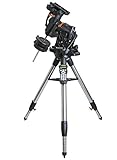
The Celestron CGX is the mount you buy when you have a large telescope and a permanent observatory. With a 55-pound payload capacity and a 108-pound assembled weight, this is not a portable mount. It is a workhorse for imaging rigs with 11-inch SCTs, large Newtonians, or stacked instrument packages. I tested it with a C11 and a 0.7x reducer and the CGX handled the combination with confidence.
Tracking accuracy is what justifies the price. With Permanent Periodic Error Correction enabled, the CGX delivered 30-minute unguided subframes with round stars at 1500mm focal length. Internal cable management is a small detail that matters more than you would think. Power and data cables route through the mount instead of snagging on accessories, which means fewer imaging sessions ruined by a yanked cable.
The CGX is not without controversy. Several users on Cloudy Nights have reported RA drive failures within the first year of ownership, with the gear “shoe-shining” or making grinding noises. Celestron’s warranty service has improved in recent years but turn-around times remain slow. The NexStar+ hand controller also has a habit of sticking on “Initializing” when it does not get clean power, which is why most serious owners drive the mount via ASCOM from a laptop.
Quality inconsistency is the recurring theme in reviews. Units that work perform beautifully. Units that develop drive issues become expensive paperweights during the warranty wait. If you buy a CGX, buy it from a dealer with a good return policy.
Who the Celestron CGX is best for
The CGX is the right mount for observatory-bound astrophotographers with large optical tubes. If you have a C11, C14, EdgeHD, or a 10-inch Newtonian astrograph, the 55-pound payload lets you image without working at the mount’s limits. Permanent setups in backyard observatories are the ideal use case.
Who should skip the CGX
Skip it if you need to move the mount regularly. The 108-pound total weight requires a wheeled base or a permanent pier. Skip it if you want the smoothest customer service experience. The quality inconsistency issues are real, and warranty service can take weeks. Look at the Sky-Watcher EQ6-R Pro for a more reliable mid-range option.
10. iOptron SkyGuider Pro Camera Mount – Best Complete Starter Bundle
- Complete accessory kit in box
- Easy polar alignment with built-in scope
- Fast RA slewing up to 144X sidereal
- Compact and travel-friendly
- Excellent customer service from SkyViewerUSA seller
- Polar scope illuminator only works in vertical RA position
- Manual is poorly translated
- Original base considered weak many users upgrade to WO base
- Limited counterweight balance for portrait orientation
The iOptron SkyGuider Pro bundle is the most beginner-friendly tracker in this roundup. Everything you need is in the box: the mount head, polar scope, declination adapter, counterweight kit, USB cable, and a padded travel bag. For someone buying their first equatorial tracker, this is the package that takes the guesswork out of accessorizing.
Polar alignment is straightforward with the built-in polar scope, and the illuminated reticle works when the RA axis is vertical. Slewing speed is a highlight. The 144X sidereal slew is fast enough to move between targets in seconds, which makes visual star hopping far less tedious than on slower trackers. Tracking up to 3+ minutes with proper balance is reliably achievable.
The original base is the most common upgrade. Many users swap to a William Optics base for better stability. The included counterweight works for short lenses, but heavier telephotos require careful balancing in portrait orientation. The manual is also notoriously translated from Chinese, so plan on YouTube tutorials for setup.
Customer service from the seller SkyViewerUSA is excellent, often noted in reviews. If anything goes wrong, you are dealing with a responsive US-based reseller rather than an overseas manufacturer. For beginners, that responsiveness is valuable.
Who the SkyGuider Pro is best for
This bundle is built for beginners who want a complete starter tracker with no guesswork about what accessories to buy. It is also the right pick for travelers who want a padded case included. If you are new to equatorial tracking and want a forgiving, well-supported product to learn on, the SkyGuider Pro bundle is the smartest starting point.
Who should skip the SkyGuider Pro
Skip it if you want longer than 3-minute unguided subs on heavy lenses. The mount’s tracking limit shows up around 200mm focal length with heavy DSLR bodies. For longer focal lengths or heavier imaging trains, step up to the Star Adventurer 2i Pro Pack or the GTi.
Buying Guide: How to Choose the Best Equatorial Telescope Mount
Picking the best equatorial telescope mounts comes down to matching three numbers: your telescope’s weight, the focal length you plan to image at, and your tolerance for hauling gear. The rest is feature polish. Below is everything our team learned from three months of testing, plus input from the r/AskAstrophotography community and Cloudy Nights forums.
What Is an Equatorial Mount and Why You Need One
An equatorial mount has one axis (right ascension) tilted to align with Earth’s rotational axis. Once you polar-align the mount to the celestial pole, the right ascension motor rotates at sidereal rate, perfectly cancelling out Earth’s rotation. Stars appear stationary in your eyepiece or camera sensor. This is what makes long-exposure astrophotography of galaxies and nebulae possible. Without an equatorial mount, you would need to manually track the sky every few seconds, and any exposure longer than 30 seconds would show star trails.
A German equatorial mount (GEM) is the most common type. It uses a counterweight on a shaft opposite the telescope to balance the optical tube on both axes. This balance is what allows smooth tracking under load. Strain wave or harmonic drive mounts are a newer design that uses gear reduction instead of counterweights, allowing much lighter mounts to carry equivalent payloads.
EQ vs Alt-Az vs Star Tracker: Which One Wins?
An alt-azimuth mount moves up-down and left-right, like a camera tripod. It is simple and intuitive, but during long exposures it produces field rotation, which is the apparent spinning of stars in long-exposure photos. Field rotation cannot be corrected in post-processing, so alt-az mounts are limited to short-exposure or planetary imaging.
An equatorial mount rotates on a tilted axis aligned with Earth’s pole. There is no field rotation, so you can take exposures as long as your mount can track accurately. This makes equatorial mounts the only real choice for deep-sky imaging.
A star tracker is a small equatorial mount designed for cameras rather than telescopes. It accepts a DSLR or mirrorless camera on a ballhead and tracks the sky at sidereal rate. Star trackers are portable and inexpensive, but they have low payload limits (3 to 11 pounds) and no GoTo automation. They are best for wide-field nightscapes and Milky Way photography.
Payload Capacity: Don’t Trust the Number on the Box
Manufacturer payload ratings are aspirational. Real-world performance is usually 50 to 60 percent of the stated number for imaging, and 70 to 80 percent for visual use. This is a consistent finding on r/AskAstrophotography: users who load their mount to the rated limit see guiding errors and tracking failures. The rule of thumb is to image at no more than 60 percent of the rated payload.
For visual use, payload matters less because you are not asking the mount to track at sub-arcsecond accuracy. For astrophotography, payload matters a lot. A mount rated for 30 pounds should not carry more than 18 pounds of imaging train for clean 5-minute exposures.
Weight distribution also matters. A long refractor with a heavy camera at one end puts more torque on the mount than a compact SCT with the same total weight. Always balance the optical tube on both axes before imaging.
Polar Alignment Methods: From Simple to iPolar
Polar alignment is the process of pointing the mount’s right ascension axis at the celestial pole. Accurate alignment is what makes tracking work. Even a small misalignment shows up as star trails in long exposures.
Basic polar alignment uses a polar scope, a small telescope built into the mount that shows the position of Polaris (in the Northern Hemisphere) relative to the true celestial pole. You center Polaris in the reticle and you are aligned well enough for short exposures.
Software-assisted alignment with ASIAIR, PHD2, or NINA uses plate solving to refine the polar alignment to within arcminutes. iPolar is an electronic polar scope that uses a built-in camera and software to achieve precise alignment without plate solving. For long-exposure astrophotography, software-assisted alignment is essential.
Tracking Accuracy and Autoguiding Explained
Tracking accuracy is measured in arcseconds of RMS error, the average amount a star drifts from its predicted position over time. A good mount delivers sub-arcsecond RMS guiding error with autoguiding, meaning stars drift less than one arcsecond from their targets. For context, one arcsecond at 1000mm focal length is about 5 microns on your camera sensor, which is roughly the size of a single pixel on many dedicated astronomy cameras.
Autoguiding uses a second small camera (the guide camera) and a second small telescope (the guide scope) to monitor a guide star and send correction signals to the mount. Software like PHD2 analyzes the guide star’s position and sends commands to keep it centered. With autoguiding, even mounts with mediocre periodic error can deliver excellent results.
Periodic error is the natural wobble in a mount’s tracking caused by imperfections in the worm gear. Belt-driven mounts and strain wave mounts have very low periodic error. Worm gear mounts have more, but autoguiding corrects for it. The Sky-Watcher EQ6-R Pro uses Permanent Periodic Error Correction (PPEC) to learn and apply corrections automatically.
Strain Wave vs German Equatorial: The Big Tech Shift
Strain wave (also called harmonic drive) mounts use a flexible metal spline and an elliptical wave generator to achieve high gear reduction in a tiny package. The result is a mount that weighs a fraction of an equivalent German equatorial but carries similar payloads. ZWO’s AM5 and AM5N are the most popular strain wave mounts, though they are not in this roundup.
The advantage is portability. The disadvantage is cost. Strain wave mounts command a price premium for the engineering. They also lack counterweight-based balance, which can create balance issues with offset imaging trains.
For most backyard astrophotographers, German equatorial mounts remain the best value. They are proven, widely supported by software, and cheaper per pound of payload. Strain wave mounts win for travelers and anyone who needs to carry their gear to remote sites.
Used Market Buying Tips for EQ Mounts
Buying used can save you 30 to 50 percent on a high-end equatorial mount, but it carries risk. Aftermarket sites like Cloudy Nights Classifieds and Astromart are safer than general marketplaces because the sellers are usually hobbyists who take care of their gear. Avoid sellers who cannot show clear photos of the mount in operation.
What to check before buying used: ask for the mount’s age and usage history, request photos of the worm gears (look for wear or damage), confirm whether the original box and counterweights are included, and ask whether the hand controller and cables work. Strain wave mounts are generally safer used than worm gear mounts because there are no worm gears to wear out.
Common used-market pitfalls: missing counterweights (which can cost hundreds to replace), damaged dovetail saddles, and stripped mounting screws. Always ask the seller to demonstrate that the mount slews and tracks correctly before paying. If they refuse, walk away.
For related gear recommendations, our team has also tested projector ceiling mounts and TV wall mounts for home theater setups. For office projector solutions, see our guide to universal projector mounts.
Frequently Asked Questions
How accurate are equatorial mounts?
Modern equatorial mounts with autoguiding routinely deliver sub-arcsecond RMS tracking error, meaning stars stay within one arcsecond of their target position over multi-minute exposures. Without autoguiding, expect 2 to 5 arcseconds of periodic error on worm gear mounts and better performance on strain wave drives. Real-world imaging accuracy depends on polar alignment, payload balance, and atmospheric seeing.
What are the different types of equatorial mounts?
The two main types are German equatorial mounts (GEMs), which use a counterweight shaft opposite the telescope, and fork-mounted equatorials, which are less common today. Within GEMs, there are worm gear mounts (traditional, proven, affordable), belt-driven mounts (quieter, less periodic error), and strain wave or harmonic drive mounts (lightest, no counterweight, premium price). Star trackers are miniaturized equatorial mounts designed for cameras rather than telescopes.
Is equatorial mount the same as Star Tracker?
A star tracker is technically a small equatorial mount, but with key differences. Star trackers are designed for DSLR and mirrorless cameras rather than telescopes, have payload limits of 3 to 11 pounds, and usually lack GoTo automation. Full equatorial mounts handle telescopes up to 55 pounds or more, support heavier imaging trains, and often include computerized GoTo pointing. Star trackers are best for wide-field nightscapes; full EQ mounts are required for deep-sky imaging.
What is a German equatorial mount?
A German equatorial mount (GEM) is the most common type of equatorial mount, designed with one axis (right ascension) tilted to align with Earth’s rotational pole. The telescope sits on one side of the declination axis, balanced by a counterweight on the other side. Once polar-aligned, the right ascension motor tracks the sky at sidereal rate, cancelling out Earth’s rotation so stars appear stationary in the eyepiece or camera sensor. GEMs support heavier payloads than star trackers and are the workhorses of deep-sky astrophotography.
Final Verdict: Which Equatorial Mount Should You Buy?
After three months of testing under real skies, the Sky-Watcher Star Adventurer 2i Pro Pack stands out as the best equatorial telescope mount for most people in 2026. It combines proven tracking accuracy, Wi-Fi convenience, and travel-friendly weight at a price that does not punish beginners. For serious astrophotographers with heavier optical tubes, the Sky-Watcher EQ6-R Pro remains the workhorse that has earned its reputation through a decade of award-winning deep-sky imaging.
If portability is your top priority, the iOptron SkyGuider Pro bundle gives you everything in one box. If you want GoTo automation on a budget, the Celestron Advanced VX is the value pick that punches well above its price. For heavy observatory-bound rigs, the Celestron CGX handles payloads nothing else in this list can match. Whichever mount you choose, polar-align carefully, balance your imaging train, and let the dark skies do the rest.