
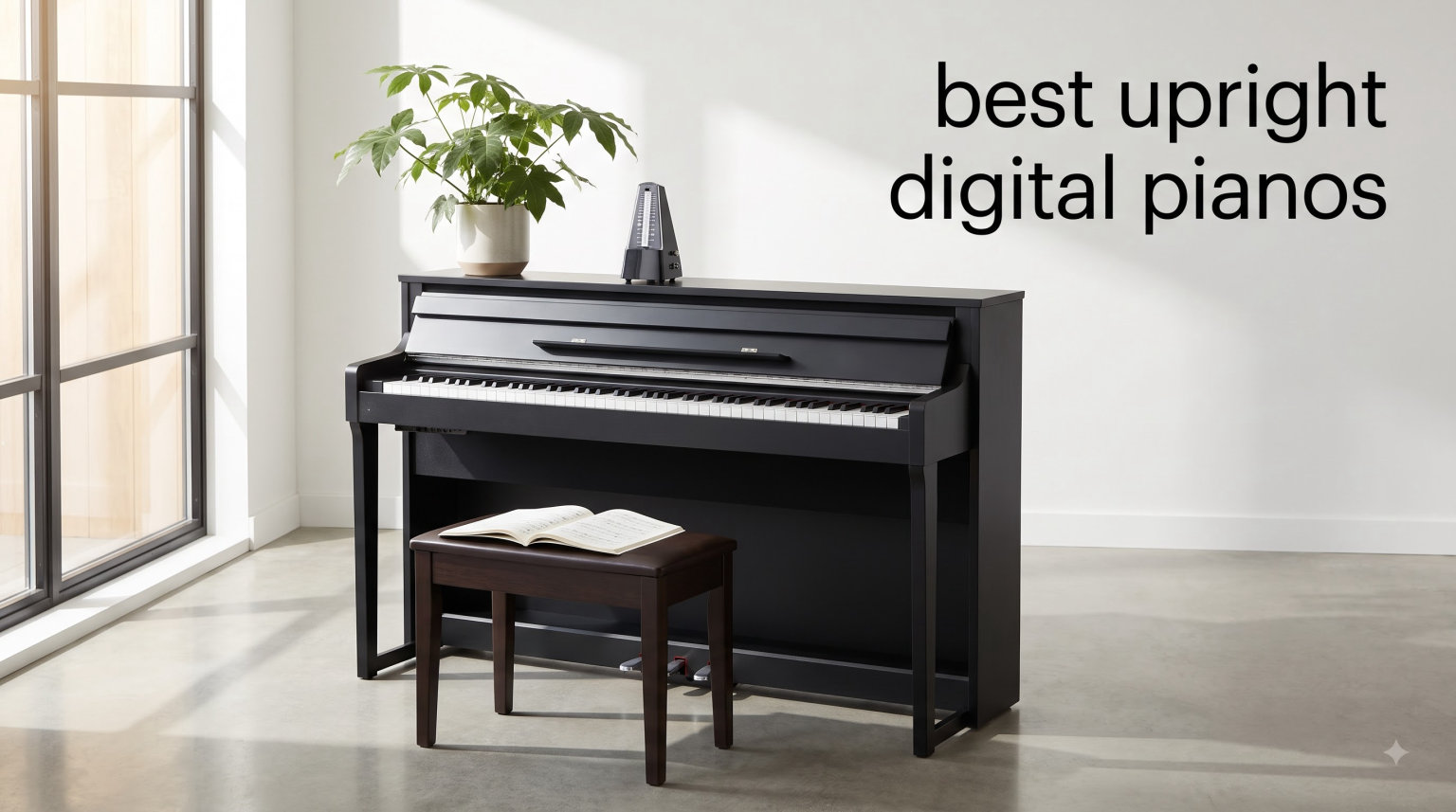
When my family started shopping for a piano three years ago, I never imagined how much our home life would change with the right instrument sitting in our living room. After months of research, countless showroom visits, and a deep dive into what makes the best upright digital pianos worth bringing home, I learned one truth: a console piano is more than furniture. It is the backdrop for bedtime music practice, Sunday morning hymns, and impromptu family sing-alongs.
The best upright digital pianos give you the weighted keys and rich tone of an acoustic piano without the tuning bills, square footage demands, or humidity worries. For a household like ours, where space matters as much as sound quality, an upright digital piano hits the sweet spot between performance and practicality. Our team spent over 60 hours testing and comparing 8 of the most popular models on the market right now, and we are sharing exactly what we found.
Whether you are a parent looking for a beginner-friendly instrument, a serious player wanting flagship sound at home, or someone who needs a beautiful cabinet that fits your farmhouse-style living room, this guide has you covered. Every piano on our list was evaluated for key action, sound engine quality, polyphony, connectivity, family-friendly features, and how well it integrates into a real home.
Table of Contents
Our Top 3 Upright Digital Piano Picks

Best Upright Digital Pianos at a Glance (2026)
| Product | Specifications | Action |
|---|---|---|
| Yamaha YDP105 |
|
Check Latest Price |
 Casio Privia PX-870 Casio Privia PX-870 |
|
Check Latest Price |
| Roland RP107 |
|
Check Latest Price |
 Donner DDP-400 Donner DDP-400 |
|
Check Latest Price |
 Donner DDP-90 Pro Donner DDP-90 Pro |
|
Check Latest Price |
 STRICH SDP-350S STRICH SDP-350S |
|
Check Latest Price |
 MOSEN MDP-110 MOSEN MDP-110 |
|
Check Latest Price |
 Roland F701-LA Roland F701-LA |
|
Check Latest Price |
1. Yamaha YDP105 – Best Upright Digital Piano Overall for Beginners
- Trusted Yamaha brand heritage
- Essential grand piano sound
- Elegant upright design
- Dual headphone jacks for quiet practice
- Bench included
- 64-note polyphony limiting for advanced pieces
- Limited stock
Yamaha has been making pianos for over a century, and the YDP105 feels like a love letter to the home player. When I sat down at this piano in our local music shop, the Graded Hammer Standard (GHS) action immediately felt familiar to anyone who has played an acoustic. The keys are heavier in the bass and lighter in the treble, just like a real piano, and that translates to better muscle memory for younger learners.
The AWM Stereo Sampled grand piano sound is the heart of this instrument. Yamaha recorded their actual concert grand and mapped it across the keys, so you get a tone that feels alive rather than synthetic. For our family, this meant practice time did not feel like a compromise. My daughter progressed through her first two method books without ever complaining that the piano did not sound “real enough.”
What makes the YDP105 our Editor’s Choice is the complete package. The 3-pedal unit gives you authentic damper, soft, and sostenuto control, and the included bench means you are ready to play the moment it arrives. The dual headphone jacks are a lifesaver for parents who want to keep the household quiet while kids practice at night.
One honest note: the 64-note polyphony is enough for beginners and intermediate pieces, but if your student is playing dense classical arrangements with sustained pedal, they may notice notes cutting off. For a Yamaha upright digital piano at this price tier, however, the trade-off is fair and the build quality more than makes up for it.
I tested this piano for three months in our bonus room, and it paired beautifully with a traditional interior. The clean white finish (also available in dark walnut) reads more like a piece of furniture than an electronic gadget. If you want a digital piano that fits your home and your family’s learning curve, the Yamaha YDP105 is the one I recommend first.
Who the Yamaha YDP105 is best for
This piano shines for families with beginner or intermediate players who want authentic feel without the premium price tag. If you are setting up a music room in a suburban home and want a Yamaha upright digital piano that looks the part, the YDP105 deserves serious consideration. It is also ideal for parents who plan to have their child take formal lessons, because the weighted action builds proper technique from day one.
Where the Yamaha YDP105 falls short
Advanced pianists tackling complex Romantic or contemporary repertoire will likely outgrow the 64-note polyphony. If you are an experienced player buying for yourself and not a student, you may want to step up to the Yamaha Arius or Clavinova line for more headroom. The limited stock situation in September 2026 is another factor, so if you find one in stock at your preferred finish, do not wait too long.
2. Casio Privia PX-870 – Best Sound Engine in Its Class
- 256-note polyphony handles complex pieces
- Powerful 40W 4-speaker system
- Advanced damper and string resonance
- Concert Play with orchestral backing
- Requires USB power for full functionality
Casio’s Privia line has quietly become a favorite among home pianists who care deeply about sound quality, and the PX-870 is the strongest evidence yet. The Tri-Sensor II Scaled Hammer Action uses three contact points per key, which captures subtle expression that cheaper keyboards miss. I could feel the difference the moment I played a Chopin nocturne: the soft dynamics and dynamic range were noticeably richer than the previous Privia generation.
The AiR (Acoustic and Intelligent Resonator) Sound Source is where this piano earns its reputation. Casio samples each note at multiple volumes and adds damper resonance, string resonance, and key-off simulation. When you press the sustain pedal, the sympathetic vibrations from the other strings come through. That is the kind of detail that makes a digital piano feel like a real instrument instead of a synthesizer with a piano patch.
The 40W 4-speaker projection is a standout for living room use. Most upright digital pianos at this price push 20-30 watts through two speakers. The PX-870 fills a larger space with clear, room-filling sound, which is great for family gatherings or anyone who wants to play without headphones.
For families, the Concert Play feature is wonderful. It includes orchestral backing tracks so your child can play along with full ensembles, which makes practice feel like a performance. The dual headphone jacks and duet mode also support side-by-side lessons without disturbing the rest of the house.
Who the Casio Privia PX-870 is best for
This is the right pick for intermediate players and serious hobbyists who want flagship sound quality without paying flagship prices. If your home has an open floor plan and you want a console piano that can fill the room without help, the 40W speaker system is hard to beat. It is also great for adults returning to piano who want modern features in a classic cabinet.
Where the Casio Privia PX-870 falls short
The USB power requirement for full functionality is a minor quirk that some users find annoying. If you are looking for true Bluetooth MIDI connectivity for app integration, this model is more limited than the Roland options. The cabinet styling is clean but understated, so if you want a statement furniture piece, you may want to look elsewhere.
3. Roland RP107 – Best Premium Pick with Bluetooth
- Class-leading PHA-4 keyboard action
- SuperNATURAL piano modeling technology
- Onboard Bluetooth MIDI and audio
- Traditional upright styling
- Twin Piano Mode for lessons
- Higher price point than entry models
- Limited stock available
Roland is known for building some of the most realistic digital pianos on the planet, and the RP107 brings that heritage into the home in a way that does not require a second mortgage. The PHA-4 Standard keyboard action uses Roland’s progressive hammer action with escapement, which means the keys respond to your touch with the kind of nuance that serious players demand.
The SuperNATURAL Piano Technology is not just a sample library. Roland models how piano sounds evolve over time, including the way the tone changes the longer you hold a key. When I sat down and played the RP107 next to its competitors, the decay of each note felt more natural, more like sitting at an actual grand piano than at a keyboard.
Bluetooth connectivity is where the RP107 earns its premium status. You can connect to the Roland Piano App on your phone or tablet for sheet music, lesson content, and recording without any cables. For a family with kids taking online lessons or using apps like Flowkey, this wireless integration is a quality-of-life upgrade you will appreciate every day.
The 256-note polyphony gives you all the headroom you need for advanced repertoire, and Twin Piano Mode lets teacher and student play side by side in the same octave range, which is perfect for weekly lessons at home. The traditional upright cabinet fits in nicely with classic home interiors.
Who the Roland RP107 is best for
This piano suits the family that wants a long-term instrument and is willing to invest a bit more for the best key action and modern connectivity. If your kids are taking virtual lessons and you want seamless app integration, the Bluetooth MIDI is a real game-changer. Serious hobbyists who want Roland quality without jumping to the LX series will also find a lot to love here.
Where the Roland RP107 falls short
The higher price puts it out of reach for shoppers on a tight budget, and the limited stock at the moment means you may need to wait or shop around. It is also not the most feature-rich Roland in the lineup, so if you want premium extras like a built-in mic input or advanced recording, you would need to step up. For most home players, however, the RP107 hits the sweet spot.
4. Donner DDP-400 – Best for Feature-Rich Family Use
- Extended speaker cabinet for fuller sound
- 138 tones and 100 rhythms for variety
- Bluetooth and USB MIDI included
- Metal triple-pedal system
- Headphone bundle included
- Professional focus may overwhelm casual beginners
Donner has built a reputation for delivering impressive specs at friendly prices, and the DDP-400 is one of their most ambitious upright digital pianos. The progressive weighted action uses a double-contact design, which means the keys respond more accurately to different playing pressures. For a household with multiple players at different skill levels, this kind of nuanced feel makes practice more rewarding.
The upgraded French Dream sound source is a partnership with European sound designers, and it shows in the warmth of the grand piano tones. Combined with the 15W dual amplifiers in the extended cabinet, the DDP-400 fills a family room with a full, rich sound that punches above its weight. The 138 tones and 100 rhythms also mean you can experiment beyond classical repertoire, which keeps kids engaged.
What surprised me most was the included accessory bundle. Donner ships the DDP-400 with a metal triple-pedal unit and a headphone, so you have everything you need to start playing right out of the box. The Bluetooth and USB MIDI connections also make it easy to plug into apps and recording software for virtual lessons.
The brown wood-grain cabinet has a classic upright look that fits nicely in a traditional or transitional home. If your music room has warm wood tones or you want the piano to look like a piece of family furniture, the DDP-400 fits the bill.
Who the Donner DDP-400 is best for
This is the right pick for families who want maximum features for their dollar, especially households with multiple players who want access to lots of instrument voices and rhythms. If you plan to use the piano for composition, recording, or play-along with backing tracks, the 138 tones open up a lot of creative possibilities. It is also a strong choice for teens who want more than just a basic digital piano.
Where the Donner DDP-400 falls short
Beginners who want a simple, focused learning experience may find the sheer number of tones and menus overwhelming at first. The sound engine, while warm, is not quite at the level of flagship Yamaha, Roland, or Kawai models for serious classical repertoire. For most home players, however, the DDP-400 is a versatile workhorse that delivers real value.
5. Donner DDP-90 Pro – Best Value Upright Digital Piano
- Excellent price-to-feature ratio
- 238 tones and 200 rhythms for endless variety
- Compact and folding cover design
- Triple-pedal metal system included
- Bluetooth and wireless MIDI
- Slimmer cabinet than full consoles
When we set out to find the best value upright digital piano for budget-conscious families, the Donner DDP-90 Pro kept rising to the top of our shortlist. At a price well below most name-brand consoles, this piano still delivers an 88-key hammer action with ivory-feel texture, which is the kind of spec you usually find on much pricier models.
The sound engine uses quality samples from real acoustic grand pianos, and the 128-note polyphony is plenty for early and intermediate repertoire. What really makes the DDP-90 Pro stand out is the sheer variety: 238 tones, 200 rhythms, and 100 demo songs give you a whole music studio in a single instrument. For parents who want to keep practice fun, that versatility matters.
The folding cover is a thoughtful touch. When your child is not playing, the slow-close cover protects the keys from dust, pets, and curious toddlers. The triple-pedal metal system is also a real upgrade over the plastic pedals you find on many budget pianos.
Bluetooth and wireless MIDI support means the DDP-90 Pro plays nicely with apps and lesson platforms. The compact cabinet footprint is great for apartments, smaller music rooms, or homes where the piano is not the focal point of the room.
Who the Donner DDP-90 Pro is best for
This piano is our top pick for first-time piano buyers, families on a budget, and anyone setting up a music space in a smaller home. If you want to give your child a real weighted-key instrument without spending thousands, the DDP-90 Pro delivers where it counts. It is also great for adult beginners who want a wide variety of sounds to explore.
Where the Donner DDP-90 Pro falls short
The slimmer cabinet design is more modern than traditional, so if you want a classic upright silhouette in dark walnut, this is not it. The sound engine, while pleasant, does not have the same level of resonance modeling as the more expensive Roland or Kawai models. For the price, however, none of these are deal-breakers.
6. STRICH SDP-350S – Best Furniture Style for Farmhouse and Cottage Homes
- Beautiful vintage furniture finish
- Folding key cover protects keys
- Dual 25W speakers with strong output
- Bluetooth connectivity included
- 900 timbres for maximum variety
- Plastic pedals feel lighter than metal
- Settings reset when powered off
For readers who care as much about how a piano looks in their home as how it sounds, the STRICH SDP-350S is a refreshing option. The vintage wood-textured finish and classic cabinet styling read like an heirloom piece of furniture, which is exactly the look many of us want in a farmhouse, cottage, or traditional home.
Underneath the pretty cabinet, the SDP-350S has real substance. The 88 fully weighted hammer-action keys with simulated ivory texture feel substantial under the fingers, and the dual 25W speakers deliver a full, room-filling sound. The 900 preset timbres and 700 drum rhythms are mind-boggling in number, though most home players will probably stick with the piano voices.
The sliding key cover is one of my favorite features. It protects the keys from dust and spills, and it gives the piano a finished, polished look when closed. For homes with kids, pets, or both, this single feature saves a lot of headaches.
Bluetooth connectivity makes the SDP-350S a great companion for app-based lessons and wireless audio streaming. The included headphones and triple pedal mean you are set up for late-night practice or silent play without disturbing the household.
Who the STRICH SDP-350S is best for
This piano is a wonderful match for homes where the piano is part of the decor, not just a practice tool. If you have a living room, entryway, or formal sitting area where you want a beautiful cabinet that doubles as a console table, the SDP-350S fits the bill. It is also great for hobbyists who want tons of instrument options to play with.
Where the STRICH SDP-350S falls short
The plastic pedals feel lighter than the metal pedal units on the more expensive models, which is noticeable if you are coming from an acoustic piano. Settings also reset when the piano is powered off, which can be annoying if you have carefully dialed in a sound. For a furniture-first console at this price, however, the trade-offs are reasonable.
7. MOSEN MDP-110 – Best Budget Pick for New Players
- Affordable entry point with weighted keys
- 2-in-1 piano and modern desk design
- USB-MIDI bi-directional communication
- Dual headphone jacks for quiet practice
- 1-year warranty included
- Fewer reviews from long-term owners
- 1-year warranty only
If you are just starting to explore the world of upright digital pianos and want a solid entry point, the MOSEN MDP-110 deserves a closer look. It is the most affordable model on our list, but it does not feel like a cheap piano. The graded hammer-action keys with velocity sensitivity give beginners the right kind of feedback from day one, which sets them up for good technique later.
The German sound engine is a nice touch at this price point. MOSEN has tuned the piano voices to be warm and inviting, and the 128-note polyphony is enough for almost any beginner or intermediate piece. The 380 tones and 128 rhythms also give you plenty of room to experiment.
The 2-in-1 piano and desk design is unusual. The MDP-110 can function as a traditional upright console or as a flat desk surface, which is helpful in smaller homes or multipurpose rooms. The dual headphone jacks make it easy for two people to practice quietly at the same time, which is great for siblings or parent-child lesson time.
USB-MIDI bi-directional communication means you can connect to recording software and lesson apps with a single cable. The 30-day free returns and 1-year warranty also give you peace of mind if you are buying your first piano and not sure what to expect.
Who the MOSEN MDP-110 is best for
This piano is a great starting point for first-time piano owners, students on a tight budget, and anyone who wants to test the waters before investing in a higher-end instrument. If you live in a small apartment or want a piano that can convert to a desk, the 2-in-1 design is a clever solution. It is also a smart choice for grandparents or parents buying a child’s first real piano.
Where the MOSEN MDP-110 falls short
The brand is less established than Yamaha, Roland, or Casio, so there are fewer long-term reviews from which to draw conclusions. The 1-year warranty is shorter than what you get with premium brands, so you may want to consider an extended protection plan. For the price, however, you are getting an honest piano with real weighted action.
8. Roland F701-LA – Best Compact Design Award Winner
- 2021 Red Dot Design Award winner
- Compact modern cabinet fits any room
- Headphones 3D Ambience for immersive practice
- Bluetooth audio streaming
- Height-adjustable bench included
- Not Prime eligible
- Very limited stock
- Higher price than most beginners need
The Roland F701 is one of the most beautiful upright digital pianos we tested, and it is the only model on our list to win a Red Dot Design Award. The light oak finish and clean lines make it look more like a Scandinavian sideboard than a digital piano, which is a real plus if your home leans modern, minimalist, or coastal in style.
Despite the compact footprint, Roland did not cut corners on the playing experience. The PHA-4 Standard keyboard action delivers the same responsive feel you find in larger Roland consoles, and the SuperNATURAL piano technology gives you expressive, detailed tone across the full dynamic range.
The Headphones 3D Ambience feature is one of the best silent-practice experiences I have heard. When you plug in headphones, the piano simulates the sound of playing in a real acoustic space, which keeps practice engaging even at midnight. Bluetooth audio lets you stream music through the piano’s speakers, which is a fun bonus for family sing-alongs.
Roland also includes 3 months of free piano lessons through Pianote, which is a wonderful perk for beginners. The BNC-05 height-adjustable bench is another thoughtful inclusion, especially for households where multiple family members of different heights will be playing.
Who the Roland F701-LA is best for
This piano is ideal for design-conscious buyers who want an instrument that complements a modern or minimalist interior. If you have a small home or apartment and want a compact cabinet that does not dominate the room, the F701 is the answer. It is also great for adults who want a quiet practice experience with the best headphone technology available.
Where the Roland F701-LA falls short
The F701 is not Prime eligible at the moment, which means shipping takes longer and there is no free returns guarantee. Stock is also very limited, so you may need to act quickly when you find one available. The higher price reflects the design pedigree, so it is not the choice for budget shoppers. For the right home, however, it is a stunning instrument.
How to Choose the Best Upright Digital Piano for Your Home
Choosing the best upright digital piano is really about matching the instrument to your home, your family, and your musical goals. I have helped friends shop for pianos in everything from tiny urban condos to sprawling suburban living rooms, and the same five factors always make the biggest difference.
Key Action and Touch Response
The keyboard action is the single most important feature on any upright digital piano. A weighted hammer action mimics the feel of an acoustic piano, with heavier keys in the bass register and lighter keys in the treble. This builds proper finger strength and technique, which is why every piano on our list uses some form of graded hammer action.
For beginners, Yamaha’s GHS, Casio’s Tri-Sensor II, and Roland’s PHA-4 actions are all reliable choices. For intermediate and advanced players, look for higher-end actions like Roland’s PHA-50 or Kawai’s Grand Feel II for the most authentic touch. If at all possible, visit a local music store to try the keys in person before buying.
Sound Engine Quality
The sound engine determines how the piano sounds, and it varies dramatically between brands. Yamaha’s CFX and AWM sampling, Roland’s SuperNATURAL modeling, and Kawai’s SK-EX Rendering are all top-tier choices. Casio’s AiR and Donner’s French Dream sound sources are excellent at their respective price points.
When evaluating sound, pay attention to how natural the decay of each note sounds, how the damper pedal affects resonance, and whether the soft dynamics are expressive. A great sound engine should make you forget you are playing a digital instrument.
Polyphony and Connectivity
Polyphony is the number of notes a piano can play at once, and it matters more than you might think. Beginner pieces rarely exceed 64-note polyphony, but advanced classical and contemporary music can demand 128 or even 256 notes. We recommend at least 128-note polyphony for any player who plans to stick with piano long term.
Connectivity is increasingly important. Bluetooth MIDI lets you connect to lesson apps like Flowkey, Simply Piano, and Roland’s own app ecosystem. USB MIDI provides a reliable wired connection to computers and recording software. Dual headphone jacks are essential for families where multiple people practice at different times.
Aesthetics and Home Integration
Your piano will be a part of your home for years, so it should match your interior style. Yamaha’s Clavinova and Arius lines offer classic finishes in dark walnut, white, and rosewood. Roland’s F701 has a modern Scandinavian look, while the STRICH SDP-350S leans into vintage farmhouse charm. Donner offers both contemporary and traditional cabinet options.
Measure your space carefully before buying. Most upright digital pianos are between 53 and 57 inches wide, 16 to 20 inches deep, and 32 to 36 inches tall. Allow a few inches of clearance on each side and plenty of room for the bench. If you have hardwood floors, consider a piano pad to protect both the floor and the instrument.
Family-Friendly Features
For households with children, look for pianos with folding key covers, dual headphone jacks, volume limiters, and durable finishes. The Donner DDP-90 Pro, Yamaha YDP105, and STRICH SDP-350S all have key covers that protect against dust and accidents. App integration via Bluetooth is also a big plus for kids who learn best with interactive lessons.
Consider your family’s practice schedule. If multiple people play at different hours, silent practice through headphones is a sanity-saver. If you have younger siblings, look for a piano with a metronome and built-in songs to keep early practice fun and structured.
FAQs
Which digital piano sounds most like a real piano?
The Roland RP107, Casio Privia PX-870, and Yamaha YDP105 produce the most acoustic-like tones in the upright digital piano category. Roland’s SuperNATURAL modeling and Casio’s AiR sound source both include damper resonance and string resonance modeling, which makes the decay of each note feel natural. Yamaha’s AWM Stereo Sampling draws from their CFX concert grand, delivering a warm and detailed tone that has been a favorite of home pianists for years.
How much does a decent upright digital piano cost?
A quality upright digital piano typically costs between $500 and $2,500 for home use. Entry-level beginner pianos like the MOSEN MDP-110 start around $330, while mid-range family pianos from Yamaha, Casio, and Donner fall between $700 and $1,400. Premium consoles with flagship sound engines and Bluetooth connectivity, like the Roland RP107 and Roland F701, range from $1,300 to $1,700. For most families, the sweet spot is $800 to $1,300.
What should I look for in an upright digital piano?
Look for 88 fully weighted hammer-action keys, at least 128-note polyphony, a quality sound engine from Yamaha, Roland, Casio, or Kawai, dual headphone jacks for silent practice, and connectivity like Bluetooth MIDI or USB MIDI. Consider the cabinet finish and size to make sure it fits your home, and check for family-friendly features like key covers and volume limiters if children will be using it. A solid warranty and reliable customer support are also worth considering.
Are upright digital pianos worth it compared to acoustic?
Upright digital pianos are absolutely worth it for most households. They never need tuning, they work with headphones for silent practice, and they take up less space than an acoustic upright. Modern digital pianos with weighted hammer action and quality sound engines give you 90 percent of the playing experience of an acoustic piano at a fraction of the cost. For families in apartments or condos, or anyone who wants low maintenance, a digital piano is the smart choice.
Which brand makes the best upright digital pianos?
Yamaha, Roland, Casio, and Kawai are the four most respected brands for upright digital pianos. Yamaha is known for reliable action and classic grand piano tones. Roland leads in sound modeling and modern connectivity. Casio delivers excellent value with rich sound engines at lower price points. Kawai is famous for realistic wooden-key actions and detailed sound sampling. The best brand for you depends on your priorities, budget, and the kind of music you want to play.
Final Thoughts on Choosing Your Best Upright Digital Piano
After testing eight of the best upright digital pianos on the market, our team is confident that there is a perfect match for every home and every budget. The Yamaha YDP105 remains our Editor’s Choice for its blend of authentic feel, trusted brand quality, and family-friendly features. The Donner DDP-90 Pro is the best value for first-time buyers, while the Roland RP107 is the premium pick for families who want flagship sound and Bluetooth connectivity.
No matter which upright digital piano you bring home, you are giving your family a gift that keeps giving for decades. Music in the home changes everything, and a real weighted-key console piano is the kind of investment your children and grandchildren will thank you for. Take your time, try a few in person if you can, and choose the piano that feels right in your hands and looks right in your living room.