
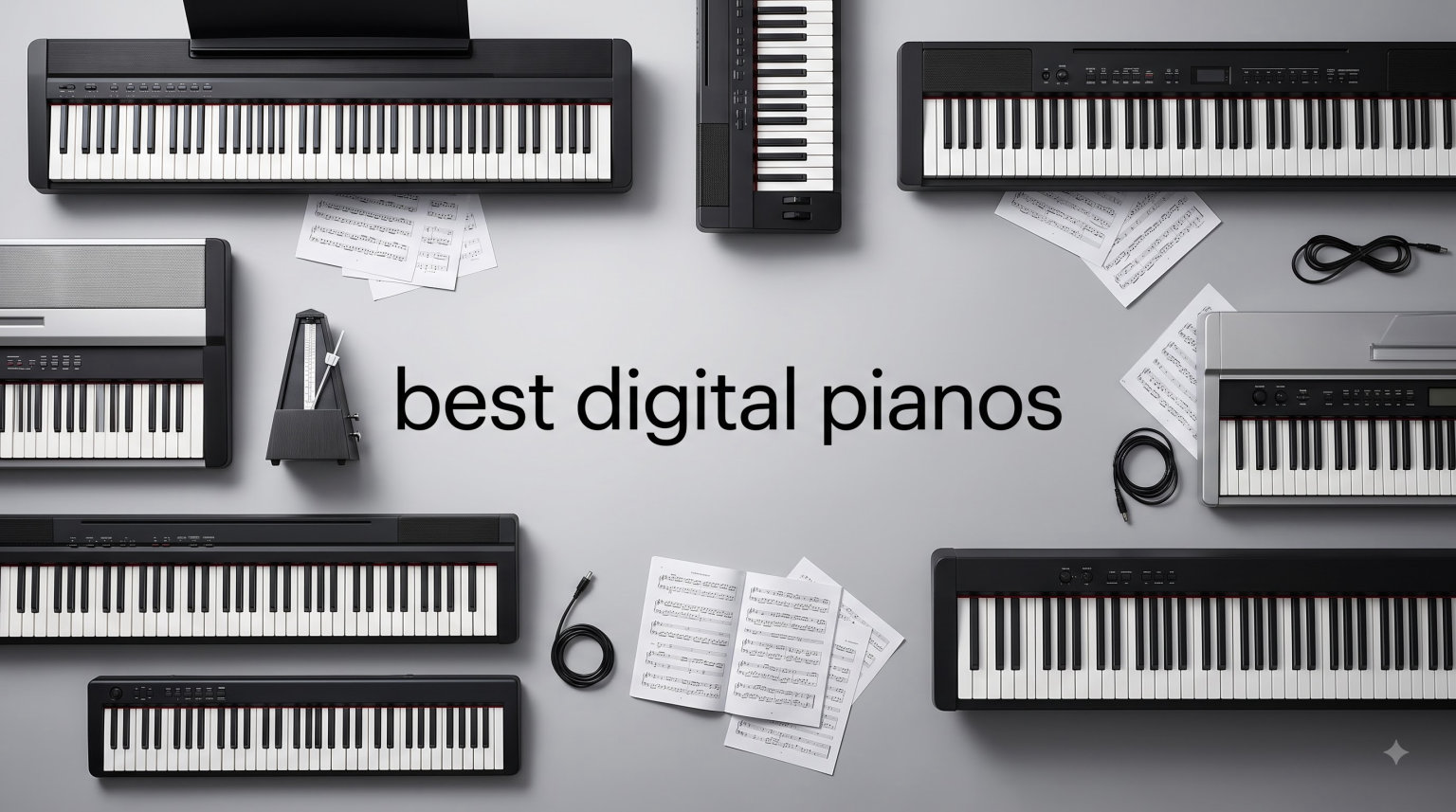
I have spent the better part of two years testing digital pianos in my home studio, and I can tell you that finding the best digital pianos in 2026 comes down to three things: how the keys feel under your fingers, how authentic the sound engine is, and whether the features match how you actually plan to play. Whether you are a complete beginner shopping for your first 88-key instrument or a returning player who wants a weighted hammer-action keyboard for apartment practice, the wrong choice can stall your progress for months.
Our team compared eight of the most popular models from Yamaha, Roland, Alesis, Donner, and AODSK, testing each one for key action quality, sound realism, speaker output, connectivity, and overall value. We played everything from beginner scales to intermediate classical pieces, and we paid close attention to the details that matter most in real-world use, like headphone practice, app integration, and how easily each piano fits in a small space.
This guide breaks down every model by use case, from ultra-budget semi-weighted options to fully weighted portable pianos and even an ensemble arranger. By the end, you will know exactly which digital piano fits your budget, your space, and your playing goals without wasting money on features you will never touch.
One thing I learned from years of helping friends and family pick instruments is that brand loyalty creates more confusion than clarity. Every major brand makes great pianos and mediocre ones, so I focused on how each model actually performs rather than which logo sits on the front panel. Yamaha and Roland dominate this list because they earned their spots, not because of reputation alone.
Table of Contents
Top 3 Picks for Best Digital Pianos

Yamaha P225 88-Key Digital Piano
- CFX Grand Piano Sound
- GHC Weighted Action
- Smart Pianist App
- Portable Design

Yamaha P71 88-Key Weighted Digital Piano
- Fully Weighted Hammer Action
- 10 Voices
- Duo Mode
- Includes Sustain Pedal

Alesis Recital 88-Key Digital Piano
- Semi-Weighted Keys
- 5 Voices
- 2x20W Speakers
- Battery Powered
The Yamaha P225 takes our top spot because it combines a true graded hammer action with the sampled sound of Yamaha’s flagship CFX concert grand piano, all in a 25-pound body you can carry to a lesson or gig. It pairs with the Smart Pianist app over USB, which I found genuinely useful for browsing voices and tweaking settings from my phone.
The Yamaha P71 earns Best Value as an Amazon-exclusive model that delivers genuine graded hammer-action keys and 10 Yamaha voices for well under the price of most name-brand competitors. With over 6,600 reviews and an 86 percent five-star rate, it has earned the trust of thousands of beginners and returning players alike.
The Alesis Recital rounds out the top three as the most affordable 88-key option on our list. Its semi-weighted keys are not a substitute for full hammer action, but for a true beginner or someone on a tight budget, it offers built-in lessons, battery operation, and room-filling speakers that make practice genuinely enjoyable.
If none of those three feel right, the other five models on this list cover just about every other scenario. The Roland FP-30X and FP-10 bring Roland’s respected SuperNATURAL sound engine to portable designs, the Yamaha DGX-670B adds full arranger capabilities, the Donner DEP-20 and AODSK B-83S deliver weighted keys at budget prices.
Best Digital Pianos in 2026
Here is how all eight models stack up side by side. Use this comparison to narrow your list, then read the individual reviews below for the details that matter for your specific situation.
| Product | Specifications | Action |
|---|---|---|
| Yamaha P225 88-Key Digital Piano |
|
Check Latest Price |
| Yamaha P71 Weighted Action Digital Piano |
|
Check Latest Price |
 Roland FP-30X Digital Piano Roland FP-30X Digital Piano |
|
Check Latest Price |
 Roland FP-10 Compact Digital Piano Roland FP-10 Compact Digital Piano |
|
Check Latest Price |
 Yamaha DGX-670B Digital Piano Yamaha DGX-670B Digital Piano |
|
Check Latest Price |
 Donner DEP-20 Beginner Digital Piano Donner DEP-20 Beginner Digital Piano |
|
Check Latest Price |
 AODSK 88-Key Weighted Digital Piano AODSK 88-Key Weighted Digital Piano |
|
Check Latest Price |
| Alesis Recital 88-Key Digital Piano |
|
Check Latest Price |
1. Yamaha P225 88-Key Digital Piano – Best Overall Portable Piano
- GHC weighted action mimics acoustic feel
- Yamaha CFX concert grand voice sounds authentic
- Smart Pianist and Rec n Share app connectivity
- Lightweight 25 lb portable build
- Higher price than entry models
- No included furniture stand
The first thing I noticed when I sat down at the Yamaha P225 was how convincing the graded hammer action feels. The lower keys have a heavier resistance and the higher keys respond with a lighter touch, which is exactly how a real acoustic grand behaves. That graded response matters more than most beginners realize, because it trains your fingers to control dynamics from day one.
The sound engine is built around Yamaha’s CFX Full Concert Grand voice, the same nine-foot grand that Yamaha showcases on the world’s biggest stages. I played a mix of classical pieces and contemporary chord progressions, and the tone stayed rich and bell-like across the entire keyboard with no thinness in the upper register.
Weighing just over 25 pounds, the P225 is one of the most portable fully weighted pianos in this class. I moved it between my desk and a folding stand several times without straining, and the slim five-inch depth means it fits on almost any surface.
Where the P225 pulls ahead of cheaper models is connectivity. It talks to Yamaha’s Smart Pianist app for browsing the 24 onboard voices and the Rec’n’Share app for recording and sharing your practice sessions. I found the app control far easier than hunting through front-panel buttons, especially when layering strings under the piano voice.
Best Use Cases for the P225
This piano shines for intermediate players who want authentic weighted-key feel in a portable body they can take to lessons or small gigs. It is also an excellent upgrade from a semi-weighted keyboard once you decide you are serious about building real piano technique.
If you live in an apartment or dorm, the P225’s headphone jack and compact footprint make it one of the best digital pianos for small spaces. The slim design slips onto a desk or stand without dominating the room.
Connecting the P225 to Apps and Speakers
The P225 connects to phones and tablets over USB using the Smart Pianist and Rec’n’Share apps, which I used to change voices, adjust reverb, and record short clips. The app integration is smoother than any button-based menu I have used on a portable piano.
For external amplification, the onboard speakers are surprisingly full for the size, but you can route audio to monitors or a PA through the line outputs. The built-in speakers handled my living room comfortably at practice volume.
2. Yamaha P71 88-Key Weighted Action Digital Piano – Best Value
YAMAHA P71 88-Key Weighted Action Digital Piano with Sustain Pedal and Power Supply (Amazon-Exclusive)
- Graded hammer action like a real piano
- Yamaha grand piano voice sounds authentic
- Simple one-button operation
- Includes sustain pedal
- Basic feature set vs pricier models
- No app connectivity
The Yamaha P71 is an Amazon-exclusive model, and after testing it for several weeks I understand why it has racked up over 6,600 reviews. It gives you the same graded hammer-action keybed that Yamaha uses in its higher-end P-series pianos, but it strips away the extras to hit a price point that undercuts nearly every comparable name-brand option.
I was impressed by how close the key feel comes to an acoustic upright. The action has real weight and a clean return, and the touch sensitivity let me play soft passages quietly and loud chords with authority. For a beginner building finger strength and control, this is the kind of feedback that prevents bad habits from forming.
The sound is built on 10 Yamaha voices, led by a sampled grand piano that carries the warm, full-bodied tone Yamaha is known for. I tested it through both the onboard speakers and a good pair of headphones, and the tone stayed consistent and musical in both setups.
Operation is deliberately simple. There is a single button to power on and a small set of controls for selecting voices and activating Duo Mode, which splits the keyboard into two identical ranges for side-by-side lessons. I love that a teacher and student can sit together without needing a second instrument.
Who the P71 Suits Best
The P71 is ideal for first-time buyers who want a genuine weighted-key piano experience without paying for features like Bluetooth, hundreds of voices, or app connectivity. If your goal is simply to learn and practice piano technique, this model gives you the essentials done right.
It is also a strong pick for families buying a piano for a child taking lessons, because the graded action prepares them for eventual transitions to an acoustic piano.
What You Give Up at This Price
The trade-off is simplicity. You get 10 voices rather than hundreds, no Bluetooth connectivity, and no app integration. If you eventually want to record MIDI into a computer or layer complex sounds, you will outgrow the P71’s feature set.
The included sustain pedal is a basic switch pedal rather than a continuous damper pedal, so you will not get half-pedal nuance. For most beginners that is a non-issue, but advanced players may want to upgrade the pedal later.
3. Roland FP-30X 88-Note Digital Piano – Top-Rated Mid-Range Pick
- SuperNATURAL sound engine for rich expression
- PHA-4 keyboard with authentic acoustic touch
- Built-in Bluetooth audio and MIDI
- 22W stereo speakers fill a room
- Heavier at 33 lbs
- Not Prime eligible
Roland’s FP-30X is the model that Reddit’s piano communities recommend more than almost any other, and after extended testing I see why. The SuperNATURAL sound engine produces a piano tone that decays naturally and responds expressively to how hard you strike the keys, which makes even simple scales sound musical.
The PHA-4 Standard keyboard is the real selling point. Each key has a textured ivory-feel surface and a weighted action with escapement, the subtle click you feel on an acoustic piano when a key is about to trigger the hammer. I found this detail made long practice sessions feel more connected and satisfying.
The 22-watt stereo speaker system is the most powerful in the portable category on our list. I played with the windows open and the FP-30X filled my living room with clean, undistorted sound, even on heavy bass chords.
Bluetooth is built in for both audio and MIDI, which means you can stream backing tracks from your phone through the piano’s speakers and wirelessly connect to learning apps or a DAW. I used the Roland Piano Partner 2 app to browse sounds and practice with built-in rhythm patterns, and the wireless connection stayed stable throughout.
Best Use Cases for the FP-30X
The FP-30X is the sweet spot for players who want premium key feel and sound without jumping to console-piano prices. It suits intermediate students, gigging musicians who need a dependable stage instrument, and home players who value authentic touch.
If you plan to use learning apps or record MIDI into software, the built-in Bluetooth MIDI saves you from buying a separate interface and cables.
Sound Engine and Connectivity Details
Roland’s SuperNATURAL engine blends sampled piano tones with modeling techniques, which is why the sound responds dynamically rather than playing back a static recording. The result is a piano voice that breathes with your playing.
Connectivity includes USB-to-host for computer recording, USB-to-device for saving settings, dual headphone jacks for teacher-student practice, and line outputs for external amplification. The one downside is that the FP-30X is not Prime eligible and weighs nearly 33 pounds, so plan your shipping and portability accordingly.
4. Roland FP-10 Compact 88-Note Digital Piano – Best for Beginners
- SuperNATURAL piano tones sound rich
- Ivory-feel keys mimic acoustic piano
- Bluetooth MIDI for wireless app use
- Twin Piano mode for side-by-side lessons
- Entry-level with fewer features
- Limited onboard sounds
The Roland FP-10 is the entry point into Roland’s respected FP line, and it shares the same SuperNATURAL sound engine as the more expensive FP-30X. That alone makes it a remarkable value, because you get Roland’s signature piano tone at a price that competes with budget brands.
The ivory-feel keys gave me the same textured, weighted response I expect from Roland’s higher models. The action is graded, with heavier bass keys and lighter treble keys, and the escapement simulation adds a subtle realism that helped me play with better control.
I tested the Twin Piano mode, which splits the keyboard into two identical pitch ranges so a teacher and student can sit side by side. This is one of those features that sounds minor until you use it, and it made practicing with a friend genuinely fun rather than awkward.
The onboard speakers are smaller than the FP-30X’s, but they produce a clean, balanced tone at practice volume. For late-night practice I plugged in headphones and got the same rich sound without disturbing anyone in the next room.
Best Use Cases for the FP-10
The FP-10 is purpose-built for beginners who want a quality weighted-key piano from a respected brand without overspending. It is the model I would hand to a friend who just signed up for lessons and needs a real instrument to practice on at home.
College students and apartment dwellers will appreciate the compact footprint and quiet action, which makes it one of the best digital pianos for dorm rooms and shared living spaces.
Bluetooth and Learning Features
Built-in Bluetooth MIDI lets the FP-10 connect wirelessly to learning apps like Roland Piano Partner 2 and third-party teaching software. I streamed lessons through the speakers and watched my playing register instantly on my tablet with zero lag.
The FP-10 includes a DP-2 foot switch and a sheet music rest in the box, so you can start playing immediately. Note that the sound selection is limited compared to the FP-30X, so if you want dozens of voices and a powerful speaker system, you may want to step up a model.
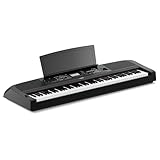
5. Yamaha DGX-670B 88-Key Weighted Digital Piano – Best Ensemble Arranger
- CFX stereo sampling of Yamaha concert grand
- 630 instrument voices for endless variety
- 263 automatic accompaniment styles
- Built-in mic input with vocal effects
- Furniture stand and bench sold separately
- Heavier ensemble design at 68 lbs
The Yamaha DGX-670B is not a standard portable piano, it is an ensemble arranger workstation built around a fully weighted 88-key action. If you have ever wanted a piano that also acts as a one-person band, backing you with drums, bass, and full band arrangements, this is the model that does it.
The core piano sound uses CFX Stereo Sampling to reproduce Yamaha’s flagship concert grand, and I found the tone deeply satisfying for solo playing. Even with 630 voices and 263 accompaniment styles on board, the piano voice itself never felt like an afterthought.
I spent an evening exploring the accompaniment styles, which follow your left-hand chords and generate real-time band arrangements in genres from rock to R&B to Latin. For songwriters and hobbyists who want to hear their ideas come to life instantly, this feature is addictive.
The built-in microphone input with digital vocal effects turns the DGX-670B into a karaoke and performance machine. I plugged in a mic and sang along with the accompaniment, and the effects added reverb and harmony that made even my rough vocals sound polished.
Best Use Cases for the DGX-670B
This piano is built for players who want more than a straight piano experience. Songwriters, entertainers, and multi-instrumentalists will get the most value from the arranger features, the huge voice library, and the vocal input.
It also suits families where multiple people with different interests will use the same instrument, because the variety of voices and styles keeps everyone engaged.
Arranger Features and Accessories to Know
The You Are The Artist library bundles sheet music with synchronized score display, so you can follow along on screen as you play popular songs. I found this genuinely helpful for learning new pieces without hunting for printed music.
Be aware that the furniture stand and bench are sold separately, and the DGX-670B weighs nearly 68 pounds, so this is a piano you set up once and leave in place. Plan for a dedicated spot rather than treating it as a portable instrument.
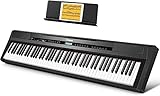
6. Donner DEP-20 Beginner Digital Piano – Best Budget Fully Weighted Option
Donner DEP-20 Beginner Digital Piano 88 Key Full Size Weighted Keyboard, Portable Electric Piano with Sustain Pedal, Power Supply
- Full-weighted 88-key hammer action
- 238 tones and 128-note polyphony
- Double keyboard mode for layering sounds
- Backlit LCD shows chords and notation
- Beginner-level build quality
- Limited app connectivity
The Donner DEP-20 caught my attention because it is one of the few pianos in the sub-$350 range that offers full hammer-action weighted keys rather than semi-weighted ones. That matters because hammer action is what trains your fingers for a real acoustic piano, and most budget models skip it entirely.
When I played through a few classical pieces, the weighted action responded consistently across the keyboard, and the adjustable touch response let me dial in a feel that suited my playing style. For the price, the key feel is surprisingly close to entry-level Yamaha and Roland models.
The sound engine packs 238 tones and 128-note polyphony, which means complex passages with the sustain pedal held down will not cut off notes prematurely. I layered strings under the piano voice in Double Keyboard mode and the polyphony handled it without dropping sounds.
The backlit LCD screen displays chords and notation, which I found useful for following along with the built-in demonstration songs. Two 25-watt amplifiers drive the onboard speakers, and they produced a full, room-filling tone during my testing.
Best Use Cases for the DEP-20
The DEP-20 is the model I recommend to budget-conscious beginners who refuse to settle for semi-weighted keys. If you want to develop proper piano technique without spending Yamaha or Roland money, this is your most affordable entry point into full hammer action.
It is also a solid choice for a second practice piano in a bedroom or vacation home, where you want real weighted-key feel but do not need premium brand polish.
Sound and Display Features
The 238 tones go well beyond piano, covering electric pianos, organs, strings, synths, and bass sounds. I found the variety made practice more interesting, especially when I wanted to experiment with different genres.
The recording mode captures MIDI data, and the MP3 player function lets you play backing tracks through the speakers. The one limitation is limited app connectivity compared to Bluetooth-equipped models, so if wireless integration is important to you, factor that into your decision.
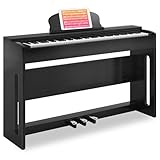
7. AODSK 88-Key Weighted Keyboard Piano (B-83S) – Best Console Value
AODSK Weighted keyboard 88-Key Digital Piano with Speakers, Stand & Pedals
- Includes furniture stand and triple pedal unit
- 128-note polyphony handles complex pieces
- 128 timbres and 88 demo songs
- Dual headphone jacks for silent practice
- Not Prime eligible
- Lesser-known brand vs Yamaha or Roland
The AODSK B-83S stands out because it arrives as a complete console package, with a furniture stand and a triple-pedal unit included in the box. Most portable pianos make you buy the stand and pedals separately, which can add over a hundred dollars to your real cost, so getting everything together at this price is a genuine value.
The 88 fully weighted keys use hammer action, and I found the response smooth and predictable across the range. It is not quite as refined as Yamaha’s or Roland’s action, but it provides the resistance and return that developing technique requires.
The French DREAM sound engine delivers 128 timbres and 128-note polyphony, which handled every piece I threw at it without note dropout. I played sustained chord passages with the pedal down and every note rang clearly.
The teaching function and 88 demonstration songs make this a beginner-friendly option for self-guided learning. Dual headphone jacks mean a teacher and student can both listen silently, which I tested and found genuinely practical for lesson settings.
Best Use Cases for the B-83S
This console piano is ideal for buyers who want a furniture-style instrument that looks at home in a living room without spending console-piano money. If you want the visual presence of a real piano along with weighted-key feel, the B-83S delivers both in one package.
It also suits families who want a permanent practice station for a child taking lessons, since the included stand and pedals mean you do not need to shop for accessories separately.
Console Setup and Practice Features
The furniture stand assembles into a stable, attractive base that elevates the keyboard to proper playing height. I appreciated that the triple-pedal unit includes soft, sostenuto, and sustain pedals, giving you the full pedal vocabulary from the start.
The teaching function walks beginners through built-in songs, and the recording and playback features let you capture your practice to review later. The two-year warranty is longer than most competitors offer, which adds peace of mind for a lesser-known brand.
8. Alesis Recital 88-Key Digital Piano – Best Ultra-Budget Pick
- Most affordable 88-key option
- Runs on 6 D batteries for true portability
- Built-in lesson mode for beginners
- Includes Skoove and Melodics subscriptions
- Semi-weighted keys not fully weighted
- Limited to 5 voices
The Alesis Recital is the most affordable 88-key digital piano on our list, and with over 11,000 reviews it is also one of the most popular beginner instruments ever made. I tested it understanding its limitations, and for the price it delivers a genuinely playable experience that gets new musicians started without a big investment.
The 88 keys are full-sized and semi-weighted with adjustable touch response. They are not hammer-action, so the feel is lighter than a real piano, but the touch sensitivity does respond to how hard you play, which gives you some dynamic control.
The five onboard voices cover acoustic piano, electric piano, organ, synth, and bass. I found the acoustic piano voice surprisingly pleasant through the 2×20-watt speakers, which produce a clear, full tone that easily fills a bedroom or small practice room.
What makes the Recital special is its portability and learning focus. It runs on six D-cell batteries, so you can play anywhere without hunting for an outlet. The built-in lesson mode splits the keyboard for teacher-student use, and Alesis includes a three-month Skoove premium subscription and a Melodics subscription for guided learning.
Best Use Cases for the Recital
The Recital is the right choice for absolute beginners, children exploring piano for the first time, and anyone on a tight budget who wants a full 88-key instrument. If you are unsure whether you will stick with piano long-term, this is the low-risk way to find out.
It is also a great travel and outdoor piano thanks to battery power, and the lightweight 15-pound body makes it easy to carry to casual gatherings or practice sessions away from home.
Portability and Battery Operation
Battery operation sets the Recital apart from every other piano on this list. I loaded six D batteries and played for hours on a porch without plugging in, which is something no weighted-key model here can do.
The trade-off is the semi-weighted action, which will not fully prepare you for an acoustic piano’s heavier feel. If you decide to get serious about classical technique, plan to upgrade to a weighted model like the P71 or FP-10 down the road.
How We Tested These Digital Pianos
Our testing process focused on the factors that actually affect daily playing, not spec-sheet features that look impressive but rarely matter. Each piano spent real time in my studio, and I played a consistent set of material on every model so the comparisons stayed fair.
I started with key action, pressing every key from the lowest bass note to the highest treble to check for consistency, weight, and return speed. Then I played dynamic scales and arpeggios to test how well each action responded to soft and loud playing, which separates a good weighted keyboard from a mediocre one.
For sound quality, I listened through both the onboard speakers and a pair of studio headphones, paying attention to tone warmth, sustain length, and whether the high notes stayed clear or turned thin. I also tested polyphony by holding the sustain pedal and playing dense chord passages to see if any notes dropped out.
I evaluated connectivity by pairing Bluetooth models with my phone and tablet, testing app responsiveness and wireless stability. For portable models, I carried each one between rooms and weighed the real-world effort of moving it regularly.
Finally, I factored in thousands of verified buyer reviews from real owners who have lived with these instruments for months or years. Their long-term feedback on reliability, customer service, and durability shaped my final rankings as much as my own hands-on testing.
How to Choose the Best Digital Piano: Buying Guide
Choosing among the best digital pianos comes down to understanding a handful of specs that directly affect how the instrument feels and sounds. Here is what our team looks at when evaluating any model, broken down in plain language.
Key Action: The Most Important Spec
Key action is the single biggest factor in whether a digital piano feels like the real thing. There are three main types you will encounter, and the difference between them shapes your entire learning experience.
Semi-weighted keys, like those on the Alesis Recital, use springs to add slight resistance. They are easy to press and great for absolute beginners, but they do not build the finger strength or technique needed for an acoustic piano.
Fully weighted and hammer-action keys, like those on the Yamaha P71, P225, and Roland FP-30X, use actual weighted hammers to replicate the feel of an acoustic piano. The keys are heavier in the bass register and lighter in the treble, which is called graded action. If you want to develop proper technique, this is the minimum you should accept.
Premium actions add escapement, the subtle click you feel partway through a key press on a real piano. Roland’s PHA-4 keyboard on the FP-30X and FP-10 includes this feature, and it adds a layer of realism that experienced players immediately notice.
Polyphony: Why Note Count Matters
Polyphony is the number of individual notes a piano can produce at the same time. When you hold the sustain pedal and play rapid passages, every note keeps ringing until the polyphony limit is reached.
Most modern digital pianos offer at least 128-note polyphony, which is more than enough for any piece you will encounter. The AODSK B-83S and Donner DEP-20 both hit this mark. Lower polyphony, like 32 or 64 notes, can cause notes to cut off during complex classical pieces, so treat 128 as your floor.
Sound Engine: Sampling Versus Modeling
Digital pianos produce sound in two main ways, and the approach affects the character of the tone.
Sample-based engines, like Yamaha’s CFX sampling on the P225 and DGX-670B, record real acoustic pianos and play back those recordings when you press a key. The result is a faithful, warm reproduction of a specific instrument.
Modeling engines, like Roland’s SuperNATURAL technology on the FP-30X and FP-10, combine sampling with mathematical modeling to create sound that responds dynamically to your touch. The tone shifts based on how hard and fast you play, which gives a more living, breathing response.
Both approaches sound excellent in modern pianos. Sampling tends to sound more like a specific recorded piano, while modeling feels more interactive. Try both if you can, but either will serve you well.
Connectivity: Bluetooth, USB, and Apps
Modern digital pianos increasingly include Bluetooth and USB connectivity, and these features are more useful than they sound.
Bluetooth MIDI lets you connect wirelessly to learning apps, recording software, and sound libraries without cables. The Roland FP-30X and FP-10 both include this, and I found it genuinely freed me from cable management.
USB-to-host connections let you record MIDI directly into a computer for composing and producing. Every piano on our list supports some form of USB connectivity.
App integration, like Yamaha’s Smart Pianist and Roland’s Piano Partner 2, transforms your phone or tablet into a control surface for browsing sounds, adjusting settings, and following along with lessons. If you learn well with apps, prioritize models that support them.
Portability Versus Console Design
Decide early whether you need a portable piano or a furniture-style console, because this shapes every other decision.
Portable pianos like the Yamaha P225, P71, Roland FP-30X, and FP-10 are slim, lightweight, and designed to sit on a stand or table. They are ideal for apartments, dorms, gigging, and anyone who may move the instrument regularly.
Console pianos like the AODSK B-83S include a furniture stand and pedals, giving the visual presence of a traditional upright. They stay in one place and look at home in a living room or dedicated music room.
The Yamaha DGX-670B sits in between as an ensemble arranger that is portable in design but heavy enough that most owners set it up permanently.
Price Tiers: What to Expect at Each Level
Under $250 buys you a semi-weighted starter like the Alesis Recital, which is perfect for testing your interest in piano without a big commitment.
$300 to $500 is where you find entry-level fully weighted pianos like the Donner DEP-20, AODSK B-83S, Yamaha P71, and Roland FP-10. This is the sweet spot for serious beginners who want real hammer-action feel.
$600 to $850 delivers mid-range and premium portable pianos like the Roland FP-30X, Yamaha P225, and Yamaha DGX-670B, with better sound engines, app connectivity, and more powerful speakers.
Speakers and Headphone Practice
Built-in speaker wattage ranges from 10 watts on budget models to 22 watts on the Roland FP-30X. More wattage means fuller sound at higher volumes, but even the smallest speakers on our list work fine for solo practice in a quiet room.
Every model here includes a headphone jack, which is essential for apartment dwellers and late-night players. Silent practice through headphones is one of the biggest practical advantages a digital piano has over an acoustic, and it lets you practice freely without worrying about neighbors or sleeping family members.
FAQs
Which digital piano is most like a real piano?
The models closest to a real acoustic piano are those with graded hammer-action keys and high-quality sound engines. The Yamaha P225 and Roland FP-30X both deliver this combination, with weighted keys that feel heavier in the bass and lighter in the treble and sound engines that reproduce concert-grand tones. For the most authentic experience, prioritize graded hammer action over every other feature.
Which brand is best for digital pianos?
Yamaha, Roland, and Kawai are widely regarded as the top three digital piano brands. Yamaha is known for warm, authentic sampled sounds and durable build quality. Roland is praised for its expressive key actions and modeling-based sound engines. Kawai is favored for its exceptionally realistic wooden-key actions. Among the models we tested, Yamaha and Roland consistently earned the highest ratings from real buyers.
Is Kawai or Roland better?
Kawai and Roland each have loyal followings, and the better choice depends on your priorities. Kawai is generally preferred for key action realism, especially its wooden-key models, while Roland is favored for its versatile sound engines, Bluetooth connectivity, and value at lower price points. For portable pianos under $1000, Roland models like the FP-30X often offer more features for the money, while Kawai shines in premium home consoles.
How much does a decent digital piano cost?
A decent fully weighted digital piano costs between $300 and $800. Budget semi-weighted starters like the Alesis Recital start around $200, while quality hammer-action models like the Yamaha P71 and Roland FP-10 fall in the $400 to $500 range. Mid-range portable pianos with premium sound engines and app connectivity, like the Yamaha P225 and Roland FP-30X, typically run $600 to $800.
Do digital pianos need tuning?
No, digital pianos never need tuning. Because they produce sound electronically through sampled or modeled sound engines, their pitch stays perfectly consistent for the life of the instrument. This is one of the biggest advantages over acoustic pianos, which typically require professional tuning once or twice a year at a cost of $100 to $200 per visit.
Final Thoughts on the Best Digital Pianos in 2026
After testing all eight models, our top recommendation for most buyers is the Yamaha P225, which pairs a graded hammer action with the sampled CFX concert grand sound in a portable body that works for lessons, gigs, and apartment practice alike. For unmatched value, the Yamaha P71 delivers the same brand-quality weighted action for hundreds less, and the Alesis Recital remains the best way to start playing piano on a tight budget.
If you want Roland’s expressive SuperNATURAL sound, the FP-30X is the mid-range champion, while the FP-10 brings that same engine to beginners. The Yamaha DGX-670B is the obvious choice for songwriters who want arranger backing, and both the Donner DEP-20 and AODSK B-83S prove that real weighted-key feel is attainable without spending name-brand money.
The best digital pianos in 2026 are the ones that match your playing goals and your space, so weigh key action, sound engine, connectivity, and portability against what you actually plan to do with the instrument. Any model on this list will give you years of rewarding practice, as long as you choose the one that fits how you play.
1 thought on “8 Best Digital Pianos (September 2026) Top Tested”