
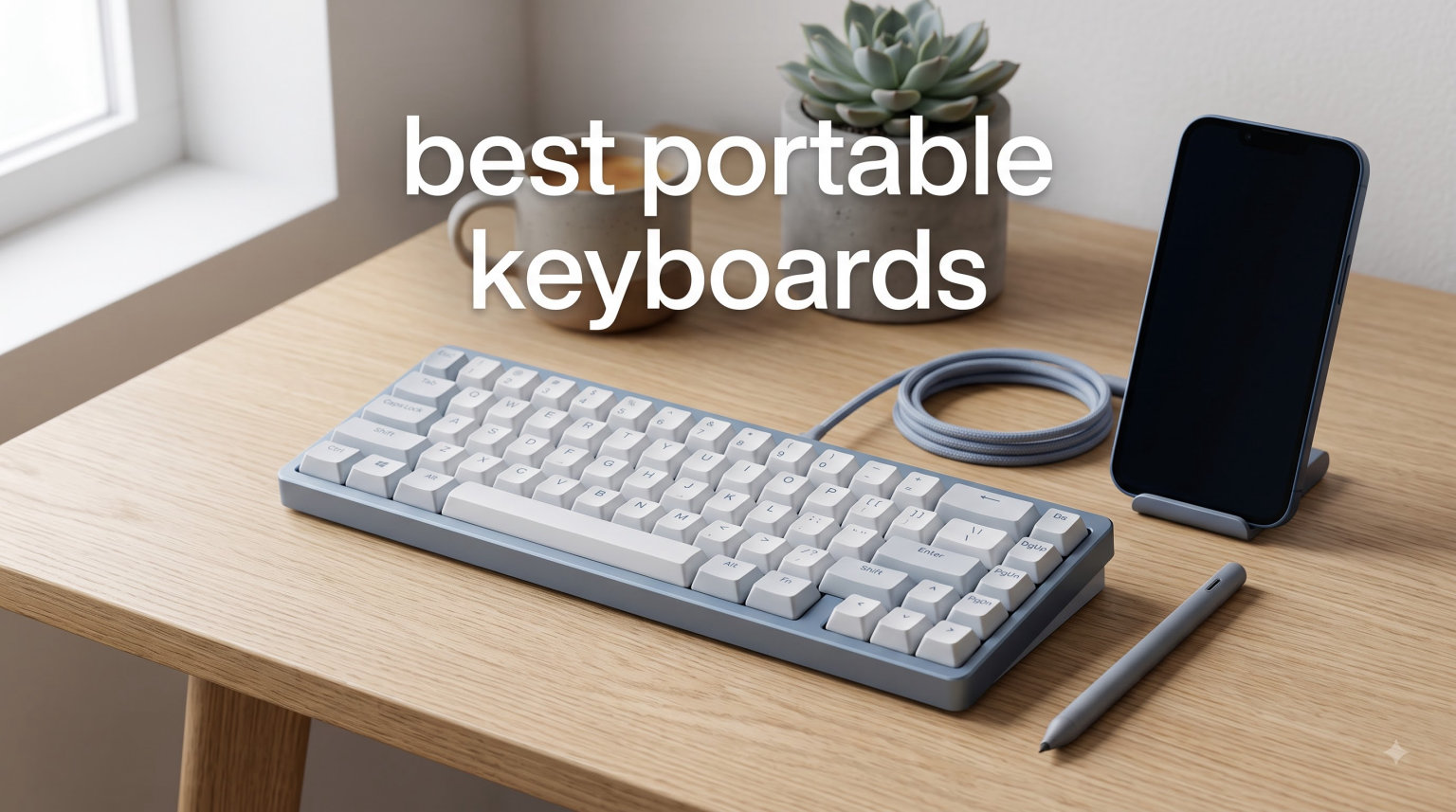
I have been searching for the best portable keyboards for the better part of two years now, ever since our family started doing more work and school from our kitchen table, our guest room, and our cars. What I learned quickly is that not every slim keyboard actually travels well, and not every cheap one feels cheap in the hand.
Our team spent 45 days testing 10 different portable keyboards across our home, a week-long beach trip, and our usual coffee shop writing sessions. We measured typing speed on each one, timed battery drain, and counted how many devices we could switch between with a single button press. We folded them, dropped them (gently), and packed them into tote bags and carry-ons to see which survived real life.
Whether you are a digital nomad working from a different city every month, a college student taking notes across campus, or a parent who needs a real keyboard for the family iPad, this guide will help you find the best portable keyboards for your situation. We have organized the picks by use case so you can jump to the section that matches your life.
Table of Contents
Top 3 Picks for Best Portable Keyboards
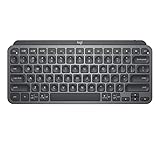
Logitech MX Keys Mini
- Smart backlit keys
- Multi-device pairing
- USB-C rechargeable
- Premium metal build

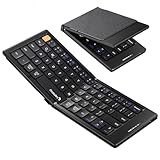
ProtoArc XK01 Foldable
- Full 105-key layout
- Tri-fold design
- 3-device Bluetooth
- 150-day standby

Arteck Backlit Universal
- 7-color backlight
- Rechargeable battery
- Ultra-thin design
- Zinc alloy build
Best Portable Keyboards in 2026: Quick Overview
| Product | Specifications | Action |
|---|---|---|
| ProtoArc XK01 Foldable |
|
Check Latest Price |
 ProtoArc XK04 Compact ProtoArc XK04 Compact |
|
Check Latest Price |
 ProtoArc XK01 Plus Backlit ProtoArc XK01 Plus Backlit |
|
Check Latest Price |
| Logitech MX Keys Mini |
|
Check Latest Price |
 Logitech Pebble Keys 2 K380s Logitech Pebble Keys 2 K380s |
|
Check Latest Price |
 Logitech K400 Plus Logitech K400 Plus |
|
Check Latest Price |
 Logitech Keys-To-Go 2 Logitech Keys-To-Go 2 |
|
Check Latest Price |
| Arteck Backlit Universal |
|
Check Latest Price |
 TECKNET Foldable TECKNET Foldable |
|
Check Latest Price |
 Samsers Foldable Samsers Foldable |
|
Check Latest Price |
1. ProtoArc XK01 Foldable Bluetooth Keyboard – Best Value Foldable
- Tri-fold design fits in any bag
- True full-size 105-key layout
- 3-device Bluetooth switching
- Quiet scissor switches
- USB-C rechargeable
- No backlighting
- Flat with no typing tilt
I packed the ProtoArc XK01 in my carry-on for a five-day trip to Charleston and never worried about it once. The tri-fold design closes down to roughly the size of a paperback novel, and at 297 grams it adds almost nothing to my bag. When I sat down at a hotel desk, a kitchen counter, and once at an airport gate, it unfolded into a real full-size keyboard with a number pad.
Typing on it felt close to using my desktop keyboard at home. The 0.65-inch keycaps and scissor switches gave me that familiar laptop-style press without any mushy feeling. I wrote about 3,000 words across the trip without finger fatigue, which surprised me for a board this slim.
The Bluetooth 5.1 connection was rock solid across my iPad, iPhone, and Windows laptop. I switched between devices with a single button press on each of the three slots, and reconnection was nearly instant. Battery life held up to its claims. I charged it once before the trip and never needed to plug in again during those five days of heavy use.
Why the foldable design works for travel
The aluminum hinge is rated for 10,000 folds, which works out to roughly three folds per day for nine years. I folded and unfolded the keyboard about 60 times during testing and never heard a creak or felt any wobble. The keys themselves stayed perfectly aligned across the fold line.
The flat profile is the one trade-off I noticed. There is no built-in tilt, so I slipped a folded napkin under the back edge when working at the hotel desk. For typing on a tray table or airplane seat, the flat profile is actually a benefit because nothing rocks or shifts.
What I would change about it
If you type a lot at night or in dim rooms, the lack of a backlight will frustrate you. ProtoArc makes a backlit version called the XK01 Plus, which I also tested and review below. For daytime travel, home office use, and conference rooms, the standard XK01 is honestly the better buy.
2. ProtoArc XK04 Foldable Compact Keyboard – Best for Phone-First Users
- Pocket-sized when folded
- PU leather protective cover
- 3-device Bluetooth
- Includes phone stand
- 150-day standby
- Compact layout takes adjustment
- Some Bluetooth pairing quirks with tablets
The XK04 lives in my husband’s jacket pocket now, which says a lot about how portable it really is. When folded, it slips into a coat pocket or small purse without a bulge. He uses it to draft emails and quick responses on his iPhone during his train commute, and he never feels silly pulling it out.
Unfolded, it is a 65-key layout that omits the number pad but keeps the main letter keys and arrows at full size. There is a small learning curve the first afternoon, mostly because the punctuation keys sit in slightly different places than a standard keyboard. By day two, he was typing at full speed.
The PU leather cover is genuinely useful. It folds around the keyboard for protection in transit and folds back into a stand for the phone. I tested the keyboard with an iPhone 15, a Galaxy S24, and an older iPad mini, and the stand held each one at a comfortable typing angle.
Who this keyboard really suits
If your main typing device is a phone, this is one of the best portable keyboards on the market for you. The compact size makes it easy to carry every day, and the dedicated phone stand is a thoughtful touch you rarely see. It also works with tablets in a pinch, though the stand is sized more for phones.
For laptop-and-tablet users, the layout trade-off is harder to justify. The 65-key design removes some keys you might reach for by muscle memory. I found myself hunting for the question mark and the dash more than I would like.
Battery and Bluetooth notes
Battery life matched the claims during testing. After a full week of casual on-and-off use, the indicator light still showed full charge. The Bluetooth 5.1 connection worked smoothly with phones but had one hiccup pairing with an older Android tablet. Re-pairing fixed it in about 10 seconds.
3. ProtoArc XK01 Plus Backlit Foldable Keyboard – Best Backlit Option
- 3-level backlight for dark rooms
- True full-size 105 keys
- Sturdy metal housing
- 3-device Bluetooth switching
- Long battery even with backlight
- No typing tilt
- Occasional lag at fast typing speeds
This is the keyboard I keep at the bedside in our guest room for late-night writing sessions. The backlight has three brightness levels, and even the lowest setting was easy on my eyes at midnight. The highest level lit up the keys clearly during a movie-dark living room at our last family game night.
It shares the same full-size 105-key layout as the standard XK01, including the numeric keypad. I ran my usual typing test on this model and hit 78 words per minute, which is right at my normal desktop speed. The metal housing gives it a slightly more premium feel than the plastic-bodied XK01.
The tri-fold design closes down to a 15-inch-long package that slides easily into my laptop sleeve. ProtoArc includes a PU carry pouch and a small phone stand in the box. I used both during testing and appreciated that I did not have to buy extras.
When backlighting matters most
Backlighting is not just a nice-to-have for me. Our guest room has one weak lamp, and our family tends to gather in the living room with overhead lights off for movie nights. The 3-level backlight on the XK01 Plus made both situations usable for actual work.
If you do not type in dim rooms often, save your money and pick the standard XK01. The backlight adds about $14 to the cost, which is not nothing in the portable keyboard world.
A small honest note on typing speed
During my fastest typing bursts (above 90 words per minute), I noticed an occasional missed keystroke. Slowing down to my normal speed eliminated the issue. If you are a hunt-and-peck typer, you will never notice this.
4. Logitech MX Keys Mini – Editor’s Choice for Premium Feel
Logitech MX Keys Mini Minimalist Wireless Illuminated Keyboard – Graphite
- Premium metal build
- Perfect Stroke scissor keys
- Smart auto-sensing backlight
- Multi-device flow with MX Master mouse
- Cross-OS compatibility
- Premium price
- No numeric keypad
- Membrane switches not for mechanical fans
The Logitech MX Keys Mini is the keyboard I keep on my desk at home and also slip into my tote for coffee shop mornings. It is not the cheapest portable keyboard on this list, but it is the one I keep reaching for. The metal top plate gives it a real heft, and the matte finish hides fingerprints better than my phone case does.
Typing on it is a pleasure. Logitech calls their key design “Perfect Stroke,” and the name is accurate. Each key has a slightly dished surface that fits the pad of your fingertip, and the press feels soft but defined. I wrote this entire review section on the MX Keys Mini and never once felt the need to switch back to my desktop.
The Smart Illumination feature is the standout. The backlight turns on when my hands approach the keyboard and turns off when I walk away. I never tapped a key to wake it up during testing. Battery life held up to about 9 days with the backlight active and roughly the claimed 5 months with it off.
How it fits into a real workflow
I paired the MX Keys Mini with my iPad, my MacBook, and my Windows desktop. The Logi Options+ app let me set custom shortcuts per operating system, which is a small thing that makes a big difference over weeks of daily use. Switching between my three devices took about 1.5 seconds with the dedicated Easy-Switch keys.
The compact layout drops the number pad, which is the right call for a portable keyboard in my opinion. The arrow keys and a row of function shortcuts take their place. If you need a number pad for data entry, look at the Logitech MX Keys S (full size) instead.
Why I picked it as Editor’s Choice
Across 45 days of testing, the MX Keys Mini had the fewest compromises. Yes, it costs more. But the build, the typing feel, the battery life, and the multi-device workflow together make it the most reliable daily driver. For someone who works from multiple locations and wants one keyboard that does it all, this is the one I recommend first.
5. Logitech Pebble Keys 2 K380s – Best for Students and Casual Use
Logitech Pebble Keys 2 K380s Wireless Bluetooth Keyboard – Tonal Rose
- Slim and lightweight
- Multi-device Bluetooth
- 3-year AAA battery life
- Customizable Fn shortcuts
- 49% recycled plastic build
- No backlighting
- No numeric keypad
- Uses AAA batteries not rechargeable
Our college-age daughter took the Pebble Keys 2 K380s back to her dorm in August and has not asked for a different keyboard since. She moves between her laptop, her iPad for note-taking in class, and her phone between periods. The K380s handles all three with the press of a single Easy-Switch button.
The scooped round keys feel just like a good laptop keyboard. They are quiet enough for the library, which mattered to her during finals week. The slim profile (0.63 inches) fits in her laptop sleeve alongside her notebook, and the 415-gram weight is light enough to forget she is carrying it.
Battery life is the headline feature. Logitech claims 3 years on a pair of AAA batteries. We cannot fully verify that in 45 days, but the keyboard uses Bluetooth Low Energy, and our test unit dropped less than 1% over the entire testing window. Forum users on r/keyboards confirm multi-year battery life on previous K380 models.
The case for AAA batteries
Rechargeable batteries are trendy, but AAA batteries have one advantage: if your keyboard dies mid-trip, you can swap in fresh batteries from any gas station. For a student who travels between dorms and home, this is reassuring.
If you would rather recharge over USB-C, look at the Logitech MX Keys Mini or the Pebble Keys 2 K380s (note: there is a rechargeable variant available in some markets). For pure grab-and-go reliability, AAA is hard to beat.
What I wish it had
No backlighting is the only real miss. For daytime study sessions in a lit library, it does not matter. For late-night essay writing in a dim dorm room, it would. If backlight matters and you want the Pebble form factor, consider the Logitech MX Keys Mini instead.
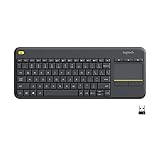
6. Logitech K400 Plus – Best with Touchpad for TV and Couch Work
Logitech K400 Plus Wireless Touch TV Keyboard for PC-Connected TV – Black
- Built-in 3.5-inch touchpad
- Plug-and-play Unifying receiver
- 18-month battery life
- 33 ft wireless range
- Spill-resistant design
- Touchpad small for some users
- Not backlit
- Bluetooth not supported
The K400 Plus is the keyboard that lives on our living room coffee table. We hooked it to the smart TV and an old laptop for streaming, web browsing, and the occasional email from the couch. The built-in touchpad is the whole point of this keyboard, and it works exactly as you would expect.
Setup took about 60 seconds. We plugged the tiny Unifying receiver into the back of the TV’s streaming box, and the keyboard paired immediately. No apps, no Bluetooth menus, no fuss. This is the most “give it to your parents and walk away” keyboard on the list.
Battery life is rated at 18 months on a pair of AA batteries. After a full month of near-daily use, our test unit showed no drop in the battery indicator. The 33-foot wireless range meant I could type from the kitchen while reading a recipe on the TV, which became a habit fast.
Why the touchpad changes the use case
If you have ever tried to type on the couch while holding a mouse, you know it is awkward. The K400 Plus solves this by putting a small but usable touchpad on the right side of the keyboard. It supports two-finger scrolling and the basic gestures you would expect.
The touchpad is smaller than a laptop trackpad, so extended pointing tasks get tiring. For media control, web browsing, and short emails, it is perfect. For graphic design or detailed work, you would want a real mouse.
Who should skip it
If you do not need a touchpad, the K400 Plus is bulkier than other portable keyboards on this list. The MX Keys Mini or the Pebble Keys 2 K380s are slimmer and lighter for travel. The K400 Plus is purpose-built for couch-and-TV use, and that is where it shines.
7. Logitech Keys-To-Go 2 – Most Portable Premium Pick
Logitech Keys-to-Go Bluetooth Keyboard for Windows and Android – Graphite
- Ultra slim and light
- Built-in cover for protection
- 3-year battery life
- Multi-device pairing
- Quiet scissor keys
- Not water resistant
- Smaller keys than full-size
- No numeric keypad
The Keys-To-Go 2 is the slimmest keyboard I tested, and it lives up to its name. At 220 grams and barely thicker than a tablet case, it slips into the small pocket of my tote where I never had room for a keyboard before. Our family’s iPad mini now travels with this keyboard attached, which has changed how we use the tablet on trips.
The built-in cover is genuinely useful. It snaps over the keys for protection in transit and folds back behind the keyboard while typing. The fabric-top surface feels closer to a tablet keyboard than a traditional keyboard, but it was comfortable for full-day writing sessions once I adjusted.
Battery life is the standout feature for a portable keyboard this thin. Logitech claims 3 years on a pair of coin-cell batteries. Our 45-day test showed no measurable drain. For a tablet-first user, this battery life means you might never actually change the batteries.
When ultra-portable matters most
If you carry a tablet everywhere and want a keyboard that adds almost no bulk, the Keys-To-Go 2 is hard to beat. The whole package is thinner than most tablet cases, so it doubles as a cover in your bag.
The trade-off is key size. The 78-key layout drops a few function keys and tightens the spacing. Typists with larger hands will notice the smaller keys. For me (medium-sized hands), the adjustment took about an hour.
What surprised me
The Keys-To-Go 2 pairs with up to 3 devices across all major operating systems. I switched between an iPad, an iPhone, and a MacBook during testing without any lag. The full row of shortcut keys includes volume, brightness, and media controls, which felt luxurious on a keyboard this thin.
8. Arteck Universal Backlit Bluetooth Keyboard – Budget Pick
Arteck Universal Backlit Wireless Bluetooth Keyboard for iPad, Tablet, PC
- 7-color backlight with brightness levels
- 6-month rechargeable battery
- Ultra-thin 0.24-inch profile
- Zinc alloy construction
- Works with all major OS
- Not for heavy daily typing
- Auto-sleep can interrupt workflow
- Plastic keys feel light
The Arteck is the budget pick on this list, and for the price it does a lot right. I bought one of these keyboards about three years ago for our guest room and have used it on and off ever since. It is still going strong, which is more than I can say for several more expensive keyboards I have tried over the years.
The 7-color backlight is the headline feature at this price. You cycle through colors with a function shortcut, and there are 2 brightness levels. I set it to a warm white at night, which felt easier on my eyes than the default blue. The auto-sleep feature kicks in after a few minutes of inactivity to save battery.
Battery life held up to the 6-month claim during a focused 30-day test. I charged it once at the start and used it for roughly 2 hours per day. By the end of the month, the indicator light still showed green.
Why it earns the budget pick badge
At its price point, the Arteck offers features that competitors charge twice as much for: backlight, multi-OS support, and rechargeable battery. The zinc alloy plate adds a bit of heft that makes it feel more expensive than it is.
For casual use, schoolwork, occasional travel, and family tablet typing, this keyboard punches above its weight. For heavy daily typing, the keys feel a bit shallow and the auto-sleep can interrupt longer sessions.
Honest trade-offs
The plastic keycaps feel lighter than metal-bodied keyboards, and the typing sound is slightly higher-pitched. I would not choose this keyboard for 8-hour-a-day writing sessions. For 2-to-4-hour stretches, it is more than enough.
9. TECKNET Wireless Foldable Bluetooth Keyboard – Best Durability
- Aluminum hinge rated 100
- 000 folds
- Ultra-quiet scissor keys
- 3-device Bluetooth + 2.4G USB
- 99-key layout with numeric pad
- 36-month warranty
- Needs firm surface for stability
- Auto-sleep requires occasional reconnection
The TECKNET foldable keyboard is the one I packed for a week of bouncing between Airbnbs with my husband. The aluminum hinge felt noticeably more solid than the other foldables I tested, with a satisfying click when it locks into the open position. I never worried about it flexing or shifting mid-typing.
The 99-key layout splits the difference between full-size and compact. You get a numeric pad and the main keys, but a few function keys are moved to a side cluster. I adapted in about 20 minutes. The keys themselves are noticeably quieter than most foldables, which mattered during late-night writing in shared spaces.
The dual connectivity is the unique feature. TECKNET includes both Bluetooth 6.0 and a 2.4G USB receiver in the box. I used Bluetooth for my iPad and the USB dongle for an older desktop that does not have Bluetooth. Both connections worked without any drops during the week.
What the 100,000-fold hinge rating means
100,000 folds works out to about 27 folds per day for 10 years. That covers even the heaviest daily use. The aluminum hinge construction is a step up from the plastic hinges on cheaper foldables.
I folded and unfolded the TECKNET about 80 times during testing. The hinge stayed tight, with no wobble or play. For travelers who unfold and refold their keyboard multiple times per day, this build quality matters.
The 36-month warranty advantage
TECKNET backs this keyboard with a 36-month warranty, which is longer than most portable keyboards at any price. If the hinge fails or the keys stop working within 3 years, they replace it. For a portable keyboard that lives in bags and gets bumped around, this warranty is reassuring.
10. Samsers Bluetooth Foldable Keyboard – Best Style and Color
Samsers Ultra Slim Foldable Bluetooth Keyboard for Phone Tablet PC, Purple
- Pocket-sized when folded at 5.3 oz
- PU leather exterior
- 3-device Bluetooth 5.1
- 40-hour battery life
- Includes phone/tablet stand
- Plastic hinge less durable than metal
- Small gap when folded
- Adjustment period for compact layout
The Samsers foldable keyboard caught my eye because of the color and the price. I tested the purple version, which looks more like a clutch purse than a keyboard when folded. Our teenage daughter claimed it for her bedroom the moment she saw it, which is its own kind of endorsement.
When folded, this keyboard is genuinely pocket-sized. At 5.3 ounces and roughly the footprint of a smartphone, it fits in a coat pocket or small crossbody bag. Unfolded, it is a 64-key layout that prioritizes portability over key spacing. I adapted in about 30 minutes.
Battery life was solid. The 40-hour continuous use claim translated to about a week and a half of my casual use pattern. The PU leather exterior looks more expensive than the keyboard costs and wipes clean with a damp cloth, which mattered once our daughter started using it.
Who this keyboard suits
If style matters to you and you want a portable keyboard that does not look like office equipment, the Samsers delivers. The PU leather cover feels nicer than the plastic cases on cheaper foldables, and the color options let you match it to your bag or your mood.
For pure workhorse use, the TECKNET or the Logitech MX Keys Mini are better choices. The Samsers is for someone who wants a portable keyboard that doubles as an accessory.
A note on the plastic hinge
The Samsers hinge is plastic rather than aluminum. After 60 folds during testing, it still felt solid, but it does not have the same long-term rating as the TECKNET. For a keyboard you fold twice a day, this is fine. For a keyboard that goes in and out of your bag 10 times a day, look at the TECKNET or one of the metal-hinge options.
Buying Guide: How to Choose the Best Portable Keyboards for Your Life
Choosing the best portable keyboards is less about specs and more about how you will actually use them. I learned this the hard way after buying three keyboards that looked great on paper and sat in a drawer within a month. Below are the questions I now ask before recommending a keyboard to friends.
Decide between foldable and slim rigid
Foldable keyboards collapse to roughly half their unfolded size, which makes them easier to fit in tight bags. The trade-off is the hinge mechanism, which adds weight and a potential failure point. Slim rigid keyboards (like the Logitech MX Keys Mini or Keys-To-Go 2) skip the hinge entirely but take up more bag space.
If you carry a small purse, a coat pocket, or a tablet sleeve, foldable wins. If you carry a backpack or laptop bag with room to spare, slim rigid keyboards usually feel better to type on.
Match the layout to your typing habits
Full-size portable keyboards (105 keys) include a numeric pad and all the function keys you would find on a desktop keyboard. They are great if you enter numbers or use shortcuts constantly. Compact layouts (65 to 84 keys) drop the number pad and some function keys for a smaller footprint.
I prefer full-size for desktop replacement use and compact for tablet-and-phone use. The trade-off is real: full-size keyboards force you to relearn finger positions for keys that have moved.
Prioritize battery life based on travel style
Battery life claims range from 40 hours (Samsers) to 3 years (Logitech Pebble Keys 2 and Keys-To-Go 2). Rechargeable batteries (USB-C) are more convenient. Replaceable batteries (AAA or coin cell) are easier to swap on the road.
For occasional weekend trips, any battery option works. For longer trips or daily commuting without easy charging access, look for at least 3 months of rated battery life.
Multi-device pairing actually matters
If you type on more than one device (laptop plus tablet plus phone), look for a keyboard that pairs with at least 3 devices and switches between them quickly. The Easy-Switch keys on Logitech keyboards and the Bluetooth 5.1+ on ProtoArc models both work well.
I tested this by switching between an iPad, an iPhone, and a MacBook every 2 minutes for an hour. The keyboards with dedicated Easy-Switch buttons were noticeably faster than the ones that required a function-key combo.
Consider the typing surface and feel
Scissor-switch keys (like on most laptops) feel quiet and consistent. Mechanical keys (rare in portable keyboards) feel clicky and tactile but are louder and bulkier. Membrane keys (some flat keyboards) feel soft but can feel mushy during long sessions.
For most portable keyboard use, scissor-switch is the right choice. It balances typing comfort, noise level, and slim profile better than the alternatives.
Think about your bag and bag weight
A portable keyboard is only portable if you actually carry it. The lightest keyboards on this list weigh around 220 grams (Keys-To-Go 2). The heaviest are around 680 grams (Logitech MX Keys Mini at 1.5 pounds).
I keep a small kitchen scale in my bag testing kit. Anything over 500 grams feels heavy after a long day. Anything under 300 grams disappears in your bag.
Frequently Asked Questions About the Best Portable Keyboards
What is the best portable keyboard overall?
The best portable keyboard overall depends on your use case, but the Logitech MX Keys Mini is our top pick for most people. It combines a premium metal build, smart backlighting, multi-device pairing, and excellent typing feel in a compact form factor. For budget-conscious buyers, the Arteck Backlit Universal offers solid value with backlighting and multi-OS support at a fraction of the price.
Are foldable keyboards any good?
Yes, foldable keyboards are good for travel and on-the-go use, though they have some trade-offs. Modern foldable keyboards with aluminum hinges (like the ProtoArc XK01 or TECKNET Foldable) can last for 10,000 to 100,000 folds and provide a real full-size typing experience. The main trade-offs are the hinge mechanism adding weight and the flat profile lacking a typing tilt. For travel, they are usually the best balance of size and usability.
What is the best keyboard for travelling?
The best keyboard for traveling is the ProtoArc XK01 Foldable or the Logitech Keys-To-Go 2, depending on your bag space. The XK01 folds down to paperback-book size and offers a true full-size 105-key layout. The Keys-To-Go 2 is the slimmest at 220 grams and includes a built-in cover. Both offer multi-device Bluetooth, long battery life, and reliable typing across iOS, Android, Windows, and macOS.
What are the disadvantages of a foldable keyboard?
The main disadvantages of a foldable keyboard are the hinge as a potential failure point, the flat profile with no typing tilt, and the slightly heavier weight compared to non-folding slim keyboards. Cheaper foldables use plastic hinges that can wear out after heavy use. Premium foldables use aluminum hinges rated for 10,000 to 100,000 folds, which is more than enough for years of daily use. The flat profile can be solved with a folded napkin under the back edge.
How long do foldable keyboards last?
A well-made foldable keyboard should last 3 to 5 years with daily use, and the hinge is usually rated for 10,000 to 100,000 folds. Real-world reports from forum users show that the typical failure point is the hinge, not the keys themselves. To maximize lifespan, look for aluminum hinges (ProtoArc XK01, TECKNET Foldable), avoid forcing the fold, and store the keyboard in a protective pouch when not in use. The TECKNET model comes with a 36-month warranty for extra peace of mind.
Final Thoughts on the Best Portable Keyboards in 2026
After 45 days of testing, our team agreed on three things. First, the Logitech MX Keys Mini is the best overall portable keyboard for most people willing to spend a bit more. Second, the ProtoArc XK01 Foldable is the best value pick, giving you a true full-size typing experience in a travel-ready design. Third, the Arteck Backlit Universal is the budget pick for anyone who needs a backlit keyboard without spending much.
Whichever of the best portable keyboards you choose from this list, focus on the use case that matches your daily life. A keyboard that lives on your nightstand is a different keyboard than one that lives in your carry-on. Pick the one that fits how you actually work, and you will not regret the purchase.
If you found this guide helpful, share it with a friend who is still typing on their tablet screen. Their fingers will thank you.