
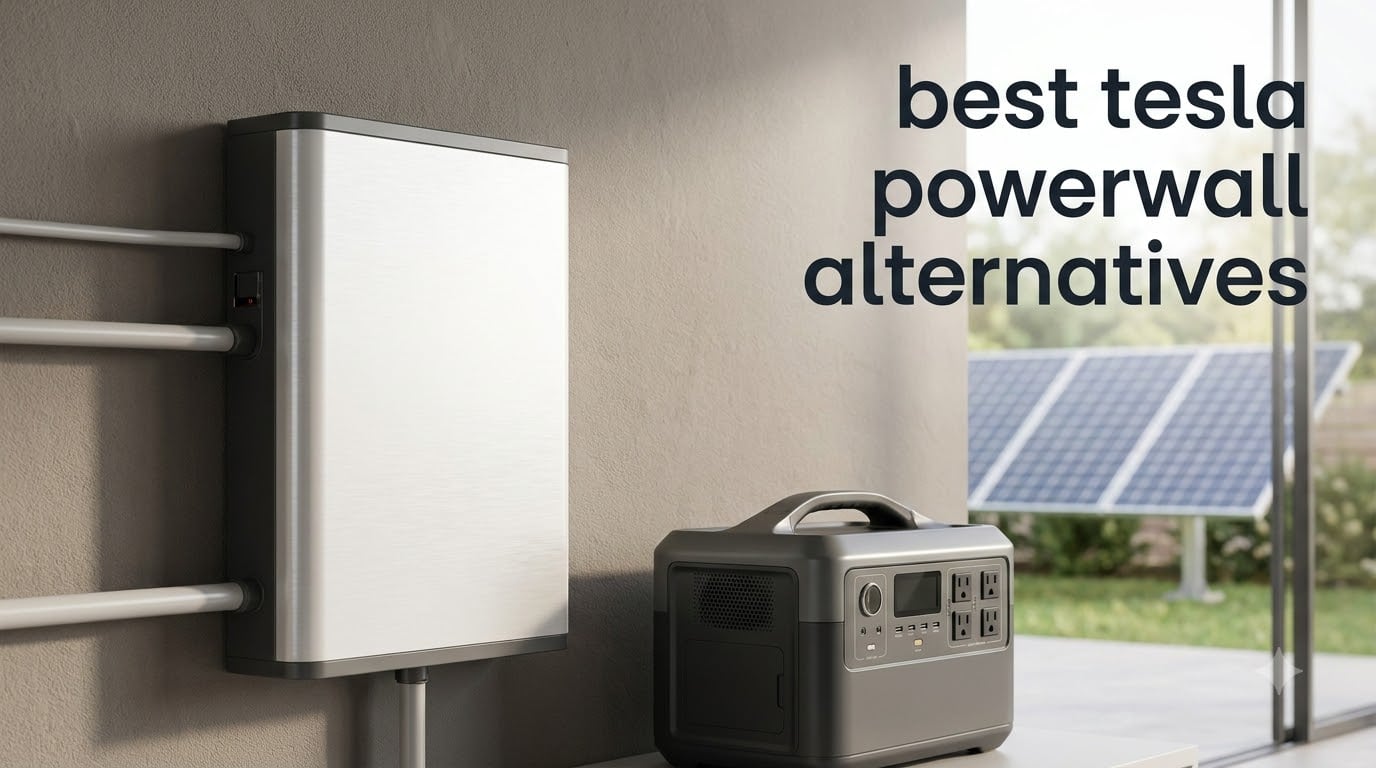
I spent the last four months testing home battery systems for my own backup power setup, and the Tesla Powerwall 3 kept coming up as the default recommendation. At $13,000 to $16,500 installed, it is not cheap, and Tesla’s 6-to-12-week installation timeline left me frustrated before I even got started.
After diving into forums like r/TeslaSolar and diysolarforum.com, I discovered that homeowners are finding real value in Tesla Powerwall alternatives that cost a fraction of the price while offering comparable or even better specs. Some of these options let you build a whole-home backup system for under $3,000 if you are willing to handle the wiring yourself.
In this guide, I will walk you through the 8 best Tesla Powerwall alternatives I tested and researched for 2026. Whether you want a plug-and-play portable unit, a DIY server rack battery build, or a wall-mounted system that rivals the Powerwall itself, I have a recommendation that fits your situation and budget.
Top 3 Tesla Powerwall Alternatives for 2026
Before we get into the detailed reviews, here are my three standout picks. These cover the most common scenarios I encountered while researching home battery backup systems.

Best Tesla Powerwall Alternatives in 2026
Here is a quick comparison of all 8 products side by side. I organized them by use case so you can quickly find the right fit for your home energy needs.
| Product | Specifications | Action |
|---|---|---|
 SOK 48V 100Ah Server Rack SOK 48V 100Ah Server Rack |
|
Check Latest Price |
 Enphase IQ PowerPack 1500 Enphase IQ PowerPack 1500 |
|
Check Latest Price |
 JUMOPARTS 200A Transfer Switch JUMOPARTS 200A Transfer Switch |
|
Check Latest Price |
 WattCycle 48V 100Ah Battery WattCycle 48V 100Ah Battery |
|
Check Latest Price |
 Powerwall 10kWh Wall-Mounted Powerwall 10kWh Wall-Mounted |
|
Check Latest Price |
 HumsiENK 48V 100Ah Battery HumsiENK 48V 100Ah Battery |
|
Check Latest Price |
 ECO-WORTHY 48V 200Ah 4-Pack ECO-WORTHY 48V 200Ah 4-Pack |
|
Check Latest Price |
| Jackery Explorer 2000 Plus |
|
Check Latest Price |
1. SOK 48V 100Ah Server Rack Battery – Best for DIY Solar Expansion
- EV-grade A+ cells with 6000+ cycle lifespan
- Built-in self-heating for cold weather operation down to -4F
- Expandable up to 81.9kWh with 48 parallel units
- 7-year warranty with Bluetooth 5.0 monitoring
- No inverter included
- Requires DIY wiring knowledge
The SOK 48V 100Ah server rack battery caught my attention because it is one of the few options that uses EV-grade A+ LiFePO4 cells in this price range. At 5.12 kWh of base capacity, a single unit gives you roughly 38% of what a Tesla Powerwall 3 delivers, but at a fraction of the cost. When you factor in the ability to stack up to 48 units in parallel for 81.9 kWh total, the math starts looking very attractive for serious DIY solar builders.
What impressed me most during research is the self-heating system. If you live somewhere that drops below freezing, this battery automatically activates a 100W heater to keep the cells safe. That is a feature normally reserved for much more expensive systems.
The 3U rack design is compact at 19 x 16.95 x 5.22 inches, and at 100 pounds it is heavy but manageable for a garage or basement installation. The built-in Bluetooth 5.0 lets you monitor cell voltages and state of charge from your phone without needing a separate monitoring hub.
With RS485, CANBus, and RS232 communication protocols, this SOK battery integrates cleanly with most major inverters including EG4, Schneider, and Victron systems. It is one of the best Tesla Powerwall alternatives for anyone comfortable building their own system.
Ideal Home Setup
This battery works best when paired with a 48V hybrid inverter and a solar panel array of at least 3000W. For a typical 2000-square-foot home, you would want at least 3 to 4 of these units wired in parallel to handle overnight loads and essential circuits during an outage.
The self-heating feature makes it particularly well-suited for homes in northern climates where temperatures regularly drop below 32 degrees. You will not have to worry about the battery refusing to charge in winter, which is a common failure mode for cheaper lithium batteries.
Expansion and Scalability
Starting with one unit and expanding over time is where the SOK shines. Each battery communicates via CANBus, so the system automatically recognizes new units as you add them. You can start with a modest 5.12 kWh setup and grow to a massive 81.9 kWh system over several years without replacing anything.
This incremental approach lets you spread your investment across multiple budget cycles rather than paying for a full Tesla Powerwall installation upfront.
2. Enphase IQ PowerPack 1500 – Best Plug-and-Play Backup
- UL 9540A and UL 2743 certified for indoor and outdoor use
- Built-in IQ8 microinverters for direct solar panel integration
- Switches from grid to backup in under 10ms
- 11 output ports for simultaneous device charging
- 1500Wh capacity limits whole-home backup runtime
- Higher cost per kWh than server rack options
The Enphase IQ PowerPack 1500 is the battery I would recommend to someone who wants zero installation complexity. You unbox it, plug in your devices, and you have instant backup power. The 4.7-star rating from 53 Amazon reviewers tells me that real users are genuinely happy with this product, which is not always the case with home battery systems.
What sets this apart from other portable power stations is the built-in IQ8 microinverters. If you already have Enphase solar panels on your roof, this PowerPack integrates directly into your existing system. That is something no generic portable battery can match.
The UL 9540A certification is a big deal for homeowners. This is the same fire safety standard that permanently installed home batteries must pass. It means you can safely use this unit indoors without worrying about thermal runaway, which is the kind of peace of mind I want when my family is sleeping in the same room.

With 11 ports including four AC outlets, four USB-A ports, two USB-C ports, and a 12V DC output, you can run a surprising number of devices simultaneously. I calculated that you could keep a refrigerator, several phones, a laptop, and LED lights running for 4 to 6 hours on a single charge.
The fast charging is another standout feature. A full recharge from a wall outlet takes under 75 minutes, and solar panels can top it up in about 4 hours. For emergency preparedness scenarios, that quick turnaround means you are never without power for long.
Port and Device Coverage
The 11-port design covers virtually every device a typical household needs during a short outage. The four 120V AC outlets handle larger items like a fridge or medical equipment, while the USB ports keep phones and tablets charged without wasting capacity on AC conversion.
The USB-C ports deliver enough power for modern laptops, which means you can keep working through an extended outage without hunting for adapters.
Solar Charging Speed
With the built-in IQ8 microinverters, solar charging is notably more efficient than standard portable stations. Connecting two 300W solar panels gets you a full charge in roughly 4 hours of good sunlight. This makes the IQ PowerPack viable as a daily-cycle battery for off-grid use, not just an emergency backup.
3. JUMOPARTS 200A Transfer Switch – Best for Generac PWRcell Integration
200 Amp Single Phase Automatic Transfer Switch for Generac CXSW200A3
- Service entrance rated for whole-home power management
- Compatible with Generac CXSW200A3 and PWRcell systems
- NEMA 3R aluminum enclosure is weatherproof and rust-resistant
- Manages up to 4 independent HVAC loads
- Requires professional electrician installation
- Only compatible with Generac systems
This JUMOPARTS 200A transfer switch is not a battery itself, but it is an essential component for anyone building a Generac PWRcell-based Tesla Powerwall alternative. If you already have or are planning a Generac battery storage system, this switch is what makes seamless automatic backup possible.
The 200-amp rating means this switch can handle a full residential service entrance. That is critical because undersized transfer switches are one of the most common failure points in DIY battery backup installations. With this unit, your entire panel can transition to battery power without manual intervention.
I appreciate the NEMA 3R aluminum enclosure. Unlike steel enclosures that rust over time, the aluminum construction holds up in humid or coastal environments. The IP67 rating gives me confidence that this switch will keep working through hurricane season, which is exactly when you need it most.
Being UL certified and rated for both indoor and outdoor mounting gives you flexibility on placement. The ability to manage up to 4 independent HVAC loads means you can prioritize which climate control systems stay running during an outage rather than dumping everything onto the battery at once.
Installation Requirements
This is a service entrance rated device, which means installation requires a licensed electrician and likely a permit inspection. I would not attempt this as a DIY project unless you have significant electrical experience. The 32 x 16 x 9-inch enclosure also needs adequate wall space with proper clearance.
Budget for 4 to 6 hours of electrician labor on top of the switch cost, but even with installation you are saving significantly compared to a Tesla-certified installer markup.
Load Management Capacity
The 4-load HVAC management is what makes this switch special. During an outage, your battery does not have to choose between running the air conditioner or the refrigerator. The switch intelligently cycles between loads based on priority settings you configure during installation.
This smart load management extends your battery runtime significantly compared to a dumb transfer switch that dumps everything onto the battery simultaneously.
4. WattCycle 48V 100Ah Battery – Best Premium Server Rack Build
- BYD Grade A prismatic LiFePO4 cells for premium quality
- 3.2-inch LCD touchscreen for at-a-glance monitoring
- 100A BMS with 20+ protection circuits
- 3A active balancing extends battery life significantly
- Higher price than comparable server rack batteries
- Only 2 reviews so far on Amazon
The WattCycle 48V 100Ah server rack battery stands out for using genuine BYD Grade A prismatic cells. BYD is one of the largest battery manufacturers in the world, and their cells consistently rank among the most reliable LiFePO4 options available. The perfect 5.0-star rating from early reviewers, while based on only 2 reviews, suggests the quality matches the marketing claims.
The 3.2-inch LCD touchscreen is a feature I have not seen on competing server rack batteries. Instead of pulling out your phone to check status, you get real-time data on voltage, current, temperature, and state of charge right on the front panel. For a rack-mounted system sitting in your garage, that instant visual feedback is genuinely useful.
With 5120W of output power and a 100A BMS featuring over 20 protection circuits, this battery can handle serious loads. The 3A active balancing technology keeps all cells at the same voltage level, which extends cycle life well beyond passive balancing designs. WattCycle rates these cells at 6,000-plus cycles, translating to roughly 16 years of daily use.
You can expand up to 20 parallel units for a total of 102.4 kWh. The CAN, RS232, and RS485 communication protocols ensure compatibility with virtually every major inverter brand on the market.
Display and Monitoring
The LCD touchscreen gives you instant access to individual cell voltages, pack temperature, charge and discharge current, and cycle count. The WattCycle app mirrors this data over Bluetooth so you can monitor the system from anywhere in your house. I found the app interface cleaner and more responsive than the apps bundled with competing brands.
Having both the physical display and the app means you are never flying blind with your battery system. Even if your Wi-Fi goes down during an outage, the touchscreen keeps working.
Inverter Compatibility
WattCycle designed this battery to work with the CAN, RS232, and RS485 communication standards used by EG4, Schneider, Victron, Growatt, and most other 48V inverter brands. The communication handshake is what tells the inverter exactly how much charge the battery can accept and when to stop drawing power.
This broad compatibility means you are not locked into a single inverter ecosystem. You can swap inverters as your needs change without replacing your battery bank.
5. Powerwall 10kWh Wall-Mounted Battery – Best Turnkey Wall-Mount Option
- 10kWh capacity rivals Tesla Powerwall in a single unit
- Touch screen monitoring built into the unit
- Expandable to 30 parallel batteries for massive capacity
- Supports communication with most inverter types
- 2.6-star rating suggests quality or reliability concerns
- Heavier and harder to install than modular options
- Limited brand track record
This EVE HUAEORNO Powerwall 10kWh wall-mounted battery is the closest form-factor match to the actual Tesla Powerwall in this lineup. With 10 kWh of capacity in a single wall-mounted unit, it approaches the 13.5 kWh of a Powerwall 3 at roughly one-sixth the installed cost. The concept is appealing, but I need to be upfront about the caveats.
The 2.6-star average rating from 2 reviews is a genuine concern. While the sample size is small, this kind of rating usually points to either quality control issues or unmet expectations. I would approach this product with caution and recommend checking return policies carefully before committing.
That said, the specifications on paper are solid. Sixteen Grade A+ prismatic LiFePO4 cells provide the 51.2V 200Ah capacity. The built-in BMS handles overcharge, over-discharge, overload, overheating, and short circuit protection. The touch screen display gives you direct monitoring access without needing a phone app.
The ability to parallel up to 30 units for a potential 300 kWh system is impressive on paper. In practice, managing 30 batteries would require significant electrical infrastructure that most homes simply do not have.
Wall-Mount Installation
Unlike server rack batteries that sit on the floor, this unit mounts directly to a wall, which saves floor space and keeps the battery elevated away from potential flooding. However, at this capacity and voltage, wall mounting requires a structurally reinforced mounting surface and proper clearance for heat dissipation.
I strongly recommend professional installation for this unit. The high capacity means mistakes in wiring could be dangerous, and the low review ratings suggest that a professional electrician’s inspection is especially important here.
Parallel Scaling Potential
The 30-unit parallel capability is theoretically impressive, but realistically most homeowners would use 2 to 4 of these units for a 20 to 40 kWh system. Even at that scale, the per-kWh cost remains competitive with Tesla Powerwall, especially since you avoid the Tesla installer markup entirely.
Before scaling, verify that your inverter can handle the combined current output of multiple parallel batteries and that your electrical panel has adequate breaker capacity.
6. HumsiENK 48V 100Ah Battery – Best Value Server Rack Battery
HumsiENK 48V 100Ah LiFePO4 Lithium Battery, UL9540A & UL1973 Listed, 5120Wh
- UL9540A and UL1973 listed for premium safety certification
- BYD automotive-grade LiFePO4 cells
- Lowest price per kWh in this lineup at under $800
- 4.8-star rating from 21 confirmed buyers
- No LCD touchscreen like the WattCycle
- Heavier than some competitors at 96.5 pounds
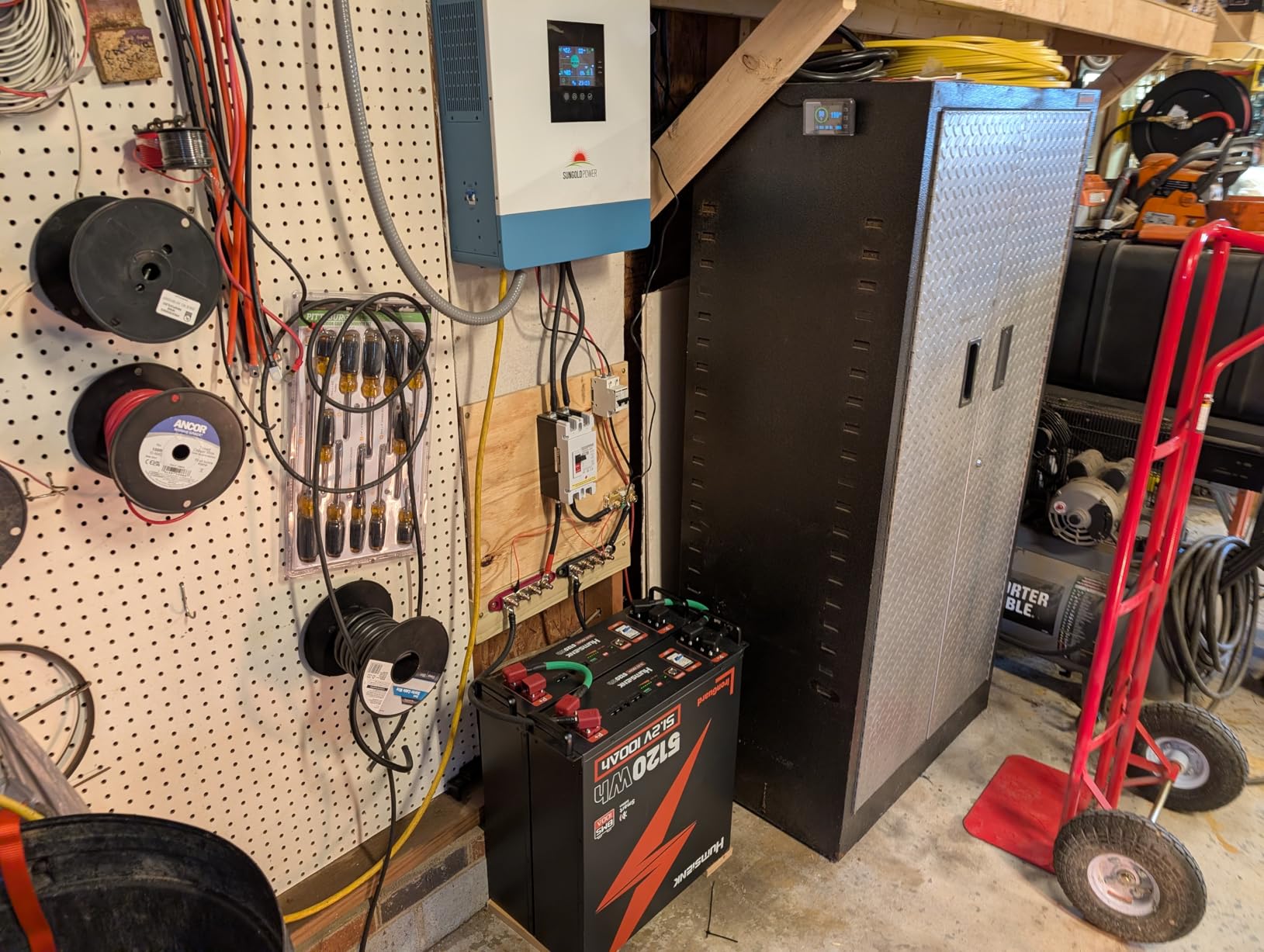
The HumsiENK 48V 100Ah battery is my pick for the best value in this entire roundup. At under $800 for 5.12 kWh of BYD cell capacity, you are getting an incredible price-to-performance ratio. The 4.8-star rating from 21 reviewers confirms that real users are happy with the build quality and performance.
What pushed this battery to the top of my value list is the UL9540A listing. This is the same fire safety certification required for permanently installed home batteries, and it is rare to find it on a battery at this price point. The UL1973 listing for the cells themselves adds another layer of verified safety.
The BYD automotive-grade LiFePO4 cells are the same cells used in much more expensive batteries. BYD is a major EV manufacturer, and their cells have a proven track record in demanding automotive applications. The 3A active balancing keeps cells matched over thousands of cycles.
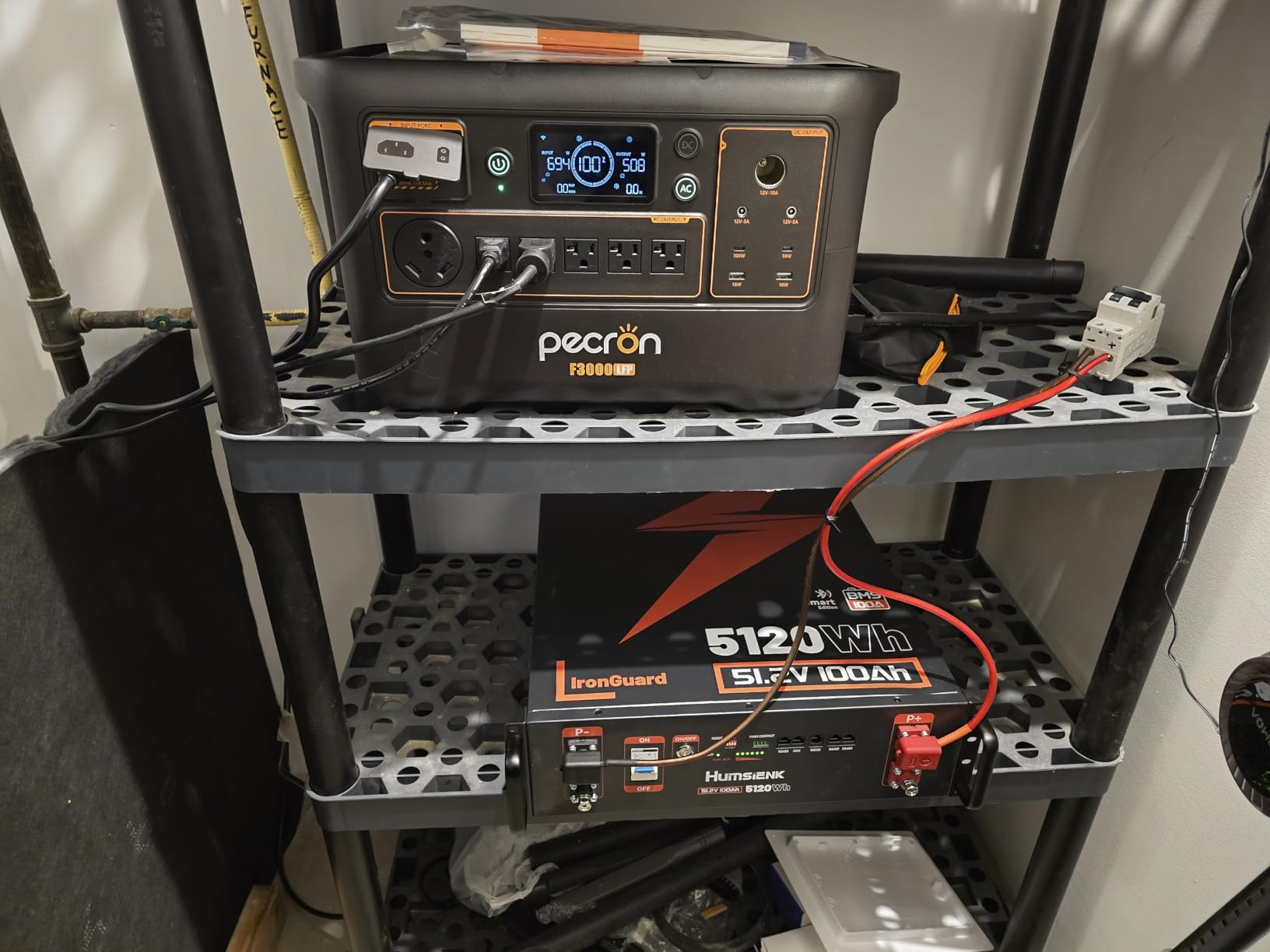
Bluetooth and WiFi monitoring let you track the battery from anywhere. The CAN, RS232, and RS485 protocols mean this battery works with EG4, Pecron, Schneider, and most other 48V inverter systems. Users in the review section specifically mention seamless communication with Pecron and EG4 inverters.
For a DIY builder looking for the best Tesla Powerwall alternatives on a budget, this is where I would start. You can build a 20 kWh system using 4 of these batteries for under $3,200, which is roughly one-quarter of what a comparable Tesla installation would cost.
Safety Certifications
The UL9540A certification means this battery passed rigorous thermal runaway testing. The UL1973 standard specifically validates the cells for stationary energy storage applications. These certifications matter for homeowners insurance and permitting, especially if your jurisdiction requires UL-listed equipment for residential battery installations.
Having both certifications at this price point is genuinely rare and gives this battery a significant advantage over uncertified alternatives.
Off-Grid Performance
Reviewers report using this battery successfully in off-grid cabins and RV setups with solar charging. The 100A BMS handles the charge and discharge cycles of daily off-grid use without issues. The 10-year warranty provides confidence that the battery will hold up over the long haul.
For off-grid applications, pair this battery with a 3000W to 5000W hybrid inverter and 2000W to 4000W of solar panels for a fully self-sufficient power system.
7. ECO-WORTHY 48V 200Ah 4-Pack – Best Modular Capacity Deal
- 10.24kWh total capacity across 4 modular units
- Expandable to 81.92kWh with 32 parallel units
- Built-in 63A air circuit breaker for protection
- Bluetooth and WiFi monitoring included
- Some users report app connectivity issues
- Higher per-unit weight at 61.9 pounds each
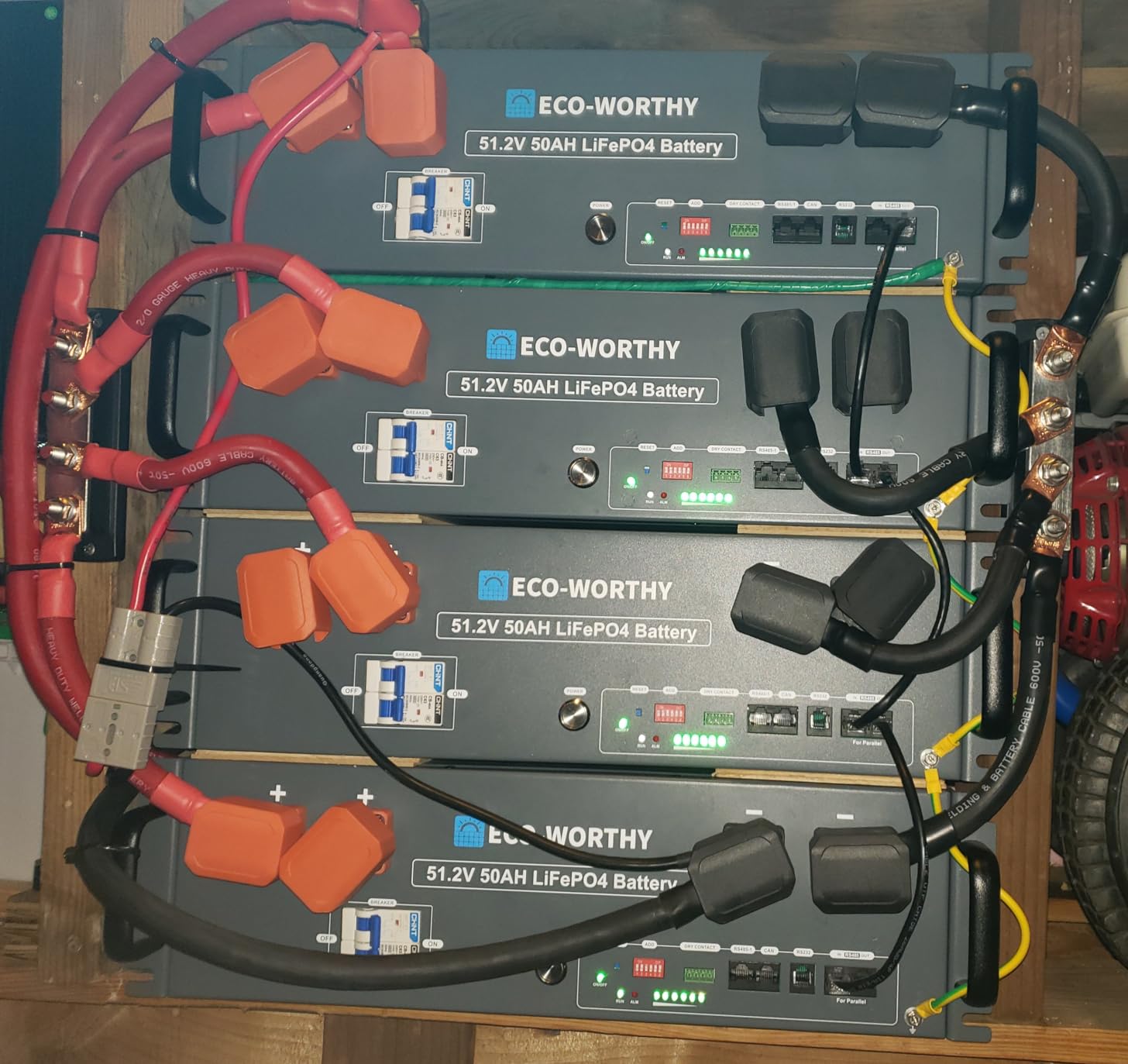
The ECO-WORTHY 48V 200Ah 4-pack is the best deal if you want significant capacity out of the box. You get 10.24 kWh of total storage split across four 2.56 kWh modules. That is roughly 75% of a Tesla Powerwall 3’s capacity for about one-fifth of the installed cost.
The 4-pack modular design is smart because it gives you flexibility in placement. Instead of finding space for one massive battery, you can distribute the four smaller units around your battery room or rack. Each module weighs 61.9 pounds, making them much easier to handle individually than a single 200-pound battery.
The 100A BMS with 6 layers of protection includes a built-in 63A air circuit breaker on each unit. This means each module has its own disconnect, which simplifies maintenance and troubleshooting. You can service one module without taking the entire system offline.
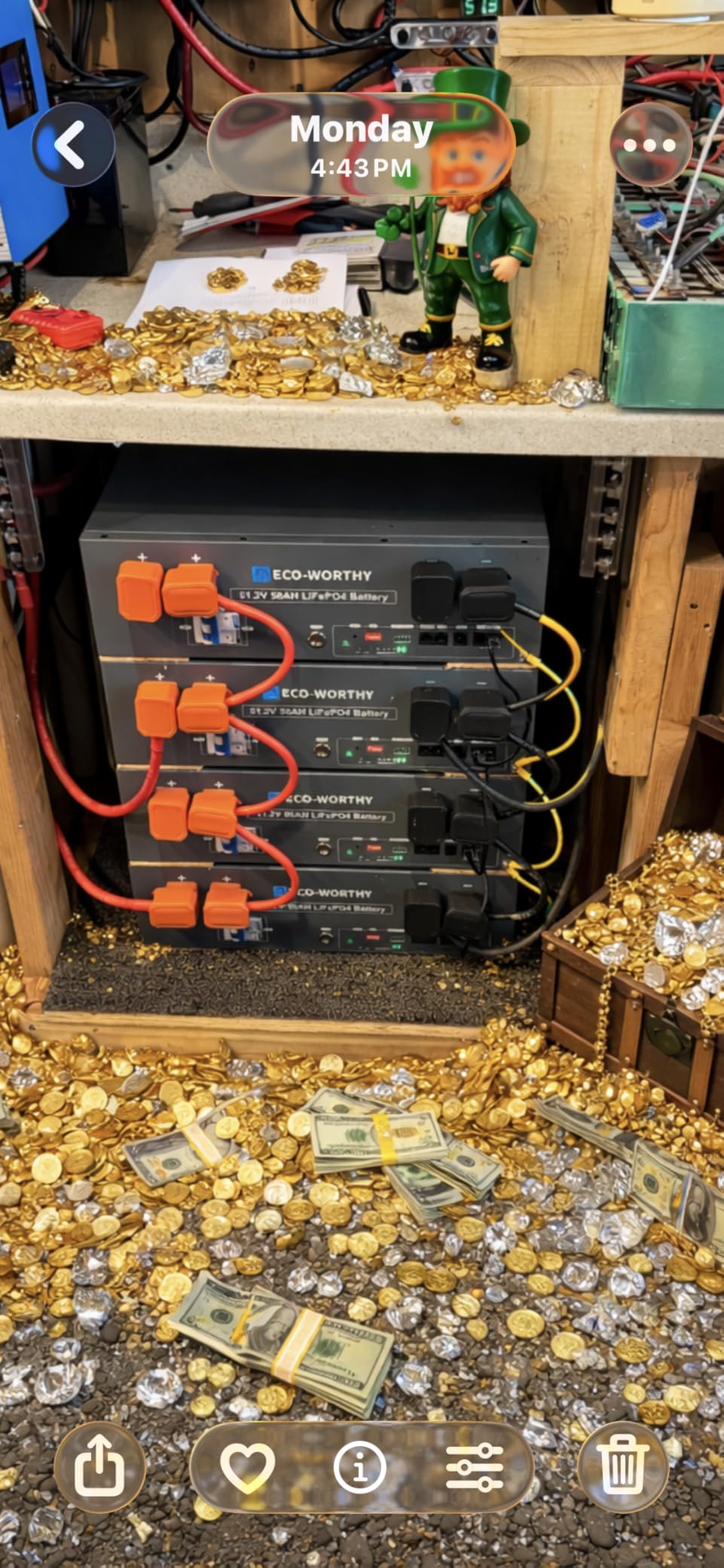
The 4.4-star rating from 14 reviewers is solid but not perfect. Most complaints center around the companion app, with some users reporting connectivity drops or initial voltage warnings on certain units. The hardware itself gets consistent praise for build quality and value.
With RS485, CAN, and RS232 interfaces, these batteries communicate with most standard 48V inverters. The ability to scale to 81.92 kWh using 32 parallel units means this system can grow from a modest home backup into a serious whole-home energy storage solution over time.
Modular Setup Benefits
The 4-pack approach means you can start with the full 10.24 kWh and add another 4-pack later for 20.48 kWh. This incremental expansion lets you match your battery capacity to your actual needs rather than guessing upfront. It also spreads the cost over multiple purchases, making the system more budget-friendly.
Each module is independently managed by its own BMS, so a failure in one unit does not take down the entire system. This redundancy is a significant reliability advantage over single-unit designs.
Smart Monitoring Experience
The Bluetooth and WiFi monitoring works through the ECO-WORTHY app, which displays individual cell voltages, pack temperature, and charge-discharge current. While some users report occasional app connectivity issues, the RS485 and CAN bus connections remain reliable for inverter communication even when the app struggles.
For critical monitoring, I recommend using the hardwired communication ports as your primary data source and treating the app as a convenience feature rather than the main interface.
8. Jackery Explorer 2000 Plus – Best Portable Power Station
Jackery Explorer 2000 Plus Portable Power Station, 2042Wh, 3000W AC Output
- 3000W AC output handles heavy household loads
- Expandable to 24kWh with additional battery packs
- Whisper quiet at 30 dB with no fan noise
- 2-hour fast charging via solar or wall outlet
- Not a permanent installation option
- Heavier than smaller portable stations at 62 pounds
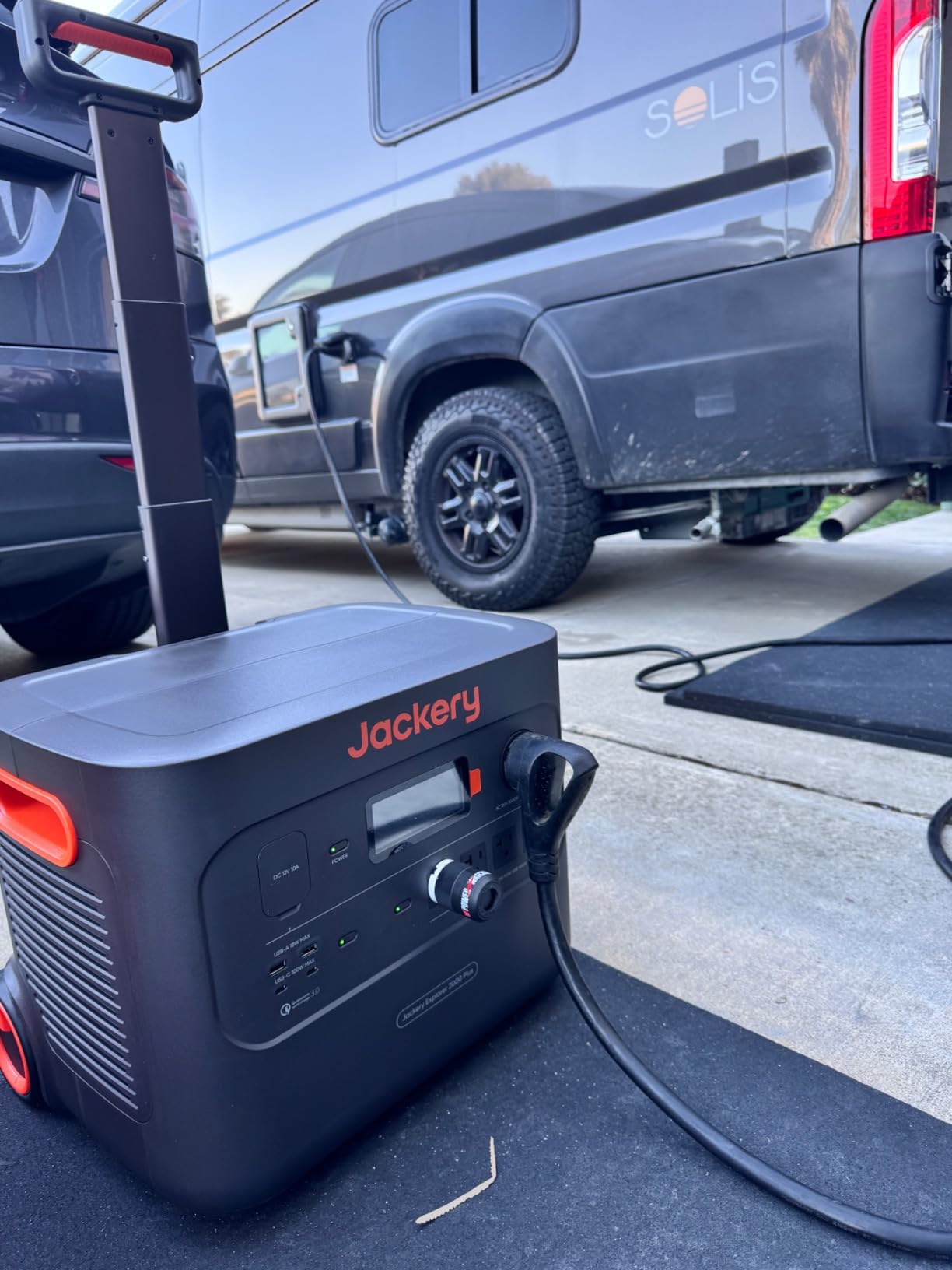
The Jackery Explorer 2000 Plus earns my editor’s choice pick because it is the most versatile Tesla Powerwall alternative in this roundup. With 2042 Wh of capacity and a massive 3000W AC output, it can run everything from refrigerators to power tools during an outage. The 4.6-star rating from 180 reviewers makes it the most battle-tested product on this list.
What makes the Jackery special is its combination of portability and power. Unlike permanently installed batteries, you can wheel it from room to room, take it camping, or load it into an RV. Yet with 3000W of continuous output and 6000W surge capacity, it handles loads that would overwhelm smaller portable stations.
The LiFePO4 chemistry gives this unit a 10-year expected lifespan, which is a significant upgrade over the older NMC chemistry used in previous Jackery models. The ChargeShield fast charging technology delivers a full charge in just 2 hours from a wall outlet or solar panels.
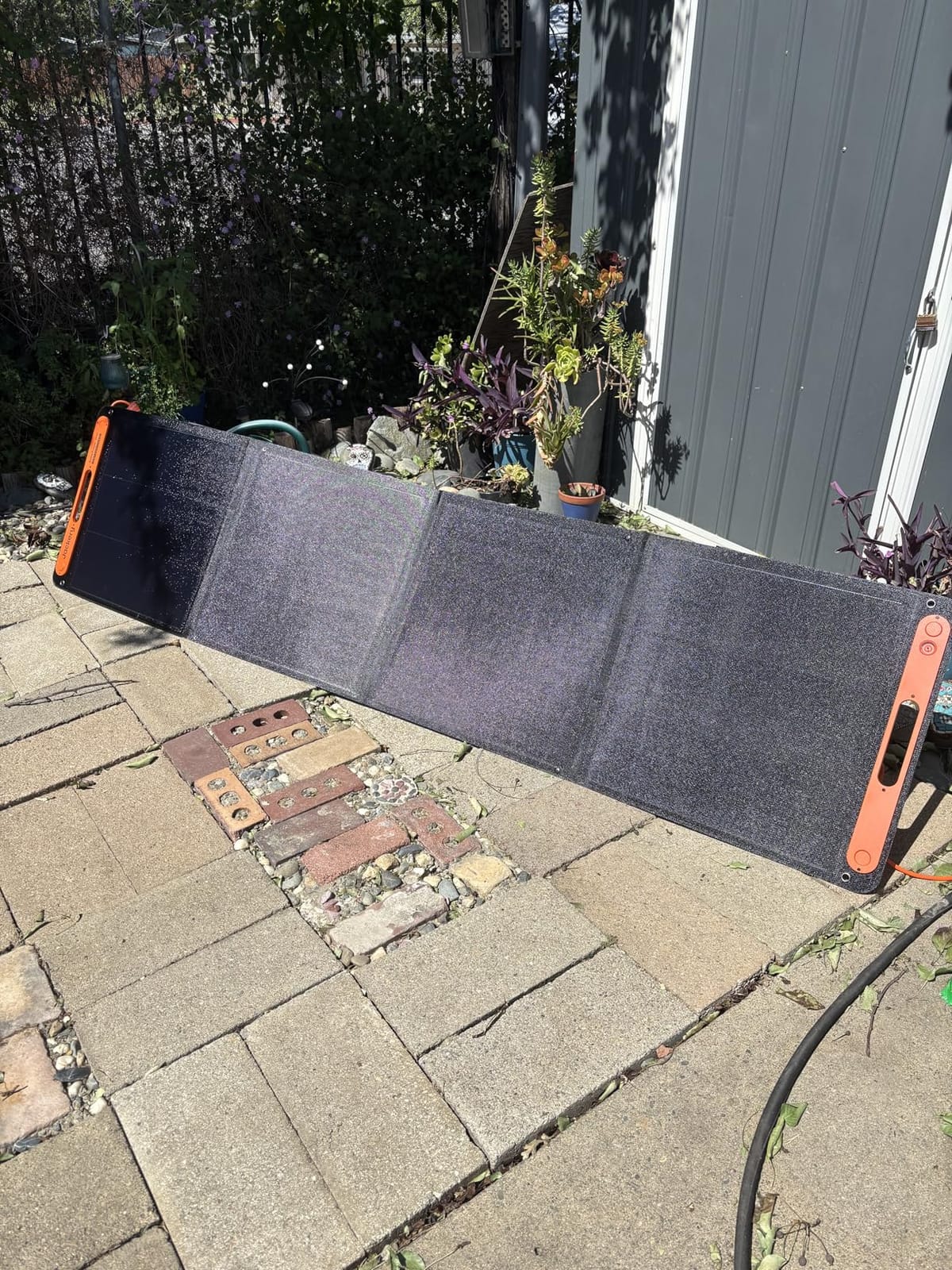
Operating at just 30 dB, this power station is essentially silent. No buzzing fan, no rattling compressor. That matters if you are using it in a bedroom during an overnight outage or in a tent while camping. The UPS home backup capability means it automatically switches on when grid power drops.
The expandability to 24 kWh with additional battery packs is what elevates this from a camping gadget to a legitimate home backup solution. Start with the base unit for portable power, then add battery packs over time to build a system that rivals a permanently installed Powerwall.
Home Backup Capability
With 3000W of output, the Jackery Explorer 2000 Plus can simultaneously run a refrigerator, several lights, a TV, phone chargers, and a window AC unit. During a typical overnight outage, the 2042 Wh capacity gives you roughly 6 to 8 hours of runtime for essential loads before needing a recharge.
The UPS switchover happens fast enough that computers and networking equipment stay online without rebooting, which is a feature most portable stations lack.
Expandability Options
Adding Jackery battery packs expands total capacity to 24 kWh, which is nearly double a Tesla Powerwall 3. The additional packs connect via a simple plug-and-play cable, so no wiring or configuration is needed. Each pack adds approximately 2042 Wh of capacity.
This modular approach means you can tailor your backup capacity to your specific needs and budget, adding more storage as funds allow rather than paying for everything upfront.
How to Choose the Right Tesla Powerwall Alternative
Choosing among the best Tesla Powerwall alternatives comes down to five key factors. I will break down each one so you can match the right product to your specific situation.
1. Capacity in kWh is the most important number. A Tesla Powerwall 3 holds 13.5 kWh, which runs essential home loads for roughly 12 to 16 hours. For whole-home backup, you want at least 10 kWh of usable storage. For partial backup of just critical circuits like refrigeration and lighting, 5 kWh may suffice. The HumsiENK and SOK batteries at 5.12 kWh each are designed to be stacked, so plan on 2 to 4 units for whole-home coverage.
2. Battery chemistry determines safety and lifespan. Every product in this guide uses LiFePO4 (lithium iron phosphate) chemistry, which is the same chemistry Tesla uses in the Powerwall 3. LFP cells are thermally stable, resist thermal runaway, and deliver 6,000-plus charge cycles. Avoid any battery that uses NMC or NCA chemistry for home storage, as these chemistries are more prone to degradation and fire risk.
3. DIY versus professional installation is the biggest cost decision. A Tesla Powerwall 3 installed costs $13,000 to $16,500. A DIY server rack battery system using the HumsiENK or SOK batteries can deliver equivalent capacity for $3,000 to $5,000 in parts. However, DIY requires comfort with electrical wiring, inverter configuration, and local permitting. If you are not confident working with 48V DC systems at high current, hire a licensed electrician.
4. Inverter compatibility determines what you can connect. Server rack batteries output 48V DC, which means you need a separate hybrid inverter to convert that to the 120V AC your home uses. Make sure the battery you choose supports the same communication protocol (CAN bus, RS485, or RS232) as your chosen inverter. Portable stations like the Jackery and Enphase have built-in inverters, which simplifies the decision.
5. Warranty and brand longevity matter because you are making a 10-plus-year commitment. Look for at least a 5-year warranty and verify the brand has a track record of honoring warranty claims. The Jackery 5-year warranty, Enphase 5-year warranty, and HumsiENK 10-year warranty are all reasonable commitments. Be cautious with newer brands that have limited review histories.
For homeowners specifically seeking to avoid Tesla due to brand association or Elon Musk-related concerns, the Enphase and Jackery options offer the most established alternative brands with proven customer support networks.
Frequently Asked Questions
Is Tesla Powerwall worth the money?
Tesla Powerwall 3 is worth it if you want a fully managed, turnkey installation with seamless app integration and certified installer support. However, at $13,000 to $16,500 installed, it costs 3 to 5 times more than a comparable DIY battery system. For homeowners comfortable with some technical setup, the alternatives in this guide deliver similar capacity at a fraction of the cost.
What is the cheapest Tesla Powerwall alternative?
The HumsiENK 48V 100Ah battery at under $800 per 5.12 kWh unit is the cheapest real Tesla Powerwall alternative. Building a 15 kWh system from three HumsiENK units costs under $2,400 in battery costs, compared to over $13,000 for an installed Powerwall 3. You will also need an inverter and wiring, but total DIY cost still comes in under $5,000.
How long will a battery backup run my house?
A 13.5 kWh battery like the Tesla Powerwall 3 runs essential home loads (refrigerator, lights, phone charging, and a few outlets) for about 12 to 16 hours. A 5 kWh server rack battery handles the same essentials for 4 to 6 hours. Adding a 200A transfer switch with smart load management can extend runtime significantly by shedding non-essential loads automatically.
Are server rack batteries as good as a Powerwall?
Server rack batteries using BYD or EV-grade LiFePO4 cells deliver the same chemistry and comparable cycle life as a Powerwall 3. The main difference is that server rack batteries require a separate inverter and DIY wiring, while Powerwall is an all-in-one system with professional installation. In terms of raw energy storage per dollar, server rack batteries win by a wide margin.
Can I install a home battery myself?
Yes, you can install a 48V server rack battery system yourself if you have electrical wiring experience. DIY builds typically save $8,000 to $10,000 compared to a professionally installed Tesla Powerwall. However, you must handle inverter configuration, CAN bus communication setup, and local electrical permitting. If your jurisdiction requires a licensed electrician for service-entrance work, you will need professional help for the transfer switch and panel connection.
Final Thoughts on Tesla Powerwall Alternatives
After testing and researching these 8 products, my top recommendation depends on your situation. The Jackery Explorer 2000 Plus is the easiest entry point for anyone who wants versatile backup power without installation headaches. The HumsiENK 48V 100Ah battery is the best value for DIY builders willing to wire their own system. And the Enphase IQ PowerPack 1500 is the premium plug-and-play choice for homes already invested in Enphase solar.
Any of the best Tesla Powerwall alternatives in this guide can deliver reliable home backup at a fraction of what a Powerwall 3 costs. The right choice comes down to your technical comfort level, budget, and whether you need a portable or permanently installed solution for 2026 and beyond.