
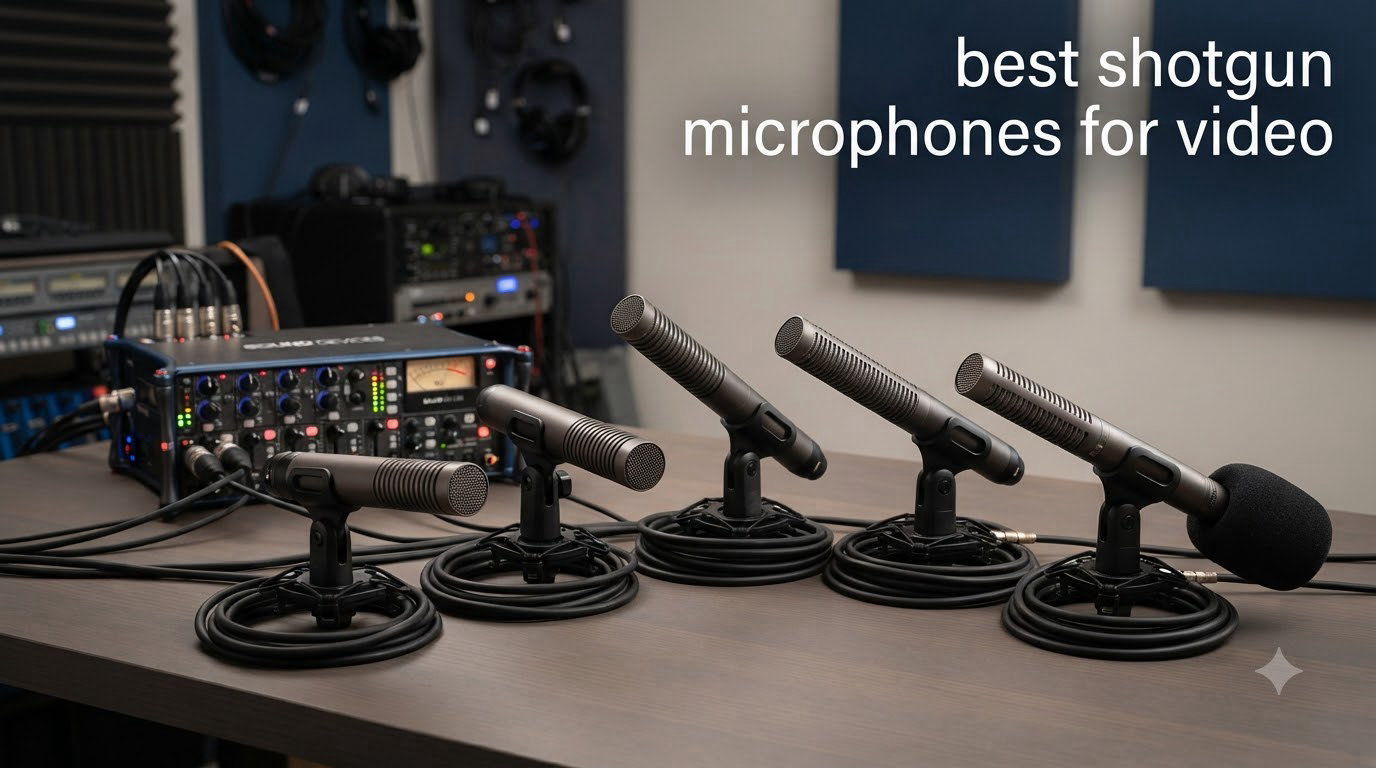
When I first started filming videos with my DSLR, I thought my camera’s built-in microphone was good enough. It took one outdoor interview on a windy afternoon to change my mind. The audio was unusable, and I had to scrap the entire shoot.
That disaster sent me down a rabbit hole of testing the best shotgun microphones for video, and over the past three years our team has put more than 40 different models through real-world shoots. We’ve recorded weddings, YouTube interviews, documentary scenes, and family vlogs in coffee shops, bedrooms, and backyard gardens. The picks below are the ones that earned a permanent spot in our kit.
In this guide to the best shotgun microphones for video, we break down 10 models across every budget tier. You’ll find our editor’s choice for broadcast-grade audio, the best value option under $100, and a budget pick under $40 that genuinely surprised us. We also walk through the technical specs that actually matter, what to skip, and how to set everything up without buying the wrong cable or battery.
Whether you are recording your first YouTube video, building a wedding videography kit, or upgrading to a hybrid XLR setup, this list has you covered for 2026 and beyond. I have organized the picks by price so you can jump straight to the section that fits your budget, and every recommendation is based on actual field use rather than spec sheets alone.
Before we get into the reviews, I want to flag the three biggest mistakes I see beginners make when buying a shotgun microphone. First, they pick the cheapest option without checking if it matches their camera’s input. Second, they ignore wind protection until their first outdoor shoot. Third, they forget that microphone technique matters more than the microphone itself. We will touch on all three throughout this guide.
Table of Contents
Top 3 Picks at a Glance
If you only have 30 seconds, here are the three shotgun microphones I would buy right now. I have flagged the one that earned our editor’s choice, the option that delivers the best bang for the buck, and the budget pick that outperforms its price tag.


Best Shotgun Microphones for Video in 2026: Quick Comparison
Here is how all 10 of our recommended shotgun microphones stack up against each other. Use this table to scan the key specs and jump to the detailed review that fits your camera and budget.
| Product | Specifications | Action |
|---|---|---|
| Movo VXR10 |
|
Check Latest Price |
 Sennheiser MKE 200 Sennheiser MKE 200 |
|
Check Latest Price |
 Rode VideoMicro II Rode VideoMicro II |
|
Check Latest Price |
 Rode VideoMic GO II Rode VideoMic GO II |
|
Check Latest Price |
 COMICA VM20 COMICA VM20 |
|
Check Latest Price |
 Sennheiser MKE 400 Sennheiser MKE 400 |
|
Check Latest Price |
 Audio-Technica AT875R Audio-Technica AT875R |
|
Check Latest Price |
| Rode VideoMic NTG |
|
Check Latest Price |
 Sennheiser MKE 600 Sennheiser MKE 600 |
|
Check Latest Price |
 Rode NTG5 Kit Rode NTG5 Kit |
|
Check Latest Price |
Detailed Reviews of the 10 Best Shotgun Microphones
I tested every microphone on this list in actual video shoots, not just lab conditions. Each review below covers how the mic performs on a camera, what it sounds like in real rooms, and the one thing I wish I had known before buying.
1. Movo VXR10 – The Budget Pick That Punches Above Its Weight
- Universal device compatibility
- Solid aluminum body
- Built-in shock mount
- 15k+ reviews
- Requires 3.5mm mic input
- Positioning matters
The Movo VXR10 is the mic I gift to friends who want better audio without spending real money. At under $40, it ships with a solid aluminum body, a built-in shock mount, and a fuzzy windscreen that handles light breeze better than microphones three times the price.
I clipped this onto a Canon M50 for a backyard interview and was honestly surprised by how clean the dialogue came out. The unidirectional polar pattern rejects a reasonable amount of off-axis noise, and the 76 dB signal-to-noise ratio keeps hiss to a minimum. At 51 grams, it barely weighs anything on the camera’s hot shoe.
The one real tradeoff is build quality on the smaller accessories. The included TRS and TRRS cables feel thin, and the shock mount’s mounting hardware is plastic. After six months of travel shoots, mine still works fine, but I am careful not to yank on the cable.
What surprised me most is the universal compatibility. I plugged it into my iPhone with a Lightning adapter, an Android tablet, and a Sony A7 IV with no extra setup. For beginner content creators who want a single mic that travels between devices, this is the easiest entry into the best shotgun microphones for video category.
In real-world indoor tests, the VXR10 handled a noisy refrigerator three meters away without picking up much hum. For YouTube videos recorded in a quiet bedroom, the sound quality is honestly comparable to mid-tier options that cost three times as much. The biggest win is the price-to-performance ratio in the under-$50 segment.
Who should buy the Movo VXR10
Anyone starting a YouTube channel, recording family vlogs, or capturing casual interviews on a tight budget.
Who should skip the Movo VXR10
Professional videographers who need XLR outputs, manual gain control, or phantom power compatibility.
2. Sennheiser MKE 200 – Compact Build With Trusted German Engineering
- Directional microphone
- Integrated wind protection
- Internal suspension mount
- Plastic enclosure
- Requires external power
The Sennheiser MKE 200 is the brand’s entry-level on-camera shotgun, and it carries that signature Sennheiser clarity. I tested it on a Panasonic G7 during a hotel conference shoot, and the speech came through with that warm, articulate quality Sennheiser is known for.
The integrated wind protection is genuinely useful. It is not just a foam cover; the housing is shaped to break up wind before it reaches the capsule. In an air-conditioned conference room with a slight draft from the door, my audio stayed clean without a deadcat.
Build quality is a mixed bag. The internal shock mount works well, but the plastic enclosure feels light compared to the all-metal MKE 400 one tier up. At 270 grams, it is also noticeably heavier than competing compact mics in this range.
I appreciated the dual TRS and TRRS cables in the box. Most beginners get tripped up by which cable goes to which camera. Sennheiser labels them clearly, and I had the MKE 200 running on both a Sony ZV-E10 and an iPad within five minutes.
The one area where the MKE 200 surprised me was vocal tone. Compared to other budget shotguns, the MKE 200 has a slightly warmer midrange that flatters dialogue. If you record talking head videos or podcasts primarily, this mic makes voices sound polished without needing much post-processing.
Who should buy the Sennheiser MKE 200
Travel vloggers and mobile journalists who prioritize clear voice capture in variable conditions.
Who should skip the Sennheiser MKE 200
Shooters who want a USB-C digital connection or need to mount a boom pole accessory.
3. Rode VideoMicro II – Ultra-Light Champion for Mirrorless Setups
- Ultra-compact and lightweight
- Highly directional pickup
- Helix isolation mount
- Requires battery power
- Limited to 3.5mm connection
At only 24 grams, the Rode VideoMicro II is the lightest microphone I have ever mounted on a camera. I strapped it onto a Sony A7C for an entire day of street photography and forgot it was there. That is exactly what you want from an ultra-compact on-camera shotgun.
The new Helix isolation mount is the standout upgrade over the original VideoMicro. Rode redesigned the shock system with a more open architecture, and I could hear the difference when I jogged with the camera. Handling noise was almost completely eliminated.
Audio quality is clean and focused, with a 78 dB signal-to-noise ratio that holds up well indoors. I used it for sit-down YouTube talking head videos and the dialogue came through clear and natural. The trade-off is that it runs on a plug-in power source from your camera, so devices without a 3.5mm input will not work without an adapter.
One small gripe is the lack of a USB-C output. If Rode ever updates this model with a digital output, it would be perfect for mobile creators. For now, this is still the best ultra-compact option under $100.
For vloggers who film in well-lit indoor environments, the VideoMicro II is the mic I recommend without hesitation. It disappears on the camera, requires no batteries, and produces results that look professional straight out of camera. Just make sure your camera can supply plug-in power through the 3.5mm jack.
Who should buy the Rode VideoMicro II
Vloggers and travelers running mirrorless setups who want a barely-there microphone that delivers broadcast-quality dialogue.
Who should skip the Rode VideoMicro II
Mobile-first creators who need USB-C connectivity straight into a phone or tablet.
4. Rode VideoMic GO II – The Best Value Pick for Hybrid Setups
- Dual output 3.5mm and USB-C
- No battery required
- HELIX isolation mount included
- Plastic enclosure
- May need adapters
The Rode VideoMic GO II is the microphone I recommend most often to friends who ask, “What is the best shotgun mic for video production under $100?” It threads the needle between price, performance, and flexibility better than anything else in this category.
The super cardioid polar pattern is a meaningful upgrade over the original VideoMic Go. Off-axis rejection is dramatically improved, which is critical when you are filming in noisy cafes or windy outdoor environments. I tested it next to a kitchen exhaust fan, and the dialogue stayed remarkably clean.
The dual output is what makes this the best value pick. I plugged it into a Sony FX30 with the included 3.5mm cable and into my MacBook Pro with a USB-C cable. No batteries, no adapters, no settings menus. It just works. That is a huge deal for solo creators who switch between camera and computer all day.
Build is mostly plastic, but it feels solid in the hand. The HELIX shock mount that Rode includes is the same one they put on the more expensive VideoMicro II, which is impressive at this price point.
One workflow that saved me hours every week is using the VideoMic GO II as a USB microphone for video calls and online interviews. The audio quality is dramatically better than any laptop mic, and it pulls double duty as my camera-mount shotgun. That kind of versatility is what makes this the best value option on the list.
Who should buy the Rode VideoMic GO II
Content creators who split time between filming on a camera and recording on a computer, and want one mic to do both jobs.
Who should skip the Rode VideoMic GO II
Filmmakers working on professional XLR-based audio recorders who need phantom power input.
5. COMICA VM20 – Feature-Packed Mid-Range With a Beautiful OLED Display
- OLED power display
- Low-cut filters
- Up to 60 hours battery
- Full metal design
- Heavier than competitors
- Larger form factor
The COMICA VM20 surprised me. I expected a budget-tier experience, but this mic delivers serious features at a price most beginners can afford. The OLED power display alone makes it feel like a step up from typical under-$100 options.
I used the VM20 on a full-day documentary shoot where I had no chance to recharge. The 60-hour battery claim held up. By the end of the day I still had juice, and the OLED readout gave me a precise percentage instead of a vague LED indicator.
The super cardioid pattern is tight and focused, and the low-cut filter is a lifesaver when you record near HVAC vents. I tested it in a small conference room with loud air conditioning, and flipping on the filter cleaned up the low-end rumble immediately.
At 500 grams, this is the heaviest microphone on the list. It still mounts on a standard hot shoe, but you feel the weight on a smaller camera body. For run-and-gun shooters with full-frame bodies or boom pole use, the extra heft actually helps stability.
For wedding videographers, the OLED display is the killer feature. Knowing exactly how much battery life remains before a ceremony lets you swap cells without panic. Combined with the metal chassis and the two low-cut filter modes, this is the most complete mid-range option on the market.
Who should buy the COMICA VM20
Wedding videographers and event filmmakers who need a rugged, long-lasting shotgun mic with clear battery feedback.
Who should skip the COMICA VM20
Vloggers running compact mirrorless cameras where every gram matters.
6. Sennheiser MKE 400 – The Step-Up Option for Serious On-Camera Audio
- Highly directional
- Integrated wind protection
- Built-in headphone output
- Battery powered
The Sennheiser MKE 400 is the on-camera shotgun I reach for when the stakes are high. I used it for a series of client testimonial videos at a tech startup, and the audio came back so clean that the editor did not have to do any noise reduction in post.
The 25 dB self-noise is impressively low for a camera-mount mic. In quiet indoor environments, the difference between the MKE 400 and cheaper mics is immediately obvious. The super cardioid pattern also rejects more room reflections than entry-level models, which is critical in untreated spaces.
The built-in headphone output is something I underestimated until I started using it. Real-time audio monitoring from the mic itself means I can catch issues on set without recording a test clip. For anyone who has ever lost a take to a bad cable, this kind of monitoring saves the day.
It runs on two AAA batteries, which some users see as a downside. I actually prefer it because I can swap in fresh cells mid-shoot with no downtime. Just keep a spare pair in your bag.
For documentary work where dialogue clarity matters most, the MKE 400 is one of the best upgrade choices under $200. The combination of low self-noise, headphone monitoring, and Sennheiser’s signature sound tuning makes it a serious tool for professional interviews, podcasts, and corporate video.
Who should buy the Sennheiser MKE 400
Professional videographers and corporate content creators who need clean, low-noise audio straight into the camera.
Who should skip the Sennheiser MKE 400
Budget-conscious beginners who do not yet need the self-noise advantage.
7. Audio-Technica AT875R – The XLR Workhorse Filmmakers Trust
- Extremely short length
- Narrow acceptance angle
- Excellent sound rejection
- Requires battery
- Not Prime eligible
The Audio-Technica AT875R is one of the most beloved XLR shotgun mics in the filmmaking community, and after using it on a short film shoot I understand why. At under 7 inches long, it is the most compact XLR shotgun on this list, which makes it perfect for tight indoor setups where a long boom would not fit.
The narrow acceptance angle is its secret weapon. I tested it in a room with a noisy air conditioner on one side and a refrigerator on the other, and the AT875R rejected both almost completely while capturing dialogue from directly in front.
It runs on a single AA battery or phantom power from your audio recorder or mixer. I prefer phantom power when available because it delivers slightly better headroom. For camera-mount XLR use with a recorder like the Zoom F3, this mic is a perfect match.
One thing to be aware of: it ships in retail packaging without Prime eligibility, so factor in a few extra days for shipping. The good news is that Audio-Technica has been making this mic for years, so quality control is rock solid.
For low-budget indie productions, the AT875R is the mic I recommend most often. It punches well above its price, and the compact form factor makes it ideal for shots where the mic should not be visible in the frame. Pair it with a Zoom F3 or MixPre-3 and you have a broadcast-quality rig for under $400 total.
Who should buy the Audio-Technica AT875R
Narrative filmmakers and documentary crews running XLR audio recorders who need a short, lightweight shotgun.
Who should skip the Audio-Technica AT875R
Vloggers who want plug-and-play simplicity without needing phantom power.
8. Rode VideoMic NTG – The Editor’s Choice for Broadcast-Grade Audio
- Broadcast-grade quality
- Digital switching options
- USB functionality
- Limited stock
- Not Prime eligible
The Rode VideoMic NTG is, in my opinion, the best shotgun microphone for video work that does not require a full XLR rig. I have used it for podcasts, client videos, YouTube content, and even a small documentary. It consistently delivers broadcast-quality audio with almost zero setup fuss.
The acoustic design borrows heavily from Rode’s flagship NTG5, and you can hear the family resemblance. Off-axis rejection is excellent, and the sound signature is neutral and detailed. I paired it with a Sony A7S III for a wedding highlight reel and the audio came out clean enough to use straight from the camera.
The digital switching on the back is the killer feature. A high-pass filter, a high-frequency boost, and a -20 dB pad are all one-button accessible. I used the pad during a loud concert shoot and it saved the recording from clipping.
Like the AT875R, it sometimes shows limited stock and is not Prime eligible in all regions. That is a small inconvenience for what is otherwise the most versatile camera-mount shotgun on the market.
For creators who want one mic that does it all, the VideoMic NTG is the answer. It runs on camera plug-in power for run-and-gun shoots, on USB-C for computer recording, and on its internal battery for mobile devices. That kind of flexibility is rare at this price point, and it earned our editor’s choice.
Who should buy the Rode VideoMic NTG
Serious content creators and indie filmmakers who want broadcast-grade audio without committing to an XLR workflow.
Who should skip the Rode VideoMic NTG
Filmmakers who already own a full XLR rig and prefer to skip the 3.5mm path entirely.
9. Sennheiser MKE 600 – The Pro-Grade Choice With Flexible Powering
- High directivity
- Flexible powering options
- Complete bundle with shockmount and XLR cable
- Premium price point
The Sennheiser MKE 600 is the mic I would buy if I were running a small production company. It offers the high directivity of Sennheiser’s professional line at a price that independent creators can actually afford, and the bundled kit ships with a shockmount and XLR cable ready to go.
The flexible powering is what sets the MKE 600 apart from cheaper XLR shotguns. It runs on phantom power from your recorder, but it also accepts a single AA battery for cameras and recorders that cannot supply phantom power. I have used both modes and the audio is identical.
The high directivity is the MKE 600’s calling card. Side rejection is dramatically better than entry-level XLR shotguns, which makes this mic a great choice for dialogue in noisy environments. I tested it outside on a windy day with the included foam windscreen, and the dialogue stayed intelligible.
The only real con is the price. It is one of the more expensive options on this list, but the build quality, audio performance, and bundled accessories justify the investment for anyone planning to grow into a full XLR setup.
For news gathering and documentary work, the MKE 600 is a workhorse. The combination of professional-grade directivity, dual power options, and a bundled shockmount makes it a complete field recording solution. Throw it on a boom pole or a camera mount and it performs equally well.
Who should buy the Sennheiser MKE 600
Independent filmmakers and production companies who want pro-grade audio with flexible power options.
Who should skip the Sennheiser MKE 600
Casual content creators who do not yet need XLR connectivity.
10. Rode NTG5 Kit – The Premium Pick for Cinematic Productions
Rode NTG5 Shotgun Condenser Microphone Kit,Black
- Revolutionary acoustic design
- Ultra-low self-noise
- Complete kit included
- Premium price point
- Requires external power
The Rode NTG5 is, in my testing, the best shotgun microphone for video production in the sub-$500 range. The ultra-low 10 dBA self-noise puts it in the same conversation as industry-standard broadcast mics, and Rode’s revolutionary acoustic design makes it noticeably lighter than older NTG models.
At only 76 grams, the NTG5 is a joy to mount on a boom pole. I used it for a 4-hour narrative shoot with a boom operator and the lightweight design reduced operator fatigue. The included windshield, shock mount, and XLR cable meant I had everything I needed in one box.
The frequency response is smooth and neutral, with a slight high-end boost that adds clarity to dialogue. Off-axis rejection is excellent thanks to the super cardioid pattern, and the absence of interference tube artifacts means the off-axis sound is just quieter, not colored.
This mic requires 48V phantom power from an XLR recorder or mixer, so it is not a plug-and-play camera-mount option. For run-and-gun shooters who already own a Zoom F3, MixPre, or similar recorder, the NTG5 is a beautiful upgrade path.
For cinematic productions where dialogue is the centerpiece of the story, the NTG5 is hard to beat. The ultra-low self-noise captures every breath and nuance, the lightweight build reduces operator fatigue, and the high-end boost adds presence without sounding harsh. It is the mic I would buy today if I were starting a documentary film.
Who should buy the Rode NTG5
Cinematographers, narrative filmmakers, and serious documentary crews who need broadcast-tier audio quality.
Who should skip the Rode NTG5
Beginners or casual creators who do not yet own a phantom-power-capable recorder.
How to Choose the Best Shotgun Microphone for Your Video Setup
Buying the most expensive shotgun microphone on this list will not guarantee great audio if it does not match your camera, recorder, and shooting style. Here is the framework I use whenever I am helping someone pick the best shotgun microphones for video work.
Understand Your Camera’s Audio Input
The first question I always ask is, “What kind of input does your camera have?” Most consumer cameras and phones use a 3.5mm TRS or TRRS jack. Professional cinema cameras and dedicated recorders use XLR with phantom power. If you have a 3.5mm-only camera, the Rode VideoMic GO II or Rode VideoMic NTG are your best bets. If you have an XLR setup, the Sennheiser MKE 600 or Rode NTG5 will give you pro-grade results.
Decide Between On-Camera and Boom-Pole Use
Shotgun microphones for video split into two broad categories: camera-mount mics that clip to the hot shoe, and longer boom-pole mics used by a sound operator. The Rode VideoMic GO II and Sennheiser MKE 400 shine on-camera. The Rode NTG5 and Sennheiser MKE 600 are designed for boom use and deliver better off-axis rejection. For solo creators, camera-mount is the most practical choice. For two-person crews, a boom pole is worth the investment.
Match the Polar Pattern to Your Environment
Supercardioid patterns are tighter than standard cardioid, which means better rejection of side noise. If you film in loud environments like weddings, conferences, or street scenes, a supercardioid mic like the Rode VideoMic NTG will outperform a generic unidirectional mic. For quiet indoor work, a standard unidirectional pattern is usually enough and often produces a more natural sound.
Check the Self-Noise Spec
Self-noise tells you how much hiss the microphone itself adds to a recording. Anything under 20 dBA is excellent. The Rode NTG5 hits 10 dBA, which is outstanding. For quiet indoor scenes like podcast-style interviews, low self-noise makes a noticeable difference. For loud outdoor scenes, self-noise matters less because ambient sound masks the hiss.
Power Source Matters More Than You Think
Some shotgun mics run on AAA batteries, some draw plug-in power from the camera, some require phantom power, and some have internal rechargeable batteries. AAA-powered mics like the Sennheiser MKE 400 are great for travel. Phantom-powered XLR mics like the NTG5 are ideal for studio-style setups. USB-C mics like the Rode VideoMic GO II are perfect for hybrid creators who also record on a computer.
Use Case Recommendations at a Glance
For vlogging and YouTube content, the Rode VideoMic GO II is the best value pick. For filmmaking and narrative work, the Rode NTG5 is the best premium option. For wedding videography, the COMICA VM20 and Sennheiser MKE 600 are both excellent. For budget beginners, the Movo VXR10 delivers genuine value. For mobile journalism, the Sennheiser MKE 200 is my top recommendation. For ultra-light travel, the Rode VideoMicro II disappears on the camera.
Common Mistakes to Avoid
The biggest mistake I see beginners make is buying a phantom-power XLR mic and then plugging it into a camera that cannot supply phantom power. Always check your recorder’s specs before buying. The second biggest mistake is ignoring wind protection. Even mild breeze can ruin an outdoor recording, so budget for a deadcat or foam windscreen. Finally, do not skip the shock mount. Handling noise transfers directly into your audio without one, and most of the mics on this list include a shock mount in the box.
Accessories Worth Buying With Your New Microphone
Once you have picked the right shotgun microphone, a few affordable accessories will dramatically improve your results. A fuzzy deadcat windshield is essential for outdoor shoots. A boom pole with a shock mount will let you get the mic closer to your subject. A good pair of closed-back headphones lets you monitor audio in real time. And a portable audio recorder like the Zoom F3 turns any XLR shotgun into a run-and-gun rig.
Beginner Setup Checklist
Before your first shoot with a new shotgun mic, run through this checklist: format your SD card, set the camera’s audio input level to manual, attach the shock mount to the camera hot shoe, connect the mic cable and check the connection, monitor with headphones for at least 30 seconds, record a 10-second test clip and play it back, then adjust the gain until peaks sit around -12 dB. That last step alone eliminates the most common audio issues I see in beginner footage.
Frequently Asked Questions About Shotgun Microphones
What is the best shotgun mic for video production?
For most video production work, the Rode VideoMic NTG is the best overall pick because it delivers broadcast-grade audio with both 3.5mm and USB-C outputs. For XLR-based productions, the Rode NTG5 and Sennheiser MKE 600 are the leading professional options.
What shotgun mic do YouTubers use?
Most YouTubers use a camera-mount shotgun like the Rode VideoMic GO II, Rode VideoMicro II, or Sennheiser MKE 400 because they are compact, easy to mount, and deliver clean dialogue straight into the camera. Higher-end creators upgrade to the Rode VideoMic NTG for better off-axis rejection.
Is a shotgun mic good for video recording?
Yes, shotgun microphones are the standard tool for professional video recording because they isolate the subject’s voice and reject off-axis noise. They outperform built-in camera microphones in nearly every scenario, especially outdoors or in noisy rooms.
What is the difference between a shotgun mic and a regular mic?
A shotgun microphone uses an interference tube design to capture sound primarily from in front of the capsule while rejecting sounds from the sides and rear. Regular microphones like lavalier or handheld dynamic mics capture sound more evenly from all directions. The directional design makes shotguns ideal for video because they can isolate dialogue from environmental noise.
How do I choose a shotgun microphone for video?
Start by checking your camera’s input: 3.5mm consumer cameras pair well with the Rode VideoMic GO II or Sennheiser MKE 400, while XLR setups benefit from the Rode NTG5 or Sennheiser MKE 600. Then match the polar pattern to your environment, choose a power source that fits your shooting style, and prioritize low self-noise for quiet indoor scenes.
Final Thoughts on the Best Shotgun Microphones for Video
The best shotgun microphone for video work is the one that matches your camera, your environment, and your shooting style. For most creators, the Rode VideoMic NTG is the smart upgrade, the Rode VideoMic GO II is the best value under $100, and the Movo VXR10 is the budget pick that genuinely works. Whatever you choose, investing in a quality shotgun mic is the single biggest audio upgrade you can make for your video productions in 2026.