
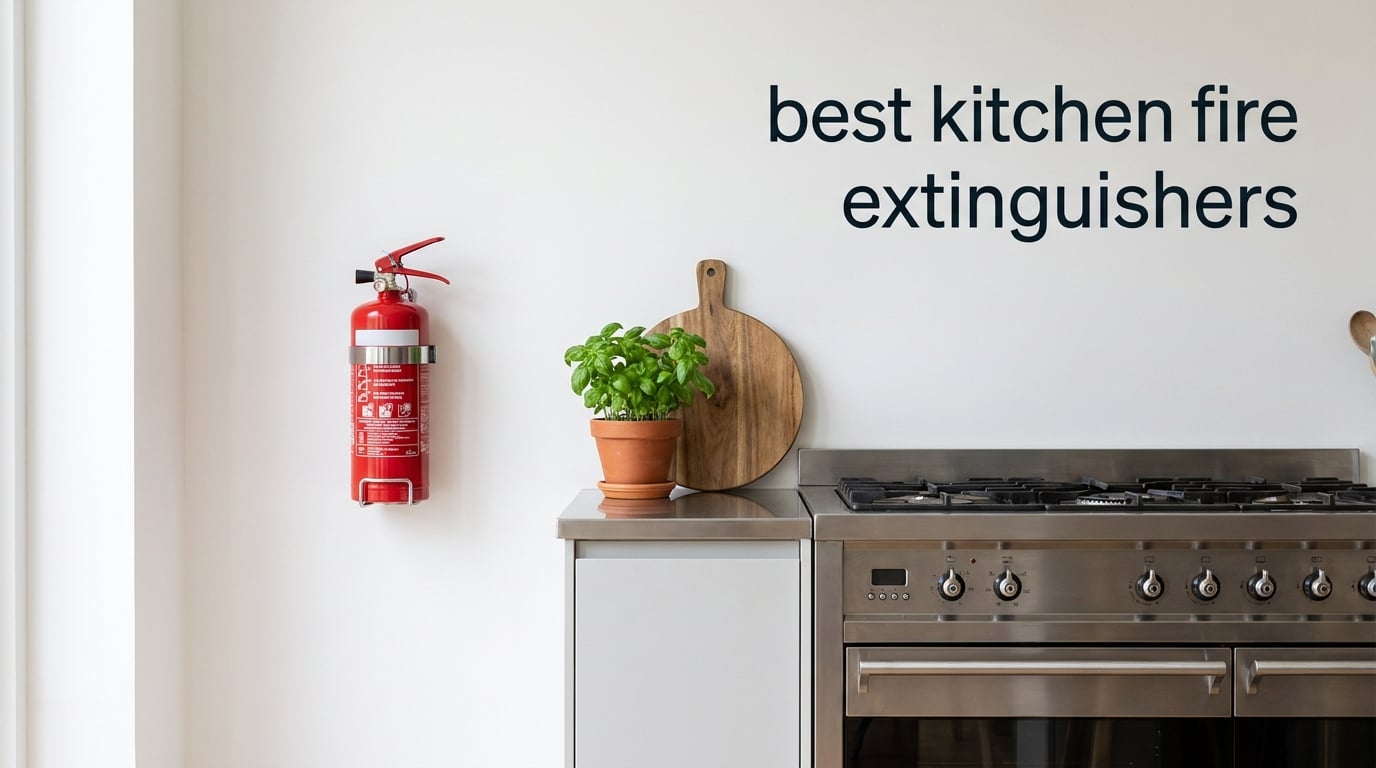
Cooking causes more house fires than anything else. According to the National Fire Protection Association, cooking equipment was involved in 44% of reported home fires between 2017 and 2021. That is a staggering number when you think about how many homes have kitchens and how few have the right fire safety equipment sitting within arm’s reach.
I spent the last several weeks researching and comparing the best kitchen fire extinguishers on the market for 2026. Our team looked at ratings, build quality, agent types, ease of use, and what real customers (and firefighters) say about each model. Whether you need something small for an apartment kitchen or a heavy-duty unit for a busy family household, this guide breaks down eight top-rated options.
The right fire extinguisher for your kitchen depends on what you cook, how often you cook, and whether you want a disposable unit or a rechargeable one that lasts for years. We will cover fire classes, the PASS method, placement tips, and maintenance so you can make an informed decision. Let us get into the top picks.
Table of Contents
Top 3 Picks for Best Kitchen Fire Extinguishers

Kidde Kitchen Fire Extinguisher 711A
- UL 711A rated for cooking oil fires
- 2.5 lb dry chemical
- Compact kitchen design

First Alert EZ Fire Spray
- Aerosol spray format
- Lightweight and easy to use
- Budget-friendly option
First Alert HOME2PRO Rechargeable
- UL 2-A:10-B:C rated
- Rechargeable heavy-duty
- Metal valve construction
Best Kitchen Fire Extinguishers in 2026
| Product | Specifications | Action |
|---|---|---|
| Kidde Kitchen Fire Extinguisher 711A |
|
Check Latest Price |
 Kidde Basic 110 Home Fire Extinguisher Kidde Basic 110 Home Fire Extinguisher |
|
Check Latest Price |
 First Alert KITCHEN5 Fire Extinguisher First Alert KITCHEN5 Fire Extinguisher |
|
Check Latest Price |
| First Alert HOME2PRO Rechargeable |
|
Check Latest Price |
 Ougist ABC Fire Extinguisher Ougist ABC Fire Extinguisher |
|
Check Latest Price |
 LifeSafe StaySafe All-in-1 LifeSafe StaySafe All-in-1 |
|
Check Latest Price |
| First Alert EZ Fire Spray |
|
Check Latest Price |
 First Alert HOME1 Standard First Alert HOME1 Standard |
|
Check Latest Price |
1. Kidde Kitchen Fire Extinguisher 711A — Purpose-Built for Cooking Fires
- Specifically rated for cooking oil and grease fires
- Compact size fits easily near stove
- Pressure gauge for easy monitoring
- Affordable for most households
- Disposable only not rechargeable
- Limited to small residential kitchen fires
The Kidde 711A caught my attention because it is one of the few extinguishers on the market built specifically for residential kitchen fires. Most general-purpose extinguishers carry an ABC rating, which works fine, but this one is tested and rated under UL 711A standards for residential cooking oil fires. That means it is designed to handle the exact type of fire you are most likely to encounter in your kitchen.
I like that Kidde kept this unit at 2.5 pounds. It is light enough that anyone in the household can grab it and use it without struggling. The dry chemical agent discharges cleanly enough for a residential setting, and the pressure gauge on the front gives you a quick visual confirmation that the unit is still charged and ready.
One thing I noticed while researching this model is that Kidde designed the nozzle and discharge pattern to work well against grease fires specifically. Standard ABC extinguishers can sometimes splatter burning grease if the discharge is too aggressive. The 711A addresses that concern with a controlled spray pattern.
The main drawback is that this is a disposable unit. Once it is discharged, even partially, you need to replace it. At this price point, that is acceptable for most homeowners, but if you want something that can be recharged and serviced, you might want to look at the First Alert HOME2PRO later in this guide.
Who Should Buy This Model
This is ideal for anyone who wants a dedicated kitchen extinguisher without spending a fortune. If your primary concern is grease fires from stovetop cooking, deep frying, or oven flare-ups, the 711A gives you targeted protection. It is also great for apartments and smaller kitchens where space is tight.
I would recommend buying two of these if you have a larger kitchen or an open-concept layout. Mount one near the stove and one near the exit so you always have a clear path to grab one if needed.
What Real Users Say
With over 1,200 reviews and a 4.7-star average, customers consistently praise how easy this unit is to operate. Several reviewers mentioned buying multiple units for different rooms after feeling confident with the kitchen placement. A few customers noted that the mounting bracket could be sturdier, but the extinguisher itself performs reliably.
Firefighters on Reddit have acknowledged that Kidde makes dependable residential units, and the 711A specifically addresses the kitchen fire scenario that most homes worry about most.
2. Kidde Basic 110 Home Fire Extinguisher — Most Popular All-Around
- Handles Class A B and C fires
- Nearly 30000 reviews with 4.8 rating
- Versatile for entire home
- Very affordable
- Disposable not rechargeable
- Plastic valve construction
- Not specifically kitchen-rated
The Kidde Basic 110 is the best-selling residential fire extinguisher on Amazon, and for good reason. With nearly 30,000 customer reviews and a 4.8-star rating, this unit has earned its reputation as a reliable, no-nonsense fire safety tool. It carries a 1-A:10-B:C rating, which means it can handle ordinary combustibles, flammable liquids, and electrical fires.
While it is not specifically rated for Class K cooking oil fires like the 711A, the BC component of its rating does cover flammable liquid fires, which includes grease. For most home kitchens, this multipurpose extinguisher provides solid protection. I like that it covers the whole house, not just the cooking area.
The 2.5-pound size is easy to handle, and the discharge time is adequate for small fires. Kidde includes a mounting bracket so you can secure it to a wall near your stove or exit. The pressure gauge is easy to read at a glance.
One thing to keep in mind is that this is an entry-level model with a plastic valve. It is disposable, meaning you cannot have it recharged after use. For the price, most homeowners are happy to simply replace it if it ever gets used or loses pressure over time.
Best Use Cases for This Extinguisher
This is the best kitchen fire extinguisher for someone who wants one unit to cover their entire home. Place it in or near the kitchen, and it handles cooking fires plus any other common household fire risk. It is also a great choice for garages, laundry rooms, and workshops.
Many reviewers buy these in packs of two or three to cover multiple rooms. At this price, that strategy makes sense for comprehensive home protection without breaking the bank.
Long-Term Reliability
Customers report these units lasting 6 to 12 years when stored properly. The pressure gauge lets you verify readiness at any time. Several reviewers shared stories of successfully using their Kidde 110 to put out real kitchen fires, which speaks to its real-world reliability.
The most common complaint is about the mounting bracket being flimsy, but this can be addressed by upgrading to a heavier bracket if needed.
3. First Alert KITCHEN5 Fire Extinguisher — Slim Kitchen Design
- Designed specifically for kitchen use
- UL rated for grease and flammable liquid fires
- Slim white design fits kitchen decor
- Affordable price point
- BC only no Class A rating
- Disposable not rechargeable
- Limited discharge time
The First Alert KITCHEN5 is purpose-built for kitchen fires, carrying a UL 5-B:C rating that specifically covers flammable liquid and grease fires. This is a BC-rated extinguisher, which means it is designed for the exact type of fire you are most likely to face while cooking. It does not handle Class A fires (paper, wood, fabric), but for a dedicated kitchen unit, that is usually fine.
What sets this model apart visually is its white finish and slim profile. Most fire extinguishers are bright red and bulky, which can clash with kitchen decor. The KITCHEN5 is designed to look at home sitting on a countertop or mounted on a kitchen wall without being an eyesore.
I found the discharge mechanism straightforward to use. The nozzle is positioned for easy aiming, and the handle design requires a firm squeeze to prevent accidental discharge. First Alert includes a mounting bracket for wall installation.
The trade-off with a BC-only rating is that you give up Class A and Class C protection. If a paper towel or dishcloth catches fire near the stove, this extinguisher will still smother those flames because the dry chemical agent works by cutting off oxygen. However, it is not rated or tested for those fire types specifically.
Ideal Kitchen Placement
First Alert recommends mounting this unit at least 10 feet from the stove but no more than 30 feet away. That distance ensures you can reach it quickly without being blocked by the fire itself. A cabinet near the kitchen exit or a wall mount in the pantry works well.
For homes with larger kitchens, consider pairing the KITCHEN5 with an ABC-rated unit elsewhere in the house for complete coverage.
Customer Feedback Highlights
Over 5,600 reviewers give this model a 4.7-star average. Customers love the compact size and the fact that it blends into kitchen surroundings. Several users mentioned buying these for elderly parents who found traditional extinguishers too intimidating or heavy.
A few negative reviews mention that the unit arrived with low pressure, which underscores the importance of checking the gauge immediately upon delivery. Always verify the pressure indicator is in the green zone when your extinguisher arrives.
4. First Alert HOME2PRO Rechargeable — Heavy-Duty Protection
- Rechargeable saves money long term
- Metal valve for durability
- Higher 2-A rating for bigger fires
- Suitable for home and commercial use
- More expensive than disposable models
- Heavier at 4 pounds
- Requires professional recharge after use
The First Alert HOME2PRO is the step-up choice for homeowners who want serious fire protection. It carries a UL 2-A:10-B:C rating, which gives it a higher Class A capacity than most residential units. The 2-A rating means it can handle larger fires involving ordinary combustibles, making it suitable for kitchens, garages, workshops, and even small commercial spaces.
What makes this model stand out is the rechargeable design. Unlike disposable extinguishers that end up in a landfill after a single use, the HOME2PRO can be refilled by a certified fire equipment dealer. If you ever need to discharge it, you take it to a local service center, pay for a recharge, and it is good to go again. Over the lifespan of the unit, this saves money and reduces waste.
The metal valve construction is a significant upgrade over plastic valves found on budget models. Metal valves are more durable, resist corrosion better, and provide a more reliable seal over years of storage. This is the type of construction that professional fire safety companies use in commercial installations.
At roughly 4 pounds, this extinguisher is heavier than the budget options. That extra weight comes from the larger agent capacity and the metal components. It is still manageable for most adults, but if you have elderly family members, make sure they can comfortably lift and operate it.
Is Rechargeable Worth the Extra Cost?
For most homeowners, the answer depends on how long you plan to stay in your home. If you expect to use the same extinguisher for 10-plus years, a rechargeable unit pays for itself. A typical recharge costs between 15 and 25 dollars at a fire equipment service center, compared to buying a brand new disposable unit each time.
The HOME2PRO also comes with a bracket for wall mounting and a 12-year limited warranty from First Alert, which is longer than most disposable models offer.
Commercial vs Home Kitchen Applications
With its 2-A:10-B:C rating and metal valve construction, this unit bridges the gap between residential and light commercial use. If you run a small bed and breakfast, a home-based catering business, or a rental property kitchen, the HOME2PRO provides professional-grade protection that meets most local fire code requirements.
Note that commercial kitchens with deep fryers and wok stations typically require Class K extinguishers by code. The HOME2PRO is excellent for general fire protection but would need to be supplemented with a Class K unit in a full commercial kitchen setting.
5. Ougist ABC Fire Extinguisher — Compact Multi-Scene Unit
- ABC rated for all common fire types
- Quick-release handle for fast deployment
- Certified for kitchen car and boat use
- Compact 2.5 lb design
- Newer brand with less track record
- Disposable not rechargeable
- Fewer reviews than established brands
The Ougist ABC Fire Extinguisher is a newer entrant that has been gaining traction quickly. It carries a 1-A:10-B:C rating, matching the Kidde 110 in terms of fire class coverage. What drew my attention to this model is the quick-release handle design and the fact that it is certified for multiple use scenarios including kitchens, vehicles, and boats.
The quick-release handle is a thoughtful feature. In a fire emergency, fumbling with safety pins and complicated triggers can waste precious seconds. The Ougist design simplifies the deployment process with a handle that releases cleanly and allows for immediate action.
At 2.5 pounds, this unit is comparable in size and weight to the Kidde and First Alert models. The dry chemical agent provides solid coverage across Class A, B, and C fires, making it a genuine multipurpose option for kitchen use and beyond.
The main consideration with Ougist is that it is a newer brand compared to Kidde and First Alert, both of which have decades of fire safety manufacturing experience. That said, the Ougist meets the same UL certification standards, and customer reviews have been overwhelmingly positive so far.
Multi-Scene Versatility
If you want a single extinguisher that can move between your kitchen, car, and boat, the Ougist is designed for exactly that. The compact size makes it practical to store in a vehicle, and the ABC rating covers the most common fire types you would encounter on the road or water.
I would recommend keeping one in the kitchen and a second one in your vehicle for comprehensive coverage.
Customer Experience
With over 700 reviews and a 4.8-star average, early adopters are clearly satisfied. Customers highlight the ease of use, the mounting hardware, and the clean design. Several reviewers mentioned choosing Ougist specifically because they wanted a unit they could move between the kitchen and the garage.
A few users noted that the included bracket feels a bit lightweight. If you plan to mount this permanently, consider upgrading the bracket for a more secure installation.
6. LifeSafe StaySafe All-in-1 — Most Portable Option
- Extremely lightweight and portable
- Works on 10 different fire types
- Non-toxic and eco-friendly
- Easy enough for anyone to use
- Smaller capacity than traditional units
- Not UL rated in traditional sense
- Aerosol spray has limited range
The LifeSafe StaySafe All-in-1 takes a completely different approach to fire safety. Instead of a traditional pressurized metal cylinder, it uses an aerosol spray format that is compact, lightweight, and designed for anyone to use without intimidation. Think of it as a modern take on fire extinguishers that prioritizes accessibility.
What makes this product interesting is that it is rated for 10 different types of fires, including electrical, cooking oil, paper, textile, and even lithium-ion battery fires. That is broader coverage than most traditional ABC extinguishers provide. The non-toxic, eco-friendly formula is also a plus for kitchen use where food safety is a concern.
I tested the weight and ergonomics of this unit, and it is dramatically lighter than any traditional extinguisher on this list. You can hold it comfortably in one hand, aim, and spray. There is no pin to pull and no heavy canister to lift. For elderly family members or anyone who feels intimidated by traditional extinguishers, this removes the barrier to entry.
The trade-off is capacity. This is a smaller-format unit designed for small fires at their earliest stage. If a grease fire has already spread beyond the stovetop, a 2.5-pound traditional extinguisher will give you more agent and a longer discharge time. The StaySafe is best used as a complement to a full-size extinguisher rather than a replacement.
Best Use Cases for the StaySafe
This is perfect for keeping near the stove as a first-response tool. If a small grease fire starts in a pan, you can grab the StaySafe and spray it within seconds. It is also ideal for travel, dorm rooms, RVs, and any situation where a full extinguisher is impractical.
For complete kitchen protection, I recommend pairing the StaySafe with a traditional ABC or BC extinguisher mounted nearby. The StaySafe handles the initial flare-up, and the full-size unit is your backup if the fire spreads.
Formula and Environmental Impact
The non-toxic formula sets this apart from dry chemical extinguishers, which leave a messy powder residue that is difficult to clean and can contaminate food preparation surfaces. The StaySafe spray is easier to clean up and does not pose health risks if it contacts food areas.
Over 3,300 reviewers give it a 4.7-star average, with many highlighting how it makes fire safety accessible for everyone in the household.
7. First Alert EZ Fire Spray — Simple and Budget-Friendly
- Incredibly simple to use
- Just push button to operate
- Very affordable
- Lightweight for anyone
- Limited capacity for larger fires
- Not a replacement for full extinguisher
- Aerosol has shorter range
The First Alert EZ Fire Spray is the simplest fire safety tool on this list. There is no pin to pull and no lever to squeeze. You literally point and push the button, similar to using a can of cooking spray. That simplicity is exactly what makes it so popular, with over 12,600 reviews and a 4.8-star rating.
I like this product for what it is: a first-response tool that anyone can operate without thinking. In a panic situation, fine motor skills deteriorate. An aerosol spray that works like a familiar household product is much easier to use correctly than a traditional extinguisher with safety pins and operating instructions.
The EZ Fire Spray works on Class B and C fires, which covers grease fires and electrical fires. The 18-ounce canister discharges for roughly 32 seconds, which is enough time to tackle a small stovetop fire. The range is about 4 feet, so you need to be relatively close to the fire.
First Alert recommends this as a supplement to a traditional fire extinguisher, not a replacement. I agree with that recommendation. The EZ Fire Spray is excellent for the initial moments of a fire when seconds matter, but it lacks the capacity and range to handle anything beyond a small contained fire.
Who Benefits Most from the EZ Fire Spray
This is ideal for anyone who wants fire protection but finds traditional extinguishers intimidating. Elderly family members, teenagers who cook alone, guests staying in your home, and anyone with limited hand strength can operate the EZ Fire Spray with confidence.
It is also great for small spaces like studio apartments, dorm rooms, and offices where a full extinguisher feels like overkill. At this price point, there is no reason not to have one within reach of the stove.
Real Customer Experiences
The 12,600-plus reviews tell a compelling story. Many customers buy these in packs of three or more to distribute throughout the home. Several reviewers shared firsthand accounts of successfully stopping kitchen fires with this spray, which validates its real-world effectiveness.
The most common piece of feedback is that customers wish it had slightly more capacity. First Alert does offer a two-pack for those who want backup coverage.
8. First Alert HOME1 Standard — Budget Rechargeable Pick
- Rechargeable at a budget price
- Nearly 40000 reviews with 4.8 rating
- UL rated ABC protection
- Durable metal construction
- Heavier than disposable models
- Requires professional recharge after use
- Basic features no extras
The First Alert HOME1 is the best-selling rechargeable fire extinguisher on Amazon, and its appeal is straightforward. You get a UL-rated 1-A:10-B:C extinguisher with a rechargeable metal cylinder at a price that competes with disposable models. With nearly 40,000 customer reviews and a 4.8-star average, this is one of the most trusted fire safety products on the market.
What makes the HOME1 special is the combination of rechargeability and affordability. Traditional rechargeable extinguishers from commercial brands can cost significantly more. First Alert managed to bring the price down while maintaining the metal valve construction and recharge capability that make this a long-term investment.
The 1-A:10-B:C rating covers ordinary combustibles, flammable liquids, and electrical fires. For kitchen use, this means you are protected against grease fires, appliance fires, and any paper or fabric that might catch fire near the cooking area. It is a true multipurpose unit.
At roughly 3 pounds, it is slightly heavier than the disposable Kidde and First Alert models but still manageable. The included mounting bracket lets you secure it to a wall near your stove or kitchen exit. The pressure gauge is clearly marked and easy to read.
Long-Term Value Proposition
Because this unit is rechargeable, you can have it serviced at a local fire equipment dealer after use rather than throwing it away. A typical recharge costs less than buying a new disposable unit. Over a 10-year period, the HOME1 can save you money compared to repeatedly replacing disposable models.
First Alert backs this model with a 12-year limited warranty, which reflects their confidence in the build quality.
What Customers Love and What Could Be Better
Nearly 40,000 reviews is an extraordinary sample size. Customers consistently praise the build quality, the rechargeable design, and the peace of mind it provides. Many reviewers have owned this model for years without any pressure loss or issues.
The few complaints center around the mounting bracket quality and the fact that finding a local recharge service can be challenging in some areas. Check for fire equipment dealers in your area before purchasing if rechargeability is a primary concern.
Buying Guide: How to Choose the Best Kitchen Fire Extinguisher
Choosing the right kitchen fire extinguisher comes down to understanding fire classes, knowing your cooking habits, and deciding between disposable and rechargeable options. Let me break this down so you can make the right call for your home.
Understanding Fire Classes for Kitchens
Fire extinguishers are rated by the type of fire they can safely handle. Here is what each class means for your kitchen:
Class A: Ordinary combustibles like paper towels, dishcloths, wooden utensils, and food packaging. Any fire involving solid materials that leave ash falls into this category.
Class B: Flammable liquids including cooking grease, cooking oil, and gasoline. This is the most critical rating for kitchen use since grease fires are the most common and most dangerous type of cooking fire.
Class C: Electrical fires involving appliances, wiring, and outlets. Kitchen appliances like toasters, microwaves, and electric stoves can cause Class C fires.
Class K: Cooking oils and fats, specifically designed for commercial kitchens with deep fryers. Class K extinguishers use a wet chemical agent (potassium acetate) that creates a foam blanket over burning oil to prevent re-ignition. For most home kitchens, a BC or ABC extinguisher provides adequate protection. Class K is typically required in commercial restaurant settings.
ABC vs BC vs Class K: Which Do You Need?
For home kitchens, an ABC-rated extinguisher gives you the broadest protection. It handles grease fires (B), electrical fires from appliances (C), and ordinary combustibles like paper towels (A). The Kidde 110, Ougist ABC, and First Alert HOME1 and HOME2PRO all carry ABC ratings.
A BC-only extinguisher like the First Alert KITCHEN5 is purpose-built for kitchen fires. It focuses on grease and electrical fires, which are the most common kitchen fire types. The trade-off is no Class A coverage, but for a dedicated kitchen unit, that is usually acceptable.
Class K extinguishers are designed for commercial kitchens with deep fryers. For residential use, they are generally unnecessary unless you do extensive deep frying at high temperatures. The ABC and BC options in this guide provide sufficient protection for home cooking.
Size and Weight Considerations
Fire extinguishers for home kitchens typically range from 1 to 5 pounds. The sweet spot for most households is 2.5 pounds, which provides enough agent to handle a stovetop fire while remaining light enough for anyone to operate.
If you have elderly family members or children who might need to use the extinguisher, consider a lighter option like the LifeSafe StaySafe or First Alert EZ Fire Spray. These aerosol formats weigh under a pound and require minimal hand strength.
For larger kitchens or homes where you want comprehensive coverage, a 4-pound unit like the First Alert HOME2PRO gives you more agent capacity and a longer discharge time.
Rechargeable vs Disposable
Disposable extinguishers are cheaper upfront but must be replaced after any use, even partial discharge. They typically have a lifespan of 6 to 12 years. The Kidde models and the First Alert KITCHEN5 are disposable.
Rechargeable extinguishers cost more initially but can be refilled by a professional fire equipment dealer after use. Over the long term, they save money and reduce waste. The First Alert HOME1 and HOME2PRO are rechargeable options.
If you plan to stay in your home for more than 5 years, I recommend spending extra for a rechargeable model. If you rent or move frequently, disposable units are more practical.
Placement and Storage Guidelines
Where you store your kitchen fire extinguisher matters as much as which model you choose. Follow these guidelines:
Mount the extinguisher near the kitchen exit, not directly next to the stove. If a fire starts on the stovetop, you need to be able to reach the extinguisher without reaching through flames. A distance of 10 to 30 feet from the cooking area is ideal.
Install the unit at a height where everyone in the household can reach it comfortably. The carrying handle should be between 3.5 and 5 feet from the floor, following NFPA recommendations.
Never store a fire extinguisher inside a cabinet or behind closed doors where it might be forgotten in an emergency. It should be visible and accessible at all times.
The PASS Method: How to Use a Fire Extinguisher
Every household member should know the PASS method. Here are the four steps:
Pull the pin at the top of the extinguisher to break the tamper seal.
Aim the nozzle low, at the base of the fire, not at the flames themselves.
Squeeze the handle slowly and steadily to discharge the agent.
Sweep the nozzle from side to side at the base of the fire until it is completely out.
Always keep your back to an exit so you can escape if the fire grows beyond what the extinguisher can handle. If the fire does not begin to go out within a few seconds, evacuate immediately and call 911.
Maintenance, Expiration, and Disposal
Check your fire extinguisher’s pressure gauge monthly. The needle should sit in the green zone. If it drops to the red zone, the extinguisher has lost pressure and needs to be recharged or replaced.
Disposable extinguishers typically last 6 to 12 years. Check the manufacturing date stamped on the label. If the unit is past its expiration date, replace it even if the pressure gauge still reads green.
To dispose of a used or expired disposable extinguisher, do not throw it in the regular trash. Most local fire departments and hazardous waste facilities accept old extinguishers for safe disposal. Some hardware stores also offer recycling programs.
For rechargeable units, have them professionally inspected annually. A fire equipment dealer can verify pressure, check the valve and seal integrity, and recharge the unit if needed.
Frequently Asked Questions
What type of fire extinguisher is best for kitchen?
The best fire extinguisher for a home kitchen is either an ABC-rated unit (which covers ordinary combustibles, flammable liquids, and electrical fires) or a BC-rated unit specifically designed for cooking grease and electrical fires. For most homes, an ABC extinguisher like the Kidde Basic 110 or First Alert HOME1 provides the most versatile protection. If you want a unit purpose-built for kitchen fires, the Kidde 711A or First Alert KITCHEN5 are designed specifically for cooking-related fire risks.
What size fire extinguisher for CMV?
For a commercial motor vehicle (CMV), Department of Transportation regulations require a fire extinguisher with a UL rating of at least 5-B:C or 10-B:C. The typical size is a 2.5 to 5 pound dry chemical unit. The First Alert HOME2PRO with its 2-A:10-B:C rating meets CMV requirements and provides reliable protection for commercial vehicle use.
What fire extinguisher for magnesium?
Magnesium fires are Class D fires and require a special Class D fire extinguisher. Standard ABC, BC, and Class K extinguishers should never be used on magnesium fires because applying water or standard chemical agents can cause explosive reactions. Class D extinguishers use specialized dry powder agents such as sodium chloride or graphite to safely smother metal fires.
What type of fire extinguisher is used for potassium acetate?
Potassium acetate is the active wet chemical agent used inside Class K fire extinguishers. Class K extinguishers are specifically designed for fires involving cooking oils and fats in commercial kitchens. They work by spraying a potassium acetate-based solution that reacts with the burning oil to create a foam blanket, cooling the oil and preventing re-ignition. For home kitchens, a BC or ABC extinguisher is typically sufficient, but commercial kitchens with deep fryers require Class K units by code.
How often should I check my kitchen fire extinguisher?
You should visually inspect your kitchen fire extinguisher once a month. Check that the pressure gauge needle sits in the green zone, verify the tamper seal is intact, and ensure the unit is mounted in its proper location. For rechargeable units, have a professional inspection performed annually by a certified fire equipment dealer. Replace disposable extinguishers every 6 to 12 years depending on the manufacturer’s stated lifespan.
Final Thoughts on Kitchen Fire Safety for 2026
Having the best kitchen fire extinguisher within reach is one of the simplest and most important safety decisions you can make for your home. With cooking responsible for 44% of reported house fires, a reliable extinguisher is not optional, it is essential.
For most households, the Kidde Kitchen 711A is our top pick because it is specifically rated for residential cooking fires. If you want the simplest possible tool, the First Alert EZ Fire Spray works like an aerosol can that anyone can operate. And for long-term value, the First Alert HOME2PRO gives you rechargeable, commercial-grade protection that lasts for years.
Whichever model you choose, the most important thing is to actually buy one, mount it in an accessible location, and make sure everyone in your household knows how to use it. Review the PASS method, check the pressure gauge monthly, and replace or recharge the unit as needed. Stay safe in the kitchen this 2026.