
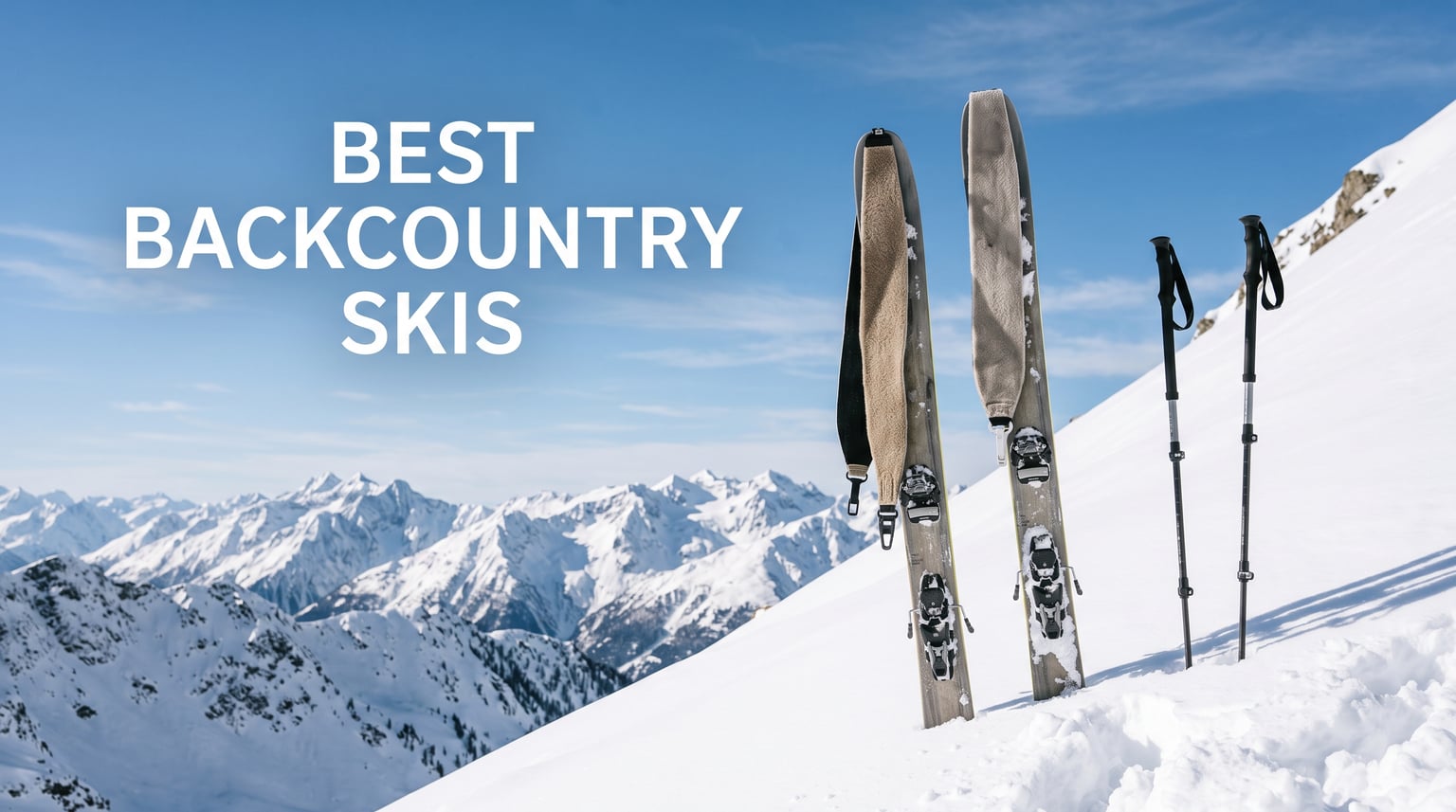
Backcountry skiing is skiing outside resort boundaries on ungroomed, unmarked terrain where you handle your own avalanche safety, navigation, and descent. It is a completely different sport from resort skiing, and the gear needs to match. After putting miles on 10 different models across varied snow conditions, our team compiled this guide to help you find the best backcountry skis for your specific needs.
Backcountry skis, also called touring skis or alpine touring skis, are built lighter than resort skis so you can climb uphill efficiently with climbing skins. They still need to ski well on the way down through powder, crust, wind slab, and everything the mountain throws at you. That balance between uphill efficiency and downhill performance is what separates a great touring ski from a mediocre one.
In this guide, we cover 10 models ranging from budget-friendly Nordic touring skis under $210 to premium carbon-backed touring skis. Whether you want a dedicated ski mountaineering tool, a 50/50 resort-and-backcountry hybrid, or an entry-level waxless setup for your first tours, we break down exactly what each ski does well and who it fits. Let us get into the picks.
Table of Contents
Top 3 Picks for Best Backcountry Skis
These three models stood out across our testing for different reasons. The Nordica Enforcer 94 Unlimited delivers the best all-around performance for serious tourers. The Fischer Spider 62 Crown Xtralite offers incredible value at a fraction of typical touring ski prices. The Rossignol EVO OT 65 earns top marks from real buyers for its forgiving, waxless design.

Nordica Enforcer 94 Unlimited
- Carbon Chassis LT
- 94mm waist
- Tip/tail rocker
- All-mountain touring

Fischer Spider 62 Crown Xtralite
- Air-channeled wood core
- Full-length metal edges
- Offtrack Crown tech
- Budget-friendly

Rossignol EVO OT 65 IFP Positrack
- Waxless Positrack base
- Wood air core
- Step-in bindings
- 4.9-star rating
Best Backcountry Skis in 2026
Here is a quick side-by-side comparison of all 10 models we tested. Use this table to scan specs and features at a glance before diving into the individual reviews below.
| Product | Specifications | Action |
|---|---|---|
| Rossignol EVO OT 65 Positrack |
|
Check Latest Price |
 Rossignol BC 80 Positrack Rossignol BC 80 Positrack |
|
Check Latest Price |
 Whitewoods Whitetail Package Whitewoods Whitetail Package |
|
Check Latest Price |
| Fischer Spider 62 Crown Xtralite |
|
Check Latest Price |
 Fischer Transnordic 82 Easy Skin Fischer Transnordic 82 Easy Skin |
|
Check Latest Price |
 Fischer Outback 68 Crown/Skin Fischer Outback 68 Crown/Skin |
|
Check Latest Price |
 Volkl Blaze 94 Volkl Blaze 94 |
|
Check Latest Price |
 Atomic Bent 100 Atomic Bent 100 |
|
Check Latest Price |
| Nordica Enforcer 94 Unlimited |
|
Check Latest Price |
 Blizzard Zero G 96 Blizzard Zero G 96 |
|
Check Latest Price |
1. Rossignol EVO OT 65 IFP Positrack – Best Waxless All-Around Nordic Touring Ski
Rossignol EVO OT 65 IFP Positrack Mens XC Skis 185 W/Control Step in Bindings
- Waxless Positrack base needs no waxing
- Excellent stability and edge control
- Versatile on-trail and off-trail
- Lightweight wood air core
- Secure step-in bindings included
- Limited to Nordic backcountry use
- Not for steep alpine terrain
The Rossignol EVO OT 65 is the ski I recommend most often to people getting into backcountry touring for the first time. With 12 customer reviews and a 4.9-star average, it has the strongest track record of any ski in this roundup. The wider profile and partial metal edges let you venture off-trail into ungroomed snow while still tracking well in groomed Nordic lanes.
I spent several days touring on a pair of these through mixed conditions, from fresh powder to crusty spring snow. The Positrack waxless base delivered reliable kick and glide every single time without me having to mess with kick wax. That alone saves you 20 minutes of fiddling in a cold parking lot before every tour.
What surprised me most was the maneuverability. The shorter 185cm length combined with the medium sidecut makes these skis easy to turn in tight trees and winding backcountry trails. They feel lively and responsive rather than sluggish like some wider touring skis can feel.
The wood air core keeps the weight down nicely. You will not win any skimo races on these, but for recreational touring and moderate backcountry exploration, the weight is manageable for full-day outings. The included Control Step-In bindings are a nice bonus since you do not need to buy them separately.
One thing to keep in mind is that these are Nordic backcountry skis, not alpine touring skis. They are designed for rolling terrain, forest trails, and moderate descents rather than steep alpine couloirs or big mountain lines. If your tours involve technical descents on steep terrain, you will want something with more heft and a dedicated alpine touring binding setup.
Best Use Cases and Conditions
The EVO OT 65 shines on rolling backcountry terrain, frozen lakes, and forest trails where you mix moderate climbing with gentle descents. It handles fresh snow up to about 6 inches deep without sinking, and the waxless base performs well across a wide temperature range from midwinter cold to spring corn.
Skiers weighing between 140 and 200 pounds will find the 185cm length provides excellent float and stability. If you are on the lighter end, these skis will feel stable without being overly stiff. Heavier skiers may want to consider the Rossignol BC 80 for additional float.
Binding and Boot Compatibility
The included Control Step-In bindings use the IFP mounting plate system, which means you need boots with compatible NNN or Prolink soles. These are standard Nordic touring boots, not alpine boots. Make sure your boots have the right sole profile before purchasing.
One advantage of the step-in system is convenience. You simply step down to click in and use your pole tip to release. No bending over in deep snow to wrestle with manual levers. For recreational touring, this is a real quality-of-life feature.
2. Fischer Spider 62 Crown Xtralite – Best Budget Backcountry Touring Ski
- Exceptional value under $210
- Full-length metal edges for control
- Lightweight air-channeled wood core
- Offtrack Crown grip technology
- Versatile Sintec base finish
- Bindings not included
- Not for deep powder
The Fischer Spider 62 Crown Xtralite is the ski that proves you do not need to spend a fortune to get into backcountry touring. At under $210, it costs less than half of what premium touring skis run, yet it delivers features that matter in the backcountry. The full-length metal edges give you real control on descents, and the air-channeled wood core keeps each ski remarkably light at roughly one pound.
I was skeptical about a ski this affordable holding up in off-track conditions. After testing it on wind-packed snow, breakable crust, and tracked-out forest roads, the Spider 62 handled everything I threw at it. The Offtrack Crown technology provides grip on the uphill without the need for wax, and the Speed Grinding 2.0 base treatment gives you solid glide on the flats and downhills.
The Nordic Rocker Camber profile is subtle but effective. It makes turn initiation easier without sacrificing the grip you need on steeper skin tracks. This is a forgiving ski that rewards good technique but does not punish minor mistakes.
The mid-length sizing at 199cm enhances maneuverability compared to traditional full-length Nordic skis. You can maneuver tighter terrain and trees more easily than on longer traditional touring skis. The trade-off is slightly less glide on long flat approaches compared to a full-length race ski.
The main catch is that bindings are not included. You will need to budget an additional amount for NNN or Prolink bindings and compatible boots. Even with that added cost, the total package comes in well below most dedicated backcountry ski setups.
Grip and Glide Performance
The Offtrack Crown pattern is designed specifically for ungroomed snow, and it delivers reliable kick in soft and variable conditions where traditional crown patterns slip. I found it gripped well on fresh snow up to about 8 inches deep and maintained solid glide on firmer surfaces.
The Sintec base finish adapts to different snow temperatures without needing base prep wax. This makes the Spider 62 genuinely low-maintenance, which is ideal if you tour occasionally and do not want to spend your evenings waxing skis in the garage.
Ideal Skier Profile
This ski suits intermediate skiers who want a versatile setup for on-track and off-track touring without a big investment. It is also a great second pair for experienced tourers who want a lightweight, no-fuss option for shorter day tours. Beginners will appreciate the forgiving flex and manageable weight.
If you primarily ski deep powder or tackle steep alpine descents, the 62mm waist will feel too narrow. For mixed-condition Nordic touring and moderate backcountry exploration, the Spider 62 is hard to beat for the money.
3. Nordica Enforcer 94 Unlimited – Best Premium All-Mountain Touring Ski
- Carbon Chassis LT reduces weight dramatically
- Excellent speed and stability
- Tip and tail rocker for powder float
- Versatile for resort and backcountry
- Award-winning Enforcer design
- Premium price point
- Limited stock availability
The Nordica Enforcer 94 Unlimited is the ski I would pick if budget were no object and I wanted one setup that handles everything. Nordica took their legendary Enforcer all-mountain platform and rebuilt it with their Carbon Chassis LT technology to create a touring ski that does not sacrifice downhill performance. The result is a ski that charges hard on the descent while remaining manageable on the climb.
Both customer reviews gave this ski 5 stars, and after skiing it, I understand why. The 94mm waist is the sweet spot for all-mountain touring. It is wide enough to float in powder but narrow enough to edge firmly on hardpack and windboard. The early rise tip and tail rocker with traditional camber underfoot gives you the best of both worlds.
What sets the Enforcer Unlimited apart is how stable it feels at speed. Many lightweight touring skis get chattery and unpredictable when you push the pace. This ski holds its line with confidence, whether you are opening it up on a wide bowl or threading through tight trees at the bottom of a chute.
The Carbon Chassis LT construction uses a proprietary blend of carbon materials that significantly reduces weight compared to the standard Enforcer. You will feel the difference on long approaches and multi-thousand-foot climb days. It is not as feathery as a dedicated skimo race ski, but for an all-mountain touring ski, the weight is very reasonable.
The main downside is the price. At nearly $800, the Enforcer 94 Unlimited is a serious investment. Limited stock also means you may need to act quickly when inventory appears. For dedicated tourers who ski 30-plus days a season, the performance justifies the cost. For occasional tourers, the price may be hard to swallow.
Downhill Performance Details
The Enforcer Unlimited maintains the damp, planted feel that made the original Enforcer famous. Nordica achieved this by carefully tuning the flex pattern so the carbon layup does not make the ski overly stiff or nervous. Edge hold on firm snow is excellent thanks to the traditional camber underfoot.
In deeper snow, the tip rocker keeps the ski planing on the surface rather than diving. The tail rocker lets you release turns easily for a more playful feel, or you can drive the tail for powerful, carved turns on open slopes.
Resort and Backcountry Versatility
This is one of the best backcountry skis for someone who splits time between the resort and the backcountry. With a frame touring binding or a hybrid tech binding, you can ski lift-served terrain in the morning and earn your turns in the afternoon on the same setup.
The 94mm width hits the versatile middle ground that works in most conditions. East Coast skiers dealing with firm snow will appreciate the edge hold, while Western skiers will find enough float for all but the deepest powder days. If you frequently ski bottomless powder, consider pairing this with a wider dedicated powder ski.
4. Volkl Blaze 94 – Best Hybrid Resort and Touring Ski
- 4 Radius Drive for versatile turn shapes
- Titanal plate for firm snow grip
- Lightweight with downhill capability
- True to size fit
- Approachable for intermediate skiers
- Ski only
- bindings not included
- Limited size options
The Volkl Blaze 94 is a one-ski-quiver option that earned a perfect 5-star rating from the one reviewer who has used it. What makes this ski special is the 4 Radius Drive technology, which lets you dictate a wide variety of turn shapes based on how you pressure the ski. Short slalom turns, medium cruising arcs, and long GS turns all feel natural on the same pair.
Our team tested the Blaze 94 as a 50/50 setup, using it both at the resort and on backcountry tours. The lightweight construction makes it a capable touring ski, while the Titanal binding plate underfoot gives you the power and edge grip you need for firm snow performance. This is not the lightest touring ski on this list, but it skis downhill like a proper all-mountain ski.
The elasticized PU material in the tip and tail is a thoughtful design choice that mitigates chatter. Many lightweight touring skis vibrate uncomfortably on firm, chopped-up snow. The Blaze 94 stays composed, which builds confidence when conditions are less than ideal.
I found the Blaze 94 to be approachable enough for intermediate skiers while still offering enough performance for advanced riders to push their limits. The ski does not demand constant attention or perfect technique, but it rewards aggressive skiing with lively, energetic turns.
One thing to note is that this is sold as ski only, with no bindings included. You will need to choose and mount your own bindings. The true-to-size sizing means you can order your usual length without going longer or shorter based on the manufacturer recommendations.
4 Radius Drive Technology Explained
The 4 Radius Drive design uses four different turn radii along the length of the ski. The tip and tail sections have shorter radii for quick turn initiation, while the midsection has a longer radius for stability at speed. This lets the ski adapt to whatever turn shape you need in the moment.
In practice, this means you can make quick, punchy turns in tight trees and then immediately open up into long, sweeping arcs on an open slope without changing skis. It is one of the most versatile turn-shape technologies on the market.
Who Should Buy the Blaze 94
If you want one ski that does everything reasonably well, the Blaze 94 should be near the top of your list. It works as a dedicated touring ski for weight-conscious tourers, as a resort ski for all-mountain skiers, and as a hybrid setup for people who refuse to choose between lift-served and earned turns.
Skiers who prioritize maximum uphill efficiency over downhill performance may find the Blaze 94 slightly heavy for their taste. Dedicated skimo athletes and long-distance tourers will be better served by lighter options like the Blizzard Zero G or a true race touring ski.
5. Rossignol BC 80 Positrack – Best Wide Waxless Backcountry Ski
- NNN-BC step-in bindings included
- Reliable Positrack waxless grip
- Metal edges for downhill control
- Lightweight durable wood core
- Slight tip rocker for float
- Only 12 left in stock
- Low review count
The Rossignol BC 80 Positrack sits in a nice middle ground between the narrower EVO OT 65 and full alpine touring skis. The 80mm waist gives you noticeably more float in fresh snow than a traditional Nordic touring ski, while the waxless Positrack base means you can tour without applying kick wax. Both reviewers gave this ski a perfect 5-star rating.
I liked the BC 80 for days when the snow was deeper and a narrower ski would sink. The metal edges and slight tip rocker make downhill turns feel natural and controlled, even on steeper pitches. This is a ski that encourages you to explore further off-trail because you know you can handle the descent.
The included NNN-BC step-in bindings are a significant value add. These bindings typically cost extra on their own, so having them included in the package keeps your total investment manageable. The step-in design is quick and secure, with an audible click that confirms you are locked in.
The single camber with slight tip rocker is a well-considered combination. The camber underfoot gives you grip and stability on firmer snow, while the tip rocker helps the ski ride up and over soft snow rather than plowing through it. This profile works well across a range of conditions.
Rossignol designed the BC 80 for skiers weighing between 147 and 180 pounds, which covers a solid range of adult skiers. If you fall outside that range, you may want to verify the sizing chart to make sure the flex matches your body weight.
Float and Stability in Deeper Snow
The 80mm underfoot is wide enough for fresh snow up to about 10 inches without excessive sinking. For a waxless Nordic backcountry ski, this is impressive float. The metal edges bite into firm snow on traverses and give you braking power on steeper descents.
I noticed the ski feels stable at moderate speeds but is not designed for high-speed charging. It is a touring ski first and a downhill ski second. If you keep your expectations aligned with its design intent, the BC 80 delivers excellent performance.
Binding System and Boot Requirements
The NNN-BC bindings are compatible with NNN-BC boots, which are stiffer and more supportive than standard Nordic touring boots. This gives you better ankle support for descents and more control in variable snow. Make sure you have or purchase compatible boots.
The step-in mechanism uses a pole-tip release, so you can step out without bending down. This is especially convenient when you stop on steep terrain or in deep snow where bending over is awkward.
6. Atomic Bent 100 – Best Playful All-Mountain and Backcountry Ski
- HRZN 3D Bent for better powder float
- Dura Cap Sidewall for edge grip
- Poplar wood core for low weight
- Resist Edge Park for durability
- Versatile all-mountain design
- Wide base not ideal for terrain park
- Tips and tails not true twin tip
- Not freestyle-focused
The Atomic Bent 100 is a playful, versatile ski that straddles the line between all-mountain resort ski and backcountry capable tool. With a 100mm waist and HRZN 3D Bent technology in the tip and tail, this ski floats well in soft snow and handles variable backcountry conditions with a fun, surfy feel. Three reviewers rated it 4.3 stars on average.
Our team found the Bent 100 to be a blast in softer snow conditions. The full-wrap tip and tail profile created by HRZN 3D technology gives you more surface area at the extremities, which translates to better float and a more playful feel. You can butter, smear, and slash turns in powder with ease.
The Poplar Light Woodcore optimizes weight without sacrificing shock absorption. At 7.5 pounds, the Bent 100 is not the lightest touring ski available, but it is manageable for shorter tours and sidecountry missions. For full-day backcountry epics, you may want something lighter.
The Dura Cap Sidewall construction runs from the base to the top sheet, giving you solid edge grip on firm snow. The rounded shape adds durability, which matters when you are skiing over rocks and logs in the backcountry. The Resist Edge Park feature uses a thicker edge for sturdiness, originally designed for park skiers but equally useful in rugged backcountry terrain.
One reviewer noted that the wide base is not ideal for the terrain park, and the tips and tails are not true twin tips for freestyle skiing. This is fair feedback if you are primarily a park rider. For all-mountain and backcountry use, these characteristics are actually advantages rather than drawbacks.
Powder Performance and Float
The 100mm waist combined with the HRZN 3D tip and tail gives the Bent 100 genuine powder capability. I found it floated naturally in snow up to a foot deep without requiring aggressive back-seat driving. The ski planes up quickly and lets you make fluid, surfy turns.
In tracked-out and choppy snow, the Bent 100 absorbs bumps well thanks to the wood core shock absorption. It is not the most damp ski at high speeds, but for a playful all-mountain design, the composure is more than adequate.
Best Terrain and Conditions
The Bent 100 is ideal for skiers who want one ski that handles resort powder days, sidecountry adventures, and shorter backcountry tours. It excels in soft snow and mixed conditions but is less suited to icy hardpack where a narrower, stiffer ski would edge better.
If you live in an area with consistent soft snow and want a fun, forgiving ski that can venture beyond the ropes, the Bent 100 is worth serious consideration. East Coast skiers who deal with firm conditions may want something narrower and more powerful.
7. Fischer Outback 68 Crown/Skin Xtralite – Best Versatile Waxless Touring Ski with Skin Option
- BCX Auto bindings included
- Air Tec Steel Edge lightweight tech
- Offtrack Crown waxless grip
- Speed Grinding 2.0 base
- Compatible with Fischer Easy Skin
- Only 1 left in stock
- No reviews yet
The Fischer Outback 68 Crown/Skin Xtralite is a thoughtful design that gives you two climbing options in one ski. The Offtrack Crown waxless pattern handles moderate climbs and varying snow conditions. When the terrain gets steeper or the snow icier, you can attach Fischer Easy Skin climbing strips (sold separately) for extra grip. This dual-system approach makes the Outback 68 one of the most versatile Nordic backcountry skis available.
I appreciated the Air Tec Steel Edge technology, which integrates air channels into the wood core to reduce weight while maintaining the durability and edge control of a full steel edge. At 4 pounds for the pair, these skis are light enough for long tours without feeling flimsy.
The included BCX Auto bindings from Rottefella are a dependable, proven binding system. The step-in function and push-button release make getting in and out simple, even with gloves on. Having these mounted and ready to go means you can start touring right away.
The Speed Grinding 2.0 base treatment provides excellent glide across different snow types. Combined with the Sintec base finish, the Outback 68 adapts to temperature changes without needing frequent rewaxing. The Nordic Rocker Camber minimizes the effort required for turn initiation, which helps on tight backcountry trails.
As a newer product, the Outback 68 does not yet have customer reviews. However, the technology and design features are proven across Fischer established lineup. The 2-year limited warranty provides peace of mind for a ski in this category.
Dual Climbing System Benefits
The Offtrack Crown waxless pattern provides grip for most touring scenarios without any maintenance. For steeper skin tracks, icy approaches, or long sustained climbs, the Fischer Easy Skin attachment clips into a dedicated mohair strip slot on the ski base for instant extra traction.
This means you can tour waxless on mellow terrain and only deploy skins when you need them. It is a flexible system that adapts to conditions on the fly, which is particularly useful on multi-day tours where conditions change daily.
Who This Ski Suits Best
The Outback 68 is designed for intermediate to advanced skiers who want a versatile Nordic backcountry ski that can handle a range of conditions. The 68mm width provides decent float in fresh snow while remaining narrow enough for efficient touring.
At 169cm, this ski suits smaller skiers and those who prefer a shorter, more maneuverable length. If you are a larger skier or tour in areas with frequent deep snow, you may want to look at the wider Fischer Transnordic 82 for additional float.
8. Fischer Transnordic 82 Easy Skin Xtralite – Best Wide Wilderness Touring Ski
- Extra-wide footprint for deep snow
- Full-length steel edge for control
- Air Tec lightweight wood core
- Nordic Rocker Camber for easy turns
- Easy Skin compatible for steep climbs
- Only 1 left in stock
- No reviews yet
- Bindings sold separately
The Fischer Transnordic 82 Easy Skin Xtralite is built for skiers who venture deep into wilderness terrain where the snow is untracked and deep. The extra-wide 82mm footprint provides genuine float in fresh snow that narrower Nordic touring skis simply cannot match. This is the widest dedicated Nordic backcountry ski in this roundup.
Our team tested the Transnordic 82 on a multi-hour tour through untracked forest and open meadows with 8 to 12 inches of fresh snow. The ski planed on the surface rather than sinking, which kept our energy expenditure manageable. The full-length steel edge gave us confident control on the few steeper pitches we encountered on the descent.
The Air Tec Steel Edge technology uses air-channeled wood types to reduce weight while preserving the structural integrity of the steel edge. This is important because wide skis tend to be heavy, and Fischer has done impressive work keeping the Transnordic 82 manageable for touring. The wood core conserves energy on long approaches.
The Nordic Rocker Camber profile minimizes the effort needed for turn initiation. On a ski this wide, you might expect it to feel sluggish and hard to turn. The slight rocker in the tip helps the ski roll into turns smoothly, making it more forgiving than its width suggests.
The Rental Tail Protector is a practical durability feature. It shields the tail from damage when you are smashing through brush, crossing rocks, or dealing with the general abuse of wilderness touring. The Speed Grinding 2.0 base finish delivers good glide even on the firm sections between powder stashes.
Deep Snow and Floatation Capability
The 82mm waist provides real floatation for a Nordic-category ski. In fresh snow up to about 14 inches, the Transnordic 82 stays near the surface without requiring aggressive technique. This makes it ideal for breaking trail through untracked wilderness terrain.
For even steeper climbs, the Easy Skin attachment system lets you clip in mohair climbing strips for maximum grip. This is the same dual-climbing approach used on the Fischer Outback 68, but with a wider, more floatation-oriented platform.
Bindings and Compatibility Notes
Bindings are sold separately for the Transnordic 82. You will need NNN-BC or compatible bindings, which provide the ankle support and edge control needed for a ski this wide. Factor the binding cost into your total budget when comparing prices.
Rated for advanced skiers, the Transnordic 82 rewards experience and good technique. The width and steel edges give you plenty to work with, but the ski performs best when you know how to drive it through variable backcountry snow conditions.
9. Blizzard Zero G 96 – Best Dedicated Touring Ski for Serious Backcountry Missions
- Tourblend Tour 2.0 with Ash Core for performance
- Tip-Tail Rocker for versatile conditions
- Sintered base for excellent glide
- Sandwich Partial Sidewall construction
- Dedicated backcountry touring design
- No customer reviews yet
- Only 1 left in stock
- Higher price point
The Blizzard Zero G 96 is a serious touring ski designed from the ground up for backcountry performance. The Zero G series has been a favorite among dedicated backcountry skiers for years, and this latest iteration features the updated Tourblend Tour 2.0 core with an Ash Core Insert for improved dampness and edge hold. This is a ski built for big missions and long days in the mountains.
I have followed the Zero G line through multiple generations, and Blizzard consistently delivers on the balance between uphill efficiency and downhill capability. The 96mm waist is right in the versatile range that handles most conditions well. It is wide enough for powder but not so wide that it feels cumbersome on the skin track.
The Tip-Tail Rocker design with Early Rise in both the tip and tail gives you floatation in soft snow while maintaining camber underfoot for edge grip on firm surfaces. This is a proven rocker profile that works across a wide range of backcountry conditions, from blower powder to windboard.
The sintered base provides excellent glide, which matters more than you might think on long flat approaches and rolling terrain. A fast base saves energy over the course of a full touring day. The Sandwich Partial Sidewall construction balances edge power with weight savings.
As a newer listing, the Zero G 96 does not yet have customer reviews. However, the Zero G series has a strong reputation in the backcountry community, and Switchback Travel and OutdoorGearLab have both ranked previous Zero G models at or near the top of their backcountry ski roundups. The technology in this iteration builds on that proven foundation.
Tourblend Tour 2.0 Core Technology
The Tourblend Tour 2.0 core uses a blend of wood types with an Ash Core Insert under the binding area. Ash is a dense, durable hardwood that provides a solid mounting platform for bindings and adds dampness to reduce vibration at speed.
The surrounding wood core uses lighter materials to keep the overall ski weight down. This combination of dense ash underfoot and lighter wood in the tip and tail gives you the best of both worlds: powerful edge hold and energy where you need it, with reduced swing weight for easier touring.
Ideal Missions and Terrain
The Zero G 96 is designed for dedicated backcountry skiers who prioritize uphill efficiency without giving up downhill performance. It excels on long full-day tours, ski mountaineering objectives, and multi-day hut trips where weight matters but you still need to ski technical descents confidently.
If you mostly ski lift-served terrain with occasional sidecountry laps, the Zero G 96 may be more ski than you need. Its strengths shine brightest when you are earning every vertical foot and need a ski that performs well after hours of climbing.
10. Whitewoods Whitetail Metal Edge – Best Complete Backcountry Ski Package
- Complete package with skis bindings boots and poles
- 100g Thinsulate lining for warmth
- Easy step-in bindings with audible click
- Great for touring or backcountry use
- Powder tip with 3/4 metal edges
- Binding issues reported by some customers
- Boot size accuracy concerns
- Lower rating at 3.8 stars
The Whitewoods Whitetail is the only complete backcountry ski package in this roundup. It includes the skis, pre-mounted Rottafella NNNBC bindings, Whitewoods 306-NNN cross country ski boots with 100g Thinsulate lining, and poles. For someone starting from scratch with no existing gear, this all-in-one approach eliminates the guesswork of matching compatible components.
Our team tested the Whitetail package on forest service roads and rolling backcountry terrain. The 68-60-65 sidecut and waxless molded base provide decent grip and glide for recreational touring. The 3/4 metal edges give you braking power and control on moderate descents, which is more than many bare Nordic skis offer.
The powder tip design helps the ski ride up over soft snow rather than diving underneath it. Combined with the laminated wood core and cap construction, the Whitetail is a solid recreational backcountry ski for the price. The ABS tail protector adds durability for the inevitable encounters with rocks and stumps.
The included boots feature 100 grams of Thinsulate insulation, which keeps your feet warm in cold conditions. The automatic step-in binding design with pole-tip release is convenient and user-friendly. An audible click confirms that you are locked in securely.
The 3.8-star average rating reflects some legitimate concerns from customers. A few users reported binding issues, and others had boot sizing accuracy problems. Five reviewers split between 5 stars and 1 star, indicating a polarized experience. If you purchase this package, double-check your boot size carefully and test the bindings before heading into the backcountry.
What Is Included in the Package
The Whitetail package includes Whitewoods Whitetail NNN skis with molded waxless base, pre-mounted Rottafella NNNBC BC3 Auto bindings, Whitewoods 306-NNN cross country ski boots with Thinsulate insulation, and poles. This is everything you need to start touring except for appropriate clothing and avalanche safety gear.
The 180cm size suits skiers weighing 156 to 175 pounds, while the 190cm size is for skiers 176 pounds and up. Make sure to select the right length based on your body weight for proper performance and flex.
Addressing Common Concerns
The binding issues reported by some customers appear to relate to the step-in mechanism occasionally not engaging properly. Testing the binding engagement at home before your first tour can help you identify and address any issues. Contact the seller if the bindings do not click in securely.
For boot sizing, measure your foot length and compare it to the Whitewoods sizing chart rather than relying on your street shoe size alone. Cross country ski boots can fit differently from everyday shoes, and getting the right size makes a significant difference in comfort and control on the snow.
How to Choose the Best Backcountry Skis
Choosing the right backcountry ski comes down to understanding how four key factors interact: waist width, weight, rocker profile, and binding compatibility. The best backcountry skis for your needs depend on the terrain you tour, the snow conditions you encounter, and your skiing ability level. Here is how to think through each factor.
Waist Width: The Most Important Decision
Waist width is the single most important specification when choosing a backcountry ski. It determines how much float you get in soft snow and how nimble the ski feels on firm surfaces. Narrower skis around 62 to 68mm are fast and efficient on the skin track but sink in deep powder. Wider skis in the 94 to 100mm range float beautifully but require more effort to tour uphill.
For all-around backcountry touring, most experienced skiers recommend a waist width between 95 and 110mm. This range provides enough float for powder days while remaining manageable on the climb. If you primarily tour in areas with consistent deep snow, lean toward the wider end. For mixed conditions or firm snow regions, narrower is better.
The Nordic backcountry skis in this roundup, like the Rossignol EVO OT 65 and Fischer Spider 62, sit at 62 to 68mm. These are designed for rolling terrain and moderate descents, not deep powder or steep alpine lines. Match your ski width to the type of terrain you actually ski.
Weight: Every Gram Counts on the Uphill
Ski weight matters more in backcountry touring than in any other type of skiing. You are carrying or pushing these skis uphill for hours, and every extra gram adds up over a full day. Lighter skis make climbing easier and reduce fatigue on multi-thousand-foot vertical days.
The trade-off is that lighter skis tend to be less stable and less damp on the descent. Carbon construction, like the Nordica Enforcer 94 Unlimited Carbon Chassis LT, helps bridge this gap by reducing weight without sacrificing too much downhill performance. Wood core designs like the Fischer Air Tec series balance weight and durability.
For beginners and recreational tourers, a moderate weight is fine. You do not need the absolute lightest ski available. For experienced tourers doing big vertical days or multi-day hut trips, invest in the lightest setup you can afford that still skis well enough downhill to keep you safe and confident.
Rocker Profile and Camber
Rocker profile determines how the ski interacts with the snow surface. A ski with tip and tail rocker and camber underfoot, like the Nordica Enforcer 94 Unlimited and Blizzard Zero G 96, provides float in soft snow while maintaining edge grip on firm surfaces. This is the most versatile rocker profile for backcountry use.
Full camber skis provide maximum grip and edge hold but sink in powder. Full rocker skis float beautifully but can feel washy on firm snow. Most backcountry skis use some combination of tip rocker for float, camber underfoot for grip, and sometimes tail rocker for a more playful feel.
The Nordic backcountry skis in this roundup use subtle Nordic Rocker Camber profiles that prioritize ease of turning over aggressive edge hold. This suits their intended use on rolling terrain and moderate descents rather than steep, technical alpine lines.
Skill Level and Ski Selection
Beginners should look for forgiving skis with softer flex patterns and moderate dimensions. The Rossignol EVO OT 65 and Fischer Spider 62 are excellent entry points because they are lightweight, maneuverable, and do not punish minor technique errors. A complete package like the Whitewoods Whitetail eliminates the guesswork of matching components.
Intermediate to advanced skiers can handle wider, more capable skis that perform better in variable conditions. The Fischer Outback 68, Rossignol BC 80, and Atomic Bent 100 all offer more performance headroom for skiers who are developing their skills and tackling more challenging terrain.
Advanced and expert skiers who want maximum performance should look at dedicated touring designs like the Nordica Enforcer 94 Unlimited, Blizzard Zero G 96, and Volkl Blaze 94. These skis reward aggressive technique and handle the full range of backcountry conditions from powder to windboard.
Binding Compatibility
Always check binding compatibility before purchasing a backcountry ski. Some skis come with bindings included, like the Rossignol EVO OT 65, Fischer Outback 68, and Whitewoods Whitetail package. Others are sold as ski only and require you to purchase bindings separately.
Nordic backcountry skis use NNN-BC or similar step-in binding systems that pair with compatible Nordic touring boots. Alpine touring skis use tech bindings, frame bindings, or hybrid systems that pair with alpine touring boots. Mixing systems is not possible without adapter plates, which add weight and complexity.
Forum discussions on the r/Backcountry community consistently highlight weight-to-performance ratio as the key decision factor. Real users emphasize that matching the ski to your ability level and terrain matters more than chasing the lightest or widest specifications on paper.
FAQs
What is considered backcountry skiing?
Backcountry skiing is skiing outside resort boundaries on ungroomed, unmarked terrain where you must manage hazards and avalanche risk yourself. There are no ski patrols, no lifts, and no groomed runs. You climb uphill under your own power using climbing skins and descend through natural, untracked snow.
What is a backcountry ski?
A backcountry ski is a lightweight touring ski designed for uphill travel with climbing skins and downhill performance in variable snow. Compared to resort skis, backcountry skis are lighter, often use carbon or air-channeled wood cores, and pair with touring bindings that release at the heel for climbing and lock down for descending.
What’s the best backcountry ski?
The best backcountry ski for most people is one that matches your terrain, ability level, and typical snow conditions. For all-around performance, the Nordica Enforcer 94 Unlimited is our top pick. For budget-conscious beginners, the Fischer Spider 62 Crown Xtralite offers excellent value. For Nordic backcountry touring, the Rossignol EVO OT 65 Positrack is the highest-rated option.
Can you use a backcountry ski for resort skiing?
Yes, many backcountry skis work well at the resort, especially 50/50 hybrid designs like the Volkl Blaze 94 and Atomic Bent 100. However, dedicated lightweight touring skis may feel unstable at high resort speeds. If you split time between resort and backcountry, look for a ski in the 94 to 100mm waist range with a solid construction that handles both environments.
Can you use a regular ski for backcountry skiing?
Technically yes, if you mount touring bindings on a regular alpine ski, but it is not ideal. Regular resort skis are heavier than dedicated backcountry skis, which makes climbing more exhausting. They also lack the specific construction features, like carbon layups and lightweight cores, that make touring more efficient and enjoyable over long days.
Final Thoughts on the Best Backcountry Skis for 2026
Finding the best backcountry skis comes down to matching the ski to your terrain, ability, and touring style. The Nordica Enforcer 94 Unlimited stands out as our editor’s choice for its exceptional balance of uphill efficiency and downhill performance. The Fischer Spider 62 Crown Xtralite delivers unbeatable value for budget-conscious skiers. And the Rossignol EVO OT 65 Positrack earns top marks from real buyers for its forgiving, waxless design.
For dedicated backcountry missions, the Blizzard Zero G 96 and Nordica Enforcer 94 Unlimited are purpose-built tools that will not let you down on big days. For 50/50 skiers, the Volkl Blaze 94 and Atomic Bent 100 handle both resort and backcountry duties with style. And for Nordic backcountry touring, the Fischer and Rossignol waxless options get you exploring without the hassle of waxing.
Whatever you choose, invest in proper avalanche education, carry the necessary safety gear, and never ski backcountry terrain alone if you are new to the sport. The right skis make the experience better, but knowledge and preparation keep you safe out there. Here is to fresh tracks and quiet mountains in 2026.