
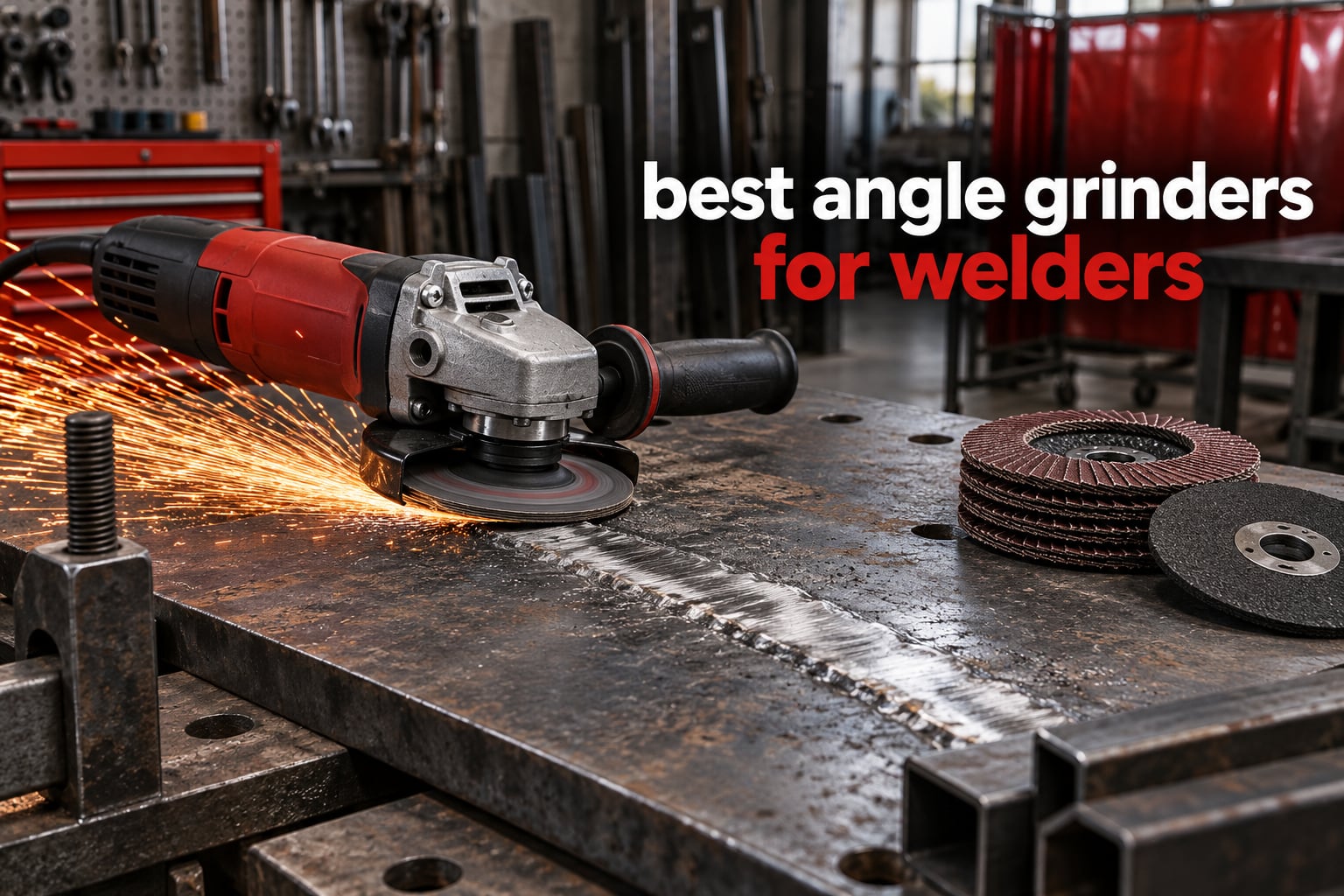
Ask any working welder what tool they reach for first, and it usually is not the welder. It is the grinder. An angle grinder is what knocks mill scale and rust off plate, cleans a bead flush, softens the corners of a flame-cut edge, and cuts the material to length in the first place. Get that step wrong and the joint never had a chance.
That is why the best angle grinders for welders are not judged on headline wattage alone. The things that decide whether a grinder survives a shop are the ones that show up in a forum thread after two years: does it bog down on a thick cap, does the wheel brake when a cut pinches, does the motor survive being fed a constant diet of metal dust. We read through all twelve of them below, spec by spec, and matched each one to the work it is genuinely good at.
Most of the grinders here are 4-1/2 inch, because that is the size a welder reaches for daily in a home shop, a mobile repair truck, or a fabrication bay. The larger 7 and 9 inch machines get their own section in the buying guide, and a couple of the picks here will accept a 5 or 6 inch wheel when you need more removal per pass. If you have not yet picked your machine, our beginner welder guide and MIG welder buying guide cover the other half of the bench.
Top 3 Angle Grinders for Welders in 2026

DEWALT DCG413B 4-1/2 Inch Brushless
- Brushless 20V motor
- Kickback brake stops wheel in 2 seconds
- 3.8 lb balanced body
- Paddle switch with two-stage trigger

BLACK+DECKER BDEG400 6.5-Amp Corded
- 6.5-amp motor
- Metal gear case
- Spindle lock
- 2-year warranty

AVID POWER 7.5-Amp 4-1/2 Inch
- 900W 7.5-amp motor
- 12000 RPM
- Tool-free guard and spindle lock
- Wheels and spanner cross-compatible
The DEWALT DCG413B takes the top spot because it is the only grinder in this group that combines a brushless motor, an electronic kickback brake, and a body light enough to hold overhead, with the deepest owner history of anything we covered. The BLACK+DECKER BDEG400 is the value pick for anyone who just needs a reliable corded cutter with a metal gear case and a two-year warranty behind it. The AVID POWER unit is the one to pick when the accessory bundle matters as much as the motor.
All 12 Angle Grinders Compared for Weld Prep in 2026
| Product | Specifications | Action |
|---|---|---|
| DEWALT DCG413B 20V MAX 4-1/2 Inch Brushless |
|
Check Latest Price |
| BLACK+DECKER BDEG400 4-1/2 Inch 6.5-Amp |
|
Check Latest Price |
| AVID POWER 7.5-Amp 4-1/2 Inch |
|
Check Latest Price |
 Metabo HPT G12SR4 4-1/2 Inch 6.2-Amp Metabo HPT G12SR4 4-1/2 Inch 6.2-Amp |
|
Check Latest Price |
 Makita 9557PBX1 4-1/2 Inch Paddle Switch Makita 9557PBX1 4-1/2 Inch Paddle Switch |
|
Check Latest Price |
 CRAFTSMAN CMCG400B V20 4-1/2 Inch CRAFTSMAN CMCG400B V20 4-1/2 Inch |
|
Check Latest Price |
 Milwaukee 2880-20 M18 FUEL 4-1/2 / 5 Inch Milwaukee 2880-20 M18 FUEL 4-1/2 / 5 Inch |
|
Check Latest Price |
 PORTER-CABLE PC750AG 4-1/2 Inch 7.5-Amp PORTER-CABLE PC750AG 4-1/2 Inch 7.5-Amp |
|
Check Latest Price |
 DEWALT DWE4011 4-1/2 Inch 7-Amp DEWALT DWE4011 4-1/2 Inch 7-Amp |
|
Check Latest Price |
 DEWALT DCG418B 60V MAX 4-1/2 to 6 Inch DEWALT DCG418B 60V MAX 4-1/2 to 6 Inch |
|
Check Latest Price |
 AOBEN AT3113X 1200W 4-1/2 Inch AOBEN AT3113X 1200W 4-1/2 Inch |
|
Check Latest Price |
 Bosch GWS8-45 4-1/2 Inch 7.5-Amp Bosch GWS8-45 4-1/2 Inch 7.5-Amp |
|
Check Latest Price |
A note before the individual reviews: nothing on this list is a 7 or 9 inch machine. Every one of these is a 4-1/2 inch class grinder, which is the right call for weld prep, bead cleanup, and cutting plate and tube up to about half an inch. If you are surfacing an I-beam or notching heavy structural sections, jump to the disc size section in the buying guide and look at a large grinder instead.
1. DEWALT DCG413B – Best Angle Grinder Overall for Weld Prep
- Brushless motor needs no brush changes
- Kickback brake stops the wheel fast on a bind
- Paddle switch and two-stage trigger guard against accidental starts
- Disc changes use a standard Allen wrench
- Balanced 3.8 lb body for long grinds
- Battery runtime drops on sustained grinding
- Less raw power than a corded unit for heavy cutting
- Two-stage trigger takes practice
The DCG413B is the grinder I recommend to anyone starting a shop with one battery platform already in mind. It runs on the 20V MAX system, weighs 3.8 pounds, and the brushless motor means there are no carbon brushes to change at six months. The two-stage trigger and paddle switch are the parts you will notice on day one: the tool will not run unless you have both the paddle engaged and the trigger deliberately squeezed.
For welding work, the kickback brake is the reason it ranks at the top. When a disc binds in a cut, the brake stops the wheel in two seconds or less, which is the difference between a sparks-and-scratches event and a disc fragmenting. The same electronics also bring E-Switch protection, so the tool will not restart on its own if power returns after a stall.
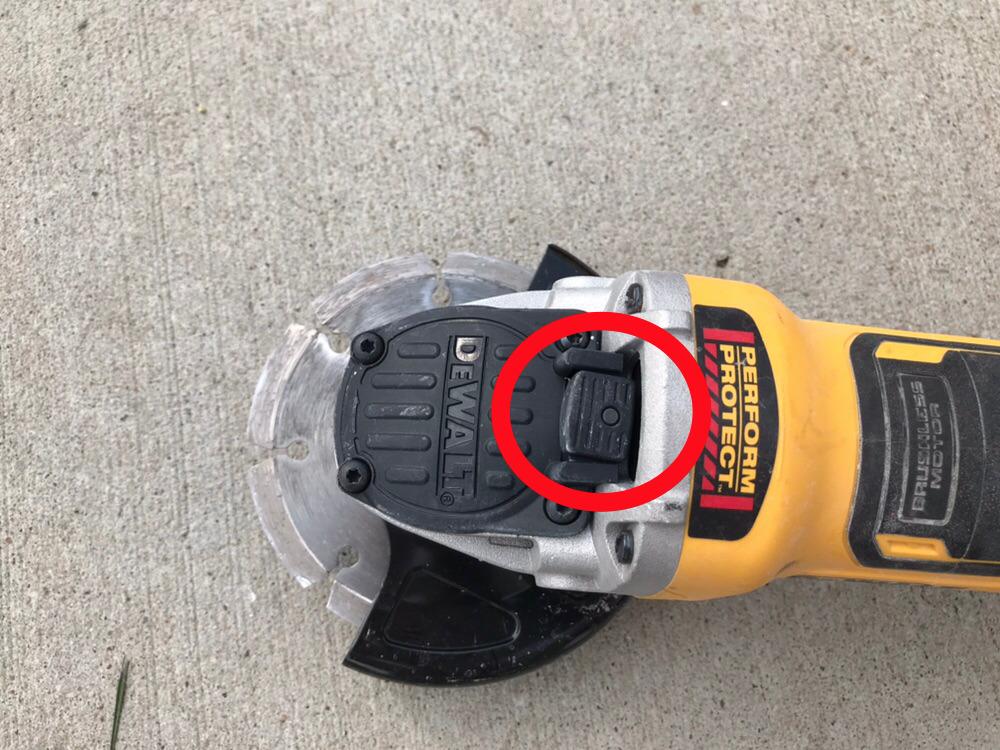
Owners across nearly ten thousand reviews describe using it for steel bracket cutting, weld bead grinding, and even concrete work. The balance is the repeated word: this is a grinder you can hold at arm’s length over a horizontal bead without it pulling you off balance. The paddle switch also runs the length of the body, so the tool can be held with either hand while your supporting hand is on the side handle.
The honest weakness is the battery. Reviewers put sustained grinding at roughly 20 to 30 minutes on a 4Ah pack, and a heavy cap on structural steel will eat that faster. Anyone grinding weld prep all day will want a second pack on the charger. Buyers who already run 20V MAX tools will find the packs interchangeable across the whole range.
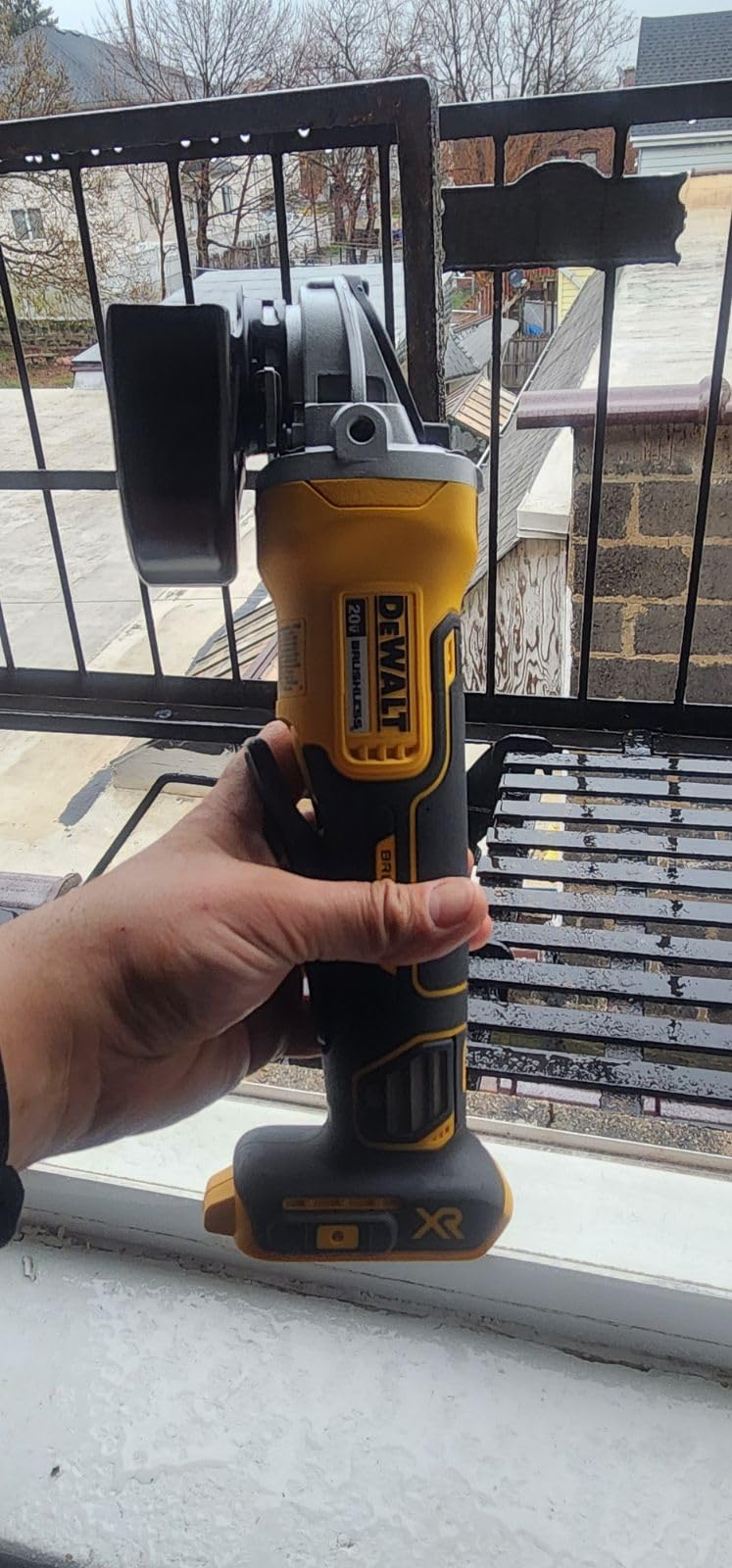
What the 3450 rpm rating means in practice
That number looks low next to the 10,000 or 12,000 rpm figures on the corded tools here, and it is worth understanding why. The listed speed is the no-load figure for the grinder’s grinding output, and on a brushless cordless machine the motor is governed for both wheel safety and torque under load. In practice owners report it chewing through steel bracket stock without stalling.
It is also the reason the two-stage trigger matters. Rather than running the wheel flat out and dropping speed the moment the bit touches metal, the tool ramps in a controlled way. If you need a genuinely fast wheel on thin material, the DWE4011 and Bosch GWS8-45 in this list spin considerably faster.
Where it falls short for a welder
If your work is long continuous removal, such as surfacing a large plate or grinding out a heavy multipass fillet, corded power wins. Reviewers say it directly: less raw power than a corded grinder for heavy continuous cutting. The 60V MAX DCG418B further down is the cordless answer to that complaint, if your shop can commit to a second battery platform.
Service is straightforward in a way that matters on a shop floor. Disc changes use a standard Allen wrench rather than a proprietary key, and the brushless motor eliminates the most common reason a cheap grinder ends up in a drawer. If your battery ecosystem is 20V MAX, this is the one to buy.
2. BLACK+DECKER BDEG400 – Best Value Corded Grinder for Welders
- Cuts steel and structural tube without overheating
- Locking slide-on switch is comfortable on long jobs
- Three-position side handle and adjustable guard
- Grinding wheel
- guard and spanner included
- Two-year limited warranty
- Noticeable vibration during use
- Slide switch can jump out of on once worn
- Light-to-medium duty rather than a full shop workhorse
The BDEG400 is the grinder I point people toward when the budget is fixed and the work is real but not industrial. At 6.5 amps and 800 watts it is honest corded power, and owners consistently report it cutting steel and structural tube without the motor getting hot. That heat behaviour matters more than any spec sheet, because a grinder that overheats on plate is a grinder that cooks its own windings.
The metal gear case is the detail that separates it from cheaper tools. Plastic gear cases crack; metal ones survive a dropped tool and a knock against a steel bench. Add the three-position side handle and you can set the tool up for a gusset, a floor girt, or an overhead weld bead without swapping grips mid-task.
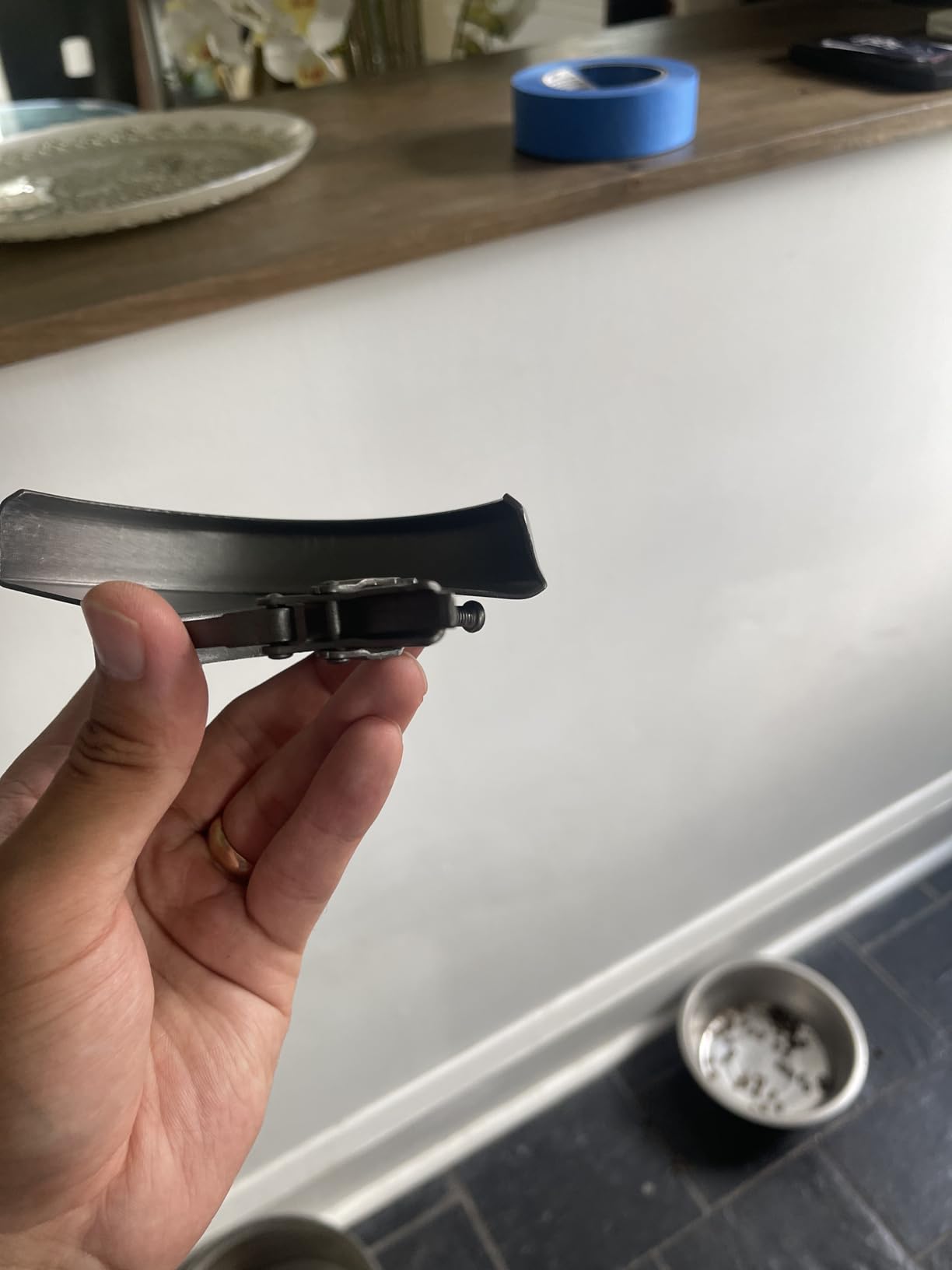
Reviewers consistently call the locking slide-on switch comfortable for extended jobs, which is unusual praise for a tool at this level. Spindle lock also means a disc change takes a few seconds rather than a struggle, and the spanner wrench is in the box along with a grinding wheel and guard. For a first fabrication shop, that is everything you need to clean a joint and get welding.
The vibration figure is the recurring complaint, along with the slide switch eventually jumping out of the on position once the switch is worn. Neither is a dealbreaker, but on long overhead work you will feel the vibration in your wrists by the end of a shift. If your day is dominated by grinding above shoulder height, the Makita or the DEWALT DCG413B are lighter-feeling tools.
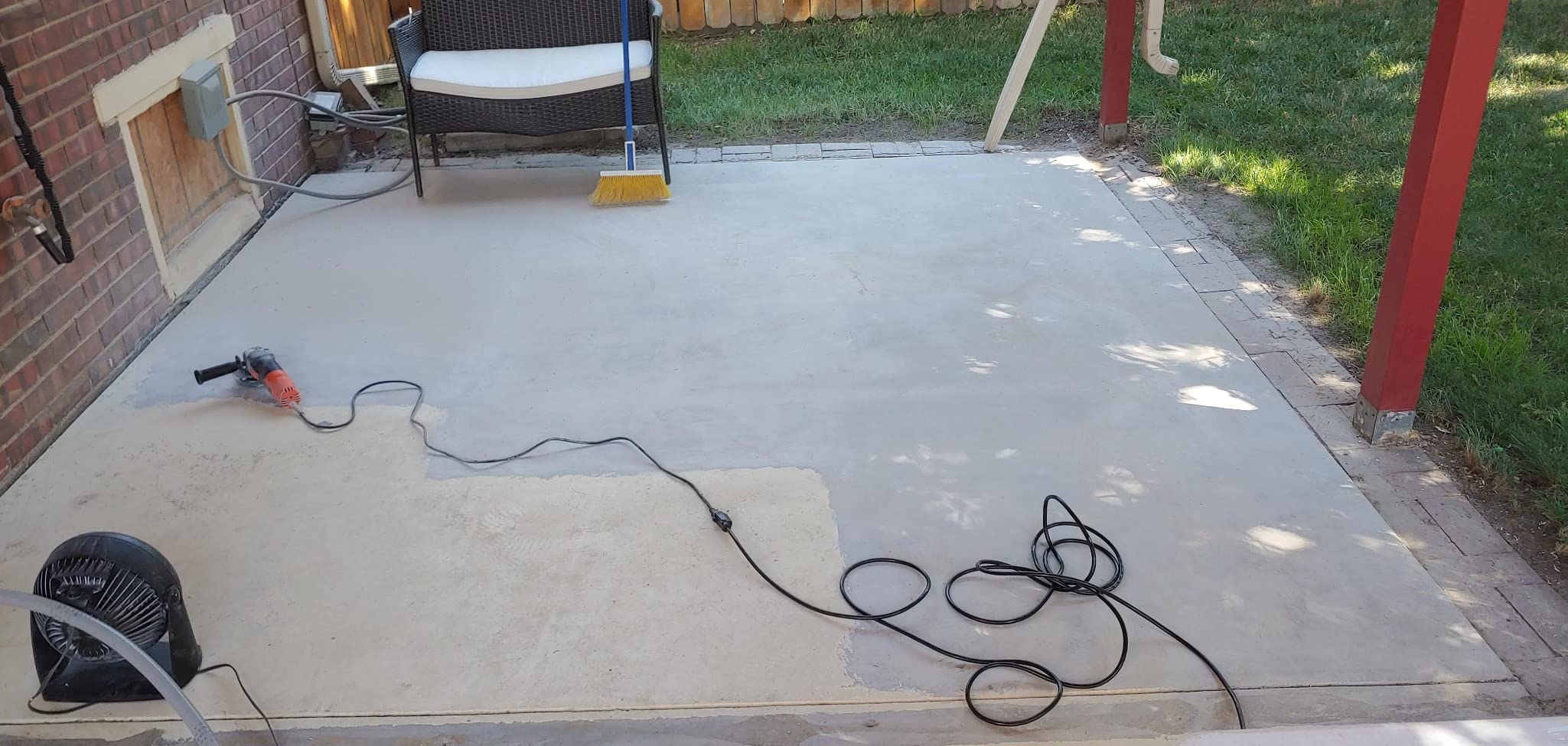
Does 6.5 amps grind a real weld bead?
Yes, for typical bead cleanup and light weld prep. Reviewers describe it handling structural steel and cutting tasks without overheating the motor. What it will not do is match a 10 to 13 amp corded unit or a brushless cordless machine on sustained, aggressive removal across a large area. Treat it as a capable job-site and hobby welder’s tool rather than a production surfacing machine.
The 10,000 rpm no-load speed sits in the middle of this group, higher than the CRAFTSMAN and Milwaukee machines and lower than the 12,000 rpm units. That balance tends to produce a manageable spark pattern on mild steel, which is easier to control than an 11,000 or 12,000 rpm wheel when you are learning to follow a cap.
Who should skip it
If you are grinding eight hours a day, the two-year warranty and the vibration level point you toward a heavier, better damped machine like the Bosch GWS8-45 or the Makita 9557PBX1. If you are a weekend fabricator or a mobile welder doing a few joints a week, the BDEG400 will outlast your interest in the project and cost very little to get started.
One more practical note: the two-year limited warranty is longer than several machines in this list that cost more. For a tool that will live in a garage rather than on a job site, that coverage is worth more than an extra half-amp.
3. AVID POWER 7.5-Amp 4-1/2 Inch – Best Budget Grinder With the Widest Accessory Bundle
- Plenty of power for pipe
- rebar and angle iron
- Wheels
- nut and spanner cross-compatible with major brands
- Tool-free guard and spindle lock speed up disc changes
- Two-position auxiliary side handle
- Generous accessory bundle out of the box
- On/off switch feels fragile and hard to depress
- Guard has few adjustment positions
- Included cutting discs are thicker than ideal and slow cuts
This is the grinder to buy when you want a full complement of consumables on day one. The box holds two cutting wheels, two grinding wheels, a flap disc, two spare carbon brushes, a guard, a spanner, and a side handle. For someone learning weld prep, that removes the most common early frustration, which is not knowing which disc goes on the spindle.
The cross-compatibility is the underrated part. It runs a standard 7/8 inch arbor with a 5/8-11 threaded spindle, so the wheels, nut, and spanner work with major brands. That means the disc supply in your shop is not locked to one manufacturer, and you are not stuck buying this brand’s consumables at whatever the markup turns out to be.
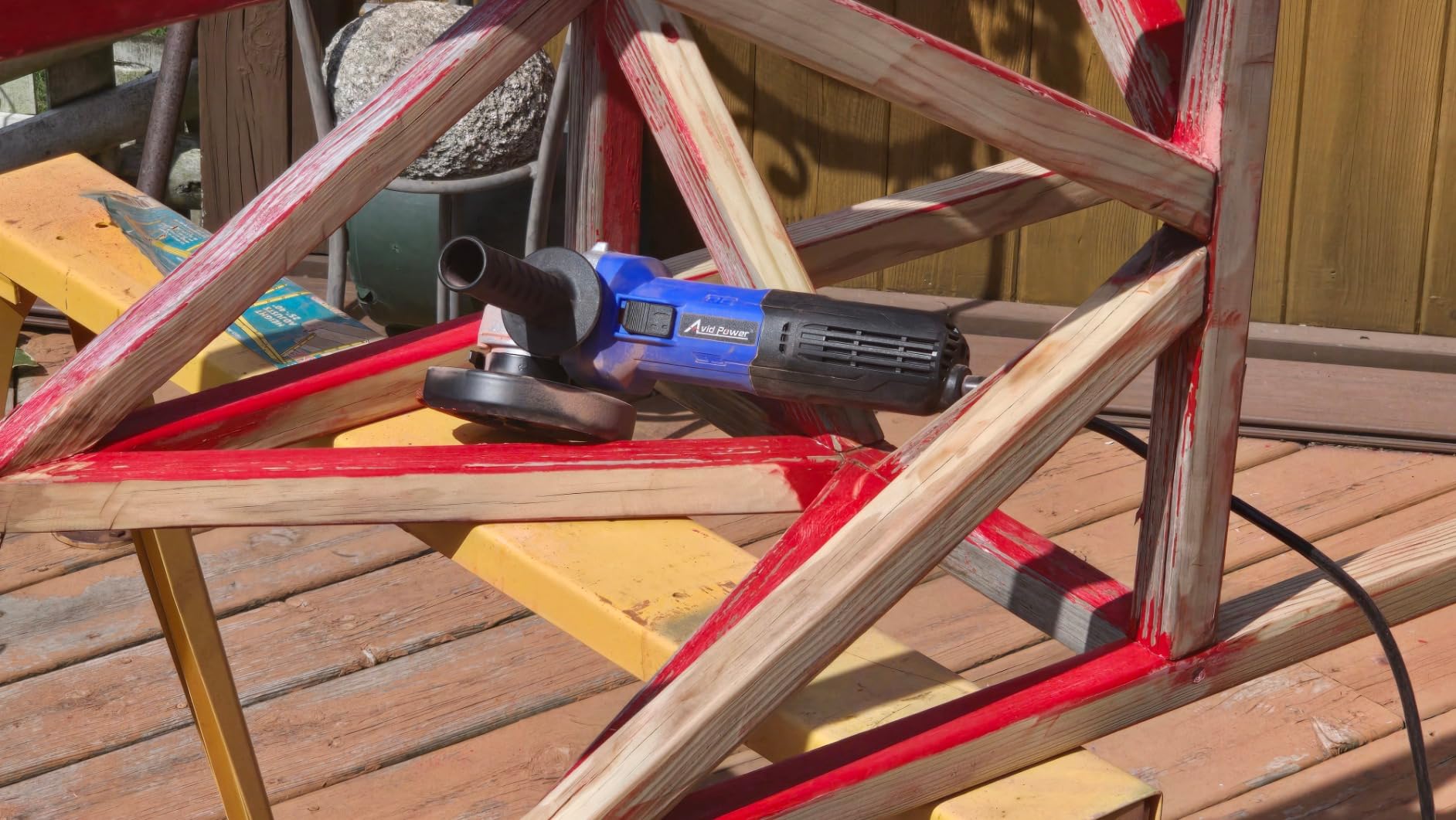
Owners report hundreds of hours of use on this machine, cutting pipe, rebar, angle iron, and rusted bolts. The 900W motor at up to 12,000 rpm is the most aggressive-looking spec set in this group, and the review consensus is that it delivers. The tool-free adjustable guard and integrated spindle lock are both genuine time savers when you are swapping between a grinding wheel and a cutting disc all day.
The switch is where the complaints cluster. It feels fragile and hard to depress, which is a real nuisance on a tool you start and stop many times during a single cleanup operation. The guard also has few adjustment positions and a simplistic locking mechanism, so setting it precisely for a bevel grind takes a little more work than on a tool-free one-touch design.
What arrives in the box, and what to ignore
You get five consumables plus spare brushes. The grinding wheels and flap disc are fine for getting started. The bundled cutting discs are the weak point, since owners note they are thicker than ideal and slow cuts down considerably. Once you settle on the disc brand you like, replace them and keep this machine for grinding work.
Weight comes in at 5.1 pounds, which sits in the middle of this group. It is not an overhead tool, but the low-profile body and 2-position handle mean it fits into tight spots between gussets better than a bulkier large-angle grinder would.
Where the money was saved
The trade-off is straightforward. The motor is strong and the accessory story is generous, but the switch and guard are the cheapest-appearing parts on the tool. If you grind in a shop where someone is not around to remind you to use the guard, that is a concern worth weighing against a machine with a more substantial guard.
The two-position 5.1 inch auxiliary handle is genuinely useful, though, and reviewers praise the spindle lock and tool-free guard for making disc changes fast. Just expect to reseat the guard a few times before you settle on your preferred angle.
4. Metabo HPT G12SR4 – Best Complete Starter Package for New Welders
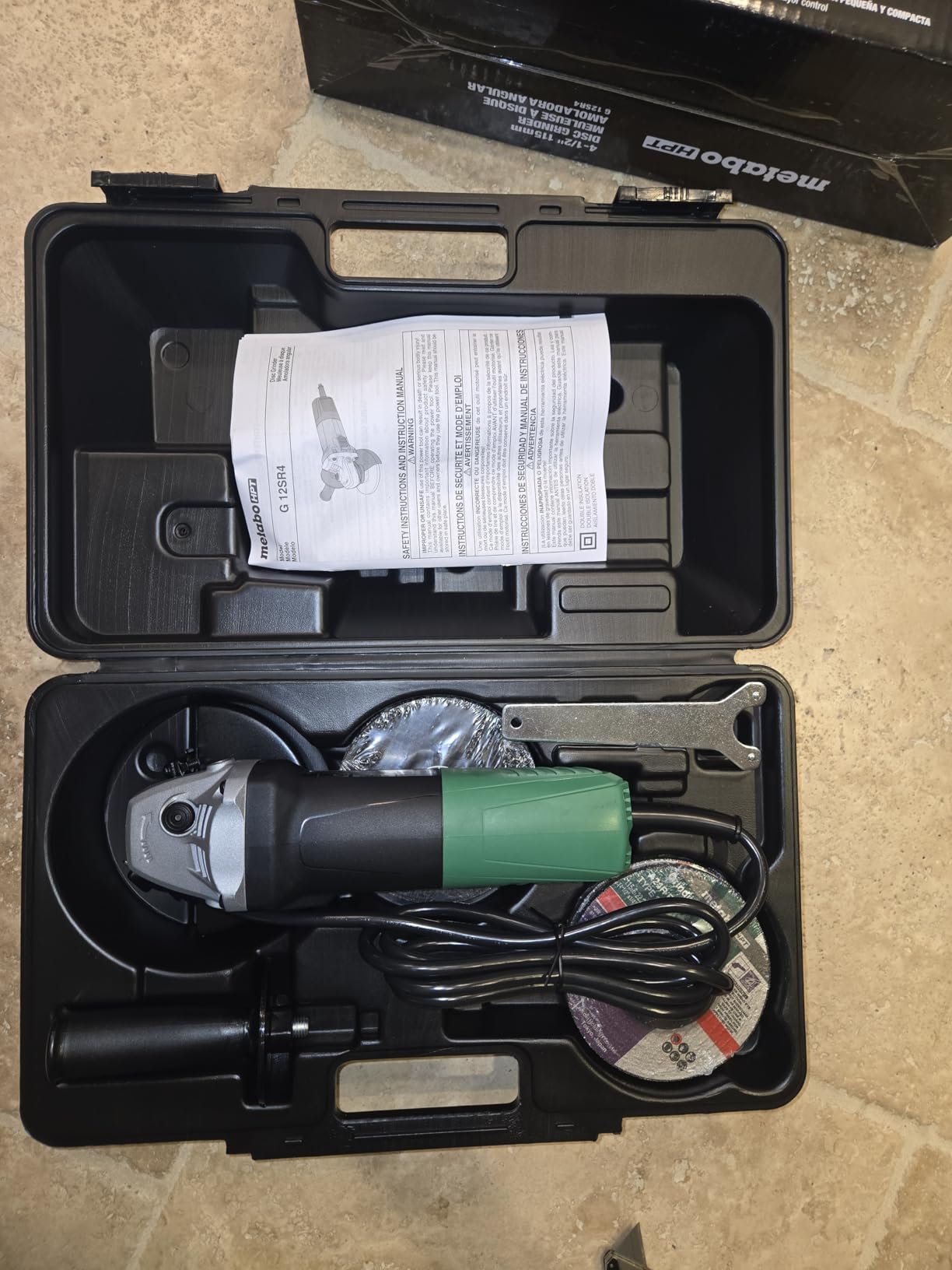
Metabo HPT 4-1/2-Inch Angle Grinder, Includes 5 Grinding Wheels & Hard Case, 6.2-Amp Motor, Compact & Lightweight, G12SR4
- Compact 4.0 lb body with good control
- Comes with five grinding wheels and a hard case
- Spindle lock speeds up disc changes
- Low-profile gear case reaches tight spots
- Only a one-year base warranty
- Slide switch instead of a paddle switch for continuous work
The G12SR4 arrives with five grinding wheels and a hard carrying case, and for a new welder that combination is the reason to look here first. The 6.2 amp motor puts out 980 watts at 12,000 rpm, which is real cutting speed on plate and angle iron, and the low-profile gear case helps when you are working inside a frame or a corner joint.
Weight is the story here. At 4.0 pounds it is one of the lighter corded machines in this group, and reviewers repeatedly single out how controllable it feels. For overhead weld bead blending on a ladder, that difference is felt by the end of the first hour.
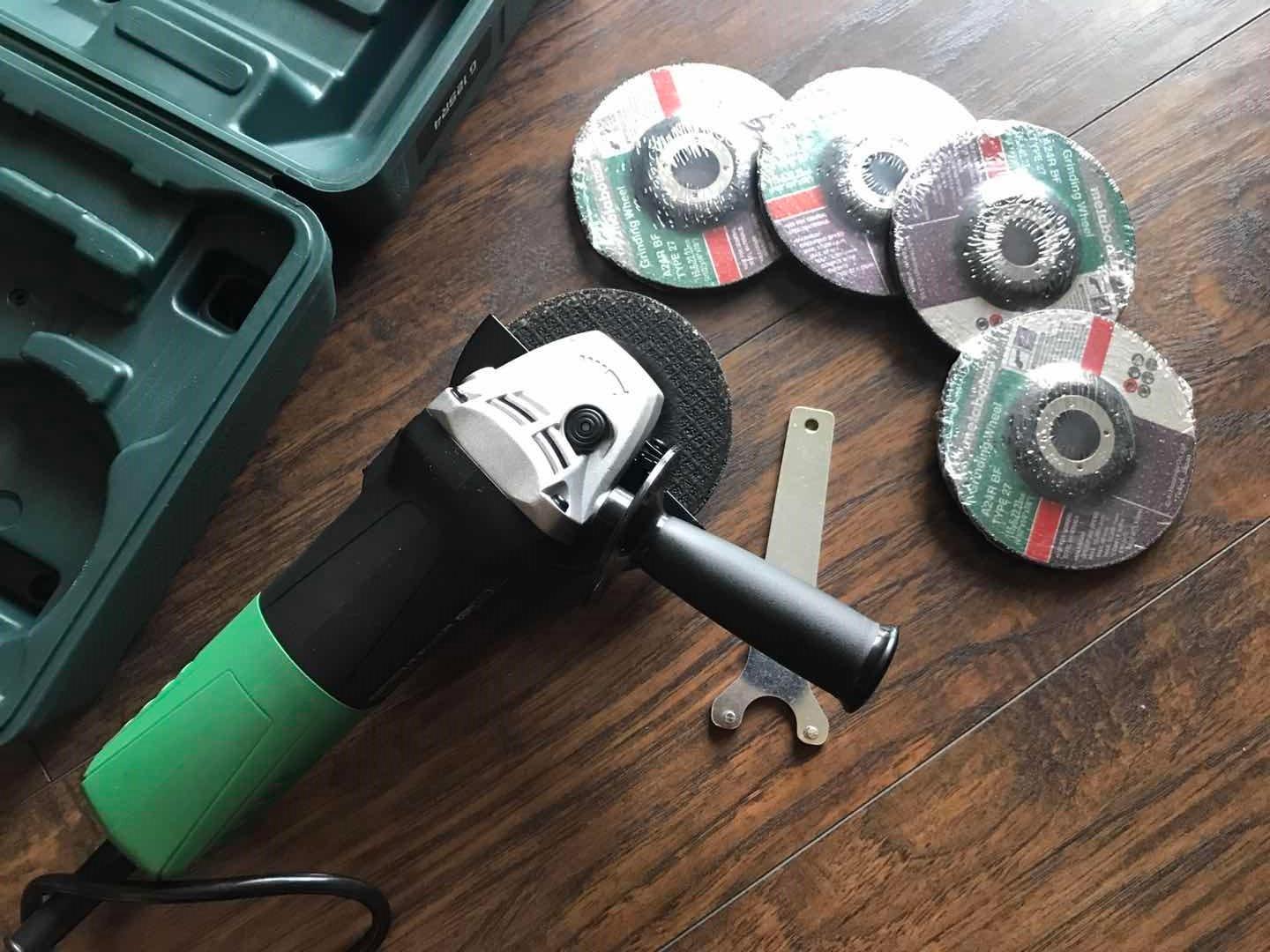
The spindle lock is a small feature that pays off constantly, because swapping between a grinding wheel, a flap disc, and a cutoff wheel happens several times per joint. The quick-off feature on the slide switch is also well judged: you can shut the tool down without hunting for a second control position, which is handy when you are working around a fixed workpiece.
The reservation is the one-year base warranty, the shortest in this group, and the slide switch. Experienced fabricators treat a paddle switch with a lock-on as close to a requirement as they treat a guard, so this is a machine for the welder still building habits rather than the one chasing production hours.
Why the low-profile gear case matters on a frame
Every grinder section in this list assumes you will sometimes get the body into a tight space. A gusset meeting a flange, the inside corner of a box section, the underside of a base plate: these are places where a tall gear housing simply will not go. The G12SR4’s low case is built for exactly those approaches, and the removable forward-canted side handle lets you set the angle to suit.
That also makes it a good second grinder for someone whose main machine is larger. It is light, it is cheap, and it fits where a bigger tool does not.
Who should buy something else
If you are grinding production weld prep daily, look past the one-year warranty and the slide switch. A brushless cordless machine or a sealed-design professional grinder will outlast this one in a shop environment. Buyers who will use it occasionally, or who want a package that includes consumables, will find very little to complain about here.
One practical buying note: this is a 6.2 amp machine. It handles routine weld prep, deburring, and light cutting without trouble, but if your material is thick plate or heavy structural sections, step up to a 7.5 amp class tool or go cordless brushless.
5. Makita 9557PBX1 – Top Rated Corded Grinder for Control and Durability
- Compact body with a 2.5 inch barrel grip for full-hand control
- Lock-on paddle switch with safety latch
- Labyrinth construction seals motor and bearings from debris
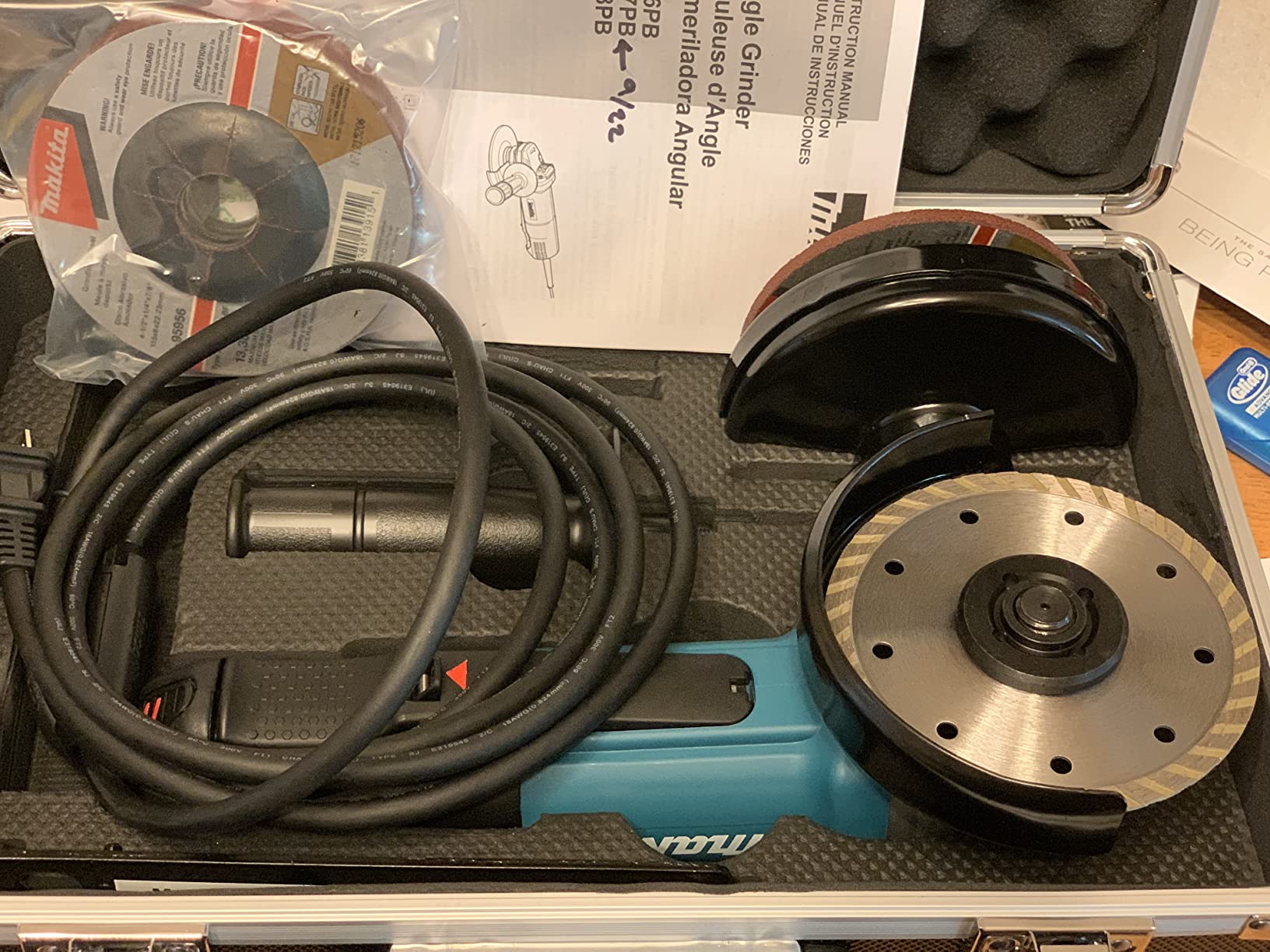
- Aluminum case with cut-out foam holds tool and discs
- All ball bearing design with metal gear housing
- Tool does not fit the case with the side handle fitted
- Case foam leaves no room for extra wheels
- A screwdriver is needed to swap guards and it is not included
The 9557PBX1 is the grinder to look at if you care about control more than raw removal speed. The 2.5 inch barrel grip lets you wrap your whole hand around the tool, and reviewers who weld with this machine point to exactly that when explaining why it feels precise. The extra large paddle switch has a safety latch and a lock-on, so it can run for a long pass on a cap and still stop the instant you let go.
The labyrinth construction is the feature that matters most in a weld shop. It seals the motor and bearings against dust and debris, which is exactly the environment a grinder lives in when it is pointed at mill scale all day. Add the all ball bearing design and metal gear housing, and you have a tool built to be serviced rather than discarded.
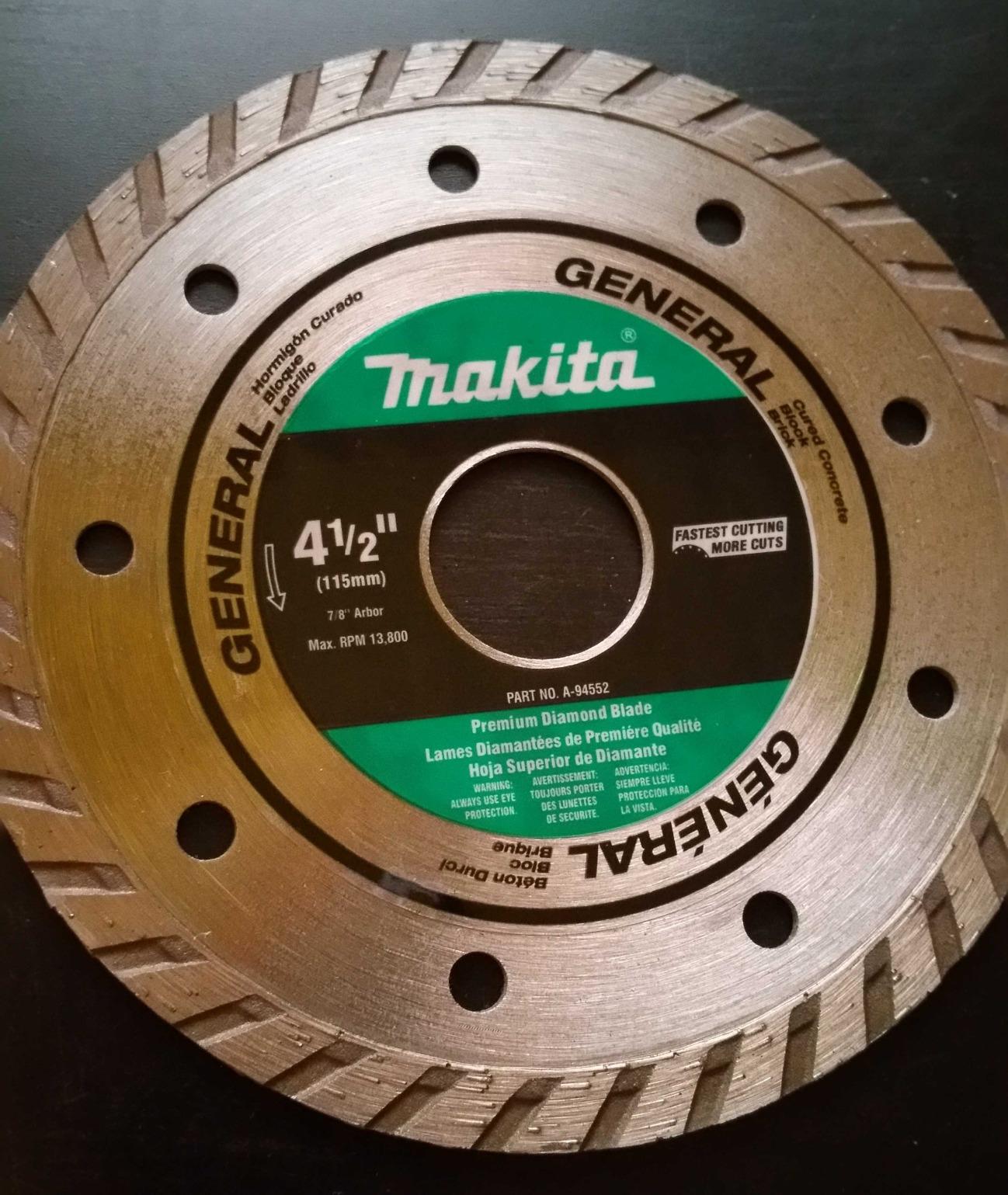
It runs smooth at 11,000 rpm with balanced included discs, and the box contains both a Type 27 grinding guard and a Type 1 cut-off guard along with five grinding wheels and a diamond blade. Having both guard geometries in the box solves the single most common purchasing error people make with cutoff wheels, because a Type 1 flat wheel needs a different flange depth than a Type 27 depressed-center wheel.
The most common complaint is the case, not the tool. The aluminum case has cut-out foam for the tool, discs, and guards, but the grinder does not fit with the side handle attached, and there is no room left for additional wheels. A Phillips screwdriver is needed to swap the two guards and it is not included in the box.
Type 1 versus Type 27: why both guards matter
This is the mounting confusion that forum users hit most often, so it is worth stating plainly. A Type 1 wheel is flat and mounts on a raised flange, and it is used for cutting and thin grinding. A Type 27 wheel is depressed at the centre, sits deeper into the guard, and is the workhorse for grinding and weld cleanup. Mount the wrong one and the guard will not sit flush, which is both a clearance problem and a safety problem.
The Makita ships with both guards, both flanges, and a lock nut wrench, so you can run either type correctly. Most of the grinders in this list include a Type 27 guard only, so you may need to source a Type 1 guard separately if you plan to do a lot of straight cutting.
Who will be happiest with this one
Anyone doing precision work inside a frame, grinding a flush cap, or blending a fillet into a finished surface. The barrel grip gives you fine motor control, and the lock-on paddle means you can set the tool down and pick it up mid-sequence without re-throttling.
The trade-off is weight. At 4.5 pounds it is heavier than the DEWALT DCG413B and the Metabo G12SR4, and that shows up on long overhead passes. If you are grinding above shoulder height for a full shift, the lighter cordless option is kinder on your shoulders.
6. CRAFTSMAN CMCG400B – Best for Long Heavy Grinds and Heat Management
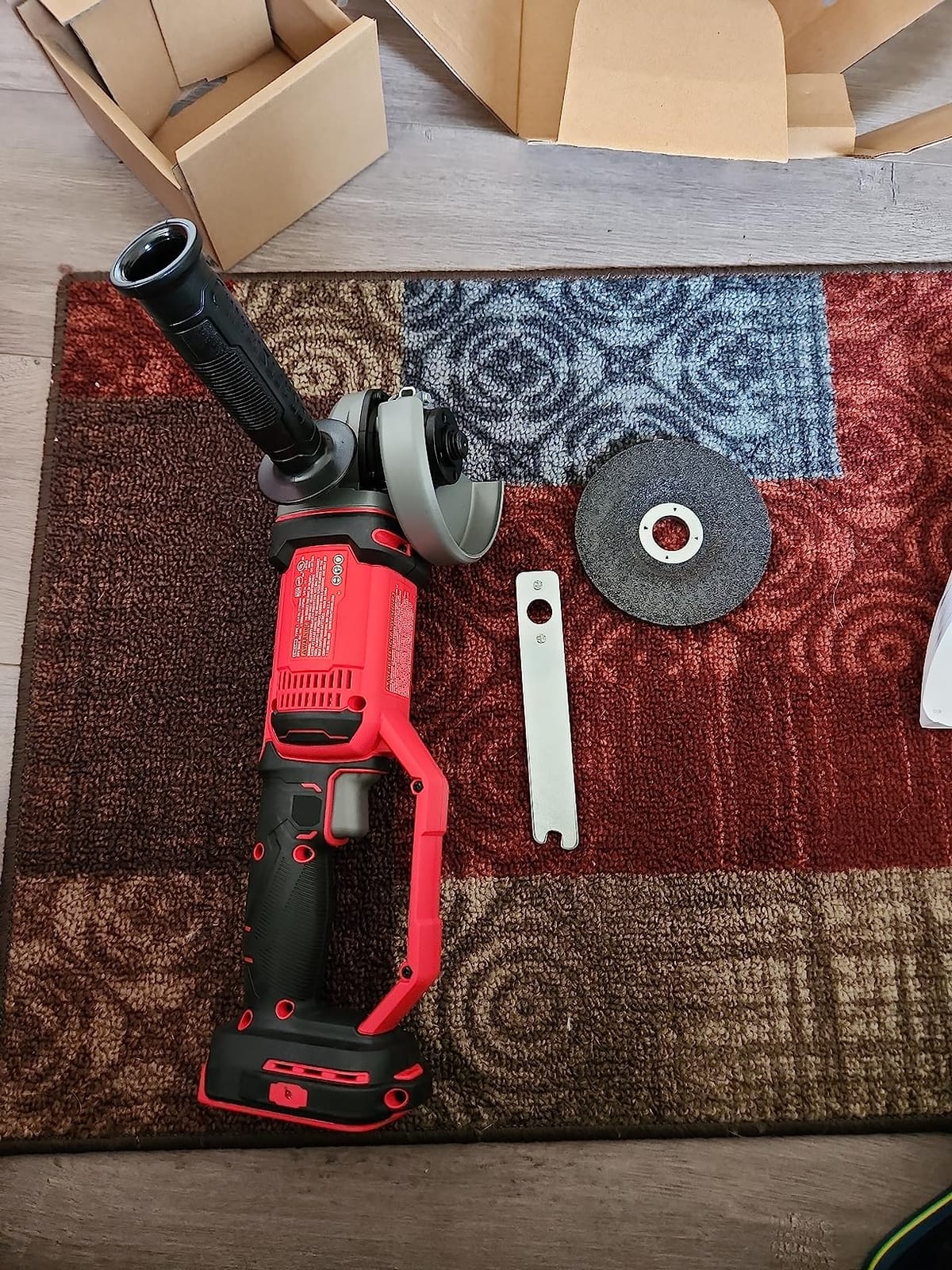
CRAFTSMAN V20* Angle Grinder, Small, 4-1/2-Inch, Tool Only (CMCG400B)
- Brushless motor rated at 8500 rpm for aggressive removal
- Cast metal gear housing dissipates heat during extended use
- Tool-free guard positioning
- Contoured over-molded handle for comfort
- Battery and charger sold separately
- 8500 rpm is lower than most 4-1/2 inch rivals
The cast metal gear housing is the reason this grinder earns its place. Owners of the CMCG400B credit it with dissipating heat during extended use, and heat is what kills grinders in a fabrication shop. A plastic gear case softens and deforms when it gets hot, and that changes bearing preload until the spindle develops play.
Power comes from a brushless motor rated at 8,500 rpm for aggressive grinding applications. That is a lower no-load figure than most 4-1/2 inch machines in this list, and it trades some speed for torque. On a heavy weld cap, holding speed under load is what you actually feel, and torque is what keeps the wheel from stalling and glazing.
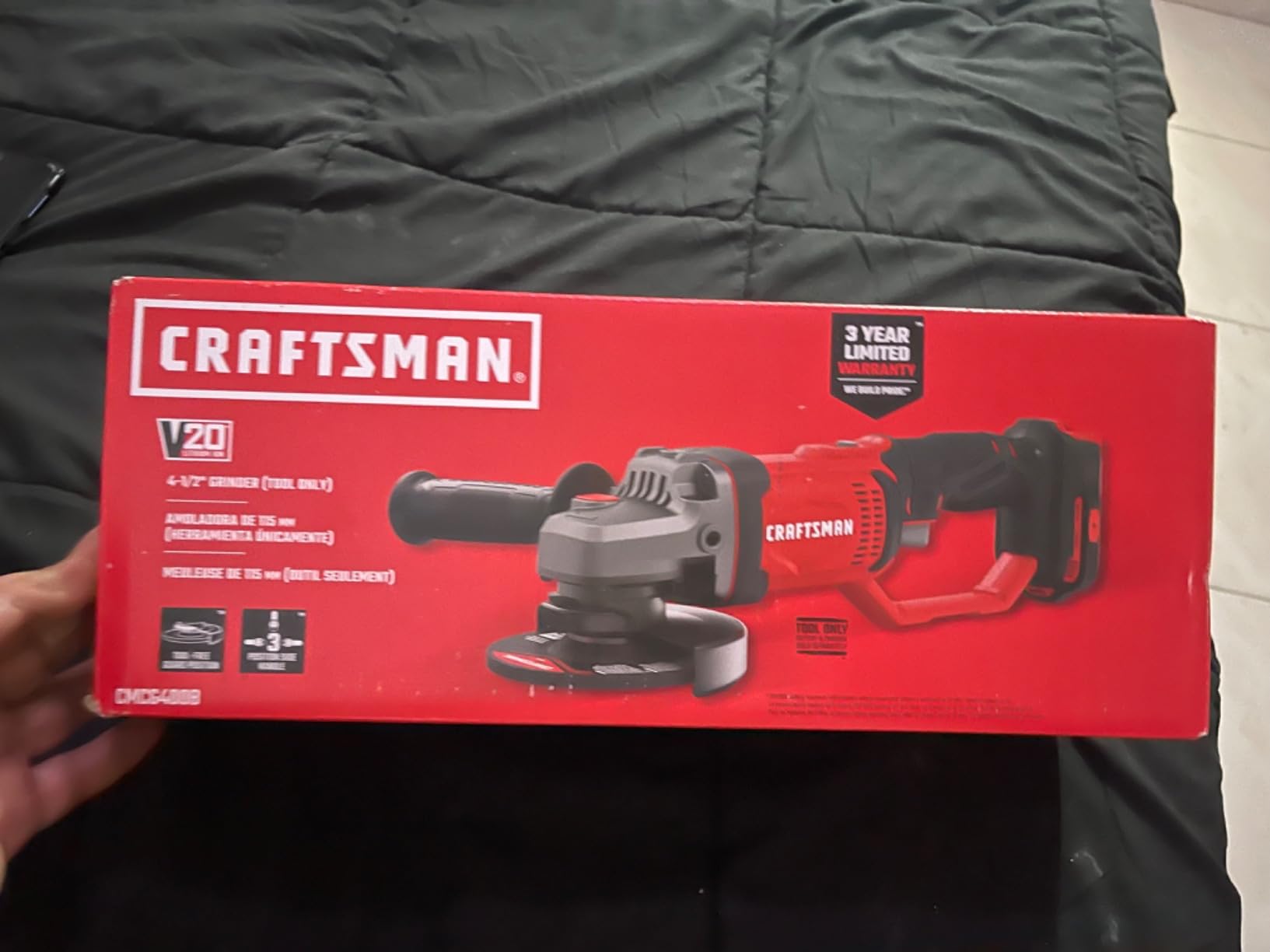
The tool-free guard positioning and the three-position contoured over-molded handle both come in for praise in owner reviews, along with the general rating for metalwork. It is part of the CRAFTSMAN V20 battery platform, so if you already own V20 packs, this drops into an existing charging setup without a new charger on the bench.
The caveat owners mention most is straightforward: the battery and charger are sold separately, so the tool-only package is not a complete purchase. That is only a problem if you are starting from nothing, because buying a battery and charger for this platform is part of the cost of entry either way.
What 8500 rpm actually changes
Lower rpm means a slower wheel speed, which usually means less aggressive material removal per pass and less heat generated in the work. On heavy structural welds, that is a fair trade: you take two passes instead of one and you do not cook the workpiece or the tool. On light cleanup and blending, the difference is barely perceptible.
It also pairs well with the cast housing. Lower speed plus a metal case means the tool stays cooler over a long run than a plastic-cased machine spinning at 12,000 rpm, and that is the combination that decides whether the grinder is still alive in year three.
Who should pass on it
If you want the fastest possible cut on thin material, or you already have a battery platform and are not willing to start a second one, skip this. The review count and rating are strong, but V20 pack compatibility is narrow compared with the DEWALT 20V MAX or Milwaukee M18 ecosystems.
If heat management is your priority and you are on the V20 platform, though, this is the grinder to shortlist. Few tools in this price class use a cast metal gear housing.
7. Milwaukee 2880-20 M18 FUEL – Best for Anti-Vibration Control on Long Passes
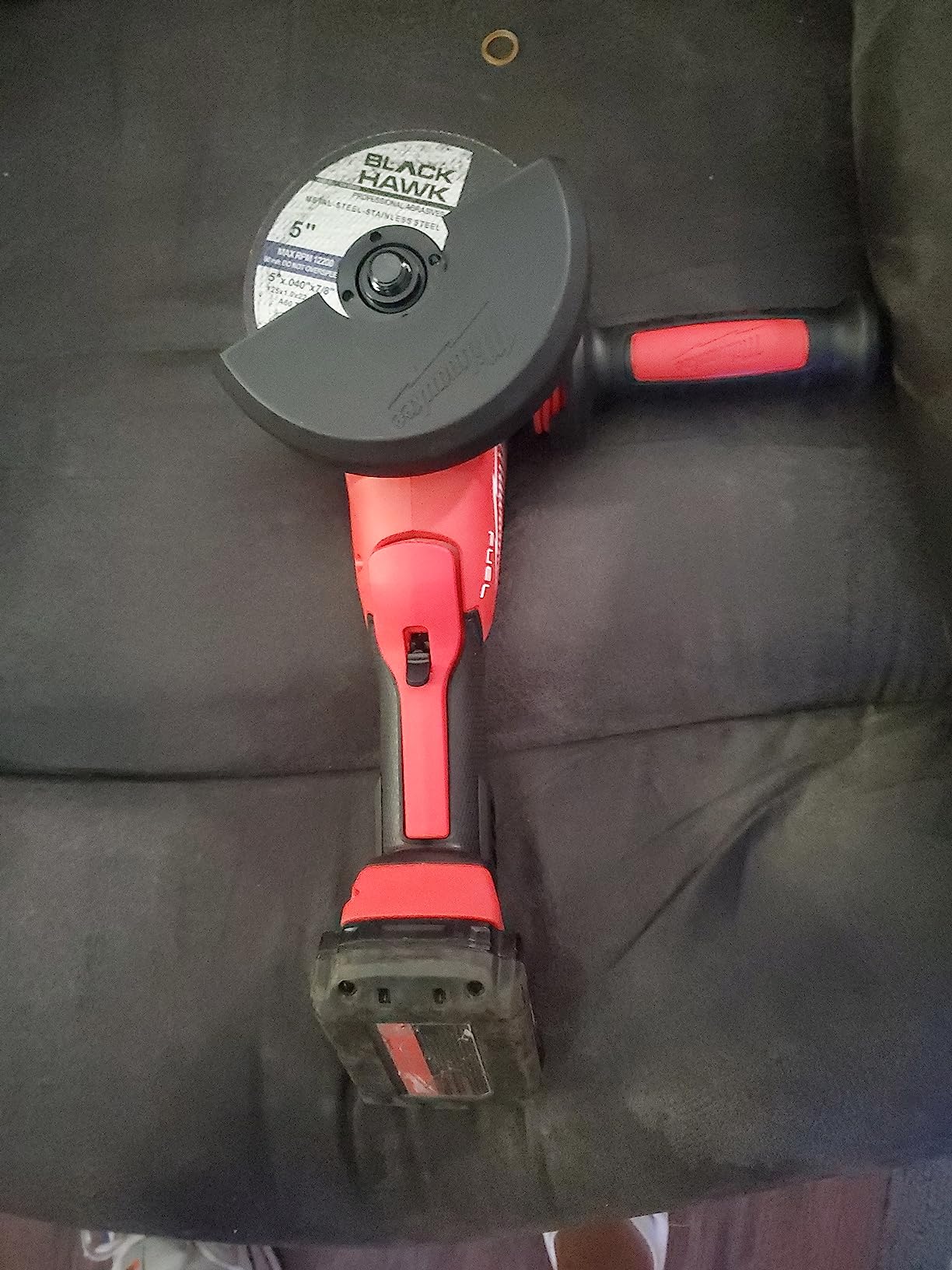
Milwaukee 2880-20 M18 Fuel Brushless Lithium-Ion 4-1/2 in. / 5 in. Cordless Small Angle Grinder with No-Lock Paddle Switch (Tool Only)
- Electronic clutch provides kickback protection
- Anti-vibration side handle reduces hand fatigue
- Works with all M18 batteries
- Standard 5/8-11 spindle accepts common accessories
- 8500 rpm is low for a 4-1/2 inch wheel
- No-lock paddle switch demands continuous trigger pressure
The 2880-20 accepts both 4-1/2 inch and 5 inch wheels, which makes it more flexible than most of the cordless grinders here. The anti-vibration side handle is the feature owners mention most, and on a 5 inch wheel grinding a heavy fillet it does reduce the fatigue that normally ends a long cleanup session early.
The electronic clutch handles kickback protection by detecting a bind and shutting the motor down before the wheel can dig into you. There is also overload protection, which is about motor life: the tool bogs rather than cooking its windings when you push past what the battery can sustain.

Platform compatibility is the quiet advantage. It runs on all M18 batteries, and M18 packs are among the most widely owned cordless packs in the field, including in shops that could not justify buying a new battery platform for a grinder. The 5/8-11 spindle means ordinary grinding accessories fit without an adapter.
Two things get criticised. The 8,500 rpm output is on the low side for a 4-1/2 inch grinding wheel, so material removal per pass is slower than on a 10,000 or 12,000 rpm machine. And the no-lock paddle switch means you hold pressure the entire time, which some owners love for control and others find tiring over a long session.
Is M18 FUEL the right tier to buy?
This is worth being blunt about, because it comes up constantly in the M18 community. The advice that circulates is to avoid the non-FUEL brushless grinders in this range if you plan to grind real stock. The FUEL designation on this model corresponds to a higher-spec motor and electronics package, and buyers report a clear difference in sustained performance under load.
The 4.5 pound listed weight reflects the tool body with its battery, and at that weight it is a comfortable cordless machine for handheld grinding. It is not a one-handed tool for extended overhead work, but it is light enough that most users will not swap to a larger grinder for bead blending.
Choosing between this and the DEWALT cordless option
Both grinders here earn their place, and the deciding factor is usually the battery you already own. If your packs are M18, this grinder is the cheaper path in. If you are starting fresh and want a more aggressive cut, the DEWALT DCG413B has higher output and a two-stage trigger that gives you a genuine dead-man function.
Whichever way you go, the community consensus holds that the non-FUEL tier is not the right choice for heavy weld prep. Spend on the higher-spec motor and the difference shows up in the first week.
8. PORTER-CABLE PC750AG – Best Shop Workhorse for Long-Term Ownership
- Strong 7.5-amp power cuts steel fencing and grills easily
- Pressure-activated safety switch shuts the tool off when released
- Threaded auxiliary handle mounts for tight-space work
- Cast metal gear housing and heavy-duty cord
- Owners report five-plus years of service with maintenance
- Heaviest 4-1/2 inch grinder here at 5.9 lb
- Brushed motor runs loud
- Wheel spins down slowly after release
The PC750AG has the strongest long-term ownership story in this group. Owners report five-plus years of service on the same unit, with brush changes and a bit of grease as the only maintenance. That is not a surprise: it is a brushed machine with a cast metal gear housing, and brushed motors are simple enough to keep alive for a very long time.
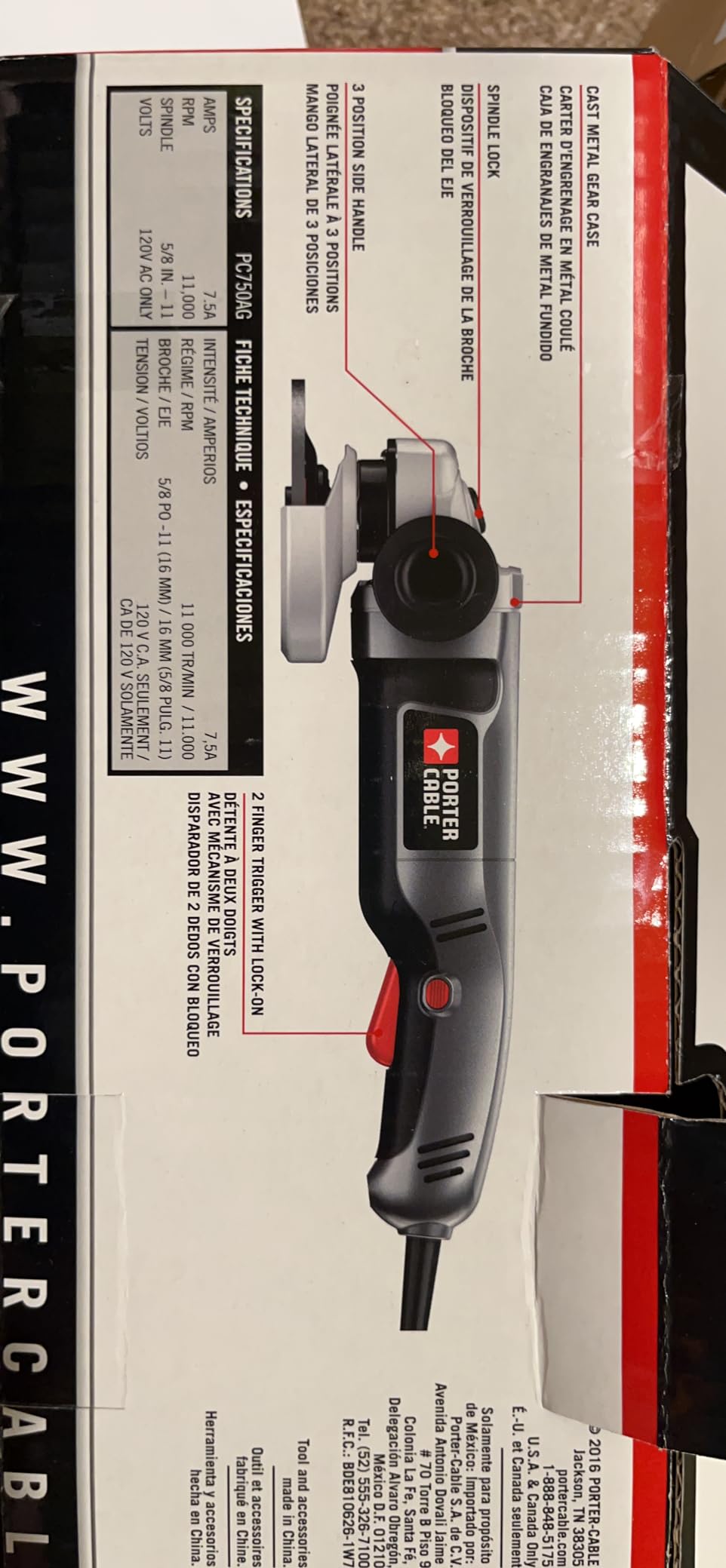
Power is 7.5 amps at 900 watts and 10,000 rpm, which is a real working combination for cutting steel fencing, propane grills, and heavy structural material. The pressure-activated safety switch shuts the tool off the moment you release it, which is a real safety feature rather than a convenience one.
The threaded auxiliary handle locations on top and the side are unusual and useful. They let you mount the handle where the geometry suits a bench-top cut or a close-quarters corner, which is exactly the awkward access that forum users complain about most often in frames and gussets. The spindle lock also means changes take a single wrench.
Weight is the honest problem. At 5.9 pounds it is the heaviest 4-1/2 inch grinder here, and owners say so plainly: it is tiring on long overhead jobs. The brushed motor is also loud, and the wheel spins down slowly after you release the switch, which means the tool is still turning after you have stopped it.
Why a brushed motor is not a bad thing
Brushless motors are more efficient and quieter, but they are also more complex to repair and harder to keep running for fifteen years. A brushed motor with replaceable carbon brushes is something any shop can service with basic hand tools. The PC750AG pairs that simplicity with a three-year limited warranty and a year of free service, which is a strong ownership package for a working tool.
For a shop that grinds structural steel every day, predictable low-speed torque and serviceability often beat the higher speed of a brushless machine. The trade is noise, weight, and slower spin-down.
Who should look elsewhere
If you work overhead for long stretches, or if you are sensitive to noise, this is not the tool. A 5.9 pound grinder with a brushed motor is a lot of mass and noise for a welder who spends hours blending caps above shoulder height.
For a fabricator who cuts plate, grinds prep, and needs a tool that will still run in ten years with a set of brushes and a can of grease, it remains a compelling pick. That kind of ownership track record is rare in this category.
9. DEWALT DWE4011 – Best for Fast Guard and Wheel Changes
DEWALT Angle Grinder, One-Touch Guard, 4-1/2 -Inch (DWE4011)
- One-Touch guard rotates into position without a tool
- Quick-Change wheel release needs no wrench
- 12000 rpm motor in a 3.9 lb body
- Slim ergonomic shape suits smaller hands
- Fewer exposed body screws reduce vibration loosening
- Slide switch is small and easy to miss with a thumb
- Loads louder and vibrates more than average
- Ships a hex wrench instead of a spanner wrench
The DWE4011 exists for one reason, and the reason is changeovers. The One-Touch guard rotates into position without a wrench, and the Quick-Change wheel release removes the disc without a tool either. On a weld cleanup where you alternate between a flap disc, a grinding wheel, and a cutoff disc several times per joint, those two features remove more friction than any spec on the sheet.
It is also the fastest small corded grinder in this group at 12,000 rpm, and it weighs only 3.9 pounds. That combination gives you quick material removal without a heavy tool in your hand. The AC/DC motor is worth noting for anyone running the grinder off a welder-generator in the field.
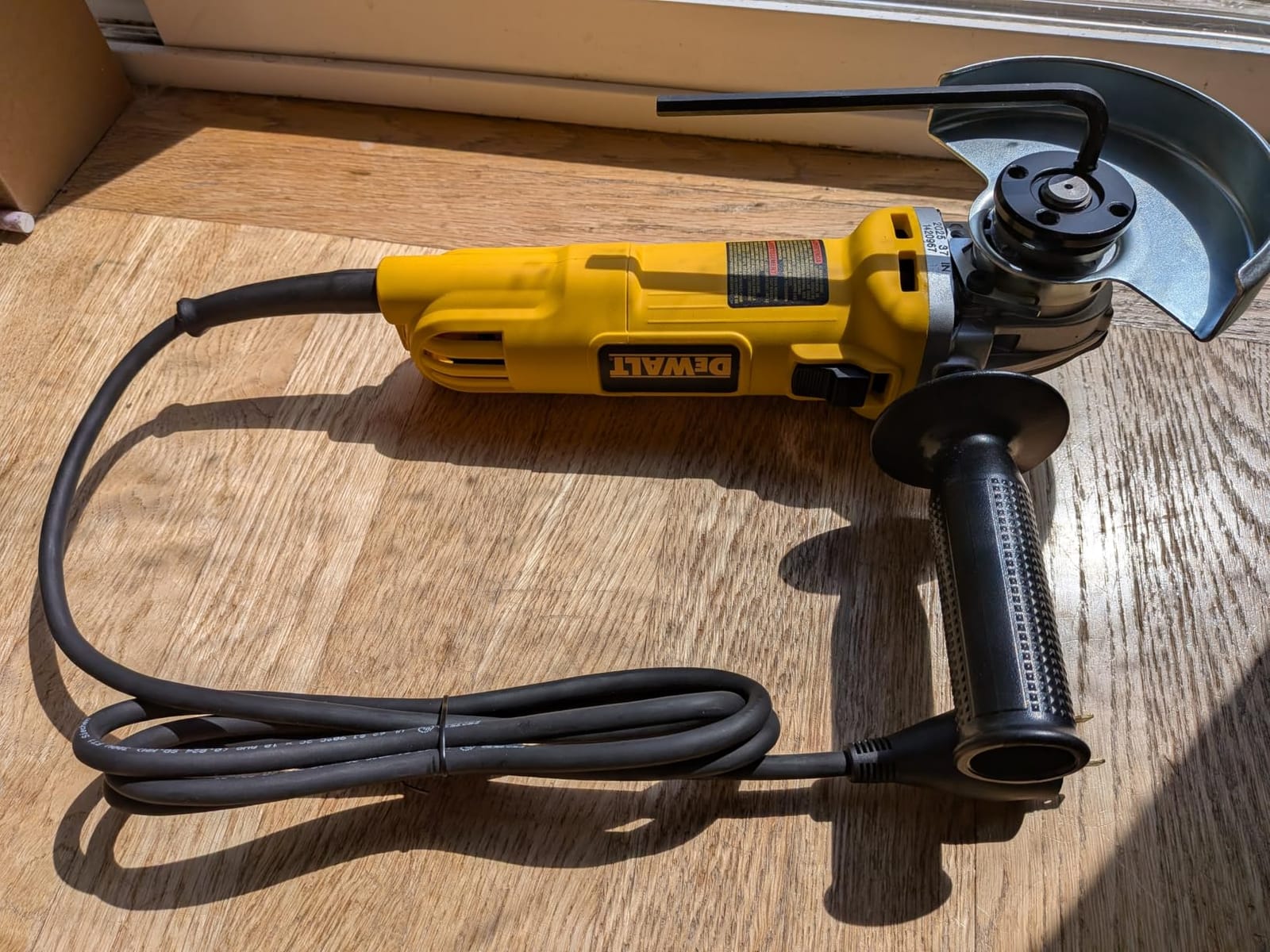
The slim ergonomic shape gets specific praise from users with smaller hands, and there is a practical reason for the design. Fewer exposed body screws means fewer places for vibration to loosen fasteners over time, which shows up as a quieter, tighter tool after months of use. It also replaced the older D28110, so parts and guard compatibility are straightforward if you are moving from that model.
The criticisms are consistent: the slide switch is small and easy to miss with a thumb, the tool is louder and more vibrational than average, and the included tool is a hex wrench rather than the traditional spanner wrench. The vibration figure is higher than the Bosch and the DEWALT DCG413B in this list.
AC/DC and generator work
An AC/DC rated motor means the grinder can run on DC power from a welder-generator, not just AC household supply. For a field welder working on a pipeline, a shipyard, or a remote site with a generator, that is a genuine capability rather than a footnote. Several tools in this list are AC only and will not start on a DC supply.
Pair that with the corded design and you have the most portable option for remote work: no battery platform to charge, and a generator that is already on the trailer. Check the generator’s output rating and the grinder’s amperage draw before you commit, and always start the grinder with the generator already at operating speed.
How the One-Touch guard compares
Compared with a guard that needs an Allen wrench, a tool-free one-touch guard takes seconds instead of a minute and, more importantly, gets used. Shops that struggle with guards being left off in the first place find that making adjustment painless changes the habit. The tradeoff is fewer indexed positions, so you may need to fine-tune by eye for a specific bevel grind.
For anyone who changes discs constantly, the guard and wheel release on this grinder are the most usable combination in the list.
10. DEWALT DCG418B 60V MAX – Best Cordless Power for Heavy Structural Work
DEWALT FLEXVOLT 60V MAX* Angle Grinder with Kickback Brake, 4-1/2-Inch to 6-Inch, Tool Only (DCG418B)
- Cordless power comparable to a 13-amp corded grinder
- Kickback brake and E-Clutch stop the wheel on a pinch
- Handles 4-1/2 and 6 inch wheels with both guards included
- Balanced grip with guard rotation for either hand
- No extension cord on crawlspace and job sites
- Requires a FLEXVOLT 60V battery and nothing else will fit
- Battery and charger not included
- Consumes batteries quickly on long heavy sessions
The DCG418B is the most powerful cordless grinder in this group by a wide margin. The brushless motor delivers 13 amp equivalent power, and owners consistently report it outrunning their previous 20V cordless and even their corded grinders on metal removal speed. If heavy structural work is the job, this is the cordless answer.
Accepting both 4-1/2 inch and 6 inch wheels with both Type 27 guards included is unusual and genuinely useful. It means one tool covers fine weld cleanup and heavier stock removal without a second grinder on the bench. The E-Clutch activates in under a tenth of a second on a pinch or stall, and the brake stops the wheel in 1.5 seconds when you release the trigger.
For job sites, the absence of an extension cord is not a small convenience. Crawlspaces, scaffolds, and elevated work all become workable when there is no cable to drag or snag. The balanced grip and rotating guard also make it comfortable for left- or right-handed use.
The catch is platform lock-in, and owners are blunt about it: this requires a FLEXVOLT 60V battery, and 20V packs and PowerStack packs will not work. Battery and charger are sold separately, and long heavy sessions drain packs faster than the smaller-platform cordless machines here.
When 13-amp equivalent power earns its cost
The gap between this and a standard 20V cordless grinder is a gap in sustained torque, not in headline speed. Both run in the region of 8,500 to 9,000 rpm no-load. What differs is how hard each one can push before the voltage sags and the motor bogs. On a heavy multipass fillet or thick structural plate, that difference is the difference between a steady pass and a stop-and-reposition pass.
Buyers report up to 30 percent more power than the smaller DEWALT cordless grinder in the same family, and their experience matches that figure on hard grinding tasks. For light deburring, the premium is wasted. For surfacing and stock removal, it is the whole point.
Count the cost before you commit
Two FLEXVOLT 60V packs and a charger add meaningfully to the purchase, and this grinder consumes them faster than the others here. That cost matters most for someone buying one grinder, and matters much less if you are building a 60V MAX platform for a whole shop.
If you are not already in that ecosystem, the DCG413B is the cheaper way into cordless grinding. If heavy structural work is daily and the cord has been holding you back, this is the tool that solves the actual problem.
11. AOBEN AT3113X – Best Accessory Bundle with Adjustable Speed Control
- 1200W motor at 11000 rpm for heavy-duty metal work
- Six-speed adjustable control for varying material
- Switch lock prevents accidental startup
- Nineteen discs
- guard
- bag and wrench included
- Standard arbor accepts common wheels
- Weight and dimensions are not published
- Lowest average rating of the professional-tier tools here
- Corded only
- so there is no battery option
The 1200W motor is the headline on the AT3113X, and it produces 11,000 rpm no-load speed. At 10 amps it draws more than most of the compact grinders in this group, which is where the extra material removal comes from on plate, rebar, and structural section.
The six-speed adjustable control is the feature that separates it from the other budget machines here. Being able to dial the speed down changes the cut on thin material, reduces the spark rate on stainless, and gives you finer control when following a weld cap. Very few grinders in this price range offer that.
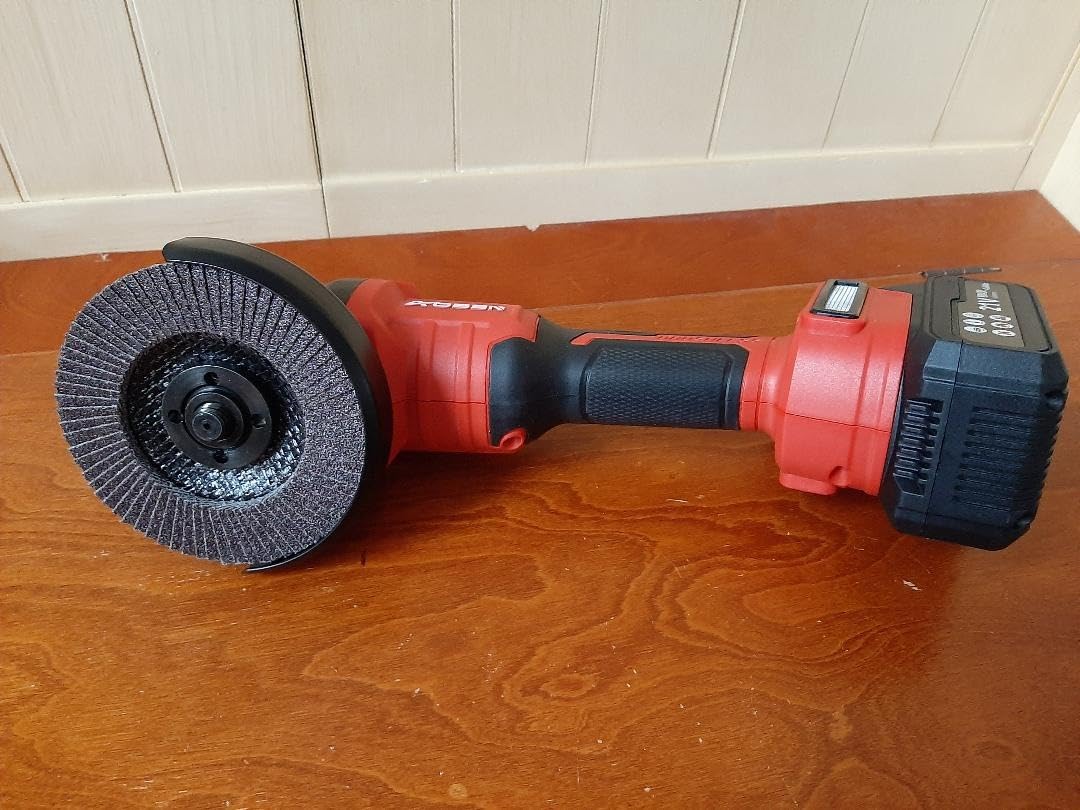
The switch lock prevents accidental startup, which is the correct instinct on a tool with this much torque. The 7/8 inch arbor and 5/8-11 spindle are standard, so consumables cross-compatibility is not a problem, and the spindle lock makes changes quick.
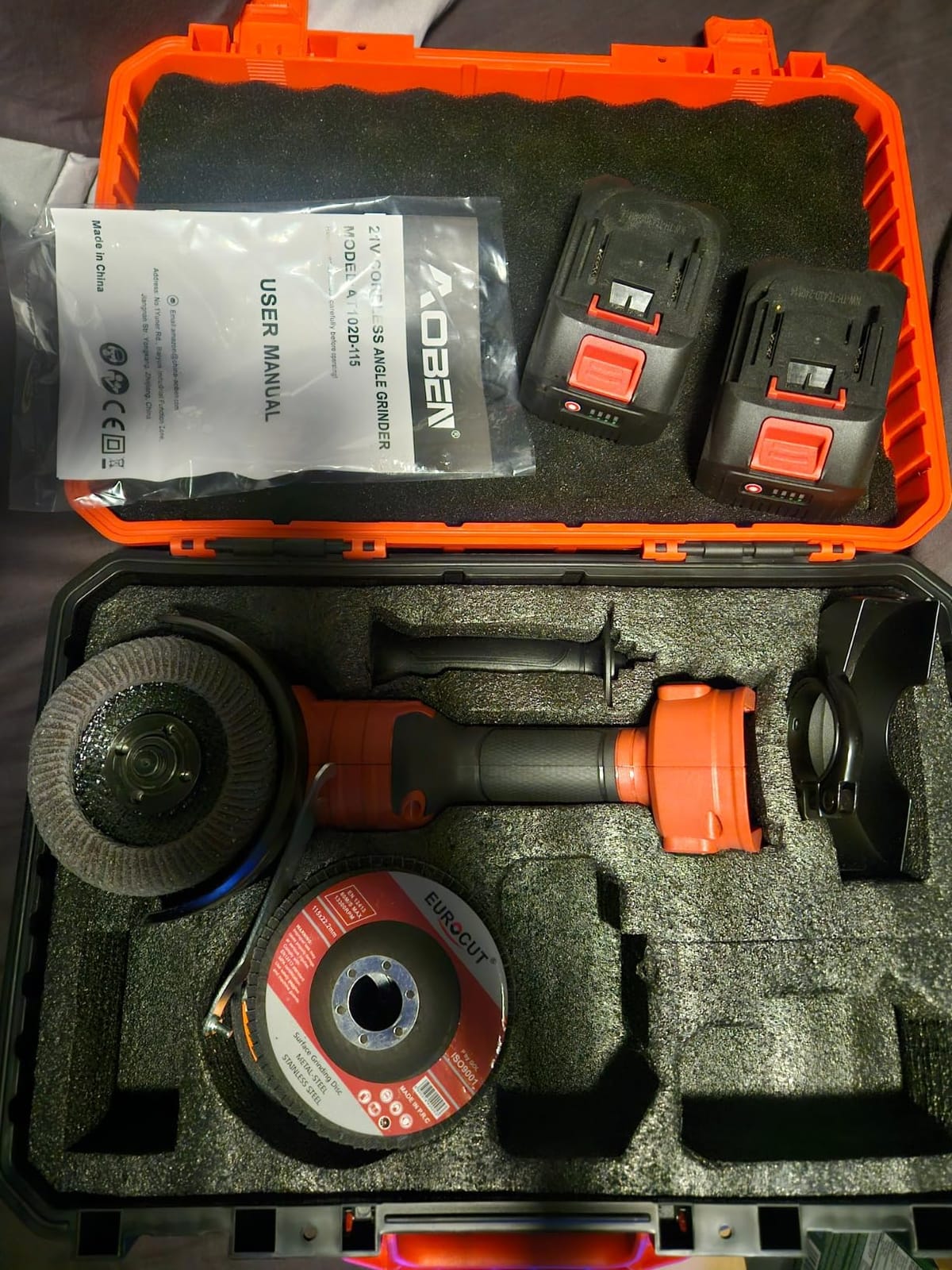
Users praise the accessory kit most of all. Nineteen discs, a guard, a tool bag, and a wrench means you can start grinding and cutting without a separate consumables purchase. Around 70 percent of its reviews are five-star, which is a solid showing for a brand with this little review history.
What six speeds actually do for a welder
Speed control is mostly a surface-finishing tool. Run the wheel fast and you cut quickly, generate more heat, and throw more sparks. Run it slower and you get a finer, cooler cut that is far easier to control near an edge or on thinner material. Having a real adjustment rather than a fixed setting is useful when you move between grinding a cap and blending a finished surface.
It is also a small safety improvement. Sparks are the hazard in a confined space, and lowering the speed reduces the volume and the reach of them when you are working inside a frame.
Where caution is warranted
This is the lowest-rated tool in the group at 4.3, and the reason is not the motor, it is the missing information. Weight and dimensions are not published, which makes it hard to judge whether the tool will suit you for extended overhead work. A 1200W motor in a small body also means a heavier balance than the lighter grinders listed here.
Treat it as a capable corded machine for the price, with a generous bundle and useful speed control, and buy it from a seller with a straightforward return policy. If you need a tool you will rely on every day with no questions asked, one of the branded machines in this list is the safer bet.
12. Bosch GWS8-45 – Best for Dust Protection and Brush Maintenance Awareness
- Professional 7.5-amp motor at 11000 rpm
- Slim-grip design praised for comfort
- Durable carbon brushes extend tool life
- Directed air flow diverts dust from components
- Service minder brushes flag when maintenance is due
- Large spindle lock and two-position side handle
- Guard adjustment needs an Allen key
- Single speed only with no variable control
- Included Type 27 guard has limited Type 1 clearance
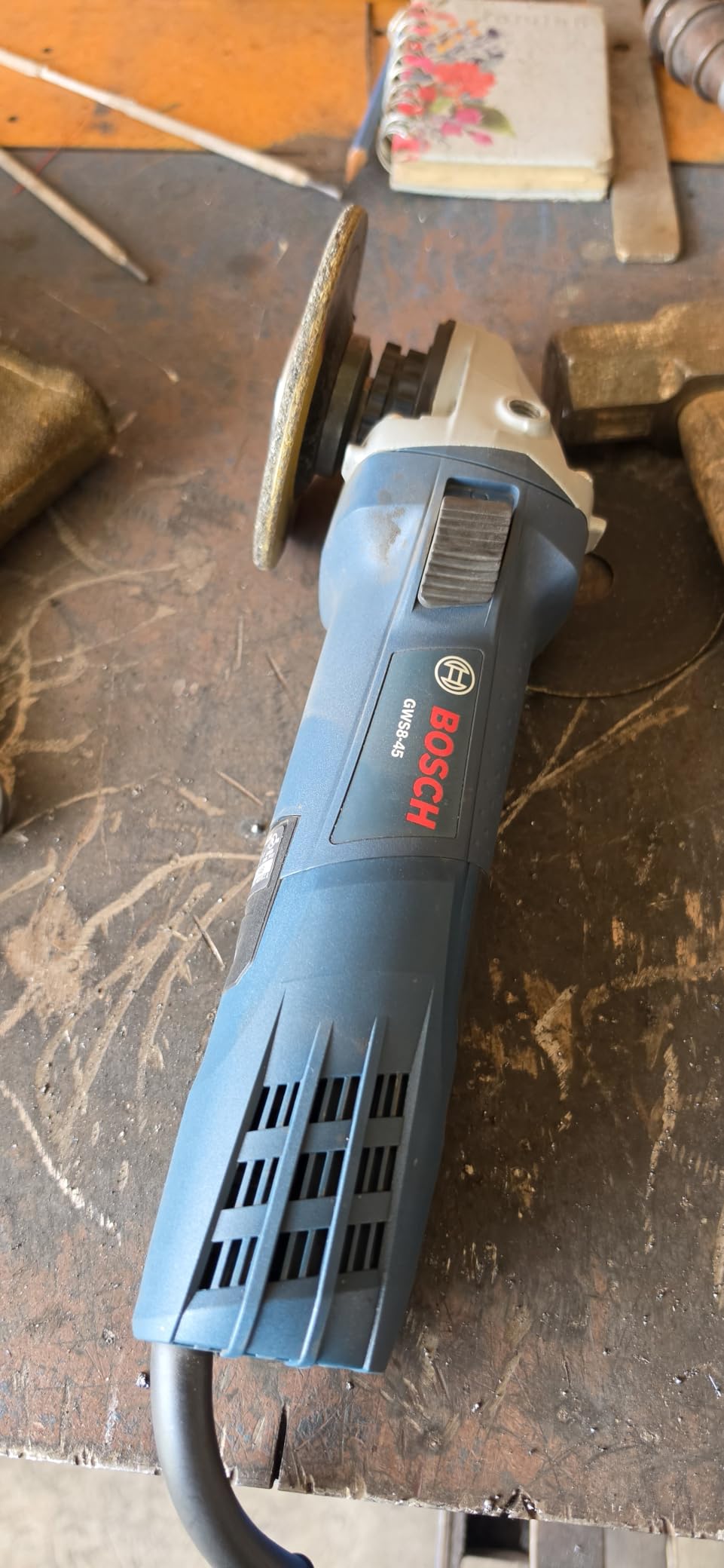
The GWS8-45 is the grinder for anyone who has watched a tool die from metal dust. Directed air flow diverts dust away from vital components, the carbon brushes are built for extended life, and the labyrinth-style sealing on this class of Bosch motor is a deliberate response to grinding environments rather than an accident.
The service minder brushes are the most underrated feature in the whole list. They stop the grinder when preventative maintenance is required, which means the tool tells you when the brushes are done instead of letting them burn out and take the armature with them. On a brushed motor, that is the single biggest factor in service life.
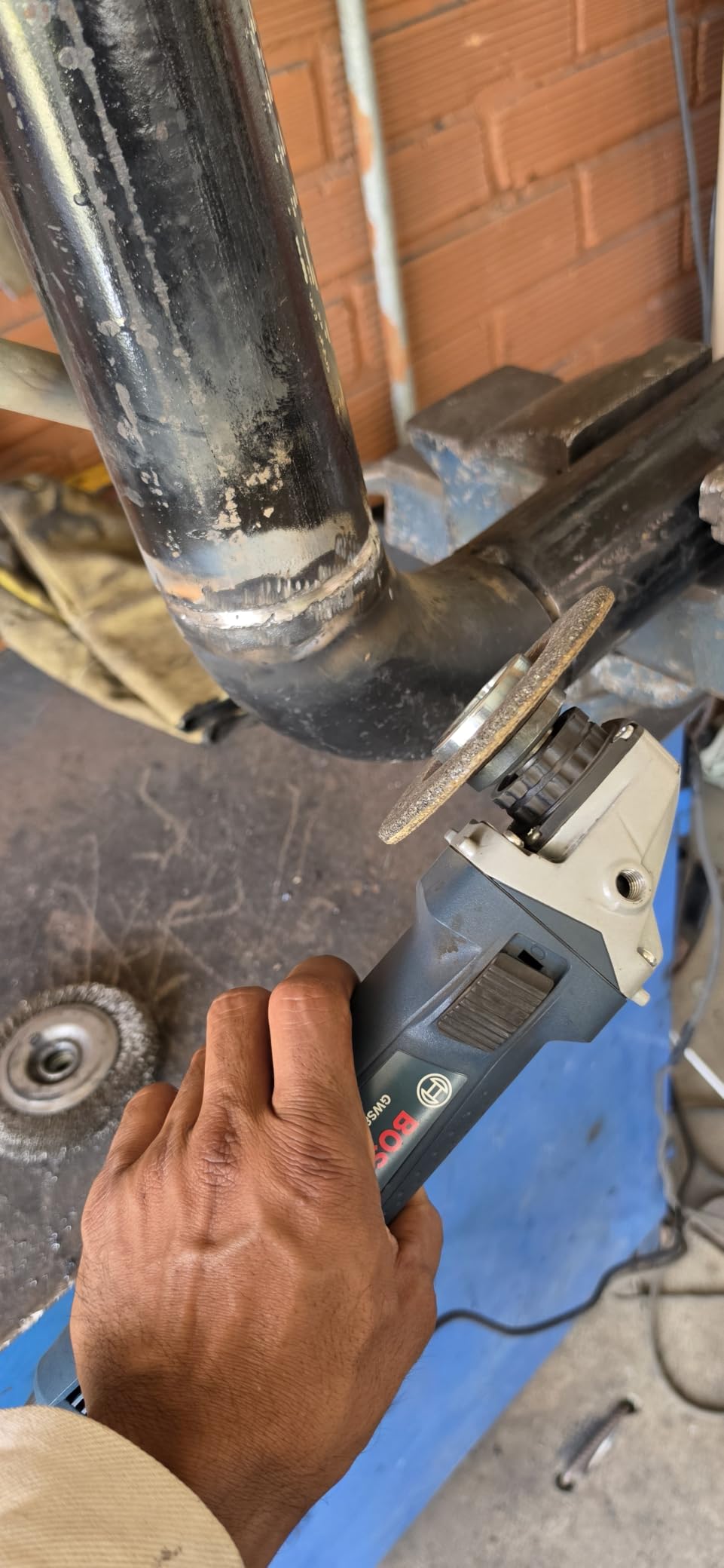
The slim-grip design is repeatedly described as excellent for comfort, and at 4.2 pounds with an 11,000 rpm output the tool feels responsive without being heavy. The burst-protection guard adjusts quickly, the two-position side handle helps with control, and the rubber power cord is reported to perform well in cold weather, which matters for anyone working outdoors in winter.
Some owners note the manual states the tool is not for cut-off applications, while also reporting that it works fine with proper discs. Guard adjustment requires an Allen key rather than being tool-free, and the included Type 27 guard has limited clearance for Type 1 cutoff discs, so plan on sourcing a separate guard if you cut a lot of flat wheels.
What directed air flow actually protects
Metal grinding dust is abrasive and conductive. It gets into the motor bearings, grinds the grease out, and shorts the commutator. Directed air flow carries debris away from those points rather than letting it settle, which extends both bearing life and the service interval between brush changes. It is a design decision you notice most in year three.
Combined with the service minder brushes, this grinder tells you when it needs attention instead of failing quietly. In a shop where the same grinder is used by several people, that is the difference between a scheduled ten-minute service and an unplanned replacement.
Where it falls short
Single speed only is the biggest functional limitation, and it is the thing the AOBEN above does better. Without a variable control you have one abrasive speed to work with, whether you are grinding a hot cap or blending a finished surface. The Allen-key guard adjustment also goes against the direction the category is moving.
For a professional shop that grinds constantly and services its own tools, the durability story and the maintenance alerts are the deciding factors, and they are strong. For light hobby use, the DEWALT DWE4011 offers faster changeovers for less money.
What to Look For When Buying an Angle Grinder for Welding
Disc size: 4-1/2 inch for weld prep, 7 and 9 inch for structural work
Every grinder in this list is 4-1/2 inch, and that is the correct default for welding. The smaller wheel keeps the tool light, keeps the guard close to your work, and limits kickback force, all of which matter when you are following a cap with a moving tool a few inches from your hand. For bead cleanup, weld prep, deburring, and cutting material up to roughly half an inch, 4-1/2 inch is the right answer.
Step up to 7 inch or 9 inch when you are surfacing large plate, grinding an I-beam flange, or cutting heavy structural sections. The larger wheel removes far more material per pass and cuts thicker stock, at the cost of weight, higher kickback force, and a guard that is much further from your fingers. A 7 inch tool with an 11,000 rpm motor and anti-vibration features is the usual next step for a fabricator; a 9 inch tool belongs in heavy equipment repair and pipeline work.
Which two types of grinders do welders use most
Welders use two kinds, and it is worth being specific because the answer is not simply corded versus cordless. The first is the small 4-1/2 inch corded grinder, which has been the shop standard for decades and remains the cheapest way to get unlimited runtime and top-end power. The second is the 4-1/2 inch brushless cordless grinder on a 18V or 20V class battery, which has become the everyday choice on job sites and in mobile work.
Between them sits a middle category: large corded 7 and 9 inch grinders for structural surfacing and heavy cutting. Experienced fabricators often end up with one of each, using a corded machine at the bench and carrying a cordless one to the work. That dual-tool approach is the most common recommendation in working welders’ own accounts of what they actually use.
Corded versus cordless, and the platform lock-in
Choose corded if your work is at a fixed bench, if you grind in long uninterrupted passes, or if you already own corded tools. There is no runtime ceiling, no charging, and no battery to carry up a scaffold. Choose cordless if you work in tight spaces, on ladders, in crawlspaces, or away from power, because a cord is a trip hazard and a dead battery mid-cut is a real problem on a job site.
The cost nobody mentions is the platform. Buying into 20V MAX, M18, LXT, CRAFTSMAN V20, or 60V MAX means buying into a battery ecosystem, and switching later means a second charger and a second set of packs. Check what you already own before choosing a cordless grinder, because an grinder you can run on your existing packs is cheaper in practice than a better grinder on the wrong platform. The DCG418B in this list is the clearest example of the risk: it needs a specific 60V pack, and nothing else will fit it.
Motor power: amps, wattage, and speed under load
Amperage is the most useful cross-brand number for corded tools, because it is measured the same way everywhere. For a 4-1/2 inch grinder, 6 to 7 amps suits light duty and hobby metalwork, 7.5 amps is the sensible all-round figure, and 10 amps or more is what you want for structural work and thick plate. Wattage is a rough proxy for the same thing and is often quoted inconsistently between brands, so trust amps when comparing two corded tools.
For cordless tools, output is usually quoted in amp-equivalent or watts, and neither maps neatly onto a corded rating. The figure that matters is sustained speed under load. A grinder that starts at 11,000 rpm and drops to 6,000 the moment the wheel touches steel is slower in the work than one that holds its speed. Overload protection and electronic clutches help the motor survive those moments, and brushless motors hold speed better than brushed ones because there is no commutator to bog down.
Safety features: kickback brake, paddle switch, restart protection
Experienced fabricators treat a kickback brake and a paddle switch as requirements rather than extras, and they are the two features that most reliably separate the tools in this list. A kickback brake or electronic clutch detects a bind and stops the wheel within a second or two, so a pinching cut does not turn into a disc fragment. The DEWALT DCG413B, the DCG418B, and the Milwaukee 2880-20 all have some version of it.
A paddle switch, sometimes called a dead man switch, only runs the tool while you hold it down, so letting go stops the motor. The Makita 9557PBX1 pairs its paddle with a lock-on for long passes, which is the right combination for a weld cap cleanup where you want both. Restart protection stops the tool from starting up unexpectedly after a power interruption. None of this replaces using the guard, and shops that retrofit guard rules are solving a training problem, not a product problem.
Dust protection and motor longevity in a weld shop
If you grind mill scale every day, dust protection decides how long the tool lasts. Look for labyrinth seals, epoxy-coated windings, directed air flow, and dust ejection. The Makita 9557PBX1 seals its motor and bearings with labyrinth construction, and the Bosch GWS8-45 uses directed air flow to divert debris from its components. Both are direct answers to the environment a welding grinder lives in.
The second factor is whether you can service the tool. Motors with replaceable carbon brushes can be kept alive indefinitely with a set of brushes and some grease, and the Bosch service minder brushes tell you when that service is due. Brushless motors need less maintenance but are harder to repair when they fail. Neither is better, but a shop with a bench and a hex key set should weigh serviceability heavily.
What working welders actually rate
Magazine rankings and the views of people who grind steel every day do not always agree, and the gap is informative. In one long-running ranking on a welding forum the order was Metabo first, then DeWalt, then Hitachi, then Makita, then Milwaukee, which is a different list from the one most buyer guides produce. A regular on the same forum put it more plainly: anything from Bosch, DeWalt, Milwaukee, or Makita will work fine provided you avoid the cheaper tier.
That is the useful takeaway. Within a tier, the differences between models are small compared with the difference between a tier and the one below it. Buy the best grinder in the class you can afford, keep spare brushes and discs for it, and resist the temptation to buy a second cheap one for occasional work. We also keep a separate guide to bench grinders, which is a different tool with a different job.
Which Disc and Grit Should Welders Use?
Grinding a weld bead is a progression, not a single step, and this is the part that separates a good weld prep job from a rushed one. Start with a 40 grit flap disc to take the bead down and blend the edges. Move to 60 grit to level the cap. Finish with 80 or 120 grit to blend the joint into the surrounding plate without cutting into the base metal.
For heavy weld removal, use a grinding wheel or a 36 or 40 grit flap disc. For cutting, use a cutoff wheel rated for the material, and be aware of the Type 1 versus Type 27 distinction we covered earlier, because a flat Type 1 wheel will not sit correctly in a Type 27 guard. For rust and mill scale, a wire wheel is faster on soft scale and a flap disc is more controlled on hard scale.
Finish welds with progressively finer abrasives. The consensus among working welders is to end with a flap disc on the angle grinder and move to finer sanding on a die grinder or air sander for the last steps. Trying to get a final finish with the grinder itself is how people gouge into finished metal, and a practical machinist forum regular described the same rule from the other direction: angle grinders are for welding prep and softening edges on steel plate, never for precision work.
Frequently Asked Questions
Which brand is considered the best for angle grinders?
For welding work, Metabo HPT, DEWALT, Makita, Milwaukee, and Bosch are the brands welders most often rate, and in one working welder’s ranking the order was Metabo first, then DEWALT, then Hitachi, then Makita, then Milwaukee. The practical rule is simpler than any ranking: within a tier the model differences are small, so buy the best tool in the class you can afford and avoid the cheapest tier.
Which two types of grinders are commonly used by welders?
Welders mainly use a 4-1/2 inch corded grinder for bench work and a 4-1/2 inch brushless cordless grinder on an 18V or 20V class battery for job sites and mobile work. Large 7 inch and 9 inch corded grinders are the third category, used for structural surfacing and heavy cutting rather than routine weld prep.
What is the best angle grinder for metal work?
The DEWALT DCG413B is the strongest all-round choice in our testing group because it combines a brushless motor, a kickback brake, and a 3.8 pound body with a deep owner history. For a purely corded shop, the Makita 9557PBX1 offers better control and dust sealing, and for the highest cordless power the DEWALT DCG418B leads if you already use 60V MAX packs.
What is the best size angle grinder for welders?
A 4-1/2 inch grinder is the right size for bead cleanup, weld prep, deburring, and cutting material up to about half an inch. Move up to a 7 inch or 9 inch machine only when you are surfacing large plate, grinding I-beam flanges, or cutting heavy structural sections, since the larger wheel adds weight and kickback force.
Is a cordless angle grinder powerful enough for grinding welds?
Yes for bead cleanup, light weld prep, and most structural grinding. A brushless cordless machine on a 18V or 20V class battery holds speed under load well enough for routine shop work, and the highest-spec cordless grinders match a 13 amp corded machine on heavy removal. Light duty brushless cordless models are the tier to avoid for stock removal.
How many amps should an angle grinder have?
For a 4-1/2 inch grinder, 6 to 7 amps suits hobby metalwork, 7.5 amps is the sensible all-round figure for a working welder, and 10 amps or more is what you want for structural steel and thick plate. For corded comparisons, amperage is the most consistent figure across brands, whereas wattage is quoted inconsistently.
Do I need an angle grinder with a kickback brake?
If you grind welds, yes. A kickback brake or electronic clutch stops the wheel within a second or two when a cut pinches, which is the difference between a shower of sparks and a disc fragmenting. Several experienced fabricators treat it as a requirement rather than a feature, and a paddle switch that only runs while held is a sensible companion.
What disc do I use to grind down a weld bead versus cutting metal?
To grind a weld bead, work progressively: a 40 grit flap disc to take the bead down, 60 grit to level it, then 80 or 120 grit to blend it into the surrounding plate. To cut metal, use a cutoff wheel rated for that material, and note that a flat Type 1 wheel needs a different flange and guard than a depressed-center Type 27 wheel.
Final Verdict: The Best Angle Grinders for Welders in 2026
The DEWALT DCG413B is the best angle grinder for welders in 2026 for most people, because a brushless motor, a kickback brake, and a 3.8 pound body in one tool is a combination nothing else in this group matches. If your shop runs corded, the Makita 9557PBX1 gives you better control and dust sealing, and if you need the most cordless power available, the DCG418B leads once you are on the 60V platform.
Buy the grinder that fits the battery packs you already own, keep spare brushes and a full box of flap discs for it, and treat the guard as a permanent part of the tool rather than an accessory. If you are still building out the rest of the bench, our home welder guide covers the machine that puts the money to work.