
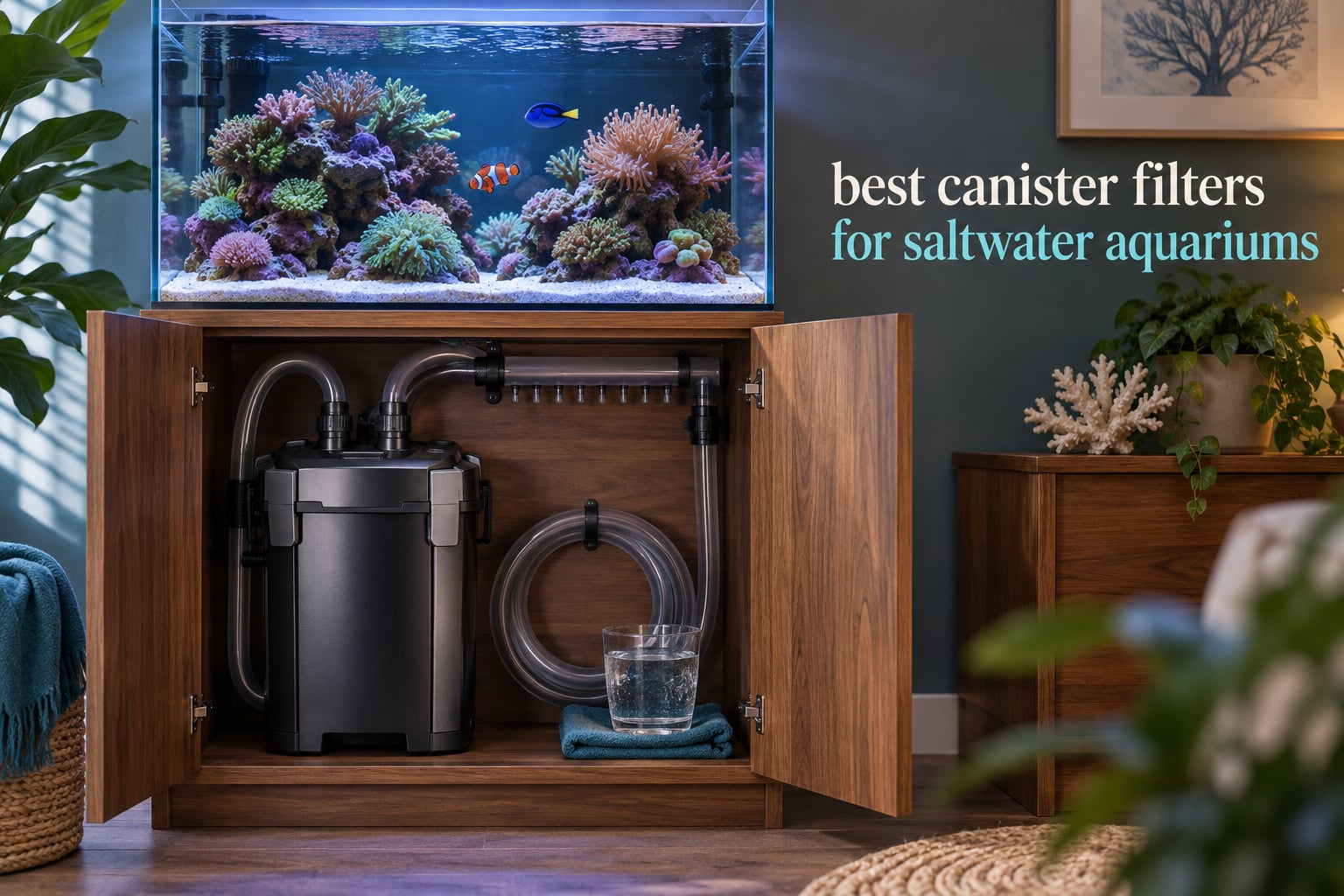
Saltwater aquariums get a bad reputation for canisters, and honestly, part of that reputation is earned. Pressurized canister filters force one hundred percent of the tank’s water through a stack of sponges and pads, which means detritus loads up faster than it would in a sump with filter socks. Used carelessly, a canister turns into a nitrate factory within a couple of months.
Used correctly, though, a canister is the best answer for a lot of saltwater setups, especially the ones most people are actually building. Our top pick for 2026 is the Penn-Plax Cascade 1000, a filter with more than 10,000 owner reviews, three stackable media baskets and a body that is explicitly rated for saltwater up to 100 gallons. If your stand is too shallow for a sump, this is the filter we would put under it.
This guide covers ten canisters that genuinely work in salt water, including saltwater-native thinking on sizing, media staging and cleaning cadence. If you want the broader picture on canisters first, our general canister filter roundup is a good companion read. We also break down the hardware side of the tank itself in our guides to rimless aquariums and bowfront aquariums.
Table of Contents
Are Canister Filters Good for Saltwater Tanks?
Yes, a canister filter works well in a saltwater aquarium, with two conditions. You must pair it with a protein skimmer, and you must clean the mechanical media every two to four weeks. A canister is a fine mechanical and biological filter, but it cannot replace a skimmer for gas exchange.
Here is the honest version. In a fish-only or fish-only-with-live-rock system up to roughly 75 gallons, a canister does everything you need if you keep up with the floss. In a mixed reef above that size, a sump is the better tool, because socks are cheap to swap, the water surface stays open, and there is far more media volume. Reef keepers on reef2reef run canister systems happily, but they are also the people cleaning pads on a schedule rather than when the pads look dirty.
Forum consensus on forums.saltwaterfish.com and marinecolorado.org is consistent on the pairing rule: a canister filter will never replace a protein skimmer. A poster on reefcentral.com put the canister’s whole problem better than we can: the only real problem with canister filters is that if not cleaned regularly they can become nitrate factories.
Top 3 Canister Filters for Saltwater Right Now
The Cascade 1000 takes our top slot because the combination is hard to argue with: 265 GPH, three handled media baskets, push-button priming, and the deepest review base of anything in this roundup at more than 10,000 owners. It is also one of the few filters here that names saltwater in its own product description rather than leaving you to assume.
The Fluval FX6 wins on paper for anyone with a big system, pairing 925 GPH with 1.5 gallons of removable media capacity and an integrated drain valve that makes large water changes painless. The Fluval 407 is the mainstream default for good reason, quietly clearing cloudy water and holding up under daily service.
Penn-Plax Cascade 1000
- 265 GPH
- rated freshwater and saltwater to 100 gallons
- Three stackable media baskets
- Dual 360-degree rotating valves

Fluval FX6
- 925 GPH rated output
- 1.5 US gallons of media baskets
- Integrated drain valve
- Self-priming Smart Pump

Fluval 407
- Rated to 100 gallons
- eTEC pump
- Up to 25 percent quieter than prior generation
- EZ-Lift media baskets
Quick Comparison: Best Canister Filters for Saltwater Aquariums in 2026
All ten filters below are suitable for a saltwater system. The flow figures are the manufacturers’ rated numbers, measured with little or no lift; your actual delivery depends on how far the pump has to push water up into the tank.
| Product | Specifications | Action |
|---|---|---|
| Penn-Plax Cascade 1000 |
|
Check Latest Price |
| Fluval 407 |
|
Check Latest Price |
 Marineland Magniflow 400 Marineland Magniflow 400 |
|
Check Latest Price |
| Fluval FX6 |
|
Check Latest Price |
 Marineland Magnum 290 Marineland Magnum 290 |
|
Check Latest Price |
 Fluval FX4 Fluval FX4 |
|
Check Latest Price |
 Eheim Classic 2213 Eheim Classic 2213 |
|
Check Latest Price |
 SunSun HW302 Pro SunSun HW302 Pro |
|
Check Latest Price |
 SunSun HW303B Pro SunSun HW303B Pro |
|
Check Latest Price |
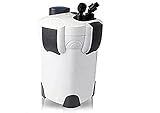 SunSun HW304B Pro SunSun HW304B Pro |
|
Check Latest Price |
How We Picked These Filters
We built this list around what actually decides a saltwater outcome: usable media volume, how the filter behaves when a pad is two weeks past due, and whether the pump survives a marine environment.
Every filter here is sold for aquarium use and works in salt water, and we favored models with large installed bases because a filter with 10,000 owner reviews tells you far more about long-term gasket and pump behavior than one with a dozen. A few specialist canisters on the shopping sites carry single-digit review counts, and we would rather not present thin retail ratings as strong social proof. Brands that show up repeatedly in this roundup include Penn-Plax, Fluval, Marineland, Eheim and SunSun.
One note before the picks: the tank sizes below are manufacturer ratings, not recommendations. Read the sizing section further down before you buy.
1. Penn-Plax Cascade 1000 – Best Overall for Saltwater
- Explicitly rated for freshwater and saltwater
- Three handled stackable media baskets
- Dual 360-degree rotating valves
- Push-button self-priming
- Full media and hardware kit included
- Modest flow for heavily stocked systems
- Carbon bags and floss pads need regular replacement
- Plastic hose clamps may need metal replacements
This is the filter we keep coming back to for saltwater. The Cascade 1000 is built for tanks up to 100 gallons and the manufacturer names both freshwater and saltwater in the same breath, which removes the guesswork that comes with cheaper imports. Three stackable baskets with built-in handles means a media swap takes minutes with wet hands.
Owners consistently point to clear water and simple maintenance, and the dual 360-degree rotating valves are the detail nobody mentions in a spec list but everyone notices in a tight cabinet. You can aim the outflow anywhere without wrestling stiff plumbing.
What you give up for that convenience is flow. At 265 GPH it sits at the lower end of flow for this roundup, and on a heavily populated fish-only system you will feel the difference against a 400 or 700 GPH unit. Turn the valve down on a reef display where current matters and it settles down nicely.
The ongoing cost is consumables. Poly fiber floss and carbon bags are single-use, and reviewers note they add up over years. The plastic hose clamps that come in the box are the other recurring complaint, so a small pack of metal clamps is a worthwhile add-on the day you install it.
Who the Cascade 1000 suits
It suits fish-only and FOWLR setups from about 30 to 90 gallons, and first-time marine keepers who want one decision rather than a dozen. A poster on r/aquarium running a 125 gallon tank defaulted to Fluval, and that instinct is sound, but for most home reefs the Cascade 1000’s three baskets hold more usable media than the entry-level Fluval models at similar flow.
It also suits anyone whose stand will not take a sump, which is one of the most common questions in the forums. A 16-by-16 cabinet leaves room for a canister and nothing else.
Who should skip it
Skip it above 100 gallons or on a heavy bioload, where 265 GPH will not move enough water to keep detritus in suspension. If you are running SPS or LPS in a mixed reef with high flow demands, look at the Fluval FX4 instead.
Skip it too if you are not willing to swap floss every two weeks. Nobody is telling you to be precious about it, but a canister on a neglected schedule is a nitrate problem waiting to happen.
2. Fluval 407 – Best Mainstream Pick for Reef Tanks
Fluval 407 Performance Canister Filter – For Aquariums Up To 100 Gallons
- Exceptionally quiet for its flow class
- Strong steady pressure clears cloudy water fast
- EZ-Lift center-handle baskets
- Simple illustrated setup
- Adjustable flow rate
- Some reports of impeller cover disengaging under pressure
- Slow manufacturer response on warranty issues
- Included carbon pouches run small
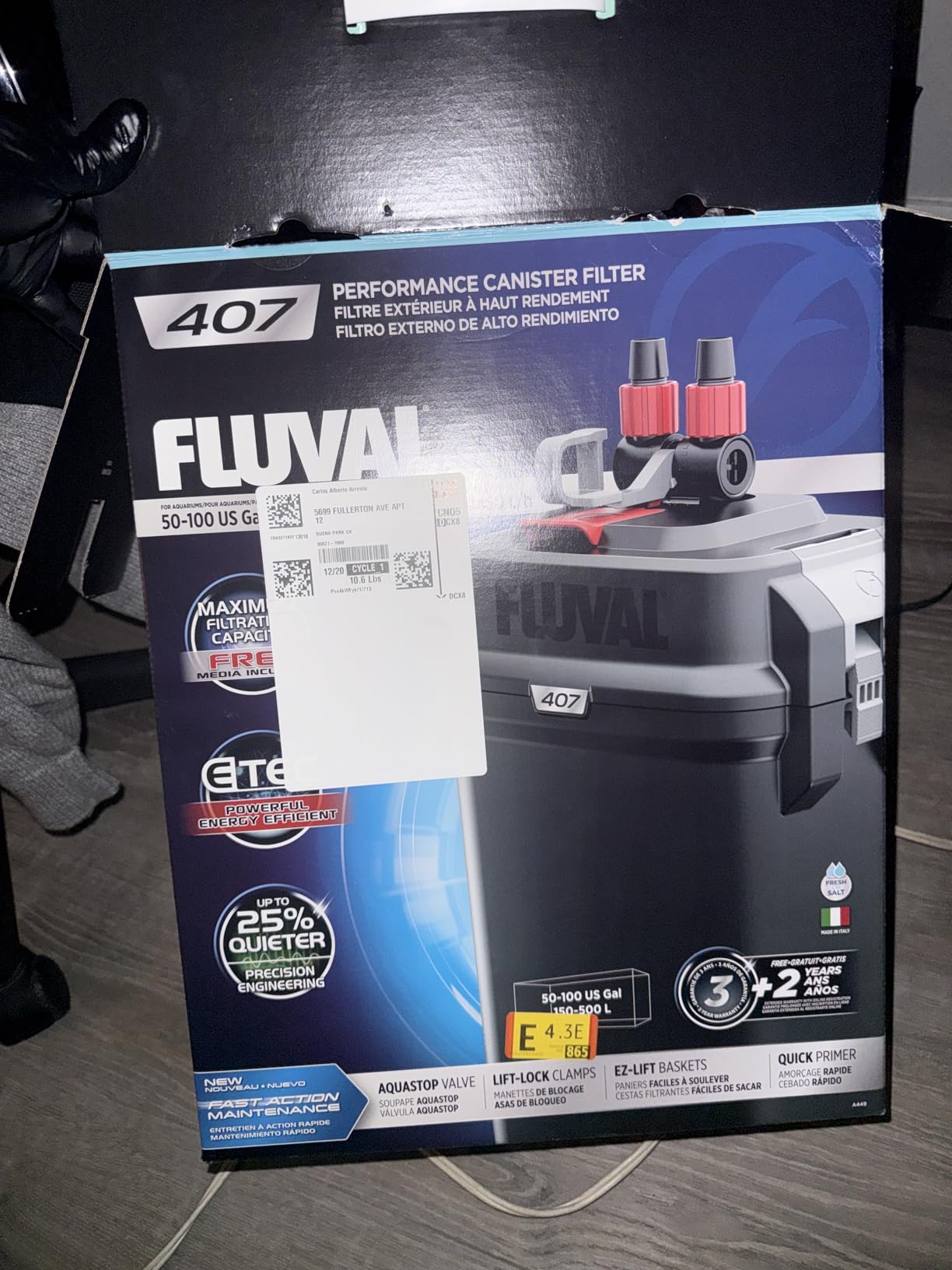
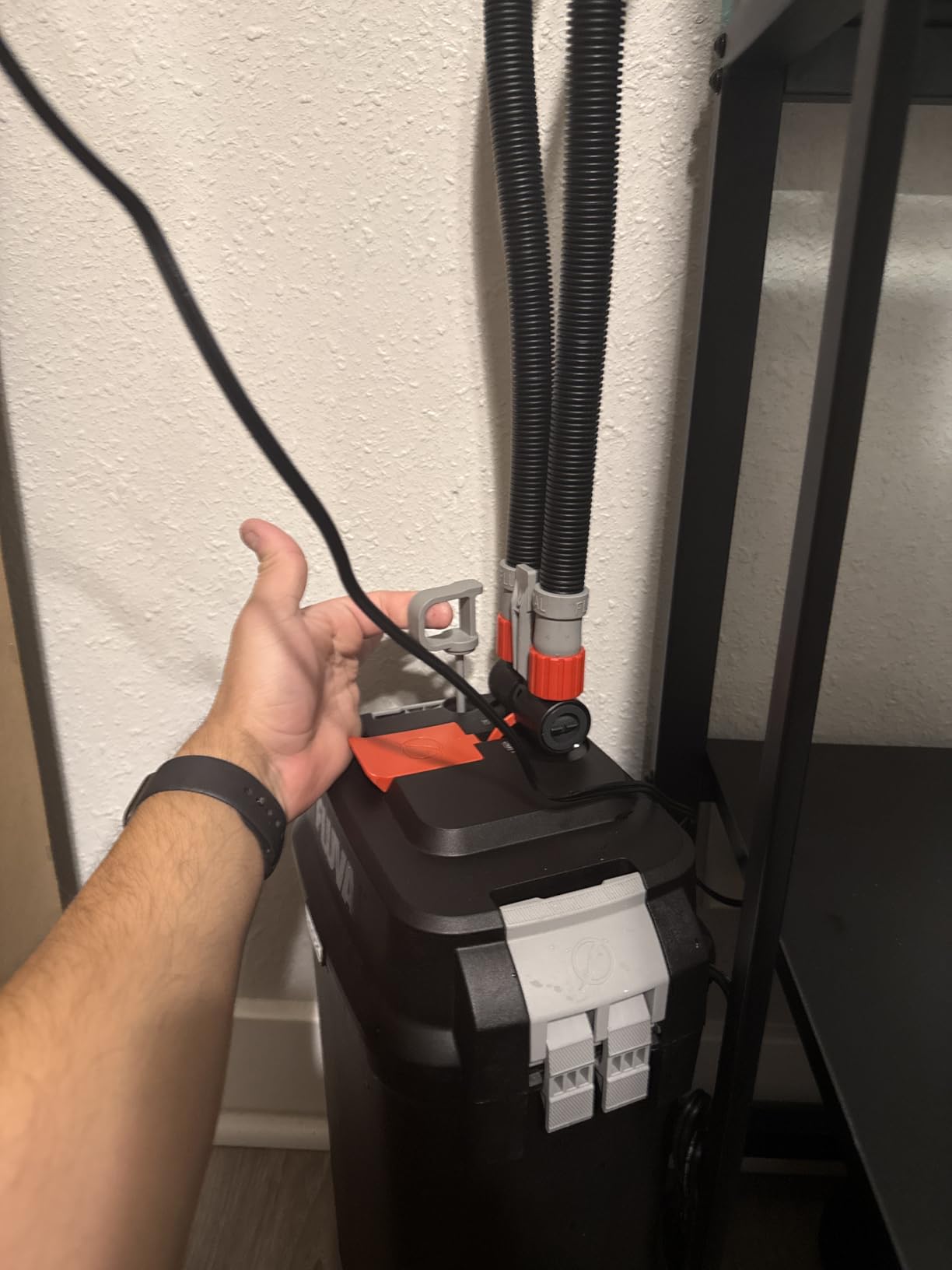
The Fluval 407 is the unit people mean when they say the default canister. It is rated for aquariums up to 100 gallons, it uses the eTEC pump design for strong output at low energy draw, and Fluval says the pump runs up to 25 percent quieter than the previous generation. In a living room, that quietness is the feature that matters most.
Service is the other reason it keeps its position. The EZ-Lift baskets have a center handle so you can pull a full wet media tray out with one finger, which is exactly what you want when the tank is 100 gallons of water and your elbows are already wet.
There is a real caveat, and we would rather you hear it here than in year two. A small but persistent group of owners reports the impeller cover disengaging under pressure, which leads to repeated motor head replacement. The same reviews single out manufacturer customer service as slow to respond on warranty issues, so if you buy this, keep the receipt and the order number somewhere obvious.
The included carbon pouches are also smaller than the standard Fluval replacement pouches, so plan to buy your own carbon in the size you actually want. It is a small cost, but it catches people out the first time they refill a tray.
Who the Fluval 407 suits
It suits mixed reef and FOWLR tanks from roughly 40 to 90 gallons where low noise matters, and anyone who wants an easy first canister with no learning curve on media changes. It pairs cleanly with a hang-on or inline skimmer on systems this size.
It is also the safe pick for a first marine tank. With more than 10,000 owner reviews, any hardware problem worth knowing about is already documented somewhere, which is a genuine advantage when you are new to salt.
Who should skip it
Skip it if your tank is over 100 gallons or your bioload is high, because the 407 is built for mid-size systems. Skip it if you are buying on warranty service alone, given the reported support delays. Above 100 gallons with a sump available, the FX4 or a sump is the honest answer.
3. Marineland Magniflow 400 – Best for Fish-Only-With-Live-Rock
- Rated for freshwater and saltwater
- 400 GPH handles a real bioload
- Stack N' Flo mechanical to biological staging
- Generous included media package
- Quiet for its flow rating
- Documented gasket and housing leaks
- Weak plastic clamps supplied in the box
- Priming can be difficult
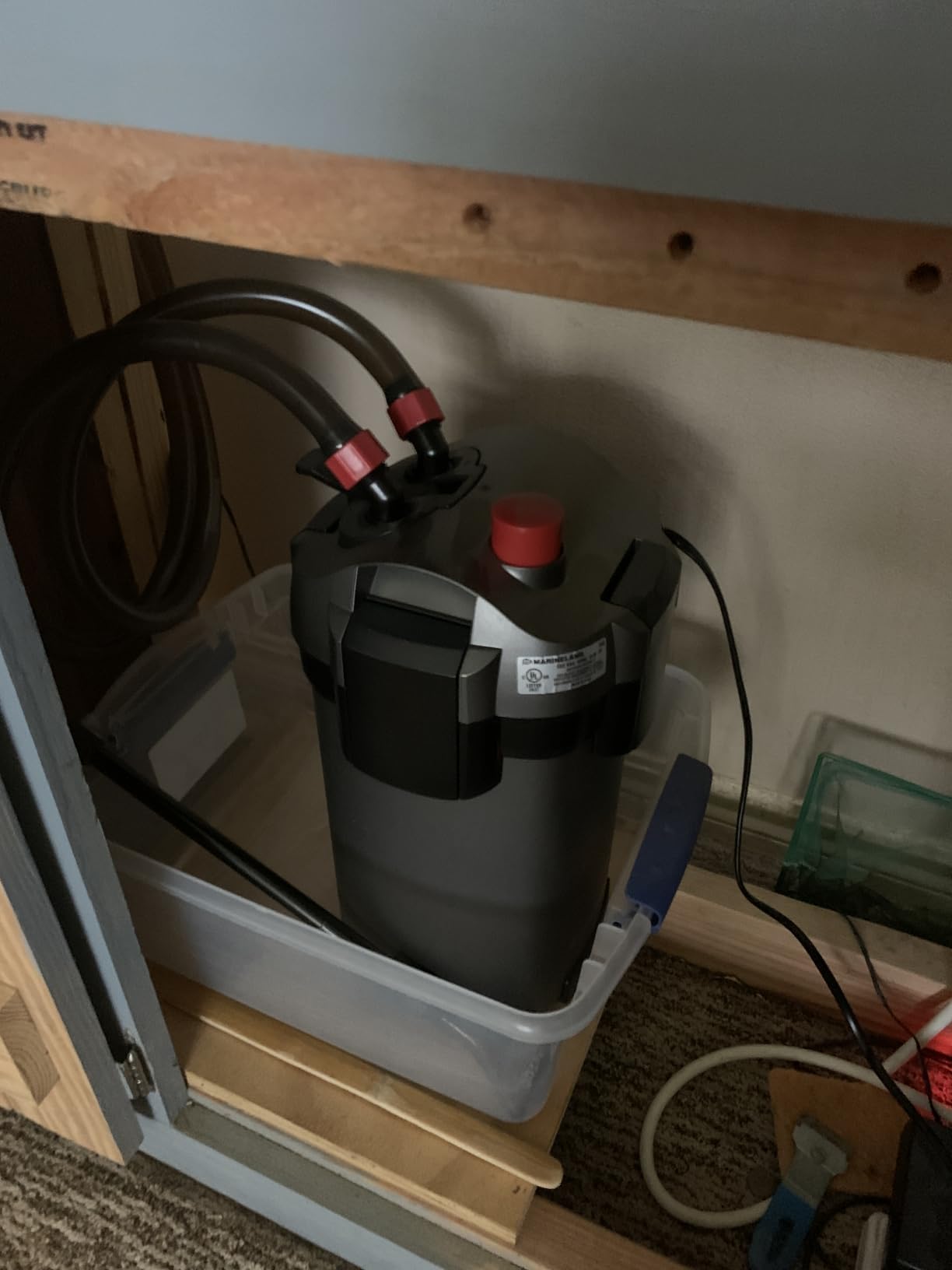
If your system is FOWLR with a genuine population of tangs, triggers and angels, 400 GPH is the number you want and the Magniflow is the one that carries it. It is rated for both freshwater and saltwater aquariums up to 100 gallons, and the Stack N’ Flo trays force water through ordered layers, which is exactly the staging a marine system needs.
The included media package is unusually generous: filter foam, activated carbon bags, bio-filter balls, ceramic rings and polishing pads all come in the box. For a first FOWLR build, that removes a whole trip to the store and gets you a running filter the same day.
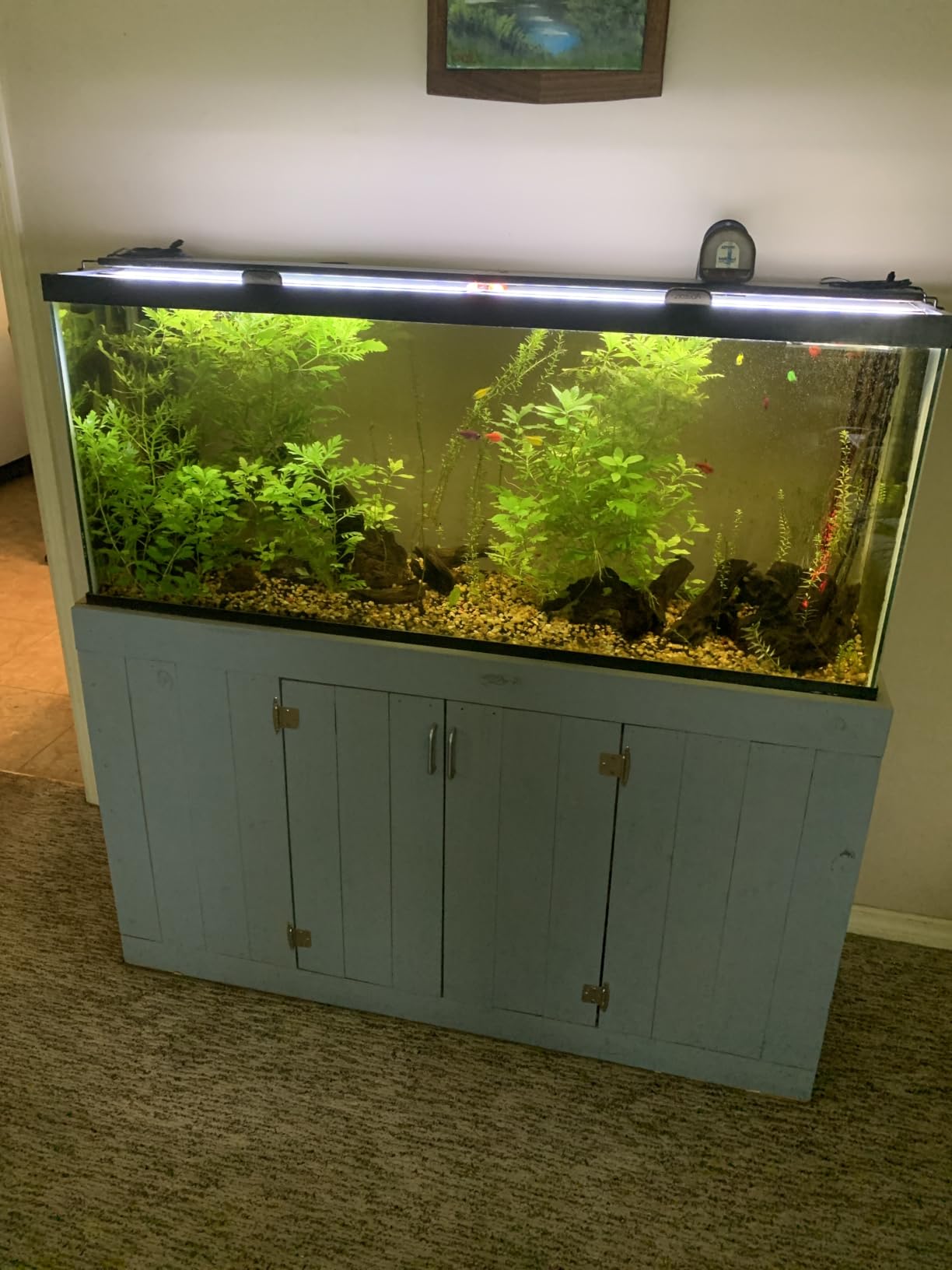
Leakage is the recurring theme in owner feedback, and it deserves a straight answer. Gasket seating problems under the handles, weak plastic clamps supplied in the box, and rigid tubing that is awkward to route all show up in the reviews. We would replace the plastic clamps on day one and check the lid gasket seating every time you open it.
Priming is the other wrinkle. The quick prime button exists, but owners report it can be a fight unless you pre-fill the canister or siphon manually. Budget five extra minutes for the first startup and it stops being an issue.
Who the Magniflow 400 suits
It suits fish-only and FOWLR tanks up to about 90 gallons with a dense population, especially if you want mechanical capacity without stepping up to a large premium pump. It also works well as a carbon or media reactor stage on a system that runs a sump alongside it.
For a mixed reef under 60 gallons, it is more than enough flow, though you will want to dial the spray bar down so you are not blasting your soft corals.
Who should skip it
Skip it if leak history makes you nervous, since gasket and clamp problems are the most repeated complaint in the reviews. It also sits among the heaviest canisters in this group at 19.27 pounds, so skip it if you need to lift the unit out for cleaning on a schedule in a low cabinet.
4. Fluval FX6 – Top Rated Pick for Large Systems
- 925 GPH clears cloudiness fast
- Near-silent at normal levels
- Self-priming with automatic air evacuation
- Individually repairable impeller and O-rings
- Integrated drain valve
- Bulky and awkward to lift for cleaning
- Stiff large-diameter hoses
- Periodic auto shutoff can startle new owners
The FX6 is the highest-rated filter we reviewed, with 4.6 stars across more than 3,400 owner reviews and an 83 percent five-star share. Pump output is rated at 925 US gallons per hour, and the removable stackable baskets hold 1.5 US gallons of media, several times what mid-size canisters carry.
What makes it long-lived is repairability. The impeller and O-rings are individually replaceable, and the Smart Pump self-starts and evacuates trapped air automatically every 12 hours. For a piece of equipment that will sit in a humid cabinet for a decade, that matters more than any headline flow number.
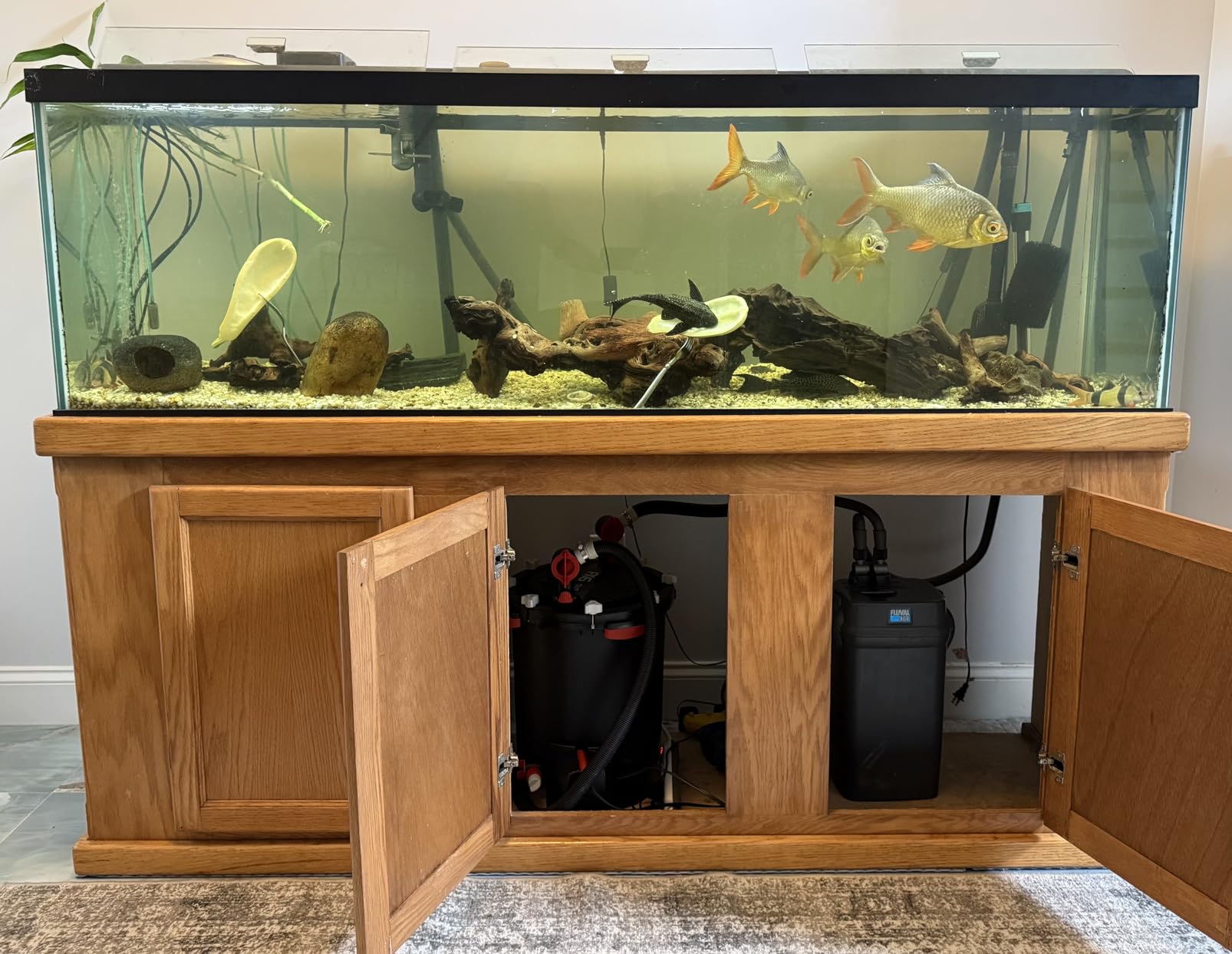
There is a physical cost. At 19.9 pounds with stiff large-diameter hoses, moving it for a media change is a two-person job in a shallow stand, and the hoses need warming before they will route where you want them. Measure your cabinet before you commit.
Two more practical notes from owners. The intake tube is very long and cannot be shortened, so shorten or secure it yourself in a sand-bedded tank to avoid pulling substrate. And the automatic shutoff every 12 hours will stop the pump briefly, which surprises first-time users the first time it happens.
Who the FX6 suits
It suits large FOWLR and predator systems in the 150 to 300 gallon range, and mixed reef displays where you want serious mechanical capacity and a drain valve for large water changes. Owners with decades in the hobby describe the FX line as a durable workhorse rather than a disposable one.
It also suits anyone who plans to run a canister and a skimmer together, because the flow leaves plenty of headroom for both and for a carbon stage on top.
Who should skip it
Skip it for tanks under 75 gallons. You are buying capacity and mass you will not use, and the weight alone makes routine service unpleasant. If your stand is shallow, the 21 inch tall design is worth checking twice before ordering.
5. Marineland Magnum 290 – Best for Quarantine Tanks and Post-Clean Polishing
Marineland Magnum 290 GPH Polishing Canister Aquarium Filter
- Under 3 pounds
- easy to lift and service
- Submerged motor starts with no priming routine
- Two refillable chambers accept any media
- Micron cartridge included for polishing
- Lower throughput than full-size canisters
- Small chambers limit media volume
- Less staging flexibility than basket systems
The Magnum 290 does something the big canisters cannot: it is small enough to carry with one hand. At 2.91 pounds and under 10 inches tall, it lives in a cabinet that cannot take anything else, and the submerged motor design means it starts with no separate priming routine at all.
We think the underrated use for this one is as a temporary polisher. After a deep clean that strips a reef tank’s mechanical filtration, running the Magnum on activated carbon for a week puts clarity back without touching the biology. A carbon or media reactor role is the other good fit.
The two refillable media chambers accept carbon or any custom media you like, and continuous three-stage filtration plus the included micron cartridge handles polishing work nicely. For a quarantine tank or a hospital setup, the flexibility is the whole point.
The trade-off is straightforward. At 290 GPH rated with two small chambers, it holds far less media than a stackable basket system, so it is not the right primary filter for a stocked display tank. The design limits how finely you can stage mechanical, chemical and biological media.
Who the Magnum 290 suits
It suits quarantine and hospital tanks, nano and micro reef systems, and anyone who wants a dedicated carbon or GFO media reactor to run alongside a sump. It also suits people who want a quiet polishing stage for a fish-only system already handled by a larger filter.
The submerged motor means no priming procedure to learn, which is a genuine advantage for beginners.
Who should skip it
Skip it as the only filter on a display tank over about 40 gallons. The flow and media volume are not built for that bioload, and you would be replacing floss constantly. Buy the Cascade 1000 or the Magniflow 400 instead.
6. Fluval FX4 – Best Compact High-Flow Option
- Very quiet even at higher flow settings
- 700 GPH clears cloudy water fast
- Adjustable flow rate to tame current
- Fast media changes with stackable trays
- Compact height fits most stands
- Large and heavy overall
- Stiff latches are hard to open
- Instructions omit outflow height guidance
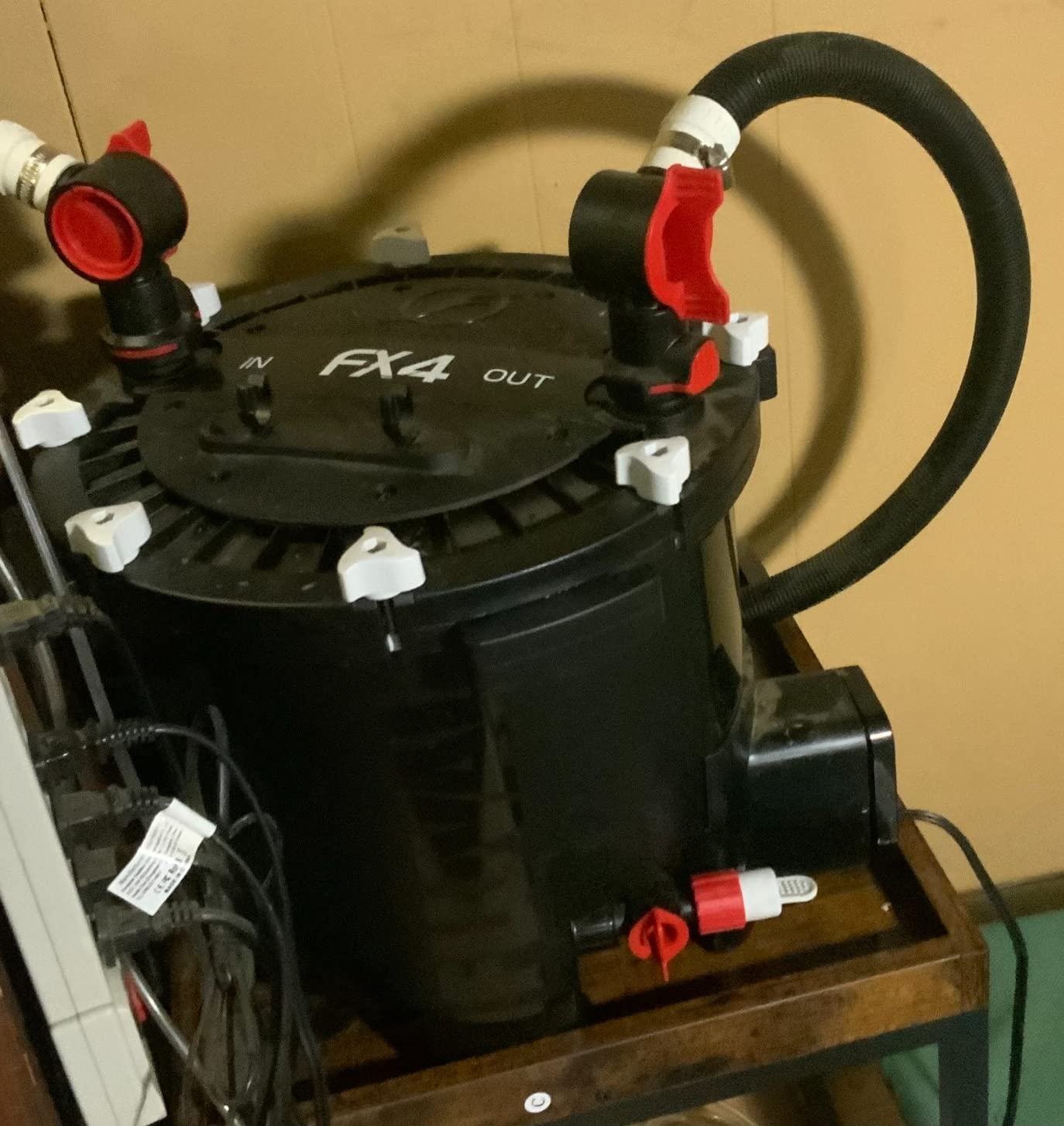
The FX4 is the answer when you need real flow but do not have cabinet height. It delivers a rated 700 US gallons per hour in a 16.5 inch tall design, and that compact body is the reason it fits under stands the FX6 will not.
Owners highlight silence at higher flow settings and adjustable flow to avoid excessive current, which matters on a reef where you want turnover without a jet aimed at your corals. Media changes are fast with the removable stackable trays, and the self-starting mode doubles as a filling aid for a new tank.
The instructions leave out one critical step. They do not tell you to set the outflow above the tank water level, and if you run it below the surface you can siphon and flood your cabinet. Set it high the first time and the problem never exists.
At 14.17 pounds the unit is still substantial, the latches are stiff, and the factory tubing is rigid, so warm it before routing. There is also a small set of reports of motor failure within a year and slow warranty handling, which is worth weighing against the Fluval 407’s more conventional reliability.
Who the FX4 suits
It suits 100 to 150 gallon mixed reef and FOWLR systems where you want high flow in a shorter body, and anyone with a stand that will not clear 21 inches. The 1 US gallon of removable media capacity is more than enough for a mixed reef if you change it on schedule.
It also works as a primary filter for a heavily stocked fish-only tank that has outgrown a 400 GPH unit but does not justify the FX6’s mass.
Who should skip it
Skip it for tanks under 75 gallons, where the size and weight are pure overhead. Skip it if shallow stands are already a struggle, and be aware of the missing outflow instruction if you are new to pressurized filtration.
7. Eheim Classic 2213 – Best Value for Small Saltwater Tanks
- Long-proven design with a large installed base
- Light and compact for under-stand handling
- Fixed silicone seal on the pump head
- Complete kit including spray bar and valves
- Handles moderate flow for mid-size tanks
- Manual priming takes more effort
- Lower flow than modern high-performance units
- Proprietary EHEIM media costs more over time
The Eheim Classic is the one that gets recommended for a reason nobody else in this roundup can match: longevity. Reef keepers on forums describe Eheim filters running 10 to 20 years and more with no issues, and that is the single strongest long-term trust signal in this hobby. The design itself has been in production for decades and is thoroughly understood.
It is also the easiest to handle. At 4.49 pounds and just under 14 inches tall, the 2213 goes into a shallow stand and comes back out for cleaning without the two-person lift a 20-pound unit needs. Variants are listed at 40, 66 and 92 US gallons, so it covers small and mid-size systems.
Two design details explain the longevity. The permo-elastic silicone sealing ring is fixed to the pump head, so the seal stays in place during cleaning and there is nothing to drop down the drain or misalign. And the kit is complete: spray bar, inlet pipe, hose, installation accessories, valves, and EHEIM Mech and Substrat Pro media.
The compromises are real but honest. Priming is manual and gravity-assisted, which takes more effort than a self-priming pump, and flow is modest by modern standards. EHEIM media is proprietary, so replacement costs add up over a decade more than they would with generic carbon and floss.
Who the Eheim Classic suits
It suits nano and small FOWLR systems, quarantine setups, and anyone who wants a filter they can set up once and forget for a decade. It is a good match for a shallow stand and for hands that would rather not lift 20 pounds of equipment in a wet cabinet.
It also suits first-time marine keepers with small systems who can pair it with a nano skimmer and keep the cleaning cadence realistic.
Who should skip it
Skip it if you need high flow for a heavily stocked tank, or if you dislike a multi-step manual priming routine every time you restart the pump. Skip it if buying proprietary consumables bothers you, because that cost repeats forever.
8. SunSun HW302 Pro – Budget Pick for Tanks Up to 75 Gallons
- Lowest cost per unit of flow in this roundup
- Complete kit with pads baskets carbon rings and bio balls
- Three baskets allow custom staging
- 265 GPH suits tanks to 75 gallons
- Hose routing and priming are less refined
- Filter pad and carbon replacement is ongoing
- Compact media volume versus premium canisters
The HW302 Pro is the straightforward budget answer. It moves a rated 265 GPH, is rated for tanks up to 75 gallons, and the pro kit includes the canister, three white filter pads, three media baskets, a pound of premium carbon, a pound of ceramic rings and a set of bio balls. Everything you need to start filtering is in the box.
For a first FOWLR system or a second filter running carbon on a bigger setup, that bundle is the reason it makes the list. Three separate baskets let you stage mechanical, chemical and biological media the same way you would in a premium unit.
Where it differs from the premium picks is refinement, not capacity. Owners describe hose routing and the priming procedure as less refined than higher-end branded canisters, so expect to spend a few minutes getting the tubing to cooperate in a tight cabinet.
Consumables are the recurring line item. Filter pads and carbon are single-use and add up over years, and the media volume is compact next to a premium large-capacity canister, so you will be swapping media more often to keep flow up.
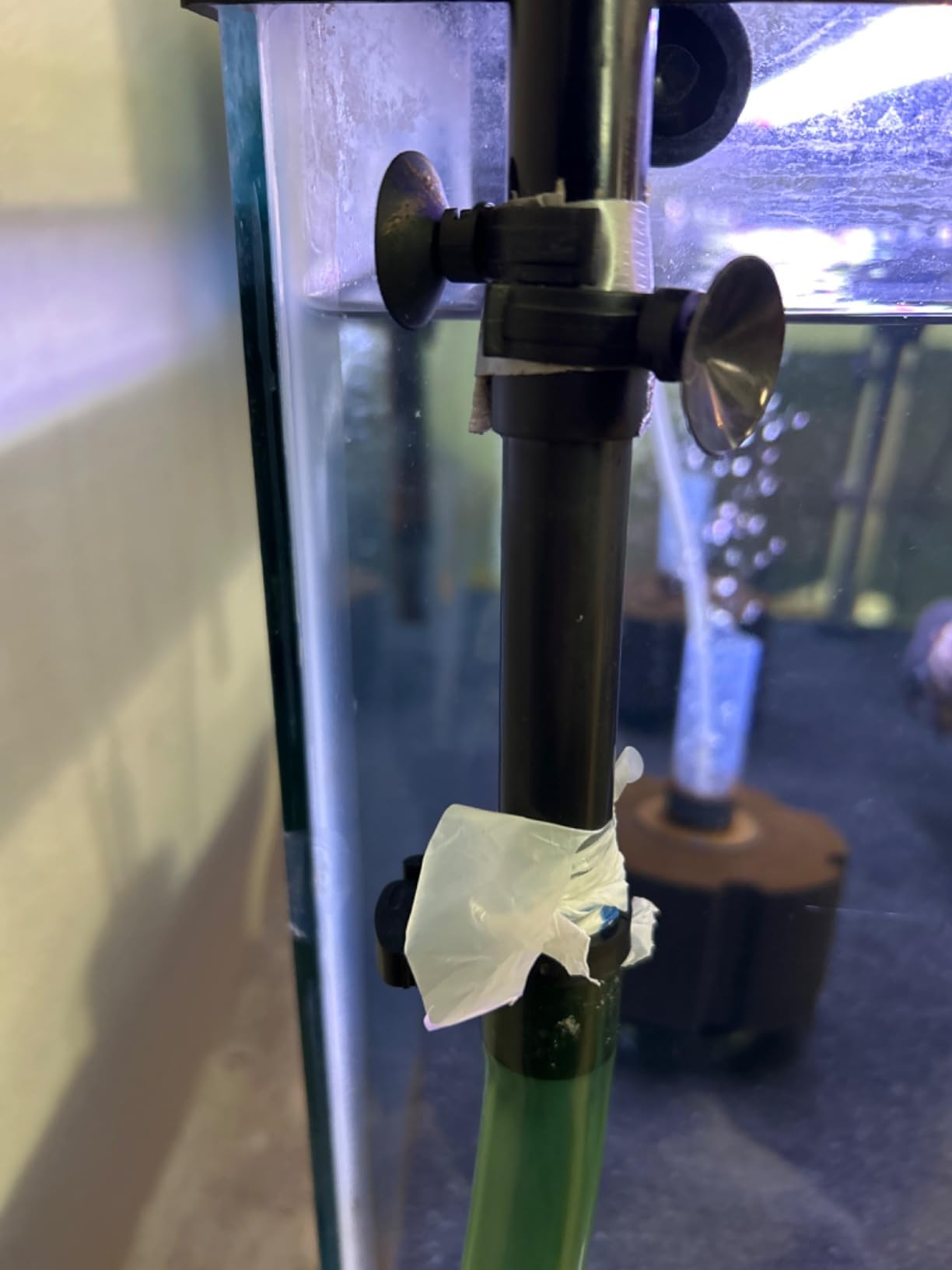
Who the SunSun HW302 suits
It suits budget-conscious FOWLR keepers on tanks up to 75 gallons, and anyone who wants a dedicated carbon or media reactor without spending on a full premium canister. It is a sensible second filter for polishing or for a quarantine system.
It also suits a first marine keeper who wants three-basket staging and a complete media package at the entry level of the category.
Who should skip it
Skip it if hose routing in your cabinet is genuinely tight, or if you want the quietest possible operation in a living room. Above 75 gallons, or on a mixed reef with high flow demand, step up to the HW303B or a mainstream brand.
9. SunSun HW303B Pro – Best for Algae and Water Clarity Control
SunSun Hw303B 370GPH Pro Canister Filter Kit with 9-watt UV Sterilizer
- Integrated 9-watt UV sterilizer
- 370 GPH rated for tanks to 100 gallons
- Full media bundle including carbon rings and bio balls
- Three baskets for staged filtration
- UV lamp needs periodic replacement
- Rigid factory tubing is awkward to route
- Consumable media replacement is an ongoing cost
The HW303B Pro adds something no other mid-size canister in this roundup adds: a built-in 9-watt UV sterilizer. Owners cite it most often as the reason to buy, and the practical effect is clearer water between water changes, which matters a lot in a reef where a haze reads as a problem.
Underneath the UV, it is a 370 GPH unit rated for tanks up to 100 gallons with three media baskets and four filter pads. The media bundle is complete, with a pound of premium carbon, a pound of ceramic rings and a set of bio balls.
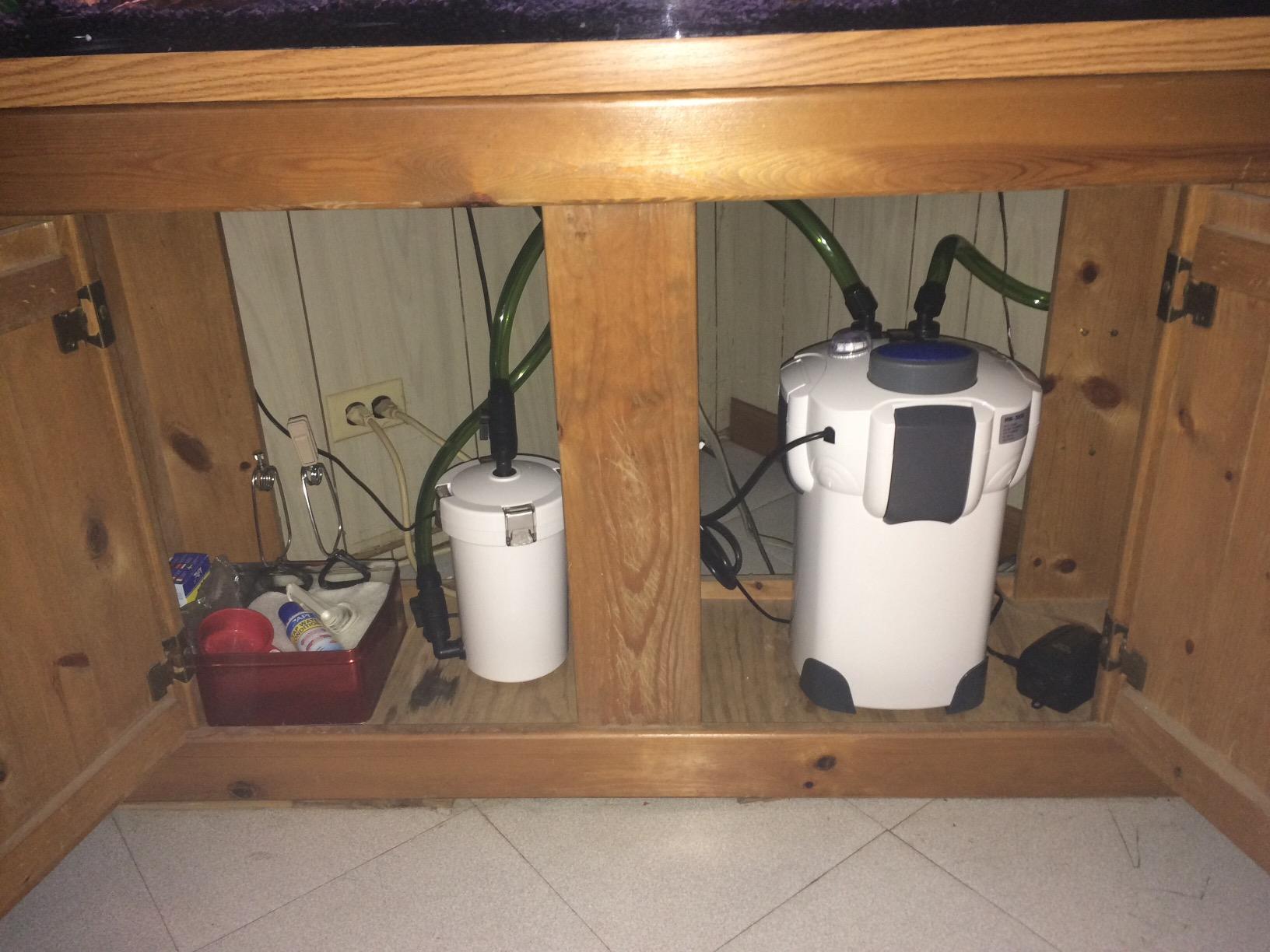
Two practical costs sit on top of the purchase. The UV lamp needs periodic replacement to stay effective, and owners treat that as a scheduled maintenance item rather than a surprise. The rigid factory tubing is less forgiving than flexible hose in a tight cabinet, so budget time for routing.
Filter pad and consumable replacement is the third ongoing expense, and with 370 GPH pushing through four pads, a lightly stocked system may be refreshing pads more often than you expect. Stage it carefully so the mechanical pad does the work and the carbon downstream stays useful.
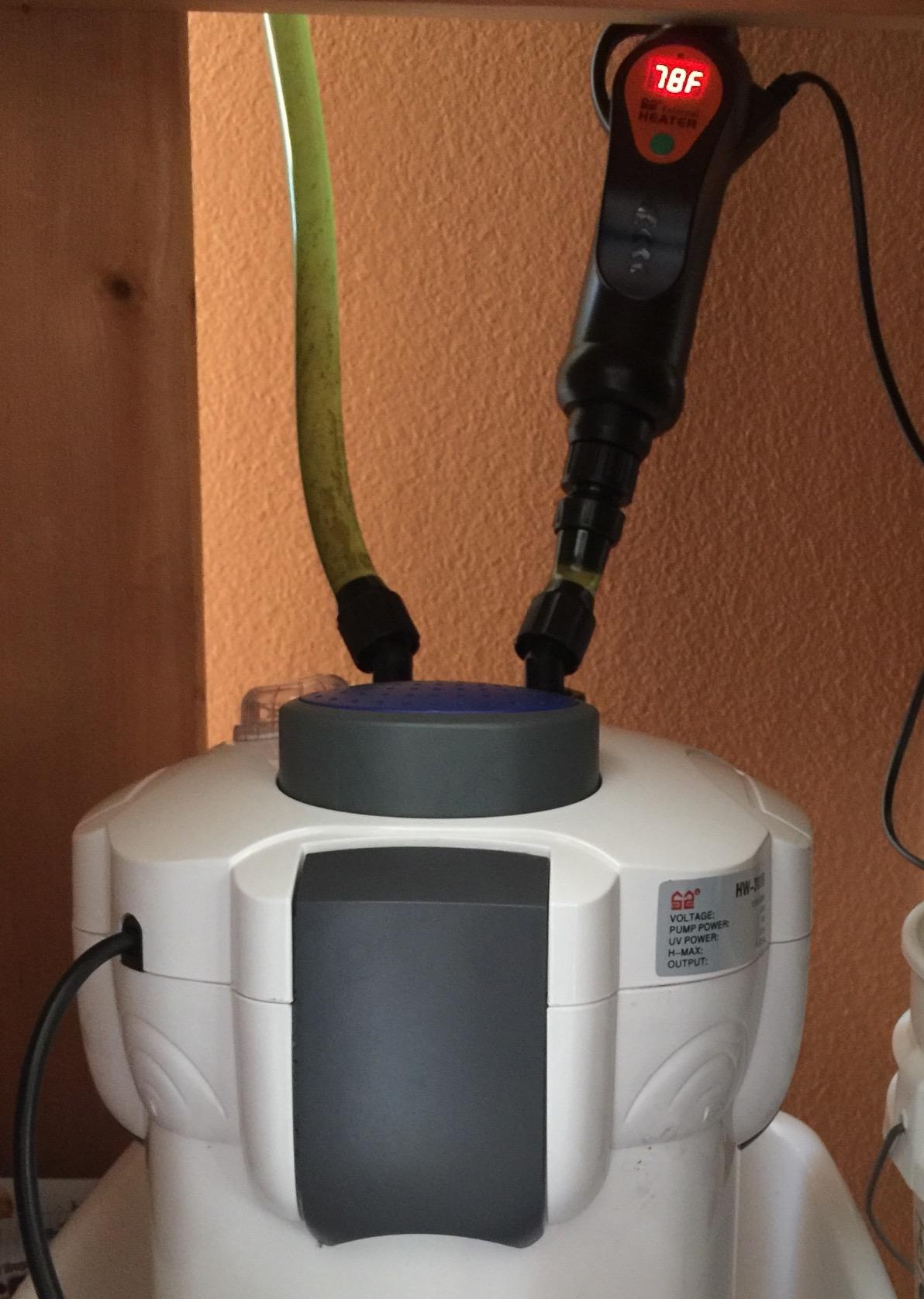
Who the HW303B Pro suits
It suits keepers who want built-in algae and clarity control without buying a separate inline UV unit, plus FOWLR and light mixed reef systems in the 60 to 100 gallon range. The UV is a genuine advantage in a tank fighting nuisance algae between changes.
It also suits a single-filter setup where you want mechanical, chemical and UV control in one box rather than three separate devices under the stand.
Who should skip it
Skip it if you already run a UV sterilizer elsewhere, since duplicating that role is wasted money. Skip it if you do not want a lamp on a replacement schedule, and note the 16 pound weight if your cabinet access is tight.
10. SunSun HW304B Pro – Best for 150 Gallon Fish-Only Tanks
Sunsun Hw304B 525GPH Pro Canister Filter Kit with 9-watt UV Sterilizer
- 525 GPH rated flow for larger systems
- Integrated 9-watt UV sterilizer
- Four media baskets for the largest media capacity in this group
- Rated for tanks up to 150 gallons
- Heavy at 17 pounds
- UV lamp needs periodic replacement
- Rigid factory tubing complicates routing in tight stands
The HW304B Pro is the top of the SunSun range and the one that steps past aquarium-sized. Rated at 525 GPH, it is built for tanks up to 150 gallons, and the four media baskets give it the largest media capacity of any kit in this group. Owners report clear water across the 100 to 150 gallon range.
The UV sterilizer is again built in at 9 watts, and the consumables bundle is full: a pound of carbon, a pound of ceramic rings, a set of bio balls, four white filter pads and one blue coarse pad. For a large fish-only system this is a lot of filtration in one box.
The weight is the practical problem. At 17 pounds, cleaning it and routing the rigid factory tubing through a tight stand is more work than the smaller SunSun kits, and reviewers name both the weight and the tubing as the main drawbacks.
As with the HW303B, the UV lamp needs periodic replacement, and with five filter pads in the box you are replacing consumables on a regular cycle. Both are costs you can plan for, but neither is free to run.
Who the HW304B Pro suits
It suits large fish-only and FOWLR systems in the 100 to 150 gallon range where you want maximum throughput and the most media volume per unit of cost, and it suits keepers running a single filter that handles mechanical, chemical, biological and UV duty together.
It also suits a sump-based reef that needs a supplementary carbon and GFO reactor with real flow behind it.
Who should skip it
Skip it for tanks under 100 gallons, where the flow and bulk are unnecessary. Skip it if you cannot easily lift 17 pounds in and out of a wet cabinet, and skip it for a mixed reef above 100 gallons where a sump is the better long-term answer.
How to Size a Canister Filter for Saltwater
Size by turnover, not by the tank label on the box
The tank rating printed on a canister is a marketing number, not a recommendation. Work out the turnover you actually need and match that against delivered flow, not rated flow.
As a starting point, look for a filter rated at one and a half times your tank volume, and aim for a turnover of four to six times per hour. A 60 gallon reef at 4x turnover needs roughly 240 GPH moving through the system. That is a rough floor rather than a target, and for a heavily stocked fish-only system you want more.
Head height quietly steals your flow
Rated GPH is measured with almost no lift. Every foot the pump has to push water up to reach the tank reduces what actually arrives, and a canister under a standard cabinet is often lifting three or four feet.
Do not expect rated numbers. Plan on delivering meaningfully less than the rating at real cabinet head height, and size upward to compensate rather than being disappointed later. A pump rated at 700 GPH that delivers a fraction of that at four feet of lift is still the right unit for a 100 gallon reef, it is just not the one on the label.
Canister vs sump: honest thresholds
Below about 40 gallons, a hang-on-back is usually enough and a canister adds weight and volume for little gain. Between 40 and 75 gallons, a canister with a hang-on or inline skimmer is a genuinely good match. Above 75 gallons, especially on a mixed reef, a sump is the better tool.
The reasons are structural rather than philosophical. Sock media is cheap to swap every few days, the water surface stays open for gas exchange, and a sump can hold far more media than a sealed canister. One reefs.com poster prefers a canister precisely because a loud sump is annoying and a sump risks overflowing on a power loss, which is a fair trade if noise and flood risk matter more to you.
Yes, a sump can also be run too large for the system, and skimmers have a matching size, but that is a tuning problem. The canister-versus-sump decision is about media volume and maintenance ergonomics.
Media stacks by system type
For a fish-only system, a coarse sponge followed by floss and a carbon bag is enough. For FOWLR, add ceramic rings or bio-balls in the final tray, and never clean more than one tray at a time.
For a mixed reef, stage mechanical first so the pads catch detritus before it reaches anything else, then carbon or GFO, then biological media last. Never rinse biological media under tap water, because the chlorine in it will kill the nitrifying bacteria and can crash a marine tank overnight. That mistake is one of the most common causes of new-reef losses, and it is entirely avoidable.
The saltwater cleaning schedule
Canisters need cleaning on a schedule in salt water, not when they look dirty. Check flow weekly, swap floss every two weeks, replace carbon every four to six weeks, and change biological media only when flow demands it, and never all at once.
Inspect hoses and fittings for salt creep at the same time. Crystallized salt on a hose or fitting is a marine-only maintenance issue, and if you ignore it, it can work into a seal and cause a leak. Wipe fittings with a damp freshwater cloth during your water change and keep the cabinet dry.
Eheim vs Fluval: the Head-to-Head That Matters for Salt
The most common question we see about canister filters for saltwater is which of the two long-established brands to buy. The short answer is that both work in salt water, and the choice comes down to flow, media volume and how much maintenance you want to do.
Fluval covers more of the size range in this roundup, from the quiet 407 rated to 100 gallons through the FX4 at 700 GPH and the FX6 at 925 GPH, and the FX line adds an integrated drain valve for large water changes. Eheim’s advantage is longevity and handling, with a fixed silicone pump-head seal, a light compact body and a design that has been proven over decades, though its Classic models run at lower flow and depend on proprietary media.
On salt compatibility, every brand in this roundup is fine. Penn-Plax, Marineland and SunSun all describe their units for aquarium use and are used routinely in marine systems, and Eheim and Fluval components are unaffected by normal reef salinity. The thing that actually differs between them in a marine cabinet is build quality, media volume and the consumables you will replace for a decade, not whether the pump survives salt water.
When Not to Use a Canister Filter
There are setups where a canister is the wrong tool, and a guide that never says no is not worth reading.
Above 75 gallons on a mixed reef, use a sump. The media volume, the open water surface and the cost of sock replacement all favor a sump, and reef keepers steer new keepers away from canisters for that reason as much as any technical one. If your stand is deep enough for a sump, the sump is the better buy.
If you will not commit to a cleaning schedule, use a sump with filter socks, which are cheap and quick to change. The nitrate-factory failure mode is the single most cited complaint about canisters in reef systems, and it is entirely a function of how often the mechanical media gets swapped.
Plan for power outages either way, because the two systems fail differently. A canister with the power off will drain through the intake and can empty your tank, so keep the outflow above the water line and know where your shutoff is. A full sump can overflow a stand if auto top-off fails. One poster on reefs.com prefers the canister specifically for this reason, which is a reminder that neither option is hands-off during an outage.
Finally, do not run a canister without a protein skimmer. That is the consensus answer on marine forums and it is correct. A canister handles mechanical and biological filtration well, but a pressurized, sealed loop is a poor gas-exchange chamber, and the skimmer is what strips the dissolved organics a canister cannot.
Frequently Asked Questions
Are canister filters good for saltwater tanks?
Yes, as long as you pair the canister with a protein skimmer and clean its mechanical media every two to four weeks. A canister handles mechanical and biological filtration well in a fish-only or FOWLR system up to about 75 gallons. Above that size, especially on a mixed reef, a sump is the better tool because sock media is cheap to swap and the water surface stays open for gas exchange.
Which canister filter is best for saltwater use?
For most home systems, the Penn-Plax Cascade 1000 is the best canister filter for saltwater. It is rated for freshwater and saltwater up to 100 gallons, has three stackable media baskets, and carries the deepest owner review base in the category. For large systems above 150 gallons, the Fluval FX6 is the stronger choice.
Can a Fluval canister filter be used on saltwater?
Yes. Fluval canister filters work in saltwater aquariums, including the 407, FX4 and FX6. The pump, seals and media housings tolerate normal reef salinity, and Fluval owners run them on marine systems routinely. Keep an eye on salt creep on fittings and wipe them down during water changes.
Which is better, Eheim or Fluval?
Both work in salt water. Fluval offers a wider size range and more media volume, with the FX line adding an integrated drain valve for large water changes. Eheim is the better pick for longevity and handling, with a fixed silicone pump-head seal, a light compact body and a design that has proven itself over decades, but its Classic models run at lower flow and use proprietary media.
How often should I clean a saltwater canister filter?
Check flow weekly, replace floss pads every two weeks, and change carbon every four to six weeks. Biological media should only be cleaned when flow demands it, and never more than one tray at a time. Never rinse bio-media or ceramic rings under tap water, because the chlorine will kill nitrifying bacteria and can crash a marine tank.
Do you need a protein skimmer if you use a canister filter?
Yes. A protein skimmer is required with a canister filter in a saltwater aquarium. A pressurized, sealed canister is a poor gas-exchange chamber, so it cannot strip dissolved organics the way a skimmer does. The consensus across marine forums is that a canister will never replace a skimmer.
Our Final Recommendation for Saltwater Aquariums
For a fish-only or FOWLR system up to about 90 gallons, the Penn-Plax Cascade 1000 is our pick for the best canister filters for saltwater aquariums, and it pairs with any hang-on or inline skimmer that fits your bioload. In a nano or shallow stand under 40 gallons, the Eheim Classic 2213 handles the volume without a heavy lift. In a 100 to 150 gallon reef with a shallow cabinet, the Fluval FX4 gives you 700 GPH in a shorter body, and above 150 gallons the Fluval FX6 is the strongest single-filter option we reviewed.
Above roughly 75 gallons on a mixed reef, though, the best canister filter for a saltwater tank is the one you do not buy. Build a sump, sock it properly, and save the canister for carbon, GFO, or as a temporary polisher after a deep clean. Whichever route you take, the skimmer stays and the cleaning schedule does not move.