
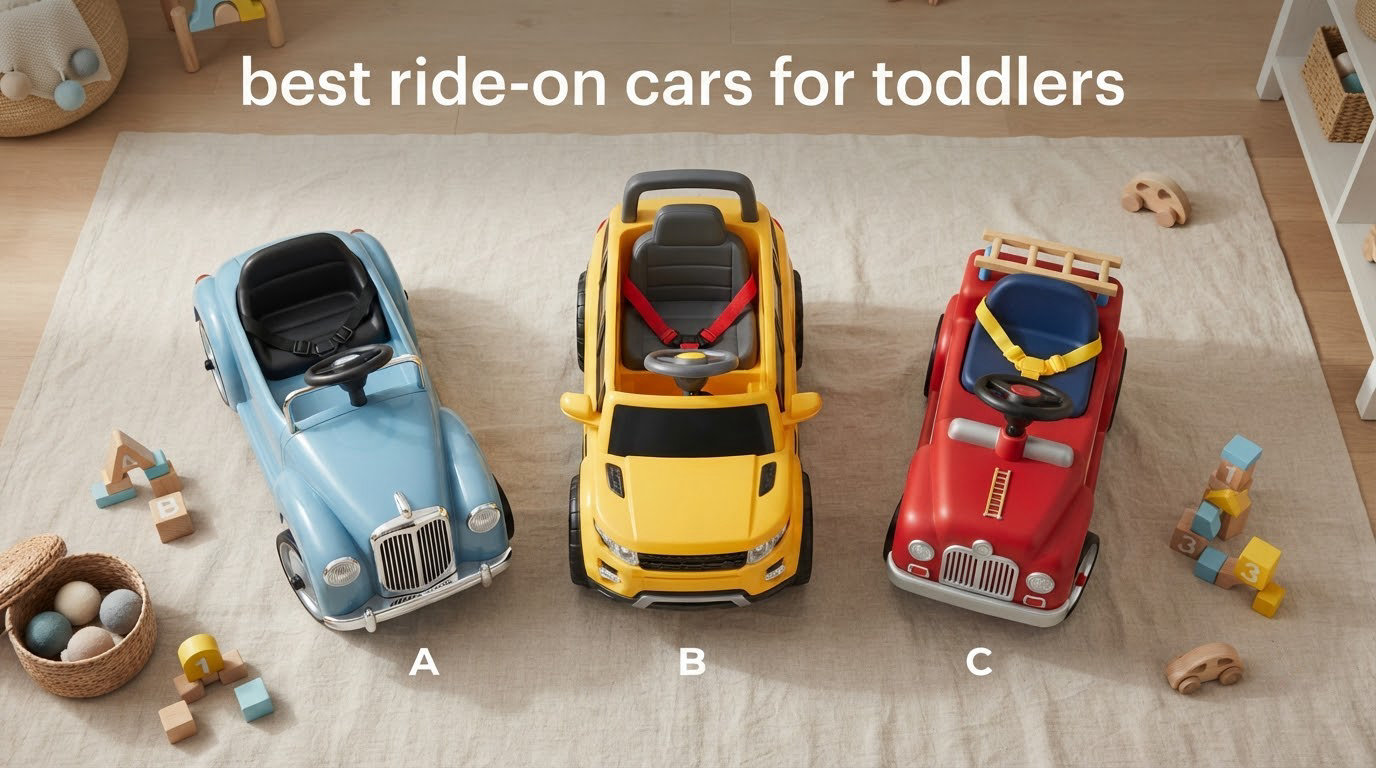
A ride-on car for toddlers comes down to three architectures, and picking the wrong one wastes money fast. Under 24 months means a foot-to-floor or push car with no motor at all. From about 18 months to 30 months a low-voltage battery car with a parent remote starts to make sense. At two years and beyond you can move to a 12V ride-on with a 2.4GHz remote, and that is the ceiling for toddlerhood.
That last point matters more than any feature list. Anything above 12V, or anything that tops out above 3 mph, is built for a child of three or older no matter what the box says. We filtered the 2026 shortlist on that rule first, then on weight capacity, because a car with a 50 lb limit is finished in months while a 66 lb car lasts years.
Our team spent several weeks comparing these twelve vehicles on assembly, real-world ride surfaces, remote behaviour and how quickly each child outgrew it. We also pulled apart the review data to separate what owners genuinely praise from what the product pages promise. Two themes came up again and again: battery runtime always lands below the manufacturer claim, and nearly every complaint about quality traces back to assembly rather than the toy itself.
We kept this list strictly to toddler-appropriate vehicles. Scooters rated 13+, quads and dirt bikes are a different purchase for a different age, and we excluded them on purpose.
Table of Contents
Top 3 Picks for the Best Ride-On Cars for Toddlers

Best Choice Products 12V Kids EV
- 61 lb capacity
- 12V with parent remote
- 2.8 mph
- Spring suspension

Little Tikes Cozy Coupe
- Grows from push to foot-powered
- 18 months to 5 years
- 50 lb capacity
- 360 degree front wheels

BIG Bobby Car Classic
- No assembly needed
- Made in Germany
- 110 lb capacity
- Ready out of the box
The Best Choice Products 12V car takes the top slot because it is the only car in this list that a two-year-old can genuinely drive while an adult holds the controller, and it has the largest review base of any 12V option here. The Cozy Coupe wins the under-two category outright, and the Bobby Car is the highest-rated pick with no assembly at all.
All 12 Best Ride-On Cars at a Glance
| Product | Specifications | Action |
|---|---|---|
| Best Choice Products 12V Kids EV |
|
Check Latest Price |
| Little Tikes Cozy Coupe |
|
Check Latest Price |
 Step2 Whisper Ride II Step2 Whisper Ride II |
|
Check Latest Price |
 Step2 Push Around Buggy Step2 Push Around Buggy |
|
Check Latest Price |
| BIG Bobby Car Classic |
|
Check Latest Price |
 Little Tikes Push and Ride Racer Little Tikes Push and Ride Racer |
|
Check Latest Price |
 Radio Flyer Creativity Car Radio Flyer Creativity Car |
|
Check Latest Price |
 ANPABO 12V Mercedes G63 ANPABO 12V Mercedes G63 |
|
Check Latest Price |
 Kiddieland Lightning McQueen Kiddieland Lightning McQueen |
|
Check Latest Price |
 Winado 12V AMG GTR Winado 12V AMG GTR |
|
Check Latest Price |
 Miniature Motors 12V Truck Miniature Motors 12V Truck |
|
Check Latest Price |
 Best Ride On Cars Mercedes G-Wagon Best Ride On Cars Mercedes G-Wagon |
|
Check Latest Price |
Read the table as two groups. Products two through seven have no motor at all and are correct for anything under two. Products one and eight through eleven are 12V electric cars for a child who can already sit steadily and follow instructions. The one thing every row shares is a weight limit, and that number decides how long the car lasts.
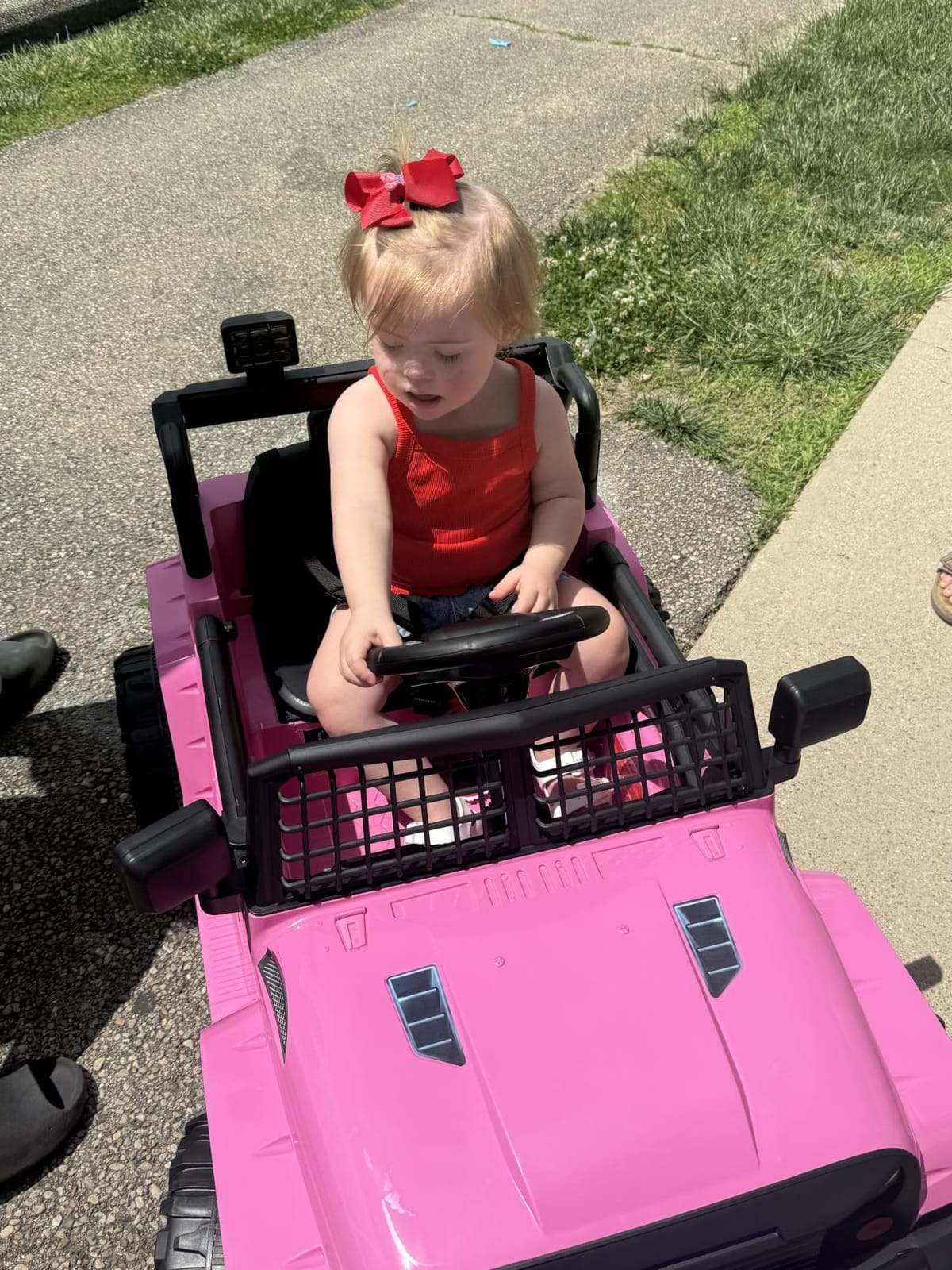
1. Best Choice Products 12V Kids Electric Vehicle – The Best Ride-On Car for a Two-Year-Old Who Wants to Drive
- Dual control so the child drives or the adult steers from the remote
- Lockable doors with an adjustable seat belt
- Never-flat plastic wheels with spring suspension
- AUX input for music
- 21000+ reviews from parents
- 61 lb capacity is modest for a car this size
- 2.8 mph feels slow to a three-year-old
- Assembly and missing parts are the most common complaints
This is the car we kept coming back to. A two-year-old sits in the seat, clips in, and works a real foot pedal while an adult holds the remote, which is exactly the milestone the pedal-to-motion link is supposed to deliver. The soft, low acceleration means the first drive on a driveway is not a lurch.
It measures 39.25 inches long by 26 wide by 26 tall and weighs 32 lb, so it stores against a wall without dominating a garage. At 61 lb of capacity it is a modest limit, and that is the one spec we would change if we could. Expect roughly a season and a half from a small two-year-old.
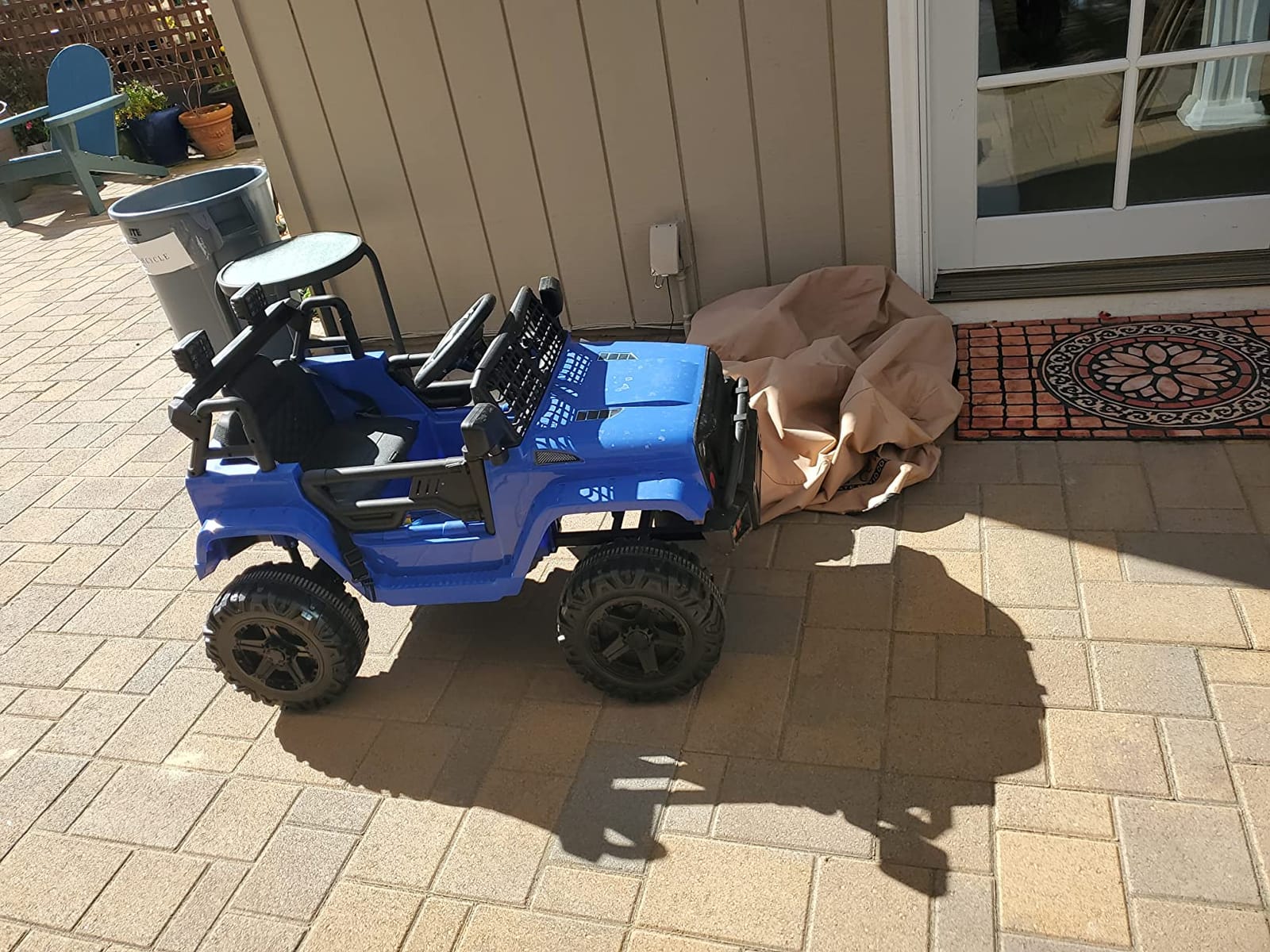
The never-flat plastic wheels are a genuine advantage over rubber, which is why this car copes with a gravel driveway and a lawn edge without a puncture. Spring suspension takes the worst out of paving joints. The lockable doors and adjustable belt are the details parents mention most warmly, because they turn a toy into something a child feels responsible for.
Will a two-year-old actually get the hang of it?
Yes, with supervision. The manual mode engages the moment your child presses the pedal, and the remote lets you cut in before they reach a kerb or a parked car. We recommend leaving it in manual for the first few sessions on a flat driveway, then switching to remote mode once the steering response feels natural.
The 2.8 mph cap is what keeps this safe at that age. It also means a five-year-old will find it slow, which is the honest trade-off for a car that works at two.
When should you skip this one?
Skip it if your child is under two and already walking confidently, because they will be able to reach the pedal before they can steer. It is also the wrong choice for a child near the 61 lb ceiling, since the headroom disappears quickly on a tall toddler.
Reviewers also flag assembly and occasional missing parts as the recurring gripes. Build it in one sitting with the hardware sorted out first, and check the box contents against the guide before you start.
2. Little Tikes Cozy Coupe – The Best Push Ride-On That Grows With Your Child
- Removable floorboard switches between parent-push and foot-powered modes
- Working doors
- clicking ignition
- horn and gas cap
- 360 degree front wheels make tight spaces easy
- Trunk and cup holders for storage
- Stiff plastic parts make assembly demanding
- Decorative stickers peel and leave sticky residue
- Noticeably loud on hard surfaces such as sidewalks
No electric ride-on in this list has more review volume than the Cozy Coupe, and after spending time with it the reason is obvious. Nothing about it needs to work. A toddler in socks can scoot across a kitchen floor using the floorboard alone, and the car keeps doing that until they are five.
Putting the floorboard back in converts it into a push car you can steer from behind, which is how a lot of families use it on the school run. The 360-degree front wheels do most of the hard work here, letting an adult pivot it in a doorway that a fixed-wheel push car cannot manage.
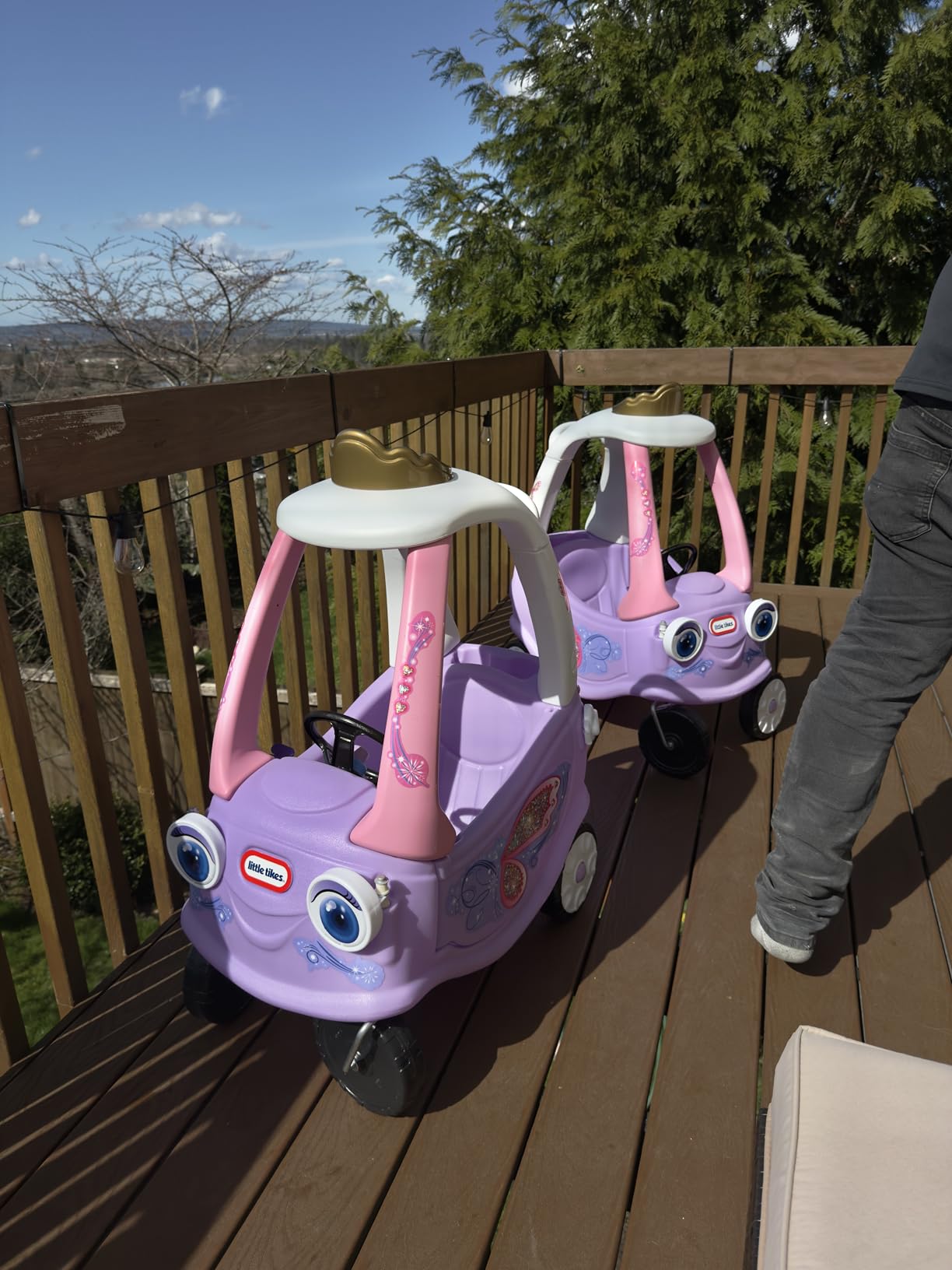
At 29.5 inches long, 16.5 wide and 33.5 tall it weighs 17.7 lb and is genuinely portable for one adult. The trunk swallows a small bag and the cup holders take a bottle, which parents tell us is what converts a short spin into a full-length walk.
Is this a first car or a last car?
Both. The 18-month to 5-year range is unusually wide, and the removable floorboard is the mechanism that makes it work. Many owners report passing it to a second child rather than selling it, which is the best value argument in this roundup.
It also has no battery, no charge time and no motor to fail. That simplicity is the reason it suits a child who is not ready for a pedal.
What will annoy you day to day?
Assembly. Owners describe the plastic parts as stiff enough to need real force, and a couple of screwdriver skills help. The stickers also lift over time and leave residue, which matters if you park it in a nice room rather than a garage.
The other recurring note is volume. On wooden floors and pavers the plastic wheels are louder than you would expect, so it is not the quietest choice for an upstairs flat.
3. Step2 Whisper Ride II – The Best Push Car for Daily Walking Distance
- Whisper-ride wheels roll very quietly
- Extra-wide rear handle is comfortable for adults
- Adjustable seat belt with horn and under-hood storage
- Double-walled plastic body with a 2 year limited warranty
- Fold-down handle must be unscrewed to fit a car boot
- Picture-only instructions take 1.5 to 2 hours
- Front wheels are fixed in line so turning needs a lift
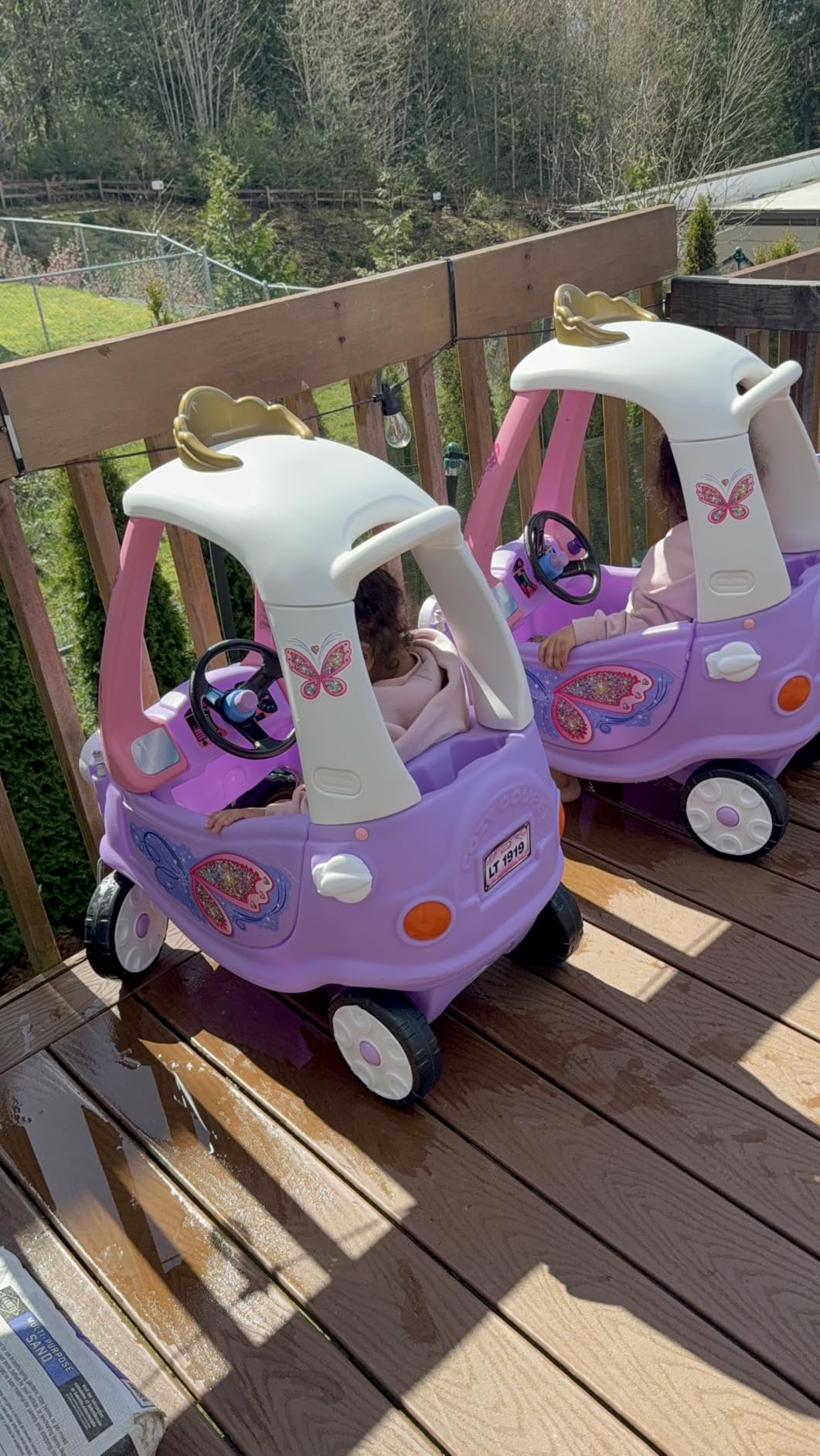
The Whisper Ride II is the stroller substitute that parents use for the whole school run, and the name is accurate. The wheel design rolls almost silently, which is why it works on hard floors and quiet hallways without the neighbours hearing a four-year-old apparently racing.
At 45.5 inches long and 19 wide it is a much bigger vehicle than the Cozy Coupe, weighing 7.1 kg, so there is real footroom for a child in a winter coat. The extra-wide rear handle makes long pushes comfortable, and a six-cup or snack holder is included for the inevitable snack negotiation.

The double-walled plastic construction and a 2 year limited warranty are the durability cues we look for in a push car, and they hold up under daily park use. The 50 lb limit matches the Cozy Coupe rather than beating it, so it will not outlast a heavier child.
Why do so many families treat it as a stroller substitute?
Because the handle is designed to be pushed one-handed while the other hand holds a toddler hand or a lead. With a seat belt, a real horn and under-hood storage, it covers the school run and the park in one piece of kit. The seat belt matters more here than you would expect, because a child standing up in a moving push car is the actual risk.
We found the low, floor-level seating position is what makes it usable at 18 months, and the space under the hood is genuinely big enough for a water bottle and a set of keys.
What are the drawbacks parents report?
Assembly is the big one. The picture-only instructions can take 1.5 to 2 hours for a first-timer, and we would budget for that rather than assume an hour. The fold handle also has to be unscrewed off to fit in a car boot, which is annoying for grandparents who transport it regularly.
Turning at full lock is harder than it looks, because the front wheels are fixed in line. A short child has to be lifted or nudged at the front to swing it around, so it needs a wide path.

4. Step2 Push Around Buggy – The Best Push Buggy for Park Daily Use
- Sturdy build that holds up after months of daily park use
- Comfortable parent handle on long walks
- Adjustable harness with a real horn
- Under-hood compartment fits snacks and a bottle
- Tires wear faster on rough or gravel ground
- A short rider can make the handle awkward for taller adults
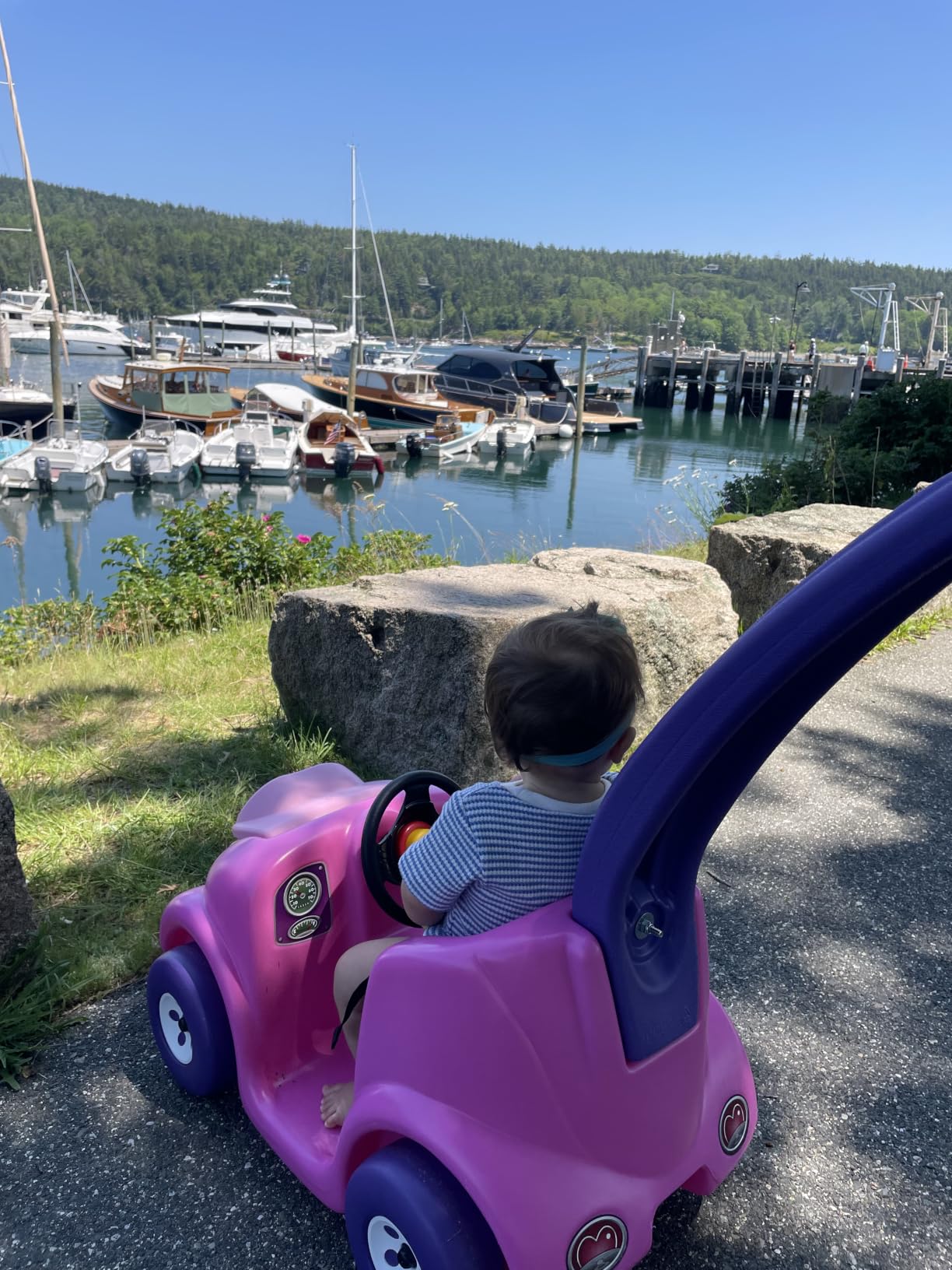
This is the buggy version of the Whisper Ride, and for many families it is the better buy. The manufacturer lists 19 months to 3 years, which puts it squarely in toddler territory, and owners rate durability very highly after months of daily use at the park.
It weighs 14.2 lb and measures 43.5 by 17.75 by 34.5 inches, so it is lighter and narrower than the Whisper Ride II and easier for one adult to handle. The adjustable harness does a better job of holding a wriggly two-year-old than a lap belt would.
Our one note is about the warranty, because it is the difference between the two Step2 push cars. This listing states no warranty, while the Whisper Ride II carries a 2 year limited warranty. If durability is your priority, that is worth comparing carefully.
Is this better than the Whisper Ride II?
For a smaller child and tighter storage, yes. The narrower body and lower weight make it the easier car in a small hallway or a flat with a lift. The harness is a genuine upgrade for a child who keeps climbing out under a standard belt.
For a taller adult pushing for long distances, the Whisper Ride’s extra-wide handle is more comfortable. Ergonomics here depend as much on the adult as on the child.
Where does it fall short?
Surfaces. The tires wear faster on rough ground and gravel, so it is really a paved-path and indoor toy. On grass or a rough track you will be pushing rather than cruising within a year.
Because the listed age band ends at 3 years, you will likely outgrow it rather than grow into it. Plan on it as a two-season purchase unless your child is small for their age.

5. BIG Bobby Car Classic – The Highest Rated Ride-On in the Set
- Ready to ride straight out of the box
- 4.8 average rating across more than 6500 reviews
- 110 lb capacity far beyond typical toddler push cars
- Ergonomic seat and low centre of gravity
- Compact footprint suits younger toddlers better
- No parent push handle so an adult cannot steer it
At 4.8 stars across more than 6500 reviews, the Bobby Car is the highest-rated product here, and the reason is unglamorous: it arrives complete. There is nothing to assemble, no battery to charge and nothing to configure.
It measures 23.23 inches long, 12.2 wide and 10.63 tall and weighs just 2.9 kg, so one adult can move it between rooms and it stores anywhere. The low centre of gravity and ergonomic seat give a beginner real stability, and the wide stance keeps it upright when a beginner leans.
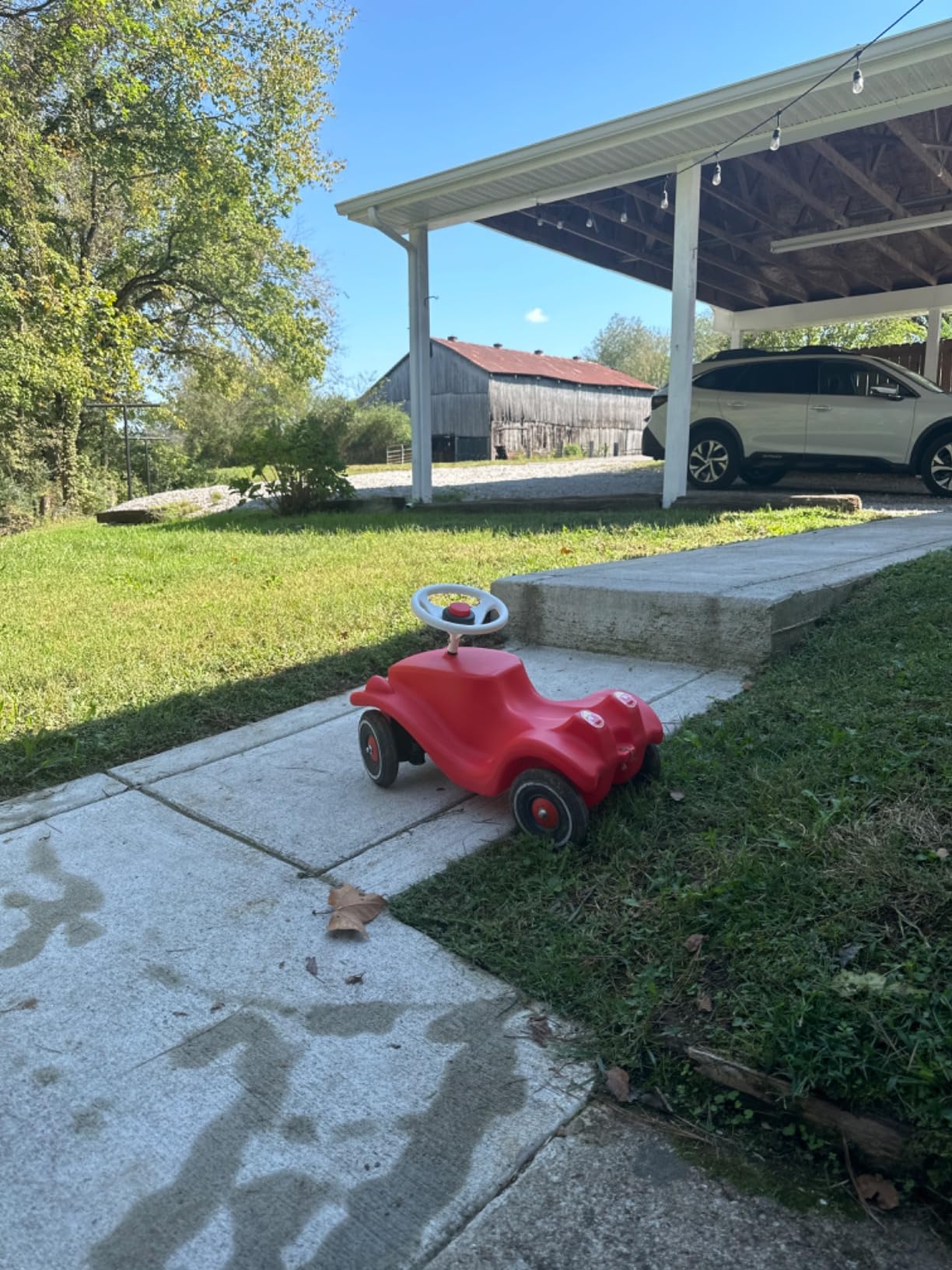
Then there is the capacity. At 110 lb, this car will not be the limiting factor in your child’s early years, which is the single most common complaint we found across 12V electric cars. It is made in Germany, and owners consistently comment on build quality that outlives cheaper plastic pedal cars.
Who is the 110 lb capacity really for?
For the child who starts at 18 months and keeps going. Most push cars in this roundup cap at 50 lb, which a large five-year-old will reach. This one will not, so it genuinely grows with the child rather than being outgrown.
That also makes it a strong hand-me-down candidate. A Bobby Car passed from sibling to sibling is a real thing in families, and the construction is built for it.
What should you know before you buy?
There is no parent push handle. Your child drives with their feet, and an adult can slow them but not steer them, so this is an indoor and smooth-surface toy first. The compact footprint also means less knee room for an older child, despite the generous weight limit.
If your pavement is uneven, expect a bumpier ride than the spring-suspended electric cars.
6. Little Tikes Push and Ride Racer – The Best Ride-On for a Child Under Two
Little Tikes Push and Ride Racer – (Amazon Exclusive), 22″L x 10″W x 17″H with screws
- Walker
- push-bar ride-on and foot-to-floor racer in one
- Low seat and wide handle suit babies from 9 months
- Durable plastic with stable tire friction for balance learning
- Light enough to self-propel on carpet and hardwood
- Hardest assembly in the set and may need force or a hammer
- Instructions are thin so extra parts can be mistaken for tools
- Posture suits average or shorter toddlers
This is the earliest-starting ride-on in the roundup, listed from 9 months, and that is the whole point. Used as a push walker it gets a baby upright and moving before they can steer, then converts to a foot-to-floor racer when they are ready to propel themselves.
At 22 by 10 by 17 inches it is small enough for a flat and light enough that a toddler can scoot it across carpet without help. The high back and sturdy handles keep an unsteady new rider upright, and the low seat makes mounting and dismounting easy.
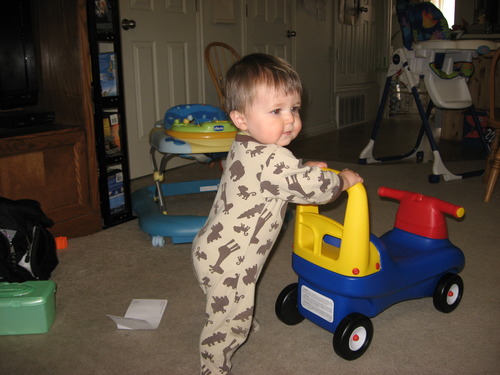
We would pick this over any electric car for a child under 18 months. There is no pedal to reach, no motor to overwhelm and nothing to charge, and the tire friction is tuned for balance learning rather than speed.
Is a 9-month-old really old enough?
As a walker, yes, which is how the manufacturer specifies it. Powered mode is for when the child is walking confidently, usually somewhere around 18 months. Parents on r/Mommit who were shopping for a very active 14-month-old wanted exactly this developmental progression rather than a themed character car.
Three modes in one toy also solves the sibling problem cheaply, since a baby and a toddler can both get on it in different configurations.
What about assembly?
Plan for it. This is the most difficult build in the set, with plastic parts that some owners report needing real force or even a hammer, and thin instructions where spare parts can be mistaken for tools. Take your time and lay the screws out sorted.
The other limitation is fit. Taller toddlers may find the intended seated posture cramped, so check legroom against your child’s height before committing.
7. Radio Flyer Creativity Car – The Best Budget Ride-On for Sensory Play
- Push walker
- ride-on and sensory play in one
- 17 activities including gears
- sliding beads and mirrors
- Anti-tip base and a 4.9 lb weight make it very stable
- Flip-up seat doubles as under-seat storage
- Front wheels do not steer with the wheel
- 42 lb capacity suits small toddlers
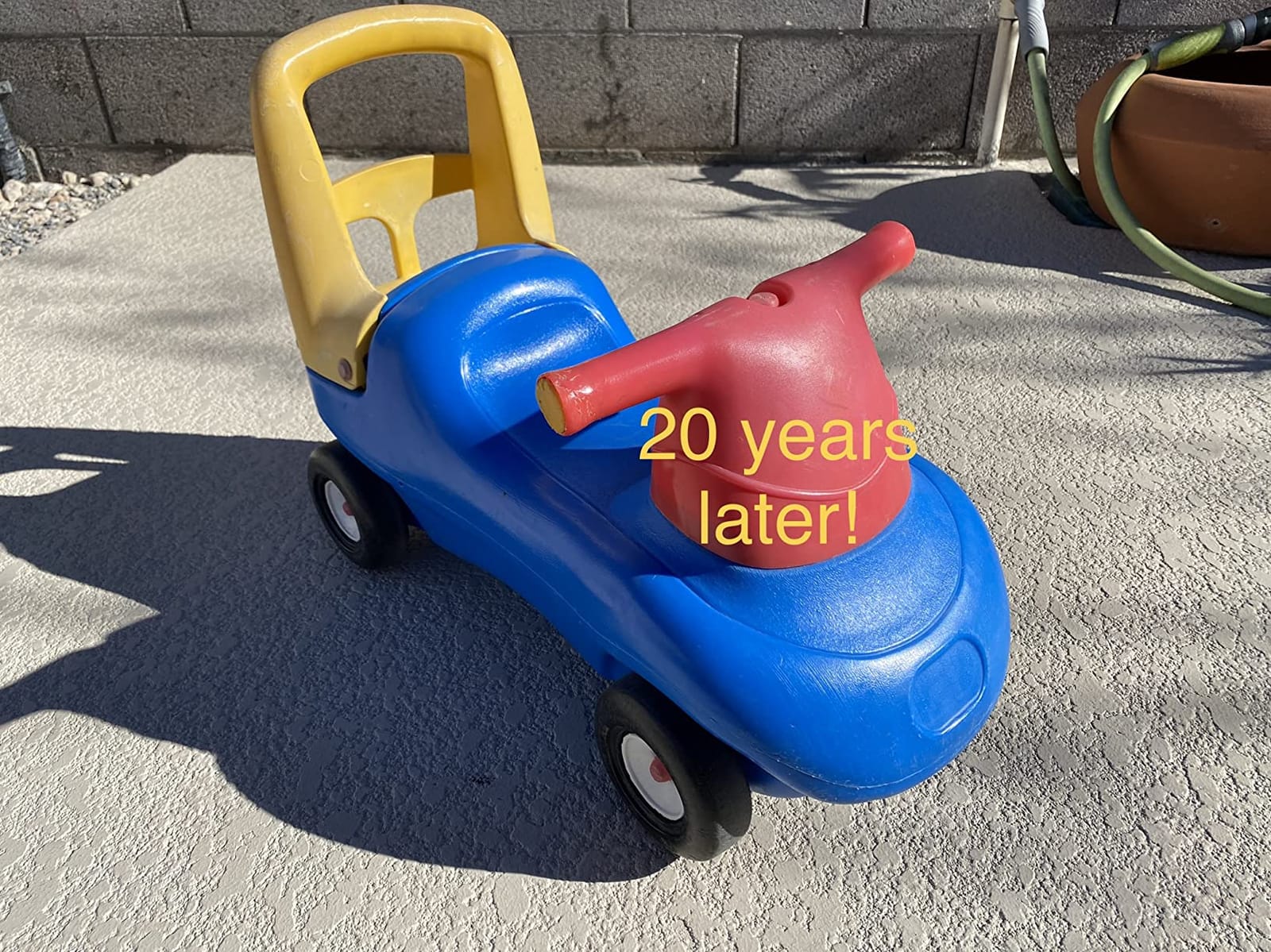
The Creativity Car is the one to buy when your toddler is not interested in pretending to be a driver and just wants something to fiddle with. Alongside the ride-on and walker modes it packs 17 activities: interlocking gears, sliding beads, a clicking spare tyre, folding mirrors and a horn.
At 4.9 lb it is one of the two lightest vehicles here, and the anti-tip base gives it a wide, stable footprint. That combination means a one-year-old can manoeuvre it across a hard floor without adult help, which is what makes it a genuine early-start pick.
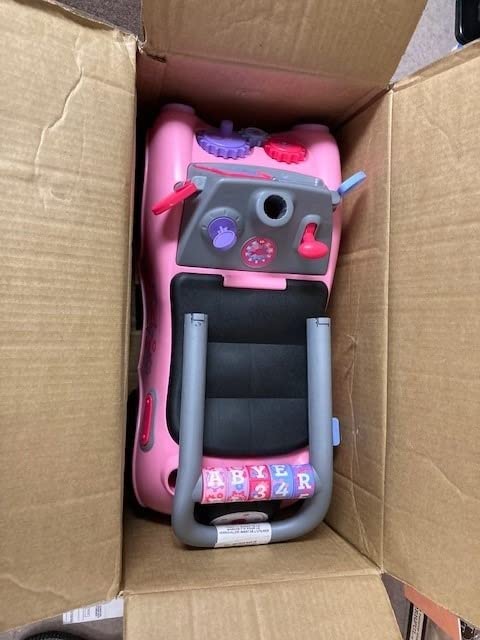
It also arrives largely assembled, and the seat flips up to reveal storage. At 21.5 by 10.5 by 16.3 inches it disappears against a wall when play is over, and the 1 year manufacturer warranty covers defects.
Is the sensory activity worth the trade-off?
If your child sits and manipulates things happily, absolutely. The dashboard is the toy as much as the driving is, and it holds attention for rainy days indoors. The trade-off is that this is a less convincing car than a themed replica, so a child obsessed with vehicles may find it less satisfying.
The 42 lb capacity is the other trade-off, and it is lower than most push cars here. It suits small toddlers well and stops being useful sooner.
What do owners complain about?
The steering. The front wheels do not connect to the steering wheel, so the car has to be tilted to turn. Several reviews raise this as the consistent flaw, and it is the one thing to warn a child about before they try it.
Beyond that, the feedback is unusually clean for a budget pick, and the 4.8 average reflects that.
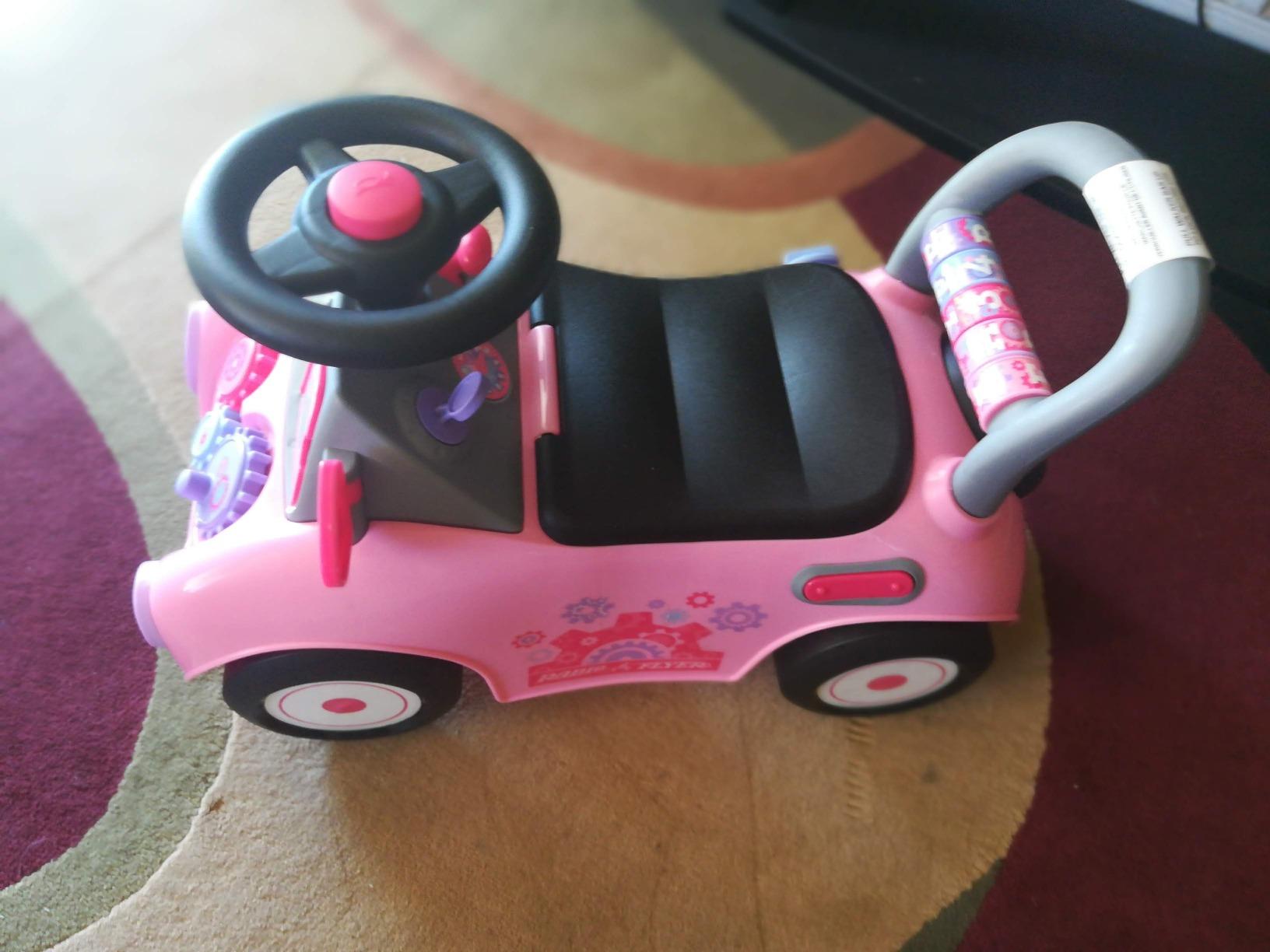
8. ANPABO 12V Mercedes G63 – The Best Licensed SUV for a Confident Two-Year-Old Driver
ANPABO 12V 7AH Licensed Mercedes-Benz G63 Electric Car for Kids, White
- Twin 35W motors and a 7Ah battery give noticeably stronger power
- Remote with forward and reverse plus a manual mode
- Soft start
- power switch
- seat belt and spring suspension
- Headlights
- engine sounds
- USB and Bluetooth
- Widest footprint in the roundup at 44 inches
- Heaviest car in the set at 36.2 lb
- Listed from 3 years so a small toddler is at the bottom of the band
The G63 is the most capable electric car here on grass and gravel, and the reason is the power pack rather than the badge. Two 35W motors and an upgraded 12V 7Ah battery give it real torque, where most 12V cars use smaller packs and bog down on a lawn.
It reaches 3 mph, which is the honest ceiling for toddler use, and the soft start keeps that speed from arriving all at once. The remote gives you full stop and steering, and manual mode takes over the moment the child presses the pedal.
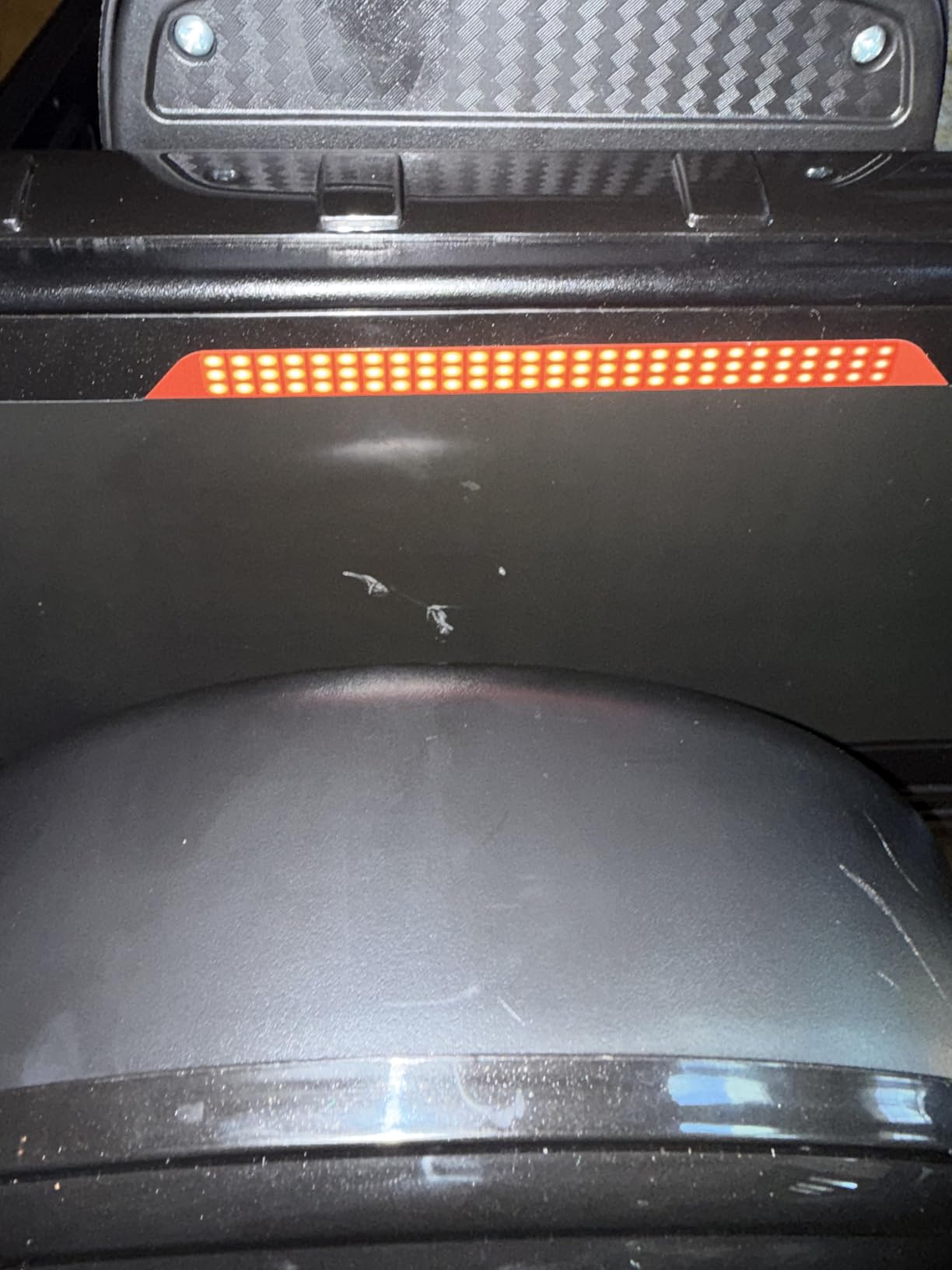
It also carries the full licensed treatment: the Mercedes grille, headlights, horn, engine sounds, built-in songs and USB plus Bluetooth playback. It weighs 36.2 lb, which is the heaviest car in the roundup and the one that takes two adults to move comfortably.
Does the extra power matter for a toddler?
On hard surfaces, not much. On grass, gravel and a driveway with a slope, it is the difference between a car that climbs and a car that stops. If your outdoor space is not flat and paved, that is the reason to stretch here rather than save.
The soft start and safety belt package is also more complete than most, and owners rate the remote control as smooth.
What are the drawbacks?
Size. At 44 by 23 by 28 inches it is the widest vehicle in the roundup, and it needs real floor space indoors plus a dedicated corner in the garage. Parents mention the footprint far more than any functional problem.
It is also listed from 3 years, so a small two-year-old is at the very bottom of the band. Check your child’s weight against the 66 lb capacity before you commit.
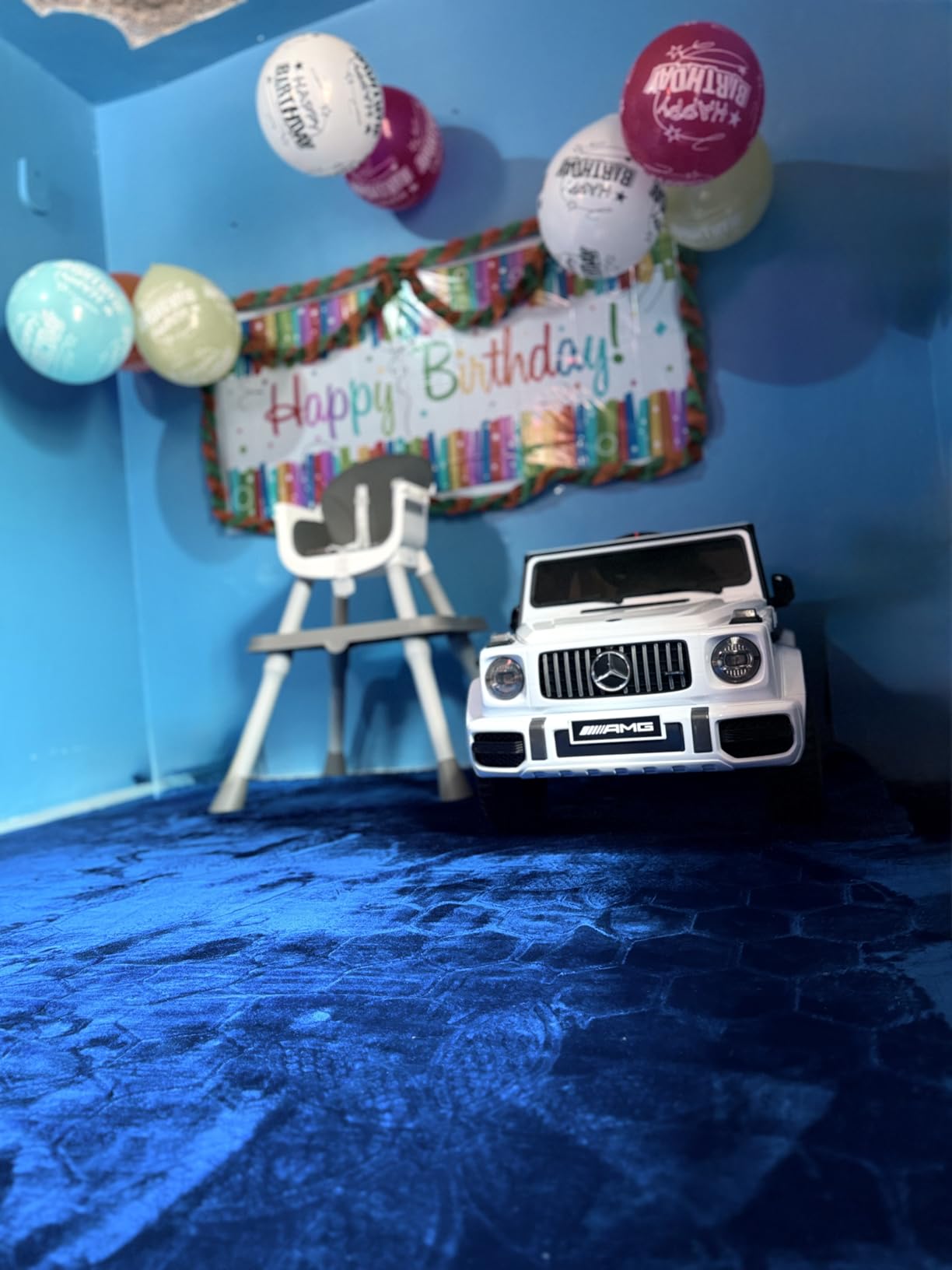
9. Kiddieland Lightning McQueen – The Best Foot-to-Floor Car for a Cars Fan
Kiddieland Lightning McQueen Ride-On Car, Foot-to-Floor Racer for Toddlers
- Faithful licensed replica that reads clearly as Lightning McQueen
- Wide wheelbase and anti-tip design keep beginners stable
- Arrives assembled with only a pull tab to remove
- Light 3.4 lb build moves smoothly across hard floors
- Most buttons play generic engine sounds rather than character clips
- Several buttons trigger the same audio
- No stated weight capacity
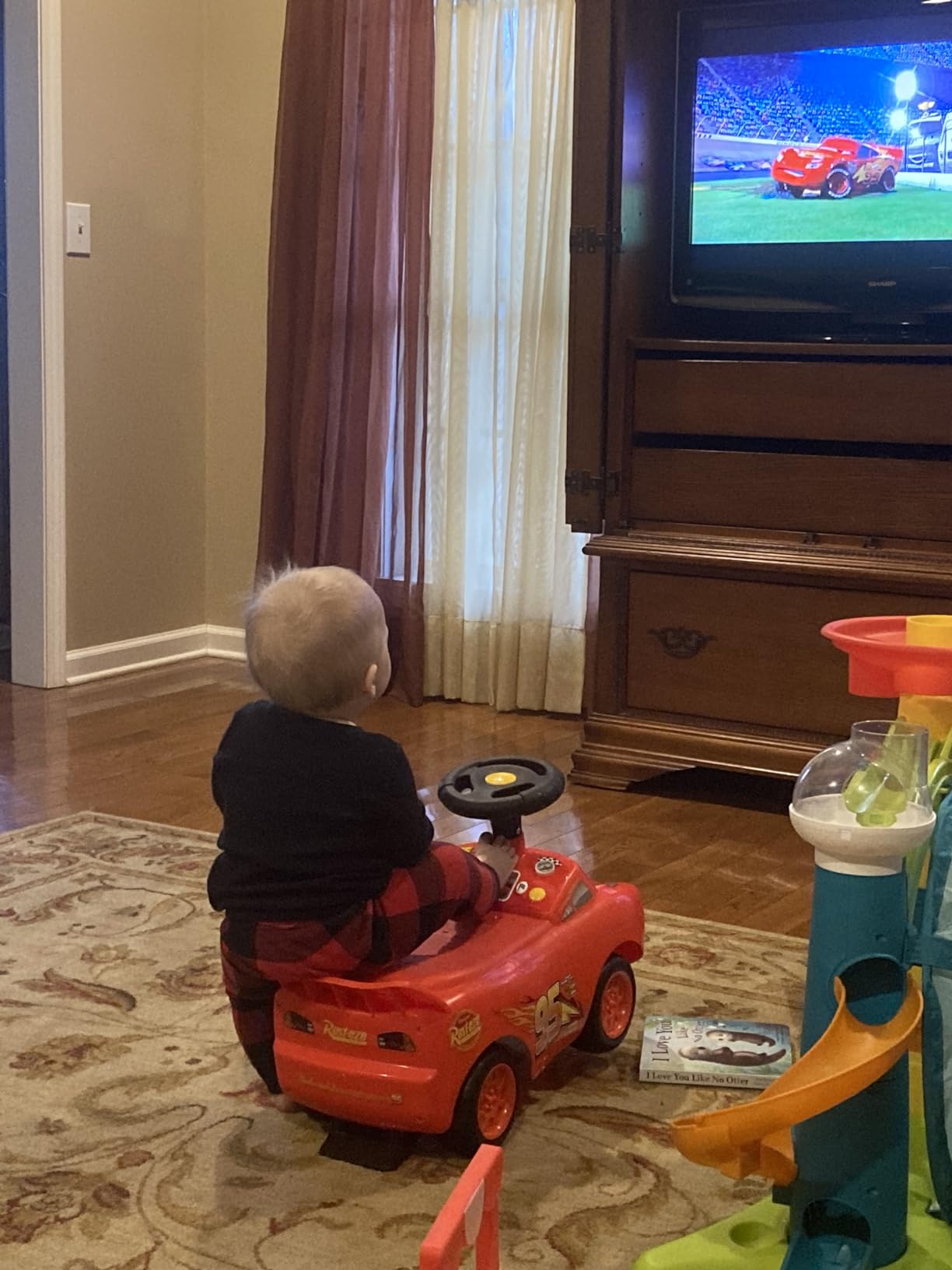
If your toddler is a Disney Pixar Cars fan, this is the gift that lands. It is a genuine licensed Lightning McQueen replica rather than a generic red car with a decal, and children who know the films recognise it immediately.
It is a pure foot-to-floor racer with no motor, rated for 12 to 36 months. At 20.75 by 9.75 by 14 inches and 3.4 lb it is the lightest vehicle we tested alongside the Radio Flyer, so a new walker can move it on hard floors with no help.
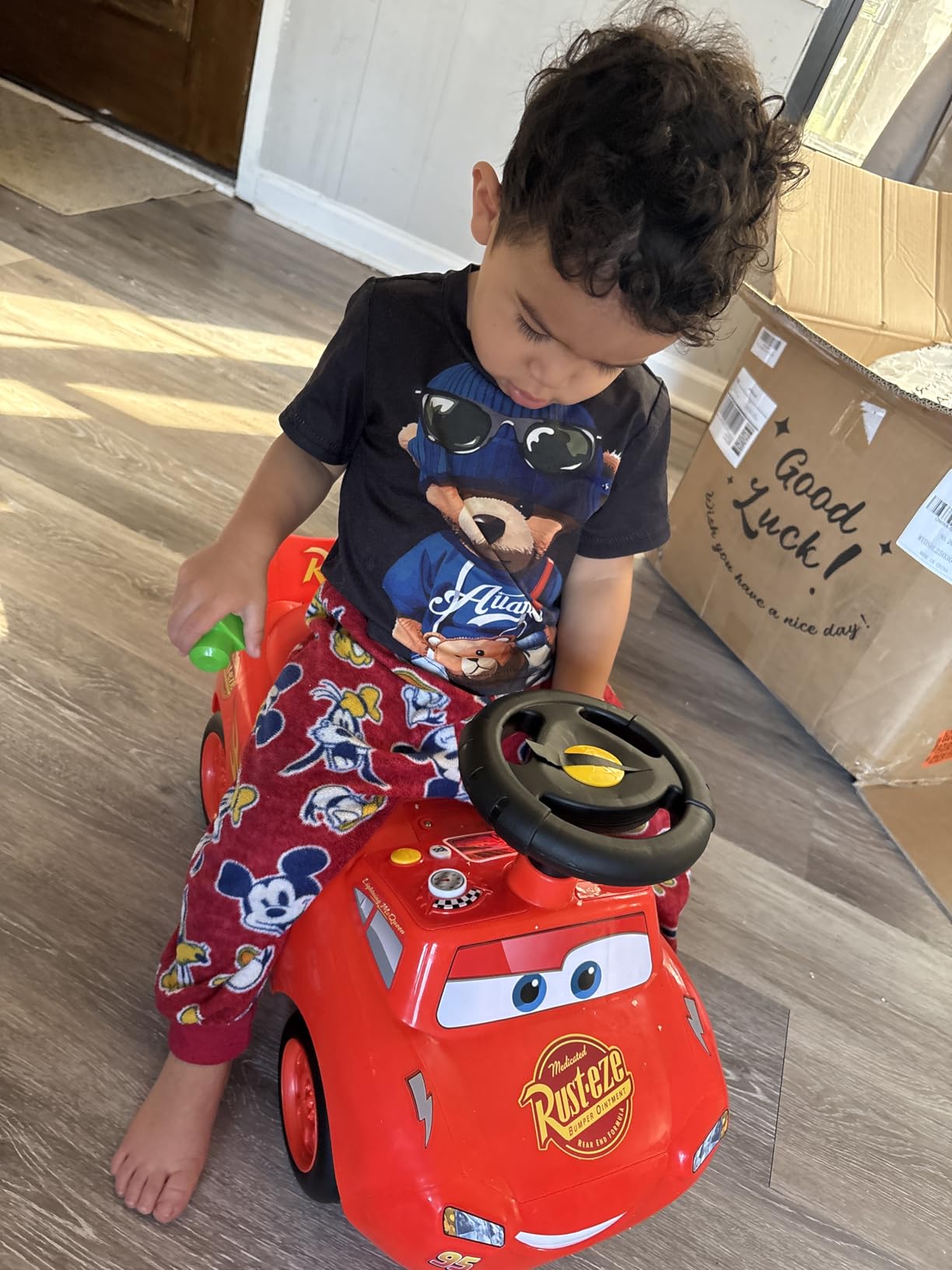
The wide wheelbase and rear anti-tip attachment are what make it safe for a beginner, and it arrives assembled with only a plastic battery pull tab for the sounds to remove. That means it works as a gift on the morning it arrives.
Why is a foot-to-floor car right at this age?
Because it develops the same core skill as a pedal car without the speed. A toddler learning to balance and steer is doing the foundational work, and adding a motor on top of that stage tends to add noise rather than progress. The ignition key, accelerator and brake effects still teach cause and effect through the sounds.
It is also a safe first step before a 12V car at three.
What should you know before buying?
The audio is the disappointment. Several buttons trigger similar generic engine noises rather than character voice clips, and multiple buttons play the same clip, which wears thin after a week. Nothing on the car is missing, it is simply not a soundtrack experience.
There is also no stated weight capacity, so the practical limit is set by leg length and balance rather than a published figure. Check that before your child grows out of the seated posture.
10. Winado 12V Mercedes AMG GTR – The Best 12V Car for Small Rooms
Winado 12V Licensed Mercedes Benz AMG GTR Kids Ride on Electric Car, Red
- Officially licensed AMG GTR replica with openable doors
- Two modes with a 3-speed parent remote and 2-speed manual mode
- Widened seat with an adjustable seat belt
- Bright headlights
- taillights
- music
- USB and AUX
- Smaller than most 12V ride-ons so sizing expectations disappoint
- 55 lb capacity suits ages 3 to 5 rather than toddlers
- 8 to 12 hour charge time is lengthy
This is the compact 12V option, and at 39 by 22 by 17 inches it is roughly a third narrower in footprint than the G63. For a flat, a small driveway or a garage already full of things, that difference decides whether an electric car is realistic at all.
It only weighs 20.5 lb, so one adult can lift it, and the 3-speed remote gives finer control than a single-speed controller. The 2-speed manual mode lets a child progress without a parent intervening on every corner.
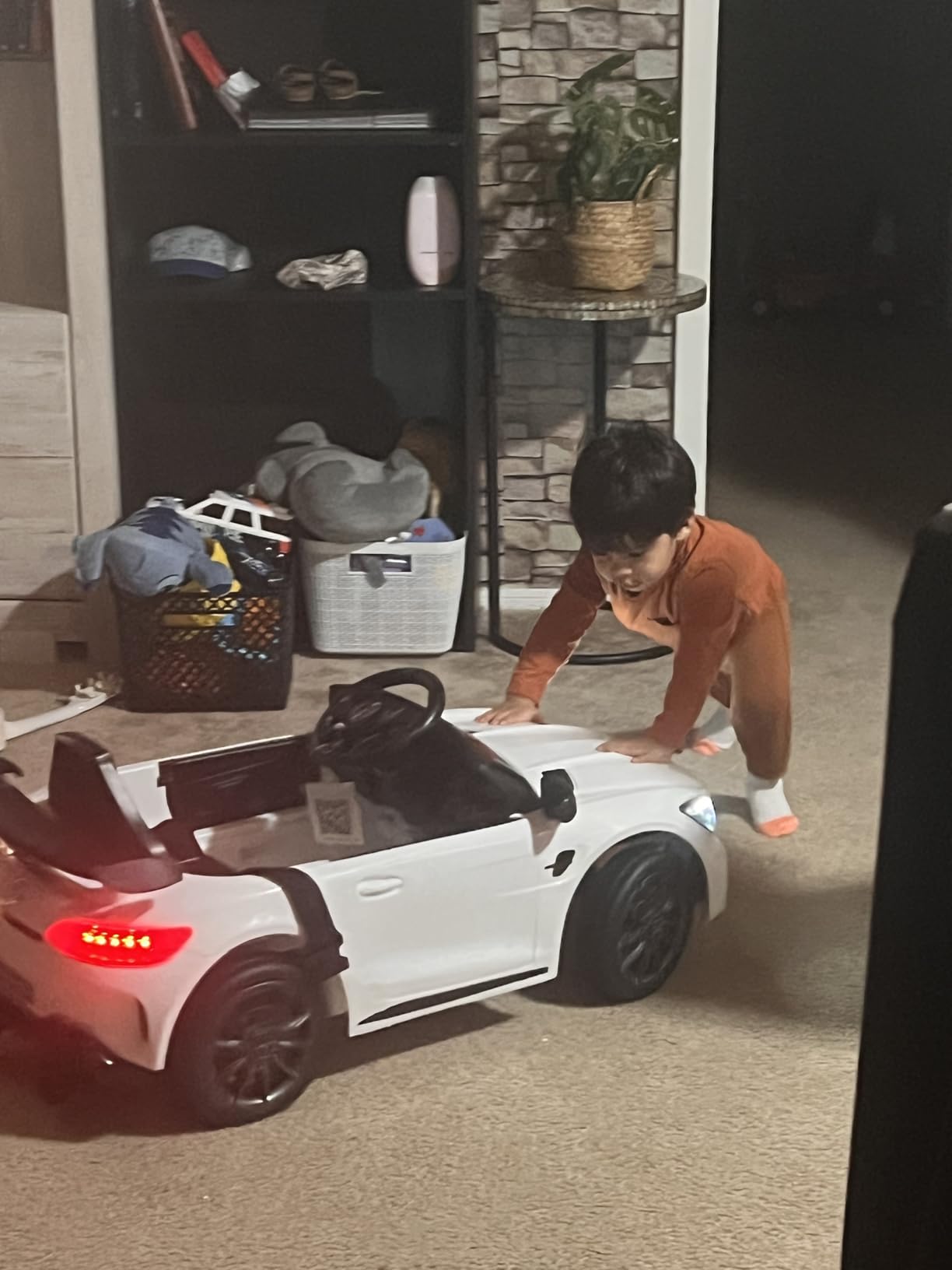
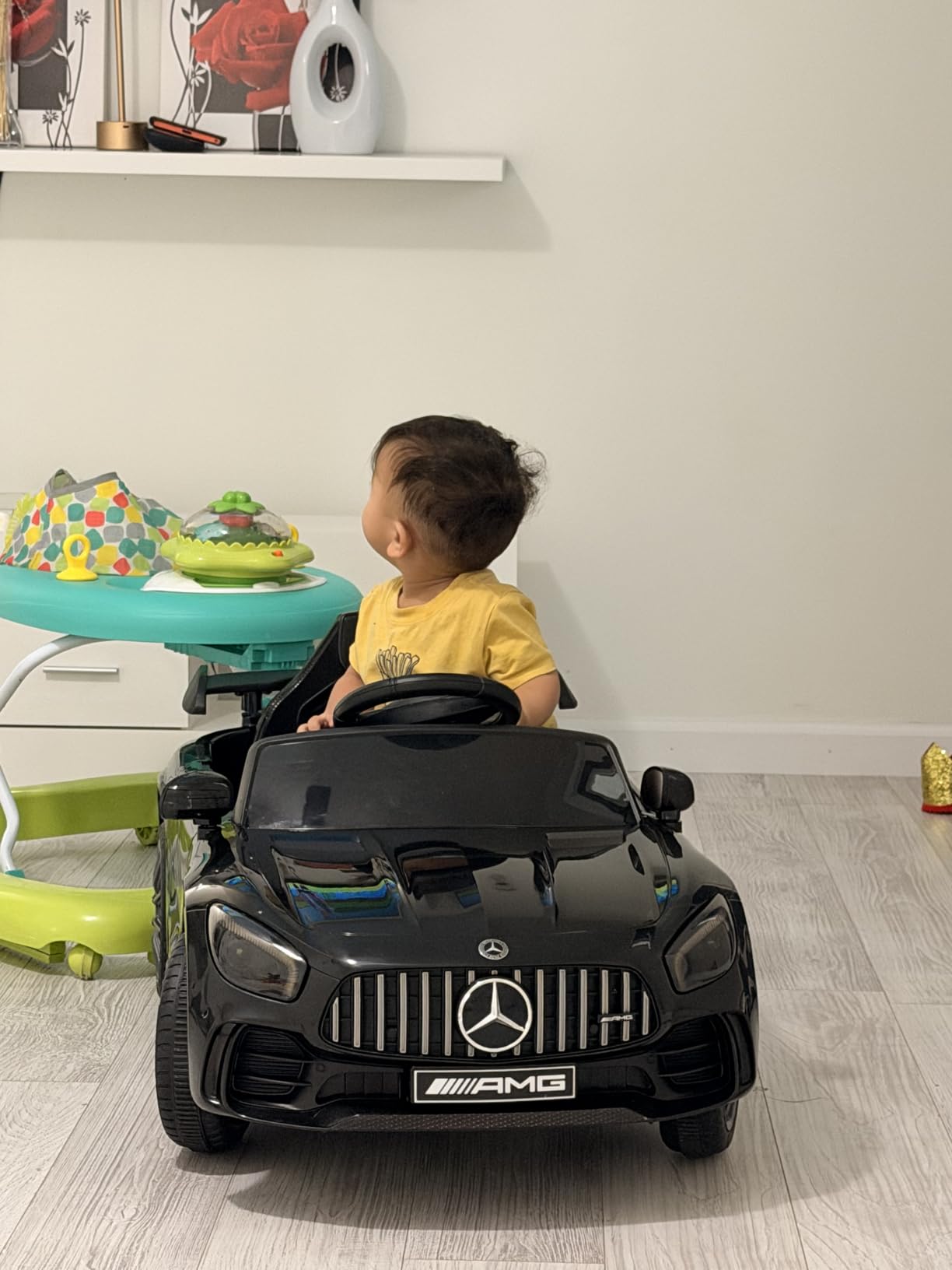
The licensed AMG GTR bodywork includes openable doors and a detailed dashboard, plus headlights, taillights, built-in music, a voltage display and USB and AUX. Widened seat and adjustable belt are the features that keep it usable as a child approaches 55 lb.
Is 55 lb of capacity enough?
It is the lowest in the electric group, alongside the Best Choice Products car. But the openable doors and the seat width make it feel bigger than the capacity number suggests, and many owners report it working well right up to the limit.
Because it is listed for 3 to 5 years, it is a better fit as a third-birthday or Christmas gift than a second-birthday one. A two-year-old will be under the age band regardless of weight.
What about charging and runtime?
Expect 1 to 2 hours of play after an 8 to 12 hour charge. That long charge is the single most criticised feature, and it shapes when you can realistically use the car, so a top-up overnight is the pattern most families settle into.
Owners otherwise report straightforward assembly and strong battery life, and the styling is regularly called authentic.
11. Miniature Motors 12V Kids Truck – The Best 12V Truck with the Shortest Play Sessions
- Twin 35W motors and a 3-speed remote
- Bluetooth speaker
- LED lights
- horn and engine sounds
- Spring suspension with a safety belt and slow start
- ASTM and CPSIA certified
- Manual mode is fixed at the 3.5 mph maximum
- 40 to 60 minutes of runtime is the shortest here
- Assembly required
The Miniature Motors truck is the one to pick if you want a proper truck shape with a stated safety certification, which is unusual in this category. ASTM and CPSIA certification is printed on the listing rather than left to a marketing claim.
Twin 35W motors push it to 3.5 mph, the fastest in this roundup, and the slow-start technology ramps it up rather than snapping it to speed. The 66 lb capacity is joint highest here, so it will not be the reason your child moves on.
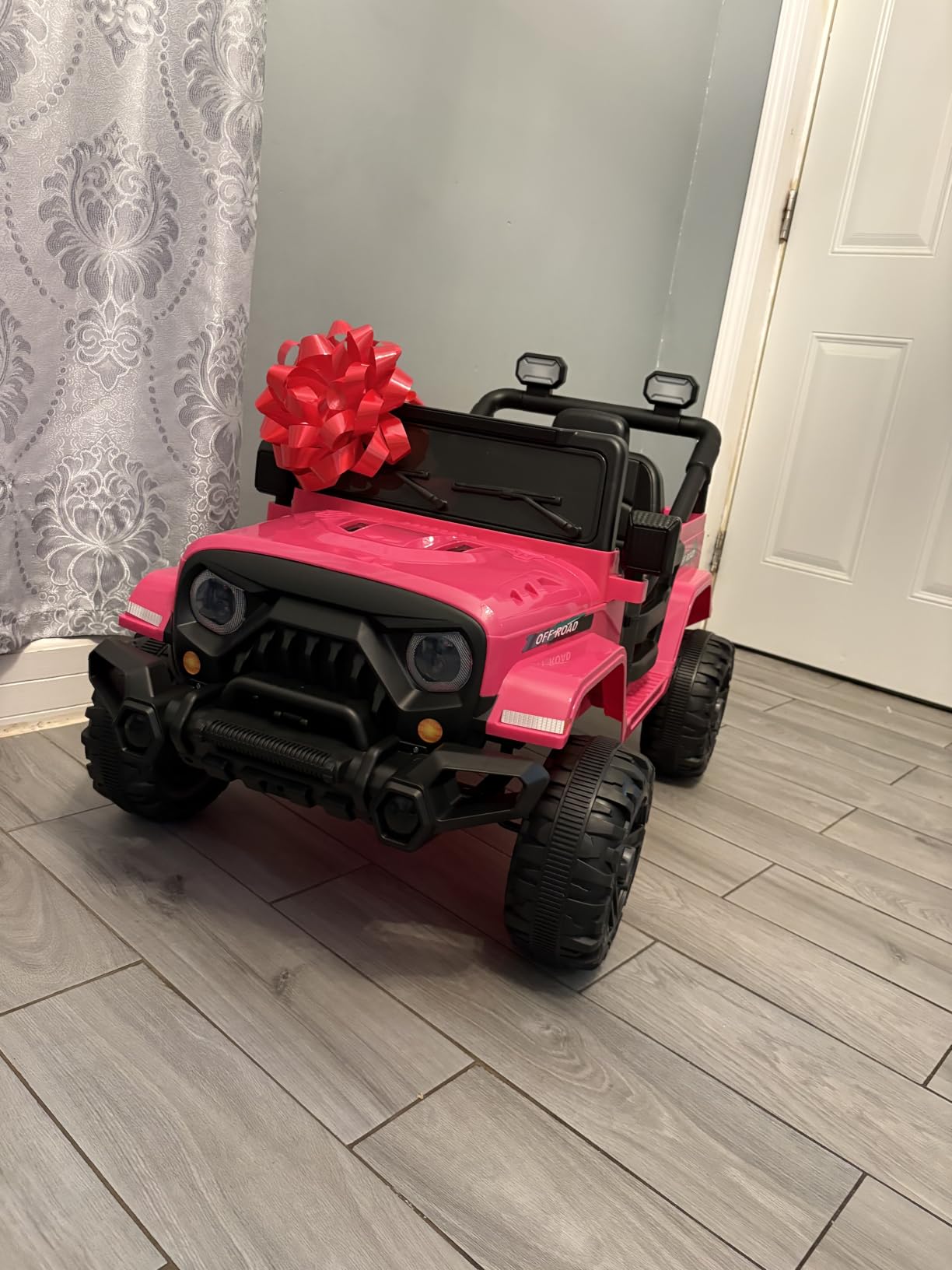
Entertainment is the strong suit: a Bluetooth speaker, LED lights, a horn and engine start-up sounds. Spring suspension smooths out the ride, and at 26.4 lb and 39 by 24.4 by 24.4 inches it sits between the compact Winado and the large G63.
Is the top speed a problem for a toddler?
Only if you let them use manual mode. The remote offers three speeds from 2 mph, which is the setting a two or three-year-old should be in. The catch is that manual mode is fixed at 3.5 mph with no low-speed option, so once your child is driving independently, there is no way to slow the car down remotely.
That is the single most important thing to know before handing over the pedal.
How long does the battery last?
Plan for 40 to 60 minutes of continuous play, which is the shortest runtime in the roundup and the most common complaint. Owners also note that assembly is required before the first drive.
Parents trying to extend drive time in online ride-on groups usually solve it with overnight charging rather than anything cleverer, and a 12V pack is replaceable, so a second battery is worth planning for.
12. Best Ride On Cars Mercedes G-Wagon Push Car – The Best 3-in-1 Push Car for a Mixed-Age Household
Best Ride On Cars Kids Outdoor Stroller Mercedes G-Wagon for Toddlers 1 to 3 Years Old with Music, Horn Sounds, and Handle, White
- Converts between stroller
- ride-on and baby walker
- Mercedes G-Wagon styling with a tufted faux-leather seat
- Steering wheel with music and horn sounds
- Removable safety guardrails with backrest and footrest
- Hidden storage under the seat
- No seat belt included and several reviewers raised it
- Push handle feels flimsy
- Limited turning radius and unclear assembly instructions
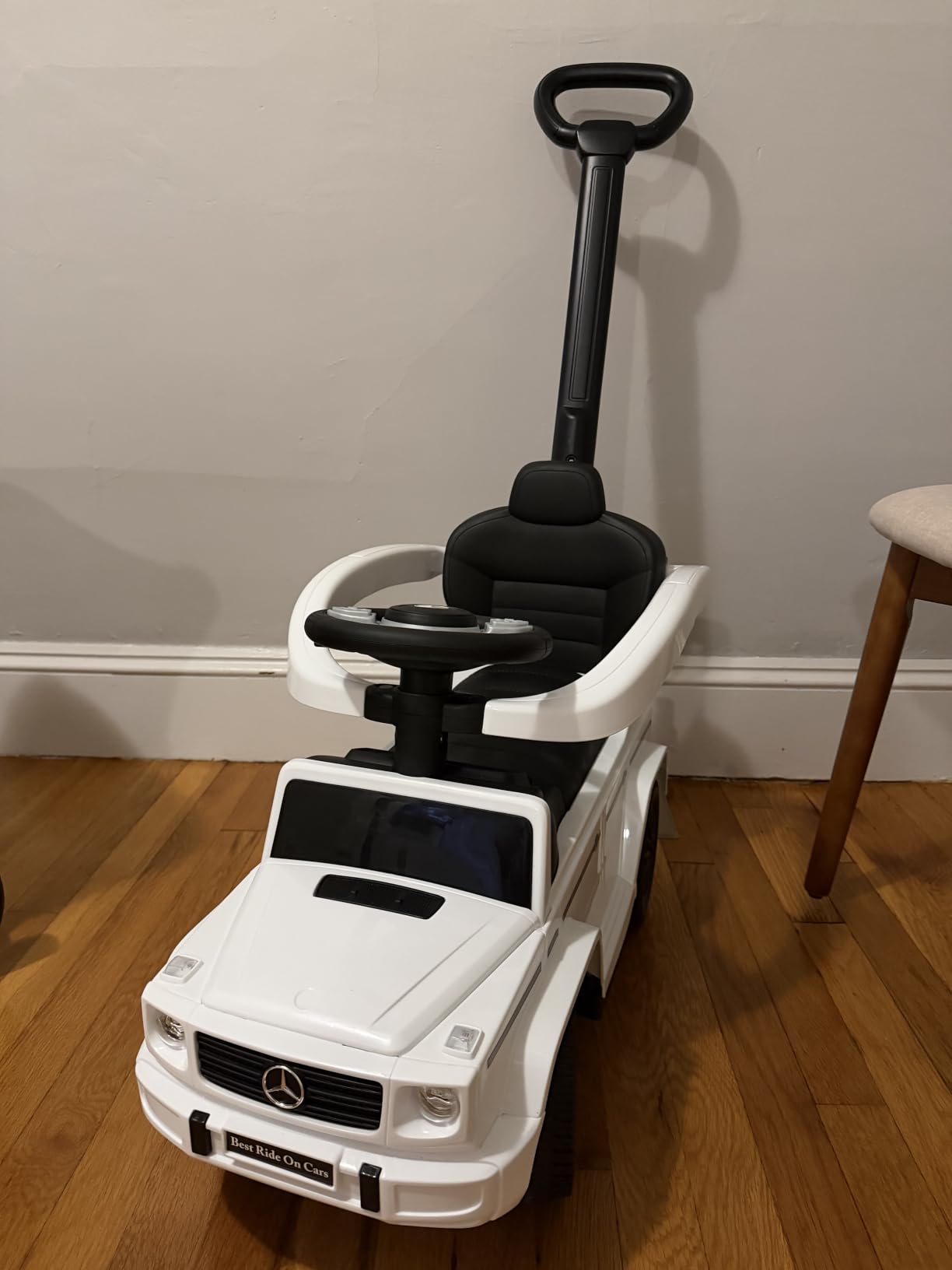
This solves the sibling problem that comes up repeatedly in toddler groups, where a parent wants one vehicle that works for an 18-month-old and a nearly-four-year-old at the same time. The G-Wagon converts between a stroller mode with a push bar, a ride-on mode and a baby walker.
It weighs 11.4 lb, which makes it one of the easiest to move between rooms, and the removable safety guardrails, stable backrest and footrest keep a younger child secure. The 40 lb capacity is the tightest in the roundup, so treat it as a toddler car rather than a keep-it-forever one.
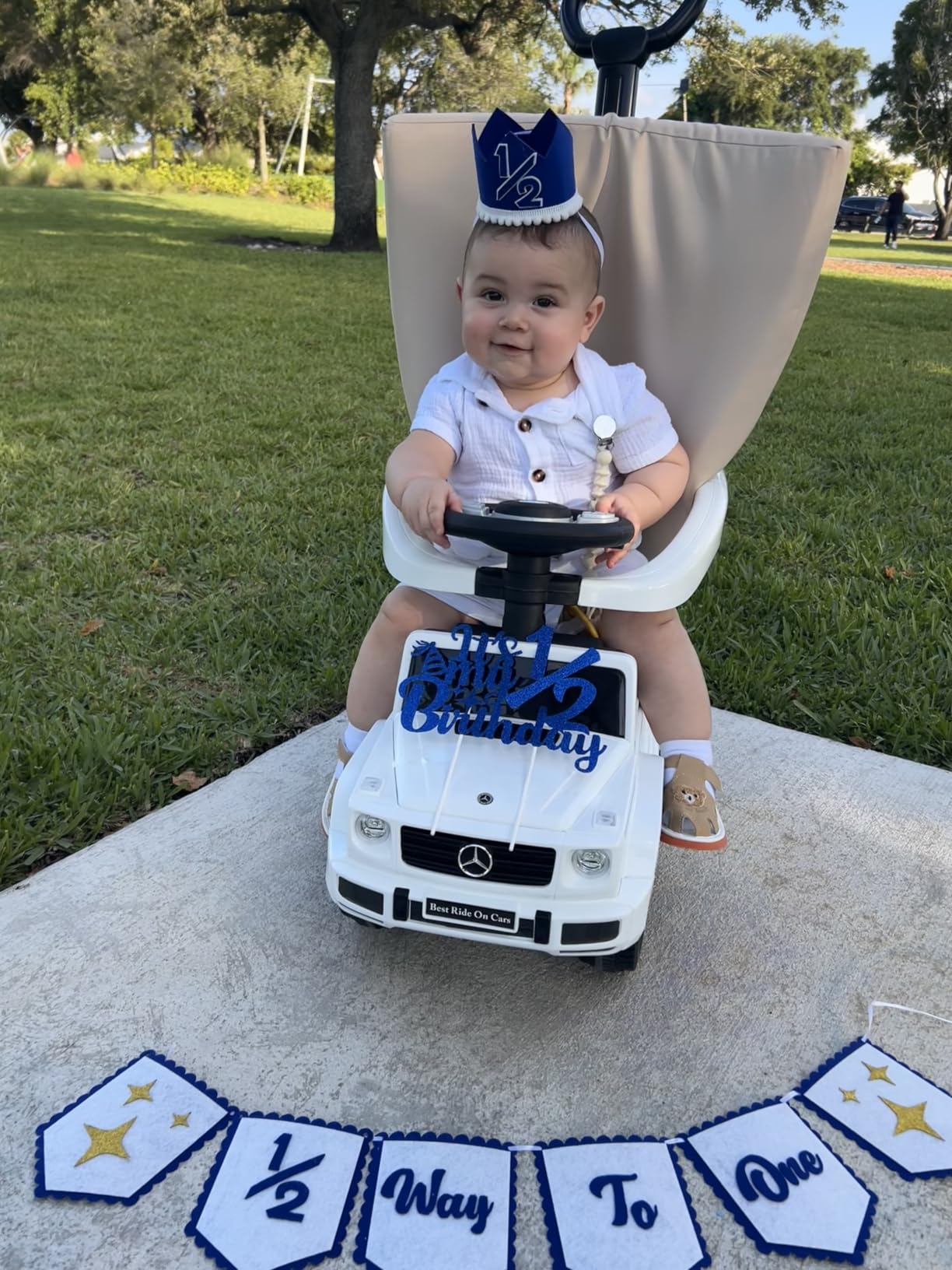
Styling is the selling point for many families. The Mercedes G-Wagon body with a tufted faux-leather seat, a steering wheel with music and horn, and hidden storage under the seat reads as a proper car to a child rather than a plastic shell. A 30 day warranty covers manufacturing defects.
Does the 3-in-1 design actually get used three ways?
Yes, in our experience the walker mode gets the most use before a year and the ride-on mode dominates afterwards, with stroller mode as the fallback when your child falls asleep mid-journey. The removable guardrails are what make the transitions quick rather than a fussy reconfiguration.
For a single child, you might get more out of a simpler car. For two children three years apart, it is a genuinely economical answer.
What should you watch out for?
No seat belt is included, and several reviewers flag that as a safety gap. Some also find the push handle flimsy, and the turning radius is tight enough to need planning in a hallway.
The 40 lb limit and the unclear assembly instructions are the other two caveats, and the list of parts is long enough that we would count the bolts before starting.
How to Choose a Ride-On Car for Your Toddler
Start with age, because it narrows the field immediately, then check the weight capacity and the surface you have available. Everything else is preference. The three questions we would ask before spending anything are: how old is your child, is the space hard floor or grass, and who else will use the vehicle.
Push car, foot-to-floor or pedal car?
A foot-to-floor push car has no motor and is propelled by the child’s own legs. It is the right answer from about 9 months to 24 months, and the simplest way into a first vehicle. A push-around car adds a parent handle and converts it into a stroller substitute, which is what makes the Step2 models useful past the toddler years.
An electric pedal car takes over from roughly 18 months at the lowest voltages, and from two years at 12V. The trade-off is a charging routine, a heavier body and a speed your child can no longer modulate.
6V vs 12V vs 24V: which voltage for a toddler
Stay at or below 12V for a toddler. A 6V car is the correct choice for 18 to 30 months because it is slow, light and usually cheap. A 12V car with a 2.4GHz remote fits a two to three-year-old, and 24V belongs to a three-plus or four-plus child, not a toddler. If a listing markets 24V to under-threes, treat that as a warning sign rather than a feature.
Top speed follows the same pattern. Forum consensus is firm that anything above 3 mph is too fast for a toddler, and community moderators consistently advise using the remote rather than letting a young child self-drive unsupervised.
Battery life, charging and what to expect
Manufacturer runtime is a maximum, and real playtime always lands below it. Where a listing states 1 to 2 hours of runtime, assume closer to one. Where it states 40 to 60 minutes, believe it. Charge times are frequently longer than the run time, so a full charge overnight is the realistic pattern for a 12V car.
Store the car somewhere you can plug a charger into rather than in a cold shed, and avoid leaving a pack flat and empty over winter. If you are buying secondhand, ask the seller to demonstrate a full charge before you commit.
Assembly, storage and the garage footprint
Assembly is the most common complaint in this entire category, and it is not close. Budget one to two hours for a push car with picture-only instructions and longer for a 12V electric unit, and keep the screws sorted in a tray. Count the parts before you start, because missing pieces are the other big theme.
On storage, the numbers matter: the electric cars here run 39 to 44 inches long and weigh 20 to 36 lb, which is a real corner of a garage rather than a shelf. Push cars fold or lift more easily. If you have no charging socket near where the car lives, an electric ride-on will lose to a push car every time. If the car does live in a garage alongside your own vehicle, our cargo box guide covers keeping that corner usable.
Riders on r/toddlers keep asking for a two-seater with trunk storage, and it is worth being honest that none of the twelve here is a two-seater. The usual workaround is one 12V car plus one push car, which suits two ages far better than a single compromise unit.
Safety First: Five Checks Before the First Drive
Every car in this roundup is a toy, not a safety device, and supervision is the control that matters. The mechanical features below are useful additions, not substitutes for an adult in the same room.
First, fit the restraint before the engine starts. A 5-point harness is better than a 3-point belt for a two-year-old, and the Best Choice Products, G63 and Winado cars all include an adjustable belt. Check the G-Wagon push car carefully, because no seat belt is included on that listing.
Second, use the remote. Experienced parents on r/PowerWheelsMods treat the 2.4GHz controller as the single most important feature on the list, because it lets an adult stop and steer without arguing with a determined two-year-old. Keep the controller within reach and switch to low speed first.
Third, look for soft start. The G63 and the Miniature Motors truck both ramp up rather than snapping to full speed, which prevents the tip-over that catches most first drives. Fourth, match the surface: grass and gravel belong to 12V cars with spring suspension, while smooth floors suit the lighter push cars and avoid the noise complaints.
Fifth, check the weight limit honestly. A child who is near the stated capacity is heavy enough to press the suspension and tip a low-centre car, and the limits are not negotiable. A helmet is worth considering for any 12V car driven on a hard driveway, and no car in this roundup should go near a public road.
Frequently Asked Questions
What is a good ride-on car for a 2-year-old?
A 6V or 12V battery ride-on with a 2.4GHz parent remote is the safest fit for a two-year-old, and among these picks the Best Choice Products 12V car is our recommendation for a child ready to work a foot pedal. If your child is not yet steering confidently, start with a foot-to-floor push car such as the Little Tikes Cozy Coupe or the Step2 Push Around Buggy, then step up to 12V closer to their third birthday. Keep top speed at or below 3 mph and use the remote rather than letting them drive unsupervised.
Which is better for my child, 12V or 24V ride-on toys?
For a toddler, 12V, and 24V is not appropriate. A 12V car with a parent remote and a 2.8 to 3.5 mph top speed suits a two or three-year-old on a driveway or lawn, while 24V is a three-plus or four-plus product with far more torque and higher speeds. A 6V car is the better match between 18 and 30 months. If a listing markets 24V to a child under three, that is a reason to move on rather than a sign of quality.
How long does a 2-year-old car battery typically last?
Expect less than the stated figure in almost every case. Listings here claim anywhere from 40 to 60 minutes up to 1 to 2 hours of play per charge, and real-world use lands at the lower end once a child uses reverse, lights and sound. Charge times run 8 to 12 hours on 12V cars, so the practical pattern is a full charge overnight and a single session the next day. A second replaceable 12V pack is the simplest way to extend the day.
Can you replace the battery in a kids ride-on car?
Usually yes. Standard 12V lead-acid packs are interchangeable across most of these brands, and the Winado and Miniature Motors listings both include a charger with a standard connector. Before buying a car, check that a compatible replacement pack is sold separately and that the connector and capacity match, since a higher-capacity pack is often the cheapest upgrade available. Sealed packs with no stated service path are the ones to avoid.
What is a good rideable horse toy for a 2-year-old?
Ride-on horses follow the same age logic as cars, and most are foot-to-floor or push-along designs rather than battery models. For a two-year-old the priority is a low seat with handles or a stable base, because balance is still developing. A push handle version can double as a walking aid, and unlike an electric car there is no charging routine to manage. Check the weight limit first, since many rideable horses are built for ages three and above.
The Verdict: Which Ride-On Car Wins for Toddlers
For a two-year-old who is ready to drive, the Best Choice Products 12V car is our pick, and its 2.8 mph cap, parent remote and a 21000-plus review base are the reason. For anything under two, the Little Tikes Cozy Coupe does more for motor development than any battery car in this list, and the BIG Bobby Car is the one that will still fit at five.
Our runners-up are the Step2 Whisper Ride II for daily walking and the ANPABO G63 if your ground is grass or gravel. Whatever you choose, stay at or below 12V, use the remote, and check the weight capacity before the birthday. Parents chasing a bigger vehicle later might enjoy our guide to RC cars for adults as a follow-on, and if the new car needs somewhere to live, our portable garage guide covers the storage problem these vehicles create.