
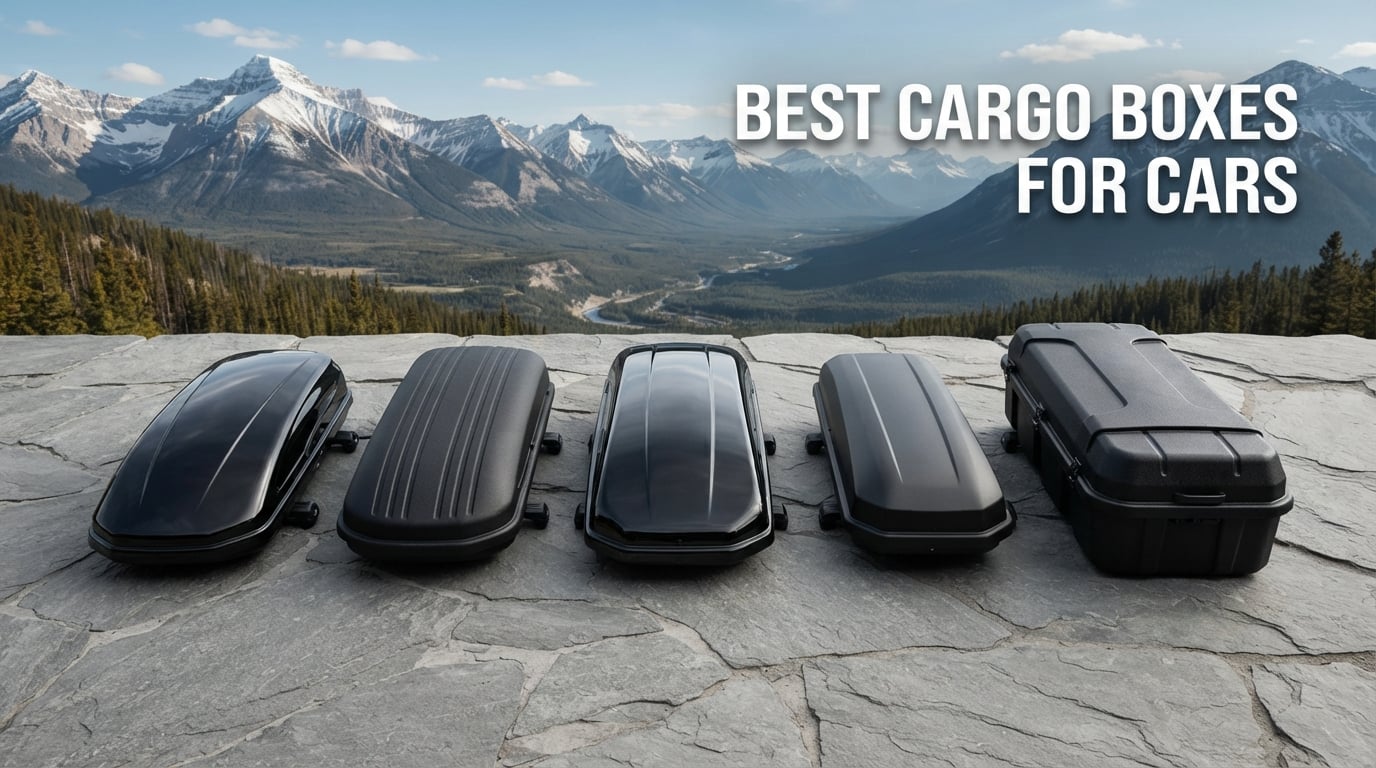
The best cargo boxes for cars give a family, a ski crew, or a camping pair more room without turning the back seat into a pile of bags. A roof cargo box is a hard-shell container that mounts on roof crossbars; the eight options here range from a stated 11 to 18 cubic feet, so the right answer depends as much on the vehicle and gear as on the box itself.
I compared the supplied listing data for capacity, exterior dimensions, empty weight, stated load capacity, opening direction, mounting approach, lock hardware, review count, and fit language. That makes this a practical shortlist for 2026, but it is not a substitute for checking your vehicle manual, crossbar rating, roof-load rating, and the manufacturer’s current fit guidance before ordering.
The two checks people miss are height and handling. Forum discussions repeatedly raise garage clearance, highway noise, leaks, crossbar compatibility, and the difficulty of lifting a large box alone, so I treat those as purchase decisions rather than small details.
Table of Contents
The top 3 picks are the Yakima SkyBox NX 18, Thule Pulse 2 L, and D SOLUTIONS Heavy Duty.
The Yakima is my editor’s choice for its stated 18-cubic-foot capacity, dual-sided access, long 84-inch body, and accommodation for skis or snowboards up to 195 cm. The Thule Pulse 2 L is the family-road-trip choice because its torque-indicator mounting and forward placement speak directly to secure attachment and rear-hatch clearance.
The D SOLUTIONS box is the compact budget pick in this group, with a stated 11-cubic-foot volume, universal fit language for crossbars, key lock, and no-tool installation. None of these labels replaces a fit check: a box can be excellent on paper and still be wrong for a short roof, a panoramic roof, or a low garage door.
The best cargo boxes for cars in 2026 span compact, long, and high-capacity needs.
This quick view compares the stated figures rather than guessing which box fits every car. The dimensions are exterior measurements from the supplied listings, and the listed load capacity never overrides the lower limit set by your vehicle roof and crossbars.
| Product | Specifications | Action |
|---|---|---|
 Yakima SkyBox NX 18 Yakima SkyBox NX 18 |
|
See Details |
 Thule Pulse 2 L Thule Pulse 2 L |
|
See Details |
 D SOLUTIONS Heavy Duty D SOLUTIONS Heavy Duty |
|
See Details |
 Thule Motion 3 Thule Motion 3 |
|
See Details |
 Perflex Exclusive 17.7 Perflex Exclusive 17.7 |
|
See Details |
 Garvee Heavy Duty 17.7 Garvee Heavy Duty 17.7 |
|
See Details |
 VISRACK 15.5 VISRACK 15.5 |
|
See Details |
 ActiveTrail 17 ActiveTrail 17 |
|
See Details |
1. The best overall cargo box is the Yakima SkyBox NX 18 for long, bulky gear.
Yakima SkyBox NX 18 XLG Rooftop Cargo Carrier, 18 Cu Ft, SKS Lock, Black
- 18 cubic feet
- Dual-side opening
- Fits skis up to 195 cm
- SKS locks
- Long 84 inch body
- Listing says not water resistant
- 53 pound empty weight
- Limited review count
I put the Yakima SkyBox NX 18 first because the stated 18-cubic-foot volume is the largest clear capacity figure in this group, and its 84-inch length gives it a meaningful edge for long equipment. Yakima says it can hold gear for up to four campers and fit skis and snowboards up to 195 cm, which makes it a serious candidate for a ski trip or a family packing bulky duffels.
The dual-sided opening is more than a convenience feature. On a driveway, at a trailhead, or beside a parked vehicle, being able to load from either side gives you more options when one side is close to a wall, another car, or a snowbank.
At 53 pounds empty, this is not the box I would plan to install alone from the ground. I would stage a second person, lay out the crossbar positions first, and use a blanket or storage cart so the lid and roof are not scratched during the lift.
The SkyBox NX 18 suits long gear and larger packing lists.
The 84 by 36 by 16.5 inch exterior size is its main strength and its main compatibility question. Measure the usable crossbar area, the roof length, and the open rear hatch before committing, especially on a sedan or a compact SUV where a long roof box can sit close to the hatch path.
The listing describes an unobstructed flattened floor, which should make soft luggage and long items easier to arrange than a floor broken up by internal hardware. I would still pack low, soft gear around rigid items and keep the lid area clear so it can close without forcing the latch.
The SkyBox NX 18 requires extra weather and lifting checks.
The listing’s water-resistance field reads “Not Water Resistant,” despite this being a hard-shell carrier. I would not assume dry protection from the shell alone; check the lid seal, latch closure, and the current manufacturer guidance, then use dry bags for items that cannot get wet.
Its SKS locks and full-metal opening handle address access and security in the listing, but locks do not make a roof box a place for irreplaceable valuables. Use them for gear storage, lock the box before driving, and do a final pull test on the lid and each mount before highway speeds.
2. The best family-focused cargo box is the Thule Pulse 2 L for secure mounting.
- 16 cubic feet
- Torque indicator
- Dual-side opening
- Forward roof position
- Limited lifetime warranty
- Listing says not water resistant
- 51 pound empty weight
- Limited review count
The Thule Pulse 2 L makes its strongest case through the mounting system. Its tool-free system has a torque indicator, so the mount gives a defined signal when it reaches the intended tightness rather than asking you to judge every clamp by feel.
It supplies 450 liters, listed as 16 cubic feet, in an 81 by 37 by 17 inch form. That is enough room to take luggage out of the cabin on a family trip, while the dual-sided opening gives the loader a better chance of finding a safe side of the vehicle to work from.
I also like the listing’s claim that its forward position permits full trunk access with minimal contact risk. That language is helpful, but I would treat it as a prompt to test the hatch clearance during a dry run, not as a universal promise for every vehicle.
The Pulse 2 L gives a clear installation cue.
People who are new to a rooftop cargo box often worry most about whether the clamps are too loose or too tight. The torque indicator is the useful feature here because it converts part of that uncertainty into a repeatable check, provided the crossbars themselves are rated and properly fitted.
The box has a stated 75 kg load capacity and weighs 51 pounds before cargo. The lower number among the box’s stated capacity, the rack rating, and the vehicle roof rating must govern the loaded setup, so I would calculate the empty-box weight as part of the roof load rather than treating it as separate.
The Pulse 2 L needs seal checks and height planning.
The supplied listing labels it “Not Water Resistant,” even though the feature list describes ASA-ABS plastic that resists weather. That mismatch is exactly why I would inspect the actual product documentation and gasket before relying on it in extended rain or snow.
Its 17-inch height also deserves a real garage test. Measure from the ground to the highest point of the mounted box, then compare it to the lowest point of the open garage door and any hanging opener, bike rack, or storage shelf.
3. The compact budget pick is the D SOLUTIONS Heavy Duty for shorter roofs.
D SOLUTIONS Hard Shell Roof Top Cargo Carrier Waterproof Travel Luggage Box
- Short 53 inch body
- 110 pound capacity
- Waterproof ABS
- Key lock
- No-tool installation
- 11 cubic feet is smaller
- Lower stated rating
- 50.3 pound empty weight
The D SOLUTIONS Heavy Duty box is the shortest option here at 53 by 34 by 15 inches, which is why I see it as a better match for drivers who do not need ski-length storage. The stated 11-cubic-foot volume is modest, but that can be the sensible choice when garage clearance, roof length, and easier placement matter more than maximum volume.
Its listing calls out universal fit for vehicles with crossbars, no-tool assembly and installation, a secure key lock, and a waterproof ABS shell. Those are the core ingredients many shoppers want in a car roof carrier, with a more contained footprint than the 70- to 84-inch boxes on this list.
The tradeoff is weight. At 50.3 pounds empty, it is close to the much longer Thule Pulse 2 L, so its compact body should not be confused with a one-person lift.
The D SOLUTIONS box favors compact cargo over long equipment.
Eleven cubic feet can work for weekend luggage, a stroller-sized gap in the cabin, or soft camping items, but it calls for disciplined packing. I would measure the longest item first; a 53-inch exterior box is not automatically a 53-inch usable interior, and the listing does not provide interior dimensions.
The stated 110-pound load capacity is another planning number, not a target to chase. Once the 50.3-pound empty carrier is on the roof, the remaining roof allowance may be much smaller than the box’s own figure.
The D SOLUTIONS box calls for a crossbar-specific fit check.
“Universal fit” means the listing intends it for vehicles with crossbars; it does not identify every bar shape, spacing, or roof system. Before buying, verify the crossbar width, spread, profile, and the clearance needed for the mounting hardware to close underneath the bars.
The 4.3 rating is based on 65 supplied reviews, a larger review count than several options here but still not a replacement for fit confirmation. I would inspect the key lock, bottom contact points, and lid alignment after the first trip and after any rough-road drive.
4. The premium pick is the Thule Motion 3 for its mounting and locking design.
- PowerClick mounting
- SlideLock closure
- Wide handle
- Wing-shaped profile
- Limited lifetime warranty
- Vehicle-specific fit required
- Capacity field conflicts
- 18 inch height
The Thule Motion 3 is the feature-led choice in this selection. Its PowerClick quick-mount system includes a torque indicator, while the SlideLock system separates locking from opening; paired with the wide handle, those details aim at the actions you repeat every time you load, close, and leave the car.
The 81 by 38 by 18 inch outside dimensions make this one of the wider and taller roof boxes in the group. Its listing says the wing-shaped profile and forward-leaning nose are intended to reduce drag and help fuel efficiency, though no listing-specific fuel-economy result is supplied.
I would not use the stated volume field for a packing calculation here because it reads 3 liters, which conflicts with the physical size and does not look like a reliable cargo-capacity specification. That is a good reminder to ask for the current size variant and its confirmed internal capacity before comparing it against a 16-, 17-, or 18-cubic-foot box.
The Motion 3 makes its case through repeat-use controls.
PowerClick and SlideLock are useful if the goal is a process that is easier to repeat correctly across road trips. The torque indicator gives a mounting reference, and the separate functions in the lock system can make it clearer whether the lid is actually locked rather than merely shut.
The available accessories listed for this model include an interior light, protective liner, and storage cover. I would treat those as optional ways to organize and protect the box, not as items to assume are in the base package.
The Motion 3 requires vehicle-specific confirmation before purchase.
This is the only product here marked Vehicle Specific Fit rather than universal fit. That is not a flaw, but it means the fit lookup is mandatory: confirm the exact Motion 3 version, vehicle, roof rack, crossbar placement, and hatch travel before selecting it.
At 18 inches tall, it also deserves the strictest garage measurement in this article. Add the roof height and bar height to the box height, allow for the mounting hardware, and leave a margin instead of relying on a door opening measured to the nearest inch.
5. The lightest large-capacity option is the Perflex Exclusive 17.7 for organized gear.
- 17.7 cubic feet
- 36 pound empty weight
- Dual-side opening
- Four keys
- Tool-free hardware
- 90 day warranty
- Durability concerns in review notes
- 130 pound stated capacity
The Perflex Exclusive is notable because it pairs a stated 17.7-cubic-foot volume with a listed empty weight of 36 pounds. That is substantially lighter than the Yakima, Thule Pulse, and D SOLUTIONS choices, so it may reduce the lifting and roof-load burden for shoppers who still need a long 73-inch carrier.
The supplied technical details say it can take skis, snowboards, boots, helmets, duffel bags, and other gear, while its 73 by 34 by 17 inch dimensions offer a long, fairly broad footprint. It comes with mounting hardware, straps, instructions, and four keys, and the central lock is described as preventing key removal until the box is locked.
I see the dual-side opening as especially useful when the box is packed for mixed activities. You can place the frequently needed items near the side you expect to access, while keeping longer equipment settled along the floor.
The Perflex combines long storage with a lower stated box weight.
A 36-pound empty shell makes planning easier, but it does not remove the need for a two-person lift. Its size is still 73 inches long, and an awkward lift at roof height can damage the car or injure the loader even when the scale number seems manageable.
The stated 130-pound capacity needs to be read alongside the vehicle and rack limits. I would weigh a fully packed box at home before a long trip, since boots, wet outdoor gear, and dense camping equipment can add up faster than soft luggage suggests.
The Perflex asks shoppers to weigh warranty and review signals.
The provided listing has a 4.2 rating from 93 reviews, with review notes that call feedback generally positive while flagging durability as a recurring concern. The manufacturer warranty is listed as 90 days, so I would inspect the lid, hinges, seals, locks, and mounting hardware closely on arrival.
Its supplied technical text describes the ABS shell as UV-resistant and impact-resistant and calls it weather-resistant and waterproof. For long trips, I would still pack sensitive items in protective bags and inspect the seal after the first wet drive rather than depending on any description alone.
6. The highest stated load-capacity choice is the Garvee Heavy Duty 17.7 for bulky cargo.
- 165 pound capacity
- 17.7 cubic feet
- Waterproof ABS
- Dual-side opening
- Tool-free installation
- Only 20 reviews
- 64 percent five-star share
- No stated warranty
The Garvee Heavy Duty 17.7 has the highest stated box load capacity in this set at 165 pounds, tied with the ActiveTrail. It combines that number with 17.7 cubic feet of claimed volume, a 71.65 by 30.71 by 14.96 inch body, dual-sided access, and a stated 42.1-pound empty weight.
Its narrower roughly 31-inch width may appeal to drivers who want substantial length without the 36- to 38-inch width of the Yakima and Thule options. The listing says it fits SUVs, trucks, and vans with roof racks and is compatible with round, square, and factory roof bars, but the exact bar system still needs confirmation.
The product description calls the carrier waterproof and describes rugged ABS construction with a UV-resistant black coating. It also includes straps and keys, and the tool-free install language points toward a quicker setup than a system needing separate tools.
The Garvee carries a high stated box limit, not an automatic roof limit.
The 165-pound figure is helpful only if the roof system can support the total. Start with the 42.1-pound carrier, add all packed cargo, then compare that total to the lowest permitted limit from the vehicle, roof rack, and crossbars.
I would use the long but narrow floor for duffels, tents, folding chairs, or other items that fit its 70-inch-class length rather than treating stated volume as a promise that every bulky object will fit. The listing does not provide internal width or hatch opening dimensions.
The Garvee needs a cautious review-count reading.
The supplied rating is 4.2 from 20 reviews, and the review insight says 64 percent are five-star with positive feedback on capacity and durability alongside mixed feedback. A small review count is not proof of a bad product, but it gives less evidence than a similar rating drawn from hundreds of reports.
No manufacturer warranty is listed in the supplied data. I would check the current warranty terms, test the locks and latches while the carrier is still new, and retighten the mounting system after the first short drive as directed by the current manual.
7. The low-profile wide option is the VISRACK 15.5 for general road-trip packing.
- 13 inch stated height
- 15.5 cubic feet
- Dual-side opening
- Waterproof ABS and PC
- Security keys
- 30 day warranty
- 58 reviews
- Shorter than ski-focused boxes
The VISRACK brings a useful shape to this roundup: it is 58.3 inches long, 35.4 inches wide, and only 13 inches high according to the listing. That low stated height may make it easier to work around garage clearance than the 17- and 18-inch boxes, while 15.5 cubic feet still provides a meaningful cargo expansion.
Its feature list includes ABS and PMMA construction, a 130-pound load capacity, dual-side opening, security key, tool-free mounting brackets, and waterproof design. The 4.7 rating is the highest supplied rating in the group, though it is based on 58 reviews rather than a large review pool.
I would choose this shape for luggage, sleeping bags, or compact camping gear rather than a ski-focused load. The 58.3-inch exterior length is far shorter than the Yakima or Perflex, so the longest item in your packing list should be measured before this becomes the automatic pick.
The VISRACK shape prioritizes height management and broad access.
A 13-inch listing height does not tell you the finished vehicle height, but it is a sensible starting point for a carport or garage calculation. Add the roof, crossbars, mounts, and a reasonable measurement margin; do not test a new setup by slowly driving into a low opening.
The 35.4-inch width and dual-sided lid should make the floor accessible from both sides of the vehicle. I would distribute soft cargo evenly, keep heavy objects centered and low, and use the straps or packing method specified by the actual manual so the load cannot shift.
The VISRACK warranty and load limit deserve a close check.
The manufacturer warranty description is listed as 30 days. That makes an early inspection especially useful: mount it, confirm both sides open and latch cleanly, check key operation, and follow the instructions for any initial recheck of the clamps.
Its stated 130-pound capacity is only one part of a roof-load calculation. I would record the 43-pound empty carrier in the same note as the rack rating, then pack below the most conservative allowed total rather than trying to use the entire box capacity.
8. The short, high-capacity alternative is the ActiveTrail 17 for smaller vehicles.
- 35.3 pound empty weight
- 165 pound capacity
- Waterproof ABS
- Dual-side opening
- Universal car and SUV fit
- Only 14 reviews
- Review notes show quality concerns
- Capacity claims conflict
The ActiveTrail has the shortest stated body after the D SOLUTIONS, at 55.12 by 35.04 by 16.14 inches, yet its feature list says 17 cubic feet and 165 pounds of capacity. That combination will catch the eye of shoppers with a smaller car or SUV who want big numbers without a 70-inch-long carrier.
I would pause before relying on the volume figure, because the supplied technical details conflict: one sentence calls it 19.4 cubic feet, while the same text also says it offers 14 cubic feet. The title and feature list say 17 cubic feet, so the current product page and size variant need direct confirmation before packing plans are made.
The listing does consistently describe a lockable system with two keys, waterproof ABS material, dual-side opening, universal fit language for cars and SUVs, and a 35.27-pound empty weight. Those are attractive basics, particularly when roof length is limited.
The ActiveTrail may suit a shorter roof after a careful fit check.
A 55-inch-class carrier can be easier to position without crowding the rear hatch than the very long options, but fit does not follow length alone. Check the required bar spread, bar profile, under-bar clearance, and the position of antennae, sunroofs, and hatch spoilers on the specific vehicle.
The 35.27-pound listed empty weight is among the lowest here, but it is still bulky at roof height. I would use two people for the first mount, protect the roof surface during lifting, and practice placing the box on the bars before trying to fasten hardware.
The ActiveTrail requires extra confirmation of its specifications and feedback.
Its 4.1 rating comes from 14 supplied reviews, the smallest review count in this roundup. The review insight reports 73 percent five-star ratings but also 16 percent one-star ratings, so I would read current fit, seal, latch, and hardware feedback carefully before making a final call.
The 165-pound stated capacity must be checked against the vehicle and rack system, just as it is with the Garvee. Because the listing has conflicting volume claims, I would also ask for confirmed interior dimensions and the exact included mounting components rather than inferring them from a headline.
The right cargo box comes from matching the roof, crossbars, gear, and storage space.
Capacity is only the first number to compare. A roof storage box needs to fit the vehicle physically, sit within its roof-load limit, clear the rear hatch and garage opening, hold the actual gear shape, and remain practical to mount and remove.
The vehicle roof rating is the limit that comes first.
Find the dynamic roof-load rating in the vehicle manual and the limit for the roof rack and crossbars. Then add the empty box weight to the cargo weight; the lowest applicable rating, not the carrier’s stated maximum, is the number that controls the load.
For example, a carrier’s 165-pound capacity does not mean a vehicle can carry 165 pounds in that carrier. The carrier itself may weigh 35 to 42 pounds before any luggage is loaded, and a lower roof or crossbar limit can reduce the usable allowance sharply.
Do not confuse a dynamic roof limit with static weight capacity. A parked vehicle can sometimes support a different amount than it can safely carry and control while braking, cornering, or encountering crosswinds; follow the vehicle and rack documentation for the driving limit.
The crossbar fit must be verified before a universal-fit claim is trusted.
Universal-fit wording is useful but broad. Measure crossbar spread from center to center, bar width and height, and the space below the bar where clamps or brackets need to close; then compare those details to the current box manual.
Factory bars, round bars, square bars, and aerodynamic bars can have different usable profiles. The Garvee specifically claims compatibility with round, square, and factory bars, while other listings simply say universal fit or fit with crossbars, so the mounting instructions matter more than the label alone.
Plan the box position with the rear hatch open. A forward mounting position may help on some vehicles, as Thule describes for the Pulse 2 L, but every roof length and hatch arc differs.
The cargo shape matters as much as cubic-foot capacity.
Use cubic feet for a broad packing comparison, then measure your longest and widest items. The Yakima’s 84-inch body and stated ability to take skis or snowboards up to 195 cm suit different gear from the 53-inch D SOLUTIONS or 55-inch ActiveTrail.
Interior dimensions, lid shape, hinge position, and the opening width can reduce usable space compared with an exterior measurement. If the listing does not state interior dimensions, do not make a precise packing promise based only on the outer shell.
For family road trips, soft duffels, sleeping bags, and jackets can usually use irregular space more easily than rigid bins. Pack dense items low and near the middle, use the supplied restraints if the manual calls for them, and do not force the lid closed over tall cargo.
The garage-clearance check prevents the most expensive mistake.
Measure from the ground to the top of the installed carrier on level pavement, not from a catalog height alone. Compare that total with the garage opening’s lowest point, then check the path inside for a door opener, stored equipment, or a sloped ceiling.
Among these listings, the VISRACK is stated at 13 inches high, the Garvee at about 15 inches, the D SOLUTIONS at 15 inches, the ActiveTrail at a little over 16 inches, the Pulse and Perflex at 17 inches, and the Motion 3 at 18 inches. Mounting height changes the final total, but that range explains why a few inches can decide the purchase.
Put a visible reminder in the car after fitting the box. Owners often use a hanging tag, dashboard note, or garage-door cue because the vehicle feels normal from the driver’s seat even though it is significantly taller.
Dual-side opening is the practical access feature to prioritize.
A dual-side-opening roof box can be loaded from the curb side, the driveway side, or whichever side has enough room. All eight selected products list dual-sided access, which is a strong common feature in this set.
Opening direction does not remove the need to park safely. Avoid loading from the traffic side of a road, keep children clear while the lid is open, and close the lid gently enough that the latch can engage without being forced.
For security, a lock confirms closure and restricts casual access, but no roof box should become a vault. Keep travel documents, medication, electronics, and other irreplaceable items in the cabin or with you.
Aerodynamic claims do not provide a fixed MPG result.
How much MPG do you lose with a roof box cannot be answered with one honest number for every vehicle, route, speed, wind condition, and box. The supplied listings describe aerodynamic profiles for the Thule Motion 3, Thule Pulse 2 L, Garvee, and ActiveTrail, but they do not provide comparable fuel-economy measurements.
A roof box adds frontal area and can affect air flow, so drivers concerned about fuel use should keep the load within limits, avoid carrying the box when it is not needed, and compare their own fuel records on similar trips rather than accepting a generic percentage as a guarantee.
Forum users also mention wind noise at highway speeds. A correct mount, tightly closed lid, and properly fitted crossbars are basic checks, but noise experience will still differ by vehicle and speed.
A hard shell is usually the better long-trip choice when locks and structure matter.
Every product in this roundup is a hard-shell cargo box. That format is a sensible fit when you want a lockable outer shell, repeatable mounting, and a rigid shape for road-trip luggage, ski gear, or camping equipment.
A soft cargo bag can make sense when storage space at home is the deciding factor, but it is a different product type and is not represented in the supplied product set. Forum discussion commonly favors hard shells for longer trips because users value the security and weather-protection approach.
Weather claims still need verification. Check the seal, lid fit, and current instructions before a wet trip, and use dry bags for gear that must stay dry because a product description alone cannot predict every rainstorm or seal condition.
Solo installation gets safer with a simple handling plan.
Even the lightest listed box here weighs more than 35 pounds and is awkward because of its size. The safer plan is two people, a clear work area, roof protection during the lift, and a slow first installation with the manual open.
If you must remove the box seasonally, decide where it will rest before taking it down. A padded wall rack, ceiling storage designed for the box, or a stable low cart can reduce the odds of cracked lids, scratched paint, or a dangerous improvised lift.
After mounting, follow the current manual’s inspection schedule. Check clamp engagement, lid closure, lock function, and strap or hardware condition before each long drive and after the first miles of a new installation.
FAQs
Are Thule cargo boxes worth it?
They can be worth considering when the supplied features match your vehicle and use case. The Pulse 2 L lists a tool-free torque-indicator mount, dual-sided opening, 16 cubic feet, and a limited-lifetime warranty, while the Motion 3 lists PowerClick mounting and SlideLock. Confirm the exact vehicle fit, roof rating, hatch clearance, and current capacity details before deciding.
Who makes the best hitch cargo carrier?
This product set does not include hitch cargo carriers, so it cannot support a brand recommendation for that category. All eight reviewed products are roof-mounted hard-shell cargo boxes. Choose between a hitch carrier and a roof box by checking rear-access needs, hitch rating, roof rating, cargo security, weather protection, and where you can store the carrier.
How much MPG do you lose with a roof box?
There is no single MPG figure that applies to every roof box, car, speed, wind condition, or route. Several supplied listings describe aerodynamic shapes, but none supplies comparable fuel-economy test results. Track fuel use on similar trips if it matters to you, mount the box correctly, and remove it when it is not needed.
Why is Thule so expensive?
A specific cost comparison is outside this review, but the supplied Thule listings emphasize named mounting and closure systems, including a torque indicator, PowerClick, and SlideLock, plus limited-lifetime warranties. Whether those features justify the outlay depends on confirmed vehicle fit, how often you use the box, the gear length you carry, and the access features you need.
The Yakima SkyBox NX 18 is the strongest all-around choice, while fit decides the final winner.
For long gear and the largest stated volume, I would start with the Yakima SkyBox NX 18. Choose the Thule Pulse 2 L when the torque-indicator mount and hatch-conscious placement are more important, the D SOLUTIONS when a shorter 11-cubic-foot box suits the roof, or the Motion 3 when its vehicle-specific fit and named controls match your car.
The best cargo boxes for cars in 2026 are not interchangeable containers. Measure first, respect the lowest roof-system rating, check garage height, confirm the exact fit, and then select the capacity and access layout that makes your trips easier.