
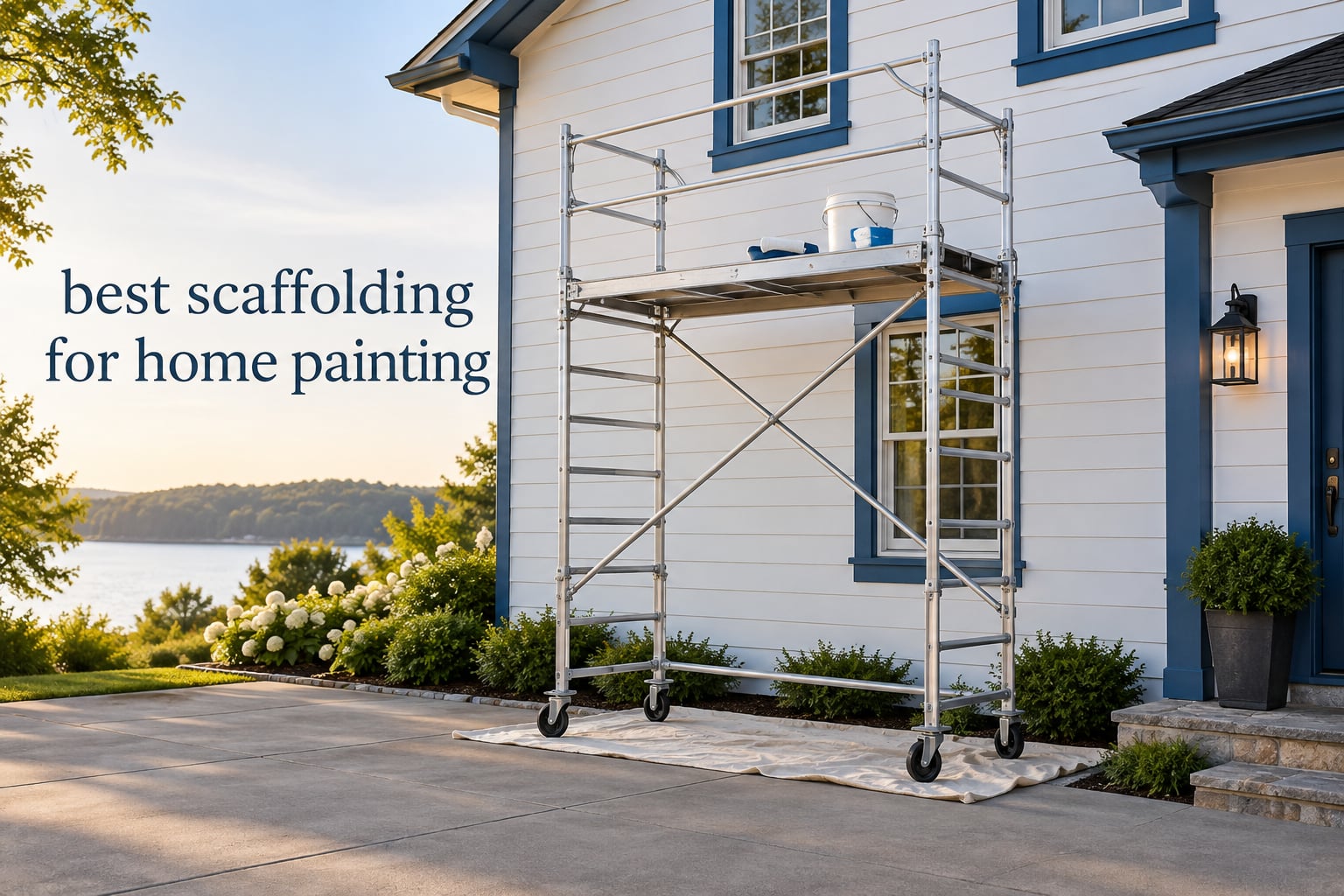
The best scaffolding for home painting is a wide-deck rolling work platform with locking casters and an adjustable steel frame. It lets you stand flat, move both arms freely, and carry your paint tray with you while you work up to roughly 12 feet of wall. A folding aluminum platform handles the same job for interior rooms and low ceilings at a fraction of the weight and cost.
I know the question because I have asked it from the top of a ladder with a tray in one hand and a brush in the other. My hands painted an entire two-story exterior before our crew switched to a rolling platform, and the difference was not subtle. A ladder makes you climb down every time you need more paint; a platform lets you set the bucket on the deck, roll two feet along the wall, and keep working. Painters describe the same progression on the r/paint forum, where experienced hands say the move to working from a deck is the step that finally retires exterior ladder climbing for good.
Below I break down eight platforms and work scaffolds that hold up to real painting work, along with the one that wins as the best overall pick for a homeowner. I leaned on published specifications, load ratings, and several hundred verified buyer reviews, and I flagged the details that actually change how a job goes: caster size, deck width, whether the frame fits through a doorway, and whether the guardrail is included. Every one of these platforms is discussed here in 2026, with the trade-offs named rather than skipped.
One more piece of gear worth pairing with any of these: our best drop cloths for painting keep the ground under your platform protected, the best tools for a home upgrade roundup covers the sprayers and extension poles that work well from a deck, and our best home ventilators guide matters more than people expect on a long interior painting day.
Table of Contents
Scaffold or Extension Ladder: Where the Line Sits at 10 Feet
Yes, you can paint a two-story house without scaffolding, but you will spend most of the project managing a ladder instead of painting. The practical threshold is height, not preference. Below about 10 feet of wall, an extension ladder with a stabilizer is faster to set up and cheaper to own. Between 10 and 20 feet, a rolling or folding work platform is the right tool. Past 20 feet, most homeowners rent a framed tower rather than owning one.
The reason for the 10-foot line is simple physics. Standing on the top three rungs of a ladder puts your center of gravity outside your base of support, and every time you shift sideways to reach a board edge you are making a correction. On a deck, your feet are on a flat surface you can move, and both hands are free. You can also put the tray down, which is the single change that makes long painting sessions possible.
Here is how the three options compare across the factors that matter on a paint job.
An extension ladder wins on setup speed and storage, and it reaches surprisingly high when you extend it properly. It loses badly on working comfort, hand availability, and how much paint you can keep with you. A rental tower handles genuinely tall work, but the time cost of pickup and return is real; one account on a home improvement forum put it at 8 to 10 hours just collecting, erecting, and returning a rented scaffold, which erases much of the saving. Buying a platform that folds flat puts those hours back in your weekend.
Top 3 Scaffolding Picks for Home Painting in 2026

Metaltech I-IMIS 5 ft Folding Scaffold
- 900 lb capacity
- 48 inch working height
- 5 inch locking casters
- Tool-free assembly

Loyoda Folding Work Platform
- 500 lb capacity
- 4 height settings
- One-touch fold
- 20.5 inch max height
All 8 Scaffolds and Work Platforms Compared in 2026
| Product | Specifications | Action |
|---|---|---|
| GIANTEX Aluminum Work Platform |
|
Check Latest Price |
| Metaltech I-IMIS 5 ft Folding Scaffold |
|
Check Latest Price |
| Loyoda Folding Work Platform |
|
Check Latest Price |
 WEN 31110T Baker-Style Rolling Scaffold WEN 31110T Baker-Style Rolling Scaffold |
|
Check Latest Price |
 Metaltech I-IMCNT 4 ft Folding Scaffold Metaltech I-IMCNT 4 ft Folding Scaffold |
|
Check Latest Price |
 HOMCOM 4-Step Steel Scaffold HOMCOM 4-Step Steel Scaffold |
|
Check Latest Price |
 VEVOR Folding Steel Work Platform VEVOR Folding Steel Work Platform |
|
Check Latest Price |
 ORIENTOOLS Adjustable Aluminum Platform ORIENTOOLS Adjustable Aluminum Platform |
|
Check Latest Price |
1. GIANTEX Aluminum Work Platform: The Best Overall Pick for Home Painting
- Lightweight enough to carry between rooms alone
- Wide deck for standing longer than a ladder
- Stable with no wobble for heavier users
- Anti-slip surface texture
- Folds flat for closet or garage storage
- Hinge bolts use plain nuts and can loosen over time
- Thin stamped leg latches can bend with repeated use
- Creaks audibly when you shift position on the deck
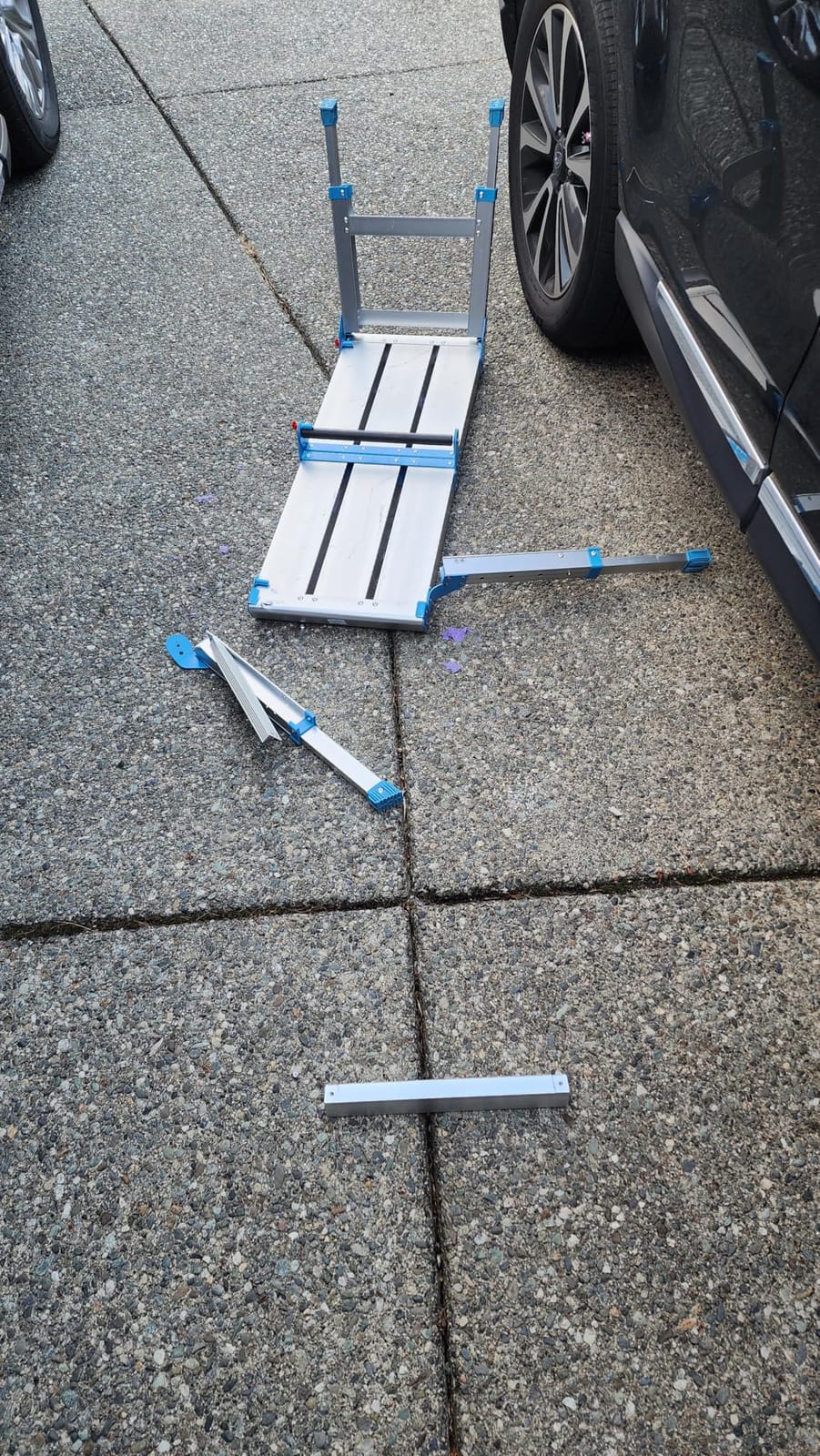
This is the platform I put on my own list first, and the reason is weight rather than any specification on the label. The aluminum frame is light enough that one person can carry it through a doorway and set it in a bedroom, which is the difference between a tool you use and a tool that sits in the garage. Buyers consistently describe exactly that experience, using it for decorating, window washing, and painting without needing a second pair of hands.
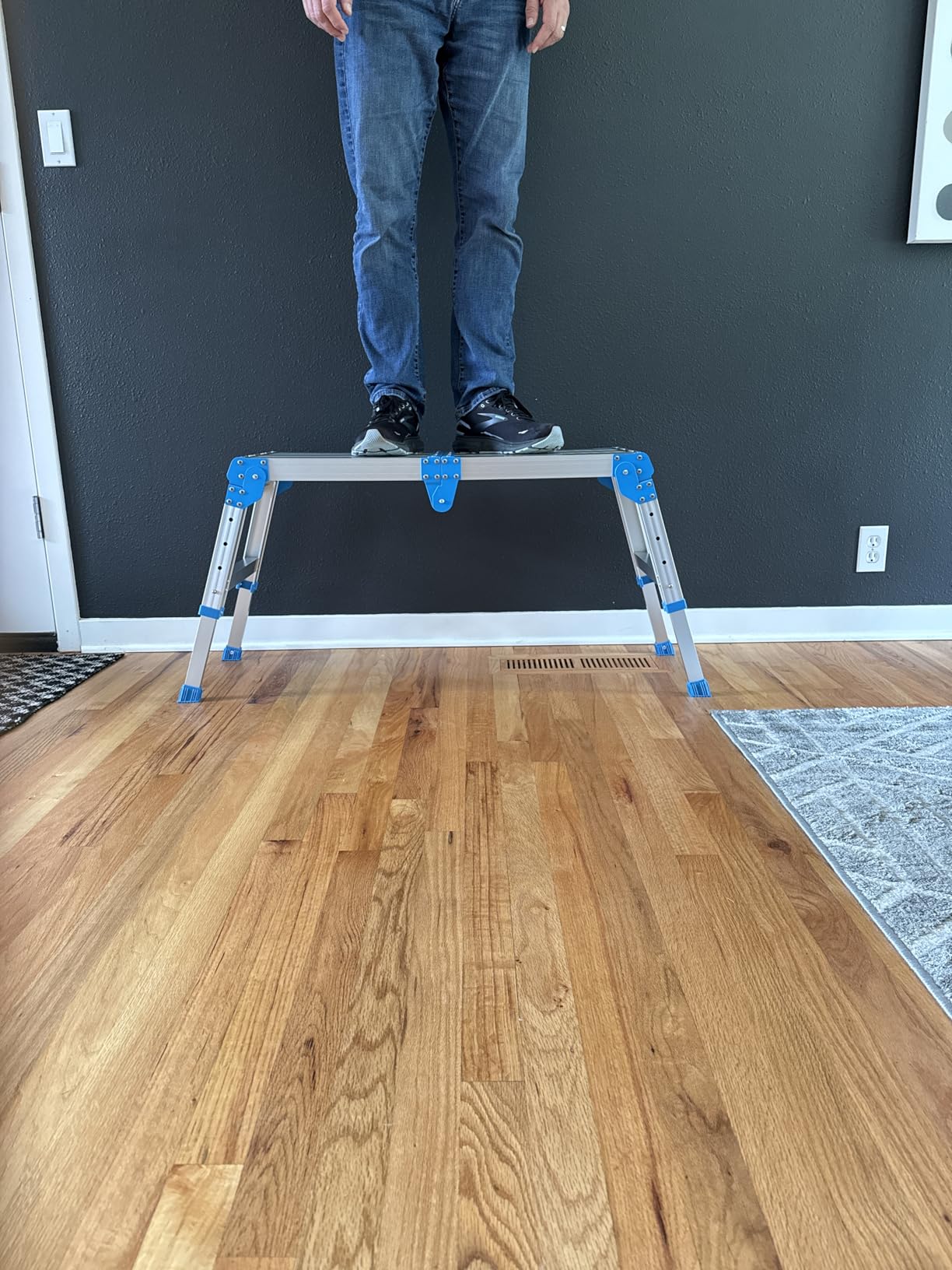
The deck is the quiet hero. Most folding platforms give you a narrow perch sized for a stepladder stance; this one gives you room to shift your feet, set a can down, and turn without thinking about balance. Owners report standing on it far longer than they could manage on a ladder, and the anti-slip texture keeps wet paint soles and damp socks from becoming a problem.
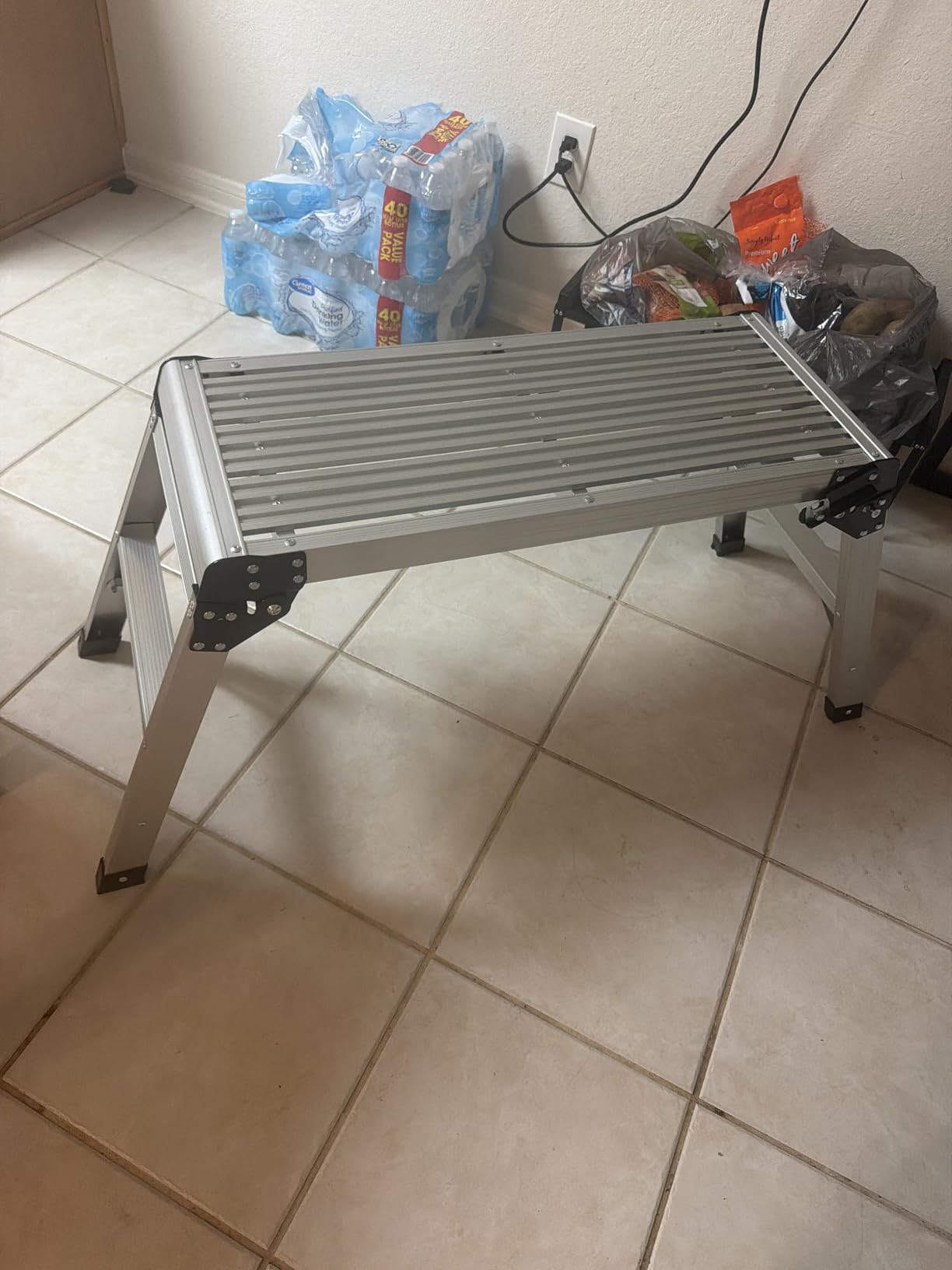
The spec sheet reads CE approved to the EN131 standard, with locking legs and skid-resistant feet, rated to 330 pounds with a 37-inch maximum height. That rating is the number to understand honestly: it is a working deck for one painter plus a tray, not a two-person station.
It reaches about 37 inches off the floor, which is short of a nine-foot ceiling but genuinely useful for the band most exterior jobs spend time in, roughly 6 to 10 feet of wall, plus soffits, fascia, and shutters. A 330-pound rating is not a limitation for most painters. It is a limitation if you plan to work with a partner, and worth knowing before you buy.
Will the deck actually hold a tray, a roller, and your feet?
It will, and that combination is what separates a work platform from a step ladder. The deck is wide and flat enough to set a five-gallon lid flat, rest a tray, and keep a second roller within reach. Since the tray never leaves the deck, you are not climbing down several rungs every time you reload, which is where most of the time savings on a paint job come from.
Buyers also call out that it stays stable with no wobble even for users over 200 pounds, and that it holds firm for painting and general maintenance work. The construction is high-strength aluminum, so it will not rust if it sits in a damp garage over a rainy season.
Where this platform will disappoint you
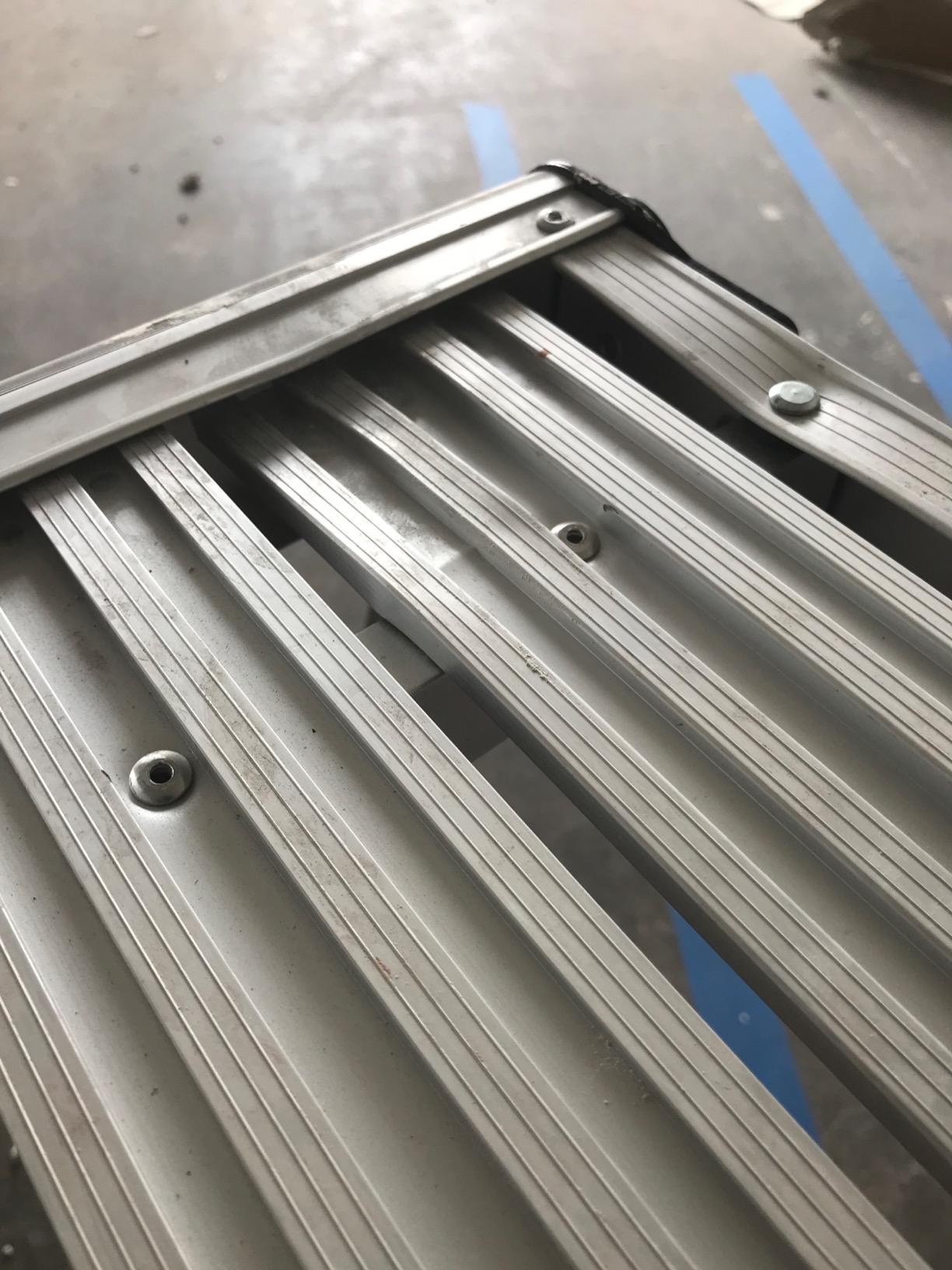
The honest weakness is the hardware at the joints. The hinge bolts on the legs use plain nuts rather than locking nuts, so an owner who sets it up repeatedly can find play developing over time. The leg safety latches are thin stamped metal and are the part reviewers report bending after repeated use.
Owners also notice the platform creaks when you move on it, and report slight play in the locking latches when weight shifts to one end. None of that is dangerous at 6 to 10 feet of wall, and none of it will stop you, but if you notice the latches loosening, tighten them before the next job rather than after.
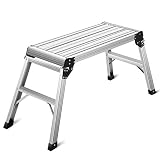
2. Metaltech I-IMIS Folding Scaffold: The Best Value for Serious Interior Work
Metaltech Jobsite Series Complete 5ft. Folding Scaffold – 900-Lb. Capacity, Model Number I-IMIS
- 900 lb capacity leaves room for two people and materials
- Tool-free assembly in about 10 minutes
- Locking casters hold firmly when repositioning
- Folds flat for transport and storage
- Convertible into a cart with a safety rail
- Casters are lighter and smaller than expected on rough ground
- Anti-slip rubber pieces can arrive missing if packaging is damaged
- A second platform deck would help for two-level work
If your painting lives mostly indoors, this is the one I would buy. Reviewers describe it as a rock-solid jobsite scaffold they trust for whole-house interior painting, crown molding, and ceiling work, and they repeatedly note that it handles like a heavier-duty brand at a lighter-duty price point. The 900-pound rating is roughly double what a residential platform needs, which buys you headroom to work with a partner and a full load of materials on the deck.
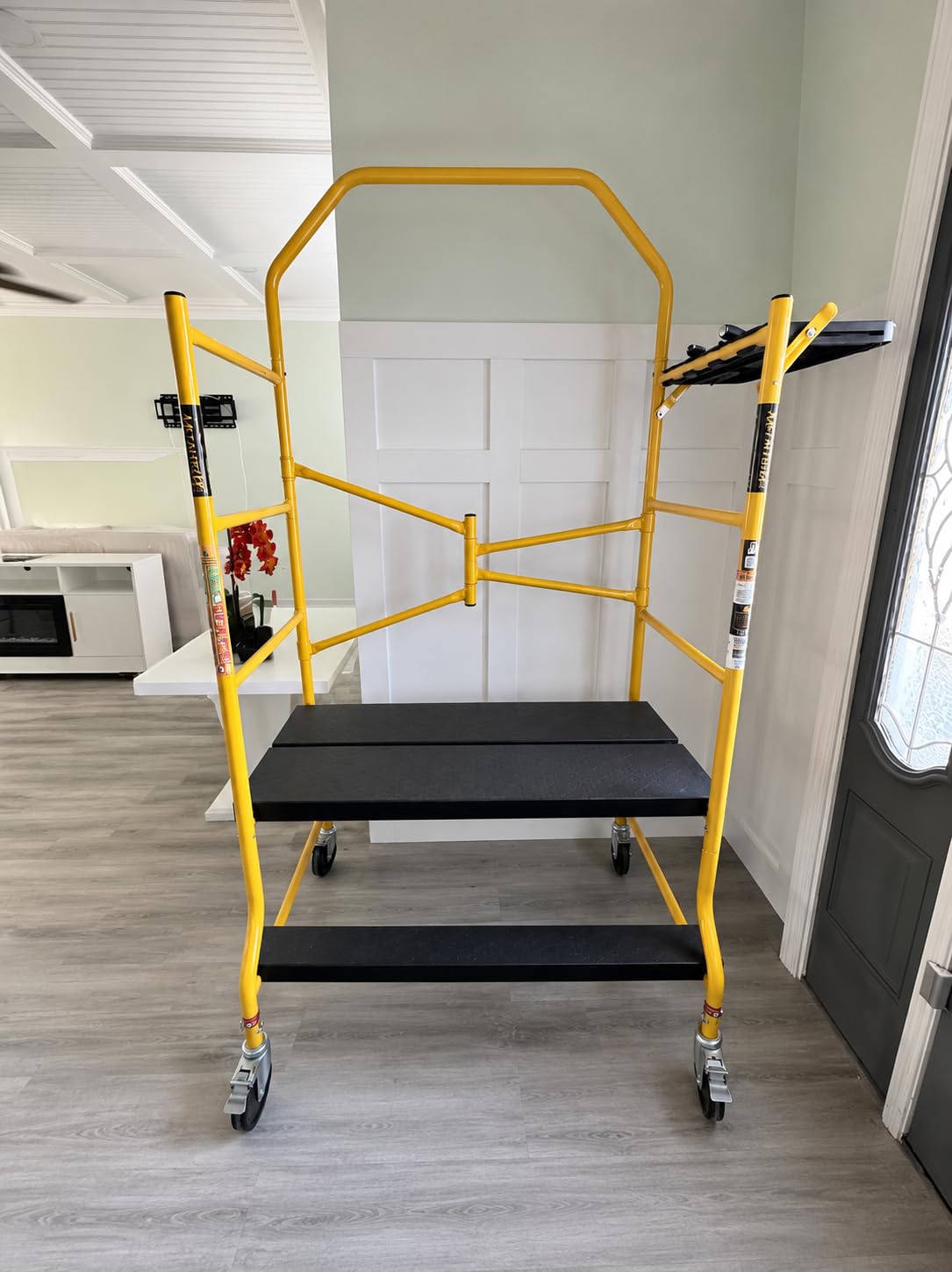
Setup is the part that wins people over. It assembles in about 10 minutes with no tools at all, which means you are not reading a printed manual on your garage floor after work. The multi-level platform adjusts through working heights of 11.5, 25, 36.5, and 48 inches, and a fold-away tool and paint shelf keeps your materials at deck level rather than on the floor.
The build is serious: 1.25-inch outside-diameter 16-gauge steel uprights, 14-gauge steel anti-slip planks, a powder coat finish that resists rust, and a one-year manufacturer warranty. It meets ANSI, CSA, and OSHA standards, which matters if you plan to use it outdoors through a wet spring rather than storing it between uses.
At 31 by 50.5 by 76.5 inches and 77 pounds, this is a two-person carry and a deliberate purchase rather than a spontaneous one. The 5-inch double-lock non-marking casters roll well on a garage floor and on paving, and they give 10-foot of reach from a compact base.
Does it have the clearance to paint a full room ceiling?
Yes, for the perimeter. The 48-inch working height covers the wall band, window returns, and the outer edge of a standard 9-foot ceiling, which is where cutting in happens. The platform is wide enough for two people, and the fold-away shelf carries cans and rollers within reach.
For the flat center of a large ceiling you will still want to reposition often, and some owners point out that a second platform deck would be useful for two-level work. The adjustable multi-level design handles that as far as the frame goes; the limit is one deck at a time.
What buyers complain about most
Caster size on rough ground is the recurring theme. On a smooth basement slab this unit is excellent, and on gravel, grass, or an uneven driveway the 5-inch casters feel lighter and smaller than the 900-pound rating suggests. If your project is outside on soft ground, plan on plywood pads.
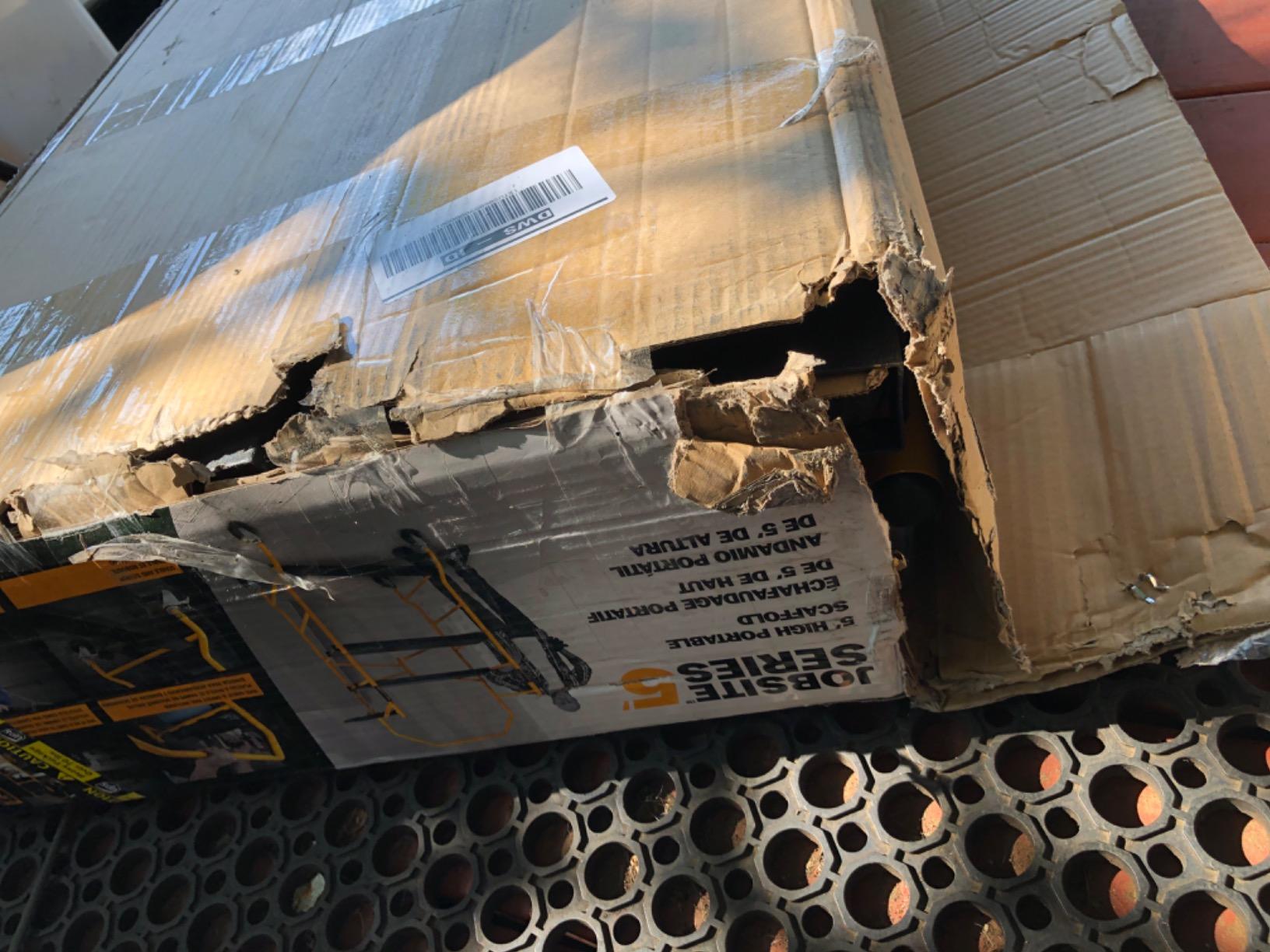
Some reviewers also report that the rubber anti-slip pieces arrive missing when the packaging is damaged in transit. It is a two-minute fix and worth checking the moment the box opens, before the frame goes up.
3. Loyoda Folding Work Platform: The Best Fit for Tight Rooms and Small Jobs
Loyoda Folding Work Platform, 500 lbs Capacity, One-Touch Fold, Larger Blue
- Opens in seconds with no assembly
- Four height settings from 14 to 20 inches
- Light aluminum body with integrated carry handle
- Textured deck and non-slip foot pads grip wet floors
- About 20.5 inch maximum height is low for upper-wall work
- Narrow footprint leaves little room for a full paint tray
This is the pick for the jobs that never justify a full scaffold. Buyers use it for RV cleaning, car washing, window cleaning, decorating, and light home painting, and they keep it in the car because it needs no assembly at all. The one-touch fold means the frame opens in seconds, which is the whole point: a platform that takes a half hour to set up will not get used for a quick hallway touch-up.
Four height settings run from 14 to 20 inches, which is a genuine range once you account for your own reach. That covers baseboards, first-coat cutting in, cabinet faces, and the lower third of most walls without you stretching. The textured striped surface and non-slip foot pads help on wet or slippery floors, which is the situation you will be in more often than you expect with interior painting.
Specs are straightforward: 500-pound capacity, aluminum construction, an integrated nylon carry handle, and a folded size of 17.51 by 13.39 by 6.69 inches. It opens with no tools, which is the feature owners mention more than any other.
The one to know is the maximum platform height of about 20.5 inches. That is a real limit for upper-wall and ceiling work, and it is the reason this platform sits below the taller models on this list. Treat it as a step up from a stepladder, not a replacement for one.
Is 20.5 inches really enough for interior painting?
For cutting in baseboards, casing, and the first coat on lower wall runs, yes. Reviewers consistently frame it that way, and at 572 reviews the pattern is clear: owners like it for the tasks that do not need height, and they stop recommending it once the ceiling comes into view.
The narrow footprint is worth planning around. A full paint tray plus your feet plus a roller on a 20-inch-deep deck is a tight arrangement, so a roller tray that hangs off the edge or a smaller tray works better here than a full-size tray.
Where it falls short
Two limits define this unit: reach and deck size. The 20.5-inch maximum height is the lowest of the folding platforms here, and the narrow footprint compared with a full scaffold leaves little room for paint trays and supplies. If your job is upper-wall or ceiling work, keep scrolling.
There is also no stated weight in the listing, so check the unit in person if you plan to carry it a long distance. The integrated handle suggests it is meant to be portable, and buyers treat it that way.
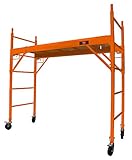
4. WEN 31110T Baker-Style Rolling Scaffold: The Best Reach for Two-Story Walls
WEN 31110T Baker-Style 6.25 ft. Multi-Purpose 1000-Pound-Capacity Rolling Steel Scaffolding
- 1000 lb rating supports painters
- tools
- and materials together
- 25 height options from 27 to 71 inches
- Swiveling casters with reinforced ball-bearing brakes
- Two sections stack for platforms above 12 feet
- Bulkiest model in this group with the largest storage footprint
- Baker geometry is awkward against narrow interior walls
This is the only Baker-style unit in the group, and it is the one to consider if the upper band of your siding is out of reach for anything shorter. It runs 25 height options from 27 to 71 inches on a 6.25-foot Baker-style footprint, and two sections stack to put a platform over 12 feet up. That stacking capability is what separates it from every fixed-height platform on this list.
The 1000-pound rating is the highest of the group alongside the framing, and the swiveling casters with reinforced ball-bearing brakes are the detail owners praise most. A swivel caster rolls forward and sideways, so you can slide the unit along a wall and pivot it at a corner without dragging it through gravel.
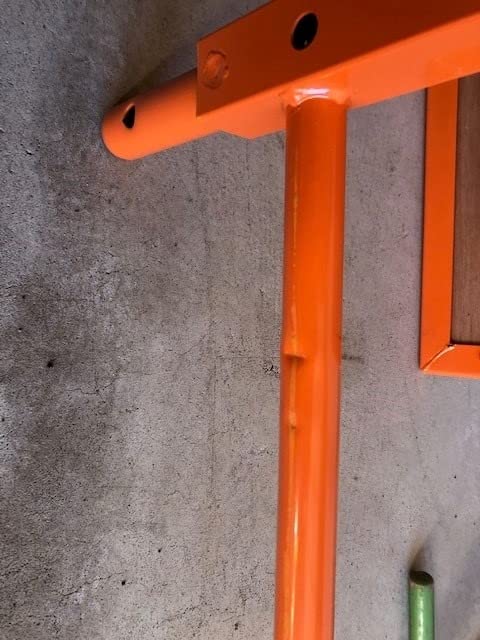
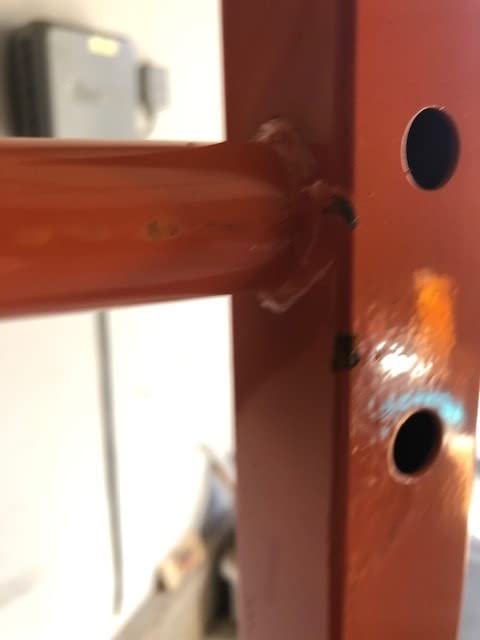
It meets OSHA and ANSI standards, which for a homeowner is not a legal requirement but is a decent shortcut for quality, since those standards cover weld integrity, steel gauge, and load labeling. Buyers rate it as a jobsite-grade platform, citing durability and easy rolling rather than any single specification.
The trade-off is honest and simple: this is the bulkiest unit in the group, and it has the largest footprint to store. Baker-style geometry also sits less conveniently against a narrow interior wall than a straight deck, which is exactly the geometry problem you avoid outside and accept inside.
Can a homeowner actually reach the second story with it?
A 71-inch deck is the tallest platform on this list, and the stacked configuration takes it over 12 feet. That is enough to work the band of siding under the second-floor windows without leaning, which is the specific pain point on most two-story jobs.
For gable and soffit work you are still above safe self-supporting reach at full extension, and no consumer platform changes that. Know where your power lines are before you roll it out; a painting forum thread about erecting tall equipment near high-voltage lines is worth reading before any two-story weekend.
What you give up for that reach
Bulk. This is the bulkiest model in the group, with a large footprint to store, and that footprint matters in a one-car garage. If you paint mostly inside, the 10-foot reach of a compact folding scaffold will serve you better.
Owners also note the Baker geometry is less convenient against narrow interior walls than a straight deck. Treat it as an exterior tool with occasional indoor use, not the reverse.
5. Metaltech I-IMCNT Folding Scaffold: The Best for Rooms With a Doorway
Jobsite Series 4ft. Folding Scaffold – 500-Lb. Capacity, Model Number I-IMCNT
- Top rated in the group with steady praise for stability at height
- Three working heights and 9 foot reach suit interior painting
- Folds flat and stores in a garage or vehicle
- Locking casters keep the unit fixed while you paint
- Safety rail and fold-away tool shelf included
- 51.5 lb weight makes it a two-person carry for some users
- Cannot be broken down further for tight stairwells
This carries the highest average rating of the eight at 4.7 stars across 364 reviews, and the reason is consistency rather than any single feature. Owners describe a rock-solid platform, quick tool-free setup, and flat storage that works in a garage or a vehicle. For interior work in a house with normal doorways, it is the pick I recommend most often.
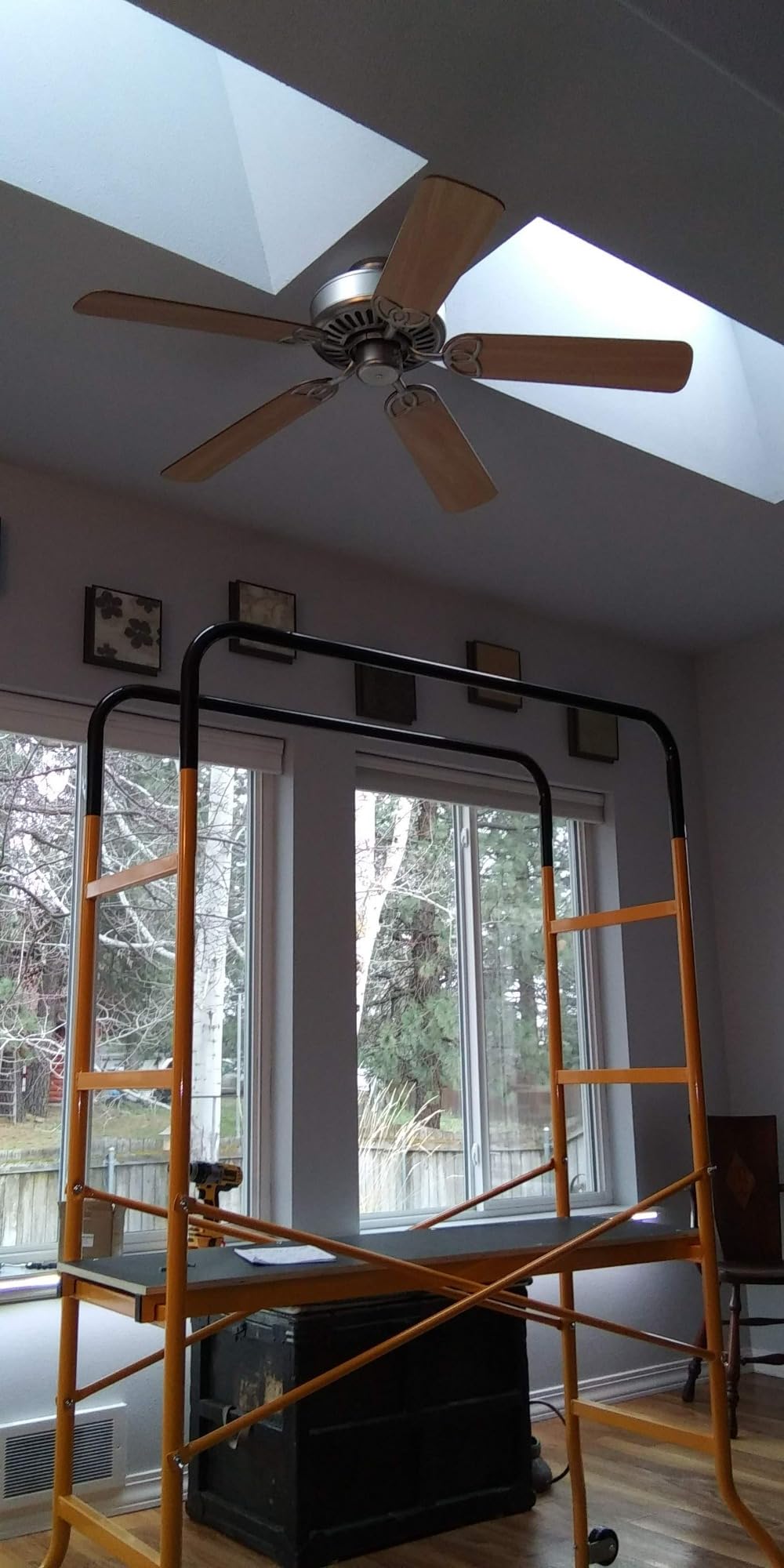
Working heights of 10, 21.5, and 33 inches with a 9-foot reach cover the wall band, window returns, and stairwell walls that a step ladder handles awkwardly. The safety rail and fold-away tool shelf mean you are not balancing a paint can on the deck edge, which is the single most common complaint about lighter platforms.
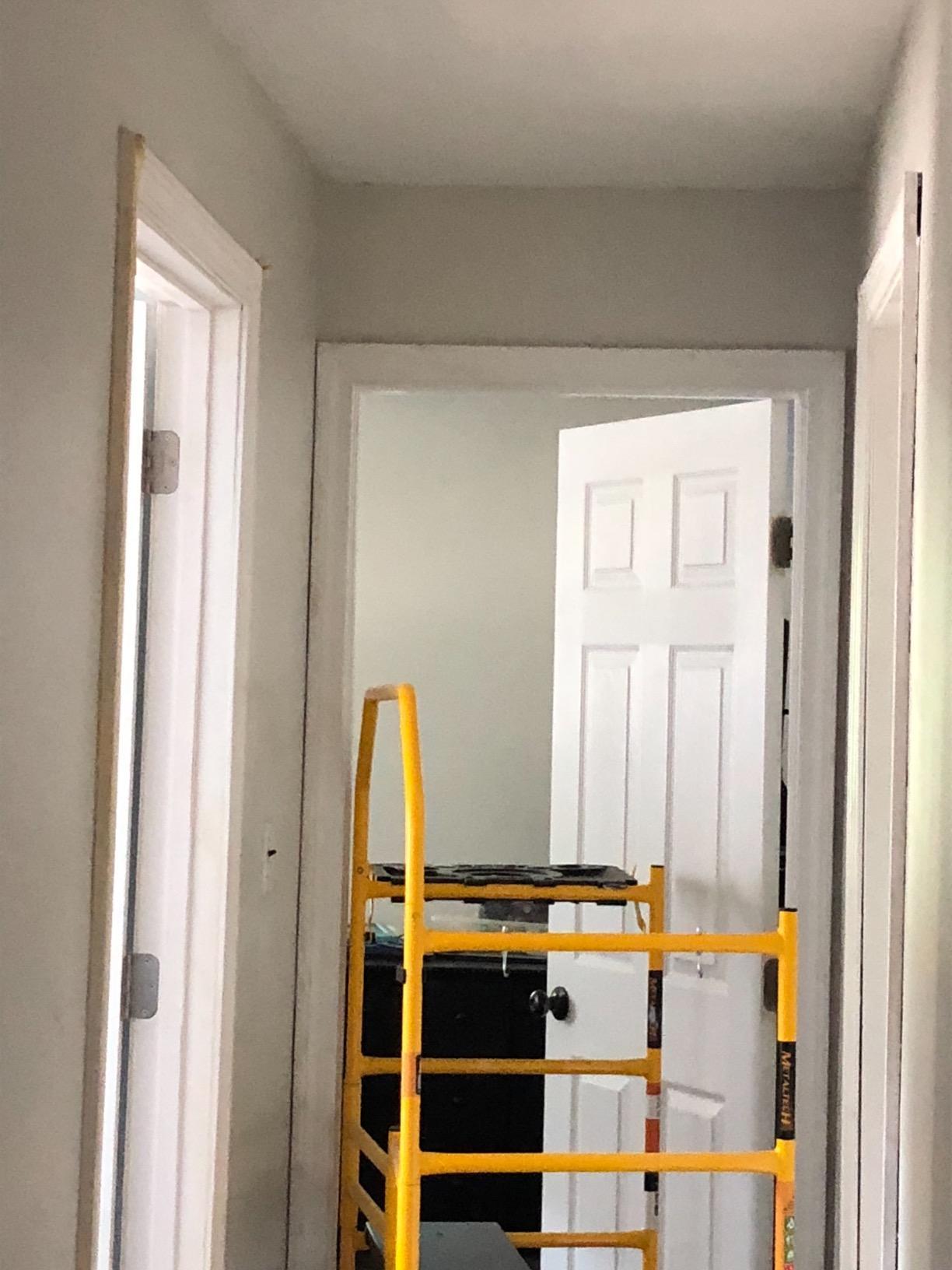
Four-inch double-lock non-marking caster wheels keep it in position while you paint, and the caster locks matter more than buyers expect: a deck that creeps an inch while you are running a brush along a cut-in line is an irritation you feel on every pass. Installation requires no tools.
It folds to 24 by 43.25 by 4.38 inches, which is the storage story that sells it in a home. At 22.5 by 49.5 by 57.75 inches deployed, it is a compact footprint for the height it gives you.
Will it fit through the house and up the stairs?
At 22.5 inches deep and 49.5 inches wide, it clears a standard doorway in a way the 50.5-inch-wide 5-foot model does not. That single dimension is why it works for interior bedrooms and halls where a larger scaffold stays in the garage.
The limitation is stairs. It cannot be broken down into smaller pieces for a tight stairwell, so if your paint route goes up a narrow staircase, plan on carrying the folded unit in two trips or painting that flight with a ladder.
Is 51.5 pounds a problem to move?
For some users, yes, and they say so directly: the 51.5-pound weight makes it a two-person carry. If you are repainting one floor and setting up in more than one room, that is worth factoring into your decision before the box arrives.
Against that, the 500-pound rating is honest, the safety rail is included rather than sold separately, and the tool shelf is the piece that most improves how a room actually gets painted. For a single-floor interior job, it is hard to argue with.
6. HOMCOM 4-Step Steel Scaffold: The Best Budget Frame for Garage Jobs
HOMCOM 4-Step Steel 4.6 x 2 x 6 ft. Scaffold 2 Wheels, 440 Pound Capacity
- Sturdy powder-coated frame that handles real DIY loads
- Compact footprint fits in a car and stores easily
- Anti-skid platform film helps in damp conditions
- Assembles and breaks down in 10 to 15 minutes
- Platform can rock if not braced against something solid
- Top hand rails slide instead of locking firmly
- Only two small wheels that roll poorly
- Not collapsible and can tip on the higher rungs
This one lives in the garage, and for popcorn ceiling scraping, drywall taping, and shop projects it does the job at a modest weight. Reviewers rate it as good value for those tasks. The powder-coated steel frame and X-bar side supports give it real structural stiffness for a 37.4-pound unit, and the platform carries 440 pounds.
Setup is quick in both directions, taking 10 to 15 minutes to assemble and take down, which matters for a tool that lives in a workbench corner rather than a dedicated bay. The anti-skid film on the platform surface helps in the dusty, damp conditions a garage produces.
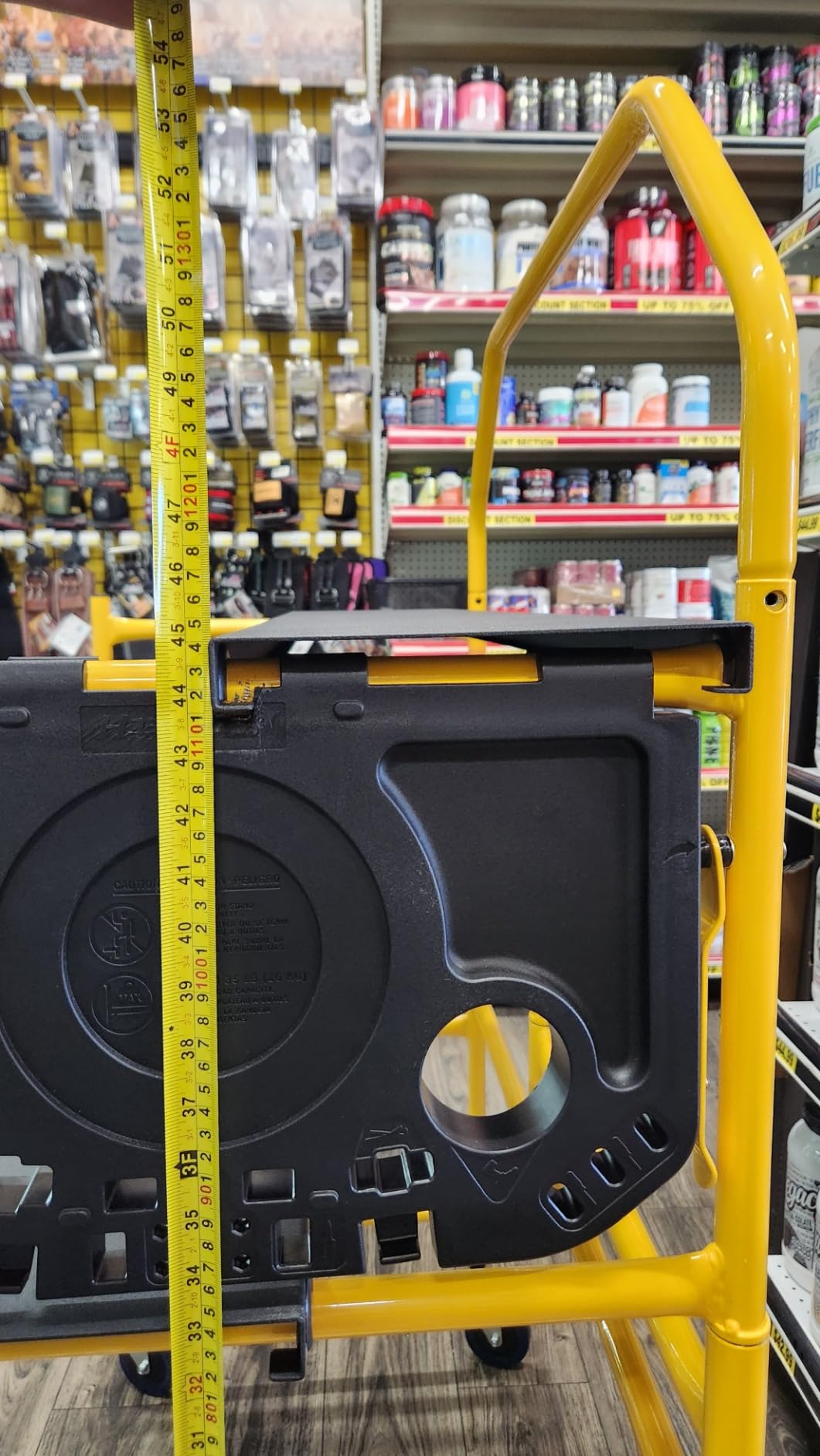
The geometry is worth understanding before you buy. The platform measures 47.25 by 14.25 inches, and the distance from the safety hinge to the platform is 14.5 inches. It has only two wheels, and repositioning means lifting the opposite side, so it is not a rolling scaffold in any practical sense.
Its 4.2 rating is the lowest in this group, and the review breakdown shows why: 61 percent of owners give it five stars, while a steady share describe a platform that rocks, shifts, or slides under load. That is a stability conversation, not a quality collapse.
Is it stable enough to stand on and paint from?
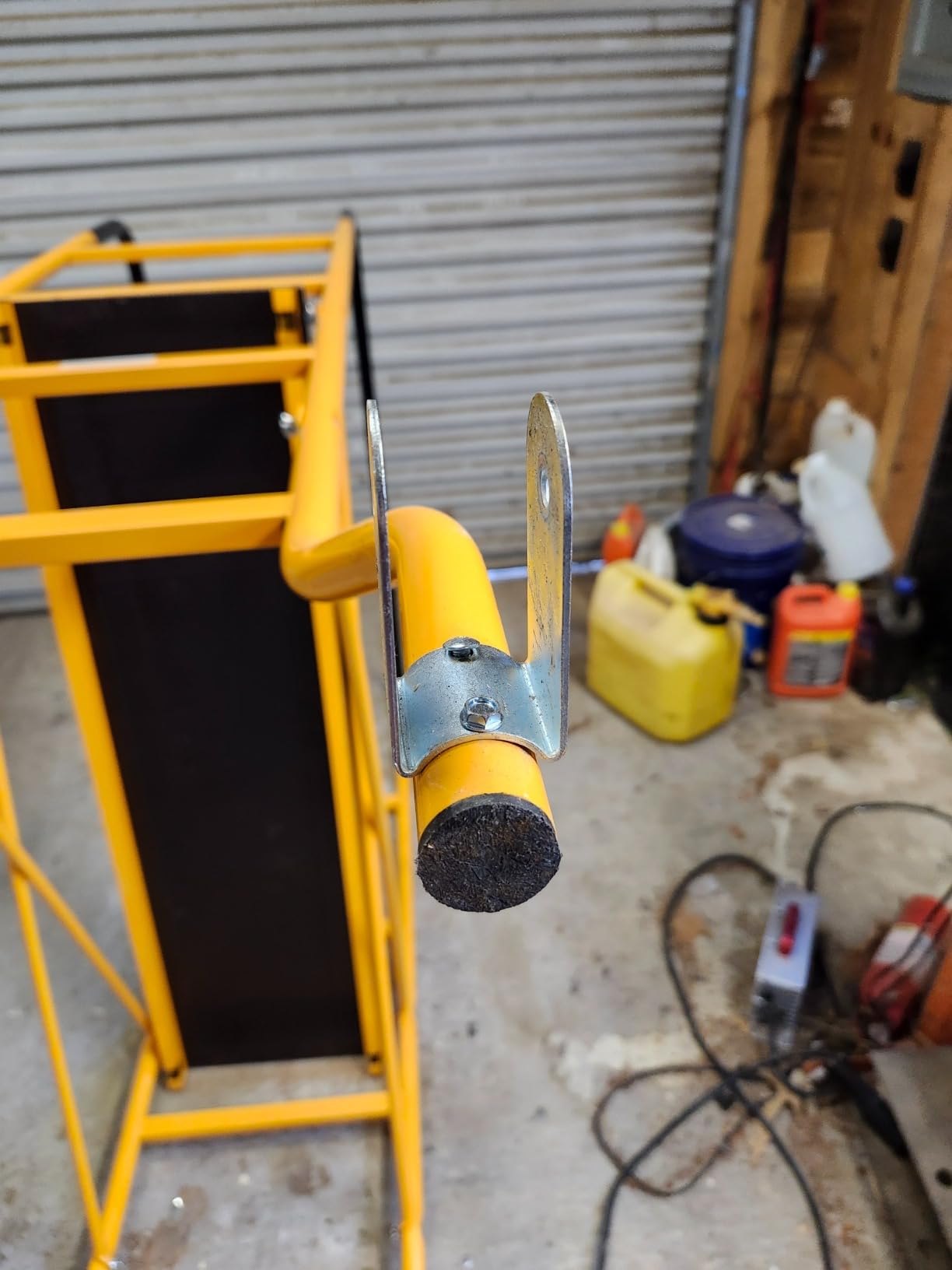
It can be, but only with help. Owners report the platform rocks or shifts unless it is braced with something solid, and the top hand rails slide up and down rather than locking firmly. If you take one thing from the reviews, take that: brace the frame before you climb.
For trimming, taping, and scraping work where one hand is occupied and you are not shifting your weight, it performs. It is not the frame to stand at full reach painting long cut-in lines, which is exactly the situation a scaffold is bought for.
Why it still earns a place on the list
It fits in a car easily, and at 37.4 pounds it moves without a second person. That portability is genuine value for a homeowner who paints a different part of the property every few months.
Also note the setup friction: instructions are hard to follow for first-time users, and it is not collapsible, so it can tip when climbing the higher rungs unassisted. Two wheels that roll poorly mean every reposition is a lift.
7. VEVOR Folding Steel Work Platform: The Best Reach in a Folding Frame
- Stable with no wobble at the tallest setting
- Four height settings cover high walls and ceilings
- Folds down small for garage storage
- Build quality reads higher than the price suggests
- Galvanized finish resists rust outdoors
- Heavier than comparable aluminum platforms
- Height change needs screws removed and a wing nut loosened per leg
- Locking pins must be fully engaged to feel solid
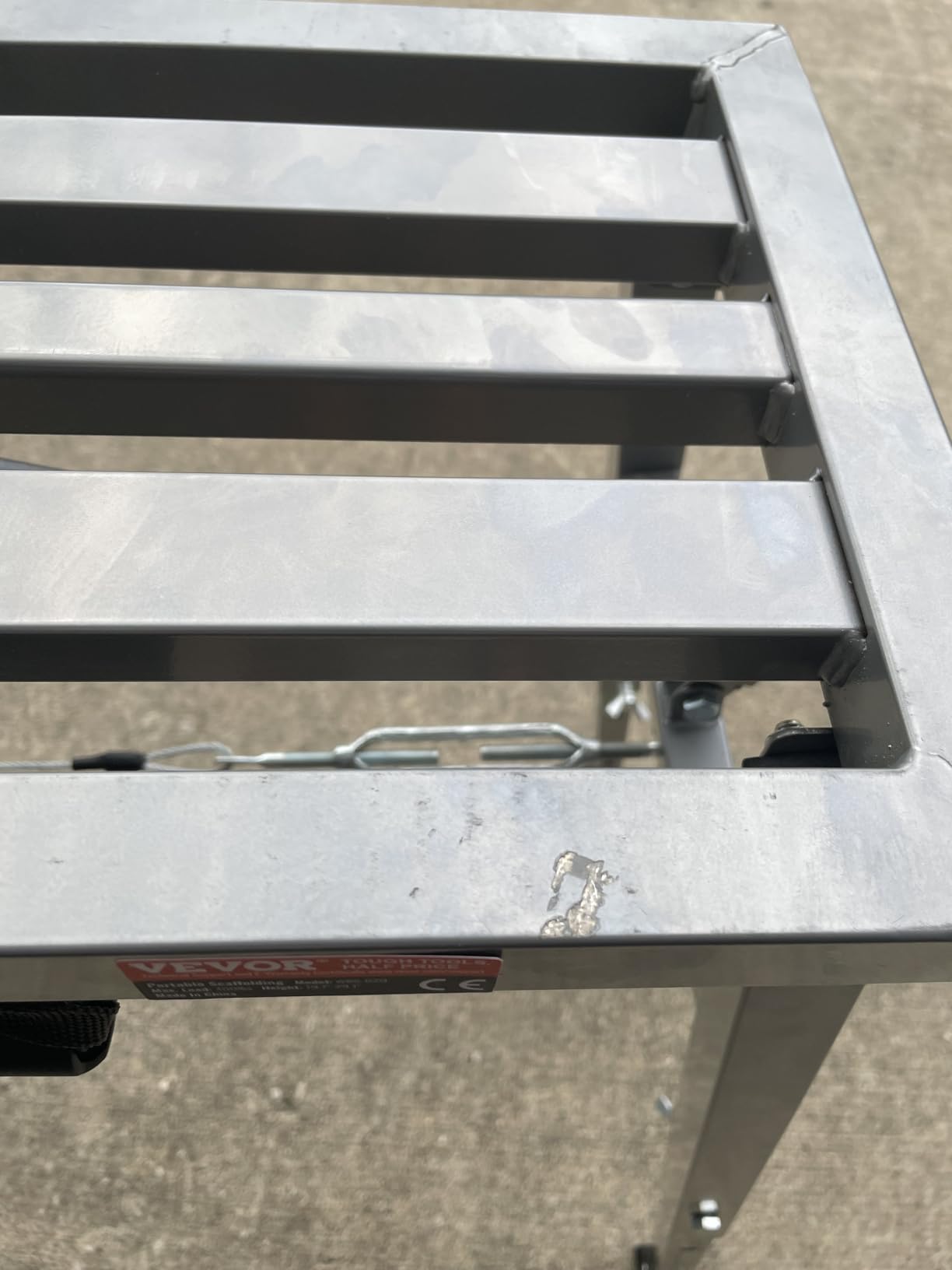
At 51 inches, the maximum deck height here puts you at a comfortable working height on a tall wall without overreaching from too low, and buyers say it saves real time on high walls, ceilings, and vehicle washing. Four settings at 31.5, 37.99, 44.49, and 51 inches let you match the deck to the band you are painting.
The galvanized finish is the detail that matters outdoors. It resists rust and corrosion, which is a real difference between a platform that survives a wet spring in the yard and one that streaks rust onto a drop cloth. Several sizes are available, including longer decks, if your wall runs are wide.
Capacity is listed at 882 pounds, with the listing describing an 800-pound class, so treat the lower figure as the working number. The triangular support structure and 0.047-inch alloy steel tube wall give it stiffness, and non-slip rubber feet handle a hard floor.
It folds to 32.48 by 20.28 by 5.31 inches in five steps, and the triangular geometry is why it does not collapse flat. At 39.2 pounds it is a solid two-person carry or a comfortable one for most.
How much setup friction should you expect?
More than you would like. Height adjustment requires removing and reinstalling screws plus loosening a wing nut per leg, which slows setup and is the recurring complaint in reviews. Budget twice the setup time you would with a pin-and-lever frame.
Buyers also stress that the locking pins must be fully engaged to get a solid feel. A half-seated pin gives you a platform that moves under load, and the fix is to check every pin with the frame unloaded before you climb.
Who should buy it and who should not
Buy it if you paint high walls, need a stable deck at 51 inches, and do not mind a slower height change. Reviewers report it feels sturdy and adjustable with no wobble at the tallest setting, and that the build quality feels higher than the price suggests.
Skip it if weight is your main constraint. It is heavier than comparable aluminum platforms, and the galvanized steel is the reason. If you need to carry it to three rooms, the lighter aluminum options serve you better.
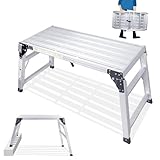
8. ORIENTOOLS Adjustable Aluminum Platform: The Best for Uneven Ground
- Largest deck in this group at 39.4 by 18.5 inches
- Only 17.6 lb so it moves between rooms easily
- Each of four legs adjusts independently for stairs and slopes
- Textured deck improves traction with a roller and tray
- Folds to 7 inches for tight storage
- 330 lb rating is the lowest here and limits a second worker
- 35 inch maximum height is well short of ceiling work
- Platform is not self-leveling once set
Independent leg adjustment is the feature that earns this platform its place, and it is the answer to uneven ground. Each of the four legs adjusts separately across 7 settings from 24 to 35 inches, so you can set one foot on a step and three on the floor, or level across a slope. Contractor forums repeatedly advise shimming casters on uneven ground for outdoor jobs, and per-leg adjustment does the shimming for you.
The deck measures 39.4 by 18.5 inches, a genuinely generous working surface, and that is what makes it a painting platform rather than a perch. Buyers specifically mention the textured surface improving traction with a paint roller and tray, and the frame is aircraft-grade aluminum weighing just 17.6 pounds.
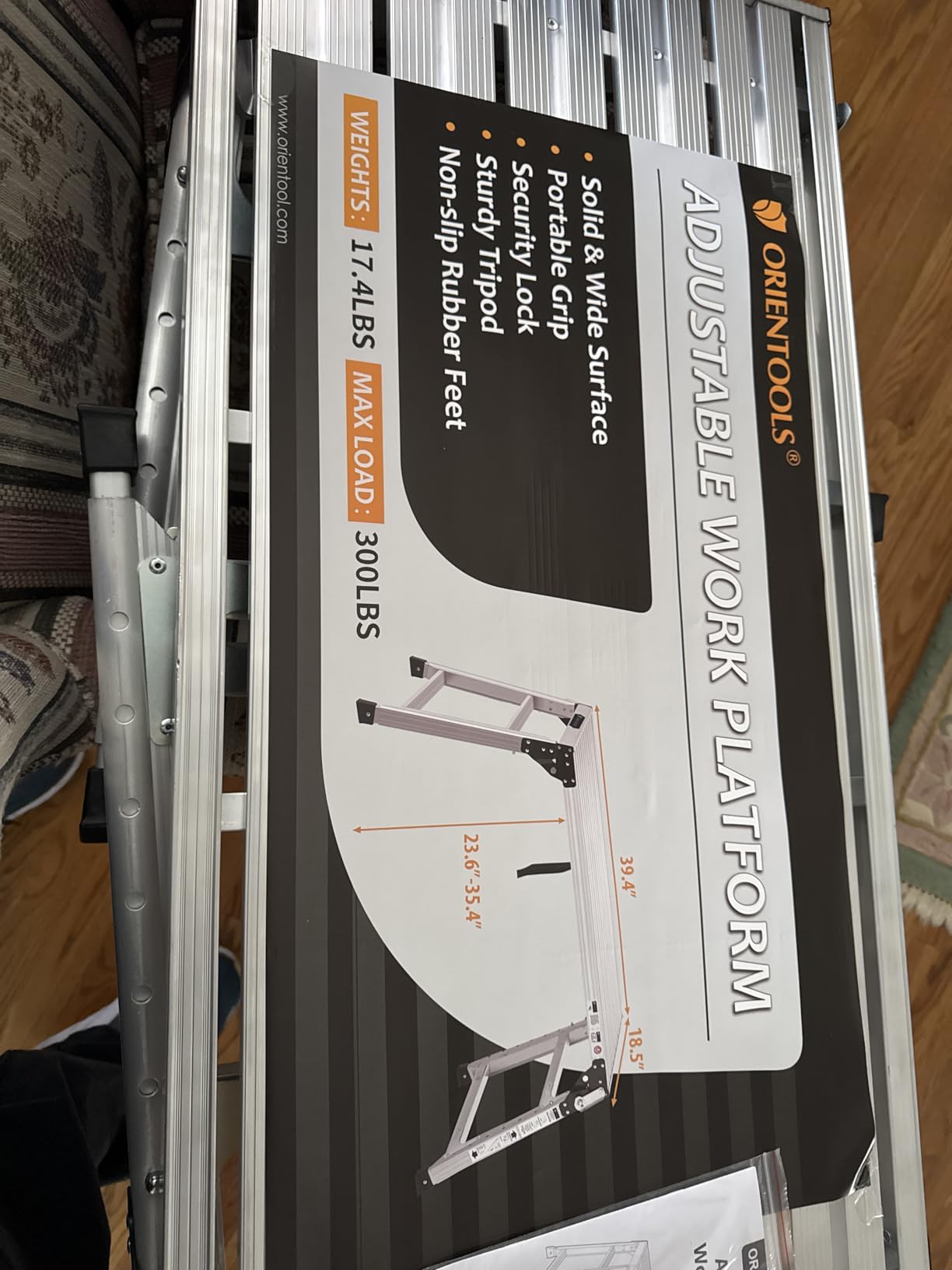
Side safety locks secure the legs during use, and non-slip rubber pads on all four feet keep it planted on a hard floor. It folds to a 7-inch stored height, which is the storage footprint of a rolled ladder and nothing more.
It is also the one platform here that stairs are a strength for rather than a problem. Stair landings, sloped garage aprons, and split-level interiors are exactly what per-leg adjustment is designed to handle.
Can one person really carry and set it alone?
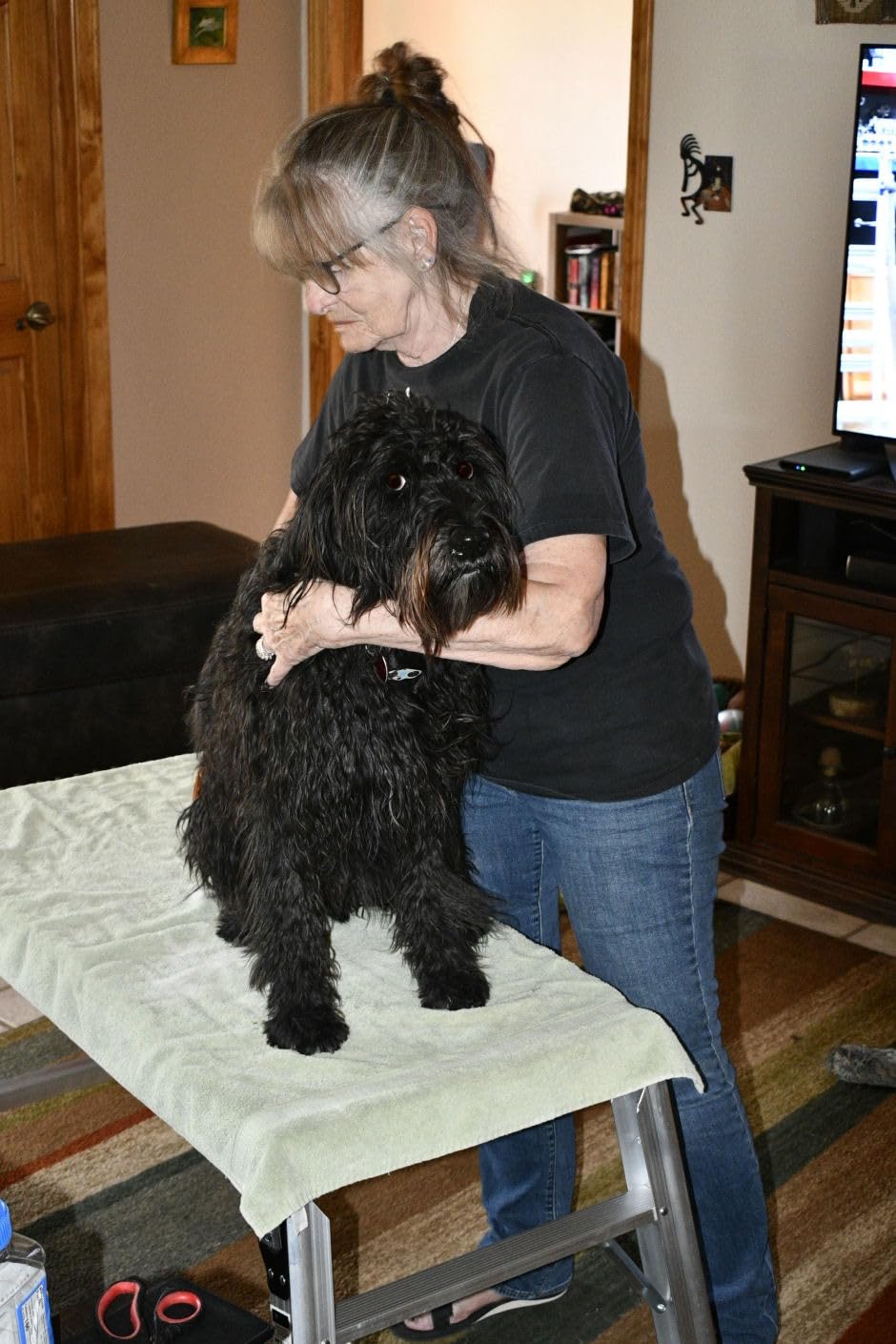
Yes. At just 17.6 pounds with a 39.4 by 18.5 inch deck, this is the rare platform where the frame weight and the working surface are both generous, and buyers move it between rooms and up steps without a second person.
Set it before you climb, and set it where you will not need to move it mid-stroke. The platform is not self-leveling once adjusted, so a shift in your weight while you lean out to reach a wall is what tests the setup.
What are the two real limits?
Capacity and height. The 330-pound rating is among the lowest of the frames here, which limits use for two workers plus material, and the 35-inch maximum height is well short of ceiling work. Adjusting it also takes care, since the platform will sit wherever you set it.
Think of it as the most maneuverable painting platform available, not the tallest. If your walls stop around 9 to 10 feet and you move between rooms and floors, it is a genuinely excellent tool.
How to Paint High Exterior Walls From a Scaffold Deck
Owning the platform is the easy half. Setting it up badly on uneven ground is the single most common DIY failure, and it is the one that turns a safe afternoon into a trip to urgent care. Work through these steps before you climb.
Level the ground before anything else
Check your footprint with a straight level on the longest frame member. If the ground is soft, grass, or gravel, set down plywood pads under each caster so the wheels roll onto a hard, flat surface instead of sinking as you reposition. On a slope, shim the downhill casters with wood until all four sit square. A scaffold that rocks once you are on it is the one you should not be standing on.
Lock the casters and load the deck last
Engage every caster brake before you climb, and check them again after you roll into position, because rolling can knock a brake partially out. Stage your materials on the ground first, then load the deck, then climb. A deck loaded before it is in position is a deck carried with a five-gallon can on it.
Change your paint sequence, not just your platform
A wide deck changes how you should work. Instead of starting at the top and working down to manage drips, work in manageable sections of roughly 10 to 12 feet and lap into the wet edge. Roll the main field from the middle of the wall outward so your roller strokes do not cross over a lap line you have already set.
Keep your tray on the deck, set the bucket lid flat beside it, and use an extension pole for the field so your ladder legs are not part of your stroke. For soffits and fascia above your deck height, an extension pole saves more time than any platform adjustment. For anything above 10 feet of platform, the right answer is a rented tower with a proper guardrail, not a leaning ladder with a paint tray.
Run a safety check before the first stroke
Guardrails go in above 10 feet on any scaffold you rent or buy, and consumer scaffolds frequently arrive without one. Confirm the guardrail is fitted, the toe board is on, every locking pin is seated, the rails are locked rather than free-sliding, and the caster brakes hold with your weight on the deck. Professional painters describe managing fear on the first trip up by starting on a low setting and raising the platform only once the movement feels normal.
Finally, survey the site before you roll anything tall into position. Overhead power lines are a genuine and legal hazard on exterior jobs, and a painting forum thread about boom lifts near high-voltage lines makes the point better than we can. Walk the perimeter first.
Scaffolding Buying Guide: Load Capacity, Working Height, and the 3 to 1 Rule
Two numbers decide almost everything: load capacity and working height. Buyers routinely confuse them, and product listings blur them on purpose, so here is the clean version.
Load capacity is a total, not a per-person figure
The load capacity printed on a scaffold is the total weight the deck is rated to hold, including your body weight, your partner, tools, paint, ladder, and materials. A 500-pound deck with two painters and a rack of buckets is already over its limit. For a single homeowner painting alone, anything from 330 pounds upward is workable; the rating matters most when two people share the deck, and that is exactly why the 900- and 1000-pound frames exist.
Working height is the deck, not your head
Working height means the height of the platform deck off the ground. Your head ends up roughly 5 to 6 feet above that, plus whatever reach you add. Typical Baker scaffold sizes come in 4-foot, 5-foot, and 6-foot footprints, with the height adjustable within each. The typical sizes of Baker scaffolds are built around two or three working positions, and the larger models trade footprint for reach.
The 3 to 1 rule in scaffolding states that the height of a working platform must not exceed one and a half times the width of its narrowest base dimension, or three times its base length, whichever is less. Put plainly: a 5-foot-square base should not carry a deck much above 7.5 feet, and a 4-foot base should not go much past 6 feet. It is a free way to check whether a unit you are considering is being asked to do more than it should.
The 4 to 1 rule is the more conservative variant used for rolling or mobile units that can be moved while loaded: the platform height stays at or below four times the base length. If a seller does not publish a base dimension, treat that as its own warning sign.
Steel, aluminum, and the ground you are standing on
Galvanized or powder-coated steel scaffolds are heavier and handle more load, which matters on soft ground because they stay put instead of skating. Aluminum platforms are light enough for one person to reposition between rooms, which is the difference between a tool you use and a tool that stays folded in the garage. Both are legitimate; they answer different problems.
Casters decide outdoor work. Four-inch casters handle a slab and a driveway; five-inch casters handle gravel and lawn. Neither rescues you from soft ground, which is why plywood pads matter more than caster size on most residential jobs.
Check what is actually in the box
Planks, casters, guardrails, and toe boards are frequently sold separately, and this is the most repeated surprise in buyer reviews across the category. Before you commit, confirm the platform deck, the caster size, and any guardrail is included. A scaffold that arrives without its anti-slip pads or a full set of pins is a two-minute fix, but one that arrives without its deck is a return.
Brands worth knowing for home painting work include Metaltech and WEN for steel folding and rolling scaffolds, Werner for adjustable steel platforms, and a longer tail of aluminum folding platforms from ORIENTOOLS, VEVOR, GIANTEX, and Loyoda. Harbor Freight and ScaffoldMart carry their own house-brand scaffolds that sit in the same tier. What separates good from poor is rarely the logo; it is published standards, a stated base dimension, and a real load rating.
Frequently Asked Questions
What is the best scaffolding system for exterior painting?
A Baker-style rolling scaffold with locking casters, an adjustable steel deck, and a 900 to 1000 pound load rating is the best scaffolding system for exterior painting. It gives you a flat standing surface, both hands free, and enough reach for the band of siding above 10 feet. Under about 10 feet of wall, an extension ladder is faster; between 10 and 20 feet, a rolling platform is the right tool.
Can I paint a 2-story house without scaffolding?
You can, but you will spend much of the job managing a ladder instead of painting. Below about 10 feet of wall an extension ladder is genuinely faster and cheaper. Between 10 and 20 feet a rolling or folding work platform is the better tool. Past 20 feet, most homeowners rent a framed tower with a guardrail rather than owning one.
What is the 3 to 1 rule in scaffolding?
The 3 to 1 rule states that the working platform height must not exceed one and a half times the width of the narrowest base dimension, or three times the base length, whichever is less. In practice a 5 foot square base should not carry a deck much above 7.5 feet, and a 4 foot base should not go much past 6 feet.
What is the 4 to 1 rule in scaffolding?
The 4 to 1 rule is the more conservative variant applied to rolling or mobile scaffolds that can be moved while loaded. It requires the platform height to stay at or below four times the base length. Sellers who do not publish a base dimension give you no way to check either ratio, so treat a missing base dimension as a warning.
What are the OSHA requirements for baker scaffolding?
OSHA standards for scaffolds built to 10 feet or more above the next lower level call for a guardrail on the work platform, a toe board, safe access, a level foundation, and a maximum working load of 250 pounds per worker. A competent person must inspect the scaffold before each use. These rules apply to employers; as a homeowner you are not legally bound, but the same numbers make a good checklist.
How do you set up a scaffold on uneven ground?
Place the scaffold on firm, level ground. On grass or gravel set plywood pads under each caster so the wheels do not sink, and shim the downhill casters with wood until all four sit square. A platform with independently adjustable legs is the easiest fix for stairs and slopes, because each leg can be set independently. Then lock every caster brake and check every locking pin before climbing.
What is the best ladder for painting high walls?
For walls under about 10 feet, a fiberglass or aluminum extension ladder with a stabilizer is the right tool, and a platform is faster to set up and easier to work from. For walls above 10 feet, an extension ladder is the unsafe answer; use a rolling or folding work platform, and rent a framed tower with a guardrail above 20 feet. Many homeowners who switch to a deck report finishing a full exterior in half the time.
Final Verdict on the Best Scaffolding for Home Painting in 2026
The GIANTEX aluminum work platform takes our EDITOR’S CHOICE as the best scaffolding for home painting in 2026, and the deciding factor is simple: a light aluminum frame with a wide anti-slip deck, light enough for one homeowner to carry into a room, stand on comfortably, and set a paint tray beside them on. It is not the tallest or the strongest option here, and it does not pretend to be.
Buy the Metaltech I-IMIS if you paint interiors and want one serious scaffold that handles two people, materials, and a full load of ceiling work. Buy the WEN 31110T if the second story is your problem and you are willing to store a large footprint to solve it. Buy the ORIENTOOLS platform if your house has stairs and sloped floors, and the Loyoda if you want something that lives in the car.
Whichever you choose, get the ground level before you get the frame up, lock the brakes, and run the safety check the first time out. The whole point of working from a platform is that you can stop climbing. Pick the one that fits your walls, set it up properly, and your exterior job finishes in days instead of weeks.