
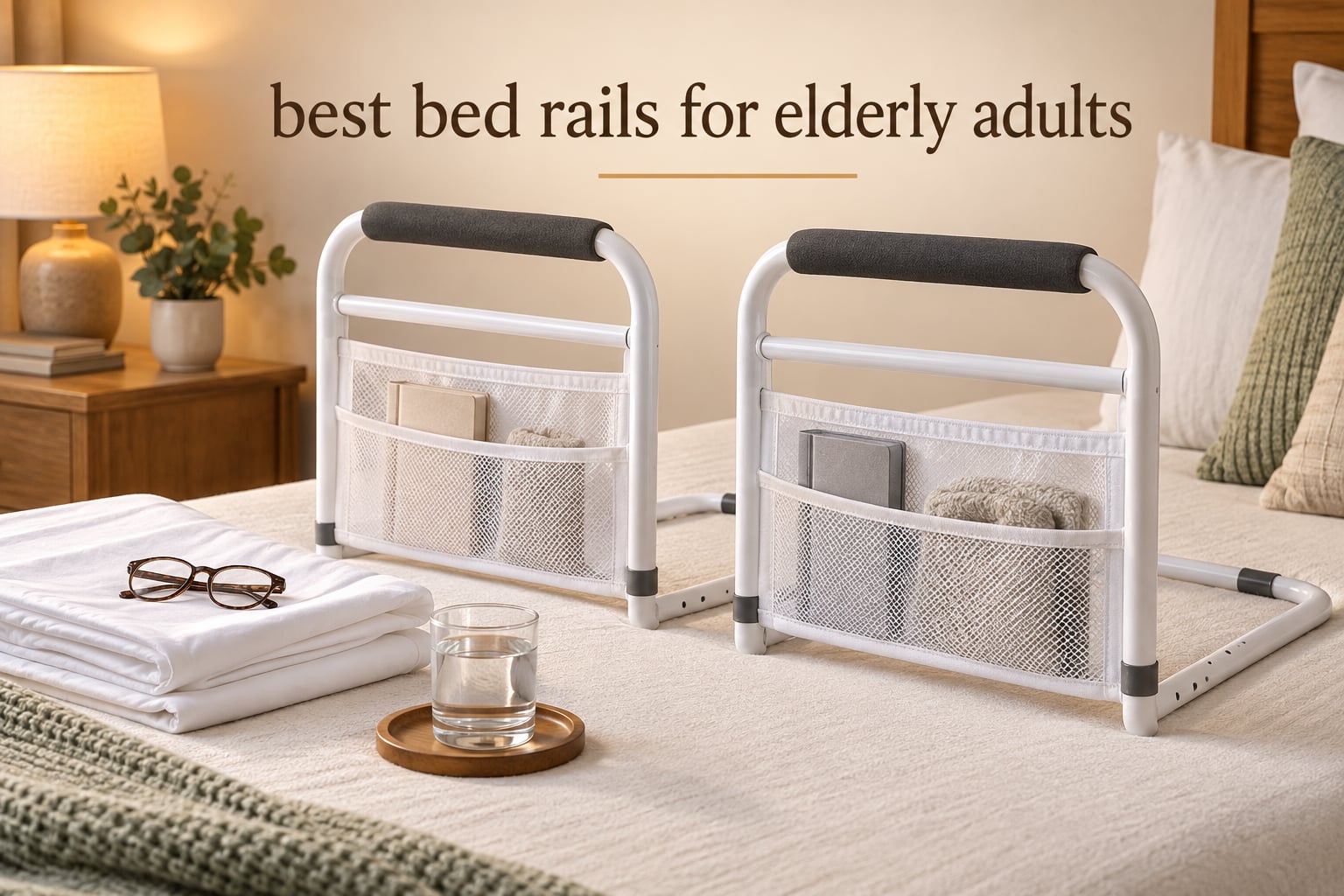
Most falls in older adults happen in a very short window: pushing back on the mattress, swinging both legs over the edge, and standing up in the dark. A bed rail puts a solid handhold in exactly that window, and the right one turns a fall into a controlled sit-down. The wrong one, fitted to the wrong bed for the wrong person, has been documented as a cause of death.
Our team spent six weeks reading the safety standards, comparing fittings, and matching each design to the reason someone needs help getting in and out of bed. This guide covers the best bed rails for elderly adults available now, with twelve picks across assist handles, half rails, and full-length guards.
We also set aside rails that are the wrong shape for the person, because a rail someone can climb over turns a low fall into a high one. If you are planning a bathroom safety upgrade too, our guides to the best shower benches for elderly and the best handheld shower heads cover the other half of the nighttime trip.
Table of Contents
Safety First: The Two Risks Every Caregiver Should Know
The Consumer Product Safety Commission recorded 284 entrapment deaths involving adult portable bed rails between 2003 and 2021. Entrapment means becoming wedged in a gap you cannot get out of, most often between the rail and the mattress, between two bars, or under the rail onto the frame. The number matters less than the mechanism, because that mechanism is what you shop against.
Since August 21, 2023, adult portable bed rails sold in the US fall under the federal mandatory standard at 16 CFR Part 1270, built on ASTM F3186-17. A listing that only says safety rail in the title and never names the standard is telling you nothing. Look for it in the specifications, not the headline.
The second risk is climbing over the rail, which is why dementia is treated as a contraindication rather than a use case. In March 2026, roughly 122000 adult portable bed rails were recalled after two reported entrapment deaths, so check CPSC.gov/Recalls before you order and again before you install.
Both risks shrink with the same two choices: a rail short enough to swing legs over comfortably, and an entrapment gap too small for a body to fall into.
Top 3 Picks for the Best Bed Rails for Elderly Adults in 2026
Three rails earned a place for different reasons, and the best pick depends on whether your priority is a proven long-term record, verified certification, or lighting the walk to the bathroom.

Medline Bed Assist Bar
- Foam grip handle
- Tool-free assembly
- Deep storage pouch
- Fits most bed sizes

Stander EZ Adjust Bed Rail
- ASTM F3186-17 tested
- Supports 300 lb
- Fits 10-14 inch mattresses
- Folds and pivots away
Lunderg Bed Assist Rail
- Motion-activated night light
- 300 lb load tested
- Four stabilizing bars
- Five-minute setup
The Best Bed Rails for Elderly Adults at a Glance in 2026
Every rail below is rated for at least 300 lb and installs without tools. The certification column matters most, because it tells you what the manufacturer actually tested.
| Product | Specifications | Action |
|---|---|---|
| Medline Bed Assist Bar with Storage Pouch |
|
Check Latest Price |
| Stander EZ Adjust Bed Rail |
|
Check Latest Price |
 Medical king Bed Rail with Floor Support Legs Medical king Bed Rail with Floor Support Legs |
|
Check Latest Price |
| Lunderg Bed Assist Rail with Motion Light |
|
Check Latest Price |
 KingPavonini Bed Rail Model BM03-1 KingPavonini Bed Rail Model BM03-1 |
|
Check Latest Price |
 WeHwupe Bed Rail with Storage Pocket WeHwupe Bed Rail with Storage Pocket |
|
Check Latest Price |
 Panta Bed Rail with Full Support Legs Panta Bed Rail with Full Support Legs |
|
Check Latest Price |
 BigDolphin Bed Rail Model GS07 BigDolphin Bed Rail Model GS07 |
|
Check Latest Price |
 Sunisife Extended Bed Assist Rail Sunisife Extended Bed Assist Rail |
|
Check Latest Price |
 YrHeiper Bed Rail with Bedside Support Legs YrHeiper Bed Rail with Bedside Support Legs |
|
Check Latest Price |
 TABEKE Bed Rail with Double Side Pockets TABEKE Bed Rail with Double Side Pockets |
|
Check Latest Price |
 YrHeiper Low-Profile Bed Rail YrHeiper Low-Profile Bed Rail |
|
Check Latest Price |
1. Medline Bed Assist Bar with Storage Pouch – Best Overall Transfer Aid
- Tool-free assembly with clearly different hole sizes
- Foam-covered handles for long holds
- Deep pouch for phone and glasses
- Flat tubing not felt through slat bases
- About 15500 ratings at 4.6 stars
- Can feel slightly wobbly even with the strap tightened
- Non-removable safety stickers look untidy
- Safety strap can bunch under the mattress
This is the one we keep coming back to for one reason: the number of people who have used it. Around 15500 ratings averaging 4.6 stars is not a marketing figure, it is fifteen years of continuous use across thousands of beds.
Buyers describe the same three things in the same words, which is how you know a design has settled rather than just promised. It is sturdy when leaned on, it goes together with no tools, and it works for sitting up and standing up. The foam-covered handles come up first, the flat tubing second.
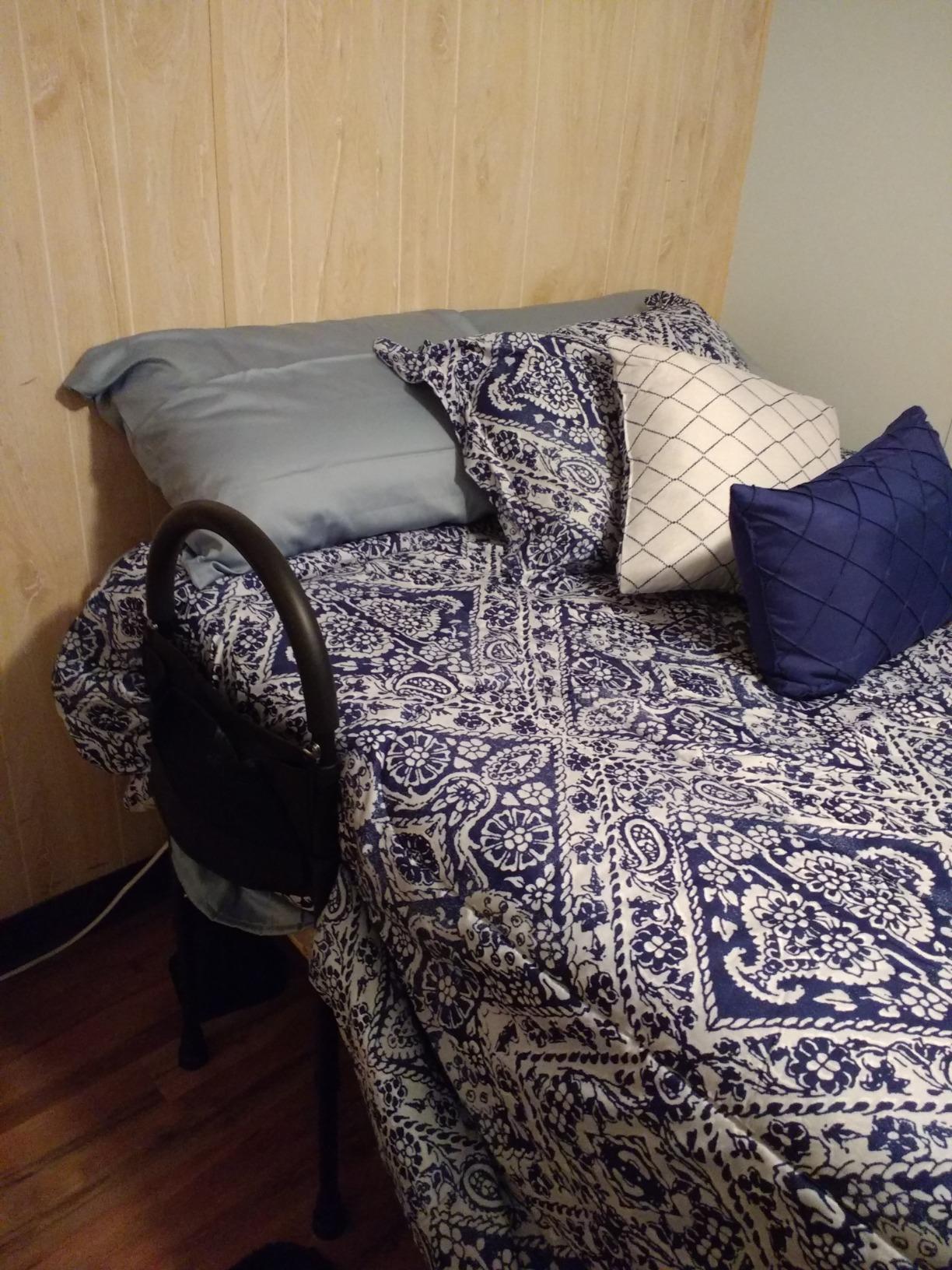
Flat tubing matters because you do not feel it through the mattress on a slat or spring base. A round tube creates a ridge that becomes a groove by morning, and people quietly take the rail out because of it.
The pouch answers the request we hear most from caregivers in aging parents forums: something firm to push on, with a pocket for a phone and glass of water, short enough to maneuver around. That is this rail in one sentence.
Honest drawbacks: some owners report slight wobble even with the strap tight, and a few added their own fasteners. The safety strap is fixed and can bunch under the mattress, and the factory stickers will not come off cleanly.
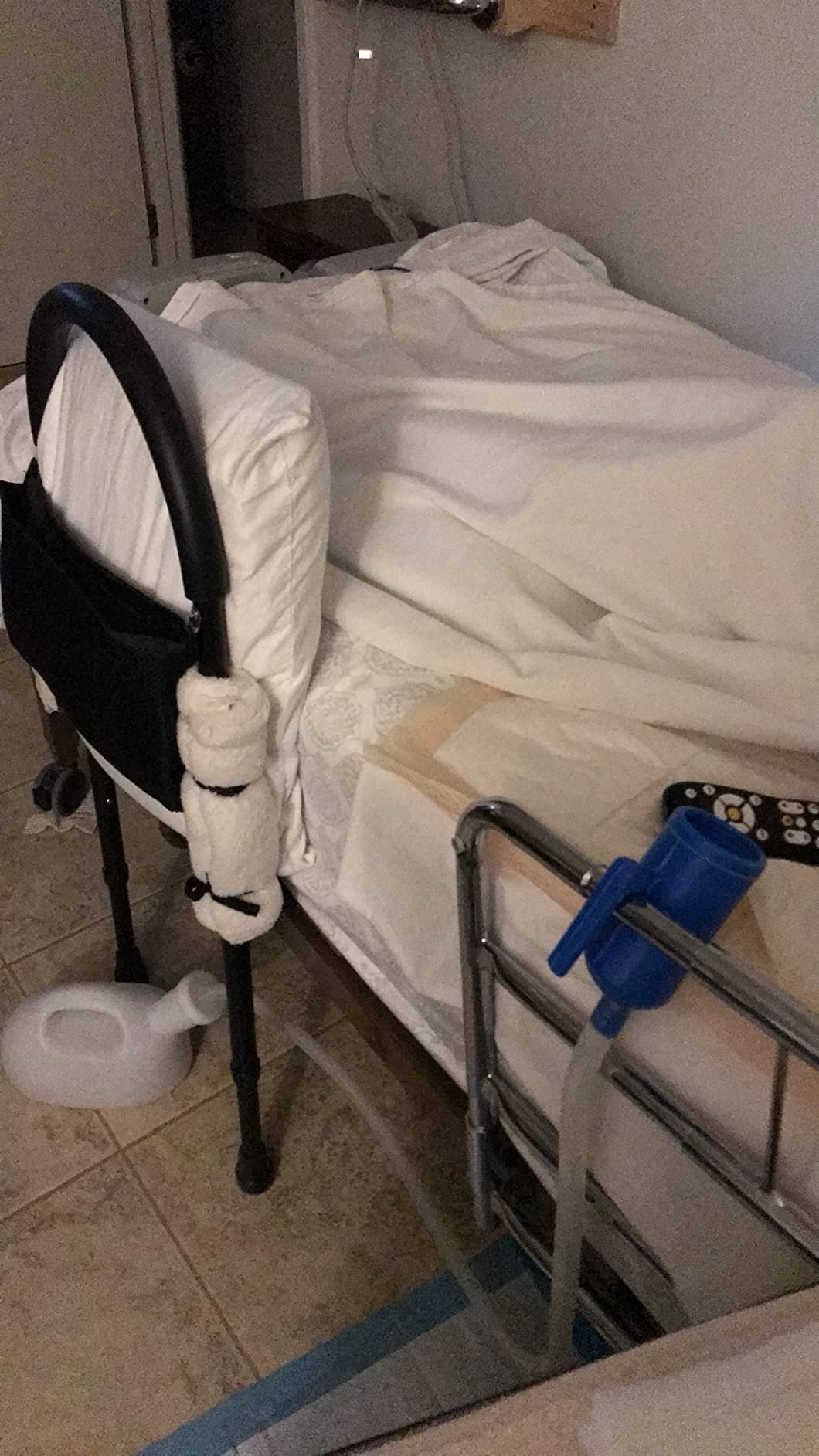
Check the fit before you order
Returns are rarely granted once packaging is opened for hygiene, so measure first. This bar is 27.5 by 14 by 43.75 inches, weighs 6.4 pounds, and fits most standard beds including queen and king.
It folds flat for transport, which matters if the bed is shared or if you move someone between rooms. It is an assist bar, not a barrier, so nobody is stopped from rolling out.
Who it suits and who it does not
It suits reduced leg strength, post hip or knee surgery recovery with weight-bearing clearance, and frequent night rises. The horizontal foam grip is easier to hold than a bare vertical tube for painful hands.
It does not suit a restless sleeper, does not suit dementia, and is not a roll-out guard. For anything heavier, pair it with a night light rather than expecting one product to do both jobs.
2. Stander EZ Adjust Bed Rail – Best Certified Full Guard
- Tested to the ASTM F3186-17 standard
- Folds and pivots down for bed making
- Adjusts from 20 to 30 inches
- Sturdy enough to stand from
- Large multi-pocket organizer
- Strap clip is difficult to unclip
- Blocks the elevating function on adjustable beds
- Pouch cover can feel enclosing
Stander is one of the few rails here that names ASTM F3186-17 in the specification rather than the product title, and that is why it leads the certified list. Powder-coated steel, 10 pounds, 300 lb stated rating, and roughly 7800 ratings at 4.6 stars.
It does two jobs. Extended to 30 inches it guards against rolling out; folded down it becomes a grab bar for standing. Reviewers keep pointing at the pivot as the feature that stops it becoming a daytime obstacle.
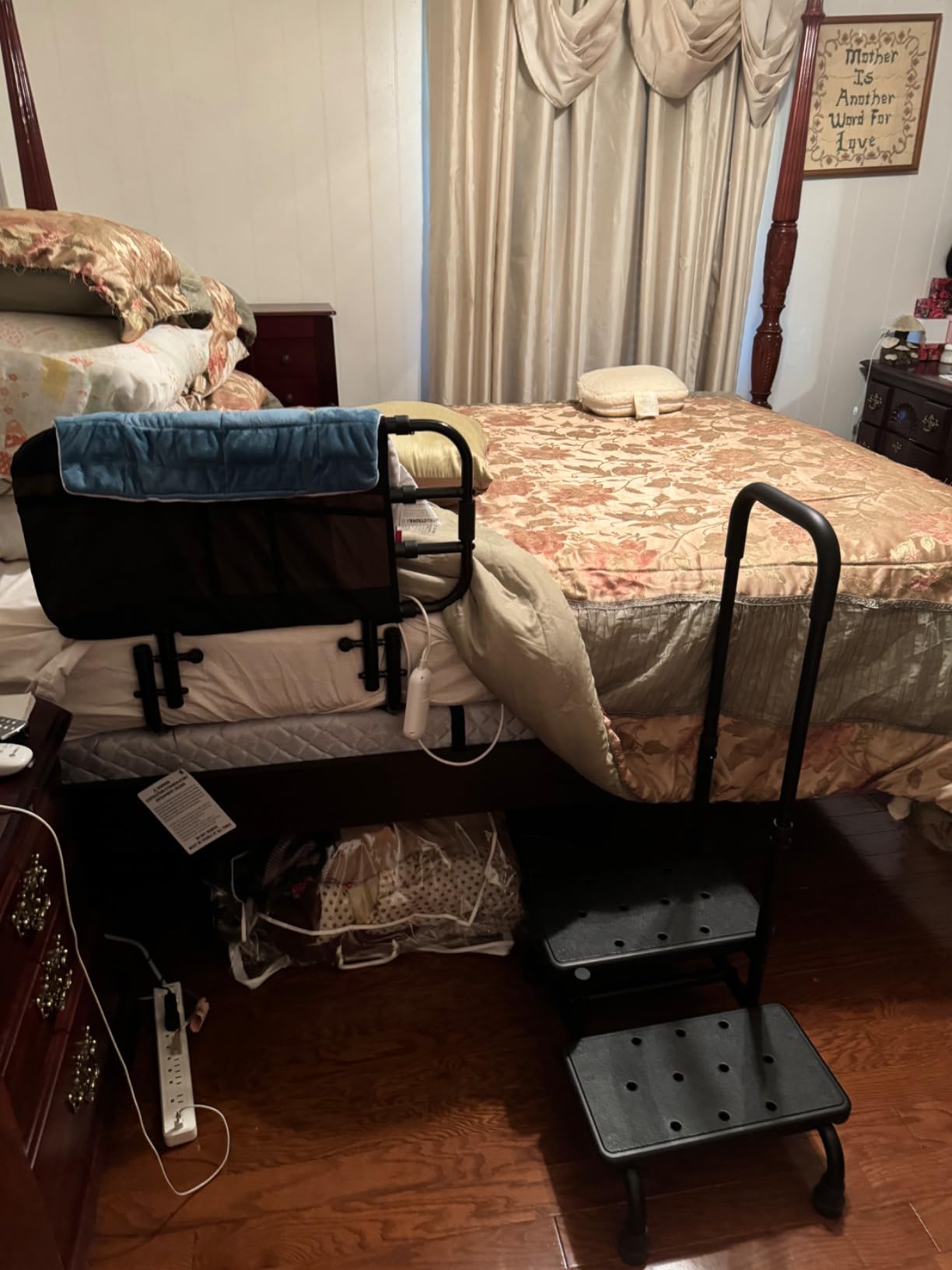
The organizer is genuinely large, not a mesh slip. Remotes, glasses, a phone, and evening medication all fit at the height a hand can find while still lying down.
That matters because the alternative is leaning out over the edge toward a bedside table, which is the exact movement the rail exists to prevent.
Limitations, stated plainly: the strap clip is hard to unclip, so attach it once and leave it. The wide under-mattress section means two will not fit opposite each other. The listing says it is not intended for adjustable beds.
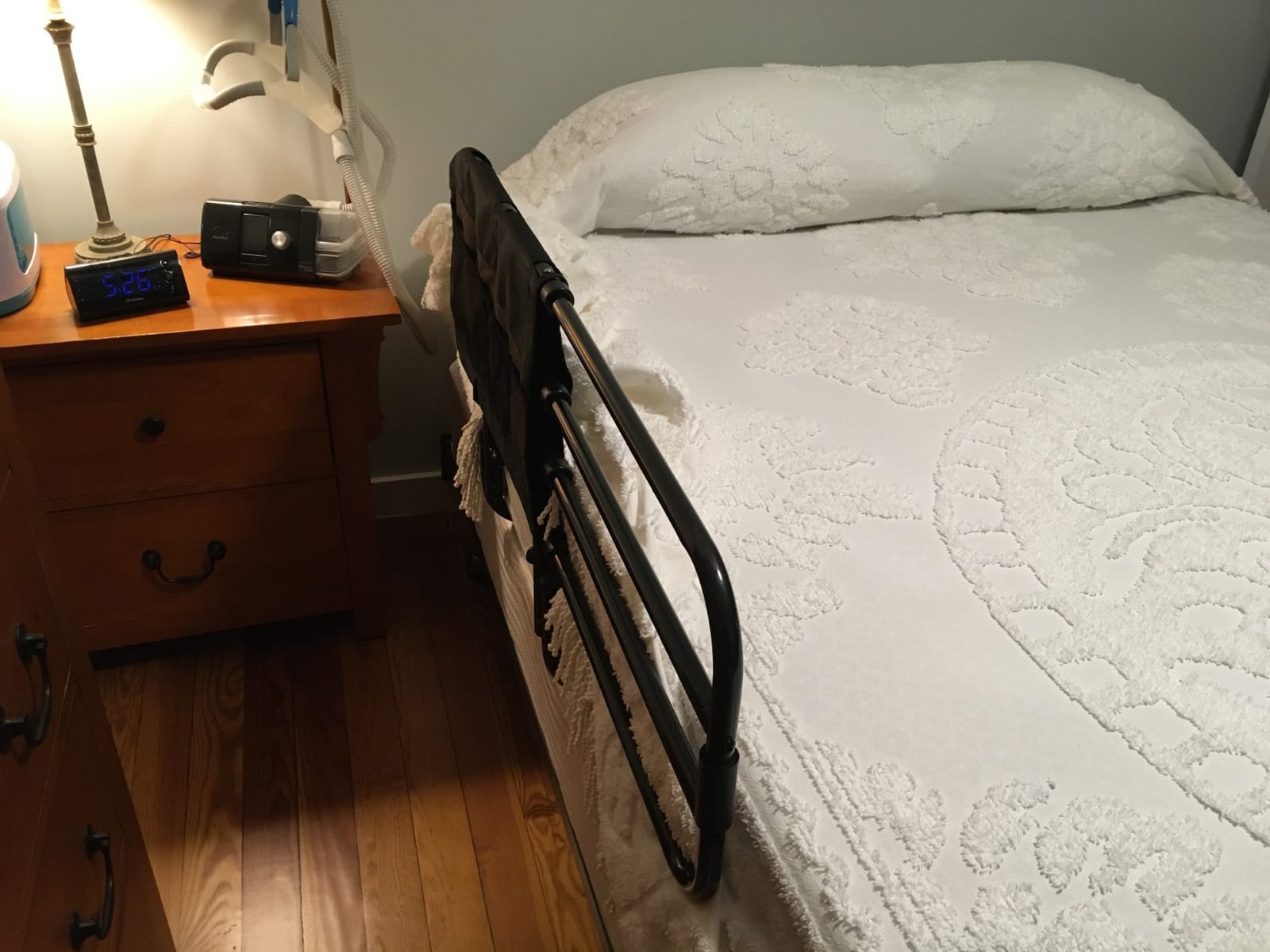
What the ASTM label actually covers
ASTM F3186-17 is a test standard, not an award. It checks load, entrapment gap dimensions, and stability under lateral force, and Part 1270 made compliance mandatory in 2023. It does not certify that the rail suits your person or your bed.
This model fits mattresses 10 to 14 inches thick, which is a narrow band. On a plush 14 inch pillow top you are at the limit.
Best for daytime care and nighttime security
Choose it when the room is used for care, not just sleep. Folding it aside means a caregiver is not working around the rail during bed making, a bed bath, or a reposition.
Skip it for a power frame, for two rails, or for dementia. For a single rail in a mixed-use room, it is the most complete option here.
3. Medical king Bed Rail with Floor Support Legs – Best Budget Pick
- Very quick tool-free assembly
- Wide enough to pull up to seated from
- Removable storage bag
- Installs on either side of the bed
- Floor legs add real stability
- Safety strap is too short for a queen box spring
- Instructions mention washers that are not included
- Some owners reassemble it to seat it
At around 9500 ratings this is the most reviewed rail in the set after the Medline bar, and at 4.4 stars it has the most visible room for improvement. That is what makes it the honest budget answer rather than a bad one.
The engineering trade is floor legs in exchange for lighter hardware and a strap that underperforms. Most portable rails grip the mattress alone, and the answer we get from caregivers asking for the least wobble under full weight is always the same: buy a rail that reaches the floor.
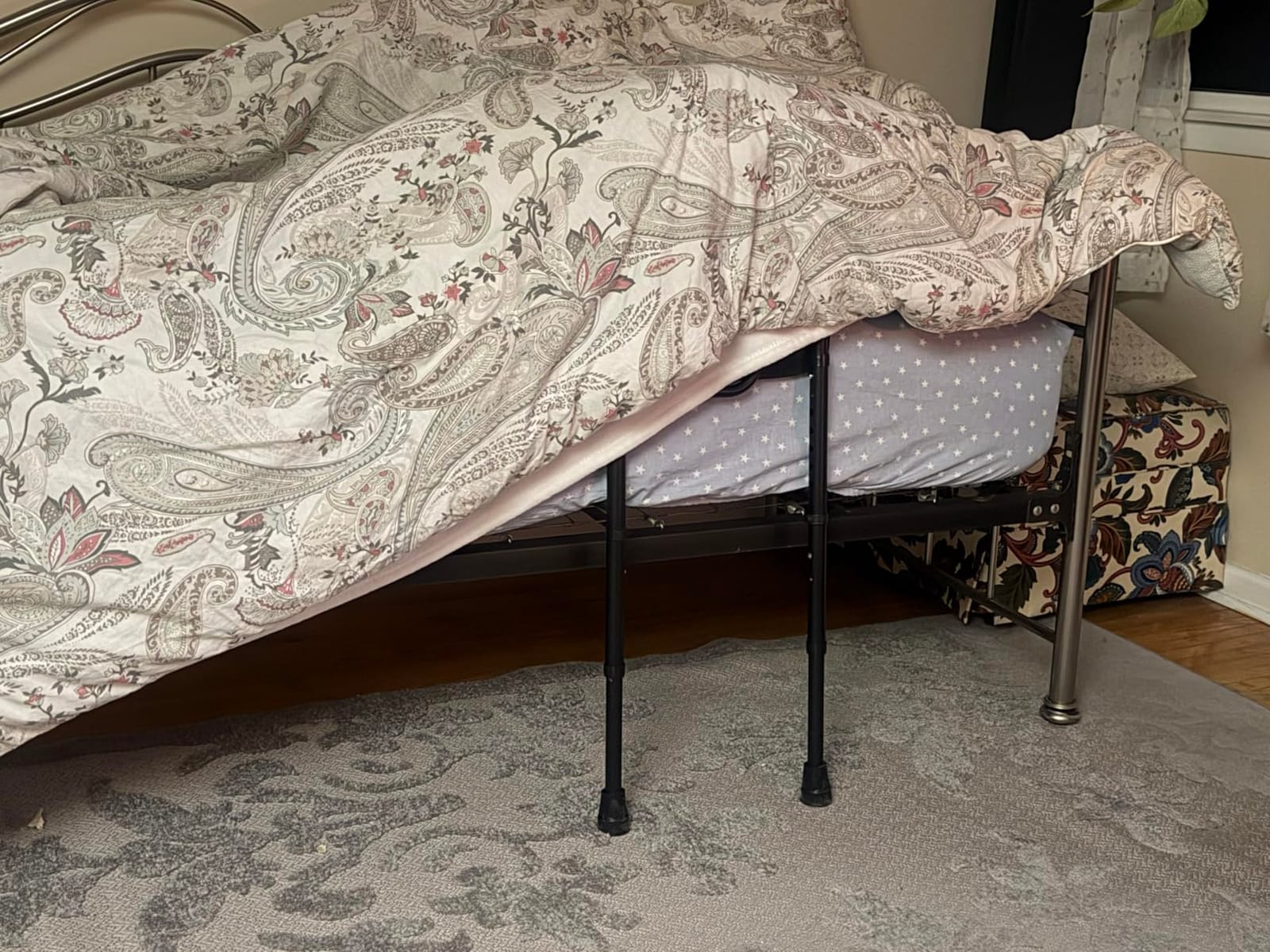
This one does. The bar is wide enough to push up from while lying down, which is harder than it sounds: weak arms need a grip point they can reach across the body and pull through.
That matters more than the padding does. A narrow post is a lever nobody with limited shoulder strength can use.
Removable bag for glasses and remotes, 6 pounds total, and it installs on either side so two can be used without buying a special model.
The near-universal complaint is strap length. It will not wrap a queen box spring, so on a larger bed you rely on mattress friction and the floor legs. Owners also note instructions referencing packing washers that are not in the box.
Best when the bed is a twin or a full
The fit is open-ended on mattress thickness, which no other rail here claims. For a twin, a full, or a split bed needing two rails, that is a strong argument.
Measure frame-to-floor clearance first. The legs need somewhere to land, and on a low platform bed with a box spring they may not reach. Expect to add your own tie-down from a hardware store.
Trade-offs against a certified rail
If the person weighs over 250 pounds, leans hard, or shares the bed with a restless partner, spend up to a certified model. This listing does not name a certification standard.
Unrated capacity is something you plan around rather than trust. For a lighter adult, a twin bed, and a second rail in the room, the floor legs do the job the strap should have.
4. Lunderg Bed Assist Rail with Motion Light – Best for Nighttime Trips
- Motion-activated rechargeable night light
- Partly pre-assembled five-minute setup
- Four horizontal bars resist wobble
- 13 inch profile suits getting out
- Non-slip handle for weak hands
- Light battery may need more frequent charging
- Light is motion-triggered not continuous
- Strap to the far frame side may need two people
At 4.7 stars across roughly 2800 ratings, this rail has the second highest average in our set, and the reason has little to do with steel. The motion-activated light is the feature caregivers mention most.
It turns the walk to the bathroom from a guess into a guided path without a lamp burning all night. It auto-activates on movement, stays on 60 seconds, and the rechargeable battery lasts weeks.
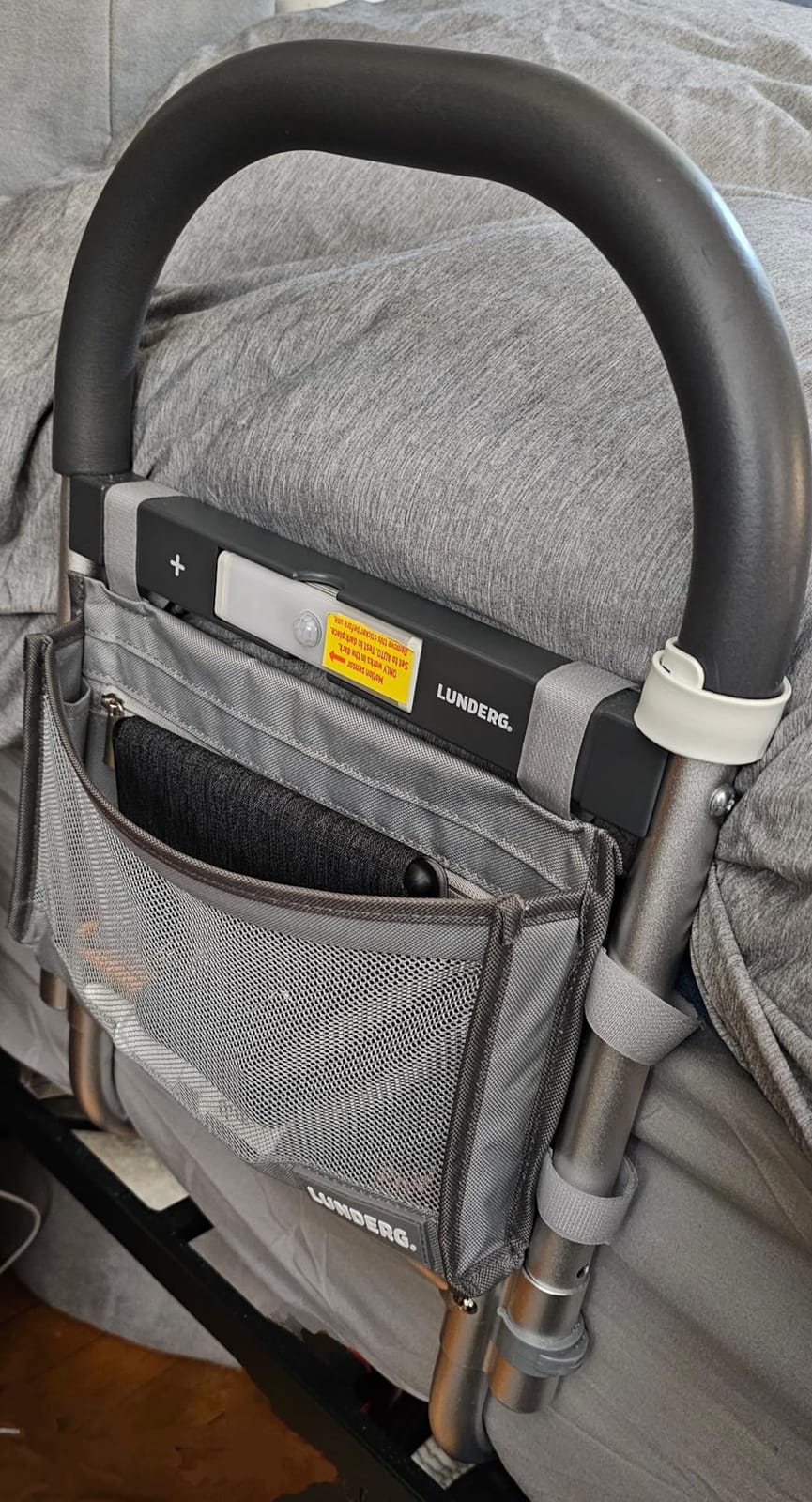
Owners describe the brightness as exactly right: enough to see the floor and doorway, soft enough not to wake a partner. That is unusual praise for a feature most people take for granted.
The structure holds up too. Four horizontal stabilizing bars give a firm grip with no visible wobble under full weight, and the whole unit weighs 2 pounds.
It arrives partly assembled, so setup is genuinely a five-minute solo job. Two caveats: the light does not stay on all night, and clipping the strap to the far side of a high frame can take two people.
How short is short enough
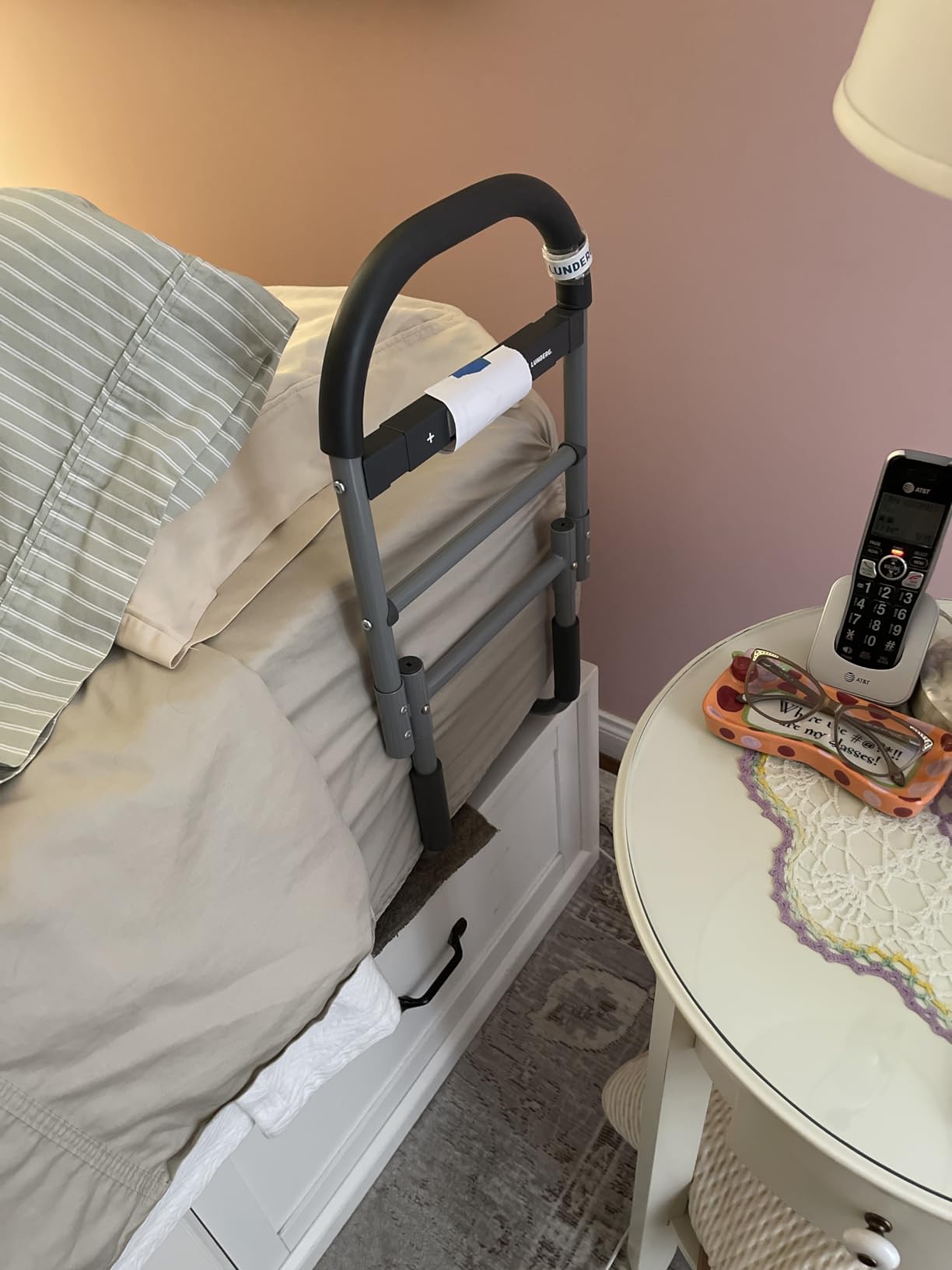
The profile is 13 inches, with a 17.5 inch option. That is the sweet spot for a bed-exit handle: short enough to swing both legs over and stand, tall enough to catch a slow roll.
A longer rail becomes something to climb, and climbing is the risk this guide opened with.
Best when the fall happens on the way to the bathroom
If the problem is the walk rather than the climb, this is the rail to buy. The light removes the most common cause of that fall and the rail covers the transfer moment.
It is also our pick for arthritic hands, since the non-slip handle is comfortable with a weak grip and the horizontal bars offer several places to catch. It fits twin to king on 7 to 13 inch mattresses, either side, and is not rated for adjustable beds.
5. KingPavonini Bed Rail Model BM03-1 – Best for Heavier Users
KingPavonini Bed Rails for Elderly Adults Safety, 380 LBS, Model BM03-1
- Highest load rating here at 380 lb
- Very stable once the base is extended
- Tool-free install in minutes
- Padded non-slip handle
- Storage pouch and narrow profile
- Some assisted living facilities will not accept this design
- Supplied strap may not reach a heavy box spring
Load capacity is usually the fourth bullet in a listing, and it should be the first thing you read. At 380 pounds, this is the highest stated rating in the roundup, which makes it the default for a larger-framed adult.
Stability comes from geometry. The base extends 28.6 to 34.7 inches, so the further under the mattress it slides the wider the footprint against the box spring. Owners say it is solid before the strap even goes on.
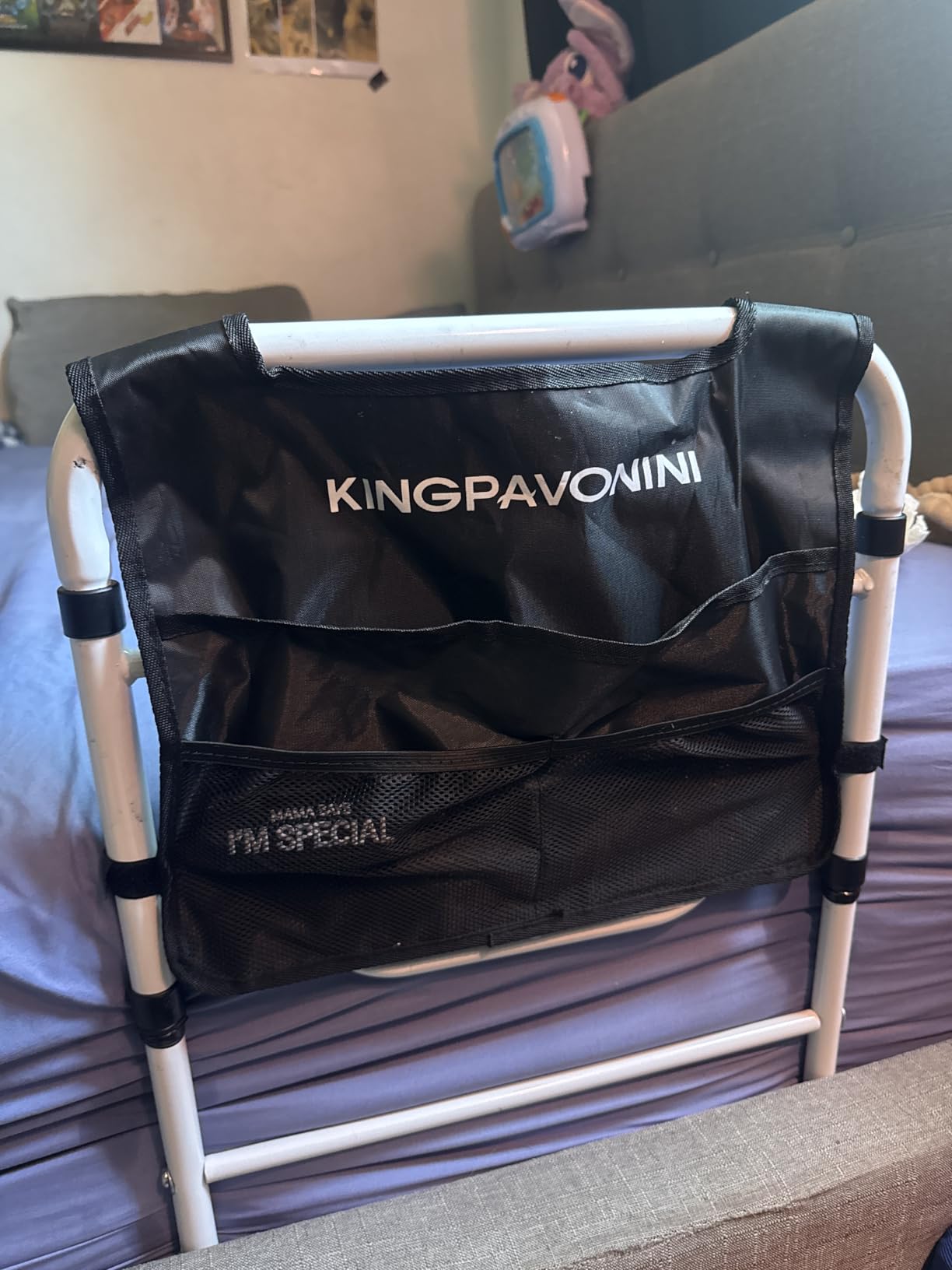
The padded upper handle stays comfortable through assisted transfers, and both dimensions adjust, from 17.6 to 20.9 inches high. At 5.5 pounds it moves easily between beds.
The narrow profile means the other side of the bed stays usable, which is where a caregiver stands during a transfer. That is a small detail with a large practical effect.
Two caveats. Some assisted living facilities will not accept this rail design under their own policies, so check before a temporary placement. And the supplied strap may need a workaround around a heavy box spring.
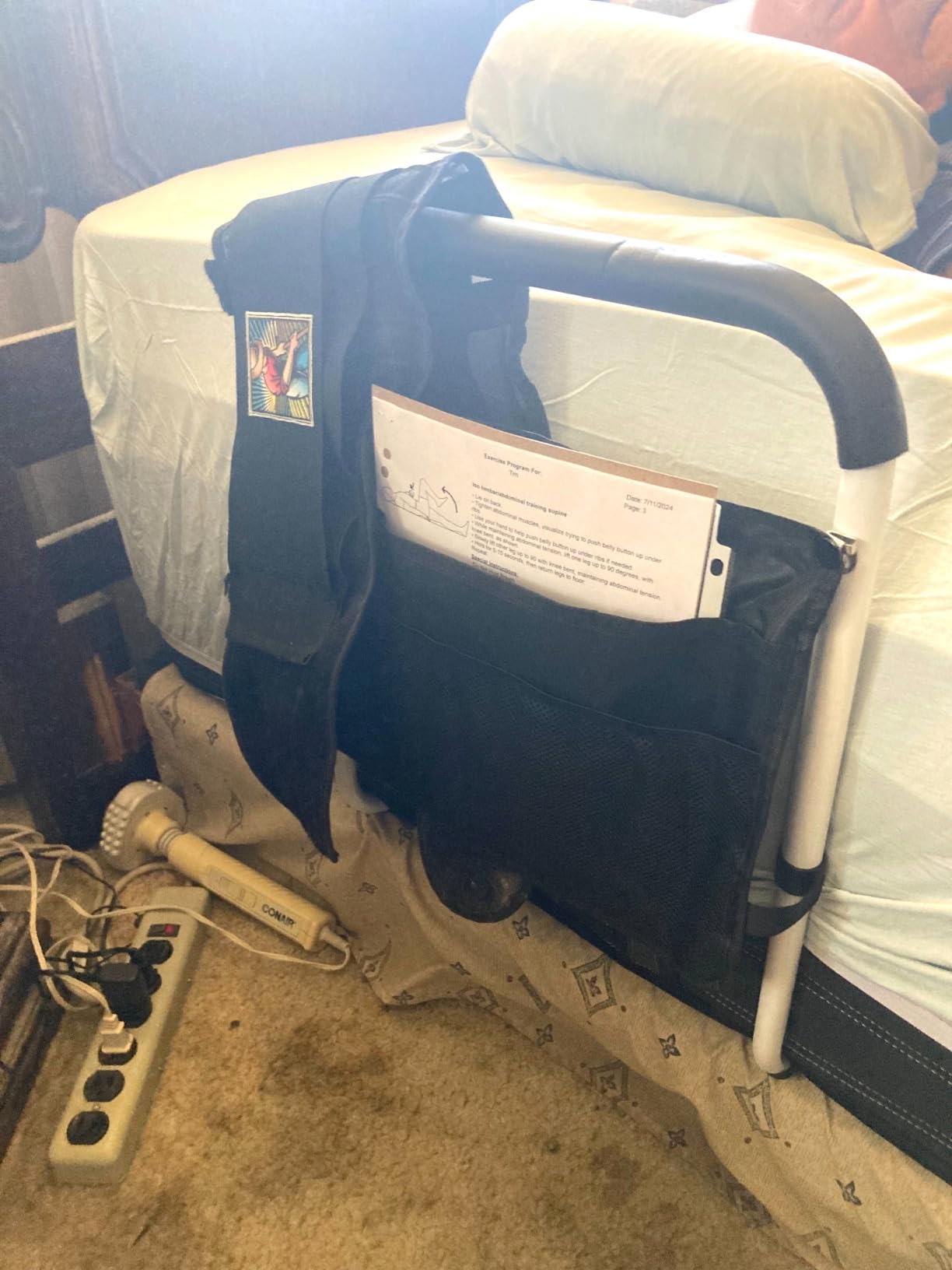
What the 3-12 inch range buys you
Most rails list a narrow thickness band and leave you guessing. This one runs 3 to 12 inches, covering a low platform bed with a thin mattress as well as a deep pillow top, on twin through king.
It is not for adjustable beds, and the listing says so directly.
Best for someone who pushes up with both arms
Typical after hip or knee surgery or during a long back recovery. The padded handle is a comfortable target for that push and the narrow profile keeps the far side clear.
Slide the base fully under the mattress before testing. A partly extended rail at 380 pounds is a different product than a fully extended one, so set it with a firm push and check it with your own weight.
6. WeHwupe Bed Rail with Bedside Storage Pocket – Best for Compact Rooms
WeHwupe Bed Rails for Elderly Adults Safety with Bedside Storage Pocket
- Tool-free assembly in minutes
- Soft non-slip foam grip
- Mesh pocket for glasses and remotes
- Tie-down straps included
- All standard bed sizes
- Not compatible with adjustable or lift beds
- Compact frame gives less lateral coverage
Around 1150 ratings at 4.6 stars, this is a compact rail with a 350 pound rating and a 4.5 pound frame. We include it because in a real home the constraint is often space rather than weight or safety.
A small bedroom with a narrow bed is exactly where an oversized rail stops working, and a frame that competes for floor space with a walker makes transfers harder, not easier.
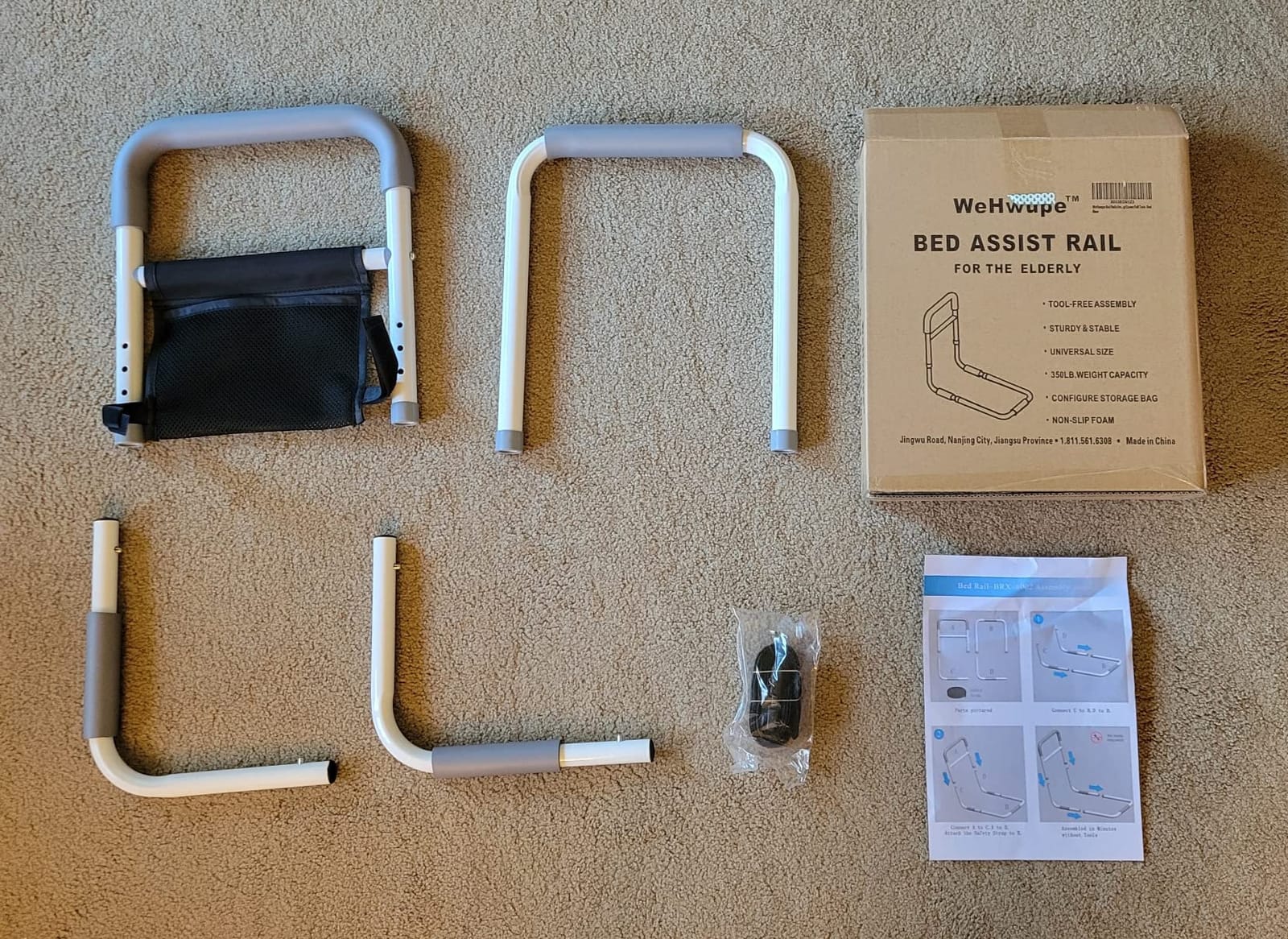
The soft foam grip suits arthritic hands and a 350 pound rating is a solid mid-range figure. The mesh pocket keeps glasses and remotes within reach while lying down.
That last point is the difference between a rail that gets used and one that gets ignored three weeks in.
Tie-down straps are in the box, assembly takes minutes with no tools, and it fits king, queen, full, and twin beds. The handle and frame wipe down with a damp cloth for long-term care.
The listing states it passed ASTM safety testing but does not name the standard number, so ask before buying if certification is your deciding factor. Lateral coverage is also lower than extended rails.
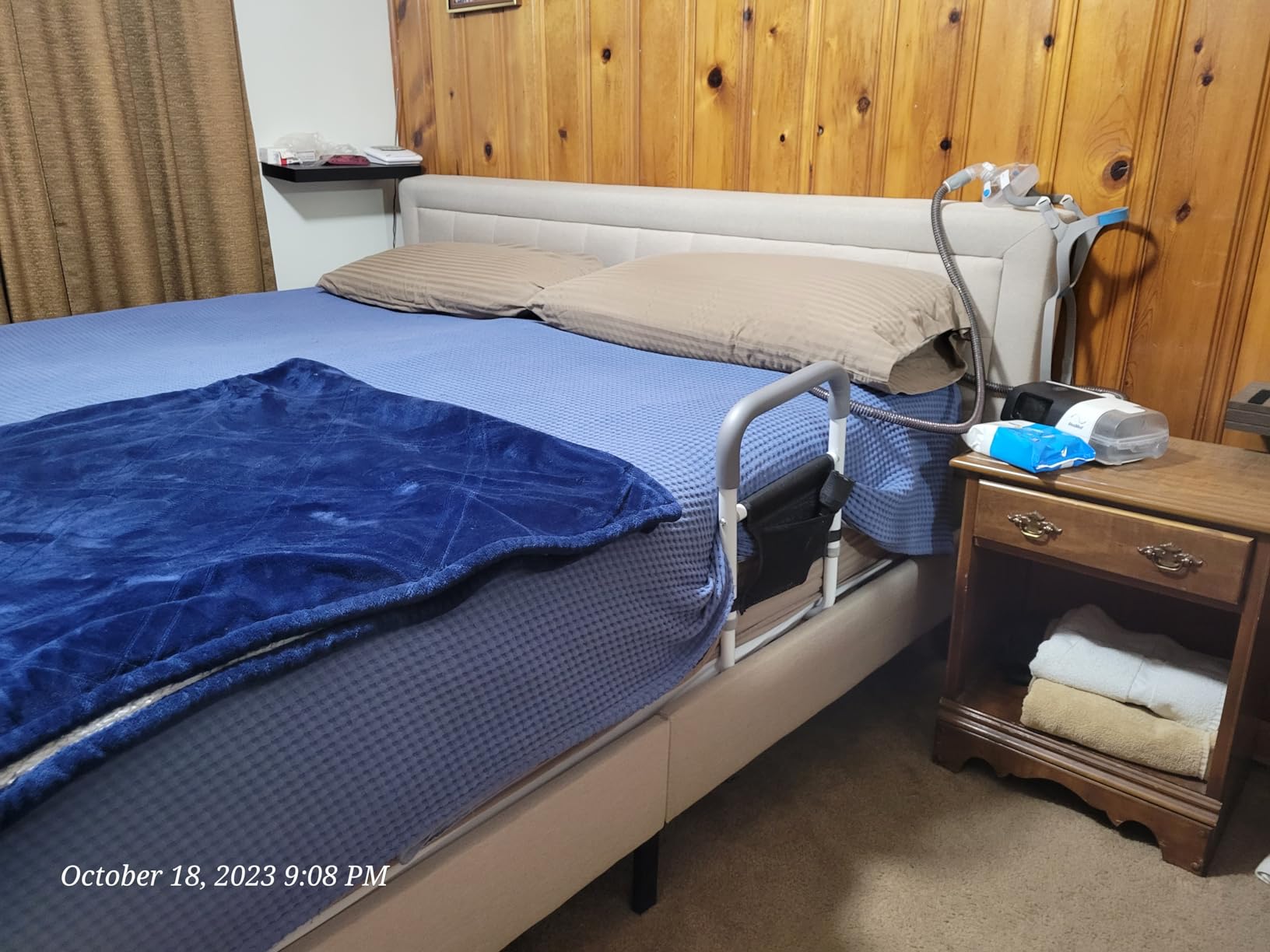
Where a small footprint actually helps
Hospitals, hospice rooms, and small bedrooms share a problem: the rail competes with a walker or a bedside table for the same floor. A narrow frame leaves a usable path on the far side.
Check frame-to-floor clearance before ordering. It anchors to mattress and frame with straps rather than floor legs, so a deep box spring pushing the rail outward can reduce its effective height.
Best for a defined recovery window
This suits someone in a six to eight week recovery where the goal is help with weak legs rather than permanent support. The foam grip means someone using it briefly is less likely to find it uncomfortable.
It is not the rail for a power or lift bed, both of which the manufacturer rules out. On a fixed frame in a small room it does a competent job in its price band.
7. Panta Bed Rail with Full-Length Support Legs – Best for Uneven Floors
- Passed ASTM F3186-17 with a 350 lb rating
- Flat tube avoids deforming the mattress
- Full-length support legs with non-slip pads
- Foam handles and removable bag
- Tool-free install with a video
- Legs need more than 12.6 inches of frame-to-floor clearance
- Height band is narrow at 17-21 inches
This rail reaches the floor on both sides, and that single decision separates it from most portable rails. Support legs with non-slip pads do not rely on mattress friction to stay upright when a person pushes down hard in the dark.
It passed ASTM F3186-17 and is rated to 350 pounds. That is the difference between a rail that rocks and one that holds.
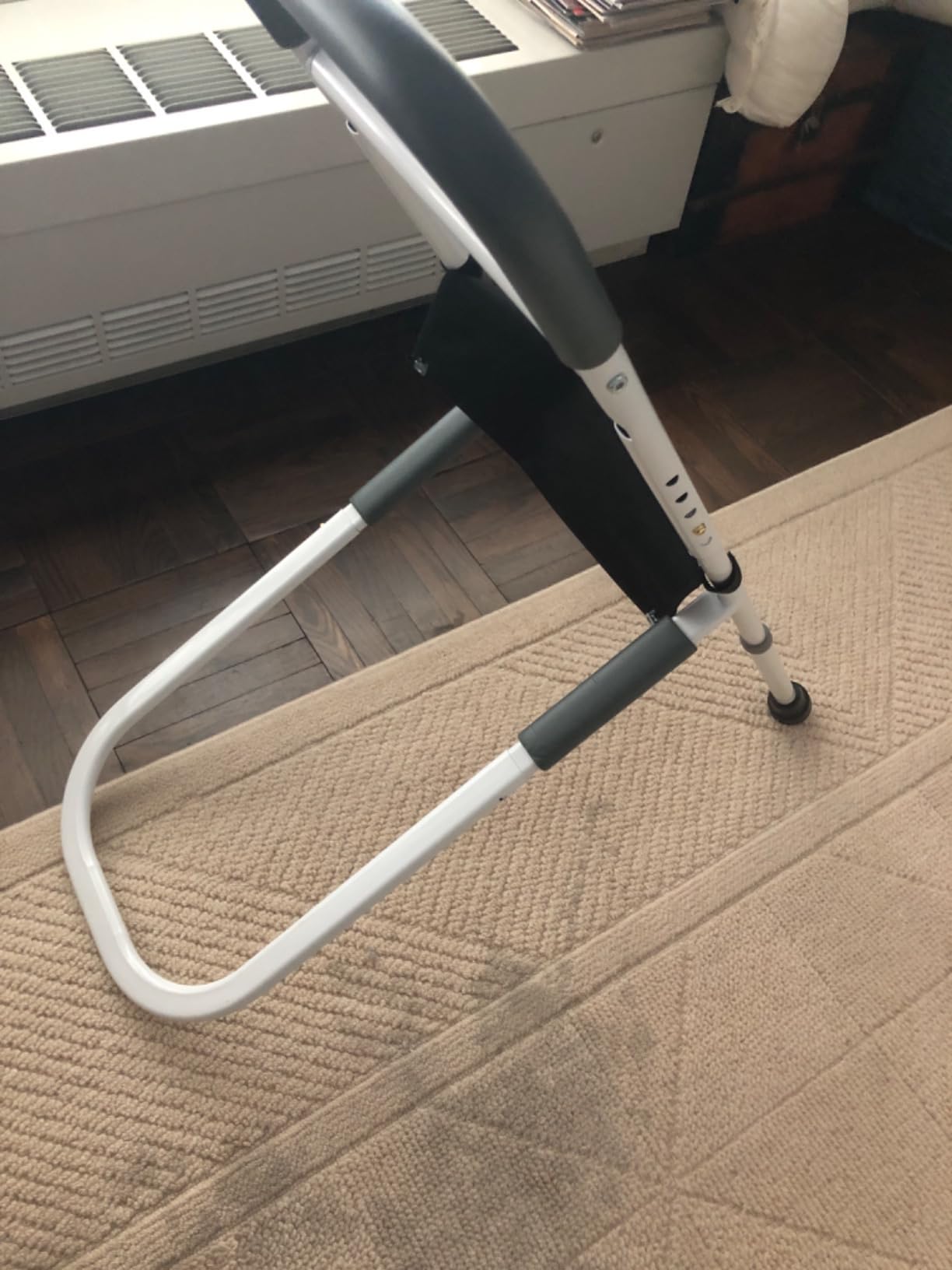
The flat tube design is the sleeper feature. It does not create a ridge in the mattress, so the person lying beside the rail does not roll into a groove by morning. On memory foam that is the difference between tolerated and removed.
Foam handles and a removable bag cover the two most requested features, and the legs adjust from 12.6 to 19.69 inches to match your clearance. There is an install video for when the printed instructions confuse people.
One hard constraint: frame-to-floor distance must exceed 12.6 inches or the legs will not reach, which rules out many low platform beds. The height band is also narrow at 17 to 21 inches.
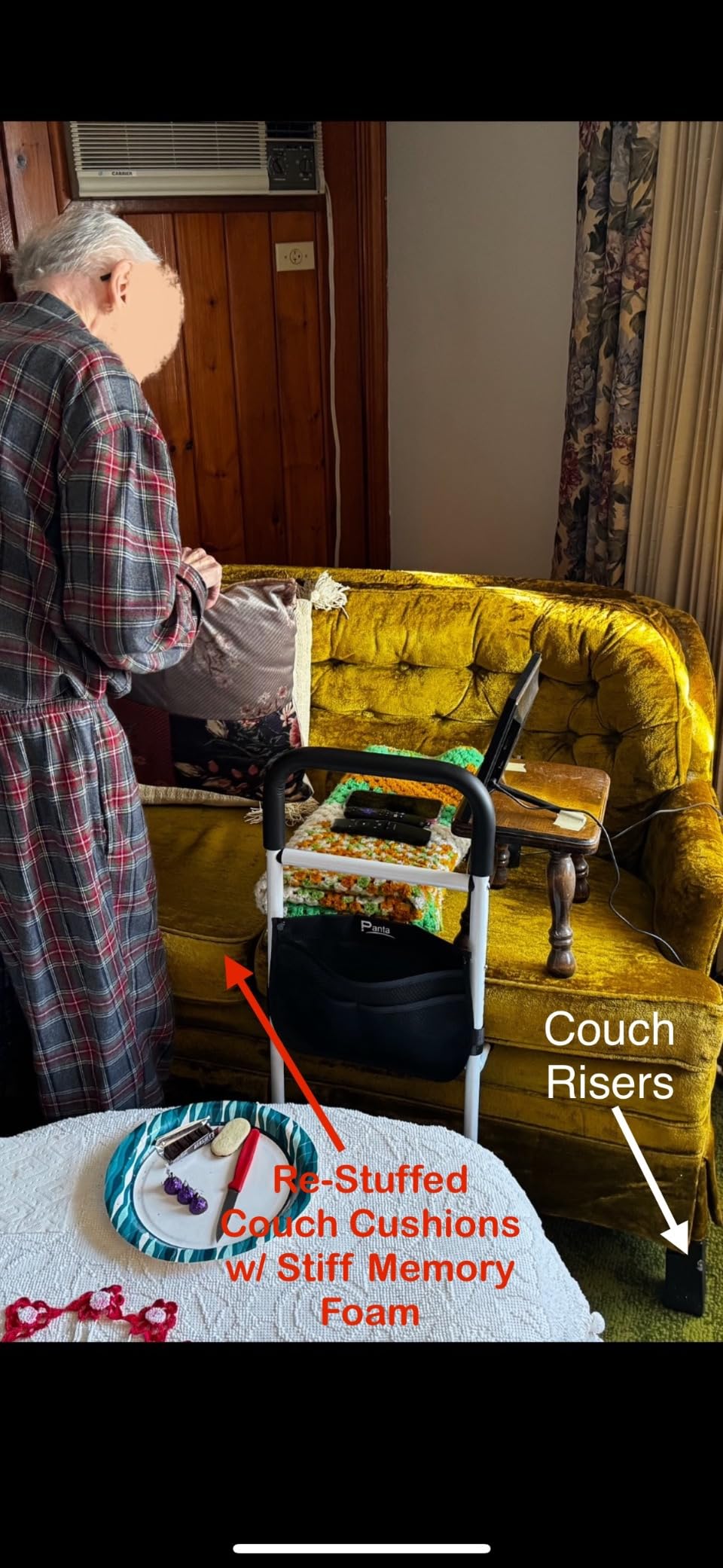
Measure this before anything else
Check two numbers with a tape measure: mattress thickness, and the vertical distance from the floor to the bottom of the frame. Under 12.6 inches means this is the wrong rail and you want a mattress-anchored model.
Older homes with original wood frames are the risk case. It fits king, queen, twin, and medium beds, in grey or black.
Best for carpet, rugs, and uneven ground
Non-slip leg pads are the reason to choose this if the floor is carpeted, if there is a rug under the bed, or if the frame sits on something slightly uneven. A leg already touching the floor does not fight the mattress.
At around 790 ratings it is a newer listing, so its long-term record is shorter than the established names. Weigh that against how long you expect the rail to stay installed.
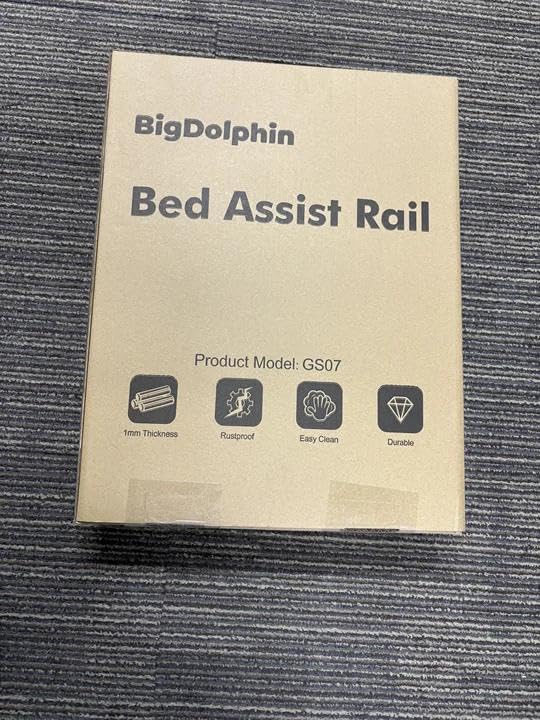
8. BigDolphin Bed Rail Model GS07 – Best for Wrist-Friendly Grip
BigDolphin Bed Rails for Elderly Adults Safety, 350 LB Capacity, Model GS07
- 30 degree curved handle reduces wrist strain
- Waterproof foam grip holds with wet hands
- Spinnable leg bottom closes floor gaps
- Height and length both adjustable
- Lightweight and tool-free
- Not suitable for adjustable beds
- Handle foam may need occasional wiping
The defining feature is a 30 degree curved handle, and the reason is biomechanical rather than cosmetic. Pushing up from lying means the wrist is bent under load, and a curve following the natural line of the arm reduces how much force it absorbs.
It is listed as ASTM compliant at 350 pounds, and weighs 6.4 pounds. The waterproof non-slip foam grip stays secure with damp hands, which matters on the way back from the bathroom.
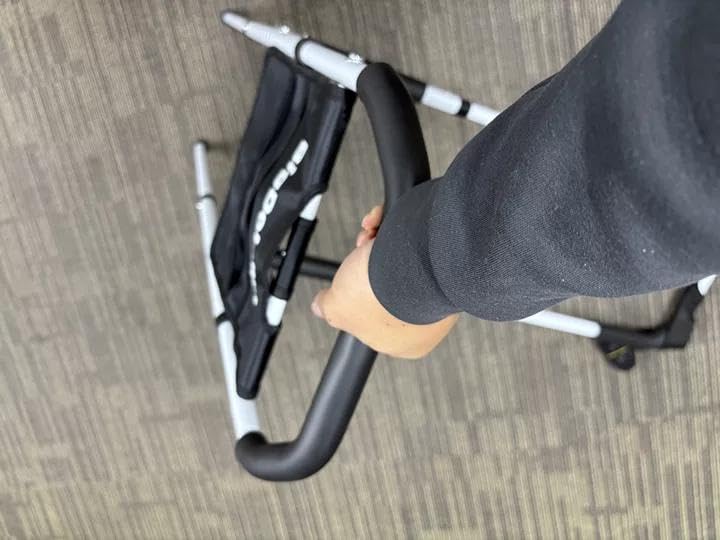
The spinnable leg bottom is a clever small fix. It closes the gap between the frame and a non-flat floor, which is the usual reason a bed rail shakes in an older house. You wind the leg out until it bears weight.
Height adjusts 16.5 to 19.7 inches and the rail extends 30.3 to 35.8 inches, so it fits thicker mattresses better than most. There is a storage pouch and the tool-free setup is light enough to move between rooms.
Variants come in curved and straight handle forms, medium and large. Curved and straight both exist because the wrist test decides it.
It is not for adjustable beds, and the handle foam needs periodic wiping to stay grippy. Both are minor.
Who a curved handle changes the outcome for
Arthritis, Parkinson’s tremor, and post-stroke weakness all change how a person grips. A straight vertical bar forces a flat-palmed push a painful hand cannot generate well, while a curve lets the forearm take some load.
The practical test is simple: have the person push toward seated with a hand flat on the grip, then again with the natural wrist curve. Most people discover quickly which one they can do at three in the morning.
Best for a grip that has to work when hands are clumsy
It is also our pick for tremor conditions, because the foam gives a forgiving surface that does not slide. Wipeable foam and steel keep it simple in long-term care.
It is not for adjustable beds, and the height range tops out below some thicker mattresses. If your mattress is 13 inches or more, confirm the rail still sits usefully above the sleeping surface.
9. Sunisife Extended Bed Assist Rail – Best for Blocking a Hard Roll
- Extended handle bar reaches 29 inches
- Foam handle reduces the strength needed to rise
- Adjusts in both length and height
- Removable bag and long safety strap
- Rubberised lower section cushions the head
- Limited height range leaves the barrier low
- Some find the build light and flimsy
- Fastener weakens with use
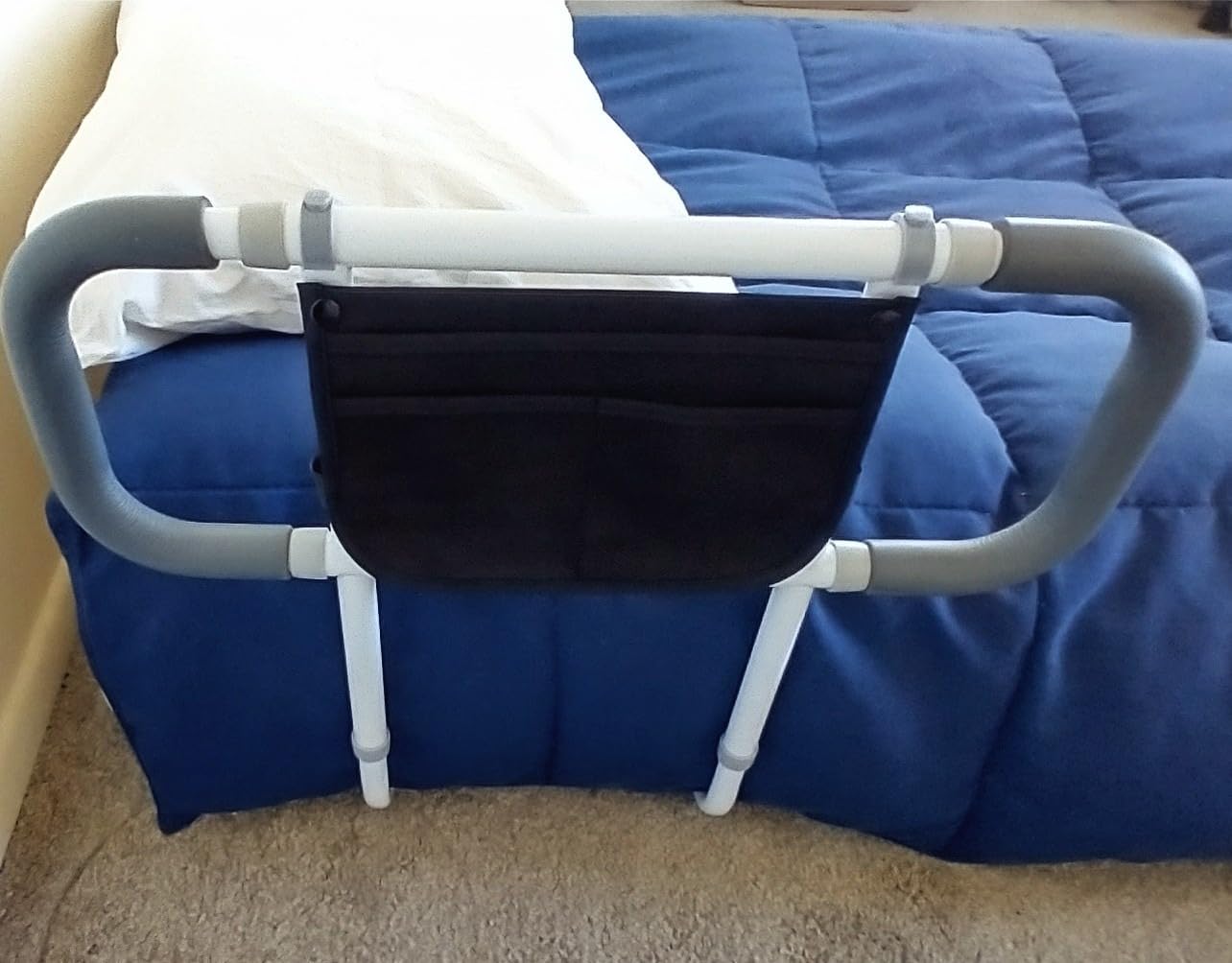
This is the rail with the longest barrier section in the roundup, and that is its entire purpose. The handle extends from 22 to 29 inches, giving a real barrier against a strong roll while still leaving the foot end open for getting in and out.
Most portable rails in this category stop short of that length. Around 540 ratings at 4.4 stars, with roughly three quarters five-star, reviewers describe the extended profile as actually stopping a hard roll rather than slowing it.
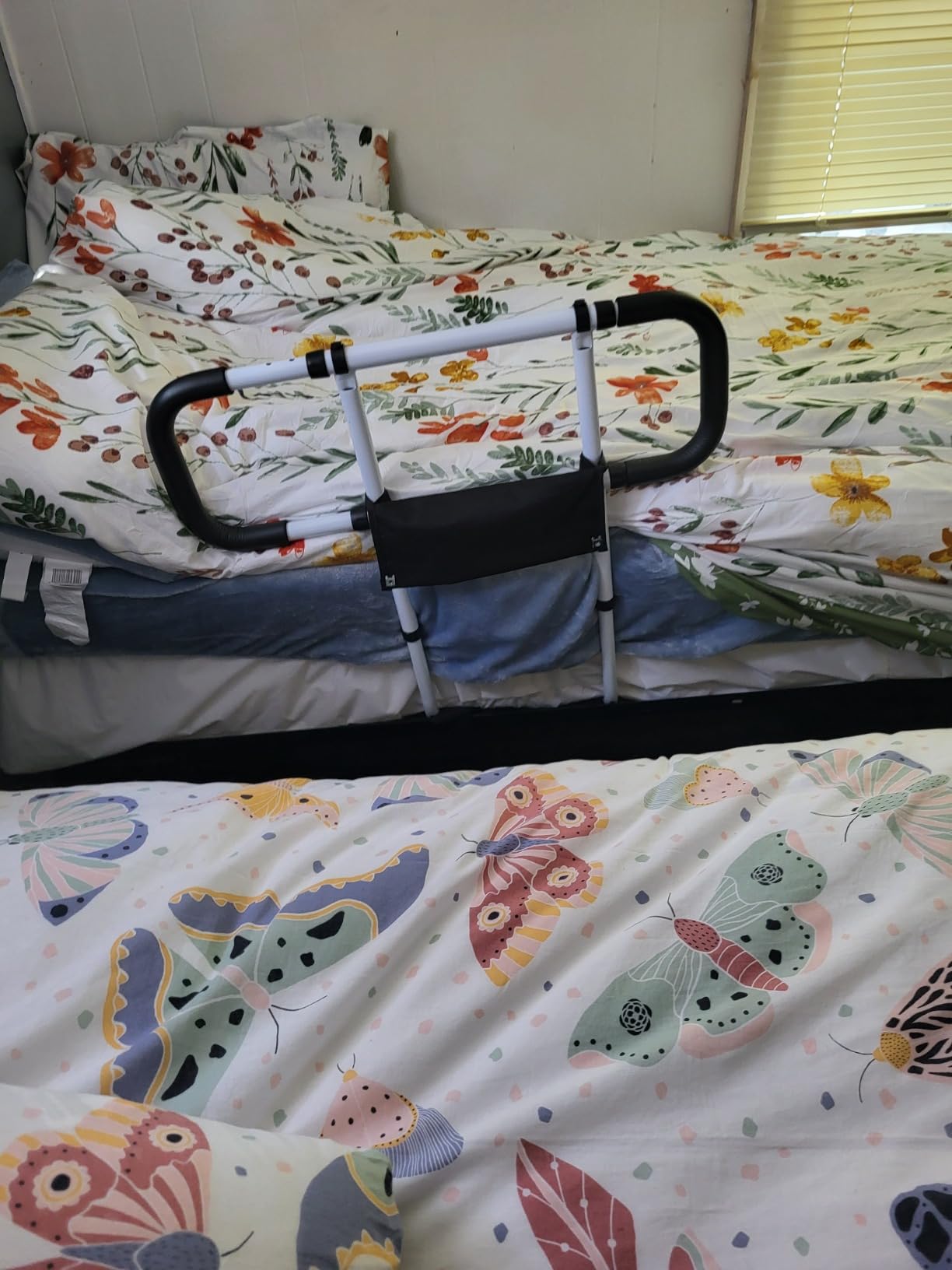
Several mention restoring confidence after a previous fall, which is the real point of a longer barrier. The foam handle reduces how much strength is needed to rise, and the rubberised lower section cushions the head if it contacts the rail in the night.
Its most useful technical detail is boring: the safety strap is 196.8 inches, the longest in the group. It reaches a large frame without the workaround several competitors need.
Criticisms worth hearing. The height range is limited, so on a thick mattress the barrier sits low relative to the sleeper. Some describe the metal as light, the instructions as unclear, and the fastener as weakening over time. A few have reversed the panel because the pocket faced the wrong way.
Roll-out prevention is a different goal from transfer help
Most of this guide is about sitting up and standing. This rail addresses the other problem, which is a sleeper who moves a lot and ends up on the floor without ever having tried to get up.
The trade is obtrusiveness. At 29 inches, it is a rail the person has to work around, which is exactly what caregivers complain about with longer designs.
Best for thick mattresses on a fixed frame
It fits mattresses 11.5 to 15.5 inches thick, making it one of the few options here for a deep pillow top or thick memory foam. It is a 300 pound steel frame fitting queen, twin, full, and king.
It works well if someone sleeps mostly in one region of the bed and poorly for someone who moves across the full width. At the top of the thickness range, check that the barrier still sits high enough above the sleeper to do anything.
10. YrHeiper Bed Rail with Bedside Support Legs – Best for Care Facility Rooms
YrHeiper Bed Rails for Elderly Adults Safety with Bedside Support Legs
- Certified 350 lb frame with a dedicated stabilizing leg
- Soft foam grip and integrated mesh pocket
- 12.3 inch footprint suits small rooms
- Tool-free install with heavy-duty straps
- Wipe-clean surfaces for long-term care
- No height adjustment on the rail itself
- Incompatible with recessed frames and adjustable beds
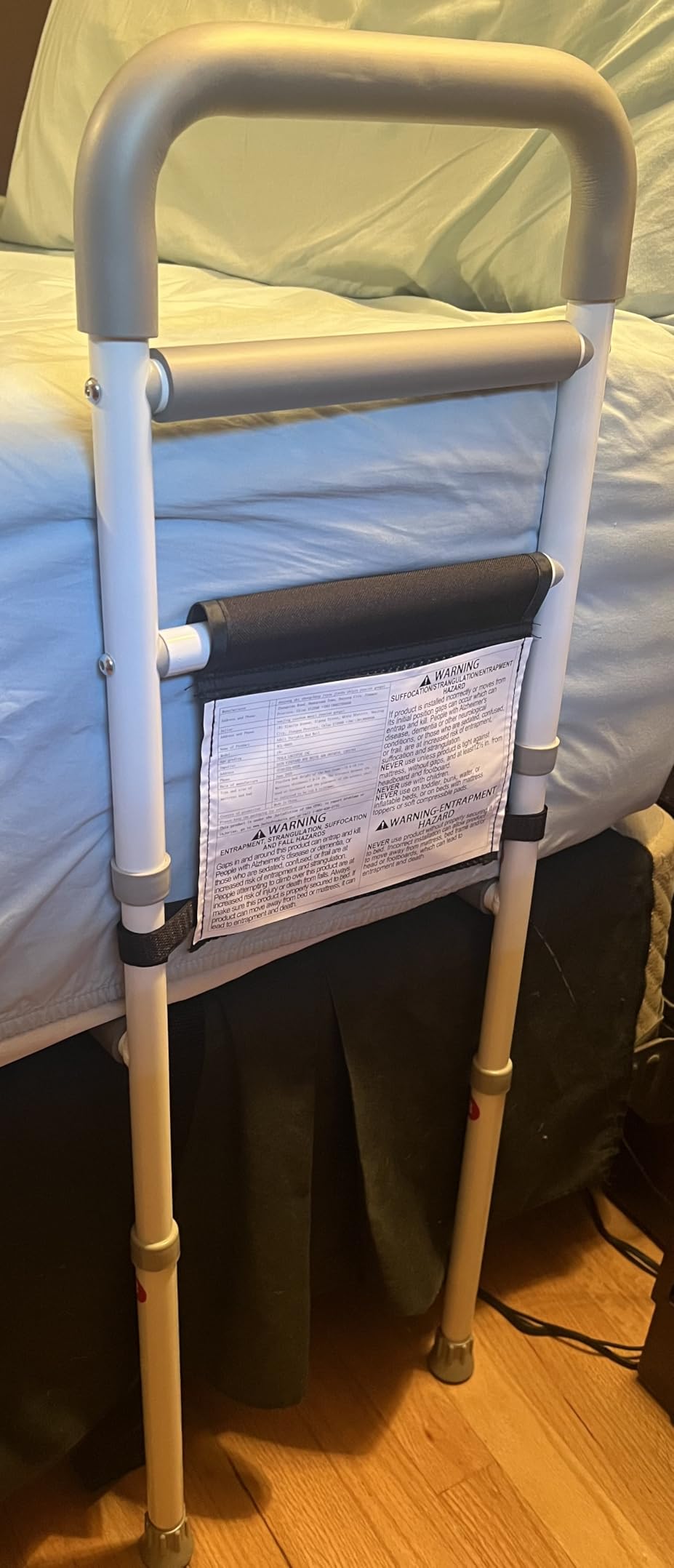
This model is built for a room where space and cleaning matter, which is why it turns up in hospital and assisted living settings. The footprint is 12.3 inches wide at 36 inches tall, one of the narrowest upper profiles here.
Frame and foam both wipe down with a damp cloth, which matters when someone is being cared for over months rather than weeks.
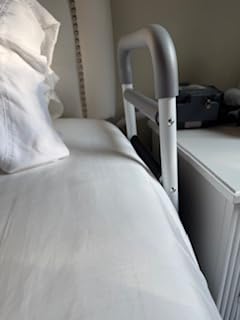
It is certified to ASTM F3186-17 at 350 pounds and adds a dedicated stabilizing leg that reviewers describe as making the rail markedly less likely to shift. That leg is the reason to choose it over a plain mattress-anchored rail.
The foam grip and integrated mesh pocket cover glasses, remotes, and medication, and the tool-free strap-in install takes minutes.
There is no height adjustment on the rail itself. Fit depends entirely on mattress thickness within the 7.9 to 13 inch range, so measure before ordering. It works on upholstered and platform bases but not recessed frames.
Recessed frames are common in older homes, so check the headboard or footboard arrangement first.
Why the narrow footprint matters in a care room
A standard bedroom has space to swing a walker around the bed. A hospice room often does not, and a wide rail reduces working space until transfers become harder rather than easier.
At 12.3 inches this leaves a usable path on the far side of the bed, which is where a caregiver stands during a transfer. It fits king through twin on 7.9 to 13 inch mattresses.
Best for a placement lasting months
The certified rating, wipe-clean surfaces, and stabilizing leg all point to a longer installation rather than a short recovery aid. At around 430 ratings and 4.5 stars the history is solid but not enormous.
The recurring note in reviews is the lack of height adjustment. Choose it when the bed is fixed, the clearance suits a leg, and the user needs a certified load rating.
11. TABEKE Bed Rail with Double Side Storage Pockets – Best Rated in the Roundup
- Highest average rating in the roundup at 4.8 stars
- Curved handle shaped to the natural wrist
- Non-slip foam underside adds mattress friction
- Tool-free install with a 35 inch base
- Double side nylon pockets
- One reviewer found the storage pocket awkward to reach
- 300 lb rating is below several competitors
At 4.8 stars across roughly 400 ratings with about 87 percent five-star, this is the highest-rated rail in our set. We would be cautious leaning on a smaller sample than the established names, but the consistency of what people describe is worth taking seriously.
The build is the differentiator. It uses 1.2 mm commercial alloy steel with thicker tubing and a larger chassis area than comparable products, which is why the base is 35 inches long and does not shift.
Non-slip foam on the underside adds friction against the mattress, protecting it during assisted rises. That foam is doing quiet work most buyers never mention.
The handle curves to the natural shape of the wrist, reducing fatigue on a repeated assisted rise, and height adjusts from 16 to 21 inches. Double side nylon pockets hold a phone, cables, earplugs, and tissues.
Limitations are small but real. The 300 pound rating sits below the 350 and 380 pound models, and one reviewer found the pocket awkward to reach, which is fair criticism of a pocket on the frame side. The listing carries 180 day coverage.
What a wider base actually buys you
The 35 inch base is the number that matters most here. Longer contact under the mattress spreads load across a wider area instead of concentrating at the clamp points, which is what reduces the shifting caregivers report in cheaper rails.
It is the geometric reason a rail feels solid, and also why the install should be done properly. It fits single, double, queen, and king beds, with a height band that suits a mid-range mattress.
Best for someone who will actually use it
The curved handle and double pockets point at one user: someone who needs a firm, steady rail for sitting down, sitting up, and standing, who wants a phone within reach, and who can still maneuver around it in bed.
That is a very common description and this rail answers it on every count. It is not the right choice for a larger-framed adult, so confirm weight before ordering.
12. YrHeiper Bed Rails for Elderly Adults Safety – 350 LB Heavy Duty Grab Bar
YrHeiper Bed Rails for Elderly Adults Safety, 350LBS Heavy Duty Grab Bar
- Certified 350 lb steel frame
- Soft foam grip with integrated mesh pocket
- Tool-free strap-in installation
- Wipe-clean surfaces for long-term care
- Low profile stays less obtrusive
- No height adjustment
- Not compatible with adjustable beds
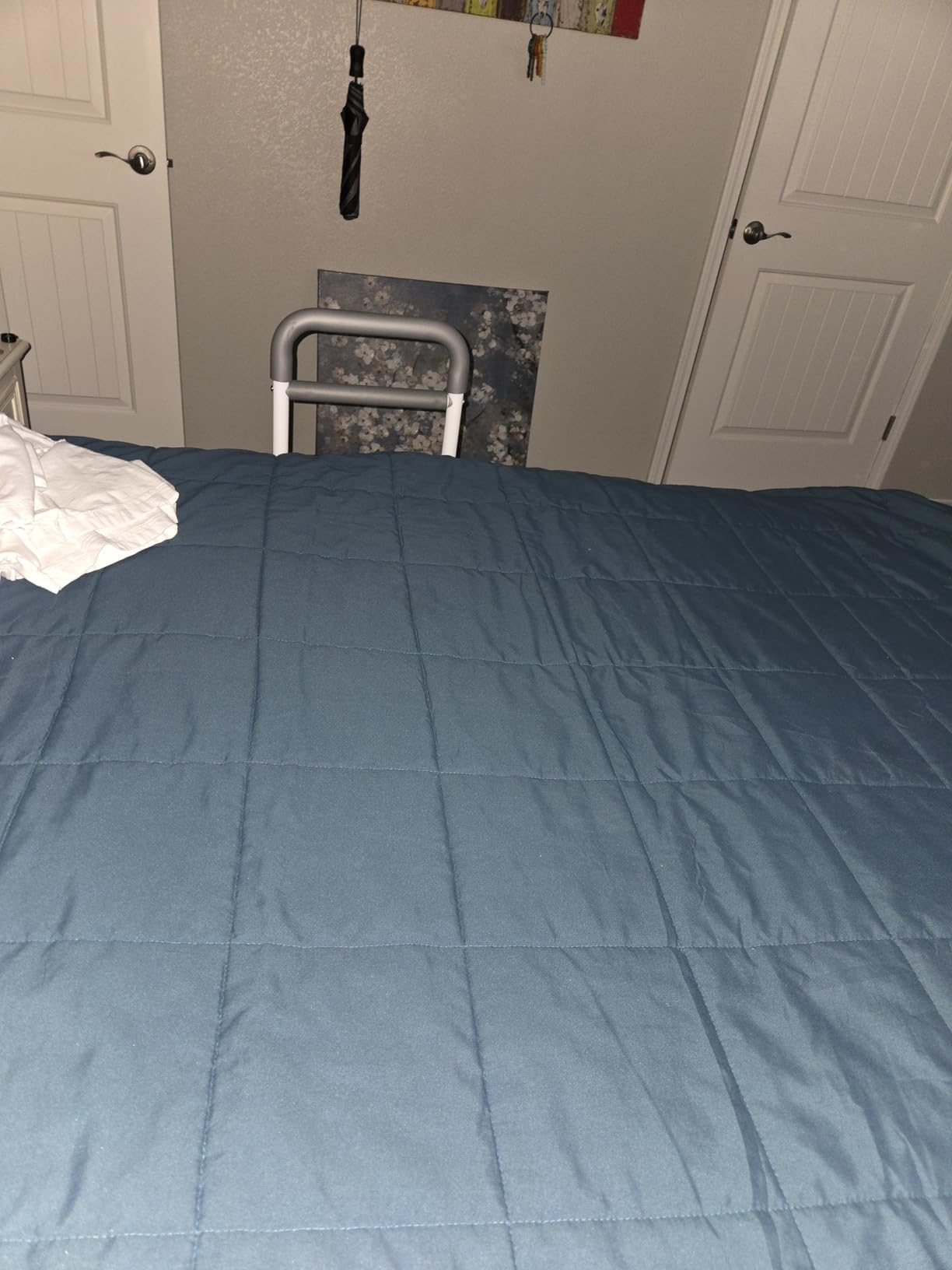
This is the sibling of the facility room model without the stabilizing leg, and at 18.7 inches it is the lowest profile in the roundup. That makes it right for a bed that looks out of place with a rail on it.
It is also right for a person who is self-conscious about using visible equipment, which sounds minor until you meet someone who refused to be helped until the device disappeared from view.
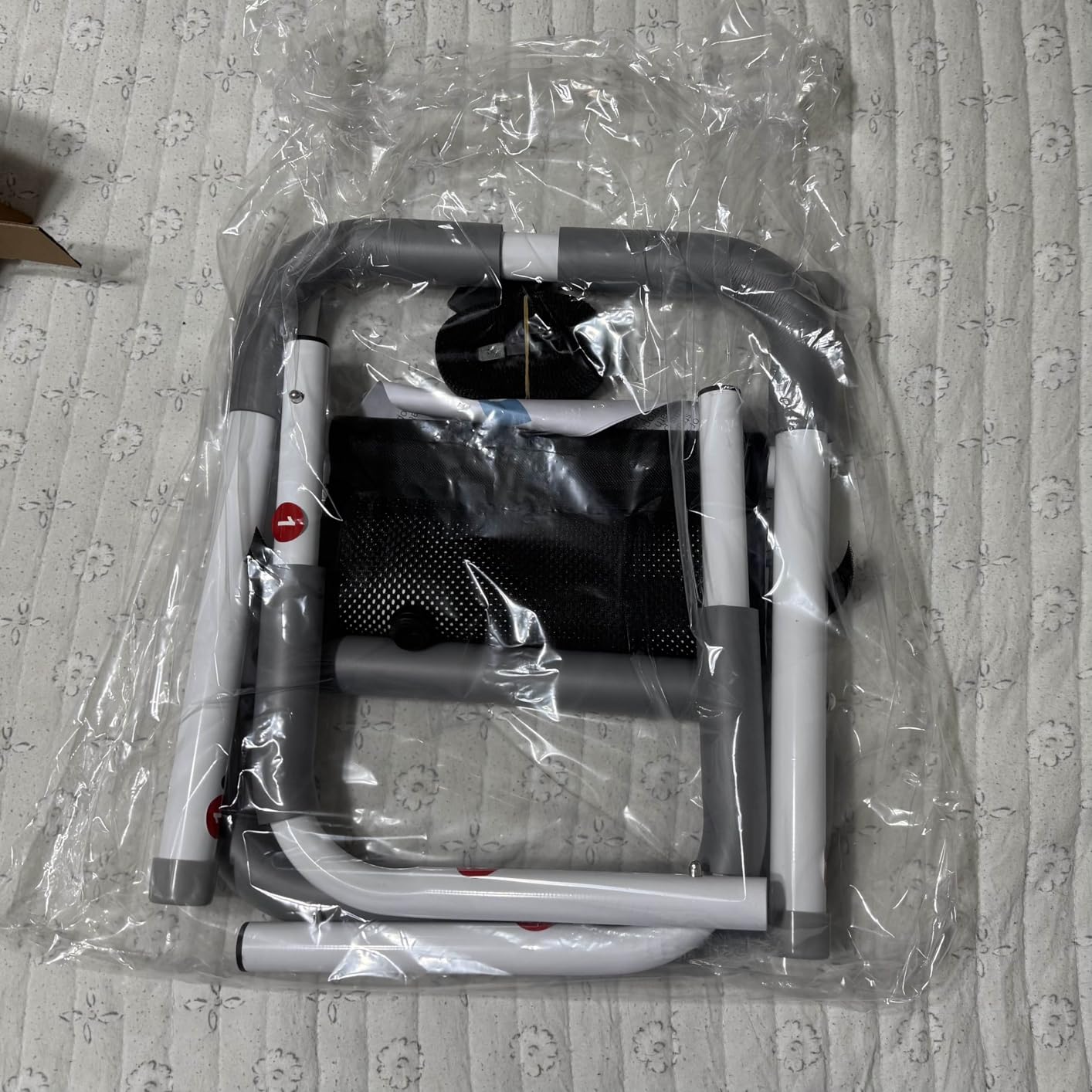
It carries the same ASTM F3186-17 certification and 350 pound rating, which is unusual for a compact rail. The foam grip and integrated mesh pocket match the larger model, so nothing practical is lost.
Installation is tool-free, with bars sliding between frame and mattress and heavy-duty straps doing the anchoring. It fits king through twin on 7.9 to 13 inch mattresses, and both foam and steel wipe clean.
Like its sibling there is no height adjustment, and it is not for adjustable beds. At around 380 ratings and 4.6 stars, reviews match the larger model: people like the rating and the easy setup, and they want height adjustment.
Lower profile, different trade
A shorter rail is an assist handle rather than a barrier. At 18.7 inches it is tall enough to catch a hand and give real leverage, and low enough that getting in and out is straightforward.
If the goal is roll-out prevention, this is not the model. If the goal is a firm handle for weak legs, it does the job without making the bed look clinical.
Best as a second rail on one bed
Because it is narrow and light, it works well opposite the larger model on a bed with the clearance to take it. At 12.3 inches, two leave a clear middle section.
With no height adjustment, the mattress thickness check is mandatory rather than advisory. At the bottom of the 7.9 inch range the rail sits high on a thin mattress, and at the top it sits low. Aim for the middle of the band.
Who Should Not Use a Bed Rail
A bed rail is a fall-prevention tool, not a restraint, and using one on the wrong person makes falls more likely. These are the five situations we would not put a rail into, and what belongs there instead.
Dementia or cognitive impairment. Someone who does not remember the rail is there will climb it, and a climb converts a low fall into a high one. Safer: a low bed close to the floor, a bed-exit alarm, a low-profile mattress, and a nightly caregiver check.
Restless sleepers who cross the whole bed. A rail they do not recognise as a boundary gets climbed or pushed loose. Safer: a floor fall mat, motion-activated lighting, or a hospital bed with integrated half rails.
Small-framed users under about 100 pounds. A rail sized for a 350 pound adult can leave a mattress-edge gap large enough for a small body to slip into, which is entrapment rather than prevention. Safer: a low-profile assist handle sized for the body.
Anyone in a restraint situation. A rail used to keep a person in bed is a restraint and carries the same dignity and legal weight as any other. Safer: involve an occupational therapist and address the cause of the wandering.
Adjustable or power bed frames. No rail in this roundup is rated for a power base, and a rail that blocks the elevating function defeats the purpose of having one. Safer: a bed-exit alarm with the frame’s own half rails, or a matched hospital bed.
Alternatives to Bed Rails for Fall Prevention
Sometimes the rail is the wrong tool and the answer is a change to the room rather than a clamp on the frame.
Lower the bed. The single most effective intervention. Most adjustable beds drop close to the floor, and a fall from a low height is far less damaging than from a 24 inch frame. It is also the standard recommendation for dementia-related wandering.
Use a floor fall mat. A padded mat beside the bed softens the landing without restricting movement, which makes it workable for someone who will not tolerate any device on the bed. It does not replace supervision.
Install a bed-exit alarm. A sensor pad alerts a caregiver or a connected system the moment someone tries to get up. For a person who needs to leave bed frequently this is the safest option, and it pairs well with the monitoring systems in our guide to the best home monitoring systems for elderly.
Reconsider the bed itself. One caregiver wrote that a powered recliner helped their mother stand more effectively than any bed, and that rails worsened her back and hip problems. If standing from a low soft surface is the real difficulty, a firm high seat can beat a rail.
Consider a hi-lo or hospital bed. These raise and lower and have rails tested as part of the frame, so there is no gap between a mismatched rail and a powered base. For long-term care they are worth a coverage conversation.
How to Choose a Bed Rail for Elderly Adults
Five criteria decide whether a rail works, and every one is checkable before you order rather than after.
1. Verify the certification, not the claim. Look for ASTM F3186-17 in the specifications or compliance section, not the title. Since 16 CFR Part 1270 became mandatory in 2023, compliant rails state the standard. If a listing does not, ask the seller, and check CPSC.gov/Recalls before and after purchase.
2. Match weight capacity with a margin. Ratings here run from 300 to 380 pounds. Pick one comfortably above the user’s weight and above the force they generate pushing down, which is several times body weight through the handle. A rail rated exactly at the user’s weight feels marginal at the moment it matters.
3. Check mattress thickness and bed type first. This is where returns happen, and many retailers will not accept a rail once the packaging is open. Measure mattress thickness, the distance from the floor to the underside of the frame, and whether the frame is recessed, upholstered, slat, or box spring. Compare all three against the fit range.
Do the fist test while you are there. Press a closed fist into the mattress edge with about 12 pounds of force. If it compresses roughly 2 inches, the mattress is too soft for a clamping rail, and you want floor support legs instead. Memory foam and thick pillow tops are the usual culprits.
Then check for adjustable bases. Almost every rail here states it is not for adjustable beds, and a rail on a power frame either blocks the elevation or works loose when the frame articulates.
4. Look for a grip that suits the hands. Foam-covered straight bars are easiest for a weak grip. A 30 degree curved handle reduces wrist strain when pushing up from lying. Loop handles are comfortable but easy to slip off with damp hands. For tremor or arthritis, test the shape with the actual person, in bed, in the position they will use it from.
5. Check how it anchors. Floor support legs resist lateral load far better than mattress friction alone, and a strap that actually reaches the frame beam adds a second anchor. A rail with neither is a handhold, not a guard. Ask what the strap length is and whether it will reach a queen box spring.
On cost and coverage. Three bands apply: compact assist handles at the low end, certified half rails in the middle, and extended full-length guards at the top. Medicare generally does not cover detachable bed rails as durable medical equipment, since they are not a prescribed item; a hi-lo or hospital bed is a different category with different rules. Health savings accounts and flexible spending accounts may allow pre-tax funds for an assistive device, so check with your administrator.
One practical warning: measure before you order, because opening the package is often the point of no return under hygiene return rules. Ten minutes with a tape measure saves a rail you cannot send back.
Installation and the Weekly Stability Check
Every rail here installs without tools, and the process is the same in all cases: connect the top and bottom sections, slide the base under the mattress, and secure it to the frame with the included strap. Most take under ten minutes once the parts are identified.
Then do a three-point test before anyone uses it. Push the top of the rail toward the mattress with full body weight and confirm nothing moves. Pull outward with the same force and check the base does not slide. Finally, load the rail with body weight for ten seconds, the way a user would pressing down to stand.
Repeat those three tests weekly. Fasteners loosen gradually with use and with the movement of the bed, and a rail that was firm on day one can develop a wobble over months. If the push test produces movement, tighten the strap and the frame connection first.
Frequently Asked Questions
Are bed rails safe for the elderly?
Bed rails can be safe for elderly adults when they are certified to ASTM F3186-17, correctly fitted to the mattress thickness, and matched to a user who will not climb them. The two documented risks are entrapment, where a body becomes wedged in a gap, and falls over the rail, which tend to be higher than a floor fall. Short assist handles for transfer help carry much lower entrapment risk than long guards. Anyone with dementia or nighttime wandering should not use one.
What are the two main risks of using bed rails?
The two main risks are entrapment and climbing. Entrapment happens when the head, neck, or torso becomes caught between the rail and the mattress, between two bars, or under the rail, in a position the person cannot escape. The Consumer Product Safety Commission recorded 284 entrapment deaths involving adult portable bed rails between 2003 and 2021. The second risk is falling over the rail, which usually happens when a confused or restless person tries to climb it and lands on a hard surface at a greater height than the floor.
What is the main cause of death from bed rails?
Entrapment is the main documented cause of death. The Consumer Product Safety Commission recorded 284 entrapment deaths involving adult portable bed rails between 2003 and 2021, most of them involving people who became wedged in a gap between the rail and the mattress and could not free themselves. That is why the federal standard at 16 CFR Part 1270, built on ASTM F3186-17, specifies maximum gap dimensions and load testing rather than leaving them to the manufacturer.
Are bed rails appropriate for dementia patients?
Generally no. A person with dementia or cognitive impairment may not remember that the rail is there and will attempt to climb it, turning a low fall into a higher one. Most geriatric safety guidance treats dementia as a contraindication rather than a use case. Safer alternatives include lowering the bed close to the floor, a bed-exit alarm that alerts a caregiver, a padded floor fall mat, and a low-profile mattress. If a rail is used in a care setting for a person with dementia, it should be documented, monitored, and reviewed regularly.
What are the alternatives to bed rails for the elderly?
The main alternatives are lowering the bed close to the floor, which is the single most effective intervention, and a bed-exit alarm that notifies a caregiver when someone tries to get up. A padded floor fall mat softens the landing without restricting movement. A powered hi-lo or hospital bed has integrated rails tested as part of the whole system, and a firm powered recliner can be better than a bed for someone whose difficulty is standing from a low surface. A bed cane or assist handle gives a handhold with far less entrapment risk than a full rail.
What are the entrapment guidelines for bed rails?
The guidelines come from ASTM F3186-17, which became mandatory for adult portable bed rails sold in the United States through the federal rule 16 CFR Part 1270 effective August 21, 2023. The standard specifies maximum gap dimensions between the rail and the mattress and between the bars, sets requirements for load testing and stability under lateral force, and applies to the whole rail including its supports. In practice, the consumer-facing checks are that the gap between the rail and the mattress is too small for a body to enter, that a soft mattress is not compressing into a large gap, and that the rail is a short assist handle rather than a long guard.
Will Medicare pay for bed rails for seniors?
Generally no. Medicare does not typically cover detachable bed rails as durable medical equipment, because they are not a prescribed item on the covered list. A fully electric hi-lo or hospital bed is a different category and may be covered when a doctor documents a medical necessity and a supplier bills it correctly. Health savings accounts and flexible spending accounts may allow pre-tax funds to be used for an assistive device such as a bed rail, so check with your plan administrator before assuming reimbursement is unavailable.
Conclusion: Which Bed Rail Fits Your Situation
If the goal is a steady handhold for sitting up and standing, the Medline Bed Assist Bar is the pick we would install first, with roughly 15500 ratings behind it and a pouch that solves the reach problem. For a certified guard that folds out of the way during the day, choose the Stander EZ Adjust. For nighttime bathroom trips, the Lunderg motion light is the one that changes the outcome.
Match the rail to the person, not the other way around. Heavier users should start at the 350 to 380 pound models, arthritic and tremor hands want a curved or foam grip, a restless sleeper needs floor support legs, and a soft mattress needs a rail anchored to the floor. Above all, confirm mattress thickness and frame clearance before you order.
Those five minutes of measuring are the difference between a rail that helps and one that ends up back in the box. We keep this guide current as certifications and recalls change, and the standards information here reflects 2026.