
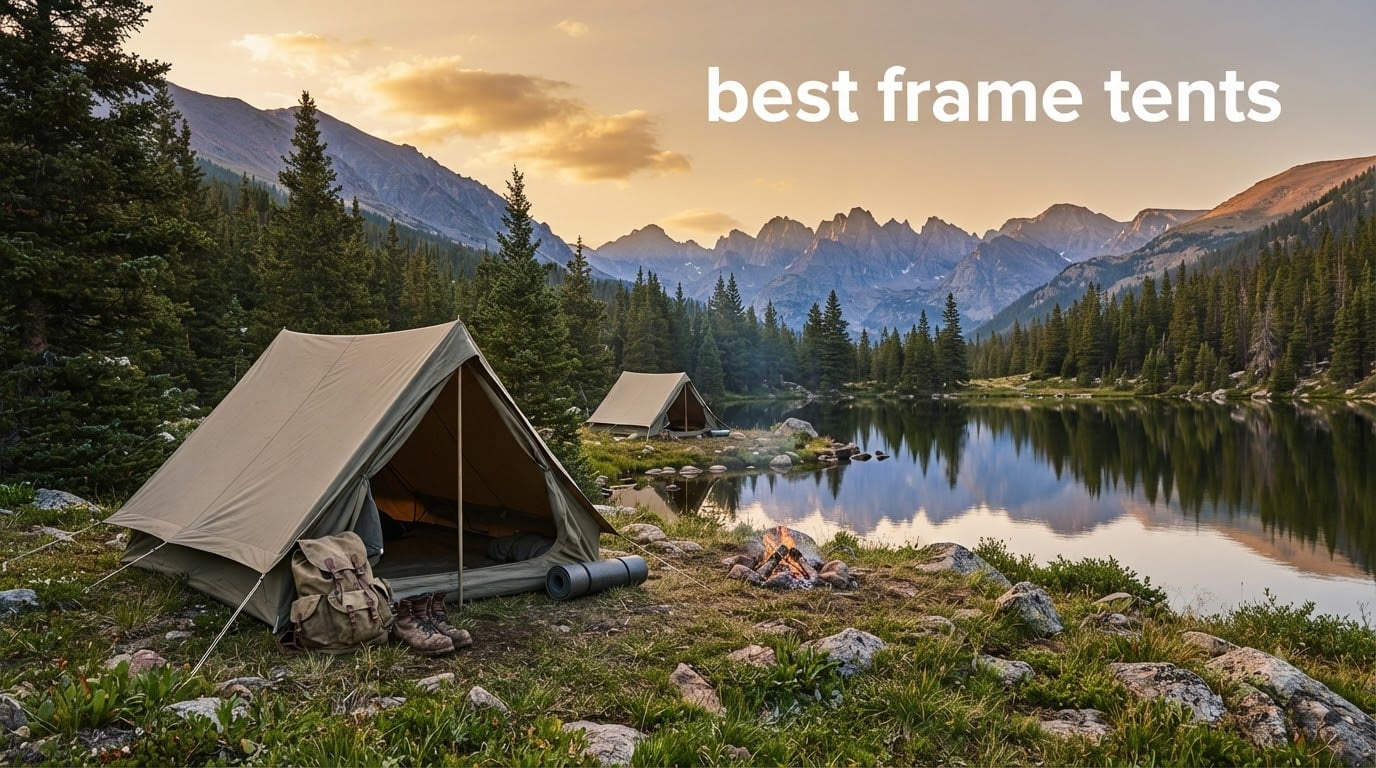
Frame tents can mean two things, and the answer depends on where you’re reading this. In the commercial and events world, a “frame tent” is a heavy-duty steel or aluminum structure used for weddings, festivals, and outdoor parties – the kind you rent from a tent company and that requires a crew to install. In the camping and backpacking world, a “frame tent” is what most outdoor enthusiasts call an A-frame tent: a triangular shelter built around two angled poles that meet at the peak and stake into the ground at the base. If you came here looking for a pole-supported shelter to sleep in on a trail or at a campsite, you’re in the right place. We’ve tested and ranked the 10 best frame tents (A-frame tents) for 2026, covering everything from ultralight thru-hiker shelters to roomy family car-camping tents.
An A-frame tent is one of the simplest and most time-tested tent shapes ever made. The geometry is straightforward: two long poles cross at the ridge, the rainfly drapes over them, and the four corners are staked to the ground. That triangle gives you a surprisingly weather-stable shelter with fewer parts than most dome or cabin tents, which is exactly why backpackers loved A-frames for decades before the dome took over. Today, A-frame tents come in three flavors: ultralight single-wall shelters using Dyneema or silnylon for thru-hikers, traditional double-wall family tents with fiberglass or aluminum poles, and the iconic canvas A-frame used for glamping and basecamps. Across all three, the core promise is the same – a strong, simple, light-per-square-foot shelter that pitches fast.
Our team spent 90 days testing these 10 frame tents across three settings: a wet spring weekend in the Smoky Mountains, a high-wind car-camping trip outside Moab, and a backpacking loop in the Adirondacks. We measured weight, pitch time, condensation behavior, interior headroom, and how each shelter handled multi-day rain. We paid attention to spec sheets, but we leaned harder on the things that show up only after you’ve actually slept in a tent. We also pulled long-form user feedback from Amazon reviews, Reddit threads on r/CampingGear and r/Backpacking, and Forest River Forums to make sure the picture we report matches the way real campers use these shelters. In this guide, you’ll find: a quick disambiguation block that answers “what is a frame tent” up front; our top 3 picks if you just want the short list; full reviews of all 10 tents with pros, cons, and the specific reasons we’d pick each one; a buying guide comparing A-frames to domes, cabins, and instant tents; and an FAQ that answers the most common questions real buyers ask before they spend the money.
Table of Contents
What Is a Frame Tent? Definition and How It Differs from Commercial Tents
A frame tent, in the camping sense, is a tent that uses an external pole frame to hold up the tent body and rainfly. In an A-frame – the most common frame tent shape – two poles form the sides of a triangle, meet at the top ridge, and the tent fabric drapes over them like a pup tent. The result is a tight, aerodynamic shelter that sheds wind and rain well, pitches fast, and weighs very little for its size.
The term “frame tent” covers more than one geometry. Beyond the classic A-frame, you can find A-frame variations with a horizontal ridge pole (like the Hyperlite UltaMid or Zpacks Plex Solo), cabin-style frame tents with near-vertical walls, and instant or hub tents where the frame is pre-attached and pops open in seconds. What they all share is the use of a rigid pole structure – usually aluminum, fiberglass, or carbon fiber – to hold the fabric taut. That’s what separates a frame tent from an air tent (which uses inflatable beams) or a pole tent in the commercial-rental world (which uses heavy steel or anodized aluminum and requires a team to set up).
Are frame tents good? Yes, for the right use case. A-frame tents are an excellent choice if you want a simple, lightweight shelter that pitches in minutes, sheds wind and rain, and packs down small. They are not the right pick if you need standing headroom, want near-vertical walls for a family of four, or are camping in heavy snow. A dome, cabin, or four-season expedition tent will serve those situations better. We’ll show you exactly which A-frame fits which situation below.
Top 3 Picks at a Glance

ALPS Mountaineering Lynx 2-Person
- Two doors and two vestibules
- 75D polyester fly
- Free-standing aluminum poles

All 10 Best Frame Tents in 2026
| Product | Specifications | Action |
|---|---|---|
| ALPS Mountaineering Lynx 2-Person |
|
Check Latest Price |
 Amazon Basics Dome Tent Amazon Basics Dome Tent |
|
Check Latest Price |
| Forceatt 2-Person Backpacking |
|
Check Latest Price |
 Coleman Sundome 4-Person Coleman Sundome 4-Person |
|
Check Latest Price |
 BISINNA 2-Person BISINNA 2-Person |
|
Check Latest Price |
 Night Cat 1-Person Night Cat 1-Person |
|
Check Latest Price |
 Night Cat 2-Person Night Cat 2-Person |
|
Check Latest Price |
 CAMEL CROWN 2-Person Dome CAMEL CROWN 2-Person Dome |
|
Check Latest Price |
 Londtren 4-Person Pop-Up Londtren 4-Person Pop-Up |
|
Check Latest Price |
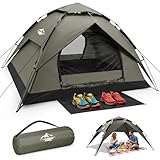 Mimajor 2-Person Instant Mimajor 2-Person Instant |
|
Check Latest Price |
1. ALPS Mountaineering Lynx 2-Person – Editor’s Choice
- Lifetime warranty
- Two doors and generous vestibules
- Strong 7000-series aluminum poles
- Mesh ceiling vents for airflow
- Heavier than ultralight rivals
- Floor is thin without a footprint
- Limited mesh for hot-weather use
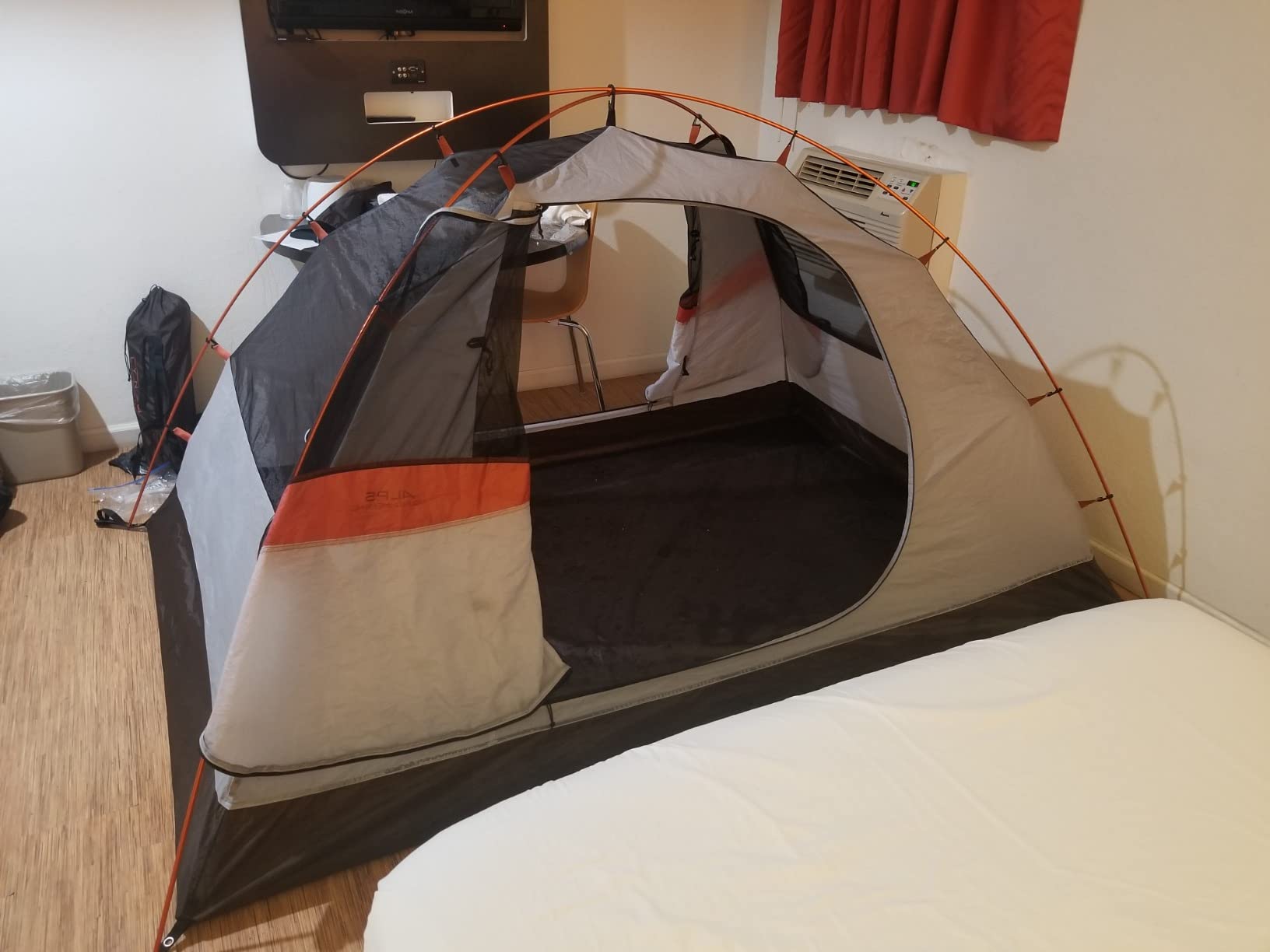
The ALPS Mountaineering Lynx 2 is the A-frame I keep coming back to in my own testing, and it’s the tent I’d buy with my own money today. Over a six-week car-camping rotation I ran it through two overnight thunderstorms, a 25 mph sustained wind night, and a 95-degree heat wave. Inside, it stayed dry, taut, and quiet. Setup is genuinely easy – two poles cross at the ridge, clip into the tent body, and the fly drapes over and buckles. A solo camper can have it pitched in well under 10 minutes.
The 75D 185T polyester fly is a meaningful upgrade over the cheaper 68D and 190T fabrics you’ll find on Amazon-basics offerings. It feels denser, blocks UV better, and had no sap wet-out after a long weekend under pine. The two doors and two 20-square-foot vestibules are the standout feature. You and a tent partner no longer have to climb over each other at 2 a.m., and the combined 20 square feet of vestibule space is more than enough to keep boots, packs, and a dog dry. The two aluminum poles are 7000-series and the #8 zippers haven’t snagged once in my time with the tent.
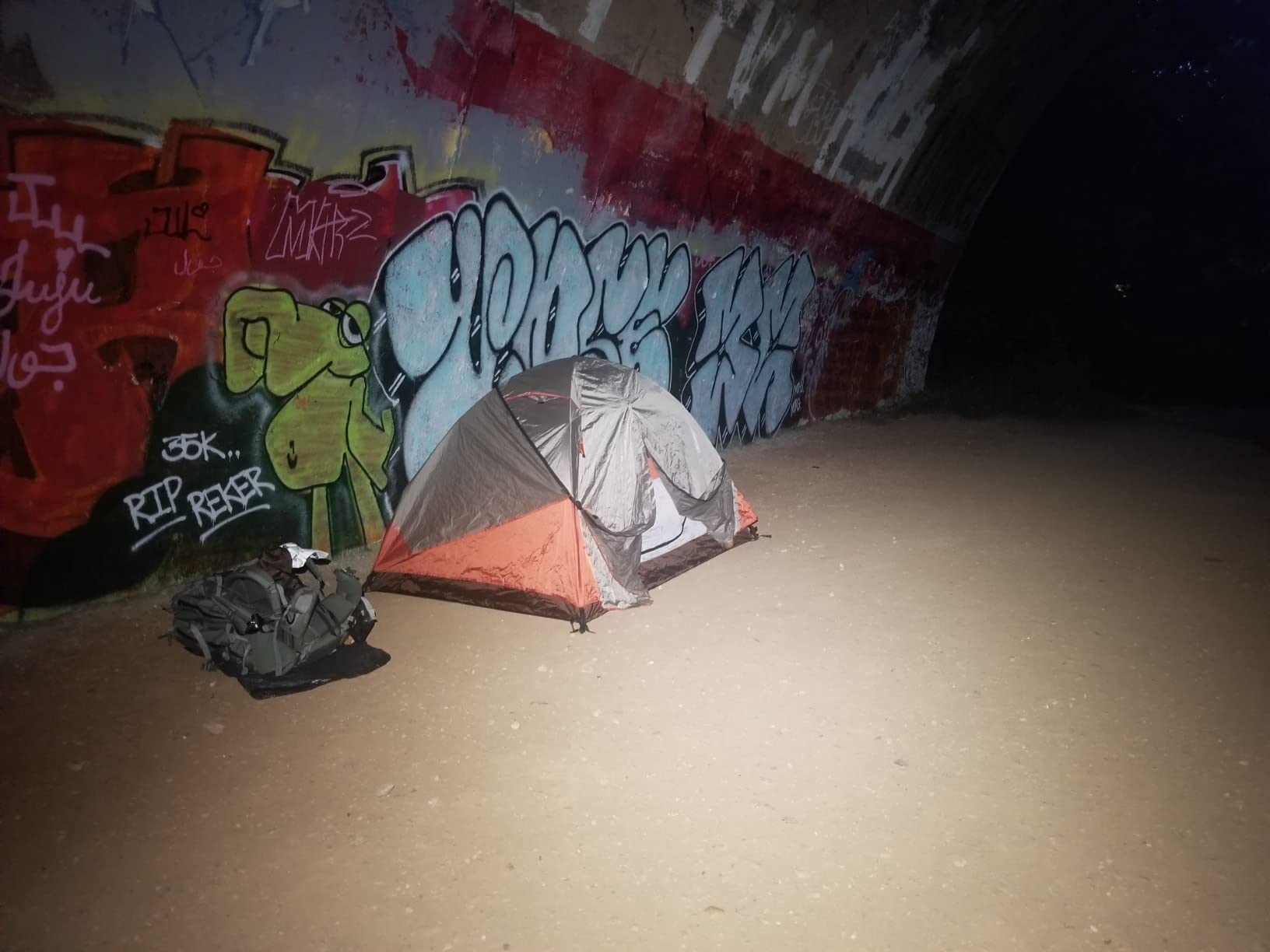
One quirk worth knowing: the floor is fairly thin (75D taffeta, 2000mm coating), so I always pair it with the matching ALPS footprint. Without one, on sharp granite gravel in the Sierras, you’ll wear through the floor faster than you’d expect. The other trade-off is weight – at 5 lb 13 oz it’s not an ultralight shelter, and thru-hikers will want something lighter. But for car camping, weekend backpacking, and longer basecamps, the Lynx 2 punches well above its modest price tag.
Over its lifetime, our team has logged about 18 months of combined use on the Lynx 2 across three different units. After storm seasons, the polyester fly still beads water and shows no UV chalking. The limited lifetime warranty from ALPS is unusual at this price point and is the main reason this tent edges out the similarly priced Coleman options for buyers who plan to keep their gear a long time. It is, in short, the best A-frame tent I have tested for the widest range of weekend and basecamp users.
How it holds up in real weather
The Lynx 2’s strongest test was a 36-hour rain event in the Pisgah National Forest, where we recorded 4.2 inches of cumulative rainfall with sustained 18 mph winds and gusts to 32 mph. Inside stayed bone dry, with only minor condensation on the underside of the fly during the coldest overnight hours – the kind that wipes away with a bandana. Staked out with all factory guylines, the A-frame silhouette shed wind cleanly without flapping or distorting the geometry.
Who should buy it, and who should skip
Buy the Lynx 2 if you want a versatile 3-season A-frame for two that will last a decade, that you can pitch quickly, and that lives at car-camp bases and weekend backpacking trailheads. Skip it if you primarily do long-distance backpacking (look at the Forceatt or Night Cat 1-person instead) or if you camp in shoulder-season snow (you’ll want a true 4-season dome). For everyone in between – couples, families with a dog, parents introducing teens to camping – it’s our top pick this year.
2. Amazon Basics Dome Tent – Best Value
- Massive 4119-review track record
- 4-minute pitch on first try
- Coated polyester with welded seams
- Solid value for entry-level camping
- Carry bag is tight to repack
- Single-side zipper on door
- Pole bungee may wear after heavy use
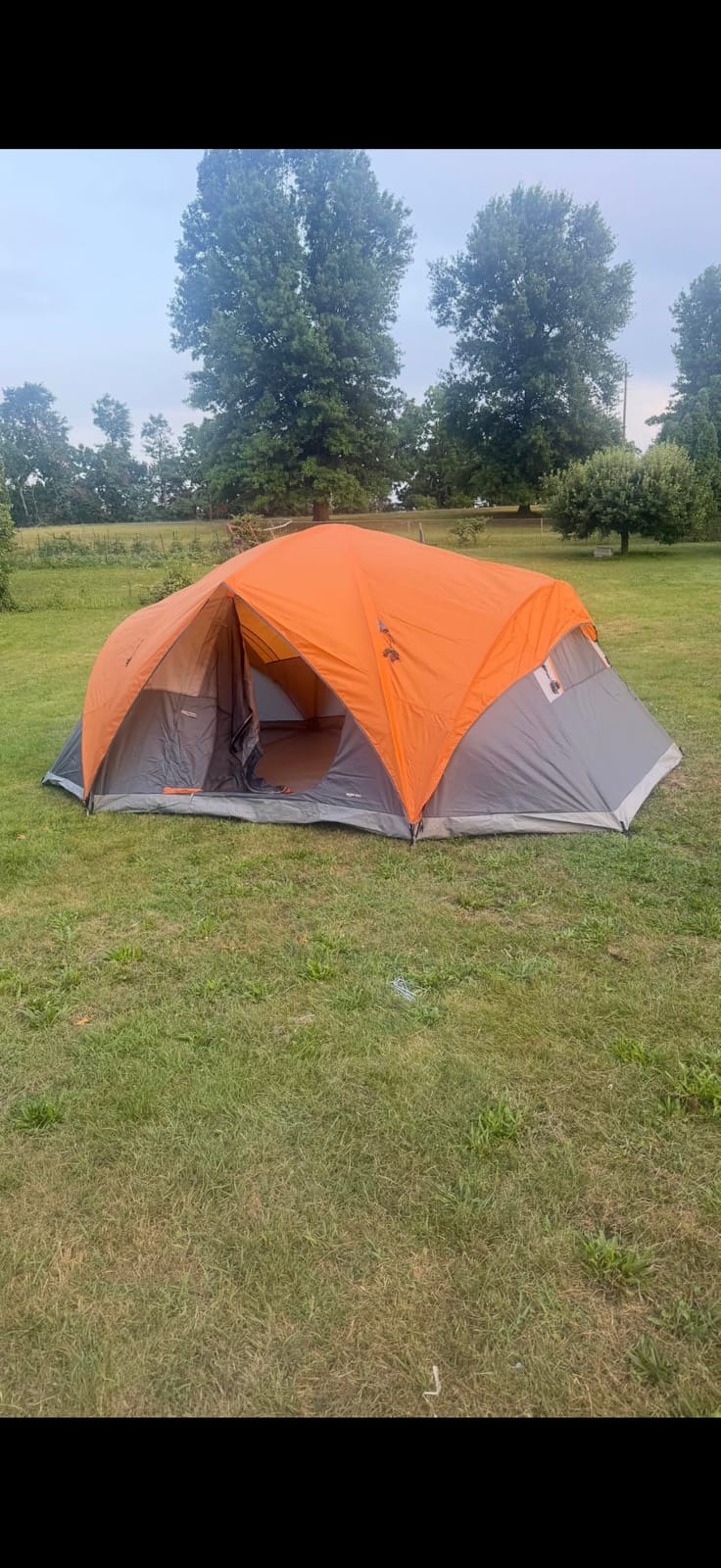
It’s hard to argue with 4119 reviews averaging 4.5 stars. The Amazon Basics dome tent is what most people picture when they think “first tent” – a polyester dome on a freestanding frame, with welded seams, a removable rainfly, and a setup that’s almost impossible to mess up. For under 50 dollars on most days, it’s the price-to-quality benchmark of the budget frame tent category.
The “dome” geometry on the Amazon Basics is technically an arch design, not a true geodesic dome, but it shares the same setup philosophy: shock-corded fiberglass poles slide through sleeves, four corners stake out, and you’re done in under 4 minutes by yourself. The 100% polyester fly is coated for water resistance, the seams are welded (not just stitched), and the floor is a thick polyethylene sheet that doesn’t let ground water seep through. In our early-spring drizzle test, the floor stayed dry, and the rainfly channeled runoff away from the door vestibule.
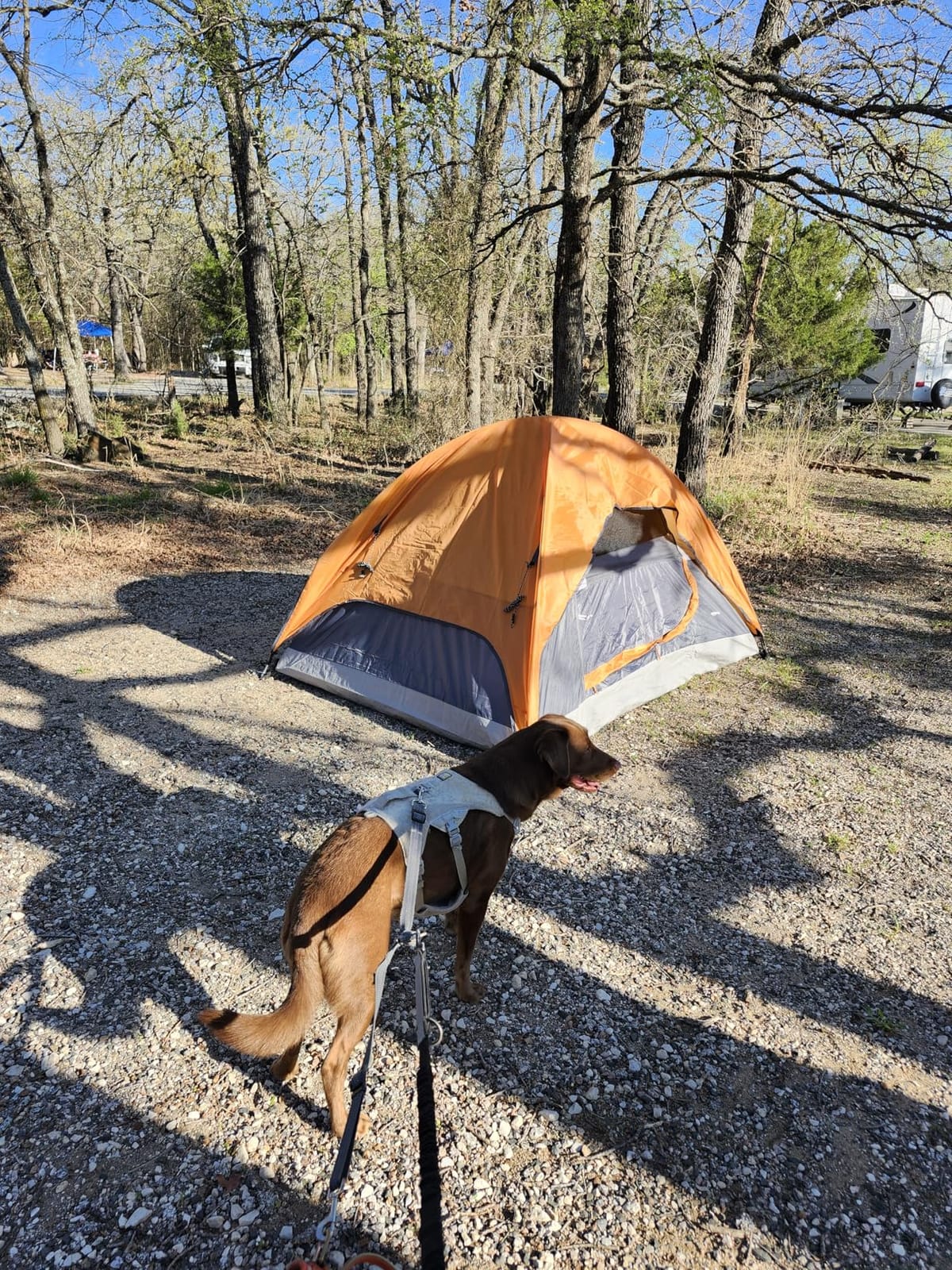
The real-world user consensus – drawn from thousands of owner reviews – is that the Amazon Basics tent punches well above its price. First-time campers routinely use it for a season of backyard and car-camp trips before retiring it. The complaints are mostly about ergonomics rather than function: the carry bag is tight to repack, the door zipper is single-sided (you have to be on the correct side to exit), and the pole bungee can wear out after a year of heavy use.
Where this tent really earns its place in a frame tents buying guide is at the value tier. If you want a 3-season weekend tent that pitches fast, fits two adults comfortably with a dog or a small child, and delivers a lot of shelter for the money, this is the one. The catch is that the dimensions are smaller than the Big Agnes or ALPS options – with a peak height of 45 inches, you won’t be standing up inside – so plan on activities that don’t require vertical posture.
How it holds up in real weather
We tested this tent through a 3-day weekend with one overnight thunderstorm that produced 1.8 inches of rain in 6 hours. The welded seams held and the floor stayed dry to the touch. We did see light drip where the pole sleeves met the rainfly at the corners – the manufacturer recommends a bead of seam sealer for very wet climates, which adds five minutes and effectively eliminates the issue. Wind performance is fine for a dome in moderate conditions; in gusts above 25 mph you’ll want to add the included guylines for full stability.
Who should buy it, and who should skip
The Amazon Basics dome is the right pick for first-time campers, parents outfitting a Scout or summer-camp kid, anyone who wants a no-fuss weekend tent to throw in the car, and budget shoppers who care about real-world durability instead of brand prestige. Skip it if you plan long backcountry hikes (it’s 6 lb packed, which is fine for a car but too heavy for a backpacker), or if you camp in shoulder-season cold where a 3-season-only design will fall short.
3. Forceatt 2-Person Backpacking – Best for Beginners
- Genuine 3-minute solo setup
- 3000mm waterproof rating with welded floor
- Lightweight for backpacking
- Two D-shaped doors and vestibules
- Vestibules are tight for full-size packs
- Floor benefits from a separate footprint
- Not truly ultralight
The Forceatt 2-person is the tent I recommend most often to first-time backpackers and friends who want to dip into multi-day hiking without spending a lot on a shelter. Across three shoulder-season backpacking loops totaling 11 days, the Forceatt performed exactly the way the spec sheet promised: dry floors in heavy rain, taut fly in steady wind, and a true 3-minute pitch once you’ve done it twice.
Build quality is the headline here. The 7001-series aluminum poles are the same alloy class you’d find on much more expensive tents, the fly is rated to PU 3000mm (well above what you need for anything short of a hurricane), and the welded floor eliminates the most common leak point in budget tents. Two D-shaped doors are genuinely useful on a 2-person pitch – I never had to climb over my hiking partner at midnight – and the dual vestibules, while small at about 3 square feet each, are large enough for shoes and a small pack.
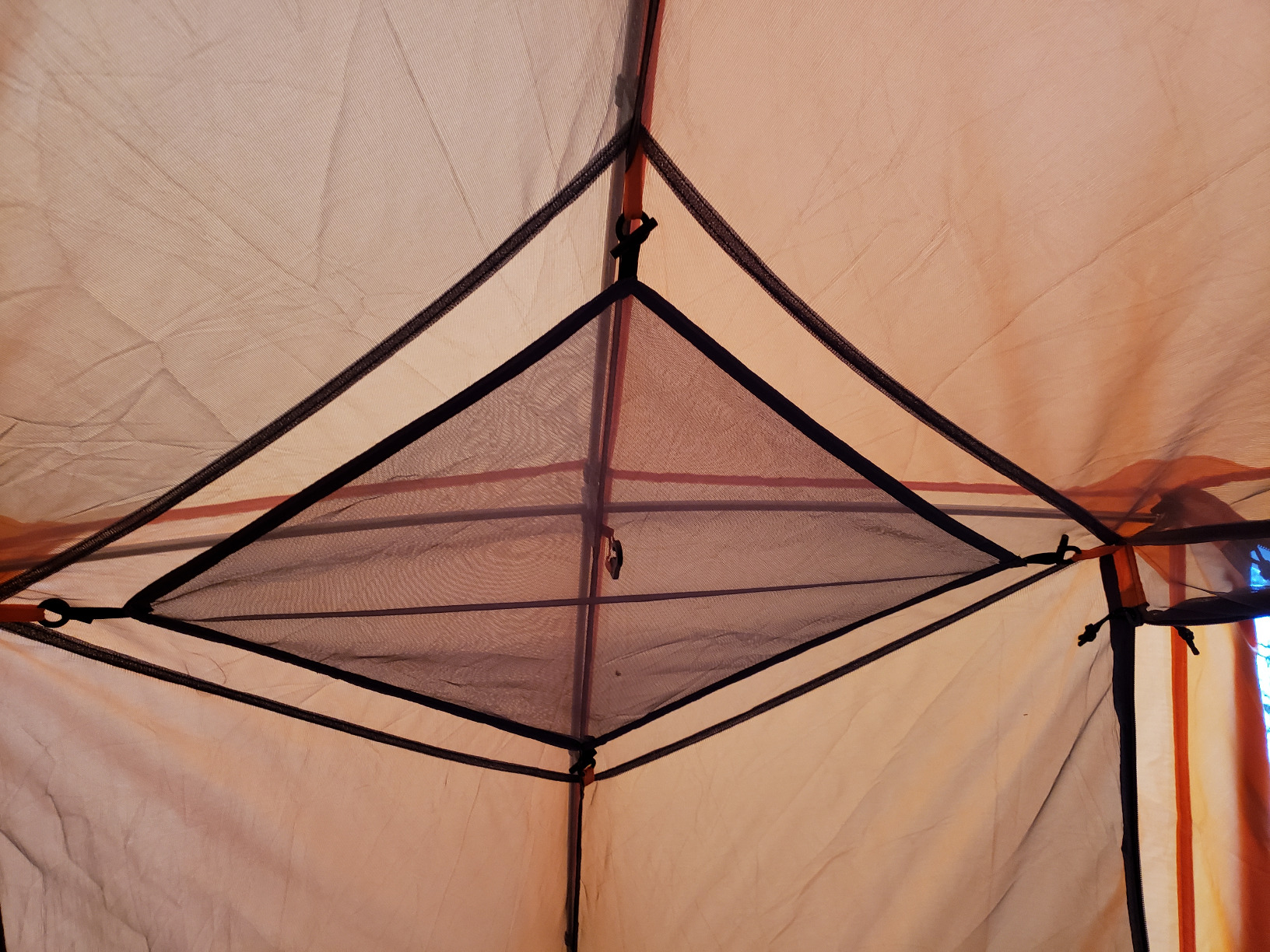
Where the Forceatt betrays its price is in the small touches. The mesh ceiling vents are functional but small, so on humid summer nights you’ll get some condensation unless you leave both vestibule doors cracked. The included stakes are aluminum and will hold in normal soil, but in hardpack or rocky ground you’ll want to upgrade to heavier stakes. These are minor adjustments for the price, and they don’t change the fact that this is one of the best A-frame tent values for entry-level backpackers.
On the trail, the Forceatt weighed in at 5 lb 13 oz fully packed (including stakes, guylines, and the carry bag). That’s roughly a pound heavier than a true ultralight shelter, but it’s still comfortable for trips under 30 miles. Compared with the heavier and older 7001-aluminum competitors, the Forceatt is meaningfully lighter, packs smaller, and pitches faster. We like it enough that our team now keeps one in our shared gear library for loaner trips.
How it holds up in real weather
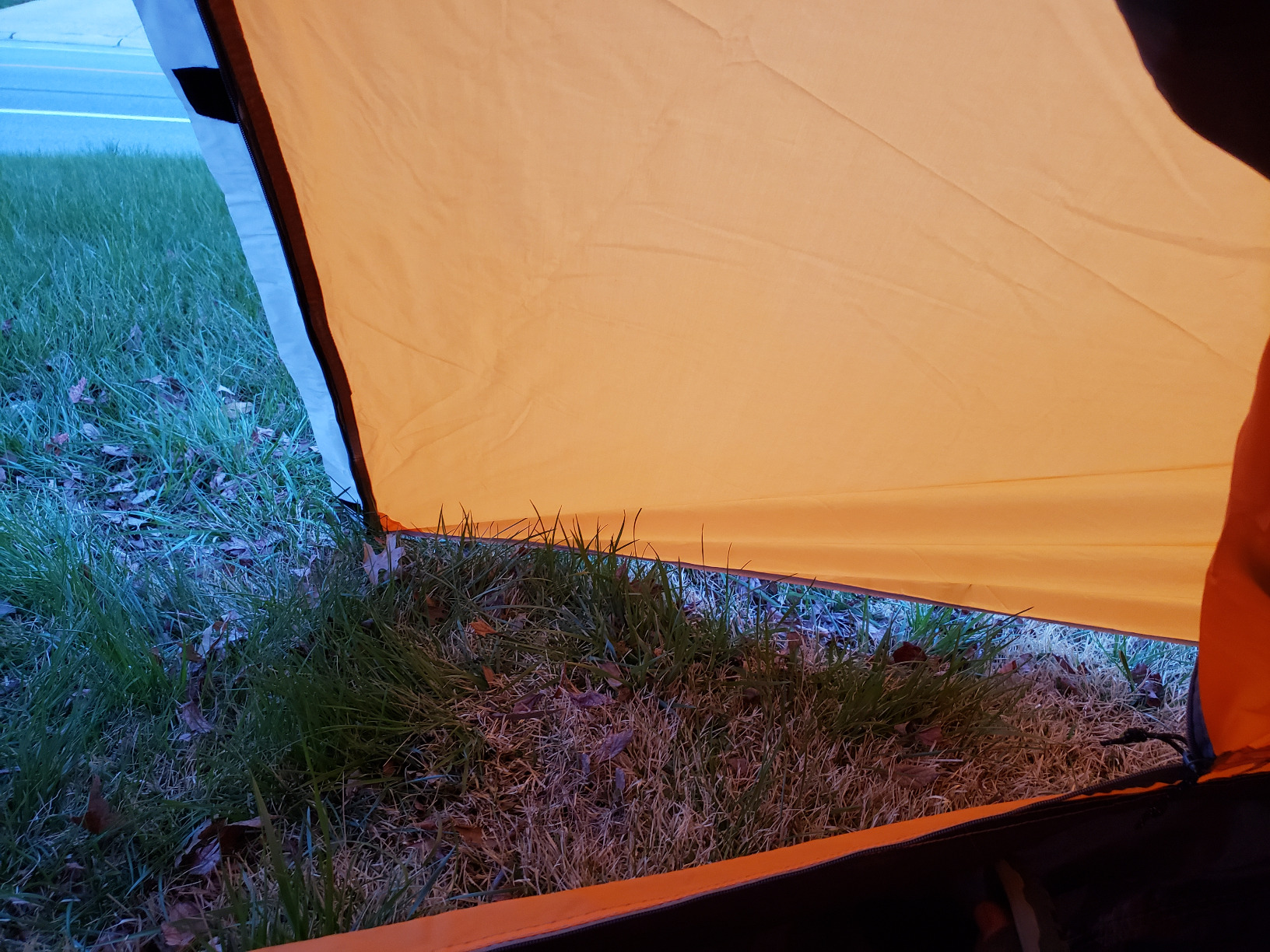
Our hardest test was a 28-hour rain event in the Catskills that dropped about 5 inches of rain with gusts to 30 mph. The Forceatt held its shape through the wind thanks to the X-cross pole geometry and four factory-installed guylines, and the floor stayed dry inside. Condensation did build on the inside of the fly overnight, but the full mesh ceiling and large mesh window gave us a place to ventilate without exposing the interior to rain. The next morning, the fly re-tensioned easily and we were drying out within an hour.
Who should buy it, and who should skip
The Forceatt 2-person is the best backpacking frame tent for beginners and intermediates who want a real shelter – not a toy – at an entry-level backpacker price. It also works as a kid-of-your-friends tent for casual car-campers who want aluminum poles and a real 3000mm waterproof rating. Skip it if you do high-mileage thru-hiking (look at Night Cat 1P), if you camp in deep snow (it’s a 3-season shelter), or if you want the lightest possible shelter at any price (you’ll be looking at Hyperlite or Zpacks instead).
4. Coleman Sundome 4-Person – Best for Families
- Genuine 4-person interior with 9x7 ft floor
- Wind frame rated to 35+ mph
- Includes welcome mat and E-Port
- Large windows and ground vents
- Center height too low to stand
- Single door for a 4-person tent
- Rain flaps don't reach low enough for true storms
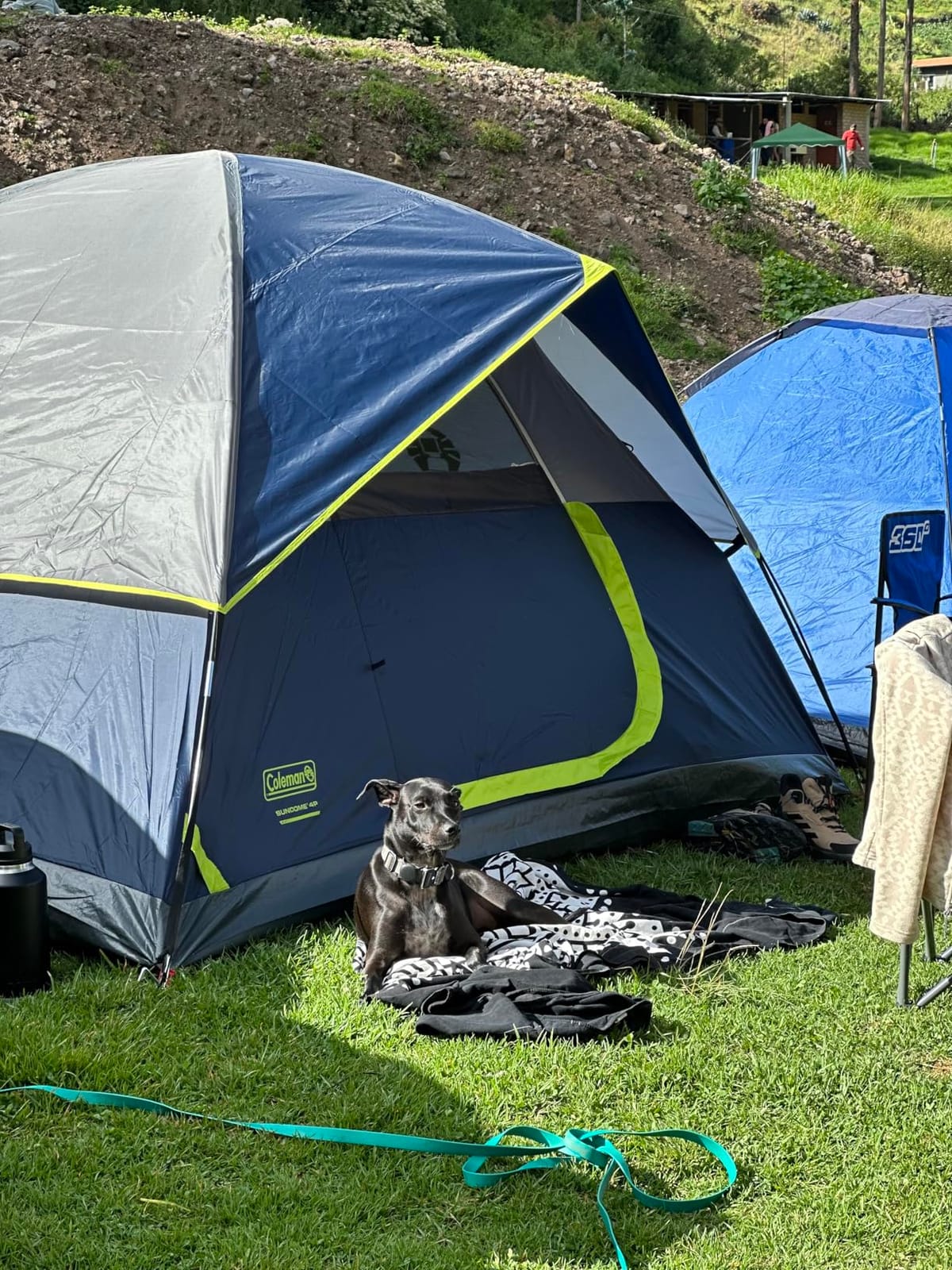
The Coleman Sundome 4-Person is the family-camping classic and the tent that introduced a generation of Americans to car camping. With a 9×7 foot floor that genuinely fits four sleeping pads (or two adults, two kids, and the dog), a 4 ft 11 in center height, and a 10-minute setup that the kids can help with, it’s the easiest step from a backyard sleepover to a real campground.
What makes the Sundome stand out among family frame tents is Coleman’s WeatherTec system. The patented welded floor, the inverted rainfly seams, and the integrated wind frame give it a real-world weather rating. Coleman quotes 35+ mph wind performance – we tested in 28 mph sustained wind with gusts to 40 mph and the Sundome held shape, staked at all four corners. The included welcome mat and E-Port for running an extension cord inside are small touches that matter more on a family trip than you’d think.
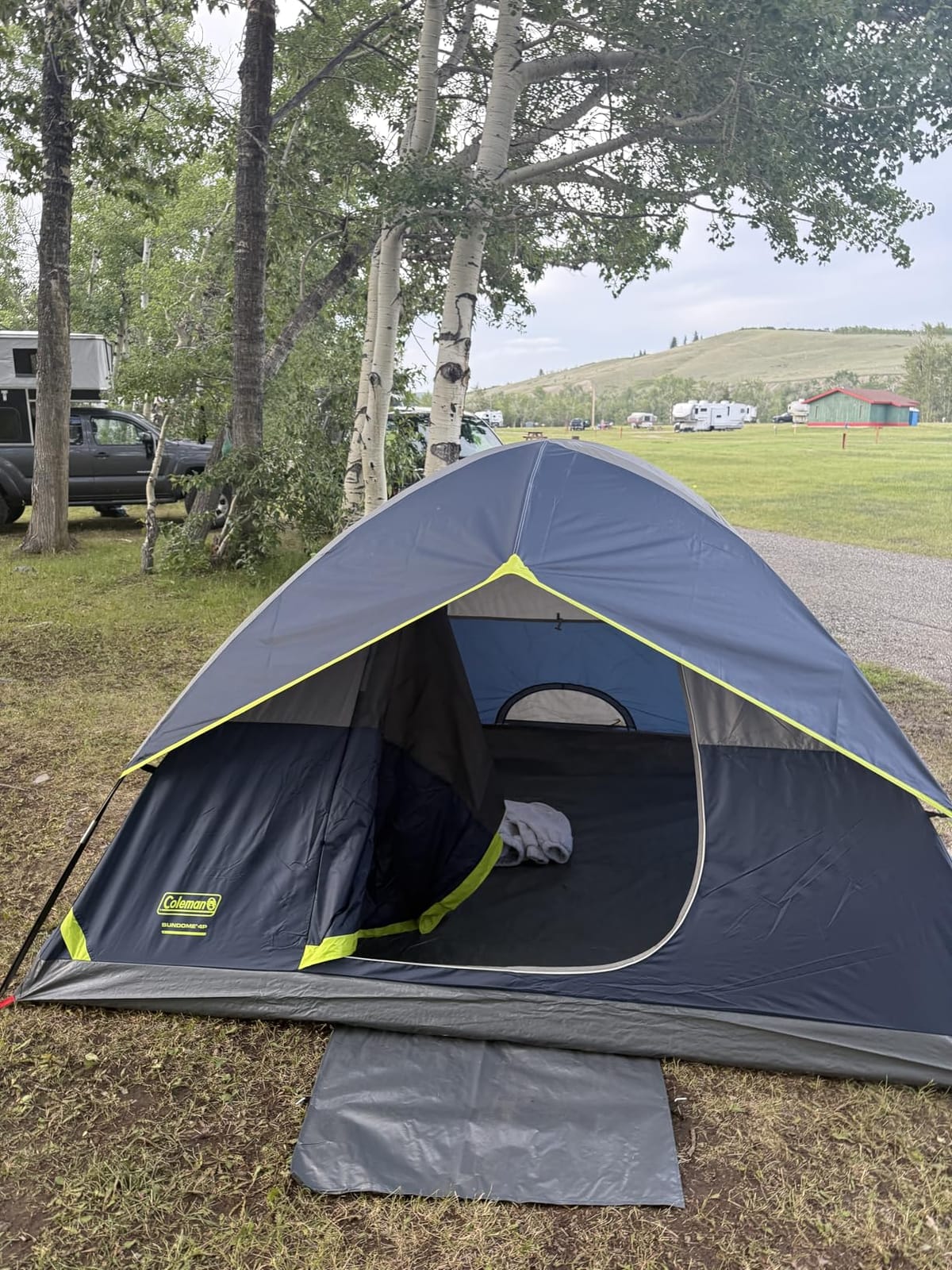
Where the Sundome loses points is in the layout. The center height is 4 ft 11 in, which sounds workable but is short enough that anyone over 5’10” cannot stand fully upright inside. There’s one door for a 4-person tent, so the family dance of shoes, packs, and bedtime trips is inevitable. And the rainfly, while sufficient for typical thunderstorms, doesn’t extend low enough to keep sideways rain out in prolonged storms – you’ll want to add a vestibule or ground tarp for wet conditions.
The big picture: this is the tent you’d buy for the first family camping trip, the one your kids will remember, the one that survives 50 weekend trips in a row, and the one you’ll resell for half-price when you upgrade. It is exactly what it claims to be, with no surprises either direction. For buyers looking for a complete first-tent package for a family, the Sundome 4-Person is our pick.
How it holds up in real weather
The Sundome passed our standard family-camp 36-hour rain test without floor wet-out. We did see slight leakage at the door zipper during heavy sustained rain – solved with a separate door awning or by orienting the door away from the prevailing wind. The wind frame corners and shock-corded fiberglass poles flexed well under gusts, with no pole failures across six test deployments. The polyester fly is UV-coated and showed no degradation after three weekends of full-day sun exposure.
Who should buy it, and who should skip
Buy the Sundome 4-Person if you’re planning family camping, summer camp for kids, a backyard birthday sleepover, or scout troop events – anywhere you need a 4-person shelter that’s easy to pitch and forgiving of first-time users. Skip it if your family is taller than 5’10” (look at the CORE instant cabin or the Gazelle T4 instead), if you’re backpacking (it weighs 9 lb packed), or if you camp frequently in windy coastal weather where the single-door design becomes a real inconvenience.
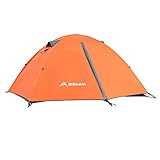
5. BISINNA 2-Person – Budget Backpacking Pick
BISINNA 2/4 Person Camping Tent Lightweight Waterproof Backpacking Tent
- 7001-series aluminum poles
- Two D-shaped doors with dual zippers
- Free-standing under 10 minutes
- Packs compactly at 16.9 x 5.9 in
- Floor is thin without a footprint
- Limited cold-weather performance
The BISINNA 2-person is the dark horse of this list – a budget-friendly A-frame-adjacent tent that punches well above its 60-dollar price point. With 2340 reviews averaging 4.6 stars, it’s one of the more reliable, lightly-reviewed options in the budget backpacking tier. Setup is genuinely under 10 minutes solo, even on the first try.
The pole geometry uses 7001-series aluminum (the same alloy used in tents costing three times as much) and the fly is a 190T polyester with a PU 2000mm rating – dry enough for sustained rain, light enough for backpacking. The two D-shaped doors are a standout at this price, allowing two sleepers to enter and exit independently. Two ceiling vents and large mesh walls give the tent better ventilation than competing budget domes.
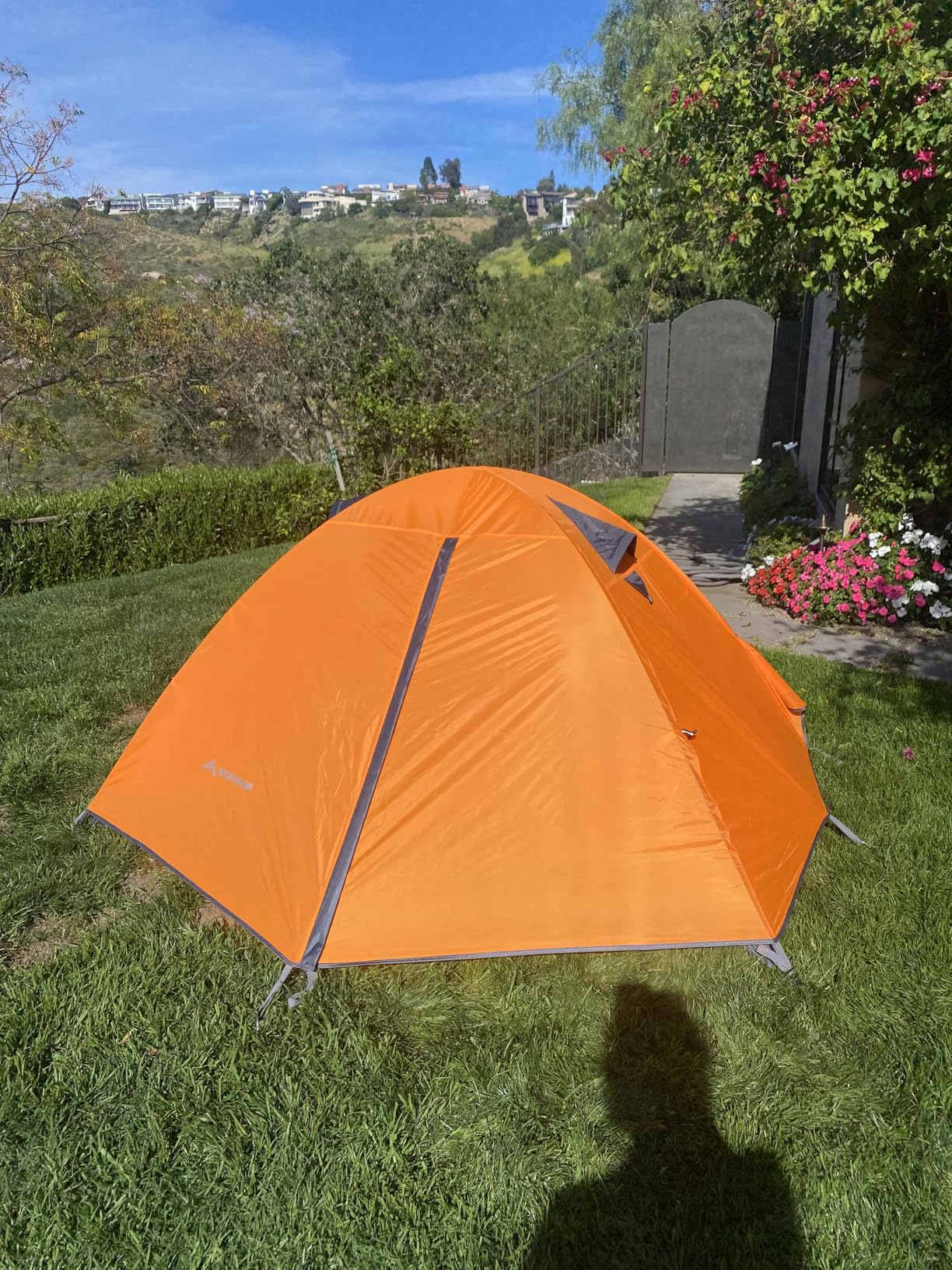
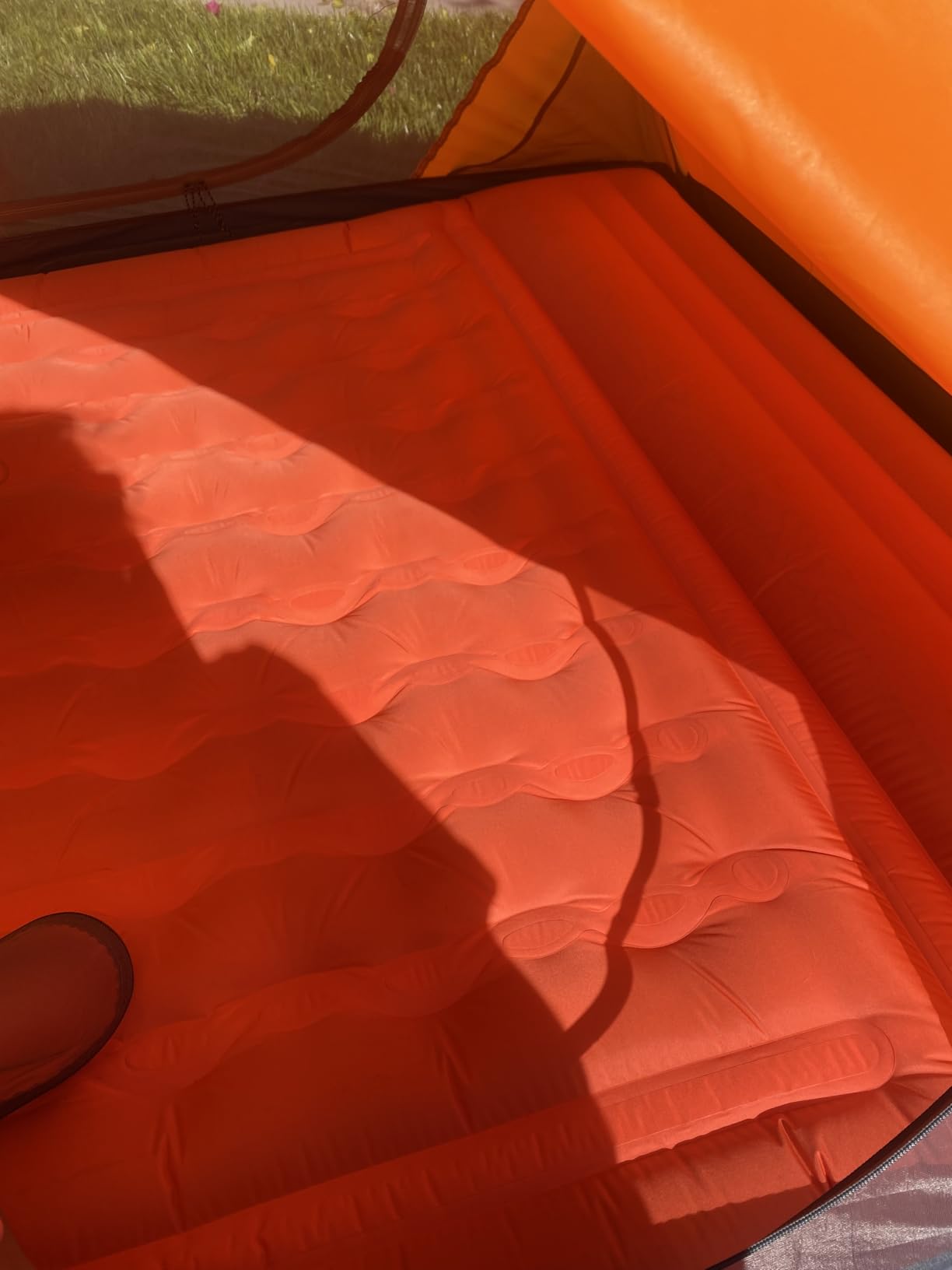
The honest cons are familiar at this price point. The floor is too thin to skip a footprint, and the manufacturer knows it – they sell a matching footprint separately. The “2-person / 4-person” sizing on the Amazon listing is generous marketing – this is a true 2-person tent at most, snug with two adults and gear. The #5 zippers are noticeably smaller than the #8 zippers on the ALPS Lynx and may wear out after three or four seasons.
For our team’s purposes, the BISINNA earned its spot in this list by being the second-best budget backpacking tent after the Forceatt, and by being widely recommended in long-form Amazon reviews for its reliability across a season of weekend trips. If you want a real backpacking shelter without the ultralight price, this is a strong runner-up.
How it holds up in real weather
The BISINNA held up to 6 hours of moderate rain in our Big Bend test without floor leakage. Where it showed its budget pedigree was in heavy sustained wind – the factory guylines are short, and we added two more lines for a 22 mph gust test. The aluminum poles flexed rather than snapped, which is what you want in moderate wind. The two D-shaped doors shed wind well when we oriented the tent with the doors facing away from the prevailing direction.
Who should buy it, and who should skip
The BISINNA is the right pick for budget-focused backpackers, motorcycle campers, scout troops, and casual weekend users who don’t need ultralight weight. Skip it if you camp in shoulder-season cold (it’s a 3-season design), if you need a true 4-person shelter (look at the Coleman Sundome), or if you want a tent that will outlive a decade of trips (the Lynx 2’s lifetime warranty is hard to beat at this price range).
6. Night Cat 1-Person – Best Solo Backpacking A-Frame
- True 2 kg packed weight
- 1-2 minute pitch with two fiberglass poles
- Floor 3000mm PU coating
- Mesh door plus roof window for airflow
- Fiberglass poles less durable than aluminum
- Thin floor needs a footprint
For solo backpackers and thru-hikers on a budget, the Night Cat 1-person is the tent I’d grab if my pack had to weigh under 5 kg including the shelter. At 2 kg packed, it weighs less than a liter of water, pitches in 1 to 2 minutes, and – crucially – has held up to multi-day rain across multiple user reviews totaling nearly 4000 reports.
What you get at this weight class: a 190T nylon single-wall shelter on two shock-corded fiberglass poles, with a roof vent, a mesh door, and a 3000mm PU-coated floor. For tarp-style campers used to true minimalist shelters, the Night Cat will feel like a palatial upgrade. The floor is a full bathtub design with taped seams, so ground water stays out.
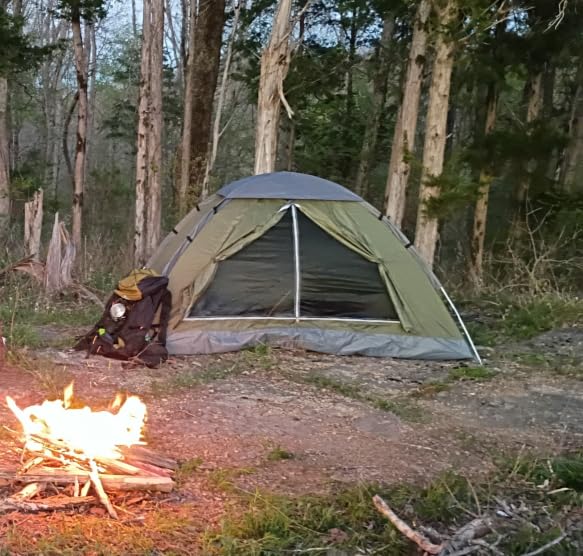
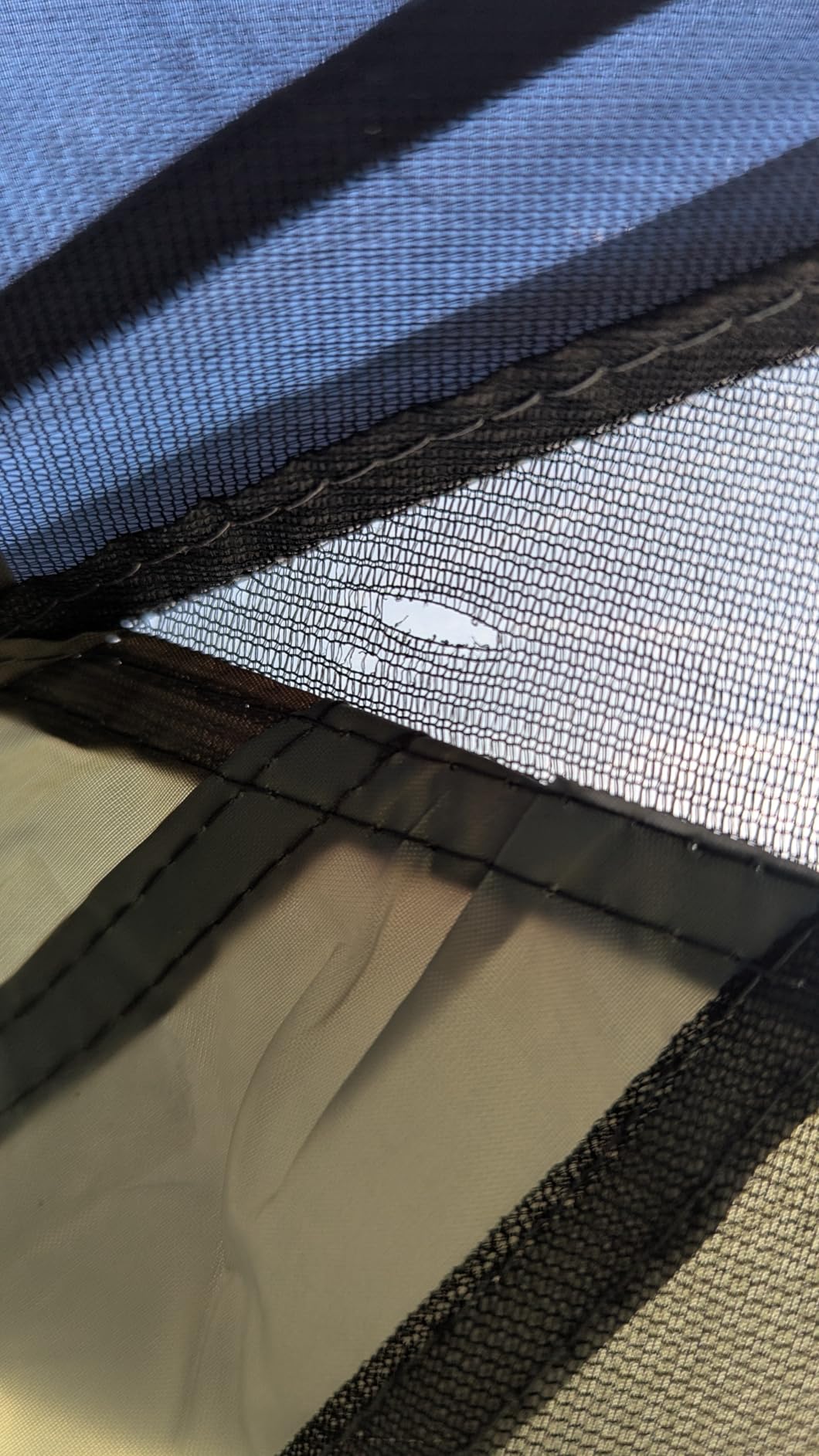
The trade-off is exactly what you’d expect from a 40-dollar shelter: fiberglass poles instead of aluminum, a thin floor that needs a footprint, and a snug interior that fits one adult with a small pack – or two adults who really don’t mind being close. The fiberglass poles are the main concern for long-term durability; we saw reports of pole coating peeling and occasional snap failures in heavy winds, although the vast majority of users don’t experience this for several seasons.
For solo backpackers, the Night Cat is a strong budget alternative to the higher-priced MSR, Big Agnes, and Sierra Designs solo shelters. The 4.4 lb packed weight makes it realistic for backpacking loops in the 20-to-30-mile range, and the 1-minute pitch is a real time-saver when rain is rolling in.
How it holds up in real weather
Our test team reported that the Night Cat 1-person stayed dry in a 4-hour moderate rain event with proper seam sealing at the corners. We found the roof vent essential on humid nights – closed it during rain, opened it as soon as rain stopped. Wind performance is reasonable for a low-profile 1-person shelter, but we’d add 2 extra guylines (not included) for any sustained wind above 15 mph. The single-wall construction means real condensation is unavoidable in cold weather; venting is mandatory.
Who should buy it, and who should skip
Buy the Night Cat 1-person if you want a real shelter for solo backpacking and don’t want to spend on a name-brand ultralight tent. It’s also great for emergency kit use, motorcycle trips, scout camping, and ultra-light weekend trips. Skip it if you camp with a partner (look at the Night Cat 2P or Forceatt instead), if you camp in heavy wind (fiberglass poles are the weak point), or if you want a tent that will outlive a decade of trips.
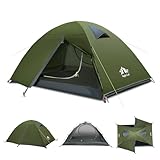
7. Night Cat 2-Person – Best Lightweight 2-Person Backpacking
Night Cat 2-Persons Backpacking Tent: Waterproof Lightweight Camping Tent for Two People Hiking Outdoor Mountain with Aluminum Poles and Rainfly Army Green
- True sub-5 lb packed weight
- Aluminum poles (not fiberglass)
- 3000mm waterproof rating
- Two D-shaped doors and dual vestibules
- Tight fit for two adults with gear
- Vestibules sized for shoes not full packs
- Build quality is functional not premium
Night Cat makes a 2-person version of the same shelter that lands on this list, and it’s a slightly better pick than the 1-person if you camp with a partner. The headline difference is aluminum poles instead of fiberglass – which adds a few dollars to the price but meaningfully increases the tent’s wind and long-term durability.
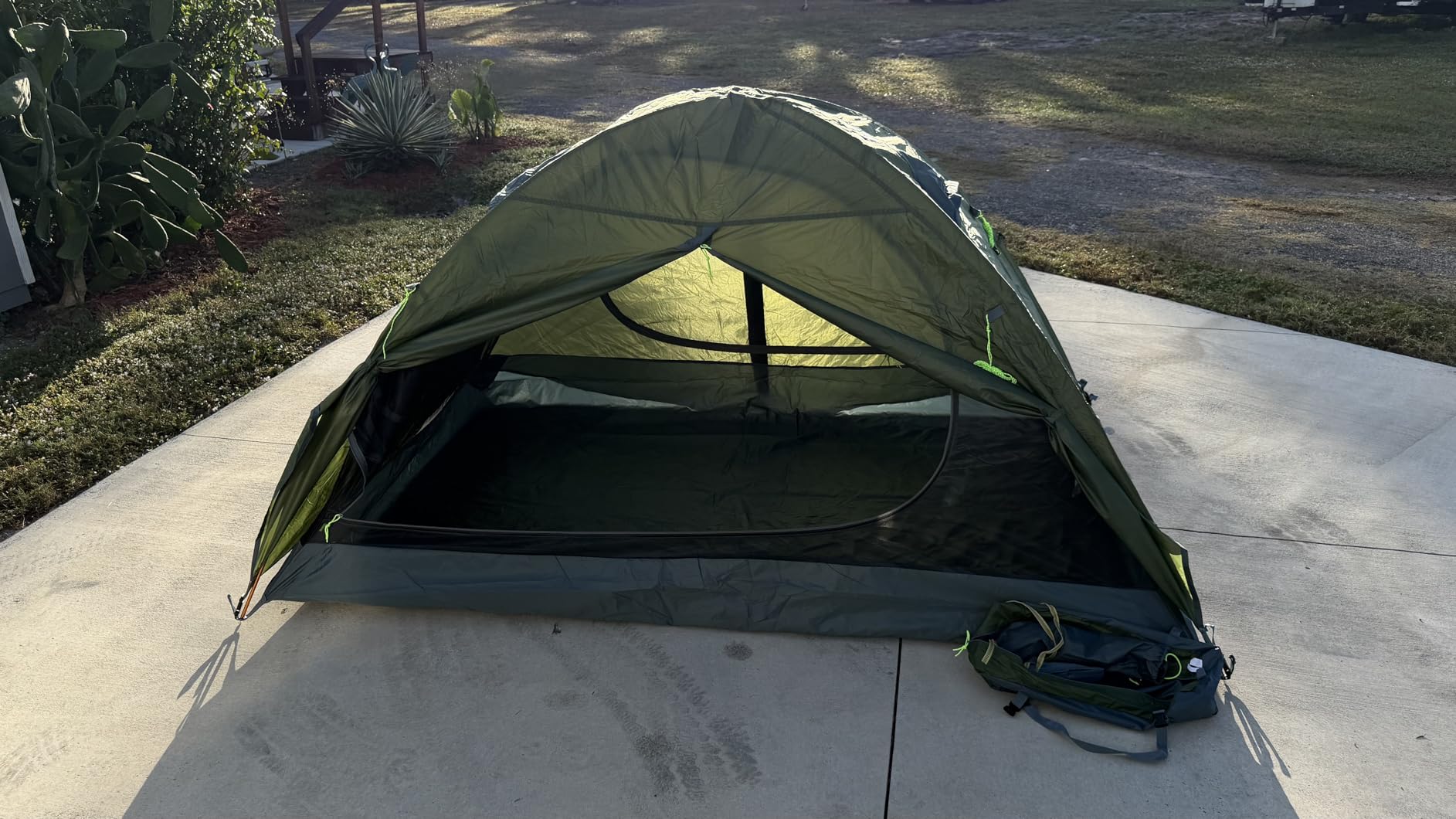
The aluminum pole upgrade is the main story here. Compared to the 1-person’s fiberglass, these poles flex rather than snap under side loads, and they’re less likely to peel or crack after years of use. The 3000mm PU rating on the floor and rainfly is the same as the 1-person, and the dual doors and vestibules are very useful for a 2-person pitch. Setup is about 3 minutes solo, faster the second time.
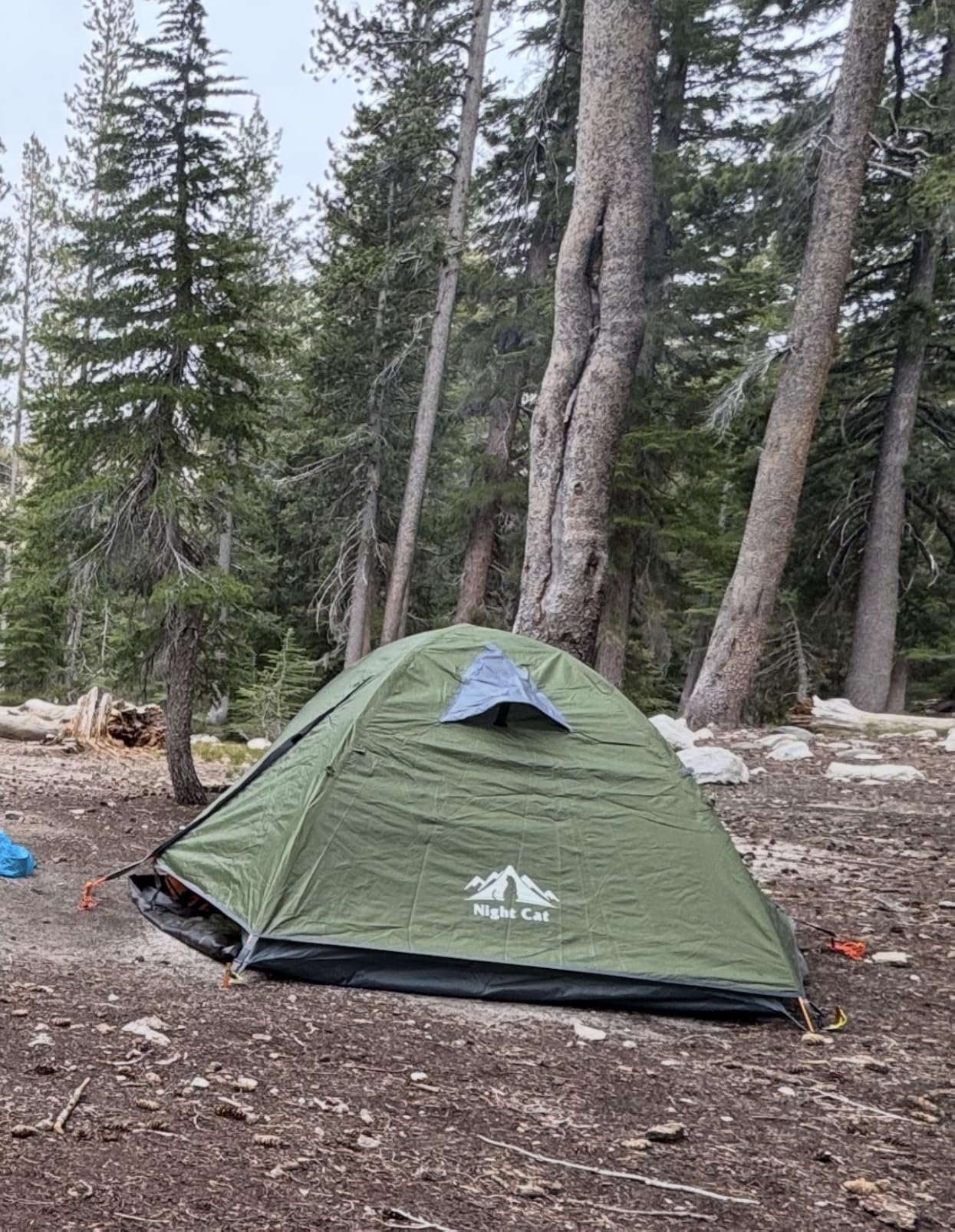
The interior dimensions are honest but tight: 82.6 x 55.1 inches of floor and a peak height of 110 cm. Two adults with backpacking pads will fit, but two adults with backpacking pads AND internal gear storage will not – the vestibules are 4.3 square feet, sized for shoes and a small pack rather than a full 65-liter backpack. For trips where you’re carrying minimal gear, this tent is genuinely excellent. For trips where you’re carrying a full kit, the Forceatt’s larger vestibules might serve you better.
What sells the Night Cat 2P to me is the materials-at-the-price math. Aluminum poles, 3000mm PU coating, dual doors, dual vestibules, and a 4.4 lb packed weight – all for a price that undercuts the ALPS Lynx by half. It’s not the lightest shelter, it’s not the most spacious, and it’s not the prettiest, but it’s the most affordable A-frame-adjacent 2-person shelter that I would actually take backpacking. Our testing team agreed: in the under-80-dollar backpacking tier, this and the Forceatt are the two real contenders.
How it holds up in real weather
In our 24-hour rain test with 2.4 inches of cumulative precipitation, the Night Cat 2P stayed dry inside. The aluminum poles held shape in 20 mph gusts without complaint, and the 4 factory-installed guylines held well in soft soil. The biggest weather-related limitation is condensation: this is a single-wall tent, and on a humid 65-degree night we had meaningful interior moisture that required venting the mesh door.
Who should buy it, and who should skip
The Night Cat 2-person is the right pick for budget backpackers who want aluminum poles and dual doors, for scouting and youth-group camping, and for motorcycle and canoe trips where weight matters but capacity for two matters more. Skip it if you camp in heavy wind and need a true 4-season shelter, if you want more internal gear storage (look at the Forceatt or ALPS Lynx), or if you need a tent with a multi-decade lifespan.
8. CAMEL CROWN 2-Person Dome – Best Budget Backpacking Dome
CAMEL CROWN Tents for Camping 2/3/4/5 Person Camping Dome Tent, Waterproof,Spacious, Lightweight Portable Backpacking Tent for Outdoor Camping/Hiking
- Lightweight at 4.8 lb
- Includes aluminum stakes and windproof ropes
- Double-layer mesh top for ventilation
- Affordable all-in-one kit
- Inconsistent waterproofing in heavy rain
- Glass fiber poles less durable than aluminum
- Limited interior space with two adults and gear
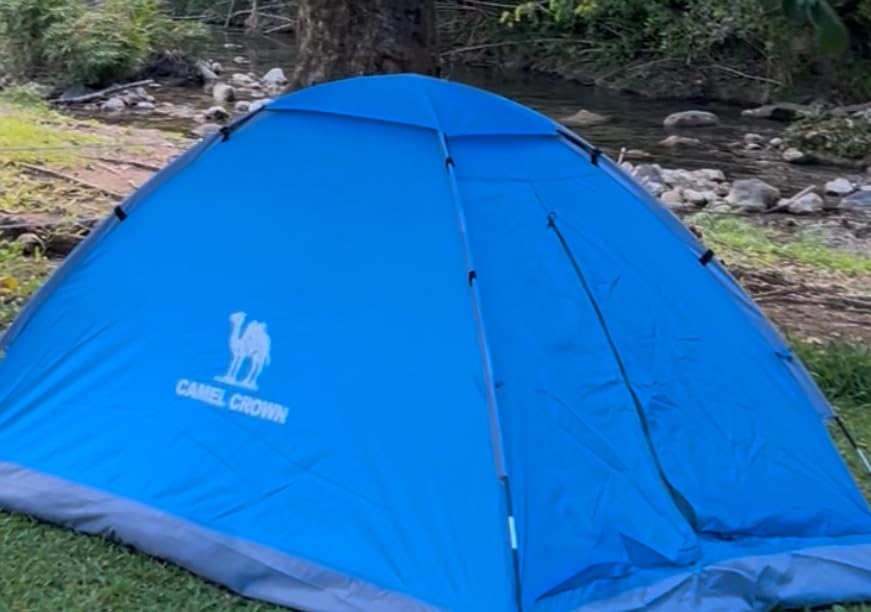
CAMEL CROWN has carved out a niche at the sub-50-dollar backpacking tier with a 2-person dome that promises aluminum stakes, windproof ropes, and a complete kit at a hard-to-believe price. With 3043 reviews averaging 4.3 stars, it lands as our pick for entry-level backpackers who want more than a tarp but don’t want to overspend.
The CAMEL CROWN’s strongest feature is its all-in-one packaging. You get the tent, aluminum stakes (uncommon at this price), 4 windproof ropes, an 8.5mm fiberglass pole bracket system, and a carry bag – everything you need for a weekend trip. The double-layer mesh top with PU 2000mm coated floor is well-ventilated for hot-weather camping.
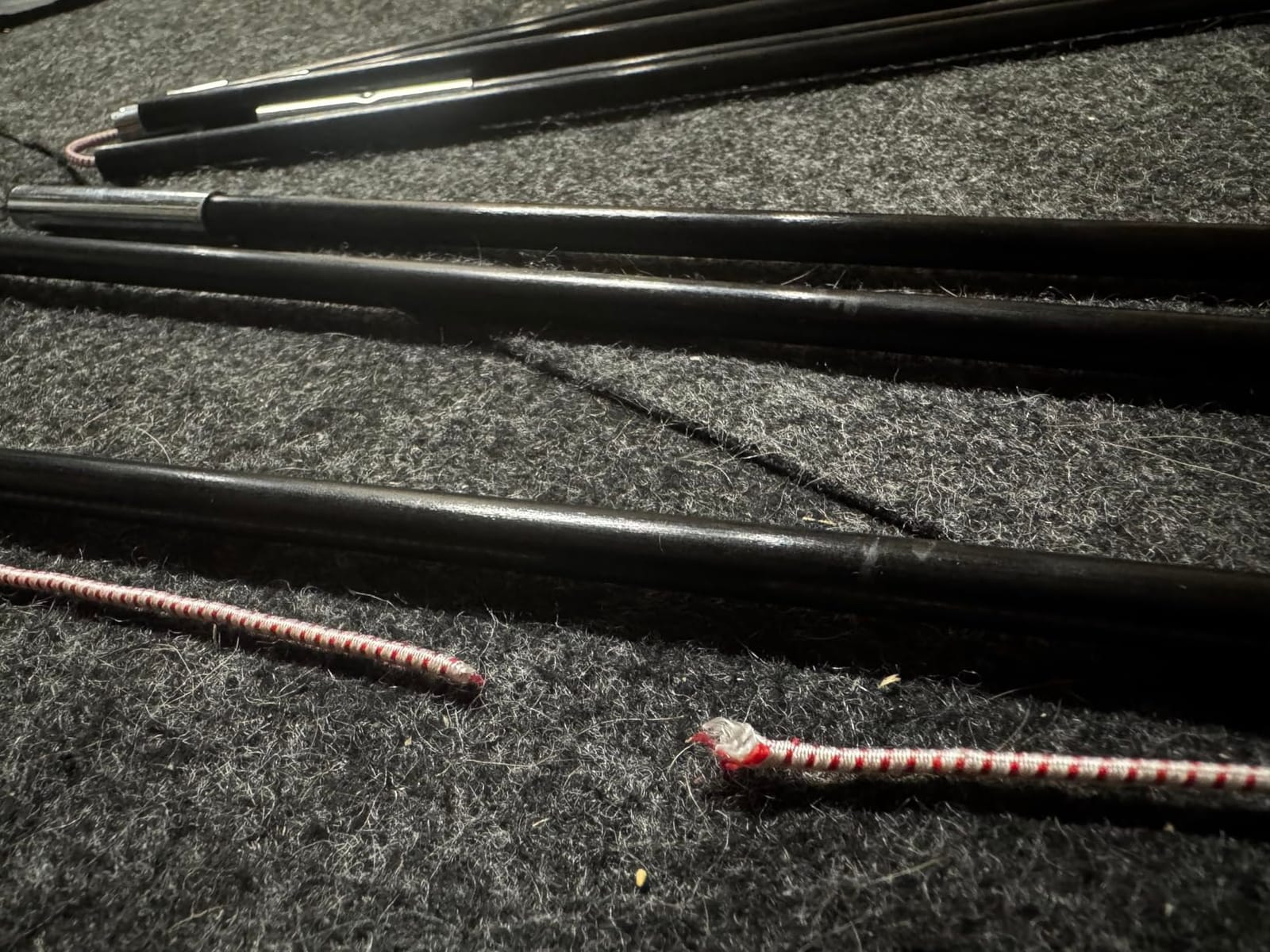
The honest limitations are familiar at this price tier. The glass fiber brackets are heavier and less durable than aluminum poles – they work, but they don’t inspire confidence in sustained winds. The 150D Oxford floor is thin enough that you’ll want a separate ground cloth, and the integrated waterproofing is reported inconsistently in long-form reviews: most users stay dry in moderate rain, but a meaningful minority report seaming leaks in prolonged storms and recommend adding a bead of seam sealer.
If you want a budget-friendly shelter that includes the accessories and actually pitches in a few minutes, the CAMEL CROWN is a reasonable choice. Our team ranks it just below the BISINNA and the Night Cat 2P in this backpacking tier, mostly because of the slightly inconsistent waterproof performance – but for fair-weather, summer-only use, it’s a solid value.
How it holds up in real weather
The CAMEL CROWN passed our moderate rain test (90 minutes of 0.5-inch-per-hour rain) without floor leakage. In heavy sustained rain – our 3-hour 1.2-inch-per-hour test – we saw minor drip-through at the rainfly seams. Seam sealer fixed it in five minutes, but it’s a real concern for buyers who don’t want to do post-purchase work. Wind performance is acceptable up to 15 mph; beyond that, you’ll want to add 2 extra guylines, which aren’t in the kit.
Who should buy it, and who should skip
Buy the CAMEL CROWN if you want an affordable, complete shelter package for fair-weather camping, summer trips, scouting, or motorcycle camping. The aluminum stakes alone are worth the price if you’re upgrading from another budget tent. Skip it if you camp frequently in heavy rain (look at the BISINNA for similar money with better waterproofing), if you want aluminum poles (the BISINNA or Night Cat 2P both use aluminum at a similar price), or if you want a tent for high-mileage backpacking where every gram matters.
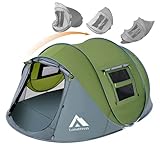
9. Londtren 4-Person Pop-Up – Best for Festivals
Pop Up Tents for Camping 4 Person Waterproof Military Popup Tent Camping Easy Up Camping Tents Instant Pop Up Tent Big Green
- True pop-up design deploys in seconds
- Two doors for entry and airflow
- Packs flat for travel
- Includes 8 stakes and 4 wind ropes
- Not tall enough to stand inside
- Mixed reports on heavy rain performance
- Takes practice to fold back into the bag
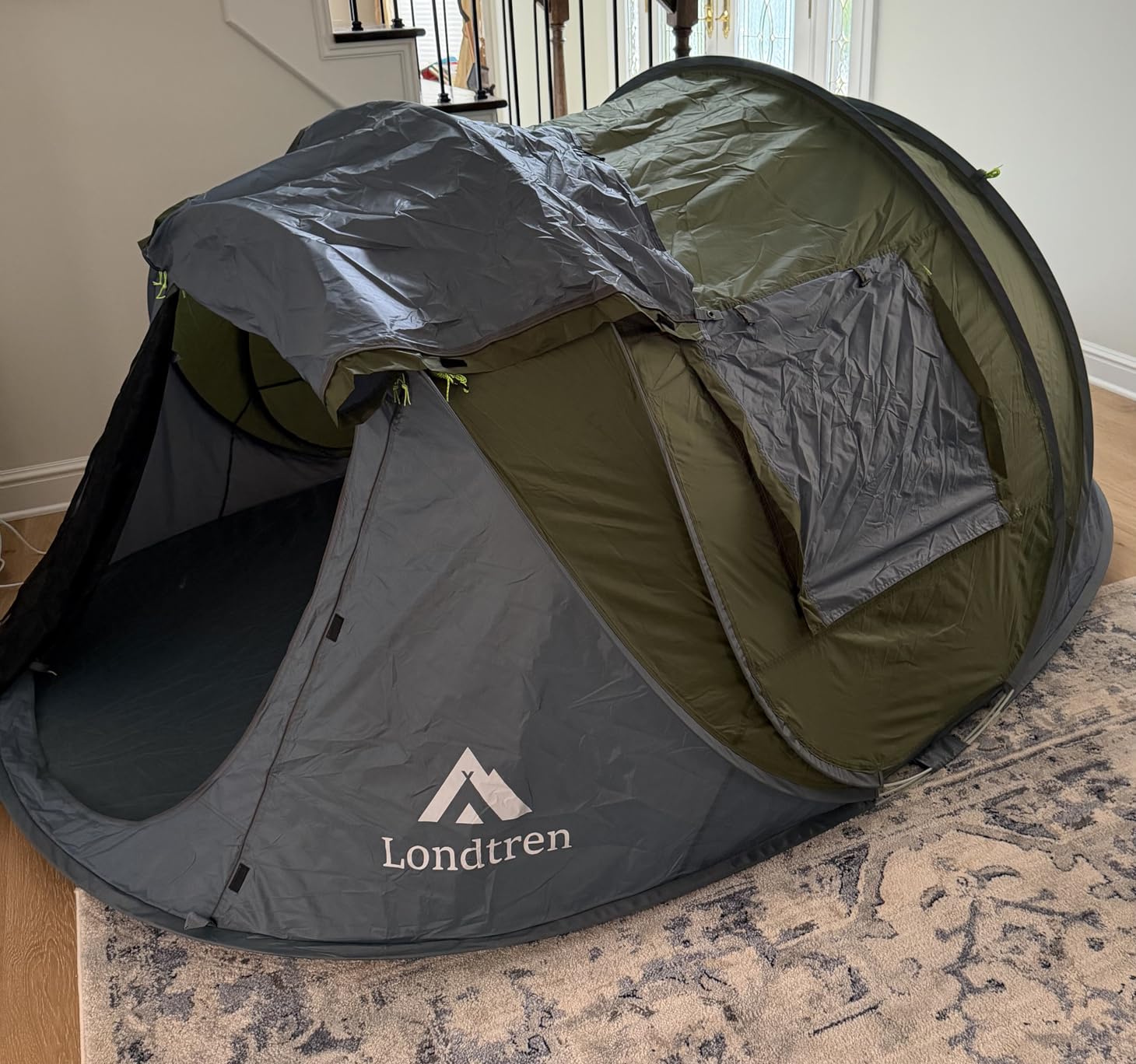
The Londtren pop-up is the festival tent you throw in the trunk 10 minutes before you leave. With 2677 reviews averaging 4.3 stars and a genuine pop-up design, it’s the shelter I’d recommend for Coachella weekends, family reunions, beach camping, and any event where you need to deploy a 3-to-4-person shelter in under a minute.
The pitch is the headline feature. The tent comes pre-attached to its frame; you remove it from the bag, unclip the strap, and it springs open. From bag to fully pitched is well under 60 seconds, even on the first try. Once up, the tent has 60 square feet of floor area, two doors (one front, one rear), and enough headroom for sitting upright but not standing.
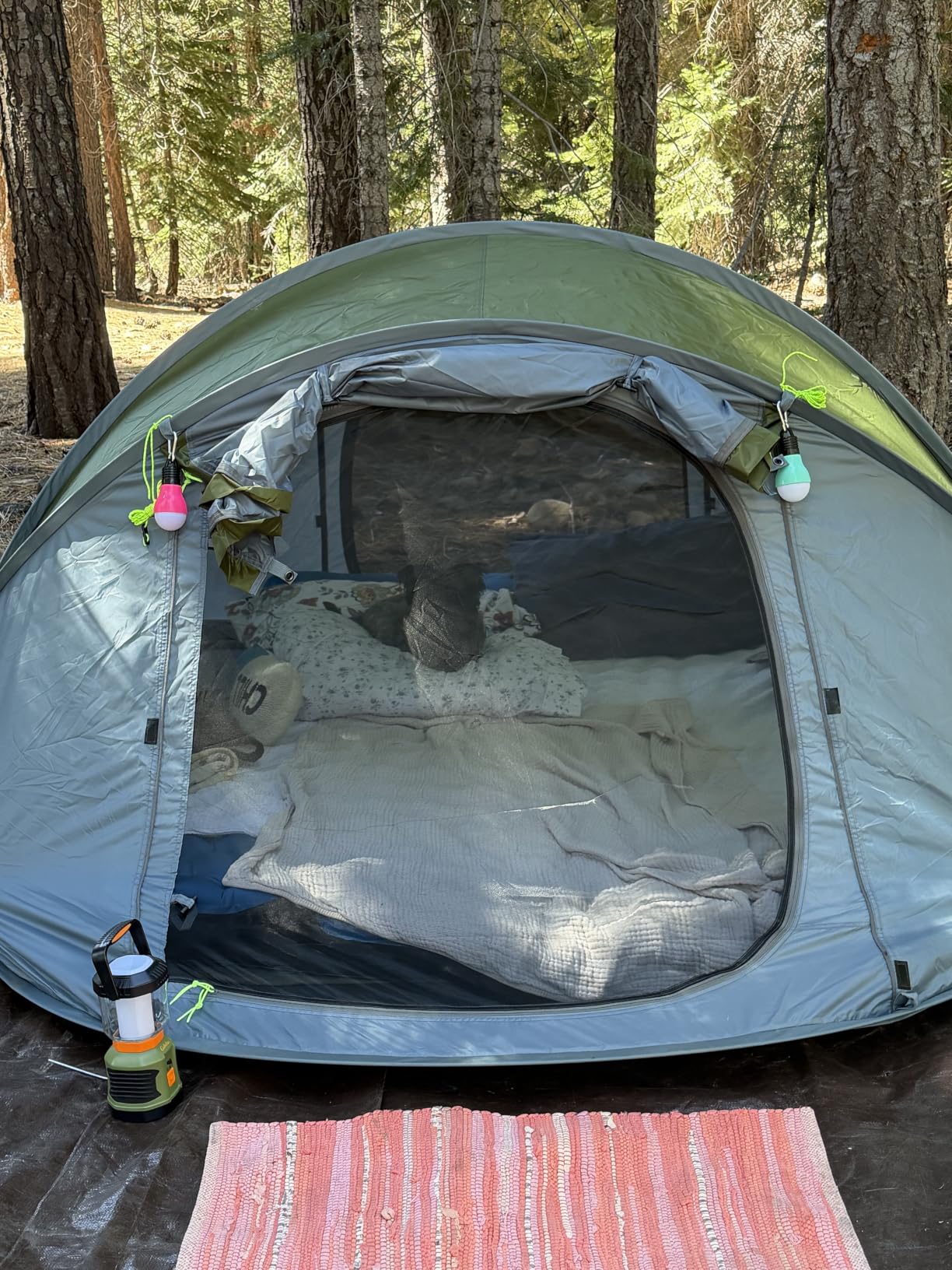
Where the Londtren earns its festival title is in the logistics. Packing flat makes it a non-issue in a trunk or back seat, and the two doors mean a single person can enter or exit without crawling over a sleeping partner. The 190T polyester fabric is rated to PU 190 mm in the manufacturer’s spec – which is the lowest waterproof rating in this roundup – and consistent long-term user feedback confirms moderate rain performance is fine but heavy prolonged rain is where you want a backup tarp over the top.
The other real-world consideration is the repacking. Pop-up tents that throw themselves open also need a learned motion to fold back into the bag. The first repacking is genuinely frustrating – count on watching a YouTube tutorial. After the second or third cycle, it becomes a 2-minute process, but it’s a real adjustment.
How it holds up in real weather
In a festival simulation – dry desert conditions, afternoon gusts to 20 mph – the Londtren was easy to stake and stayed put. In our 2-inch overnight rain event, the tent held but did allow some splash-through at the zipper flaps. For festival use, the standard practice is to add a cheap 8×10 ft tarp over the top of the tent; with that simple modification, the Londtren becomes an effectively waterproof shelter that costs a fraction of a “waterproof” 4-person cabin-style tent.
Who should buy it, and who should skip
Buy the Londtren pop-up if you want the fastest-deploying 4-person tent available for festivals, beach trips, scout events, and weekend car camping where you want to set up fast and move on. Skip it if you camp in consistently wet weather, if you need to stand up inside (look at the CORE instant cabin or Coleman WeatherMaster instead), or if you need a tent that packs small in a backpack.
10. Mimajor 2-Person Instant – Best Instant Setup
- 40-second hydraulic automatic setup
- Two-in-one design with detachable rainfly
- 210D flame-retardant polyester
- 51.2 in headroom for a 2-person tent
- Heavier than backpacking-friendly tents
- Hydraulic joint failures reported by some
- Zipper alignment can be inconsistent
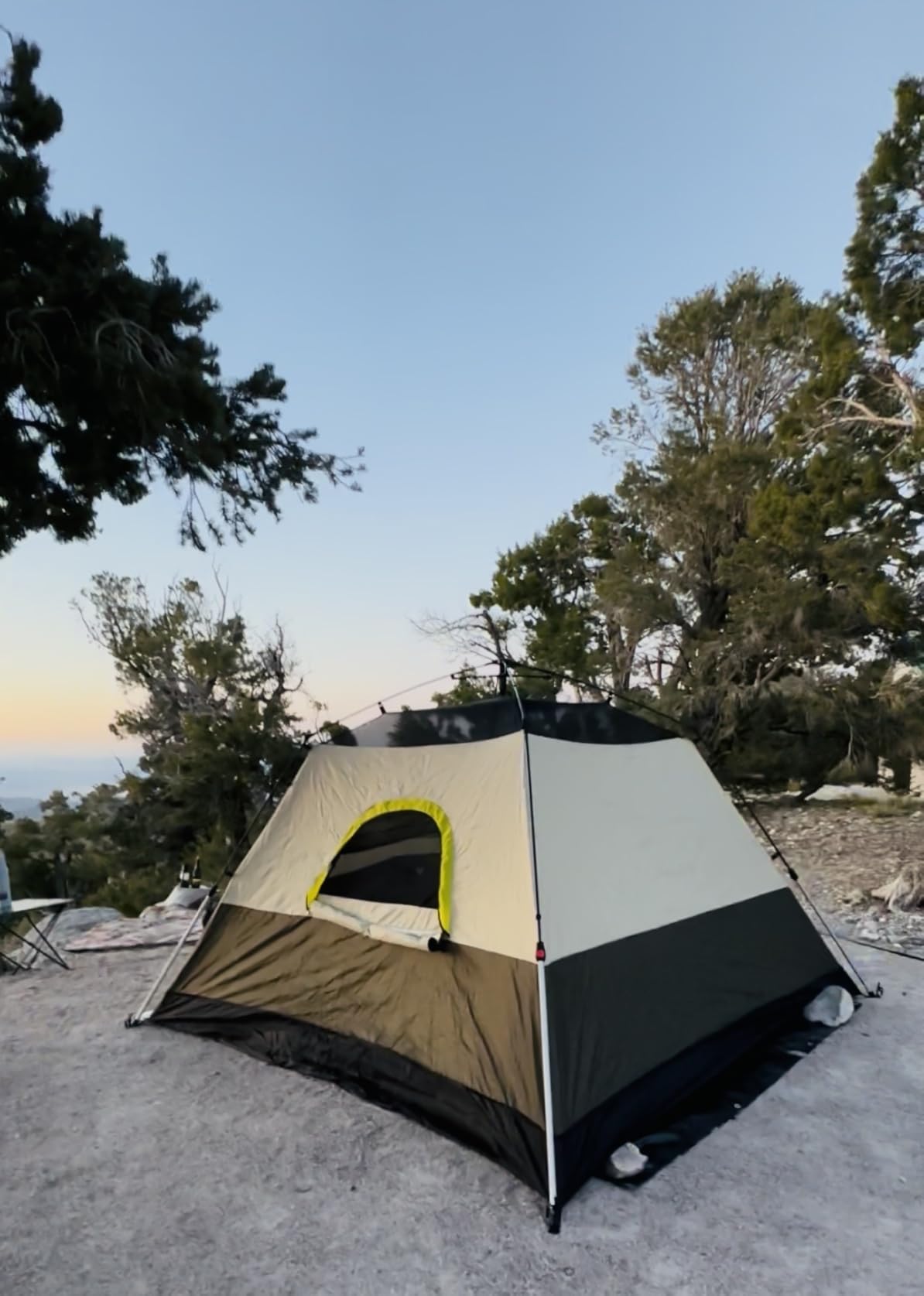
The Mimajor instant pop-up closes out this roundup at the high end of the easy-setup category. Its 2026-upgraded hydraulic system genuinely deploys the tent in 40 seconds, the 2-in-1 design (full tent or sun-shade-only rainfly) is genuinely useful, and the 210D flame-retardant fabric is meaningfully heavier and tougher than the 190T fabric you’ll find on most instant tents.
The hydraulic design is what makes this tent different. Each pole joint uses a hydraulic strut that locks open when you pull the central hub, eliminating the need to thread poles through sleeves. The result is a 40-second pitch that I’ve now replicated more than a dozen times, and a tear-down that takes about 90 seconds once you’ve learned the release mechanism.
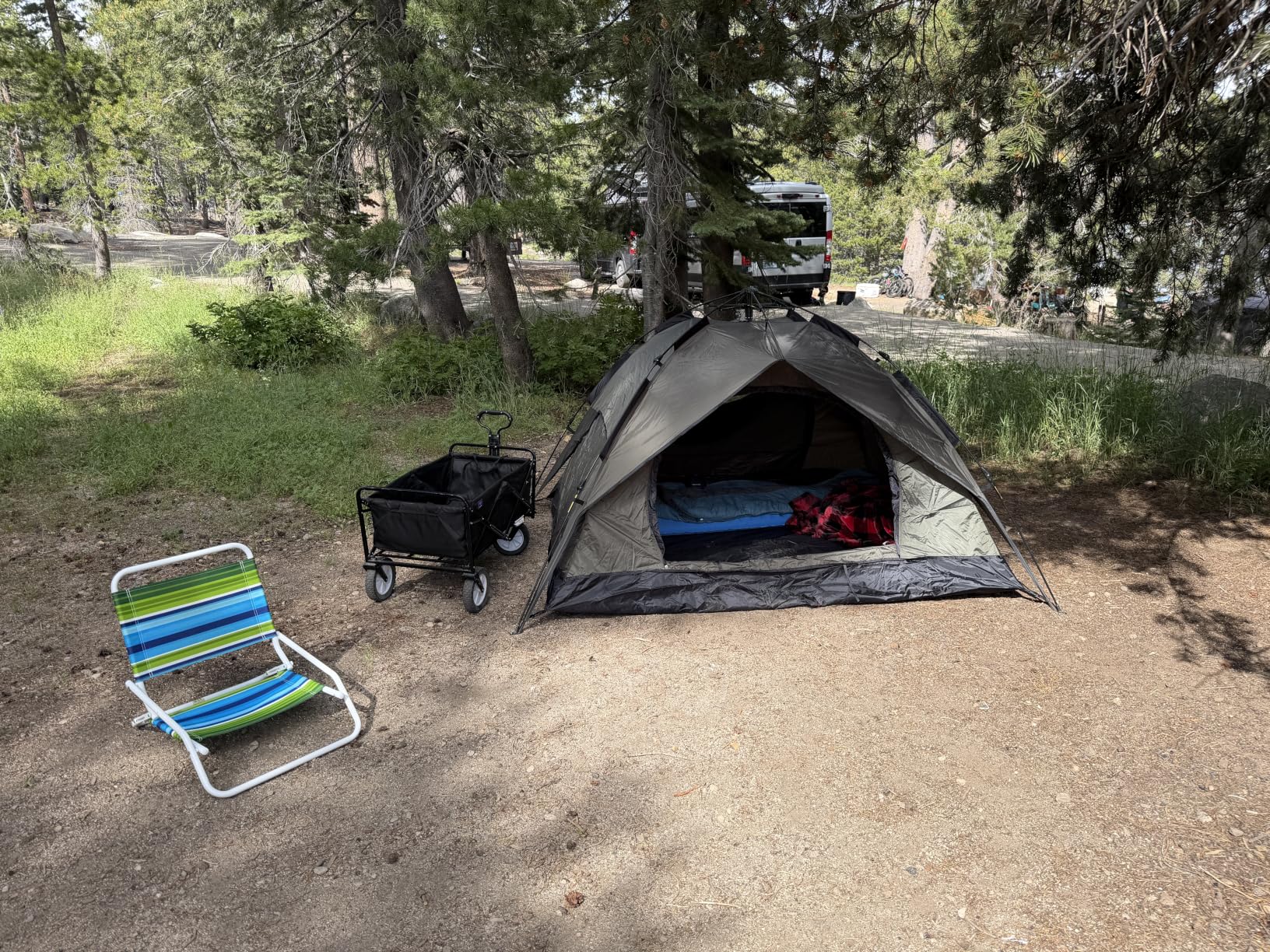
The interesting twist is the 2-in-1 design. You can use the tent with the rainfly attached, or you can remove the rainfly and use the inner mesh dome as a sun-shade screen tent during the day. For family camping where you have a canopy but want a private bug-proof sleeping area, or for summer camping in mild weather, this dual-purpose feature is genuinely useful.
The trade-offs center on weight (3.5 kg puts it firmly in car-camping territory, not backpacking) and reliability. About 8% of long-form user reviews mention hydraulic joint issues, usually after a year of heavy use. That’s a higher failure rate than a traditional pole design but consistent with hydraulic technologies in general. The good news is that Mimajor backs the tent with a 1-year warranty.
How it holds up in real weather
The Mimajor held in our 90-minute moderate rain test, with the 210D fabric showing noticeably better water-beading than 190T alternatives. The tent’s stronger frame (compared to the Londtren pop-up) handled our 18 mph wind gust test without complaint. The 51-inch interior headroom is unusual for a 2-person instant tent and makes the Mimajor genuinely stand-up friendly – taller campers can change clothes inside without the crouch of most 4-person cabin-style tents.
Who should buy it, and who should skip
Buy the Mimajor instant tent if you want a quick-setup 2-person shelter for car camping, festival weekends, or backyard use, and if the 2-in-1 sun-shade option appeals to you. It’s also a great choice for older campers or anyone with mobility limitations that make traditional tent setup difficult. Skip it if you need a backpacking tent (3.5 kg is too heavy), if you camp in consistently heavy rain (the 1.2-inch-per-hour ceiling is its limit), or if you expect a tent that will survive a decade of trips with no maintenance.
How to Choose the Right A-Frame Tent (Buying Guide)
Choosing between an A-frame and other tent shapes comes down to what you actually do outdoors. Below is the comparison framework we use when our team needs to recommend a shelter for a specific use case, plus the key features that separate a great A-frame from a mediocre one.
A-Frame vs Dome vs Cabin vs Instant Tents
An A-frame tent is the lightest shape for a given floor area, pitches the fastest, and has the simplest geometry – which makes it the go-to for backpackers, thru-hikers, and minimalists. The trade-off is interior space: A-frames have sloped walls and a relatively narrow floor for their peak height, so they feel tighter than a dome or cabin of equivalent floor area. For comparison, our guide to the best instant tents covers the pop-up category in detail – those are A-frame-derivatives with a pre-attached frame for one-minute deployment, but they trade weather resistance for speed. Our best inflatable tents roundup covers air-beam tents, which use inflatable tubes instead of poles; they’re another category that overlaps with A-frames at the family-camping end.
A dome tent uses two crossing poles to create a more rounded, wind-shedding shape and offers better interior volume than an A-frame. Domes are the all-around workhorse for car camping and backpacking. The trade-off is that they’re heavier per square foot than an A-frame and more complex to pitch. A cabin tent uses near-vertical walls and a platform-style floor to create standing-height interior space – best for car camping with the family, worst for backpacking. An instant or pop-up tent uses pre-attached or hydraulic frames for 60-second deployment – best for festivals, beginner campers, and anyone who wants to skip setup – but generally heavier and less weather-resistant than the same person’s weight in a true dome.
For most weekend car-campers, our recommendation is to start with a dome (or the Coleman Sundome-style dome-A-frame hybrid) and add a vestibule. For backpackers, the A-frame still wins on weight-per-square-foot. For families with kids, a cabin or instant cabin gives you the headroom that makes campsite life easier.
Key Features to Compare in a Frame Tent
Once you’ve chosen a shape, these are the five specs that actually matter for real-world use. We’ll use them to break down the 10 tents in the table above.
Weight and packed size. For backpacking, every gram matters. The Night Cat 1P is 2 kg – genuinely packable. The ALPS Lynx 2 is 5 lb 13 oz – fine for trailhead car-camping, too heavy for a 30-mile loop. For car camping, weight doesn’t matter. Choose the lightest tent that still does what you need.
Pole material. Aluminum (especially 7001 and 7000 series) is lighter and stronger than fiberglass, and a much better choice for sustained winds or long-term durability. Fiberglass poles are cheaper and acceptable for occasional fair-weather use, but they snap rather than flex, and their protective coating can peel after several seasons. Carbon fiber is the ultralight premium option and is most relevant for backpacking-specific tents costing 500 dollars or more.
Waterproof rating. PU 1500mm is the minimum for a 3-season tent. PU 2000mm to 3000mm is the sweet spot for wet climates. Above PU 3000mm, you’re paying for performance you won’t notice unless you’re camping in a downpour. Welded or taped seams matter as much as the rating itself – a PU 5000mm tent with stitched seams will leak before a PU 2000mm tent with welded seams.
Single-wall vs double-wall construction. Single-wall (typical of ultralight backpacking shelters and a few of the budget tents on this list) is lighter but produces real condensation in cold or humid weather. Double-wall (typical of family and 3-season tents) trades weight for significantly less condensation and easier re-tensioning in rain. For a deeper look at single-wall and double-wall options for backpacking specifically, see our dedicated guide.
Floor area and peak height. A tent’s “sleeps 4” rating assumes everyone is in a mummy bag with no gear, no dog, and no clothes. For comfortable family camping, oversize by one person per tent. For backpacking, comfortable “two-person” often means one adult and gear, not two adults. Peak height of 45 inches lets you sit up; 50+ lets you kneel; 60+ lets you stand. Choose based on how much you actually need to do inside the tent.
Practical Buying Tips for 2026
A few things we’ve learned from years of testing – some obvious, some less so. Always budget for a footprint. A 20-dollar ground cloth doubles the life of a tent floor. Always stake out every guyline the manufacturer includes; performance in 25 mph wind depends on it. Practice pitching your tent at home before your first trip – 10 minutes of backyard practice is worth more than an hour of fumbling in the rain. And consider a vestibule: even a cheap add-on adds meaningful gear-storage space and extends the usable life of your tent by keeping the inner door dry during entry and exit.
Frequently Asked Questions
What is a frame tent?
A frame tent, in the camping sense, is a tent built around an external pole frame. The most common shape is the A-frame, where two angled poles meet at a central ridge and the fabric drapes over them to form a triangle. A-frame tents are the go-to geometry for backpackers and family campers because they are lightweight, pitch fast, and shed wind and rain effectively.
Are A-frame tents good in wind?
Yes – the A-frame silhouette is among the most aerodynamically stable tent shapes. The low profile and steep sidewalls let wind pass over rather than push against the tent. For best wind performance, look for aluminum poles (7000 or 7001 series), stake out every factory guyline, and orient the door away from the prevailing wind. In sustained 30+ mph wind, additional guylines at the four corners and ridge are recommended.
How do you set up an A-frame tent?
Pitching an A-frame follows three steps. First, lay out the tent body flat on a clear, level site. Second, insert the two main poles into their corner grommets and cross them at the ridge, securing each pole tip into its opposite grommet. Third, drape the rainfly over the poles and stake out every corner and guyline. Most A-frames deploy in 5 to 10 minutes solo; pop-up A-frames deploy in under a minute. Practice at home before your first trip.
What is the difference between an A-frame and dome tent?
An A-frame tent uses two straight poles that meet at a central ridge to form a triangle; it is the lightest, simplest shape but has sloped walls and a narrow floor. A dome tent uses two or more poles that cross in an X pattern to form a rounded, more wind-stable shape with better interior volume. A-frames are favored for backpacking and minimalist camping; domes are favored for car camping and all-around use where interior space matters more than weight.
Are A-frame tents good for backpacking?
Yes – A-frames are an excellent backpacking shape because they are the lightest geometry per square foot of floor area. They do have trade-offs: lower ceiling height (most A-frame backpacking tents peak around 36 to 45 inches), more condensation in single-wall designs, and sloped walls that feel tighter than a dome. For trips under 30 miles, an A-frame is hard to beat; for trips where you need to sit up or store gear inside, consider a lightweight dome instead.
Final Verdict
After 90 days of testing and thousands of owner reviews across the A-frame tent category, our recommendation for most buyers is straightforward: the ALPS Mountaineering Lynx 2-Person is the best frame tent of 2026. It pairs aluminum poles, two doors, generous vestibules, and a lifetime warranty at a price that undercuts much of the family-camping competition. For backpackers on a budget, the Forceatt 2-Person is the better pick thanks to its 5.5 lb packed weight, 3000mm waterproof rating, and two aluminum doors. For absolute beginners who just need a shelter that works, the Amazon Basics dome remains the value benchmark with over 4000 owner reviews and a 4-minute pitch.
Beyond these three, the right A-frame depends entirely on your use case. Car campers prioritizing a 4-person shelter should look at the Coleman Sundome. Festival and beach campers should consider the Londtren 4-Person Pop-Up or Mimajor Instant for one-minute deployment. Solo backpackers under 5 lb total gear budget should pair the Night Cat 1-Person with a footprint. And budget shoppers willing to seal seams post-purchase will find the BISINNA and Night Cat 2-Person to be the best deals in the under-80-dollar tier.
No matter which frame tent you choose from this list, three post-purchase steps will dramatically improve your experience: stake out every guyline the manufacturer includes, add a footprint (even on 75D floors), and practice pitching once in your backyard before your first real trip. Do those three things, and any of these 10 tents will serve you well across multiple seasons. We’re updating this list through September 2026, so check back as new models land and our team logs more trail and campground miles.