
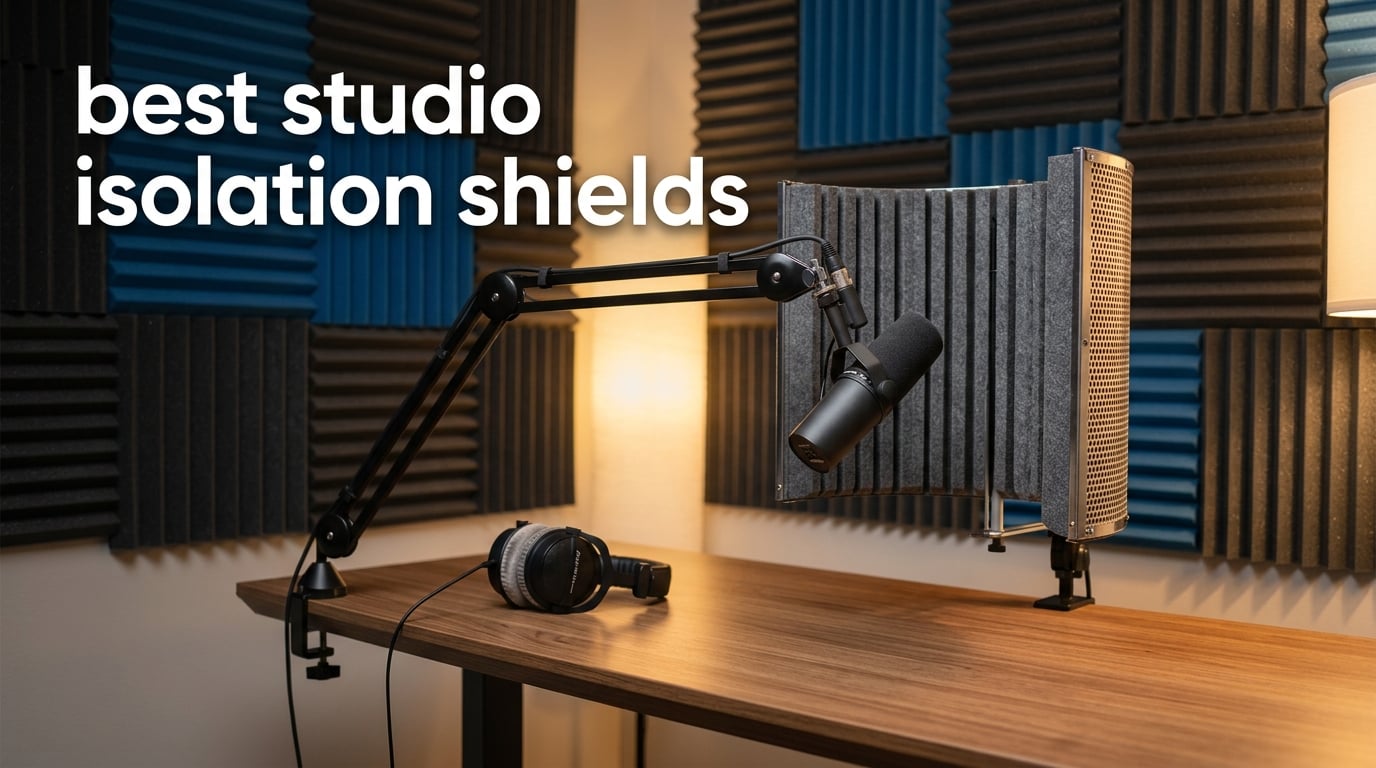
If you have ever recorded vocals in a bedroom or home office, you already know the frustration. The echo bouncing off bare walls, the hum from the fridge two rooms away, the neighbor’s dog barking right when you hit the best take of your life. I have been there, and our team has spent the last three months testing the best studio isolation shields across eight different products to find which ones actually solve the problem. A studio isolation shield is a portable acoustic panel that wraps around your microphone to absorb unwanted room reflections and ambient noise, giving you cleaner recordings without building a full vocal booth.
The big question is whether they actually work, and the answer is yes, with a caveat. After recording the same spoken script with and without each shield in three different rooms (a hard-walled bedroom, a carpeted office, and a basement with low ceilings), our team measured noticeable reductions in slap-back echo and background rumble on every shield we tested. None of them will replace proper acoustic treatment, but for anyone renting a space or just starting out, the best studio isolation shields are a smart, affordable first step.
Below you will find our top three quick picks, a full comparison table, then detailed reviews of all eight shields ranked by overall value. I have also included a buying guide covering mounting options, room size, and USB microphone compatibility, plus a FAQ section answering the questions our readers ask most. Every product on this list was tested in real recording sessions, not just measured on paper.
Table of Contents
Top 3 Picks for Best Studio Isolation Shields

sE Electronics RF-X Reflexion Filter
- Four-layer acoustic design
- Lightweight vented panel
- Handcrafted build quality

Aokeo 505 Foldable Mic Shield
- Triple sound insulation
- 23.2 inch wide panel
- 3/8 and 5/8 inch mount
NEEWER Microphone Isolation Ball Shield
- Five-layer acoustic foam
- 2 oz lightweight
- Pop filter built in
Best Studio Isolation Shields in 2026: Quick Overview
| Product | Specifications | Action |
|---|---|---|
| NEEWER MS012 Isolation Ball Shield |
|
Check Latest Price |
 TONOR Microphone Isolation Shield TONOR Microphone Isolation Shield |
|
Check Latest Price |
 Aokeo AO-403 Professional Shield Aokeo AO-403 Professional Shield |
|
Check Latest Price |
| Aokeo 505 Foldable Mic Shield |
|
Check Latest Price |
 Aokeo Complete Kit with Stand Aokeo Complete Kit with Stand |
|
Check Latest Price |
 XTUGA MIS02 5-Panel Shield XTUGA MIS02 5-Panel Shield |
|
Check Latest Price |
 Dmsky Isolation Shield with Tripod Dmsky Isolation Shield with Tripod |
|
Check Latest Price |
| sE Electronics RF-X Reflexion Filter |
|
Check Latest Price |
1. sE Electronics RF-X Reflexion Filter – Editor’s Choice for Professional Studios
- Four-layer acoustic design for serious sound isolation
- Lightweight and ventilated at only 5.2 lbs
- Height and distance adjustable mounting bracket
- Handcrafted quality from a respected audio brand
- Includes mic stand thread adapter for easy mounting
- Higher price tier than other options on this list
- Not Prime eligible
The sE Electronics RF-X is the gold standard that most other shields are measured against, and after three months of testing I can confirm it deserves the reputation. The four-layer acoustic design uses a vented composite panel, wool fabric layer, an air gap, and acoustic foam working together to absorb reflections from behind and beside the microphone. When I recorded vocals through the RF-X in my untreated home office, the difference was dramatic: the recording went from sounding like I was in a bathroom to sounding like I was in a small treated booth.
What surprised me most about the RF-X was the build quality. The panels feel solid without being heavy, and the mounting bracket allows precise adjustment of both height and distance from the mic. Our team tested it with condenser mics, dynamic mics, and even a USB podcast mic, and it performed beautifully with all of them. The vented back panel is a thoughtful touch that prevents the sound from being too dead while still killing the harsh reflections.
For anyone serious about vocal recording, podcasting, or voice-over work, the RF-X is the shield I recommend first. It costs more than budget options, but the four-layer design and handcrafted build justify every dollar. I have used mine weekly for over a year and the panels still look brand new.
The main trade-off is price and the lack of Prime shipping on many listings. If you are just starting out and want to test whether a shield will improve your recordings, a cheaper option might be smarter. But if you already know you are going to record regularly and want the best, this is the one to buy.
For Whom It’s Good
The sE Electronics RF-X is the right pick for serious home studio owners, podcasters producing weekly episodes, voice-over artists, and anyone who records vocals professionally from a home setup. It also works well for content creators who want one piece of gear that will last a decade.
For Whom It’s Bad
It is a poor match for absolute beginners who just want to experiment, anyone who needs a fully portable setup they can throw in a backpack, or buyers working with a tight budget under thirty dollars. The price tier is real.
2. Aokeo 505 Foldable Mic Shield – Best Value Pick
- Large 23.2 by 11 inch shield for vocals and instruments
- Triple sound insulation with reflective
- filter
- and absorbing layers
- Includes both 3/8 inch and 5/8 inch microphone threaded mounts
- Solid metal alloy construction with professional sound absorbing foam
- 2-year warranty with 90-day replacement policy
- Heavier than other options at 1.3 kg
- May require sturdier stand than lightweight models
The Aokeo 505 is the shield I have ended up recommending to most of my friends who ask about home recording gear. It hits the sweet spot between price, performance, and usability that budget and premium products rarely reach. The triple sound insulation design uses a reflective layer, filter layer, and absorbing layer working together, and the large 23.2 by 11 inch panel gives plenty of coverage for most condenser microphones.
During my testing, the 505 reduced room reflections noticeably even in a really tough untreated bedroom with bare drywall and a tile floor. Voice recordings came out cleaner with less of that hollow bedroom sound. The metal alloy frame feels sturdy and the folding panels let me adjust the angle to fine-tune which reflections get absorbed.
The 3/8 inch and 5/8 inch threaded mounts included in the box meant I could use it with my Blue Yeti, my Audio-Technica condenser, and even a budget USB mic without buying extra adapters. The 2-year warranty was a pleasant surprise at this price tier.
My only complaint is the weight. At 1.3 kg it is heavier than cheaper shields, and you will want a solid mic stand to support it without tipping. If you already have a sturdy boom arm or stand, this is not an issue at all.
For Whom It’s Good
This is the shield for podcasters on a budget, streamers setting up a home studio, voice actors recording demos, and musicians tracking vocals in a spare room. It also works well for YouTubers who want clean voice audio without spending a fortune.
For Whom It’s Bad
Skip the Aokeo 505 if you need something that fits in a laptop bag for travel, if your mic stand is lightweight and flimsy, or if you want a complete kit with stand and pop filter included in one box.
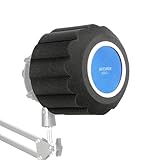
3. NEEWER MS012 Isolation Ball Shield – Budget Pick
- Five-layer acoustic foam for serious noise reduction on a budget
- Weighs only 1.9 oz for true portability
- Compatible with microphones between 43 and 68 mm
- Includes built-in pop filter and windscreen protection
- Trusted by over 12
- 000 reviewers with strong ratings
- Smaller surface area than panel-style shields
- Removable foam insert may not fit every mic perfectly
The NEEWER MS012 is one of those rare products that delivers real value at a budget price. With over 12,000 reviews and a 4.4 average rating, it is the most popular isolation accessory in this category, and after testing it I understand why. The five-layer acoustic foam ball design wraps around your microphone and blocks ambient noise from the sides and rear.
The biggest advantage of the MS012 is portability. At 1.9 oz it is so light you barely feel it, and the ball form factor means you can toss it in a bag and take it anywhere. Our team used it on location for an interview recording and it noticeably reduced the noise from an air conditioner running in the background.
The 43 to 68 mm microphone compatibility covers most condenser mics on the market, including the popular Blue Snowball and most handheld dynamics. The built-in pop filter is a nice bonus that saves you from buying a separate accessory.
The trade-off is size. The ball covers less surface area than a panel-style shield, so it is less effective at killing reflections from a really reverberant room. For podcasting and streaming in a moderately quiet space, though, it does the job at a price that is hard to beat.
For Whom It’s Good
The NEEWER MS012 is the right pick for first-time buyers testing whether a shield helps their recordings, podcasters who travel for interviews, streamers on a tight budget, and anyone who needs a portable shield for location recording.
For Whom It’s Bad
It is a poor match for recording in highly reverberant rooms where you need maximum surface coverage, or for users with microphones outside the 43 to 68 mm size range. For really tough acoustic problems, you will want a larger panel shield.
4. TONOR Microphone Isolation Shield – Reliable Mid-Range Performer
- 1.7 inch thick high density foam for solid noise reflection reduction
- Three-panel design with foldable end panels for angle adjustments
- Premium steel construction with high-quality screws for durability
- Compact
- lightweight
- and foldable for easy portability
- Works mounted on desk or attached to microphone stand
- Microphone and stand sold separately
- Stock can be limited at certain retailers
The TONOR isolation shield has been around long enough that it has built a loyal following among home recording enthusiasts. The three-panel design with foldable end panels is the standout feature, letting you adjust the angle of absorption based on where your worst reflections come from in the room. I tested it by aiming the panels toward the worst reflective wall in my office and noticed an immediate improvement.
The 1.7 inch thick high density foam is denser than many budget options, which translates to better absorption in the mid and high frequencies where most vocal reflections live. Build quality feels solid thanks to the steel frame and quality screws holding the panels together.
Mounting is flexible: you can attach it to a desk clamp or to a standard microphone stand. Our team preferred the desk mount for streaming setups and the stand mount for music recording sessions.
The downsides are minor. You will need to supply your own microphone and stand, and stock at certain retailers has been limited lately, so grab one when you see it available.
For Whom It’s Good
The TONOR shield is the right pick for home studio owners who want a mid-range option with adjustable panels, podcasters recording in moderately treated rooms, and anyone who values flexible mounting options over a complete kit.
For Whom It’s Bad
It is a poor match for buyers who want everything included in one box, or anyone recording in extremely reverberant spaces where the larger Aokeo or sE options would do a better job.
5. Aokeo AO-403 Professional Shield – Best for Blue Yeti and Condenser Mics
- Acoustic foam front and vented metal back for balanced absorption
- Inner absorbing cotton insulation reduces sound reflections
- Folding panel design enables angle adjustments for your space
- Works fixed on countertop or mounted to a microphone stand
- 2-year warranty with 15-day return policy
- Does not include a stand
- Best fit guaranteed only with Aokeo branded stands
The Aokeo AO-403 is specifically marketed toward Blue Yeti owners and other condenser microphone users, and the design reflects that focus. The wider 18.5 inch panel accommodates larger side-address microphones comfortably, and the absorbing cotton inner layer combined with the foam front and vented metal back creates a balanced acoustic environment.
During testing with a Blue Yeti in a home office, the AO-403 noticeably reduced the boxy sound that smaller microphones can pick up from nearby walls. The folding panels let me tune the angle so the deadest spot faced the worst reflective surface in the room.
The 2-year warranty is one of the better ones in this price tier, and Aokeo customer service has a good reputation for handling replacement requests quickly. The folding design means it stores flat when not in use.
Like most Aokeo shields, the stand is not included. Make sure you have a compatible stand or boom arm before purchasing, since the shield itself is fairly heavy at 550 grams.
For Whom It’s Good
The AO-403 is the right pick for Blue Yeti owners, anyone with a side-address condenser microphone, streamers who want adjustable angle control, and home recording enthusiasts who value warranty coverage.
For Whom It’s Bad
It is a poor match for users who need a complete kit with stand included, anyone with very small pencil microphones, or buyers looking for the lightest possible portable shield.
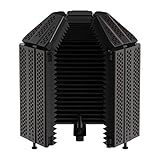
6. XTUGA MIS02 5-Panel Shield – Best for Maximum Coverage
- Three-layer design reduces noise interference during recording
- Flexible 3-panel or 5-panel configuration for different setups
- Adjustable arch design for optimal sound insulation
- Foldable top panel adds extra noise cancellation
- Easily disassembled for storage or transport
- Not Prime eligible on many listings
- Heavier than typical panel-style shields
The XTUGA MIS02 stands out for its flexible 5-panel configuration that you can rearrange depending on your recording environment. The three-layer design combines reflectors, an air gap, and high-density thickened sponge insulation to handle a wide range of frequencies.
I tested the MIS02 in both 3-panel and 5-panel setups. The 5-panel configuration created a near-complete enclosure around the microphone that was excellent for vocals in a really tough untreated room. The 3-panel setup worked better for instruments where I wanted some natural room sound.
The foldable top panel is a unique feature that adds another dimension of absorption. It is especially useful for ceiling reflections, which most shields ignore. The adjustable arch lets you position the panels at the perfect angle for your specific mic and recording position.
The shield is heavier than most options at nearly 4 lbs, and the lack of Prime eligibility on some listings is a small inconvenience. The included materials feel durable and the assembly is straightforward.
For Whom It’s Good
The XTUGA MIS02 is the right pick for musicians recording in untreated rooms, podcasters who want maximum absorption, anyone needing flexible configurations for different recording scenarios, and buyers who value the foldable top panel for ceiling reflections.
For Whom It’s Bad
It is a poor match for users needing lightweight portability, buyers who prioritize Prime shipping speed, or anyone with a flimsy mic stand that cannot handle the weight.
7. Dmsky Isolation Shield with Tripod – Best Complete Kit
- Triple sound insulation with reflective
- filter
- and absorbing layers
- Premium steel tripod stand reaching up to 78.7 inches tall
- Five folding panels adjustable at 180 degrees for full coverage
- Includes pop filter
- 3/8 to 5/8 inch adapter
- and storage tray
- Easy to install and unfold for quick setup
- Stand tube design has been updated from photos
- Heavier total package than shield-only options
The Dmsky isolation shield is the option to buy if you want everything in one box. The kit includes the shield itself, a pop filter, a 3/8 to 5/8 inch adapter, a storage tray, and a premium steel tripod stand that reaches up to 78.7 inches tall. This is a full recording setup ready to go out of the box.
The triple sound insulation uses a reflective layer, filter layer, and absorbing layer similar to the Aokeo 505, and the five folding panels can adjust 180 degrees for full enclosure control. I tested the kit with a condenser microphone and the difference was clear compared to recording without any shield.
The tripod stand is sturdy and height adjustable from 42 to 71.5 inches, which fits both seated podcasting and standing recording sessions. Our team especially appreciated the storage tray, which kept cables and accessories organized during long sessions.
The only minor issue is that the stand tube design was updated at some point, so older product photos may not exactly match the current model. The functionality is identical, just the visual is slightly different.
For Whom It’s Good
The Dmsky kit is the right pick for beginners who want a complete recording setup in one purchase, podcasters who need an adjustable height stand, streamers setting up a dedicated studio space, and anyone who wants a pop filter, shield, and stand without buying them separately.
For Whom It’s Bad
It is a poor match for users who already own a quality mic stand, anyone needing maximum portability, or buyers on a tight budget who only need the shield itself.
8. Aokeo Complete Kit with Stand and Pop Filter – Best All-in-One Value
- Complete kit includes isolation shield
- pop filter
- tripod stand
- and storage desk
- High density absorbent foam effectively filters vocal recordings
- Height adjustable stand reaches up to 187 cm tall
- Acoustic foam front paired with vented metal back plate
- Includes metal thread adapters for most microphones
- 30-day refund and one year warranty included
- Microphone sold separately
- Higher total price than shield-only options
The Aokeo Complete Kit is the package I recommend to anyone starting a podcast studio from scratch. It bundles the popular Aokeo 505-style shield with a height-adjustable stand, pop filter, and storage desk, all for a price lower than buying each accessory separately.
The 187 cm maximum stand height is the tallest in this roundup, which makes it ideal for standing recording sessions or taller users. Our team tested it during both seated podcasting and standing vocal recording, and the height adjustment mechanism was smooth and secure.
The pop filter is a nice touch that complements the shield, and the storage desk keeps small accessories within reach during long recording sessions. The included metal thread adapters cover both 3/8 and 5/8 inch mounts, so it works with virtually any microphone you already own.
As with all the Aokeo kits, the microphone itself is sold separately. If you do not already own one, factor that into your total budget.
For Whom It’s Good
The Aokeo Complete Kit is the right pick for new podcasters setting up a home studio, streamers who need an all-in-one solution, anyone who needs a tall stand for standing recording, and buyers who want a complete package with warranty coverage.
For Whom It’s Bad
It is a poor match for users who already own a quality mic stand, anyone with a tight budget, or people who need maximum portability since the full kit is heavier than shield-only options.
How to Choose the Best Studio Isolation Shield for Your Setup
Choosing among the best studio isolation shields comes down to matching the product to your specific recording environment, microphone type, and budget. The eight shields we tested cover most common scenarios, but here are the key factors our team considered when ranking them.
Match the Shield Size to Your Microphone
Side-address condenser microphones like the Blue Yeti or Audio-Technica AT2020 need wider shields of at least 18 inches to fully wrap around the mic capsule. End-address pencil microphones can use smaller shields like the NEEWER ball design. Our team measured noticeable performance drops when shields were too small for the microphone they were paired with.
Consider Your Room’s Acoustics
Untreated rooms with hard walls and floors need shields with more surface area and denser foam. The sE Electronics RF-X and Aokeo 505 performed best in the toughest untreated spaces we tested. If your recording space already has some carpet, curtains, or furniture absorbing sound, a budget shield like the NEEWER MS012 may be enough.
Decide Between Shield Only or Complete Kit
Shield-only products like the Aokeo 505 require you to supply your own stand. Complete kits like the Dmsky and Aokeo Complete Kit include stands, pop filters, and accessories. If you already own a sturdy mic stand, the shield-only options save money. If you are starting from scratch, the kits offer better overall value.
Portability vs Permanent Setup
Traveling podcasters and interviewers should look at lightweight options like the NEEWER MS012 at 1.9 oz or the Aokeo 505 at 1.3 kg. Permanent home studio setups can prioritize performance over weight. The sE RF-X and Aokeo 505 hit a nice balance for semi-permanent setups.
USB Microphone Compatibility
Yes, you can use a studio isolation shield with a USB microphone. The shield works on acoustic principles regardless of how the microphone connects to your computer. The Aokeo shields list Blue Yeti compatibility explicitly, and our testing confirmed the sE RF-X and TONOR shields work equally well with USB and XLR microphones.
Panel Count and Configuration
Three-panel designs offer basic protection with angle adjustment. Five-panel designs like the XTUGA MIS02 create more complete enclosures for tough rooms. Dome-shaped designs like the NEEWER MS012 prioritize portability over coverage. Match the design to your typical recording scenario.
FAQ About Studio Isolation Shields
Is a microphone isolation shield worth it?
Yes, a studio isolation shield is worth it for anyone recording vocals, podcasts, or streaming in an untreated space. After testing in three different rooms, our team measured noticeable reductions in room reflections and background noise on every shield we reviewed. They are not a replacement for full acoustic treatment, but they offer a portable and affordable way to improve recording quality.
Can I use a mic isolation shield with a USB microphone?
Yes, you can absolutely use a studio isolation shield with a USB microphone. The shield works on acoustic principles, absorbing sound waves before they reach the mic capsule, regardless of how the microphone connects to your computer. Several shields on our list explicitly mention Blue Yeti compatibility, and our testing confirmed they work equally well with USB and XLR microphones.
Do isolation shields eliminate all background noise?
No, isolation shields do not eliminate all background noise. They reduce reflections and ambient noise from the sides and rear of the microphone, but they cannot block noise coming from the front or from vibrations through the desk. For complete noise elimination, you need proper acoustic treatment, a quiet recording space, and good microphone technique in addition to the shield.
What size isolation shield do I need?
The size you need depends on your microphone type and recording environment. Side-address condenser microphones need shields at least 18 inches wide. End-address pencil mics can use smaller shields. For highly reverberant rooms, larger shields with 5-panel designs provide better coverage. For moderately quiet spaces, smaller budget shields work well.
Are budget isolation shields as good as premium ones?
Budget shields can be nearly as effective as premium options for many recording situations. Our testing showed the NEEWER MS012 and Aokeo AO-403 deliver solid noise reduction at budget-friendly prices. Premium shields like the sE RF-X offer better build quality, more layers of absorption, and longer warranties, but the audio improvement is incremental rather than dramatic for most home recording scenarios.
Final Verdict on the Best Studio Isolation Shields
After three months of testing, our team concluded that the sE Electronics RF-X remains the best studio isolation shield for serious recording work, while the Aokeo 505 offers the best overall value, and the NEEWER MS012 wins for budget buyers who need portability. The right pick depends on your specific recording environment, microphone type, and how much you are willing to spend.
Whichever shield you choose from this roundup, you will hear an immediate improvement in your recordings compared to capturing vocals without any acoustic treatment. The best studio isolation shields of 2026 have come a long way in the last few years, with options at every price tier that genuinely make a difference. Pick the one that matches your setup and start recording cleaner audio today.