
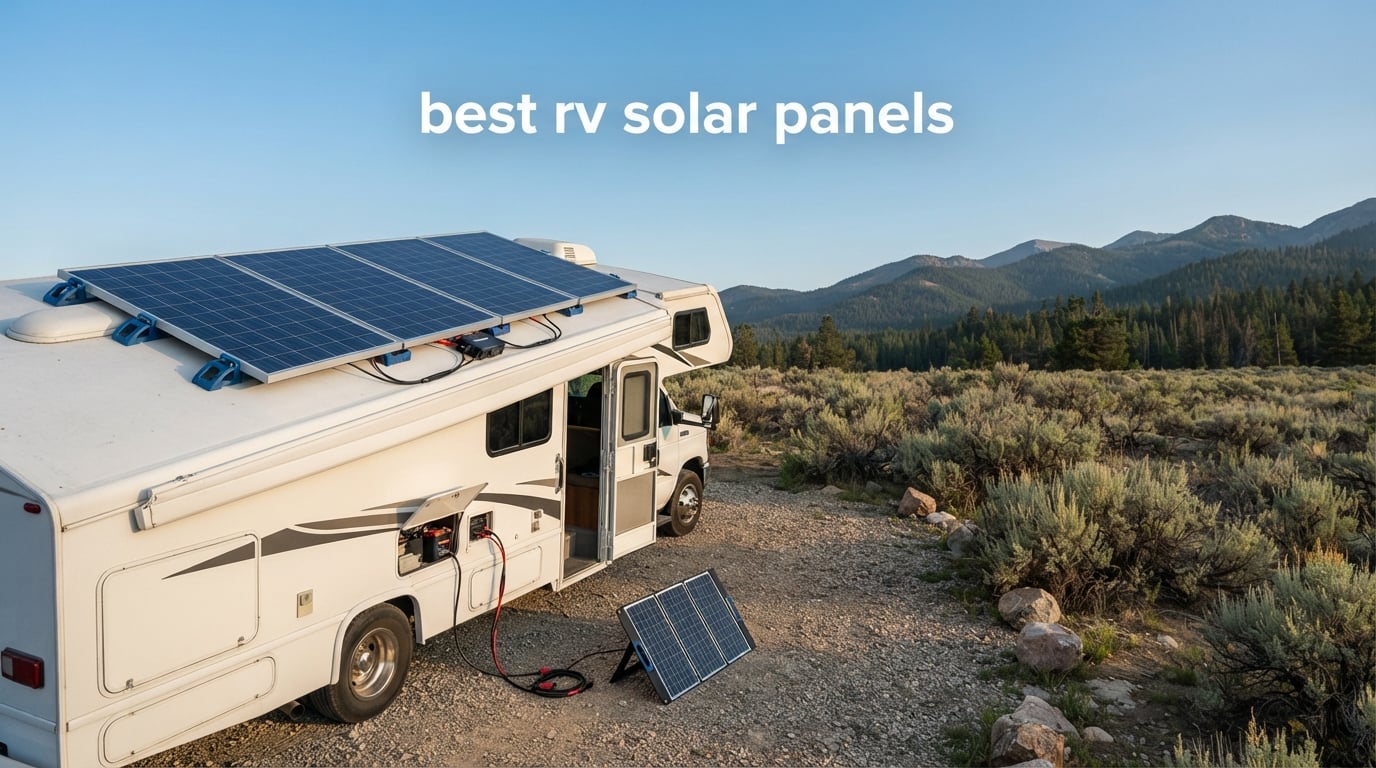
The best RV solar panels turn a sunny campsite into a practical way to recharge a battery bank, run small DC loads, and cut generator time. The right choice is not simply the panel with the largest wattage label; it is the one that fits your roof, controller input, battery system, travel habits, and willingness to set up equipment outside.
For this 2026 guide, we compared all 12 products in the supplied product data by stated output, cell type, weather rating, weight, connectors, included items, warranty claims, and review record. A portable panel works well when you camp under partial tree cover or do not want roof penetrations, while fixed monocrystalline solar panels make more sense for daily charging without setup.
One point comes up repeatedly in RV communities: the panel is only one part of an RV solar power system. A correctly sized charge controller, suitable wire and fusing, a battery bank, and sensible mounting matter just as much, particularly for boondocking solar setups that must work for days rather than an afternoon.
Table of Contents
These Are the Top 3 Picks for RV Solar Panels
Our Editor’s Choice is the BougeRV 200W Portable for a manageable 13.8-pound folding panel with N-type cells, an 8.2-foot cable, and IP65 protection. The Callsun 400W pair is the Best Value fixed-array option because it combines two 200W bifacial panels with anti-shade design and a stated 25-year performance commitment.
The HQST 200W is the Budget Pick in this group for buyers who want a notably light, weather-rated portable panel and broad power-station adapter support. These are category picks, not claims that one panel fits every RV.

These 12 RV Solar Panels Make the 2026 Shortlist
The quick overview below keeps portable units, roof-mounted panels, panel pairs, and kit contents visible in one place. Read the reviews before deciding, because stated wattage alone does not say whether a panel includes mounting hardware, a controller, or connectors that match your existing equipment.
| Product | Specifications | Action |
|---|---|---|
| BougeRV 200W Portable |
|
Check Latest Price |
 Callsun 400W Bifacial Pair Callsun 400W Bifacial Pair |
|
Check Latest Price |
 ZOUPW 480W Bifacial Portable ZOUPW 480W Bifacial Portable |
|
Check Latest Price |
 HQST 200W Ultra-Light HQST 200W Ultra-Light |
|
Check Latest Price |
 ZOUPW 450W Portable ZOUPW 450W Portable |
|
Check Latest Price |
 Renogy 200W N-Type Renogy 200W N-Type |
|
Check Latest Price |
 Renogy 100W N-Type Renogy 100W N-Type |
|
Check Latest Price |
 GRECELL 200W Portable GRECELL 200W Portable |
|
Check Latest Price |
 ECO-WORTHY 400W Set ECO-WORTHY 400W Set |
|
Check Latest Price |
 Renogy ShadowFlux 400W Renogy ShadowFlux 400W |
|
Check Latest Price |
 Rvpozwer 200W 18BB Rvpozwer 200W 18BB |
|
Check Latest Price |
 DOKIO 200W Kit DOKIO 200W Kit |
|
Check Latest Price |
1. BougeRV 200W Portable Is the Balanced Portable Choice
BougeRV 200W Portable Solar Panel, N-Type Foldable Solar Charger Fiberglass
- 25% stated efficiency
- Fiberglass reinforcement
- 8.2 ft cable
- Foldable handles
- XT60 and DC7909
- No controller listed
- 25 reviews
The BougeRV is a 200 watt solar panel built for the traveler who wants meaningful charging capacity without putting another permanent structure on the roof. Its 13.8-pound listed weight is easy to notice beside the heavier folding options, and the integrated side handles support the portable use case.
The product data specifies N-type cells with up to 25% conversion efficiency, a fiberglass reinforcement layer, IP65 water and dust resistance, plus XT60 and DC7909 connections. That combination makes it a sensible starting point for a compatible power station or a portable RV battery-charging arrangement.
Its setup flexibility suits campsites with moving shade
An 8.2-foot extension cable lets you park the RV where it is comfortable and move the panel toward open sun. That matters at wooded campgrounds, where a roof-mounted solar array can spend much of the day under a branch shadow.
IP65 means the panel is rated against dust and water jets, not a license to leave its connectors lying in standing water. Pack the panel dry when possible, and route the cable where a door or tire cannot pinch it.
Its system match requires a connector check
The supplied data names XT60 and DC7909 compatibility, so verify the input connector and voltage range of your power station before ordering. A panel can have the correct wattage and still not plug directly into a particular battery box or controller.
No charge controller is listed among the included components. For charging a conventional RV battery rather than a regulated power-station input, plan the controller, fuse protection, and battery cables as separate parts.
2. Callsun 400W Bifacial Pair Is the Fixed-Array Choice
- Two 200W panels
- Bifacial generation
- Anti-shade layout
- Pre-drilled holes
- 25-year performance commitment
- Needs permanent mounting
- Controller not included
The Callsun package consists of two 200W N-type monocrystalline panels for 400W total stated output. This is the kind of roof-mounted solar starting point that can make sense for a Class B van or travel trailer with enough clear roof area and a proper controller.
Callsun lists bifacial construction, 16 busbars, a dual-module parallel anti-shade design, tempered glass, corrosion-resistant aluminum, and 23.8 pounds for the product. The stated 51.3 by 30.3 inch dimensions give you a useful first check against vents, air conditioners, and walking paths.
Its bifacial design needs smart placement to matter
The transparent backsheet can collect light from both sides, but the claimed extra gain depends on reflected light reaching the rear surface. A flush roof installation may not get the same benefit as a placement with reflective ground exposure or space beneath the panel.
The anti-shade layout is attractive for roofs interrupted by vents, but no solar panel ignores deep shade. Make a paper roof map first, then leave room for service access and a cable route.
Its fixed installation calls for roof-specific mounting
Pre-drilled holes simplify bracket alignment; they do not decide where it is safe to drill into your RV. Forum users repeatedly flag leaks from rushed installations, so use a roof-compatible mounting method and sealant, follow the RV maker’s guidance, and inspect the seal after travel.
The listing states a 10-year support period and a 25-year performance commitment. Those terms are useful long-term signals, but keep documentation and confirm the current warranty terms directly with the maker.
3. ZOUPW 480W Bifacial Is the High-Output Portable Option
- 480W stated output
- Bifacial cells
- IP68 rating
- Ground stakes included
- 42.5V architecture
- Long unfolded footprint
- Small review sample
The ZOUPW 480W gives a portable solar panel unusually high stated capacity for an RV base camp. At 22.5 pounds, it is not weightless, but the product data calculates a strong 21.3 watts per pound and lists a storage bag, stakes, and extension cables.
It uses N-type 16BB cells, a bifacial layout, bypass diodes, and a 42.5V maximum voltage architecture. That voltage makes input compatibility the first question: check the allowable solar input range on your EcoFlow, Bluetti, Anker, or other power station.
Its long unfolded shape needs a large sunny patch
The listed dimensions are 138.6 by 32.6 inches when open, so this is not the panel to squeeze beside a compact campsite chair. It fits better where a traveler can spread it on clean ground and adjust its direction as the sun moves.
Ground stakes can help with placement, yet they are not a substitute for taking the panel down when strong wind is expected. A large folded panel has plenty of surface area for wind to catch.
Its power-station voltage is a non-negotiable check
High voltage can be useful for larger solar generators, but it can exceed the allowed range of smaller units. Match the panel’s stated 42.5V maximum voltage to your equipment manual before connecting anything.
The IP68 rating and composite coating describe solid weather protection, but connectors and a power station need their own protection. Keep every connection clean, fully seated, and out of pooled water.
4. HQST 200W Is the Lightest Everyday Carry Panel
- 11 lb weight
- 25% stated efficiency
- Two kickstands
- IP67 protection
- Three-input adapter
- Panel only listed
- Controller not listed
The HQST 200W is compelling for RVers who have avoided portable solar panels for RV use because of lifting and storage hassle. Its listed 11-pound weight is substantially lower than many 200W folding designs, and the product page says it is up to 37% lighter than comparable units.
It combines N-type 16BB cells with two adjustable kickstands, an IP67 rating, and a 4.9-foot adapter cable with XT60, DC7909, and DC5521 ends. The 4.6 rating comes from 984 reviews in the supplied data, which is a broader review base than several newer portable models here.
Its low weight helps with frequent repositioning
A portable panel earns its place when you will actually move it into the sun. The two kickstands adjust between 40 and 60 degrees, giving you a straightforward way to improve sun angle without a roof rack.
That is useful for short stays, shoulder-season camping, and sites with a shaded parking spot. It also leaves the RV roof untouched, which removes one source of concern about roof penetrations.
Its adapters suit power stations, not every battery setup
The adapter set is aimed at common portable power stations, including Jackery, EcoFlow, BLUETTI, Goal Zero, and Anker models. Confirm the power station’s input limits, since connector fit alone does not confirm electrical compatibility.
If your goal is direct charging for a 12V RV battery, add a compatible charge controller between panel and battery. The included-components field identifies only the solar panel.
5. ZOUPW 450W Is the Large-Generator Portable Match
- 450W stated output
- IP68 ETFE layer
- 4-in-1 cable
- Bypass diodes
- Ground stakes included
- 29.5 lb weight
- Very large open size
The 450W ZOUPW is another high-capacity folding choice, aimed at bigger power stations with a stated 40–60V input range. It provides 25% stated N-type efficiency, smart bypass diodes, ETFE coating, ground stakes, a storage bag, and an adapter cable.
At 29.5 pounds and 121.85 inches long when unfolded, this panel has a clearer role as a two-person setup or a stationary campsite array. It is less appealing for someone who wants to grab a compact panel for a quick battery top-up.
Its 45.9V specification must fit your solar input
The listed open-circuit voltage is 45.9V. Check the maximum input voltage of the solar generator rather than relying on the model names in a compatibility list, because input specifications differ within the same brand.
For the right large power station, the higher-output format can reduce the number of panels and parallel cables needed. For the wrong unit, it can be incompatible, so this is a specification to verify before purchase.
Its weatherproof build does not make it windproof
IP68 and fully sealed lamination are strong protections for water and dust exposure. The wide, long panel still needs to be secured and supervised in gusty weather, especially when it is supported on angled kickstands.
The fiberglass structure is listed as 30% lighter than comparable panels, yet 29.5 pounds is still a meaningful carry. Consider the storage location and the path from the RV to the sunlit area.
6. Renogy 200W N-Type Is the Compact Fixed-Roof Panel
- Class B friendly
- Low heat coefficient
- 12V and 24V use
- 25-year output term
- Renogy support record
- Single panel only
- 23.4 lb fixed panel
Renogy’s 200W N-Type is a fixed panel for shoppers building a deliberate roof array rather than a folding camp setup. The product data lists 25% efficiency, 16 busbars, 23.4 pounds, a 37.44V maximum voltage, and operation with 12V and 24V battery systems.
Its stated compactness for Class B vans makes it worth measuring against a smaller roof where every vent and antenna matters. This is the one product section where the phrase best RV solar panels applies especially well to a roof-first buyer who values a known RV-focused brand.
Its hot-weather performance suits exposed roofs
Panels naturally make less power as they heat up, which is why the stated low temperature coefficient is relevant for sunny southern routes. It does not remove heat losses, but it can be a better fit than ignoring temperature behavior entirely.
The listing also claims low degradation of no more than 1% in the first year and no more than 0.4% annually after that. Treat those as manufacturer performance terms, and keep the registration details.
Its roof plan needs controller and clearance space
One panel is not a complete camper solar kit. You still need a controller sized for the panel configuration, appropriately rated wire, fuses, mounting hardware, and a planned roof entry point.
Leave air space where the recommended mounting system allows it, which can help heat dissipation and makes water drainage easier. Do not cover existing roof seams or create a layout that blocks later roof maintenance.
7. Renogy 100W N-Type Is the Small-Array Building Block
- 25% stated efficiency
- 13 lb panel
- Wind and snow ratings
- Hot-weather focus
- 25-year performance term
- 100W needs expansion
- Mounting hardware not listed
A 100W panel is rarely the whole answer for power-hungry off grid RV power, but it can be the right building block for modest use or an expandable array. Renogy lists a 13-pound weight, 22.79V maximum voltage, 25% stated efficiency, and 16BB N-type cells.
The 34.1 by 22.8 inch dimensions are easier to place around roof obstacles than large-format panels. A pair or four-panel layout can also let an installer work around a vent, fan, or skylight while building toward a higher total wattage.
Its weather ratings answer a real roof concern
The supplied data lists IP67 protection, a 2400Pa wind-load rating, and a 5400Pa snow-load rating. Those figures describe the product’s tested resistance, not the strength of the RV roof, brackets, fasteners, or sealant below it.
Check the roof maker’s load guidance before adding any array. Panel weight, mounting rails, hardware, and the force of highway wind all belong in that decision.
Its 100W output suits careful energy budgets
One hundred watts can cover lighter battery maintenance and small loads in favorable sun, but it will not create unlimited AC power. Track daily watt-hours from lights, fans, pumps, devices, and any inverter load before deciding how many panels you need.
The manufacturer lists a 10-year material warranty and a 25-year performance guarantee at 80% output. For a permanent array, that longer-term coverage is part of the appeal.
8. GRECELL 200W Is the Four-Kickstand Portable Alternative
- Four adjustable stands
- ETFE lamination
- Multiple connector ends
- Compact folded form
- IP65 rating
- 19V maximum voltage
- Not a roof panel
GRECELL’s 200W foldable panel has four built-in adjustable kickstands rather than the two found on many competitors. That extra support can make angle adjustment more stable across a larger panel face, and its supplied cable includes XT60, Anderson, DC7909, and aviation connections.
The data lists monocrystalline silicon, a stated 23.5% conversion rate, ETFE lamination, IP65 protection, 16.53 pounds, and a 19V maximum voltage. It is designed as a charging panel for compatible power stations, not as a permanent roof panel.
Its stand layout makes angle adjustment straightforward
Solar output depends on sun angle, so a panel that can stand securely at an angle has a practical advantage over one placed flat on dirt. Set it in unobstructed sun, then shift it through the day if you need the most from a limited daylight window.
The listing says the folded size is 25.82 by 21.1 by 2.95 inches. Measure the RV storage bay, because a panel that folds neatly can still be awkward in a narrow compartment.
Its connector bundle calls for a polarity check
The product says it works with 95% of power stations, but “most” does not remove the need to inspect polarity, input voltage, and connector size. Never force a connector or assume an adapter changes electrical limits.
For a standard battery bank, use an appropriate charge controller. The panel’s cable bundle is useful, yet charging safety depends on the full system rather than the panel alone.
9. ECO-WORTHY 400W Set Is the Four-Panel DIY Array
- Four-panel array
- N-type 16BB cells
- IP68 junction box
- Pre-drilled holes
- Low-light focus
- Weight not supplied
- Controller not listed
The ECO-WORTHY listing covers four 100W panels for a 400W array, which gives an installer more layout choices than two very large panels. Each panel is listed at 35.63 by 23.03 inches, uses MC4 connectors, and has a low-iron-glass and anodized-aluminum construction.
Its N-type 16BB cells, bypass diodes, IP68-rated junction box, and pre-drilled holes speak directly to a fixed DIY RV solar installation. The data does not provide an item weight, so confirm the complete shipment and mounting weight before loading a lighter RV roof.
Its four-panel format helps around roof obstacles
Separate 100W modules can be distributed around fans and vents more easily than a pair of wider panels. That is useful only if the wiring plan is equally thoughtful: series and parallel connections change voltage, amperage, and controller requirements.
Bypass diodes help reduce the impact of partial shading on a panel, but they cannot make a shaded roof equivalent to full sun. Place the modules where AC units, antennas, and roof boxes cast the least shadow.
Its DIY installation still needs electrical planning
Pre-drilled holes and MC4 connectors reduce basic assembly work, but the kit description does not name a charge controller, battery, inverter, cable-entry gland, fuses, or roof brackets. Budget time to select each of those items rather than treating the panels as a complete system.
The listed 1.18-inch thickness is intended to help heat dissipation. Mounting with the maker’s recommended clearance can also keep leaves and water from getting trapped beneath the array.
10. Renogy ShadowFlux 400W Is the Shade-Focused Roof Option
- ShadowFlux anti-shading
- 25% stated efficiency
- Compact panel size
- IP67 protection
- 25-year output term
- 4.3 rating
- Weight not supplied
Renogy’s ShadowFlux package is a pair of 200W N-type panels with a stated 400W total and an emphasis on anti-shading performance. For a motorhome roof that cannot avoid every shadow from an air conditioner, antenna, or nearby tree, that design focus is worth a close look.
The supplied data lists 25% efficiency, 16BB construction, an IP67 rating, 24V DC output, and dimensions of 49.7 by 30.1 inches per panel. The product’s 4.3 rating from 275 reviews is lower than the leading selections, so it should be chosen for its stated shade feature rather than rating alone.
Its shade feature helps with partial obstruction
Anti-shading technology is most relevant when part of an array gets interrupted by a narrow shadow. It should not become an excuse to mount panels below a roof rack, beside an always-open awning, or under dense trees.
Map shadows at several times of day before drilling. This small planning step can improve real charging more than chasing a minor difference in advertised cell efficiency.
Its warranty terms suit long-term fixed use
Renogy lists a five-year materials and craftsmanship warranty plus 25-year output coverage at 80%. For a roof array, file those terms with your installation photos and keep the panel serial information.
The supplied data does not list the product weight. Ask for the current specifications and total installed load, including brackets and rails, before deciding that this pair fits your roof capacity.
11. Rvpozwer 200W 18BB Is the Weather-Rated Single Panel
200 Watt Solar Panel 18BB, 25% High Efficiency, N-Type 12V 200W Solar Panel
- 25% stated efficiency
- 18BB cells
- IP68 protection
- Pre-drilled holes
- Wind and snow ratings
- Controller required
- Maximum three panels stated
The Rvpozwer is a 200W rigid N-type panel with 18 busbars, 25% stated efficiency, IP68 protection, and a 19.18-pound listed weight. Its dimensions of 26.38 by 52.76 inches create a tall, narrow rectangle that may suit some roof plans better than a wide panel.
The manufacturer lists a corrosion-resistant electroplated aluminum frame, tempered glass, pre-drilled mounting holes, and a 30-year stated life period. It also provides specific caution points: use a controller to prevent overheating, inspect and clean regularly, and use no more than three panels in parallel or series.
Its 18BB cell layout targets efficiency and longevity
Busbars are conductive strips that carry electricity through the cell. An 18BB design is presented as a way to improve photoelectric conversion and durability, though sunlight, temperature, mounting angle, and shading still shape the output you see.
For a fixed RV roof, its IP68 rating and stated 2400Pa wind and 5400Pa snow-load resistance are useful specifications. The installation hardware and roof substrate remain the deciding limits for the complete installation.
Its array limit needs to shape expansion plans
The listing says a maximum of three panels in parallel or series. If you expect to grow beyond that, choose the controller, wiring configuration, and panel platform with the eventual array in mind.
Regular cleaning is not optional maintenance fluff. Dust, pollen, bird droppings, and leaf debris can block cells, and a soft brush with water is safer than abrasive materials on the panel surface.
12. DOKIO 200W Kit Is the Hardware-Inclusive Starter Pair
- Two-panel kit
- Z-brackets included
- 5m MC4 cable
- Half-cell layout
- Waterproof connectors
- Controller required
- Polarity must be checked
The DOKIO kit supplies two 100W monocrystalline panels, mounting brackets, clips, alligator clips, a five-meter MC4 cable, and a bag. For a buyer starting from no solar hardware at all, that included mounting and wire package can remove several basic items from the first shopping list.
The panels have aluminum frames and tempered glass, weigh 24 pounds according to the supplied data, and use a half-cell layout with bypass diodes. The 4.2 rating from 435 reviews is the lowest in this roundup, so read the current feedback alongside the practical kit contents.
Its included brackets make a beginner plan easier
Z-brackets and longer cables are welcome, but the kit is not a complete electrical system. The listing explicitly says a PWM or MPPT controller is required, and it does not replace the need for fuses, battery leads, roof sealant, and a weatherproof cable entry.
Lay out the brackets on the roof before drilling and confirm there is backing or an approved attachment point. This is where an unhurried installation avoids the roof-leak problem frequently raised by RV owners.
Its wiring needs polarity confirmation before power-up
MC4 connectors are common, but do not connect by color or shape alone when combining components from different sources. Verify positive and negative with the documentation or a meter before connecting a controller or battery.
The half-cell layout and bypass diodes can reduce losses from partial shade, yet the best result still comes from a clear mounting location. Keep a small gap around the panels for drainage, inspection, and cleaning.
These Buying Rules Match an RV Panel to Your Actual Power Needs
Start with the energy you use, not a wattage label. Add the watt-hours for your normal day: lights, water pump, vent fan, phone charging, laptop, television, and any inverter-powered appliances; then compare that total with your battery capacity and realistic solar hours.
Panel form should match where and how you camp
Rigid panels are the usual choice for a permanent roof array. They require roof-safe brackets or an approved adhesive system, a sealed cable entry, and a plan for vents and shade, but they harvest power while you drive and camp without daily setup.
Portable solar panels for RV use are the better fit for shaded parking, occasional trips, renters, or people who do not want roof penetrations. Their tradeoff is setup, storage, cable management, and the need to bring them in during wind or when leaving camp.
Flexible solar panels are another form factor, but none of the supplied products is a flexible panel. If you later choose flexible solar panels, confirm their recommended mounting method and heat management; a panel lying flat on a hot roof can behave differently from a framed panel with airflow.
Wattage should follow a written daily-load estimate
Use these practical ranges as starting points, then adjust for sunshine, battery chemistry, inverter losses, and how often you travel:
Light use: Around 100–200W may support battery maintenance, lights, a fan, water pump, and device charging in good sun.
Moderate off-grid use: Around 300–600W is a common forum-reported range for basic needs of full-time RVers, especially with adequate battery storage.
Higher demand: Larger arrays and batteries are needed for frequent inverter use, cooking appliances, or attempts to run air conditioning.
These are planning ranges, not output promises. A 400 watt solar kit produces less than its nameplate rating during clouds, winter sun, poor angle, heat, dirt, or shade.
A charge controller protects the battery and shapes the system
Panels create DC electricity, which should flow through a charge controller before reaching a conventional battery bank. The controller regulates charging voltage and current, helping prevent battery damage from uncontrolled solar input.
PWM controllers are simpler and can suit basic systems, while an MPPT charge controller can convert excess panel voltage into charging current more effectively in many configurations. Choose one based on the array’s open-circuit voltage, maximum current, battery voltage, and the wiring layout you intend to use.
Power-station owners have a different setup: a unit with built-in solar charging management may accept a panel directly, but only within its stated input range. Always compare voltage, current, wattage, and connector requirements before plugging in.
Roof mounting must respect leaks, load, and highway wind
Roof leaks are the most common pain point raised in the supplied forum research. Do not treat pre-drilled panel holes as permission to drill anywhere; identify roof construction, approved attachment points, compatible sealant, and a cable route before work begins.
We recommend a dry layout first: place cardboard templates or the actual panels on the roof, check shadows, open every vent and awning, and make space for service. Then follow the RV manufacturer’s instructions and the panel maker’s mounting requirements, rather than copying an unrelated installation.
Weight also adds up. Count panels, brackets, rails, sealant, wires, and any hardware, then confirm the roof’s capacity. Wind resistance ratings describe the panel itself; the whole installation must remain secure at travel speed and in gusty campsites.
Weather, shade, and cleaning change daily charging
N-type cells, bypass diodes, and anti-shade layouts can help, but they do not defeat a heavy shadow. A small shadow across one part of an array can affect output, which makes roof layout and portable-panel placement worth more attention than many buyers give them.
In hot weather, panels lose some output; in cold but clear weather, they can perform well even though daylight hours are shorter. Clean accumulated dust, pollen, leaves, and droppings with water and a soft non-abrasive tool, then inspect cables and mounts during routine roof checks.
A basic installation sequence keeps the project organized
Measure loads and battery capacity: decide what the system needs to recharge.
Map roof space or portable placement: account for shade, storage, cable path, and safe walking areas.
Select the controller and protection: match its ratings to the planned array and battery.
Mount and seal correctly: follow the RV and panel instructions for fasteners, brackets, sealant, and cable entry.
Test before relying on the system: check polarity, charging voltage, fuse placement, secure connections, and expected controller behavior.
If any part of that list is unfamiliar, an RV electrical technician can review the plan. Solar is quiet and useful, but batteries and DC wiring can deliver high current, so a safe installation comes before a larger array.
FAQs
What’s the best solar panel for a motorhome?
The best solar panel for a motorhome matches available roof area, battery voltage, controller limits, and daily energy use. The Callsun 400W pair and Renogy fixed panels suit roof arrays, while the BougeRV, HQST, GRECELL, and ZOUPW portable panels suit motorhomes parked in shade or owners avoiding roof installation.
How long will it take a 400W solar panel to charge a 100Ah battery?
A 12V 100Ah battery holds roughly 1,200 watt-hours before accounting for usable capacity and charging losses. In strong sun, a 400W array might theoretically supply that energy in about three peak-sun-hours, but controller losses, heat, battery charge stage, angle, shade, and weather commonly make the real time longer.
How big of a solar panel do you need to run a camper?
Start with daily watt-hour use. Around 100–200W can suit light loads, while 300–600W is a common range for basic off-grid RV needs with adequate batteries; frequent inverter loads need more panel and battery capacity. Solar panels do not directly run most camper appliances without a correctly designed battery, controller, and inverter system.
What is the life expectancy of solar panels on an RV?
A well-mounted rigid RV panel can serve for many years, but life depends on weather exposure, roof movement, mounting quality, cleaning, and connector condition. Several supplied products list long performance coverage, including 25-year output terms, but warranty language is not the same as a guarantee of identical real-world output for every installation.
These Picks Make RV Solar Easier to Choose in 2026
The best RV solar panels are the ones that fit the way you camp and the electrical system you can safely support. Choose the BougeRV or HQST for light, movable charging, a ZOUPW panel for high-output power-station use, or a Callsun, Renogy, ECO-WORTHY, Rvpozwer, or DOKIO array when a fixed system is the better plan.
Before selecting any panel, measure the roof or storage bay, list daily watt-hours, and confirm controller or power-station input limits. That short preparation turns a solar purchase into a usable off-grid setup rather than an expensive panel that cannot do the job you had in mind.