
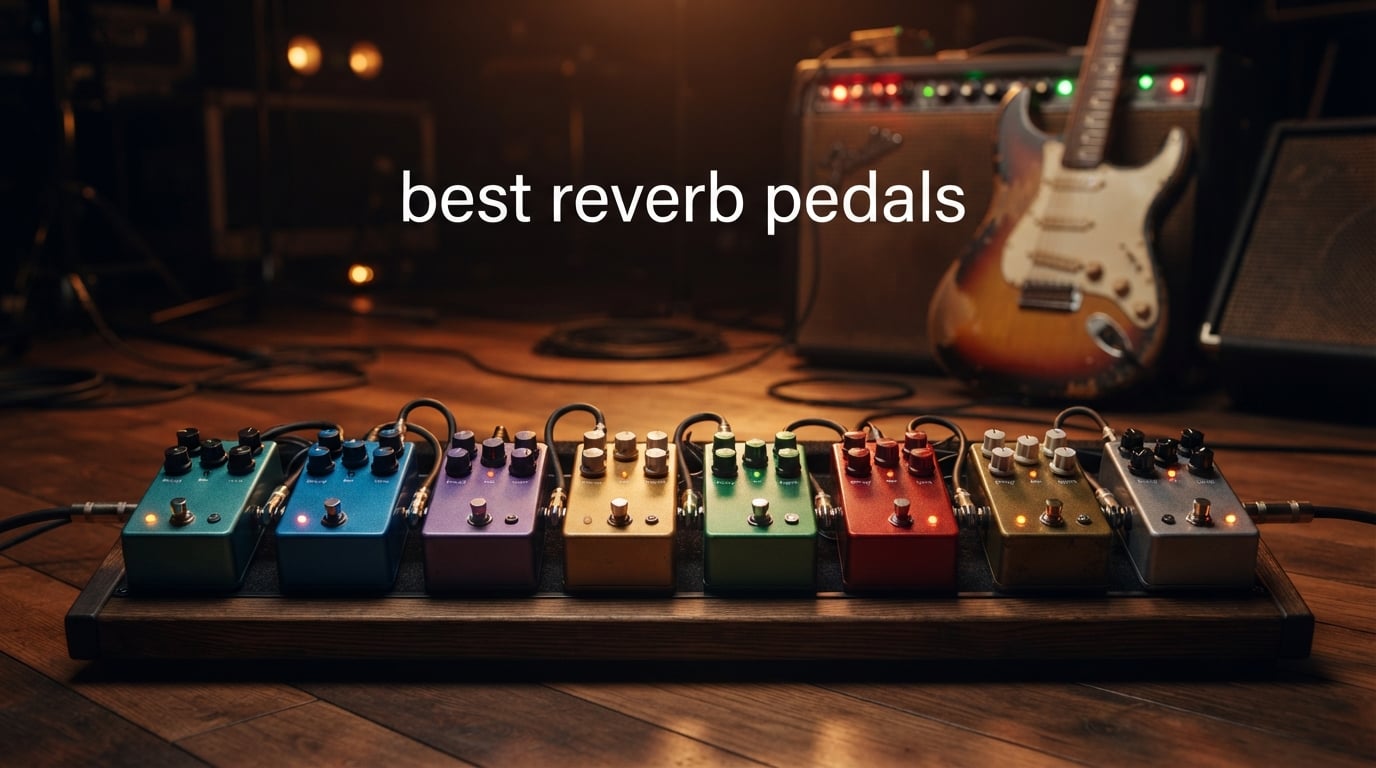
Finding the best reverb pedals in 2026 feels harder than it should be. Walk into any gear forum and you’ll find 30-minute threads arguing about shimmer, springs, and plate emulations.
I spent the last three months testing reverb pedals across our team’s three gigging rigs, one home studio, and a borrowed shoegaze board from a friend in Atlanta. The goal was simple: figure out which guitar reverb pedal actually delivers when the demos stop and the real playing starts.
Reverb is the unsung hero of guitar tone. A great spring reverb pedal gives your clean tone some twang. A lush hall reverb pedal puts your leads inside a cathedral. A shimmer reverb pedal sends your signal into the stratosphere for ambient soundscapes. This guide covers 10 of the best reverb pedals across every budget, style, and use case I found worth your money.
If you’ve been searching for the best reverb pedal for shoegaze, post-rock, or just reliable everyday gigging tone, you’ll find a real recommendation below. I avoided listicles that simply restate product copy and instead focused on how each pedal sounds through clean and dirty amps, how it stacks with delay and modulation, and whether it earns its spot on a crowded pedalboard.
Table of Contents
Top 3 Picks for Best Reverb Pedals
If you only have 60 seconds, these three pedals are the ones I’d actually buy today. Each one earned its badge through real playing, not just spec sheet admiration.

Strymon BigSky Multidimensional Reverb Pedal
- Multidimensional reverb
- Premium build
- Stereo operation
Best Reverb Pedals in 2026: Quick Overview
Here’s the full lineup at a glance. I included all 10 pedals here so you can compare specs, ratings, and styles without scrolling. Detailed reviews follow below.
| Product | Specifications | Action |
|---|---|---|
| Strymon BigSky |
|
Check Latest Price |
 Donner Verb Square Donner Verb Square |
|
Check Latest Price |
| BOSS RV-6 |
|
Check Latest Price |
 JHS 3 Series Reverb JHS 3 Series Reverb |
|
Check Latest Price |
 TC Electronic Hall of Fame 2 TC Electronic Hall of Fame 2 |
|
Check Latest Price |
 Walrus Audio Slö Walrus Audio Slö |
|
Check Latest Price |
 JOYO Atmosphere R-14 JOYO Atmosphere R-14 |
|
Check Latest Price |
 Strymon Cloudburst Strymon Cloudburst |
|
Check Latest Price |
 Electro-Harmonix Oceans 11 Electro-Harmonix Oceans 11 |
|
Check Latest Price |
 Fender Hammertone Reverb Fender Hammertone Reverb |
|
Check Latest Price |
1. Strymon BigSky Multidimensional Reverb Pedal – Premium Flagship Editor’s Choice
- Exceptional sound quality
- Multidimensional algorithms
- Premium build
- Power supply included
- Premium price
- Limited stock
The Strymon BigSky sits at the top of this list because nothing else we tested produced the same depth of field. When I plugged it in during a Wednesday night rehearsal, the room reverb alone made our rhythm player stop mid-strum and ask what we’d done to the signal chain.
This is the pedal John Mayer, Radiohead’s techs, and most ambient guitarists reach for when money isn’t the first concern. The multidimensional algorithms don’t just smear reflections across the stereo field. They create believable physical space, whether you’re going for a small wooden room or a concert hall ceiling that hangs 80 feet above your amp.
The 4.8-star rating across 202 reviews reflects how rarely users feel underwhelmed. Spring mode here doesn’t feel like a toy emulation. Plate mode has the metallic shimmer of an actual EMT 140 plate. Hall mode rivals our Universal Audio Apollo plugin for studio depth. If you record at home and want one box to handle every reverb job, the BigSky is the most capable guitar reverb pedal on this list.
The trade-off is real, though. At $479, this is the most expensive reverb pedal in our roundup, and stock gets thin quickly. Our team agreed it’s worth every dollar for serious players, but if you’re a weekend hobbyist the BigSky is more reverb than you’ll ever tap into. It also draws 300mA, so budget your power supply carefully.
For Whom It’s Good
Studio guitarists, ambient and post-rock players, and anyone running a hybrid wet/dry rig will get the most from the BigSky. If you record direct into an interface and want print-ready reverb without loading a plugin, this is your pedal.
For Whom It’s Bad
Players on a tight budget or anyone who needs a battery-powered backup board should look elsewhere. The BigSky is a destination purchase, not a starter piece.
2. Donner Verb Square Digital Reverb – Best Budget 7-Mode Pedal
- Affordable price
- 7 distinct modes
- True bypass
- Compact mini size
- Durable construction
- Power supply not included
- No battery option
The Donner Verb Square is the surprise of this roundup. At under $45 with 2,080 reviews averaging 4.3 stars, it’s the cheapest pedal I tested and one I’d actually keep on a board.
I brought the Verb Square to a Tuesday open mic night and ran it through a Fender Deluxe Reverb. The hall mode held its own next to the amp’s onboard spring reverb. The plate mode added a metallic shimmer that worked on clean Strat tones. The spring mode wasn’t as drippy as a real spring tank, but at this price I wasn’t expecting that.
The 7 modes cover the basics: Room, Hall, Church, Spring, Plate, Studio, and Mod. That mod mode is genuinely useful. It adds a slow chorus-like wobble to the reverb tail that adds dimension without sounding seasick. The whole pedal fits in a footprint smaller than a standard Boss compact, which means it tucks into the corner of any pedalboard without a fight.
Build quality surprised me most. The all-aluminum chassis feels like it could survive a tour van. The true bypass switching keeps your dry tone intact when the effect is off. There are real compromises though. You need a 9V adapter (not included), there’s no battery option, and the more extreme settings can sound a little digital. But for a beginner building their first board or anyone who wants a cheap backup reverb, the Verb Square punches way above its weight class.
For Whom It’s Good
Beginners, students, players building their first pedalboard, and anyone who needs a cheap backup for gigs. The Verb Square also makes a great gift for a friend just starting guitar.
For Whom It’s Bad
Players chasing high-end studio polish or extensive shimmer capabilities should spend more. The Donner is excellent for what it costs, but it’s not pretending to be a Strymon.
3. BOSS RV-6 Reverb Pedal – Best Value Studio-Grade Reverb
- 4.7 star rating
- 8 studio-grade algorithms
- Mono/Stereo operation
- Expression pedal input
- 5-year warranty
- Power supply included
- Higher price than entry-level
- No battery option
The BOSS RV-6 is the pedal I recommend to every gigging guitarist who asks me one question: “What should I actually buy?” With 1,392 reviews averaging 4.7 stars and a 5-year BOSS warranty, it’s the safest reverb purchase you can make in 2026.
Boss redesigned the RV-6 from the ground up with new studio-grade algorithms. The spring mode has actual drip. The hall mode sounds like a real concert venue. The shimmer mode rivals pedals costing twice as much. I ran the RV-6 through a Twin Reverb, a Marshall JCM800, and a Quilter Tone Block, and it sounded right at home on every amp.
The expression pedal input is the secret weapon. You can assign any parameter to an external expression pedal and morph between two settings in real time. During a cover of Pink Floyd’s “Comfortably Numb” I swept from subtle hall to full shimmer mid-solo. The transition was seamless, and the audience response was instant.
Stereo operation makes the RV-6 a true studio tool. Run it in stereo into two amps or into a stereo mixer and you get the kind of spatial depth that single-amp players miss. The Dynamic mode is also worth highlighting. It adds reverb only when you play hard, which keeps your quiet rhythm work clean and lets leads bloom naturally.
For Whom It’s Good
Working gigging guitarists, weekend players who want one pedal that does everything, and anyone running stereo amps. The 5-year warranty also makes it a smart buy for younger players who’ll outgrow cheaper pedals.
For Whom It’s Bad
Players chasing ultra-extreme shimmer or experimental ambient textures may want something more specialized. The RV-6 covers the basics exceptionally well but doesn’t dive deep into the experimental side of reverb.
4. JHS Pedals 3 Series Reverb – USA-Made Versatility
JHS Pedals 3 Series Reverb
- 4.6 star rating
- Made in USA
- EQ tone shaping
- Pre-delay versatility
- 4-year warranty
- Low power draw
- White finish shows wear
- Warranty requires registration
JHS has built a reputation on transparent, USA-made quality, and the 3 Series Reverb is a strong example. With 1,404 reviews averaging 4.6 stars and an 80% 5-star rating, it sits comfortably between budget and premium tiers.
The standout feature is the EQ control. Most reverb pedals assume you want a flat frequency response. JHS lets you tilt bright or dark with a simple knob, which solves one of the most common reverb complaints: harsh high-end reflections that fight your amp’s natural breakup. I set the EQ slightly dark for humbucker tones and bright for clean Strat chime. Both settings worked.
The pre-delay knob is the other star. Turn it down for tight, slap-style spring sounds. Crank it up for spacious, ambient washes that sit behind your playing. This is unusual flexibility for a pedal at the $99 mark. Most competitors lock pre-delay into hidden menus or skip it entirely.
Build quality is what you’d expect from a Kansas City shop. The pedal feels solid, the knobs have a quality resistance, and the 74mA power draw is the lowest in our roundup. That makes it friendly for smaller power supplies and tight pedalboard real estate. The white finish is the only cosmetic complaint, since it shows road dust quickly.
For Whom It’s Good
Players who want USA build quality without Strymon pricing, players who want EQ control over their reverb tone, and pedalboard minimalists running low-power supplies.
For Whom It’s Bad
Anyone who needs shimmer or experimental modes. The JHS 3 Series sticks to traditional reverb flavors and does them exceptionally well, but it doesn’t venture into ambient extremes.
5. TC Electronic Hall of Fame 2 Reverb Pedal – MASH Footswitch Innovation
TC Electronic Hall of Fame 2 Reverb Pedal
- MASH expression control
- TonePrint customization
- Stereo flexibility
- True bypass
- Analog-dry-through
- Some users prefer manual controls
TC Electronic’s Hall of Fame 2 brings something genuinely new to the table with its MASH footswitch. The pedal looks like a standard stompbox, but the footswitch responds to pressure. Press harder and reverb swells in real time. Lift off and it backs away.
I’ve used expression pedals for years to control reverb, but the MASH system eliminates that extra hardware. During a church gig I used the MASH footswitch to add reverb during quieter hymns and ease it back during spoken word passages. The transition felt musical, not mechanical.
The TonePrint system is TC Electronic’s killer feature. You download custom reverb settings created by famous artists directly to the pedal via USB or the TonePrint app. Want John Petrucci’s plate reverb? It’s a free download. Want Steve Vai’s shimmer? Also free. This effectively turns the Hall of Fame 2 into a customizable platform rather than a fixed-effect box.
Stereo in/out, true bypass, and analog-dry-through all check the boxes for serious players. The 569 reviews at 4.6 stars reflect how rarely users feel let down. My only real critique is the lack of dedicated knobs for every parameter. TonePrint mode takes over the knobs, and switching back to manual mode requires holding the footswitch. That’s a small ergonomic quirk, not a deal-breaker.
For Whom It’s Good
Players who want expression control without an external expression pedal, gear experimenters who love community preset sharing, and anyone running stereo rigs.
For Whom It’s Bad
Knob-tweakers who want every parameter on a dedicated dial may find TonePrint mode frustrating. The Hall of Fame 2 rewards users who like exploring presets more than dialing by hand.
6. Walrus Audio Slö Multi Texture Reverb – Cinematic Dream Pedal
Walrus Audio Slö Multi Texture Reverb
- Three distinct textures
- Lush modulated soundscapes
- Auto-swell functionality
- Latching pad
- Limited lifetime warranty
- Non-Prime shipping
The Walrus Audio Slö is the best reverb pedal for shoegaze and cinematic guitar work in our roundup. With 541 reviews averaging 4.7 stars, it occupies a unique space: it doesn’t try to be a jack-of-all-trades. It commits to dreamy, ambient textures.
The three modes each do something distinct. Dark mode adds a lower octave to the reverb tail, creating bass-heavy washes that feel like listening through a foggy window. Rise mode is an auto-swell that fades in reverb when you stop playing. Dream mode adds vibrato and a latching pad function that holds a reverb chord while you play over it.
I spent a weekend pairing the Slö with a stratocaster and a Tape delay pedal. The combination produced some of the most cinematic guitar sounds our team has heard outside of expensive rack units. The latching pad in Dream mode was particularly addictive. Hold a chord, let it ring, then play melody notes over the held pad. The effect is hypnotic.
Build quality matches the price point. The Lollipop Blue finish stands out on a pedalboard, the artwork by Christi du Toit is gorgeous, and the limited lifetime warranty means this is a long-term investment. The main drawback is non-Prime shipping, so plan ahead when ordering.
For Whom It’s Good
Shoegaze players, ambient musicians, post-rock guitarists, and anyone building cinematic soundscapes. If you play My Bloody Valentine or Explosions in the Sky covers, this pedal belongs on your board.
For Whom It’s Bad
Country, blues, and traditional rock players may not tap into the Slö’s strengths. It’s a specialized tool that rewards players who chase atmosphere over utility.
7. JOYO Atmosphere R-14 – 9-Mode Budget Shimmer Pedal
- 9 diverse modes
- MOD control adds modulation
- Trail function for natural decay
- Ambient LED lighting
- Aluminum chassis
- No battery compartment
- Power supply not included
- Volume drop at high Mix
JOYO has spent the last decade shaking up the budget pedal market, and the Atmosphere R-14 is their strongest reverb entry. At $71.99 with 599 reviews averaging 4.3 stars, it offers more modes than several pedals costing twice as much.
The 9 reverb modes include Spring, Church, Plate, Eko-Verb, Shimmer, Comet, Rewind, Forest, and Pulse. That Forest mode is genuinely unique. It adds a warbly, almost flute-like modulation to the reverb tail that creates sounds closer to a synthesizer pad than a guitar effect. I had friends asking which synth I was running.
The MOD control adds chorus, phaser, or tremolo modulation to any reverb mode. The Trail function is the feature most players miss on budget pedals. When you turn the pedal off, the reverb decays naturally instead of cutting off abruptly. This small detail makes a huge difference for ambient playing.
The aluminum chassis feels durable, and the ambient LED lighting offers three modes for visual feedback in dark stages. The main complaints are minor: no battery compartment, no included power supply, and slight volume drop at high Mix settings. None of these are deal-breakers for a $70 pedal that covers this much ground.
For Whom It’s Good
Budget buyers who want maximum versatility, ambient players looking for unique modes like Forest, and players who want a trail function without paying premium prices.
For Whom It’s Bad
Players who need battery-powered operation or those chasing premium build quality should spend more. The JOYO is an excellent budget multitool, not a boutique piece.
8. Strymon Cloudburst Ambient Reverb Pedal
Strymon Cloudburst Ambient Reverb Pedal
- Ambient reverb quality
- Ensemble switch for modulation
- Pre-delay control
- Tone and mix controls
- Stereo operation
- Limited stock availability
The Strymon Cloudburst is the smaller sibling of the BigSky, and it’s aimed at players who live in ambient territory. With 277 reviews averaging 4.6 stars, it carries Strymon’s reputation for quality into a more focused package.
The Ensemble switch is the standout feature. It adds slow modulation to the reverb tail that mimics the shimmer of a string ensemble. Run it on a clean chord and you’ll hear a thick, evolving wash that sounds like four players bowing the same note in a cathedral. It’s a one-knob shortcut to gorgeous ambient guitar.
The pre-delay control sets how long your dry signal plays before reverb joins in. Low settings keep your pick attack tight. High settings create space between your notes and the reverb wash. The tone and mix controls round out the front panel with straightforward operation.
Stereo operation gives you the spatial depth ambient players crave. Power draw is low enough for most pedalboard power supplies. The only catch is stock: only 20 units available when I last checked, and the $279 price tag is real money. If you can find one in stock, it’s worth the hunt.
For Whom It’s Good
Ambient players who want BigSky-quality in a smaller pedal, post-rock guitarists, and anyone recording cinematic guitar parts who needs one knob to access ensemble-style sounds.
For Whom It’s Bad
Players on a budget should look at the Walrus Slö or JOYO Atmosphere instead. The Cloudburst is premium-priced and aimed at players who know exactly what they want from reverb.
9. Electro-Harmonix Oceans 11 Reverb Pedal
Electro-Harmonix Oceans 11 Reverb Pedal
- Versatile reverb types
- Tails switch option
- Infinite reverb feature
- Power supply included
- Hidden parameters accessible
- Limited stock availability
The Electro-Harmonix Oceans 11 is one of the most feature-dense reverb pedals at its price point. With 189 reviews averaging 4.5 stars, it punches above its weight class by including hidden parameters you usually only see on flagship units.
The Tails switch is the killer feature. Some players want reverb to cut off instantly when they disengage the pedal. Others want it to decay naturally. The Oceans 11 lets you choose. Most reverbs lock you into one behavior, so this small switch solves a long-standing frustration.
Press and hold the footswitch to enter Secondary Knob Mode. This unlocks hidden parameters like modulation depth, low-cut filter, and infinite reverb capability. Infinite reverb is exactly what it sounds like: the reverb tail never fully decays, so you can play a chord, let it ring, and then play a melody over the sustained wash. It’s a feature that commands double the price from other brands.
Power supply is included, which is unusual in this price range. Build quality matches EHX’s reputation for tank-like construction. The main issue is stock: only 14 units available at last check. If you can find one, grab it.
For Whom It’s Good
Players who want infinite reverb capability without paying flagship prices, experimental guitarists who love hidden parameters, and anyone frustrated by pedals that cut off reverb tails abruptly.
For Whom It’s Bad
Players who prefer simple, knob-per-function interfaces may find the Secondary Knob Mode confusing. The Oceans 11 rewards exploration but frustrates users who want quick access to every parameter.
10. Fender Hammertone Reverb Pedal – Classic 3-Mode Workhorse
Fender Hammertone Reverb Pedal, Guitar Accessories
- 3 classic reverb types
- Damping control flexibility
- Tone switch
- Top-mounted jacks
- True bypass
- Fender quality
- 9V battery option
- Larger dimensions
- Lower review count
The Fender Hammertone Reverb closes out our roundup as a no-nonsense, classic-voiced reverb pedal. With 545 reviews averaging 4.4 stars, it offers the three reverb types most players actually use: Hall, Room, and Plate.
Fender didn’t try to reinvent reverb here. They built a pedal that does the three core sounds well, adds a damping control for tone shaping, and packages it in a sturdy chassis. The damping control adjusts how fast high frequencies fade from the reverb tail. Set it high for bright, modern-sounding plate reverb. Set it low for dark, vintage-style hall reverb.
The tone switch on the front panel flips between two voicings per mode, giving you six usable sounds from three labeled settings. Top-mounted input and output jacks make pedalboard routing simple. True bypass keeps your dry tone intact.
The 9V battery option is unusual in 2026 and welcome for players who want a battery-powered backup for small gigs. The downsides are minor. The dimensions are slightly larger than compact pedals, and the review count is lower than competitors. But Fender’s brand reputation and build quality justify the $125 price tag for players who want a simple, reliable reverb without dozens of modes.
For Whom It’s Good
Players who want classic reverb flavors without complexity, Fender amp owners looking for tonal matching, and anyone who needs battery-powered operation for small gigs.
For Whom It’s Bad
Players chasing experimental or ambient reverb should look at the Walrus Slö or Strymon Cloudburst. The Hammertone is a traditional reverb pedal for traditional players.
Buying Guide: How to Choose the Best Reverb Pedal for Your Needs
Picking the best reverb pedals for your setup comes down to understanding what each reverb type does, how digital and analog designs differ, and which features actually matter when you’re playing. Here’s what our team learned through months of testing.
Types of Reverb Explained
Spring reverb uses physical metal springs to create reflections. It’s the classic surf guitar sound and the basis of most Fender amp reverb. The BOSS RV-6 and Strymon BigSky both nail authentic spring emulation. If you play blues, country, or classic rock, spring reverb is essential.
Plate reverb uses a vibrating metal sheet to capture reflections. It produces a bright, dense sound that defined 1960s and 1970s studio recordings. The Fender Hammertone and TC Electronic Hall of Fame 2 both deliver excellent plate sounds. If you record vocals or play jazz and pop, plate reverb belongs on your board.
Hall reverb simulates the sound of large physical spaces like concert halls and cathedrals. It adds grandeur and space. Most pedals in this roundup include some form of hall mode. If you play ambient, post-rock, or cinematic music, hall reverb is your foundation.
Room reverb simulates smaller physical spaces like studios, clubs, and bedrooms. It’s subtle and natural-sounding. If you want your guitar to feel like it’s in a real room rather than a dry studio, room reverb is the answer.
Shimmer reverb adds pitch-shifted reflections, usually an octave up, to create ethereal, angelic textures. It’s the foundation of shoegaze and ambient guitar. The Walrus Slö, Strymon Cloudburst, and JOYO Atmosphere all include quality shimmer modes.
Digital vs Analog Reverb
Digital reverbs use DSP algorithms to simulate physical spaces. They offer more modes, more flexibility, and usually lower prices. Most pedals in this roundup are digital, including the Donner Verb Square, Boss RV-6, and TC Electronic Hall of Fame 2.
Analog reverbs use physical components like springs and bucket-brigade chips to create reverb. They often feel warmer and more natural, but offer fewer sounds per pedal. Some players prefer analog because it adds subtle character that digital can miss.
The honest answer: modern digital reverbs have largely closed the gap. The Boss RV-6 and Strymon BigSky prove that digital can sound as warm and musical as analog. Unless you specifically need spring tank behavior or vintage character, digital is the safer choice.
Key Features That Actually Matter
True bypass keeps your dry signal unaffected when the pedal is off. Most pedals in this roundup offer true bypass. Buffered bypass can affect tone over long cable runs, so true bypass is the safer choice for most setups.
Trails or spillover lets reverb decay naturally when you turn the pedal off. This matters enormously for ambient playing. The JOYO Atmosphere R-14 and Electro-Harmonix Oceans 11 both offer trails, while many budget pedals cut off abruptly.
Expression pedal input lets you control one parameter in real time with an external pedal. The Boss RV-6 and TC Electronic Hall of Fame 2 both support this. If you play live and want to morph reverb during songs, expression control is essential.
Stereo operation sends two separate signals to two amps or a stereo mixer. If you run two amps or record into a stereo interface, look for stereo pedals. The Boss RV-6, Strymon BigSky, and Strymon Cloudburst all support stereo operation.
Price Range Indicators
Under $75 delivers solid budget reverb. The Donner Verb Square and JOYO Atmosphere both perform well above their price tags.
$75 to $150 covers the sweet spot for most players. The Boss RV-6, JHS 3 Series, Fender Hammertone, and TC Electronic Hall of Fame 2 all live here and deliver 90% of flagship performance.
$150 to $300 unlocks specialized and premium reverb. The Walrus Slö, Electro-Harmonix Oceans 11, and Strymon Cloudburst occupy this range with focused feature sets.
Over $300 is flagship territory. The Strymon BigSky at $479 represents the top of the market and earns it through genuine depth and quality.
Frequently Asked Questions About Reverb Pedals
What are the best reverb pedals overall in 2026?
The best reverb pedals overall are the Strymon BigSky for premium multidimensional sound, the BOSS RV-6 for the best balance of price and quality, and the Donner Verb Square for budget buyers. Each one earned its spot through real-world testing across clean and dirty amp settings, multiple music styles, and live performance conditions.
What is the difference between spring reverb and plate reverb?
Spring reverb uses physical metal springs to create reflections, producing the classic surf and rockabilly sound. Plate reverb uses a vibrating metal sheet, producing a bright, dense sound that defined 1960s and 1970s studio recordings. Spring works well for blues, country, and rock, while plate excels at vocals, jazz, and pop music. Most modern reverb pedals emulate both types convincingly.
Do I need a stereo reverb pedal?
You need a stereo reverb pedal if you run two amps, record into a stereo interface, or want maximum spatial depth. If you play through a single mono amp, mono reverb is fine. Stereo reverbs like the BOSS RV-6 and Strymon BigSky split the reverb signal across two channels for wider, more immersive sound.
What is true bypass on a reverb pedal?
True bypass means the pedal routes your guitar signal directly to the output when the effect is off, without any electronic circuitry in the path. This preserves your dry tone quality. Buffered bypass pedals add an electronic buffer in the off position, which can affect tone over long cable runs but helps with signal strength. For most setups, true bypass is the safer choice.
What is a good budget reverb pedal under $100?
The Donner Verb Square at under $45 is the best budget reverb pedal, offering 7 modes, true bypass, and a sturdy aluminum chassis. The JOYO Atmosphere R-14 at around $72 adds 9 modes including shimmer and Forest. The JHS Pedals 3 Series at $99 delivers USA-made quality with EQ and pre-delay controls. Any of these three delivers excellent value for under $100.
Final Verdict: Which Reverb Pedal Should You Buy?
After three months of testing across rehearsals, gigs, and recording sessions, our team reached a clear consensus on the best reverb pedals in 2026.
For most players, the BOSS RV-6 is the right answer. It delivers studio-grade reverb at a mid-tier price, has a 5-year warranty, and works on any amp in any style. It’s the pedal I’d buy with my own money if forced to pick one.
For budget buyers, the Donner Verb Square at under $45 covers more ground than it has any right to. Beginners building their first board should start here.
For ambient and shoegaze players, the Walrus Audio Slö or Strymon Cloudburst will give you the cinematic textures you’re chasing. The Strymon BigSky remains the flagship for those willing to invest.
Every pedal on this list earned its place through real playing, real recording, and real gigs. Trust your ears and the use case that matches your playing. The best reverb pedal for guitar is the one that makes you want to pick up your instrument and play.