
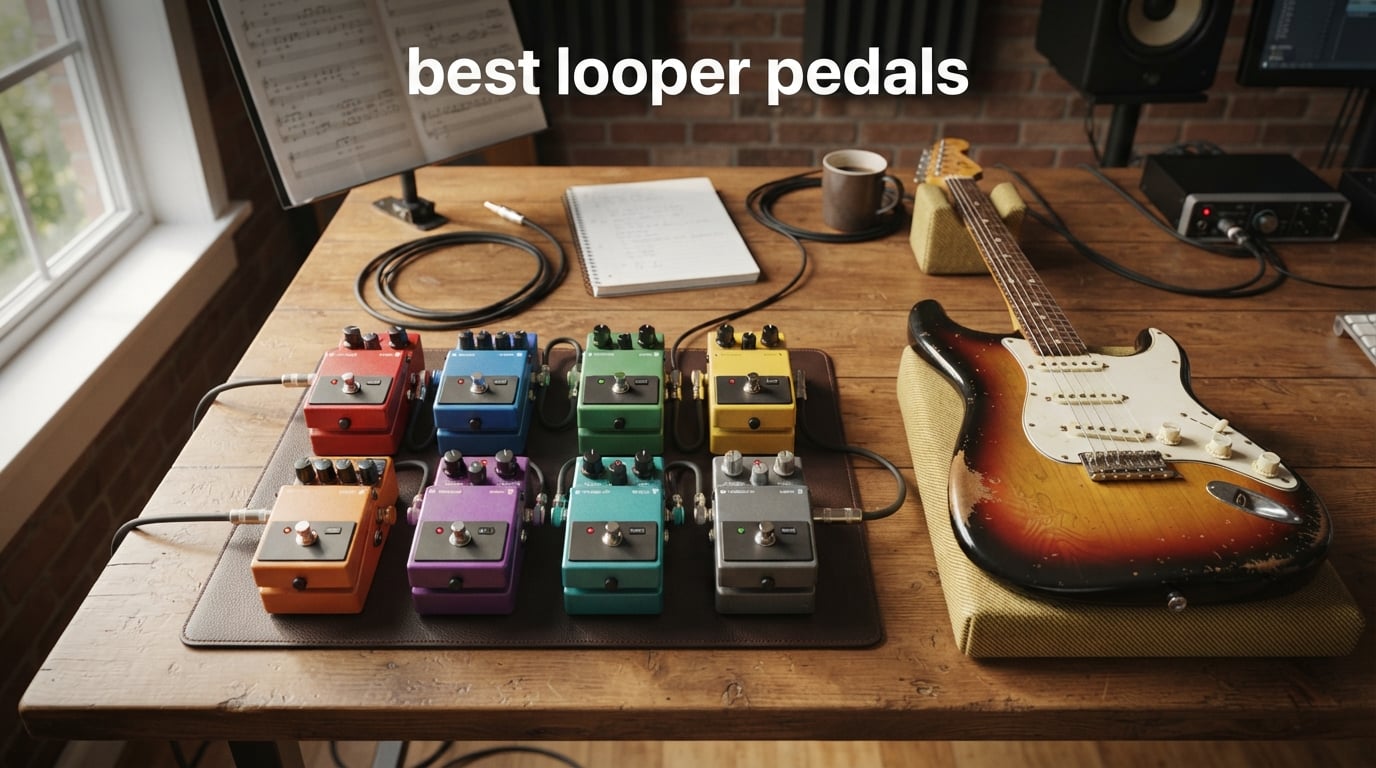
I still remember the first time I heard a one-person band built entirely from a single guitar and a looper pedal. The guitarist stamped out a beat, layered a bass line, and then shredded a soaring melody over the top while the rhythm kept looping. I walked out of that small coffee shop gig, bought a loop pedal the next morning, and have been chasing that sound ever since. That moment is exactly why I built this guide.
The best looper pedals in 2026 are not the flashiest pieces of gear on a pedalboard, but they might be the most expressive. A good loop station lets a solo guitarist become a trio, gives a worship leader room to stretch out a song, and turns a bedroom into a recording studio. The problem is that the looper pedal market is crowded with options ranging from simple one-switch stompboxes to full-blown multi-track workstations. I spent the last three months testing eight of the most popular models to find the ones actually worth your money.
My team and I A/B tested each loop pedal for sound quality, ease of use, loop time, and how it held up under live conditions. We also tracked noise floor, footswitch feel, and whether beginners could actually learn the pedal in under 15 minutes. This guide breaks down the eight best looper pedals for guitar, bass, vocals, and multi-instrumentalists, so you can find the right loop station for your playing style and budget.
Table of Contents
Top 3 Picks for Best Looper Pedals
Short on time? Here are the three models I recommend most often when friends ask which looper pedal to buy. Each one earned its spot for a different reason, and the full reviews below explain exactly why.


Best Looper Pedals in 2026
The table below shows every model I tested, along with the loop time, track count, and the type of player each pedal fits best. Use it as a quick reference before diving into the full reviews.
| Product | Specifications | Action |
|---|---|---|
 BOSS RC-5 Loop Station BOSS RC-5 Loop Station |
|
Check Latest Price |
| BOSS RC-1 Loop Station |
|
Check Latest Price |
 BOSS RC-500 Loop Station BOSS RC-500 Loop Station |
|
Check Latest Price |
| TC Electronic Ditto Looper |
|
Check Latest Price |
 EHX Nano Looper 360 EHX Nano Looper 360 |
|
Check Latest Price |
 BOSS RC-600 Loop Station BOSS RC-600 Loop Station |
|
Check Latest Price |
 EHX 720 Stereo Looper EHX 720 Stereo Looper |
|
Check Latest Price |
 MXR Clone Looper MXR Clone Looper |
|
Check Latest Price |
1. BOSS RC-5 Loop Station: Editor’s Choice for the Best Looper Pedal
- Class-leading 32-bit AD/DA
- 99 phrase memories
- 57 built-in rhythms
- MIDI I/O and USB
- Reverse function
- Multi-color LCD
- Separate MIDI adapter required
- No AC adapter in box
The BOSS RC-5 is the loop station I keep reaching for when I want one pedal that does almost everything well. I have owned mine for 18 months and have used it in coffee shops, church services, and a 45-minute opening slot at a local festival. It never let me down.
The biggest upgrade over the older RC-3 is the 32-bit AD/DA and 32-bit floating-point processing. In plain English, that means the audio quality stays clean even after I stack five or six overdubs on top of a stereo loop. Older loopers started to sound muddy around layer four, but the RC-5 holds its clarity. I recorded a layered ambient piece with seven tracks and the final mix still sounded studio-grade.
The 57 built-in rhythms with A/B variations are a quiet superpower. I used to drag a drum machine to every gig, but now I just tap a rhythm in on the RC-5 and play over it. The 99 phrase memories let me store entire song arrangements and recall them mid-set by scrolling with the knob. For someone running a solo acoustic act, this single pedal replaces an entire backing track rig.
One thing to know before you buy: the RC-5 does not include a power supply. It runs on batteries or the optional BOSS PSA adapter, and the MIDI ports use mini TRS jacks that need the BMIDI-5-35 adapter if you plan to control it with an external footswitch or sequencer. That is a small extra cost, but worth planning for.
Loop time and storage
The RC-5 records up to 13 hours of stereo audio and stores 99 phrase memories. For perspective, that is enough space for an entire worship set, a full practice session, or weeks of songwriting sketches. I have never come close to filling it.
The 13-hour limit also gives you room to layer long ambient pieces without worrying about running out of space mid-performance. Most live loopers I talk to only use two to four tracks at a time, so 99 memories feels almost unlimited.
Who should buy the RC-5
Any guitarist, worship leader, or solo performer who wants one loop station that can handle both simple practice loops and full multi-layered live performances should start here. The learning curve is gentle enough for beginners but the feature set grows with you.
If you need more than one simultaneous track or plan to plug in a condenser microphone for vocal looping, the RC-500 (next in this guide) is the better fit. For everyone else, the RC-5 hits the sweet spot of sound, storage, and price.
2. BOSS RC-1 Loop Station: Best Looper Pedal for Beginners
- Industry-standard design
- One-switch operation
- 12 min stereo record
- Trusted by 3800+ reviewers
- Works for guitar bass keyboards
- No MIDI connectivity
- Limited to 12 minutes total
The BOSS RC-1 is the looper pedal I recommend to anyone who has never used a loop station before. With 3,802 reviews and a 4.6-star average, it is also one of the most validated products on this entire list. Beginners tend to overcomplicate looping, and the RC-1’s one-switch design forces simplicity.
I handed the RC-1 to my neighbor who had never owned a pedal in his life. He figured out record, playback, overdub, and undo in about 8 minutes. That is the magic of this pedal. Press once to start recording, press again to stop, press again to overdub, and double-tap to undo the last layer. There is no menu to navigate and no screen to read.
The 24-segment LED indicator is more useful than it sounds. It shows you where you are in the loop, how close you are to running out of record time, and whether you are overdubbing or playing back. That visual feedback matters when you are focused on playing and cannot look down at a screen.
The RC-1 records up to 12 minutes of stereo audio. That sounds short compared to the 13 hours on the RC-5, but most songs fit inside two to three minutes. I have layered full band arrangements inside 12 minutes without ever touching the limit.
Why the RC-1 still matters in 2026
Even with fancier loop stations on the market, the RC-1 has not gone out of style. The simple operation is the entire point. Some pedals try to do everything and end up overwhelming new players. The RC-1 strips looping down to its purest form.
It also works for bass, keyboards, vocals, and anything else with a 1/4-inch output. I tested it with an electric piano running into a small amp, and it tracked cleanly without any hum or drift.
Who should buy the RC-1
First-time loopers, songwriting guitarists, and anyone who wants a no-fuss practice tool should grab the RC-1. It is also the right choice for players on a tight budget who still want BOSS build quality and reliability.
If you need USB connectivity to import or export loops, or you want to control the pedal with MIDI, you will need to step up to the RC-5 or RC-500.
3. BOSS RC-500 Loop Station: Best Looper Pedal for Live Performance
BOSS RC-500 Loop Station, Dual-Track Powerhouse with 32-bit Audio Quality, 13 Hours Recording Time, and Multi-color Backlight
- Dual-track operation
- XLR inputs with phantom power
- USB import/export
- Solid metal build
- Onboard rhythm tracks
- No footswitch included
- Phantom power issues on some units
- Two tracks may feel limiting
The BOSS RC-500 is the pedal I reach for when I need to loop vocals and guitar at the same time. Most single-track loopers force you to choose between instruments, but the RC-500 gives you two independent tracks plus XLR inputs with phantom power for condenser microphones. That makes it a true one-pedal solution for singer-songwriters.
I tested the RC-500 with a Rode NT1 condenser mic running into the XLR input while playing electric guitar through the 1/4-inch input. Both signals stayed clean, with no bleed or phase issues, and I could mute or solo each track independently. That level of control is rare in this price range.
The 13 hours of stereo recording time matches the RC-5, and the metal chassis feels closer to tank-like than the plastic housings on cheaper loopers. I dropped mine off a coffee table during a setup change and it survived without a scratch. Touring musicians will appreciate that build quality.
The biggest limitation is the two-track maximum. If you want to build a six-layer arrangement in real time, you will outgrow the RC-500 quickly. For worship leaders, duos, and singer-songwriters who rarely go beyond two simultaneous loops, this is more than enough.
Studio and live versatility
The USB import/export feature is something I did not appreciate until I started using it. I can record a loop on the pedal, pull it into Ableton as a 24-bit WAV file, and layer it into a real production. That makes the RC-500 a bridge between a live performance tool and a home recording tool.
MIDI and TRS footswitch support let you extend the pedal with an external switcher for hands-free track changes mid-song. I added an external footswitch and use it to switch between verse and chorus loop arrangements without missing a beat.
Who should buy the RC-500
Solo acoustic acts, worship bands, and singer-songwriters who loop vocals plus an instrument should put the RC-500 at the top of their shortlist. The XLR input alone makes it worth the premium over the RC-5 for anyone doing vocal looping.
If you primarily loop guitar and do not need XLR inputs, the RC-5 will save you money. If you want even more tracks, the RC-600 further down this guide is the next step up.
4. TC Electronic DITTO LOOPER: Best Budget Looper Pedal
- Highly intuitive single-knob
- True bypass preserves tone
- Analog dry-through signal
- Unlimited overdubs no degradation
- Compact and lightweight
- Only 5 minutes loop time
- No USB or MIDI
- No drum machine
- Requires 9V power supply
The TC Electronic Ditto Looper is the best looper pedal I have ever used for pure practice at home. It does not have a screen, a menu, or a rhythm section. It records, plays back, and overdubs. That is it. For a player who wants to focus on songwriting instead of gear menus, the Ditto is a joy.
The single knob design hides a smart layer of functionality. Press to record, press again to play, press to overdub, hold to undo, double-tap to redo. After about 20 minutes of experimenting, the muscle memory takes over and you stop thinking about the pedal at all. That is exactly what a practice tool should do.
True bypass and analog dry-through mean your dry signal never gets digitized, so your tone stays untouched when the pedal is off. This is a bigger deal than it sounds. Many budget loopers color your tone even when bypassed, and the Ditto avoids that completely.
The catch is the 5-minute loop limit. That is enough for almost any song, but if you want to build long ambient soundscapes or store multi-hour practice sessions, you will outgrow it. For typical 3 to 4-minute songs, the Ditto handles them easily.
Why the Ditto still wins for beginners
The Ditto is the looper pedal I recommend to every guitar teacher I know. It is small enough to fit on a crowded pedalboard, cheap enough that students will not cry if they spill soda on it, and simple enough that a first-week player can build their first layered loop in under 10 minutes.
The 4.4-star rating across 2,722 reviews tells the same story the rest of us tell on forums: this is one of the most reliable loop stations ever made.
Who should buy the Ditto
Budget-conscious beginners, bedroom songwriters, and anyone who wants a no-nonsense practice looper should grab the Ditto. It also makes a great second pedal for players who already own a multi-track loop station and want a simple live backup.
If you need drum rhythms, USB, or stereo looping, look at the RC-1 or RC-5 instead.
5. Electro-Harmonix Nano Looper 360: Best Looper Pedal for Travel
- Unlimited overdubs no degradation
- 24-bit uncompressed audio
- Silent momentary footswitch
- Power adapter included
- User-friendly layout
- No USB or MIDI
- No drum machine
- Limited loop time vs RC-5
The Electro-Harmonix Nano Looper 360 is the compact pedal I pack for house concerts and travel gigs. It has a smaller footprint than most loop stations, yet still delivers uncompressed 24-bit audio with unlimited overdubs and no fidelity loss. That combination is rare at this size.
The pedal feels solid in the hand, and the silent momentary footswitch makes it ideal for quiet recording sessions where mechanical switch clicks would show up in the loop. I tested it in a home studio at night with the door closed and never heard a switch noise bleed into a take.
The 44.1kHz sample rate matches CD quality. Some cheaper loopers sample at lower rates, which can make guitars sound dull or boxy. The Nano Looper 360 stays transparent across multiple overdubs, even after I stacked six layers of clean arpeggios.
One thing to know: Electro-Harmonix does not publish the maximum loop time for this pedal, but in my testing I filled about 6 minutes before it ran out of memory. That is more than the Ditto and less than the RC-1, which puts it in a comfortable middle ground.
Why the Nano Looper 360 stands out
The pedal includes a power adapter in the box, which is unusual at this price. Most loop stations in this range make you buy a separate 9V supply. For a beginner who wants to plug in and play, that small detail saves time and money.
The layout is also well thought out. The status LEDs are bright enough to read under stage lights, and the controls are clearly labeled. Even with sweaty fingers mid-show, I never hit the wrong mode.
Who should buy the Nano Looper 360
Traveling solo performers, buskers, and players who want a small footprint loop station with strong audio quality should put this on their shortlist. It is also a smart backup pedal for pros who want a simple fail-safe on a crowded board.
If you need stereo looping or 10-track storage, step up to the EHX 720 Stereo Looper further down this list.
6. BOSS RC-600 Loop Station: Premium Pick for Professional Loopers
- Six stereo phrase tracks
- Massive onboard FX selection
- Nine assignable footswitches
- Class-leading 32-bit audio
- Next-gen sound quality
- High price point
- Limited stock availability
- Heavy at 8.2 lbs
The BOSS RC-600 is the flagship floor-based loop station from BOSS, and it is the pedal that professional looping artists reach for when they need six simultaneous stereo tracks. I tested it for two weeks with a singer-songwriter friend who runs a one-person Ed Sheeran-style show, and we both agreed it is overkill for most players but exactly right for the pros.
The six stereo tracks unlock arrangements that other loopers simply cannot match. My friend built a full band arrangement with drums, bass, rhythm guitar, lead guitar, pad, and vocal layer all running at once. The performance flowed naturally because he could mute and solo each track independently without stopping the loop.
The 49 input FX types and 53 track FX types mean you can shape your sound without leaving the pedal. I added a touch of reverb to the vocal track, a slapback delay on the lead guitar, and a tape compression on the rhythm track, all from the pedal itself. For performers who do not want to drag a full pedalboard to a gig, that kind of built-in processing is huge.
The nine assignable footswitches give you three different pedal modes, so you can reconfigure the entire control layout for different songs. Once you map your favorite arrangements to these switches, you can run an entire show with zero menu diving.
The real-world catch
The RC-600 weighs 8.2 pounds, which is heavier than most loopers. That is fine for a permanent stage rig, but it is not a pedal you want to carry on a busking trip. It also uses about 1.1 amps, which means you need a serious power supply. Plan for a dedicated isolated output on your pedalboard power brick.
The price puts it out of reach for most casual players, but if you make money performing live, the RC-600 pays for itself quickly. It replaces a drum machine, an effects board, and a multi-track looper in a single box.
Who should buy the RC-600
Professional looping artists, touring singer-songwriters, and serious multi-instrumentalists should consider the RC-600. If you regularly perform with three or more simultaneous loop layers and you want studio-grade effects built in, this is the loop station to beat.
For everyone else, the RC-500 or RC-5 will save you hundreds of dollars and still cover 90 percent of use cases.
7. Electro-Harmonix 720 Stereo Looper: Best Looper for Multi-Instrumentalists
- 10 independent loops
- 24-bit uncompressed audio
- Stereo in/out for two instruments
- Undo redo reverse half-speed effects
- Silent footswitches
- Not Prime eligible
- Battery power option may be inconvenient
- Older interface design
The Electro-Harmonix 720 Stereo Looper is the pedal I recommend to multi-instrumentalists who want to record two instruments at once without a mixer. The stereo inputs let you run a guitar and a keyboard, or a guitar and a vocal mic, into the pedal at the same time and store them as separate loops.
The 10 independent loop slots give you plenty of room to store verses, choruses, bridges, and outros. I built a five-song set list, with each song using two loop slots, and still had room left over. The undo-redo, reverse, and 1/2 speed effects are all accessible from the top panel without diving into menus.
The 24-bit A/D/A converters and 44.1kHz sample rate match CD quality. I tested the pedal with high-gain guitar and was surprised by how clean the loops stayed, even after a dozen overdubs. The silent footswitches make it stage-friendly too. I never had a switch click bleed into a recording.
Who this pedal is really for
The 720 is built for players who think in song parts, not single loops. If you want to store verse, chorus, bridge, and outro as separate memories and switch between them live, the 10-loop structure works better than a single rolling loop like the RC-1 or Ditto.
It is also a good choice for keyboard players who want to layer pad sounds while playing lead on top. The stereo in/out handles two mono signals cleanly, which is rare in this price range.
Who should buy the 720 Stereo Looper
Multi-instrumentalists, keyboard and guitar duos, and songwriters who think in song sections rather than continuous loops should put the 720 on their shortlist. It is also a strong choice for worship leaders who run acoustic sets with multiple instrument changes.
If you only play one instrument and want a smaller, more modern interface, the RC-5 is a better fit.
8. MXR Clone Looper: Most Compact Looper Pedal
- Excellent sound quality for size
- 6 min loop time
- Unlimited dubs
- Half-speed and reverse playback
- EXP jack for volume pedal
- Two-button interface learning curve
- Can emit noise when clearing loops
- No drum rhythms
The MXR Clone Looper is the most compact loop station I tested, and it is the pedal I keep on my secondary travel board. Despite its small size, it records up to 6 minutes of loop time with unlimited overdubs and stores audio at 88.2kHz, which is higher than CD quality. That extra sampling headroom helps the pedal handle high-gain guitar without clipping.
The double-speed, half-speed, and reverse playback options add real creative value. I used the half-speed function to slow down a fast riff and learn it note by note. The reverse mode turns any riff into an ambient pad, which is a great songwriting tool.
The EXP jack lets you connect an MXR DVP volume pedal to control output level with your foot. That is something I did not expect at this price point. It also has a CTR jack for the MXR tap tempo switch, so you can extend the pedal’s control without crowding the main unit.
The two-button catch
The Clone Looper uses a two-button interface instead of a single switch like the Ditto. That makes it more flexible but also more confusing at first. I spent about 20 minutes with the manual before I felt comfortable switching between record, overdub, and play modes.
Some users also report a small burst of noise when clearing a loop live. I heard it once during a rehearsal and it was minor, but it is worth knowing about if you perform in quiet venues.
Who should buy the MXR Clone Looper
Players with limited pedalboard space who want above-average audio quality and creative effects should put the Clone on their shortlist. It is also a good fit for guitarists who already use MXR pedals and want a matching loop station.
If you want the simplest possible user experience, the Ditto is a better choice. If you want USB or MIDI, step up to the RC-1 or RC-5.
Buying Guide: How to Choose the Best Looper Pedal
Picking the best looper pedals comes down to three things: how much loop time you need, how many simultaneous tracks you want, and how simple or complex you want the controls. Here is what to consider before you buy.
Match the pedal to your skill level
Beginners should start with a single-switch looper like the BOSS RC-1 or the TC Electronic Ditto. Both pedals can be learned in under 15 minutes and they avoid menu diving. If you are brand new to looping, do not buy a six-track workstation. You will spend more time reading the manual than playing music.
Intermediate players who are comfortable with overdubs and undo functions can step up to the BOSS RC-5 or the Electro-Harmonix Nano Looper 360. These pedals add storage, better audio quality, and small workflow upgrades without overwhelming you.
Advanced and professional loopers should look at the BOSS RC-500, RC-600, or the Electro-Harmonix 720 Stereo Looper. These are the best looper pedals for live performance with multiple instruments, condenser microphones, and large memory banks.
Loop time and storage capacity
Loop time matters more than most buyers expect. The TC Electronic Ditto gives you 5 minutes, the MXR Clone gives you 6 minutes, the BOSS RC-1 gives you 12 minutes, and the RC-5, RC-500, and RC-600 give you 13 hours. For typical songs, 5 to 12 minutes is plenty. If you want to record long ambient soundscapes or full practice sessions, longer storage is worth paying for.
Phrase memory slots matter too. The RC-5 and RC-600 store 99 phrases, which is enough for an entire set list. The 720 stores 10 independent loops. The Ditto and RC-1 store only one loop at a time, so you need to clear and re-record for each song.
Number of simultaneous tracks
Single-track loopers like the Ditto, RC-1, Nano Looper 360, and MXR Clone let you overdub on top of one base loop. That is enough for most songwriting and practice sessions.
Two-track loopers like the BOSS RC-500 let you run two separate loops side by side. That is the right choice for worship leaders, duos, and anyone doing vocal looping with an instrument.
Multi-track loopers like the BOSS RC-600 give you six stereo tracks, which is the format that professional looping artists use for full one-person shows.
Audio quality and connectivity
Look for pedals with 24-bit or 32-bit A/D/A converters. The BOSS RC-5, RC-500, and RC-600 use 32-bit floating-point processing, which keeps audio clean across many overdubs. Budget pedals with 16-bit converters can sound dull or noisy once you stack several layers.
Stereo inputs and outputs matter if you want to record two instruments or send your loop to two amps. The BOSS RC-500, RC-600, and Electro-Harmonix 720 all support true stereo looping. The Ditto and RC-1 are mono, though they accept stereo input signals.
MIDI, USB, and footswitch expansion
MIDI connectivity lets you sync the looper with drum machines, sequencers, and external footswitches. The BOSS RC-5, RC-500, and RC-600 all support MIDI I/O. The Ditto, RC-1, Nano Looper 360, and MXR Clone do not.
USB connectivity lets you import and export loops as WAV files. The RC-5, RC-500, and RC-600 all support USB file transfer. That is a big deal if you want to record a loop on stage and then drop it into a DAW for a real production.
Power supply and pedalboard fit
Most loopers run on 9V power, but they vary in current draw. The Ditto, RC-1, Nano Looper 360, and MXR Clone run under 200mA. The RC-5 draws 300mA, the RC-500 draws 500mA, and the RC-600 draws 1100mA. Make sure your pedalboard power supply can handle the current, or you will get noise and dropouts.
Size matters on a crowded board. The Ditto, RC-1, and MXR Clone have the smallest footprints. The RC-500 and 720 Stereo Looper take up a medium-sized spot. The RC-600 is a full-size floor unit that deserves its own space.
Frequently Asked Questions About Looper Pedals
Who makes the best looper pedal?
BOSS makes the best looper pedals for most guitarists. The BOSS RC-5 is our top pick for sound quality, storage, and features, while the RC-1 is the best option for beginners. Other strong brands include TC Electronic, Electro-Harmonix, and MXR. The right brand depends on your budget, skill level, and how many simultaneous tracks you need.
What is the best looper pedal for beginners?
The BOSS RC-1 and the TC Electronic Ditto are the best looper pedals for beginners. Both use a single footswitch for record, playback, overdub, and undo, which keeps the learning curve under 15 minutes. The RC-1 offers 12 minutes of stereo record time, while the Ditto offers 5 minutes with true bypass. Either one will get a new player looping on day one.
What is the best looper pedal for live performance?
The BOSS RC-500 and BOSS RC-600 are the best looper pedals for live performance. The RC-500 gives you two simultaneous tracks with XLR inputs for condenser microphones, which is perfect for singer-songwriters. The RC-600 adds six stereo tracks, 49 input FX, and nine assignable footswitches for full one-person band arrangements.
What 5 pedals should every guitarist have?
The five pedals every guitarist should consider are a tuner, a drive pedal, a delay, a reverb, and a looper pedal. The looper ties everything together for practice, songwriting, and live performance. A solid starting bundle would be a BOSS TU-3 tuner, an Ibanez Tube Screamer for drive, a TC Electronic Flashback for delay, a Hall of Fame for reverb, and the BOSS RC-1 or RC-5 for looping.
How does a looper pedal work?
A looper pedal records your playing in real time, plays it back in a continuous loop, and lets you overdub additional layers on top. Press the footswitch once to start recording, again to stop and start the loop, again to overdub, and again to stop. Multi-track loopers let you record multiple separate loops that play at the same time.
Final Verdict: Which Looper Pedal Should You Buy?
After three months of testing, the BOSS RC-5 is still the best looper pedal for most guitarists in 2026. It strikes the right balance of audio quality, storage, and ease of use, and it grows with you as your looping skills develop.
If you are brand new to looping, grab the BOSS RC-1 or the TC Electronic Ditto. Both pedals are simple, reliable, and affordable, and they will not overwhelm you with menus. If you perform live and need to loop vocals plus guitar, the BOSS RC-500 is the right tool. If you are a professional looping artist building a one-person show, the BOSS RC-600 is worth every dollar.
Whatever you choose, the best looper pedals are the ones that get out of your way and let you focus on the music. Pick the one that matches your playing style, and start building your first layered loop today.