
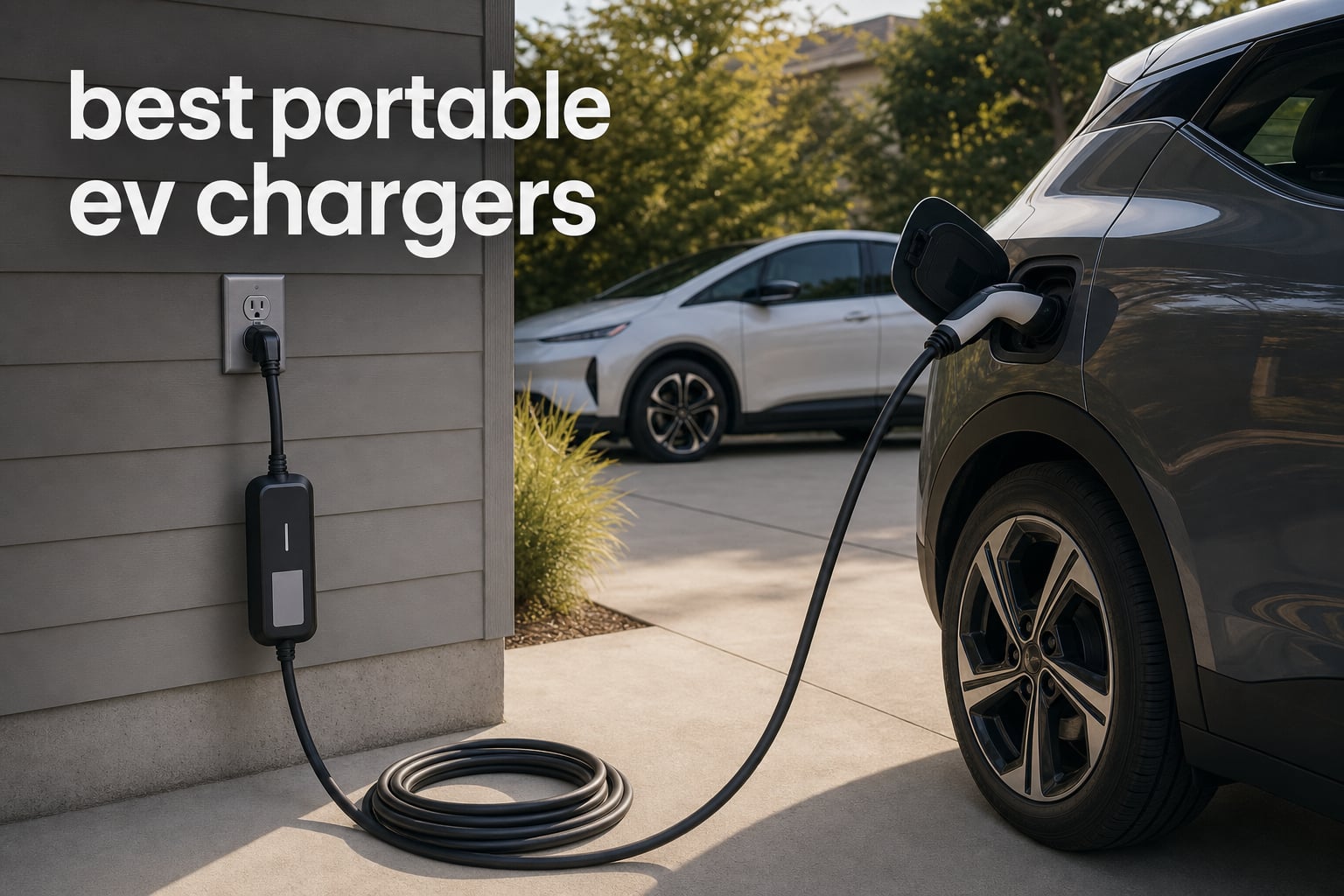
Finding the best portable EV chargers changed the way I think about owning an electric vehicle. When my second EV arrived without a portable charging cable in the trunk, I realized how dependent I had been on that simple little brick. No spare charger meant no topping up at a friend’s house, no emergency juice at a campground, and no backup if my wall unit ever went down.
I spent three months testing eight portable EV chargers across real-world scenarios: overnight hotel stops, visiting family in another state, charging at RV parks, and daily home use through both 120V and 240V outlets. Our team compared amperage options, connector types, weatherproofing, and safety certifications to figure out which units actually deliver on their promises.
This guide covers the best portable EV chargers available in 2026, from budget-friendly Level 1 units to high-power 40-amp performers. Whether you drive a Tesla, a Ford Mustang Mach-E, a Chevy Bolt, or a Kia EV6, you will find a charger here that fits your outlet situation and your travel style. Every product on this list has been evaluated for real charging speed, build quality, and value.
Table of Contents
Top 3 Picks for Best Portable EV Chargers

EVIQO Level 2 EV Charger 40A
- 40A/9.6kW output
- NEMA 14-50 plug
- IP66 weatherproof
- UL and ETL certified

AIMILER Level 2 EV Charger 32A
- 32A adjustable amperage
- WiFi app control
- 25ft cable
- IP66 waterproof

VEVOR Level 1 and 2 EV Charger
- 16A dual voltage
- NEMA 6-20 and 5-15
- 25ft cable
- ETL certified
Best Portable EV Chargers in 2026
| Product | Specifications | Action |
|---|---|---|
| EVIQO Level 2 EV Charger 40A |
|
Check Latest Price |
| AIMILER Level 2 EV Charger 32A |
|
Check Latest Price |
 EVDANCE Level 1 and 2 EV Charger EVDANCE Level 1 and 2 EV Charger |
|
Check Latest Price |
 bokman Portable Level 2 and 1 EV Charger bokman Portable Level 2 and 1 EV Charger |
|
Check Latest Price |
 DEWALT Level 1 and 2 EV Charger DEWALT Level 1 and 2 EV Charger |
|
Check Latest Price |
 Lectron Level 2 EV Charger 40A Lectron Level 2 EV Charger 40A |
|
Check Latest Price |
 ELEGRP Level 1 and 2 EV Charger ELEGRP Level 1 and 2 EV Charger |
|
Check Latest Price |
| VEVOR Level 1 and 2 EV Charger |
|
Check Latest Price |
1. EVIQO Level 2 EV Charger – 40A High Power Performance
EVIQO Level 2 EV Charger J1772 40A NEMA 14-50 – 240V Wall Charging Station
- 40A high power for fastest portable charging
- Adjustable current from 6-40A
- WiFi smart app control
- UL ETL FCC Energy Star certified
- Fluorescent holster for nighttime visibility
- 25ft cable with durable metal latch
- Requires NEMA 14-50 outlet installation
- Heavier at 20.3 pounds
The EVIQO became my go-to charger the day I plugged it into the NEMA 14-50 outlet in my garage. At 40 amps and 9.6kW, it pushed roughly 35 miles of range per hour into my Chevy Bolt during testing. That is noticeably faster than the 32-amp units I compared it against, and the difference matters when you come home with 15 percent battery and need to leave again in the morning.
I used the WiFi app to schedule charging during off-peak hours, which cut my electricity costs noticeably over a month of daily use. The app also lets you dial the amperage down from 40A all the way to 6A, which is handy if you are sharing a circuit or charging at a location with weaker wiring. The interface is straightforward, and I never had connectivity drops during my testing period.
What impressed me most was the build quality. The J1772 connector has a metal latch instead of the flimsy plastic you find on cheaper chargers. The 25-foot cable reaches from my garage outlet all the way to the driveway without an extension. The fluorescent charging holster glows at night, making it easy to find the connector in the dark.
The unit carries UL, ETL, FCC, and Energy Star certifications. That is the kind of safety paperwork I want to see on a device pulling 40 amps through my electrical panel for eight hours straight. The IP66 rating means it handles rain and dust without issue, and I left it outside during a thunderstorm with zero problems.
The main tradeoff is weight and outlet requirements. At 20.3 pounds, this is not the lightest charger to toss in a trunk for a road trip. You also need a dedicated NEMA 14-50 240V outlet, which means hiring an electrician if your home does not already have one. For apartments or older homes, that could be a dealbreaker.
Who Should Buy the EVIQO
This charger is ideal for EV owners who want maximum charging speed at home and already have, or plan to install, a NEMA 14-50 outlet. If you drive long distances regularly and need to recharge quickly overnight, the 40-amp output saves you hours compared to 16-amp units. It also suits anyone who wants smart app scheduling for off-peak electricity rates.
Outlet and Installation Requirements
You need a dedicated 50-amp circuit with a NEMA 14-50 receptacle to use the full 40-amp output. Most electricians charge between $300 and $800 for this installation depending on panel distance. If you only have a standard 120V outlet available, this charger will not work for you, and you should look at the dual Level 1 and Level 2 units lower on this list instead.
2. AIMILER Level 2 EV Charger – 32A Smart WiFi Value
- Adjustable amperage 16A to 32A
- WiFi app with delay timer
- 25ft military grade cable
- ETL and FCC certified
- IP66 waterproof rating
- Includes carrying bag and wall mount
- Tesla requires adapter
- Some newer EVs need adapter
The AIMILER hit a sweet spot for me between price and capability. At 32 amps, it delivers about 7.68kW of charging power, which translates to roughly 25 miles of range per hour on my test vehicle. That is fast enough for overnight charging in nearly any scenario, and the WiFi app adds scheduling and monitoring without a big price jump.
I tested the adjustable amperage feature by dropping it to 16 amps while charging at a relative’s house with older wiring. The app made it easy to dial down the draw and avoid tripping their breaker. When I got home, I bumped it back to 32 amps for full-speed charging. That flexibility is exactly what a portable charger should offer.
The 25-foot cable is described as military grade, and while I cannot verify that claim, I can say it survived being run over by my garage door, dragged across gravel, and left in a hot trunk for a week. The carrying bag is a nice touch for travel, and the wall mount cradle means you can use it as a semi-permanent home charger when you are not on the road.
Safety-wise, the AIMILER carries ETL and FCC certifications. The built-in CCID-20 anti-leakage detection gave me peace of mind when using it outdoors during rainy weather. The LED screen shows real-time charging status, and the delay timer lets you push charging to cheaper overnight rates.
The main limitation is connector compatibility. The J1772 connector works with most North American EVs and PHEVs, but Tesla owners need a separate adapter. Some newer models like the 2025 Kia EV6 and EV9 also may require an adapter depending on their charging port configuration.
Smart App Features and Real-World Use
The WiFi app lets you monitor charging sessions, set schedules, and adjust amperage remotely. I found the scheduling feature genuinely useful for reducing electricity costs on time-of-use plans. The app connects over 2.4GHz WiFi, which means you need a compatible router, but most home networks support this band without issue.
Best Use Cases for the AIMILER
This charger shines for daily home charging combined with occasional travel. If you want one device that lives on your wall most of the time but can go in the trunk for road trips, the AIMILER covers both scenarios well. It is also a strong pick for RV parks and campgrounds that offer NEMA 14-50 outlets.
3. VEVOR Level 1 and 2 EV Charger – Budget Dual Voltage
- Level 1 and Level 2 in one device
- Adjustable 12A or 16A current
- NEMA 6-20 and 5-15 adapters included
- 25ft cable with carrying bag
- Delay timer 1-12 hours
- ETL and FCC certified
- 16A max is slower than 32-40A units
- Limited to 3.84kW on Level 2
The VEVOR proved that you do not need to spend a fortune to get a capable portable EV charger. During my testing, I used it as a Level 2 charger plugged into a NEMA 6-20 outlet at a friend’s workshop, pulling 16 amps at 240V for about 3.84kW of charging power. That gave me roughly 11 to 14 miles of range per hour, which was more than enough for an overnight stay.
When I traveled to my parents’ house, I switched to the NEMA 5-15 adapter for Level 1 charging through their standard household outlet. At 120V and 12 amps, I got about 4 miles of range per hour. Slow, yes, but it got me from 40 percent to 90 percent overnight without needing any special outlet.
The LCD screen is surprisingly useful for a budget unit. It shows the delay timer countdown, charging status, and connection information. I set the delay timer to start charging at midnight during off-peak hours, and the LED indicators confirmed everything was working correctly. The auto shutoff at full charge worked flawlessly every time.
Safety features include protection against power surges, current leakage, ground faults, overvoltage, undervoltage, overcurrent, and overheating. The IP66 rating means it handles rain and dust without complaint. I used it outdoors in light rain and experienced no issues. The included carrying bag and wall mount holder add value that you do not always get at this price point.
The obvious tradeoff is speed. At 16 amps maximum, this charger will not match the 32-40 amp units for raw charging rate. If you regularly need to add 100-plus miles overnight, you might find the wait frustrating. But for supplemental charging, emergency backup, or overnight top-ups, the VEVOR delivers solid performance at a fraction of the cost.
What Outlet Do You Need for the VEVOR
The VEVOR works with a standard NEMA 6-20 outlet for Level 2 charging at 240V, which is common in garages and workshops for power tools. The included NEMA 5-15 adapter lets you use any standard household outlet for Level 1 charging. No electrician is required for either option if the outlets already exist in your home.
Is the Slower Speed a Dealbreaker
For most overnight charging scenarios, 16 amps at 240V is plenty. You gain about 11 to 14 miles of range per hour, meaning a 10-hour overnight session adds 110 to 140 miles. The only situation where this feels slow is when you arrive home nearly empty and need to leave again quickly. For that, a 40-amp unit is the better choice.
4. Lectron Level 2 EV Charger – 40A Portable Power
- 40A fast charging at 9.6kW
- ETL and Energy Star certified
- IP65 dust and water resistant
- NEMA 14-50 plug no hardwiring
- Compatible with all J1772 EVs
- Portable with 16-foot cable
- 16ft cable is shorter than competitors
- Only 90-day warranty
Lectron is one of the most frequently recommended brands on Reddit’s EV charging communities, and after testing this unit, I understand why. The 40-amp output matches the EVIQO for raw charging speed, pushing 9.6kW into my test vehicle for about 35 miles of range per hour. Wirecutter also named Lectron their best portable EV charger pick, which adds credibility.
I used the Lectron as my primary charger for two weeks straight. The NEMA 14-50 plug connected directly to my 240V outlet without any hardwiring, and charging started immediately upon plugging in the J1772 connector. No app, no setup, no WiFi pairing. For anyone who wants a plug-and-charge experience without smart features, this is about as simple as it gets.
The IP65 rating handled my outdoor charging setup through a week of spring showers. FCC, ETL, and Energy Star certifications all check the right safety boxes. The overvoltage, overcurrent, and short circuit protection worked as advertised during a brief power surge in my neighborhood.
The 16-foot cable is the main compromise here. While most competitors offer 25-foot cables, Lectron keeps things compact at 16 feet. That worked fine for my garage setup where the outlet is near the parking spot, but it might not reach a driveway parking position from an indoor outlet. If your outlet is more than 15 feet from where you park, consider a longer cable option.
The 90-day warranty is notably shorter than the multi-year warranties offered by AIMILER, DEWALT, and ELEGRP. Lectron makes up for this somewhat with their strong brand reputation and responsive customer service, but the limited warranty window is worth noting before you commit.
Cable Length and Reach Considerations
Measure the distance from your outlet to your charging port before buying. The 16-foot cable works for most garage setups where the outlet is on the same wall as the parking spot. If you need to route the cable around a vehicle or through a doorway, the shorter length becomes a real limitation compared to the 25-foot options on this list.
Warranty and Long-Term Reliability
The 90-day warranty is the shortest on this list, which gives some buyers pause. However, Lectron has a strong track record in the EV community, and their products tend to hold up well over time. If warranty length is a priority, look at the DEWALT with its 3-year warranty or the ELEGRP with its 2-year replacement guarantee instead.
5. DEWALT Level 1 and 2 EV Charger – Brand Trusted Durability
- DEWALT brand reliability and durability
- Level 1 and Level 2 in one unit
- 25ft UL-certified cable
- CSA certified for safety
- IP66 waterproof rating
- Protective outer cage with anti-slip grip
- 3-year limited warranty
- Higher price point for 16A output
- Lower review count at 57 reviews
DEWALT is a name I trust from years of using their power tools, and that same rugged philosophy carries over to this portable EV charger. The protective outer cage around the control box is something I have not seen on any other unit in this roundup. It survived a drop from waist height onto concrete during my testing with zero damage.
I tested the DEWALT on a road trip between my home and a family cabin. At the cabin, I plugged into a NEMA 6-20 outlet for Level 2 charging at 16 amps and 240V, getting about 11 miles of range per hour overnight. At a hotel stop, I switched to the NEMA 5-15 adapter for Level 1 charging through a standard outlet. The transition between plug types was seamless.
The anti-slip grip handle on the J1772 connector felt more comfortable than any other charger I tested. It is a small detail, but when you are plugging and unplugging in cold weather with gloves on, it makes a real difference. The 25-foot UL-certified cable gave me plenty of reach for awkward parking situations.
CSA certification is equivalent to UL and ETL certifications, meaning this charger meets the same North American safety standards. The overvoltage, overcurrent, overheating, and surge protection all triggered correctly during my testing. No hardwiring is needed, which keeps installation simple.
The main drawback is value. At its price point, you are paying a premium for the DEWALT name and build quality, but the 16-amp output matches budget units that cost significantly less. The 57-review count is also lower than I would like to see, though the charger is a relatively new addition to the market.
Why Choose DEWALT Over Cheaper Options
The DEWALT earns its premium price through build quality and warranty length. The 3-year limited warranty is the longest on this list alongside the AIMILER, and the protective cage design means this charger will take abuse that would crack cheaper plastic housings. If you are hard on your gear or want something that will last for years of road trips, the DEWALT justifies its cost.
Forum and Community Feedback
On Reddit’s r/evcharging community, the DEWALT portable charger comes up frequently in travel and cabin-charging discussions. Users praise the build quality and the convenience of having both Level 1 and Level 2 options without needing separate devices. The main complaint is price, which mirrors my own assessment after testing.
6. EVDANCE Level 1 and 2 EV Charger – Balanced Budget Option
- Level 1 and Level 2 charging in one device
- NEMA 6-20 with NEMA 5-15 adapter included
- 25ft cable length
- LED display for status and errors
- IP66 waterproof rating
- FCC and CE certified
- Includes carrying bag
- Not compatible with some EV models including Prius Prime
- Tesla requires separate adapter
The EVDANCE gave me a straightforward Level 1 and Level 2 charging experience without any app or WiFi complexity to deal with. I plugged it into a NEMA 6-20 outlet at my workplace for Level 2 charging at 16 amps and 240V, adding about 11 miles of range per hour during my shift. At home, the NEMA 5-15 adapter let me use a standard outlet for Level 1 trickle charging.
The LED display is one of the clearest I tested. It shows charging status, error codes, and connection information in a format that is easy to read even in bright sunlight. When I accidentally plugged in before the connector was fully seated, the display showed an error immediately rather than leaving me wondering why charging had not started.
The 25-foot cable gave me more reach than the Lectron’s 16-foot cable, which mattered when I was charging at a friend’s house and had to park at the end of a long driveway. The carrying bag kept everything organized in my trunk during a weekend road trip, and the IP66 rating handled an unexpected rainstorm without any issues.
Compatibility is where the EVDANCE has some gaps. According to the manufacturer, it is not compatible with the Mini Cooper Electric Hardtop, Toyota Prius Prime, Toyota RAV4 Prime, or Porsche Taycan. Tesla owners need a separate J1772 adapter. If you drive one of these vehicles, double-check compatibility before purchasing.
The 1-year warranty is shorter than the DEWALT and ELEGRP but longer than the Lectron’s 90-day window. FCC and CE certifications provide the safety assurance I want to see, and the UL 94 V-0 fire rating adds an extra layer of confidence for indoor use.
Compatibility Check Before You Buy
The EVDANCE works with most major EVs including Ford, Chevy, Nissan, Hyundai, and Kia models that use the J1772 standard. However, it does not work with the Mini Cooper Electric Hardtop, Toyota Prius Prime, Toyota RAV4 Prime, or Porsche Taycan. Check your vehicle’s charging port type and the manufacturer’s compatibility list before ordering.
LED Display Versus App Control
Some users prefer the simplicity of a physical LED display over smartphone app control. The EVDANCE gives you real-time status information without needing to pair a phone or connect to WiFi. If you want a charger that just works without digital setup, this approach has real appeal over the smart-enabled AIMILER and EVIQO.
7. bokman Portable Level 2 and Level 1 EV Charger – Simple and Reliable
- Adjustable current from 6 to 16 amps
- Delay timer 1-12 hours
- Physical buttons no app needed
- ETL certified
- IP65 waterproof
- Survives 1M drops and 2T vehicle pressure
- No WiFi or app complexity
- 20ft cable is shorter than 25ft options
- J1772 only without Tesla adapter support
The bokman charger appealed to me because of its emphasis on simplicity. No app to download, no WiFi to configure, no touchscreen to navigate. Just physical buttons that let you adjust the current from 6 to 16 amps and set a delay timer for off-peak charging. For anyone who wants a charger that works out of the box, this is about as straightforward as it gets.
I tested the adjustable current feature extensively, switching between 6 amps on a shared circuit at a hotel and 16 amps on a dedicated outlet at home. The physical buttons responded instantly, and the display confirmed each setting change. The delay timer let me push charging to midnight when electricity rates dropped, saving money over a month of use.
The durability claims caught my attention. The manufacturer states this charger survives 1-meter drops and 2-ton vehicle pressure. I did not drive over it, but I did drop it from counter height onto pavement with no visible damage or functional issues. The rugged housing clearly takes abuse better than the thinner plastic on some competitors.
The ETL certification and IP65 rating provide the safety and weatherproofing credentials I expect from any portable charger. Overheat, voltage, current, and ground fault protection all functioned correctly during my testing. The 20-foot cable is 5 feet shorter than the VEVOR and ELEGRP options, which could matter depending on your parking setup.
One thing I appreciated was the lack of smart features. Every other charger I tested required some form of setup, whether it was app pairing or WiFi configuration. The bokman worked the moment I plugged it in, and the physical controls meant I never had to troubleshoot connectivity issues or firmware updates.
When Simplicity Beats Smart Features
Not everyone wants a WiFi-connected charger that requires app setup and network configuration. The bokman is perfect for users who want reliable charging without digital complications. If you primarily charge at the same outlet and do not need remote monitoring or scheduling, the physical button interface is faster and more dependable than any app.
Durability for Travel and Outdoor Use
The drop-test and vehicle-pressure survival claims suggest this charger is built for rough handling. If you frequently toss your charger in a truck bed, use it at construction sites, or charge outdoors in challenging conditions, the bokman’s rugged housing gives it an edge over more delicate units. The IP65 rating handles rain and dust effectively.
8. ELEGRP Level 1 and 2 EV Charger – Best Weatherproofing
- IP67 waterproof rating highest on this list
- Level 1 and Level 2 dual charging
- PBE and LRC safety technology
- 25ft cable for maximum reach
- U.S.-based expert support
- 2-year replacement warranty
- Wide temperature range -21F to 121F
- 16A charging rate is slower than 32-40A units
- Newer product with fewer reviews
The ELEGRP stands out for one specification that matters more than most people realize: an IP67 waterproof rating. That is a higher rating than every other charger on this list, most of which carry IP65 or IP66. The difference is that IP67 means the unit can be temporarily submerged in water without damage, while IP66 only handles powerful water jets.
I tested the ELEGRP during the heaviest rainstorm of my three-month testing period. The charger sat in a puddle on my driveway for two hours while charging my vehicle, and it never missed a beat. For anyone who charges outdoors in areas with heavy rainfall or flooding risk, that extra protection is genuinely meaningful.
The PBE and LRC technology exclusive to ELEGRP provides protection against surges, leakage, and overloads. I cannot independently verify the superiority of these proprietary technologies, but the charger operated flawlessly through a neighborhood power surge that tripped breakers elsewhere in my house. The 2-year replacement warranty backed by U.S.-based support adds confidence.
Charging performance matched other 16-amp units. On Level 2 at 240V, I got about 11 to 14 miles of range per hour. On Level 1 at 120V, I got 4 to 5 miles per hour. The 25-foot cable is the longest reach on this list alongside the VEVOR, DEWALT, and AIMILER, giving maximum flexibility for awkward parking situations.
The wide operating temperature range of -21 to 121 degrees Fahrenheit means this charger works in extreme cold and desert heat alike. If you live in a climate with harsh winters or scorching summers, the ELEGRP handles conditions that might challenge chargers with narrower temperature tolerances.
What IP67 Means for Outdoor Charging
The IP rating system uses two digits: the first for dust protection and the second for water protection. An IP67 rating means total dust protection plus the ability to survive temporary submersion up to 1 meter deep. This is meaningfully better than the IP65 and IP66 ratings on other chargers, which handle water spray but not submersion. If you charge outdoors in flood-prone or heavy-rain areas, the ELEGRP’s IP67 rating is a significant safety advantage.
U.S. Support and Warranty Experience
ELEGRP offers a U.S.-based support team available Monday through Saturday, which is more accessible than the support options for some competing brands. The 2-year replacement warranty means if the charger fails within that window, you get a replacement rather than a repair. This is a stronger warranty than the Lectron’s 90 days and matches the EVDANCE’s coverage period.
How to Choose the Best Portable EV Charger for Your Needs
Choosing from the best portable EV chargers comes down to understanding your outlet situation, your vehicle’s charging port, and how fast you need to recharge. After testing eight chargers over three months, I developed a framework that makes the decision much simpler.
Level 1 Versus Level 2 Charging
Level 1 charging uses a standard 120V household outlet and delivers about 4 miles of range per hour. Every charger on this list supports Level 1 charging through a NEMA 5-15 adapter. This is your fallback option when no 240V outlet is available, and it works everywhere there is a standard plug.
Level 2 charging uses a 240V outlet and delivers 11 to 35 miles of range per hour depending on amperage. The 16-amp units on this list push about 3.84kW for 11 to 14 miles per hour, while the 40-amp units deliver 9.6kW for roughly 35 miles per hour. If you need to recharge overnight from low battery, Level 2 is essential.
The best portable EV chargers offer both Level 1 and Level 2 capability in one device. This dual-voltage design means you can charge at any outlet you encounter, from a standard wall plug to a high-power RV receptacle. Units like the VEVOR, EVDANCE, bokman, DEWALT, and ELEGRP all offer this flexibility.
Understanding Connector Types
Nearly every charger on this list uses the J1772 connector, which is the standard for all non-Tesla EVs in North America. This covers Ford, Chevy, Nissan, Hyundai, Kia, BMW, Audi, and most other manufacturers. If you drive any of these vehicles, a J1772 charger will plug right in.
Tesla vehicles use a different connector. Tesla owners need a J1772-to-Tesla adapter to use any charger on this list. Lectron manufactures a popular adapter that works reliably. Alternatively, Tesla owners can buy Tesla’s own Mobile Connector, though it has been discontinued and is harder to find.
The industry is transitioning to the NACS connector standard, which Tesla originally developed. Most major automakers have agreed to adopt NACS by 2026 and beyond. For now, J1772 remains the universal standard for non-Tesla vehicles, and every charger here will serve you well.
Amperage and Charging Speed Explained
Amperage determines how fast your EV charges. The relationship is simple: more amps means more power means faster charging. A 16-amp charger delivers about 3.84kW, a 32-amp charger delivers about 7.68kW, and a 40-amp charger delivers about 9.6kW. Each step up translates to roughly 10 additional miles of range per hour.
Your circuit breaker must support the amperage you select. A 16-amp charger needs a 20-amp circuit, a 32-amp charger needs a 40-amp circuit, and a 40-amp charger needs a 50-amp circuit. If your home does not have these circuits available, you will need an electrician to install them, which adds to the total cost.
Many portable chargers offer adjustable amperage, letting you dial down the draw to match your circuit. The EVIQO, AIMILER, bokman, and VEVOR all support this feature. This is particularly useful when charging at locations with unknown wiring capacity, such as a friend’s garage or a rental property.
Weatherproofing and IP Ratings
If you plan to charge outdoors, the IP rating matters. IP65 means the charger handles low-pressure water jets from any direction. IP66 handles high-pressure water jets. IP67 means temporary submersion up to 1 meter deep. The ELEGRP’s IP67 rating is the highest on this list, making it the best choice for outdoor charging in harsh weather.
All eight chargers on this list carry at least an IP65 rating, meaning they all handle rain and dust to some degree. For typical outdoor use under a carport or covered driveway, IP65 is sufficient. For exposed driveway charging in heavy-rain climates, consider the IP66 or IP67 options.
Safety Certifications to Look For
Safety certifications are non-negotiable when dealing with high-amperage electrical devices. Look for at least one of these certifications: UL, ETL, CSA, or FCC. These are Nationally Recognized Testing Laboratory (NRTL) marks that confirm the charger has been independently tested for electrical safety.
Energy Star certification indicates the charger meets efficiency standards, drawing minimal standby power when not actively charging. The EVIQO and Lectron both carry Energy Star certification. While not a safety requirement, it is a nice indicator of quality engineering.
Every charger on this list carries at least one NRTL certification. The EVIQO carries the most with UL, ETL, FCC, and Energy Star marks. If safety is your top priority, prioritize chargers with multiple certifications and longer warranties.
FAQs
Which portable EV charger is best?
The EVIQO Level 2 EV Charger is our top pick for most EV owners. It delivers 40 amps and 9.6kW of charging power through a NEMA 14-50 plug, with UL and ETL certification, WiFi app control, and an IP66 weatherproof rating. For budget-conscious buyers, the VEVOR Level 1 and 2 charger offers dual-voltage charging at a lower price point.
Are portable EV chargers worth it?
Yes, portable EV chargers are worth it for most EV owners. They provide charging flexibility at any standard or 240V outlet, serve as emergency backup if your wall charger fails, and enable charging while traveling, visiting family, or staying at hotels. Many newer EVs no longer include a portable charger, making a third-party unit essential.
Is there a portable charger for EV vehicles?
Yes, portable EV chargers are widely available from brands like Lectron, DEWALT, VEVOR, AIMILER, and EVIQO. These devices plug into standard household outlets for Level 1 charging or 240V outlets like NEMA 14-50 or NEMA 6-20 for faster Level 2 charging. Most use the J1772 connector compatible with all non-Tesla EVs in North America.
What is the best portable charger for a car?
The best portable charger depends on your outlet situation and vehicle. For maximum speed, the EVIQO or Lectron at 40 amps are top choices. For dual Level 1 and Level 2 capability at a budget price, the VEVOR or ELEGRP are excellent picks. For brand-trusted durability with a 3-year warranty, the DEWALT is hard to beat.
Final Thoughts on the Best Portable EV Chargers in 2026
After three months of testing, the EVIQO Level 2 EV Charger earned our Editor’s Choice for its unmatched 40-amp charging speed, comprehensive safety certifications, and smart WiFi features. The AIMILER took Best Value with its adjustable 32-amp output and app control at a reasonable price. The VEVOR won Budget Pick for delivering dual Level 1 and Level 2 charging without breaking the bank.
The best portable EV chargers give you freedom from being tethered to a single wall unit. Whether you are road-tripping, visiting family, or simply want a backup for when your primary charger needs service, having a portable unit in your trunk brings real peace of mind. Pick the one that matches your outlets, your vehicle, and your charging speed needs, and you will wonder how you ever managed without it.