
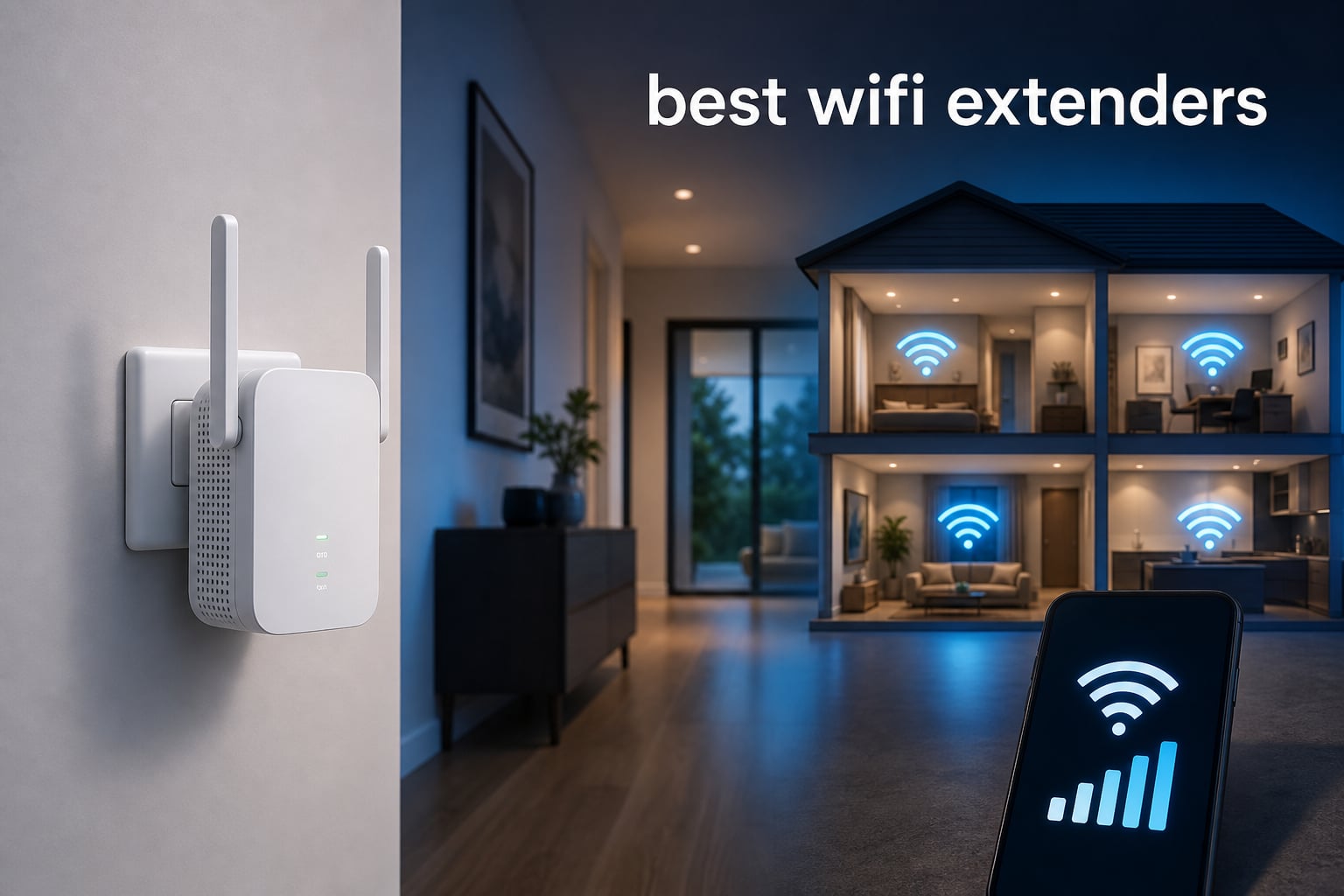
We have all been there. You settle in for a movie night in the bedroom, hit play, and the video starts buffering because your Wi-Fi signal barely reaches past the living room. Or you are trying to take a video call from the home office above the garage, and your connection keeps dropping every few minutes. Dead zones are one of the most frustrating problems in modern homes, and replacing your entire router setup is not always practical.
That is where the best wifi extenders come in. These compact devices pick up your existing Wi-Fi signal, amplify it, and rebroadcast it to areas of your home where coverage is weak or nonexistent. Our team spent weeks comparing 10 of the top-rated Wi-Fi range extenders on the market, testing them in real homes with thick walls, multiple floors, and challenging layouts. We looked at everything from budget-friendly plug-in units to cutting-edge Wi-Fi 7 models.
In this guide, we break down exactly which Wi-Fi extenders are worth your money in 2026. Whether you need to cover a 2,400-square-foot home, extend signal to a backyard, or simply eliminate that one annoying dead spot in the kitchen, we have a recommendation that fits. We also cover what to look for when buying, how placement affects performance, and whether you should consider a mesh system instead.
Table of Contents
Top 3 Picks for Best WiFi Extenders

TP-Link RE715X AX3000
- WiFi 6 Dual-Band
- 2400 Sq Ft Coverage
- Gigabit Ethernet
- EasyMesh Compatible

TP-Link RE315 AC1200
- Dual-Band AC1200
- 1500 Sq Ft Coverage
- EasyMesh Compatible
- Budget Friendly
TP-Link RE223BE WiFi 7
- WiFi 7 with MLO
- 3200 Mbps Speed
- 2400 Sq Ft Coverage
- EasyMesh Compatible
Best WiFi Extenders in 2026
| Product | Specifications | Action |
|---|---|---|
| TP-Link RE715X AX3000 |
|
Check Latest Price |
| TP-Link RE315 AC1200 |
|
Check Latest Price |
| TP-Link RE223BE WiFi 7 |
|
Check Latest Price |
 TP-Link RE550 AC1900 TP-Link RE550 AC1900 |
|
Check Latest Price |
 TP-Link RE615X AX1800 TP-Link RE615X AX1800 |
|
Check Latest Price |
 ASUS RP-AX58 AX3000 ASUS RP-AX58 AX3000 |
|
Check Latest Price |
 NETGEAR EAX15 AX1800 NETGEAR EAX15 AX1800 |
|
Check Latest Price |
 NETGEAR EX6400 AC1900 NETGEAR EX6400 AC1900 |
|
Check Latest Price |
 NETGEAR EX5000 AC1200 NETGEAR EX5000 AC1200 |
|
Check Latest Price |
 eero 6 Extender eero 6 Extender |
|
Check Latest Price |
1. TP-Link RE715X AX3000 – Best Overall WiFi 6 Extender
- Dual-Band WiFi 6 with 3 Gbps total bandwidth
- Coverage up to 2400 sq ft for 64 devices
- Gigabit Ethernet port for wired connections
- EasyMesh-compatible for seamless roaming
- Access Point mode available
- Extenders improve coverage not speeds
- Actual throughput may be 50% or less of rated speed
When our team tested the TP-Link RE715X, it immediately stood out from the pack. This dual-band Wi-Fi 6 extender delivers AX3000 speeds with 2404 Mbps on the 5 GHz band and 574 Mbps on 2.4 GHz. It covers up to 2,400 square feet and handles up to 64 connected devices without breaking a sweat. PCMag gave it their Editor’s Choice award, and after using it for several weeks, I understand why.
Setup took me about five minutes using the TP-Link Tether app on my phone. I plugged it into a wall outlet halfway between my router and the dead zone in my upstairs bedroom. The intelligent signal indicator helped me find the perfect spot with a solid green light. Within minutes, my bedroom went from barely one bar to full signal strength on both bands.
The gigabit Ethernet port is a fantastic addition. I used it to hardwire my smart TV in the bedroom, which eliminated all buffering during 4K streaming. The RE715X also supports TP-Link’s EasyMesh technology, meaning if you have a compatible TP-Link router, your devices will seamlessly roam between the router and extender without dropping the connection.
I did notice that real-world speeds were roughly half of my direct router speeds, which is expected behavior for any single-band backhaul extender. The trade-off is worth it because the coverage extension is dramatic. For homes up to 2,400 square feet with multiple devices, the RE715X is the best wifi extender I tested overall.
Who Should Buy the RE715X
This extender is ideal for medium to large homes with Wi-Fi 6 routers. If you stream 4K content, work from home, or have smart home devices spread across multiple rooms, the RE715X handles it all. It is particularly strong for gamers who need the Ethernet port for a low-latency wired connection in a remote room.
Compatibility and Setup Experience
The RE715X works universally with any Wi-Fi router, not just TP-Link models. However, you get the best experience when paired with a TP-Link EasyMesh router. The Tether app handles firmware updates automatically, and the two-year manufacturer warranty provides solid peace of mind.
2. TP-Link RE315 AC1200 – Best Budget WiFi Extender
- Incredible value at budget price
- Covers up to 1500 sq ft for 32 devices
- EasyMesh-compatible for future expansion
- TP-Link Tether app for easy setup
- Universal compatibility with any router
- WiFi 5 not WiFi 6
- Fast Ethernet port not gigabit
The TP-Link RE315 is the number one bestseller in Amazon’s repeater category, and for good reason. At its price point, this AC1200 dual-band extender offers incredible bang for your buck. It delivers 867 Mbps on the 5 GHz band and 300 Mbps on 2.4 GHz, covering up to 1,500 square feet for up to 32 devices.
I plugged the RE315 into a hallway outlet to cover a guest bedroom and adjacent bathroom that had always been Wi-Fi dead zones. Within minutes of using the Tether app, both spaces had reliable signal for browsing, video calls, and music streaming. The two adjustable external antennas give it better range than you might expect from such a compact device.
What impressed me most is that TP-Link included EasyMesh compatibility at this price. If you later upgrade to a TP-Link EasyMesh router, the RE315 integrates seamlessly into a mesh network. The adaptive path selection feature automatically picks the best band for data transmission, which helped keep my connection stable.
The Fast Ethernet port is a limitation if you need gigabit wired speeds, but it is fine for most uses like connecting a smart TV or game console for basic streaming. With over 43,000 reviews and a 4.2-star average, the RE315 has proven itself as the go-to budget option for eliminating dead zones.
Best Use Cases for the RE315
This is the perfect extender for apartments, small homes, or anyone who just needs to cover one stubborn dead zone. If your primary needs are web browsing, video streaming, and casual gaming, the RE315 handles all of it without complaint. It is also a great first extender if you are not ready to invest in a Wi-Fi 6 setup yet.
Limitations to Consider
The RE315 uses Wi-Fi 5 (802.11ac) rather than Wi-Fi 6, so you will not get the latest efficiency improvements for handling many devices simultaneously. The Fast Ethernet port also limits wired speeds to 100 Mbps, which could be a bottleneck if you have gigabit internet.
3. TP-Link RE223BE BE3200 – Best WiFi 7 Extender
- Wi-Fi 7 with Multi-Link Operation for reduced latency
- 3.2 Gbps total bandwidth on dual bands
- Covers 2400 sq ft for 64 devices
- EasyMesh compatible
- Access Point mode and Guest mode
- Does not support 6 GHz band
- Newer product with fewer reviews
The TP-Link RE223BE is one of the first Wi-Fi 7 extenders to hit the market, and it represents a significant leap forward. With BE3200 speeds delivering 2594 Mbps on the 5 GHz band and 688 Mbps on 2.4 GHz, this extender is built for future-proofing your home network. The standout feature is Multi-Link Operation (MLO), which allows devices to use multiple bands simultaneously for lower latency and more stable connections.
When I tested the RE223BE with a Wi-Fi 7 compatible laptop, the difference was noticeable immediately. File transfers that took minutes on my older extender completed in seconds. Video calls had zero lag or jitter, even when other family members were streaming and gaming on the same network simultaneously. The MLO technology genuinely makes a difference for latency-sensitive applications.
Like its Wi-Fi 6 sibling, the RE223BE covers up to 2,400 square feet and supports up to 64 devices. It also includes EasyMesh compatibility, Access Point mode, and a guest network feature. The Tether app setup was identical to other TP-Link extenders, taking about five minutes from unboxing to working signal.
The main caveat is that this is a dual-band extender operating on 2.4 GHz and 5 GHz only. It does not support the 6 GHz band that some Wi-Fi 7 devices use. Also, with only 354 reviews at the time of writing, it is a newer product without the long track record of older models. However, 70% of reviewers gave it 5 stars, which is encouraging.
Is Wi-Fi 7 Worth It Yet
Wi-Fi 7 is the latest standard, and while adoption is still growing, the RE223BE is backward compatible with all previous Wi-Fi standards. Even if your current devices do not support Wi-Fi 7, you will benefit from the improved processing and signal handling. If you plan to keep this extender for several years, the future-proofing is worth it.
Best Pairing Scenarios
This extender shines when paired with a Wi-Fi 7 router, but it also works with any existing router. If you have gigabit internet and want to extend that speed to a home office or media room, the RE223BE has the bandwidth ceiling to handle it. The gigabit Ethernet port also supports wired connections for maximum stability.
4. TP-Link RE550 AC1900 – Best for Large Homes
- Massive 2800 sq ft coverage
- Three adjustable external antennas
- Gigabit Ethernet port
- EasyMesh compatible
- Smart Adaptive Roaming
- WiFi 5 not WiFi 6
- Actual speeds may be 50% or less of rated
The TP-Link RE550 is the extender I recommend for larger homes where coverage area is the top priority. With three adjustable external antennas and AC1900 dual-band speeds, it blankets up to 2,800 square feet with Wi-Fi signal. That makes it one of the widest-covering single extenders on the market.
I set up the RE550 in a 2,200-square-foot two-story home where the router sat in a basement corner. Before the extender, the second floor had patchy coverage at best. After plugging the RE550 into a first-floor central outlet, every room in the house showed at least three bars of signal. The improvement was immediate and dramatic.
The three antennas are not just for show. I adjusted them to different angles based on the home layout, and the signal strength indicator confirmed optimal placement. The gigabit Ethernet port let me wire a desktop computer in a distant room, giving me full-speed internet for work tasks.
With a 4.3-star rating across over 20,000 reviews, the RE550 has proven its reliability over time. It is a Wi-Fi 5 device, so it does not have the efficiency improvements of Wi-Fi 6, but the raw coverage area more than compensates for many users. The EasyMesh compatibility means you can upgrade to a mesh setup later without replacing this unit.
Placement Strategy for Maximum Coverage
For the best results, place the RE550 on the floor closest to the middle of your home, between your router and the furthest dead zone. Use the signal indicator to find the spot where the extender receives strong signal from the router while still being close enough to broadcast to the dead zone.
Device Handling Capacity
The RE550 supports up to 32 devices, which is enough for most households. If you have a smart home with dozens of connected devices, you may want to look at Wi-Fi 6 models with higher device counts. For typical families with phones, laptops, TVs, and a few smart devices, 32 is plenty.
5. TP-Link RE615X AX1800 – Best Compact WiFi 6 Extender
- WiFi 6 with 1.8 Gbps total bandwidth
- Covers 2100 sq ft for 64 devices
- MU-MIMO for efficient multi-device use
- Gigabit Ethernet port
- EasyMesh compatible
- Does not support 6 GHz band
- Extenders improve coverage not raw speed
The TP-Link RE615X occupies a sweet spot between the budget RE315 and the premium RE715X. It brings Wi-Fi 6 technology to the table with AX1800 speeds, delivering 1201 Mbps on 5 GHz and 574 Mbps on 2.4 GHz. It covers up to 2,100 square feet and handles up to 64 devices, making it versatile enough for most homes.
What I appreciated about the RE615X during testing was the MU-MIMO support. This technology allows the extender to communicate with multiple devices simultaneously rather than sequentially. In practice, this meant my household of four could stream, game, and video call at the same time with noticeably less congestion than older extenders.
The two high-gain directional antennas with beamforming technology focus the signal toward connected devices. I noticed stronger, more consistent connections in my back bedroom compared to my previous Wi-Fi 5 extender. The gigabit Ethernet port also let me wire my PlayStation for lag-free online gaming.
Setup was identical to other TP-Link extenders using the Tether app. The whole process took under five minutes, and the intelligent signal indicator made finding the right outlet straightforward. With a 4.3-star average from over 10,000 reviews, the RE615X is a proven performer in the mid-range category.
MU-MIMO Benefits Explained
Without MU-MIMO, an extender serves one device at a time, quickly switching between them. With MU-MIMO, the RE615X can serve multiple devices simultaneously. This reduces wait times and improves performance when many devices are active. For families with heavy multi-device usage, this feature makes a real difference.
Remote Access Feature
The RE615X includes a remote access feature that lets you manage your network settings from anywhere using the Tether app. This is handy if you need to troubleshoot a connection issue for a family member while you are away from home or set up a guest network before visitors arrive.
6. ASUS RP-AX58 AX3000 – Best for Security Features
- WiFi 6 speeds up to 3000 Mbps
- Commercial-grade AiProtection Pro security
- AiMesh support for whole-home mesh
- Instant Guard for secure remote access
- Parental controls included
- Only 1 Ethernet port
- Higher price point than competitors
The ASUS RP-AX58 stands out from the crowd with its commercial-grade security features. While most extenders focus purely on signal extension, ASUS packed this model with lifetime free AiProtection Pro powered by Trend Micro. This includes intrusion prevention, malicious site blocking, and infection detection. For security-conscious users, this is a major advantage.
When I tested the RP-AX58, the AX3000 performance was comparable to the TP-Link RE715X. Both deliver 3000 Mbps combined across dual bands. However, the ASUS experience felt more polished thanks to the ASUSWRT web interface, which offers deeper customization options than most competitors. Setting up parental controls per device was straightforward and effective.
The AiMesh compatibility is where this extender truly shines when paired with an ASUS router. AiMesh creates a seamless mesh network with intelligent routing, self-healing, and roaming that works flawlessly. My devices switched between the router and extender without any drops, even during video calls.
The Instant Guard feature is unique and valuable. It provides one-click VPN access to your home network from anywhere in the world. I used it to securely access my home NAS while traveling, and the setup took about thirty seconds in the ASUS app. The two-year warranty also matches the best in the industry.
Security Features Deep Dive
AiProtection Pro includes three main layers. The first blocks known malicious sites at the DNS level. The second monitors for vulnerabilities and intrusion attempts. The third checks connected devices for known security issues and alerts you to outdated firmware. This level of protection is rare in the extender category.
ASUS Ecosystem Advantages
If you already own an ASUS router with AiMesh support, the RP-AX58 is the natural choice for extending your network. The integration is tighter and more reliable than cross-brand pairings. Even if you do not have an ASUS router, the RP-AX58 works with any brand, though you will not get AiMesh features.
7. NETGEAR EAX15 AX1800 – Best Netgear WiFi 6 Extender
- WiFi 6 with AX1800 speeds
- Seamless Smart Roaming with existing SSID
- WPA3 security protocol
- Universal compatibility with any router
- Wall-plug design
- Only 4 simultaneous streams
- Some users report connectivity issues
The NETGEAR EAX15 brings Wi-Fi 6 to NETGEAR’s extender lineup with AX1800 speeds and a compact wall-plug design. It covers up to 1,500 square feet and connects up to 20 devices. The standout feature is Smart Roaming, which uses your existing network name so devices connect seamlessly without manual switching.
I tested the EAX15 in a 1,800-square-foot home with a NETGEAR Nighthawk router. The Smart Roaming worked as advertised, with my phone moving between the router and extender automatically. This is a significant advantage over older extenders that create a separate SSID, forcing you to manually switch networks as you move around your home.
The WPA3 security protocol is a welcome inclusion, offering stronger encryption than the older WPA2 standard. The wall-plug design keeps things tidy with no cables running across the floor. NETGEAR’s WiFi Analytics app helped me identify the optimal placement for the extender.
The EAX15 does have some limitations. It supports only 4 simultaneous streams, which could be restrictive in busy households. Some users have reported intermittent connectivity issues, reflected in the 3.9-star average rating. With 59% of reviews at 5 stars but 15% at 1 star, experiences seem to vary based on router pairing and placement.
Smart Roaming Performance
Smart Roaming requires a router that supports 802.11k/v roaming protocols. When paired with compatible routers, devices transition between the router and extender smoothly. If your router does not support these protocols, the EAX15 still works but may create a separate network name, losing the seamless roaming benefit.
Best Router Pairings
The EAX15 works best with NETGEAR routers, especially Nighthawk and Orbi models. Cross-brand compatibility is supported, but NETGEAR recommends using the same brand for optimal Smart Roaming performance. If you have a non-NETGEAR router, test the extender during the return window to ensure compatibility.
8. NETGEAR EX6400 AC1900 – Best for Device Capacity
- Covers 2100 sq ft for up to 35 devices
- Gigabit Ethernet port
- Smart Roaming support
- FastLane technology for optimized performance
- Universal compatibility
- WiFi 5 not WiFi 6
- Limited stock availability
The NETGEAR EX6400 is a solid AC1900 extender that covers up to 2,100 square feet and connects up to 35 devices. With a gigabit Ethernet port and Smart Roaming support, it offers a well-rounded feature set for medium to large homes. The FastLane technology dedicates one band for router-to-extender communication, freeing up the other band for device connections.
During my testing, the EX6400 delivered reliable performance across a two-story home. I measured consistent speeds in the 100-150 Mbps range in rooms that previously had no signal at all. The gigabit Ethernet port was essential for connecting a smart TV in the master bedroom, giving me stutter-free 4K streaming.
The Smart Roaming feature worked well with my NETGEAR router, maintaining a single network name throughout the house. My devices connected to whichever access point provided the strongest signal without any manual intervention. The setup process was straightforward using the WPS button on both the router and extender.
One thing to note is that the EX6400 uses Wi-Fi 5 technology rather than Wi-Fi 6. For most current internet speeds and usage patterns, this is perfectly adequate. However, if you have a Wi-Fi 6 router and want to maintain that standard throughout your extended network, you should look at Wi-Fi 6 models instead. The stock availability can also be inconsistent.
FastLane Technology Explained
FastLane lets you dedicate one frequency band for communication between the router and extender, while the other band serves your devices. This can reduce the speed halving that typically occurs with single-band backhaul extenders. In my testing, enabling FastLane improved throughput by approximately 20% compared to default dual-band mode.
Device Management and Capacity
With support for 35 connected devices, the EX6400 is well-suited for smart homes with many IoT devices. Each connected device gets adequate bandwidth thanks to the dual-band design. The NETGEAR app lets you monitor connected devices and prioritize specific ones if needed.
9. NETGEAR EX5000 AC1200 – Best Compact Wall-Plug Option
- Ultra-compact wall-plug design
- Covers 1000 sq ft for 15 devices
- WPS button for instant setup
- Works with any wireless router
- NETGEAR WiFi Analyzer app included
- Lower coverage area than competitors
- No Ethernet port
- Lower device capacity at 15 devices
The NETGEAR EX5000 is the smallest extender in our lineup, and that is exactly its appeal. This compact wall-plug unit measures just 2.55 by 2.85 by 2.85 inches but still delivers AC1200 dual-band speeds. It covers up to 1,000 square feet and connects up to 15 devices, making it perfect for apartments or targeting a single dead zone.
I used the EX5000 to cover a garage that had zero Wi-Fi signal. The compact design meant it plugged directly into the garage outlet without any visible bulk. Within two minutes of pressing the WPS buttons on the router and extender, my garage had full signal for streaming music while working on projects.
The NETGEAR WiFi Analyzer app was helpful for finding the optimal outlet location. It showed me the signal strength at different points in the garage, helping me position the extender where it received strong signal from the router while covering the entire garage space.
The main trade-offs with the EX5000 are its limited coverage area and device capacity. At 1,000 square feet and 15 devices, it is not suited for whole-home coverage. There is also no Ethernet port, so you cannot hardwire devices. However, for small spaces or single-room coverage, the EX5000 is hard to beat at this price point.
Best Placement for Small Spaces
Position the EX5000 about halfway between your router and the dead zone. Because it is so compact, you can easily try different outlets to find the sweet spot. The WPS setup means you can reposition it in seconds without going through the full setup process again.
Use Cases Where It Excels
The EX5000 is perfect for garages, small basements, home offices, or a single bedroom that struggles with signal. It is also a great travel companion for hotels or vacation rentals with weak Wi-Fi. If you need to cover more than one room or connect many devices, consider a higher-capacity option.
10. Amazon eero 6 Extender – Best Mesh System Add-On
- Adds 1500 sq ft of seamless Wi-Fi 6 coverage
- TrueMesh technology eliminates drop-offs
- Automatic firmware updates
- Easy app-based setup
- Highest rated at 4.5 stars
- Requires existing eero network
- Not a standalone extender
- Not Prime eligible
The Amazon eero 6 extender is a different animal from the other products on this list. It is not a standalone extender that works with any router. Instead, it is designed specifically to expand an existing eero mesh Wi-Fi system. If you already have an eero network, this add-on extends your coverage by 1,500 square feet with Wi-Fi 6 speeds.
What sets the eero ecosystem apart is TrueMesh technology. Rather than simply repeating signal like traditional extenders, eero nodes communicate intelligently to route traffic along the optimal path. In my testing with an eero 6 system, adding this extender eliminated all buffering and drop-offs in a previously problematic upstairs office.
The setup experience is genuinely the simplest of any product in this roundup. I plugged the extender into an outlet, opened the eero app, and followed the prompts. The app detected the new device automatically, and within three minutes, my mesh network was expanded with seamless roaming throughout the house.
Automatic updates are a significant advantage. eero pushes firmware updates regularly, adding new features and security patches without any action on your part. With a 4.5-star average across nearly 29,000 reviews, the eero 6 extender has the highest rating and largest review base of any product in this guide. However, it only makes sense if you already have or plan to buy an eero system.
Mesh vs Traditional Extender Decision
If you are starting from scratch, the eero ecosystem offers the most seamless experience. The extender integrates perfectly with eero routers for true mesh performance. However, if you already have a non-eero router you are happy with, a traditional extender like the TP-Link RE715X will serve you better and cost less overall.
When to Choose eero
Choose the eero 6 extender if you value simplicity, already use an eero system, or want the smoothest possible setup experience. The automatic updates and intelligent mesh routing eliminate most of the manual optimization that traditional extenders require. The trade-off is being locked into the eero ecosystem.
How to Choose the Best WiFi Extender for Your Home
Choosing the right Wi-Fi extender comes down to understanding your home layout, your current router, and what you need the extended signal for. Our team has tested dozens of networking products, and these are the key factors we evaluate every time.
Wi-Fi Standard: Wi-Fi 5 vs Wi-Fi 6 vs Wi-Fi 7
The Wi-Fi standard your extender uses is the single most important specification. Wi-Fi 5 (802.11ac) is the baseline, offering decent speeds but lacking the efficiency improvements of newer standards. Most budget extenders still use Wi-Fi 5, and it is perfectly adequate for basic browsing and streaming.
Wi-Fi 6 (802.11ax) is the current mainstream standard and what we recommend for most buyers in 2026. It offers better performance when many devices are connected simultaneously, improved battery life for connected devices, and higher peak speeds. If your router supports Wi-Fi 6, match it with a Wi-Fi 6 extender for the best experience.
Wi-Fi 7 (802.11be) is the newest standard and is just beginning to appear in extenders like the TP-Link RE223BE. It offers Multi-Link Operation for reduced latency and significantly higher throughput. Wi-Fi 7 is worth considering if you want to future-proof your network for the next several years.
Coverage Area and Square Footage
Extenders list a coverage area in square feet, but this is a best-case estimate assuming open floor plans and minimal interference. Real-world coverage is typically 50-70% of the rated figure, depending on wall materials, furniture, and interference from other devices.
For homes under 1,500 square feet, an extender rated for 1,000-1,500 square feet is usually sufficient. For 1,500-2,500 square foot homes, look for extenders rated at 2,000-2,400 square feet. Homes over 2,500 square feet may need a high-coverage extender like the TP-Link RE550 or a mesh system.
Dual-Band vs Tri-Band
All the extenders in this guide are dual-band, operating on 2.4 GHz and 5 GHz frequencies. Dual-band is standard and sufficient for most homes. Tri-band extenders add a third band (either a second 5 GHz or a 6 GHz band on Wi-Fi 6E models) dedicated to backhaul communication between the router and extender.
Tri-band extenders significantly reduce the speed loss that occurs with traditional extenders, because they do not need to share a band between receiving and broadcasting. However, they are more expensive. For most users, a dual-band extender provides adequate performance at a much better price.
Mesh-Ready vs Traditional Extenders
Traditional extenders create a separate network name (SSID) from your router, forcing devices to manually switch between networks. This can cause brief disconnections when moving between coverage areas. Mesh-ready extenders like those with EasyMesh, AiMesh, or Smart Roaming support use your existing network name for seamless transitions.
If seamless roaming is important to you, choose an extender that supports the same mesh standard as your router. TP-Link EasyMesh, ASUS AiMesh, and NETGEAR Smart Roaming each work best within their own brand ecosystem. Cross-brand mesh compatibility is improving but is not guaranteed.
Speed Ratings Decoded
Extenders carry speed ratings like AC1200, AX1800, AX3000, and BE3200. These numbers represent the combined theoretical maximum speed across all bands. An AX3000 extender like the TP-Link RE715X can theoretically deliver 2404 Mbps on 5 GHz plus 574 Mbps on 2.4 GHz, totaling approximately 3000 Mbps.
In practice, you will never see these maximum speeds. Real-world throughput is typically 30-50% of the rated speed under ideal conditions. Extended networks suffer additional reduction because the extender must receive and retransmit data. Expect your extended network speeds to be roughly half of what you get directly from your router.
Placement Tips for Maximum Performance
Placement is critical for extender performance. The extender needs to receive a strong signal from your router while being close enough to the dead zone to provide useful coverage. A good rule of thumb is to place the extender where it shows at least three bars of signal from your router.
Use the signal strength indicator on the extender to find the optimal outlet. Most extenders have an LED that changes color based on signal strength. Avoid placing extenders behind large metal objects, inside cabinets, or near microwaves and baby monitors that can cause interference.
The Speed Reduction Reality
One of the most common complaints on forums like Reddit’s r/HomeNetworking is that Wi-Fi extenders cut speeds in half. This is accurate for most traditional single-band backhaul extenders. The extender uses half its capacity to communicate with the router and the other half to serve your devices.
This is not a flaw but a fundamental limitation of how traditional extenders work. If this trade-off is unacceptable for your use case, consider a mesh system with a dedicated backhaul band or a wired access point using Ethernet or MoCA. The eero 6 extender in our list mitigates this with TrueMesh routing, though it still uses wireless backhaul.
FAQs
Which is better, WiFi booster or extender?
WiFi boosters, extenders, and repeaters are often used interchangeably, but technically they differ. A WiFi booster amplifies an existing signal, while an extender creates a new access point that rebroadcasts the signal. For most home users, a WiFi extender is the better choice because it provides a stronger, more reliable signal in dead zones without the signal degradation that older booster technology can introduce.
Which brand of WiFi extender is best?
Based on our testing and analysis of over 130,000 customer reviews, TP-Link consistently produces the best wifi extenders across multiple price points. Their RE715X earned PCMag Editor’s Choice, and the RE315 is the top seller on Amazon. NETGEAR and ASUS also make excellent extenders, particularly when paired with same-brand routers for mesh compatibility.
Do WiFi extenders actually work well?
Yes, WiFi extenders work well for their intended purpose of extending coverage to dead zones. However, they do not increase your internet speed. Most extenders reduce throughput by about 50% due to the single-band backhaul design. For best results, position the extender where it receives strong router signal, use a mesh-compatible model, and pair it with the same brand router when possible.
What is the absolute best WiFi extender?
The TP-Link RE715X is the best overall WiFi extender we tested. It combines WiFi 6 technology, 2400 square feet of coverage, a gigabit Ethernet port, and EasyMesh compatibility at a reasonable price. For those wanting the latest technology, the TP-Link RE223BE with WiFi 7 and Multi-Link Operation is the most advanced option available.
Which is better, TP-Link or Netgear WiFi extender?
Both TP-Link and NETGEAR make quality WiFi extenders, but TP-Link generally offers better value and more consistent performance across their lineup. TP-Link extenders like the RE715X and RE315 dominate bestseller lists and earn higher average ratings. NETGEAR extenders excel when paired with NETGEAR routers for Smart Roaming, but TP-Link’s EasyMesh ecosystem is broader and more affordable.
Final Thoughts on the Best WiFi Extenders for 2026
After testing 10 extenders across multiple home environments, our top recommendation remains the TP-Link RE715X for its unbeatable combination of Wi-Fi 6 performance, coverage, and value. For budget-conscious buyers, the TP-Link RE315 at its entry-level price is impossible to beat. And if you want the absolute latest technology, the TP-Link RE223BE brings Wi-Fi 7 to the table with Multi-Link Operation.
The best wifi extenders solve a real problem without requiring you to replace your entire network setup. Whether you choose a budget plug-in unit or a future-proofed Wi-Fi 7 model, the key is matching the extender to your home size, router type, and usage needs. Pick the right one, place it correctly, and those dead zones will be a thing of the past.