

A pedal kayak moves the boat with your feet, leaving your hands free to fish, steer a rod, or manage a landing net. The best pedal kayaks combine a drive that suits your water, a hull you can manage off the water, and enough deck space for the way you actually fish.
I approached this list as a decision guide, not a claim that every boat fits every angler. I compared the supplied specifications, published feature lists, customer-rating summaries, capacity, drive type, transport arrangement, and stated warranty information for all eight models.
The short version is simple: a propeller drive is familiar and often offers reverse, while a fin drive uses a back-and-forth motion that can suit quiet, shallow-water movement. Neither system fixes a kayak that is too heavy to launch alone or too narrow for your standing confidence, so those tradeoffs matter just as much as the pedal unit.
Forum conversations repeatedly bring up the same concerns: carrying a heavy hull, finding room to store it, learning the pedals, and keeping the drive maintained. This guide calls those out plainly, including incomplete or conflicting listing details, so you can narrow the field without guessing.
Table of Contents
The top three pedal kayaks answer three different needs
For a flexible two-seat modular platform, the Albott is the strongest pick in this data set. The Reel Yaks Raider makes the clearest case when compact storage and broken-down transport are priorities, while the BKC 10.5 Pro pairs a 65-pound listed hull weight with a 440-pound listed capacity.


These pedal kayaks in 2026 are the eight models compared here
The table below is a quick filter, not a substitute for the reviews. Capacity and weight come from the supplied listing data, so leave room for your body weight, clothing, safety gear, tackle, battery, and any accessories before deciding a stated limit is enough.
| Product | Specifications | Action |
|---|---|---|
| Albott Modular Fishing Kayak |
|
Check Availability |
 Reel Yaks Raider 9.5 Reel Yaks Raider 9.5 |
|
Check Availability |
 Reel Yaks Radar 10 Reel Yaks Radar 10 |
|
Check Availability |
| BKC 10.5 Pro Pedal Fishing Kayak |
|
Check Availability |
 Reel Yaks Raptor Modular Reel Yaks Raptor Modular |
|
Check Availability |
 Pelican Catch HDII Premium Angler Pelican Catch HDII Premium Angler |
|
Check Availability |
 Perception Showdown 11.5 Perception Showdown 11.5 |
|
Check Availability |
 Reel Yaks Recon 10.5 Reel Yaks Recon 10.5 |
|
Check Availability |
These rankings favor published fit, transport, and fishing function over hype
I gave the most weight to what can be checked in the analyzed data: drive layout, dimensions or listed hull weight, stated capacity, seat and rigging provisions, warranty language, and the size and pattern of the customer-review sample. A higher star number from a very small sample is useful, but it is not proof of long-term durability.
Stability needs careful reading too. A wide W-hull, a 36-inch width, or a flat standing deck is a good signal, yet none of those numbers can promise that every person will be comfortable standing. Your balance, footwear, loaded gear, wind, current, and launch conditions all change the result.
Transport is a deciding factor that comparison lists often skip. A listed 62- to 67-pound hull can still be awkward for one person, while a modular boat may break into manageable sections but takes time to assemble and has more connections to inspect before launch.
I also did not turn missing details into made-up specifications. For example, the Pelican listing has an unclear dimensions field, and the Reel Yaks Recon listing contains both 400- and 430-pound capacity figures; those are reasons to confirm the final manufacturer documentation before ordering.
1. Albott Modular Fishing Kayak is the best modular two-seat choice
Albott Modular Fishing Kayak with Propeller Drive System & Durable HDPE
- Propeller drive with reverse
- three-step modular assembly
- adjustable seat
- stainless rudder hardware
- two-seat listing
- 109.7 lb listed weight
- only 10 reviewed ratings
The Albott earns the top position because its listing combines a propeller drive, a modular HDPE hull, an adjustable seat, and a two-seat configuration in one package. Its 4.7 rating is the highest in this group, although that result comes from only 10 reviews, so I would treat it as an encouraging early signal rather than a settled record.
The key appeal is flexibility. The listing says the kayak can work for solo, group, family, and commercial-rental use, while its three-step assembly and internal handles target the usual problem of moving a full-size fishing boat.
Its published technical weight is 109.7 pounds, which is heavy despite the modular design. The supplied details also show 400 pounds as the technical maximum, while the product title says 420 pounds, so the lower documented figure is the safer planning number until the manufacturer confirms otherwise.
The propeller system is described as quiet, responsive, and capable of easy reverse maneuvering, with a 304 stainless steel rudder lock screw. Ample storage and modular upgrades make it the most adaptable option here, but those claims do not remove the need to inspect the assembled boat and drive before every outing.
The Albott works best when shared use and modular storage matter
I would put this model on the short list for a household that expects more than one person to use one kayak. The published two-seat listing and adjustable seating point toward a flexible leisure or fishing platform rather than a narrowly specialized tournament boat.
It also fits an owner who can store separate sections and does not need to lift the complete 109.7-pound package in one move. The HDPE material and stainless rudder hardware speak to a practical, hard-use design.
The Albott needs a careful capacity and transport check before purchase
Do not choose it solely because the title presents a larger capacity figure. Plan around the 400-pound technical detail and count every item you carry, including a cooler, rods, anchor gear, and safety equipment.
The review sample is small, and the complete weight is substantial. Buyers seeking a light single-person lift or a long history of owner feedback should compare the Raider, Raptor, and BKC listings as well.
2. Reel Yaks Raider 9.5 is the best compact transport choice
- Four-step assembly
- 31 lb sections
- propeller drive
- W-hull balance
- two-year hull warranty
- 380 lb capacity
- one-seat layout
The Reel Yaks Raider is the clearest answer for an angler who has limited storage or no interest in wrestling a long hull onto roof racks. Its product data lists a 9.5-foot length, a 66-pound item weight, and built-in handles on sections described as 31 pounds each.
That modular approach is more meaningful than a simple total-weight figure. The listing says it assembles and disassembles in four steps, then fits in small apartments, closets, and car trunks, which directly addresses a frequent forum complaint about where a pedal kayak lives between trips.
This is a one-seat, propeller-drive model with a 380-pound listed maximum capacity and a 35-inch cockpit size. The maker describes the drive as knee-friendly, weed-resistant, and quiet, and the W-hull is presented as a balance aid for rougher water.
Its 4.6 rating from 34 reviews offers a larger feedback base than the Albott, but it is still a modest sample. The stated two-year hull warranty is a useful ownership detail, particularly because drives, hardware, and modular joints should be checked as regularly as the hull.
The Raider is right for anglers who load and store alone
I would favor the Raider for someone in an apartment, condo, or home with a compact garage. A boat that can divide into 31-pound sections is much more realistic to carry through a doorway or pack into a vehicle than a conventional full-length hull.
The 9.5-foot footprint also makes it a sensible compact option for casual fishing and sheltered-water outings. Its propeller drive and four-step setup keep the use case straightforward for a newer pedal-kayak owner.
The Raider is limited when payload and passenger space are priorities
The 380-pound capacity is the lowest tier in this eight-kayak group, and the listing provides one seat only. Larger anglers or anglers who pack heavy electronics, coolers, and camping equipment need more margin than a capacity figure that is only barely above their loaded total.
Modular joints bring a routine: assemble carefully, verify locks, and rinse the drive after use. If a longer hull and added capacity matter more than the smallest possible storage package, the Radar is the logical next Reel Yaks model to examine.
3. Reel Yaks Radar 10 is the best modular capacity step-up
- 430 lb capacity
- propeller drive
- 31 lb sections
- W-hull
- two-year hull warranty
- Heavier than Raider
- 4.4 rating from 33 reviews
The Reel Yaks Radar takes the modular idea into a 10-foot, one-seat kayak with a 430-pound listed capacity. That extra capacity is its main reason to choose it over the Raider, especially for an angler whose tackle and safety equipment eat into a smaller payload allowance.
The analyzed technical details list an 88-pound item weight, 33-inch width, and 13-inch height. Like the Raider, it is described as a four-step design with built-in handles and 31-pound sections for transport and storage.
The standard listing in this data is the propeller-drive version, though the product details also name a fin-drive variant. Verify which drive is included in the final configuration, because the pedal feel, shallow-water behavior, and replacement parts differ between the two systems.
Its 4.4 rating comes from 33 reviews, with 71 percent five-star ratings and 5 percent one-star ratings in the supplied summary. That is not a reason to rule it out, but it is a reason to read the current feedback for the exact drive and color configuration you plan to buy.
The Radar makes sense when a compact boat still needs more payload margin
I would choose the Radar over the Raider when 430 pounds gives a meaningful cushion for the fully loaded boat. Capacity is not just about the paddler; it includes the pedal drive, rods, crate, cooler, anchor, electronics, and anything stored in hatches.
The W-hull description and 33-inch width may appeal to a buyer who wants a balance-focused shape in a modular package. It remains a single-seat kayak, so the added capacity is for gear margin rather than a second passenger.
The Radar requires buyers to verify the drive and published weight
The technical specification says 88 pounds, while a feature summary refers to 85 pounds. I would use the higher technical figure for transport planning and confirm the shipped configuration before deciding whether it is easy enough to handle.
There is also a listed fin-drive variant beside the propeller-drive standard configuration. Ask which drive, rudder parts, and warranty coverage apply to the specific option in your cart instead of assuming the details transfer across variants.
4. BKC 10.5 Pro Pedal Fishing Kayak is the best light-hull fishing layout
- Light 65 lb listed hull
- 440 lb capacity
- rudder steering
- rod holders and hatches
- motor-ready
- 17 reviews
- 4.3 rating with 9 percent one-star reviews
The BKC 10.5 Pro stands out on the supplied numbers: a 65-pound listed hull paired with a 440-pound stated maximum capacity. If those figures match the final configuration, that is a compelling combination for an angler who needs a manageable boat without giving up much gear allowance.
Its layout is openly fishing-focused, with flush-mounted rod holders, multiple sealed storage hatches, rear cargo space with bungee, and an ergonomic aluminum-frame seat. The upgraded propeller drive uses bicycle-style pedals with adjustable foot straps, while a hand-operated rudder is intended to improve tracking control.
The data also lists a two-seat capacity even though the kayak is a 10.5-foot pedal model. I would not interpret that field as a promise of comfortable two-person fishing; verify the actual seat arrangement and capacity label directly before planning to carry another person.
The 4.3 rating is based on 17 reviews, and the summary reports 9 percent one-star ratings. That small review base makes careful inspection of current fit, hardware, and drive feedback more important than the headline specifications alone.
The BKC 10.5 Pro suits anglers who want fishing rigging without a heavy listed hull
I would look closely at this BKC if rod holders, sealed hatches, rear cargo space, and a motor-ready format are part of the plan. The hand rudder and adjustable pedal straps give a buyer several control and fit points to assess before launch.
The listed 65-pound hull weight is also attractive for a solo owner. Even so, a kayak this shape can be bulky, so carrying technique, vehicle height, and the distance from parking area to water still matter.
The BKC 10.5 Pro needs extra review of seating and owner feedback
The listing has only 17 reviews, fewer than most options here, and its two-seat field needs confirmation. A prospective buyer should obtain the manufacturer capacity label and ask what the published seating count means for the supplied model.
The reported one-star share is another reason to review recent owner comments for recurring drive or finish concerns. If a longer warranty statement is more persuasive than a light listed hull, compare the Pelican and Perception coverage details below.
5. Reel Yaks Raptor Modular is the best reviewed fin-drive modular choice
- Fin-drive propulsion
- 62 lb listed weight
- two-piece storage
- W-hull
- rod holders and rails
- 380 lb capacity
- 4.2 rating with 14 percent one-star reviews
- one-year hull warranty
The Reel Yaks Raptor is the most reviewed kayak in this group, with 160 ratings, and it is the clearest modular fin-drive option in the analyzed data. Its 62-pound listed item weight, two-piece design, and compact-storage focus make it a serious candidate for a buyer who cannot keep a full-length hull at home.
The listing describes a smooth fin-drive system for hands-free propulsion and quiet movement. It also identifies a wide W-hull, a 380-pound stated capacity, flush-mount rod holders, track rails, and storage hatches, which gives a basic fishing-rigging foundation without asking the buyer to start from an empty deck.
Fin drives and propeller drives behave differently. The supplied research characterizes fin systems as back-and-forth pedal systems, while a propeller system is more like bicycle pedaling; pick the motion you find comfortable and study how the particular drive handles the shallow water you use.
The major caution is not hidden: the 4.2 rating includes a supplied 14 percent one-star share, the highest in this set, even as 69 percent of its ratings are five-star. The warranty is listed as one year limited for the hull, so current review patterns and support terms deserve close attention.
The Raptor fits anglers who want a modular fin-drive fishing setup
I would start here if a fin drive, compact two-piece storage, and a 62-pound listed item weight are your main filters. Track rails and flush rod holders make it easier to plan for a fish finder or other accessories than a bare recreational sit-on-top.
The larger review count can help a shopper find recurring themes more easily than a 10- or 17-review listing. Read both favorable and critical feedback, concentrating on comments about assembly, drive service, and how the W-hull feels with a loaded deck.
The Raptor is a cautious choice when reliability confidence is the goal
A 14 percent one-star share does not identify the cause of every complaint, but it does mean the 4.2 average needs context. I would not skip the product; I would verify return terms, replacement-part access, and the current warranty language before committing.
Its 380-pound capacity also asks for disciplined packing. The Radar offers a higher published capacity in the same broad modular category, while the Raider keeps the transport-first concept with a propeller drive.
6. Pelican Catch HDII Premium Angler is the best accessory-rail layout
- HyDryve II shallow-water maneuvering
- Ergocast G2 seat
- four accessory rails
- three rod holders
- lifetime hull warranty
- 350 lb capacity
- unclear listed dimensions
- 4.1 rating
The Pelican Catch HDII is the strongest match for a buyer who wants accessory placement called out clearly in the supplied listing. It has four accessory rails, three flush-mount rod holders, a hand-controlled rudder, and the HyDryve II pedal system, which the product description links to shallow-water maneuvering.
Comfort is another stated focus. The Ergocast G2 seat is designed for a fishing-chair feel, and the 67-pound listed item weight keeps the hull in the lighter published range of this group.
Its 350-pound maximum capacity is the smallest listed figure in this entire roundup. That can be fully workable for a lightly loaded angler, but a heavy crate, large cooler, extra battery, and fishing electronics can consume available margin quickly.
Pelican publishes the broadest hull coverage in the data set: a lifetime limited warranty against manufacturer defects, with one year on parts and accessories, subject to conditions. The supplied dimensions field reads 34 inches long by 13 inches wide by 126 inches high, which is internally unclear, so verify dimensions from current manufacturer material.
The Catch HDII is a direct fit for anglers building an accessory setup
I would favor this model when rails and rod-holder locations are more important than a large payload number. Four rails offer multiple places to organize accessories, and the hand rudder keeps directional control near the seat.
The seat and shallow-water drive description make it appealing for a dedicated angler who expects long sessions on protected water. A 67-pound listed weight is helpful, though it still deserves a realistic carry plan.
The Catch HDII needs a strict payload plan and specification check
The 350-pound capacity leaves less room than every other kayak reviewed here. Add your own weight and every item that travels with you before concluding that the remaining capacity is adequate.
I would also confirm overall length, width, and drive clearance from the manufacturer because the analyzed dimensions field is not credible as written. The lifetime limited hull coverage is attractive, but read the stated conditions and the separate one-year parts-and-accessories term.
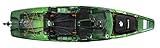
7. Perception Showdown 11.5 is the best standing-deck choice
- 450 lb capacity
- wide flat standing deck
- elevated mesh seat
- silent traction pads
- gear recesses
- 85 lb listed weight
- 4.1 rating from 26 reviews
- one-seat layout
The Perception Showdown 11.5 is the standout for a buyer who puts standing room first. The listing specifies a 36-inch width, wide flat deck, silent traction pads, and an elevated fold-away lawn-chair-style mesh seat, all features aimed at sight lines and stable footing while fishing.
Its 450-pound capacity is the highest clearly stated figure in this list. There is room for a substantial fishing load on paper, but the boat itself is listed at 85 pounds, which shifts the practical question from deck space to how you will cartop, wheel, or carry it to the water.
Fishing details include double-barrel rod holders, molded-in rod notches, integrated gear-storage recesses, and side carrying handles. The listing describes a pedal system for hands-free propulsion and shallow-water maneuvering, but it does not specify whether that system is a fin or propeller arrangement in the supplied data.
The hull and deck have a five-year limited warranty against material or manufacturing defects, with one year on installed accessories. Its 4.1 rating is based on 26 reviews, so the listing offers useful feature detail but still benefits from direct questions about parts, drive servicing, and the exact current configuration.
The Showdown 11.5 is best when stand-up fishing and capacity lead the decision
I would put the Showdown at the top of a standing-fishing shortlist. The 36-inch width, traction pads, elevated seat, and flat deck give the clearest published case for a spacious working platform among these eight choices.
The 450-pound capacity also gives the most stated load margin. That can be helpful for anglers carrying a larger crate, multiple rods, electronics, and the standard safety kit, provided the complete load stays below the manufacturer limit.
The Showdown 11.5 demands a transport plan before it earns a place in the garage
An 85-pound listed hull is not a casual one-handed carry. A cart, a second person, or a vehicle-loading routine can be more important to everyday use than the long list of deck features.
The drive type is not named in the supplied information, which makes it harder to compare pedal motion directly with the Raptor fin drive or the propeller-drive models. Confirm the drive architecture and parts support if your fishing includes grass, very shallow flats, or frequent pedal-service needs.
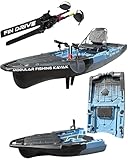
8. Reel Yaks Recon 10.5 is the best included-gear modular setup
- Fin drive
- two-piece design
- stadium seat
- paddle and rod holder included
- tracks and hatches
- Capacity fields conflict
- only 21 reviews
- 4.1 rating
The Reel Yaks Recon is a 10.5-foot modular kayak that comes with a paddle, 360 rod holder, stadium seat, and pedal-drive equipment in the supplied product data. That included-gear approach reduces the number of basic fishing and backup-propulsion items a new owner needs to sort out separately.
The product details call it a fin-drive model, with a wide W-hull, flush-mount rod holders, track rails, and storage hatches. Its technical data gives an 88-pound item weight and 35.4-inch width, while the design is described as two pieces for apartments, garages, and vehicle trunks.
Capacity needs special attention. The product title says 400 pounds, yet the detailed technical field and product details name 430 pounds; I would use neither number as a final decision point without checking the capacity plate or current manufacturer specification.
Its 4.1 rating is based on 21 reviews, with 57 percent five-star ratings and 12 percent one-star ratings in the supplied summary. The hull warranty is listed as two years, which is clear enough to compare with the one-year Raptor and the longer published Pelican and Perception hull terms.
The Recon works for a buyer who wants core fishing gear in a modular package
I would consider the Recon when a stadium seat, paddle, 360 rod holder, tracks, and hatches are all useful from the outset. The paddle is especially practical as a backup if the drive is raised, obstructed, or being serviced.
The modular form can make storage more approachable than a one-piece 10.5-foot boat. The listed 35.4-inch width and W-hull description also indicate that balance is a design priority, though only an on-water fit can tell you whether it meets your standing needs.
The Recon requires capacity verification and realistic assembly expectations
The 400- versus 430-pound discrepancy is too important to ignore. Confirm the final limit in writing, then leave a practical buffer instead of loading right to the stated maximum.
At 88 pounds listed, this remains a substantial kayak even though it divides into pieces. The two-year hull warranty is useful, but buyers who value the largest review sample should also weigh the Raptor’s 160 ratings and its different fin-drive setup.
The right pedal kayak starts with drive type, load, and launch routine
Choose the drive before getting distracted by accessory lists. A propeller drive typically uses a bicycle-like circular pedal motion, and the Albott, Raider, Radar, and BKC listings identify that format; the Albott listing also specifies reverse maneuvering.
A fin drive uses a back-and-forth motion, and the Raptor and Recon listings identify that layout. It can be a good match for quiet movement and some shallow-water situations, but drive clearance and behavior are model-specific, so do not assume every fin drive works the same way in weeds, rocks, or mud.
A stable hull is the answer when standing casts are part of your plan
Start with width, hull form, deck shape, and your own balance. The Showdown lists a 36-inch width, flat standing deck, and traction pads, while the Reel Yaks models use W-hull descriptions; those are useful signals, not a universal standing guarantee.
Try a similarly sized kayak if you can, and practice in calm, protected water before standing with rods or turning to reach gear. A low center of gravity, uncluttered deck, and a load placed close to the center of the boat all help.
A real capacity calculation is the answer when gear keeps growing
Capacity includes far more than body weight. Add a personal flotation device, clothing, water, tackle, anchor, crate, cooler, fish finder, transducer, battery, and every accessory that stays aboard, then compare that total to the confirmed manufacturer limit.
Leave headroom rather than treating the maximum as a target. The Pelican’s 350-pound listing needs particularly careful math, while the Perception’s 450-pound figure offers more published margin; both still need a safe, balanced load.
A carry test is the answer when a kayak looks light on paper
Listed hull weight does not describe every lift. A 65-pound or 67-pound boat can be broad and awkward, while a heavier modular kayak may be easier because it separates into smaller pieces, as the Raider and Radar listings describe.
Map the full route from storage to vehicle to launch. Include stairs, gates, soft ground, trailer height, roof-rack height, and the distance from parking to water, then decide whether you need a cart or another person for every trip.
A service routine is the answer when pedal-drive maintenance worries you
Rinse the drive, rudder hardware, and hull after use, especially after salt or dirty water, and inspect moving components before each launch. Follow the maker’s manual for lubrication, storage, and replacement parts rather than applying a generic fix to a particular drive system.
Warranty terms are only one part of ownership. The analyzed listings state six months for the Albott, one year limited for the Raptor, two years for the Raider, Radar, and Recon hulls, lifetime limited hull coverage for the Pelican, and five years limited on the Perception hull and deck; coverage conditions and accessory terms vary.
A paddle and personal flotation device are the answer when plans change
Hands-free kayaking does not remove the need for basic safety equipment. Carry a paddle as backup, wear a properly fitted personal flotation device, watch weather and water conditions, and practice getting back aboard in safe, shallow conditions.
The 120 rule is a cold-water reminder: when the combined air and water temperature is below 120 degrees Fahrenheit, dress for immersion with suitable thermal protection. Avoid alcohol on the water, tell someone your route, and treat wind and current as real limits rather than inconveniences.
FAQs
What is the 120 rule in kayaking?
The 120 rule says that when the combined air and water temperature is below 120 degrees Fahrenheit, you should dress for immersion with suitable thermal protection. A pedal drive does not change cold-water safety needs.
Are pedal kayaks any good?
Pedal kayaks are good for anglers who want hands-free propulsion for fishing, better water coverage, and a steadier casting routine. They also add weight, drive maintenance, and storage considerations, so the right choice depends on your launch and transport routine.
What is the leading cause of death in kayaks?
Drowning is the leading cause of death in kayaking, often after a capsize or when a paddler cannot get back aboard. Wear a properly fitted personal flotation device, account for water temperature and weather, and practice re-entry before relying on a new kayak offshore.
Is a pedal kayak better than a paddle kayak?
A pedal kayak is better when hands-free fishing, steady propulsion, and covering water are the priority. A paddle kayak can be simpler to carry, store, and maintain, so neither is better for every angler or launch site.
The Albott is the strongest all-around modular answer for 2026
The Albott is my first pick for its modular build, propeller drive, adjustable seating, and two-seat listing, provided its 109.7-pound listed weight and lower 400-pound technical capacity work for your routine. The Raider is the better transport-led choice, and the Showdown is the most compelling published standing-deck option.
The best pedal kayaks are not automatically the longest, widest, or most accessorized models. Choose the drive motion you can use comfortably, verify the exact capacity and warranty for the final configuration, and make a launch-and-storage plan that lets you get on the water often.