
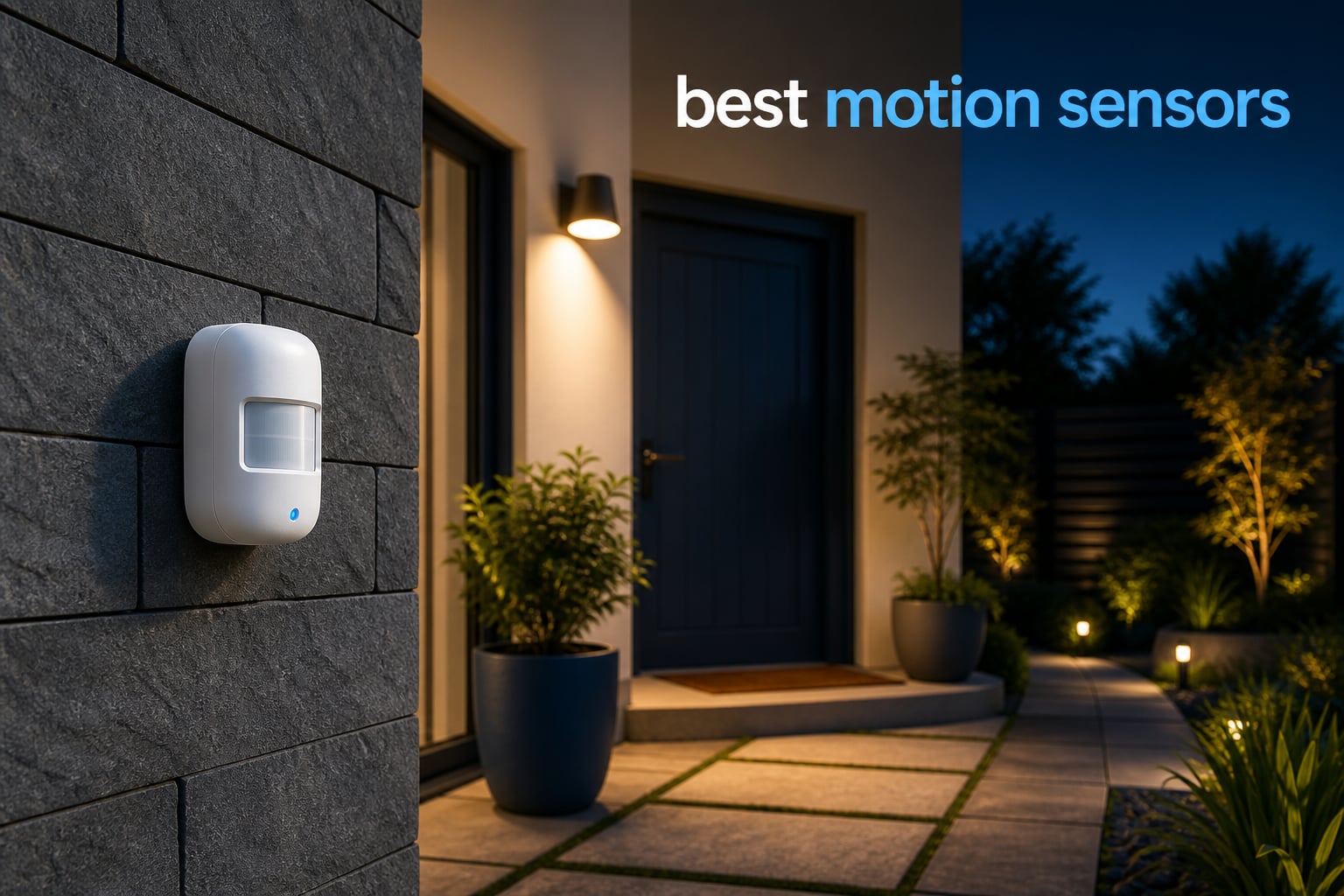
The best motion sensors turn a small movement into a useful action: a hallway light comes on, a security alert arrives, or a room stops wasting power when it is empty. The right choice is less about buying the sensor with the longest claimed range and more about matching its protocol, power source, coverage, and automation options to your home.
I narrowed this list to 10 products with documented specifications and distinct jobs, from a weatherproof outdoor unit to sensors made for Zigbee, Amazon Sidewalk, Matter over Thread, and room-level presence detection. I also called out the catches that come up often in owner discussions: a required hub, pets setting off alerts, an advertised range that does not fit every room, and setup choices that can limit a sensor’s best features.
For a normal indoor PIR sensor, movement means a changing heat pattern. A presence sensor uses radar instead, so it can notice much smaller movements and may keep lights on while someone is sitting still. That difference is the first decision I would make before looking at mounting hardware or app automations.
These recommendations are based on the supplied product listings, specifications, and review summaries rather than a claim of hands-on testing. Before ordering, check that the listed ecosystem and required hub match the devices already in your house; that single check prevents most disappointing smart-home purchases.
Table of Contents
The three clearest picks cover outdoor coverage, flexible Zigbee use, and long battery life
Choose the Philips Hue Outdoor Motion Sensor for an exterior lighting area, the THIRDREALITY Zigbee Motion Sensor for broad hub compatibility and pet-aware placement, or the Aqara Motion Sensor P1 when a long battery claim and adjustable timeout matter most. The cards below give the shortest route to those decisions.


The best motion sensors in 2026 are easiest to compare by protocol, coverage, and power
This overview compares all 10 models without pretending that their ranges are interchangeable. An outdoor wall sensor, a compact indoor PIR sensor, and a ceiling-mounted radar sensor solve different problems even when all can trigger a light.
| Product | Specifications | Action |
|---|---|---|
| Philips Hue Outdoor Sensor |
|
Check Availability |
 Ring Motion Detector Ring Motion Detector |
|
Check Availability |
 Aqara Motion Sensor P1 Aqara Motion Sensor P1 |
|
Check Availability |
 SONOFF SNZB-03P SONOFF SNZB-03P |
|
Check Availability |
 Haozee Smart Motion Sensor Haozee Smart Motion Sensor |
|
Check Availability |
| THIRDREALITY Zigbee Sensor |
|
Check Availability |
 SONOFF SNZB-06P SONOFF SNZB-06P |
|
Check Availability |
 THIRDREALITY Motion R1 THIRDREALITY Motion R1 |
|
Check Availability |
 SONOFF SNZB-06P24 SONOFF SNZB-06P24 |
|
Check Availability |
 Aqara Motion Light P2 Aqara Motion Light P2 |
|
Check Availability |
1. Philips Hue Outdoor Motion Sensor is the best choice for Hue-powered exterior lighting
- IP44 outdoor rating
- wide 160 degree area
- 39 foot range
- major assistant support
- battery power
- Hue Bridge required
- works best in Hue ecosystem
The Philips Hue Outdoor Motion Sensor is the direct pick for a driveway, porch, patio, garage approach, or garden path that already uses Hue lights. Its 160-degree detection area and stated 39-foot maximum range are far more suited to a broad exterior zone than the small indoor sensors on this list.
Its IP44 weatherproof rating is the fact that matters here. The sensor can be mounted on a flat wall, an inside or outside corner, or a post, so I would use its adjustable placement to aim across a route people walk rather than directly toward a public sidewalk.
The product listing says that a Hue Bridge is required for automations, remote control, and a stable connection. That is a real ecosystem commitment, but it also makes sense for a household already running Hue, because one sensor can control compatible indoor and outdoor Hue lights instead of acting as a standalone alert device.
Alexa, Google Assistant, and Apple HomeKit support make the sensor easier to keep in a mixed smart home. Its battery-powered design also avoids running a cable outside, although every battery-powered outdoor unit needs a reachable mounting location for future battery changes.
For exterior lighting, I would pair the motion trigger with a time window and a darkness condition in the Hue system. That keeps lights from coming on in daylight and limits repeated triggers from activity that is normal for your location.
Forum conversations commonly warn that coverage and hub requirements deserve more attention than the headline range. This model has a clear answer on both: it is designed for outdoor placement, and it asks for the Hue Bridge rather than a generic Zigbee coordinator.
The installation decision is whether your outdoor zone already has Hue lighting
Buy this sensor when you want one motion event to control Hue lights across an exterior area. The bridge requirement is not a flaw if Hue is already your lighting system; it is a reason to choose a different model if it is not.
Mount it where a person crosses the sensor’s view, then adjust its angle before relying on it for a dark walkway. A sensor pointed into a busy street or toward moving branches can create unwanted light activity.
The coverage decision is whether IP44 protection fits the exposure at your wall or post
IP44 means this is a weatherproof outdoor option, not a promise that every exposed location is identical. A protected mounting point usually makes servicing and aiming easier than the most exposed corner of the property.
The listed 39-foot maximum range and 160-degree area favor driveways, paths, and patios over a narrow interior passage. For a small indoor room, its coverage is more than most people need.
2. Ring Motion Detector is the best no-base-station option for Amazon Sidewalk homes
- No base station
- pet settings
- instant alerts
- 30 foot range
- battery power
- Amazon Sidewalk required
- coverage varies
- monitoring is optional
Ring’s newest Motion Detector takes a different route from Zigbee sensors: it connects through Amazon Sidewalk and does not need a base station. That is appealing for someone who wants a room sensor without adding a dedicated hub, provided Sidewalk coverage is available where the sensor will be used.
The listing specifies a 9.1-meter range, which is about 30 feet, and a 90-degree field of view. That is a sensible shape for watching one room, an entry path, or a hallway, rather than trying to cover a wide open floor plan from one corner.
Its pet-friendly setting is a major differentiator. Ring says the setting can reduce false alerts from pets under 50 pounds, which makes this one of the more relevant options for a home where a roaming dog or cat would make an ordinary security sensor noisy.
Instant motion-activated notifications are part of the core job, while optional Ring Pro Monitoring adds a separate monitoring path for compatible service plans. I would treat monitoring as a separate decision from the sensor itself, since not every household wants ongoing service attached to a simple motion alert.
There is an important limitation in the product data: Sidewalk is required and coverage can vary by location. Before making this your indoor security sensor, confirm that the Amazon Sidewalk connection is practical in the exact room where the unit will sit.
This is not presented as an outdoor, weatherproof sensor. Put it in the indoor role it was designed for, and use the pet setting as a starting point rather than assuming it will eliminate every false motion event.
The network decision is whether Amazon Sidewalk is available at the intended location
The no-base-station design is convenient only when Sidewalk can actually provide coverage. A check before installation is more useful than moving the sensor around after alerts begin dropping.
Households already using Ring may find the app and notification flow familiar. People building a mixed Zigbee or Matter setup may prefer a sensor that joins their existing hub instead.
The pet decision is whether a setting for animals under 50 pounds matches your household
Pet-aware settings can reduce nuisance notifications, but room layout still matters. Aim the detector away from areas where a pet jumps onto furniture or crosses close to the device.
The 90-degree field of view also offers a practical way to narrow attention to a doorway or passage. That is often more effective than trying to make a broad sensor ignore all animal movement.
3. Aqara Motion Sensor P1 is the best long-battery PIR sensor for an Aqara hub
- Claimed 5 year battery
- adjustable timeout
- three sensitivity levels
- wide angle
- Home Assistant support
- Aqara hub required
- not for other Zigbee hubs
- features vary by platform
The Aqara Motion Sensor P1 is a straightforward PIR sensor with unusually useful controls. Aqara lists a five-year battery life from two CR2430 coin cells, three sensitivity levels, and an app-adjustable detection timeout from one to 200 seconds.
Those timeout settings matter more than they first appear. A short timeout can make a hallway light respond quickly after each pass, while a longer one can stop a room light from turning off between ordinary movement. I would set the timeout around the actual activity pattern instead of copying a generic automation recipe.
Coverage is specified as 170 degrees up to four meters and 150 degrees up to seven meters. The included 360-degree stand gives you a way to refine the aim, which helps reduce unwanted triggers from a nearby doorway, pet route, or heated appliance.
This sensor requires an Aqara Zigbee 3.0 hub and is not compatible with other Zigbee hubs according to its listing. It works with Aqara Home, HomeKit, Alexa, IFTTT, and Home Assistant, but platform support is not identical: Aqara notes that light sensitivity is unavailable in HomeKit and Alexa.
Owner discussions often praise Aqara’s battery claims but also mention that ecosystem setup deserves patience. Update the hub firmware, keep the sensor within the listed 10-meter distance of the Aqara hub, and verify the automation in the platform you actually plan to use.
For the best motion sensors list, this is my clearest indoor PIR recommendation for someone committed to Aqara. The combination of timeout control, wide view, and claimed long battery life is more useful for lighting automations than a basic fixed-delay detector.
The automation decision is whether adjustable timeout will improve your room routine
Choose the P1 when you want control over how quickly a detected room is considered inactive. That level of adjustment suits hallways, bathrooms, and living areas with very different traffic patterns.
A PIR sensor still may not see a person who sits completely still. Use a longer timeout in a desk area, or choose a presence sensor farther down this guide when stationary occupancy is the actual goal.
The hub decision is whether an Aqara Zigbee hub is already part of your setup
The P1 is not a general-purpose Zigbee device for any coordinator. Its required Aqara hub is the tradeoff for its stated Aqara ecosystem support and app controls.
Home Assistant compatibility is listed, but the hub remains part of the path. Readers who want a sensor to pair directly with a different Zigbee hub should compare the THIRDREALITY and SONOFF choices instead.
4. SONOFF SNZB-03P is the best local-scene choice for quick Zigbee lighting triggers
- Fast 5 second response
- local scenes
- 3 year battery
- Zigbee 3.0
- security alerts
- Zigbee hub required
- 19.7 foot stated range
- indoor-oriented
The SONOFF SNZB-03P is aimed at simple, fast indoor automations. SONOFF specifies a five-second shortest detection interval for automatic lights, a 19.7-foot range, and more than three years of battery life from its included CR2477 battery.
Its strongest feature is local smart scene support. The product information says Zigbee scenes can still run when Wi-Fi is down as long as the Zigbee devices are powered on, which is a meaningful distinction for a light that needs to react at the moment someone walks into a dark room.
The sensor uses Zigbee 3.0 and is listed as compatible with SONOFF NSPanel Pro, iHost, ZB Bridge Pro, ZBDongle-E, and Echo Plus second generation. It still needs a Zigbee hub, so the quick setup story starts with making the hub choice before buying several sensors.
A 19.7-foot range is not a drawback in a compact hall, utility room, or bathroom. It does mean I would not put one at the far end of a large open living area and expect it to cover every corner.
SONOFF also frames it as a home-security trigger that can start camera recording, an alarm, and notifications through the gateway. That can be useful, but a motion event is not proof of who or what caused it, so use it as one signal in a broader security routine.
For households concerned about cloud dependence, local lighting scenes are the reason to look closely here. The sensor itself is battery powered, while the dependable behavior depends on the nearby Zigbee mesh and the powered devices that support it.
The response decision is whether a short detection interval matters in your lighting routine
The stated five-second shortest interval is well suited to a closet, landing, or busy hallway. It is less important in a room where lights should remain on for several minutes after a person leaves.
Set the automation delay separately from the sensor’s ability to report again. A quick report and a sensible turn-off delay can work together without making lights flicker.
The reliability decision is whether local Zigbee scenes fit your outage plan
Local scene execution can keep a basic Zigbee lighting routine working when Wi-Fi is unavailable. It does not remove the need for a powered, compatible Zigbee hub and a healthy local mesh.
Place the sensor within dependable range of the network rather than at the most distant edge of the house. Forum users regularly report that real coverage depends on walls and hub placement, not only a number on the box.
5. Haozee Smart Motion Sensor is the best compact option with motion and illumination data
- Motion and illumination sensing
- Home Assistant support
- Zigbee2MQTT support
- battery placement
- activity records
- Zigbee hub required
- manual language may vary
- limited temperature data
The Haozee Smart Motion Sensor combines a PIR motion detector with illumination sensing. That second reading gives an automation a useful context: a light can react to a person entering only when the room is actually dim enough to need it.
It is a battery-powered Zigbee product and requires a Zigbee hub. The listing specifically names Home Assistant and Zigbee2MQTT support, making it worth a look for a household that wants sensor states available in a more customized automation system.
Its advertised high sensitivity is intended to detect people and animals in range, with a mobile notification and an alert when motion is detected. Since it sees animals too, I would not treat it as pet immune; point it carefully in a home with pets and use the lux reading to make lighting rules more selective.
The sensor can display historical detection records in the app according to the listing. An activity record is helpful when you are tuning a routine, because it shows whether the problem is a missed motion event, a poorly chosen delay, or an automation that reacts at the wrong time.
This is a compact indoor choice for someone who wants to experiment with light-aware automations but accepts a less established review base than the larger brands. The supplied data does not list a maximum detection range, so buy it for the protocol and PIR-plus-lux combination rather than a long-distance coverage claim.
The operating-temperature detail in the product data is limited, which is another reason I would reserve it for normal indoor rooms instead of a shed, exterior wall, or unconditioned garage. A dedicated weatherproof model is the safer outdoor direction.
The lighting decision is whether a separate illumination reading will improve your automation
A motion-only rule may turn lights on during a bright afternoon. Motion plus a light threshold gives a more selective trigger for a bathroom, entry, basement, or hallway.
Test the threshold at the time people actually use the room. The amount of daylight reaching a window can change sharply by season and by whether a door is open.
The integration decision is whether your Zigbee hub supports the system you plan to run
Home Assistant and Zigbee2MQTT support are listed, but a Zigbee hub is still required. Confirm the pairing path before installing the sensor in a hard-to-reach location.
Use the historical records to adjust the automation after installation. This is especially helpful when motion activated lights behave differently around pets, reflected sunlight, or an active doorway.
6. THIRDREALITY Zigbee Motion Sensor is the best pet-friendly choice for broad hub compatibility
- Pet friendly design
- wide platform support
- Alexa routines
- 2 year battery
- easy setup
- Zigbee hub required
- some connectivity reports
- indoor use only
The THIRDREALITY Zigbee Motion Sensor is a practical answer for people who already have a compatible Zigbee hub and want fewer platform restrictions. Its supported-device list includes Home Assistant, SmartThings, Aeotec, Homey, Hubitat, and several Echo and Eero devices with built-in Zigbee hubs.
The sensor is described as pet friendly, has a stated 20-foot detection range, and runs on two included AAA batteries for a listed two-year typical battery life. Standard AAA cells can be easier to replace than specialty coin cells, especially if you plan to install several sensors around the house.
Alexa routines are a natural fit. The listing gives examples such as turning on a smart light or smart plug when motion appears and turning it off after the delay you specify. That is a clean use case for an entry, stair landing, closet, or utility space.
It is for indoor use only. The broad hub support should not be confused with weather resistance, so a covered porch or garage with temperature swings is still better served by a sensor designed for that environment.
Review data includes some reports of connectivity issues. I would take that as a reason to place it where the Zigbee mesh is strong, verify it stays connected for several days, and add a powered Zigbee repeater if the room sits at the edge of the network.
This model makes the most sense when pet-friendly placement and ecosystem flexibility are more important than advanced timeout or light-level controls. It is one of the clearer general indoor options among the best motion sensors for a multi-platform home.
The compatibility decision is whether your existing Echo or hub has a built-in Zigbee radio
A compatible built-in Zigbee hub can remove the need for another dedicated bridge. Check the exact Echo, Eero, or hub model rather than assuming every smart speaker provides Zigbee pairing.
For Home Assistant, SmartThings, Homey, Hubitat, and Aeotec users, the listed support offers a broader starting point than a sensor tied to one brand’s bridge.
The pet-placement decision is whether the sensor can watch a route above animal activity
Pet friendly design can help, but placement still has the final say. Mounting the sensor to observe human-height movement across a doorway is usually smarter than aiming it down at a pet’s favorite floor route.
Use a short period of notification-only automation before attaching an alarm or a bright light action. That lets you see whether the room’s real pet activity needs a different aim or a different rule.
7. SONOFF SNZB-06P is the best entry-level presence sensor for keeping lights on while you sit still
- Detects stationary people
- light sensing
- local scenes
- Zigbee 3.0
- multiple platforms
- Zigbee hub required
- 4 meter range
- not battery powered
The SONOFF SNZB-06P is not a standard PIR sensor. Its 5.8GHz microwave radar is designed to detect both movement and a stationary person, which is the key advantage in a home office, reading area, bedroom, or bathroom where a person may remain still long enough for a PIR sensor to assume the room is empty.
The stated maximum range is four meters, so this is a close-range room sensor rather than a device for a long corridor. It is powered by DC instead of a battery, which means planning a nearby outlet or power connection is part of the installation decision.
A built-in light detector lets the sensor limit light actions to dark conditions. That gives it a useful combination for hands-free lighting: detect that someone remains in the room, but do not turn on lights simply because the room is occupied during a bright day.
It uses Zigbee 3.0 and supports local smart scenes. The product data lists Alexa, Google Home, SmartThings, IFTTT, and Home Assistant support, though a compatible Zigbee bridge remains required for operation.
Presence detection can be more sensitive than motion detection, which is why placement and calibration are important. I would begin with the least intrusive automation, such as keeping a lamp on, before attaching the sensor to security notifications or whole-room scenes.
This is the right category when the complaint is “the lights turn off while I am still here.” If the actual need is simply noticing somebody walking through a hall, a battery PIR sensor will usually be simpler and needs less power planning.
The sensing decision is whether stationary occupancy matters more than fast walk-by detection
Radar presence sensing can notice a person who is reading, working, or resting with little visible movement. That is the main reason to select this model over a conventional PIR sensor.
Use it in a defined room within its listed four-meter range. A space with too many adjacent activity sources can make a sensitive presence rule harder to tune.
The power decision is whether a DC-powered installation is realistic at the mounting point
This sensor is not a battery model, so concealment and cable routing deserve thought before mounting. The tradeoff is avoiding routine battery replacement for a sensor that may be used frequently.
Keep the Zigbee bridge requirement in the plan as well. A local scene can be useful during a Wi-Fi outage, but the Zigbee network still has to be properly installed.
8. THIRDREALITY Motion Sensor R1 is the best adjustable-range option for changing room sizes
- Manual sensitivity adjustment
- up to 9.5 meter range
- Zigbee ecosystem support
- real-time alerts
- AA power
- Lower 3.7 rating
- hub required
- battery-life details conflict
The THIRDREALITY Motion Sensor R1 is built around adjustable sensitivity. Its controls allow a listed range from 1.5 to 9.5 meters, so I would consider it for a room where a fixed sensitivity setting would either miss the doorway or notice activity too far beyond the intended zone.
The product information says adjustment happens with button controls rather than by opening a mobile app. That is helpful if you want a physical way to refine coverage while standing in the room, although the sensor still needs a Zigbee hub for its smart-home role.
It supports Home Assistant, SmartThings, Homey, Hubitat, and compatible Echo devices with built-in Zigbee. The listing also says the device is designed for real-time human motion detection without being affected by heat or sunlight, a useful claim for a room near windows that should still be checked in the actual installation spot.
There is a data inconsistency worth flagging rather than glossing over: the specifications list a three-year battery average life, while the feature text says three AA batteries can last up to one year under typical use. Plan around the more conservative one-year statement and treat actual replacement timing as dependent on traffic and reporting frequency.
The rating is 3.7 from 127 reviews in the supplied data, lower than many alternatives here. That does not make it unusable, but it does move it behind the higher-rated THIRDREALITY standard sensor unless adjustable range is specifically the feature you need.
Its best role is a room with awkward geometry: perhaps an entry where a short setting avoids a nearby corridor, or a larger room where a longer setting reaches the route people use. Verify the setting with notifications before relying on it to run an important automation.
The coverage decision is whether manual range adjustment solves a real placement problem
Adjustable sensitivity is useful when a sensor must focus on one path while ignoring another. It is not a replacement for choosing a mounting position that naturally limits what the sensor can see.
Start at a moderate range, then increase only if a legitimate route is missed. A longer setting may include movement you did not intend to automate.
The confidence decision is whether the lower rating is acceptable for a specialized feature
The supplied rating and review count suggest more caution than with the standard THIRDREALITY model. Test it in the actual room before making it the only trigger for security or safety-related actions.
Battery-life information also conflicts within the listing, so a reachable placement is sensible. AA batteries are convenient, but accessible mounting makes every maintenance task easier.
9. SONOFF SNZB-06P24 is the best ceiling presence sensor for zone-based room control
- Micro-movement detection
- seven zones
- self-learning calibration
- light sensor
- ceiling coverage
- Corded power
- lower 3.7 rating
- Zigbee hub required
- 4 meter range
The SONOFF SNZB-06P24 is the most specialized sensor in this roundup. It uses 24GHz mmWave radar to detect micro-movements such as breathing, has a ceiling-mount form factor, and lets you configure up to seven zones within a four-meter range and 110-degree field of view.
Zone control is the feature to focus on. Instead of treating the whole room as one area, you can choose which parts should count and which should be ignored, such as a sofa or desk while excluding a corridor or a window-facing edge.
The listing describes self-learning calibration that filters repetitive interference from appliances, pipes, or airflow. That is promising for a sensitive radar sensor, but I would still allow time for calibration and confirm that routine room conditions are not creating unwanted presence events.
An ambient light sensor with calibration and historical data gives this a strong lighting-automation focus. A room can stay lit while occupied and dark, then turn off only when the relevant zone is empty, rather than reacting to every small movement with a basic on-off rule.
It is corded electric, so this is a planned installation rather than a sensor to stick anywhere for a quick trial. It works with Home Assistant, SmartThings, and Alexa through compatible Zigbee ecosystems, but a hub is required and the supplied rating is 3.7 from 75 reviews.
I would choose it for a desk, seating area, or bathroom where zones and subtle-presence detection solve a known lighting annoyance. It is unnecessary for a simple doorway trigger, where a standard PIR sensor is simpler to install and much easier to aim.
The room-layout decision is whether seven zones will prevent unwanted automations
Zone settings help when one room has different purposes, such as a working desk beside a passage. They can tell the automation to care about occupancy in the seating or working area rather than every nearby movement.
Draw the zones around how people actually use the room. Give the calibration process time before judging whether a boundary needs to move.
The installation decision is whether ceiling power and Zigbee coverage are available together
Ceiling placement can provide useful room coverage, but corded power makes the location less flexible than a battery sensor. Plan the cable route and the service access before the device is mounted.
Its four-meter range should be measured against the ceiling height and the key occupied area. A large open-plan room may need a different sensor arrangement rather than one sensitive device at its center.
10. Aqara Motion and Light Sensor P2 is the best Matter-over-Thread PIR option
- Native Matter Thread
- independent light sensor
- 170 degree angle
- local automations
- adjustable stand
- Thread border router required
- Alexa lacks light sensor support
- lower 3.6 rating
The Aqara Motion and Light Sensor P2 is the protocol-forward pick for a household moving toward Matter over Thread. It pairs a PIR motion sensor with a separate light sensor and is designed to work through a compatible Matter controller that also acts as a Thread Border Router.
Its listed coverage is up to seven meters, with a 170-degree horizontal and 45-degree vertical detection angle. The included 360-degree adjustable stand makes it easier to direct that wide field toward the area that should activate a light.
The P2 uses two CR2450 lithium batteries with a listed two-year battery life. Aqara says automations can execute without the cloud, which is an important privacy and reliability point for a basic local lighting action.
Native Matter compatibility does not mean that every platform exposes every sensor feature in the same way. The product information specifically says Alexa does not support the light sensor functionality, so an automation that relies on brightness needs to be verified in the chosen ecosystem before this becomes your main light-control sensor.
The technical path is more demanding than a simple Zigbee sensor because a 2-in-1 Matter Controller and Thread Border Router are required. That may be natural for an Apple Home or compatible Alexa household already using Thread, but it is an unnecessary hurdle for someone who just wants one hallway motion trigger.
With a 3.6 rating from 648 reviews in the supplied data, I would buy it for its Matter-over-Thread and local-automation strengths, not as a blind pick. Confirm controller support, Thread coverage, and the platform’s available sensor states first.
The protocol decision is whether your home already has a Matter controller and Thread Border Router
The P2 needs both functions, sometimes in one device. Check the exact controller before purchase, because Matter support alone does not automatically mean Thread Border Router support.
Thread can offer a low-power mesh path for a battery sensor, but every smart-home system still needs a compatible setup and reasonable network coverage where the sensor will be mounted.
The feature decision is whether your preferred platform exposes both motion and light readings
The independent light sensor is a strong reason to choose the P2, but Alexa does not support that functionality according to the listing. If brightness-based lighting is the goal, test the available controls in your platform plan.
For a motion-only Matter routine, the P2 remains a compact option with local automation capability. The adjustable stand and wide horizontal angle offer useful placement flexibility indoors.
The right motion sensor starts with the kind of movement you need to detect
A motion sensor is a device that detects a change in its view and sends that event to a light, app, alarm, or automation. Most compact battery models here are PIR sensors, short for passive infrared, which look for changes in heat signatures from people and animals.
A PIR sensor is usually the better choice for a hallway, entry, closet, stairway, or quick security notification. It responds well when somebody walks across its field, consumes little power, and can run for long periods from coin or AA batteries.
A presence sensor uses radar rather than the same PIR approach. It can see smaller movement from a seated person and, on some models, subtle micro-movements; that makes it more appropriate when lights turn off while someone is quietly working, reading, or resting.
The best outdoor motion sensor is a weather-rated model matched to your lighting ecosystem
For the products in this guide, the Philips Hue Outdoor Motion Sensor is the dedicated outdoor recommendation because it carries an IP44 weatherproof rating, has a 39-foot stated range, and covers 160 degrees. It is the choice for a Hue user who wants exterior lights to react to movement along a driveway, patio, garden, or entrance.
Outdoor placement is not only about a weather rating. Aim the sensor across the path a person will cross, avoid placing it directly toward a road or a heavily moving tree, and choose a mounting point that remains reachable for battery service.
Do not use an indoor-only Zigbee sensor outdoors just because it is inexpensive or simple to pair. Temperature swings, moisture, and long-distance mesh coverage can all make an exterior installation less dependable than its indoor specification suggests.
The most important buying checks are protocol, range, placement, power, and false-alert control
The protocol answer is to buy the sensor that joins the hub you already own
Aqara P1 requires an Aqara Zigbee 3.0 hub and is not listed for other Zigbee hubs. SONOFF models require a compatible Zigbee bridge, while the THIRDREALITY models list a wider set of Zigbee-platform options, including several hubs and Echo devices with built-in Zigbee.
The Ring sensor uses Amazon Sidewalk rather than a base station, which can be convenient where coverage is present. The Aqara P2 uses Matter over Thread and needs a compatible Matter controller plus a Thread Border Router.
Do not treat “works with Alexa” as a complete answer about setup. The key question is how the sensor reaches Alexa: through a brand hub, a built-in Zigbee hub, a Thread network, or Amazon Sidewalk. That path determines whether it pairs at all and which features appear.
The coverage answer is to place a PIR sensor across the route people travel
Detection range measures distance, while detection angle describes the width of the sensor’s view. A model with a wide angle is useful for a broad area, but it may also see movement through a nearby open door if it is pointed carelessly.
For a PIR sensor, crossing the field of view is usually more reliable than walking straight toward it. Before fastening a mount or applying adhesive, hold the sensor in the likely position and watch the motion events for a day.
Walls, furniture, glass, and hub placement change real-world results. The listed range is a useful comparison point, not a promise that every floor plan will offer that exact usable distance.
The power answer is to choose battery cells for flexible placement and corded power for constant presence sensing
Battery models work well for hallways, closets, and temporary placement because no outlet is required. Aqara lists five years for the P1, SONOFF lists three years for the SNZB-03P, and THIRDREALITY lists two years for its standard sensor, but traffic level and reporting settings can shorten those figures.
Coin-cell units stay compact, while AA or AAA units can be easier to service with commonly available batteries. If a sensor is high on a wall or outdoors, maintenance access is part of the design, not an afterthought.
Corded radar sensors such as the SONOFF presence choices make sense when stationary detection is needed and power can be planned at the mounting point. Their lack of battery servicing can be appealing, but installation is less flexible.
The pet answer is to begin with placement and use pet settings as an extra layer
Pets are a common source of unwanted motion events. The Ring Motion Detector has pet-friendly settings for pets under 50 pounds, and the standard THIRDREALITY sensor is described as pet friendly, but no generic claim replaces careful positioning.
Mount a PIR sensor to observe a human route rather than a low, wide view of the floor. Keep it away from favorite climbing furniture and test notification-only actions before making a motion event trigger an alarm, camera routine, or bright exterior light.
Presence sensors can be even more sensitive because their job includes detecting smaller movements. Use their zones, calibration, and lighting conditions where available, then let the room’s normal activity guide further adjustments.
The automation answer is to add one condition before you add more devices
A simple rule such as “motion turns on the hall light” is a good start. A better rule often adds a condition: only after sunset, only when the light reading is low, only during a sleeping schedule, or only when a security mode is armed.
Lux-capable models such as the Haozee, SONOFF presence sensors, and Aqara P2 can support light-aware behavior. This reduces unnecessary activations in daylight and is often more effective than adding a second motion sensor.
For security, use a motion detector as one part of a routine, not as proof of an intruder. Pairing an alert with a camera, a contact sensor on a door or window, or a second confirmation can make notifications more useful.
The privacy answer is to favor local actions when they fit your household
Several listed Zigbee products support local scenes, meaning basic device-to-device actions can continue even if Wi-Fi is unavailable. Aqara says the P2 can run automations without the cloud, while Hue uses its bridge for a stable connection and remote control.
Local does not mean every notification or integration is private in every configuration. Review the permissions and account requirements of the app and hub you choose, especially before connecting activity records or alerts to a household-wide service.
For caregiving, baby-room monitoring, or pet tracking, a motion sensor can show activity but cannot explain why it happened. Keep its limits clear and choose a purpose-built safety product when a situation requires more than an automation signal.
FAQs
What are the best outdoor motion sensors?
The Philips Hue Outdoor Motion Sensor is the dedicated outdoor pick in this guide because it has an IP44 weatherproof rating, a stated 39-foot range, and a 160-degree detection area. It requires a Hue Bridge, so it is best for a home that already uses Hue lights or plans to build around that ecosystem.
What is the best sensor to detect movement?
For indoor PIR motion detection, the Aqara Motion Sensor P1 stands out for its five-year claimed battery life, three sensitivity levels, adjustable one-to-200-second timeout, and wide listed detection angle. It requires an Aqara Zigbee 3.0 hub, so it is not the right choice for every Zigbee setup.
Which is better, PIR sensor or IR sensor?
PIR means passive infrared and is the common choice for motion sensing because it detects changes in heat signatures when people or animals move. Radar presence sensors are better when you need to detect someone sitting still, but they need more careful placement and can require corded power.
Do motion sensors need a hub?
Many smart motion sensors need a specific hub or network path. Aqara P1 needs an Aqara hub, SONOFF models need a compatible Zigbee bridge, and the Aqara P2 needs a Matter controller and Thread Border Router. Ring is different because it uses Amazon Sidewalk and does not need a base station.
Can motion sensors work with Alexa?
Yes, but the route varies. Philips Hue, Aqara, SONOFF, THIRDREALITY, and the Aqara P2 list Alexa compatibility, though some features may be limited by platform. For example, Aqara states that Alexa does not support the P2 light sensor function.
The best motion sensors are the ones that match the automation system you already use
For an outdoor Hue lighting setup, choose the Philips Hue Outdoor Motion Sensor. For an Aqara home that needs a flexible indoor PIR, choose the Motion Sensor P1; for a pet-aware sensor with broad Zigbee options, the standard THIRDREALITY model is the clearer fit.
If lights go out while someone is still in the room, skip another ordinary PIR and look at the SONOFF presence sensors instead. The Aqara P2 is the more forward-looking option for a compatible Matter-over-Thread home, but its controller requirement and platform feature limits should be checked first.
In 2026, the most useful next step is simple: list your hub, voice platform, room size, and the action you want motion to trigger. Then choose the sensor whose documented connection and coverage fit that list, rather than adding another smart device that cannot join the home you already have.