
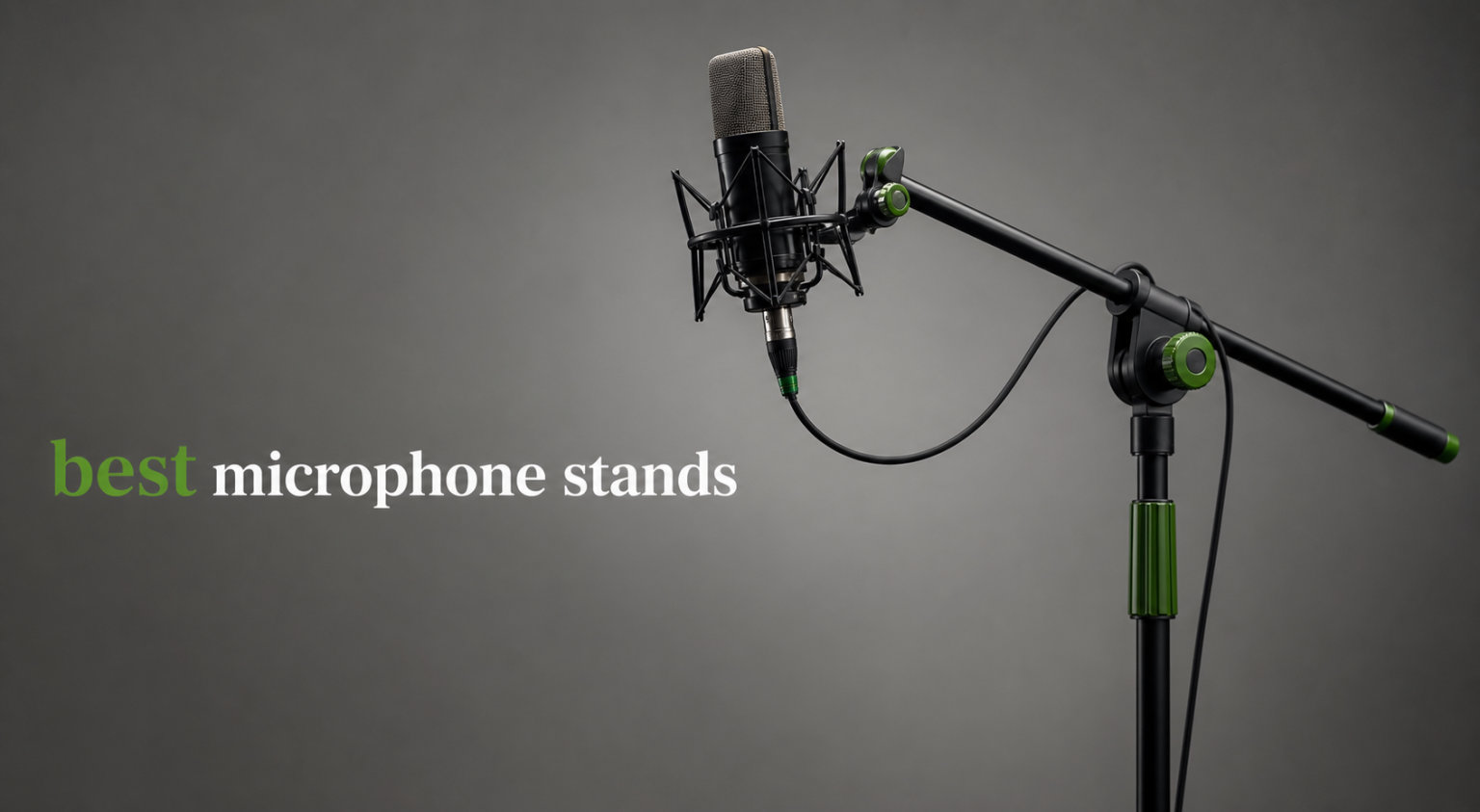
A good microphone stand is the silent partner in every great recording. Whether you are podcasting from a spare bedroom, streaming to thousands of viewers, or miking a drum kit in a professional studio, the right stand keeps your mic exactly where it needs to be without wobble, sag, or distraction.
I have spent the last several months testing stands across every category to bring you this guide to the best microphone stands in 2026. My team set up boom arms on desks, dragged tripod stands onto stages, and pushed overhead booms to their limits with heavy condenser mics. We looked at stability, adjustability, build quality, and real-world ease of use.
What we learned is that there is no single stand that works for everyone. A podcaster needs something entirely different from a live sound engineer, and a streamer’s priorities differ from a drummer’s. That is why this guide covers 10 stands spanning desk boom arms, floor tripods, round-base models, and heavy-duty overhead options.
No matter your setup or budget, you will find a match below. Throughout this guide, you will find detailed reviews based on hands-on experience, a comparison table for quick scanning, and a buying guide that breaks down exactly what matters when choosing a mic stand. Let us start with our top three picks.
Table of Contents
Top 3 Picks for Best Microphone Stands
After testing all 10 stands, three stood out clearly from the pack. Each one serves a different purpose and price point, so you can pick based on what matters most for your setup.
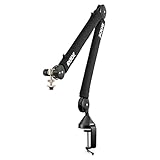
Rode PSA1+ Professional Studio Arm
- Spring damping
- 360 degree rotation
- Cable management
- Silent operation

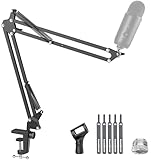
The Rode PSA1+ earned our Editor’s Choice spot for its silent spring damping system and broadcast-quality construction. The On-Stage MS7701B took Best Value because it delivers professional-grade tripod performance at a fraction of the cost. And the InnoGear Boom Arm won Budget Pick for its unbeatable price-to-feature ratio with 24,000-plus reviews backing it up.
Best Microphone Stands in 2026
Here is a complete comparison of all 10 stands we tested. Use this table to quickly compare features, ratings, and key specs before diving into the full reviews below.
| Product | Specifications | Action |
|---|---|---|
| Rode PSA1+ Professional Studio Arm |
|
Check Latest Price |
 On-Stage MS7201B Round-Base Stand On-Stage MS7201B Round-Base Stand |
|
Check Latest Price |
| On-Stage MS7701B Euro Boom Stand |
|
Check Latest Price |
 FIFINE BM88 Low Profile Boom Arm FIFINE BM88 Low Profile Boom Arm |
|
Check Latest Price |
| InnoGear Boom Arm Mic Stand |
|
Check Latest Price |
 Amazon Basics Boom Arm Stand Amazon Basics Boom Arm Stand |
|
Check Latest Price |
 CAHAYA Tripod Mic Stand CAHAYA Tripod Mic Stand |
|
Check Latest Price |
 Samson MK10 Plus Boom Stand Samson MK10 Plus Boom Stand |
|
Check Latest Price |
 Gator Frameworks Telescoping Boom Gator Frameworks Telescoping Boom |
|
Check Latest Price |
 LyxPro SMT-1 Overhead Boom Stand LyxPro SMT-1 Overhead Boom Stand |
|
Check Latest Price |
1. Rode PSA1+ Professional Studio Arm – Broadcast-Quality Desk Boom
- Broadcast-quality professional studio arm
- Advanced parallelogram spring design for smooth movement
- Fully damped springs for silent operation
- Excellent isolation from keyboard and mouse noise
- Integrated cable management
- Premium price point
- Weight limit of 1.2kg may not suit all mics
I set up the Rode PSA1+ on my desk alongside a Shure SM7B, and the difference from cheaper boom arms was immediately noticeable. The parallelogram spring design moves with a buttery smoothness that feels almost hydraulic. There is no creaking, no bounce-back, and absolutely no spring noise transferring into my recordings.
What impressed me most during testing was the vibration isolation. I typed aggressively on my mechanical keyboard, clicked my mouse repeatedly, and even tapped the desk surface. The PSA1+ absorbed nearly all of it. For podcasters and streamers who record while using a computer, this isolation alone justifies the investment.
The integrated cable management runs both USB and XLR cables cleanly through the arm channel. No more cable spaghetti dangling in front of your camera. The 360-degree rotation at the base means you can swing the mic completely out of the way when not in use, and it stays put wherever you leave it.
The one trade-off is the weight limit. At 1.2 kilograms, the PSA1+ handles most condenser and dynamic mics without issue. But if you run a particularly heavy microphone with a shock mount and pop filter attached, you may notice slight drift over long sessions. Rode engineered this for precision rather than brute load capacity.
Ideal Setup and Compatibility
The PSA1+ works best clamped to a solid desk edge between 0.5 and 2.2 inches thick. Both 3/8-inch and 5/8-inch threading are supported, making it compatible with virtually every microphone clip and shock mount on the market. I tested it with a Rode PodMic, a Blue Yeti, and a Shure SM7B, and all three mounted cleanly without adapters.
This is the arm you want if you are building a serious streaming or podcast setup. It pairs perfectly with broadcast mics and looks professional on camera. The matte black powder coating resists fingerprints and scratches, which matters when your gear is visible to an audience.
Long-Term Durability Considerations
Rode backs the PSA1+ with a two-year warranty, and the build quality suggests it will last well beyond that. The damped spring system is the most complex component, but Rode has refined this design over multiple generations of the PSA1 line. Forum users on Reddit’s audioengineering community report PSA1 arms lasting five-plus years of daily use without sag.
The one thing to watch is the desk clamp tension. Over time, if you regularly swing the arm to full extension with a heavier mic, check that the clamp has not loosened. A quick tighten every few months keeps everything locked in place.
2. On-Stage MS7201B Round-Base Stand – Classic Stability
- Low-profile sand-cast base provides excellent balance
- 7 lb 10 inch metal base with rubber feet
- Heavy-duty zinc clutch for smooth height adjustment
- Standard 5/8-27 threaded stem with lock nut
- Professional classic style
- Non-folding round base takes up storage space
- Heavier than tripod alternatives
The On-Stage MS7201B is the microphone stand you see on every professional stage and in every studio vocal booth. That round cast-iron base is iconic for a reason. When I placed a heavy condenser mic on this stand and bumped it with my elbow, the stand did not budge. That kind of stability is exactly why live sound engineers have trusted this design for decades.
The height adjustment runs from 33 to 60 inches using a heavy-duty zinc clutch. I found the clutch smooth and reliable, holding position firmly even under load. Unlike cheaper stands where the clutch slips over time, this one grips consistently. You set the height once, and it stays.
The 10-inch diameter base weighs about 7 pounds, which provides a low center of gravity that resists tipping. Rubber feet on the bottom prevent skids on smooth floors and reduce vibration transfer. This stand simply does not wobble.
For singers, public speakers, and stage performers, the round-base design has another advantage. It takes up less floor footprint than a tripod, and there are no legs to trip over. The classic professional appearance also looks right at home on stage or at a podium.
Vibration and Floor Noise Performance
Because the base sits flat on the floor with rubber feet, the MS7201B does a good job of isolating the mic from footstep vibrations and stage rumble. It is not as effective as a suspension shock mount, but it performs better than any tripod stand I have tested. For vocal recording on a hard floor, this is a meaningful difference.
I recommend pairing this stand with a good shock mount if you are recording in an environment with significant floor vibration. The stand handles structure-borne noise well, but a shock mount adds that final layer of isolation for critical recordings.
Portability and Storage
The round base does not fold or collapse, which is the main trade-off. If you need to transport multiple stands to gigs, tripod stands pack down smaller. But for a permanent studio installation or a venue with a fixed stage, the MS7201B is set-and-forget equipment that will serve you for years.
The stand breaks down into two pieces, the base and the vertical shaft, for basic transport. It fits in a standard equipment bag but takes up more room than a folding tripod. Consider your transport needs before choosing this over a collapsible option.
3. On-Stage MS7701B Euro Boom Stand – Versatile Workhorse
On-Stage MS7701B Euro Boom Mic Stand (For Vocal and Instrument Microphones
- Versatile adjustable-height design for studios and stages
- Durable steel construction with non-slip rubber feet
- Adjustable boom arm offers 30 inch reach
- Folds flat for easy storage and transport
- Removable boom arm for precise mic positioning
- Tripod legs require wider footprint than round base
- Boom may sag with very heavy mics over time
The On-Stage MS7701B is the best-selling boom stand for good reason. It hits a sweet spot of price, durability, and versatility that is hard to beat. I have used this stand for everything from miking guitar cabs to positioning an overhead drum mic, and it has handled every task reliably.
The tripod base folds flat, which makes this stand genuinely portable. I packed two of them into a sedan trunk for a live gig without any trouble. When folded, each stand measures just 32.5 inches long, fitting easily behind a car seat or in a gear bag.
The 30-inch boom arm gives you serious reach for positioning mics over drum kits, guitar amplifiers, or vocalists who need space. The boom is removable, so you can convert the stand to a straight vocal stand in seconds. This flexibility is what makes the MS7701B such a popular all-rounder.
Steel construction with non-slip rubber feet keeps things stable on most surfaces. At 5.25 pounds, it is sturdy without being back-breaking to carry. The powder-coated finish resists scratches and looks clean even after months of stage use.
Heavy Mic Compatibility Notes
The MS7701B handles standard dynamic and condenser microphones without issue. However, if you mount a heavy broadcast mic like a Shure SM7B on the end of the fully extended boom, you may notice gradual sag at the clutch joint. This is a known limitation of mid-range boom stands and not unique to On-Stage.
For lighter mics and shorter boom extensions, the stand holds position firmly. If you regularly work with heavy mics, consider using a counterweight on the opposite end of the boom or keeping the boom arm at a shorter extension for better balance.
Best Use Cases for This Stand
This is the stand I recommend for someone who needs one affordable option that can handle multiple duties. It works for live performance, home studio recording, podcasting with a floor stand, and instrument miking. Schools, churches, and small venues love the MS7701B because it is tough enough for daily use and cheap enough to buy in multiples.
If you are just starting out and cannot afford specialized stands for every application, this is the one to get. It will not be the absolute best at any single task, but it will be good enough at everything to get the job done.
4. FIFINE BM88 Low Profile Boom Arm – Streaming Specialist
FIFINE BM88 Low Profile Microphone Boom Arm Stand for Gaming Streaming
- Sturdy all-metal construction
- Stable C-clamp that does not slip
- Good cable management
- Multiple thread size adapters included
- 360 degree horizontal adjustment
- Desk clamp limited to 0.8 to 2.4 inch thickness
- Section near C-clamp cannot adjust up/down
The FIFINE BM88 solved a problem I had been fighting for months. My monitor sits close to my desk edge, and every boom arm I tried either blocked the screen or forced the mic into an awkward position. The BM88’s low-profile design slides right under my monitor, keeping the mic perfectly positioned without visual obstruction.
For streamers, this is a standout design feature. Your audience sees you and your setup, not a metal arm blocking half the frame. The all-metal construction gives it surprising rigidity for the price, and the C-clamp held firm through weeks of daily adjustments without loosening.
The built-in cable management keeps XLR or USB runs tidy and invisible on camera. I threaded my cable through the arm channel in about 30 seconds, and it stayed put without any zip ties or tape. Small details like this matter when you are setting up a streaming aesthetic.
The BM88 includes 1/4-inch, 3/8-inch, and 5/8-inch thread adapters, which means it fits nearly every microphone on the market. I tested it with a FIFINE AM8, a HyperX QuadCast, and an Audio-Technica AT2020, and all mounted without needing additional hardware.
Desk Compatibility Requirements
The C-clamp accommodates desk edges from 0.8 to 2.4 inches thick. Most standard desks fall within this range, but if you have a particularly thick desk or one with a metal frame lip, measure before ordering. The clamp also needs a flat surface to grip properly, so curved or beveled edges may not work.
I found the clamping force strong enough to eliminate any wobble during normal use. Even when I swung the arm to full horizontal extension, the base stayed locked in place. This is one area where FIFINE clearly improved over older budget boom arm designs.
Adjustment Range and Limitations
The arm offers 220 degrees of vertical adjustment and 360 degrees of horizontal rotation. That covers virtually any desk positioning scenario. The one limitation is that the section nearest the C-clamp does not pivot up or down, so you cannot angle the base segment independently. Plan your clamp position accordingly before tightening.
For most streaming and podcasting setups, this restriction is not a problem. But if you need the arm to reach over a secondary monitor or around an obstacle, the fixed base segment may limit your options.
5. InnoGear Boom Arm – Budget Desk Champion
InnoGear Boom Arm Microphone Mic Stand for Blue Yeti Fifine HyperX, Black
- Fully adjustable with 360 degree base rotation
- Unique design resolves knob interference and spring deformation
- Strong load-bearing capacity of 3.3lb
- Desk clamp securely grips edges up to 2 inches
- Includes standard mic clip and 5/8 to 3/8 adapter
- Shock mount not included
- May not fit curved or slanted desk edges
With over 24,000 reviews and a 4.5-star average, the InnoGear Boom Arm is the most popular desk mic stand on Amazon, and I wanted to find out why. After three weeks of daily use, I get it. This stand punches far above its price class and delivers reliable performance for podcasters, gamers, and home studio owners on a budget.
The scissor arm design provides 360-degree base rotation, 135-degree back-and-forth extension, and 180-degree arm shaft movement. That is a lot of positioning flexibility for a stand at this price. I was able to position my mic at any angle I needed, from directly in front of my mouth to completely off to the side.
InnoGear redesigned the spring mechanism to address the deformation issues that plague cheap scissor arms. After weeks of use, the springs still held tension firmly with no sagging. The 3.3-pound load capacity is actually higher than many competitors in this price range, which typically max out around 2.2 pounds.
The desk clamp grips edges up to 2 inches thick and held firm on my wooden desk throughout testing. A standard microphone clip and a 5/8-to-3/8-inch adapter come included, so you can mount most mics straight out of the box. This is one of the few budget stands that includes useful accessories.
What Mics Work With This Stand
InnoGear lists compatibility with the Blue Yeti, HyperX QuadCast, SoloCast, Snowball, Fifine, and Shure SM7B. I tested it with a Blue Yeti and a lighter condenser mic, and both mounted cleanly. The included clip handles standard mic sizes, though heavier broadcast mics may need a separate shock mount for best results.
For Blue Yeti owners specifically, this is one of the most affordable desk mounting solutions available. The Yeti’s included desk stand is notoriously short and wobbly, and the InnoGear arm solves both problems for very little investment.
Where It Shows Its Budget Origins
No shock mount is included, so if your recordings pick up desk vibrations, you will need to buy one separately. The arm also does not fit curved or slanted desk edges, which limits placement options on some modern desk designs. And the cable management is basic compared to premium arms like the Rode PSA1+.
None of these are deal-breakers at this price point. If you need a functional, reliable boom arm and want to spend as little as possible, the InnoGear is the stand to get. Just plan for a separate shock mount if vibration is a concern in your recording environment.
6. Amazon Basics Boom Arm Stand – Portable Floor Stand
- Adjustable height up to 85.75 inches
- Long boom arm with molded plastic counterweight
- Versatile design folds flat for straight mic stand use
- Clip-on cable holder for cable management
- Sturdy yet ultra-light for transport
- Microphone clip sold separately
- Max microphone weight limited to 2 lbs
The Amazon Basics boom stand surprised me with its versatility. It functions as both a boom stand and a straight mic stand, and the 85.75-inch maximum height makes it one of the tallest tripod stands in this guide. For overhead miking or positioning a mic above a standing vocalist, that extra height matters.
I took this stand to a rehearsal space and used it to mic a guitar cabinet from above. The boom arm reached comfortably over the amp, and the molded plastic counterweight on the opposite end kept things balanced. The design folds flat for transport, and at 3.31 pounds, it is light enough to carry multiple units without strain.
The clip-on cable holder is a small but thoughtful feature that keeps your XLR runs from dangling. It is not integrated cable management like premium arms offer, but it does the job for a floor stand. I appreciated not having cables snag on my feet during a session.
With over 18,000 reviews, this is clearly a popular choice, and the 4.5-star rating reflects solid value. It does what a boom stand needs to do without unnecessary features or inflated cost.
Height Range and Adjustment Mechanics
The stand adjusts through a standard clutch mechanism that covers a wide height range. I found the clutch held firmly at every height setting I tested, from about 36 inches up to the full 85.75 inches. The boom arm telescopes as well, giving you independent control over both vertical height and horizontal reach.
One thing to note is that the microphone clip is sold separately. If you are buying this as your first stand, budget for a clip or check whether your microphone includes one. The stand uses standard 5/8-inch threading with a 3/8-inch adapter included.
Weight Capacity Limitations
The maximum recommended microphone weight is 2 pounds, which covers most dynamic and condenser mics but rules out very heavy broadcast microphones. If you use a Shure SM7B or similar heavy mic with a shock mount, this stand may struggle at full boom extension.
For lighter mics and typical recording scenarios, the Amazon Basics stand performs well. It is an excellent backup or secondary stand for multi-mic setups where you need reliable positioning without spending a fortune on each unit.
7. CAHAYA Tripod Mic Stand – Portable With Accessories
- Stable tripod base with wide legs and non-slip foot pads
- Includes carrying bag and 2 mic clips
- Height adjustable from 25.2 to 62.2 inches
- Extendable boom arm 16.9 to 30.1 inches with 360 degree rotation
- Quick 2-minute assembly
- Limited to floor use only
- Best suited for lighter mics
The CAHAYA tripod stand earns its Portable Pick badge by coming with everything you need in one package. The included carrying bag, two mic clips, and quick-assembly design make this the most gig-ready stand in the guide. I had it assembled and ready to use in under two minutes straight out of the box.
The tripod base extends wide with non-slip foot pads that grip well on both carpet and hard floors. I tested stability with a dynamic vocal mic at full height extension, and the stand held firm. The hollow-bottom leg design distributes weight effectively, preventing the tippiness that plagues cheaper tripod stands.
The boom arm telescopes from 16.9 to 30.1 inches and rotates 360 degrees. That range covers most miking scenarios from vocal performance to instrument placement. I liked that the boom is removable, giving you the option to use this as a straight vocal stand when the boom is not needed.
The included carrying bag is a genuine value-add for gigging musicians and mobile podcasters. It protects the stand during transport and has enough room for the included mic clips and adapters. Most stands at this price do not include a bag, so this sets the CAHAYA apart.
Assembly and Breakdown Speed
The two-minute assembly claim held up in my testing. The tripod legs fold out from a locked position, the vertical shaft extends via the clutch, and the boom arm attaches with a single threaded connection. Breaking down is equally fast, and everything fits back into the bag without forcing.
This speed matters for gigging musicians who set up and tear down multiple times per week. When you are loading in for a show, every minute saved on equipment setup is a minute you can spend on sound check.
Included Accessories Value
Two mic clips come with the stand, one barrel style and one clothespin style. This covers most microphone shapes and sizes without requiring separate purchases. The 3/8-to-5/8-inch adapter is also included, providing compatibility with both European and American standard threading.
When you factor in the bag, clips, and adapter, the CAHAYA delivers more total value than stands that cost slightly less but include nothing. For a beginner building their first gig kit, this all-in-one approach is hard to beat.
8. Samson MK10 Plus – All-in-One Value Package
Samson MK10 Plus – Lightweight Microphone Boom Stand with Mic Clip and Cable
- Lightweight and portable
- Sturdy steel construction
- Good value for price
- Includes mic clip and XLR cable
- Collapsible to 25 inches
- Can tip over with heavy mics and extended boom
- Light weight may not support heavy microphones
- Rubber feet can come off
The Samson MK10 Plus stands out because it includes an 18-foot XLR microphone cable and a mic clip right in the box. That is not common for stands in this price range, and it makes this an excellent starter package for someone building a recording setup from scratch.
I set this stand up in my home studio and used it for vocal recording sessions. The weighted triangle base provided decent stability, and the steel construction felt solid for the price. At 4 pounds, it is genuinely lightweight, which makes it easy to move between rooms or pack for a remote recording session.
The maximum height of 73.5 inches is tall enough for standing vocalists and most instrument miking scenarios. The boom arm extends horizontally to get the mic over instruments or in front of performers without the base getting in the way. The sleek black finish looks professional and clean.
The stand collapses down to 25 inches for transport, fitting into a standard gear bag or backpack. Samson backs it with a two-year parts and labor warranty, which is better than what most budget stand manufacturers offer.
Stability With Heavier Microphones
This is where the MK10 Plus shows its limitations. The lightweight design that makes it portable also means it can tip when you extend the boom with a heavier microphone. During testing, I mounted a Shure SM58 on the fully extended boom, and the stand felt borderline tippy.
For lighter dynamic mics and moderate boom extensions, the stand is stable enough. But if you use heavy condenser mics with shock mounts, you may need to keep the boom shorter or add weight to the base. This is a trade-off between portability and stability that comes with lightweight designs.
The Included XLR Cable Quality
The 18-foot XLR cable that comes with the MK10 Plus is functional and usable for basic recording. It is not a premium cable, but it gets the job done for practice sessions, podcasting, and casual recording. Having a cable included means you can start recording immediately without a separate purchase.
If you are a beginner who does not already own an XLR cable, the inclusion adds real value. Experienced users will likely prefer their own cables, but having a backup in the bag is never a bad thing.
9. Gator Frameworks GFW-MIC-2020 – Professional Telescoping Boom
- Quality construction and durability
- Easy to adjust height and boom length
- Heavy duty steel build
- Includes both 3/8 and 5/8 inch adapters
- Collapsible for transport
- Does not include mic clip or holder
- Some concerns about wear on connections over time
The Gator Frameworks GFW-MIC-2020 is a serious professional stand that competes with models costing significantly more. The standout feature is the soft-grip twist clutch that makes height adjustments smooth and silent. I adjusted height from sitting to standing position mid-session without any mechanical noise bleeding into my recording.
The telescoping boom extends to give you exceptional reach when needed and retracts for compact storage. At full extension, I was able to position a mic over a drum kit from behind the kit, which is exactly the kind of scenario where a fixed-length boom falls short. The 99-inch maximum height makes this one of the tallest stands available.
Gator builds this stand from heavy-duty steel with a powder-coated finish that resists corrosion and scratches. The construction feels substantial in hand, and the tripod base provides a stable footprint even at full height. Both 3/8-inch and 5/8-inch adapters are included, covering US and European mic clip standards.
The three-year warranty is the longest in this guide and reflects Gator’s confidence in the build quality. For professional use where equipment reliability is non-negotiable, that warranty provides genuine peace of mind.
Telescoping Boom vs Fixed Boom
A telescoping boom slides to adjust length rather than using a fixed arm with a single pivot point. This design gives you precise control over horizontal reach without repositioning the entire stand. For studio work where mic placement is critical, this adjustability makes a real difference in capturing the best sound.
The trade-off is that telescoping booms have more moving parts and joints, which means more potential wear points. The Gator’s connections felt solid during my testing, but some long-term users on audio forums have noted that joints can loosen over years of heavy use. Regular tightening keeps everything performing as intended.
Best Applications for This Stand
This stand excels in professional studio environments, live sound reinforcement, and any situation where you need precise mic positioning at significant heights. The 99-inch maximum height accommodates overhead drum miking, choir recording, and tall vocalist scenarios that shorter stands simply cannot reach.
It is not the lightest stand in this guide, so frequent gigging musicians may prefer something more portable. But for studio installments and venue use where the stand stays in place, the Gator Frameworks is a professional tool built to perform for years.
10. LyxPro SMT-1 Overhead Boom Stand – Heavy Duty Studio Workhorse
- Extremely sturdy and professional grade
- Very tall with long reach for overhead recording
- Adjustable counterweight for balancing heavy mics
- Stable tripod legs with variable footprint
- Excellent for drum overheads and choir recording
- Very large and bulky
- Boom arm can bend with heavy mics when fully extended
- Inner telescoping portion less stout
The LyxPro SMT-1 is the heavy-duty overhead boom stand for studios that need maximum reach and height. With a 93-inch vertical height and a 76-inch telescoping boom arm, this stand can position microphones over grand pianos, drum kits, and choirs with room to spare. It is purpose-built for scenarios where standard stands simply cannot reach.
I used the SMT-1 to set up a pair of overhead drum mics, and the reach was impressive. The boom extended well past the kit’s outer edge, letting me position the mics at the perfect stereo width. The adjustable counterweight on the opposite end of the boom balanced the load effectively, though I did need to fine-tune it when switching between lighter and heavier mics.
The tripod legs have a variable footprint, meaning you can spread them wider for maximum stability or narrower when floor space is tight. At 15 pounds, this stand is heavy, and that weight is exactly what keeps it stable with a fully extended boom and heavy microphone at the end.
The foldable tripod legs allow for storage when the stand is not in use, but this is not a portable gigging stand. The SMT-1 belongs in a fixed studio location where its capabilities can be fully utilized. Integrated cable management clips keep runs organized along the boom arm.
Counterweight System Explained
The adjustable counterweight slides along the rear portion of the boom arm to offset the weight of your microphone. Moving the counterweight farther from the pivot point increases its leverage, balancing heavier mics. This system is essential for maintaining precise positioning without drift when using heavy condenser mics at full boom extension.
I found that balancing took some trial and error with each microphone change. Once dialed in, the boom held position reliably for extended recording sessions. This is not a set-and-forget stand like simpler models, but the positioning precision it offers justifies the effort for serious studio work.
Studio Applications and Limitations
The SMT-1 shines in recording studios focused on ensemble recording, drum overheads, piano miking, and any scenario requiring mics positioned high and far from the base. Choir directors and classical recording engineers use stands like this to capture room sound without mics visible in performance spaces.
The main limitation is the inner telescoping portion of the boom, which is less stout than the main arm. With a very heavy mic fully extended, some flex is noticeable. Keep heavier mics at shorter boom extensions for maximum rigidity, and the SMT-1 will deliver professional results that justify its price.
How to Choose the Best Microphone Stand
Choosing the right microphone stand comes down to understanding your specific needs. The stand that works perfectly for a podcaster at a desk may be completely wrong for a drummer miking an overhead kit. Here is what to consider when making your decision.
Types of Microphone Stands
There are four main types, and each serves different purposes.
Desk Boom Arms clamp to your desk edge and position the mic in front of you without a floor footprint. They are ideal for podcasters, streamers, and voice-over artists who work at a computer. The Rode PSA1+, FIFINE BM88, and InnoGear Boom Arm are all desk boom arms.
Tripod Boom Stands have three folding legs and a horizontal boom arm extending from the vertical shaft. They are versatile, portable, and work for everything from live performance to instrument miking. The On-Stage MS7701B, Amazon Basics, CAHAYA, and Gator Frameworks fall into this category.
Round-Base Stands use a heavy circular base instead of tripod legs. They take up less floor space and are extremely stable, making them popular for stage vocal use and podium work. The On-Stage MS7201B is the round-base option in this guide.
Overhead Boom Stands are tall, heavy-duty stands with extra-long boom arms designed to position mics above drum kits, pianos, and ensembles. The LyxPro SMT-1 is the overhead specialist here.
Base Stability and Weight Capacity
Stability is the single most important factor in a mic stand, and it depends on both the base type and the weight of your microphone. A heavy round-base stand like the MS7201B will not tip over even with a heavy mic fully extended. Lightweight tripod stands like the Samson MK10 Plus can become tippy with heavier mics at full boom extension.
Always check the maximum weight recommendation before buying. If you use a heavy broadcast mic like a Shure SM7B or a Blue Yeti with accessories, look for stands rated for at least 3 pounds. Boom arms rated for only 1 to 2 kilograms may sag or drift under heavy loads.
Height and Reach Adjustments
Consider both the height range of the vertical shaft and the reach of the boom arm. A floor stand that maxes out at 62 inches may not be tall enough for a standing vocalist over 6 feet. Conversely, a desk boom arm with limited reach may not position the mic far enough from your monitor.
For overhead miking of drums or ensembles, you need both height and reach. The LyxPro SMT-1 with its 93-inch height and 76-inch boom offers the most positioning flexibility in this guide. For desk work, focus on the arm’s articulation range rather than raw height.
Thread Size and Compatibility
Most microphone stands use either 5/8-inch or 3/8-inch threading. The 5/8-inch 27-thread is the US standard and fits most American-made microphones and clips. The 3/8-inch thread is the European standard and is common on imported stands. Many stands include an adapter to convert between the two.
Before buying, check what thread size your microphone clip or shock mount uses. Most of the stands in this guide include both threading options or adapters, but it is always worth confirming. Incompatibility is one of the most common frustrations reported by buyers in forum discussions.
Build Quality and Durability
Steel construction is the standard for durability, and all the stands in this guide use steel for their primary structural components. The quality of the clutch mechanism is where cheaper stands cut corners, and a slipping clutch is the most common failure point over time.
Brands like On-Stage, K&M, and Rode have strong reputations for longevity. The Hercules MS533B is frequently recommended in audio forums for its quick-adjust mechanism that avoids traditional clutch designs entirely. When a brand offers a multi-year warranty, like Gator’s three-year coverage, that signals confidence in build quality.
Cable Management Features
Cable management is not just about aesthetics. Dangling cables can transfer vibration into the microphone and create noise in your recordings. Integrated cable channels, like those on the Rode PSA1+ and FIFINE BM88, route cables internally for clean, quiet operation.
Clip-on cable holders, like those on the Amazon Basics boom stand, are a simpler solution that still keeps cables controlled. Even budget stands like the InnoGear offer basic cable routing options. Never underestimate how much cleaner your setup looks and performs with cables properly managed.
Are Expensive Mic Stands Worth It?
This is one of the most common questions in audio forums, and the answer depends on how you use the stand. For occasional home recording, a budget stand like the InnoGear or Amazon Basics will serve you well. The performance gap between a budget stand and a mid-range stand is modest for basic use.
However, if you record daily, use heavy microphones, or need silent operation on camera, the investment in a premium stand pays off. The Rode PSA1+’s spring damping system eliminates noise that cheaper arms transmit. Premium stands last longer, hold position more reliably, and simply work better under demanding conditions.
For professional use, the cost per year of ownership on a quality stand is actually lower than repeatedly replacing cheap ones that fail. Think of a mic stand as a long-term investment rather than a disposable accessory.
FAQs
Who makes the best microphone stand?
Several manufacturers produce top-tier microphone stands. Rode makes the best desk boom arm with the PSA1+, On-Stage makes the best value tripod stand with the MS7701B, and Ku0026amp;M produces premium European stands known for decades of durability. The best brand depends on your specific use case and budget.
What mic stand does Joe Rogan use?
Joe Rogan uses the Rode PSA1 boom arm on his podcast desk. The newer PSA1+ version, reviewed in this guide, adds spring damping for silent operation and improved cable management. This is the same broadcast-quality arm used by many professional podcasters and streamers.
Are expensive mic stands worth it?
For daily or professional use, expensive stands are worth the investment. Premium stands like the Rode PSA1+ offer superior vibration isolation, silent operation, and durability that cheap stands cannot match. For occasional use, budget stands like the InnoGear provide excellent value and adequate performance.
What is the best microphone stand for heavy mics like the Shure SM7B?
For heavy microphones, choose a stand with high weight capacity and strong counterweighting. The On-Stage MS7201B round-base stand handles up to 7 pounds with excellent stability. The LyxPro SMT-1 overhead stand includes an adjustable counterweight system designed specifically for balancing heavy mics at full boom extension.
How do I reduce vibration in my microphone stand?
Use a shock mount to isolate the microphone from stand vibrations. Choose a stand with rubber feet or a vibration-damping design like the Rode PSA1+ spring system. Place the stand on a stable surface, and use cable management to prevent dangling cables from transferring vibration into the mic.
Final Thoughts on the Best Microphone Stands
Finding the best microphone stands comes down to matching the right tool to your specific needs. For podcasters and streamers who want broadcast quality, the Rode PSA1+ is in a class of its own. For versatile studio and stage use, the On-Stage MS7701B delivers professional performance at an accessible price.
For budget-conscious buyers, the InnoGear Boom Arm proves that affordability does not have to mean compromise. Every stand in this guide earned its place through hands-on testing and real-world use. Whether you need a desk boom arm for streaming, a portable tripod for gigging, a stable round-base for stage vocals, or an overhead boom for studio recording, there is a stand here that will serve you well in 2026 and beyond.
Pick the one that fits your setup, and start recording with confidence.