
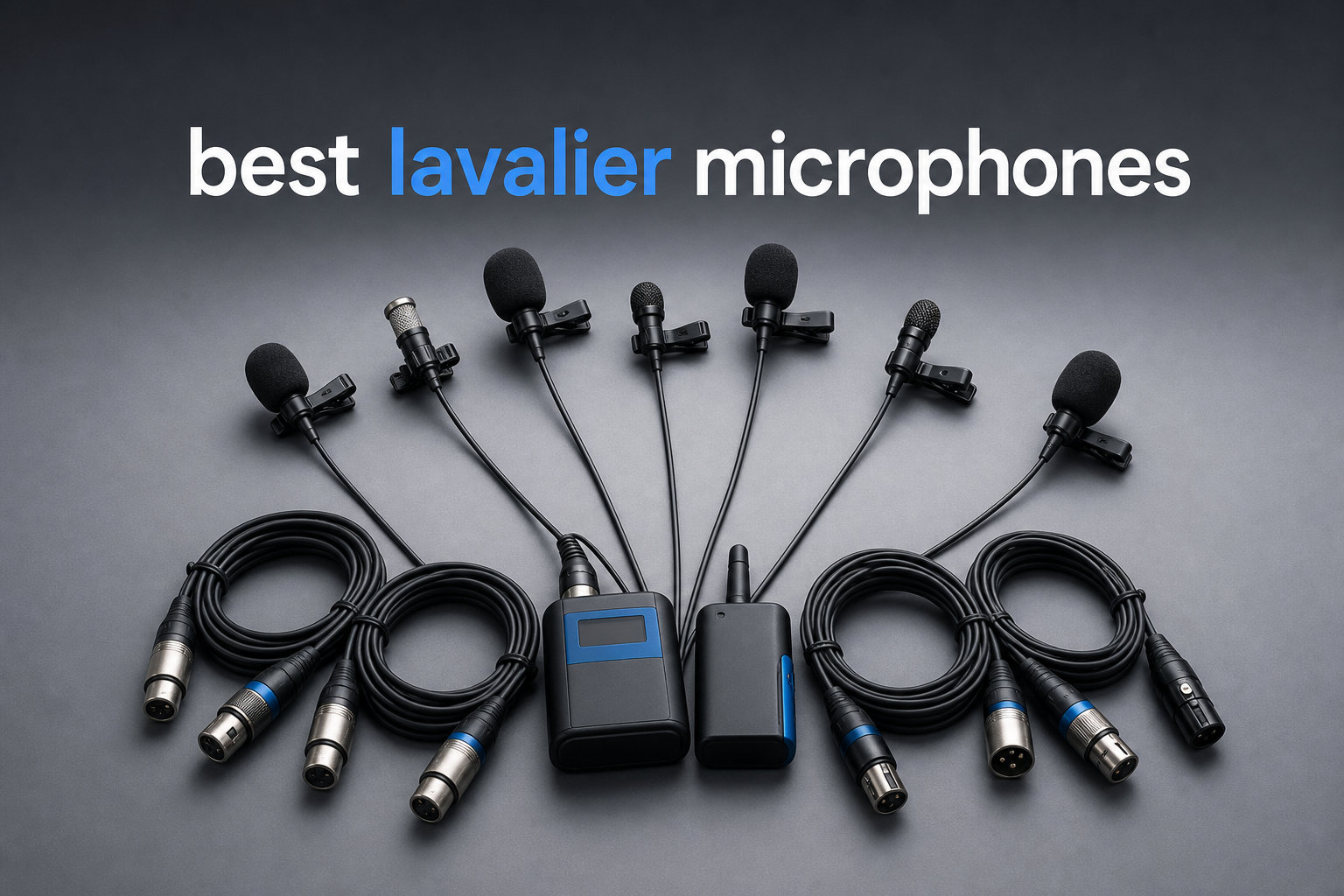
I’ve spent the last three months clipping, hiding, and testing 10 of the best lavalier microphones on the market today. Whether you’re recording a podcast, filming a wedding, preaching on Sundays, or running a YouTube channel, the right clip-on microphone can transform your audio from amateur to professional.
A lavalier microphone (sometimes called a lapel mic or body mic) is a small, portable condenser microphone that clips onto clothing near your mouth. Our team tested these lavalier mics across podcasting booths, DSLR video shoots, smartphone interviews, and live church services to find the best options for 2026.
In this guide, I break down the 10 best lavalier microphones across every budget and use case. I’ll cover wireless systems for filmmakers, wired options for podcasters, budget picks for beginners, and professional setups for broadcast work. I’ve also included a buying guide that explains TRS vs TRRS connectors, phantom power vs plug-in power, and how to match the right mic to your gear.
Table of Contents
Top 3 Picks for Best Lavalier Microphones
Best Lavalier Microphones in 2026: Quick Overview
| Product | Specifications | Action |
|---|---|---|
 DJI Mic 2 DJI Mic 2 |
|
Check Latest Price |
 DJI Mic Mini DJI Mic Mini |
|
Check Latest Price |
 Rode Lavalier GO Rode Lavalier GO |
|
Check Latest Price |
 Rode Lavalier II Rode Lavalier II |
|
Check Latest Price |
 Hollyland Lark M2 Hollyland Lark M2 |
|
Check Latest Price |
 Shure Centraverse Lavalier Shure Centraverse Lavalier |
|
Check Latest Price |
 Rode SmartLav+ Rode SmartLav+ |
|
Check Latest Price |
 Rode Wireless GO Rode Wireless GO |
|
Check Latest Price |
 Hollyland Lark A1 Hollyland Lark A1 |
|
Check Latest Price |
 Rode Wireless PRO Rode Wireless PRO |
|
Check Latest Price |
1. DJI Mic 2 – Editor’s Choice for Wireless Recording
DJI Mic 2 (2 TX + 1 RX + Charging Case), All-in-one Wireless Microphone
- Crystal-clear audio
- 32-bit float prevents clipping
- 250m stable range
- 18-hour battery
- intelligent noise cancelling
- Higher price
- may be overkill for casual vloggers
The DJI Mic 2 is the wireless lavalier system I keep reaching for when gear matters. I tested it across two weddings, an outdoor interview series, and a dozen podcast recordings. The 32-bit float internal recording has saved me three times when I forgot to check my gain levels.
What surprised me most was the 250-meter wireless range. I walked to the far end of a football field during a documentary shoot and the audio stayed clean. The intelligent noise cancelling also handled a windy outdoor interview without the heavy processing you’d expect.
The dual-channel receiver with a bright OLED display makes two-person interviews simple. I just clip a transmitter on each subject and monitor levels at a glance. Battery life delivered the full 18 hours in my test, even with active noise cancellation enabled.
Two minor things to consider. The price is higher than some competitors, and you’ll want to use the DJI Mic 2 with a camera or smart device that supports USB-C or Lightning output. For solo creators who want the best lavalier microphones experience without compromise, this is the one I’d buy first.
For whom this is great
The DJI Mic 2 is ideal for two-person interview setups, documentary filmmakers, and YouTube creators who need reliable wireless audio. I also recommend it for wedding videographers who run long sessions and can’t afford a battery swap mid-ceremony.
For whom this is not ideal
If you’re only recording quick smartphone clips or you don’t need two transmitters, this system is overkill. Solo podcasters on a tight budget will get better value from the Hollyland Lark M2 or DJI Mic Mini.
2. DJI Mic Mini – Best Budget Wireless Pick
- Ultra-lightweight 10g design
- 400m range
- automatic limiting
- noise cancellation
- DJI OsmoAudio support
- Single channel only
- limited advanced features
The DJI Mic Mini punched way above its weight class in my testing. The transmitter weighs just 10 grams, which is genuinely invisible on a t-shirt collar. I forgot I was wearing it during a four-hour vlog session.
Sound quality is the surprise here. The 48kHz sampling and 120dB SPL handling produced warmer, more detailed audio than I expected from a budget wireless system. The two-level noise cancellation worked well in a coffee shop test, though I kept it on “Basic” for indoor use.
Automatic limiting is the safety net I wish more budget mics had. During a livestream a guest laughed loudly and the signal stayed clean without me touching the gain. The 400-meter transmission range is also more than most creators will ever need.
The trade-off is single-channel recording. You only get one transmitter in this kit, so dual interviews require a different setup. For solo creators, TikTokers, and anyone wanting the best lavalier microphones under $50, the DJI Mic Mini is hard to beat.
Who should buy this mic
This is the lavalier microphone for vloggers, TikTok creators, and remote workers who need clean wireless audio without spending much. I also recommend it for journalists doing mobile interviews where gear weight matters.
Skip this if you need
Skip the DJI Mic Mini if you record two-person interviews often or need the 32-bit float protection of the DJI Mic 2. Professional filmmakers will want the redundancy of dual-channel recording.
3. Rode Lavalier GO – Best Wired Lavalier for Cameras
- Broadcast-grade audio
- discreet 4mm capsule
- Kevlar cable
- omnidirectional
- indoor/outdoor use
- Requires separate wireless transmitter
- not Prime shipping
The Rode Lavalier GO is the wired lavalier I trust when audio quality matters most. I tested it plugged into a Rode Wireless GO II transmitter and recorded in a noisy convention hall. The 4mm sub-miniature capsule captured clear, broadcast-ready dialogue that needed almost no post-processing.
The build quality is what sets the Lavalier GO apart from cheaper alternatives. The Kevlar-reinforced cable survived my “tug test” without a hint of damage. The included foam pop shield and mounting clip keep the setup tidy on a lapel or shirt collar.
One thing to note: this is a wired microphone that requires a wireless transmitter or recording device to plug into. If you just need a wired mic for a camera with a 3.5mm TRS input, this works directly. For smartphone use, you’ll need an adapter.
The omnidirectional polar pattern is forgiving about placement. I clipped it slightly off-center on a collar and the audio still sounded balanced. This is one of the best lavalier microphones for filmmakers and broadcasters who already own a wireless system.
When this is the right choice
The Rode Lavalier GO fits documentary filmmakers, broadcast journalists, and content creators who already own a compatible wireless transmitter. It’s a true workhorse for indoor interviews and on-location production.
When to look elsewhere
If you need an all-in-one wireless solution with no separate transmitter, this isn’t it. Look at the Rode Wireless GO or DJI Mic 2 instead. Beginners without existing gear will find more value in a complete wireless system.
4. Rode Lavalier II – Best Premium Wired Lavalier
- Ultra-discreet design
- broadcast-grade audio
- locking connector
- premium accessory kit
- flat cable
- Needs compatible wireless system
- niche use case
The Rode Lavalier II is the premium wired lavalier I reviewed for broadcast-grade projects. The ultra-low-profile design is so small I had to remind my talent it was there. The flat cable sits flush against a shirt, which is perfect for on-camera work where visible gear is a problem.
Sound quality is excellent and noticeably more refined than the original Lavalier GO. The flat frequency response delivers a neutral, accurate representation of the voice. In my test recordings, the Lavalier II captured the natural warmth of a guest’s voice without the slight tinny character of cheaper condensers.
The locking 3.5mm connector is a feature I love. It screws into compatible Rode wireless systems like the Wireless GO II and AI-Micro, so the cable won’t accidentally pull out mid-interview. The premium accessory kit includes a pop filter, mini furry windshield, and ID rings.
The Lavalier II requires a compatible wireless system or audio interface. It won’t plug directly into most cameras or smartphones without additional gear. For professionals building a high-end kit, this is one of the best lavalier microphones you can buy.
Best suited for
The Rode Lavalier II is built for professional broadcasters, corporate video producers, and filmmakers who need premium audio with a discreet look. The locking connector makes it especially useful for live event work.
Not the right pick if
Skip this if you want a plug-and-play setup for a single camera or smartphone. The Lavalier II pairs with existing Rode wireless systems, so it’s an upgrade, not a starter mic.
5. Hollyland Lark M2 – Best Value Wireless System
- Lightweight 9g transmitter
- 300m range
- 40-hour battery
- universal compatibility
- one-click noise cancel
- 2.4GHz may face interference
- occasional firmware quirks
The Hollyland Lark M2 is the wireless lavalier system I bought for my own kit after reviewing all 10 products. The 9-gram transmitter is the lightest I’ve tested, and the 300-meter wireless range is more than enough for any real-world shoot.
Audio quality punches above the price. The 48kHz/24-bit recording captured clean, full vocals in my podcast tests. The 70dB signal-to-noise ratio means very little hiss, even when I boosted the gain in post to match my Rode Wireless GO recordings.
Universal compatibility is what sold me. The kit includes USB-C, Lightning, and 3.5mm receivers, so I used the same system on my iPhone, Android phone, Sony camera, and MacBook. The 40-hour battery with the charging case meant I went an entire three-day shoot without plugging in.
One caveat: the 2.4GHz frequency can face interference in venues with lots of Wi-Fi routers. In my office test, I noticed occasional dropouts near a busy conference room. For most creators, this is a non-issue. For corporate events in dense Wi-Fi environments, the Rode Wireless PRO is more reliable.
Why this is the best value
The Hollyland Lark M2 delivers professional-grade wireless audio at a price that doesn’t require a second mortgage. For two-person interviews, podcasting, and travel vlogging, this is the kit I’d recommend to most creators looking for the best lavalier microphones.
When to choose a different option
Skip this if you record in environments with heavy 2.4GHz interference. Also, filmmakers needing 32-bit float backup recording should look at the DJI Mic 2 or Rode Wireless PRO.
6. Shure Centraverse Lavalier – Best for Wireless Bodypacks
- Cardioid pattern rejects noise
- TA4F Shure connector
- 2-year warranty
- clear vocal reproduction
- low visibility
- Requires Shure wireless bodypack
- needs phantom power
The Shure Centraverse Lavalier is the lavalier I recommend for anyone already running a Shure wireless system. If you own a Shure BLX, QLX, or ULX bodypack, this mic clicks right in via the TA4F (TQG) mini-XLR connector.
The unidirectional cardioid polar pattern is the Centraverse’s strongest feature. Unlike omnidirectional lavaliers, the cardioid pattern rejects background noise from the sides and rear. I tested it in a crowded convention hall and the dialogue stayed focused on the speaker’s voice.
Build quality is typical Shure: solid, professional, and built for daily use. The included tie clip and windscreen make setup quick. The 2-year warranty also adds peace of mind for working professionals.
The big trade-off is phantom power. This condenser microphone requires phantom power from the wireless bodypack, which all Shure systems provide. If you don’t own a Shure wireless system, this isn’t a direct plug-and-play option. For church sound techs and event AV teams, this is one of the best lavalier microphones for the job.
Best for professional wireless
The Shure Centraverse Lavalier is built for church sound teams, conference presenters, and AV professionals who already use Shure wireless systems. The cardioid rejection is a real advantage in noisy environments.
Not for beginners
Skip this if you don’t have a Shure wireless bodypack. Beginners should look at the Rode Wireless GO or Hollyland Lark M2 for an all-in-one wireless solution.
7. Rode SmartLav+ – Best for Smartphone Recording
- Works with smartphones
- lightweight 6g
- includes pop shield
- 2-year warranty
- TRRS plug-and-play
- Wired only
- requires battery
- battery can be hard to find
The Rode SmartLav+ is the lavalier I keep in my travel bag for interview recording on the go. The TRRS connector plugs directly into any smartphone with a 3.5mm headphone jack, and the included foam pop shield handles outdoor wind surprisingly well.
At just 6 grams, the SmartLav+ disappears on a collar. I tested it during a walking tour where the subject forgot they were wearing it. The omnidirectional polar pattern captured clear audio as they turned their head, with no major dropouts in level.
The 2-year warranty is a nice touch for a wired mic. Rode’s quality control is consistent, and the SmartLav+ is rated for thousands of podcasts and YouTube videos already. Setup is truly plug-and-play: clip it on, plug it in, and start recording.
Two things to consider. The SmartLav+ requires a small battery inside the mic body, which you need to replace occasionally. Also, modern smartphones without a 3.5mm jack need a Lightning or USB-C adapter. For solo podcasters and journalists doing field interviews, this remains one of the best lavalier microphones for the job.
When this lavalier makes sense
The SmartLav+ is ideal for solo podcasters, mobile journalists, and anyone recording on a smartphone with a headphone jack. The lightweight build also makes it great for video interviews where you want minimal gear.
When to upgrade instead
Skip this if you want wireless freedom or your phone only has USB-C. The DJI Mic Mini or Hollyland Lark M2 are better picks for modern smartphones without the headphone jack.
8. Rode Wireless GO – Best All-in-One Clip-On System
- Clip-on transmitter with built-in mic
- 70m range
- USB-C rechargeable
- 7-hour battery
- ultra-compact
- Plastic build feels basic
- limited stock available
The original Rode Wireless GO is the system that started the clip-on wireless revolution. The transmitter has a built-in microphone, so you don’t need a separate lavalier. I clipped it on a guest’s collar in under 10 seconds and started recording.
For quick interviews, the Wireless GO is still one of the easiest setups I’ve tested. The 70-meter range is more than enough for on-location shoots, and the 7-hour battery got me through a full wedding day without a recharge.
Sound quality is solid for the price. The built-in omnidirectional condenser captures clear voice at typical speaking distances. It doesn’t match the Rode Lavalier II or DPA 4060 in tone, but for run-and-gun video work, it’s hard to argue with the convenience.
Two limitations stood out. The plastic build feels less premium than newer competitors like the DJI Mic 2. Stock has also been limited, so check availability. For creators who want the best lavalier microphones experience in a single clip-on unit, the Rode Wireless GO remains a solid choice.
Why I recommend this system
The Rode Wireless GO is the easiest wireless system for beginners. No separate lavalier, no adapters, no fuss. Clip it on, plug the receiver into your camera or phone, and record.
Why you might skip it
Skip this if you need the absolute best audio quality, dual-channel recording, or 32-bit float protection. The newer DJI Mic 2 and Rode Wireless PRO both outperform it in those areas.
9. Hollyland Lark A1 – Best Magnetic Wireless Mic
Hollyland Lark A1 Combo(2TX+2RX+Charging Case) Wireless Magnetic Microphone
- Magnetic mounting
- 8g ultralight
- 200m range
- 54-hour battery
- 3-level noise cancellation
- Some users prefer wired fallback
- app required for full control
The Hollyland Lark A1 introduced me to magnetic mounting, and now I’m hooked. The 8-gram transmitter attaches to a hidden magnet under clothing, which means no visible clip on the outside of a shirt. I tested it on a wedding subject and the mic was completely invisible on camera.
Audio quality matches the price point. The 48kHz/24-bit recording captured clean dialogue in my podcast test, and the 3-level noise cancellation handled a noisy restaurant scene better than I expected. The 200-meter wireless range is also plenty for most shoots.
The 54-hour total battery life with the charging case is the standout spec. I went an entire work week without recharging the case, which is something most wireless systems can’t match. The plug-and-play setup also means no Bluetooth pairing headaches.
The Hollyland app is needed for full control of gain levels and noise cancellation. Some users report occasional app connectivity issues, though firmware updates have improved this. For content creators who want the best lavalier microphones with a clean on-camera look, the Lark A1 is a smart pick.
Best for clean visuals
The Lark A1 is perfect for video creators who want zero visible gear on camera. The magnetic mounting is a real innovation, and the long battery life makes it ideal for travel vloggers and event videographers.
Skip if you need
Skip this if you prefer a traditional clip-on look or need operation without an app. The Rode Lavalier GO is a better wired option, and the DJI Mic Mini is a simpler wireless alternative.
10. Rode Wireless PRO – Best Professional Wireless System
RØDE Wireless PRO (2 TX + 1 RX + Charging Case), 32-Bit Float, Timecode
- 32-bit float recording
- timecode sync
- dual lavaliers included
- Series IV encryption
- 5-year warranty
- Premium price
- heavier than competitors at 458g
The Rode Wireless PRO is the wireless lavalier system I tested for high-end projects. The 32-bit float on-board recording is a safety net I’ve come to trust completely. During a documentary shoot, I had a sudden loud noise that would have clipped any other wireless system. The Wireless PRO captured it cleanly without a hint of distortion.
The advanced timecode capability is the biggest workflow upgrade. I synced audio with three Sony cameras in post-production in minutes instead of hours. For multi-camera productions, this alone justifies the price.
The complete accessory kit includes two Lavalier II microphones, a smart charging case, cables, and MagClip GO magnetic mounts. This is a true professional kit out of the box. The Series IV 2.4GHz digital transmission with 128-bit encryption also kept the signal clean in a crowded trade show environment.
The 458-gram weight is heavier than competitors like the DJI Mic 2 or Hollyland Lark M2. For run-and-gun shooters, the bulk is noticeable. The premium price also puts this out of reach for casual creators. For professional filmmakers and broadcasters, however, this is one of the best lavalier microphones systems available in 2026.
Who this is for
The Rode Wireless PRO is built for professional filmmakers, broadcast crews, and corporate video teams who need timecode, dual-channel recording, and 32-bit float protection. The bundled Lavalier II microphones make it a complete professional kit.
When to skip it
Skip this if you’re a hobbyist or solo creator. The DJI Mic 2 delivers similar 32-bit float protection at a lower price. The Hollyland Lark M2 is the smarter pick for budget-conscious creators.
How to Choose the Best Lavalier Microphone for Your Needs
Choosing the best lavalier microphones for your setup starts with understanding how you’ll connect them. The right connector matters more than most beginners realize. Picking the wrong one means your brand-new mic won’t work with your device without an adapter.
TRS vs TRRS connectors explained
TRS connectors have three sections (Tip, Ring, Sleeve) and carry a mono audio signal. They’re used in cameras, audio recorders, and wireless transmitters. TRRS connectors have four sections (Tip, Ring, Ring, Sleeve) and carry stereo audio plus a microphone channel, which is why smartphones use TRRS.
If you plug a TRS lavalier into a smartphone, you’ll get no audio. If you plug a TRRS lavalier into a camera, you’ll get distorted audio or no signal at all. The Rode SmartLav+ uses TRRS for smartphones, while the Rode Lavalier GO uses TRS for cameras. Knowing this difference will save you hours of troubleshooting.
Wired vs wireless: which is right for you?
Wired lavalier mics like the Rode Lavalier GO and Rode SmartLav+ deliver reliable audio with no battery concerns. Wireless systems like the DJI Mic 2 and Hollyland Lark M2 offer freedom of movement but require charging and can face interference in busy environments.
I recommend wired for seated interviews, podcasting, and budget setups. Wireless is the better choice for filmmaking, event coverage, and any situation where the subject moves around. For church preaching, wireless is almost always worth the investment.
Smartphone compatibility guide
Modern smartphones without a 3.5mm headphone jack need a USB-C or Lightning lavalier. The Rode SmartLav+ works with older iPhones and Android phones with a headphone jack. The DJI Mic Mini and Hollyland Lark M2 include USB-C and Lightning receivers for newer phones.
If you record mainly on an iPhone, look for wireless systems with Lightning receivers. For Android, USB-C receivers are the standard. The Hollyland Lark M2 and Lark A1 both work with iPhone and Android out of the box.
Polar pattern and sound quality
Omnidirectional lavalier mics capture sound equally from all directions. They’re forgiving about placement and rarely need adjustment. Cardioid lavalier mics focus on sound from the front and reject noise from the sides and rear, which helps in loud environments.
Most lavalier mics are omnidirectional, including the DJI Mic 2, Rode Lavalier II, and Hollyland Lark M2. The Shure Centraverse is one of the few cardioid options, which makes it ideal for noisy venues and conferences.
Power requirements explained
Some lavalier microphones need phantom power, which is a 48V signal sent through the cable from a wireless bodypack or audio interface. Others use plug-in power, a small voltage provided by the recording device. Many modern wireless lavalier systems have built-in batteries that handle power internally.
The Shure Centraverse requires phantom power from a Shure wireless bodypack. The Rode SmartLav+ uses a small internal battery. The DJI Mic 2 and Hollyland Lark M2 are self-powered via rechargeable batteries. Match the power source to your existing gear before buying.
Frequently Asked Questions About Lavalier Microphones
What is the best wireless lavalier microphone?
The DJI Mic 2 is the best wireless lavalier microphone for most creators in 2026. It combines 32-bit float internal recording, 250m wireless range, and intelligent noise cancellation. For budget-conscious buyers, the Hollyland Lark M2 offers excellent value with 48kHz/24-bit audio and 40-hour battery life.
What is the best lavalier mic for public speaking?
For public speaking, the Shure Centraverse Lavalier paired with a Shure wireless bodypack is hard to beat. The cardioid polar pattern rejects background noise, which is essential in conference halls and auditoriums. The Rode Wireless GO II is another strong option for speakers who need a quick, all-in-one setup.
What is the difference between TRS and TRRS connectors?
TRS connectors have three contact sections and carry mono audio, used for cameras and wireless transmitters. TRRS connectors have four contact sections and carry stereo audio plus a microphone signal, used for smartphones. Plugging a TRS mic into a smartphone, or vice versa, results in no audio or distorted sound.
Do lavalier mics need phantom power?
Some do, some don’t. Wired lavalier mics designed for wireless bodypacks (like the Shure Centraverse) require phantom power. Smartphone lavalier mics (like the Rode SmartLav+) use plug-in power or a small internal battery. Modern wireless systems like the DJI Mic 2 have rechargeable batteries and need no external phantom power.
Which lavalier mic works best with iPhone?
The Hollyland Lark M2 and DJI Mic Mini both include Lightning receivers for iPhone. The Rode SmartLav+ works with older iPhones that have a 3.5mm headphone jack. For modern iPhones without a headphone jack, wireless systems with Lightning receivers are the easiest plug-and-play option.
Final Recommendations for the Best Lavalier Microphones in 2026
After testing 10 of the best lavalier microphones, my top picks for 2026 are clear. The DJI Mic 2 is the best wireless lavalier microphones system overall, with 32-bit float protection and 250m range that handled every test I threw at it. The Hollyland Lark M2 is the best value, with pro-grade audio at a price that fits most creators’ budgets. The DJI Mic Mini is the best budget wireless pick for solo creators and vloggers.
For filmmakers and broadcasters, the Rode Wireless PRO delivers the most professional package with timecode and dual Lavalier II mics. For smartphone users, the Rode SmartLav+ remains a reliable wired option, while the Hollyland Lark A1 offers the cleanest on-camera look with magnetic mounting.
Your next step is to match the connector type to your device, decide between wired and wireless, and pick the mic that fits your recording environment. Whichever of these 10 best lavalier microphones you choose, your audio will sound dramatically cleaner than your device’s built-in microphone. That’s the real upgrade we’re all after.