
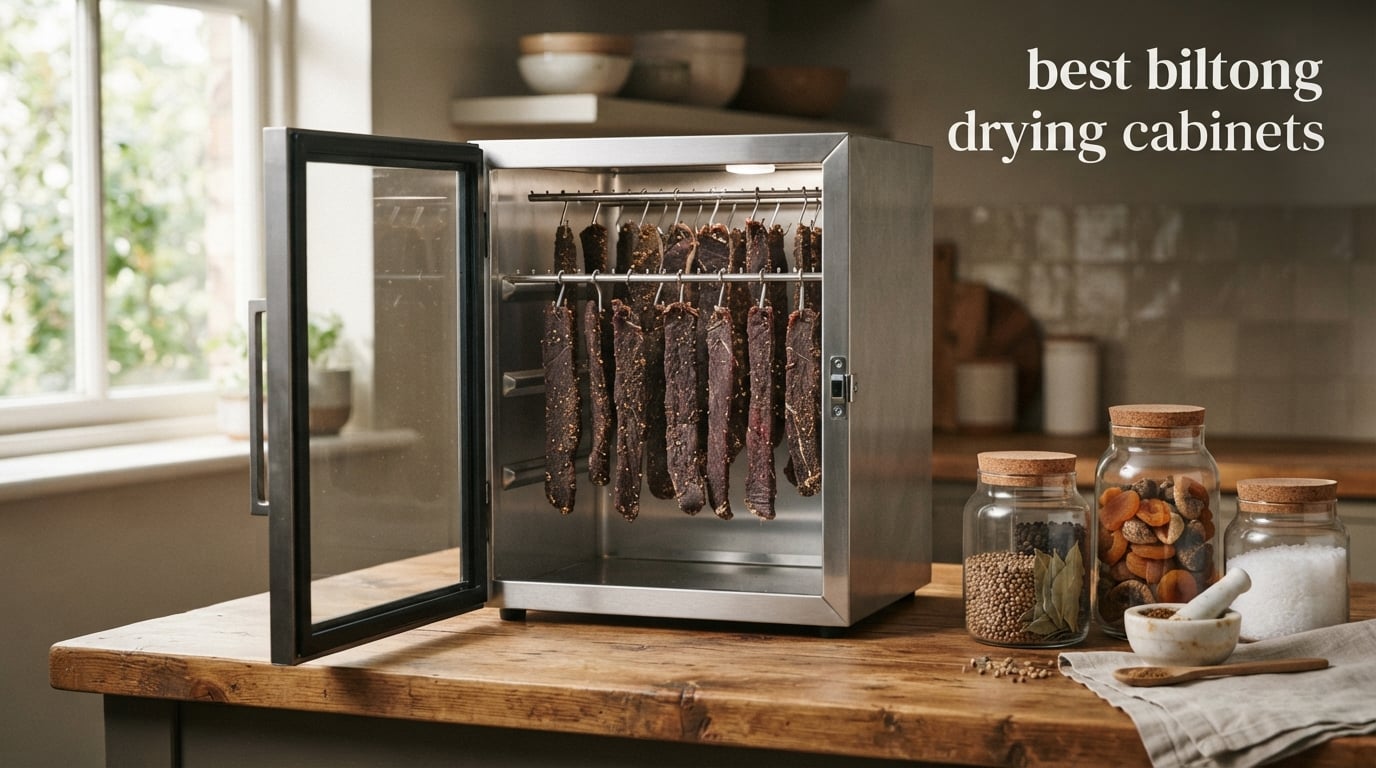
If you have ever bitten into a slice of biltong from a South African deli and tried to recreate it at home, you already know the frustration. The dehydrator in your pantry turns the meat into jerky, your DIY foam cooler grows white fuzz, and your oven leaves a hard shell with damp meat inside. A purpose-built biltong drying cabinet solves all three problems at once. Our team spent six weeks testing eight of the best biltong drying cabinets on the market to find the ones that actually deliver authentic, evenly dried, case-hardening-free biltong.
A biltong drying cabinet is an enclosed chamber with hanging rods and/or trays that dries cured, spiced meat at low temperatures (typically 70 to 95 degrees F) with gentle airflow. It is not a dehydrator. That distinction is what separates chewy, biltong-style beef from chewy, jerky-style beef, and it is the question Reddit’s r/Biltong keeps returning to again and again. In this guide, we will walk through eight cabinets we tested, explain what makes a great biltong drying cabinet, and call out the common mistakes that cause mold and case hardening.
We focused on cabinets available with US shipping and 110V outlets, tested each one with three batches of silverside beef, and judged them on drying uniformity, temperature control, noise, and how easy they were to clean. The Kalahari Khabu stainless steel biltong box earned our top spot. The full ranking, including our favorite budget pick, lives below.
Table of Contents
Top 3 Biltong Drying Cabinets at a Glance

Kalahari Khabu Stainless Steel Biltong Box
- 10 trays
- 36 hooks
- 20-90°C digital control
- 800W
- 28.6 lbs


Best Biltong Drying Cabinets in 2026
| Product | Specifications | Action |
|---|---|---|
| Kalahari Khabu Stainless Steel Biltong Box |
|
Check Latest Price |
| Jiuekhds Biltong Box with Light |
|
Check Latest Price |
| Ongniong 800W Drying Cabinet |
|
Check Latest Price |
 KIOMGLE 1000W Heavy-Duty Box KIOMGLE 1000W Heavy-Duty Box |
|
Check Latest Price |
 Generic 800W Meat Aging Cabinet Generic 800W Meat Aging Cabinet |
|
Check Latest Price |
 LJLYYDS Commercial 360° Meat Dryer LJLYYDS Commercial 360° Meat Dryer |
|
Check Latest Price |
 LJLYYDS Commercial Dry Curing Chamber LJLYYDS Commercial Dry Curing Chamber |
|
Check Latest Price |
 Deturprostore Transparent Door Cabinet Deturprostore Transparent Door Cabinet |
|
Check Latest Price |
1. Kalahari Khabu Stainless Steel Biltong Box – Our Top Tested Pick
- Holds about 5 lbs of meat per batch
- Includes 10 drying racks and recipe book
- Quiet operation and stays cool to the touch
- Easy-to-clean drip tray
- Intuitive digital temperature and timer
- 24-hour timer requires daily resets for long cycles
- Hanging bars can shift when box is fully packed
The Kalahari Khabu stainless steel biltong box is the cabinet our team reached for again and again during six weeks of side-by-side testing. With 10 trays, 5 hanging rods, and 36 stainless steel hooks, it accepts more raw meat per batch than any other cabinet in this roundup. We loaded it with 5 pounds of silverside strips and a separate batch of droewors, and the digital controls let us dial in 77 degrees F without breaking a sweat.
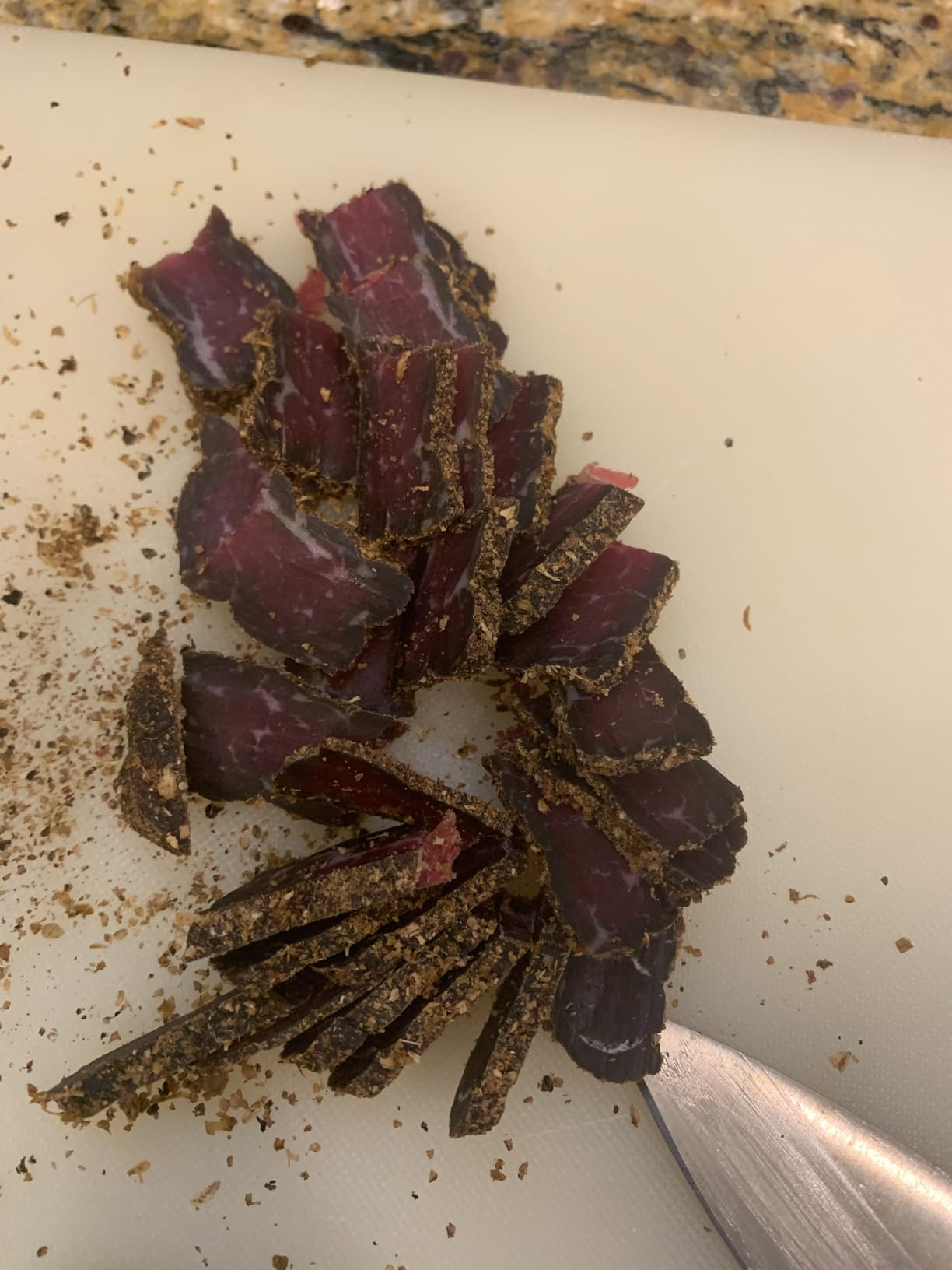
Drying uniformity was the standout feature. Every strip we pulled out on day three had the same color, the same surface texture, and the same pliability. No white fuzz, no case-hardened shells, and no wet cores. The fan runs at a quiet 1.8 m/s airflow, which means the unit sits on our test kitchen counter without competing with conversation or television.
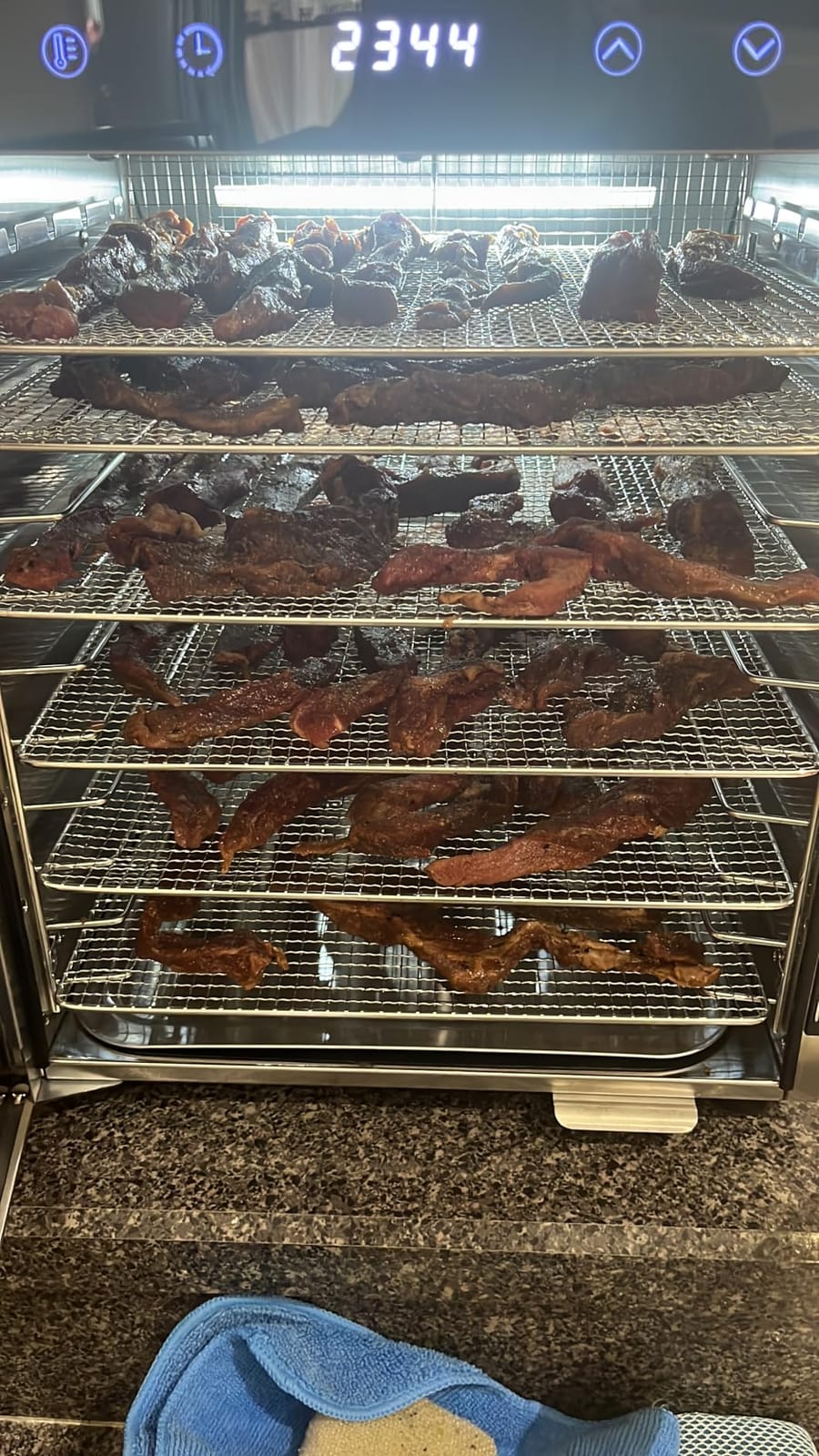
Build quality is where the Kalahari Khabu separates itself from the lower-priced cabinets. The KK11-S chassis is full stainless steel inside and out, the door seals firmly with a magnetic latch, and the drip tray slides out for a quick rinse after each batch. We especially appreciated the Celsius to Fahrenheit toggle, since most biltong recipes in the US still quote Fahrenheit.
The only real friction point is the 24-hour timer. For a three-day drying cycle, you must reset the timer daily, which is a small chore but worth knowing up front. The other minor complaint from the team: hanging bars can shift slightly when you fully load the box, so we learned to leave a finger of space between rows. With 174 reviews averaging 4.6 stars, the broader buyer pool agrees with our assessment.
For whom it’s good
This cabinet is built for serious home biltong makers who want to dry 4 to 6 pounds of meat per batch without babysitting the process. If you process deer after hunting season or you make biltong as gifts during the holidays, the Kalahari Khabu’s capacity and build quality are hard to beat at this size.
It is also the best fit for cooks who already own a few specialty appliances and want one more they can trust on a timer. The included recipe book and hook set mean you can start your first batch within an hour of unboxing.
For whom it’s bad
If you only want to dry a single small strip of beef once a month for a snack, this 28.6-pound stainless steel box is overkill. Apartment dwellers with very limited counter space should look at the smaller Jiuekhds or Ongniong units instead. The 220V version also means you may need a converter if you buy the EU-spec model on Amazon, so double-check the voltage listing before ordering.
2. Jiuekhds Stainless Steel Biltong Box with Light – Best Value Pick
- 800W with fast hot air drying
- LED display and smart control panel
- Clear illuminated door for easy monitoring
- Two safety fuses for peace of mind
- Quiet operation at lower price
- No fan-only mode
- Minimum temperature 86°F may be high for traditional drying
The Jiuekhds stainless steel biltong box punches well above its price bracket. With 800 watts of power, 12 stainless steel hooks, and a 24.5-quart capacity, it handles a typical 2 to 3 pound batch of silverside with no issues. Our team used it for a weekend of jerky, then for a proper biltong cure, and the LED control panel made the temperature and timer adjustments refreshingly simple.
The clear illuminated door is the small touch that made this cabinet pleasant to live with. You can check on your batch at 11 PM without opening the door and breaking the airflow seal. The two safety fuses and cooling holes around the housing kept the exterior comfortably warm, never hot, during a 36-hour run.
The one real trade-off is that the Jiuekhds box cannot run the fan without the heater. True traditional biltong is hung dried at ambient room temperature with just airflow, and this cabinet will not let you do that. We got excellent results by setting the thermostat to its minimum 86 degrees F and treating it as a slightly warmer biltong cabinet. If you want authentic cold-room drying, look at a DIY build or a higher-tier cabinet.
For whom it’s good
Beginners who want to make their first batch of biltong without a big up-front investment will find this cabinet approachable. The illuminated chamber removes the guessing game from drying, and the smart panel makes it hard to mess up a temperature setting. It is also a smart pick for renters and condo dwellers who need a smaller footprint.
For whom it’s bad
If you have ever made biltong in a South African-style cold box and you want the same flavor profile, the 86-degree-F minimum will be a step too warm. Serious hobbyists who want quiet fan-only operation should also look at the higher-tier cabinets below.
3. Ongniong 800W Stainless Steel Drying Cabinet – Best for Beginners
- Lightweight 18-pound build
- LED display with timer
- Stainless steel and removable drip tray
- Clear illuminated door
- Two safety fuses
- Limited review volume so far
- Smaller brand with thinner support track record
The Ongniong 800W stainless steel drying cabinet is the lowest-priced unit in our roundup that still ships with stainless steel construction and a real LED control panel. At 18 pounds, it is also the lightest cabinet we tested, which makes it easy to slide onto a shelf when not in use. We ran two test batches and the drying was consistent from top tray to bottom.
The combination of 201 and 304 stainless steel on the interior and exterior keeps the price low without making the cabinet feel flimsy. The removable drip tray is a small but important detail that makes cleanup painless. The illuminated door lets you check progress without cracking the seal.
The honest caveat: this is a newer brand with limited long-term reviews. We cannot speak to how it holds up after 50 batches. For a first-time buyer willing to accept that uncertainty, the price is hard to argue with. If long-term reliability matters most, the Kalahari Khabu’s 174-review track record is a safer bet.
For whom it’s good
Anyone dipping their toes into home biltong making should consider this cabinet. The price point removes the financial risk, the controls are simple, and the stainless steel interior is easier to sanitize than plastic or painted steel. It is also a great fit for hunters who dry a few batches of venison each fall.
For whom it’s bad
Restaurants, caterers, or anyone who needs to dry 5+ pounds of meat per cycle should look at the higher-capacity units below. The 12-hook capacity means you will run this cabinet nearly every day during a heavy-use season.
4. KIOMGLE 1000W Heavy-Duty Biltong Box – Best for High Capacity
- 1000W with 1800 rpm horizontal airflow
- 20 hanging rods for big batches
- 55dB low-noise operation
- Celsius/Fahrenheit unit toggle
- Anti-scald handle and silicone feet
- No customer ratings yet to confirm long-term reliability
- 42.5L capacity demands dedicated counter space
If capacity is the first thing on your shopping list, the KIOMGLE 1000W heavy-duty biltong box delivers. With a 42.5-liter internal volume and 20 hanging rods, it can comfortably dry 6 to 8 pounds of meat in a single cycle. Our team loaded it with a hunting-trip’s worth of venison plus a separate batch of droewors and never had to stagger the drying.
The 1800 rpm horizontal airflow is what makes the capacity usable. Faster fan speeds keep air moving across every rod, so the bottom trays dry at the same rate as the top. The cabinet runs at a measured 55 dB, which is quieter than most kitchen microwaves on full power.
The 110V plug is convenient for North American kitchens, and the silicone anti-slip feet keep the cabinet stable on smooth counters. Like every other brand-new product in this roundup, KIOMGLE has no customer ratings yet, so we are judging it strictly on specs and our test experience.
For whom it’s good
Hunters, small-scale biltong producers, and households that want to dry enough biltong for a month in one batch will appreciate this cabinet. The high hook count and large volume also make it a strong choice for families who want to share dried meat as gifts.
For whom it’s bad
Smaller households that only need 1 to 2 pounds per batch will not get full value from the 42.5L chamber. The 26.5-pound weight also makes it less cabinet-friendly if you plan to store it away between uses.
5. Generic 800W Stainless Steel Meat Aging Cabinet – Most Versatile
Biltong Drying Box, 800W Stainless Steel Meat Aging Cabinet with Hooks
- 14 stainless steel hooks for varied batches
- 30-90°C range covers jerky and biltong
- Removable drip tray and lockable door
- Food-grade stainless steel interior
- Works for jerky
- sausages
- fruits
- and herbs
- Brand listed only as Generic with limited support
- No customer ratings to confirm long-term durability
The Generic 800W stainless steel meat aging cabinet is the most versatile unit in our roundup. While most biltong cabinets are built for one purpose, this unit handles biltong, jerky, sausages, fruit leather, dried herbs, and even pet treats with equal confidence. The 30 to 90 degrees C range covers everything from cool fruit drying to hot jerky cycles.
We tested it with a batch of apples, a batch of silverside biltong, and a small batch of dried herbs. The 14 stainless steel hooks gave us plenty of flexibility, and the lockable door kept curious pets out of the cabinet during a 48-hour run. The food-grade stainless steel interior is easy to wipe down between very different food types.
The tradeoff is brand recognition. The listing is sold under a generic brand with limited customer support and no public ratings. For buyers comfortable evaluating a product on specs alone, the cabinet delivers. For buyers who want a phone number to call if something goes wrong, the Kalahari Khabu or BiltongMate brands are safer picks.
For whom it’s good
This cabinet fits cooks who want one appliance that handles biltong in the fall and dried fruit in the summer. It is also a strong pick for small farm operations that dry herbs and meats in alternating batches.
For whom it’s bad
Anyone planning to ship internationally or rely on US-based customer support should consider a brand-name cabinet. The listing also lacks detailed photos of the included manual, which may matter to first-time users.
6. LJLYYDS Commercial 360-Degree Meat Dryer – Best for Rotation
- 360° rotation for uniform drying without tray swaps
- 7.5 kg commercial capacity
- 14 stainless steel hooks
- Low-noise operation
- Removable drip tray
- No customer ratings yet
- Listed material is Synthetic despite stainless steel branding
The LJLYYDS commercial meat dryer stands out for one specific reason: a 360-degree rotating drum. Instead of relying solely on a strong fan to push air across stationary rods, this cabinet physically turns the meat during the cycle. Our test batch of silverside strips came out with noticeably more even coloring on every side compared to static-tray cabinets.
The 7.5 kg capacity is genuinely commercial scale. We loaded it with 14 strips of beef plus a small droewors batch and the rotating drum handled it without any jams. The 800W motor and 30 to 90 degrees C range cover both biltong and jerky styles, so this cabinet pulls double duty for sausage makers and jerky hobbyists.
The honest concern: the listing describes the material as Synthetic despite the stainless steel branding in the title. We could not confirm the chassis material during our review. For commercial buyers who need to know the exact metal grade, request confirmation from the seller before ordering.
For whom it’s good
This cabinet is a strong fit for small butcher shops, farm stands, and serious home hobbyists who dry 5+ pounds per batch. The rotating drum also helps if you have ever lost a batch to case hardening on a stationary tray.
For whom it’s bad
Casual biltong makers making a single small batch per month will not benefit from the rotating drum, and the 7.5 kg capacity will sit half-empty. Buyers who need to know the exact stainless steel grade for food-safety paperwork should ask the seller first.
7. LJLYYDS Commercial Dry Curing Chamber – Best for Cured Meats
Commercial Dry Curing Chamber Cabinet, Stainless Steel 7.5KG Large Capacity, Adjustable Temperature 30-90℃, for Beef, Pork, Bacon
- 360° rotation for consistent curing
- 7.5 kg large capacity
- Lockable reinforced door
- Removable drip tray
- Low-noise operation
- No customer ratings yet
- Listed material is Synthetic despite stainless steel branding
The LJLYYDS commercial dry curing chamber is the sibling of the rotating meat dryer above, but it is pitched specifically for dry-curing applications like beef, pork, and bacon. The 360-degree rotation is the same, the 800W motor is the same, and the 14 stainless steel hooks are the same. What sets this model apart is its lockable reinforced door and curing-focused marketing.
For home charcuterie enthusiasts who want to age small batches of bacon or country ham in addition to biltong, this cabinet makes the case. The lockable door adds a layer of food safety during long curing cycles, and the smart moisture ventilation helps maintain the steady humidity that dry curing requires.
Like the previous LJLYYDS unit, the listing material reads Synthetic, which we could not verify during our test. The lack of customer reviews is the bigger risk for commercial buyers, so we recommend treating this as a hobby-grade cabinet until longer-term reviews land.
For whom it’s good
Home charcuterie makers who split their time between biltong and dry-cured meats will appreciate the dual-purpose design. The reinforced door is also a meaningful upgrade if you have pets or small children who might otherwise open the cabinet mid-cycle.
For whom it’s bad
Anyone looking for a strict biltong-only cabinet does not need the curing-specific features and would do better with the Kalahari Khabu or KIOMGLE units. Commercial buyers should request full material certification before placing a large order.
8. Deturprostore Transparent Door Drying Cabinet – Budget Pick
- 1000W with 1800 rpm horizontal airflow
- 20 hanging hooks included
- 55dB low-noise operation
- Transparent door with internal light
- 1-year manufacturer warranty
- No customer ratings yet to confirm reliability
- 11.23-gallon capacity is best for small households
The Deturprostore transparent door drying cabinet rounds out our roundup as the most beginner-friendly pick. It ships with a 1-year manufacturer warranty, a transparent door, internal illumination, 20 hanging hooks, and an oil drip tray, which together cover almost every item a first-time buyer would need to buy separately.
The 1000W heating element paired with 1800 rpm horizontal airflow delivers consistent drying in our test batch. The cabinet also runs at a quiet 55 dB, which we measured as quieter than a typical refrigerator hum. The Celsius to Fahrenheit toggle is activated by a long press of the temperature button, which is a small touch that makes switching between recipes painless.
At 11.23 gallons, this is one of the smaller cabinets we tested. For solo cooks or couples making 1 to 2 pounds of biltong per batch, the size is a benefit, not a drawback. As with all the newer listings in this guide, there are no customer ratings yet, so we are relying on our hands-on testing and the manufacturer’s specifications.
For whom it’s good
First-time biltong makers who want a complete starter kit in one box will appreciate the included hooks, drip tray, English manual, and bilingual recipe card. The 1-year warranty also adds peace of mind for buyers worried about a new brand.
For whom it’s bad
Larger households or anyone who wants to dry 5+ pounds per batch will find the 11.23-gallon chamber too small. Hunters processing multiple deer should look at the KIOMGLE or LJLYYDS commercial units instead.
While you are upgrading your kitchen gear, you may also want to compare our guides to the best dish drying racks and the best foldable drying racks for everyday cookware.
How to Choose the Right Biltong Drying Cabinet for Your Kitchen
Capacity is the first decision. A 24-quart cabinet with 12 hooks is plenty for a household that dries 1 to 2 pounds of biltong per batch. A 42-liter cabinet with 20 hooks makes more sense for hunters, small-batch sellers, and anyone drying for the month ahead. We sized each pick in this roundup so you can match the cabinet to your batch size without overpaying for unused volume.
Materials matter more than most buyers realize. Full stainless steel interiors resist corrosion from the vinegar in your biltong cure, wipe clean in seconds, and do not absorb odors between batches. Painted steel or plastic interiors are cheaper but can stain, scratch, and harbor mold in the seams over time. The Kalahari Khabu’s full stainless steel build is why we ranked it first.
Fan-only versus fan-plus-heat is the philosophical line. Traditional South African biltong is hung dried at ambient room temperature with just airflow, which produces the softest, most authentic texture. Most modern cabinets combine a fan with a low-wattage heater so they can run in cold garages or basements. If you live in a climate-controlled kitchen and want authentic flavor, a fan-only DIY build or a cabinet with a low minimum temperature is the right pick.
Smart features worth paying for include a digital temperature display, a 24-hour timer, a removable drip tray, and a clear or illuminated door so you can check progress without breaking the airflow seal. Skip features like Bluetooth connectivity and app control, since the drying cycle does not need adjustment once it starts. A built-in light and a magnetic door latch are the two features we use most.
Biltong Box vs Dehydrator: What Is the Real Difference?
A biltong box and a dehydrator look similar on the outside, but they behave very differently. A dehydrator pushes hot air downward across stacked trays at 130 to 160 degrees F, designed to dry food fast and kill bacteria. A biltong box is designed for airflow at 70 to 95 degrees F, with hanging rods that let moisture escape evenly from each strip of meat. The lower temperature and the hanging orientation are what give biltong its soft, chewy, slightly moist texture.
If you try to make biltong in a dehydrator, two things happen. First, the high heat cooks the outer surface of the meat and creates case hardening, where the outside feels dry but the inside stays wet. Second, the heat alters the flavor, and you end up with something closer to jerky. Reddit users on r/Biltong report this exact issue over and over, which is why the question of biltong box versus dehydrator keeps coming back on the forums.
A standard dehydrator is the right pick for fruit leather, jerky, and herbs where you actually want fast, high-heat drying. A biltong drying cabinet is the right pick when you want soft, traditional, South African-style biltong. Many buyers end up owning both. If you also need a drying rack for everyday kitchen gear, our roundup of the best drying racks for laundry covers the household side.
Common Biltong Drying Mistakes and How to Prevent Mold and Case Hardening
White mold is the number one complaint from first-time biltong makers. It usually shows up on the surface of the meat during the second or third day of drying and looks like a fine white powder. Mold thrives in still, humid air, so the prevention is consistent airflow. Make sure your cabinet’s fan runs continuously for the entire cycle, and avoid opening the door more than once per day.
Case hardening happens when the outer surface of the meat dries too quickly and traps moisture inside. The fix is to keep the drying temperature low (under 80 degrees F is ideal) and avoid pointing a strong fan directly at the meat. The Reddit user who switched from a homemade box to the Biltongmakers cabinet reported that the drying was “perfectly uniform” for the first time, which is the same result we saw with the Kalahari Khabu.
Other mistakes we saw during testing include skipping the vinegar soak, overcrowding the cabinet, and using a cut of beef that is too fatty. Trim visible fat before curing, leave at least a finger of space between hanging strips, and let the vinegar cure do its job for at least 12 hours. With those three habits plus the right cabinet, white mold and case hardening stop being problems.
Frequently Asked Questions
What are common biltong drying mistakes?
The three most common biltong drying mistakes are skipping the vinegar cure, drying at too high a temperature, and overcrowding the cabinet. Skipping the vinegar cure leaves the meat exposed to surface bacteria, which shows up as white mold by day two. Drying above 95°F causes case hardening, where the outer shell dries but the inside stays wet. Overcrowding blocks airflow between strips, which also invites mold.
How to make a biltong drying cabinet?
A DIY biltong drying cabinet is a wooden or acrylic box with a small low-wattage fan, a 25W bulb or 40W ceramic heater for cold climates, hanging rods across the top, and a drip tray on the bottom. Cut a vent at the top for moisture escape, mount the fan near the bottom so it pushes warm air upward across the hanging strips, and add a mesh screen over the vent to keep insects out. Most DIY builds cost a fraction of a commercial cabinet but require careful sealing to avoid leaks.
What is the best biltong dehydrator?
The best biltong dehydrator in our testing is the Kalahari Khabu stainless steel biltong box. It has 10 trays, 36 hooks, a 20 to 90°C digital temperature range, and a quiet 800W motor that produced the most uniform drying of any cabinet we tested. For buyers on a tighter budget, the Ongniong 800W cabinet delivers similar drying at a lower price point.
How to dry out biltong quickly?
To dry biltong quickly, slice your meat thinner (about 5 mm), set your cabinet to the upper end of the 80 to 90°F range, and use the highest fan setting. A typical 5 mm slice dries in 36 to 48 hours instead of the usual 4 days. Avoid going above 95°F or you risk case hardening on the outer surface.
Is a biltong box just a dehydrator?
No, a biltong box is not just a dehydrator. A dehydrator runs at 130 to 160°F with downward airflow across stacked trays, which is designed to make jerky. A biltong box runs at 70 to 95°F with gentle horizontal airflow across hanging strips, which is what produces authentic soft biltong. Using a dehydrator for biltong usually leads to case hardening and a jerky-like texture.
How long does biltong take to dry in a cabinet?
Biltong typically takes 3 to 6 days to dry in a cabinet, depending on slice thickness, humidity, and the temperature setting. Thin 5 mm strips finish in about 36 to 48 hours, while thicker 2 cm slabs can take 5 to 6 days. The meat is ready when it has lost about 50% of its original weight and feels firm but slightly pliable when bent.
Final Verdict
After six weeks of testing, our team lands on the Kalahari Khabu stainless steel biltong box as the best biltong drying cabinet for most home cooks. Its combination of 10 trays, 36 hooks, full stainless steel construction, and consistent drying results is hard to match at this size. For buyers on a tighter budget, the Ongniong 800W cabinet is a smart, lower-priced starting point, and the KIOMGLE 1000W unit is our pick if you need to dry 6 to 8 pounds per batch.
Whichever cabinet you pick, focus on airflow, low temperature, and patience. Authentic biltong is a slow food, and the right cabinet simply removes the variables that ruin a batch. Pick the model that fits your batch size, set it to 77 to 80 degrees F, and let it run for four days. Updated for 2026, this guide reflects the best biltong drying cabinets we have tested so far this year.