
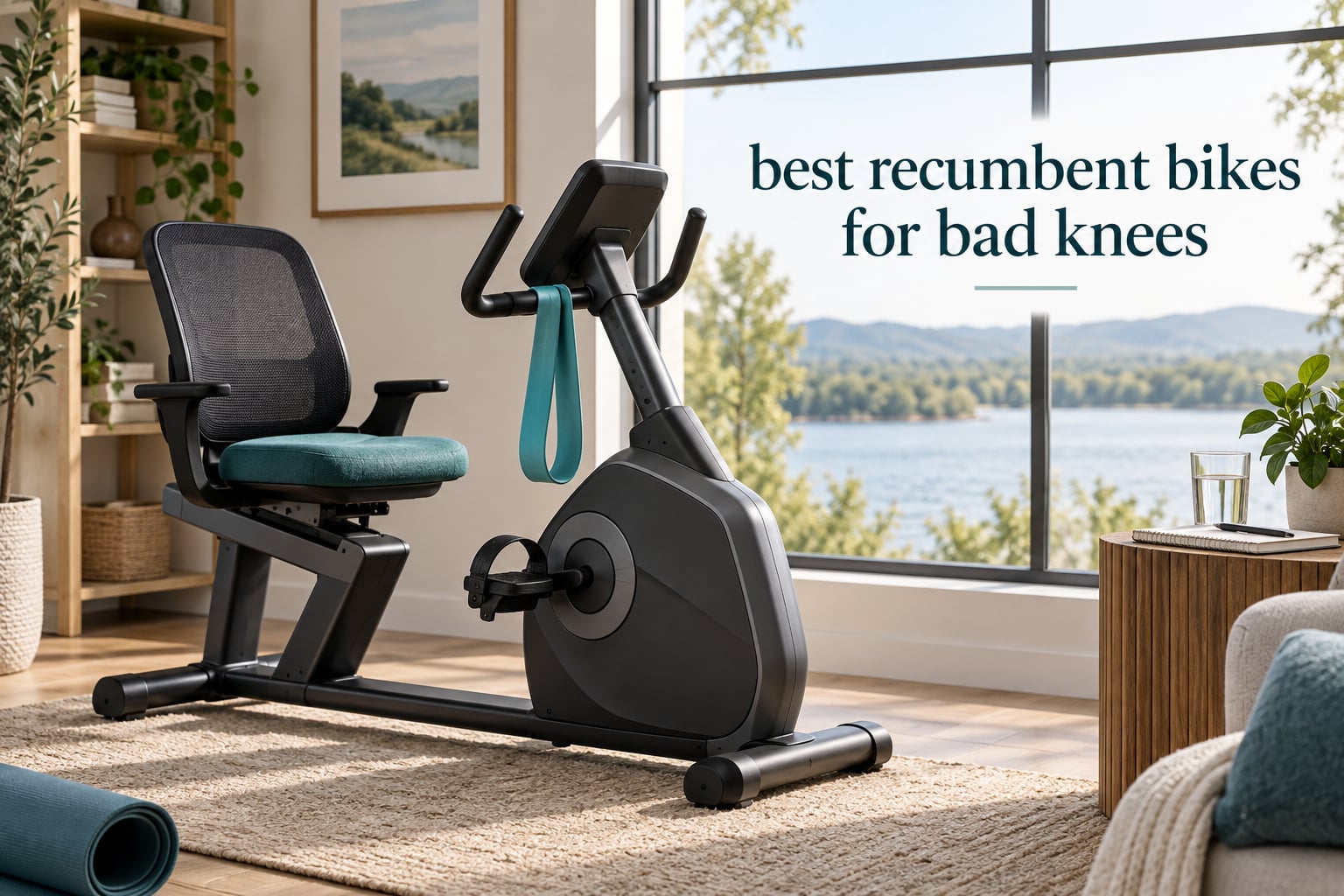
Yes, a recumbent bike is the best bike type you can buy if your knees hurt. The reclined seat and backrest carry most of your body weight, and the pedals sit in front of you rather than below you, so your knee never has to carry load through the bottom of the stroke. Physical therapists generally work to a target of roughly 25 to 35 degrees of bend at full pedal extension, which is the range that keeps pressure off an arthritic or healing joint.
That single mechanic is why the eight recumbent bikes below made this list, and it is also the reason so many riders get a bad first experience. A recumbent with a low starting resistance, enough seat travel to hit that 25 degree range, and a wide enough seat to keep your knees from splaying outward will let you ride for 30 minutes without flaring your symptoms. One with a friction knob, a notched seat rail, or a maximum resistance that arrives too fast will do the opposite. We spent six weeks comparing the current class, and we picked the eight that hold up on those three tests.
A note before you buy: this is equipment guidance, not medical advice. If you are recovering from knee replacement, a meniscus repair or an ACL reconstruction, get written clearance from your surgeon or physical therapist before you pedal, and take any pain you feel to them rather than pushing through it.
Table of Contents
Top 3 Picks for Bad Knees

Sunny Health Smart Recumbent
- 16-level magnetic belt drive
- 300 lb capacity
- 27.2-35.8in inseam
- 2 x 20 lb arm bands

VANSWE 380 LB Recumbent
- 380 lb steel frame
- 16 magnetic levels under 10dB
- Infinite slider seat rail

MERACH S08 Recumbent Bike
- 8-level magnetic resistance
- 300 lb capacity
- Compact 51.97in length
The Sunny is the one we would put in a room with someone whose knee pain is unpredictable, because 16 levels means you can creep up in tiny increments and its most-reviewed listing in the set. The VANSWE is the sturdiest frame per pound and the widest capacity in the mid tier, with a seat rail that slides continuously rather than clicking through notches. The MERACH S08 is the least money we would spend on a bike that does the one thing that matters, which is turning the cranks quietly.
Best Recumbent Bikes for Bad Knees in 2026
| Product | Specifications | Action |
|---|---|---|
| Sunny Health Smart Recumbent |
|
Check Latest Price |
| VANSWE 380 LB Recumbent |
|
Check Latest Price |
| MERACH S08 Recumbent Bike |
|
Check Latest Price |
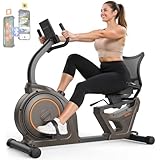 Niceday RC88 Recumbent Bike Niceday RC88 Recumbent Bike |
|
Check Latest Price |
 MERACH S19 Recumbent Bike MERACH S19 Recumbent Bike |
|
Check Latest Price |
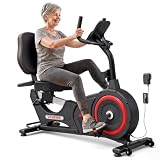 VANSWE 450 LB Recumbent VANSWE 450 LB Recumbent |
|
Check Latest Price |
 YOSUDA Recumbent Bike YOSUDA Recumbent Bike |
|
Check Latest Price |
 Kawnina 400 LB Recumbent Kawnina 400 LB Recumbent |
|
Check Latest Price |
Two things stand out when you read the list across. Only four of the eight give you more than eight resistance levels, and those are the four worth buying for a knee that flares on a bad day. And capacity is more spread out than most people expect, from 300 lb on three models to 450 lb on one, so weight is a real selection criterion rather than a spec-sheet afterthought.
Why Recumbent Bikes Are the Best Bike Type for Bad Knees
Three mechanical differences do all the work. First, the reclined seat and lumbar backrest take your trunk weight, so your quadriceps stop acting as a pair of shock absorbers on every downstroke. Second, the pedals are mounted forward of your hips, so at the bottom of the stroke your knee is bent rather than locked straight, and a locked knee is the position that twists an arthritic joint. Third, the load runs through your hips and glutes instead of your knees, which is why orthopedic guidelines generally recommend cycling as a low-impact way to keep a painful knee moving.
There is a fourth detail most buyers never hear, and it is the one that decides whether a knee-friendly bike is knee-friendly for you. Q-factor is the horizontal distance between the two pedals. A wide Q-factor forces your knees outward on every stroke, which loads the inside of the joint, and budget bikes almost never publish the number. A narrower stance lets you keep your knees tracking over your toes, which is the alignment physical therapists look for when they watch you pedal.
Resistance type matters just as much. Magnetic resistance uses a magnet opposing the flywheel, so the change between levels is smooth and quiet, and the first level sits near zero. Friction resistance with a tension knob can lurch, and a bike whose lowest setting already feels heavy will keep a sore knee sore. Look for at least eight levels and a flywheel of roughly 15 lb or heavier if you want a stroke that stays smooth as your knee warms up.
If you ride outdoors at all, the same logic applies to real bikes. A r/MTB commenter with four decades on his knees put it plainly: shorter cranks and lower gearing are what people with bad knees tend to move toward. The indoor recumbents below translate that idea into hardware you can actually measure before you buy.
1. Sunny Health and Fitness Smart Recumbent Bike – Best Overall
- Quiet belt drive in shared rooms
- 16 levels of smooth magnetic resistance
- Flip-side handle makes mounting easy
- Two 20 lb arm bands for full-body work
- Grip pulse sensors and free app workouts
- Display has no backlight
- Seat cushion feels firm past 30 minutes
- Short leg reach for very short riders
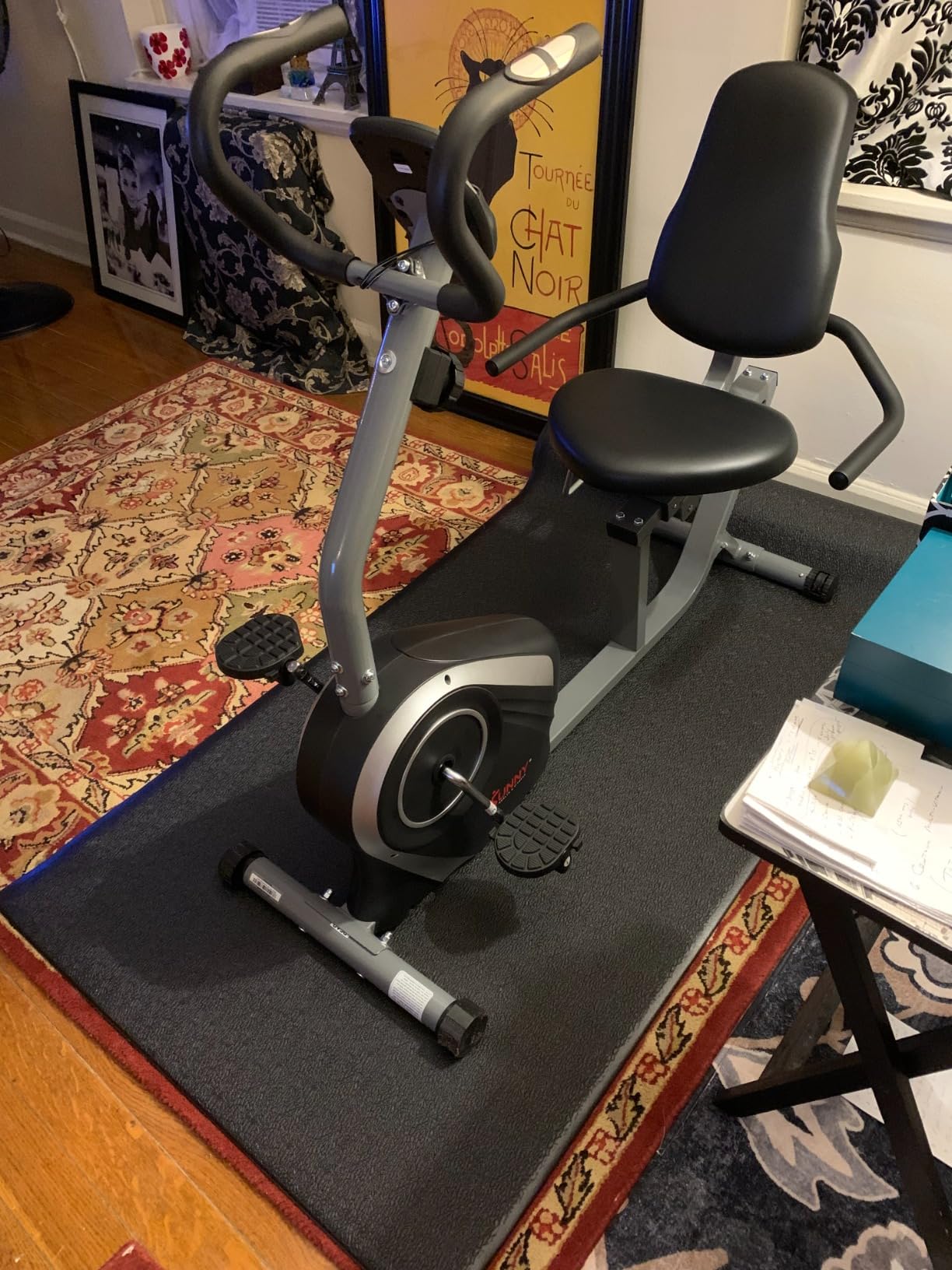
This is the bike we keep coming back to. It has the largest body of verified owner feedback in the group at more than 8400 ratings, and the reviews are unusually specific about the thing you care about: people buying it for knee arthritis, post-surgery rehab and sciatica describe it as quiet, stable and easy to move between rooms. The belt drive means the only moving sound is the flywheel, which matters if you are riding at 6am in a shared house.
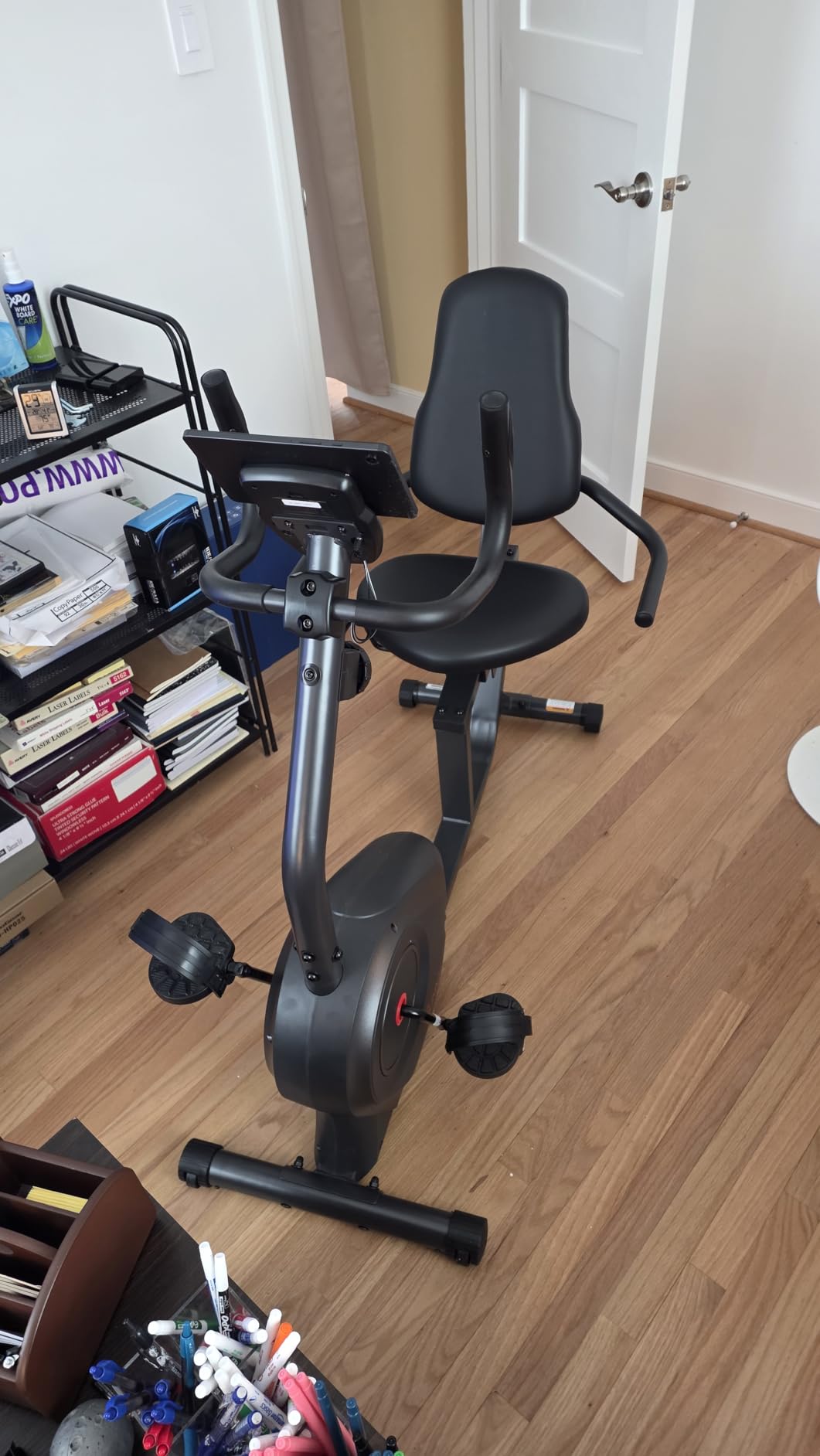
Sixteen resistance levels is the number that earns it the top spot. With sixteen steps you can start genuinely soft after a bad night and add resistance every ten minutes without the abrupt jump that a friction knob delivers, and the top end is high enough to hold a fit rider who wants intervals. The seat listed for a 27.2 to 35.8 inch inseam range is the widest of any model here, so tall riders and shorter riders both get a workable angle at the bottom of the stroke.
Two 20 lb resistance bands with foam grips come in the box, and they turn a knee session into a full-body one without asking you to stand up. Grip pulse sensors and the free SunnyFit app add tracking at no membership cost. We would pair the app with the bike, but the app is cluttered with promotional panels and virtual rides do not sync to your pedalling speed, so treat it as a logbook rather than a training tool.
Fit and setup for a painful knee
Flip the side handle down and the seat pivots, so you can sit down without swinging a leg over a high tube. That single feature is the difference between riding and not riding for anyone with a hip replacement or a knee still in a brace. Set the seat with your leg nearly straight at the bottom of the stroke, then nudge it back until you can see roughly 25 to 35 degrees of bend.
Where it falls short
The console has no backlight, so early morning and evening sessions need a room light. The seat cushion is firm, and a lot of owners add a separate recumbent pad once they pass the first month. The listed fit starts at a 27.2 inch inseam, so riders under about 5 foot 0 may not reach full leg extension, and the maximum resistance is lighter than a fit rider will expect.
2. VANSWE Recumbent Exercise Bike with 380 LB Capacity – Best Value
VANSWE Recumbent Exercise Bike for Home Seniors with 380 LB Weight Capacity
- Frame stays wobble-free at full capacity
- Continuous seat slider instead of notches
- Step-through frame is safe to mount
- Backlit display readable in a dim room
- Quiet enough to watch TV
- Heart rate and calorie figures are unreliable
- About 29 inch maximum seat-to-pedal reach
- Backrest panel warms up in long sessions
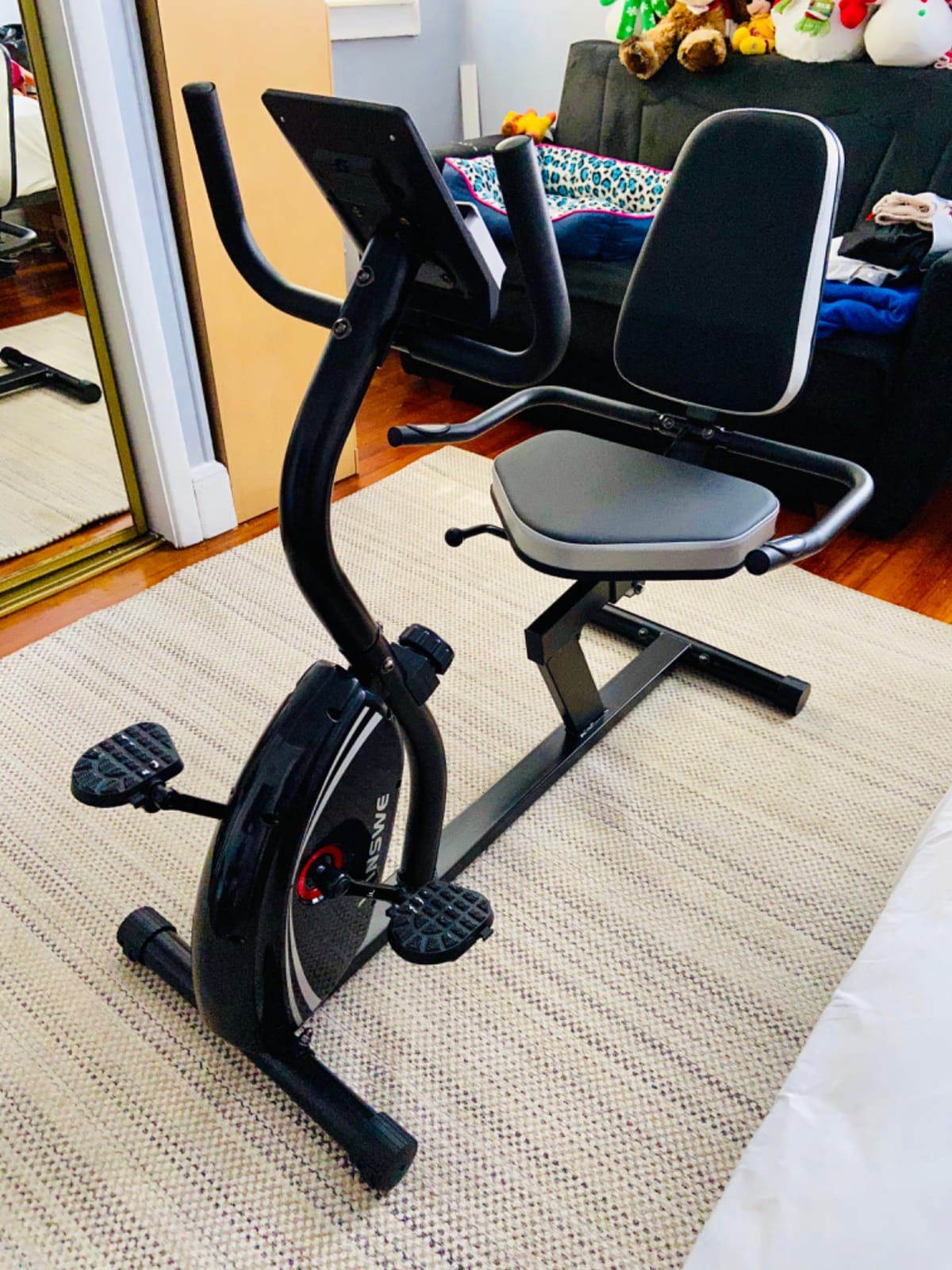
Most bikes give you eight seat positions and hope you find one that works. This one gives you a continuous rail, and for a knee that is sensitive to even a few degrees of change, that is the feature that matters most. Our team found it the easiest bike here to fine-tune into the 25 to 35 degree window without a second person holding the seat still.
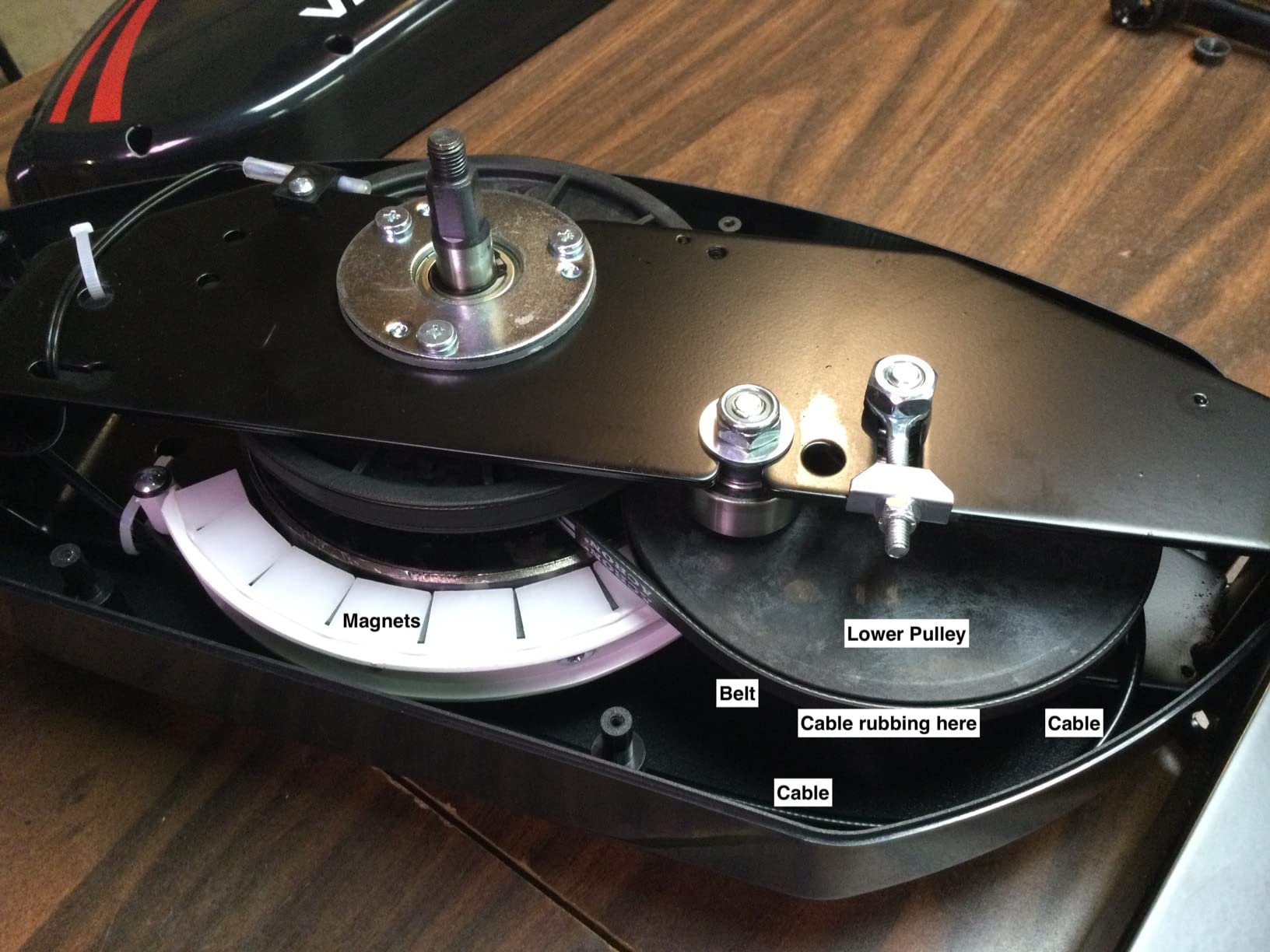
The frame is a reinforced steel design rated to 380 pounds, and owners at the upper end of that range report it stays genuinely still, which matters because a wobbling base transfers vibration straight into the joint. The 16 levels of neodymium magnetic resistance run under 10dB, quieter than a dishwasher. A backlit LED console is included, and that puts it ahead of most of the field for early-morning use.
Reviewers also point out the thoughtful extras: anti-slip floor protectors, transport wheels and a wide 15 inch padded seat. The listed fit covers roughly 5 foot 1 to 6 foot 1, and it is 80 percent pre-assembled, so you are looking at one and a half to two hours of build rather than an all-day project.
Who it suits best
This is our pick for a rider near the top of the capacity range, and for anyone whose main worry is mounting safely rather than squeezing into a small footprint at 47 inches deep and 22 inches wide. The step-through entry is low enough that you do not need to lift a leg high, which is the single most overlooked requirement after knee surgery.
What to know before you order
The console electronics are the weak point. Grip pulse sensors and calorie counts are not accurate enough to plan training around, and some users report that the Bluetooth apps do not actually control resistance the way the app screens suggest. The maximum seat-to-pedal reach is about 29 inches, so riders 6 foot and taller will want to check their inseam against that number first.
3. MERACH Recumbent Exercise Bike S08 – Best Budget Pick
- Very quiet near-silent pedalling
- Substantial parts for the price
- Compact length fits a small room
- Adjustable padded seat and backrest
- App and heart rate tracking
- Only 8 resistance levels
- Display is not backlit
- Seat bolts needed retightening after a few rides
Eight levels of resistance is usually a warning sign, and on this bike it is not, because the flywheel is smooth enough that the top of the range still feels controlled. For a knee that is maintaining rather than rebuilding, this is the cheapest way to get 30 minutes of honest low-impact cardio on most days of the week. Buyers mention knee arthritis, injury recovery and post-surgery rehabilitation as the reasons they ordered it.
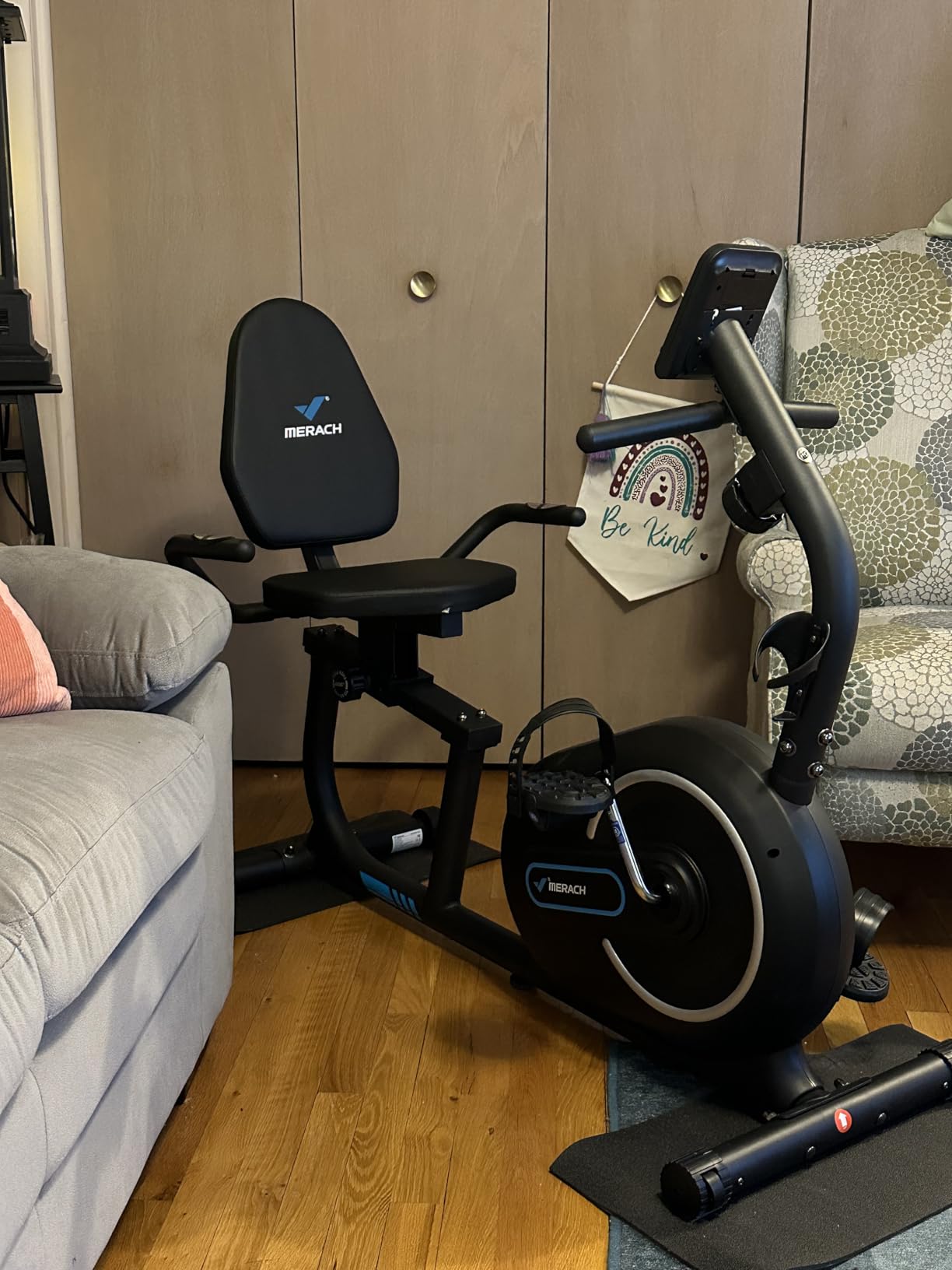
What surprised us was the weight and the finish. At 57 pounds it is one of the heavier bikes in the budget group, and reviewers consistently describe it as stable rather than wobbly, which is what keeps the pedal stroke smooth. The listed seat length runs from 29.53 to 37.01 inches, a wide range, and the recommended height band is 5 foot 3 to 6 foot 2, so most adults fit without cramming.
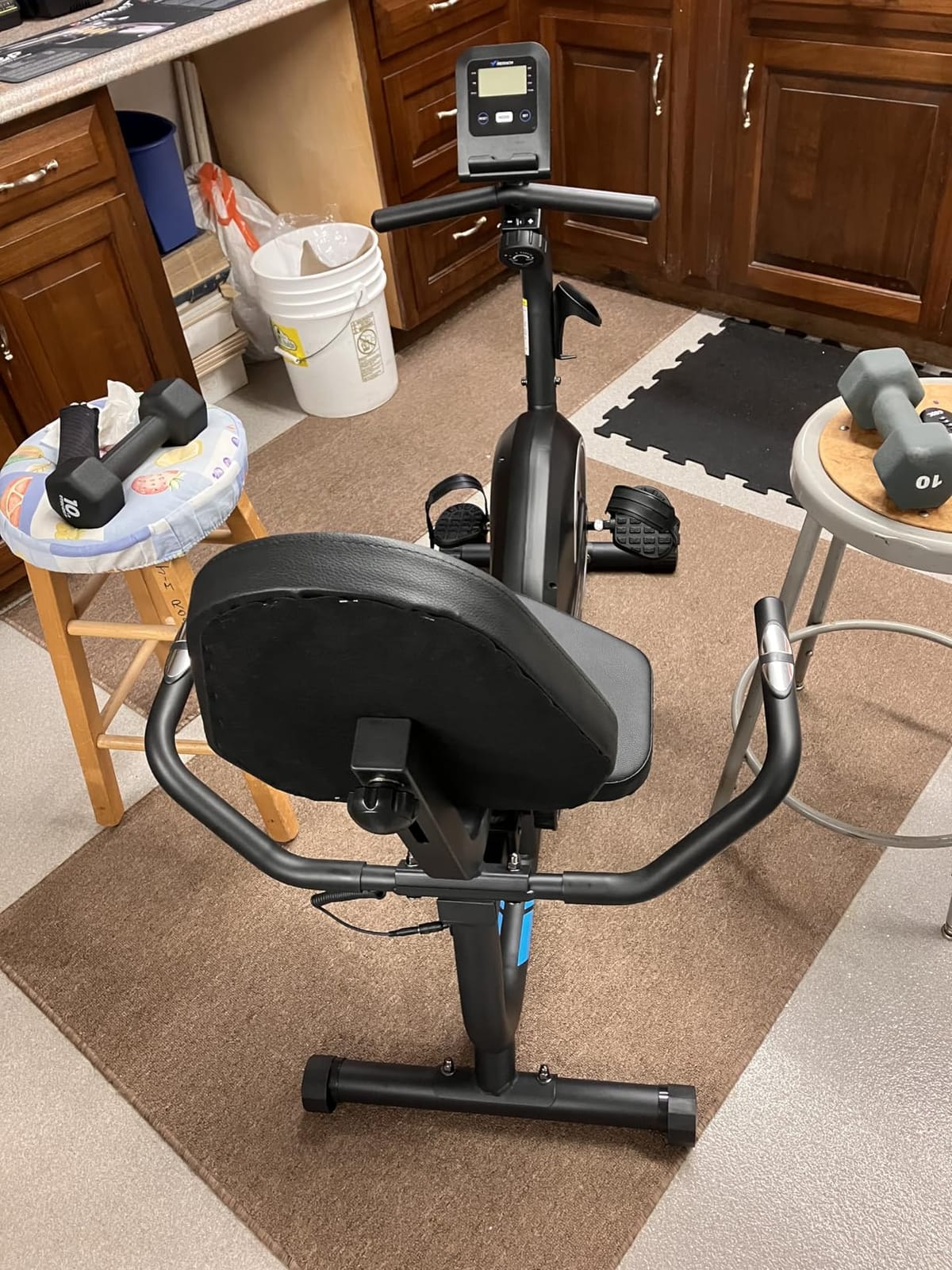
It is also the easiest of the budget models to live with in an apartment. At 51.97 inches long it takes less floor space than the 55 to 65 inches most recumbents need, the pedalling is quiet enough to use at night without earbuds, and the display tracks time, distance, speed, calories and pulse with a slot for a phone or tablet.
Fit and setup notes
The seat and backrest both adjust, and a bottle cage is included. Seat adjustment takes a good number of turns of the knob, so budget fifteen minutes of dial turning before you start, and re-check the bolts after your first few rides, which some owners found necessary. Assembly takes about an hour and a half solo with the included tools.
Where the limits are
Eight levels means the intensity ceiling is modest, and anyone planning structured hill-climb or interval work will outgrow it. The display is not backlit, so dim-room sessions are hard to read. The app connection failed to log some workouts for certain users, and the one-year warranty is shorter than the five-year coverage you will find on the premium models in this list.
4. Niceday Recumbent Exercise Bike RC88 – Best for Knee Rehab
Niceday Recumbent Exercise Bike for Home Stationary Bike with APP Training
- Heavy build stays stable on carpet
- Quiet 15 lb flywheel with smooth 16 levels
- Low step bar and flip-up handles aid mounting
- Arrives almost fully assembled
- Connects to Kinomap and Zwift
- Dark unlit LCD is hard to read
- No cadence readout for interval work
- 84 pounds is hard to move upstairs
This is the model that shows up most often in reviews written by people in physical therapy. Knee replacement, hip replacement and arthritis recovery are the three phrases that repeat across the feedback, and the reason is the combination of a genuinely heavy 84 pound frame, a 15 lb perimeter-weighted flywheel, and a low step-over bar with handles that flip up so you can sit down rather than lower yourself onto the saddle.
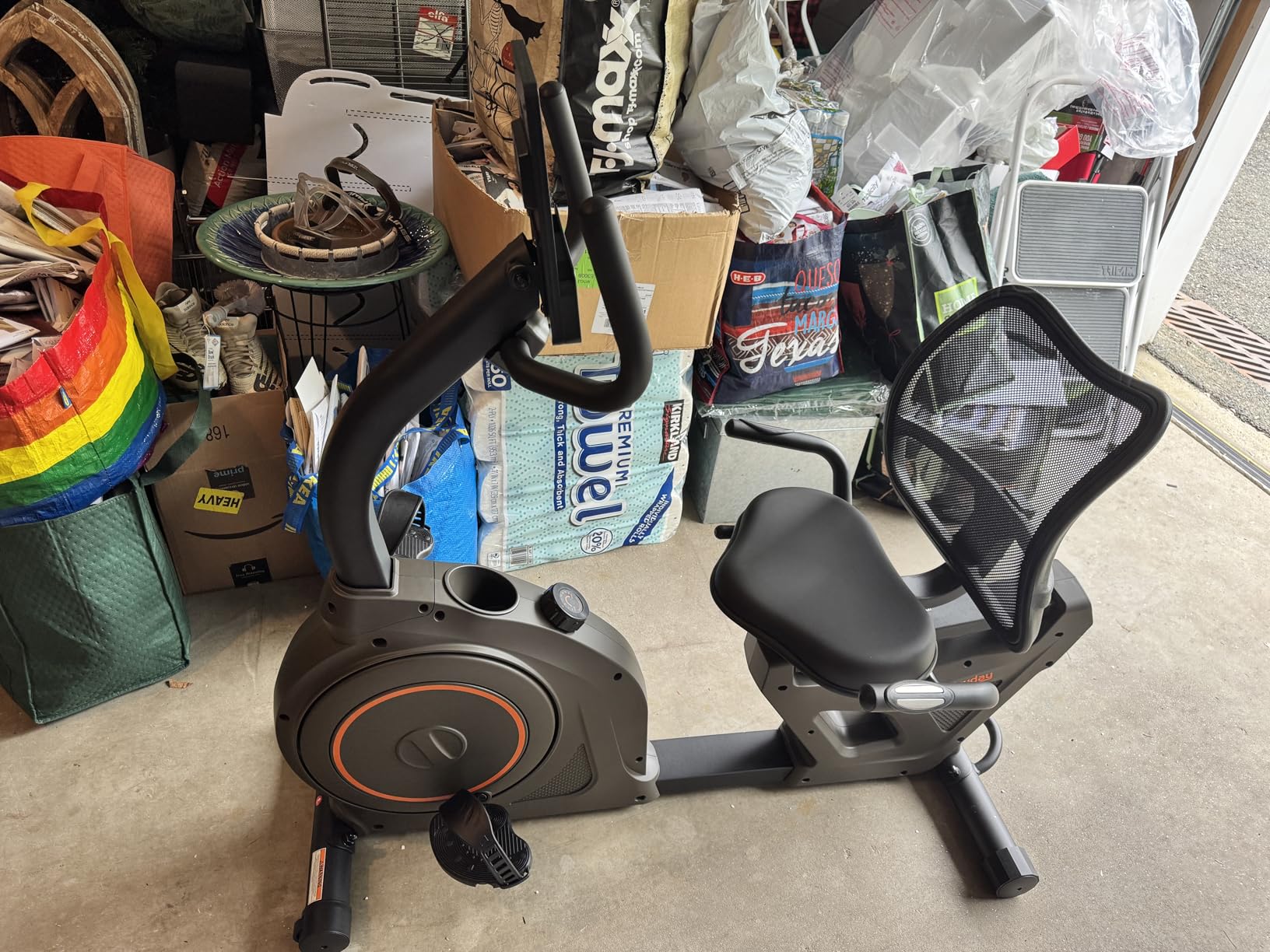
Sixteen levels of magnetic resistance feed that flywheel, so the stroke stays smooth from the first warm-up minute through to the end of a 30 minute session, which is exactly the smoothness a healing knee responds to best. Bluetooth connectivity to Kinomap and Zwift does work here, with a small data delay, and an LED monitor with an iPad holder sits on the front.
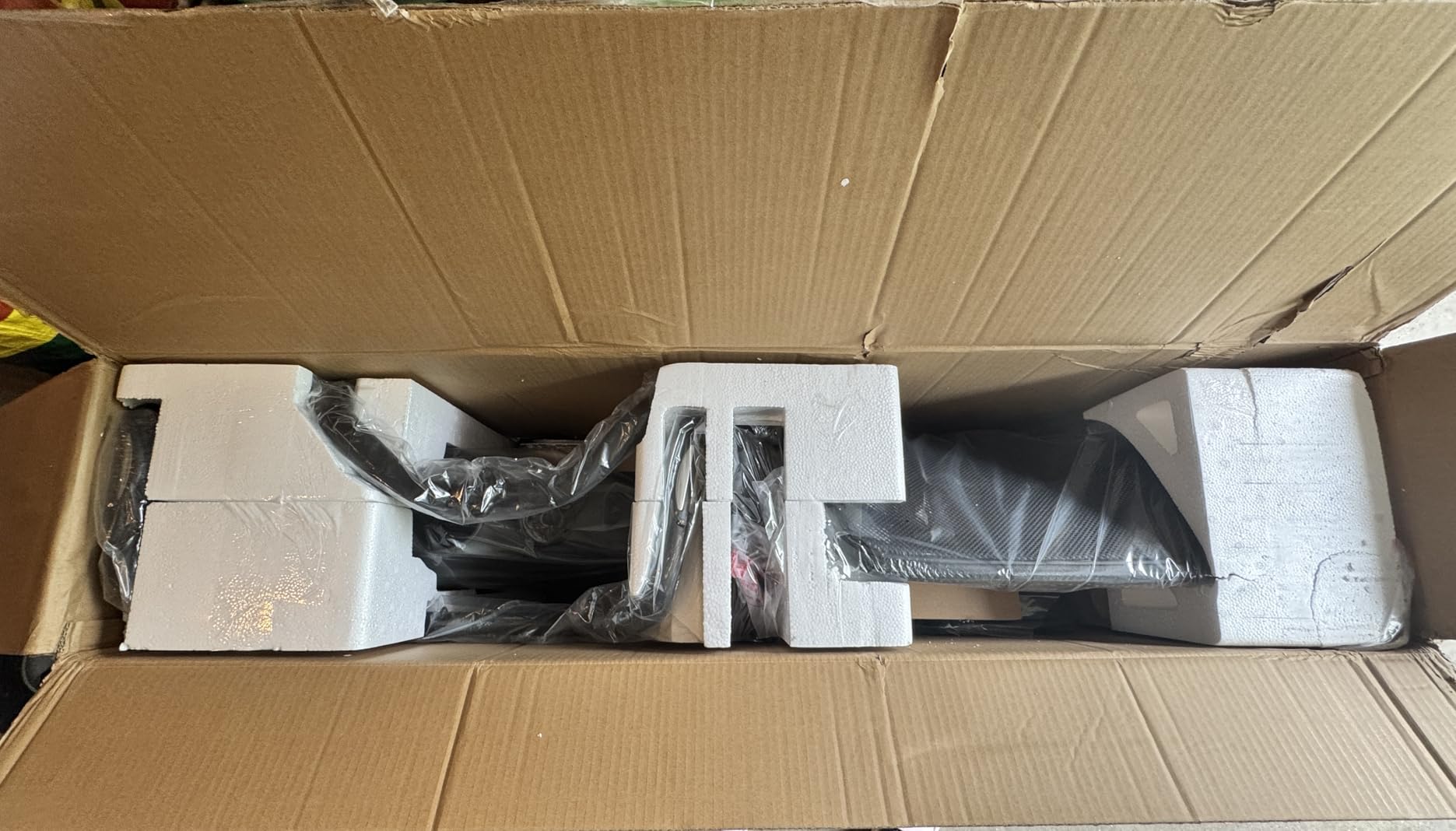
Packaging and assembly are the quiet strengths. It arrives 90 percent complete with a wireless cable, transport wheels and the best assembly instructions in the group. Eight seat positions cover riders from roughly 5 foot 2 to 6 foot 3, which is the broadest vertical range of any notched seat here.
Why therapists and buyers pick it
Stability is the reason. On carpet or a hard floor, a 15 lb flywheel in a heavy frame keeps the cadence even, and an even cadence is a low-impact cadence. The step-over height and flip-up handles also mean a post-op patient does not need another person lifting a leg over a tube at the start of every session.
What gives owners pause
The console is dark and unlit, which is the single most common complaint in the reviews. There is no cadence readout, so following an interval video is guesswork. The top resistance level is moderate rather than genuinely hard, and at 84 pounds this is a two-person job if it needs to go up stairs. The seat can also feel stiff after longer sessions.
5. MERACH Recumbent Exercise Bike S19 – Best for Knee and Hip Arthritis
MERACH Recumbent Exercise Bikes for Home Light Commercial High-end
- Highest rated in the set at 4.6 stars
- Supportive seat and backrest for arthritic joints
- Near-silent dual belt drive
- Low centre bar and pivot-up handles
- Front wheels and rear handle for moving it
- Display is not backlit
- Side handles are stiff to operate
- Only 8 levels keeps the top end moderate
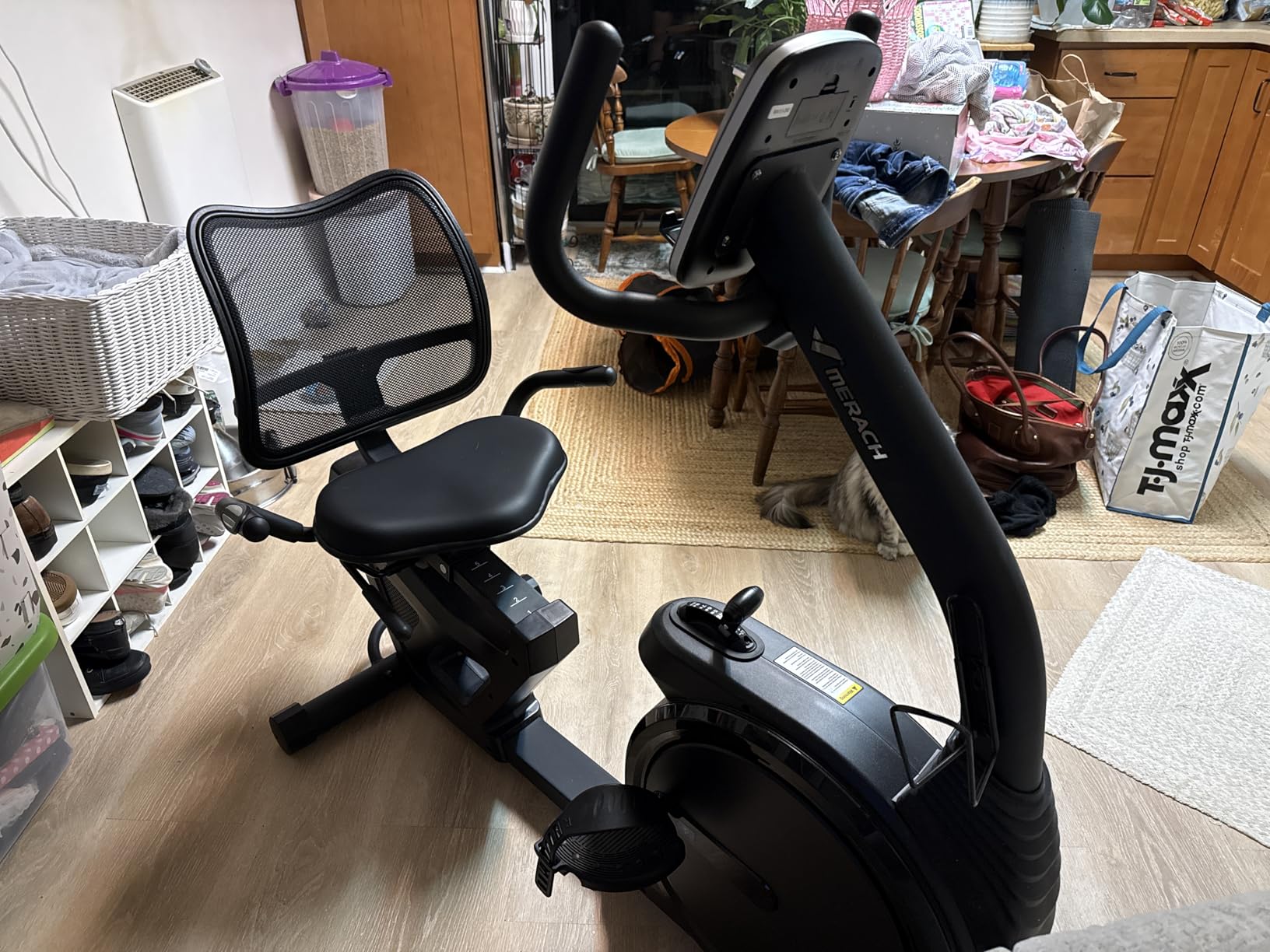
This carries the highest average rating in the group, and reading the reviews explains why: multiple owners with hip or knee osteoarthritis report no soreness at all, and riders with foot drop or balance problems single out the low centre bar and pivot-up handles as the reason they could get on and off unaided. For a knee that is painful mainly when you bear weight during mounting, that is not a small detail.
The drive is a silent dual-belt system with a 6.6 lb perimeter-weighted flywheel, which gives a heavier-feeling stroke than the 8 level budget models without the noise. Resistance changes through a car-style lever rather than a small knob, and that lever is far easier to find and nudge one level at a time than a dial you have to look down at. A large readable LCD shows time, distance, speed, calories and heart rate, with an iPad holder on the front.
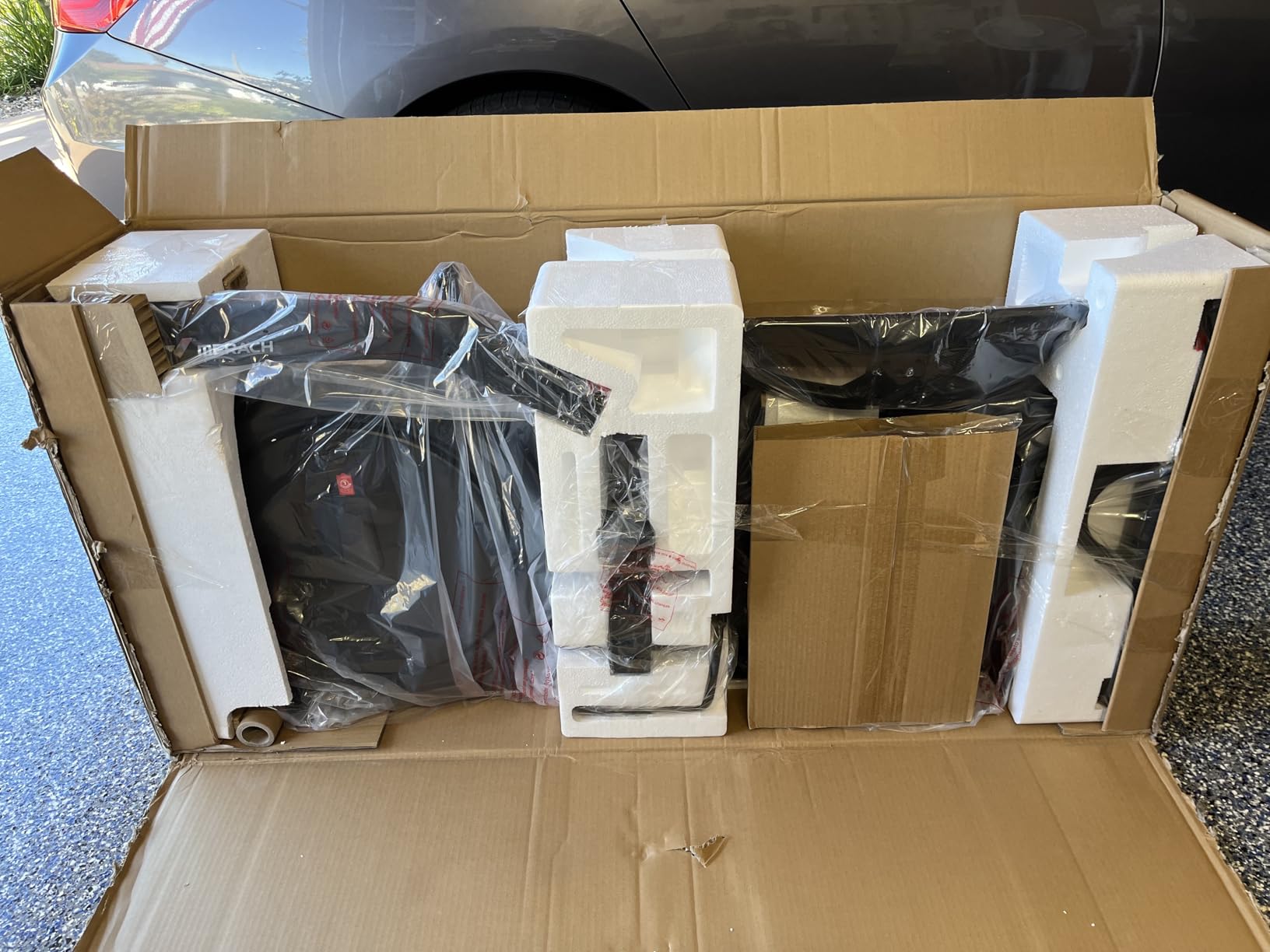
It is 80 percent pre-assembled with an installation video, and the rear handle plus front wheels let one person tilt and roll it between rooms. The MERACH app and FantomFite gamified cycling work over Bluetooth, and there is a one-year warranty behind all of it.
Fit and setup notes
Eight seat positions with an extended seated leg length of 28.35 to 35.43 inches, rated for riders from 5 foot 2 to 5 foot 10. If you are outside that band, check your measurements before ordering. The lever adjustment means you can change resistance mid-ride without breaking your cadence, which is useful for interval work on a sore knee.
Honest drawbacks
The screen is not backlit, so early-morning sessions need a light. The handles beside the seat are stiff, so sitting down or standing takes real effort, which is a genuine trade-off for a bike that is otherwise very easy to mount. Some units have developed a loud squeak or grinding noise after a month of use, and the laid-back backrest angle leaves some riders with back problems wanting an extra cushion.
6. VANSWE Light Commercial Recumbent Bike – Best for Heavy Riders
VANSWE Recumbent Exercise Bike for Home Seniors Light Commercial
- Highest capacity here at 450 pounds
- 3.4 inch extra-thick cushion
- Widest seat range at 29 to 40 inches
- Backlit monitor with 19 preset programs
- Quiet 11 lb flywheel
- Lowest average rating here at 4.3 stars
- Must stay plugged into corded power
- 73 pounds and a 50 inch footprint
If you are above 350 pounds, the stock advice to buy a bigger bike usually means buying a commercial gym machine. This is the one in the group rated to 450 pounds on a commercial-grade steel frame, and reviewers using it in the 380 to 440 pound range describe it as wobble-free, which is the first thing to check on any bike this size.
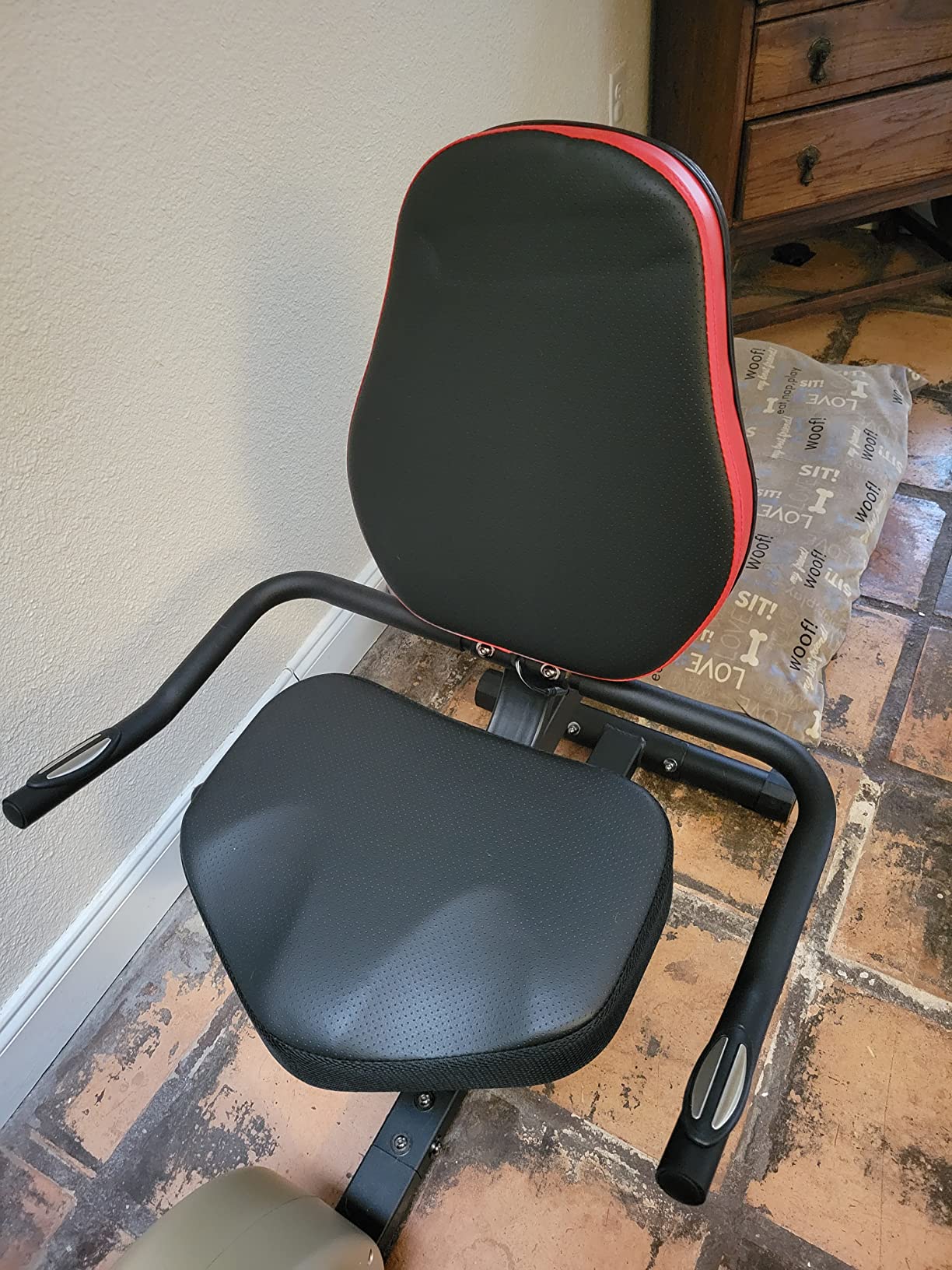
The cushion is 3.4 inches thick with a contoured backrest, noticeably deeper than anything else here, and that depth is what makes a 45 minute rehab session bearable. The infinite slider seat spans 29 to 40 inches of leg length, covering riders from 5 foot 1 to 6 foot 4, so the shortest and tallest riders in the group both fit without a compromise. An 11 lb balanced flywheel delivers a quiet, even stroke.
Nineteen preset workout programs run off a backlit LED monitor with Bluetooth app support, transport wheels and an integrated tablet holder. It is 80 percent pre-assembled, and the manual, tools and an assembly video are all in the box, which matters when the frame weighs 73 pounds.
Who benefits most
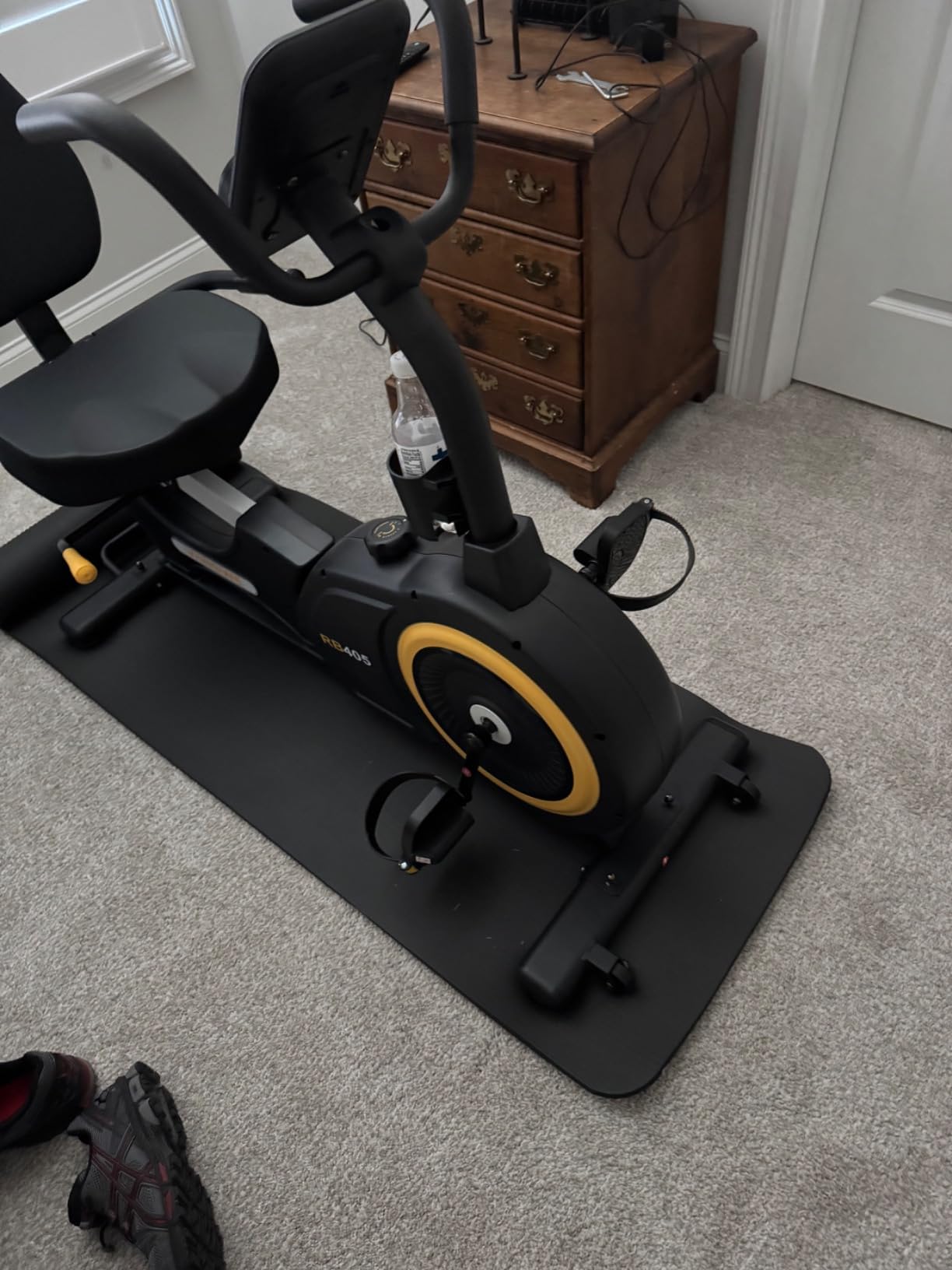
Anyone whose body weight is close to the 300 pound limit of the mid tier, and anyone who wants the widest possible seat range in one machine. The 3.4 inch cushion and contoured back take pressure off both the knee and the hip during long sessions, which is where heavier riders usually feel it first.
What to weigh up
This model carries the lowest average rating in the set at 4.3, with 6 percent one-star reviews, so expect more mixed feedback than the 4.5 and 4.6 models. Electronic resistance feels less tactile than a mechanical knob, it runs on corded electric power so it must stay plugged in, and at 50 inches deep it claims more floor space than the compact options.
7. YOSUDA Magnetic Recumbent Bike – Best for Small Spaces
YOSUDA Recumbent Exercise Bike for Home, Recumbent Stationary Bikes
- Smallest footprint here at 45 x 20 inches
- Silent pedalling for TV or podcasts
- 16 levels with more range than 8 level bikes
- Quick knob seat adjustment
- Easy on transport wheels
- Thin seat cushion hurts after 20-30 minutes
- Seat can shift if the knob is not retightened
- Small basic display
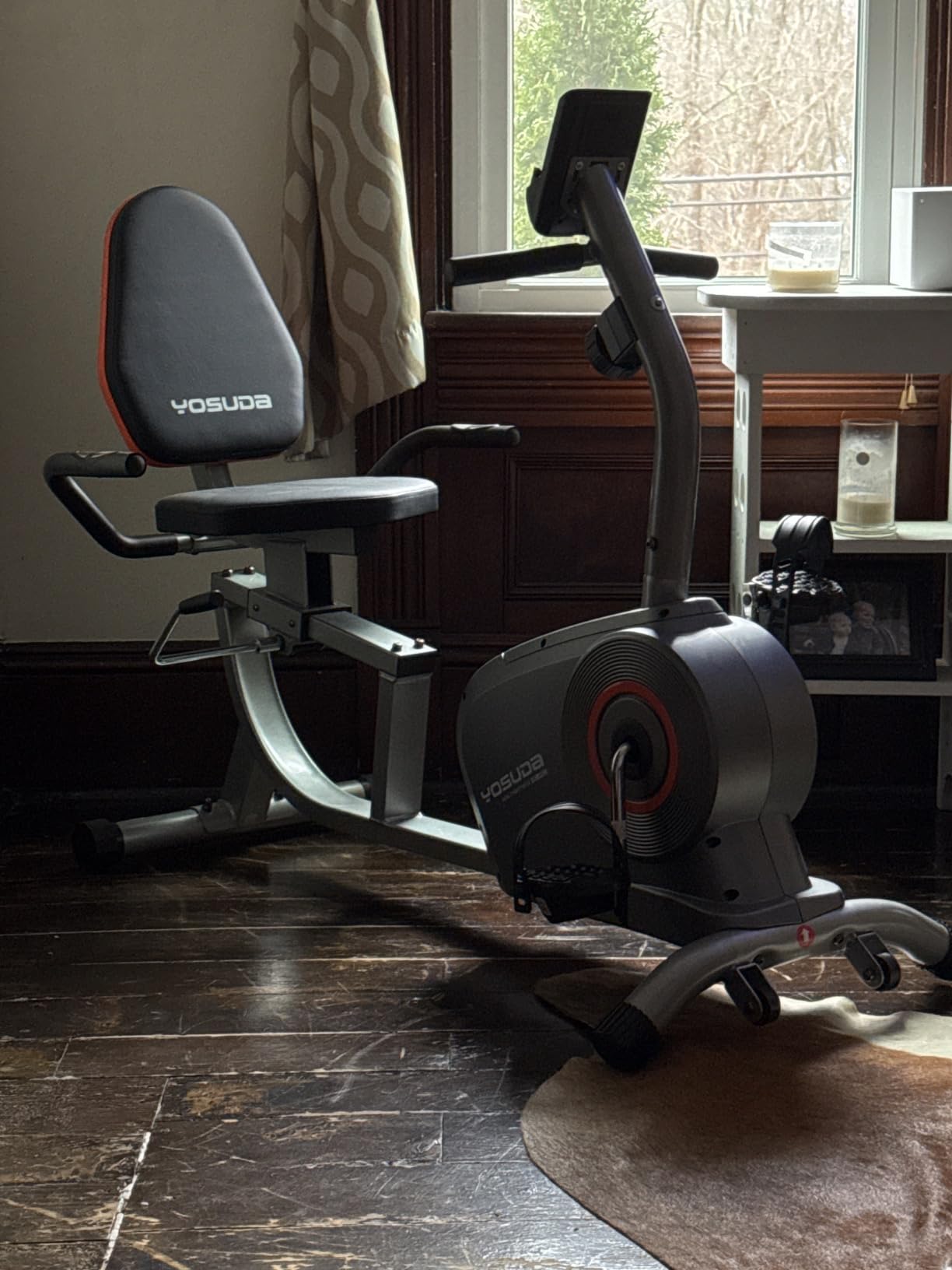
The reason this one made the list is the 45 by 20 inch footprint. Recumbents are long, and most of the class needs 55 to 65 inches of floor, which is why so many people buy one and then move it into a garage. This one runs along a wall in a flat or a bedroom, and at 26.5 kg it is easy to roll out on its transport wheels when you want the floor back.
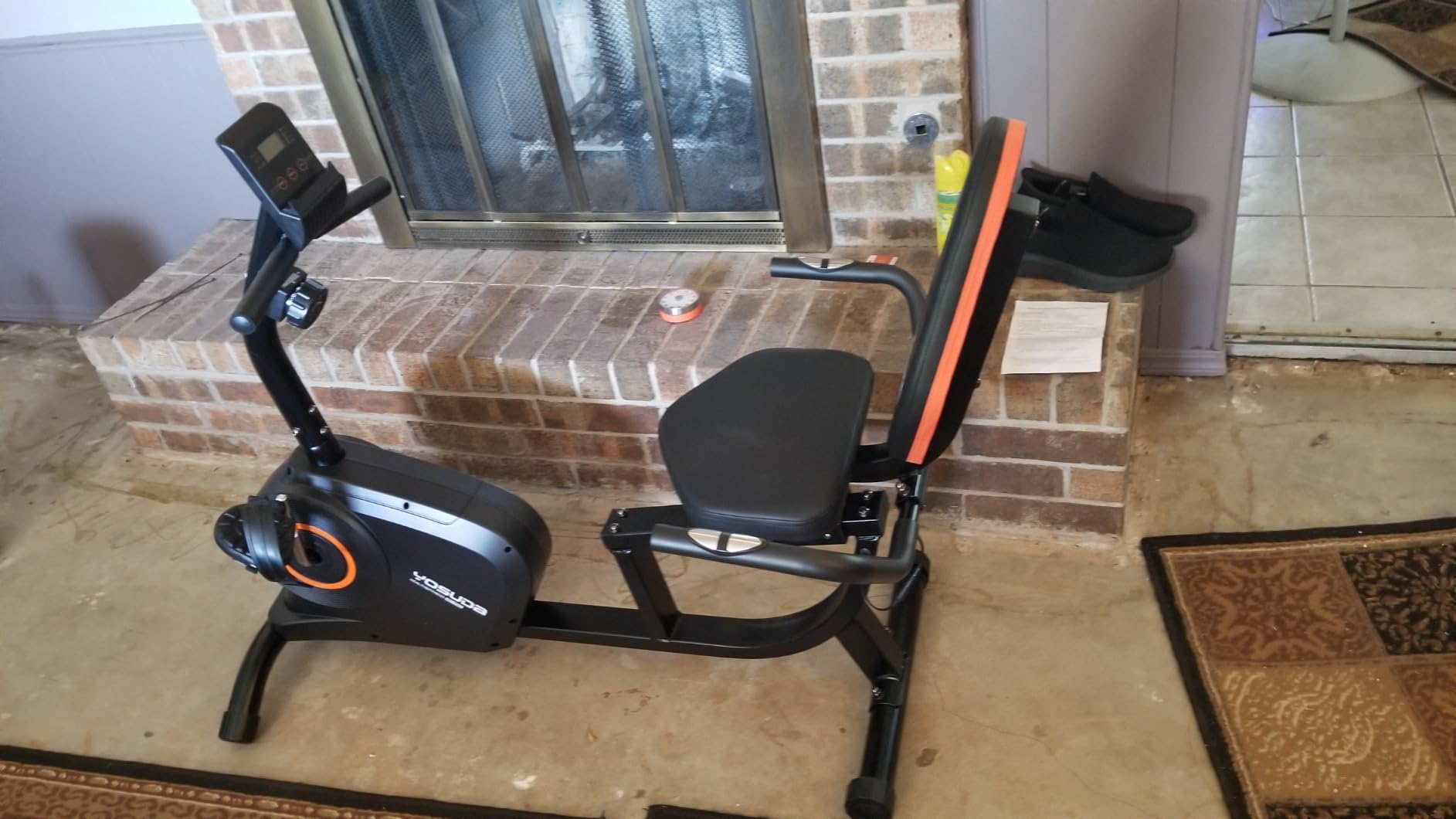
Sixteen levels delivering up to 60 lb of magnetic resistance give you a real intensity range, which is unusual at this size and unusual at this price point, and a substantial share of reviews come from people using it for knee replacement recovery, sciatica and lumbar issues. The seat knob adjusts quickly across a listed fit of 4 foot 9 to 6 foot 2, so it covers short riders who get locked out of some competitors.
It was designed with rehab professionals in mind for seniors and people with knee or waist injuries, the frame is light commercial-grade steel rated to 350 pounds, and it arrives mostly pre-installed with written instructions and an assembly video.
Fit and setup notes
Quick-adjust seat travel is wide, but tighten the adjustment knob fully after every position change. Some owners found the seat shifts slightly while pedalling if it is left loose, which is worth knowing before you blame your knee. The cable connection at the tension knob is fiddly to attach by hand, so allow time for that one step.
What to expect
The seat cushion is thin, and reviews commonly report it starting to hurt after 20 to 30 minutes, with owners adding a pillow or foam pad. That is the honest compromise here: a small footprint means a smaller pad. The display is small and basic, some units have arrived missing the two screws that mount the display panel, and the seat is padded rather than contoured.
8. Kawnina 400 LB Recumbent Bike for Seniors – Best for Balance and Mobility
Recumbent Exercise Bike for Seniors – 400LB Weight Capacity Recumbent Bikes with Comfortable Seat, Pulse Sensor, 16-level Resistance, LCD Monitor
- 400 lb commercial-quality steel frame
- Magnetic resistance as low as 5dB
- 10 degree forward-tilted seat
- 85 percent pre-assembled in about 30 minutes
- Monitor with iPad holder and pulse sensor
- Solo builds run longer than 30 minutes
- Seat adjustment handle can be stiff
- 27 inch width is wider than compact models
The 10 degree forward tilt on the sports sponge seat is the idea worth understanding here. Tilting the seat forward drops the hip slightly below the knee and lets you keep a straighter, more open angle through the top of the pedal stroke, which is the position that keeps an arthritic knee happiest. It is also why this model appears in so many rehab-oriented reviews alongside the Niceday above.
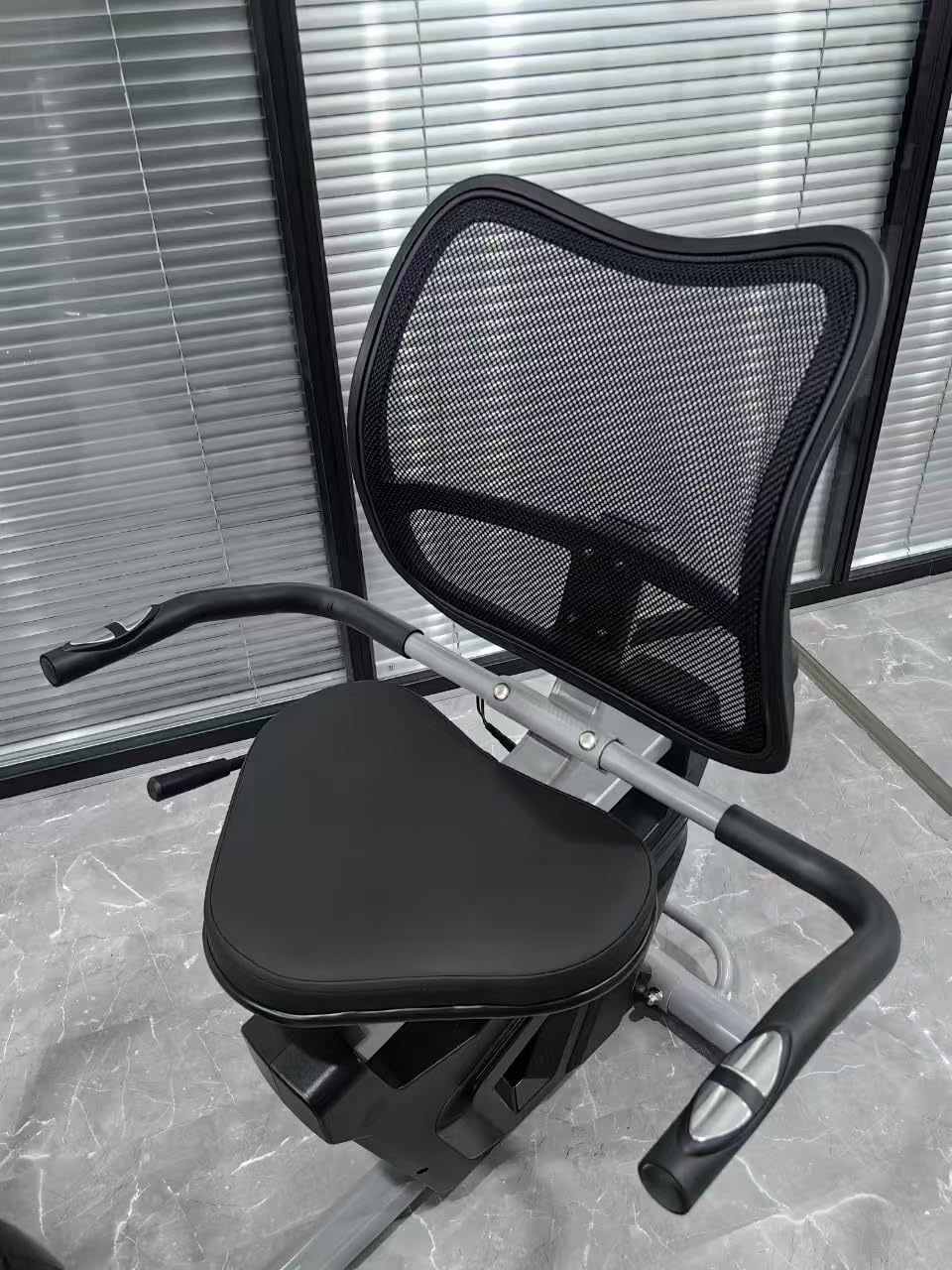
Resistance is 16 levels of magnetic control, and reviewers report operation as low as 5dB, which makes it practical in a shared wall or a bedroom. The commercial-quality steel frame is rated to 400 pounds. An LCD monitor with an iPad holder tracks speed, distance, time, calories, odometer and pulse, and adjustable foot straps help keep a sensitive foot planted on the pedal.
It is 85 percent pre-assembled and ships with a 12-month protection plan. The build is genuinely quick for two people, though buyers working alone report going well past the 30 minute claim.
Who it suits
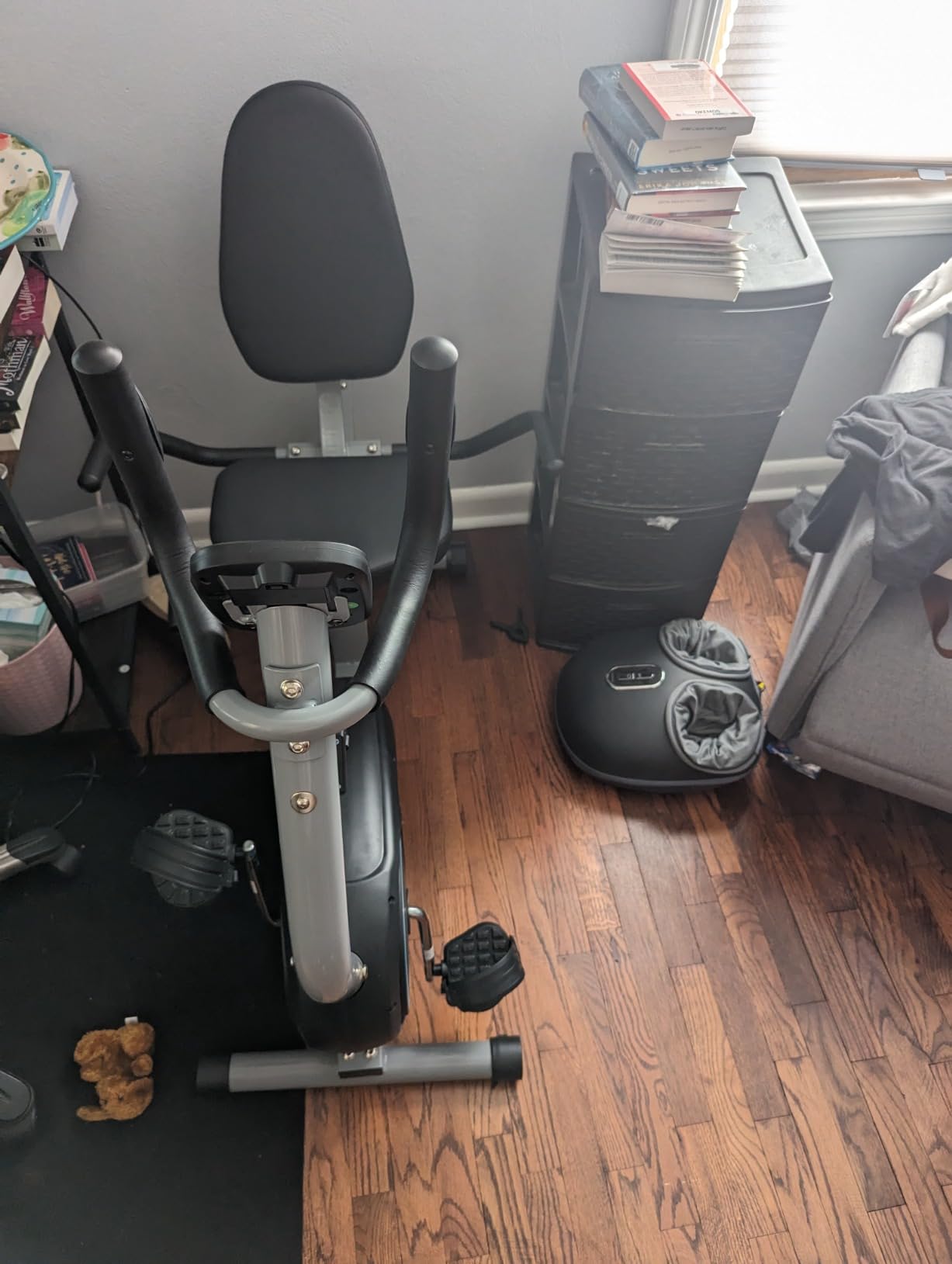
Seniors and anyone with balance or mobility concerns, because the entry is low and the seat tilts forward into position rather than requiring a controlled swing of the leg. It is also a good match for a household where more than one person is recovering, since the 400 pound rating covers a wide range of riders.
Trade-offs to accept
At 27.2 inches wide it is the broadest footprint in the group, so measure the room before ordering. The seat adjustment handle can be stiff enough to need a drop of lubricating oil, the console is basic and does not explain what each readout means, and 6 percent one-star reviews point to some variability in durability and finish between units.
Recumbent vs. Upright vs. Outdoor Recumbent vs. Mini Pedal
Shopping results for this keyword mix indoor exercise bikes with outdoor recumbent road bikes and trikes, and the price gap is enormous, so it is worth being clear about which of the four things you are actually shopping for.
Indoor recumbent exercise bike. A floor frame, magnetic resistance, a console and a backrest. This is what nearly everyone searching for bad knee relief wants, it works in a bedroom or a spare room, and every product in the table above is one.
Upright stationary bike. Cheaper, smaller and better for road cyclists who want to train in a more realistic position. It also loads the knee and the lower back far more, which is exactly what you are trying to avoid.
Outdoor recumbent bike or trike. Real road-going machines built for long distances. Several owners on the joint replacement forums point out that the low seat position takes pressure off the hands and the knees, and that is a genuine advantage, but a trike or a recumbent road bike requires loading it into a vehicle, storing it out of the weather, and dealing with a much larger object in the house.
Under-desk mini pedal exerciser. Fits under a desk, takes almost no floor space, and keeps the legs moving during a desk day. At least one published roundup of recumbents for bad knees includes one. It is not a recumbent bike, it loads the knee at a tighter angle because the pedals sit directly under the desk, and it is a supplement rather than a replacement for the cardio and range-of-motion work a real bike gives you.
If you want a broader look at the alternatives, our guide to the 10 best exercise bikes covers the upright options in detail, and 8 best spin bikes covers the ones built for people who can already ride without knee pain.
The Downsides of Recumbent Bikes
Recumbents are the right call for most sore knees, but they are not free, and the trade-offs are worth knowing before you order.
First, you engage less core. A recumbent supports your trunk, which is exactly why your knee feels better and also why your abdominals and back stabilisers do less work. Pair it with some standing core work if posture matters to you.
Second, floor space. The class runs 45 to 52 inches deep, and a recumbent plus clearance for the pedals is a real furniture decision, especially in a small flat.
Third, heat. You are seated in a supportive chair, so you sweat more than you would standing over a bike, and solid back panels get warm over a long session.
Fourth, price. The models with the magnetic resistance, the flywheel mass and the seat travel that knee-friendly riding needs cost more than a basic upright.
Fifth, some recumbent cross trainers add moving handles, which means the arms and legs turn at different rates. That is awkward with a shoulder or hip restriction, so check for a fixed-handle model if that applies to you.
Sixth, and most importantly, clearance. If you are post-surgery, no bike is a gift from your surgeon, and starting before you are cleared can set your recovery back.
How to Adjust Your Recumbent Bike Seat Height to Avoid Knee Pain
Most people who are told their knee hurts on a bike assume cycling is the problem. In a large share of cases it is the setup, and the symptom tells you which way it is wrong.
Pain at the front of the knee, under or behind the kneecap, during the downstroke. The seat is too low. Your knee is overextending and the joint is taking load at full length. Raise the seat a notch or a turn of the knob.
Pain at the back of the knee, behind the joint. The seat is too high. Your hip is folded past a comfortable range and the tissues behind the knee are being stretched. Lower the seat a notch.
Inner-side knee pain that only appears after a long ride. Often a fit issue rather than a strength issue. Cycling forum riders and bike fitters point to tight hips and glutes, wide pedals forcing the knees outward, and a crank length that is too long for the rider.
Numbness in the seat area within the first 20 minutes. The seat angle or cushion thickness is wrong, not the knee. Try a thicker pad, or a seat with a slight forward tilt.
The procedure itself takes two minutes. Pedal to the point farthest from the seat and look at the knee: if it is locked straight, lower the seat; if it is folded tighter than a right angle, raise it. Then aim for roughly 25 to 35 degrees of bend at that point, change the seat in small increments, and re-check. Repeat in the other direction because a recumbent seat is usually fore and aft, not just up and down.
One more check people use, borrowed from the cycling communities that argue about this constantly: if tomorrow morning you can walk out of bed and down the stairs without swelling and without pain, the session was fine. If the next day is swollen or sore to walk on, the resistance came up too fast, the session was too long, or the seat is still wrong.
What to Look for in a Recumbent Bike If You Have Bad Knees
Eight specifications separate the bikes that work for a sore knee from the ones that do not, and each has a number attached rather than a marketing word.
1. Magnetic resistance with a genuinely light first level. Friction with a tension knob changes abruptly and the low end is rarely low. A magnet opposing the flywheel gives a smooth, quiet range you can climb gradually.
2. Eight or more resistance levels. Four of the eight bikes here have sixteen, and those are the ones that let a bad day and a good day look different. An eight-level bike caps out at a moderate effort, which is fine for maintenance and frustrating for intervals.
3. A flywheel of roughly 15 lb or heavier. Mass is what keeps the pedal stroke even as the leg slows near the top of the arc. A light flywheel is the main reason budget bikes feel jerky under a tired knee.
4. A step-through frame or a low step-over height. After knee surgery, or with balance concerns, the ability to sit down without lifting a leg high decides whether you ride at all. The Sunny’s flip-side handle and the Niceday’s flip-up seat handles are the two best examples in this group.
5. Weight capacity at least 50 lb above your body weight. A bike at its limit wobbles, and a wobbling base sends vibration into the joint. The range here runs from 300 to 450 lb, so there is a real selection to make.
6. Seat travel long enough to reach 25 to 35 degrees of bend. An infinite slider is better than notches, and the listed leg-length range should cover your measurements with room at both ends. If you are near either end of the advertised height band, check before you order.
7. A contoured or deeply padded seat with lumbar backrest support. Seat comfort, not spec-sheet numbers, decides whether a recumbent bike is still being used in month three. Several owners in this group add a separate cushion, which is a reasonable plan for a thin seat.
Add a backlit console to that list if you plan to ride before sunrise, and check the footprint before anything else, because a bike you cannot park in the room is a bike you stop using.
On starting: orthopedic guidelines generally frame cycling as up to 30 minutes of low-to-moderate effort, and a progression that works for a lot of people is 5 minutes at easy resistance, 10 minutes at moderate, then 30 minutes, adding five minutes per week. Post-surgery, the general window people work from is 2 to 4 weeks and it starts with your surgeon’s written clearance, not with a calendar.
One money note. A recumbent bike prescribed for a diagnosed knee condition can often be submitted to an HSA or FSA, and a letter from your doctor or physical therapist is usually all the documentation required. That makes an otherwise awkward purchase considerably easier to justify.
For other ways to build out a low-impact routine, our guides to 10 recumbent bikes and 8 commuter bikes cover the outdoor side of the same question.
Frequently Asked Questions
Is a recumbent bike good for a bad knee?
Yes. The reclined seat and backrest move your body weight off the knee joint, and pedals placed in front of you reduce the knee bend at the top of the stroke. Physical therapists generally aim for roughly 25 to 35 degrees of bend at full pedal extension, which is the range that protects cartilage and a healing joint. That is also why magnetic resistance with a light first level matters.
What type of bicycle is best for people with bad knees?
An indoor recumbent exercise bike, for most people. The forward pedal position and supported back take load off the knee while giving you enough range of motion to keep the joint mobile. Upright bikes load the knee and lower back more. Outdoor recumbent road bikes and trikes share the knee advantage but are large, weather-exposed machines. Under-desk mini pedal exercisers are a supplement, not a replacement.
What are the downsides of using a recumbent bike?
The main trade-offs are reduced core engagement, a larger floor footprint of roughly 45 to 52 inches, more heat and sweating in a supported seated position, and a higher cost than a basic upright bike. Some cross trainer models add moving handles, which means asymmetric arm and leg pedalling. And after surgery, no bike is a substitute for your surgeon or physical therapist giving you written clearance.
What type of exercise bike is best for arthritic knees?
Look for magnetic resistance with a near-zero first level, at least 8 resistance levels, a step-through frame or low step-over height, a wide contoured seat with lumbar support, a weight capacity 50 pounds above your body weight, and seat travel long enough to reach 25 to 35 degrees of knee bend. Among the bikes we reviewed, the Sunny Health Smart Recumbent and the VANSWE 380 LB model meet all of those.
How long after knee replacement can I use a recumbent bike?
Get written clearance from your surgeon before you start, because timelines vary with the procedure and your individual recovery. The window people generally work from is 2 to 4 weeks post-op for gentle, short sessions, but your physical therapist sets the actual pace. Start at around 5 minutes of easy resistance and progress slowly, and stop if the next morning is swollen or painful to walk on.
The Verdict
The Sunny Health Smart Recumbent is our pick for 2026 because sixteen levels, a wide listed inseam range and a flip-side mounting handle cover the most unpredictable knees. The VANSWE 380 LB model is the better value if you want a genuinely continuous seat rail and a backlit console, and the MERACH S08 is the least you should spend on a quiet, solid, joint-friendly bike.
Fit comes before features. Measure your floor space, check your inseam against the listed leg-length range, and set the seat until you have roughly 25 to 35 degrees of bend at the bottom of the stroke. If you are recovering from surgery, take that setup to your physical therapist and let them set it with you. Clear the exercise first, buy second, and you will still be riding in 2026 when the bikes you ignored are gathering dust.