
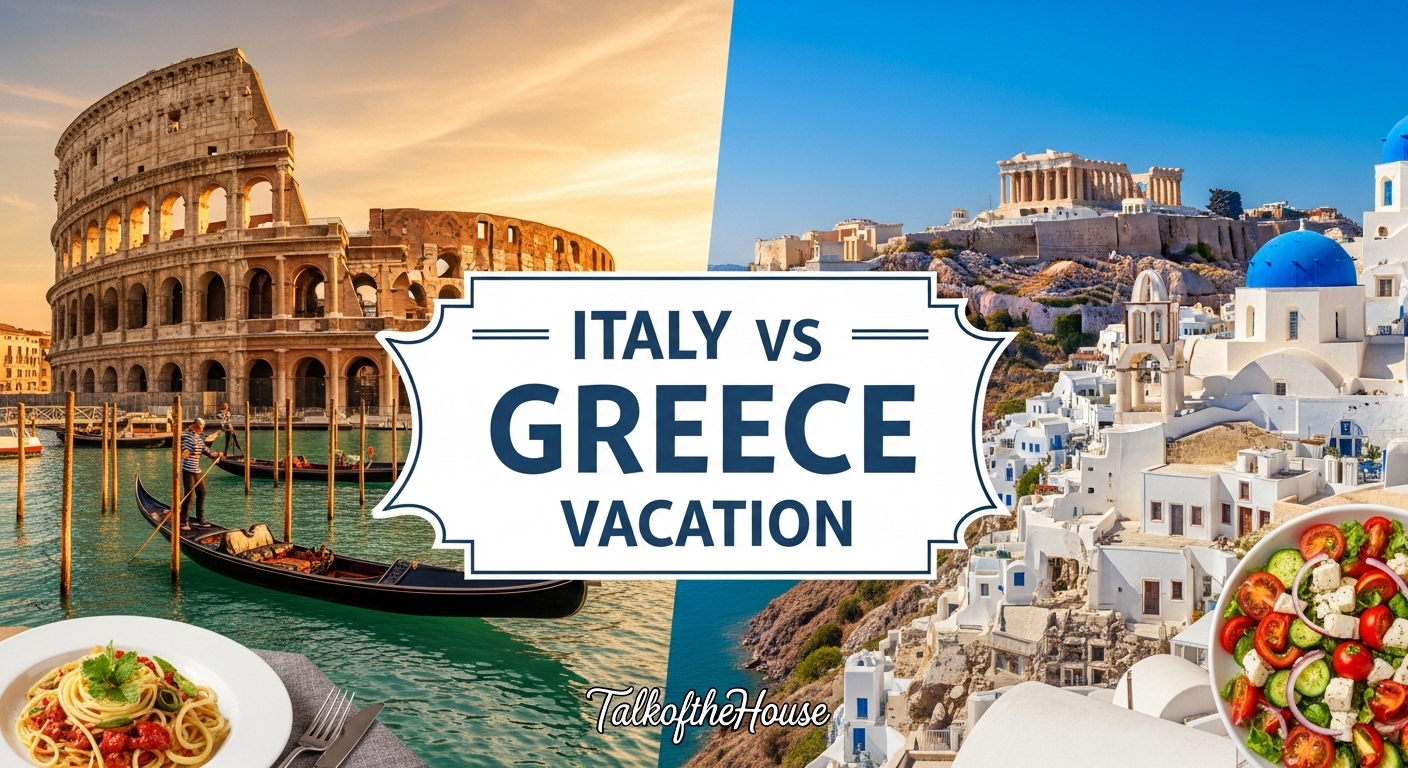
I have stood at the edge of Santorini’s caldera watching the sun paint the Aegean Sea in shades of gold. I have also wandered through Florence’s Uffizi Gallery, surrounded by Renaissance masterpieces that took my breath away. Choosing between an Italy vs Greece vacation is one of travel’s most delightful dilemmas, and I have faced it myself more than once.
Both countries sit along the sparkling Mediterranean, offering ancient ruins, mouthwatering cuisine, and that unmistakable coastal charm that draws millions of visitors each 2026. Yet they deliver fundamentally different experiences. Italy overwhelms you with artistic treasures and cosmopolitan energy, while Greece invites you to slow down, island-hop, and embrace the beach life.
This guide draws from my own travels through both nations plus insights from hundreds of fellow travelers I have connected with over the years. Whether you are planning a honeymoon, a family adventure, or your first trip to Europe, I will help you figure out which destination matches your travel style, budget, and must-see list.
Table of Contents
Quick Comparison: Italy vs Greece at a Glance
Let me cut straight to the answer everyone wants. There is no universal winner in the Italy vs Greece vacation debate. The right choice depends entirely on what you value most in a trip.
Italy wins if you want nonstop cultural immersion, world-class art, diverse landscapes from Alpine lakes to Tuscan vineyards, and arguably the world’s greatest food scene. Greece wins if you prioritize pristine beaches, crystal-clear swimming waters, a relaxed pace, and more budget-friendly options.
| Category | Italy | Greece | Winner |
|---|---|---|---|
| Beaches | Dramatic cliffs (Amalfi), developed resorts | Crystal-clear waters, 200+ islands | Greece |
| Cost (2 weeks) | $3,500-$7,000 per person | $2,500-$5,500 per person | Greece |
| Food & Dining | Regional diversity, world-famous cuisine | Fresh Mediterranean, mezze culture | Tie |
| History & Culture | Renaissance art, Roman ruins, Vatican | Acropolis, ancient Greek sites | Italy |
| Transportation | Excellent train network | Ferries essential, time-consuming | Italy |
| Best For | Art lovers, foodies, city explorers | Beach lovers, island hoppers, relaxers | Depends |
If you can only visit one on this trip, ask yourself this single question: Do you want to spend your days moving between museums and historic sites, or swimming in turquoise waters and hopping between islands? Your honest answer reveals your winner.
What Italy and Greece Have in Common
Before diving into differences, let me highlight what makes both destinations special. These similarities explain why both consistently rank among Europe’s top vacation spots.
- Mediterranean Magic: Both countries enjoy that perfect Mediterranean climate with hot, dry summers and mild winters. You will find fresh seafood, olive oil, wine, and outdoor dining cultures that make every meal feel like a celebration. The pace of life encourages lingering over dinner, taking afternoon breaks, and prioritizing enjoyment over efficiency.
- Ancient History Everywhere: History buffs rejoice in both destinations. Italy offers Roman ruins like the Colosseum and Forum, while Greece presents the Acropolis and Delphi. Walking through these ancient sites creates an almost spiritual connection to the past. I remember standing in the Athenian Agora, imagining Socrates debating philosophy where I stood.
- Warm Hospitality: Greeks famously pride themselves on philoxenia (love of strangers), and their hospitality lives up to the reputation. Italians similarly welcome visitors with passion, especially when you show interest in their regional specialties. In both countries, I have been invited into homes for meals, given extra wine “on the house,” and treated like family rather than a transaction.
- Romance Factor: Both countries rank among the world’s top honeymoon destinations. Italy offers Venice’s canals, Tuscany’s rolling hills, and the Amalfi Coast’s dramatic views. Greece counters with Santorini’s sunsets, Mykonos’s whitewashed charm, and hidden beaches perfect for two. If you are planning a romantic getaway, neither will disappoint.
The Biggest Differences You Need to Know
Now let me break down the differences that actually matter for planning your trip. These are the factors that should drive your decision.
- The Vibe: Italy feels fast-paced and culturally intense. You will want to see the Vatican, the Uffizi, the Duomo, the Colosseum, and that incredible restaurant your friend recommended. Greece operates on siga-siga (slowly-slowly) time. The goal is beach, swim, eat, repeat. I found myself checking my watch constantly in Italy, while Greece trained me to stop caring what time it was.
- Landscape Variety: Italy packs more geographic diversity into one country. You have the Dolomite mountains, Lake Como’s elegance, Tuscany’s countryside, Sicily’s volcanic landscapes, and coastlines facing four different seas. Greece, while stunning, offers less variety. You get gorgeous islands, Athens, and the Peloponnese, but the scenery follows a similar Mediterranean pattern throughout.
- Island Hopping: Greece dominates here completely. With over 200 inhabited islands grouped into distinct chains (Cyclades, Ionian, Dodecanese), you could spend months exploring. Each island has its own personality, from party-central Mykonos to laid-back Naxos to historic Crete. Italy has islands too (Sicily, Sardinia, Capri), but they are fewer and less integrated into typical itineraries.
- Art and Museums: Italy owns this category. The Renaissance was born here, and the concentration of world-class art is unmatched. The Vatican Museums, Uffizi Gallery, and Accademia (home to David) alone justify a trip. Greece has excellent museums, particularly the Acropolis Museum, but nothing approaching Italy’s artistic density.
- Language Barriers: English proficiency is generally good in both countries’ tourist areas, but I noticed a key difference. In rural Greece, I found more English speakers than in rural Italy. Greeks also seemed less self-conscious about speaking English, while Italians sometimes hesitated unless their English was strong.
Beaches: Greece Takes the Crown
If beach quality drives your vacation choice, book that ticket to Greece right now. The clarity of Greek water genuinely startled me the first time I saw it. You can stand chest-deep and still count the pebbles on the seafloor.
Greece’s Beach Highlights:
Santorini’s Red Beach offers otherworldly volcanic scenery with rust-colored cliffs framing azure waters. Mykonos combines beach clubs and crystal swimming with a party atmosphere. Crete’s Elafonissi Beach features rare pink sand created by crushed coral and shells. The smaller Cyclades islands like Paros and Naxos offer family-friendly beaches with shallow, warm waters perfect for children.
Italy’s Coastal Offerings:
Italy’s beaches are beautiful but different. The Amalfi Coast delivers dramatic cliffs and picturesque towns like Positano, though the actual beaches are often small pebbly coves. Sardinia’s Costa Smeralda rivals anything in Greece for water clarity, but it is harder to reach and more expensive. The Cinque Terre offers stunning coastal hiking with swimming opportunities, though the towns get packed in summer.
The fundamental difference: Greece’s beaches are the main attraction, while Italy’s coastlines complement other activities. In Greece, you plan your day around which beach to visit. In Italy, you might spend the morning at the Uffizi, afternoon on the beach, evening at a trattoria.
Culture & History: Italy’s Artistic Dominance
For travelers who measure vacations by how much they learn and experience culturally, Italy delivers more bang for your buck. The sheer concentration of UNESCO World Heritage sites is staggering.
Italy’s Cultural Treasures:
Rome alone justifies weeks of exploration. The Colosseum, Roman Forum, Pantheon, and Vatican create a crash course in Western civilization. Florence adds the Renaissance dimension, Michelangelo’s David, Brunelleschi’s dome, and the Uffizi’s Botticellis. Venice brings Byzantine influence and canal-side mystery. Even smaller cities like Siena, Verona, and Bologna offer major cultural rewards.
Greece’s Historical Sites:
Greece holds its own with the Parthenon presiding over Athens, Delphi’s mystical ruins, and Knossos in Crete. The ancient Greek sites feel more raw and authentic, less reconstructed than many Roman ruins. Standing on the Acropolis, you sense the birth of democracy and philosophy. The museums, particularly the Acropolis Museum with its glass floors revealing excavations below, are world-class.
However, Greece’s cultural offerings are more focused. You get ancient Greece primarily, with some Byzantine and Ottoman layers. Italy spans Etruscan, Roman, Medieval, Renaissance, Baroque, and Modern periods. For culture omnivores, Italy’s variety wins.
Food & Cuisine: A Delicious Tie
Declaring a food winner feels impossible because both cuisines rank among the world’s best. I have had life-changing meals in both countries. The better choice depends on your dining priorities.
Italian Cuisine:
Italy’s regional diversity astounds me. Rome offers cacio e pepe and carbonara that ruin American Italian food forever. Naples invented pizza, and eating a Margherita at L’Antica Pizzeria da Michele felt like a religious experience. Florence serves bistecca alla fiorentina, massive T-bone steaks cooked rare. Venice specializes in seafood risottos and cicchetti (small plates). Tuscany’s wine country pairs Chianti with pecorino cheese.
The structure of Italian dining creates theater. Antipasti, primi (pasta), secondi (meat/fish), contorni (vegetables), dolci (dessert), coffee, and digestif. A proper Italian dinner takes three hours, and nobody rushes you.
Greek Cuisine:
Greece offers the celebrated Mediterranean diet in its purest form. Fresh vegetables, olive oil, feta cheese, yogurt, seafood, and grilled meats dominate. I loved the mezze culture, ordering multiple small dishes to share. Grilled octopus became my obsession, along with fava (yellow split pea puree), dolmades, and horiatiki (Greek village salad).
Greek tavernas feel more casual than Italian restaurants. You might sit on plastic chairs at a harbor-side table, watching fishing boats while eating the morning’s catch. The experience is less formal, often cheaper, and equally delicious.
Verdict: Serious foodies who want culinary education should choose Italy. Those wanting fresh, healthy, casual dining with amazing seafood should choose Greece.
Cost Comparison: What You’ll Actually Spend
Let me break down the numbers because budget often drives this decision. In my experience, Greece runs about 15-25% cheaper than Italy for equivalent experiences.
Accommodation Costs:
Mid-range hotels in Italy’s major cities (Rome, Florence, Venice) typically cost $120-180 per night during shoulder season, jumping to $250+ in summer. Greece offers more consistent pricing, with nice island hotels running $80-150 per night. Athens hotels match Italian city prices, but the islands feel more affordable.
Budget travelers can find hostels in both countries for $30-50 per night. Luxury seekers will spend heavily in both, though Italy’s high-end options (Amalfi Coast villas, Venice palazzos) reach stratospheric prices that Greek luxury rarely matches.
Food and Dining:
Italian restaurant meals average $15-25 for pasta dishes, $20-40 for mains, plus wine at $8-15 per glass. A nice dinner for two with wine easily hits $80-120. Greek tavernas offer mains for $10-18, with wine often cheaper and house wine frequently excellent. Dinner for two with wine might run $50-80.
Both countries offer budget options. Street pizza in Italy, souvlaki in Greece, and market-fresh picnics keep costs down. But if you want sit-down restaurant experiences, Greece stretches your dollar further.
Transportation:
Italy’s train network saves money compared to car rental. High-speed trains between major cities cost $30-80 depending on booking timing. Greece requires ferries for island hopping, which add up fast. A typical island hop (Athens to Santorini to Mykonos back to Athens) might cost $150-250 in ferries alone.
The $10,000 Question:
Is $10,000 enough for a trip to Italy? Absolutely, for a couple spending two weeks. That breaks down to about $350 per day, which covers nice hotels, restaurant meals, museum entries, and train travel. You will not live luxuriously, but you will be comfortable. In Greece, that same $10,000 buys significantly more flexibility, perhaps upgrading to boutique hotels or adding a sailing excursion.
Transportation & Logistics: Getting Around
How you move through each country shapes your experience significantly. Italy makes transportation easy; Greece requires more planning.
Italy’s Train Network:
Italy’s Trenitalia and Italo high-speed trains connect major cities efficiently. Rome to Florence takes 90 minutes. Florence to Venice, two hours. You can cover the country’s highlights without ever renting a car. I found train travel in Italy almost relaxing, with countryside views and frequent departures.
Within cities, metros in Rome and Milan work well. Venice requires boats (vaporettos), which adds charm if not speed. Smaller towns like Siena or the hill towns of Tuscany benefit from bus connections or rental cars.
Greece’s Ferry System:
Greece’s transportation centers on ferries, and they require patience. Athens to Santorini takes 5-8 hours by ferry (or 45 minutes by expensive flight). Island-to-island connections vary by season, with reduced schedules in shoulder months.
I learned to treat ferry rides as part of the experience. Watching the Cyclades appear on the horizon, feeling the sea breeze, reading on deck. But they do consume vacation time. A two-week Greece trip might lose 3-4 days to transportation if you island-hop extensively.
Flight Connections:
Italy offers multiple entry points: Rome, Milan, Venice, Naples, all with international connections. Greece funnels most visitors through Athens, though some islands like Crete and Rhodes have direct summer flights from European cities.
Best Time to Visit Each Country
Timing your trip right matters nearly as much as choosing the destination. Both countries follow similar seasonal patterns with some key differences.
Peak Season (July-August):
Avoid if possible. Temperatures soar above 90°F (32°C) in both countries. Crowds become overwhelming, especially in Rome, Florence, Santorini, and Mykonos. Prices peak for hotels and flights. If you must travel in summer, book accommodations six months ahead.
Shoulder Season (May-June, September-October):
This is the sweet spot for both destinations. Weather remains warm enough for swimming (especially in Greece), crowds thin out, and prices drop. I particularly love late May, when wildflowers still bloom in the countryside and everything feels fresh.
Italy’s Winter Advantage:
Italy’s major cities work year-round. Rome, Florence, and Venice in winter offer shorter museum lines, lower hotel rates, and cozy trattoria atmospheres. Christmas markets in northern cities add charm. Greece’s islands largely shut down November through March, with restaurants and hotels closed, though Athens remains viable.
My Recommendation:
Visit Greece in late May/early June or mid-September for ideal beach weather without peak crowds. Visit Italy in April-May or September-October for comfortable sightseeing weather.
Who Should Visit Which: Matching Traveler to Destination
Let me get specific about who belongs where. These profiles come from conversations with dozens of fellow travelers and my own observations.
Choose Italy If…
You can spend hours in museums without getting bored. You want to see Renaissance paintings, Roman ruins, and Baroque churches. You love cities with layers of history visible on every street.
You consider yourself a serious foodie. You want to learn about wine regions, take cooking classes, and understand why Roman pasta differs from Tuscan pasta. You are willing to pay more for extraordinary meals.
You enjoy efficient transportation and city-hopping. You want to wake up in Rome, have lunch in Florence, and dinner in Venice. You like the energy of busy piazzas and vibrant street life.
Choose Greece If…
You want to spend mornings swimming in clear water and afternoons napping on the beach. You crave that island-hopping lifestyle, waking up on a different island every few days. You want to slow down rather than speed up.
You are working with a tighter budget but still want a European vacation. You prefer casual tavernas over formal restaurants. You value natural beauty over man-made attractions.
You want a laid-back atmosphere where schedules feel flexible. You like the idea of spending three hours over lunch because nobody is rushing you. You want to disconnect from work and urban stress.
For Honeymooners
Both countries deliver romantic experiences, but the style differs. Italy offers Venice’s gondolas, Tuscany’s wine tastings, and the Amalfi Coast’s dramatic cliffside towns. You will move more, see more, eat more.
Greece counters with Santorini’s famous sunsets, Mykonos’s boutique hotels, and private sailing trips between islands. You will swim more, relax more, move slower. Greece wins for beach-loving couples; Italy for culture-loving couples.
For Families
Italy offers more activities to keep children engaged, from gladiator school in Rome to pizza-making classes in Naples. The train system makes moving between cities easy with kids. However, Italy’s intensity can overwhelm younger children.
Greece provides beach time that children love, plus less rushing between sights. The laid-back pace suits families who want to settle in one place. Consider reading our guide to family-friendly vacation destinations for additional ideas.
My advice: Choose Italy for curious, energetic kids who can handle museum visits. Choose Greece for water-loving kids who need downtime.
For Solo Travelers
Greece edges ahead for solo travelers, particularly women. English is widely spoken, locals are genuinely helpful, and the hostel/guesthouse scene on islands creates natural social environments. I felt completely safe traveling alone through the Greek islands.
Italy works well too, with excellent hostel networks in major cities. However, Rome and Florence can feel overwhelming alone, and petty theft requires more vigilance. Both are far safer than most global destinations, but Greece feels more relaxed for solo exploration.
Frequently Asked Questions
What is better to visit, Greece or Italy?
Neither is objectively better. Choose Greece if you prioritize beaches, island hopping, and a relaxed pace. Choose Italy if you want world-class art, diverse landscapes, and culinary variety. Both offer incredible Mediterranean vacations.
Is $10,000 enough for a trip to Italy?
Yes, $10,000 is sufficient for a two-week trip to Italy for two people at a mid-range level. This budget covers nice hotels, restaurant meals, museum entries, and train travel. You will be comfortable though not luxurious. In Greece, the same amount stretches further.
What not to do in Italy as an American?
Avoid eating at restaurants right next to major tourist attractions like the Colosseum or Trevi Fountain. Do not order cappuccino after 11 AM. Skip the bread basket unless you plan to eat it. Learn basic Italian greetings. Dress modestly when visiting churches. Validate your train tickets before boarding.
Should US citizens travel to Greece?
Yes, Greece is very safe and welcoming for US citizens. English is widely spoken in tourist areas. Greece ranks among the most hospitable nations globally. No special visa is required for stays under 90 days. Follow normal travel precautions against pickpockets in Athens.
Can I visit both Italy and Greece in one trip?
Yes, but you need at least two weeks to do both justice. Fly into Rome, spend a week in Italy, then fly to Athens and spend a week island hopping. Alternatively, take an overnight ferry from Bari or Brindisi in Italy to Patras or Igoumenitsa in Greece.
Which country is safer for tourists?
Both Italy and Greece are very safe by global standards. Greece may have a slight edge with lower petty crime rates. Athens requires normal urban awareness, while Greek islands feel exceptionally safe. In Italy, watch for pickpockets in Rome and Florence tourist areas.
Do I need to speak the language to travel?
No, English is widely spoken in tourist areas of both countries. Greece may have slightly better English in rural areas. Learning basic greetings and thank you in Italian or Greek is appreciated but not required. Menus and signs in tourist areas are often bilingual.
Final Verdict: You Cannot Go Wrong
After years of traveling through both countries and helping friends plan their Italy vs Greece vacation decisions, I have reached a simple conclusion. You cannot make a wrong choice here. Both destinations deliver extraordinary experiences that will become lifelong memories.
If you love art, food, and variety, Italy will captivate you. If you crave beaches, relaxation, and island adventures, Greece will steal your heart. First-time visitors to Europe often do better with Italy because the cultural density justifies the travel investment. Repeat visitors or those seeking pure relaxation should head to Greece.
My honest recommendation? If you can only pick one for this trip, close your eyes and picture your perfect day. Are you standing in front of Botticelli’s Birth of Venus, espresso in hand? Or are you swimming in turquoise water with a Greek island as your backdrop? Your daydream reveals your answer.
Wherever you go in 2026, pack light, bring a sense of adventure, and prepare for meals you will remember forever. Both countries have welcomed travelers for millennia. They know how to show you a good time.