
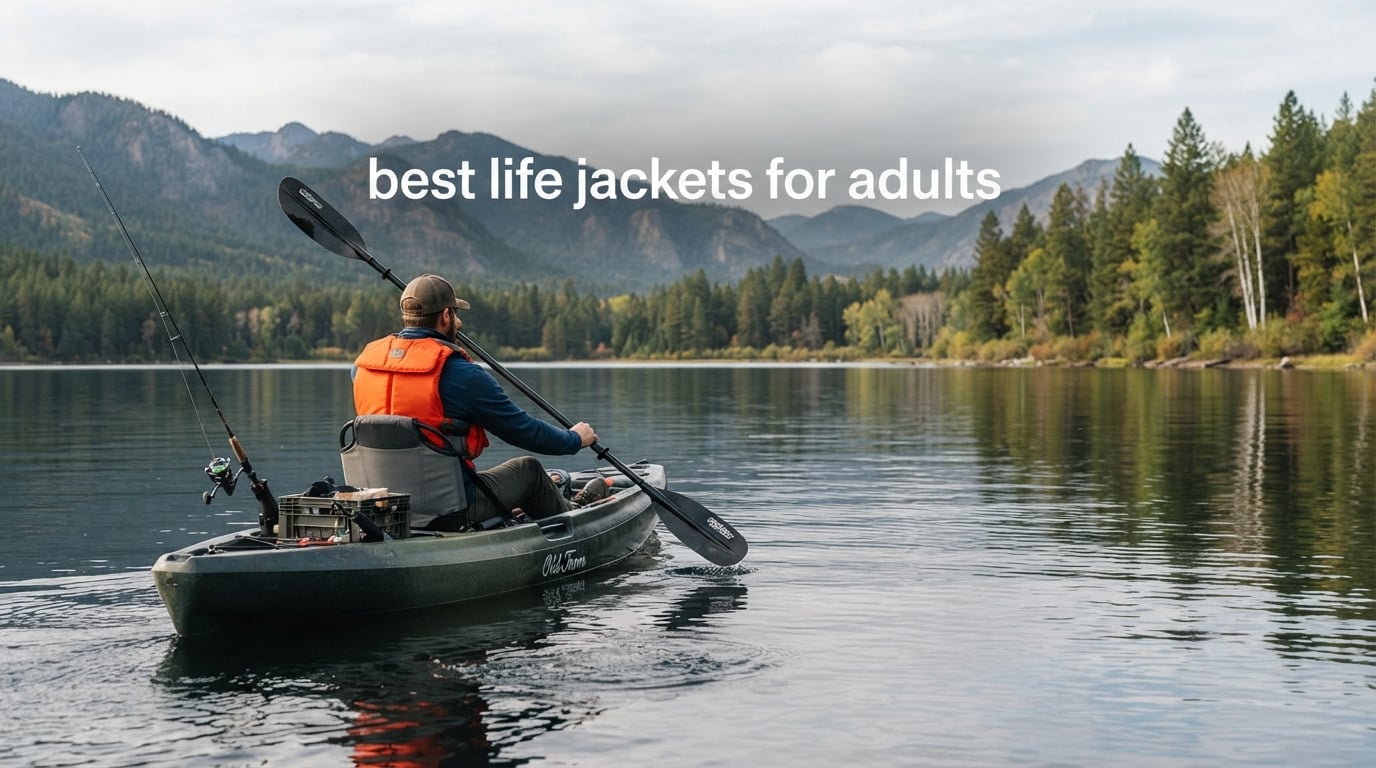
The best life jackets for adults are the ones you will actually wear: a USCG-approved model that stays snug below your chin, lets you move for your activity, and matches the kind of water you are on. For a fishing kayak, that can mean a high mesh back and tool storage; for wakeboarding, it can mean flexible segmented foam; for a long day on a boat, it may mean a low-profile inflatable that you will maintain properly.
I approached this list by comparing the verified product specifications, certifications, construction details, and available customer-review data for eight adult personal flotation devices. That matters because comfort claims alone do not tell us whether a PFD has the Type classification, chest range, buoyancy figure, or seat-back clearance that makes it practical for your day on the water.
Fit comes before every other feature. Paddling and boating forums repeatedly point to the same problems: arm chafing, a vest riding toward the chin in the water, and generic sizing that does not sit well on bigger frames. Put the life vest on over the clothing you expect to wear, fasten every closure, then have someone pull upward at the shoulders; if it moves above your ears or toward your chin, tighten it or try another size.
All eight choices below have an adult-focused use case, but they are not interchangeable. Foam Type III PFDs are the straightforward choice for people who want flotation ready at all times, while the two Type V inflatable options need a deliberate inflation and maintenance routine. Check the rules for your boat, state, activity, and waterway before leaving shore.
A quick terminology note helps: “life jacket” and “PFD” are often used for the same item in everyday speech, but the label and its USCG approval are what matter for legal carriage requirements. This guide uses the product makers’ supplied Type and approval statements, so inspect the label on the exact vest you receive before relying on it.
Table of Contents
Top 3 picks answer the most common adult life jacket needs
Our short list starts with the Stohlquist Fisherman for seated anglers who want a Type III vest with a high mesh back, the HyperLite Elite for active water sports where mobility matters, and the MW Adult Universal for a simple Type III option with adjustable straps. The first two have 4.8-star averages in their supplied review data, while the MW gives boaters a basic, multipurpose construction to consider.
Fishing from a kayak: Stohlquist Fisherman — Type III flotation, tall-seat clearance, and fold-down EVA work-surface pockets.
Boating and active water sports: HyperLite Men’s Elite — constructed foam panels, a zip closure, and stated full range of motion.
Boating, tubing, and spare-vest duty: MW Adult Universal — Type III approval, 200-denier nylon ripstop, and adjustable straps.


These eight life jackets give a quick 2026 overview
The comparison below puts every reviewed model in one place. Start with the activity and approval type, then read the full section for the details that affect comfort, including seat-back height, panel shape, closure style, and chest range.
| Product | Specifications | Action |
|---|---|---|
| Stohlquist Fisherman Lifejacket |
|
View Details |
 HyperLite Men’s Elite HyperLite Men’s Elite |
|
View Details |
 BLUESTORM Cirro 16 Belt Pack BLUESTORM Cirro 16 Belt Pack |
|
View Details |
 Astral V-Eight Fisher Astral V-Eight Fisher |
|
View Details |
 Body Glove Phantom Women’s Body Glove Phantom Women’s |
|
View Details |
 THURSO SURF Horizon THURSO SURF Horizon |
|
View Details |
 BLUESTORM Cirro 26 BLUESTORM Cirro 26 |
|
View Details |
| MW Adult Universal |
|
View Details |
1. Stohlquist Fisherman is the strongest match for kayak anglers with tall seats
- Graded sizing
- High mesh back
- Fold-down EVA pockets
- USCG Type III
- 16 lb 4 oz buoyancy
- Buckle closure
- Designed around fishing use
The Stohlquist Fisherman has the clearest fishing-specific feature set in this group. Its Type III rating and 16 pounds 4 ounces of sea-level buoyancy give it a stated flotation figure, while the 500-denier Cordura outer shell and 200-denier Oxford liner point to a build intended for regular use around tackle and boat hardware.
What stands out to me is the high mesh-back layout. Kayak anglers often report that a standard foam back collides with a seat and presses the vest forward; Stohlquist specifically says this raised design creates more clearance for tall seat backs. The EVA pockets also fold down into work surfaces, which is a meaningful detail when you are changing a lure or handling small tools.
Kayak anglers with a tall seat get the most from this layout
This is the adult life vest I would narrow down first for someone who fishes from a sit-on-top kayak, pedal kayak, or other boat with a tall seat. The back design addresses a real comfort complaint rather than simply adding more foam or another buckle.
The plainer question is whether you need the pocket system. If you regularly carry tackle, small tools, or accessories on your body, the fold-down EVA pockets bring useful organization; if you only cruise on a pontoon, that specialized layout may be more vest than you need.
Graded sizing gives more people a better place to start
Stohlquist lists Graded Sizing as a way to create a more appropriate fit across a wider range of users. That is more helpful than treating “adult universal” as a perfect answer, especially for people who have had shoulder straps rub or a vest rise during paddling.
Still, sizing is never automatic. Wear the vest fully buckled, sit in your actual seat if possible, rotate your torso as you would while casting, and do the upward shoulder test before committing to it for a trip.
2. HyperLite Men’s Elite is the mobility-first choice for active water sports
- Constructed foam panels
- Zip closure
- Quick drying
- Full range of motion
- Hypervent technology
- Men's-specific model
- Check fit before water use
The HyperLite Men’s Elite is built around foam, a front zip entry, adjustable straps, and buckles. The supplied details call out Biolite foam, Truefit Technology, Fluidflex Patterns, and constructed buoyancy panels, all of which make this a sensible option to examine for boating, paddling, swimming, and other active water sports.
I would put the claimed range of motion at the center of the buying decision here. A bulky vest can make it harder to twist, reach, and recover your balance, while a close-fitting foam vest keeps flotation present without a separate inflation step. The listing also says the exterior dries quickly and uses Hypervent Technology for temperature regulation.
Active riders and boaters get the intended benefit from its panel shape
This model makes the most sense for an adult who expects repeated movement rather than long periods seated with gear. The Fluidflex-pattern construction and segmented buoyancy approach are aimed at reducing the stiff, boxy feel many people associate with basic foam vests.
A zip closure does not replace proper adjustment. Close the zipper, secure the straps and buckles, then move your arms as if you were paddling or holding a tow rope; the vest should feel secure without pinching the inner arm or restricting a deep breath.
Foam-ready flotation makes it simpler than an inflatable PFD
Foam is already buoyant the moment you enter the water, which makes it easier for newer boaters to understand. There is no CO2 cylinder to inspect, no manual pull cord to reach, and no automatic mechanism to keep dry and service.
The trade-off is bulk and warmth. HyperLite addresses that concern with temperature-regulating ventilation and a lightweight Biolite exterior, but only wearing it during your normal activity can tell you whether the fit works with your body and clothing.
3. BLUESTORM Cirro 16 is the compact manual inflatable for paddle sports
- USCG Type V
- Low-bulk belt pack
- 16.5 lb buoyancy
- 30-52 inch chest
- D-rings
- Manual activation
- CO2 cylinder requires checks
The BLUESTORM Cirro 16 takes a very different approach from a foam vest: it is a waist belt PFD that inflates manually with a CO2 cylinder. Its supplied approval statement is Type V with Type III performance, and its stated 16.5 pounds of buoyancy is paired with an optional oral-inflation backup listed at up to 29 pounds.
This low-bulk format is relevant for stand-up paddleboarding, fishing, and kayaking when a conventional vest feels hot or rubs the arms. It has a universal adult fit range for 30- to 52-inch chests and D-rings for accessories, but the compact design only works as intended when the wearer knows exactly how and when to activate it.
Experienced paddleboarders get the biggest comfort advantage from this belt pack
I would reserve the Cirro 16 for adults comfortable with a manual inflatable routine. Its minimal profile leaves the shoulders and upper back clear, which can be appealing for a paddle stroke or casting motion, but it also means you must pull the activation cord in an emergency.
For a confident swimmer on calm water who will inspect the unit before each outing, that may be a reasonable trade. For a non-swimmer, a beginner, or someone who might panic after falling in, ready-to-float foam is generally the more straightforward option to investigate.
The 30- to 52-inch chest range needs a precise measurement
Measure the fullest part of your chest over the clothing you plan to wear, then compare the result with the supplied range rather than guessing from a shirt size. A belt that is too loose can shift; one that is too tight can be uncomfortable enough that it gets left in the boat.
Manual inflatables also call for routine care. Check the CO2 cylinder, the arming status, the fabric, the oral-inflation tube, and the owner instructions before launch, and follow the maker’s servicing guidance after use or inflation.
4. Astral V-Eight Fisher is the breathable fishing vest for hot paddling days
- Airescape airflow
- High mesh back
- Pliers holster
- Multiple pockets
- Light 1.25 lb build
- Fishing-specific storage
- Zipper closure
The Astral V-Eight Fisher is a Type III PFD built for kayak fishing and touring, with a listed design buoyancy of 16 pounds. At a stated 1.25 pounds, it is the only product in this list with a supplied vest weight, and Astral pairs that light build with its Airescape Airflow System.
Its storage is purposeful rather than generic: a pliers holster, easy-access slip pocket, and zippered pocket are all listed. The high mesh back is also designed to work with kayak seats, so this model directly addresses both heat buildup and backrest interference, two complaints that come up often among regular paddlers.
Warm-weather anglers get cooling and storage in the same PFD
Choose the V-Eight Fisher when ventilation and on-body fishing storage are central to the day. A high-back PFD can make a major difference in a framed kayak seat, and the Airescape system gives this product a distinct focus for people who find a solid foam back hot.
The pocket mix is useful only if it matches your gear routine. Check that a secured tool, phone, or small tackle item does not block the zipper, chafe your ribs, or interfere with the stroke you use on the water.
Custom adjustment works best when shoulders and side straps are set together
Astral lists hook-and-loop shoulder straps plus side straps for its custom fit. Set the shoulder height first so the foam sits in the intended place on the chest, then take up the side slack evenly instead of tightening only one side.
Before using it offshore or on moving water, test the range of motion while seated and standing. The right fit stays low on the torso while you reach forward, look over your shoulder, and lean back against the seat.
5. Body Glove Phantom is the women’s neoprene option with segmented mobility
- USCG and Transport Canada approved
- Segmented panels
- Front zip with drains
- Lumbar support
- Concealed straps
- Women's-specific sizing
- Confirm torso fit
The Body Glove Phantom is a women’s PFD with USCG and Transport Canada approval, form-fitting PE foam flotation, and an Evoprene outer shell. Its front-zip entry, drain panels, segmented panel design, and two-belt adjustment system make it a strong candidate for someone who wants a more shaped foam life vest for boating, fishing, kayaking, rafting, or paddling.
Segmented panels are the defining feature here because they help a foam vest bend with the body rather than forming one rigid block across the torso. The supplied lumbar support panel adds another comfort-focused detail for extended wear, while the concealed straps can keep the exterior cleaner than loose webbing.
Women who want a shaped foam vest get the clearest reason to consider it
A women’s-specific cut can be a better starting point than downsizing a unisex vest, especially when shoulder placement and chest shape affect comfort. The Phantom’s form-fitting foam and segmented design are aimed at a close, mobile fit instead of the looser feel of a universal vest.
That does not make sizing optional. Zip the front, fasten both belts, sit down, and lift your arms overhead; if the vest rides up or the zipper strains, a different size or torso shape is a safer call.
Drain panels and lumbar support matter on longer boating days
Drain panels can help water leave the vest after swimming or spray, and lumbar support can make a difference when you are seated for a long stretch. These are comfort features, not substitutes for a correctly tightened PFD.
For frequent wakeboarding or similar high-motion use, assess the vest while doing the motions your sport requires. The segmented construction should make reaching easier, but only a stable fit keeps it in place during a fall.
6. THURSO SURF Horizon is the visibility-focused multipurpose foam vest
- High-visibility color
- Reflective strips
- Easy-release buckles
- Lightweight feel
- Multipurpose use
- Limited technical buoyancy data
- Size must be checked
The THURSO SURF Horizon is positioned as a USCG-approved adult life vest for kayaking, boating, and fishing. Its listed highlights are high-visibility color, reflective strips, adjustable straps, easy-release buckles, and a lightweight foam construction intended to allow a full range of motion.
I see the Horizon as a practical choice for people who want visibility cues built into a multipurpose PFD. Orange fabric and reflective trim are not a replacement for a plan, communication device, or proper boating lights, but they can make a person easier to spot in changing conditions.
Boaters who prioritize visibility get the main benefit from this vest
High-visibility color and reflective strips are useful considerations for a boat crew, family group, or paddler who may be out around dawn, dusk, or busy traffic. Those features make this model more purposefully safety-oriented than a vest chosen mainly for appearance.
There is no supplied buoyancy figure in the analyzed listing, so I would read the label on the physical PFD for its approved size and performance details. Do not treat a color or reflector as evidence that a vest fits or floats correctly.
Adjustable buckles suit occasional users when the fit is checked each time
The easy-release buckle setup is straightforward for guests and occasional boaters, but every new wearer needs an individual adjustment. A strap position that works for one adult is not automatically right for another adult with a different chest, torso, or clothing layer.
For a group boat, label each person’s fitted vest or take a minute before departure to do the shoulder-lift check. This small routine addresses the ride-up issue that forum users report with loosely fitted standard jackets.
7. BLUESTORM Cirro 26 is the automatic inflatable for low-bulk cruising
- USCG Type V
- Automatic and manual activation
- 26 lb buoyancy
- Low waist profile
- 30-56 inch chest
- Requires maintenance
- Not ready-to-float while uninflated
The BLUESTORM Cirro 26 is a USCG-approved Type V PFD with Type III performance that can inflate automatically on submersion or manually with its pull cord. It also has a backup oral inflation tube and a stated 26 pounds of buoyancy, which the supplied product data describes as twice the minimum rating of Type III foam vest life jackets.
Its long shell and soft flat profile are made to keep the waist belt lower and more comfortable than a bulky foam vest. The fit range of 30 to 56 inches is the broadest stated chest range among these eight options, making it relevant for many adult body sizes after a real measurement and try-on.
Comfort-first boaters get automatic inflation with a low-profile fit
This is the inflatable to consider for sailing, angling, boating, and paddling when low bulk is the decisive comfort factor. The automatic trigger provides another activation path beyond the manual pull cord, which may appeal to adults who are worried about needing to react quickly after unexpected submersion.
It is still not a maintenance-free safety device. The CO2 cylinder, automatic inflator component, oral tube, shell, and waist adjustment all need inspection according to the manufacturer’s instructions, and the PFD must be worn as directed for its Type V approval to apply.
The 30- to 56-inch chest range can help bigger adults start their search
People who are big or tall often have poor results from a one-size claim that does not disclose a measurement range. The Cirro 26 gives a stated 30- to 56-inch chest span, but that range is only the first screening point; torso length, belt placement, and jacket layers still matter.
Test the low belt while sitting, bending, and reaching. If it shifts high on the ribs or the shell rubs your neck, re-adjust it or select another PFD rather than assuming the published chest range settles the fit question.
8. MW Adult Universal is the straightforward Type III vest for general boating
- USCG Type III
- 200-denier nylon ripstop
- Ergonomic shape
- Adjustable straps
- Multiple sizes
- Limited technical buoyancy data
- Simple feature set
The MW Adult Universal is a USCG-approved Type III life jacket made with 200-denier nylon ripstop fabric. Its listed design includes an ergonomic shape, adjustable waist, chest and shoulder straps, and sizing that spans XS through XL, with uses that include boating, fishing, tubing, paddleboarding, and kayaking.
This is the simple foam option in the roundup. It does not add an inflatable mechanism, fishing holster, or specialty seat-back system; instead, it concentrates on adjustable retention and durable ripstop fabric. That makes it a sensible model to assess for a boat locker or for adults who need a familiar buckle-style PFD.
General boat crews get the most practical use from this Type III design
For standard boating, fishing, tubing, or a spare vest for a regular guest, the MW’s Type III approval and adjustment system cover the basics buyers usually need. Multiple sizes are preferable to assuming that one vest will work for every adult on board.
Its 200-denier nylon ripstop construction is intended to resist wear and tear, which is useful for equipment that may be handled by many people. After any hard use, inspect webbing, buckles, stitching, and foam for damage before returning it to service.
Simple straps work when each one is tightened in the right order
Set the waist strap, chest strap, and shoulder straps so the vest sits centered and close to the body. The goal is a snug but breathable fit that does not restrict normal movement and does not travel toward the face when pulled upward.
The analyzed listing does not provide a buoyancy number, so inspect the sewn label for the approved size and information on the actual vest. For a beginner, that label check is a better safety habit than choosing solely by color, generic size, or a comfort claim.
The right adult life jacket starts with a secure fit
A personal flotation device works best when it is suited to your body, activity, and local rules. Use this buying guide after choosing a shortlist, because a model with impressive features is still the wrong choice if it rides up, blocks your stroke, or carries an approval type that does not meet your boating situation.
A correct fit stays low on the torso and allows normal movement
Start by measuring your chest or following the maker’s size chart for the exact model. Put the PFD on over realistic layers, close the zipper or buckles, and tighten the waist and side straps before touching shoulder adjustments.
Next, lift your arms, rotate your torso, and sit if you will use a kayak, canoe, or boat seat. Have another person pull up on the shoulder straps; a properly adjusted vest should not move up past your ears or ride toward your chin.
Forum users repeatedly flag arm chafing as a reason they stop wearing a vest. Check the arm openings during a full paddle or casting motion, and pay attention to edges that contact the inner arm, collarbone, or neck before you take the vest into open water.
USCG Type III and Type V labels answer different use questions
Type III is a common label for wearable flotation aids intended for conscious users in calmer or inland water where rescue is expected to be relatively quick. The foam Type III products here are ready to provide buoyancy without any activation step, which makes them easy to understand for many new boaters.
Type V identifies a special-use device. The BLUESTORM Cirro 16 and Cirro 26 are listed as Type V PFDs with Type III performance, so follow their label instructions on wear, activation, and maintenance rather than treating them like every foam vest.
USCG approval is a non-negotiable starting filter for many boating situations, but a PFD can only count when it is the correct size, serviceable, and worn according to the label. Local requirements can add details, so check the rules before every trip.
Foam is ready immediately while inflatables trade bulk for upkeep
Foam life jackets create flotation through buoyant foam already inside the vest. Their advantages are immediate flotation and a simple pre-launch check; their compromise is that even low-profile foam takes up space and can feel warmer in midsummer.
Inflatable PFDs can be far less bulky until deployed, which is why the Cirro 16 belt pack and Cirro 26 vest can appeal to anglers, sailors, and paddleboarders. They demand more from the owner: inspect the CO2 cylinder and inflation system, know the manual pull, review the oral backup, and follow the maker’s rearming instructions after activation.
For a non-swimmer, a first-time boater, or anyone likely to freeze after a fall, I would begin the search with a correctly fitted foam model. An automatic inflatable adds an activation path, but its care routine and label directions remain part of the safety system.
Buoyancy needs depend on the person, clothing, and PFD approval
Many adults need about 7 to 12 pounds of buoyancy, or roughly 31 to 53 Newtons, to stay afloat, but that general range is not a sizing formula. Body composition, water conditions, footwear, weather layers, fatigue, and whether a person can swim all change the real situation.
A person who weighs 300 pounds does not simply need twice the flotation of a smaller person. Use a USCG-approved vest that is rated and sized for the wearer, then focus on a secure fit; the adult chest range is more informative for choosing among these products than body weight alone.
The Stohlquist Fisherman lists 16 pounds 4 ounces, the Astral V-Eight Fisher lists 16 pounds, the Cirro 16 lists 16.5 pounds once inflated, and the Cirro 26 lists 26 pounds once inflated. Where no buoyancy figure was supplied, the sewn label is the reference to consult.
Activity matching prevents comfort problems before they start
For fishing from a kayak, seek a high mesh back and storage that does not obstruct the stroke; the Stohlquist Fisherman and Astral V-Eight Fisher meet that brief in different ways. For active water sports, close-fitting segmented or flexible foam such as the HyperLite Elite or Body Glove Phantom can be more suitable than a bulky utility vest.
For paddleboarding or light fishing where unrestricted shoulders are the priority, a manual inflatable belt such as the Cirro 16 is compact but demands confident, informed use. For boating with occasional adult guests, straightforward adjustable Type III options such as the THURSO SURF Horizon and MW Adult Universal are easier to hand out, provided each person has a correct fit.
Big and tall adults should not accept a generic “universal” claim without measuring. The Cirro 26 states a 30- to 56-inch chest range, the Cirro 16 states 30 to 52 inches, and Stohlquist’s graded sizing is designed for a wider range; compare those facts with the actual manufacturer chart and do an in-person fit check when possible.
Care keeps a PFD ready for the day it is needed
After use, rinse off salt, mud, or grime with fresh water when the maker permits it, dry the PFD away from prolonged direct heat, and store it in a dry, ventilated place. Do not leave it compressed under heavy gear, and do not use a life vest as a boat fender or seat cushion.
Before launching, inspect foam for damage, webbing for frays, buckles and zippers for function, and stitching for separation. Inflatable models need the added cylinder, inflator, oral tube, and arming-status checks listed in their manuals.
Every adult should also practice putting their own vest on and fastening it before a stressful moment. A life jacket stored under a seat or fitted only after trouble starts cannot offer the same protection as one worn correctly from the dock onward.
FAQs
What is the best brand of life jacket?
There is no single best brand for every adult. Stohlquist and Astral stand out here for fishing-oriented Type III designs, HyperLite focuses on mobility for water sports, and BLUESTORM offers compact inflatable options. Choose the certified model that fits your activity and body rather than choosing by brand alone.
Is there a difference between a swim vest and a life jacket?
Yes. A swim vest may provide buoyancy for supervised swimming but is not automatically a USCG-approved PFD for boating. A life jacket or personal flotation device has a specific approval label and intended use. Check the sewn label to confirm the exact approval and size before taking it on a boat or waterway.
How do you choose a life jacket for adults?
Choose an adult life jacket by confirming its USCG approval, matching the size or chest range to the wearer, and checking that it stays below the chin when pulled upward at the shoulders. Then match the design to the activity: high-back foam for kayak seats, flexible foam for water sports, storage for fishing, or an inflatable only if you will maintain and wear it correctly.
How much buoyancy does a 300 lb person need?
A 300-pound adult should use a USCG-approved PFD sized for their chest and body, not choose by body weight alone. Buoyancy needs vary with body composition, clothing, water conditions, and swimming ability. Check the PFD label and manufacturer fit guidance, then verify that the vest is snug and does not ride up.
The Stohlquist Fisherman leads this 2026 adult life jacket shortlist for fishing
For fishing from a tall-seat kayak, the Stohlquist Fisherman is our leading recommendation because it combines a USCG Type III rating, stated 16 pounds 4 ounces of buoyancy, a high mesh back, and useful fold-down EVA pockets. The Astral V-Eight Fisher is the alternative to examine when airflow and a lighter listed build are the bigger priorities.
For active water sports, look first at the flexible foam construction of the HyperLite Elite or the segmented women’s fit of the Body Glove Phantom. For low-bulk wear, the Cirro 16 and Cirro 26 inflatables are specialized tools that only make sense when you will follow their activation and inspection requirements.
The best life jackets for adults in 2026 are not chosen by appearance alone. Pick the approved PFD that fits your measured body, does not ride up or chafe during the movements you make, and is worn every time you are on or near the water.