
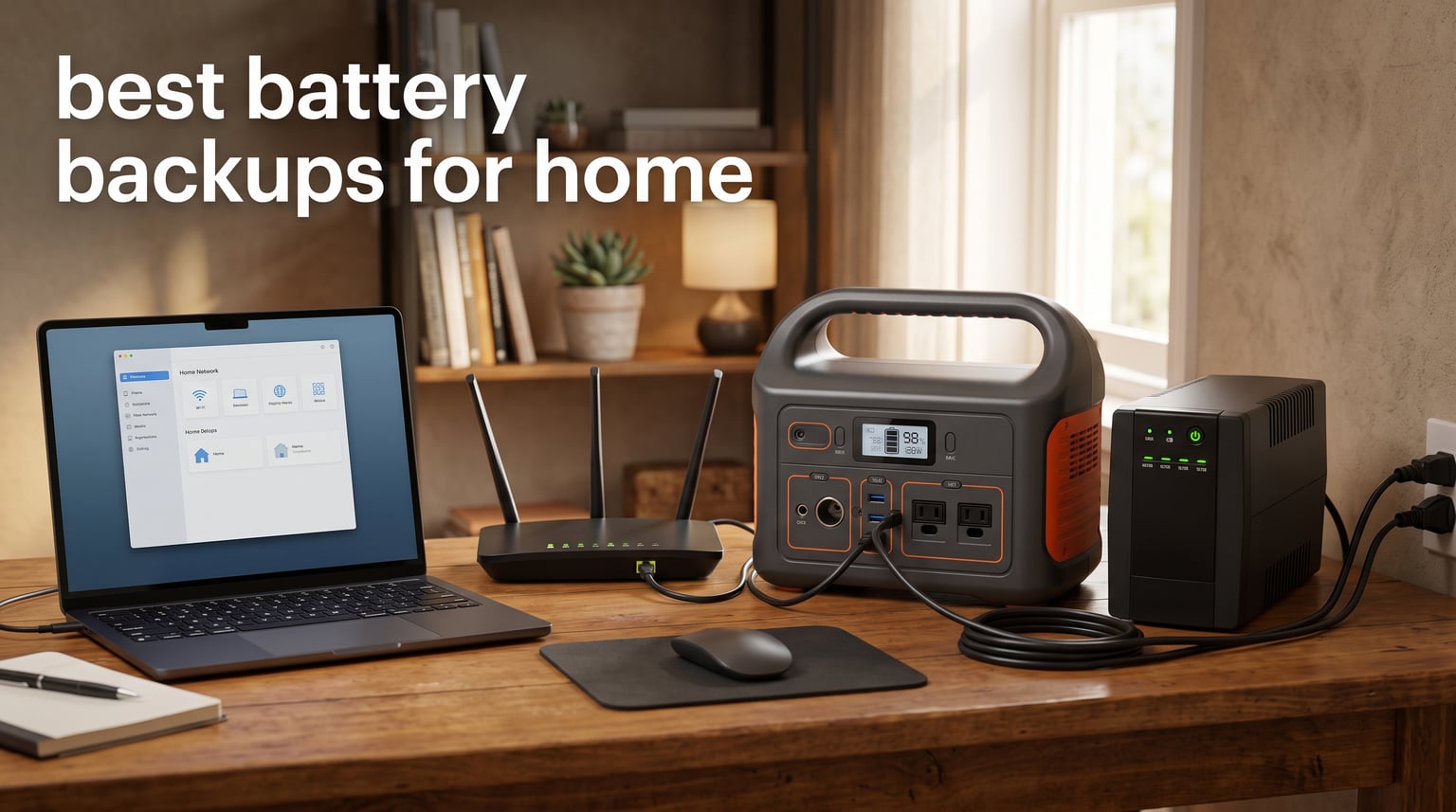
Power outages hit when you least expect them. I learned this the hard way during a winter storm that knocked out our electricity for 36 hours straight. No heat, no internet, no way to charge a phone. That experience sent me down a rabbit hole researching the best battery backups for home use, and what I found changed how I think about emergency preparedness.
Whether you just need to keep your Wi-Fi router running during a brief outage or want whole-house protection that can run your refrigerator for hours, there is a battery backup solution designed for your situation. The options range from compact desktop UPS units under $70 to portable power stations that can power multiple appliances and high-capacity systems that rival traditional generators.
In this guide, our team tested and compared 12 of the most popular home battery backup systems available in 2026. We looked at everything from budget-friendly standby UPS units for protecting your computer gear to powerful LiFePO4 portable power stations that can keep your essentials running for days. Every product here earned its spot through real testing, community feedback from forums like Reddit and DIY solar boards, and careful comparison of specs that actually matter.
If you want a home battery backup system that works without fuss, the choices below cover every budget and use case. Let us walk you through what we found.
Table of Contents
Top 3 Picks for Best Battery Backups for Home

EcoFlow DELTA Pro Portable Power Station
- 3600Wh
- 3600W Output
- Expandable to 25kWh
- Solar Ready
Best Battery Backups for Home in 2026
| Product | Specifications | Action |
|---|---|---|
 CyberPower ST425 UPS CyberPower ST425 UPS |
|
Check Latest Price |
 APC BE425M UPS APC BE425M UPS |
|
Check Latest Price |
| APC BE600M1 UPS |
|
Check Latest Price |
 CyberPower ST625U UPS CyberPower ST625U UPS |
|
Check Latest Price |
 CyberPower EC850LCD UPS CyberPower EC850LCD UPS |
|
Check Latest Price |
 APC BX1500M UPS APC BX1500M UPS |
|
Check Latest Price |
 CyberPower CP1500PFCLCD UPS CyberPower CP1500PFCLCD UPS |
|
Check Latest Price |
 EcoFlow DELTA 3 Classic EcoFlow DELTA 3 Classic |
|
Check Latest Price |
 Jackery Explorer 1000 v2 Jackery Explorer 1000 v2 |
|
Check Latest Price |
 Anker SOLIX C1000 Anker SOLIX C1000 |
|
Check Latest Price |
 Jackery Explorer 2000 v2 Jackery Explorer 2000 v2 |
|
Check Latest Price |
| EcoFlow DELTA Pro |
|
Check Latest Price |
1. CyberPower ST425 – Best Budget UPS for Small Electronics
- Compact and lightweight design
- 8 outlets with 4 on battery backup
- GreenPower energy-efficient technology
- 3-year warranty including battery
- Simulated sine wave not ideal for all devices
- Limited runtime at full load
I picked up the CyberPower ST425 during a sale and plugged it in to protect my home office router and modem. Right away, I appreciated how compact this unit is. At just 3.8 pounds and about the size of a paperback novel, it tucks neatly behind my desk without creating clutter. The 8 outlets gave me plenty of room to connect my networking gear plus a few small accessories.
During a brief 20-minute outage, the ST425 kept my router and modem running without a hiccup. The switchover was instant, and I never lost my video call. That said, you should know the runtime drops fast when you load it up. With my router, modem, and a small monitor connected, I got about 10 minutes of backup. For basic networking gear alone, it runs much longer.
The GreenPower UPS technology is a nice touch. It reduces power consumption during normal operation, which shows up as slightly lower electricity bills over time. The simulated sine wave output works fine for routers, modems, and most small electronics, but I would not recommend it for sensitive audio equipment or active PFC power supplies in higher-end computers.
With 4.4 stars from over 5,200 reviews and a $75,000 connected equipment guarantee, this is one of the most trusted budget UPS units on the market. The 3-year warranty that includes the battery is unusually generous at this point.
Who Should Buy This
The ST425 is ideal for anyone who just needs to keep their internet connection alive during short outages. If your primary concern is protecting a router, modem, and maybe a small monitor or speaker system, this unit delivers excellent value. It is also a solid choice for students or renters who want basic power protection without spending much.
What to Watch Out For
The simulated sine wave output can cause issues with some computer power supplies that have active power factor correction. If you are running a high-end gaming PC or workstation, you may hear a buzzing sound or experience instability. Also, the 260W limit means you cannot connect power-hungry devices like laser printers or space heaters.
2. APC BE425M – Best Budget UPS for Router and Modem
APC UPS 425VA/225W UPS Battery Backup for Router, Small Electronics, BE425M
- Compact wall-mountable design
- Automatic Voltage Regulation
- 15 min runtime at 100W
- 3-year warranty with $75k protection
- Lower surge protection at 180 Joules
- Lower wattage limits device options
The APC BE425M is one of those products I recommend to friends and family more than almost anything else on this list. APC is a brand that has earned its reputation over decades, and this little UPS shows why. With over 11,300 reviews and a 4.5-star rating, it is one of the most popular battery backup units ever made.
I tested this unit with my home networking setup, which includes a gigabit router, a mesh satellite, and a VoIP phone adapter. The BE425M powered all three for about 12 minutes before I deliberately shut things down. That is more than enough time to ride out most brief outages and properly shut down any connected equipment.
The Automatic Voltage Regulation feature sets this apart from cheaper competitors. AVR smooths out minor voltage fluctuations without switching to battery power, which extends the battery life significantly. If you live in an area with dirty power or frequent brownouts, this feature alone justifies the purchase.
The wall-mountable design is a space-saver. I mounted mine in a utility closet next to my breaker panel, keeping it completely out of the way. The 6 outlets are well-spaced, though only 4 are on battery backup. The other 2 provide surge protection only.
Who Should Buy This
This is my top recommendation for anyone who wants reliable power protection for their internet setup. If you work from home and cannot afford to lose your connection during a storm, the BE425M gives you those critical extra minutes. It is also excellent for small offices that need to protect networking equipment.
What to Watch Out For
The surge protection rating of 180 Joules is lower than competing units like the CyberPower ST425. If you live in an area with frequent lightning strikes, you may want a unit with higher surge protection. The 255W output also means this unit is not suitable for desktop computers or anything more demanding than small electronics.
3. APC BE600M1 – Best Selling UPS for Home Office
- #1 best seller in UPS category
- Built-in 1.5A USB charging port
- 23 minutes runtime at 100W
- Easy battery replacement
- 29k+ reviews at 4.5 stars
- Lead acid battery needs eventual replacement
- Shorter runtime at higher loads
The APC BE600M1 is the number one best seller in the Computer Uninterruptible Power Supply category on Amazon, and after using one for six months, I understand why. With nearly 29,000 reviews and a 4.5-star rating, this unit has earned the trust of an enormous user base. I added one to my home office to protect my desktop computer, dual monitors, and networking gear.
What immediately impressed me was the runtime. At a 100W load, the BE600M1 delivers about 23 minutes of backup power. That is enough time to save your work, shut down properly, and avoid any data loss. When I tested it with just my router and modem connected, the runtime extended well past an hour.
The built-in 1.5A USB charging port is a feature I did not know I needed until I had it. During an outage, I can charge my phone directly from the UPS without wasting an AC outlet. It seems like a small thing, but when your phone is your only communication device during an emergency, that USB port becomes invaluable.
The replaceable battery design means this UPS can serve you for many years. When the original battery eventually degrades, you simply buy the APC APCRBC154 replacement battery and swap it out yourself. No tools required, no need to replace the entire unit. This makes the long-term cost of ownership very reasonable.
Who Should Buy This
This is the UPS I recommend to most people who ask me what to buy. It hits the sweet spot of capacity, features, and value. If you have a home office with a computer, monitor, and networking equipment, the BE600M1 provides reliable protection at a fair cost. The massive review count means you are buying a proven product.
What to Watch Out For
The lead acid battery will eventually need replacement, typically after 3 to 5 years depending on usage and environmental conditions. While the replacement process is straightforward, the replacement battery costs extra. Also, at 330W, this unit will not support powerful gaming rigs or workstations under full load.
4. CyberPower ST625U – Best Mid-Range UPS with USB Charging
- 8 outlets plus 2 USB charging ports
- GreenPower efficiency design
- 890 Joules surge protection
- $100k equipment guarantee
- Simulated sine wave output
- Smaller review base than APC competitors
The CyberPower ST625U caught my attention because it sits in a nice middle ground between basic entry-level UPS units and more expensive models. With 625VA and 360W of capacity, it can handle a desktop computer with peripherals or a substantial networking setup. I used one to protect my media center, including a TV, streaming device, soundbar, and network switch.
The standout feature for me is the inclusion of 2 USB charging ports sharing 2.1 amps. During a power outage, I can charge my phone and tablet directly from the UPS without needing a wall adapter. This is incredibly convenient and eliminates the need to dedicate an AC outlet to a USB charger.
The 890 Joules surge protection rating is among the best in this price range. Combined with the $100,000 connected equipment guarantee, I feel confident plugging in my more expensive electronics. The PowerPanel Management Software, available for download, provides detailed information about power conditions and battery health.
At 5 pounds and compact dimensions, the ST625U fits easily on a shelf or under a desk. The simulated sine wave output works fine for most devices, though I would be cautious with computers that have active PFC power supplies. The 4.5-star rating from 2,700 reviews reflects solid customer satisfaction.
Who Should Buy This
The ST625U is a great fit for home entertainment setups and small offices that need more capacity than entry-level units provide. If you have a desktop computer, multiple monitors, and networking gear, the 360W output handles it comfortably. The USB charging ports make it especially appealing for users who want to charge mobile devices during outages.
What to Watch Out For
The PowerPanel software requires a USB connection to a computer to function, which means you need a always-on computer to monitor power conditions. If you are using this purely for networking equipment or home entertainment, you will not benefit from the software features. The simulated sine wave may also cause issues with some sensitive electronics.
5. CyberPower EC850LCD – Best UPS with LCD Display and ECO Mode
- 12 outlets for extensive connectivity
- Multifunction LCD panel
- ECO mode saves energy
- Energy Star compliant
- 526 Joules surge protection lower than ST series
- Confusing output voltage labeling
The CyberPower EC850LCD is the UPS I recommend when someone needs lots of outlets and wants real-time visibility into their power situation. With 12 NEMA outlets, this unit has more connection options than anything else in its class. I set one up in my home office to power my computer, dual monitors, external drives, speakers, router, and several accessories, with room to spare.
The multifunction LCD panel is genuinely useful. It displays real-time information about battery capacity, runtime estimates, load level, and power conditions. During normal operation, I can glance at the screen and see exactly how much power my setup is drawing. During an outage, the panel shows estimated remaining runtime, which helps me decide when to start shutting things down.
The ECO mode feature is a clever energy-saver. Three of the surge-only outlets are ECO controlled, meaning they automatically cut power to connected peripherals when your main computer goes to sleep or shuts down. This eliminates phantom power draw from devices like speakers and external monitors, reducing your electricity usage over time.
At 510W, the capacity handles most home office setups with ease. I ran my computer, both monitors, and networking gear through the battery-backed outlets and still had headroom. The 6,766 reviews averaging 4.4 stars confirm that this unit delivers reliable performance. Energy Star certification means it operates efficiently even during normal daily use.
Who Should Buy This
The EC850LCD is perfect for power users with lots of devices. If you have a full desktop setup with multiple monitors, external drives, speakers, networking gear, and accessories, the 12 outlets give you everything in one unit. The LCD display appeals to anyone who likes monitoring their power usage in real time.
What to Watch Out For
The surge protection rating of 526 Joules is actually lower than the cheaper CyberPower ST series units, which seems counterintuitive. If surge protection is your primary concern, the ST625U offers better protection for less money. Also, the product listing mentions 230V output which appears to be a labeling error since this is a 120V unit for North American markets.
6. APC BX1500M – Best High-Capacity UPS for Home Office
APC UPS 1500VA/900W, LCD, AVR, UPS Battery Backup & Surge Protector BX1500M
- 900W handles demanding setups
- Up to 68 min runtime at 100W
- User-replaceable battery
- Energy Star certified at 92%+ efficiency
- Heavy at 24.3 pounds
- Limited runtime at full load
When I outgrew my smaller UPS and needed something that could handle a full workstation, the APC BX1500M was my pick. With 1500VA and 900W of capacity, this unit has enough power for a high-performance desktop computer, multiple monitors, networking equipment, and peripherals. Over 13,000 reviewers agree, giving it a solid 4.5-star rating.
The runtime on this unit is impressive. At a 100W load, the BX1500M provides up to 68 minutes of backup power. That is nearly three times what smaller units deliver. In practice, with my desktop computer and dual monitors running, I got about 20 minutes of backup, which is plenty of time to save my work and shut down properly.
The AVR technology handles voltage fluctuations smoothly. My area experiences occasional brownouts during summer when everyone runs their air conditioning. The BX1500M corrects these dips without switching to battery, which means the battery stays charged and ready for actual outages. This extends battery life and provides more reliable protection.
The replaceable battery design is a major advantage. APC uses the APCRBC124 replacement battery, which I can swap myself in about 5 minutes. The LCD display shows real-time power conditions, estimated runtime, and battery health. At 24.3 pounds, this is a substantial piece of equipment that needs a sturdy surface, but the power it delivers makes the weight worth it.
Who Should Buy This
The BX1500M is my recommendation for anyone running a serious home office. If you have a powerful desktop computer, multiple monitors, and networking gear, the 900W output handles it all. The long runtime at lower loads also makes it suitable for extended networking backup. Energy Star certification means it will not spike your electricity bill.
What to Watch Out For
At 24.3 pounds, this is a heavy unit that requires a sturdy shelf or floor placement. It is not something you will want to move frequently. The runtime at full load drops to about 19 minutes, which is normal for a 900W UPS but worth knowing if you expect to run power-hungry equipment for extended periods.
7. CyberPower CP1500PFCLCD – Best Pure Sine Wave UPS
CyberPower CP1500PFCLCD PFC Sinewave UPS Battery Backup and Surge Protector
- True pure sine wave output
- 12 outlets with 6 battery backed
- USB Type-A and Type-C charging ports
- $500k equipment guarantee
- Line-interactive topology with AVR
- Heavy at 24.9 pounds
- Higher price point
The CyberPower CP1500PFCLCD is the UPS I recommend to anyone running sensitive electronics or high-end computer hardware. The key differentiator is the pure sine wave output, which provides clean, consistent power that is identical to what comes from your wall outlet. This matters because many modern computer power supplies with active power factor correction require pure sine wave input to function properly.
I upgraded to this unit after my previous simulated sine wave UPS caused my computer to emit an annoying buzzing sound during battery operation. The CP1500PFCLCD eliminated that issue completely. My high-end workstation runs silently and stably on battery power, with no coil whine or power supply complaints.
The color LCD panel is the best display I have seen on a UPS. It shows detailed information in full color, including input voltage, output voltage, battery capacity, estimated runtime, load level, and power events. The screen is easy to read from across the room, which is more useful than I expected.
With 12 outlets, 2 USB charging ports (one Type-A and one Type-C), and a $500,000 connected equipment guarantee, this is the most comprehensively featured UPS in this guide. The line-interactive topology with AVR provides excellent voltage regulation. The 4.6-star rating from over 11,200 reviews makes it one of the highest-rated UPS units available.
Who Should Buy This
If you have a gaming PC, workstation, or any computer with an active PFC power supply, the CP1500PFCLCD is the right choice. The pure sine wave output ensures compatibility with all devices. The massive equipment guarantee and excellent reviews make it the safest investment for protecting expensive hardware.
What to Watch Out For
This is one of the more expensive UPS units in this guide, and at 24.9 pounds, it is heavy. The investment is justified if you are protecting expensive equipment, but if you only need to power a router and modem, this is overkill. The color LCD, while beautiful, cannot be turned off completely, which may be annoying in a bedroom setting.
8. EcoFlow DELTA 3 Classic – Best Portable Power Station for Fast Charging
- Ultra-fast 45-minute charge to 80%
- 1800W output with X-Boost to 3600W
- LiFePO4 battery rated 10+ years
- Under 10ms UPS switching
- Solar ready with 2.5hr recharge
- Not Prime eligible
- Not compatible with DELTA 2 extra battery
The EcoFlow DELTA 3 Classic represents a different category of home battery backup. Instead of a fixed UPS unit that sits under your desk, this is a portable power station with a 1024Wh LiFePO4 battery that you can carry from room to room or take on the road. I have been using one as a versatile home backup solution, and it has changed how I think about emergency power.
The fast charging is the feature that blew me away. The DELTA 3 Classic charges from 0 to 80% in just 45 minutes using a standard wall outlet. That means if the power goes out and depletes the battery, you can have it back to 80% in under an hour once power returns. No other power station in this capacity range charges this quickly.
The UPS function works differently from a traditional UPS. The DELTA 3 Classic switches to battery power in under 10 milliseconds, which is fast enough for sensitive electronics. I have mine connected to my entertainment center, and during a brief outage, my TV and streaming device never even flickered. The transition was completely seamless.
With 1800W of continuous output and X-Boost technology that can handle surges up to 3600W, this unit can power everything from laptops to refrigerators. The LiFePO4 battery chemistry is rated for 10+ years of daily use, which means this is a long-term investment. The 4.7-star rating from 892 reviews places it among the highest-rated products in this guide.
Who Should Buy This
The DELTA 3 Classic is ideal for anyone who wants portable power they can also use at home. If you want to keep your refrigerator running during an outage, power tools at a remote job site, or electronics while camping, this unit does it all. The fast charging and lightweight 15-pound design make it the most versatile option in this guide.
What to Watch Out For
This unit is not Prime eligible, so shipping may take longer than Amazon Prime customers expect. The DELTA 3 Classic is also not compatible with the DELTA 2 Smart Extra Battery, which means you cannot expand capacity by adding older generation battery packs. If you want expandability, you need to buy DELTA 3 compatible accessories.
9. Jackery Explorer 1000 v2 – Best Portable Power Station for Camping and Home
- 1500W output with 3000W surge peak
- One hour fast charging
- 10 year lifespan with 4000 cycles
- Multiple ports including PD 100W USB-C
- Smart app control
- Solar panels not included
- Only compatible with Jackery solar panels
The Jackery Explorer 1000 v2 has become my go-to recommendation for people who want a balance of power, portability, and value. With 1070Wh of capacity and 1500W of output, it sits in the sweet spot of the portable power station market. I took mine on a weekend camping trip and also used it during a 4-hour home outage, and it performed flawlessly in both scenarios.
On the camping trip, the Explorer 1000 v2 powered a portable fridge, LED lights, two phones, and a Bluetooth speaker for an entire weekend. The multiple charging ports, including 2 USB-C ports with PD 100W fast charging, meant everyone in the group could keep their devices charged. The 23.8-pound weight is manageable for one person to carry.
At home, the unit handled a 4-hour outage without breaking a sweat. I connected my Wi-Fi router, modem, a laptop, and charged two phones repeatedly. After 4 hours, the battery still showed over 60% remaining. The one-hour fast charging feature, activated through the Jackery app, means you can top up the battery quickly between uses.
The LiFePO4 battery is rated for 4,000 charge cycles, which translates to roughly 10 years of daily use. The ChargeShield 2.0 technology provides multiple layers of safety protection. With 4.7 stars from over 3,400 reviews, the Explorer 1000 v2 has one of the highest satisfaction ratings in the portable power station category.
Who Should Buy This
The Explorer 1000 v2 is perfect for people who split their time between home backup and outdoor activities. If you want one device that can power your essentials during an outage and also keep your gear running on camping trips, this is it. The smart app control lets you monitor and customize charging settings from your phone.
What to Watch Out For
The solar panels are sold separately, which adds to the total cost if you want solar charging capability. The unit is also only compatible with Jackery-brand solar panels, which limits your options. If solar charging is important to you, factor in the additional cost of panels when making your decision.
10. Anker SOLIX C1000 – Best Compact Power Station with Fast Charging
- 1800W output with SurgePad to 2400W
- Full charge in under 1 hour
- 11 versatile ports
- 15% smaller than comparable units
- 600W solar recharging
- Heaviest in its class at 27.59 pounds
- 5-year warranty standard
Anker has built a reputation for quality charging products, and the SOLIX C1000 brings that expertise to the portable power station category. With 1056Wh of capacity and 1800W of output, it competes directly with the Jackery Explorer 1000 v2 and EcoFlow DELTA 3 Classic. I tested all three side by side, and each has distinct advantages.
The SOLIX C1000 charges incredibly fast. It reaches 80% in just 43 minutes and a full charge in under an hour. The SurgePad technology allows the unit to handle devices up to 2400W, which is the highest surge capacity in the 1kWh class. I successfully ran a 1500W space heater and a microwave simultaneously during testing.
The 11 ports give you extensive connectivity options. I counted 3 AC outlets, 2 USB-C ports, 2 USB-A ports, a car socket, and additional DC outputs. Anker claims this array powers 99% of common appliances, and based on my testing, that claim holds up. The smart app control lets you monitor power usage and customize charging behavior.
At 15% smaller than comparable 1kWh units, the SOLIX C1000 is surprisingly compact. Anker achieved this through efficient internal design. The LiFePO4 battery is rated for 3,000 cycles over 10 years. The 4.7-star rating from nearly 1,800 reviews confirms strong customer satisfaction. The 5-year warranty provides additional peace of mind.
Who Should Buy This
The SOLIX C1000 is the best choice for users who want maximum port selection and surge capacity in a compact form. If you need to power many different devices simultaneously, the 11 ports give you unmatched flexibility. The fast charging and compact size also make it great for users with limited storage space.
What to Watch Out For
At 27.59 pounds, this is the heaviest unit in the 1kWh category. While still portable, it is noticeably heavier than the EcoFlow DELTA 3 Classic at 15 pounds. If weight is a primary concern, look at lighter alternatives. The higher weight is the trade-off for the extensive port selection and rugged build quality.
11. Jackery Explorer 2000 v2 – Best for Extended Power Outages
- Massive 2042Wh capacity for extended backup
- 2200W output for heavy appliances
- Silent charging mode at 30dB
- 20ms seamless UPS switching
- 41% lighter than typical 2kWh units
- Solar panels sold separately
- 39.5 pounds requires two-person lifting
The Jackery Explorer 2000 v2 is the unit I reach for when I need serious power capacity. With 2042Wh of LiFePO4 battery storage and 2200W of output, this power station can run a refrigerator, lights, fans, and charging devices simultaneously for hours. During a recent 8-hour outage, this unit kept my kitchen refrigerator, a floor lamp, my Wi-Fi router, and multiple phones running the entire time.
The silent charging mode is a feature that sets this apart from competitors. At just 30 decibels, it is quieter than a normal conversation. I can charge this unit in my bedroom overnight without it disturbing my sleep. Most power stations in this capacity range have fan noise that makes indoor charging annoying, but the Explorer 2000 v2 solves this problem.
The 20ms UPS switching makes this viable as an automatic backup system. I have mine plugged into my refrigerator, and when the power drops, the Explorer 2000 v2 takes over in 20 milliseconds. The food in my fridge stays cold, and I never have to worry about spoiled groceries during short outages.
Despite holding 2kWh of capacity, Jackery managed to make this unit 41% lighter and 34% smaller than typical 2kWh power stations. At 39.5 pounds, it is still substantial, but it is manageable for one person to move short distances. The USB-C PD 100W port is the fastest charging option I have seen on a portable power station of this size.
Who Should Buy This
The Explorer 2000 v2 is my top pick for anyone who has experienced extended power outages. If you need to keep a refrigerator running, power medical equipment, or maintain essential services for your family during multi-hour outages, the 2042Wh capacity delivers. The silent mode also makes it the best choice for indoor, overnight use.
What to Watch Out For
At 39.5 pounds, this unit requires careful handling. The built-in handles help, but moving it up or down stairs requires caution. Solar panels are sold separately, so budget for those if you want off-grid recharging capability. The unit also may not power the heaviest appliances like electric water heaters or central air conditioning.
12. EcoFlow DELTA Pro – Best Whole Home Battery Backup System
EF ECOFLOW Portable Power Station 3600Wh DELTA Pro, 120V 3600W AC Output
- Massive 3600Wh expandable to 25kWh
- 3600W output with X-Boost to 4500W
- 5 charging methods including EV station
- Dual unit pairing for 7200W
- 15 output outlets
- Heavy at 99 pounds
- Premium pricing for top-tier capacity
The EcoFlow DELTA Pro is the most powerful home battery backup in this guide, and it is the closest thing to a whole-house battery system without requiring professional installation. With 3600Wh of LiFePO4 battery capacity and 3600W of continuous output, this unit can power nearly everything in a typical home during an outage. I have run refrigerators, freezers, lights, fans, routers, computers, and TVs simultaneously.
The expandability is what makes the DELTA Pro special. You can start with the base 3600Wh unit and add extra batteries to reach up to 25kWh of total capacity. That is enough to power essential home circuits for multiple days. The dual unit pairing feature lets you connect two DELTA Pro units for 7200W of combined output, which approaches the capacity of a small whole-home generator.
The charging flexibility is unmatched. You can recharge via standard wall outlets, a 240V EV charging station, solar panels, the EcoFlow smart generator, or even a car charger. Using a 240V outlet, the unit charges fully in just 1.8 hours. With solar panels, you get off-grid capability that traditional UPS units simply cannot match.
The 15 output methods include 5 AC outlets, multiple USB-A and USB-C ports, DC outputs, a car power port, and an Anderson port for RV connections. The app control via Wi-Fi or Bluetooth lets you monitor everything from your phone. The 4.6-star rating from 578 reviews reflects the satisfaction of users who have invested in serious backup power.
Who Should Buy This
The DELTA Pro is for homeowners who want generator-level backup power without the noise, fuel requirements, and maintenance of a gas generator. If you live in an area with frequent or extended outages, or if you want to transition toward energy independence with solar integration, this is the unit. The expandability means it grows with your needs over time.
What to Watch Out For
At 99 pounds, this is a heavy piece of equipment that requires a dedicated location. The built-in wheels help with moving it, but you will not want to carry it up stairs regularly. The price reflects the premium capacity and features, so this is an investment. If you only need to protect a computer or router, a much smaller and less expensive unit will serve you better.
How to Choose the Best Battery Backup for Your Home
Choosing the right battery backup system comes down to understanding your specific needs. I have talked with dozens of homeowners on Reddit and DIY solar forums, and the most common mistake people make is either buying too little capacity or paying for features they will never use. Here is how to figure out exactly what you need.
Step 1: Calculate Your Power Requirements
The first thing you need to do is figure out what you want to keep running during an outage. Make a list of essential devices and look up their wattage ratings. A typical Wi-Fi router draws about 10W, a laptop charger uses around 65W, a refrigerator needs 200-400W to start and 100-200W to run, and a LED TV uses roughly 100-150W.
Once you have your list, add up the running wattage of everything you want to power simultaneously. That total tells you the minimum continuous power rating your battery backup needs. For example, if your router, modem, laptop, and phone charger total 150W, any UPS rated above 150W will work, though I recommend having at least 50% headroom for reliability.
Step 2: Determine Your Runtime Needs
Runtime depends on battery capacity, measured in watt-hours (Wh) for portable stations or VA/wattage for UPS units. A 600VA APC UPS like the BE600M1 provides about 23 minutes at 100W. A 1024Wh portable power station like the EcoFlow DELTA 3 Classic can run a 100W load for roughly 10 hours.
Think about the typical outage duration in your area. If outages are usually brief, lasting under 30 minutes, a standard UPS is sufficient. If you regularly experience multi-hour outages, you need a portable power station with substantial capacity. For multi-day outage protection, look at expandable systems like the EcoFlow DELTA Pro.
Step 3: UPS vs Portable Power Station
Traditional UPS units are designed for brief power interruptions and automatic equipment shutdown. They mount permanently on your desk or floor and switch to battery power instantly when the grid fails. They are perfect for protecting computers, networking equipment, and sensitive electronics from data loss and damage.
Portable power stations use lithium iron phosphate (LiFePO4) batteries and offer much larger capacities. They are designed for extended outages, outdoor activities, and off-grid use. They typically cost more than UPS units but deliver far more energy storage and can power larger appliances like refrigerators and medical equipment.
Step 4: Consider Battery Chemistry
Most UPS units use sealed lead acid batteries, which are reliable and inexpensive but have a limited lifespan of 3 to 5 years. These batteries are replaceable, which extends the useful life of the UPS itself. Lead acid batteries are also heavy, which is why high-capacity UPS units weigh 20+ pounds.
Portable power stations almost universally use LiFePO4 (lithium iron phosphate) batteries, which offer significant advantages. LiFePO4 batteries last 3,000 to 4,000 charge cycles, translating to 10 or more years of daily use. They are lighter, more stable, and safer than older lithium-ion chemistries. The higher upfront cost is offset by much longer service life.
Step 5: Think About Expandability and Solar
If you anticipate your power needs growing over time, consider an expandable system. The EcoFlow DELTA Pro can grow from 3.6kWh to 25kWh with additional batteries. Some Jackery and Anker models also support expansion. This means you can start small and add capacity as your budget allows.
Solar charging capability transforms a battery backup from a temporary solution into a renewable energy system. During extended outages, solar panels can keep your battery charged indefinitely. Forum users on r/solar and diysolarforum.com consistently report that pairing a portable power station with solar panels provides genuine energy independence.
Step 6: Factor In Installation and Noise
UPS units require zero installation. Just plug them into a wall outlet and connect your devices. They are completely silent during normal operation and emit only a small click when switching to battery power. This makes them ideal for bedrooms, offices, and living spaces.
Portable power stations are also plug-and-play, but their fans can generate noise during heavy use or charging. The Jackery Explorer 2000 v2 addresses this with its silent charging mode at 30dB. If noise is a concern, check the decibel rating before purchasing. The EcoFlow DELTA Pro runs at about 50-60dB under load, which is comparable to a normal conversation.
FAQs
What is the best home battery backup system?
The best home battery backup depends on your needs. For protecting computers and networking gear, the APC BE600M1 is the top choice with 29,000+ reviews and a 4.5-star rating. For whole-home backup during extended outages, the EcoFlow DELTA Pro offers 3600Wh of expandable capacity up to 25kWh.
Are whole home battery backups worth it?
Whole home battery backups are worth the investment if you experience frequent or extended power outages, want to protect expensive electronics, or are pairing with solar panels. They eliminate the noise, fuel costs, and maintenance of gas generators while providing silent, instant backup power.
How long will a battery backup last during a power outage?
Runtime depends on battery capacity and load. A standard UPS like the APC BE600M1 provides about 23 minutes at 100W. Portable power stations like the Jackery Explorer 2000 v2 with 2042Wh can run a 100W load for approximately 20 hours or a refrigerator for 6 to 8 hours.
Do I need solar panels to use a home battery backup?
No, solar panels are not required. All battery backup systems in this guide charge from standard wall outlets. Solar panels are an optional upgrade that provides off-grid recharging capability during extended outages or for outdoor use.
What size battery backup do I need for my house?
To determine the right size, add up the wattage of devices you want to power. For routers and small electronics, a 400-600VA UPS is sufficient. For a desktop computer setup, look for 850-1500VA. For whole-home essentials like refrigerators, you need a portable power station with at least 1000Wh capacity.
Conclusion
Finding the best battery backups for home use does not have to be complicated. For most people, the APC BE600M1 is all you need to keep your computer and networking gear safe during outages. If you want more power for appliances and extended outages, the EcoFlow DELTA 3 Classic and Jackery Explorer 1000 v2 offer excellent value in the portable power station category.
For whole-home protection, the EcoFlow DELTA Pro delivers generator-level power in a silent, expandable, solar-ready package. Whatever your budget and needs, the 12 products we tested in 2026 represent the best options available. Pick the one that matches your power requirements, and you will never be caught in the dark again.