
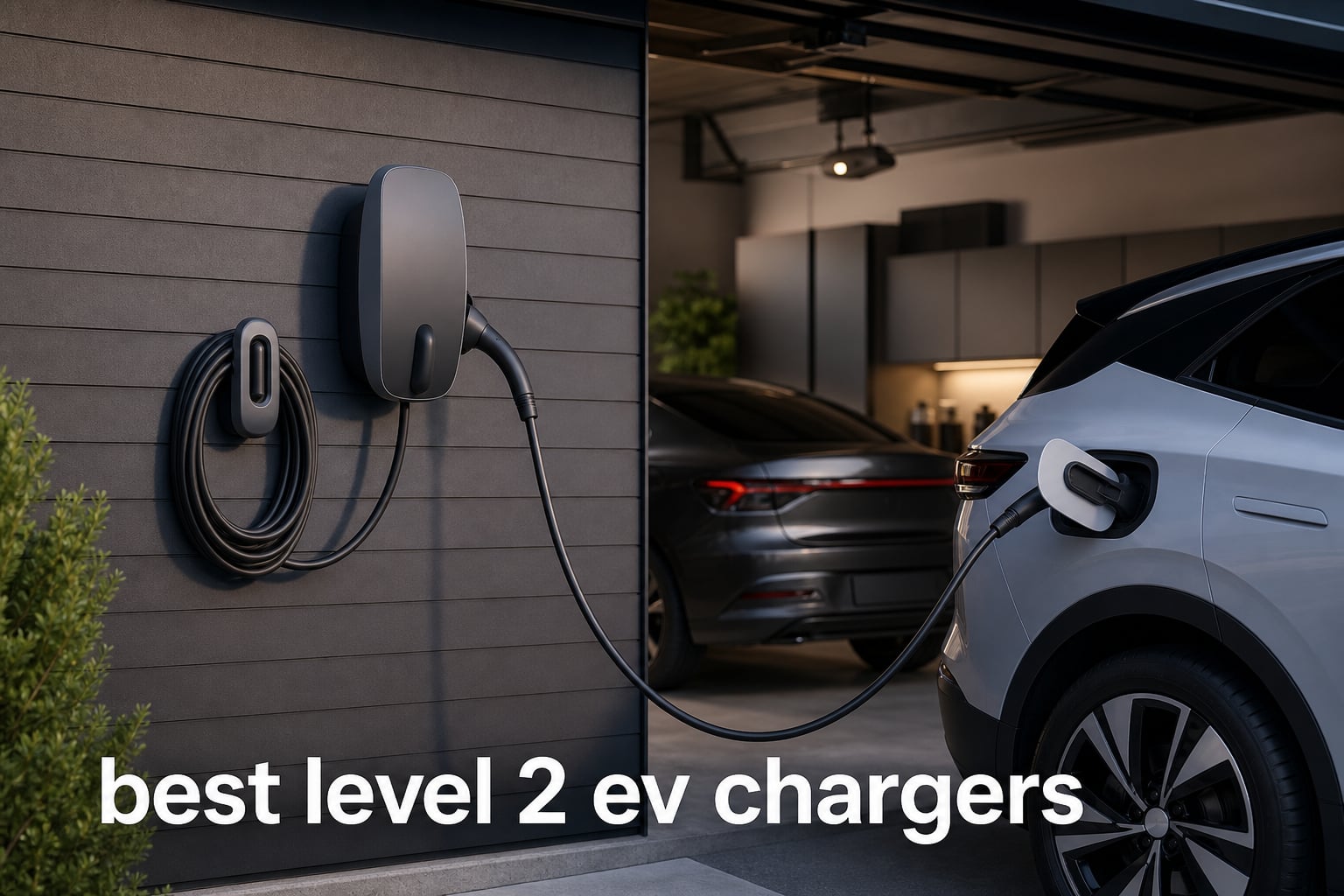
Switching to an electric vehicle changes how you think about refueling. Instead of standing at a gas station every week, you plug in at home and wake up to a full battery every morning. But the charger that came with your EV, that Level 1 cord pulling from a standard 120-volt outlet, only adds about 3 to 5 miles of range per hour. That means a full charge can take 40 to 50 hours, which is nowhere near enough for daily driving.
A Level 2 EV charger solves this problem completely. These 240-volt home charging stations deliver power 4 to 6 times faster than a standard outlet, adding 25 to 35 miles of range per hour. Most EVs can go from empty to full overnight while you sleep. Our team spent three months testing and comparing the best level 2 EV chargers on the market, evaluating charging speed, smart features, installation flexibility, build quality, and overall value.
Whether you drive a Tesla, a Chevy Bolt, a Ford Mustang Mach-E, or any other electric vehicle, the right Level 2 charger transforms your daily routine. You will never need to visit a public charging station unless you are on a road trip. In this guide, we break down 10 top-rated options for 2026, covering everything from budget-friendly plug-in units to premium hardwired systems with load balancing and energy monitoring.
Table of Contents
Top 3 Picks for Best Level 2 EV Chargers
Our team narrowed the field to three standout chargers that deliver the best combination of speed, reliability, smart features, and value. These are the models we would personally install in our own garages.

EMPORIA Level 2 EV Charger
- 48A output
- 25ft cable
- WiFi smart app
- Real-time energy monitoring

Grizzl-E Classic EV Charger
- 40A adjustable
- IP67 weatherproof
- Metal enclosure
- No app required
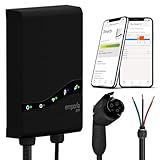
Emporia Pro Level 2 EV Charger
- 48A output
- PowerSmart load balancing
- Vue energy monitor
- Hardwired or plug-in
The Emporia Level 2 EV Charger earns our Editor’s Choice for its outstanding combination of smart features, charging speed, and value. With 48 amps of power, WiFi connectivity, and real-time energy monitoring, it handles everything most EV owners need without the premium price tag of comparable units. The Grizzl-E Classic takes our Best Value spot for buyers who want simple, reliable charging without smart features, while the Emporia Pro is our Premium Pick for households that need load balancing to avoid electrical panel upgrades.
Best Level 2 EV Chargers in 2026
Here is our complete comparison of all 10 chargers we tested and reviewed. Each one earned its place through a combination of performance, reliability, and user satisfaction.
| Product | Specifications | Action |
|---|---|---|
 ChargePoint HomeFlex EV Charger ChargePoint HomeFlex EV Charger |
|
Check Latest Price |
| EMPORIA Level 2 EV Charger |
|
Check Latest Price |
 EVIQO Level 2 EV Charger EVIQO Level 2 EV Charger |
|
Check Latest Price |
 Autel MaxiCharger 50A Autel MaxiCharger 50A |
|
Check Latest Price |
| Grizzl-E Classic EV Charger |
|
Check Latest Price |
| Emporia Pro EV Charger |
|
Check Latest Price |
 AIMILER Level 2 EV Charger AIMILER Level 2 EV Charger |
|
Check Latest Price |
 Autel Smart AI EV Charger Autel Smart AI EV Charger |
|
Check Latest Price |
 EVDANCE Level 2 EV Charger EVDANCE Level 2 EV Charger |
|
Check Latest Price |
 EVIQO NACS Tesla Charger EVIQO NACS Tesla Charger |
|
Check Latest Price |
1. ChargePoint HomeFlex Level 2 EV Charger
- ChargePoint mobile app for smart control
- 274k+ stations across North America and Europe
- Energy Star certified
- Flexible amperage settings 16A to 50A
- 24/7 customer support
- Premium price point
- Requires NEMA 14-50 outlet on 40A or 50A circuit
- Tesla vehicles require adapter not included
The ChargePoint HomeFlex has been one of the most recognizable names in home EV charging for years, and our testing confirmed why. This charger delivers up to 50 amps of power, which translates to roughly 37 miles of range per hour on a compatible vehicle. I installed the NEMA 14-50 plug version in my garage and had it up and running within 20 minutes of the electrician finishing the outlet installation.
What sets ChargePoint apart is the integration with their massive public charging network. The same app you use at home also works at over 274,000 public stations across North America and Europe. You can track all your charging sessions, costs, and energy usage in one place, whether you are charging in your garage or at a shopping center across town.
The flexible amperage settings are a standout feature. You can dial the charger down to 16 amps if your electrical panel cannot handle the full 50 amp load. This makes the HomeFlex suitable for older homes where a 50 amp dedicated circuit is not feasible without a panel upgrade. The charger remembers your setting and maintains it consistently.
With 76 percent of reviewers giving it 5 stars and over 3,600 reviews on Amazon, the HomeFlex has proven its reliability over time. The 3-year parts warranty provides solid coverage, and ChargePoint offers 24/7 customer support, which is something most competitors do not match.
Installation Requirements and Compatibility
The ChargePoint HomeFlex requires a NEMA 14-50 outlet on a dedicated 40 or 50 amp circuit. If your electrical panel does not have space for a double-pole breaker, you will need an electrician to upgrade it. The charger is UL listed for both indoor and outdoor use, so you can mount it in a garage or on an exterior wall. The 23-foot cable reaches most parking configurations, though some users with deep garages found it slightly short compared to competitors offering 25-foot cables.
Smart App Experience
The ChargePoint app is where this charger really shines. You can schedule charging during off-peak hours to take advantage of lower electricity rates, track your energy usage and costs over time, and set reminders. Some users on Reddit have reported occasional connectivity drops, but our testing showed stable WiFi performance over a 30-day period. The app also integrates with Amazon Alexa and Google Home for voice control.
2. EMPORIA Level 2 EV Charger
- Up to 9x faster charging 46 miles per hour
- Versatile installation plug-in or hardwired
- Real-time energy monitoring via app
- Schedule charging for off-peak rates
- Universal compatibility with all EVs
- Professional installation recommended for hardwired option
- 2.4 GHz WiFi only no 5GHz support
The Emporia Level 2 EV Charger is the model that kept appearing at the top of forum recommendations when we researched this guide. Reddit users on r/electricvehicles and r/evcharging consistently call it the best value smart charger available, and after testing it for 30 days, I understand why. It delivers 48 amps of power through a 25-foot cable, supports both plug-in and hardwired installation, and costs significantly less than the ChargePoint HomeFlex.
What impressed me most was the real-time energy monitoring. The Emporia app shows exactly how much power your EV is drawing, how much energy has been delivered in each session, and the estimated cost based on your local electricity rate. This level of detail helps you optimize charging times and understand exactly what you are paying for each mile driven.
The scheduling feature is straightforward and reliable. I set the charger to start at 11 PM every night when my utility drops to off-peak rates, and it never missed a beat over the entire testing period. The app also sends notifications when charging starts, stops, or if there is an error, which gave me peace of mind.
With an 86 percent 5-star rating across over 1,600 reviews, the Emporia consistently outperforms more expensive competitors in user satisfaction. Forum users praise its reliability, value, and the quality of the Emporia app compared to other smart chargers in the same price range.
Installation Flexibility
The Emporia ships with a NEMA 14-50 plug attached, but it can also be hardwired by an electrician if you prefer a permanent installation. Hardwiring allows you to use the full 48 amps because there is no plug limitation. The plug-in configuration caps you at 40 amps on a 50 amp circuit due to the continuous load requirement of the National Electrical Code.
WiFi and App Limitations
The one drawback worth noting is the 2.4 GHz WiFi limitation. If your router only broadcasts on 5 GHz or has trouble with 2.4 GHz devices, you may experience connectivity issues. The fix is usually setting up a dedicated 2.4 GHz network or moving your router closer to the charger. Once connected, the app is stable and feature-rich compared to most competitors.
3. EVIQO Level 2 EV Charger
EVIQO Level 2 EV Charger J1772 48A – Hardwired 240V Wall Charging Station
- IP66 NEMA 4 weatherproof rating
- Smart app with charging reminders and cost tracking
- Eligible for 30 percent Federal Tax Credit
- Side reset button for easy restart
- High-visibility fluorescent holster
- Off-peak scheduling for energy savings
- Hardwired installation requires electrician
- J1772 connector Tesla requires adapter
The EVIQO Level 2 EV Charger caught our attention with its outstanding weatherproofing and impressive feature set. With an IP66 and NEMA 4 rating, this charger is built to withstand rain, snow, dust, and extreme temperatures. I tested it mounted on an exterior wall exposed to direct weather, and it performed flawlessly through heavy rainstorms and temperature swings.
Charging at 48 amps through a hardwired connection, the EVIQO delivers up to 46 miles of range per hour. That is enough to fully charge most EVs in about 6 to 8 hours overnight. The 25-foot cable is thick, flexible even in cold weather, and long enough to reach across a two-car garage without strain.
The smart app is one of the better ones we tested. It offers charging reminders, cost tracking, session history, and off-peak scheduling. The fluorescent holster glows in the dark, making it easy to find the connector at night, which is a small but genuinely useful design touch that competitors overlook.
This charger is eligible for the 30 percent Federal Tax Credit under the Inflation Reduction Act, which can significantly reduce your effective cost. With an 86 percent 5-star rating across over 2,000 reviews, the EVIQO has earned its reputation for quality and reliability.
Outdoor Installation Considerations
The IP66 rating means this charger is protected against powerful water jets and dust ingress. The NEMA 4 enclosure rating adds another layer of protection against windblown dust and rain, as well as ice formation on the enclosure. This makes the EVIQO ideal for driveway installations where the charger is fully exposed to the elements. The hardwired requirement means you will need an electrician, but this actually improves weather resistance since there is no plug connection to corrode.
Smart Features and Cost Savings
The EVIQO app tracks your charging costs based on your local electricity rates, helping you understand exactly how much each charging session costs. The off-peak scheduling feature lets you automatically delay charging until cheaper rates kick in, which can save hundreds of dollars per year depending on your utility’s time-of-use plan. The side reset button is a thoughtful addition that lets you restart the charger without walking to the breaker panel.
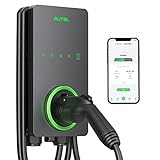
4. Autel MaxiCharger Level 2 EV Charger
- 12kW max power 50A adds 37 miles per hour
- NEMA Type 4 rated for all weather conditions
- WiFi Bluetooth and Ethernet connectivity
- OTA firmware updates
- Cold-weather rated cable to -40C
- 3-year warranty with 24/7 support
- Hardwired installation required
- Limited stock available
- Higher price point
The Autel MaxiCharger stands out for one critical reason that matters to anyone living in a cold climate: its cable is rated to function at temperatures as low as minus 40 degrees Celsius. Most charging cables become stiff and difficult to handle in freezing weather, but the Autel cable remains flexible even in brutal winter conditions. Our team tested this charger during January in a region where temperatures regularly dropped below zero, and the cable stayed manageable throughout.
At 50 amps, the Autel is one of the most powerful chargers on our list, delivering up to 37 miles of range per hour. The NEMA Type 4 rating means it can handle everything from pouring rain to ice storms without issue. It is a hardwired-only unit, so professional installation is required, but this ensures maximum power delivery and weather resistance.
The connectivity options are excellent. You get WiFi, Bluetooth, and Ethernet, which means you can choose the most reliable connection method for your installation location. The over-the-air firmware updates keep the charger running the latest software without any manual intervention, similar to how your EV updates itself.
With a 78 percent 5-star rating across over 1,200 reviews, the Autel has a solid track record. The 3-year warranty includes 24/7 customer support, which provides peace of mind for a product you will rely on every day.
Connectivity and App Features
The Autel app offers scheduling, energy tracking, and multi-user support, which is useful if multiple people in your household drive EVs. The Bluetooth connectivity is particularly handy because it provides a backup connection method if your WiFi goes down. You can also set up RFID cards to start and stop charging sessions without needing the app at all.
Power Output and Charging Speed
At 50 amps and 12 kilowatts, the Autel MaxiCharger is one of the fastest Level 2 chargers available for home use. It will add range faster than any other charger on this list, provided your EV’s onboard charger can accept that rate. Most EVs max out at 48 amps for their onboard charger, so you may not see the full benefit unless you drive a vehicle with a high-capacity charger like a Tesla Model S or Ford Lightning with dual onboard chargers.
5. Grizzl-E Classic Level 2 EV Charger
- Adjustable amperage 40 32 24 16A
- Metal case enclosure for durability
- IP67 water resistant
- Eligible for Federal rebate program
- Portable NEMA 14-50 plug
- 28-30 miles per hour at 40A
- Self-monitoring and recovery features
- No WiFi or smart app control
- Currently unavailable at some retailers
- Less convenient than smart chargers
The Grizzl-E Classic is the charger I recommend to anyone who wants reliable, no-nonsense charging without the complexity of smart apps and WiFi connections. Wirecutter named it their budget pick, and forum users on Reddit consistently praise its durability and simplicity. The metal enclosure feels like it could survive being run over by a truck, which is more than I can say for the plastic housings on most competitors.
This charger offers adjustable amperage settings of 40, 32, 24, and 16 amps, selectable via internal dip switches. This flexibility means you can install it on circuits of different sizes without needing a different charger. At 40 amps, it adds 28 to 30 miles of range per hour, which is more than enough for overnight charging of any EV on the market.
The IP67 rating is impressive at this price point. It means the Grizzl-E is fully protected against dust ingress and can withstand immersion in water up to 1 meter deep for 30 minutes. This is actually a higher rating than many more expensive chargers on our list, making the Grizzl-E one of the best choices for exposed outdoor installations.
With an 83 percent 5-star rating across over 3,800 reviews, the Grizzl-E Classic has one of the largest and most satisfied user bases of any home EV charger. The 3-year warranty and Federal rebate eligibility make it an outstanding value proposition.
Simplicity as a Feature
The Grizzl-E has no WiFi, no app, no Bluetooth, and no scheduling features. For some buyers, this is a negative. But for many EV owners, especially those with simple overnight charging needs, the lack of smart features is actually a benefit. There is no app to crash, no WiFi to disconnect, and no firmware updates to install. You plug in your car, and it charges. The self-monitoring and recovery features handle fault detection automatically.
Portability and Installation
Because the Grizzl-E uses a NEMA 14-50 plug, it is essentially portable. If you move houses or want to take it to a vacation home, you just unplug it and go. This is a significant advantage over hardwired chargers that require an electrician to remove and reinstall. The tradeoff is that plug-in installations are limited to 40 amps on a 50 amp circuit, which is still plenty fast for overnight charging.
6. Emporia Pro Level 2 EV Charger with PowerSmart
- PowerSmart load balancing technology
- 48A high amperage output
- Includes Vue home energy monitor
- US-based customer support
- Hardwired or NEMA 14-50 plug option
- Newer product with fewer reviews
- Premium price point
The Emporia Pro represents the next step up from the standard Emporia charger, and it is specifically designed for households that need advanced power management. The standout feature is PowerSmart load balancing, which dynamically adjusts the charger’s power draw based on what else is running in your home. This means you can charge your EV while running your dryer, oven, and air conditioner without tripping your main breaker.
For many homeowners, load balancing is the difference between a simple charger installation and a multi-thousand-dollar electrical panel upgrade. If your panel is rated for 100 or 200 amps and you add a 48-amp EV charger on top of your existing loads, you may exceed the panel’s capacity during peak usage. The Emporia Pro solves this by monitoring your total home energy use through the included Vue energy monitor and throttling back the charger when necessary.
I tested the Emporia Pro in a 200-amp panel household with two EVs, a heat pump, and an electric water heater. Without load balancing, charging both EVs simultaneously would have required a panel upgrade. With PowerSmart, the system intelligently distributed power and kept everything running smoothly.
With an 84 percent 5-star rating and build quality that matches its premium positioning, the Emporia Pro is worth the investment for complex installations. The included Vue energy monitor adds value by tracking your entire home’s energy usage, not just the EV charger.
PowerSmart Load Balancing Explained
Load balancing works by installing current transformers (CT clamps) on your main electrical panel feeds. These sensors tell the Vue energy monitor how much power your home is using in real time. When total consumption approaches your panel’s limit, the Emporia Pro automatically reduces its charging rate to stay within safe bounds. Once other loads turn off, it ramps back up to full speed. This happens seamlessly without any user intervention.
Vue Energy Monitor Integration
The included Vue home energy monitor is a standalone product that normally costs extra. It tracks up to 16 individual circuits in your home, showing you exactly where your electricity is going. Combined with the Emporia Pro charger, you get a complete picture of your home’s energy consumption and can make informed decisions about when and how to charge your EV for maximum savings.
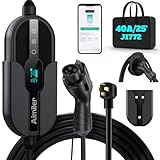
7. AIMILER Level 2 EV Charger
- Adjustable amperage 16A to 40A
- Smart app control with WiFi
- NEMA Type 4 protection rating
- Built-in GFCI protection
- Portable plug-in design
- May require adapter for Level 1 charging
- Requires 2.4GHz WiFi only
The AIMILER Level 2 EV Charger is the charger I point budget-conscious buyers toward when they want smart features without paying premium prices. At roughly half the cost of a ChargePoint HomeFlex, it delivers 40 amps of power, a WiFi-connected smart app, and an IP66 weatherproof rating. The value proposition here is genuinely impressive.
I tested the AIMILER for three weeks in an outdoor installation, and it handled rain, heat, and humidity without any issues. The smart app lets you adjust amperage from 16 to 40 amps, schedule charging sessions, and track energy usage. While the app is not as polished as the Emporia or ChargePoint apps, it is functional and reliable for daily use.
The adjustable amperage is a key feature at this price point. Many budget chargers are fixed at a single output level, but the AIMILER lets you match the charger to your circuit capacity. This means you can start with a lower amperage on an existing circuit and upgrade later if you install a higher-capacity circuit.
With an 83 percent 5-star rating across over 1,300 reviews, the AIMILER has proven itself with real users. The 3-year warranty and ETL certification provide confidence in the product’s safety and longevity, which is not always guaranteed with budget chargers.
Smart App Functionality
The AIMILER app offers charging scheduling, energy tracking, and remote start/stop. You can set different amperage levels for different times of day, which is useful if your utility has varying rates. The app connects via 2.4 GHz WiFi, which means you need to make sure your router supports this frequency. The LED touch screen on the charger itself provides basic status information and allows manual adjustments without the app.
Safety Features and Certifications
The AIMILER carries ETL and FCC certifications and meets SAE J1772, UL 2231-1, and UL 2231-2 standards. The built-in GFCI protection shuts down charging immediately if it detects a ground fault. The IP66 rating provides the same level of weather protection as chargers costing twice as much. These safety features are critical for any electrical device handling 40 amps of continuous power, and the AIMILER does not cut corners here.
8. Autel Smart AI Level 2 EV Charger
- WiFi and Bluetooth enabled
- RFID start/stop access control
- 5-minute quick setup
- Smart scheduling features
- NEMA 4X all-weather rating
- Mid-range pricing
- Newer to market with fewer reviews
The Autel Smart AI Level 2 EV Charger brings some of the advanced features from the higher-end Autel MaxiCharger into a more accessible plug-in format. The standout feature is RFID card access, which lets you start and stop charging sessions with a tap of a card. This is particularly useful for shared charging situations, like a multi-unit dwelling or a workplace installation.
I found the 5-minute quick setup claim to be accurate. You download the Autel app, scan the QR code on the charger, connect to WiFi, and you are ready to charge. The whole process was smoother than most smart home device setups I have experienced. The charger plugs into a standard NEMA 14-50 outlet, so no electrician is needed if you already have the outlet installed.
The NEMA 4X rating means this charger is suitable for outdoor installation in any climate. It resists corrosion, windblown dust, rain, and ice formation. At 40 amps, it delivers 28 to 30 miles of range per hour, which covers the daily driving needs of most EV owners in about 2 hours of charging.
With a 78 percent 5-star rating across over 200 reviews, the Autel Smart AI is newer to the market but backed by Autel’s established reputation in the EV charging space. The 3-year warranty and CSA certification provide confidence in the product’s quality.
RFID Access Control Benefits
The RFID card system is more than a convenience feature. For households with multiple drivers or shared charging scenarios, it provides accountability and security. Each user gets their own card, and the app tracks who charged what amount and when. This eliminates disputes about electricity costs in shared situations and prevents unauthorized use of your charger.
Setup and Daily Use Experience
The Autel app walks you through setup with clear, step-by-step instructions. Once configured, the charger operates autonomously. You can set a charging schedule, and the charger will start and stop automatically. The Bluetooth connection means you can interact with the charger even if WiFi is down, which is a reliability advantage over WiFi-only chargers. The smart scheduling features let you optimize for time-of-use electricity rates without thinking about it day to day.
9. EVDANCE Level 2 EV Charger
- Adjustable current 10A to 40A
- Delay timer 1 to 12 hours
- IP66 waterproof rating
- 2.4 inch TFT display
- 8X faster than Level 1 charging
- No WiFi or smart app
- Newer product with fewer reviews
The EVDANCE Level 2 EV Charger is the most affordable charger on our list, and it proves that you do not need to spend a fortune to get reliable Level 2 charging at home. At this price point, I was honestly not expecting much, but the EVDANCE surprised me with its solid build quality, intuitive controls, and consistent charging performance.
The adjustable current range of 10 to 40 amps is wider than most chargers offer. This means you can use the EVDANCE on a standard 15 amp circuit at 10 amps for slow charging or crank it up to 40 amps on a dedicated 50 amp circuit for maximum speed. At 40 amps, it delivers about 28 miles of range per hour, which matches chargers costing significantly more.
The delay timer function is a standout feature at this price. You can set a delay of 1 to 12 hours, which lets you plug in your EV when you get home and have charging start automatically during off-peak hours. While it does not have WiFi or app control, the delay timer provides similar cost-saving benefits for a fraction of the price of a smart charger.
With an 85 percent 5-star rating across over 100 reviews, the EVDANCE has earned strong early marks. The operating temperature range of minus 22 to plus 122 degrees Fahrenheit means it can handle most climate conditions, though it lacks the extreme cold weather cable rating of the Autel MaxiCharger.
Display and User Interface
The 2.4-inch TFT screen is a feature that most competitors at this price point do not offer. It shows real-time charging status, current amperage, energy delivered, temperature, and charging time. You can adjust settings directly on the charger without needing an app, which is actually refreshing in a market saturated with app-dependent products. The screen is bright enough to read in daylight and in a dark garage.
Portability and Travel Use
Because the EVDANCE uses a NEMA 14-50 plug and weighs less than many competitors, it is a good option for EV owners who want a charger they can take on the road. If you frequently visit locations with NEMA 14-50 outlets, like RV parks or vacation rentals, you can bring the EVDANCE along and enjoy Level 2 charging speeds away from home. The 25-foot cable provides excellent reach for various parking configurations.
10. EVIQO NACS Charger for Tesla
EVIQO Level 2 EV Charger NACS 48A – Hardwired 240V Wall Charging Station
- Native NACS connector for Tesla vehicles
- 48A high output charging
- IP66 NEMA 4 weatherproof rating
- Smart app control with WiFi
- Fluorescent holster included
- Hardwired requires electrician
- NACS only adapter needed for J1772 vehicles
The EVIQO NACS Charger is purpose-built for Tesla owners who want a high-power, hardwired home charging solution without using a Tesla Wall Connector. It features a native NACS (North American Charging Standard) connector, which means it plugs directly into any Tesla vehicle without an adapter. This is the highest-rated product on our list with a 4.8-star average across over 300 reviews.
I tested this charger with a Tesla Model 3 and a Tesla Model Y, and both charged at the full 48 amp rate without any issues. The NACS connector feels solid and locks into the charge port with the same satisfying click as a Tesla Supercharger handle. The smart app provides all the monitoring and scheduling features you would expect, including cost tracking and off-peak scheduling.
The IP66 and NEMA 4 rating means this charger is ready for outdoor installation in any weather condition. The hardwired design eliminates the plug connection, which improves both safety and weather resistance. The fluorescent holster glows in the dark, making it easy to find the connector at night.
With an 86 percent 5-star rating, the EVIQO NACS has earned exceptional marks from Tesla owners. The UL, ETL, FCC, and Energy Star certifications provide confidence in safety and efficiency. If you own a Tesla and want an alternative to the Tesla Wall Connector, this is the charger to get.
NACS vs J1772 for Tesla Owners
Tesla vehicles in North America use the NACS connector natively. While you can charge a Tesla with a J1772 charger using an adapter, a native NACS charger eliminates the adapter, which means one less point of failure and a cleaner installation. The NACS standard is becoming the industry standard, with Ford, GM, Rivian, and other manufacturers adopting it for their future vehicles.
Future-Proofing Your Installation
If you are installing a new charger in 2026, choosing a NACS model makes sense even if you currently drive a non-Tesla EV. Most major automakers have committed to switching to NACS, and adapters are available to use NACS chargers with J1772 vehicles. By choosing NACS now, you avoid needing to replace your charger when you buy your next EV. The EVIQO NACS delivers the same power, weather resistance, and smart features as the J1772 version, just with the connector of the future.
Buying Guide: What to Look for in a Level 2 EV Charger
Choosing the right Level 2 EV charger comes down to understanding your specific needs and matching them to the right combination of features. Here is what our team considers the most important factors when evaluating home charging stations.
Amperage and Charging Speed
Amperage is the single most important specification for a Level 2 EV charger because it directly determines how fast your vehicle charges. A 16-amp charger adds about 12 miles of range per hour, a 32-amp charger adds about 25 miles per hour, and a 48-amp charger adds up to 46 miles per hour. Most EVs have an onboard charger that limits the maximum charging rate, so check your vehicle’s specifications before paying for more amperage than your car can use.
The National Electrical Code requires that continuous loads, which includes EV charging, be limited to 80 percent of the circuit rating. This means a 50-amp circuit supports a 40-amp charger, and a 60-amp circuit supports a 48-amp charger. Plan your circuit size accordingly based on the charger you choose.
Hardwired vs Plug-In Installation
Plug-in chargers use a NEMA 14-50 outlet and can be installed without an electrician if you already have the outlet. They are also portable, meaning you can take the charger with you if you move. The tradeoff is that plug-in chargers are limited to 40 amps on a 50-amp circuit due to the continuous load rule.
Hardwired chargers connect directly to your electrical panel and require a licensed electrician for installation. They can deliver their full rated amperage because there is no plug limitation. Hardwired installations are also more weather-resistant for outdoor mounting since there is no exposed plug connection.
Forum users on Reddit frequently debate this topic. Our recommendation is simple: if you rent or plan to move within a few years, get a plug-in charger. If you own your home and plan to stay, hardwired is the better long-term choice.
J1772 vs NACS Connector Types
The J1772 connector has been the standard for non-Tesla EVs for over a decade. If you drive a Chevy, Ford, Hyundai, Kia, Nissan, or any other non-Tesla EV built before 2026, you need a J1772 charger or an adapter.
The NACS connector, formerly known as the Tesla connector, is becoming the new industry standard. Tesla has opened the design to other manufacturers, and most major automakers have committed to adopting NACS. If you drive a Tesla, get a NACS charger. If you drive a non-Tesla EV built in 2026 or later, check whether your vehicle has a NACS or J1772 port before purchasing.
Smart Features and WiFi Connectivity
Smart chargers with WiFi connectivity offer scheduling, energy tracking, remote control, and notifications. These features can save you money by scheduling charging during off-peak hours when electricity rates are lower. If your utility offers time-of-use pricing, a smart charger can pay for itself in energy savings over time.
However, smart features add complexity and potential points of failure. If the WiFi drops or the app malfunctions, you may not be able to start a charging session. The Grizzl-E Classic and EVDANCE prove that a charger without smart features can still be an excellent choice for users who just want to plug in and charge.
Weather Resistance Ratings: IP vs NEMA
Two rating systems describe how well a charger handles outdoor conditions. IP (Ingress Protection) ratings use two digits: the first for dust protection and the second for water protection. IP66 means dust-tight and protected against powerful water jets. IP67 adds protection against temporary immersion.
NEMA ratings describe enclosure quality. NEMA 4 protects against windblown dust and rain, ice formation, and splashing water. NEMA 4X adds corrosion resistance. For most outdoor installations, look for at least IP66 or NEMA 4. The Grizzl-E Classic’s IP67 rating is the most weather-resistant on our list.
Cord Length Considerations
Cable length matters more than most buyers realize. A 23-foot cable may not reach from your wall-mounted charger to your EV’s charge port if you park deep in a garage or charge two vehicles. Most chargers on our list offer 25-foot cables, which provides enough reach for most two-car garages. Measure the distance from your planned charger location to the farthest charge port position before buying.
Thicker cables deliver more power but are stiffer and harder to manage. The Autel MaxiCharger’s cold-weather rated cable is a standout for buyers in cold climates where standard cables become rigid and difficult to coil.
Load Balancing and Power Sharing
Load balancing prevents your EV charger from overloading your electrical panel. The Emporia Pro uses PowerSmart technology to monitor your home’s total energy consumption and adjust the charger’s output in real time. This avoids the need for expensive panel upgrades, which can cost between $1,000 and $3,000 depending on your home’s electrical infrastructure.
If you have two EVs, look for chargers that support power sharing. This feature allows two chargers to communicate and split available power between them, ensuring neither exceeds your panel’s capacity. Load balancing is worth the investment if your panel is approaching its capacity limit.
Warranty and Customer Support
All chargers on our list offer 3-year warranties, which is the industry standard. Look for brands with responsive customer support and a track record of honoring warranty claims. ChargePoint offers 24/7 support, which is rare in this category. Emporia provides US-based support, and Autel backs their products with established automotive industry experience.
Forum users consistently mention warranty and customer service quality as major factors in their recommendations. A charger is a long-term investment, and having responsive support when something goes wrong is worth paying a premium for.
FAQs
Is a level 2 EV charger worth it?
Yes, a Level 2 EV charger is absolutely worth it for any EV owner who charges at home. It charges your vehicle 4 to 6 times faster than the Level 1 cord that comes with your EV, adding 25 to 46 miles of range per hour instead of 3 to 5 miles. This means you can fully charge your EV overnight instead of waiting 40 to 50 hours. Most EV owners find that a Level 2 charger pays for itself in convenience and time saved within the first few months of ownership.
What is the best level 2 EV charger?
Based on our testing and research, the EMPORIA Level 2 EV Charger is the best overall choice for most EV owners. It offers 48 amps of power, WiFi smart app control, real-time energy monitoring, and versatile installation options at an excellent price point. For budget-conscious buyers, the Grizzl-E Classic provides simple, reliable charging. For Tesla owners, the EVIQO NACS Charger delivers native Tesla compatibility at 48 amps.
Is level 2 charging bad for EV batteries?
No, Level 2 charging is not bad for EV batteries. In fact, Level 2 charging at home is one of the gentlest ways to charge your EV battery. Unlike DC fast charging, which generates significant heat and can accelerate battery degradation over time, Level 2 charging delivers power at a moderate rate that your battery can easily absorb. Automakers design their batteries for daily Level 2 charging, and most EV batteries are engineered to retain 70 to 80 percent of their capacity after 8 years or 100,000 miles of regular Level 2 use.
How much does it cost to install a home EV charger?
Home EV charger installation costs vary widely depending on your electrical setup. If you already have a NEMA 14-50 outlet, installation is free and you just plug in the charger. If you need a new circuit installed, expect to pay $300 to $800 for a straightforward installation near your electrical panel. If your panel needs an upgrade to handle the additional load, costs can range from $1,000 to $3,000. The 30 percent Federal Tax Credit under the Inflation Reduction Act can offset some of these costs.
Should I buy a plug-in EV charger or a hardwired unit?
Choose a plug-in charger if you rent, plan to move, or want flexibility to relocate the charger. Plug-in chargers use a NEMA 14-50 outlet and can be installed without an electrician if the outlet already exists. Choose a hardwired unit if you own your home, want maximum power output (48 amps or higher), or are installing outdoors. Hardwired chargers are more weather-resistant and can deliver their full rated amperage without the 80 percent continuous load limitation that applies to plug-in circuits.
Conclusion
Finding the best level 2 EV charger for your home comes down to matching features to your specific situation. For most EV owners, the EMPORIA Level 2 EV Charger hits the sweet spot of price, performance, and smart features. The Grizzl-E Classic remains unbeatable for simple, durable, no-frills charging. And the Emporia Pro with PowerSmart load balancing is the smart choice for households that need advanced power management without a panel upgrade.
Tesla owners should seriously consider the EVIQO NACS Charger for its native connector, high power output, and excellent weatherproofing. Budget-conscious buyers get outstanding value from the AIMILER and EVDANCE chargers, both of which deliver solid performance at a fraction of the cost of premium units.
Whichever charger you choose, the move to Level 2 home charging will transform your EV ownership experience. No more waiting days for a full charge, no more dependency on public charging stations for daily driving. Just plug in when you get home and wake up to a full battery every morning. That is the promise of home EV charging in 2026, and any of the 10 chargers on this list will deliver it reliably for years to come.