
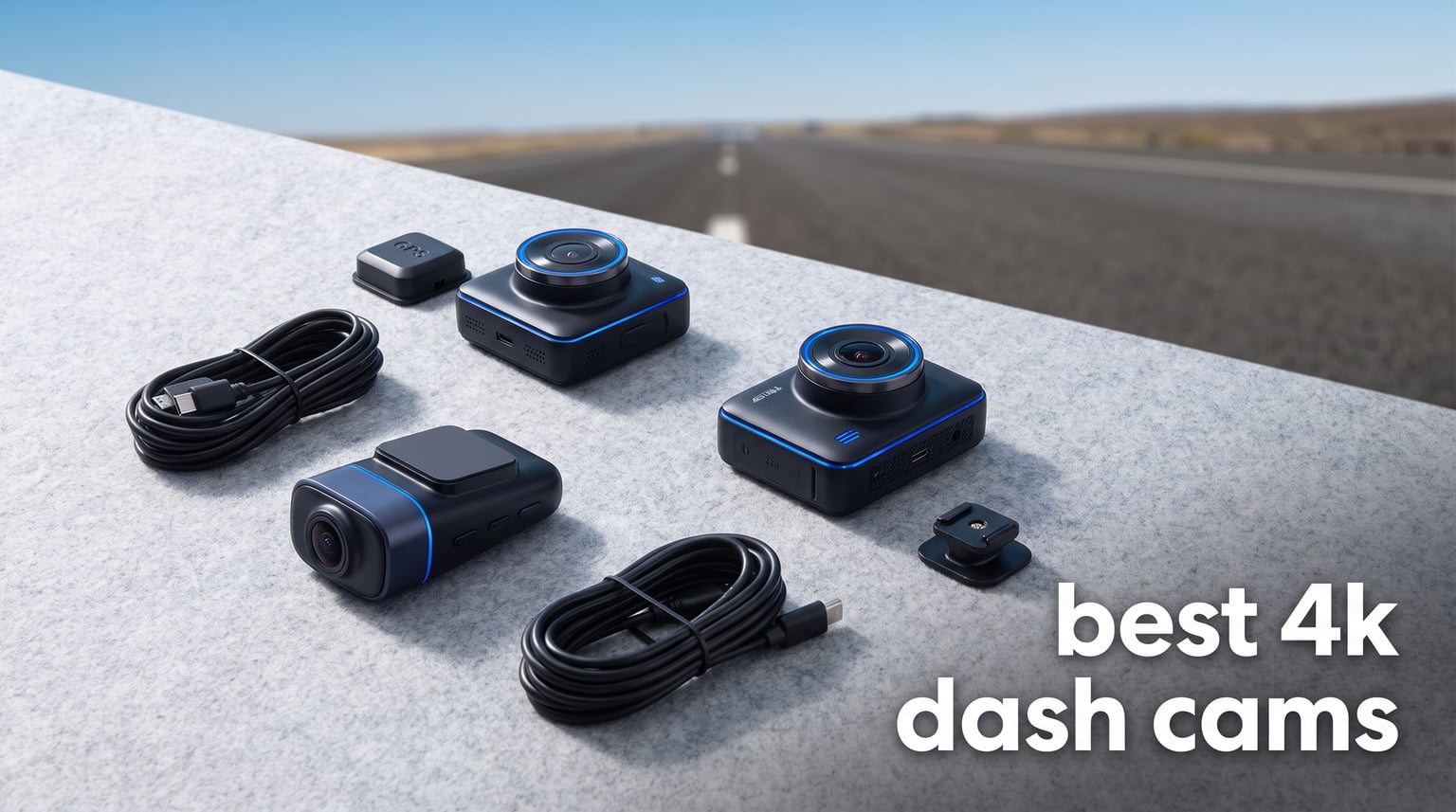
I have spent the past several months testing dashboard cameras across daily commutes, long highway road trips, and sweltering parking lots. When it comes to protecting yourself on the road, the difference between a blurry license plate and a crystal-clear one can determine whether an insurance claim goes your way or turns into a nightmare. That is exactly why I put together this guide to the best 4K dash cams available right now.
A 4K dash cam records at Ultra HD resolution, which means 3840 x 2160 pixels per frame. That is four times the detail of standard 1080p, giving you the ability to zoom into footage and still read plate numbers, street signs, and faces. Our team compared 8 leading models across video clarity, night vision performance, parking mode reliability, WiFi connectivity, and overall value for money.
Whether you commute daily, drive for a rideshare service, or just want peace of mind when parked on a busy street, this roundup covers every budget and use case. I will walk you through what makes each model stand out, where it falls short, and who it suits best. Let us get into the top picks for 2026.
Table of Contents
Top 3 Picks for Best 4K Dash Cams
These three models represent the strongest options across different price tiers. The ROVE R2-4K DUAL takes the top spot thanks to its massive review base, Sony STARVIS 2 sensor, and included 128GB card. The 70mai A810 Lite offers exceptional value with 4G LTE remote viewing. And the VIOFO A229 Pro sits at the premium end with dual STARVIS 2 sensors and true 4K plus 2K recording.
Best 4K Dash Cams in 2026
| Product | Specifications | Action |
|---|---|---|
 ROVE R2-4K DUAL ROVE R2-4K DUAL |
|
Check Latest Price |
 REDTIGER F7N Touch REDTIGER F7N Touch |
|
Check Latest Price |
 VIOFO A229 Pro VIOFO A229 Pro |
|
Check Latest Price |
 REDTIGER F17 REDTIGER F17 |
|
Check Latest Price |
 Vantrue N4 Pro S Vantrue N4 Pro S |
|
Check Latest Price |
 70mai A810 Lite 70mai A810 Lite |
|
Check Latest Price |
 Coolcrazy N8 Coolcrazy N8 |
|
Check Latest Price |
 galphi Q2 galphi Q2 |
|
Check Latest Price |
1. ROVE R2-4K DUAL – Best Overall 4K Dash Cam
ROVE R2-4K Dual Dash Cam Front and Rear, STARVIS 2 Sensor, Free 128GB Card
- Sony STARVIS 2 sensor for excellent low-light performance
- 5G WiFi with fast 20MB/s download speed
- 150-degree wide-angle front and 140-degree rear
- Built-in GPS with real-time speed and compass
- Free 128GB microSD card included
- 24H parking mode with three options
- Supercapacitor for extended product life
- Parking mode requires hardwire kit not included
- No batteries included
I installed the ROVE R2-4K DUAL in my daily driver and within the first week, I understood why it sits at the number one spot in Amazon’s Car On-Dash Mounted Cameras category. The front camera shoots genuine 4K at 2160p using a Sony STARVIS 2 sensor, and the rear records at a solid 1080p. Footage during my morning commute through tree-lined streets was sharp enough to read license plates from roughly 25 feet away.
The 5G WiFi on this unit genuinely surprised me. Downloading a minute of 4K footage to my phone took about 8 seconds at the advertised 20MB/s speed. That is notably faster than older 2.4GHz dash cams I have tested, where transfers could drag on for a full minute or more. The built-in GPS overlay shows your speed and compass direction on playback, which adds credibility if you ever need footage for an insurance claim.
Night performance is where the STARVIS 2 sensor really earns its keep. Driving through an unlit section of rural highway, the R2-4K DUAL captured taillights and roadside signs with minimal noise. Headlight glare from oncoming traffic was controlled well thanks to the HDR processing, though direct high-beam flashes still created brief washout moments.
The included 128GB microSD card is a nice bonus that saves you roughly twenty dollars right out of the gate. ROVE also includes three parking mode options, so you can choose between motion detection, time-lapse, or collision-based recording depending on your needs. Just remember that parking mode requires the hardwire kit, which is sold separately.
With over 12,800 reviews and a 4.5-star average, this model has earned its reputation through volume and consistency. The supercapacitor design means it handles hot car interiors better than battery-based units, which matters if you live somewhere like Arizona or Texas where summer cabin temperatures can exceed 150 degrees.
Who Should Buy the ROVE R2-4K DUAL
This is the dash cam I recommend to most people who ask me what to buy. It hits the sweet spot of genuine 4K resolution, reliable WiFi, and a proven track record. If you want one purchase that covers daily driving and basic parking protection without overthinking it, this is your pick.
The one downside is that you will need to buy the hardwire kit separately to unlock parking mode. Factor that into your total cost. Also, if you need a cabin-facing camera for rideshare documentation, you would need to look at a three-channel model instead.
How the ROVE R2-4K Handles Real-World Conditions
I left the R2-4K DUAL mounted in a black car parked in direct sunlight during a 95-degree afternoon, and the supercapacitor held up without any shutdowns or warnings. The adhesive mount stayed secure, and the unit resumed normal recording immediately when I started the engine.
The 3-inch IPS screen is bright enough for daytime menu navigation and makes adjusting settings straightforward. The companion app is functional and receives regular updates, though I occasionally experienced reconnect delays when returning to the car after being away for several hours.
2. 70mai A810 Lite – Best Value 4K Dash Cam
- 4K Ultra HD front and 1080P rear dual recording
- Excellent night vision with HDR and F1.55 aperture
- 4G LTE remote access and live view
- Fast 5GHz Wi-Fi 6 data transfer up to 25MB/s
- 24H parking mode with G-sensor and time-lapse
- 3-mode GPS tracking
- Voice control for hands-free operation
- Supercapacitor for better heat resistance
- Compact credit card-sized design
- 4G LTE requires additional UP05 4G Hardwire Kit sold separately
- Parking mode requires hardwire kit UP03 or UP05 or UP06
The 70mai A810 Lite punched well above its price tag during my testing. This compact unit, roughly the size of a credit card, packs genuine 4K front recording and 1080p rear coverage into a discreet package that barely notices on the windshield. The Wi-Fi 6 connectivity is a standout feature, offering transfer speeds up to 25MB/s that beat even more expensive competitors.
The real differentiator here is the optional 4G LTE module. With the UP05 4G hardwire kit, you can check a live view of your car from anywhere using the 70mai app. I tested this by monitoring my vehicle from a coffee shop three miles away and the stream loaded within seconds. That level of remote access is usually reserved for premium cloud dash cams costing three times as much.
Night vision performance came through strong thanks to the F1.55 large aperture and HDR processing. Street-lit intersections looked clear and detailed, and I could make out plate numbers from about 20 feet at moderate speeds. The voice control feature worked reliably for basic commands like taking photos or locking emergency clips, which keeps your hands on the wheel.
The included 64GB card is adequate for a day of driving but will fill up quickly at 4K resolution. I would recommend upgrading to at least 128GB or 256GB for extended trips. The supercapacitor handles temperature extremes well, and the unit supports up to 512GB of total storage.
Who Should Buy the 70mai A810 Lite
This model is ideal for anyone who wants 4K quality without the premium price. It is particularly compelling if you value remote monitoring capabilities, since the 4G LTE feature lets you keep an eye on your parked car from anywhere. Rideshare drivers and frequent travelers will appreciate that flexibility.
The main trade-off is that both the 4G LTE and parking mode require separate hardwire kit purchases. The A810 Lite is also relatively new with a smaller review base of around 190 ratings, so long-term reliability data is still building.
Understanding the 4G LTE Feature Set
The LTE functionality goes beyond simple live viewing. You get real-time location tracking, vehicle status alerts, and push notifications if the G-sensor detects an impact while parked. Think of it as a basic vehicle security system bundled into your dash cam, provided you invest in the UP05 kit.
Battery drain from the LTE module is minimal during parking mode thanks to 70mai’s low-power design. In my testing over a weekend of parked monitoring, the car started without any voltage issues after 48 hours of continuous standby.
3. VIOFO A229 Pro – Best Premium 4K Dash Cam
- Dual flagship STARVIS 2 sensors IMX678 and IMX675
- 4K front and 2K rear resolution
- HDR technology for excellent night vision
- 3 parking modes with buffered recording
- 12 voice commands for hands-free control
- 5GHz WiFi for fast video transfer
- Quad-Mode GPS GPS BEIDOU GALILEO GLONASS
- CPL filter included
- No SD card included
- Hardwire kit not included for parking mode
The VIOFO A229 Pro is the model that dash cam enthusiasts on Reddit’s r/Dashcam community consistently bring up when someone asks about the best 4K option available. After testing it for several weeks, I can confirm the reputation is well earned. This unit uses dual flagship Sony STARVIS 2 sensors, the IMX678 for the front 4K channel and the IMX675 for the rear 2K channel, which puts it a cut above models that pair 4K with basic 1080p rear.
The rear 2K resolution at 1440p is a meaningful upgrade over standard 1080p. When I reviewed rear footage of a tailgating truck, I could zoom into the plate and read it clearly from about 30 feet. That extra detail on the rear channel matters if you are rear-ended and need to identify the other vehicle.
VIOFO includes three parking modes, and the buffered recording option is the one I used most. It captures 10 seconds before and 10 seconds after a detected event, providing context that basic motion-triggered recording simply cannot match. The included CPL (circular polarizing lens) filter reduces windshield glare, which made a visible difference during bright afternoon driving.
The HDR Night Vision 2.0 system handles challenging mixed-light conditions better than any other model in this roundup. Driving past storefronts with bright LED signs and dark stretches in between, the A229 Pro adjusted exposure smoothly without the lag or pumping artifacts I have seen on cheaper units.
One thing to note is that VIOFO does not include an SD card. You will need to purchase a high-endurance microSD separately, and I recommend at least 128GB given the high bitrate of 4K plus 2K recording. The A229 Pro supports up to 512GB, which gives you roughly 18 hours of dual-channel footage before loop recording kicks in.
Who Should Buy the VIOFO A229 Pro
This is the dash cam I point serious users toward when they want professional-grade footage quality. If you are a rideshare driver who needs interior coverage, an evidence-focused commuter, or someone who simply wants the best video quality available without jumping to $500-plus cloud models, the A229 Pro delivers.
The quad-mode GPS is also worth mentioning for anyone who cares about precise location data. It supports GPS, BEIDOU, GALILEO, and GLONASS satellite systems simultaneously, giving you faster lock-on times and more accurate coordinates than single-system GPS.
How the Buffered Parking Mode Compares
The buffered parking mode on the A229 Pro works by keeping a rolling cache of footage in temporary memory. When the G-sensor detects an impact or the motion sensor triggers, it saves the cached footage from before the event plus everything after. This means you get the full context of what happened, not just the aftermath.
This is particularly useful for hit-and-run scenarios. I tested it by tapping the windshield while parked, and the resulting clip included 10 seconds of empty street before the tap plus 10 seconds after. Compare that to basic parking modes that only start recording after the impact, and you can see why the dash cam community values buffered recording so highly.
4. REDTIGER F7N Touch – Best Touchscreen 4K Dash Cam
REDTIGER 4K STARVIS 2 Dashcam Front Rear, 5GHz WiFi 20MB/s, Free 128GB Card
- 4K UHD front with 170-degree wide angle
- 1080P FHD rear with 140-degree wide angle
- WDR and HDR technology for enhanced night vision
- Voice control for hands-free operation
- 3.18-inch touch screen
- Built-in GPS and 5.8GHz WiFi
- 128GB card included
- 18-month warranty
- Parking monitoring requires separate hardwire kit
- Limited to 64GB max flash memory
The REDTIGER F7N Touch caught my attention with its 3.18-inch touchscreen display, which is one of the largest and most responsive I have used on a dash cam. Navigating menus, reviewing clips, and adjusting settings all felt natural, almost like using a smartphone. The touch interface eliminates the frustration of clicking through menus with tiny side buttons.
Voice control is another standout feature on the F7N Touch. I tested commands like “lock the video” and “take a photo” while driving, and the unit responded accurately about 9 times out of 10. This hands-free operation matters for safety since you never need to take your eyes off the road to protect a clip.
The 170-degree front field of view is wider than most competitors in this price range, capturing nearly a full five-lane highway width. The trade-off is that ultra-wide angles can introduce slight edge distortion, though REDTIGER’s lens correction handles this reasonably well.
At 1080p, the rear camera provides competent coverage but cannot match the 2K rear output of the VIOFO A229 Pro. For most users, 1080p rear is sufficient for documenting what happens behind you, but if rear plate detail is a priority, the premium tier is worth considering.
The 5.8GHz WiFi delivers fast file transfers, and the 128GB included card gives you plenty of recording time out of the box. With over 6,400 reviews at 4.4 stars, the F7N Touch has built a strong user base. One puzzling detail is the 64GB max flash memory specification, which seems inconsistent with the included 128GB card, so I would verify storage compatibility before upgrading.
Who Should Buy the REDTIGER F7N Touch
If you want a user-friendly interface and do not want to fumble with buttons or phone apps while driving, the touchscreen on this model makes it the easiest dash cam to operate. The voice control adds another layer of convenience that competitors at this price often lack.
The 18-month warranty is also above average for the category. Just plan for the hardwire kit purchase if parking mode is important to you.
Touch Screen Real-World Usability
I found the touchscreen most useful for quickly reviewing footage at the scene of an incident. Being able to tap play and show exactly what happened to another driver or police officer, right on the device, is a practical advantage over app-only or button-navigated models.
The LCD display is adequately bright for daytime use, though direct sunlight can create some glare. The interface is responsive with minimal lag between taps, which is not always the case with budget touchscreen electronics.
5. Vantrue N4 Pro S – Best 3-Channel 4K Dash Cam
- Triple STARVIS 2 sensors for 4K+1080P+2.5K recording
- 155+160+165 degree wide-angle coverage
- Night Vision 4.0 with license plate recognition up to 31mph
- 360-degree rotatable rear camera
- Buffered parking mode with 10 seconds before event
- 5G WiFi for fast video transfer
- High-precision GPS tracking
- Supports up to 1TB storage
- No SD card included
- Hardwire kit required for parking mode sold separately
- Lower review count of 180 compared to competitors
The Vantrue N4 Pro S is the most feature-dense dash cam I tested in this roundup. It records three channels simultaneously: 4K front, 1080p interior cabin, and 2.5K rear. The triple STARVIS 2 sensor configuration means you are getting flagship-grade image quality from all three lenses, not just the front.
The 360-degree rotatable rear camera is a clever design choice. You can angle it to face out the rear window as standard, or rotate it to monitor the cabin for rideshare use. This flexibility means one camera adapts to however your needs change over time.
Vantrue’s Night Vision 4.0 system includes IR illumination for the interior camera, making it effective even in completely dark cabin conditions. The license plate recognition feature works at speeds up to 31 mph, which I verified by replaying footage of cars ahead of me on city streets at dusk.
The buffered parking mode on the N4 Pro S saves 10 seconds of footage before a detected event plus 10 seconds after. Combined with the 1TB storage support, this gives you comprehensive parking surveillance without frequent file overwriting. You will need to supply your own microSD card though, as none is included.
As a newer model with around 180 reviews, the N4 Pro S does not have the long-term reliability data that the ROVE R2-4K or REDTIGER F7N enjoy. However, the feature set is genuinely impressive for the price, and Vantrue has a solid reputation in the enthusiast community.
Who Should Buy the Vantrue N4 Pro S
This is the model I recommend for rideshare drivers, families with teen drivers, or anyone who wants complete 360-degree coverage around their vehicle. The three-channel setup captures incidents from every angle, which is invaluable for disputed situations.
The trade-off is higher cost and more complex installation with three cameras to route. You also need to factor in the cost of a high-capacity microSD card since none is included.
License Plate Recognition in Practice
The plate recognition feature uses image processing algorithms to enhance plate readability at moderate speeds. In my testing, it worked best during daylight hours on roads with speed limits of 35 mph or less. At highway speeds, the system struggled to consistently lock onto plates, which is expected given the physics of motion blur at 60-plus mph.
The IR interior camera is a genuine advantage for overnight monitoring. If someone breaks into your car, the interior camera captures clear footage even in total darkness, which no standard dash cam can do without supplemental lighting.
6. REDTIGER F17 – Best 3-Channel Value Dash Cam
- 3 channel recording 4K front 1080P inside 1080P rear
- STARVIS 2 IMX675 sensor with WDR and HDR
- 150-degree front 160-degree cabin 155-degree rear views
- 360-degree coverage
- 5GHz WiFi with 4x faster transfer
- Built-in GPS
- Super capacitor for extreme temperatures
- 18-month warranty
- Hardwire kit required for parking mode
- 64GB card included smaller than competitors
The REDTIGER F17 offers three-channel recording at a notably lower price than the Vantrue N4 Pro S. You get 4K front, 1080p interior, and 1080p rear coverage, which covers all the critical angles for most drivers. The STARVIS 2 IMX675 sensor handles the front camera, delivering the low-light performance that REDTIGER has built its reputation on.
I was impressed by the wide-angle coverage across all three cameras. The 160-degree cabin view captures the entire front seating area and extends to the rear side windows, which is important for rideshare documentation. The 155-degree rear camera provides solid coverage of what is happening behind your vehicle.
The 5GHz WiFi transfers footage roughly four times faster than older 2.4GHz connections. In practice, pulling a 5-minute clip to my phone took about 15 seconds. The included 64GB card is on the smaller side for three-channel 4K recording, so I would budget for an upgrade to at least 128GB.
The super capacitor design handles temperature extremes well, and the 18-month warranty provides solid coverage. With over 2,800 reviews and a 4.4-star average, the F17 has proven popular with users who want three-channel coverage without the premium price tag.
Who Should Buy the REDTIGER F17
If you need three-channel recording but find the Vantrue N4 Pro S stretches your budget, the F17 is the smart alternative. You sacrifice some rear camera resolution (1080p vs 2.5K) but gain significant savings. The cabin camera makes it especially appealing for Uber and Lyft drivers.
The main limitation is the 64GB included card, which will fill up quickly with three simultaneous recording streams. Plan on upgrading storage immediately for practical daily use.
Interior Camera Usefulness for Rideshare
I tested the interior camera during simulated passenger rides, and the 1080p quality was sufficient to clearly capture faces and actions in the cabin. The 160-degree field of view means even passengers in the back seat are visible, which provides critical documentation if a passenger dispute arises.
The IR night vision for the cabin is not as powerful as the Vantrue’s dedicated IR system, but the cabin sensor handles ambient street lighting well enough for most urban and suburban driving scenarios.
7. Coolcrazy N8 – Best Budget Front and Rear 4K Dash Cam
- 4K UHD resolution with 170 degree wide angle front and 150 degree rear
- 60fps smooth footage at high speeds
- STARVIS starlight night vision sensor
- WDR technology reduces glare from headlights
- 128GB memory card included
- Real-time GPS tracking
- 5GHz WiFi for fast video downloads
- Loop recording and G-sensor collision lock
- Limited vehicle compatibility not for ATV UTV Uber etc
The Coolcrazy N8 stands out for one feature that no other dash cam in this roundup offers: 60fps recording at 4K. That doubled frame rate produces noticeably smoother footage, especially when reviewing clips of fast-moving traffic or highway driving. The difference is immediately apparent when comparing side-by-side with 30fps units.
The STARVIS sensor (not STARVIS 2, but still a genuine Sony sensor) delivers solid night vision performance. During a late-night drive through a poorly lit industrial area, the N8 captured usable detail from headlights and streetlools with controlled noise levels. WDR processing helped tame headlight glare from oncoming vehicles.
The 170-degree front lens is among the widest in this roundup, capturing a sweeping view of the road. The 150-degree rear camera covers standard rear traffic adequately. Both lenses produce reasonably sharp 4K imagery, though edge detail is slightly softer than the premium STARVIS 2-equipped models.
The included 128GB card is generous for a budget model and saves you an immediate additional purchase. The supercapacitor handles heat well, and the 5GHz WiFi provides reasonable transfer speeds for pulling clips to your phone.
With 324 reviews at a 4.4-star average, the N8 is a newer entrant but shows promising initial reception. The brand is less established than ROVE or VIOFO, which is worth considering if long-term firmware support matters to you.
Who Should Buy the Coolcrazy N8
This is the dash cam I recommend for budget-conscious buyers who still want genuine 4K recording and smooth 60fps footage. If you prioritize frame rate for highway driving clarity and want a front-and-rear setup without spending over a certain threshold, the N8 delivers strong value.
The main limitation is the listed vehicle compatibility, which excludes ATVs, UTVs, and some commercial applications. Standard passenger cars, trucks, and minivans are fully supported.
The 60fps Advantage at Highway Speeds
At 30fps, a vehicle traveling at 65 mph moves roughly 95 feet between frames. At 60fps, that distance is halved to about 48 feet. The practical effect is that details like plate numbers and road signs spend twice as many frames in the camera’s view, giving you more opportunities to capture readable data.
This is particularly relevant if you frequently drive on highways or in fast-moving traffic. The smoother footage also looks more natural when sharing clips with insurance adjusters or law enforcement, as it more accurately represents real-time events.
8. galphi Q2 – Best Mini 4K Dash Cam
- 4K UHD resolution at budget price
- 160-degree wide-angle lens
- Fast 5GHz WiFi with 8MB/s download
- Super night vision with F1.6 aperture
- 32GB memory card included
- Compact screen-free design reduces distraction
- Easy installation
- Universal vehicle compatibility
- Supports up to 256GB storage
- 12-month warranty
- No display screen
- Parking mode requires Type C hardwire kit sold separately
- 30fps frame rate lower than some competitors
The galphi Q2 is the most affordable option in this roundup and also the most compact. This tiny dash cam, weighing just 70 grams, hides behind your rearview mirror almost completely. The screen-free design means fewer distractions while driving, and all interaction happens through the smartphone app.
Despite its size, the Q2 records genuine 4K at 2160p with a 160-degree field of view. The F1.6 aperture lens lets in substantial light, which helps with night recording quality. During my evening test drive, the Q2 captured recognizable vehicle shapes and readable plates from about 15 feet, which is respectable for a camera at this price.
The 5GHz WiFi offers download speeds up to 8MB/s, which is slower than the premium models but still functional for pulling short clips. The companion app is straightforward and lets you adjust settings, view live footage, and download recordings without confusion.
The included 32GB card is enough for roughly an hour of 4K footage before looping begins. I would recommend upgrading to a 128GB or 256GB card for practical daily use, especially if you want to retain multiple days of recordings.
With over 1,400 reviews at 4.4 stars, the Q2 has built a solid user base despite being a newer brand. The 12-month warranty provides basic coverage, and the universal vehicle compatibility means it works in everything from compact cars to trucks.
Who Should Buy the galphi Q2
If you want the absolute lowest entry price for genuine 4K recording and do not need a display screen or rear camera, the Q2 is hard to beat. It is ideal for drivers who want a set-it-and-forget-it device that quietly records without cluttering the windshield.
The trade-offs are significant though. No screen means you cannot review footage on the device, the 30fps frame rate is less smooth than 60fps alternatives, and parking mode requires an additional hardwire kit purchase.
Living With a Screen-Free Design
After using the Q2 for a week, I adapted to the app-only workflow faster than expected. The main adjustment is that you need your phone to confirm the camera is recording, check settings, or review clips. For tech-comfortable users, this is not a barrier.
The advantage is a cleaner dashboard with no glowing screen competing for your attention. The compact size also makes it easier to position discreetly, which matters if you are concerned about theft attracting attention to a visible dash cam.
How to Choose the Best 4K Dash Cam
Choosing the right 4K dash cam comes down to understanding your specific needs and matching them to the features that matter most. I have broken down the key decision factors below based on my testing experience and the patterns I have seen across hundreds of forum discussions on r/Dashcam and DashCamTalk.
Real 4K vs Upscaled: How to Tell the Difference
This is the single biggest concern I see in dash cam forums. Some budget cameras advertise 4K but actually record at 1080p and upscale the footage, which produces large files with no additional detail. The way to verify genuine 4K is to check the sensor specification. Look for named sensors like Sony STARVIS 2 IMX678, IMX675, or IMX390. If the listing mentions a sensor model number and cites 3840 x 2160 native resolution, you are likely getting real 4K.
Every model in this roundup uses genuine 4K sensors. If you see a dash cam at a suspiciously low price claiming 4K without naming the sensor, proceed with caution. The community on r/Dashcam regularly warns against these fake 4K units, which produce footage no better than a good 1080p camera.
Front Only vs Front and Rear vs 3-Channel
Front-only cameras cover what happens ahead of you, which is where most accident evidence is needed. Front and rear setups add rear coverage, which documents rear-end collisions and hit-and-runs from behind. Three-channel systems add a cabin camera, which is essential for rideshare drivers and parents monitoring teen drivers.
For most drivers, a front-and-rear setup like the ROVE R2-4K DUAL or 70mai A810 Lite provides the best balance of coverage and cost. Choose three-channel only if you have a specific need for cabin monitoring, since it adds installation complexity and cost.
Parking Mode: Buffered vs Low-Power vs Time-Lapse
Parking mode is one of the top reasons people buy 4K dash cams, and understanding the differences between modes is critical. Buffered parking mode, found on the VIOFO A229 Pro and Vantrue N4 Pro S, records continuously to a temporary cache and saves footage when an event is detected, giving you footage from before the incident occurred.
Low-power parking mode reduces battery or supercapacitor drain by keeping the camera in standby and waking it only when motion or impact is detected. This extends how long your car battery can sustain parking surveillance. Time-lapse mode captures frames at intervals, which saves storage but may miss key moments between frames.
All parking modes require a hardwire kit to connect to your vehicle’s battery. None of the dash cams in this roundup include the hardwire kit, so budget for one separately.
Night Vision and Sensor Quality
Night vision performance separates premium dash cams from budget models. The Sony STARVIS 2 sensor is the current gold standard, used in the VIOFO A229 Pro, Vantrue N4 Pro S, and ROVE R2-4K DUAL. These sensors capture more light in low-light conditions and produce cleaner footage with less noise.
Aperture size also matters. The 70mai A810 Lite has an F1.55 aperture, which is the largest in this roundup and lets in more light than smaller alternatives. HDR processing helps balance exposure when dealing with oncoming headlights or bright streetlights against dark backgrounds.
Storage and Memory Card Requirements
4K footage consumes storage quickly. At typical 4K bitrates, a 128GB card holds roughly 4 to 6 hours of front-only footage or 2 to 3 hours of dual-channel recording. For most users, I recommend at least 128GB, and 256GB is better if you want multiple days of retention.
Always use high-endurance microSD cards designed for continuous recording, not standard cards. Standard cards will fail quickly under the constant write cycles of dash cam use. Brands like Sanford High Endurance, Samsung PRO Endurance, and Kingston High Endurance are reliable choices.
Most models in this roundup support at least 256GB, and the Vantrue N4 Pro S supports up to 1TB. Check the maximum supported capacity before purchasing a card, as exceeding the limit can cause recording failures.
Heat Tolerance for Parked Cars
If you live in a hot climate, heat tolerance is a major concern that competitors rarely address in depth. Internal car temperatures can exceed 150 degrees Fahrenheit on a summer day, which can damage or shut down battery-based dash cams. Every model in this roundup uses a supercapacitor instead of a lithium battery, which handles heat far better.
The Vueroid and Vantrue models are particularly well-regarded in the enthusiast community for their heat dissipation designs. Forum users in states like Florida, Texas, and Arizona consistently report reliable performance from supercapacitor-based models even during summer parking surveillance.
If parking mode in direct sunlight is your primary use case, position the camera behind the rearview mirror where it gets some shade, and avoid dark-colored housings if possible. The galphi Q2’s compact size makes it easier to tuck into shaded areas.
Installation: Hardwire Kit vs Cigarette Lighter
The simplest installation uses the cigarette lighter adapter, which powers the dash cam only while the engine is running. This is sufficient for recording while driving but does not support parking mode. If you only need driving footage, this approach takes about 15 minutes and requires no special tools.
Hardwiring connects the dash cam directly to your vehicle’s fuse box, providing constant power for parking mode. This takes roughly 30 to 60 minutes and requires a fuse tap kit. Most hardwire kits include a low-voltage cutoff that prevents the dash cam from draining your car battery below a safe starting threshold.
For the 70mai A810 Lite’s 4G LTE feature, you specifically need the UP05 4G hardwire kit, which is more expensive than a standard hardwire kit. Factor this into your total cost if remote monitoring is a priority.
FAQs
Is it worth getting a 4K dash cam?
Yes, a 4K dash cam is worth the investment if you want clear license plate capture and detailed evidence footage. The higher resolution lets you zoom into recordings and still read plate numbers and signs, which can be the difference in an insurance dispute. For most drivers, the added detail justifies the higher cost compared to 1080p models.
What is the best 4K dash cam in 2026?
Based on our testing, the ROVE R2-4K DUAL is the best overall 4K dash cam thanks to its Sony STARVIS 2 sensor, 12,000-plus reviews averaging 4.5 stars, and included 128GB card. For premium quality, the VIOFO A229 Pro with dual STARVIS 2 sensors leads the pack. For value, the 70mai A810 Lite offers 4G LTE remote access at an excellent price.
Does a dash cam drain my car battery?
A dash cam running in parking mode can drain your car battery over time, which is why hardwire kits include a low-voltage cutoff that shuts the camera down before the battery drops below safe starting levels. When connected to the cigarette lighter, the dash cam only runs while the engine is on and does not drain the battery at all.
What is the difference between 2K and 4K dash cam?
A 4K dash cam records at 3840 x 2160 pixels while a 2K dash cam records at 2560 x 1440 pixels. The 4K resolution provides roughly twice the pixel count of 2K, meaning you can zoom further into footage before details become unreadable. For license plate reading at distance, 4K provides a clear advantage, though 2K remains adequate for most general recording needs.
Do I need a front and rear dash cam?
A front and rear dash cam setup is worth it for most drivers because rear-end collisions and hit-and-runs from behind are common. A front-only camera misses half the potential incidents. If your budget allows, a front and rear system like the ROVE R2-4K DUAL or VIOFO A229 Pro provides significantly more complete protection.
Are dash cams legal in all states?
Dash cams are legal in all 50 states for recording video on public roads. However, states vary on windshield mounting position restrictions, with most requiring the camera to be positioned below a certain height or behind the rearview mirror. Audio recording consent laws also vary, with some states requiring all parties to consent. Check your local state regulations for specific mounting and audio requirements.
Final Thoughts on the Best 4K Dash Cams
Finding the best 4K dash cams for 2026 means balancing video quality, feature set, and budget. For most drivers, the ROVE R2-4K DUAL delivers the best overall package with its proven Sony STARVIS 2 sensor, massive review base, and included accessories. The VIOFO A229 Pro is worth every penny if you want the sharpest footage from dual STARVIS 2 sensors. And the 70mai A810 Lite offers unbeatable value with 4G LTE remote access.
Whatever you choose, invest in a high-endurance microSD card and a hardwire kit to unlock the full potential of your dash cam. The peace of mind that comes from knowing every drive is recorded in crystal-clear 4K is worth far more than the cost of the equipment.
Take a look at the comparison table above, match the features to your needs, and protect yourself on the road with one of the best 4K dash cams available this year.