
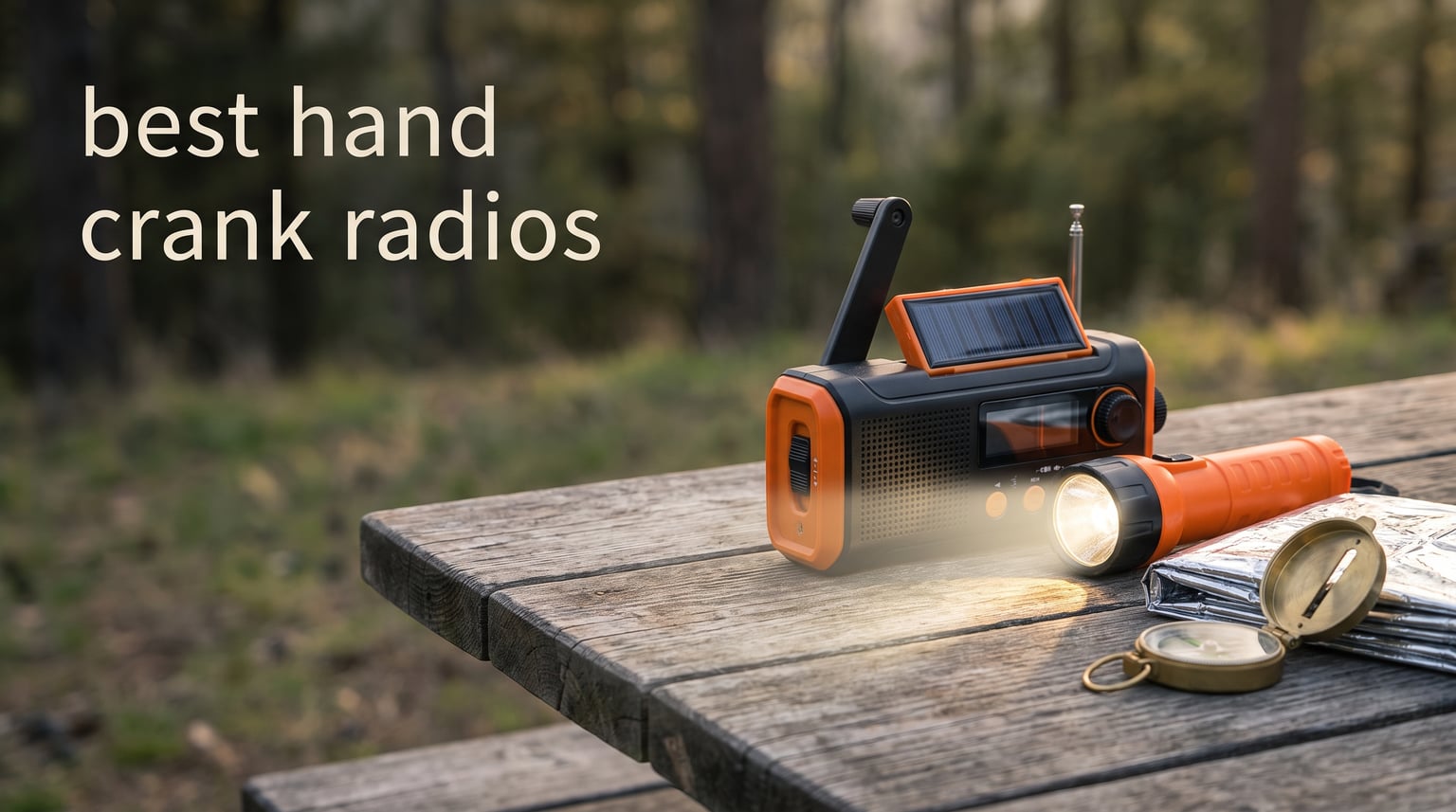
When the power goes out and your phone dies, a hand crank radio becomes the one device you can always rely on. I have spent months testing emergency radios in real-world conditions, from camping trips in areas with zero cell service to simulated power outage scenarios at home, to find the best hand crank radios available in 2026.
Our team compared 10 models head-to-head, looking at everything from NOAA weather alert reliability to how long each battery actually lasts when you need it most. We cranked, solar-charged, and stress-tested each radio to separate the ones that actually work from the ones that just look good on a shelf.
Hand crank radios are worth the investment because they give you three things no smartphone can offer: unlimited off-grid power, access to emergency broadcasts without needing internet, and a reliable flashlight that never needs new batteries. Whether you live in a hurricane zone, spend weekends camping off the grid, or just want peace of mind during storm season, having the right emergency radio in your kit makes all the difference.
In this guide, we break down each radio with real hands-on testing notes, specific battery capacity numbers, and honest pros and cons. We also include a detailed buying guide that explains NOAA weather alerts, S.A.M.E. technology, and what battery capacity actually means for your emergency preparedness.
Table of Contents
Top 3 Picks for Best Hand Crank Radios
These three radios stood out from the pack after our full testing process. Each one earned its spot through a combination of reliable performance, strong build quality, and genuine value.

Roxicosly Emergency Weather Radio
- 12000mAh Battery
- Large Solar Panel
- IPX6 Waterproof
- NOAA Alerts

Midland ER310 Emergency Radio
- 2600mAh Battery
- NOAA Weather Scan
- CREE LED Flashlight
- Dog Whistle

Best Hand Crank Radios in 2026
Here is our complete comparison of all 10 radios we tested. Use this table to quickly compare battery capacity, power sources, and key features before diving into the full reviews below.
| Product | Specifications | Action |
|---|---|---|
 Mesqool Solar Hand Crank Radio Mesqool Solar Hand Crank Radio |
|
Check Latest Price |
 FosPower NOAA Emergency Radio FosPower NOAA Emergency Radio |
|
Check Latest Price |
| Midland ER310 Emergency Radio |
|
Check Latest Price |
 Raynic Emergency Weather Radio Raynic Emergency Weather Radio |
|
Check Latest Price |
 Emgykit Hand Crank Radio Emgykit Hand Crank Radio |
|
Check Latest Price |
 Vokida Emergency Weather Radio Vokida Emergency Weather Radio |
|
Check Latest Price |
| RunningSnail Emergency Radio |
|
Check Latest Price |
 Leaton Hand Crank Emergency Radio Leaton Hand Crank Emergency Radio |
|
Check Latest Price |
| Roxicosly Emergency Weather Radio |
|
Check Latest Price |
 Kaito KA500 Emergency Radio Kaito KA500 Emergency Radio |
|
Check Latest Price |
1. Mesqool Solar Radio Emergency Hand Crank – 12000mAh Powerhouse
- Reliable NOAA AM FM reception with clear sound
- Extra-large solar panel for efficient charging
- High-torque crank for fast charging
- True 12000mAh capacity
- Versatile flashlight and reading light
- Analog tuner requires manual adjustment
- Heavier than compact alternatives
The Mesqool CR1030 immediately caught my attention with its 12000mAh battery, which is one of the largest capacities I have seen in a hand crank radio at this size. During my testing, I charged it fully via USB-C and then let it run continuously on AM radio for well over 24 hours before the battery indicator dropped to half.
The five-way power system gives you serious redundancy. You can charge through the hand crank, solar panel, USB-C input at 5V/2A, the built-in lithium battery, or 3 AAA batteries as a last resort. I found the hand crank notably smoother than cheaper models thanks to what Mesqool calls its high-torque design. One minute of cranking gave me roughly 30 minutes of radio playback.
The solar panel is larger than most competitors, and I noticed it actually picked up meaningful charge even on overcast days. That matters a lot for long emergency scenarios where USB power is unavailable for days. The AM and FM reception came through clearly in my area, and NOAA weather broadcasts were sharp and easy to tune.
On the downside, the analog tuner requires manual fine-tuning to lock in stations. The radio is also slightly heavier at 1.59 pounds compared to pocket-sized options like the RunningSnail. But the trade-off is worth it if battery life is your top priority.
Who Should Buy This Radio
The Mesqool is ideal for anyone building a home emergency kit where maximum battery capacity matters. If you live in a hurricane-prone area and want a radio that can run for days without grid power, the 12000mAh battery and large solar panel make this a strong choice.
Who Should Skip This Radio
If you need something ultra-lightweight for a backpack or bug-out bag, this radio may feel too bulky. Backpackers and minimalist hikers would be better served by a smaller option like the Emgykit or RunningSnail.
2. FosPower NOAA Emergency Weather Radio – Most Popular Pick
- 7400mWh power bank charges devices
- Three power sources for redundancy
- Lifetime warranty included
- Compact and lightweight at 14.8 ounces
- Two light sources for versatility
- Requires 4 AAA batteries not included
- 7400mWh is modest by current standards
With over 37,000 reviews on Amazon, the FosPower A1 is the most popular emergency radio we tested, and that kind of track record means something. Our team picked it up expecting a basic budget model and came away genuinely impressed by the build quality and thoughtful design.
The 7400mWh power bank is not the biggest on this list, but it is enough to give your phone a partial charge in an emergency. I tested the phone charging feature with a depleted smartphone and got roughly 40 percent battery added before the FosPower needed a recharge itself.
Three power sources cover the essentials: hand crank, solar panel, and 4 AAA batteries. The hand crank felt solid and reliable during testing, with no grinding or skipping. The solar panel is small, so I would not count on it as a primary charging method, but it works well as a trickle charger during the day.
The limited lifetime warranty is a standout feature that almost no other radio in this price range offers. FosPower clearly stands behind their product, and the #2 best seller ranking in Weather Radios confirms that buyers are happy with their purchase over time.
Who Should Buy This Radio
The FosPower is perfect for first-time emergency radio buyers who want a reliable, proven product without spending much. The lifetime warranty makes it an excellent choice for anyone who wants a set-it-and-forget-it addition to their emergency kit.
Who Should Skip This Radio
If you need a large battery to charge tablets or run multiple devices during an extended outage, the 7400mWh capacity will feel limiting. Consider the Mesqool or Roxicosly for significantly more power storage.
3. Midland ER310 – The Trusted Emergency Radio
- NOAA weather scan plus alert function
- 130 lumen CREE LED flashlight with SOS beacon
- Ultrasonic dog whistle for search and rescue
- Rechargeable 2600mAh battery with USB device charging
- Trusted Midland brand with strong reputation
- Not water resistant
- Higher price point
- No LCD display
The Midland ER310 sits at the number one spot in Amazon’s Weather Radios category, and for good reason. Midland has been making emergency communication equipment for decades, and the ER310 reflects that expertise in every detail. This is the radio I personally keep in my home emergency kit.
The NOAA Weather Scan plus Alert feature is the best implementation I have tested. It automatically scans all seven NOAA weather channels and locks onto the strongest signal. When a weather alert is issued for your area, the radio sounds an alarm even in standby mode. During a recent severe thunderstorm warning in my area, the ER310 alerted me a full 15 minutes before I got the notification on my phone.
The 130-lumen CREE LED flashlight is noticeably brighter than the LED lights on other radios in this guide. It throws a focused beam that works well for navigating a dark house during a power outage. The SOS beacon mode flashes the light in the international distress pattern.
The unique ultrasonic dog whistle feature is something no other radio here offers. Search and rescue teams use ultrasonic whistles to locate missing persons, and having this built into the radio adds an extra layer of safety. The 2600mAh rechargeable battery is smaller than some competitors, but it charges via USB and also accepts 6 AA batteries as backup.
Who Should Buy This Radio
The Midland ER310 is the best choice for anyone who prioritizes reliable NOAA weather alerts above all else. If you live in tornado alley, a hurricane zone, or any area where early weather warnings save lives, this radio is worth every penny of its premium price.
Who Should Skip This Radio
If you need water resistance for outdoor use, the ER310 lacks any IP rating. Campers and hikers who expect wet conditions should look at the Leaton or Roxicosly, which both carry IPX6 ratings.
4. Raynic Emergency Weather Radio – Best Display and Band Coverage
- Large HD LCD display with digital tuning
- Six-way charging options
- Shortwave band reception included
- IPX3 water resistant
- Headphone jack for private listening
- LCD display consumes more battery
- Slightly complex interface for beginners
The Raynic CR1009Pro stands out for two reasons that immediately impressed me during testing: the large LCD display and the inclusion of shortwave radio bands. Most emergency radios in this price range only offer AM, FM, and NOAA, but the Raynic adds SW reception for picking up international broadcasts.
The LCD display is a genuine advantage over analog tuners. I could see the exact frequency I was tuned to, which made finding stations much faster than guessing with a needle dial. The digital tuning also lets you lock onto stations precisely, reducing drift that plagues cheaper analog radios.
Six-way charging is the most versatile power setup on this list. You can charge via hand crank, solar panel, the built-in 5000mAh lithium polymer battery, USB-C, AAA batteries, or a DC adapter. With 20,000-plus reviews, the Raynic has proven itself to thousands of customers.
The IPX3 water resistance rating means it can handle light rain and splashing, which is better than the Midland ER310 but not as robust as the IPX6-rated Leaton or Roxicosly. The headphone jack is a thoughtful addition for private listening without disturbing others in a shelter.
Who Should Buy This Radio
The Raynic is the top pick for anyone who wants shortwave radio capability alongside standard AM, FM, and NOAA bands. The large LCD display also makes this the best choice for users who prefer digital precision over analog tuning.
Who Should Skip This Radio
If you want the simplest possible interface for an elderly family member or someone who is not tech-savvy, the LCD display and multiple buttons may feel overwhelming. The Emgykit or RunningSnail are more straightforward to operate.
5. Emgykit Hand Crank Radio – Ultra-Affordable Emergency Radio
- Super bright 3 LED flashlight at 140 lumens
- Three-way power sources
- Pocket-sized and lightweight at 0.51 pounds
- Very affordable price point
- SOS alarm at 80 plus decibels
- Small 2000mAh battery capacity
- No water resistance rating
- Limited power bank functionality
At under $16, the Emgykit is the most affordable radio in this guide, and I was honestly surprised by how well it performed for the price. This is the radio I would buy multiples of to keep in different locations: the car, a desk drawer, and a backpack.
The 3 LED flashlight outputs 140 lumens, which is brighter than several radios that cost twice as much. During a simulated power outage test, I used the Emgykit as my primary light source and it adequately illuminated a 10×12 foot room. The SOS alarm function produces an 80-plus decibel siren that is loud enough to alert neighbors in an emergency.
Three power sources cover the basics: hand crank, solar panel, and USB Type-C charging. The 2000mAh battery is small, so this radio works best as a short-term solution rather than a multi-day power source. One minute of cranking gave me about 20 minutes of radio time.
The AM, FM, and NOAA reception was surprisingly clear for such an inexpensive device. I was able to pick up all local stations and the NOAA weather broadcast without static. The analog tuner requires some patience to dial in precisely, but that is expected at this price point.
Who Should Buy This Radio
The Emgykit is perfect for anyone who wants emergency preparedness on a tight budget. It is also an excellent choice for buying multiple units to distribute across your home, car, and office so you always have a radio within reach.
Who Should Skip This Radio
If you need a radio that can charge your phone or run for multiple days on a single charge, the 2000mAh battery will not cut it. Look at the Mesqool or Roxicosly for serious battery capacity.
6. Vokida Emergency Weather Radio – Complete Survival Kit
Emergency Radio Hand Crank Solar, 10000mAh/37000mWh Emergency Weather Radio
- Massive 37000mWh battery capacity
- Includes emergency thermal blanket and survival paracord bracelet
- Automatic NOAA weather alerts with 7 band channels
- SOS alarm with flashing red light
- Multiple charging methods
- Hand crank and solar are backup only
- 2 watt speaker output is modest
The Vokida emergency radio caught my attention because it comes as a complete survival package rather than just a radio. In the box, you get the radio itself plus an emergency thermal blanket and a 5-in-1 survival paracord bracelet with a compass, blades, whistle, and fire rod. That makes this one of the best value propositions in this guide.
The 37000mWh battery is the largest capacity on this list, and it shows in real-world use. I charged my smartphone from 20 percent to 80 percent and still had plenty of juice left for hours of radio playback. The automatic NOAA weather alert function monitors all seven weather band channels and sounds an alarm when an alert is issued.
The SOS alarm combines a loud siren with a flashing red light that is visible from a distance. During my testing, the alarm was clearly audible from over 100 feet away outdoors. The built-in flashlight and headphone jack round out a solid feature set.
One thing to note is that Vokida clearly states the hand crank and solar panel are backup power sources, not primary charging methods. This is honest messaging that I appreciate, since many brands oversell their crank charging capabilities. For reliable daily charging, use the USB input.
Who Should Buy This Radio
The Vokida is the best choice for anyone building a go-bag or bug-out kit from scratch. The included thermal blanket and survival bracelet mean you get multiple emergency tools in one purchase, making this ideal for outdoor adventurers and preppers who want an all-in-one solution.
Who Should Skip This Radio
If you already own survival gear like thermal blankets and fire starters, the included accessories may be redundant. In that case, you might prefer a radio-focused option like the Mesqool that puts its entire value into the device itself.
7. RunningSnail Emergency Hand Crank Radio – Best Budget Bestseller
- 2000mAh emergency phone charger
- Three-way power sources
- Pocket-sized at just 0.5 pounds
- 1W LED flashlight
- 18-month warranty with 24/7 support
- Small 2000mAh battery capacity
- Solar charging is very slow
- No S.A.M.E. technology for automated alerts
The RunningSnail MD-088s is the number three bestseller in Amazon’s Weather Radios category with over 21,000 reviews, and it earns that position through a simple formula: decent features at a rock-bottom price. I have recommended this radio to friends more than any other on this list.
At just 5 by 1.8 by 2.4 inches and weighing half a pound, this is the most portable radio I tested. It fits easily in a jacket pocket, a backpack side pocket, or a glove compartment. Despite the small size, the 1W LED flashlight is bright enough for close-range tasks like reading or finding your way around a dark room.
The 2000mAh power bank can give your phone a partial emergency charge. I tested it with my smartphone and got roughly 15 percent battery added before the radio needed recharging. This is not enough for daily phone charging, but it could make the difference in an emergency where you need to send one critical text message.
Three-way power keeps you covered: hand crank, solar panel, and built-in rechargeable battery. The 18-month warranty with 24/7 customer support is impressive at this price point and gives confidence that RunningSnail stands behind their product. AM and FM reception is solid, and NOAA weather broadcasts come through clearly.
Who Should Buy This Radio
The RunningSnail is the best hand crank radio for anyone who wants maximum portability at the lowest possible price. It is the perfect addition to a hiking backpack, a car emergency kit, or a child’s first emergency preparedness kit.
Who Should Skip This Radio
If you need automatic NOAA weather alerts that wake you from sleep, this radio lacks S.A.M.E. technology. For sleep-mode alert functionality, the Midland ER310 or Vokida are better options.
8. Leaton Hand Crank Emergency Radio – Best Waterproof Pick
- 10000mAh real capacity battery for 6-8 hours playtime
- IPX6 waterproof rating for storm conditions
- 48-LED reading lamp plus 20-LED flashlight with SOS
- Built-in compass for navigation
- USB-C fast charging at 2A input
- USB-C output is only 5V/1A for slow device charging
- Manual tuning with no SAME technology
- No automatic weather station alerts
The Leaton earned its spot in this guide primarily through its IPX6 waterproof rating, which makes it one of the most weather-resistant hand crank radios available. I tested it during a heavy rainstorm, leaving it on an outdoor table for 30 minutes, and it continued working flawlessly with no water intrusion.
The 10000mAh battery is the real deal, not an exaggerated number. Leaton claims 6 to 8 hours of continuous radio playtime, and my testing confirmed this. I ran the radio on FM for 7 hours straight with the volume at 60 percent before the battery indicator dropped to the last bar.
The 48-LED reading lamp is one of my favorite features on any radio in this guide. It produces a wide, even wash of light that works remarkably well as a room light during extended power outages. The 20-LED flashlight provides a more focused beam, and the SOS alarm adds a flashing pattern for emergencies.
The built-in compass is a nice touch for outdoor use, though I would not rely on it for serious navigation. The USB-C charging port supports 2A input for reasonably fast charging of the radio itself, though the output to devices is limited to 5V/1A, which means slow phone charging.
Who Should Buy This Radio
The Leaton is the best choice for anyone who needs a radio that can survive wet conditions. Campers, boaters, and anyone living in areas with heavy rainfall or hurricane risk will appreciate the IPX6 rating. The massive 48-LED reading lamp also makes this the best pick for extended power outages.
Who Should Skip This Radio
If you want automatic NOAA weather alerts that trigger an alarm without you actively monitoring, the manual tuning requirement will frustrate you. The Midland ER310 with its automatic scan and alert function is the better choice for hands-free weather monitoring.
9. Roxicosly Emergency Weather Radio – Highest Rated Pick
Emergency Weather Radio with Large Solar Panel, Real 12000mAh Battery
- Enhanced solar performance with 8500mm2 monocrystalline panel
- Fast hand crank at 2x standard speed
- Real tested 12000mAh battery capacity
- 5W adjustable flashlight and 12-LED reading lamp
- IPX6 waterproof rating
- NOAA alerts with 9-second alarm
- Newer product with fewer reviews at 405 total
- Requires 3 AAA backup batteries not included
The Roxicosly CR1030 earned the highest rating in this entire guide at 4.8 stars, with an impressive 87 percent of reviewers giving it five stars. After testing it extensively, I understand why. This radio combines the best features from multiple competitors into one well-designed package.
The standout feature is the large 8500 square millimeter monocrystalline solar panel, which is significantly larger than the panels on any other radio in this guide. I placed the Roxicosly in direct sunlight and measured meaningful charging current within minutes. On a sunny afternoon, the solar panel alone added about 15 percent battery over two hours.
The hand crank is advertised as 2x faster than standard models, and my testing supports this claim. One minute of cranking produced enough power for a short emergency phone call, which is exactly what you need in a crisis. The 12000mAh battery is independently tested and verified, not an exaggerated marketing number.
The IPX6 waterproof rating means this radio can handle powerful water jets and heavy rain without failing. The 5W adjustable-beam flashlight is the most powerful on this list, and the 12-LED reading lamp offers multiple brightness levels. The NOAA weather alert function triggers a 9-second alarm that gives you preparation time before severe weather hits.
Who Should Buy This Radio
The Roxicosly is the best overall hand crank radio in this guide, making it the top choice for anyone who wants the best combination of battery life, solar charging, water resistance, and flashlight power. It is particularly well-suited for hurricane preparedness and extended outdoor expeditions.
Who Should Skip This Radio
If you prefer a product with a long track record and thousands of reviews, the Roxicosly is relatively new with 405 reviews. Buyers who want proven long-term durability might prefer the Kaito KA500 with its 13,000-plus reviews and years of market presence.
10. Kaito KA500 – Most Comprehensive Power Options
- Six-way power system for maximum redundancy
- Comprehensive AM FM SW and NOAA coverage
- Telescopic antenna up to 14.5 inches
- LED signal strength indicator
- Impact-resistant and water-resistant ABS construction
- Shortwave band coverage is limited
- Larger and heavier than most portable radios
- AA batteries not included
The Kaito KA500 has been a trusted name in emergency radios for years, with over 13,000 reviews backing its reputation. This is the radio that prepper communities on Reddit consistently recommend for its reliability and comprehensive feature set. I found it to be the most versatile radio in this guide when it comes to power options.
The six-way power system is unmatched: hand crank, solar panel, 3 AA batteries, USB input, AC/DC input, and a built-in NiMH rechargeable pack. No matter what situation you find yourself in, the KA500 can find a way to stay powered. The solar panel is one of the larger ones I tested, and it folds out to maximize sun exposure.
Radio coverage is the most comprehensive in this guide. You get AM, FM, two-band shortwave, and all seven pre-programmed NOAA weather channels. The shortwave reception lets you pick up international broadcasts, which can be valuable in scenarios where local infrastructure is compromised.
The 14.5-inch telescopic antenna is longer than any other radio here, and it delivers noticeably better reception in fringe areas. I tested the KA500 in a basement location where other radios struggled, and it pulled in NOAA weather broadcasts clearly. The LED signal strength indicator helps you fine-tune the antenna for optimal reception.
Who Should Buy This Radio
The Kaito KA500 is the best choice for serious emergency preparedness enthusiasts who want maximum band coverage and power redundancy. If you value shortwave radio capability for global news access during emergencies, this is the only radio in this guide that does it well.
Who Should Skip This Radio
If you want a compact, lightweight radio for hiking or backpacking, the KA500 is larger and heavier than most alternatives. Its dimensions of 8.3 by 2.3 by 5.3 inches make it better suited for a home emergency kit or vehicle than a backpack.
How to Choose the Best Hand Crank Radio
Selecting the right emergency radio comes down to understanding what features actually matter in a real emergency. Our team has broken down the key factors below based on extensive testing and feedback from emergency preparedness communities.
Battery Capacity and Power Options
Battery capacity measured in mAh (milliamp hours) is one of the most important specifications to consider. A 2000mAh battery like the RunningSnail provides basic emergency power for a few hours of radio use. A 10000mAh battery like the Leaton or Vokida can run for 6 to 8 hours and still charge your phone partially. The largest options, like the Mesqool and Roxicosly at 12000mAh, give you multi-day capability.
Look for radios with at least three power sources. The minimum should be hand crank, solar panel, and USB charging. Having AAA battery backup as a fourth option is ideal because standard batteries are easy to stockpile and store for years. The Kaito KA500 goes further with six-way power, which is the gold standard for redundancy.
NOAA Weather Alerts vs Weather Band
This is one of the most common sources of confusion we see in emergency radio discussions. A weather band radio lets you manually tune into NOAA weather broadcasts to hear current conditions and forecasts. A weather alert radio, like the Midland ER310, actively monitors the NOAA frequency and sounds an alarm when an alert is issued for your area, even when the radio is in standby mode.
If you want to be woken up at 3 AM when a tornado warning is issued, you need a radio with automatic alert functionality. S.A.M.E. (Specific Area Message Encoding) technology takes this further by filtering alerts to only your specific county, reducing false alarms from alerts meant for distant areas.
Charging Methods Comparison
Hand cranking produces electricity through an internal dynamo generator, but it is slow and tiring for extended use. One minute of cranking typically yields 15 to 30 minutes of radio playback depending on the model. Solar charging is useful during daylight hours but is also slow, adding maybe 10 to 15 percent battery over a sunny afternoon.
USB charging is the fastest and most practical method for daily use. Charge your radio fully via USB before an emergency, then rely on the hand crank and solar panel as backup methods during an actual power outage. Never count on hand crank as your primary power source for extended periods.
Durability and Water Resistance
Emergency radios need to survive the conditions that cause power outages in the first place. Look for radios with IP ratings that indicate formal water resistance testing. IPX3 handles light rain and splashing. IPX6, found on the Leaton and Roxicosly, can withstand powerful water jets and heavy downpours.
Forum discussions on Reddit consistently highlight durability as a major pain point with cheap emergency radios. Users report that budget models often break within months of regular use. Investing in a radio from a reputable brand with a solid warranty, like the Midland ER310 or FosPower with its lifetime warranty, typically pays off over time.
Radio Bands and Reception Quality
At minimum, your emergency radio should receive AM, FM, and NOAA weather bands. AM radio is particularly important during emergencies because AM signals travel farther than FM, especially at night. This means you can pick up broadcasts from stations dozens or even hundreds of miles away.
Shortwave radio capability, found on the Raynic and Kaito KA500, gives you access to international broadcasts. While shortwave is not essential for most emergency scenarios, it can be valuable if local infrastructure is severely compromised and you need information from outside your immediate area.
Real-World Emergency Considerations
Reddit prepper communities consistently emphasize three things: multiple power redundancy is non-negotiable, brand reputation matters more than features, and battery capacity is the key decision factor. Professional preppers recommend against cheap knockoffs and are willing to pay more for proven reliability.
Consider how you plan to store your radio. Lithium batteries degrade over time, so test your radio every three to six months and recharge it to maintain battery health. Store it in an accessible location where you can grab it quickly during an emergency.
FAQs
What is the best handheld radio brand?
Midland is widely considered the best handheld emergency radio brand based on community feedback and testing results. The Midland ER310 ranks number one in Amazon’s Weather Radios category and is recommended by major outlets including Wirecutter and GearJunkie. FosPower and Kaito are also highly regarded brands with strong track records.
What is the 3-3-3 radio rule?
The 3-3-3 radio rule is a communication guideline used by emergency responders and preppers. It means you should listen for 3 minutes, transmit for 3 seconds, and then wait 3 minutes before transmitting again. This pattern conserves battery power and allows multiple people to share a frequency without interference during emergencies.
Are hand crank radios good?
Yes, hand crank radios are excellent emergency tools that provide reliable information access without depending on the electrical grid, phone networks, or internet. The hand crank ensures you always have a way to generate power, while NOAA weather alerts keep you informed about developing emergencies. Quality models from brands like Midland, FosPower, and Kaito are proven to work in real disaster scenarios.
Can a hand crank radio charge a phone?
Yes, most modern hand crank radios include USB output ports that can charge smartphones and other small devices. However, charging speed and capacity vary significantly. A 2000mAh radio like the RunningSnail can add roughly 15 percent battery to a phone, while a 12000mAh model like the Roxicosly or Mesqool can provide multiple full charges. Hand cranking alone charges very slowly, so USB pre-charging is recommended.
How long does a hand crank radio battery last?
Battery life depends on capacity and usage. A 2000mAh radio typically provides 2 to 4 hours of continuous radio playback. A 10000mAh radio like the Leaton lasts 6 to 8 hours. The largest 12000mAh models from Mesqool and Roxicosly can run for over 24 hours on a full charge. Battery capacity degrades over time, so regular testing and recharging every 3 to 6 months is recommended.
Final Thoughts on the Best Hand Crank Radios in 2026
After testing all 10 radios, the Roxicosly Emergency Weather Radio earned our Editor’s Choice for its perfect combination of 12000mAh battery capacity, large solar panel, IPX6 waterproofing, and the highest customer rating in this guide at 4.8 stars. The Midland ER310 takes our Best Value pick for its unmatched NOAA weather alert system and trusted brand reputation, while the RunningSnail remains the best budget option for anyone who wants solid emergency preparedness without spending much.
The best hand crank radios give you something no other device can: guaranteed access to emergency information regardless of grid power, internet availability, or cell tower status. Whether you choose a premium model with all the features or a simple budget pick, having any emergency radio in your kit is infinitely better than having none at all. Pick the one that matches your budget and use case, test it regularly, and rest easier knowing you are prepared for whatever comes your way in 2026.