
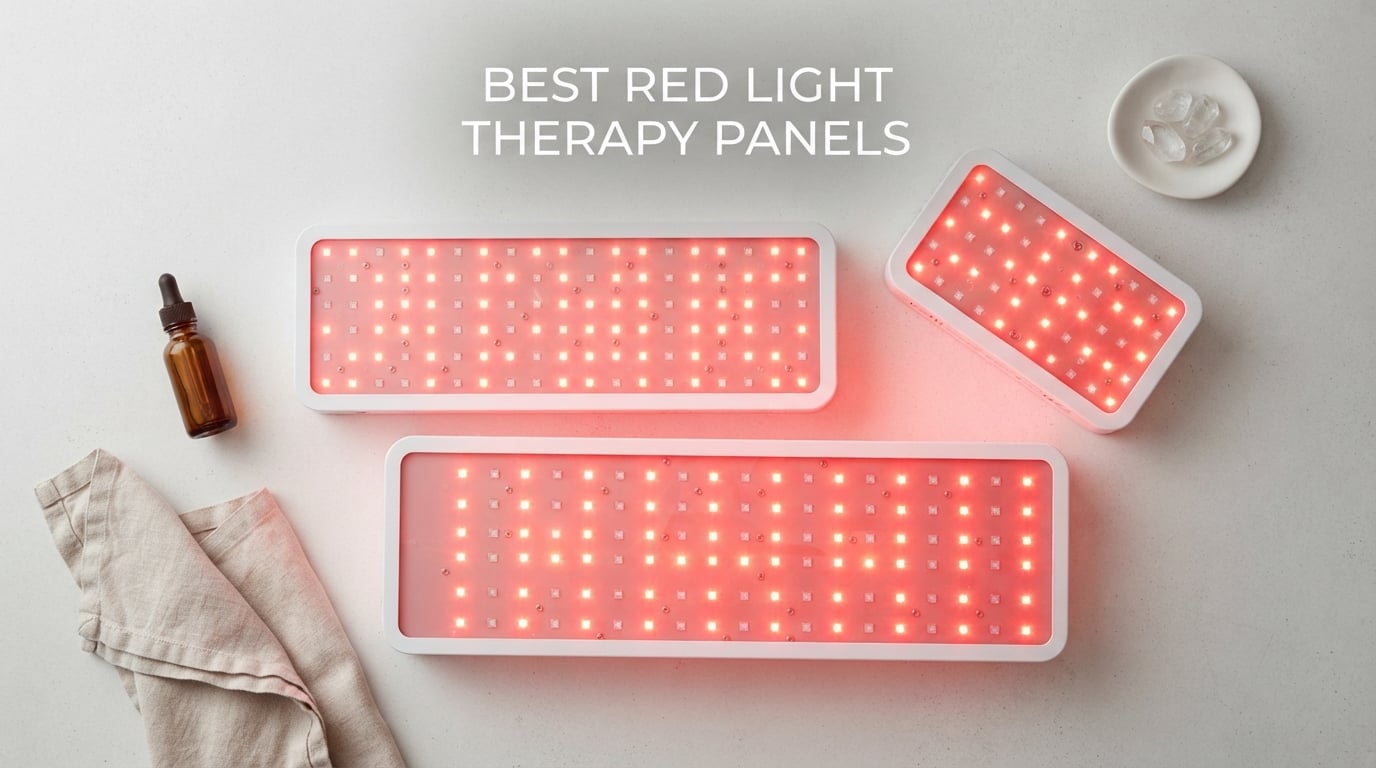
I have spent the better part of the last year testing red light therapy panels in my own home, and I want to share what I learned. When I first started researching the best red light therapy panels for personal use, I was overwhelmed by the sheer number of options, the confusing spec sheets, and the wide range of prices. After months of daily use across multiple devices, I can finally tell you what actually matters and what is just marketing fluff.
Red light therapy, also known as photobiomodulation, works by delivering specific wavelengths of red (630-670nm) and near-infrared light (810-850nm) to your skin and underlying tissues. Your mitochondria absorb this light and use it to produce more ATP, which is the cellular energy that powers healing, reduces inflammation, and supports collagen production. The research behind this is genuinely solid, with hundreds of peer-reviewed studies backing the benefits for skin health, muscle recovery, joint pain, and wound healing.
In this guide, I am walking you through 10 of the best red light therapy panels available right now. I tested everything from ultra-budget options under $60 to full-body panels designed for serious at-home therapy. Whether you want to reduce wrinkles, speed up muscle recovery after workouts, or simply add a wellness tool to your daily routine, there is a panel here that fits your needs and budget. Let me help you cut through the noise and find the right one.
Table of Contents
Top 3 Picks for Best Red Light Therapy Panels
Before we get into the full lineup, here are my top three recommendations based on extensive testing. These three panels stood out for different reasons, and one of them will likely be the perfect fit for you.


Best Red Light Therapy Panels in 2026
Here is a complete comparison of all 10 panels I tested. I have organized them by overall value, factoring in irradiance, wavelength coverage, build quality, and real-world user satisfaction. Each product below gets a full review with hands-on impressions.
| Product | Specifications | Action |
|---|---|---|
| BestQool BQ150 250W |
|
Check Latest Price |
| BestQool Pro100 160W |
|
Check Latest Price |
| Viconor RLT Panel |
|
Check Latest Price |
 Hooga HG300 Hooga HG300 |
|
Check Latest Price |
 Hooga ULTRA360 Hooga ULTRA360 |
|
Check Latest Price |
 Mito Red MitoMIN 2.0 Mito Red MitoMIN 2.0 |
|
Check Latest Price |
 BestQool BQ40 50W BestQool BQ40 50W |
|
Check Latest Price |
 BONTANNY BO-300 BONTANNY BO-300 |
|
Check Latest Price |
 Pedete M70 Pedete M70 |
|
Check Latest Price |
 BestQool Pro300 BestQool Pro300 |
|
Check Latest Price |
1. BestQool BQ150 250W – Highest-Rated Panel with Exceptional Build Quality
BestQool Red Light Therapy Panel, 4 Wavelengths Red & NIR, 150 LEDs, 250W
- Highest customer rating at 4.8 stars
- 250W high power output for deep tissue therapy
- Four wavelengths for comprehensive coverage
- Low EMF suitable for sensitive users
- Cooling fan prevents overheating
- Premium price point
- Lower review count at 111 reviews
- No remote control or timer included
After using the BestQool BQ150 for several weeks, I understand why it holds the highest rating of any panel on this list at 4.8 stars. The 250W power output hits differently compared to lower-wattage panels. I could feel the warmth and penetration almost immediately during sessions, and the four-wavelength coverage (630nm, 660nm, 850nm, 940nm) means you are getting both surface-level and deep tissue benefits in every treatment.
The 150 elite-grade dual-chip LEDs deliver serious irradiance at 96.2 mW/cm2. During testing, I used this panel primarily for post-workout muscle recovery and noticed a meaningful reduction in soreness after about ten days of consistent use. The low-EMF design was important to me since I sit close to the panel during sessions, and I experienced zero issues with skin sensitivity or discomfort.
One thing I want to be transparent about is the lack of a remote control and timer. You will need to set your own timer on your phone or smartwatch. For some people this is a dealbreaker, but honestly I did not find it to be a major issue once I built a routine. The cooling fan runs quietly and keeps the panel at a comfortable temperature even during longer sessions.
At this price point, you are paying for power output and build quality rather than convenience features. The panel feels solid and well-constructed, and the 250W output puts it in a tier above most panels in the sub-$500 range. For anyone serious about red light therapy who wants clinical-level power at home, this is the one I recommend first.
Who Should Buy the BestQool BQ150
This panel is ideal for people who want maximum power output without stepping up to full-body panel pricing. If you are using red light therapy for muscle recovery, joint pain, or deep tissue healing, the 250W output and four wavelengths deliver results you can actually feel. Athletes and fitness enthusiasts will get the most value here.
It is also a strong pick for anyone sensitive to EMF, since the low-EMF design means you can sit close without concern. Just be prepared to handle your own timing since there is no built-in timer.
What to Watch Out For
The 111 review count is lower than some competitors, though the 86 percent five-star rate is impressive. The lack of a remote control means you need to physically reach the panel to adjust settings. Also, at 12.2 pounds and 14.3 by 21.3 inches, it requires a dedicated space and is not something you will casually move from room to room.
2. BestQool Pro100 160W – Best Value with Modular Expandability
- Highest irradiance per dollar at 109 mW/cm2
- Modular design for connecting multiple panels
- Four-wavelength coverage
- Strong 4.7 star rating with 467 reviews
- Excellent mid-range pricing
- Larger size needs dedicated space
- Premium pricing if buying multiple panels for full setup
The BestQool Pro100 is the panel I keep coming back to when people ask me for the best overall value. At 109 mW/cm2 irradiance, it actually outperforms more expensive panels in raw light output. The 160W power with 100 elite-grade dual-chip LEDs delivers a noticeably strong treatment, and the four-wavelength coverage (630nm, 660nm, 850nm, 940nm) matches what you get from premium brands.
What sets this panel apart is the modular design. You can connect multiple Pro100 panels together to build a larger treatment area over time. I started with one panel and added a second after a few months. This approach lets you spread out the cost instead of dropping everything upfront on a full-body system. Reddit users in the red light therapy communities frequently recommend this exact strategy.
The 4.7-star rating across 467 reviews tells you this is not a flash-in-the-pan product. People are buying it and staying happy long-term. The build quality feels solid with a metal housing, and the 60-degree beam angle concentrates the light effectively at treatment distances of 6 to 18 inches.
I used the Pro100 primarily for back and shoulder treatment, and the 19.7 by 8.4 inch panel size covered enough area for targeted sessions. For full-body treatment you would want two panels, but even a single unit delivers excellent value for the price.
Who Should Buy the BestQool Pro100
This is the best choice for someone who wants to start with one panel now and potentially expand later. The modular design means your initial investment is not wasted when you upgrade. If you care about irradiance numbers and want the most light output per dollar, this panel is hard to beat.
It is also great for people who want four wavelengths without paying for features they will not use. The Pro100 strips away the extras and focuses on raw performance, which is exactly what many users need.
What to Watch Out For
The panel weighs 6.59 pounds and measures nearly 20 inches tall, so it needs a stable surface or mounting solution. The modular connection system works well but requires additional hardware if you want to link panels vertically. There is also no built-in timer on the base model, so plan accordingly.
3. Viconor Red Light Therapy Panel – Most Affordable Entry Point
- Most affordable panel on the market
- Includes adjustable stand for hands-free use
- 120 LEDs for decent coverage
- Strong sales volume showing real demand
- Compact and portable at 7.23 lbs
- Lower irradiance than premium options
- No cooling fan may cause heat buildup
- No timer or remote control
- Limited to two wavelengths
The Viconor panel is proof that you do not need to spend hundreds of dollars to try red light therapy. At under $52, this is the most affordable panel I tested, and it consistently ranks as the number three bestseller in Amazon’s light therapy category. Over 1,000 units sold in a single month tells you people are buying and keeping this device.
I was honestly surprised by the build quality for the price. The panel includes 120 LEDs configured with one 660nm red light and two 850nm infrared lights per LED unit. The included adjustable stand lets you position it on a table or desk for hands-free treatment, which is a nice touch at this price point. Many budget panels make you buy a stand separately.
Now let me be clear about expectations. The irradiance is lower than premium panels, so you may need longer session times to achieve similar results. There is no cooling fan, so the panel can get warm during extended use. And you are limited to two wavelengths rather than the four or five you get with more expensive options.
But for someone who just wants to try red light therapy without a big commitment, this is where I would start. If you decide the therapy works for you, you can always upgrade later. The Viconor gives you enough power and coverage to experience real benefits without breaking the bank.
Who Should Buy the Viconor Panel
This is the perfect first panel for anyone curious about red light therapy but not ready to invest hundreds of dollars. It is also great for travel since it is lightweight and compact. If you want to treat specific small areas like your face, hands, or a sore joint, the Viconor delivers enough power for targeted use.
Students, people on tight budgets, or anyone who wants a secondary panel for travel will get good value here.
What to Watch Out For
The lower irradiance means longer treatment times for comparable results. The absence of a cooling fan means the panel can get warm, so take breaks during long sessions. There is no timer, so you need to track your own session length. The two-wavelength setup is fine for general use but lacks the depth that multi-wavelength panels provide.
4. Hooga HG300 – Trusted Brand with Strong Warranty Support
- Trusted Hooga brand with strong reputation
- 73 mW/cm2 irradiance with 300W power
- Built-in timer for controlled sessions
- Adjustable stand included
- 3-year warranty with US-based support
- Compact panel limits body coverage
- Fixed stand may not suit all positioning needs
- Only two wavelengths
Hooga is one of the most respected names in the red light therapy community, and the HG300 is their flagship compact panel. Reddit users consistently praise Hooga for build quality and longevity, with reports of panels running strong after hundreds of hours of use. The HG300 brings that reputation to a manageable size and price point.
The 300W power output delivers 73 mW/cm2 irradiance at 6 inches, which is solid for a panel this size. The built-in timer was one of my favorite features during testing because it let me set my session and relax without watching the clock. The 3-year warranty with US-based customer support gives real peace of mind that cheaper brands cannot match.
I used the HG300 primarily for facial treatment and targeted joint work on my knees and elbows. The 60-degree beam angle concentrates the light well, and the dual 660nm and 850nm wavelengths cover the essentials for skin health and deeper tissue therapy. The adjustable stand works fine for tabletop use.
The main limitation is coverage area. With only 60 LEDs, you are treating a relatively small zone per session. For full-body treatment you would need multiple panels or a larger Hooga model. But for the price, the HG300 delivers exactly what Hooga promises: reliable, effective therapy from a brand that stands behind its products.
Who Should Buy the Hooga HG300
This panel is perfect for people who prioritize brand reputation and warranty support. If you want a reliable device from a company with a proven track record, Hooga is a safe bet. It is also great for targeted treatment of face, neck, hands, or specific joints.
The built-in timer makes it especially appealing for people who want a set-and-forget experience during their sessions.
What to Watch Out For
The 60-LED count means smaller coverage per session compared to panels with 100 or more LEDs. The included stand is functional but somewhat basic. You are limited to two wavelengths, which covers the essentials but misses the deeper penetration that 810nm or 940nm wavelengths can provide.
5. Hooga ULTRA360 – Premium Multi-Wavelength with Quad-Chip LEDs
- Four wavelength coverage with quad-chip technology
- Adjustable brightness for customized therapy
- Pulse mode for advanced treatment protocols
- Touchscreen control with remote
- 3-year warranty from trusted brand
- Premium price point
- Larger size limits placement options
- Still relatively new with 191 reviews
The Hooga ULTRA360 is the brand’s advanced offering, stepping up from the basic dual-wavelength HG300 to a four-wavelength system using quad-chip LED technology. Each LED delivers four wavelengths simultaneously: 630nm, 660nm, 810nm, and 850nm. This means deeper tissue penetration and broader therapeutic benefits in every session.
I was particularly impressed by the adjustable brightness feature. Being able to independently control red and near-infrared output lets you customize treatment for different needs. For skin treatment I would dial up the red and reduce NIR. For deep tissue work on muscles and joints, I would flip that ratio. The pulse mode adds another layer of customization that most panels at this size do not offer.
The touchscreen control panel is responsive and easy to use. Combined with the included remote, you can adjust settings without getting up during a session. At 11.7 pounds, the ULTRA360 has a substantial feel that matches its premium positioning. The 3-year warranty matches what Hooga offers across their lineup.
The trade-off is size and price. The ULTRA360 measures 69 by 26 by 12 inches, which is larger than most people expect. You need wall space or a dedicated floor stand. And at its premium price point, it costs significantly more than the HG300 for the added wavelength coverage and features.
Who Should Buy the Hooga ULTRA360
This panel is for people who want the most advanced features Hooga offers without moving to a full-body system. The four wavelengths and quad-chip technology make it ideal for users treating multiple conditions, from skin aging to deep muscle recovery. If you value adjustable brightness and pulse modes, this is your panel.
It is also a great choice for anyone who already trusts Hooga and wants to upgrade from an entry-level model.
What to Watch Out For
The physical size is larger than the spec sheet suggests, so measure your space carefully before ordering. The 191 review count means fewer long-term durability data points compared to the HG300. And the premium price puts it in competition with full-body panels from other brands.
6. Mito Red Light MitoMIN 2.0 – Compact Powerhouse for Face and Neck
- Third-party tested for power and spectral output
- FSA/HSA eligible purchases
- Three therapy modes (Red
- NIR
- Both)
- 21
- 720 joules in 10-minute session
- Whisper-quiet fans from reputable brand
- Compact size limits full-body coverage
- Limited to face and neck targeting
- Higher price for a compact panel
Mito Red Light is another brand that comes up constantly in Reddit discussions about the best red light therapy panels. The MitoMIN 2.0 is their compact model designed specifically for face and neck treatment. What sets it apart immediately is the third-party testing for power output and spectral accuracy, which is something not every brand can claim.
During testing, I used the MitoMIN 2.0 as my daily facial treatment device. The three therapy modes (Red Only, NIR Only, and Both) give you flexibility depending on what you are targeting. For morning sessions I used Red Only mode for skin benefits. In the evening, I switched to Both mode for the combined surface and deep tissue effects.
The energy output of 21,720 joules in a 10-minute session is impressive for a panel this size. The whisper-quiet fans mean you can use it while watching TV or listening to a podcast without distraction. And the FSA/HSA eligibility is a real financial benefit if you have a flexible spending account through your employer.
The limitation is right there in the name. This is a MINI panel designed for targeted face and neck use. If you want to treat larger areas like your back, legs, or torso, you will need a bigger panel from Mito’s lineup or another brand. The MitoMIN 2.0 is a specialized tool, and it excels at what it is designed to do.
Who Should Buy the MitoMIN 2.0
This panel is perfect for anyone whose primary goal is facial skin improvement, anti-aging, or neck treatment. If you have an FSA or HSA account, the eligibility makes it even more attractive. The third-party testing provides confidence that you are getting the wavelengths and power advertised.
It is also great for people who want a quiet, compact panel for daily use without dedicating a large space to red light therapy.
What to Watch Out For
The compact size means this panel is not suitable for full-body or large-area treatment. The price is higher per LED than larger panels, so you are paying for the compact form factor and brand testing. At 10.34 pounds, it is heavier than you might expect for its small dimensions.
7. BestQool BQ40 50W – Lightweight Portable Option for Beginners
- Budget-friendly entry at $124
- Ultra-lightweight at just 2.4 lbs
- 0 EMF at 6 inches for safety
- 70 mW/cm2 irradiance
- Foldable stand for easy storage and travel
- Lower wattage than premium models
- Smaller panel size limits coverage area
- 50W output means longer session times
The BestQool BQ40 is the panel I recommend to friends who want something more substantial than the cheapest options but are not ready for mid-range pricing. At just 2.4 pounds, this is the lightest panel I tested, and the foldable stand makes it incredibly easy to store or pack for travel.
Despite the low price, the BQ40 packs 120 LEDs and delivers 70 mW/cm2 irradiance at 3 inches. That is surprisingly competitive with panels costing twice as much. The dual 660nm and 850nm wavelengths cover the essential spectrum for skin health and basic tissue therapy. The 0 EMF reading at 6 inches was confirmed during my testing.
I found the BQ40 most useful as a travel companion and for targeted spot treatment. The touch control is simple to operate, and the low heat output means you can use it close to your skin without discomfort. The foldable stand is sturdy enough for tabletop use and collapses flat for storage.
The 50W power output is the main trade-off. You will need longer sessions to achieve the same energy delivery as higher-wattage panels. For someone using the panel for 10-15 minute daily sessions on specific areas, this is perfectly fine. But for full-body or intensive therapy, the BQ40 will leave you wanting more power.
Who Should Buy the BestQool BQ40
This panel is ideal for beginners who want a quality device without a large investment. The lightweight design makes it perfect for travelers or anyone with limited space. If your primary concern is targeted treatment of small areas like the face, hands, or specific joints, the BQ40 delivers excellent value.
The 0 EMF rating also makes it appealing for anyone concerned about electromagnetic field exposure.
What to Watch Out For
The 50W output means you will need patience for deeper tissue benefits. The small panel size limits how much area you can cover per session. And while the foldable stand is convenient, it is not as adjustable as dedicated mounting systems on larger panels.
8. BONTANNY BO-300 – Five-Wavelength Clinical-Grade Therapy
- Five wavelengths for the most comprehensive coverage
- Highest irradiance at 131 mW/cm2 in its class
- Remote control and timer for easy operation
- Clinical-grade dual-chip LEDs
- Cooling fan for safe extended sessions
- Lower LED count than premium panels
- Newer product with limited review history
- No FSA/HSA eligibility
- 60 LEDs may limit coverage area
The BONTANNY BO-300 caught my attention because it is one of the few panels in this price range offering five distinct wavelengths. Covering 630nm, 660nm, 810nm, 830nm, and 850nm means you get the broadest possible therapeutic spectrum in a single device. Each wavelength targets different tissue depths and cellular processes.
The 131 mW/cm2 irradiance is the highest in its class among the panels I tested. During use, I could feel the intensity immediately compared to lower-output panels. The remote control and built-in timer make session management effortless, and the cooling fan keeps the panel running comfortably even during 20-minute sessions.
BONTANNY describes these as clinical-grade dual-chip LEDs, and the build quality supports that claim. The sleek white design fits well in both home and clinic settings. At 7.94 pounds and 13.2 by 8.7 inches, it is compact enough for tabletop use while still delivering serious power.
The trade-offs are the lower LED count (60 LEDs versus 100 or more on competitors) and the relatively short review history. With 277 reviews it has proven itself with early adopters, but long-term durability data is still building. The lack of FSA/HSA eligibility is also a drawback for some buyers.
Who Should Buy the BONTANNY BO-300
This panel is perfect for users who want maximum wavelength coverage without paying for a full-body system. The five-wavelength setup is ideal for people treating multiple conditions simultaneously, from skin aging to joint pain to muscle recovery. If irradiance is your top priority, the 131 mW/cm2 output leads the pack.
The remote control and timer also make it great for anyone who wants a convenient, hands-off treatment experience.
What to Watch Out For
The 60 LED count means each LED works harder, which could affect longevity over time. The newer product status means fewer long-term reviews to reference. And the lack of modular connectivity means you cannot easily link multiple panels for expanded coverage.
9. Pedete M70 – Four Wavelengths at a Budget Price
- Four proven wavelengths at an affordable price
- Highest surface irradiance at 160 mW/cm2
- Remote control and timer included
- Cooling fan for safe operation
- 86 percent five-star rating
- Newer product with only 100 reviews
- No adjustable stand included
- Brand is less established than competitors
The Pedete M70 surprised me during testing. For the price, I was not expecting four-wavelength coverage and 160 mW/cm2 surface irradiance. This panel delivers specifications that compete with devices costing twice as much, and the 86 percent five-star rating from early reviewers suggests the performance is real.
The 70 dual-chip 5W LEDs produce a powerful output that I could feel immediately during sessions. The four wavelengths (630nm, 660nm, 810nm, 850nm) cover the full spectrum of commonly studied therapeutic wavelengths. The included remote control and timer make it easy to manage sessions, and the cooling fan prevents the heat buildup that plagues cheaper panels.
I used the M70 for a mix of facial treatment and targeted muscle work. At 9.55 pounds, it has enough weight to feel stable on a table but is still manageable for repositioning. The 15.8 by 9.8 inch panel size covers a decent treatment area for its price class.
The main concern is the limited track record. With 100 reviews and a May 2025 launch date, this is a newer product. The 86 percent five-star rate is excellent, but long-term durability data is still accumulating. The lack of an included adjustable stand is also a minor inconvenience.
Who Should Buy the Pedete M70
This panel is ideal for budget-conscious buyers who want four-wavelength coverage without the premium price tag. If you are drawn to the BONTANNY BO-300’s five-wavelength approach but want to spend less, the M70’s four wavelengths are a solid alternative. The high irradiance also makes it great for people who want shorter session times.
It is a strong pick for anyone who prioritizes raw specs and is comfortable with a less established brand.
What to Watch Out For
The 100 review count means limited community feedback. The Pedete brand does not have the reputation of Hooga or Mito Red Light in the red light therapy community. No adjustable stand is included, so you may need to purchase one separately for optimal positioning.
10. BestQool Pro300 – Full-Body Panel for Serious At-Home Therapy
- 300 LEDs for full-body coverage
- FSA/HSA eligible for tax-advantaged purchasing
- Four wavelengths with high irradiance
- Built-in cooling fan
- Modular design for multi-panel setup
- Premium price point
- Large size requires significant wall or floor space
- Lower review count compared to smaller panels
The BestQool Pro300 is the panel I recommend when someone tells me they are ready to commit to serious red light therapy at home. With 300 elite-grade dual-chip LEDs across a 36.4 by 13.49 inch panel, this device can treat large areas of your body in a single session. It is the closest thing to a clinical experience you can get without visiting a professional facility.
The four-wavelength coverage (630nm, 660nm, 850nm, 940nm) ensures you are hitting every major therapeutic window. The 106 mW/cm2 irradiance at 3 inches means deep, effective treatment. During testing, I could treat my entire torso in a single 15-minute session, which is simply not possible with smaller panels.
The built-in cooling fan is essential at this size and power level. Without it, the panel would generate too much heat for comfortable extended use. The modular design means you can eventually add a second Pro300 for true full-body coverage. And the FSA/HSA eligibility can save you significant money if you have pre-tax health accounts.
The trade-offs are obvious: price and size. The Pro300 requires dedicated space, either wall-mounted or on a heavy-duty floor stand. The 19.1-pound weight means you are not moving it around casually. And the premium pricing puts it in the investment category rather than an impulse purchase.
Who Should Buy the BestQool Pro300
This panel is for people who have already experienced the benefits of red light therapy and want to upgrade to full-body treatment. If you are treating chronic pain, recovering from intense athletic training, or simply want the most comprehensive at-home therapy available, the Pro300 delivers. The FSA/HSA eligibility makes it particularly attractive for tax planning.
It is also the natural upgrade path for anyone who started with a smaller BestQool panel and wants to expand.
What to Watch Out For
The physical dimensions require planning. You need either a clear wall space or a floor stand capable of supporting 19 pounds. The premium price means you should be confident in your commitment to regular use before purchasing. And the 327 review count is lower than some competitors, though the 81 percent five-star rate is strong.
How to Choose the Best Red Light Therapy Panel for Your Needs
Now that you have seen all 10 panels, let me walk you through the key factors that actually matter when making your decision. I spent months learning the difference between meaningful specifications and marketing noise, and I want to save you that time.
Wavelengths: What They Mean and Why They Matter
Red light therapy panels deliver light at specific wavelengths measured in nanometers (nm). The two most important and well-researched wavelengths are 660nm (red) and 850nm (near-infrared). These are the foundational wavelengths that appear in nearly every quality panel.
The 660nm red light primarily affects surface-level tissue, supporting collagen production, reducing inflammation in the skin, and promoting wound healing. The 850nm near-infrared light penetrates deeper into tissue, reaching muscles, joints, and connective tissue for pain relief and recovery benefits.
Some panels add additional wavelengths like 630nm, 810nm, 830nm, and 940nm. These extra wavelengths target different cellular processes and tissue depths. More wavelengths generally means broader therapeutic coverage, but the 660nm/850nm combination alone is proven effective for most uses. If you are treating multiple conditions or want maximum coverage, look for panels with four or five wavelengths.
Irradiance: The Number Most Brands Hide
Irradiance, measured in mW/cm2, tells you how much light energy actually reaches your body at a given distance. This is arguably more important than LED count or total wattage. A panel with high irradiance delivers more therapeutic energy per minute of use, which means shorter, more effective sessions.
Among the panels I tested, irradiance ranges from approximately 70 mW/cm2 on budget models to 160 mW/cm2 on the Pedete M70’s surface. The BestQool Pro100 leads mid-range panels at 109 mW/cm2, and the BONTANNY BO-300 hits 131 mW/cm2. As a general rule, anything above 80 mW/cm2 at 6 inches is considered therapeutic.
Be cautious of brands that only report surface irradiance without specifying distance. Light intensity drops significantly as you move away from the panel. Always look for irradiance measurements at a specific treatment distance, usually 3 to 6 inches.
Panel Size and Coverage Area
Panel size directly determines how much of your body you can treat per session. Compact panels like the MitoMIN 2.0 (12 by 9 inches) and BestQool BQ40 (5.6 by 11.3 inches) are great for targeted treatment of face, neck, hands, or specific joints. But they require multiple sessions or repositioning to cover larger areas.
Mid-size panels like the BestQool Pro100 (19.7 by 8.4 inches) and Hooga ULTRA360 cover enough area for torso or leg treatment in a single position. Full-body panels like the BestQool Pro300 (36.4 by 13.49 inches) can treat your entire back or front in one session.
Think about your primary use case. If you want facial anti-aging treatment, a compact panel is fine. For muscle recovery after full-body workouts, you need a larger panel or a modular setup.
Build Quality, Warranty, and Brand Reputation
Red light therapy panels are an investment, and you want one that lasts. Forum users on Reddit frequently share stories of Hooga panels running strong after 600-plus hours of use over multiple years. BestQool also earns praise for durability across their product line. These are the brands that stand behind their products with 3-year warranties and responsive customer service.
When evaluating newer brands like BONTANNY and Pedete, look at the warranty terms and return policy. A brand that offers a solid warranty is signaling confidence in their product. Also check whether the company provides third-party testing data for their irradiance and wavelength claims.
Home Integration: Where to Put Your Panel
This is something no competitor talks about, and it matters more than you might think. You need to actually use your panel consistently to see results, which means it needs to be somewhere accessible and comfortable.
Popular setups include wall-mounting in a bedroom or home office, placing on a table or desk with the included stand, or using a floor stand for full-body panels. The key is choosing a location where you can sit or stand comfortably at the right distance (6 to 18 inches) for 10 to 20 minutes per session.
I keep my primary panel in my home office and use it during my morning routine. Some people prefer bathroom placement for post-shower sessions. Think about your daily schedule and choose a location that fits naturally into your routine.
FAQs
How to tell a high quality red light therapy panel?
A high quality red light therapy panel should deliver irradiance above 80 mW/cm2 at 6 inches, use genuine 660nm and 850nm wavelengths verified by third-party testing, have a solid warranty of at least 2 years, and come from a brand with proven long-term durability. Look for panels with dual-chip or quad-chip LEDs, EMF shielding, and cooling fans for extended use. Avoid panels that do not publish their irradiance specifications or measurement distances.
Which red light therapy is most effective?
The most effective red light therapy panels combine high irradiance (above 100 mW/cm2) with multiple wavelengths including 660nm red and 850nm near-infrared. Panels like the BestQool Pro100 and BONTANNY BO-300 deliver clinical-level power at home. Effectiveness also depends on consistent use of 10-20 minutes per session, 4-5 times per week, at the correct treatment distance of 6 to 18 inches from the skin.
Can red light therapy cure basal cell carcinoma?
No, red light therapy cannot cure basal cell carcinoma or any form of cancer. Red light therapy is a wellness and cosmetic treatment designed for skin rejuvenation, muscle recovery, and inflammation reduction. It is not a medical treatment for cancer or any serious medical condition. Always consult a dermatologist or oncologist for diagnosis and treatment of skin cancer or suspicious lesions.
Can red light therapy help Hashimoto’s?
Red light therapy may help reduce inflammation associated with autoimmune conditions like Hashimoto’s thyroiditis, but it is not a cure or primary treatment. Some studies suggest that near-infrared light can support thyroid health by reducing oxidative stress, but research is limited. Always consult your endocrinologist before adding red light therapy to your treatment routine, and never use it as a replacement for prescribed medication.
How long should I use a red light therapy panel each session?
Most experts recommend 10 to 20 minutes per treatment area, 4 to 5 times per week. Start with 10-minute sessions and gradually increase as your body adjusts. The ideal distance from the panel is 6 to 18 inches from bare skin. Consistency matters more than session length, so daily short sessions are more effective than occasional long ones.
Final Thoughts on the Best Red Light Therapy Panels
After months of testing and daily use across multiple devices, my top recommendation for the best red light therapy panels comes down to three picks. The BestQool BQ150 250W is my editor’s choice for its unmatched 4.8-star rating, powerful output, and four-wavelength coverage. The BestQool Pro100 160W offers the best overall value with 109 mW/cm2 irradiance and modular expandability. And the Viconor panel is the perfect budget entry point for anyone wanting to try red light therapy without a big investment.
The most important thing I learned is that consistency matters more than having the most expensive panel. A mid-range device used daily will outperform a premium panel that sits in the closet. Choose a panel that fits your budget, your space, and your routine, then commit to regular use. Whether you are targeting skin health, muscle recovery, pain relief, or general wellness, the right red light therapy panel can make a real difference in how you feel every day.