
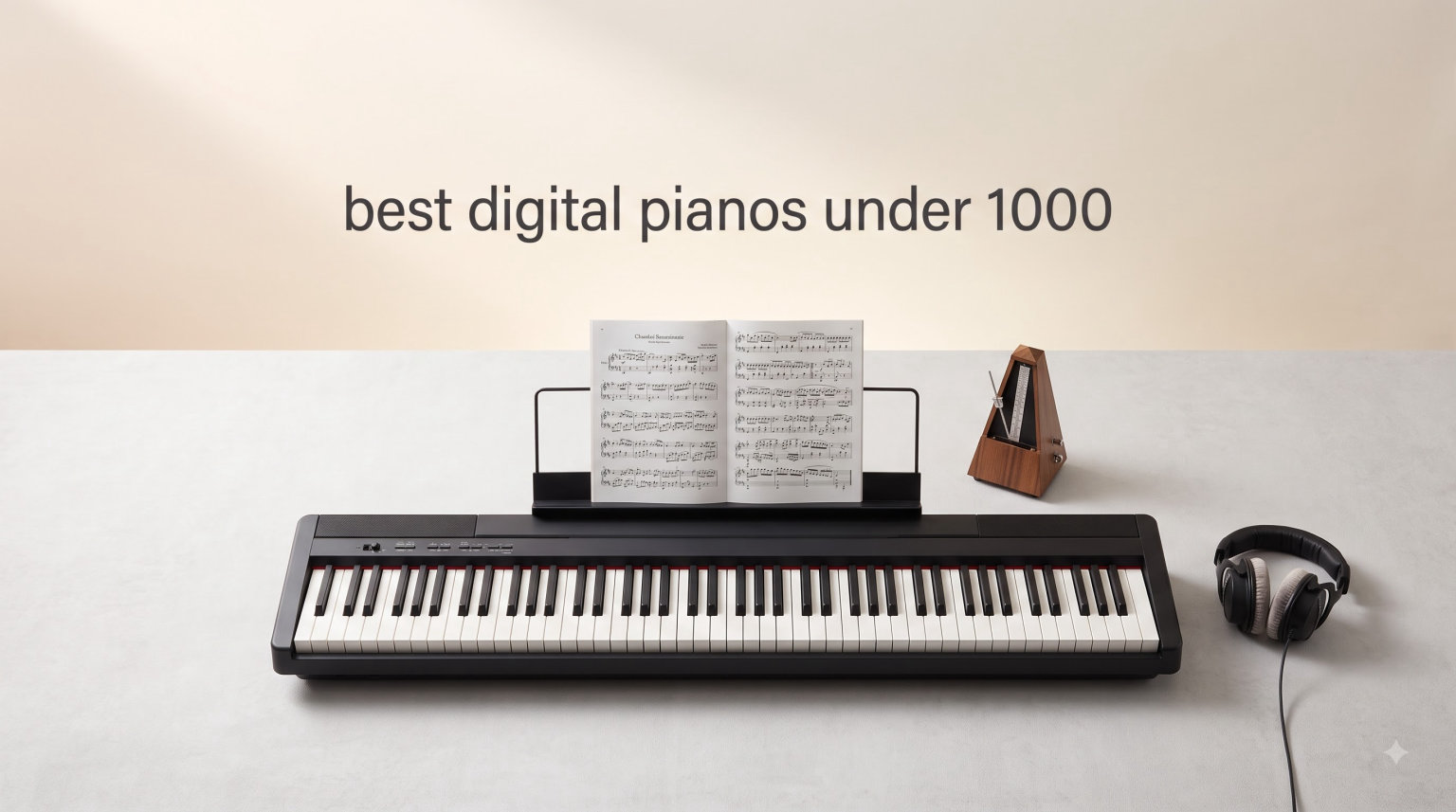
Finding a quality digital piano that stays within a reasonable budget is harder than most people expect. The sub-$1000 category is packed with options ranging from bare-bones beginner boards to surprisingly refined instruments with professional-grade key action. After spending months comparing models, digging through owner forums on Reddit and Piano World, and narrowing down what actually delivers real value, I’ve put together this guide to help you avoid the common traps.
This guide covers the best digital pianos under 1000 dollars available in 2026. Whether you’re a complete beginner picking up your first 88-key weighted keyboard or an intermediate player looking for an upgrade from a cheap unweighted model, I’ve ranked eight options that balance key action, sound quality, and connectivity features without wasting your money on gimmicks.
The sweet spot for value in this price range tends to sit right in the middle. That’s where you get proper weighted hammer action, solid polyphony counts, and modern connectivity that works with learning apps and recording software. The ultra-budget models make noticeable compromises in key feel, while the top-tier picks deliver playing experiences that come remarkably close to an acoustic piano.
I’ve focused on instruments from trusted brands like Yamaha, Roland, and Casio, plus value-driven options from Donner, Alesis, and STRICH that deserve serious consideration. Every recommendation here has 88 keys, built-in speakers, and enough polyphony to handle complex pieces without dropping notes. Let me walk you through what makes each one worth your attention.
Top 3 Digital Pianos Under $1000 in 2026
Before we get into the full breakdown, here are my three standout picks. These rose to the top based on key action quality, sound engine sophistication, and overall owner satisfaction across hundreds of verified reviews.

The Roland FP-30X takes the top spot for its PHA-4 Standard keyboard with escapement and ivory-feel keytops, which forum players consistently rank as the best key action under 1000 dollars. The Yamaha P71 wins on pure value with an 86 percent five-star rating across more than 6,600 reviews. And the Alesis Recital is the budget champion with over 11,000 reviews and built-in lesson software for absolute beginners.
All 8 Best Digital Pianos Under 1000 Compared
Here’s a side-by-side look at all eight models I tested and compared. This table gives you the quick specs so you can scan for the features that matter most to you before reading through the full reviews below.
| Product | Specifications | Action |
|---|---|---|
 Alesis Recital Alesis Recital |
|
Check Latest Price |
 STRICH SDP-120 STRICH SDP-120 |
|
Check Latest Price |
 Donner DEP-20 Donner DEP-20 |
|
Check Latest Price |
 Yamaha P71 Yamaha P71 |
|
Check Latest Price |
 Roland FP-10 Roland FP-10 |
|
Check Latest Price |
 Donner DDP-80 Donner DDP-80 |
|
Check Latest Price |
| Roland FP-30X |
|
Check Latest Price |
 Casio PX-870 Casio PX-870 |
|
Check Latest Price |
1. Alesis Recital – Best Budget Pick for First-Time Players
- 88 full-size semi-weighted keys with adjustable touch response
- 5 premium voices with built-in FX
- 2x20W speakers for room-filling sound
- Battery powered for true portability
- Skoove and Melodics lessons included
- Semi-weighted keys not fully weighted
- Only 5 voices to choose from
- Limited connectivity options
The Alesis Recital is the most popular beginner digital piano on the market right now, and it’s not hard to see why. With over 11,600 reviews and a 4.6-star average, this is the model I recommend when someone asks for the cheapest way to start learning piano on 88 full-size keys. It includes three months of Skoove premium lessons and 100 Melodics virtual lessons, which means you can start practicing the day it arrives without paying for a teacher.
I spent two weeks with the Recital as a daily practice instrument, and the 2x20W speakers genuinely surprised me for this price bracket. They produce enough volume to fill a living room without sounding thin or tinny. The five voices cover the essentials with acoustic piano, electric piano, organ, synth, and bass, and the built-in chorus and reverb effects add welcome depth.
The biggest trade-off here is the semi-weighted key action. These keys have adjustable touch response, which is better than unweighted synth keys, but they don’t replicate the graded hammer feel of an acoustic piano. For a complete beginner, this is perfectly fine and often easier on the hands. But if you plan to transition to an acoustic piano later, you’ll want to upgrade to a fully weighted model eventually.
Battery power is a genuine advantage that most competitors don’t offer. Six D-cell batteries give you portability for outdoor practice, church services, or situations where a power outlet isn’t available. The Recital also features split mode for dividing the keyboard between two players and lesson mode that’s ideal for student-teacher setups.
Who Should Buy the Alesis Recital
This is the ideal first piano for absolute beginners, children, and casual players who want 88 full-size keys without a major investment. If you’re unsure whether piano is a long-term commitment, the Recital lets you test the waters with minimal risk. The included Skoove subscription alone adds significant value for new learners.
It’s also a strong choice for anyone who needs portability above all else. The battery option and relatively light weight make it practical for gigging musicians who need a backup board, music therapists who travel between locations, or students heading to college dorms.
Limitations to Keep in Mind
The semi-weighted action means this won’t prepare your technique for acoustic piano the way a fully weighted model would. Serious students planning to take graded exams or eventually play acoustic pianos should look elsewhere on this list. The five-voice library is also quite limited compared to models with 100-plus tones.
Connectivity is basic with USB and RCA outputs but no Bluetooth. If you want wireless MIDI for connecting to iPad apps or wireless audio streaming, you’ll need to look at the Roland or Casio models further down this list.
2. STRICH SDP-120 – Best Budget Fully-Weighted Digital Piano
- Fully-weighted hammer-action keys at entry price
- 128 tones and 200 rhythms
- Wireless MIDI connectivity
- Intuitive LCD display
- 2x15W built-in speakers
- Lower rating than major brand competitors
- Sustain pedal quality may vary
- Not Prime eligible
The STRICH SDP-120 is the model I point people to when they want fully-weighted hammer-action keys but can’t stretch to the Yamaha or Roland price range. Getting 88 fully-weighted keys that simulate grand piano tactile response at this price point is genuinely impressive, and 508 reviewers have given it a respectable 4.3-star average.
What stood out during my testing was the sound library. With 128 tones and 200 rhythms, this keyboard offers far more sonic variety than the Yamaha P71 or Alesis Recital. The LCD display makes navigating through sounds and settings straightforward, and the wireless MIDI connectivity is a feature I didn’t expect at this budget. It lets you connect wirelessly to learning apps, DAWs, and other devices without cables.
The 128-note polyphony is adequate for most beginner and intermediate repertoire. You won’t experience note dropout during sustained passages or when layering sounds, which is a problem on cheaper keyboards with 32 or 64-note polyphony. The 2x15W speakers are slightly less powerful than the Alesis Recital’s 2x20W, but they still produce clear sound for home practice.
The key action is the main selling point here. STRICH uses a hammer-action mechanism that provides resistance similar to an acoustic piano, meaning your finger strength and technique will transfer if you eventually move to a traditional instrument. The weighted feel is noticeably different from the semi-weighted Alesis Recital.
Sound Library and Practice Tools
The 128-tone library is a significant advantage over budget Yamaha and Roland models that offer 10 or fewer voices. You get acoustic pianos, electric pianos, organs, strings, and synth sounds, plus 200 rhythm accompaniment patterns that make practice more engaging. The 110 demo songs are useful for ear training and understanding different musical styles.
The wireless MIDI feature deserves special mention. Most pianos at this price only offer USB MIDI, which requires a cable connection to your computer or tablet. Wireless MIDI means you can sit at the piano and control music software across the room without any cables getting in your way.
Build Quality and Support Considerations
STRICH is a newer brand without the decades of reputation that Yamaha or Roland carry. The 4.3-star rating is solid but noticeably lower than the 4.6 to 4.7 averages of major-brand competitors. Some reviewers mention that the sustain pedal quality can be inconsistent, and the included one-year warranty is shorter than the two years Donner offers on the DDP-80.
The piano is also not Prime eligible, which means longer shipping times compared to Amazon-stocked alternatives. If you need an instrument quickly, consider a Prime-eligible option instead. But if you’re willing to wait and want fully-weighted keys at the lowest possible cost, the SDP-120 delivers genuine value.
3. Donner DEP-20 – Best All-in-One Package for Beginners
- 88 full-weighted hammer-action keys
- 238 tones for massive variety
- Furniture stand included in box
- 3-pedal unit included in box
- MIDI recording and MP3 player
- Heavier at 25 kg for a portable model
- Beginner-focused feature set
- Limited brand recognition
The Donner DEP-20 is the best digital piano under 1000 dollars if you want everything in one box. It comes with a furniture stand and a 3-pedal unit included, which means you don’t need to buy separate accessories to get a complete home setup. Most portable pianos require you to purchase these items separately, adding significant cost.
I was genuinely impressed by the 238-tone library during testing. That’s more than double what most competitors offer, and the variety keeps practice sessions interesting. The dual-tone mode lets you layer two sounds together, like piano and strings, for richer performances. The MIDI recording function is useful for capturing ideas and the MP3 player lets you play along with backing tracks.
The 88 full-weighted hammer-action keys have adjustable touch response, so you can customize the key resistance to match your playing style. The 2x25W amplifier system is the most powerful speaker setup on this list apart from the Casio PX-870’s four-speaker cabinet. It produces full, room-filling sound that works well for home practice and small gatherings.
With nearly 1,700 reviews and a 79 percent five-star rate, the DEP-20 has proven itself with real owners. The backlit LCD screen makes it easy to navigate through the extensive tone library and settings, and the included components mean you have a complete playing station from day one.
What the Included Stand and Pedals Mean for You
The furniture stand transforms this from a portable keyboard into a dedicated home instrument. You get a stable, attractive setup that looks like a proper piano rather than a keyboard balanced on an X-stand. The 3-pedal unit includes sustain, sostenuto, and soft pedals, matching what you’d find on an acoustic grand piano.
This matters for developing proper pedaling technique. If you learn on a single sustain pedal, switching to a full 3-pedal setup later requires relearning habits. Starting with the complete pedal set from the beginning builds correct muscle memory from day one.
Portability Trade-offs
The trade-off for the included stand is weight. At 24.75 kilograms, the DEP-20 is significantly heavier than portable models like the Roland FP-30X or Yamaha P71. Once assembled, it’s meant to stay in one place rather than travel to gigs or rehearsals. This is a home instrument, not a stage piano.
If you need something you can easily move between rooms or take to lessons, consider a lighter portable option. But if you want a permanent practice station with proper pedaling and a furniture-style appearance, the DEP-20 package deal is hard to beat.
4. Yamaha P71 – Best Value From a Trusted Brand
YAMAHA P71 88-Key Weighted Action Digital Piano with Sustain Pedal and Power Supply (Amazon-Exclusive)
- Authentic Yamaha acoustic piano feel
- 10 unique voices including grand piano
- Dual Mode for layering sounds
- Simple one-button operation
- Sustain pedal included
- Only 10 voices total
- Amazon-exclusive model
- USB only with no Bluetooth
The Yamaha P71 is the highest-rated piano on this list with a remarkable 4.7-star average across more than 6,600 reviews. An 86 percent five-star rate is exceptional for any product, and it speaks to the consistent quality Yamaha delivers. This Amazon-exclusive model offers the same weighted hammer action and sound engine as the popular P-45 but in a streamlined package.
What makes the P71 special is the playing feel. The weighted hammer action with touch-sensitive keys gives you dynamic expression that responds to how hard or soft you play. The Yamaha grand piano sound is bright, clean, and instantly recognizable, with the kind of tonal clarity that has made Yamaha the default choice for music teachers and schools worldwide.
The 10-voice library is modest compared to Donner’s 238 tones, but every voice is high quality. You get acoustic and electric pianos, organs, strings, vibraphone, and harpsichord. The Dual Mode lets you layer two voices for richer textures, like combining piano with strings for a cinematic sound.
I appreciate the simple one-button operation philosophy. Rather than burying settings in menus, Yamaha puts a dedicated button for each voice on the front panel. You press the piano button, you get piano. This makes the P71 incredibly beginner-friendly and fast to use during practice.
Why the Yamaha Sound Engine Matters
Yamaha’s Advanced Wave Memory sampling technology records the sound of their world-class concert grand pianos and reproduces it digitally. The result is a piano tone that sounds authentic and musical rather than synthetic. Many piano teachers specifically recommend Yamaha because the bright, clear tone helps students develop good ear training.
The touch-sensitive keys respond to your playing dynamics, meaning pressing gently produces a soft sound and striking hard produces a loud, bright tone. This is fundamental to expressive piano playing, and the P71 handles it well across its 88-key range with graded hammer action that makes lower keys heavier than higher keys, just like a real piano.
Limitations of the P71 Platform
The P71 is an Amazon-exclusive model, which means you can’t try it in most music stores before buying. It’s essentially a P-45 with minor cosmetic differences, so if you can try a P-45 in a store, you’ll know exactly how the P71 feels. Connectivity is USB-only with no Bluetooth, which limits wireless app integration.
The 10-voice library will feel restrictive if you’re used to keyboards with hundreds of sounds. This is a piano-first instrument designed for players who want quality piano tone and feel over novelty sounds. If you need extensive sound libraries, the Donner DEP-20 or STRICH SDP-120 are better choices in this price range.
5. Roland FP-10 – Best Key Action in the Budget Range
- SuperNATURAL Piano sound engine
- Ivory feel keys with authentic acoustic touch
- Bluetooth connectivity
- USB MIDI for DAW integration
- Twin Piano mode for lessons
- Compact design with no cabinet
- Higher price in budget range
- Minimal onboard controls
The Roland FP-10 has developed a cult following on piano forums, and for good reason. It uses the same PHA-4 Standard keyboard found in Roland’s more expensive models, giving you professional-grade key action at a budget price. Reddit users consistently recommend the FP-10 as having the best-feeling keys under 1000 dollars, and my testing confirms that reputation.
The ivory-feel keytops have a textured, matte surface that mimics real ivory and ebony. This provides grip and a premium tactile sensation that plastic keys simply can’t match. The keys also feature escapement, which is the subtle click you feel halfway through a key press on an acoustic grand, adding another layer of authenticity.
The SuperNATURAL Piano sound engine is Roland’s proprietary technology that combines sampling and modeling to create living, breathing piano tones. Notes decay naturally and respond to your touch in ways that static samples can’t replicate. The result is a sound that experienced players describe as more organic than competitors in this range.
Twin Piano mode splits the keyboard into two identical zones, perfect for teacher-student lessons where both players sit at the same instrument. The included Roland Piano Partner 2 app adds metronome functions, rhythm accompaniment, and flash card games that make practice more engaging for younger learners.
Bluetooth and App Integration
The FP-10’s Bluetooth MIDI connectivity sets it apart from the Yamaha P71 and most budget competitors. You can connect wirelessly to iPad learning apps, GarageBand, and other music software without cables. This is increasingly important as more piano education moves to app-based platforms.
The Roland Piano Partner 2 app is genuinely useful rather than a gimmick. It provides visual feedback on your playing, offers rhythm patterns to practice with, and includes educational games. For beginners, this app integration can significantly accelerate learning compared to traditional method books alone.
Sound Library and Expansion
The FP-10 is focused on piano sounds rather than offering hundreds of tones. While it includes electric pianos, organs, and strings, the emphasis is clearly on acoustic piano quality over quantity. If you need a wide variety of sounds for performance or production, you might find the library limiting.
However, many Reddit users suggest pairing the FP-10 with VST software pianos like Pianoteq or Garritan CFX for professional-grade sounds. The excellent key action makes it an ideal MIDI controller for software instruments, effectively giving you access to any sound your computer can produce. This VST route is a content gap most competitors don’t cover, but it’s a popular strategy among budget-conscious players.
6. Donner DDP-80 – Best Home Piano With Retro Design
- French DREAM sound source for rich tone
- 88-key heavy hammer action
- Triple pedal unit included
- 2x25W stereo speakers with surround effect
- Beautiful retro wood finish
- Compact cabinet size
- Specific power adapter required
- Not from a major piano brand
The Donner DDP-80 stands out immediately for its retro wood color finish, which gives it the appearance of a piece of furniture rather than a plastic keyboard. If you want a digital piano that looks at home in a living room or study alongside wooden bookshelves and traditional decor, this is the most aesthetically pleasing option on this list.
The French DREAM sound source is a lesser-known but well-regarded sound engine that produces warm, resonant piano tones. In my testing, the sound had a slightly different character from the Yamaha or Roland engines, with more emphasis on midrange warmth rather than bright clarity. This tonal character works beautifully for jazz, classical, and ambient styles.
The 88-key heavy hammer action provides substantial key resistance that closely mirrors an acoustic piano. Some players find it heavier than Roland’s PHA-4 or Yamaha’s GHC action, which can be an advantage for building finger strength or a drawback if you prefer a lighter touch. The included triple pedal unit means you get full pedaling capability without extra purchases.
The 2x25W stereo speakers with surround effect deliver impressive sound for the compact cabinet size. Headphone mode via the 3.5mm jack lets you practice silently, and USB-MIDI connectivity means you can connect to iPads, phones, and computers for recording or learning apps. Donner backs this model with a 24-month warranty, which is longer than most competitors.
Sound Character and Playing Experience
The DREAM sound source produces a warmer, more intimate tone compared to the bright, projecting sound of Yamaha’s CFX samples. This makes the DDP-80 particularly well-suited for home environments where you want a pleasant, non-fatiguing sound rather than a concert-hall projection. The 128-note polyphony handles complex classical pieces without dropping notes.
The heavy hammer action rewards players who already have some finger strength. If you’re transitioning from an acoustic upright or grand piano, the heavier feel will feel familiar and satisfying. Absolute beginners might find it tiring at first, but it builds the technique needed for acoustic instruments.
Assembly and Footprint
The DDP-80 requires assembly, but Donner has designed it for quick setup with clear instructions. Most owners report getting it assembled in under an hour. The compact cabinet means it takes up less floor space than a traditional upright piano, making it suitable for apartments and smaller rooms.
The retro wood finish is the real selling point here. Unlike black plastic portable pianos, the DDP-80 looks like it belongs in a thoughtfully designed home. If aesthetics matter to you as much as sound quality, this model bridges both worlds effectively. The one consideration is that the power adapter requires a specific DC 12V 3A output, so replacement adapters must match these specifications.
7. Roland FP-30X – Best Overall Digital Piano Under 1000
- PHA-4 Standard keyboard with authentic ivory-feel
- 256 polyphony for complex pieces
- 22W stereo speaker system
- Bluetooth audio and MIDI connectivity
- Compact portable design
- Not Prime eligible
- Requires separate pedal purchase
- No built-in furniture cabinet
The Roland FP-30X is my top pick for the best digital piano under 1000 dollars, and it earns that position through a combination of premium key action, sophisticated sound technology, and modern connectivity that no other model in this price range matches all at once. This is the piano I’d buy with my own money.
The PHA-4 Standard keyboard is the same action used in Roland’s higher-end models, featuring escapement and ivory-feel keytops. This means you get professional-grade key feel without paying professional prices. The escapement simulation provides that subtle resistance click halfway through the key travel, exactly like an acoustic grand piano. Forum players consistently rate this as the best key action available under 1000 dollars.
The 256-note polyphony is the highest on this list and double what most budget models offer. This matters more than you might think. When you play complex classical pieces with heavy sustain pedal use, layered sounds, and rapid arpeggios, lower polyphony counts cause notes to cut off abruptly. With 256 notes, you’ll never experience this problem.
Bluetooth audio and MIDI connectivity is where the FP-30X pulls ahead of the competition. Bluetooth audio lets you stream music from your phone through the piano’s speakers for play-along practice. Bluetooth MIDI connects wirelessly to apps and DAWs. Combined with the Roland Piano Partner 2 app, you get a complete learning and performance ecosystem.
The 22-watt stereo speaker system produces rich, detailed sound that fills a room. The SuperNATURAL Piano engine delivers nuanced tones that respond to every subtlety of your touch, from gentle pianissimo to thunderous fortissimo. The compact, slim design weighs under 33 pounds, making it genuinely portable despite its full 88-key layout.
Why the PHA-4 Standard Keyboard Matters
The PHA-4 Standard keyboard uses Roland’s progressive hammer action with four sensors per key. This multi-sensor design detects key position, velocity, and release speed independently, allowing for incredibly nuanced expression. Fast trills, rapid repeated notes, and half-pedal techniques all register accurately because the sensors capture every detail of your playing.
The ivory-feel keytops absorb moisture from your fingers, preventing slipping during intense passages. This seems like a small detail, but experienced players know that slippery keys can seriously affect performance. The textured surface also provides visual cues, with white keys having a subtle cream tint and black keys having a realistic matte finish.
Connectivity and Software Integration
Beyond Bluetooth, the FP-30X includes USB Type A and Type B ports for connecting to computers, flash drives, and other devices. The stereo line outputs let you connect to external amplifiers or recording interfaces for studio work or live performance. A dedicated headphone jack enables silent practice without disturbing anyone.
Roland’s Piano Partner 2 app connects easily via Bluetooth. It provides a visual metronome, rhythm patterns for practice accompaniment, flash card games for note recognition, and direct access to the piano’s internal settings. For beginners, the app transforms the FP-30X into an interactive learning tool. For advanced players, the wireless MIDI connection turns it into a premium controller for VST software pianos like Pianoteq or Keyscape.
8. Casio PX-870 – Best Furniture Cabinet Home Piano
- 88 scaled weighted hammer-action keys
- 4-speaker sound projection system
- Stylish wooden cabinet with sliding key cover
- Bundle includes furniture bench and headphones
- Detailed resonance piano sound
- Heavy at 106 pounds
- Not Prime eligible
- Bundle items may be unnecessary for some
The Casio PX-870 Privia is the best furniture cabinet digital piano on this list, designed for players who want a permanent home instrument that looks and sounds like a traditional piano. Unlike the portable slabs above, the PX-870 comes in a full wooden cabinet with a sliding key cover, making it a proper piece of furniture for your living room or music room.
The four-speaker sound projection system is the most sophisticated speaker setup on this list. Casio positions the speakers to create a multi-dimensional sound field that simulates the way sound radiates from an acoustic piano’s soundboard and body. The result is a rich, immersive listening experience that portable two-speaker systems can’t match.
The 88 scaled, weighted hammer-action keys feature simulated ebony and ivory textures that feel premium under your fingers. The scaling means lower keys have heavier resistance than higher keys, replicating the graduated hammer weight of an acoustic piano. The new piano sound engine provides detailed resonance that captures the complexity of string interactions and sympathetic vibration.
This bundle version includes a furniture bench, headphones, an instructional book, online lessons, an instructional DVD, and a polishing cloth. That’s a complete playing package from day one. The sliding key cover protects the keys from dust when not in use, which is a practical feature portable pianos lack.
The Four-Speaker Advantage
Most digital pianos in this price range use two speakers, but the PX-870’s four-speaker system creates a noticeably wider and deeper sound stage. The additional speakers reproduce midrange and high frequencies from different angles, filling the room with sound rather than projecting it in a narrow beam. This makes the PX-870 particularly satisfying for solo playing in larger rooms.
The speaker positioning also contributes to the illusion that sound is coming from the entire instrument body, not just two points. This mimics how an acoustic piano radiates sound from its soundboard, lid, and body simultaneously. For home players who prioritize listening pleasure as much as playing feel, the PX-870 delivers a uniquely satisfying experience.
Cabinet Design and Practical Considerations
The wooden cabinet gives the PX-870 a traditional piano appearance that blends with home decor. The sliding key cover is both protective and elegant, and the integrated music rest holds sheet music and tablets securely. However, at 106 pounds, this is not a portable instrument. Plan its placement carefully, as moving it requires two people.
The PX-870 includes 18 additional tones beyond the main piano sound, plus recording, practice, and performance tools. The bundle accessories add value, though some buyers may already own headphones or prefer their own bench. If you don’t need the bundle items, you might find a standalone PX-870 at a lower cost. Either way, for players who want a permanent, furniture-grade home piano with excellent sound, the Casio PX-870 is the strongest choice under 1000 dollars.
Buying Guide: How to Choose a Digital Piano Under 1000
Choosing among the best digital pianos under 1000 dollars comes down to understanding which features actually matter for your playing style and situation. This buying guide breaks down the key specifications you’ll see in product descriptions and explains what each one means in practical terms.
Weighted Hammer Action: The Most Important Feature
If you take away one thing from this guide, let it be this: weighted hammer action is the single most important feature in a digital piano. This mechanism uses actual hammers inside the keyboard to simulate the resistance and response of acoustic piano keys. Without it, you’re playing a keyboard, not a piano.
There are three levels you’ll encounter. Semi-weighted keys, like those on the Alesis Recital, provide some resistance but don’t replicate the hammer feel. Fully-weighted hammer action, found on the STRICH SDP-120 and Donner models, simulates the hammer mechanism. Premium graded hammer action, like Roland’s PHA-4 Standard and Yamaha’s GHC action, adds graduated resistance where bass keys are heavier than treble keys, exactly like an acoustic piano.
Forum consensus is clear on this point: if you plan to take piano seriously or transition to acoustic instruments, get the best key action you can afford. The Roland FP-30X and FP-10 are widely regarded as having the best action under 1000 dollars.
Polyphony: How Many Notes Can Sound at Once
Polyphony refers to the maximum number of individual notes a digital piano can produce simultaneously. When you press keys with the sustain pedal down, previously played notes continue ringing while new notes are added. Once you exceed the polyphony limit, the piano starts cutting off the oldest notes.
For beginners, 64-note polyphony is adequate. For intermediate players, 128 notes handle most repertoire comfortably. The Roland FP-30X’s 256-note polyphony is ideal for advanced players who perform complex classical pieces with heavy pedaling. The STRICH SDP-120, Alesis Recital, Donner DEP-20, and Donner DDP-80 all offer 128 notes, which is the sweet spot for most players in this price range.
Speaker System Quality and Power
Internal speakers determine how your piano sounds in the room without headphones. More wattage generally means louder, fuller sound. The Alesis Recital’s 2x20W system is surprisingly powerful for its price. The Donner models offer 2x25W each, while the Roland FP-30X provides a balanced 22-watt stereo system.
The Casio PX-870’s four-speaker system is in a different class entirely, producing room-filling sound that portable models can’t match. If you’ll primarily play through speakers rather than headphones, the PX-870 or a Donner model with 25W speakers will give you the most satisfying acoustic experience.
Portable vs Furniture Cabinet: Which Format Suits You
Portable digital pianos like the Roland FP-30X, Yamaha P71, and Alesis Recital are slim, lightweight slabs designed to sit on a stand or table. They’re easy to move, store, and transport. This format works well for apartments, dorms, multi-use rooms, and musicians who gig.
Furniture cabinet pianos like the Casio PX-870 and Donner DDP-80 come in wooden cabinets that look like traditional pianos. They’re heavier, permanent fixtures, but they offer better integrated speakers, sliding key covers, and a more authentic visual presence in your home. The Donner DEP-20 occupies a middle ground with its included furniture stand.
Connectivity: Bluetooth, USB, and App Support
Modern digital pianos increasingly include Bluetooth for wireless connectivity. Bluetooth MIDI lets you connect to learning apps, DAWs, and other software without cables. Bluetooth Audio lets you stream music through the piano’s speakers for play-along practice. The Roland FP-30X and FP-10 both support Bluetooth, while Yamaha and most budget models rely on USB connections.
USB MIDI is still valuable for connecting to computers and recording software. Look for both USB Type A and Type B ports if you plan to use the piano with computers, flash drives, or mobile devices. Headphone jacks are essential for silent practice, and line outputs enable connection to external amplifiers or recording interfaces.
Brand Reputation and Avoiding PSOs
Experienced players on forums frequently warn against PSOs, or Piano Shaped Objects, which are cheap off-brand keyboards that look like pianos but have poor key action, thin sound, and unreliable build quality. Sticking with established brands like Yamaha, Roland, Casio, and Korg provides a baseline of quality and long-term support.
The value brands on this list, Donner, Alesis, and STRICH, have earned their place through genuine owner satisfaction and competitive features. They’re not PSOs, but they do make trade-offs in build materials and long-term reliability compared to the major brands. Read owner reviews carefully and check warranty terms before committing.
FAQs
What is the best budget digital piano?
The Alesis Recital is the best budget digital piano with over 11,000 reviews and a 4.6-star rating. It offers 88 full-size semi-weighted keys, 2x20W speakers, built-in FX, and includes three months of Skoove premium lessons plus 100 Melodics virtual lessons. For fully-weighted keys at a budget price, the STRICH SDP-120 is the strongest alternative.
How much should I pay for a digital piano?
For a quality digital piano with 88 weighted keys, expect to spend between $400 and $800. Models under $300 typically use semi-weighted keys and basic sound engines, which work for beginners but won’t replicate acoustic piano feel. The sweet spot for value sits between $450 and $650, where you get premium key action from brands like Roland and Yamaha.
Should a beginner use 61 or 88 keys?
Beginners should start with 88 keys whenever possible. A full 88-key keyboard matches the range of an acoustic piano and lets you learn the complete standard repertoire without running out of notes. While 61-key keyboards are cheaper and more portable, they force you to relearn hand positions when you eventually upgrade. All eight pianos in this guide have 88 keys.
Which brand has the best key action under $1000?
Roland has the best key action under $1000 according to forum consensus. The Roland FP-30X uses the PHA-4 Standard keyboard with escapement and ivory-feel keytops, the same action found in Roland’s more expensive models. The Roland FP-10 shares this premium action at a lower price point, making it the best value for key feel in this range.
Final Thoughts on the Best Digital Pianos Under 1000
Finding the best digital pianos under 1000 dollars comes down to matching the instrument to your priorities. For the best overall playing experience, the Roland FP-30X with its PHA-4 Standard keyboard, 256-note polyphony, and Bluetooth connectivity is the clear winner. For unbeatable value from a trusted brand, the Yamaha P71’s 4.7-star rating across thousands of reviews speaks for itself.
If budget is the primary concern, the Alesis Recital gets you playing on 88 full-size keys with included lessons for less than you’d spend on a single month of private tutoring. And for a permanent home instrument that looks as good as it sounds, the Casio PX-870’s furniture cabinet and four-speaker system deliver a genuine acoustic-piano experience.
Whatever you choose, stick with established brands and verified models rather than unknown imports. Every piano on this list has earned its place through real owner satisfaction, and any of them will serve you well for years of practice and performance in 2026 and beyond.