
The best pruning shears for arthritic hands are ratchet and geared bypass pruners with padded, wide handles. Those two mechanisms break the cut into stages or multiply your closing force, so you do not have to squeeze hard to get through a stem. A standard bypass pruner asks your fingers for a hard pinch on every cut, and after a hundred roses that pinch turns into joint pain, swelling, and a week of recovered hands.
I have spent the last two springs testing hand pruners against sore hands, and the difference between a mechanism that reduces force and one that simply has soft grips is night and day. Grips help comfort, but they do almost nothing for the joint when a 1-inch branch is involved. Force reduction comes from what happens inside the tool, not from what wraps around your fingers.
Below I cover the five pruner designs that matter for reduced grip strength, then break down ten models with their real cutting capacity, weight, handle type, and the complaints owners actually report. I also include a short hand-measuring routine so you can check fit before you commit, plus notes on care, because a dull blade demands exactly the kind of crushing force your joints cannot give.
A few of these tools also pair well with the everyday comfort picks in our best hand massagers guide if your hands are tight after a session, and cold weather makes stiff fingers considerably worse, which is why our hand warmer picks are worth keeping in the garden basket too.
Table of Contents
Which Pruner Type Suits Arthritic Hands?
Five designs come up again and again when people ask for garden shears built around low grip strength, and they solve the problem in completely different ways.
Ratchet pruners divide one hard cut into several easy squeezes. Inside the handle is a toothed mechanism that resets between strokes, so you never have to generate peak force in a single movement. A permies.com gardener with hand trouble described ratcheting clippers as making it “so much easier to cut anything”, and that sentiment shows up in the reviews of every ratchet model below. The trade-off is speed: a 3/4-inch branch takes three or four strokes instead of one.
Geared pruners keep the scissor action but insert a gear between the handle and the blade. Fiskars calls its version PowerGear2, and it multiplies the force your hand produces at the hardest part of the cut while still giving a clean, single-stroke bypass cut on live stems. This is the design I would pick if you want a normal-feeling pruner that still takes a meaningful branch.
Bypass pruners use two curved blades that slide past each other, giving the cleanest cut on green growth. They are the standard for roses, perennials, and fruit, but they need both blades to meet at the same time, which is a two-handed pinch. On their own they are not the gentlest option, which is why most of the gentlest tools here are ratchet, geared, or adjustable.
Anvil pruners send one blade down onto a flat surface, so you push rather than squeeze two blades together. Some people with stiff fingers find that easier, and anvil designs are good on dead, dry wood. The cost is accuracy: anvil blades can flatten or crush softer green stems, so I keep them for deadwood and woody jobs only.
Adjustable-span pruners let you change the distance between open handles, usually with a thumb slider. If your hands are small, or swelling changes week to week, matching grip span to your hand is worth more than any padding. I will show you how to measure your own span in the buying guide below.
Electric pruners sit in a different category entirely, since you press a trigger instead of building force. They are genuinely helpful during a flare, but the trigger itself becomes the problem when fingers are swollen, and battery logistics add friction to a tool you may use twice a year. None of the ten products below are electric, and the FAQ covers that choice on its own.
Top 3 Picks for Pruning Shears for Arthritic Hands

Felco F8 Pruning Shears
- Forged aluminium handles
- 1 inch cutting capacity
- Replaceable parts
- Lifetime warranty

Gardener’s Friend Ratchet
- 3-stage ratchet action
- Neoprene anvil insert
- 1 inch capacity
- Lifetime warranty
All 10 Pruning Shears at a Glance in 2026
Every model below appears once in this table with its mechanism, capacity, and the detail that matters most for hands that cannot squeeze hard.
| Product | Specifications | Action |
|---|---|---|
| Felco F8 Pruning Shears |
|
Check Latest Price |
| The Gardener’s Friend Ratchet Pruners |
|
Check Latest Price |
| Fiskars SoftGrip Bypass Shears |
|
Check Latest Price |
 VOTREK Stepless Handle Pruners VOTREK Stepless Handle Pruners |
|
Check Latest Price |
 MEPEREZ Segmented Lever Snips MEPEREZ Segmented Lever Snips |
|
Check Latest Price |
 Gerossi Two-in-One Ratchet Shears Gerossi Two-in-One Ratchet Shears |
|
Check Latest Price |
 EZ Kut Heavy Duty Ratchet Shears EZ Kut Heavy Duty Ratchet Shears |
|
Check Latest Price |
 Craft911 Japanese Steel Bypass Pruners Craft911 Japanese Steel Bypass Pruners |
|
Check Latest Price |
 Fiskars PowerGear2 Bypass Shears Fiskars PowerGear2 Bypass Shears |
|
Check Latest Price |
 Haus and Garten EnduroPRO Bypass Haus and Garten EnduroPRO Bypass |
|
Check Latest Price |
1. Felco F8 Pruning Shears: The Best Overall Pick for Arthritic Hands
- Highest average rating of the ten at 4.8
- Forged aluminium handles backed by a lifetime warranty
- Carbon steel blade holds its edge
- Every component is replaceable and maintainable
- Micrometric adjustment simplifies blade changes
- Shaped for right-handed use only
- Forged alloy and steel make it heavier than plastic-handled pruners
I reached for the Felco F8 first when my own right hand started complaining after a morning of cutting back hydrangeas. It is not a ratchet and it does not need to be. The forged aluminium handles are shaped to fill the palm rather than pinch at the fingertips, which means the closing force comes from a bigger muscle group than a plastic handle with a narrow grip ever asks for.
Owners describe it as the traditional professional benchmark, and the review pattern backs that up. With an average of 4.8 across more than 3,000 ratings, it sits at the top of this group, and the praise is consistent rather than scattered. People notice that the carbon steel blade keeps an edge through a whole season and that the tool still works years later because parts are replaceable instead of discarded.
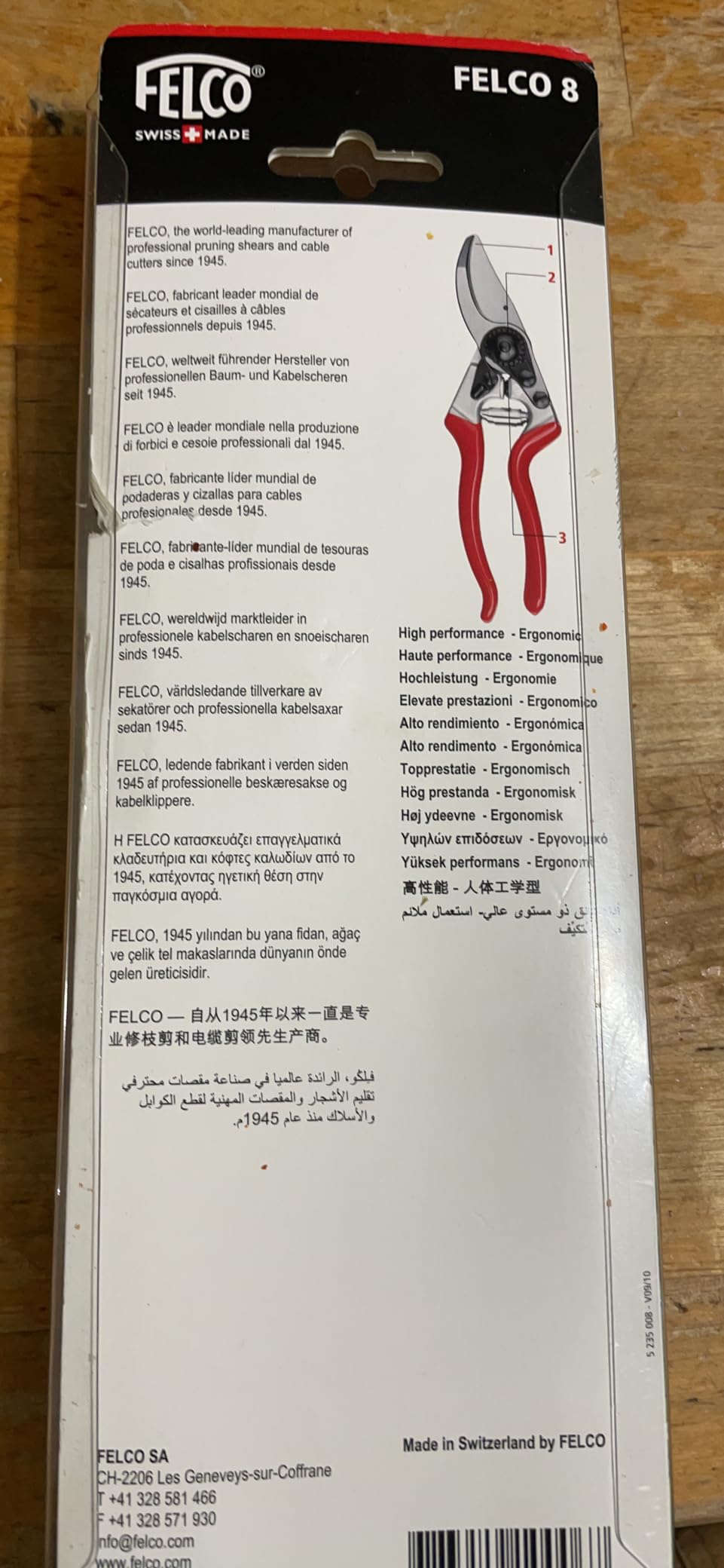
The 1-inch cutting capacity covers roses, flowering shrubs, small fruit, and most of what a home garden throws at a hand pruner. Blade changes are handled with a micrometric adjustment rather than a guess, so if you do eventually need fresh steel, the swap is a five-minute job at the kitchen table with an allen key.
Two things to weigh before buying. The handle geometry is built for right-handed use, and a garden full of right-handed people is exactly why this is our top pick rather than a compromise. It is also the heaviest-feeling tool here at 8.64 ounces, which is a fair trade for a serviceable design but worth knowing if hand weight is your main complaint.

Who the Felco F8 suits well
It suits anyone who wants a professional-grade bypass pruner that stays sharp, survives hard use, and can be repaired rather than replaced. The lifetime warranty on the forged aluminium handles means one component failing does not end the tool, and that matters when arthritis is a progressive condition and you are not replacing purchases often.
For rheumatoid arthritis, where grip strength and stamina come and go, the combination of a wide forged handle and near-zero maintenance appeals to me most. It is the pair I would put in a gift box, because it is the one a serious gardener keeps for decades.
Who should pick something else
Skip it if you are left-handed, which the shape does not accommodate, or if you want to cut branches thicker than an inch without moving to loppers. It is also the wrong pick if the absolute lightest tool matters most to you, since 8.64 ounces is a full 2.7 ounces above the lightest option in this roundup.
2. The Gardener’s Friend Heavy Duty Ratchet Pruners: Best for Weak Grip
- Ratchet stages turn one hard squeeze into several easy pulls
- Neoprene anvil insert holds the branch steady
- Lifetime warranty from the manufacturer
- Ambidextrous so it works for any hand orientation
- Heavier than lighter ratchet alternatives
- Anvil blade can crush softer green stems
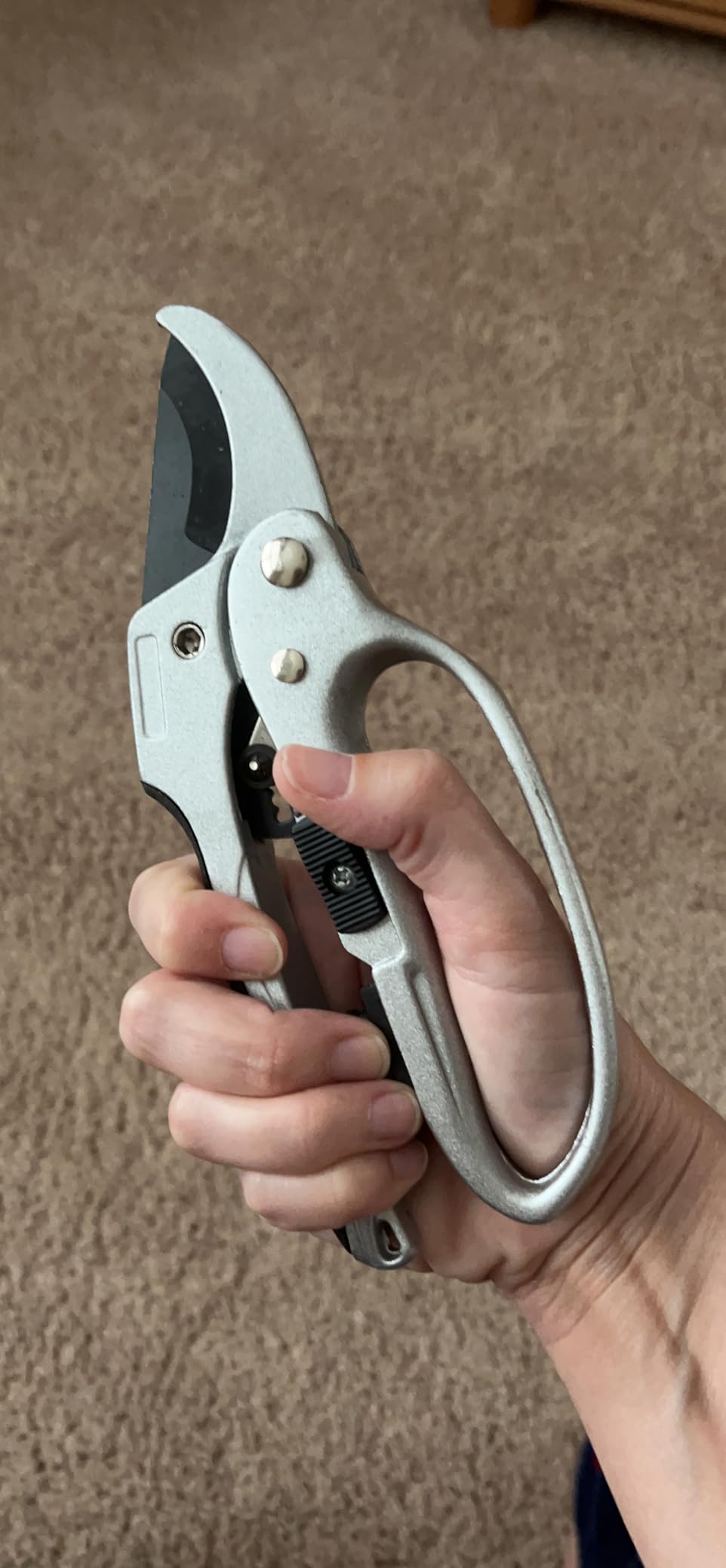
If the honest question is whether ratchet pruners actually work when grip strength is genuinely low, this is the tool to answer it. The three-stage ratchet resets the blade partway through the cut, so the force needed on any single squeeze is a fraction of what closes a conventional bypass pruner.
Reviewers with limited hand strength describe the stepped action in almost the same words, calling it the difference between finishing a pruning job and putting the tool down. The safety latch also stops the tool opening unexpectedly in a pocket, which is a small thing that matters more when your grip is unpredictable.
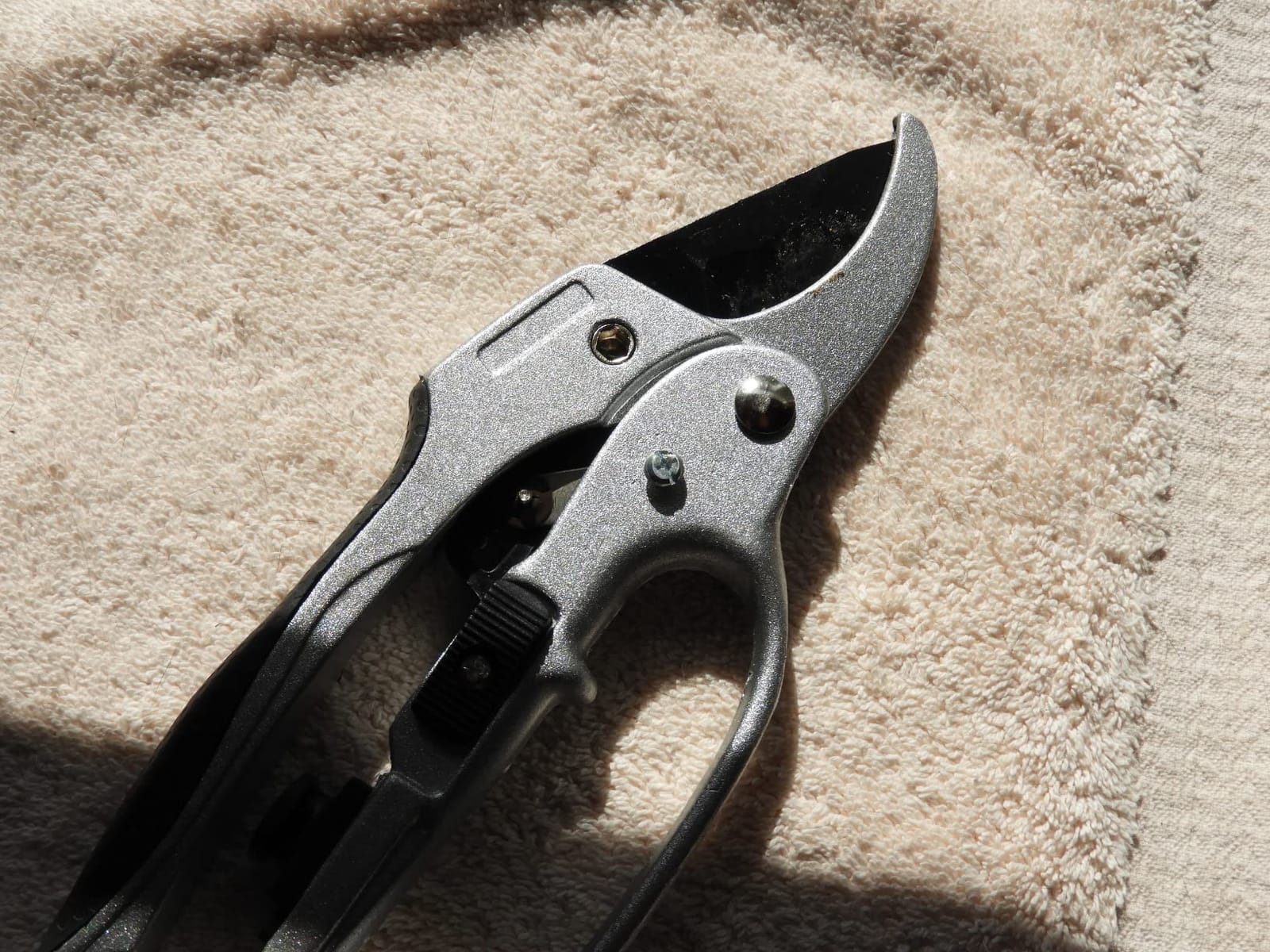
The neoprene insert in the anvil is the detail I did not expect to care about. It grips the branch while the blade closes, which stops thin stems from rotating out of position at the exact moment force is highest, and that produces a noticeably cleaner cut on roses and dogwood.
Capacity runs to 1 inch depending on wood density, with manganese steel doing the cutting on an alloy steel body. That build is genuinely heavy-duty rather than marketing language, which is why I would pair it with lighter pruners for flowers and reserve it for shrubs and woody stems.
Who these ratchet pruners suit well
They suit gardeners whose hands are the limiting factor, not their arms. Each stroke is a short, gentle pull, so the tool works for people who cannot close a standard pruner on a live stem, and the ambidextrous build means hand orientation is not a deciding factor.
For severe rheumatoid arthritis or a bad carpal tunnel flare, this is my first recommendation in the whole roundup. The ratchet does the heavy lifting and you just guide the tool, which is a meaningful difference in how long you can stay out in the garden.
Who should pick something else
Not the right choice for a lot of delicate tip work, because the staged action is slower and the anvil blade flattens softer green growth compared with bypass geometry. If you spend a session deadheading daisies, you will move to one of the bypass options faster than you expect.
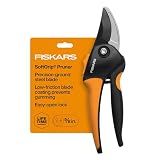
3. Fiskars SoftGrip Bypass Pruning Shears: Best Value Pick for Sore Hands
- Lightest tool in the group at 5.92 ounces
- Comfortable non-slip grip with a simple one-handed lock
- Low-friction coating resists rust and sap
- Most reviews of any pick here at over 7000 ratings
- 5/8 inch capacity is the smallest of the ten
- Basic non-geared design gives less cutting power
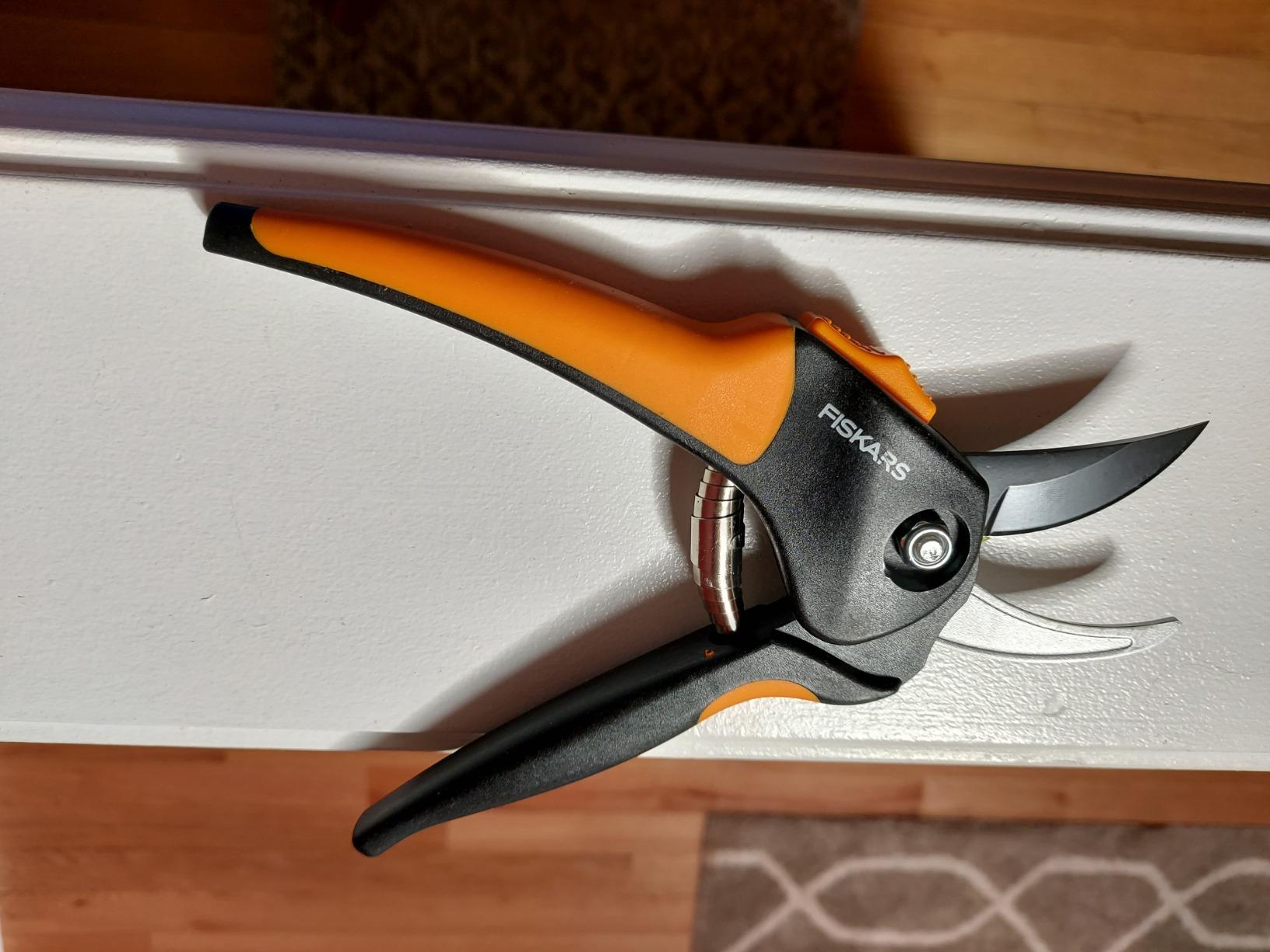
When grip is painful, weight is an underrated variable, and this is the lightest pruner in the roundup at 5.92 ounces. A lighter tool means less sustained load through the wrist and forearm, and in a long session that difference shows up the next morning more than the mechanism does.
It also carries the largest review base here, more than 7,000 ratings averaging 4.6, which is the closest thing to long-term evidence you get in this category. Buyers favour the SoftGrip handle for staying comfortable through a full afternoon, and the non-slip texture holds when your hands are damp or you are working with gloves on.
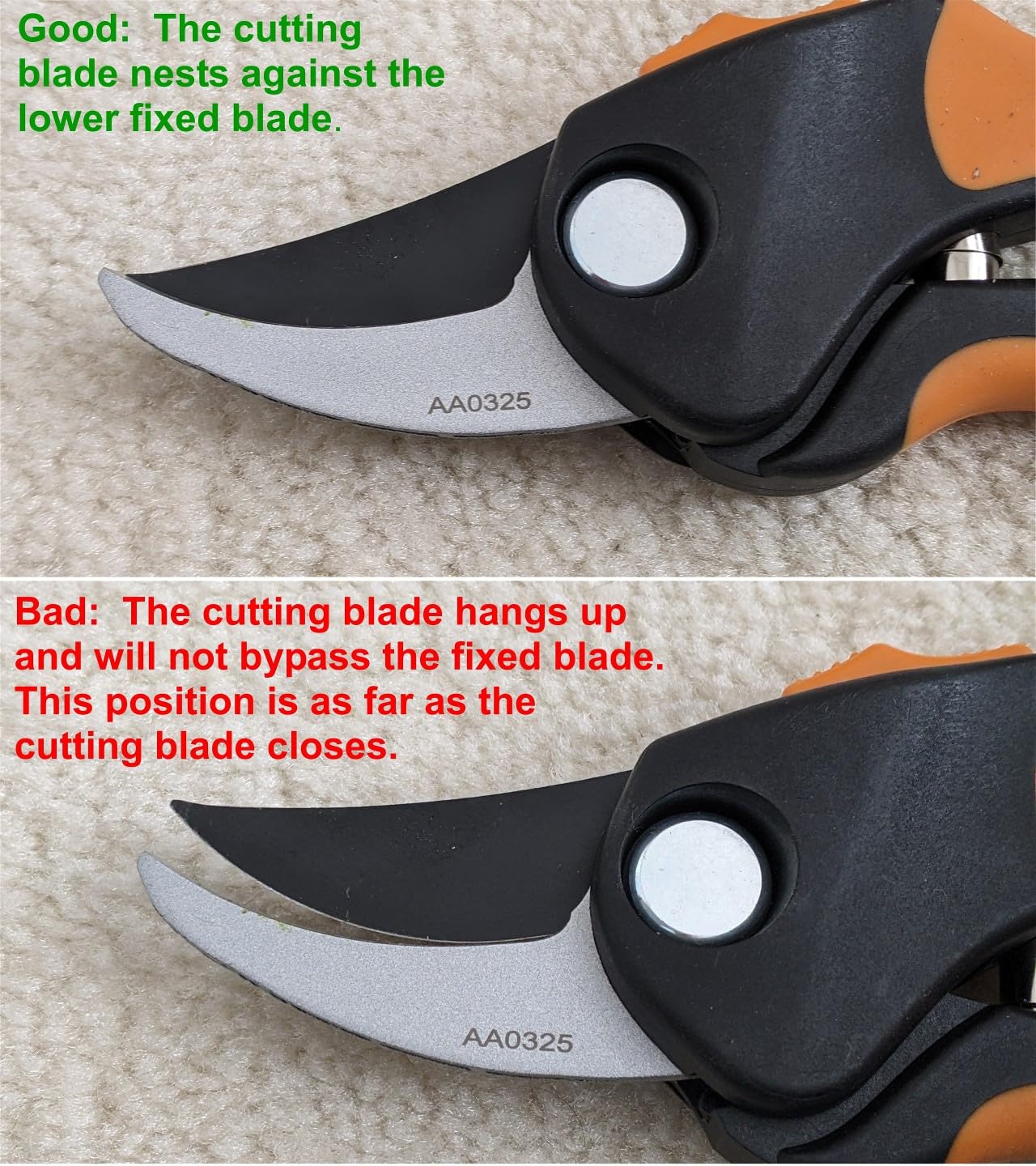
The self-cleaning sap groove is the detail that keeps this tool working, because sticky blades drag and drag means more force. The low-friction coating resists both gumming and rust, so a wipe-down after each job is usually enough to keep the edge cutting cleanly.
The lock opens with one hand, which sounds trivial until you are holding a stem in the other one. For flowers, herbs, and thin perennials the 5/8-inch capacity is genuinely all you need, and the bypass blade leaves a tidy wound that heals without dieback.
Who the SoftGrip suits well
It suits anyone whose hands tire before their enthusiasm does. Flower cutting, herb harvesting, deadheading, and indoor plant maintenance are all jobs where capacity is not the constraint, and carrying less weight for an hour is the difference between finishing the bed and stopping halfway through.
For osteoarthritis in the fingers rather than the thumb, the wide SoftGrip handle spreads pressure across the palm instead of concentrating it in two small contact points. It is also the easiest recommendation in this list for a first purchase, because nothing about it needs explaining.
Who should pick something else
Anyone cutting woody branches over about half an inch. The design has no gearing and no ratchet, so it asks for more hand force than any other tool here once the stem gets thick, and that is precisely the situation it is least suited to.
4. VOTREK Stepless Handle Pruners: Best for Small Hands and Swelling
VOTREK® Pruning Shears, Patented Stepless Handle Opening for All Hand Size
- Stepless thumb slider fits a wide range of hand sizes
- Enclosed spring resists sap
- dirt and rust
- Light weight reduces fatigue in long sessions
- One-handed side lock that works with gloves
- Newer listing with a far smaller review base than the established brands
- May need occasional lubrication after extended use
Grip span is the measurement almost every competitor article skips, and it is the one that decides whether a pruner feels right in your hand. The VOTREK solves it with a stepless thumb slider that adjusts both handle span and blade opening, so the tool adapts to the hand in front of you rather than to a size on a label.
For a gardener with small hands, or with hands that swell and change week to week during a flare, that adjustability is the feature reviewers single out again and again. Nobody else in this roundup offers it.
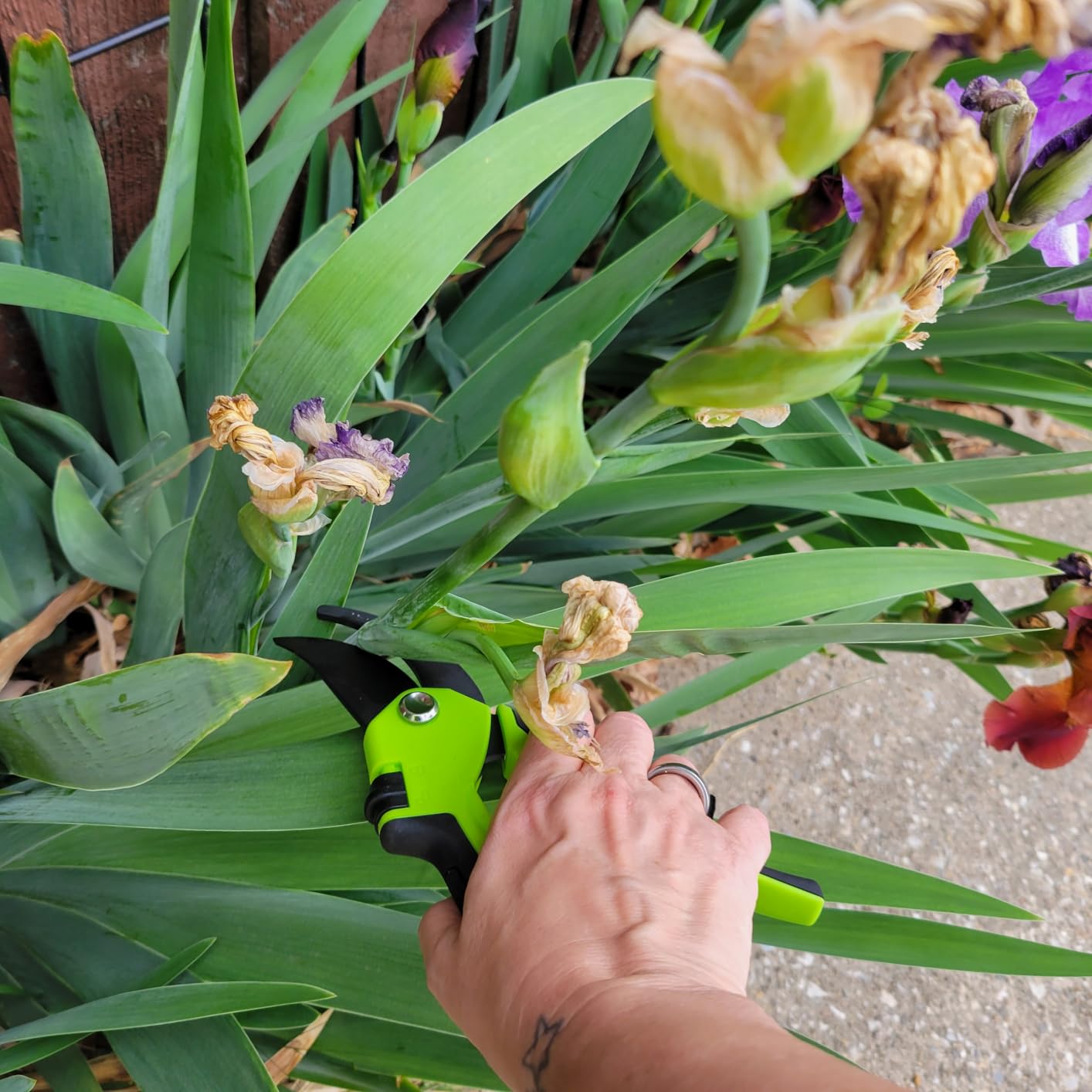
The blade is SK5 high-carbon steel with a Teflon nonstick coating, rated to 1 inch, and the fully enclosed spring housing is a smart piece of engineering. Open springs on conventional pruners collect sap and grit, and that debris is what makes a light pruner stop opening smoothly.
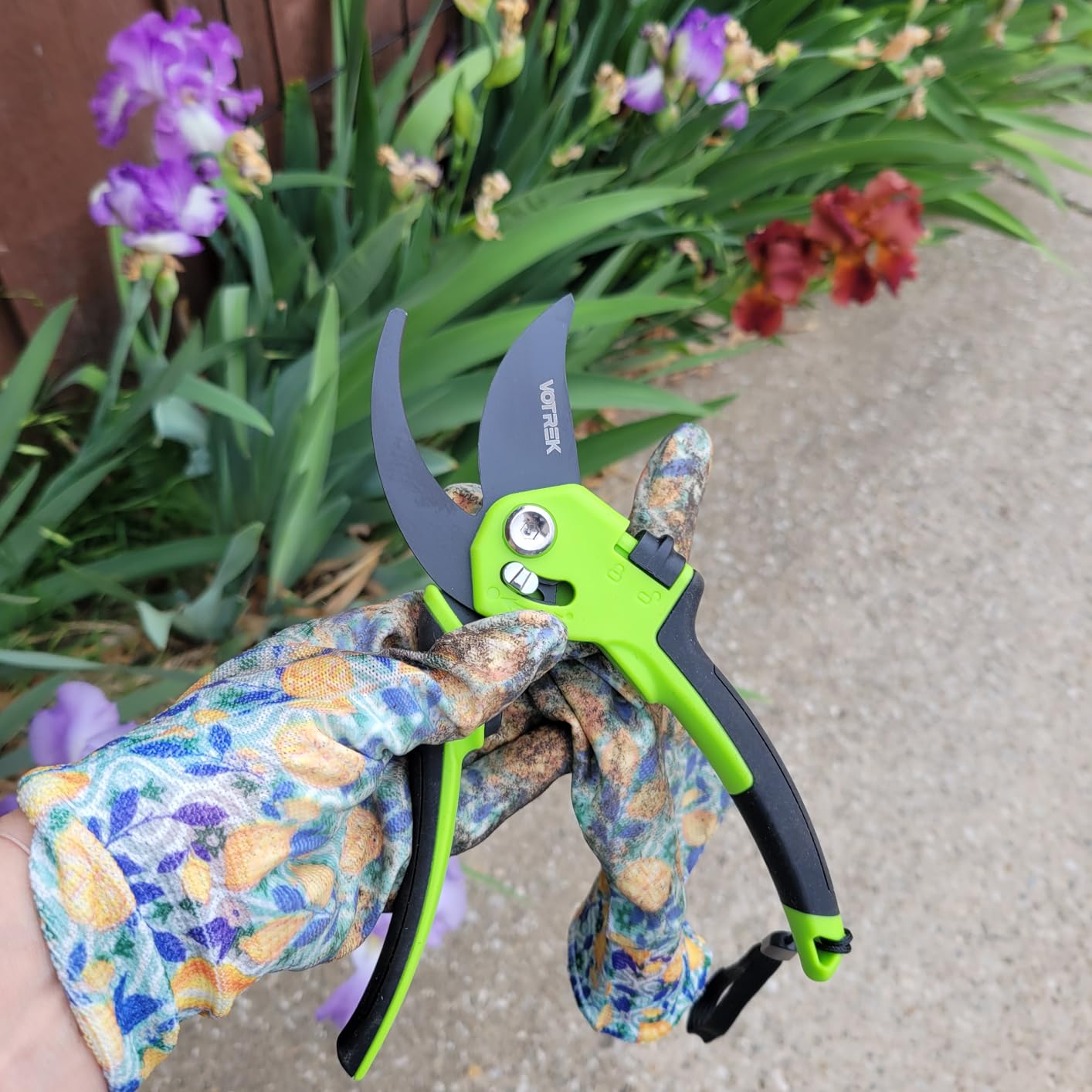
At 8.32 ounces it is light for its class, and the TPR coating with a shock-absorbing handle structure stays secure in damp or sweaty conditions. The side thumb lock works one-handed and remains operable with gloves, which matters for anyone who wears them for joint warmth.
Who the VOTREK suits well
It suits small hands, and it suits hands that vary. The ability to dial the span down rather than forcing oversized handles is genuinely useful, and the 1-inch capacity means you are not sacrificing branch thickness to get a better fit.
For carpal tunnel or thumb-base pain, the one-handed side lock avoids the twisting wrist motion that top-of-hand locks require, and the lifetime warranty covers the tool if the adjustment ever wears out.
Who should pick something else
Be cautious if you prefer a heavily proven tool. With 575 ratings, this listing has a much shorter history than the established brands in this roundup, so you are trusting the mechanism more than the track record. Reviews do describe needing occasional lubrication after extended use.
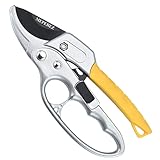
5. MEPEREZ Segmented Lever Garden Snips: Best for Carpal Tunnel Hands
- Segmented lever delivers roughly 4 times the cutting power
- Rated for carpal tunnel
- arthritis and small hands
- Ambidextrous rubber handles sized for small and large hands
- Bright yellow finish is easy to spot in foliage
- Some arrive too tight and need adjusting
- Ratchet can fail to advance between strokes
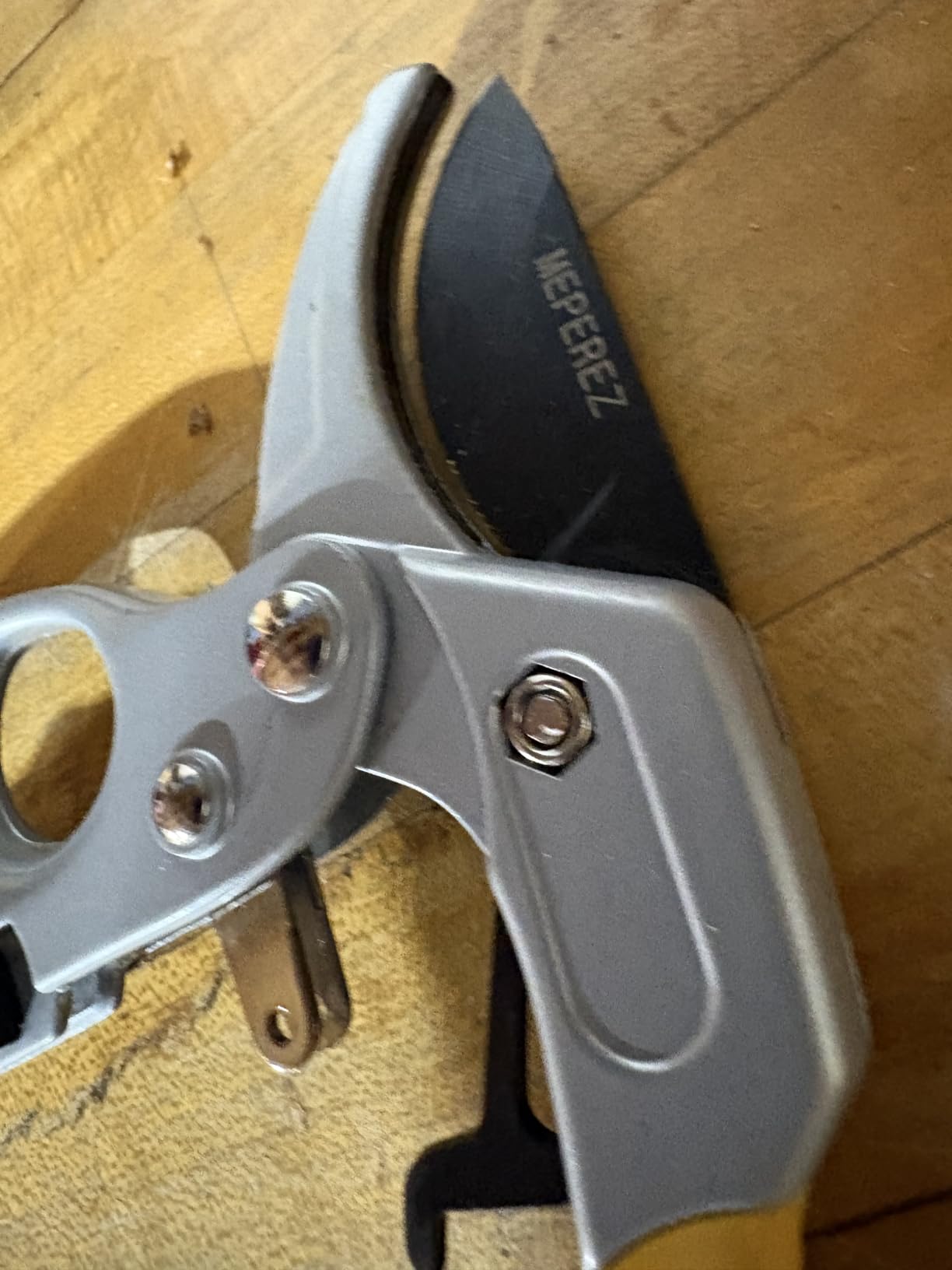
This is the model I hand to people whose hands are fine most of the year and unusable in October. The segmented lever design multiplies cutting power by roughly four, which sounds like marketing until you try to close a conventional pruner on a stubborn rose cane and then try this one on the same cane.
With more than 5,800 ratings averaging 4.1, it is one of the most reviewed ratchet models in the group, and the review pattern is very specific: owners with osteoarthritis and age-related hand weakness consistently praise the ratchet action and the reduced pain, while a smaller group reports mechanical issues.
The ergonomically sized rubber handles are described as fitting both small and large hands, and the whole tool is ambidextrous. At 7.76 ounces it is comfortably light while still offering a full 1-inch cutting capacity, which is unusual in this category.
One practical note: some owners receive a pair that arrives too tight and needs adjusting before first use, so factor in ten minutes with the tool before a big pruning day rather than discovering it mid-job. The bright yellow finish also solves a problem nobody mentions, which is finding shears after they land in a bed.
Who these snips suit well
They suit seasonal gardeners who prune hard twice a year and want a tool that reduces force without the commitment of a pro-level purchase. The lock and unlock slider works by pressing the handles and releasing, which is operable with reduced dexterity.
For carpal tunnel specifically, the wide ambidextrous rubber grip and light body keep the wrist neutral, and the 4x power multiplier covers the thick stems that would otherwise end the session early.
Who should pick something else
Not the pick if you have very large hands, since the handle opening is reported as narrow for them even though the listing calls it adjustable for both sizes. A minority of owners also report the ratchet failing to advance and needing manual repositioning between strokes, and a few mention blade durability concerns.
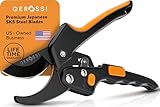
6. Gerossi Two-in-One Ratchet Pruning Shears: Best Switchable Design
Gerossi Ratchet Pruning Shears Heavy Duty, Hand Pruners for Gardening
- Two-in-one switchable design covers fine pruning and thicker limbs
- Ratchet mode triples hand power for arthritic hands
- Lightweight with a padded
- non-slip grip
- Selector and lock sit on both sides for ambidextrous use
- Some buyers feel it performs like a cheaper non-ratchet pruner
- A small number report the internal spring failing after a couple of months
Most ratchet pruners force a compromise: you accept three-stage cuts on every stem, including the tiny ones where it is pointless. The Gerossi solves that with a two-in-one design that switches between ordinary single-cut action and a 3-step ratchet mode, so you pay the extra strokes only when the branch warrants it.
Multiple owners in their seventies and eighties describe pruning for hours without hand pain, and they credit the switchable ratchet mode rather than the grip alone. That is the specific pattern I care about in this category, because it matches the profile of the person shopping for these shears.
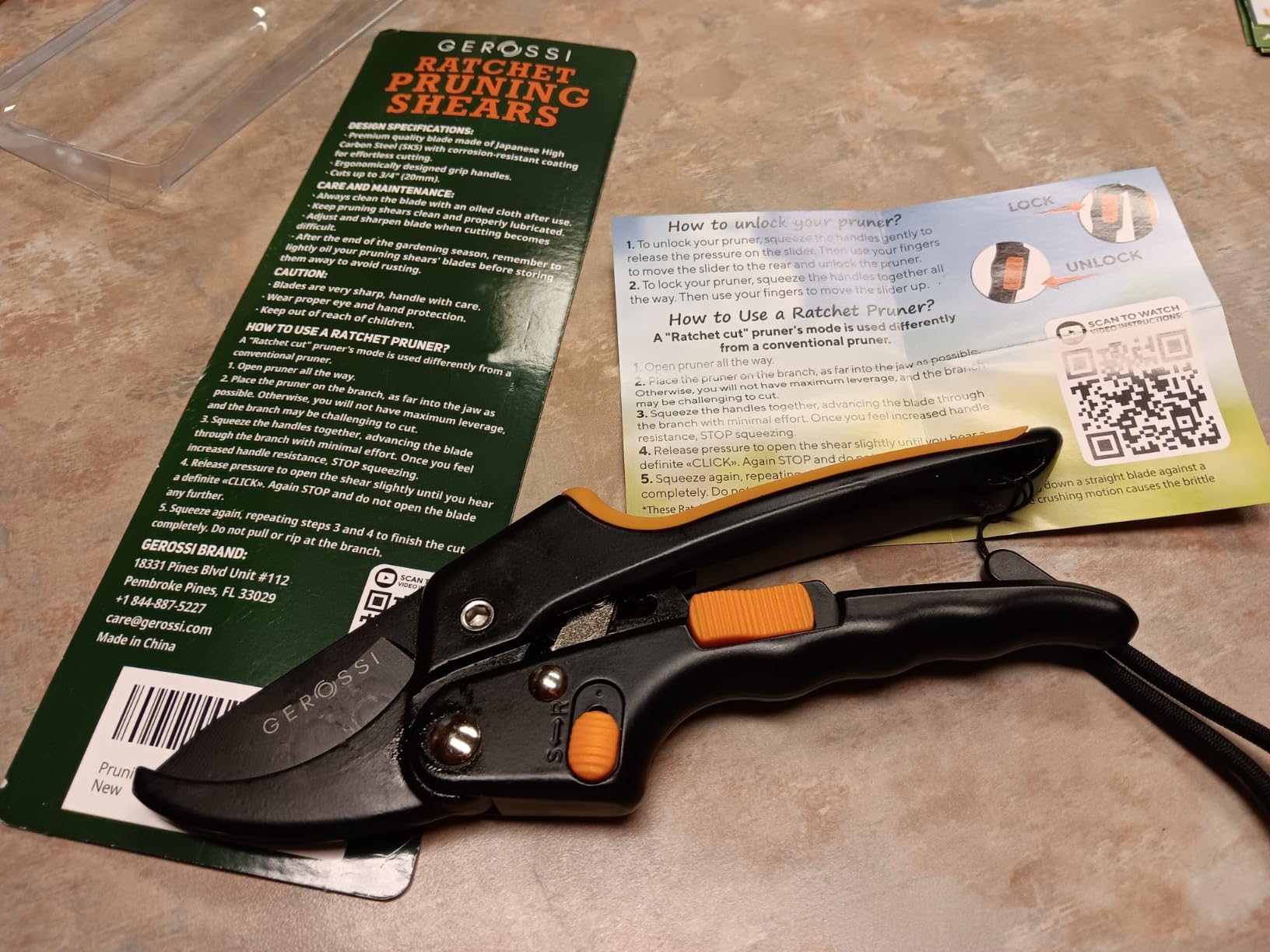
The blade is SK5 high-carbon steel with ultra-fine polishing and a corrosion-resistant coating, rated to 3/4 inch. At 0.22 kg it is one of the lighter ratchet options here, and the aluminum body with ergonomic rubber grip stays comfortable over a long session.
Customer service replaced a pair for one owner outside the warranty window, which tells you something about how the brand handles problems. The included hang rope is a small courtesy, and the one-hand safety lock works from either side.
Who the Gerossi suits well
It suits gardeners with mixed workloads, where most cuts are light but a few rose canes or small branches need help. Switching modes takes one movement, so the tool adapts to the task instead of the task adapting to the tool.
For anyone who wants ratchet assistance but refuses to give up a clean, fast single-stroke cut on flowers and herbs, this is the design that finally makes sense to me.
Who should pick something else
A small number of buyers feel the ratchet benefit is overstated compared with cheap conventional pruners, which is worth weighing given the 3/4-inch capacity is modest. Some owners also report the internal spring failing after a couple of months of use.
7. EZ Kut Heavy Duty Ratcheting Shears: Best for Thick Deadwood
- Largest cutting capacity here at 1.5 inches
- Ratchet action makes large cuts possible with limited grip
- Sharp blade that passes paper-cutting tests
- Knuckle guard adds protection
- Light for a heavy-duty rating
- Handle grips can feel oversized for very small hands
- Ratchet occasionally sticks and needs clearing
When deadwood is the job, no other tool here cuts as thick, and 1.5 inches of capacity changes what you can do without reaching for loppers. The SK5 hardened carbon steel blade with a non-stick coating is the business end, and it passes the paper test that separates serious blades from decorative ones.
Reviewers with carpal tunnel and arthritis describe the ratchet as the difference between finishing a pruning job and giving up on it, which is exactly the mechanism story I want to see validated. The cast aluminum full-metal body is built for that kind of load and stays light enough to work with all day.
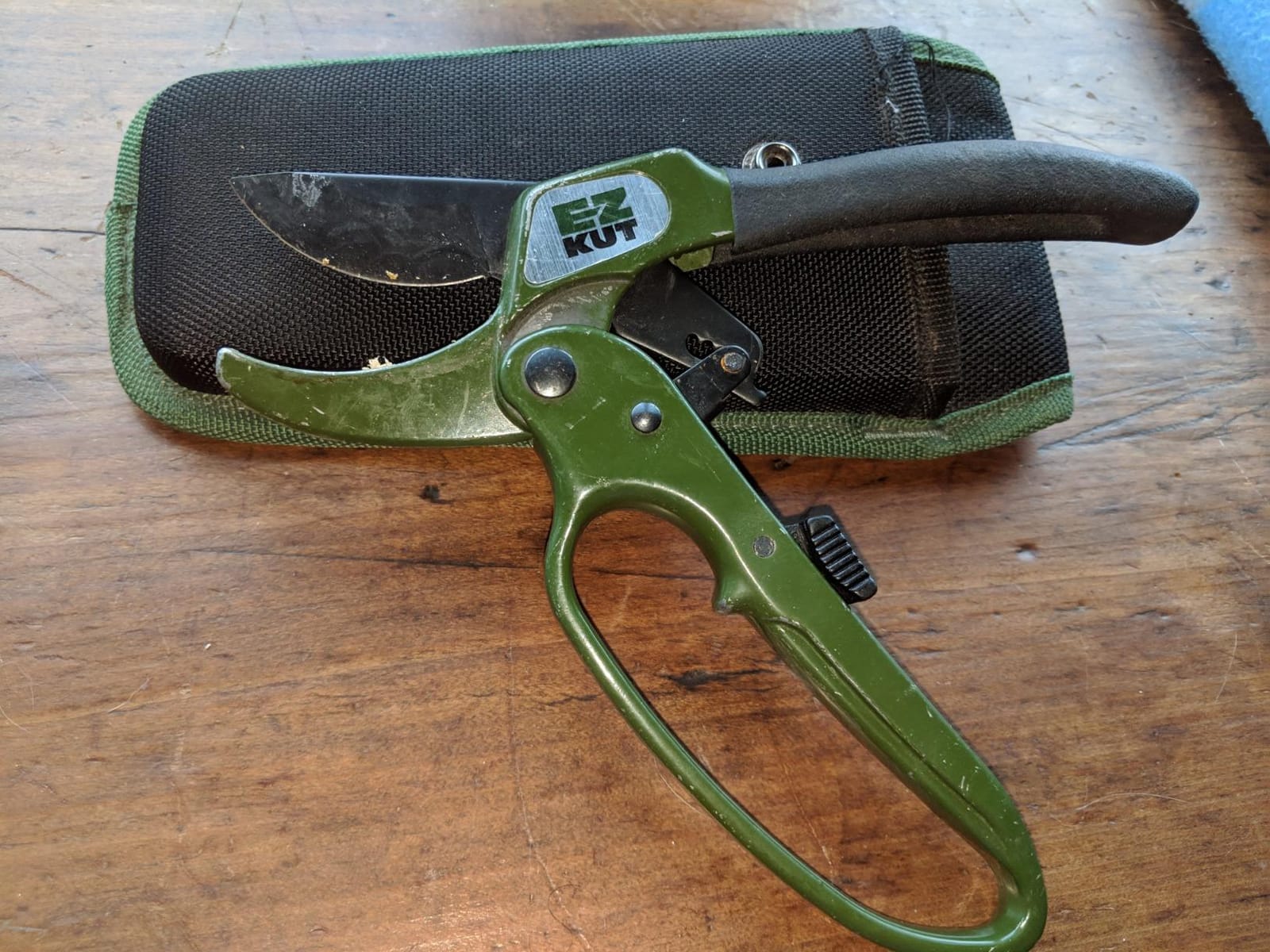
The knuckle guard around the handle is not common on pruners this size, and it is the feature I would mention first to anyone who splits or has swelling. A ratchet tool already implies more hand travel than a standard pruner, so protecting the back of the hand from the swing is sensible.
The built-in safety lock keeps the blades closed in storage, which matters more than it sounds when a heavy tool with an exposed blade lives in a shed. Note that a sheath appears in some photos but is not part of the base package, so plan on storing it locked or in a separate holster.
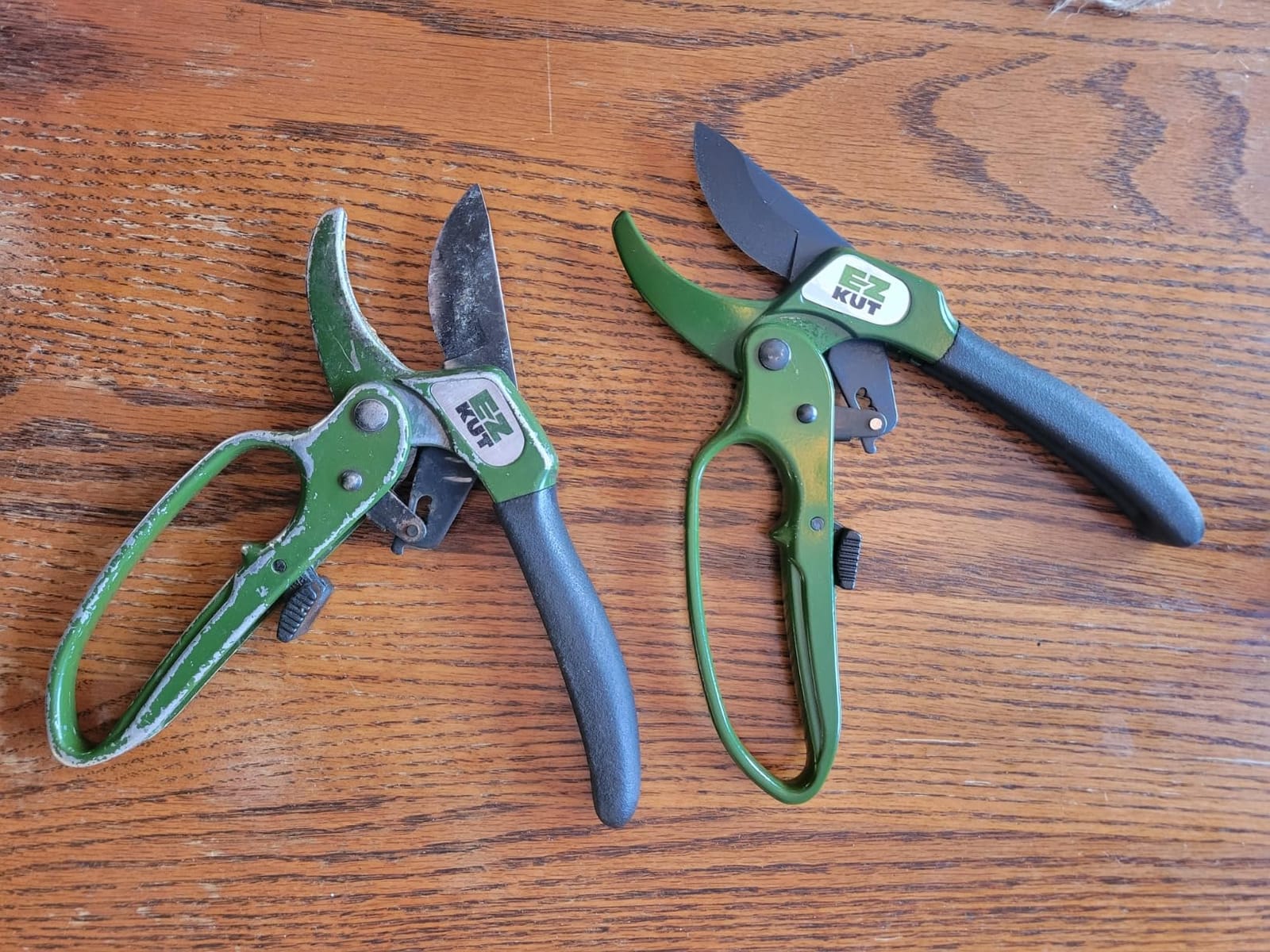
Who the EZ Kut suits well
It suits anyone who prunes fruit trees, mature shrubs, or storm-damaged branches where 1 inch is simply not enough. The ratcheting mechanism keeps the required force manageable even at 1.5 inches, which no other hand pruner in this roundup manages.
For de Quervain’s tenosynovitis or a thumb joint that flares under load, the ratchet plus the knuckle guard covers both ends of the grip, and the safety latch prevents an accident in a pocket.
Who should pick something else
It is the wrong tool for small hands, since the grips are reported as oversized, and for anything delicate. An anvil blade on soft green stems will crush them, and the extra weight and length become tiring on flower work. Stick to deadwood and woody pruning with it.
8. Craft911 Japanese Steel Bypass Pruners: Best Budget Pick
- Low entry cost makes it easy to try without commitment
- Comfortable non-slip grips suited to small or weak hands
- SK5 steel with titanium coating holds a sharp edge
- Non-slip texture gives control in damp conditions
- Some models report the spring detaching after limited use
- Safety lock can fail to engage
- Blades dull faster than heavier-duty pruners
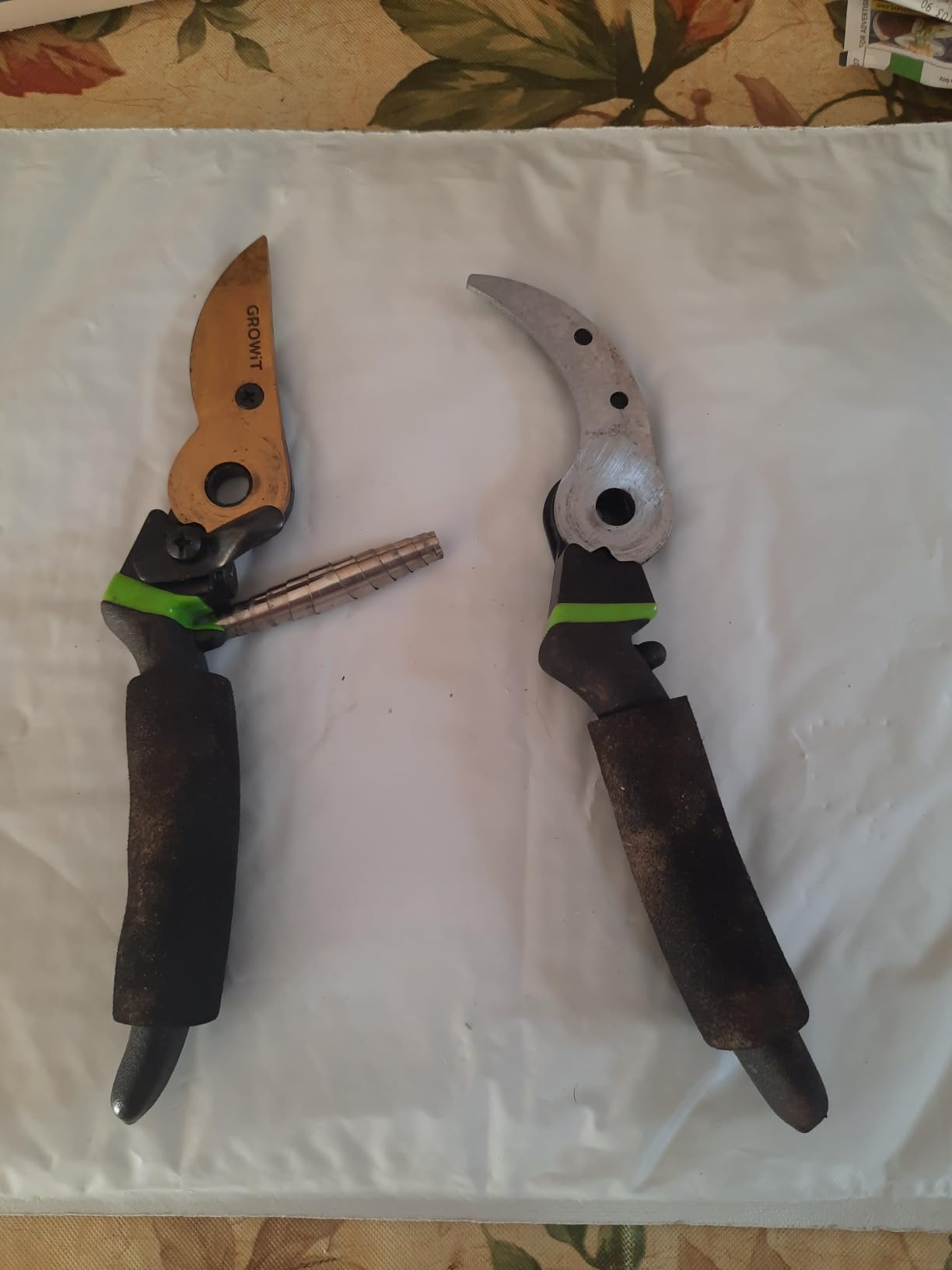
Two names and several thousand reviews make this the entry point I suggest when someone wants to test whether light-touch pruners make a real difference before spending more. Owners with arthritic hands buy multiple pairs, which tells you the cost of being wrong is low and the convenience of having one in each shed is high.
The blade is SK5 high-carbon steel with a titanium coating, and the stated cuts are 3/4 inch. The 2.95-inch blade with a 1.42-inch opening is a compact frame that fits smaller hands comfortably, which is a more useful detail here than the number alone.
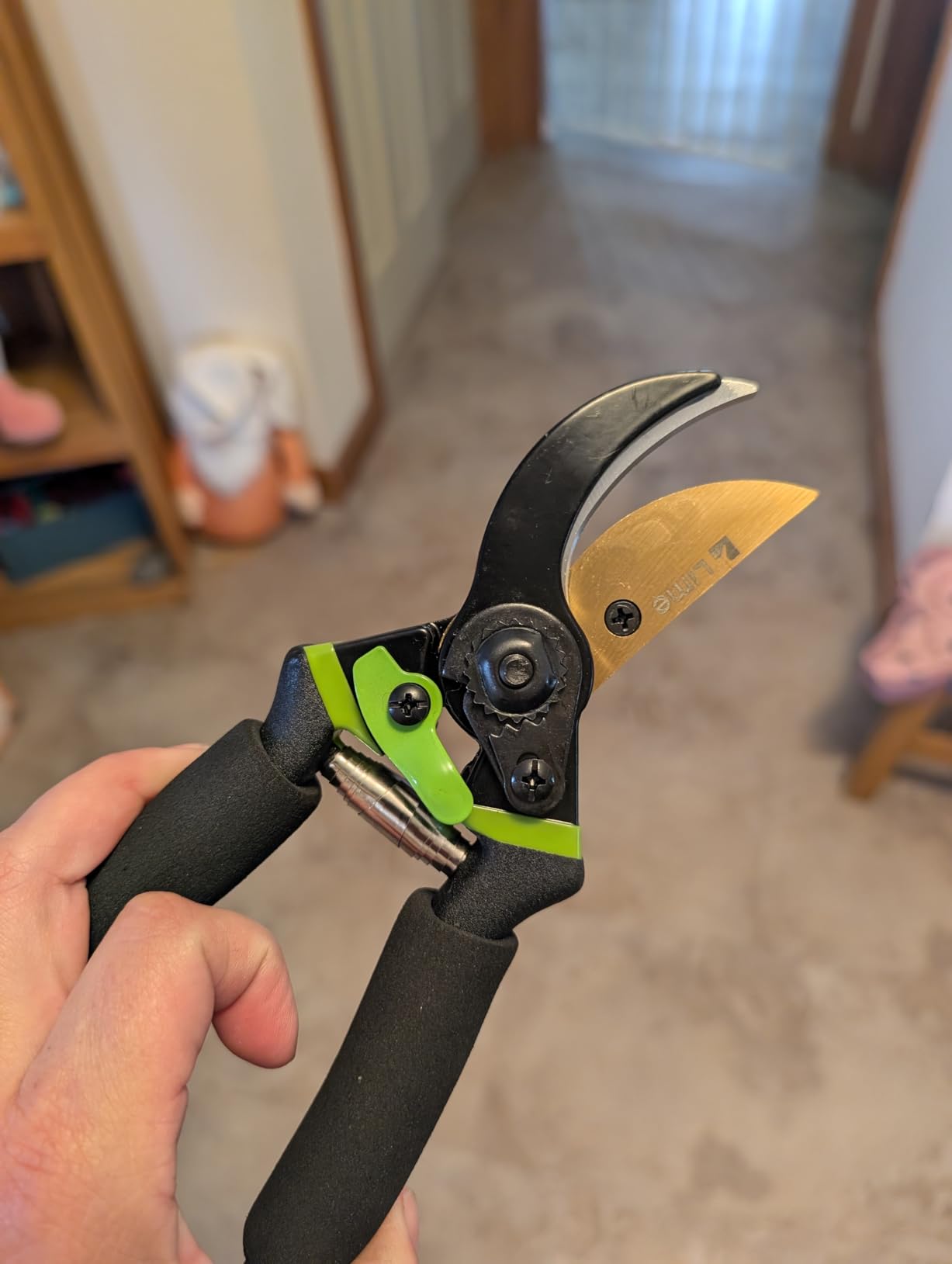
The non-slip handle texture is designed with seniors and arthritic hands in mind, and it holds control in wet conditions. The built-in safety lock closes the blades with one-handed activation, so you are not using your sore thumb to secure the tool before putting it away.
At 0.33 kg it is not the featherweight option, but for a bypass pruner with a full steel blade that is expected. The materials are rust-resistant and easy to clean, which matters more than usual because a rusty blade is a blade that needs more force.
Who the Craft911 suits well
It suits beginners, occasional gardeners, and anyone who wants a backup pair for a second location in the garden. At this entry point you can find out how your hands respond to a titanium-coated blade without committing to a professional tool.
For a renter, a new gardener, or a gift that will not hurt if it is lost in the leaf pile, the low cost and ambidextrous build remove the usual friction from buying.
Who should pick something else
Not the choice for heavy pruning, since the bypass design gives no force multiplication and the steel dulls sooner than heavier alternatives. Recurring mechanical complaints include a spring that detaches after limited use and a safety lock that does not always engage properly.
9. Fiskars PowerGear2 Bypass Shears: Best Geared Power
Fiskars PowerGear2 Bypass Pruning Shears, 3/4″ Cut Capacity Garden Clippers
- Gear system multiplies cutting power for tougher branches
- Rolling contoured handle reduces hand fatigue
- Hardened bypass blades stay sharp through heavy use
- Backed by a lifetime warranty
- Fits most pruner holsters
- Pivot joint can loosen over time
- Debris in the gear box can cause jamming
- Cuts closer to half an inch in practice on thicker stems
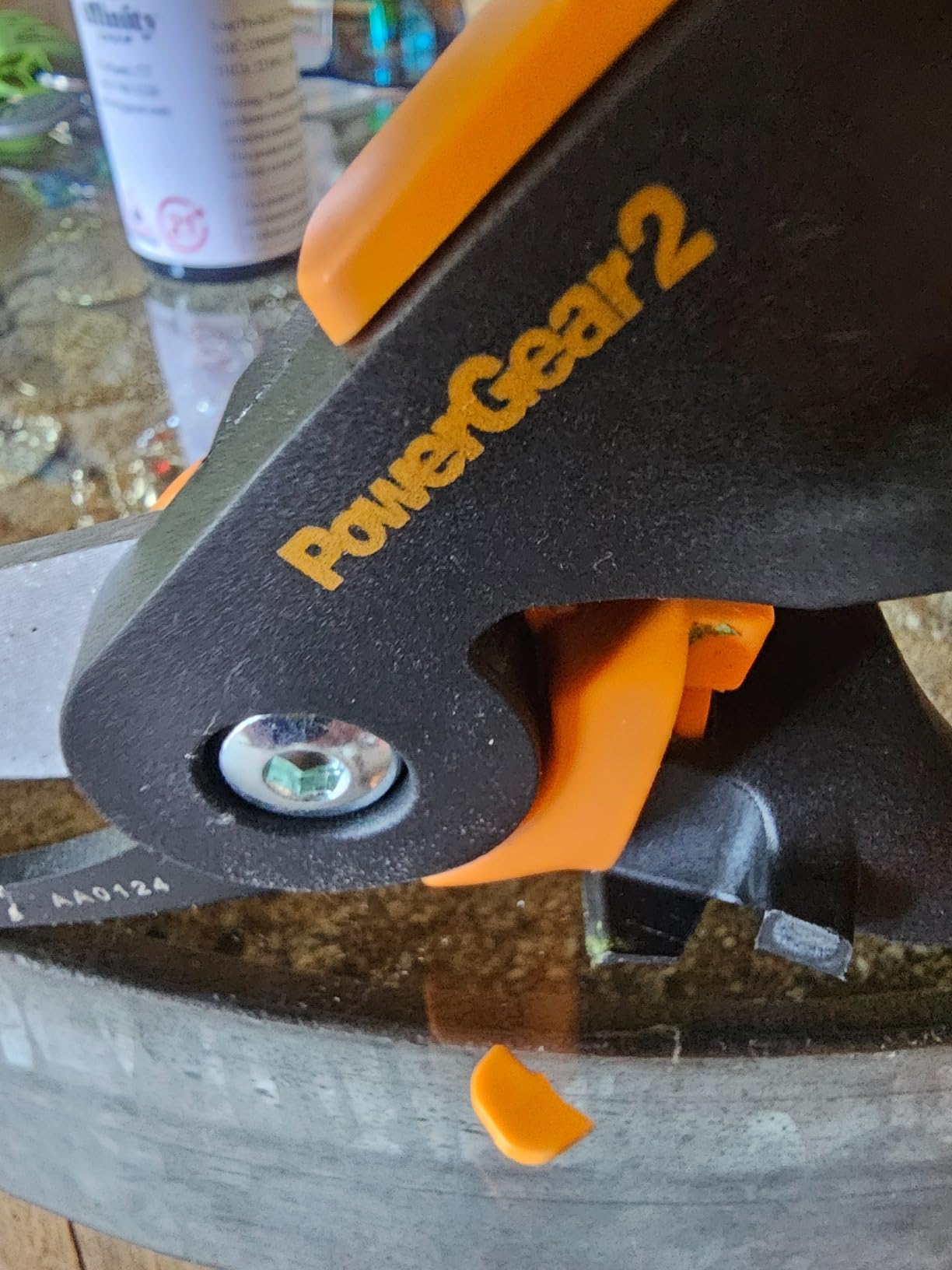
PowerGear2 puts a gear between your hand and the blade, and the modified gearing concentrates force through the toughest part of the branch rather than wasting it. Users recovering from hand injuries or arthritis credit the linkage with making pruning possible again, which is the same claim I make for ratchets with one big difference: you still get a single-stroke scissor cut.
The contoured rolling handle follows the natural arc of the hand instead of fighting it, so force arrives along the line your fingers already want to move. At 8.8 ounces it is not the lightest here, but the weight is doing structural work rather than simply existing.
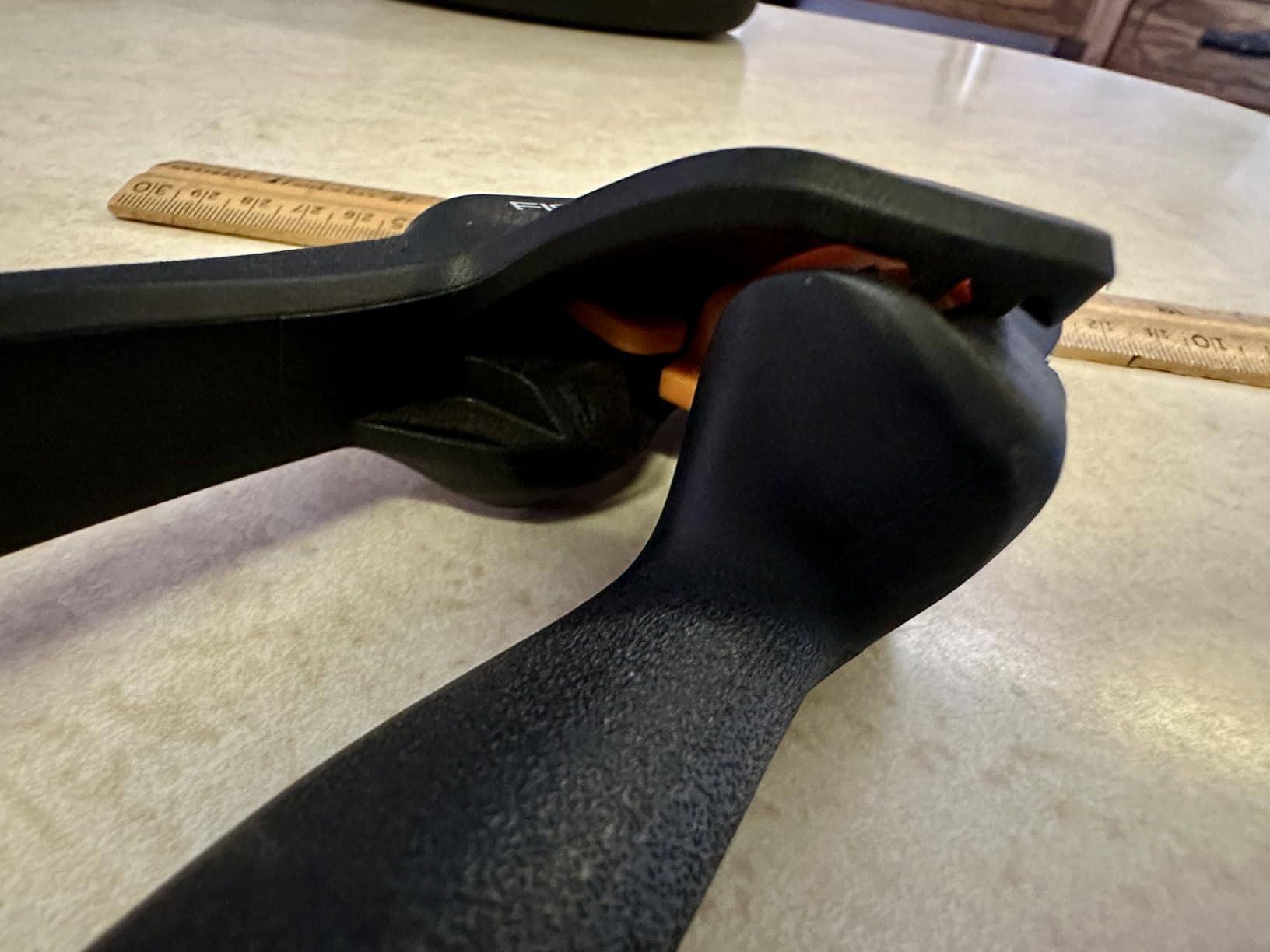
The fully hardened bypass steel blades carry a low-friction coating that resists sap and gumming, which matters when a mechanism has more surfaces that can catch debris. Lifetime warranty coverage rounds out a design clearly built to be kept for a long time.
The downside is mechanical rather than ergonomic, and owners are candid about it. The pivot joint can loosen with use and the gear box will jam if plant debris is not cleaned out, so a quick wipe and a check of the pivot after a season is the maintenance this tool asks for.
Who the PowerGear2 suits well
It suits gardeners who want a single-stroke pruner that still handles 3/4-inch stems and who dislike ratchet tools as slow. For mixed pruning, this is the design that feels most like a familiar pair of shears while doing less work per stroke.
The rolling handle is a good match for wrist that already hurts, because the handle rotates with the hand rather than requiring you to rotate the wrist around the handle.
Who should pick something else
If your grip is severely limited, a gear multiplies force but still asks you to close the handles each time, so a ratchet option is easier. Anyone cutting branches over 3/4 inch will need a different tool, and buyers report real-world performance closer to half an inch on thicker stems.
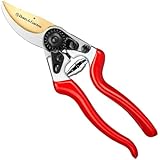
10. Haus and Garten EnduroPRO Bypass Pruners: Best Ergonomic Bypass
- Excellent cutting power for both woody and delicate stems
- Rubber grips hold their friction when wet
- Bypass blade angle gives visibility in tight spots
- Blades arrive sharp and resist dulling
- Secure one-handed lock
- Costs noticeably more than budget big-box pruners
- Listed sizing skews toward medium-to-large hands
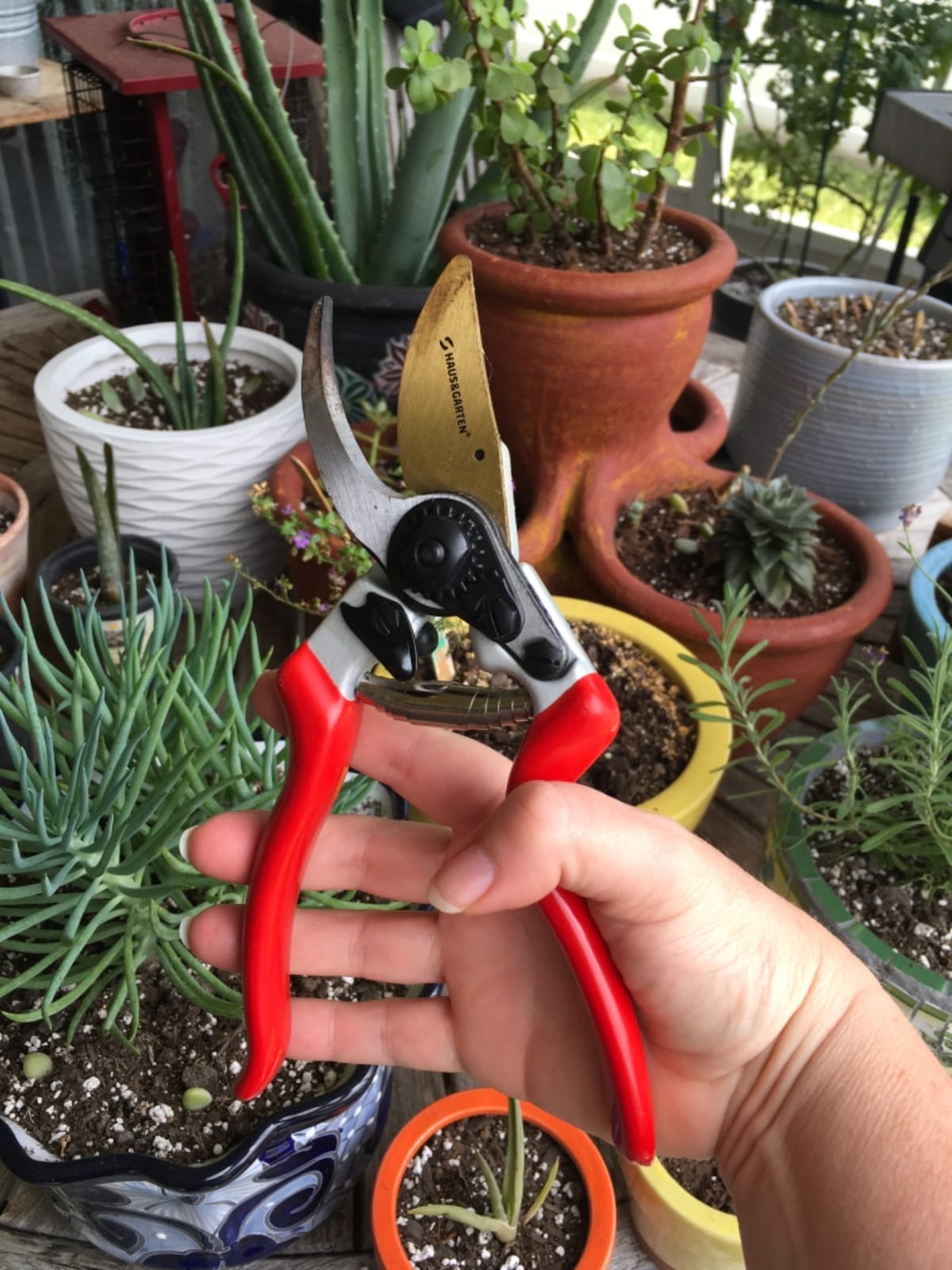
The EnduroPRO is the tool I recommend when someone wants a conventional bypass pruner and their issue is wrist posture rather than raw squeezing power. The handle is deliberately aligned to reduce wrist strain, so the cut comes from the arm and shoulder rather than from twisting at the carpals.
Owners with carpal tunnel and small hands single out the ergonomic grips and the blade leverage, and reviewers who replaced cheaper rusting or dulling pruners describe this as a long-term purchase that outlasted several budget tools. That is the specific claim I wanted to check, and the review pattern supports it.
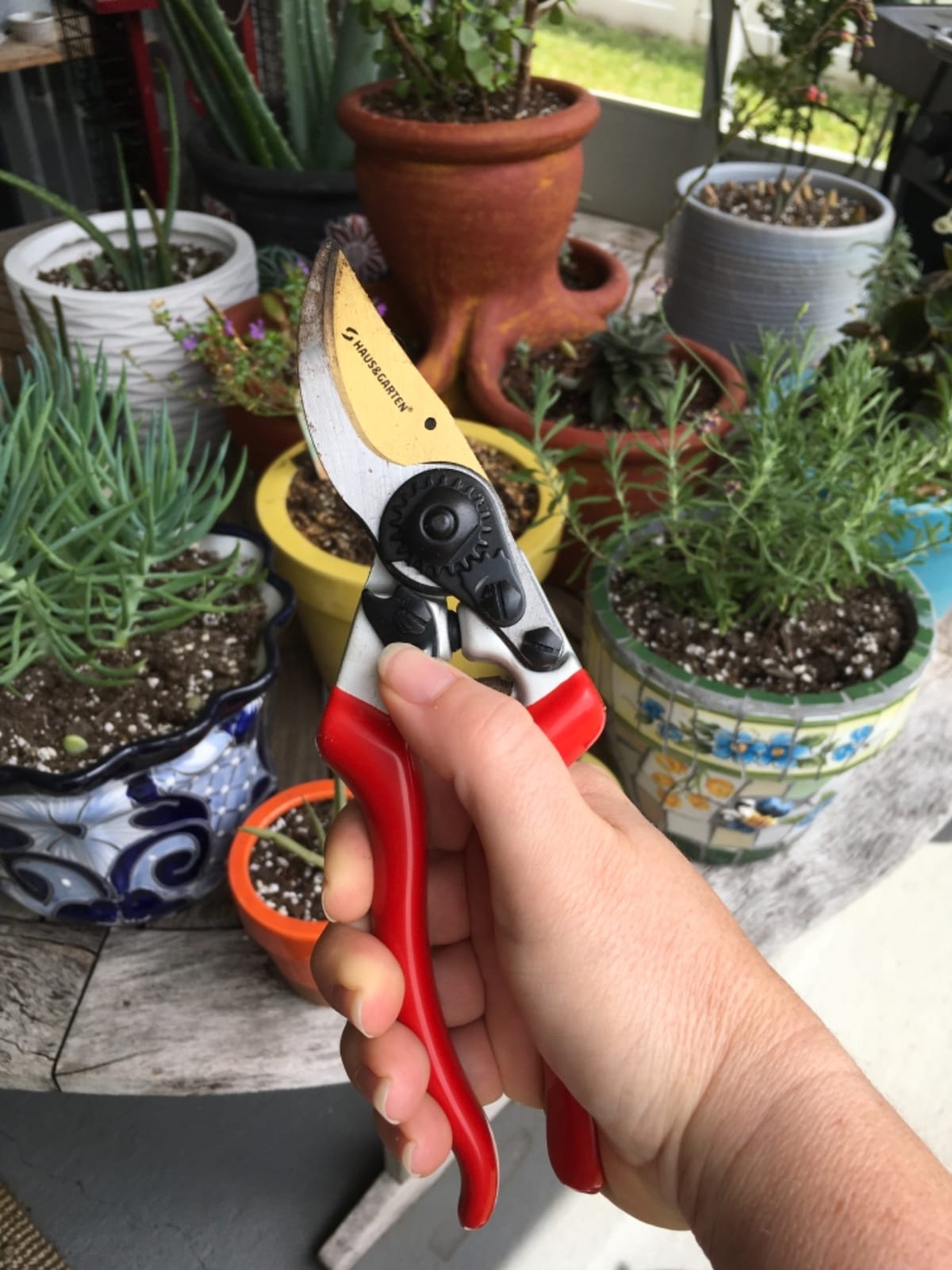
Japanese-grade high-carbon steel blades are heat treated and titanium coated to reduce friction and rust, and the bypass angle gives you a clear line of sight to the cut, which makes it pleasant on crowded shrubs where you cannot see what the blade is doing.
The drop-forged handles and anodized aluminum body are the reason this tool still feels tight after years, and 1-inch capacity covers most shrub and rose work. The red anti-slip soft grips are ambidextrous and hold friction when wet, which is a real difference on a damp spring morning.
Who the EnduroPRO suits well
It suits gardeners with wrist and thumb pain, particularly carpal tunnel, who want one capable pruner for everything from rose deadheading to woody shrub pruning. The 1-inch capacity and the leverage together mean you are not reaching for a second tool mid-task.
If you have been through two cheap pruners that rusted or dulled, this is the reasonable step up, and the corrosion-resistant coating means it will not repeat the cycle.
Who should pick something else
The listed sizing skews toward medium-to-large hands, so if your hands are genuinely small you should confirm the fit before committing, and one of the adjustable or compact options may serve better. It also costs noticeably more than budget big-box pruners, so if cost is the deciding factor the Fiskars SoftGrip covers the same job.
How to Choose Shears for Weak Hands
Measure first, buy second. Almost every pruner that disappoints a gardener with arthritis fails on fit, not on quality, and the fit takes thirty seconds to check.
Measure your grip span. Open your hand fully and measure the widest distance between your thumb tip and little finger tip. That span is the maximum comfortable handle opening you want, and you should look for a pruner whose open handles fall at or just below it. If your measurement sits under about 3 inches, skip tools listing medium-to-large sizing and focus on compact frames or adjustable handles such as the VOTREK.
Test the handle in the shop of your own kitchen. If you can order without opening a box, wrap your grip around the closed handles and check three things. The palm should fill the handle rather than perch on the end of it, the web between thumb and index finger should not be pinched when you close halfway, and your wrist should stay straight rather than bending outward to reach the blade.
Weight matters more than people expect. Everything above 9 ounces starts to tell on a hand that tires at twenty minutes, and the difference between the heaviest and lightest tools in this roundup is nearly 3 ounces carried for an entire session. Lightweight aluminum or plastic-handled pruners are the right call for flowers; forged alloy and steel bodies are worth the weight on woody work.
Match the mechanism to your grip strength, not your ambition. If you can close a standard pruner on a pencil-thin stem, geared or adjustable bypass pruners will serve you for years. If closing a normal pruner is painful, go straight to a ratchet model and accept the extra strokes. If your hands are good for a few minutes at a time and then swell, electric or ratchet-assisted tools are the honest answer, though electric triggers can be difficult with swollen fingers.
Consider your arthritis type. Osteoarthritis in the finger joints responds best to lighter tools with wide grips and low-friction finishes. Rheumatoid arthritis, where strength and stamina fluctuate, is best served by ratchet or geared designs so each stroke stays within your comfortable range. Carpal tunnel and de Quervain’s tenosynovitis are largely about wrist posture, so look for rolling or aligned handles and avoid designs that ask you to twist or pinch at the base of the thumb.
Check the warranty and the parts list before you buy. A tool that can be repaired is worth more over ten years than a cheaper tool that must be replaced, and arthritis is a progressive condition, so replacement frequency tends to rise. The Felco F8, Gardener’s Friend, Fiskars, and VOTREK all carry lifetime warranties, and Felco makes every component replaceable. Add a small holster to the budget so the tool is not left on a bench with an exposed blade.
Do not forget a left-hand alternative. If you are left-handed, check the hand orientation field before buying, and choose an ambidextrous model such as the Gardener’s Friend, the Gerossi, or the Fiskars SoftGrip. Left-handed users describe ambidextrous builds as a lifesaver, and it is the one specification that cannot be fixed later with tape or a return.
Sharpening, Cleaning and Storing Shears
A dull blade is the hidden reason so many gardeners with sore hands think they need a lighter tool. A blade that has gone dull crushes rather than cuts, which multiplies the force required, and the only real fix is a sharp edge.
Clean after every session. Sap and dirt act like glue on the pivot and, on geared and ratchet designs, inside the mechanism. Wipe blades with a damp cloth, then a dry one, and follow with a light film of oil on the pivot point. A pruner with an enclosed spring needs this less than others, which is one advantage of that design.
Disinfect between plants when disease is a concern. Wipe both blades with isopropyl alcohol and let them dry fully before the next plant, especially when moving between rose bushes or fruit trees. This takes a minute and prevents transferring plant pathogens through a tool you use on everything.
Sharpen on a stone or hone, not a file, and keep the angle consistent with the factory edge. Take it slowly with a diamond hone, remove only a little metal, and clean the burr away afterward. Sharpen with the blade removed where the design allows it, since the Felco micrometric adjustment makes this straightforward.
Store closed and locked, off the ground, in a dry location. Leave the lock engaged or use a holster so a tool with an exposed heavy blade is never reachable by children. Spring tension is the part people forget, so if a pruner starts opening slowly, a drop of oil on the spring usually restores it before you go shopping for a replacement.
Frequently Asked Questions
Are ratchet pruners good?
Ratchet pruners are one of the most reliable options for arthritic hands because they break one hard cut into two or three easy squeezes, so peak hand force is never required. A permies.com gardener with hand trouble described ratcheting clippers as making it so much easier to cut anything. The trade-off is speed, and anvil-style ratchets can crush soft green stems, so keep them for woody growth.
What pruning shears are best for small hands?
Pruners with adjustable handle span fit small hands best, because a thumb slider lets you set the opening to your actual grip rather than accepting the manufacturer’s sizing. Compact bypass frames under 8 inches also help. If your hands swell during flares, adjustable beats fixed, and if you prefer a fixed design, measure the distance between your thumb and little finger at full stretch and match it to the open handle width.
Are bypass or anvil pruners better for arthritic hands?
Bypass pruners make the cleanest cut on live stems because two curved blades slide past each other, but they ask you to squeeze both blades together, which is harder for stiff fingers. Anvil pruners send one blade onto a flat surface, so you push instead of squeezing, and many gardeners with arthritis find that easier. Choose bypass for flowers and fruit, anvil for dead, dry wood.
Do electric pruning shears help arthritis?
Electric pruning shears can help, because a motor supplies the cutting force and you only press a trigger instead of building pressure. Reviews on gardening forums describe cordless electric pruners as worth it for significant pruning work. Two cautions: a trigger can be hard to operate with swollen fingers, and battery life is typically limited to a couple of hours, so they suit planned sessions rather than light daily touch-ups.
What gardening tools are best for seniors with arthritis?
For most seniors, the shortlist is a ratchet or geared hand pruner for woody stems, a lightweight bypass pruner for flowers and herbs, padded loppers for branches up to 1.5 inches, and long-handled tools that let you work without bending. Add a pair of cushioned gloves, keep blades sharp so less force is needed, and pace sessions with rest breaks during flare-ups rather than pushing through.
Final Thoughts
The best pruning shears for arthritic hands come down to one question: how much force can you produce in a single squeeze. If the answer is little, buy a ratchet and accept the extra strokes, which is why The Gardener’s Friend earns its place for anyone with severe RA or a bad flare. If the answer is moderate and you want normal-feeling scissors, the Felco F8 gives you a wide forged handle, a carbon steel blade, and a lifetime warranty on parts you can still replace in ten years.
For lighter everyday work, the Fiskars SoftGrip at under 6 ounces is hard to argue with, and the VOTREK’s adjustable handle is the smartest answer for small hands or hands that change week to week. Whichever one you pick in 2026, measure your grip span first, keep the blade sharp, and buy the loppers at the same time, because no hand pruner should be asked to do a branch cutter’s job.