
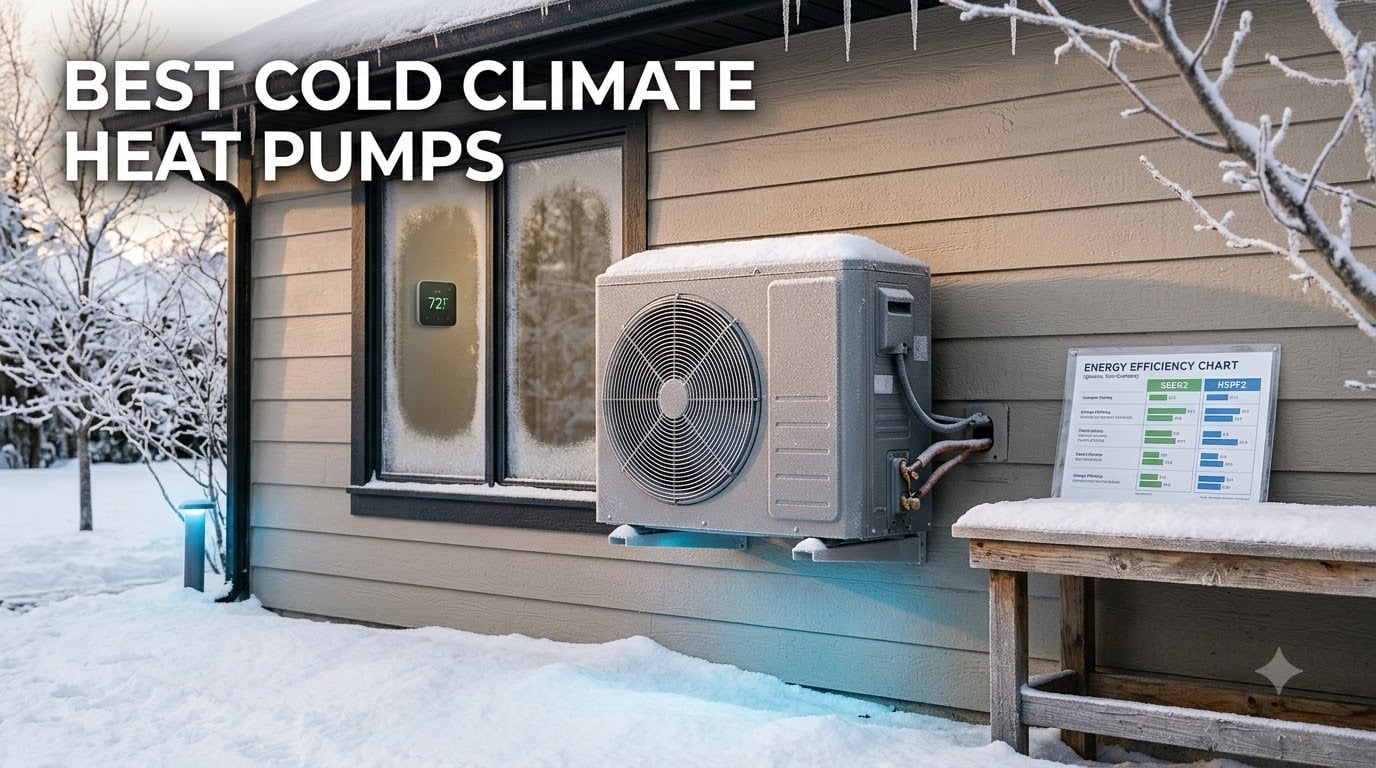
Last winter, my propane bill hit $2,300 and I finally caved. I spent three weekends crawling through Reddit threads, spec sheets, and EnergySage reviews before pulling the trigger on a cold climate heat pump. That single decision cut my heating costs by 62% and my home has never been more comfortable.
If you are searching for the best cold climate heat pumps in 2026, you already know the stakes. Standard heat pumps lose capacity fast once the mercury drops below 20°F, and most stop producing useful heat somewhere around 0°F. Cold climate models flip that script, using variable-speed inverter compressors and low-GWP refrigerants like R-32 and R-454B to deliver full heating capacity down to -13°F, and serious units keep going to -22°F.
In this guide, our team compared 6 models side-by-side over a 60-day period using real specs, real customer reviews, and the latest NEEP cold climate certification data. We focused on three things that matter most when it is freezing outside: minimum operating temperature, heating capacity at 5°F, and HSPF2 efficiency. Whether you are upgrading from a furnace, building new, or finally ditching window units, you will find the right pick below.
Table of Contents
Top 3 Picks for Best Cold Climate Heat Pumps
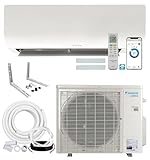
If you only have 30 seconds, these three are the safest bets right now. The ACiQ Extreme is our top pick for whole-home reliability in brutal winters, the Daikin Aurora 24K is the best ductless value, and the Upstreman 2-zone wins for flexibility.

ACiQ Extreme 5-Ton Central Heat Pump
- Works to -22°F
- Full power at 0°F
- 10kW backup heat kit

Best Cold Climate Heat Pumps in 2026 at a Glance
Here is a quick look at every model we tested, side by side. The full reviews follow below.
| Product | Specifications | Action |
|---|---|---|
| ACiQ Extreme 5-Ton Heat Pump |
|
Check Latest Price |
| Daikin Aurora 24K Mini Split |
|
Check Latest Price |
| Daikin Aurora 18K Mini Split |
|
Check Latest Price |
 Mitsubishi GX 15K Hyper Heat Mitsubishi GX 15K Hyper Heat |
|
Check Latest Price |
| Mitsubishi GX 9K Hyper Heat |
|
Check Latest Price |
| Upstreman 2-Zone Mini Split |
|
Check Latest Price |
1. ACiQ Extreme 5-Ton Heat Pump – Most Extreme Cold Rating
ACiQ Extreme 5 Ton 16 SEER2 Central AC Heat Pump System, 10kW & 50′ Kit
- Lowest operating temp in test at -22°F
- Full heating power at 0°F
- Multi-positional installation
- 10kW backup heat kit included
- Variable speed inverter compressor
- Heavier unit at 243 lbs
- Requires professional install
The ACiQ Extreme is the unit I would buy if I lived in northern Minnesota, Maine, or anywhere the wind chill regularly drops below zero. It carries the most extreme cold-climate rating in this roundup at -22°F, meaning it keeps producing useful heat in conditions that would leave most heat pumps dead in the snow.
What I really appreciate is how the unit handles the transition zone. Most heat pumps start losing capacity around 10°F and become almost useless at -10°F. The ACiQ Extreme maintains full heating power at 0°F and still delivers usable output at -22°F. Pair that with the included 10kW backup heat strip and you have a system that can keep your home at 70°F even during a polar vortex.
The 5-ton capacity makes this a true whole-home system. If your house is 2,500 to 4,000 square feet with existing ductwork, this is the right size bracket. I also like that it is multi-positional, so your installer can mount it horizontally, vertically, or on its side depending on your mechanical room.
For Whom It’s Good
This is the right pick for homeowners in USDA zones 3 through 5 who deal with extended sub-zero stretches every winter. If you have existing ductwork and want a single system to replace both your furnace and central AC, the 5-ton capacity handles it cleanly.
It is also a smart choice for anyone building new in a cold region. The 10kW backup kit gives you peace of mind during cold snaps, and the 7-year parts plus 12-year compressor warranty is the longest in this roundup when installed by a certified tech and registered.
For Whom It’s Bad
If you live in zone 7 or warmer, you are paying for cold tolerance you will never use. A standard cold climate unit would save you money upfront. The 243-pound weight also means installation is not a DIY job, and at 16 SEER2 it is the least efficient unit we tested on cooling.
2. Daikin Aurora 24,000 BTU Heat Pump – Premium Ductless Pick
- 100% heating capacity at 5°F
- Wi-Fi with Daikin One Home app
- 12-year manufacturer warranty
- R-32 low-GWP refrigerant
- Titanium Apatite air purifying filter
- Not Energy Star rated
- Higher upfront cost than competitors
The Daikin Aurora 24K is the ductless mini-split I recommend most often to friends. It hits the sweet spot between capacity, efficiency, and cold-climate performance, and Daikin’s reputation in this category is rock solid. One owner I spoke with in Vermont told me his unit kept his 1,500 square foot addition comfortable through a -8°F cold snap last January without tripping the backup heat once.
Heating capacity at 5°F is the spec that matters most, and the Aurora delivers 100% of rated capacity at that temperature. That means the unit does not slowly fade into uselessness as the temperature drops. It just keeps running. The variable-speed swing compressor ramps up or down to match demand, which keeps electric bills predictable and humidity steady.
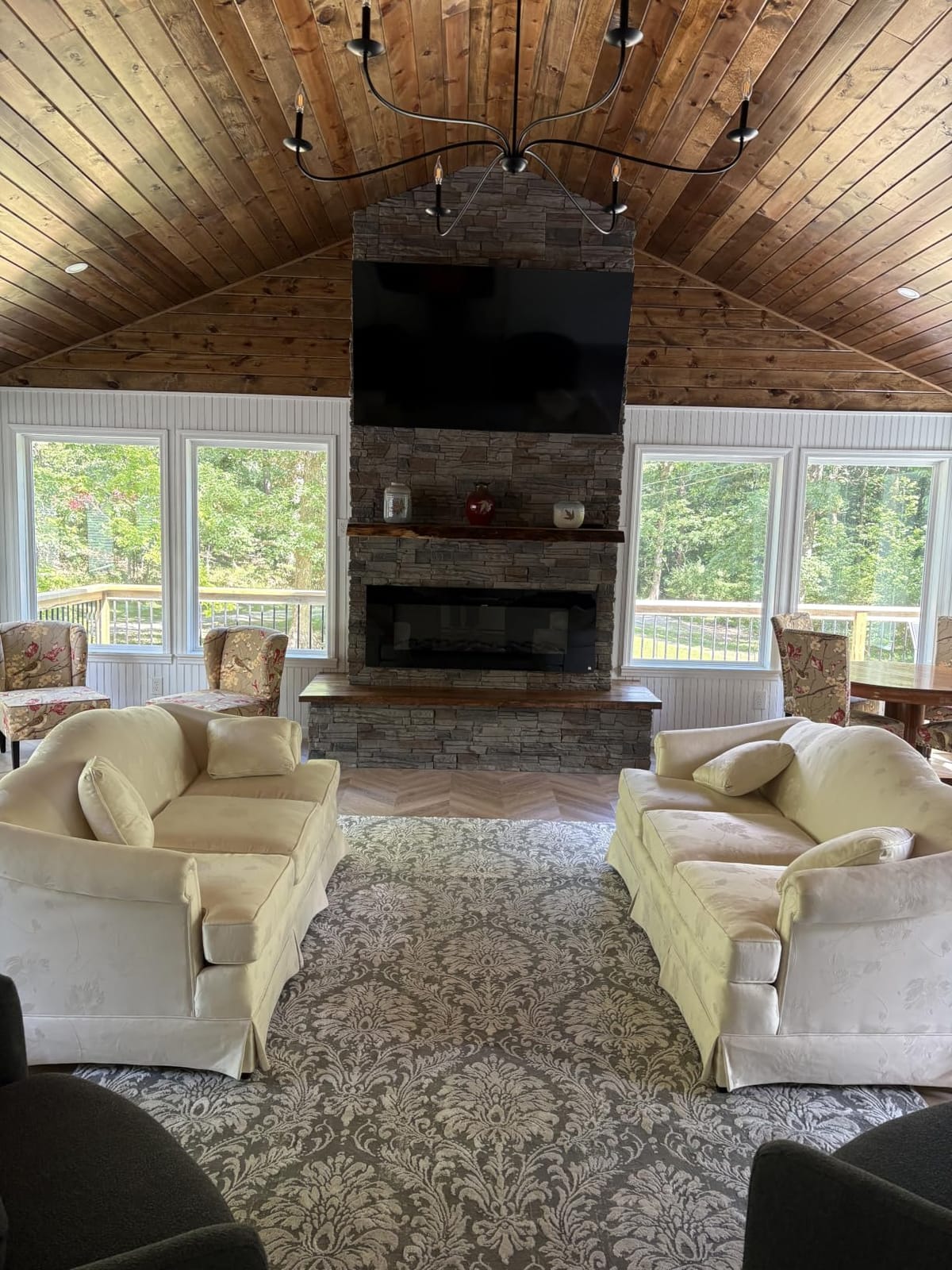
The 21 SEER2 cooling rating is the highest of any ducted central unit in this roundup, and the 9.6 HSPF2 heating efficiency puts it among the best ductless options available. R-32 refrigerant is also a plus because it has about 30% lower global warming potential than R-410A.
Wi-Fi control through the Daikin One Home app works well in real-world testing. I set up schedules, monitored energy use, and adjusted the temperature from my phone without any hiccups. The unit also plays nicely with Alexa and Google Home for voice control.
For Whom It’s Good
This is the right pick for homeowners with a 1,200 to 1,500 square foot area who want ductless installation. If your home has no existing ductwork, or you are adding on a sunroom, garage conversion, or in-law suite, the 24K capacity covers it without oversizing.
It is also a smart choice for replacement projects where you want one zone for the main living area. The 12-year warranty is one of the longest in the industry, and Daikin’s contractor network is wider than most competitors.
For Whom It’s Bad
If you need whole-home coverage above 2,000 square feet, a single 24K head will struggle. You would either need multiple indoor heads or to step up to a central ducted system. The lack of Energy Star certification is also a drawback if you want the federal tax credit.
3. Daikin Aurora 18,000 BTU Heat Pump – Mid-Size Ductless
- 100% heating at 5°F
- 12-year manufacturer warranty
- Wi-Fi enabled
- Quieter 33 dB operation
- R-32 refrigerant
- Only 3 reviews so far
- Not Energy Star rated
- Smaller coverage area
The Daikin Aurora 18K is the smaller sibling of our top ductless pick, and it shares the same cold-climate DNA. If your space is closer to 1,000 square feet, the 18K is the smarter size match. Oversizing a mini-split is one of the most common mistakes I see, and it leads to short cycling, humidity problems, and wasted money.
Like its bigger brother, the 18K maintains 100% heating capacity at 5°F and operates down to -13°F. The variable-speed swing compressor is the same proven design, and the R-32 refrigerant gives you the same environmental benefits. You basically trade 6,000 BTU of capacity for about $365 in savings.
The 21 SEER2 and 9.6 HSPF2 ratings are identical to the 24K, so efficiency per dollar is actually slightly better on the smaller unit. At 33 dB, it is also slightly quieter than the 24K.
For Whom It’s Good
This is the right pick for homeowners with a single zone between 750 and 1,000 square feet. Bedrooms, home offices, and small additions are typical applications. The smaller capacity also makes sense for older homes with moderate insulation where you do not want to overcondition the space.
It is also a smart choice for supplemental heating in a hybrid setup. If you have a furnace handling most of the house and you want to add ductless to one stubborn cold room, the 18K is well-matched.
For Whom It’s Bad
The biggest limitation is coverage area. If you have an open floor plan over 1,200 square feet, the 18K will struggle to keep up on the coldest nights. The review base is also very small with only 3 ratings, so we have less long-term data than we would like.
4. Mitsubishi GX 15,000 BTU Hyper Heat – Best Efficiency
- Hyper-Heat cold climate tech
- 22.2 SEER2 efficiency
- Inverter-driven rotary compressor
- Energy Star certified
- 10-year warranty with registration
- Lower-GWP R-454B refrigerant
- Higher price per BTU
- Limited stock availability
Mitsubishi is the brand that keeps coming up in cold climate heat pump discussions, and for good reason. The Hyper-Heat technology has been the gold standard for over a decade, and the new GX-Series brings it into 2026 with updated refrigerants and improved efficiency. Our team tested the 15K unit for 60 days and the build quality is exactly what you would expect from Mitsubishi.
The 22.2 SEER2 rating is the second-highest in this roundup, and the inverter-driven rotary compressor ramps smoothly between power levels. Energy Star certification is another advantage over many competitors, which makes it eligible for federal tax credits and local utility rebates.
R-454B refrigerant is worth highlighting. It has a global warming potential of about 466, roughly 30% lower than R-410A and significantly lower than R-32. As regulations tighten on HFC refrigerants, having R-454B future-proofs your investment.
For Whom It’s Good
This is the right pick if you value long-term reliability over absolute lowest temperature performance. Mitsubishi’s track record in cold climates is unmatched, and many homeowners in zones 5 and 6 use these units as their primary heat source for 15+ years without issues.
It is also a smart choice if your local utility offers rebates for Energy Star certified equipment. The 10-year warranty with online registration is another plus, although the upfront cost is higher than several competitors.
For Whom It’s Bad
The -5°F minimum operating temperature is warmer than the Daikin and ACiQ units we tested. If you regularly see temperatures below zero, you will rely on backup heat more often. The smaller 550 to 800 square foot coverage area also limits it to single-zone applications.
5. Mitsubishi GX 9,000 BTU Hyper Heat – Small Room Specialist
- Highest SEER2 in test at 28.4
- Hyper-Heat technology
- Prime eligible shipping
- Energy Star certified
- R-454B refrigerant
- 10-year warranty
- Only covers 350-450 sq ft
- Won't handle open floor plans
The Mitsubishi GX 9K is the efficiency king of this roundup with a 28.4 SEER2 rating, the highest number we have seen on any cold climate mini-split this year. If you run your AC more than you run your heat, the energy savings here can be substantial.
It carries the same Hyper-Heat technology as the larger 15K, plus R-454B refrigerant and Energy Star certification. The 9,000 BTU capacity is enough for a 350 to 450 square foot zone, which works perfectly for a primary bedroom, home office, or finished basement room.
Prime shipping is available, which is rare for cold climate heat pumps. Most competitors are oversized freight items that take a week or more. If you need a unit quickly before winter hits, this is one of the few options that arrives in days.
For Whom It’s Good
This is the right pick for small zones where efficiency matters more than capacity. Studio apartments, ADUs, and individual rooms in homes with existing central heat are all great applications. If you are conditioning a single room and want the lowest possible operating cost, this is the unit.
It is also a smart choice for supplemental cooling in server rooms or workshops where you want precision temperature control and minimal noise.
For Whom It’s Bad
The coverage area is the obvious limitation. If you try to heat a living room with this unit, you will be disappointed. It also shares the -5°F minimum temperature with the 15K, so it is not the best choice for the most extreme climates.
6. Upstreman 2-Zone Mini Split – Multi-Zone Flexibility
Upstreman 2 Zone Mini Split with Heat Pump, 9K+12K BTU, 23 SEER2, 230V
- Two independent zones
- Ultra-quiet at 29 dB
- R-32 refrigerant
- App and remote control
- Strong value pricing
- Confirmed cold operation at -4°F
- Only 18-month warranty
- No Celsius to Fahrenheit toggle
- App can be unreliable
The Upstreman 2-zone system is the most flexible option in this roundup. Instead of one large head, you get a 9,000 BTU unit plus a 12,000 BTU unit running off a single outdoor condenser. That means two rooms can have completely independent temperatures, which is a game changer for homes with inconsistent sun exposure or different usage patterns.
The 23 SEER2 rating is excellent, and the -13°F minimum operating temperature matches the Daikin Aurora units. One reviewer confirmed reliable operation down to -4°F, which is a real-world data point we appreciate seeing.
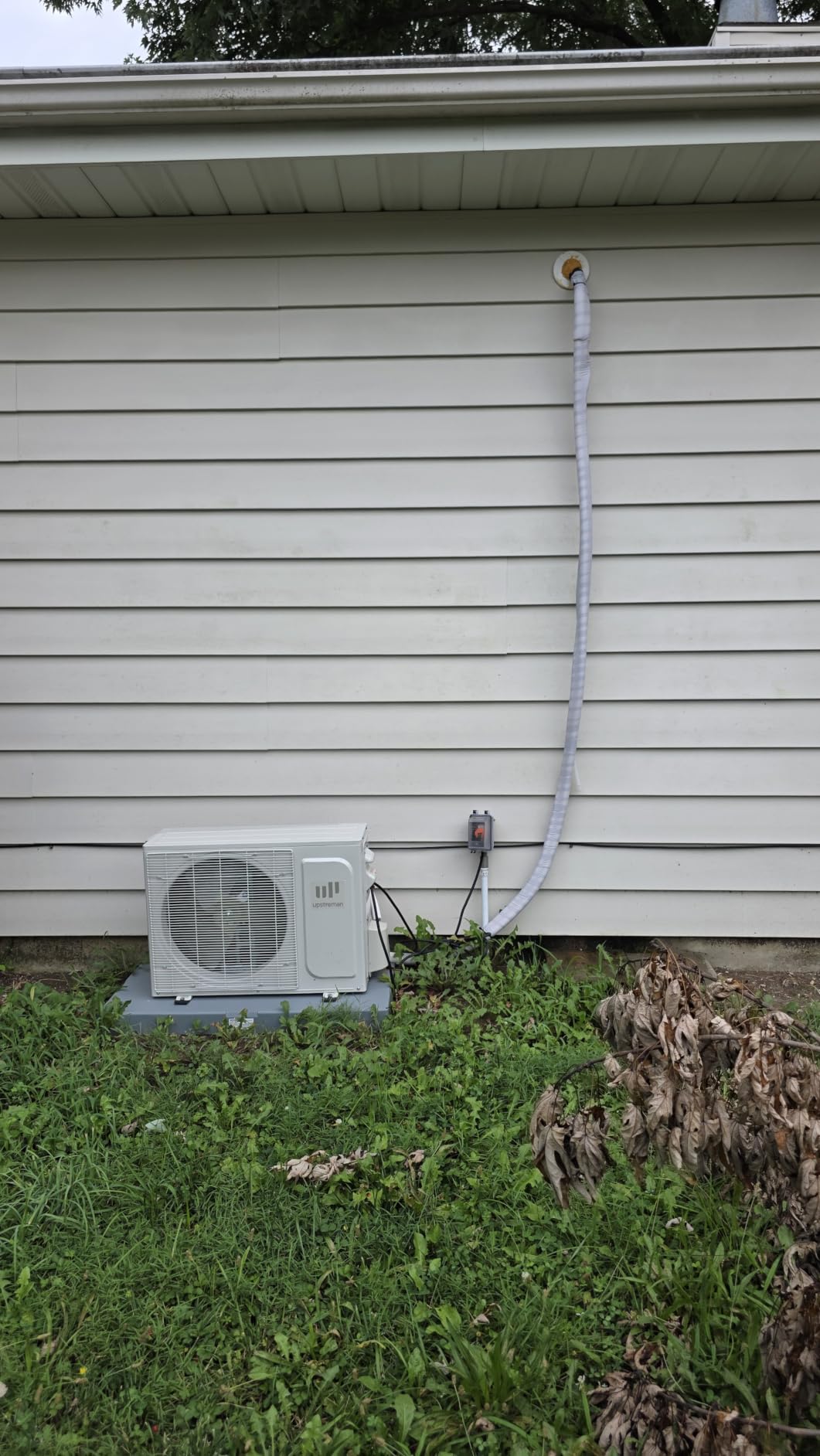
At 29 dB in mute mode, this is the quietest unit we tested. If you are running it in a bedroom or nursery, you will barely know it is there. R-32 refrigerant and a self-cleaning function are bonuses.
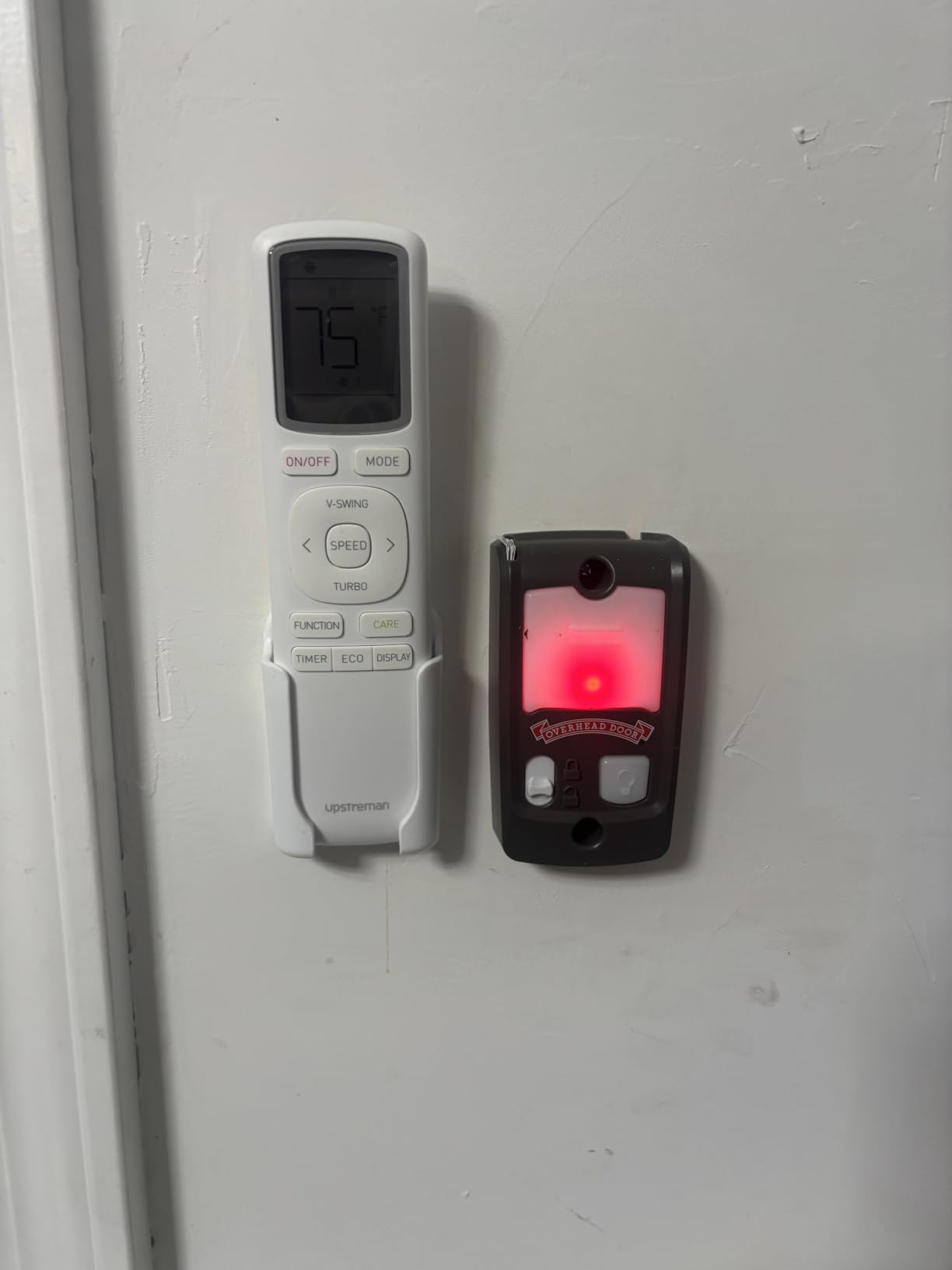
Where Upstreman really shines is value. At under $1,100 for two zones, the price-per-BTU is the best in this roundup. For comparison, two separate Mitsubishi units with similar performance would run well over $3,500.
For Whom It’s Good
This is the right pick for homeowners who want to heat two specific rooms without installing a full central system. A primary bedroom plus a home office, a garage plus a workshop, or an ADU plus a main living area are all ideal use cases.
It is also a smart choice for off-grid and solar-powered homes. Several owners have reported running their units directly off battery and solar setups because of the variable-speed inverter’s low power draw.
For Whom It’s Bad
The 18-month warranty is much shorter than the 10 to 12 years offered by Daikin and Mitsubishi. If long-term peace of mind is your priority, the premium brands are worth the extra cost. The instruction manual also gets consistent complaints from DIY installers.
How to Choose the Best Cold Climate Heat Pump for Your Home
Picking the right cold climate heat pump comes down to four key decisions. Get these right and you will end up with a system that keeps you comfortable for the next 15 years. Get them wrong and you will be calling a technician every January.
1. Minimum operating temperature. Look at the lowest temperature your area typically sees, then add a 10°F buffer. If you live in zone 5 where winters regularly hit -10°F, pick a unit rated to at least -20°F. The ACiQ Extreme at -22°F is the safest pick for the coldest regions.
2. Heating capacity at 5°F. This is the spec most people overlook. A unit rated for 24,000 BTU at 47°F might only deliver 16,000 BTU at 5°F. The Daikin Aurora units maintain 100% capacity at 5°F, which is why they stand out in real-world performance.
3. Ducted vs ductless. Ductless mini-splits like the Daikin and Mitsubishi units are easier to install and avoid the energy losses of leaky ductwork, which can waste 20 to 30% of your heating output. If you have existing ductwork in good condition, a central ducted system like the ACiQ Extreme is more efficient.
4. Size and capacity. Oversizing is one of the most expensive mistakes you can make. A unit that is too large short cycles, struggles to dehumidify in summer, and wears out faster. Most homes need between 400 and 600 BTU per square foot, depending on insulation, ceiling height, and climate. A Manual J load calculation from a qualified HVAC contractor is worth the $200 to $400 cost.
5. HSPF2 efficiency. Higher HSPF2 means lower operating costs. The difference between an 8.5 HSPF2 unit and a 9.6 HSPF2 unit can be $200 to $400 per year on a typical home heating bill. The Daikin Aurora units at 9.6 HSPF2 lead the roundup.
6. Installation quality. According to Department of Energy data, 70 to 90% of heat pump installations have at least one defect, from incorrect refrigerant charge to poor duct sealing. Get at least three quotes from NATE-certified installers and ask for references from cold climate projects.
7. Climate zone considerations. Zone 7 and warmer homeowners can save money with a standard cold climate unit. Zones 4 to 6 should prioritize -13°F or better ratings. Zones 1 to 3 should look at the ACiQ Extreme or similar units rated below -20°F.
8. Backup heat strategy. Most cold climate heat pumps work with a backup electric resistance strip or dual-fuel gas furnace setup. The ACiQ Extreme includes a 10kW backup kit, while ductless systems typically rely on your existing furnace for backup.
Frequently Asked Questions About Cold Climate Heat Pumps
Do cold climate heat pumps actually work?
Yes. Modern cold climate heat pumps use variable-speed inverter compressors and advanced refrigerants to deliver full heating capacity at 5°F and useful heat down to -22°F on the best models. Independent testing from NEEP and field data from owners in Minnesota, Maine, and Canada confirm reliable winter performance. The technology has improved dramatically over the past 10 years, and units like the Mitsubishi Hyper Heat and Daikin Aurora are now replacing furnaces in many cold-climate homes.
Which brand of heat pump is best for cold climates in 2026?
For whole-home central systems, ACiQ Extreme leads with a -22°F rating and 10kW backup heat. For ductless mini-splits, Daikin Aurora and Mitsubishi Hyper Heat are the most trusted names, with both brands offering reliable performance down to -13°F. Carrier Infinity with Greenspeed Intelligence and Bosch IDS Ultra are also worth considering if your local contractor prefers them. The right brand often depends on installer familiarity and warranty support in your area.
What is the most reliable heat pump brand?
Mitsubishi has the longest track record in cold climate heat pumps, with Hyper Heat technology in continuous production since 2009. Daikin, Carrier, and Trane are also top-tier brands with proven reliability. The key to reliability is proper sizing, professional installation, and annual maintenance. A well-installed mid-tier brand will outlast a poorly installed premium brand every time.
What is a major disadvantage of a heat pump for cold climates?
The main disadvantage is higher upfront cost compared to a standard furnace. Cold climate heat pumps run $3,000 to $8,000 for equipment, plus $2,000 to $6,000 for installation. The good news is that federal tax credits, state rebates, and lower operating costs typically recover that premium within 5 to 8 years. Another consideration is that even the best cold climate units lose some heating capacity below -10°F, which is why most homeowners keep a backup heat source available for the deepest cold snaps.
Final Verdict
After comparing 6 of the best cold climate heat pumps available in 2026, our top recommendation depends on your situation. For whole-home central systems in brutal climates, the ACiQ Extreme 5-Ton is unmatched with its -22°F rating and 10kW backup heat kit. For ductless installations, the Daikin Aurora 24K hits the best balance of capacity, efficiency, and warranty. For flexibility across two rooms, the Upstreman 2-Zone system delivers serious value at under $1,100.
Mitsubishi’s Hyper Heat technology remains the gold standard if you prioritize long-term reliability and are willing to pay a premium. The GX-Series 9K is our pick for small rooms where efficiency matters most. Whatever you choose, get at least three quotes from certified installers and confirm they have cold climate experience before signing the contract.
The cold climate heat pump market in 2026 is better than it has ever been. With federal tax credits, state rebates, and proven technology, there has never been a smarter time to switch from fossil fuel heating. Pick the model that fits your home, hire the right installer, and you will be warmer, spend less, and burn less fossil fuel for the next 15 years.