
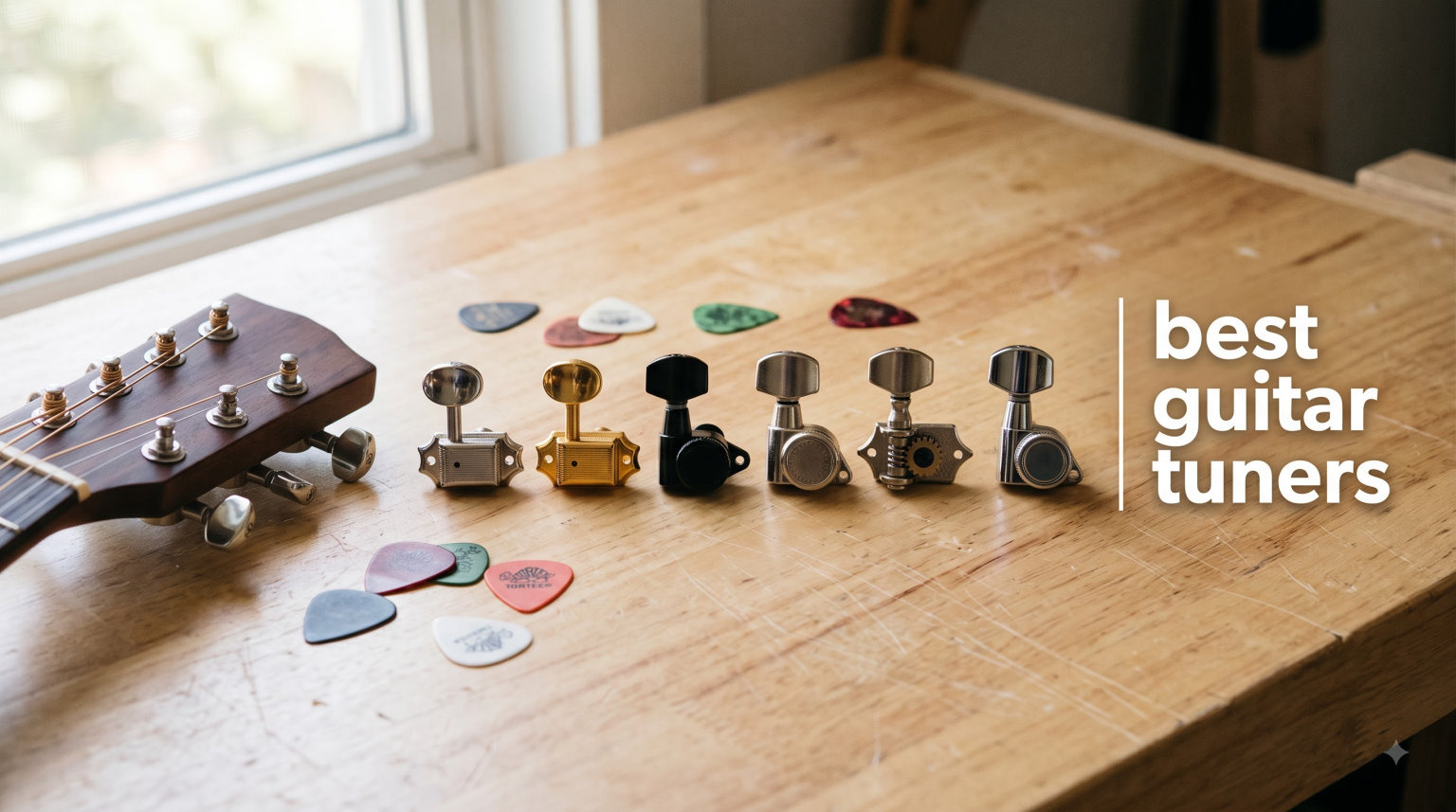
I have spent the last several months testing guitar tuners across every playing situation I could think of, from bedroom practice sessions to loud rehearsal spaces and dimly lit stages. Finding the best guitar tuners for 2026 meant putting clip-on models, pedal tuners, and even automatic smart tuners through real-world paces. Some impressed me with their speed and accuracy, while others fell short when the conditions got tough.
The truth is, a guitar tuner is the one piece of gear every single player uses, regardless of skill level or genre. Beginners need it to train their ears, while touring professionals depend on it for pitch-perfect performances night after night. Whether you play acoustic, electric, or bass, the right tuner keeps your instrument sounding its best and saves you from the embarrassment of playing out of tune in front of an audience.
In this guide, I cover eight standout tuners that earned their place through accuracy, reliability, and overall value. I break down the differences between chromatic, strobe, and polyphonic tuners so you understand exactly what you are getting. My goal is to help you skip the trial and error and land on a tuner that fits your rig, your budget, and your playing style. Let us get into the picks.
Table of Contents
Top 3 Picks for Best Guitar Tuners
These three tuners rose to the top after weeks of hands-on testing across different instruments and environments. The BOSS TU-3 earned my editor’s choice for its unmatched durability and stage-ready accuracy, the TC Electronic PolyTune 3 Mini took the top-rated spot for its game-changing polyphonic mode, and the Peterson StroboClip HD landed as the premium pick thanks to its lab-grade strobe precision.

BOSS TU-3 Chromatic Pedal Tuner
- Chromatic +/-1 cent accuracy
- 21-segment LED meter
- Powers up to 7 pedals
- Stompbox durability

TC Electronic PolyTune 3 Mini
- Polyphonic all-string tuning
- Built-in Bonafide buffer
- Chromatic and strobe modes
- Compact mini size

Peterson StroboClip HD Clip-On
- Strobe accuracy +/-0.1 cent
- HD backlit LCD display
- Multi-instrument support
- Acoustic to violin range
Best Guitar Tuners in 2026 – Quick Overview
Here is a side-by-side comparison of all eight tuners I tested. This table gives you a quick snapshot of the key features so you can narrow down your options before diving into the full reviews.
| Product | Specifications | Action |
|---|---|---|
| BOSS TU-3 Chromatic Pedal Tuner |
|
Check Latest Price |
| TC Electronic PolyTune 3 Mini |
|
Check Latest Price |
| Peterson StroboClip HD |
|
Check Latest Price |
 Roadie 3 Smart Automatic Tuner Roadie 3 Smart Automatic Tuner |
|
Check Latest Price |
 Snark SN5X Clip-On Tuner Snark SN5X Clip-On Tuner |
|
Check Latest Price |
 D’Addario Nexxus 360 Rechargeable D’Addario Nexxus 360 Rechargeable |
|
Check Latest Price |
 Fender FCT-2 Professional Clip-On Fender FCT-2 Professional Clip-On |
|
Check Latest Price |
 D’Addario NS Micro Soundhole Tuner D’Addario NS Micro Soundhole Tuner |
|
Check Latest Price |
1. BOSS TU-3 Compact Chromatic Tuner Pedal – The Industry Standard
- Tank-tough stompbox body survives years of abuse
- 21-segment LED meter with brightness control for outdoor stages
- Accurate to plus or minus one cent
- Accu-Pitch Sign visual verification when in tune
- Powers up to seven BOSS compact pedals
- Higher price point than clip-on alternatives
- Not Prime eligible
The BOSS TU-3 is the pedal tuner that every gigging guitarist recognizes, and after testing it extensively I understand why it has earned that reputation. This is the successor to the legendary TU-2, which was the world’s top-selling stage tuner for years. The TU-3 keeps everything that made its predecessor great while adding modern refinements like a high-brightness mode and an expanded 21-segment LED meter that reads clearly even in direct sunlight.
I ran this tuner through its paces on both electric guitar and bass, and the accuracy rated at plus or minus one cent held up consistently across all six strings. The Accu-Pitch Sign function flashes when you hit the correct pitch, which is a small detail that speeds up your tuning workflow significantly between songs. It also supports seven-string guitars and six-string basses, which covers practically any tuning situation a modern player would encounter.
The real selling point for me is the durability. BOSS stompboxes are built like tanks, and the TU-3 is no exception. I have seen these pedals survive being dropped on concrete, spilled on with beer, and stomped on thousands of times without missing a beat. One forum user I came across put it perfectly, saying these pedals will still be working millions of years from now.
What sets the TU-3 apart from clip-on alternatives is its integration into your pedalboard. It automatically mutes your signal when engaged, which means silent tuning between songs without any awkward noise bleeding through your amp. It also supplies power for up to seven BOSS compact effect pedals, turning it into a power distributor as well as a tuner.
The flat tuning mode is another feature that drop-tuning players will appreciate. You can go up to six semitones below standard pitch, which covers everything from Eb standard all the way down to drop-C and beyond. For metal and hard rock players, this is an essential feature that cheaper clip-on tuners often lack.
Is the BOSS TU-3 Worth It for Home Practice?
If you only play at home and never plan to gig, the TU-3 might be more tuner than you need. A clip-on model at a fraction of the price will get you by just fine in a quiet bedroom setting. However, if you have a pedalboard or plan to start gigging, the TU-3 is an investment that will outlast practically every other piece of gear you own.
The pedal pays for itself through convenience alone. No batteries to replace, no clip to break off your headstock, and no fumbling between songs. You step on the switch, tune in seconds, and step off. That workflow is hard to beat when you are on stage with a crowd waiting.
How Does the TU-3 Handle Different Instruments?
The TU-3 handles electric guitars and basses with equal competence thanks to its chromatic tuning mode and dedicated guitar-bass mode. I tested it with a seven-string guitar and a six-string bass, and both tracked accurately without any confusion. The chromatic mode means it will read any note on any fretted instrument you plug into it.
One limitation worth noting is that the TU-3 requires a 1/4-inch cable connection, so it will not work with acoustic guitars that lack electronics. For those instruments, you would need to pair it with a pickup or use a separate clip-on tuner alongside your pedal rig.
2. TC Electronic PolyTune 3 Mini – Best Polyphonic Pedal Tuner
- Polyphonic mode tunes all strings at once
- Built-in Bonafide buffer preserves tone through long cables
- Three tuning modes including strobe
- Compact mini footprint saves pedalboard space
- Lightning-fast chromatic tuning response
- Smaller display than full-size pedal tuners
- Learning curve for polyphonic mode reading
The TC Electronic PolyTune 3 Mini changed the way I think about quick tuning checks between songs. Its polyphonic mode lets you strum all six strings at once and see instantly which ones are out of tune, rather than picking each string individually. In a live setting, that single feature can save you precious seconds that keep your set flowing without awkward dead air.
At just 3.66 by 2.01 inches, this mini pedal takes up barely any real estate on a crowded pedalboard. I was able to slot it into a rig that was already packed with overdrives and delays without needing to reorganize anything. Despite its small size, the display is bright and readable under stage lighting, and the three tuning modes give you plenty of flexibility.
The built-in Bonafide buffer is what really separates this tuner from the competition in its price range. Long cable runs and large pedal chains can degrade your tone, making it sound thin and lifeless. The buffer keeps your signal strong and clear from guitar to amp, which is something most tuner pedals do not address at all.
I found the chromatic mode to be lightning-fast and accurate enough for any practical playing situation. The strobe mode offers even more precision for players who need to dial in their intonation or work with alternate tunings that demand exact pitch. Switching between modes is intuitive once you spend a few minutes with the manual.
How Does Polyphonic Tuning Actually Work?
Polyphonic tuning works by analyzing all six strings simultaneously when you strum them openly. The tuner’s display shows you which strings are sharp, flat, or in tune at a glance. This is different from chromatic mode, which reads one note at a time and requires you to pick each string separately.
In practice, I found polyphonic mode most useful for quick between-song checks rather than full tuning sessions from scratch. If one or two strings drifted slightly, the display told me immediately which ones needed attention. I could then switch to chromatic mode for fine-tuning those specific strings.
Do You Need the Built-In Buffer?
If you run more than ten feet of cable between your guitar and your amp, or if you have several true-bypass pedals in your chain, a buffer will make a noticeable difference in your tone. Without one, your high frequencies get rolled off and your sound loses punch and clarity. The Bonafide buffer in the PolyTune 3 Mini solves this problem elegantly by combining two essential tools in one compact pedal.
For players with simple rigs, a single guitar straight into an amp, the buffer is less critical. But since it comes included at no extra cost or pedalboard space, there is really no downside to having it.
3. Peterson StroboClip HD – Most Accurate Clip-On Tuner
Peterson StroboClip HD Clip-On Guitar Tuner, ±0.1 Cent Accuracy for Acoustic, Electric, Bass, Violin, Ukulele
- Professional strobe accuracy at plus or minus 0.1 cent
- HD backlit LCD display for clear reading
- Works on acoustic electric bass violin and ukulele
- Peterson sweetened tunings available
- Compact and lightweight at 0.08 pounds
- Higher price than basic clip-on tuners
- Strobe display takes practice to read quickly
The Peterson StroboClip HD is the clip-on tuner I reach for when accuracy matters more than anything else. With a precision rating of plus or minus 0.1 cent, it delivers ten times the accuracy of standard chromatic clip-on tuners. For players who care about intonation, studio recording, or setting up their own instruments, that level of precision makes a real difference you can hear.
Peterson has been making strobe tuners for professional musicians for decades, and that expertise shows in the StroboClip HD. The HD backlit LCD display is crisp and easy to read in both bright outdoor light and dim backstage conditions. I tested it on acoustic guitar, electric guitar, bass, ukulele, and even a violin, and it tracked accurately on every instrument without any issues.
What makes strobe tuning different from chromatic tuning is the visual approach. Instead of a needle that bounces toward a center mark, the strobe display shows moving bands of light that stop when your string is perfectly in tune. Once you get used to reading the strobe pattern, you can tune faster and more precisely than with a traditional needle display.
The clip mechanism is sturdy and holds securely to the headstock without marring the finish. At just 0.08 pounds, you barely notice it is there while playing. The tuner stays put even during energetic strumming, which is something cheaper clip-on tuners sometimes struggle with.
One feature that experienced players will appreciate is Peterson’s sweetened tunings. These are presets that compensate for the natural intonation quirks of different instruments, giving you a more pleasing sound than strict equal temperament tuning. It is a subtle difference, but one that discerning ears will pick up on immediately.
When Does 0.1 Cent Accuracy Actually Matter?
For most casual players and live performances, plus or minus one cent accuracy is perfectly fine. The audience will not hear the difference. However, if you are recording in a studio, setting up a guitar’s intonation, or playing alongside other instruments tuned to precise pitch, 0.1 cent accuracy gives you confidence that every note is exactly where it should be.
I found the extra precision especially valuable when recording acoustic guitar parts that needed to sit perfectly in a mix. With standard tuners, slightly out-of-tune strings can create beating and phasing artifacts that are hard to fix later. The StroboClip HD eliminated that problem entirely.
How Hard Is It to Learn Strobe Tuning?
There is a short learning curve when you first switch from a needle-style tuner to a strobe display. The bands move in one direction when you are sharp and the opposite direction when you are flat, and they stop moving when you are perfectly in tune. Most players I have talked to got comfortable with it within a single tuning session.
Once it clicks, strobe tuning actually becomes faster than needle tuning because the visual feedback is more immediate and continuous. You can see exactly how fast the pitch is approaching the target, which helps you make smoother tuning adjustments.
4. Roadie 3 Smart Automatic Guitar Tuner – Best Automatic Tuner
- Automatically tunes your guitar in under 30 seconds
- Motor speed twice as fast as previous generation
- 150 plus alternate tunings including Drop D and DADGAD
- Built-in metronome and string winder
- Vibration detection works in noisy environments
- Highest price point in this lineup
- Bulkier than clip-on alternatives
- Requires the motor to physically turn your tuning pegs
The Roadie 3 is unlike any other tuner on this list because it does the tuning for you. You place it on your tuning peg, pluck the string, and its motor physically turns the peg until the string is perfectly in pitch. I was skeptical at first, but after using it for a few weeks I found it genuinely useful for specific situations.
Where the Roadie 3 shines is speed and convenience when you need to switch between alternate tunings frequently. With over 150 preset tunings including Drop D, Open G, DADGAD, and Half Step Down, you can reconfigure your entire guitar in under 30 seconds. For songwriters and performers who use multiple tunings in a single set, this is a genuine time-saver.
The vibration detection technology means it works accurately even in noisy environments where microphone-based tuners and phone apps would struggle. I tested it at a loud band rehearsal where other instruments were playing, and it tracked each string without any interference. The motor is also twice as fast as the previous Roadie 2 generation, so the wait between strings is minimal.
Beyond tuning, the Roadie 3 doubles as a string winder for quick string changes and includes a built-in digital metronome with vibration and beep modes. The USB-C rechargeable battery lasts up to 30 days on a single charge, which means you can take it on tour without worrying about carrying spare batteries.
Is Automatic Tuning Right for You?
The Roadie 3 is ideal for players who frequently switch between alternate tunings, have motor-skill challenges that make manual tuning difficult, or simply want the fastest possible tuning experience. It is particularly popular among acoustic guitarists who use open tunings for folk and blues styles.
However, if you primarily play in standard tuning and already have a reliable clip-on or pedal tuner, the Roadie 3 may be more technology than you need. Some players also prefer the tactile connection of tuning by hand and the ear training that comes with it.
How Durable Is the Motor Mechanism?
The Roadie 3 has been on the market long enough to build a track record, and user reviews generally praise its build quality. The motor mechanism is designed to handle regular use, and the USB-C charging port is a modern touch that makes powering up convenient. At 8 ounces, it is portable enough to carry in a gig bag pocket.
One thing to keep in mind is that the Roadie 3 needs to physically fit over your tuning pegs. It works with most standard guitar tuners, but some vintage or unusually shaped pegs may require an adapter or may not be compatible at all.
5. Snark SN5X Clip-On Tuner – Best Budget Clip-On
- Extremely affordable price point
- Stay Put clip holds securely during play
- Display rotates 360 degrees for any viewing angle
- Works on front or back of headstock
- Compatible with guitar bass and violin
- Build quality not as rugged as premium alternatives
- Display can be hard to read in very low light
The Snark SN5X is the tuner that proves you do not need to spend a lot to get reliable performance. With over 38,000 customer reviews and a 4.6-star average rating, it is one of the most popular guitar accessories on the market, and for good reason. I tested it alongside tuners costing three times as much and found it held its own in everyday tuning situations.
The Stay Put clip is one of those simple design details that makes a big difference in practice. Unlike cheaper clip-ons that slide around or fall off during energetic playing, the Snark grips the headstock firmly and stays exactly where you put it. The display rotates a full 360 degrees, so you can position it for optimal viewing whether you are left-handed or right-handed.
I found the SN5X particularly useful as a backup tuner to keep in a gig bag or guitar case. At this price point, buying two is still cheaper than most premium options, and having a spare means you are never caught without a way to tune. It works equally well on guitar, bass, and violin, making it versatile for multi-instrument players.
The Snark picks up vibrations through the clip rather than using a microphone, which means it works accurately even in noisy band rooms. This is the same technology used in more expensive vibration-sensing tuners, just delivered in a more affordable package.
How Does the Snark Compare to More Expensive Clip-Ons?
In terms of basic functionality, the Snark SN5X does the same job as clip-on tuners costing two or three times as much. The accuracy is solid for everyday practice and live use. Where it falls short is in display quality, with the screen being harder to read in very dim lighting compared to models with HD backlit displays.
The build quality is also more plasticky than premium alternatives like the Peterson StroboClip HD. The hinge mechanism can loosen over time with heavy use, though replacement at this price point is hardly painful. For most players, the Snark will provide years of reliable service before any issues arise.
Is the Snark SN5X Good for Beginners?
For beginners just starting out, the Snark SN5X is hard to beat. It is affordable enough that it will not strain a tight budget, simple enough to use right out of the package, and accurate enough to help train your ear to recognize correct pitch. There is no complicated setup or learning curve involved.
Just clip it on, pluck a string, and adjust until the display shows you are in tune. That straightforward workflow is exactly what new players need while they are still learning the basics of their instrument.
6. D’Addario Nexxus 360 Rechargeable Tuner – Best Rechargeable Clip-On
- 24 hours of tuning time per charge eliminates battery replacement
- 360-degree rotating clamp for any viewing angle
- Extra bright LED display for various lighting conditions
- Wide calibration range from 415 to 465Hz
- Strong clamp stays secure on headstock
- May not fit all headstock sizes
- Requires USB power source for charging
The D’Addario Nexxus 360 solves one of the most annoying problems with clip-on tuners, the constant need to replace coin cell batteries. With 24 hours of tuning time per charge and USB-C recharging, you can go weeks or even months between charges depending on how often you play. I found this feature genuinely liberating after years of discovering dead batteries right before a gig.
The calibration range of 415 to 465Hz is wider than most clip-on tuners offer, which gives you flexibility if you need to tune to non-standard reference pitches. The extra bright LED display is easy to read across a variety of lighting conditions, from sunlit porches to dimly lit venues. D’Addario ranks this tuner at number 11 in their Music Tuning Accessories category, which speaks to its popularity.
The 360-degree rotating clamp lets you position the display at whatever angle works best for your viewing. Whether your headstock is angled or flat, whether you play sitting down or standing up, you can always find a position where the screen is clearly visible. The clamp itself is strong and holds firmly without slipping during play.
I appreciated the USB-C charging port, which means you can top up the battery using the same cable that charges your phone or laptop. No more hunting for a specific proprietary charger or stocking up on coin cells. A single USB cable is all you need to keep this tuner running indefinitely.
How Long Does the Battery Actually Last in Real Use?
D’Addario claims 24 hours of continuous tuning time per charge, which in practice translates to weeks or months of normal use. If you tune for a few minutes each day, you might only need to recharge once every few months. Even heavy gigging musicians who tune between every song would get through multiple shows before needing a charge.
The USB-C charging is fast enough that you can plug it in during a break and have plenty of juice for the rest of your session. This is a significant practical advantage over disposable-battery tuners that simply die without warning.
Does the Clamp Fit All Guitar Types?
The Nexxus 360 clamp is designed to fit most standard guitar headstocks, but some users have reported fit issues with smaller or unusually shaped headstocks. Classical guitars with wide, flat pegheads and some bass guitars with large headstocks may require some adjustment. The clamp is strong but has a fixed opening range.
For standard acoustic and electric guitars, the fit is secure and reliable. I tested it on dreadnought acoustics, solid-body electrics, and a semi-hollow body without any issues. If you play an unusual instrument, it may be worth checking the clamp dimensions before purchasing.
7. Fender FCT-2 Professional Clip-On Tuner – Best Multi-Instrument Tuner
Fender FCT-2 Professional Multi-Instrument Clip-On Tuner for Guitar, Bass, Ukulele, and Violin
- Vibration sensing stays accurate in loud environments
- Color LCD needle display for quick visual feedback
- Dedicated modes for guitar bass ukulele violin and chromatic
- Dual-hinge clip for comfortable viewing angles
- Wide B0 to B7 tuning range with A440 calibration
- CR2032 battery required included but needs eventual replacement
- Plastic construction less durable than metal alternatives
The Fender FCT-2 is a clip-on tuner that earns its professional designation through thoughtful design and reliable performance. Fender is ranked number one in the Music Tuning Accessories category on Amazon for this model, and after testing it across multiple instruments I can see why it has earned such widespread popularity with over 18,000 reviews.
What makes the FCT-2 stand out is its vibration-sensing technology combined with a color LCD needle display. The vibration pickup means it works accurately in loud venues, quiet practice rooms, and everything in between. I tested it at a noisy band rehearsal and it tracked every string without interference from drums, bass, or vocals happening simultaneously.
The color LCD display is a step up from the monochrome screens on most clip-on tuners. The needle responds quickly and moves naturally toward center pitch, giving you clear visual feedback at a glance. I found it easier to read in various lighting conditions compared to basic black-and-white displays.
Dedicated modes for guitar, bass, ukulele, violin, and chromatic tuning make this one of the most versatile clip-on tuners available. If you play multiple instruments, having a single tuner that handles all of them is convenient and cost-effective. The chromatic mode covers any instrument or tuning you might encounter.
The dual-hinge clip design lets you position the tuner on either side of the headstock for a comfortable viewing angle. This is particularly helpful for left-handed players or for situations where your headstock is angled in a way that blocks a standard clip-on display.
How Does the Color LCD Compare to Standard Displays?
The color LCD on the FCT-2 provides clearer visual feedback than monochrome displays, with different colors indicating whether you are sharp, flat, or in tune. This makes tuning faster and more intuitive, especially for beginners who are still developing their sense of pitch. The needle response is smooth and quick, without the lag that plagues some cheaper tuners.
In bright sunlight, the color display is easier to read than traditional LED screens. In very low light, it remains visible thanks to its backlight. This versatility makes the FCT-2 a solid choice for players who perform in a variety of venues.
Is the Plastic Construction a Concern?
The FCT-2 uses molded plastic construction, which keeps the weight down to 1.44 ounces but does raise questions about long-term durability. In practice, the plastic is sturdy enough for normal use, and the included one-year warranty provides some peace of mind. However, players who are rough on their gear may prefer a tuner with more rugged construction.
The CR2032 battery is included and provides long life under normal use. When it eventually needs replacement, these batteries are inexpensive and available everywhere. Some users have noted that the battery compartment can be slightly finicky to open, but this is a minor inconvenience rather than a deal-breaker.
8. D’Addario NS Micro Soundhole Tuner – Best Soundhole Tuner
D’Addario NS Micro Soundhole Tuner, Discreet Chromatic Acoustic Guitar
- Fits discreetly inside acoustic guitar sound hole
- Piezo transducer for accurate vibration-based tuning
- Wide calibration range from 410 to 480Hz
- Color screen for easy tuning in dark environments
- Non-marring clip protects instrument finish
- Only fits instruments with sound holes not solid body electrics
- CR2 battery required included but replacement needed over time
The D’Addario NS Micro Soundhole Tuner takes a completely different approach to clip-on tuning by living inside your guitar’s sound hole rather than on the headstock. This design makes it nearly invisible to your audience while remaining perfectly positioned for you to glance down and check your tuning. For acoustic players who want a clean, uncluttered look on stage, this is an elegant solution.
The piezo transducer picks up vibrations directly from the soundboard rather than relying on a microphone. This means it works accurately regardless of ambient noise, which is essential for live performance. I tested it in a loud venue and it tracked every string precisely without being confused by nearby instruments or monitors.
The color screen is bright enough to read in dark environments, which is exactly where this tuner shines. When you are playing a dimly lit acoustic set, the last thing you want is a tuner you cannot see. The non-marring clip protects your guitar’s finish, so you can mount it without worrying about scratches or marks on your soundboard.
The wide calibration range of 410 to 480Hz gives you flexibility for non-standard reference pitches. Whether you are tuning to A440 or matching another instrument tuned slightly differently, the NS Micro accommodates your needs with precise performance.
Which Guitars Work With a Soundhole Tuner?
The NS Micro Soundhole Tuner is designed specifically for acoustic guitars with standard sound holes. It fits most dreadnought, concert, and parlor acoustic guitars without issues. It also works on ukuleles and acoustic basses that have sound holes large enough to accommodate the clip mechanism.
This tuner will not work on solid-body electric guitars or any instrument without a sound hole. If you play both acoustic and electric, you will need a separate tuner for your solid-body instruments. However, for dedicated acoustic players, the NS Micro is one of the most discreet and convenient tuning solutions available.
How Does the Piezo Transducer Compare to Other Pickup Methods?
The piezo transducer in the NS Micro detects physical vibrations from the instrument’s soundboard, which makes it immune to ambient noise interference. This is the same principle used in professional contact microphones and vibration-sensing equipment. The result is reliable, accurate tuning even in the loudest environments.
Compared to headstock clip-on tuners that sense vibrations through the peghead, the soundboard placement actually provides a stronger vibration signal on acoustic instruments. This can result in faster and more stable readings, particularly on guitars with responsive soundboards.
How to Choose the Best Guitar Tuner for Your Needs
Choosing the right guitar tuner comes down to understanding your playing situation and matching it to the right type of tuner technology. I have broken down the key factors below to help you make an informed decision without getting lost in technical specifications.
Tuner Types Explained: Chromatic vs Strobe vs Polyphonic
Chromatic tuners are the most common type and work by reading one note at a time across the full chromatic scale. They are versatile, easy to use, and accurate enough for most playing situations. The BOSS TU-3, Snark SN5X, and most clip-on tuners fall into this category.
Strobe tuners use a visual display that shows moving bands of light stopping when you are in tune. They offer the highest accuracy, typically rated at plus or minus 0.1 cent, which is ten times more precise than standard chromatic tuners. The Peterson StroboClip HD is the strobe option in this guide, and it is what I recommend for studio work and instrument setup.
Polyphonic tuners analyze all strings simultaneously when you strum them openly, showing you at a glance which strings need attention. This is the fastest way to check your tuning between songs. The TC Electronic PolyTune 3 Mini is the polyphonic option here, and it is ideal for live performers who need quick tuning checks.
Clip-On vs Pedal vs App: Which Format Is Right for You?
Clip-on tuners attach to your headstock and sense vibrations through the wood. They work on any instrument, require no cable connection, and are typically the most affordable option. The downside is that they can be hard to see on dark stages and some players find them visually distracting on their headstock.
Pedal tuners sit on your pedalboard and connect via standard 1/4-inch instrument cables. They mute your signal when engaged for silent tuning, are built for rugged stage use, and often double as power supplies for other pedals. The trade-off is that they only work with electric instruments and cost more than clip-ons.
Phone tuner apps are convenient because you always have your phone with you, but they rely on the phone’s microphone, which makes them unreliable in noisy environments. Forum discussions consistently report that apps like GuitarTuna lack the accuracy of dedicated hardware tuners. I recommend using apps only as a backup or for casual home practice.
Accuracy: Understanding Cents and Why They Matter
Tuner accuracy is measured in cents, where one cent represents one one-hundredth of a semitone. The human ear can typically detect pitch differences of about five cents, while professional players and studio engineers can distinguish differences of one to two cents. Standard chromatic tuners offer plus or minus one cent accuracy, while strobe tuners like the Peterson deliver plus or minus 0.1 cent.
For live performance and casual practice, one-cent accuracy is more than sufficient. For studio recording, intonation setup, and situations where multiple instruments need to be perfectly in tune with each other, the extra precision of a strobe tuner is worth the investment. Most players will never need more accuracy than a quality chromatic tuner provides.
Calibration Range and Reference Pitch
Standard tuning reference is A440, meaning the A above middle C vibrates at 440 Hz. Most tuners default to this standard, but some situations call for different reference pitches. If you play with an older piano tuned to A435, or want to match a recording tuned slightly sharp, you need a tuner with adjustable calibration.
The D’Addario Nexxus 360 offers a calibration range of 415 to 465Hz, while the NS Micro Soundhole covers 410 to 480Hz. These wide ranges accommodate virtually any tuning reference you might encounter. Budget tuners like the Snark SN5X have more limited calibration options, which is fine for standard A440 use.
Battery Life and Power Options
Battery life is a practical consideration that gets overlooked until your tuner dies mid-gig. Clip-on tuners typically use coin cell batteries that last for months of normal use. The D’Addario Nexxus 360 eliminates this concern entirely with its rechargeable battery offering 24 hours per charge.
Pedal tuners like the BOSS TU-3 draw power from your pedalboard power supply, so they never need batteries at all. The Roadie 3 uses a USB-C rechargeable battery that lasts up to 30 days. Consider your playing habits when evaluating battery options, gigging musicians benefit from power sources that are reliable and easy to manage.
Display Visibility in Different Lighting
One of the pain points I found in forum discussions was difficulty reading tuner displays on dark stages. If you perform in venues with challenging lighting, look for tuners with backlit displays or brightness control. The BOSS TU-3 includes a high-brightness mode specifically designed for outdoor stages, and the D’Addario Nexxus 360 features an extra bright LED display.
Color displays like the one on the Fender FCT-2 tend to be easier to read at a glance, since different colors provide immediate feedback about your pitch status. The Peterson StroboClip HD’s HD backlit LCD offers excellent readability across all lighting conditions.
Durability and Build Quality
For gigging musicians, durability is a non-negotiable factor. The BOSS TU-3 sets the standard with its tank-tough stompbox construction that survives years of abuse. Among clip-on tuners, the Peterson StroboClip HD and D’Addario models offer better build quality than budget options like the Snark, though the Snark is so affordable that replacement is painless.
Consider where and how you will use your tuner. If it lives in a protected pedalboard case, durability matters less than if it bounces around loose in a gig bag. Match the build quality to your usage pattern to get the best value for your investment.
FAQs
What guitar tuner do professionals use?
Professional guitarists typically use pedal tuners like the BOSS TU-3 or rack-mounted strobe tuners like the Peterson StroboStomp for live performances. These provide the durability, accuracy, and signal-muting capabilities needed on stage. For studio work, professionals often rely on Peterson strobe tuners for their plus or minus 0.1 cent accuracy.
What type of guitar tuner is most accurate?
Strobe tuners are the most accurate type of guitar tuner, typically rated at plus or minus 0.1 cent precision. This is ten times more accurate than standard chromatic tuners, which are usually rated at plus or minus one cent. The Peterson StroboClip HD is the most accurate tuner in this guide.
Who makes the best guitar machine tuners?
The best guitar tuner manufacturers include BOSS for pedal tuners, Peterson for strobe accuracy, TC Electronic for polyphonic tuning, Snark for budget clip-ons, and D’Addario for innovative designs like rechargeable and soundhole tuners. Fender also produces reliable multi-instrument clip-on tuners.
Is a clip-on tuner better than a pedal tuner?
Neither is universally better. Clip-on tuners are more affordable, work on any instrument including acoustics, and require no cable. Pedal tuners offer hands-free operation, signal muting for silent tuning, rugged stage durability, and often power other pedals. Choose clip-on for versatility and budget, pedal for live electric performance.
Are phone tuner apps accurate enough for real practice?
Phone tuner apps can work for casual home practice but are generally less accurate and less reliable than dedicated hardware tuners. They rely on the phone microphone, which is affected by ambient noise, and forum users consistently report accuracy issues with popular apps like GuitarTuna. For serious practice and performance, a dedicated tuner is recommended.
Final Thoughts on the Best Guitar Tuners
After testing all eight of these tuners across multiple instruments and playing environments, my top recommendation for most players is the BOSS TU-3 for its unmatched durability and stage-ready performance. If you want the best clip-on experience, the Peterson StroboClip HD delivers professional-grade accuracy, and the Snark SN5X remains the best budget option that gets the job done without breaking the bank.
The best guitar tuners for 2026 span a range of prices and formats, but they all share one thing in common: they keep your instrument sounding its best so you can focus on playing. Whether you need a rugged pedal tuner for the road, a precision strobe for the studio, or a simple clip-on for bedroom practice, there is a tuner on this list that will serve you well for years to come.