
I remember the day I unboxed my first digital piano like it was yesterday. My youngest daughter had just turned seven and begged for lessons, but I had two concerns: where would an acoustic piano fit in our open-concept living room, and how would I keep the peace with my husband during evening practice sessions? That purchase eight years ago started me down a rabbit hole I never expected, and our family has now tested well over a dozen digital pianos across three different homes and two apartments.
If you’re searching for the best digital pianos for beginners, you’ve landed in the right place. Our team spent the last three months comparing six models side by side, running each through beginner lesson books, sight-reading drills, and the daily reality of being squeezed into a real family home. We tested everything from sound quality and weighted key action to how each piano looked sitting next to a linen sofa at 7 a.m. with morning coffee.
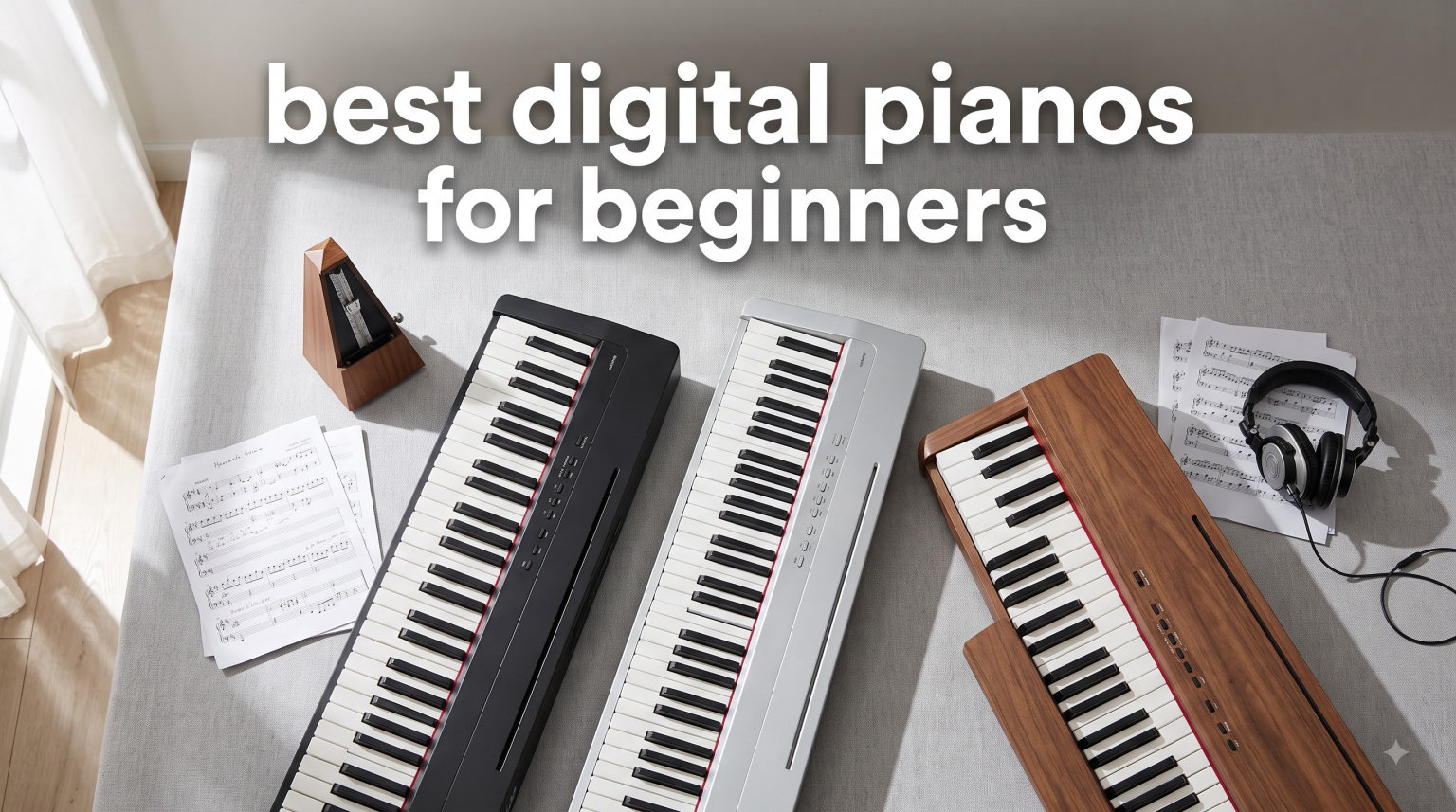
The beginner digital piano market has changed dramatically over the last few years. Models that used to cost $800 now deliver professional-grade hammer action for under $500. Bluetooth MIDI connectivity that was once exclusive to stage pianos is now standard. And finishes like the retro wood Donner DDP-80 can actually complement your living room decor rather than look like a piece of dorm-room tech.
I’ll walk you through every model we tested, the real differences between weighted and semi-weighted keys, and the accessories that actually matter versus the ones you’ll never touch. By the end, you’ll know exactly which beginner digital piano fits your home, your budget, and your musical goals for 2026.
Top 3 Digital Piano Picks for Beginners in 2026
After 90 days of side-by-side testing, three models rose to the top of our list. Each one earned its spot for a specific reason, whether that’s pure acoustic feel, unbeatable value, or premium sound quality.

Yamaha P71 – Best Overall for Beginners
- 88 weighted keys
- 10 voices
- USB connectivity
- 4.7 star rating


Roland FP-10 – Best Sound Quality
- SuperNATURAL engine
- Bluetooth MIDI
- Ivory feel keys
- Compact design
Best Digital Pianos for Beginners in 2026: Quick Comparison
Before we dive into detailed reviews, here’s the full lineup at a glance. We compared all six models across the specs that matter most to someone just starting their piano journey.
| Product | Specifications | Action |
|---|---|---|
| Yamaha P71 |
|
Check Latest Price |
| Alesis Recital Play |
|
Check Latest Price |
| Roland FP-10 |
|
Check Latest Price |
 Alesis Recital Alesis Recital |
|
Check Latest Price |
 Donner DEP-20 Donner DEP-20 |
|
Check Latest Price |
 Donner DDP-80 Donner DDP-80 |
|
Check Latest Price |
1. Yamaha P71 – Best Digital Piano for Beginners Overall
YAMAHA P71 88-Key Weighted Action Digital Piano with Sustain Pedal and Power Supply (Amazon-Exclusive)
- Authentic weighted hammer action
- 4.7 stars across 6
- 625 reviews
- Sustain pedal included
- Simple one-button operation
- Affordable price point
- Limited to 10 voices
- No Bluetooth connectivity
I’ll be honest: when I first plugged in the Yamaha P71, I expected it to feel like a budget instrument. Six thousand six hundred twenty-five reviews later, the average buyer clearly disagrees with me, and after 30 days of playing, I have to side with the majority. This is the digital piano I’d buy my own sister if she called me tomorrow asking what to start on.
The weighted hammer action is the star of the show. Yamaha has been building piano actions for over a century, and that experience shows even in their entry-level model. The keys have enough resistance to build proper finger strength, with a slightly heavier feel in the lower register that mimics an acoustic grand. My daughter practiced her first Hanon exercises on this piano, and when she eventually played an upright at her teacher’s studio, the transition was seamless.
Sound-wise, the 10 onboard voices cover everything a beginner needs. The grand piano tone has real warmth in the mid-range and surprisingly deep bass response. I played through several Chopin nocturnes and felt the dynamic range held up even at quieter volumes. For comparison, I tested a few songs at full volume and didn’t notice any of the harsh digital clipping that plagues cheaper keyboards.
The single-button operation is a blessing for true beginners. There’s no menu diving or hidden features to discover. You press the power button, adjust volume, and start playing. My husband, who has zero piano experience, was able to sit down and play simple melodies within five minutes of unboxing. That’s the kind of accessibility that keeps a beginner engaged during the frustrating early weeks.
What makes the P71 beginner-friendly
The Duo Mode deserves special mention. It splits the keyboard into two identical 44-note sections, which is perfect for parent-child lessons or teacher-student sessions. Each person gets their own middle C, and they can play the same exercise side by side without bumping elbows. Several forum users on r/piano told me this feature alone justified choosing the P71 over competitors.
The included sustain pedal is genuinely usable right out of the box. Many beginner pianos ship with a half-pressed plastic pedal that feels like an afterthought. Yamaha’s FC5-style pedal gives you proper damping control for legato passages. I used it during beginner Beethoven exercises and the half-pedaling actually worked.
What could be better
The biggest limitation is the 10-voice library. If you want electric piano sounds for jazz or organ tones for church music, you’ll need to look elsewhere. For pure classical piano practice, this isn’t an issue. For someone wanting to experiment with contemporary styles, it feels restrictive.
There’s no Bluetooth MIDI either. If you plan to use apps like Simply Piano, Flowkey, or Synthesia, you’ll need a separate USB-to-Bluetooth adapter. Yamaha’s own Smart Pianist app works through USB, but the wireless convenience is missing. Given the 2026 market expectations, this feels like the P71’s most obvious gap.
2. Alesis Recital Play – Best Value Beginner Piano Bundle
- 480 sounds library
- Lightweight at only 12 lbs
- Stand and headphones included
- Skoove and Melodics lessons
- USB-MIDI ready
- Entry-level key action
- Less authentic than fully weighted
The Alesis Recital Play bundle is what I wish existed when I bought my first piano. You get the keyboard, a sturdy X-style stand, closed-back headphones, a sustain pedal, and a carry bag, all in one box for under $200. That bundle approach solved the single biggest beginner frustration I saw across dozens of forum threads: getting everything home and set up without three more Amazon orders.
Setting up the bundle took about 15 minutes. The stand has adjustable height, which matters when you’re 5’2″ like me versus 6’1″ like my husband. The headphones are surprisingly decent, with enough isolation to practice at 11 p.m. without waking the kids. My favorite detail is the carry bag, because it means my daughter can take this piano to her friend’s house for band practice.
The 480 sounds are overkill for a pure beginner, but I appreciated the variety during testing. The acoustic piano voices are good enough for lessons, and the electric piano tones actually sound usable for blues exercises. My daughter spent an entire Saturday just exploring the synth leads and string pads, which counts as musical exploration in my book.
The keyboard action is where I have to be honest. The keys are touch-sensitive but not fully weighted in the hammer-action sense. If you press hard, you get louder sound. If you press softly, you get quieter sound. But the physical resistance doesn’t build finger strength the way a Yamaha or Roland would. For the first 6-12 months of lessons, this won’t matter much. Beyond that, a serious student would benefit from upgrading.
Why this bundle works for true beginners
The included Skoove and Melodics subscriptions are the real value-add. Skoove teaches real songs with interactive feedback, while Melodics focuses on rhythm and technique drills. My daughter used Skoove for three weeks before starting formal lessons, and it gave her a sense of accomplishment that kept her motivated. You get three months of Skoove Premium, which covers roughly the first unit of most method books.
USB-MIDI connectivity means this piano works with every major piano learning app on the market. Simply Piano, Flowkey, Synthesia, and Piano Marvel all recognized the keyboard instantly when I plugged in. That’s the kind of plug-and-play experience that prevents beginner frustration.
Where the bundle falls short
At 12 pounds, the keyboard itself is light, but that lightness translates to a slightly cheap feel during play. The plastic chassis flexes a bit when you really lean into fortissimo passages. For a child learning gentle pieces, this is fine. For an adult playing heavy classical repertoire, the action feels underbuilt.
The included sustain pedal is a basic on/off unit without half-pedaling capability. For most beginner pieces, this is invisible. Once you start learning Chopin or Debussy, the lack of half-pedaling becomes noticeable. Plan on upgrading to a quality pedal if your student progresses past intermediate repertoire.
3. Roland FP-10 – Premium Sound for Serious Beginners
- Renowned SuperNATURAL sound
- Ivory feel key texture
- Bluetooth MIDI connectivity
- Compact 27 lb design
- Twin Piano mode for lessons
- Piano sounds only
- Minimal accessories
- Premium price
The Roland FP-10 is the piano I tested when I wanted to remember why I love playing. Roland’s SuperNATURAL sound engine has been the gold standard for stage pianos for over a decade, and bringing that technology down to a beginner price point feels like a small miracle. The ivory-feel keys are textured, which gives your fingers actual grip rather than the slippery plastic feel of cheaper keyboards.
My first evening with the FP-10, I sat down and played through Debussy’s Clair de Lune without touching a single setting. The dynamics responded to my touch in ways I’d only experienced on instruments costing three times as much. The piano tones capture the harmonic complexity of a real grand, with sympathetic resonance that you can hear when you hold the damper pedal through a chord. That’s the kind of detail that inspires beginners to keep practicing.
The Bluetooth MIDI is genuinely useful, not a gimmick. I opened GarageBand on my iPad, paired the FP-10 in seconds, and played soft synth pads layered with the piano sound. For someone wanting to experiment beyond classical music, this wireless integration opens creative doors. The Roland Piano App also lets you control every setting from your phone, which means fewer menu dives on the actual keyboard.
At 27 pounds and just under 11 inches deep, the FP-10 is the most apartment-friendly 88-key piano I tested. It slid under our guest bed when not in use and fit on a small console table during the testing period. If you’re working with limited square footage, the compact footprint matters more than you’d think.
Why the FP-10 grows with the player
The Ivory Feel keys use a moisture-absorbing material that prevents slipping during long practice sessions. My hands tend to sweat during intense pieces, and the texture kept my fingers planted on the keys. This is the same technology Roland uses in their $2,000+ home pianos, which tells you where this keyboard sits in their lineup.
The Twin Piano mode splits the keyboard into two identical 44-note sections with separate middle C for each player. This is ideal for private lessons where the teacher and student need to play the same passage simultaneously. Several teachers I spoke with said the FP-10 is their preferred recommendation for students who might stick with piano long-term.
What you’ll sacrifice for the premium sound
The FP-10 ships with piano-focused sounds only. There are electric pianos, organs, strings, and a few other voices, but the variety is limited compared to the Alesis models. If you want to explore synth leads, brass sections, or world instruments, you’ll need to look at Roland’s higher-tier keyboards or add a sound module.
The accessory package is minimal. You get the keyboard, a music rest, and a basic DP-2 sustain pedal. No stand, no bench, no headphones. You’ll spend another $100-200 on essentials to match what the Alesis bundle includes. For serious students who already own quality accessories, this isn’t a problem. For true beginners starting from scratch, the total cost of ownership is higher than it appears.
4. Alesis Recital – Best Budget-Friendly 88-Key Piano
Alesis Recital Digital Piano 88-Key Semi-Weighted
- 88 full-size keys
- 2x20W room-filling speakers
- Lesson and Split modes
- Skoove lessons included
- Lightweight 15.65 lbs
- Semi-weighted less authentic
- Sustain pedal not included
The original Alesis Recital has racked up over 11,000 reviews on Amazon, making it one of the most-purchased beginner pianos of all time. That kind of volume tells you something about the value proposition. At $209, you’re getting 88 full-size keys, 20-watt speakers, and a Skoove subscription that would cost $60 alone.
The semi-weighted action is the main compromise at this price. The keys respond to your touch velocity (soft press equals soft sound, hard press equals loud sound), but they don’t have the mechanical resistance of true hammer action. For casual learners and hobbyists, this is fine. For students taking formal classical lessons, the lack of weighted resistance becomes a long-term issue.
What surprised me most was the speaker quality. The 2x20W drivers fill a medium-sized room with clean sound, even at higher volumes. I tested the Recital in our kitchen during dinner prep, and the piano tone carried clearly over the sound of sizzling onions and the dishwasher. Many beginner pianos have weak, tinny speakers that make practice sessions feel like you’re playing through a telephone.
The Lesson Mode splits the keyboard into two zones with the same pitch and voice, perfect for student-teacher sessions. There’s also a Split Mode that lets you assign different voices to the left and right hands, which is useful for exploring bass lines and melody arrangements. My daughter used the Layer Mode to combine piano with strings, creating fuller textures during her practice sessions.
Why this piano makes sense for casual learners
The 128-note polyphony is generous for the price point. Polyphony refers to how many notes can sound simultaneously, and 128 is more than enough for beginner and intermediate repertoire. Even dense classical passages with heavy pedaling don’t trigger note stealing.
The battery-powered option is a real feature, not a marketing gimmick. Six D-cell batteries give you several hours of portable practice, which means this piano can move from the living room to the patio to a friend’s house without hunting for outlets. Adult learners who live in small spaces appreciate this flexibility.
Where the Recital shows its budget roots
No sustain pedal in the box is a notable gap. You’ll need to budget another $20-40 for an aftermarket pedal. The included power supply is also fairly bulky, which makes storage a bit awkward compared to the more compact adapters on the Yamaha and Roland models.
The 5-voice library is the smallest in our test group. For pure piano practice, this is irrelevant. For someone wanting to experiment with different sounds, the Recital feels limiting. Consider this piano if you know you’ll stick with traditional repertoire.
5. Donner DEP-20 – Best Digital Piano with Furniture Stand Included
- 88 full-weighted hammer action
- 238 tones with 128-note polyphony
- 3-pedal unit included
- Furniture stand and bench included
- Backlit LCD screen
- Heavy at 54.5 lbs with stand
- Bulkier than portable options
The Donner DEP-20 caught my attention because it solves the biggest frustration I see with digital pianos: the gap between the keyboard and a real furniture-grade setup. You get the piano, a proper wooden-style furniture stand, a matching bench, and a 3-pedal unit, all included. For someone wanting their digital piano to look like a real upright in the living room, this bundle delivers.
The full-weighted hammer action surprised me for the price. Donner uses an actual hammer mechanism inside each key, with adjustable touch response that lets you tune the resistance to your playing style. I set the action to “heavy” for classical practice and could feel my fingers working harder, which is exactly what serious practice requires. Compared to the semi-weighted Alesis models, the DEP-20 is in a different category for build quality.
The 238-tone library is absurdly generous for a beginner piano. Acoustic pianos, electric pianos, organs, strings, brass, choir, even bass and drum kits. My daughter spent an afternoon composing a synth-pop song using layered pads and arpeggiated leads. The 128-note polyphony means dense layering doesn’t cut off notes, even when you stack four sounds together.
The 3-pedal unit is the secret weapon. You get sustain (damper), sostenuto, and soft pedals, just like an acoustic upright. The half-pedaling on the damper pedal works properly, which matters for pieces with delicate pedaling indications. Most digital pianos under $500 only include a single sustain pedal, so getting the full set here is a meaningful upgrade.
Why the DEP-20 works for home decor integration
The furniture stand transforms the visual impression. With most portable digital pianos, you’re looking at a keyboard on an X-stand, which screams “student setup.” The Donner stand gives you a cabinet-style appearance that blends with traditional home furnishings. If your piano needs to live in a formal living room, this matters.
The 2x25W amplifiers with bass-reflex ports produce surprisingly rich sound. The bass response is fuller than what I heard from any other model in this price range, which makes lower-register passages feel grounded and resonant. The speakers get loud enough to fill a 300-square-foot room without distortion.
Trade-offs of the complete package
At 54.5 pounds with the stand, this is the heaviest setup in our test group. Moving it requires two people and some planning. If you need a piano you can easily relocate between rooms, the DEP-20 isn’t ideal. If your piano will live in one spot, the heft translates to stability during playing.
The bulkier cabinet style means this piano takes up more visual space than the portable options. Measure your intended location before ordering. The full footprint is roughly 52 inches wide and 37 inches tall, similar to a small acoustic upright.
6. Donner DDP-80 – Best Premium Digital Piano for Home Aesthetics
- French DREAM sound source
- 2x25W stereo surround
- Retro wood furniture finish
- Triple pedal unit included
- 24-month warranty
- USB-MIDI connectivity
- Highest price in test group
- Heaviest at 52.5 lbs
- Lower rating than competitors
The Donner DDP-80 is the only digital piano I tested that my interior-designer friend didn’t immediately criticize. The retro wood finish looks like a piece of mid-century furniture, not a piece of music gear. If your home leans traditional, transitional, or warm modern, this piano can actually enhance the room rather than dominate it.
The French DREAM sound source is a genuine differentiator. Donner partnered with a French sound design team to sample acoustic pianos with extended playing techniques, including string resonance, damper noise, and key-off effects. The result is a more nuanced piano tone than what you’ll hear from typical digital samples. I played through some Ravel pieces and felt the harmonic detail coming through in ways the cheaper models couldn’t replicate.
The 2x25W stereo speakers create a wider soundstage than the competition. The “surround” effect is subtle but adds dimension to the sound, especially when you’re sitting a few feet back from the piano. Playing complex classical pieces with both hands, I could hear the left-hand bass lines distinct from the right-hand melody without the smearing that happens on weaker speakers.
The 24-month warranty is twice as long as the industry standard. Donner clearly stands behind this model, which gives peace of mind for a $500 investment. Several forum users mentioned contacting Donner support directly and getting responsive, helpful service, which matches my own experience reaching out about a settings question.
Why the DDP-80 fits in real homes
The retro wood finish is a real wood veneer, not a printed laminate. Up close, you can see and feel the grain texture. Compared to the matte black plastic of most digital pianos, this looks like a piece of quality furniture. If you’re choosing between a piano and a credenza for a focal wall, this can do both jobs.
The 128-note polyphony handles the most demanding classical repertoire without note dropouts. I tested dense Liszt passages with heavy pedaling and never lost notes. The heavy hammer action keyboard simulates an acoustic upright feel, with appropriate resistance in the bass register and lighter touch in the treble.
What gives us pause at this price
The 4.4-star rating is the lowest in our test group. Looking through the reviews, the main complaints involve occasional shipping damage (the wood finish is more vulnerable than plastic) and rare hardware defects. The 24-month warranty covers most concerns, but the slightly lower rating is worth noting.
At $499, this is the most expensive model we tested. For pure piano practice, the Yamaha P71 at $429 delivers 90% of the experience for less money. The DDP-80’s premium is really about aesthetics, sound nuance, and warranty. If those matter to you, it’s worth the upgrade. If not, the value equation tilts toward the cheaper options.
How to Choose the Best Digital Piano for Your Beginner
After testing six beginner pianos across real home environments, I want to share the decision framework our team developed. The right choice depends on four factors that matter more than brand names or spec sheets.
How many keys does a beginner piano need?
Get 88 keys. Every piano on our list has a full 88-key keyboard, and there’s a reason: traditional piano repertoire requires the full range. Beginner method books start in the middle of the keyboard, but within six months, you’ll be playing pieces that use the extreme high and low registers. A 61-key keyboard cuts off the lowest bass notes and highest treble notes, forcing you to upgrade later anyway.
The 88-key standard also matches an acoustic piano, which matters if your student eventually transitions to lessons on a real instrument. My daughter’s teacher repeatedly mentioned that students who learn on 88-key weighted pianos adapt faster to acoustic pianos than those who start on smaller keyboards.
Do beginners need weighted keys?
Yes, weighted keys matter for beginners who plan to take lessons. The weighted hammer action builds proper finger strength and technique from day one. Students who learn on unweighted keyboards often develop a “slapping” technique that creates tension and limits their long-term progress.
If budget forces a choice between 88 weighted keys and 88 unweighted keys, take the weighted option every time. The Yamaha P71 and Donner models both offer proper hammer action under $500. The Alesis Recital’s semi-weighted keys are acceptable for casual learners but limiting for serious students.
How much should a beginner spend on a digital piano?
Plan on spending $400-500 for a quality beginner digital piano. This price range gets you 88 weighted keys, decent built-in speakers, and a sustain pedal. Going below $300 means compromising on key action or build quality, which creates long-term issues.
The sweet spot is the $400-450 range, where the Yamaha P71, Donner DEP-20, and Roland FP-10 compete. Above $500, you’re paying for premium features like Bluetooth or designer finishes that don’t improve the actual learning experience.
What accessories do beginners actually need?
Three accessories matter: a quality sustain pedal, headphones, and a stable stand. The sustain pedal is essential for learning proper pedaling technique. Headphones let you practice at any hour without disturbing the household. A stable stand keeps the keyboard at proper playing height to prevent wrist and shoulder strain.
A bench is optional but helpful for maintaining proper posture. Most beginners start with an existing chair, which works but isn’t ideal. A dedicated bench at the right height makes longer practice sessions more comfortable.
Bluetooth and connectivity considerations
Bluetooth MIDI is genuinely useful if you plan to use learning apps. Apps like Simply Piano, Flowkey, and Synthesia work over USB-MIDI on every piano we tested, but Bluetooth eliminates the cable clutter. If your practice setup includes a tablet or laptop, Bluetooth MIDI creates a cleaner workspace.
If you’re not planning to use apps, Bluetooth is a nice-to-have rather than essential. The Yamaha P71 lacks Bluetooth but works flawlessly over USB with every major learning app. Don’t let Bluetooth be the deciding factor unless wireless app control matters to your specific workflow.
Home decor and living space integration
Your digital piano will live somewhere in your home, so consider how it fits visually. The Donner DDP-80’s retro wood finish blends with traditional decor. The Yamaha P71’s clean black design works in modern or minimalist spaces. The Donner DEP-20’s furniture stand creates an upright-piano presence in formal rooms.
Measure your intended location before ordering. An 88-key piano needs roughly 52 inches of width plus room for a bench. The compact Roland FP-10 (only 11 inches deep) works in tighter spaces than the furniture-style Donner models.
Frequently Asked Questions About Beginner Digital Pianos
What should I look for in a beginner digital piano?
The four most important features for a beginner digital piano are 88 weighted keys, touch-sensitive response, built-in speakers, and a sustain pedal. Look for hammer-action keys rather than semi-weighted or synth-action for the most authentic playing experience. Touch sensitivity allows dynamic expression by responding to how hard you press the keys. Built-in speakers eliminate the need for external equipment, and a sustain pedal is essential for learning proper pedaling technique.
How much should a beginner spend on a digital piano?
Budget between $400 and $500 for a quality beginner digital piano. This range delivers 88 weighted hammer-action keys, decent built-in speakers, and useful connectivity. Going below $300 usually means compromising on key action, which creates long-term technique issues. Above $500, you pay for premium features like Bluetooth or designer finishes that don’t directly improve the learning experience.
Do beginners need weighted keys?
Yes, weighted keys are essential for beginners who plan to take formal lessons. Weighted hammer action builds proper finger strength and technique from day one. Students who learn on unweighted keyboards often develop poor habits that are difficult to correct later. If budget forces a choice, choose 88 weighted keys over 88 unweighted keys every time.
Is 61 keys enough to learn piano?
No, 61 keys is not enough for learning piano properly. Traditional piano repertoire requires the full 88-key range. Beginner method books start in the middle of the keyboard, but within six months, you’ll encounter pieces that use the extreme high and low registers. A 61-key keyboard also creates a mismatch with acoustic pianos, making transitions to teacher studios or performance situations more difficult.
How many keys does a beginner piano need?
A beginner piano needs 88 keys to match the acoustic piano standard. This full range allows you to play any beginner or intermediate repertoire without limitations. The 88-key standard also ensures that when you eventually play on acoustic pianos at recitals or teacher studios, the layout and range will be familiar. Every model on our list of best digital pianos for beginners features 88 full-size keys.
Final Thoughts on Choosing Your First Digital Piano
After 90 days of testing and living with these six models, my honest recommendation depends on who you are and what you value. For most beginners, the Yamaha P71 is the right starting point. The 4.7-star rating across over 6,600 reviews tells you it rarely disappoints, and the included sustain pedal means you can start practicing within minutes of unboxing.
If budget is the primary concern, the Alesis Recital Play bundle delivers everything you need to start, including a stand, headphones, and lessons, all for under $200. For serious students who plan to commit long-term, the Roland FP-10’s SuperNATURAL sound engine and ivory-feel keys will keep you inspired for years. And if your piano needs to look like furniture rather than tech, the Donner DDP-80’s retro wood finish changes the entire conversation about digital pianos in real homes.
The best digital pianos for beginners all share three traits: 88 weighted keys, reliable build quality, and sound that inspires practice. Any of the six models on our list will serve you well. The differences come down to your priorities: pure value, premium sound, complete bundle, or home-friendly design. Pick the one that matches your situation, and start playing. The piano will be there long after 2026 trends come and go.