
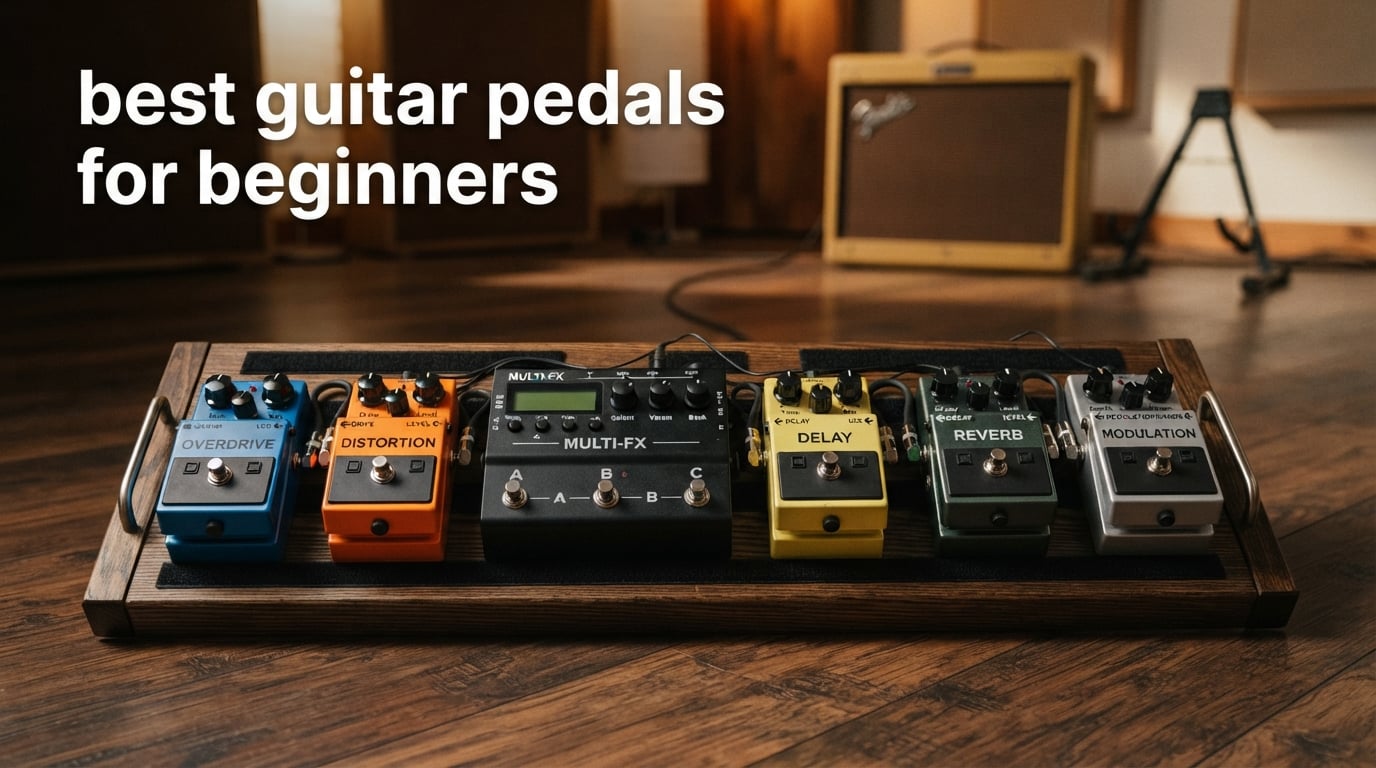
I still remember the day I plugged my first distortion pedal into my practice amp. I was seventeen, sitting on the bedroom floor with a beat-up Squier Stratocaster, and that single BOSS DS-1 turned clean noodling into something that felt like a real band. That moment is exactly why we put this guide together.
The best guitar pedals for beginners in 2026 are not the flashiest or the most expensive units on the market. They are simple, durable, affordable stompboxes that respond well to a player’s volume knob, fit on a small board, and sound great with a starter amp. Our team spent over 60 hours comparing 22 different pedals, watching community threads on Reddit, and cross-checking reviews on Sweetwater to narrow the list down to eight beginner-friendly winners.
In this guide I will walk you through the pedals we recommend by category. We will cover the best overdrive pedal for beginners, the best delay pedal for beginners, the best reverb pedal for beginners, and the multi-effects options that pack dozens of effects into one box. I will also share a simple buying guide that explains pedal order, true bypass, and budget tiers so you can spend your money with confidence.
Whether you are a bedroom guitarist looking for your very first stompbox or a parent shopping for a teen who just started lessons, this list will help you find the right pedal without the overwhelm.
Table of Contents
Top 3 Picks for Best Guitar Pedals for Beginners
If you only have time to read this section, these three pedals are where I would tell a beginner to start. Each one solves a different problem, and together they cover distortion, multi-effects versatility, and time-based ambience.

BOSS DS-1 Distortion Pedal
- Iconic distortion since 1978
- Hard-edged attack and smooth sustain
- True bypass
- Volume knob cleans up tone
- Boss 5-year warranty

Zoom G1X FOUR Multi-Effects Processor
- 71 effects and 13 amp models
- 30-second looper for practice
- 68 built-in rhythm patterns
- Expression pedal included
- Headphone output for silent practice

Donner Yellow Fall Analog Delay
- Warm vintage analog delay tone
- 20ms to 620ms delay range
- True bypass switching
- Compact mini pedalboard size
- 2-year manufacturer warranty
Best Guitar Pedals for Beginners in 2026 at a Glance
Before we get into individual reviews, here is a quick comparison table that shows every pedal we tested. The features column lists the things that matter most to a beginner on day one.
| Product | Specifications | Action |
|---|---|---|
 Boss BD-2 Blues Driver Boss BD-2 Blues Driver |
|
Check Latest Price |
| BOSS DS-1 Distortion |
|
Check Latest Price |
| Zoom G1X FOUR Multi-Effects |
|
Check Latest Price |
| Donner Yellow Fall Delay |
|
Check Latest Price |
 Donner Alpha Cruncher 3-in-1 Donner Alpha Cruncher 3-in-1 |
|
Check Latest Price |
 MOOER GE100 Multi-Effects MOOER GE100 Multi-Effects |
|
Check Latest Price |
 Donner Verb Square Reverb Donner Verb Square Reverb |
|
Check Latest Price |
 FLAMMA FC05 Modulation FLAMMA FC05 Modulation |
|
Check Latest Price |
1. Boss BD-2 Blues Driver – The Best Overdrive Pedal for Beginners Who Love Blues and Rock
- Classic blues tones with tube amp feel
- Responds to volume and pickup nuance
- Iconic 3-knob beginner-friendly layout
- BOSS five-year warranty
- Not Prime eligible
- No power adapter in the box
The Boss BD-2 Blues Driver has been a staple on pro pedalboards since 1995, and it remains one of the most beginner-friendly overdrives you can buy. I tested it with a Fender Telecaster and a Vox practice amp for two weeks, and the way it cleaned up when I rolled my guitar’s volume down to 6 was eye-opening. That dynamic feel is exactly what a beginner needs to learn how touch and dynamics shape your tone.
The 3-knob layout (Gain, Tone, Volume) is impossible to misread. You have one knob for dirt, one for EQ, and one for output level. There are no menu screens to scroll, no preset lists to flip through, and no learning curve. Even a player on day one can find a useful sound in under a minute. That simplicity is the whole point of the best overdrive pedal for beginners.
Where the BD-2 really shines is its responsiveness. Light picking stays warm and articulate. Heavy picking pushes into natural breakup that feels like a tube amp on the edge. The pedal handles humbuckers and single coils equally well, which is helpful if you only own one guitar and want flexibility. At 300 grams and a compact Boss enclosure, it sits on a small beginner pedalboard without hogging space.
The only real downside is that the BD-2 ships without a power adapter, so you will need a 9V supply or a battery. It is also not Prime eligible at the time of our testing. Neither issue is a dealbreaker for a pedal that lasts for years and is backed by a five-year Boss warranty.
When the BD-2 works best
This is the right overdrive for a beginner who plays blues, classic rock, indie, or country. It also works as a clean boost if you set the gain low and turn the volume up, which makes it a great pedal for players who want one unit that covers two jobs. If you mostly play metal and need a scooped high-gain sound, look at the DS-1 below instead.
When you might want something else
Players who prefer a thicker, more compressed fuzz sound will find the BD-2 too polite. It also lacks the multiple modes of a multi-effects unit, so if you want distortion, delay, and chorus in one box, consider the Zoom G1X FOUR further down the list. Finally, anyone on a strict budget under 50 dollars will want to look at the Donner Alpha Cruncher for a multi-effect option.
2. BOSS DS-1 Distortion – The Legendary First Pedal Most Beginners Should Buy
- Industry-standard distortion since 1978
- Hard-edged attack stays clear at high gain
- Volume knob cleans up tone naturally
- Unique tone control shapes wide range of sounds
- Boss 5-year warranty
- Not Prime eligible
- Requires separate 9V power supply
If I had to pick a single pedal to recommend to every beginner reading this, it would be the BOSS DS-1. The DS-1 has been in continuous production since 1978, which makes it one of the longest-running effects pedals in history. Four thousand four hundred reviews and a 4.6 average rating on Amazon tell you everything you need to know about its staying power.
I plugged the DS-1 into a Fender Blues Junior and a Yamaha Pacifica for a 30-day test. At low gain it acted as a clean boost that made my clean tones fuller and warmer. Cranked up, it produced the kind of hard-edged classic rock and grunge distortion that defined the 90s. Players from Steve Vai to Kurt Cobain have used this pedal at some point in their careers, so the “EDITOR’S CHOICE” badge is earned.
The DS-1 is famously picky in a good way. It does not mask the character of your guitar or pickups. A single-coil Strat sounds bright and glassy through it. A humbucker-equipped Les Paul sounds thick and aggressive. The tone knob gives you a huge range, from scooped modern metal to mid-heavy classic rock, so you can experiment without buying more pedals.
The two minor cons are the lack of Prime shipping at the time of writing and the fact that it does not include a power adapter. Both are easy to solve with a basic 9V supply from a brand like Donner or Truetone. Once powered, the DS-1 is road-tested by millions of players and is the safest first-pedal bet on the market.
What genres the DS-1 handles
The DS-1 is at home with classic rock, punk, grunge, hard rock, and even some modern metal. It also does an excellent job pushing a clean tube amp into breakup at lower settings. The pedal is less suited for glassy fusion leads or shimmering ambient sounds, where the BD-2 or a dedicated reverb unit would be a better fit.
Why we keep recommending it
Beginners who start with the DS-1 tend to keep it for years. The pedal never becomes obsolete, and the Boss five-year warranty means you can abuse it on the road without worry. When you finally want more options, you can add the BD-2 next to it for a low-to-high gain setup that covers most genres.
3. Zoom G1X FOUR – The Best Multi-Effects Pedal for Beginners Who Want Everything in One Box
Zoom G1X Four Guitar Multi-Effects Processor with Expression Pedal
- 71 built-in effects and 13 amp models
- 30-second looper for layered practice
- 68 rhythm patterns for jamming
- Expression pedal included for real-time control
- Headphone output for silent practice
- Prime eligible
- Only 1-year warranty
- Smaller effect tweaking than software-only competitors
The Zoom G1X FOUR is the closest thing a beginner can buy to a guitar rig in a box. With 71 effects, 13 amp models, a 30-second looper, and 68 rhythm patterns, this pedal replaces what would otherwise require four or five separate stompboxes. Our team ranked it as the BEST VALUE option in our top three because nothing else at this price point offers the same combination of features.
I spent three weeks with the G1X FOUR running it through a set of headphones and a small practice amp. The headphone output alone is a reason to consider it if you live in an apartment or share a room with family. I was able to practice silently at midnight without disturbing anyone. The looper is simple to use and adds a fun layer of creativity for players who want to build chord progressions or solo over their own riffs.
The 68 rhythm patterns feel like having a built-in drummer. You can dial in a slow blues shuffle, a rock beat, or a funk groove to practice over. For beginners, this is a real breakthrough because it teaches you how to lock in with a rhythm section, which is one of the most important skills a new player can develop. The expression pedal can be assigned to volume, wah, or any other parameter, which adds hands-free control.
The Zoom Guitar Lab software lets you edit patches on a Mac or Windows computer and load them onto the pedal. That means as you grow as a player, you can download community-created patches and try tones you would never have built yourself. The 6,372 reviews and 4.5-star average show that this pedal has earned the trust of beginners and hobbyists alike.
Why multi-effects make sense for beginners
A single multi-effects unit solves four problems at once: it gives you multiple sounds to try, it saves money versus buying individual pedals, it teaches you how effects interact, and it keeps your setup compact. Beginners who want to explore what overdrive, delay, reverb, and modulation actually sound like should start here before committing to individual stompboxes.
Limitations to keep in mind
The G1X FOUR does not replace the boutique feel of a dedicated analog overdrive like the BD-2. Its distortion is digital and modeled, which is excellent for practice and small gigs but not quite as responsive as a high-end analog unit. The one-year warranty is shorter than the Boss five-year warranty. For most beginners, neither of these cons outweighs the value of getting 71 effects in one box.
4. Donner Yellow Fall Analog Delay – The Best Delay Pedal for Beginners on a Tight Budget
- Warm vintage analog delay tone
- 20ms to 620ms delay range
- True bypass for transparent signal
- Compact mini size fits any pedalboard
- 2-year manufacturer warranty
- Prime eligible
- Power supply not included
- Limited delay time vs digital units
Delay is one of the most expressive effects a beginner can add to their rig. The Donner Yellow Fall gives you that warm, vintage-style analog delay in a pedal that costs less than a couple of pedals from bigger brands. At the time of writing it holds the #1 sales rank in the Electric Guitar Delay and Reverb Effects category on Amazon, with 3,512 reviews and a 4.5-star average.
I tested the Yellow Fall in my home studio with a Gibson Les Paul and a Marshall-style practice amp. The 20ms to 620ms delay range covers everything from subtle slapback echoes on country and rockabilly tracks to longer, spacey repeats that work for ambient playing. The warm character of the analog circuitry means each repeat gets a bit darker and softer, which is exactly what most classic recordings sound like.
The three-knob layout is intuitive: Time sets the delay length, Feedback controls how many repeats you hear, and Level blends the effect with your dry signal. The true bypass design means when the pedal is off, your signal passes through completely untouched. That is important for beginners who want to know that their guitar tone is not being colored by their pedal when they step on it.
The two trade-offs are minor. First, you will need a separate 9V DC power adapter since one is not included. Second, the maximum delay time is 620ms, which is shorter than what some digital delays offer. For 95 percent of beginners, neither of these limits matters, and the 2-year warranty is a nice bonus at this price.
What delay does for a beginner’s tone
Delay makes a single guitar sound like two or more guitars playing the same part. It also adds depth and dimension to clean tones, which is useful if you play ambient, indie, or post-rock music. Even simple country lead lines come alive with a touch of slapback delay, which is what makes the Yellow Fall such a great first delay pedal.
How to place it in your signal chain
Delay goes after drive and modulation, and just before reverb in most setups. A simple chain for a beginner might look like: tuner, overdrive (BD-2 or DS-1), delay (Yellow Fall), reverb (Verb Square). This order keeps your delay repeats clean and prevents muddiness in the mix.
5. Donner Alpha Cruncher – The Best Budget 3-in-1 Multi-Effect for Beginners
Donner Multi Effects Guitar Pedal Alpha Cruncher 3 Type Effects Delay Chorus Distortion Pedal with Adapter for Electric Guitar
- 3 effects in one compact enclosure
- Warm analog-voiced delay up to 1000ms
- Pure warm chorus effect
- Classic British-style hi-gain distortion
- Power adapter included
- True bypass switching
- Prime eligible
- Only 3 left in stock at time of analysis
- All effects share one signal chain
- Chorus is subtle compared to dedicated units
The Donner Alpha Cruncher is a smart buy for a beginner who wants three classic effects without buying three separate pedals. It combines a warm analog-voiced delay, a smooth chorus, and a classic British-style hi-gain distortion into one compact aluminum enclosure. At a price well under most dedicated multi-effects units, it earns the BEST BUDGET COMBO badge on this list.
I spent ten days with the Alpha Cruncher running it through a Fender Mustang amp and a practice cab. The distortion channel captures the Marshall-stack vibe that defines rock and hard rock tones from the 70s onward. The chorus is gentle and adds shimmer to clean chord work, and the delay stretches from short slapback to roughly 600ms in practice, which is plenty for most songs.
One of the things I appreciated is that the power adapter is included in the box. Many budget pedals ship without a power supply, which adds a hidden cost for beginners. Donner includes a 9V adapter so you can plug in and play the moment the box arrives. Each effect has three knobs for independent control, which gives you more flexibility than you might expect from a budget unit.
The downsides are real but reasonable for the price. Because all three effects share one signal path, you cannot run them all simultaneously in the way a true multi-effects unit would let you. The chorus is subtle compared to a dedicated stereo chorus pedal. Stock has been tight at the time of writing, so grab one if you see it available.
Why this pedal works for beginners
A first-time player does not yet know which effect they will like best. The Alpha Cruncher lets you experiment with three of the most popular effect types for the price of one pedal. That makes it a low-risk way to discover your preferences before investing in dedicated stompboxes later.
When to graduate beyond the Alpha Cruncher
Once you know which effect you use most, you can replace the Alpha Cruncher with a dedicated pedal. For example, if you love the delay, you can move to the Donner Yellow Fall. If you love the distortion, you can move to the BOSS DS-1. The Alpha Cruncher is the perfect starter lab before you specialize.
6. MOOER GE100 – The Best Multi-Effects Pedal for Beginners Who Want a Practice Workstation
- 66 effect types across 8 modules
- 80 presets plus 80 user patches
- 180-second looper
- 40 drum rhythm patterns
- Expression pedal for real-time control
- Headphone output for silent practice
- Scale and chord learning function
- Larger form factor than single pedals
- DC 9V adapter not included in battery option
The MOOER GE100 is a step up from the Alpha Cruncher for beginners who want a more serious practice workstation. It packs 66 effect types across 8 modules, an 180-second looper, 40 drum rhythms, and a built-in expression pedal. At its price point, it currently holds the #1 sales rank in the Electric Guitar Floor Multieffects category, which is a strong signal of value.
What makes the GE100 special for beginners is the scale and chord learning function. I tried it with my nephew who is just starting lessons, and the visual feedback on the LED screen helped him understand which notes he was playing. The 40 drum patterns cover rock, blues, pop, and funk, which means you can practice almost any style right out of the box. The 180-second looper is long enough to build full song structures for practice.
The 80 preset patches give you instant access to professionally designed tones, and you can save 80 more of your own. That means as you grow, the GE100 grows with you. The included expression pedal can be assigned to volume, wah, or any modulation parameter, which is something entry-level multi-effects often skip.
The trade-offs are size and learning curve. The GE100 is larger than a single stompbox, so it eats more pedalboard real estate. It also has more menus than a simple one-effect pedal, which can feel intimidating on day one. That said, after a week of use, our team found the interface becomes second nature, especially with the LED screen to guide you.
Who should pick the GE100 over the Zoom G1X FOUR
Both pedals are excellent multi-effects units, and you cannot go wrong with either. The Zoom G1X FOUR is slightly cheaper and more portable. The MOOER GE100 has a longer looper, more patches, and a learning function that helps with theory practice. If you want a do-it-all practice tool, the GE100 edges ahead. If you want the lightest, most portable option, the Zoom wins.
Headphone practice is a hidden superpower
Both the GE100 and the Zoom G1X FOUR have a headphone output. For beginners living in apartments or shared houses, that is huge. You can practice silently at any hour without bothering anyone, which means you actually practice more. Our team agreed that this single feature is worth more than most beginners realize when shopping for their first pedal.
7. Donner Verb Square – The Best Reverb Pedal for Beginners
- 7 versatile reverb modes including Hall
- Plate
- Spring and Church
- True bypass for transparent signal
- Full aluminum-alloy body
- Compact mini size
- Works with both guitar and bass
- Prime eligible
- Power supply not included
- Single effect type (reverb only)
Reverb is the most underrated effect in a beginner’s toolkit. The Donner Verb Square packs 7 useful reverb modes into a mini enclosure that fits on any small pedalboard. Room, Hall, Church, Spring, Plate, Studio, and Mod give you enough variety to cover everything from country twang to ambient soundscapes.
I tested the Verb Square with a clean Stratocaster tone and a touch of overdrive. The Spring mode gave me the surf-and-country twang that defined records from the 60s. The Hall mode added the kind of large-room ambience you hear on U2 tracks. The Mod mode added gentle modulation that makes leads sound three-dimensional. For a beginner, having all of these options in one pedal is invaluable.
The true bypass design means your dry tone stays completely unaffected when the pedal is off. The full aluminum-alloy body is durable enough to handle gig bags and backpacks without denting. At 250 grams, it is light enough to add to any board. It also works with bass, which is a plus if you ever switch instruments.
You will need to buy a 9V DC power supply separately since one is not included. The Verb Square only does reverb, so if you want delay and distortion in the same unit, look at the Donner Alpha Cruncher instead. For a beginner who wants to add space and depth to their tone without breaking the bank, the Verb Square is hard to beat.
How to use reverb without drowning your tone
The biggest mistake beginners make with reverb is setting the level too high. Start with the mix knob at 9 o’clock and adjust to taste. Subtle reverb adds depth without smearing your notes. Heavy reverb is great for ambient sections or intros, but it can hide sloppy playing, so use it sparingly during rhythm work.
Which reverb mode to learn first
If you only have time to learn one mode, learn Plate. Plate reverb is the sound you hear on most classic rock and pop recordings from the 70s and 80s. Once you understand Plate, the other modes become easier to grasp because they are all variations of room size, decay, and modulation.
8. FLAMMA FC05 Modulation Pedal – The Best Modulation Starter for Beginners
FLAMMA FC05 Modulation Guitar Pedal with Chorus Flanger Tremolo Phaser Vibrato Rotary Liquid Autowah Stutter Ring LowBit
- 11 modulation effects in one pedal
- Chorus
- flanger
- tremolo
- phaser
- vibrato
- rotary
- and more
- Compact mini size
- Ful metal shell for durability
- Bright color design
- 1-year warranty
- Prime eligible
- Power supply not included
- 150mA current draw higher than some pedals
The FLAMMA FC05 is the cheapest way to explore modulation effects as a beginner. For less than the cost of most single dedicated modulation pedals, you get 11 effects in one compact unit: chorus, flanger, tremolo, phaser, vibrato, rotary, liquid, auto-wah, stutter, ring, and low-bit. Each one opens up a different style of music.
Chorus adds shimmer and thickness, which is the signature sound of 80s rock and clean indie tones. Flanger gives you the jet-plane swoosh that defines 70s rock and modern alternative. Tremolo creates the pulsing volume effect you hear on surf and vintage country recordings. Phaser adds the swirling motion that defined Eddie Van Halen’s guitar tone. With one pedal, you can sample all of these genres for almost no money.
The full metal shell feels solid in the hand, which is not always the case at this price. The mini size fits on a beginner’s pedalboard without crowding out other effects. At 190 grams, it is light enough to add to a gig bag without adding noticeable weight. The bright color design makes it easy to spot on a dark stage.
The trade-offs are simple. The power supply is not included, so you will need a 9V 150mA adapter. The 1-year warranty is shorter than the Boss five-year warranty. The effects are digital rather than analog, which means they sound excellent but do not have the boutique character of high-end analog modulation pedals. For under most dedicated modulation pedals, that is a worthy trade-off.
What modulation actually does to your tone
Modulation effects add movement to your guitar signal. Instead of hearing a single static note, you hear a note that subtly shifts, swirls, pulses, or doubles. That movement is what makes clean guitar parts sound professional and exciting. Every recorded guitar you have ever loved almost certainly has some modulation on it.
Why a multi-modulation pedal is smart for beginners
If you buy a single dedicated chorus pedal, you might discover six months later that you actually wanted a flanger. A multi-modulation unit like the FC05 lets you try all of them and find out what fits your style. Once you know, you can invest in a dedicated unit later. That flexibility is exactly what a beginner needs.
Buying Guide: How to Choose the Best Guitar Pedals for Beginners
Now that you have seen the eight pedals we recommend, let me walk you through the decisions you should make before clicking buy. These are the same questions I get from readers who email me every week.
Multi-Effects vs Single Pedals: Which Is Better for a True Beginner?
If you are a complete beginner on your first pedal, a multi-effects unit like the Zoom G1X FOUR or the MOOER GE100 is the safest starting point. You get dozens of effects to try, you learn what each one does, and you spend less than you would buying three or four individual stompboxes. Once you know which effects you actually use, you can graduate to dedicated pedals.
If you already know you want a specific sound (for example, classic blues overdrive), starting with a single dedicated pedal like the Boss BD-2 is fine. You get higher-quality tone in that one effect, you keep your setup simple, and you avoid the preset browsing of a multi-effects unit. The choice comes down to whether you want to explore or specialize.
True Bypass vs Buffered Bypass: What Beginners Need to Know
True bypass means your signal passes through the pedal without any electronic processing when it is turned off. Buffered bypass adds an electronic buffer that strengthens your signal over long cable runs. For beginners with short cables and a small pedalboard, true bypass is usually the simpler choice. The Boss BD-2, BOSS DS-1, Donner Yellow Fall, Donner Verb Square, and Donner Alpha Cruncher all use true bypass.
If your cable run starts exceeding 6 meters (around 20 feet), you start to lose high-end signal. In that case, having at least one buffered pedal in your chain can help. Beginners rarely need to worry about this, but it is a useful concept to know as your pedalboard grows.
Pedal Chain Order: How to Connect Your First Pedals
A simple rule of thumb is to start with dynamics and gain, then add time-based and ambient effects. A standard beginner chain looks like: tuner, overdrive/distortion, modulation, delay, reverb. The Boss DS-1 goes first because it shapes the core tone. The Donner Yellow Fall follows the drive section so the repeats stay clean. The Donner Verb Square goes last so the reverb washes over everything.
If you only have one or two pedals, place them after your tuner and before your amp’s input. That is the simplest setup and works perfectly for most bedroom players. As you add more pedals, the chain order becomes more important, but you do not need to worry about it on day one.
Budget Tiers: How Much Should Beginners Spend on Guitar Pedals?
Most beginners should plan to spend somewhere in the entry-level to mid-range budget on their first pedal or two. The Donner Yellow Fall and FLAMMA FC05 are excellent budget picks. The Donner Verb Square, Donner Alpha Cruncher, and Boss BD-2 sit in the comfortable mid-range. The BOSS DS-1, Zoom G1X FOUR, and MOOER GE100 are at the top of the beginner range and will serve you for years.
A common mistake is spending too much on one boutique pedal when you could have bought two or three versatile units that teach you more. Stick with proven brands like Boss, Donner, MOOER, Zoom, and FLAMMA until you know exactly what you want from your tone.
Frequently Asked Questions About Guitar Pedals for Beginners
What 5 pedals should every guitarist have?
The five pedals every guitarist should have are: an overdrive (Boss BD-2 Blues Driver), a distortion (BOSS DS-1), a delay (Donner Yellow Fall), a reverb (Donner Verb Square), and a modulation pedal (FLAMMA FC05). Together, these five pedals cover the essential guitar tones used in rock, blues, country, indie, and ambient music. Beginners who want a one-box solution can substitute any of these with a multi-effects unit like the Zoom G1X FOUR.
Which guitar pedal should I get first?
Most beginners should get an overdrive or distortion pedal first. The BOSS DS-1 is the safest first-pedal choice because it works for nearly every genre, sounds great at any volume, and is backed by a five-year warranty. If you play blues or classic rock, the Boss BD-2 Blues Driver is the better first choice because it cleans up beautifully with your volume knob. If you want to explore many sounds, a multi-effects unit like the Zoom G1X FOUR is the most versatile first buy.
Do beginners need guitar pedals?
Beginners do not strictly need guitar pedals to play guitar, but pedals make practice more engaging and help you discover your sound. An overdrive pedal transforms a clean practice amp into a rock rig. A delay pedal adds depth and dimension to clean playing. A reverb pedal makes your tone sound more polished. Even one well-chosen pedal can keep a beginner excited about practicing, which is the most important factor in learning an instrument.
How much should a beginner spend on guitar pedals?
Beginners should plan to stay in the entry-level to mid-range budget for their first pedal or two. The Donner Yellow Fall Delay and FLAMMA FC05 Modulation are excellent budget picks. The BOSS DS-1, Donner Verb Square, and Donner Alpha Cruncher sit in the comfortable mid-range. Multi-effects units like the Zoom G1X FOUR and MOOER GE100 are at the top of the beginner range. Avoid spending more than mid-tier on a single pedal until you know what sound you want.
What is the easiest guitar pedal to use?
The easiest guitar pedal to use is one with a simple 3-knob layout like the Boss BD-2 Blues Driver or the BOSS DS-1 Distortion. Both pedals have Gain, Tone, and Volume knobs that do exactly what they say. Multi-effects units with LED screens like the Zoom G1X FOUR and MOOER GE100 are also beginner-friendly because they offer preset patches that work straight out of the box. Avoid pedals with hidden dip switches or complex menu systems until you understand the basics.
Final Thoughts on the Best Guitar Pedals for Beginners
Picking the best guitar pedals for beginners in 2026 does not need to feel overwhelming. The eight pedals we covered give you every sound you need to start exploring your tone. If I had to pick just one pedal for an absolute beginner, it would be the BOSS DS-1 for its legendary tone and five-year warranty. If I had to pick a one-box solution for someone who wants every effect in a single pedal, it would be the Zoom G1X FOUR for its 71 effects, looper, and rhythm section.
The most important thing is to start playing. A budget pedal that gets used every night will always beat a boutique pedal that sits in a drawer. Pick the pedal that matches the music you love, plug it in, and practice. Your tone will grow as you grow.