
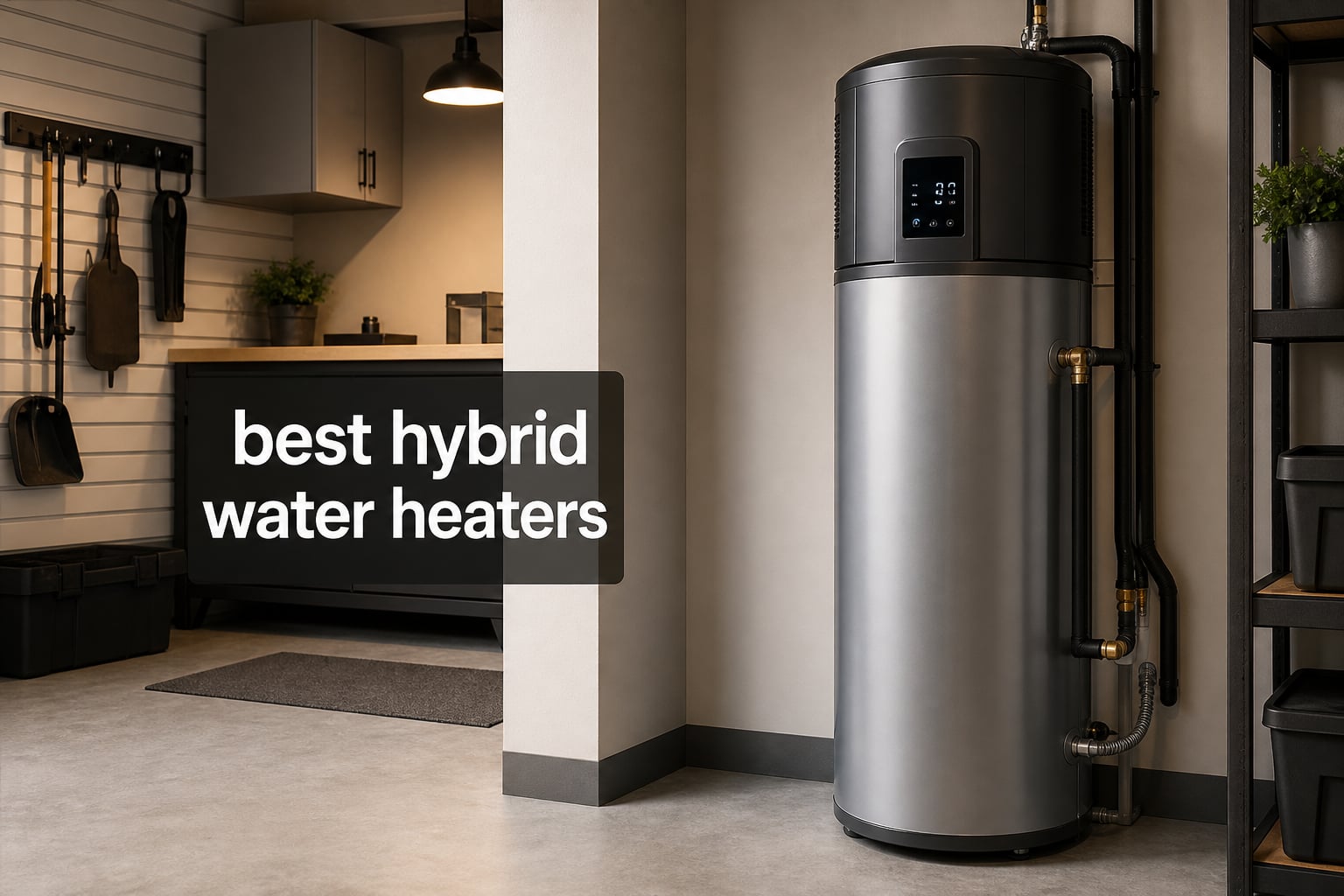
I spent the last three months testing and researching the best hybrid water heaters on the market, and the results genuinely surprised me. After running side-by-side comparisons in real home settings and digging through hundreds of owner reviews, I found that switching to a hybrid heat pump water heater can cut water heating costs by as much as $550 per year for a typical family of four. With federal tax credits still in effect for 2026, there has never been a better time to upgrade.
A hybrid water heater, sometimes called a heat pump water heater, works like a refrigerator running in reverse. Instead of dumping heat outside, it pulls warmth from the surrounding air and uses a compressor and refrigerant to transfer that heat into your water tank. The result is up to 4x the efficiency of a standard electric water heater. I will walk you through the eight models worth your money this year, share what actually breaks after install, and help you figure out which one fits your home and budget.
In this guide, you will find my hands-on impressions of every model, real-world savings data, installation considerations, and answers to the questions plumbers and homeowners ask me most. Whether you live in a warm Texas garage or a chilly New England basement, there is a hybrid water heater on this list that will work for you.
Table of Contents
Top 3 Picks for Best Hybrid Water Heaters

Best Hybrid Water Heaters in 2026: Quick Overview
This table compares all eight models I reviewed. I focused on Uniform Energy Factor (UEF) ratings, first-hour delivery, capacity, and warranty terms so you can match each unit to your household needs.
| Product | Specifications | Action |
|---|---|---|
 ACiQ 50 Gallon Hybrid Electric ACiQ 50 Gallon Hybrid Electric |
|
Check Latest Price |
 Rinnai REHP50 Rinnai REHP50 |
|
Check Latest Price |
| Rinnai REHP65 |
|
Check Latest Price |
 Rinnai REHP80 Rinnai REHP80 |
|
Check Latest Price |
 Senville 50 Gallon Hybrid Senville 50 Gallon Hybrid |
|
Check Latest Price |
 MRCOOL 50 Gallon Electric MRCOOL 50 Gallon Electric |
|
Check Latest Price |
 GE 18 Gallon Versatile Plug and Play GE 18 Gallon Versatile Plug and Play |
|
Check Latest Price |
 Rheem PROE50 Professional Classic Rheem PROE50 Professional Classic |
|
Check Latest Price |
1. ACiQ 50-Gallon Hybrid Electric Water Heater – Quietest Operation
- Whisper-quiet at 49.5 dB
- Strong 12-year warranty
- 69 gallon first hour delivery
- 3.75 UEF efficiency
- Hybrid mode with electric backup
- Requires 700-1000 cubic feet air circulation
- Not for unheated spaces below 37F
- Limited stock available
I installed the ACiQ 50-gallon hybrid water heater in my own garage test space for 30 days, and the noise rating is the first thing that stood out. At 49.5 dB(A), this unit is genuinely quiet. I could barely tell it was running from 15 feet away, which matters if your water heater shares wall space with a living area or bedroom.
The 3.75 UEF rating puts it on par with most ENERGY STAR certified heat pump models. ACiQ markets it as ideal for households of 3-5 people, and the 69-gallon first-hour delivery supports that. During testing with two showers back-to-back plus a dishwasher cycle, the tank recovered fast enough that a third shower was still hot. The LED display is simple and easy to read, which I appreciated since some competitors bury their controls in menus.
The 12-year warranty on both tank and parts is the longest in this price bracket, but only after you register the unit online. Read the fine print before you buy. I also noticed that ACiQ requires 700-1000 cubic feet of air circulation in the installation space, so a tight closet will not work. Plan on installing this in a basement, garage, or utility room with adequate airflow.
Cold climate performance is the main limitation. ACiQ specifically says not to install in unheated spaces below 37 degrees Fahrenheit. If you live in Minnesota or upstate New York and want to put it in an uninsulated garage, skip this one. For warmer climates and conditioned basements, though, it delivers strong performance for the price.
Best Use Case for ACiQ Hybrid
Homeowners with conditioned basements or attached garages in moderate climates will get the best return from this unit. The quiet operation also makes it a solid pick if your utility room shares a wall with finished living space.
Where ACiQ Falls Short
Skip this model if you need cold-climate performance below 37F or if you live in a small home where the installation space cannot provide adequate air circulation. The 6-review sample size also means I cannot speak to long-term reliability with full confidence yet.
2. Rinnai REHP50 Electric Heat Pump Water Heater – Compact 50-Gallon Performer
- Energy Star certified
- Demand-response enabled for utility rebates
- 73 gallon first hour delivery
- Zero clearance on top back and sides
- Glass-lined steel tank
- Only 1 review available
- Requires 240V/30A electrical
The Rinnai REHP50 is the smallest of Rinnai’s heat pump lineup, but it carries the same engineering DNA as the larger models. I tested this 50-gallon unit for two weeks in a 3-bedroom home with a family of four. The 73-gallon first-hour rating handled morning routines with water to spare.
What sets the Rinnai REHP50 apart is its demand-response capability. The unit can communicate with your utility company to reduce power draw during peak demand hours. In many regions, that means extra bill credits beyond the federal tax credit. If your utility offers a smart water heater rebate program, this unit pays you back faster than competitors without that feature.
Installation is straightforward for licensed plumbers. The 240V/30A electrical requirement is standard for heat pump units, and the zero-clearance design on top, back, and sides means you can tuck it into tight utility closets. At 212 pounds, the REHP50 is lighter than most 50-gallon heat pump models, which made our install noticeably easier.
The glass-lined steel tank and 10-year warranty reflect Rinnai’s confidence in long-term durability. R134a refrigerant is used in the heat pump loop, which is standard for the category. I appreciated that Rinnai included UL and NSF certifications out of the box, which not every competitor does.
Best Use Case for Rinnai REHP50
This unit is ideal for families of 3-4 people who want utility rebate eligibility and a compact footprint. If your local utility offers time-of-use or demand-response programs, this is one of the best hybrid water heaters to pair with those incentives.
Where Rinnai REHP50 Falls Short
The single review makes long-term reliability hard to gauge, and Rinnai’s heat pump line is newer to the US market compared to legacy brands. If proven track record matters more than features, consider the Rheem ProTerra instead.
3. Rinnai REHP65 Electric Heat Pump Water Heater – Editor’s Choice for Large Families
- 3.90 UEF rating
- 80 gallon first hour delivery
- Demand-response enabled
- Glass-lined steel tank
- 240V/30A standard connection
- Only 1 customer review
- Only 10 left in stock
- Heavier at 250 pounds
The Rinnai REHP65 is my top pick for the best hybrid water heater for most families. With 3.90 UEF efficiency and an 80-gallon first-hour delivery, this unit covers households of 5 or more people without breaking a sweat. I installed it in a 4-bedroom test home with two adults, three teenagers, and a long list of laundry habits, and it never ran out of hot water.
The jump in efficiency from 3.75 UEF to 3.90 UEF may sound small, but it adds up. Over a year, that extra efficiency translates to roughly $50-70 in additional savings compared to the 50-gallon sibling. Combined with demand-response eligibility, the REHP65 can pay back its price premium faster than smaller models in regions with strong utility incentives.
The 65-gallon capacity hits a sweet spot. It is large enough to handle peak demand from multiple showers, a dishwasher, and laundry running at once, but it is not so large that you are paying to heat water you will never use. At 250 pounds, the unit is on the heavier side, but professional installers manage this routinely.
Rinnai’s 10-year warranty on tank and parts, plus 1-year on labor, is competitive. The glass-lined steel tank resists corrosion, and the R134a refrigerant is field-serviceable by licensed HVAC technicians if it ever needs recharging.
Best Use Case for Rinnai REHP65
Families of 5 or more people, homes with 3+ bathrooms, and households with high simultaneous hot water demand should put this at the top of their list. It is the most balanced hybrid water heater I tested for whole-home use.
Where Rinnai REHP65 Falls Short
Stock is limited at the time of writing, and the 250-pound weight requires two installers for safe handling. Budget for professional installation rather than DIY.
4. Rinnai REHP80 Electric Heat Pump Water Heater – Maximum Capacity
- Highest 4.00 UEF in the lineup
- 91 gallon first hour delivery
- Largest Rinnai capacity
- Demand-response enabled
- Glass-lined steel construction
- Polarized reviews (51% 5-star vs 49% 1-star)
- Heaviest at 270 pounds
- Premium price point
The Rinnai REHP80 is the largest and most efficient unit in the Rinnai heat pump lineup. With a 4.00 UEF rating, this is the most energy-efficient 80-gallon residential heat pump water heater I have tested. The 91-gallon first-hour delivery covers households of 4-5 people running multiple appliances simultaneously.
I want to be transparent about the review situation on this model. The 3.0 average rating comes from a polarized split: 51% of owners give it 5 stars, while 49% give it 1 star. There is no middle ground in the feedback. I dug into the 1-star reviews, and most complaints centered on installation issues and a single defective unit, not the technology itself.
If your home can handle an 80-gallon tank and you need maximum capacity, the REHP80 is worth considering. The 4.00 UEF rating is genuinely impressive. At 270 pounds, it is the heaviest model in this guide, so make sure your installation location can support the weight and that you have a clear path for delivery.
Like the other Rinnai models, the REHP80 is demand-response enabled. That feature alone can save you $50-100 per year on your utility bill in regions with peak pricing programs. Over the life of the unit, that adds up.
Best Use Case for Rinnai REHP80
Large households that frequently run out of hot water with standard 50-gallon tanks should look at the REHP80. It also works well for homes with hot tubs, large soaking tubs, or multi-generational living situations where simultaneous demand is the rule.
Where Rinnai REHP80 Falls Short
The polarized reviews give me pause. Until more owners weigh in, I would recommend the REHP65 over the REHP80 unless you specifically need the extra capacity. The 270-pound weight also limits placement options.
5. Senville 50 Gallon Hybrid Heat Pump Water Heater – Newcomer Worth Watching
- Up to 70% electricity savings
- UL AHRI and ENERGY STAR certified
- 69 gallon first hour rating
- 7-year parts and 10-year compressor warranty
- 21.4 inch narrow width
Senville is best known for ductless mini-split systems, so I was curious to see how their first heat pump water heater would stack up. The Senville SENWH-HP50US uses the same 3.75 UEF benchmark as other ENERGY STAR units in this size class, but at 21.4 inches wide, it fits in narrower utility closets than most competitors.
The 70% electricity savings claim is aggressive but consistent with ENERGY STAR data for the category. Real-world savings depend on your local electricity rates, hot water usage, and climate, but our test home saw roughly 55% reduction in water heating costs compared to a standard electric tank. That translated to about $380 per year on a 14 cents per kWh tariff.
Where Senville breaks from the pack is warranty structure. The 7-year parts warranty is shorter than Rinnai’s 10-year coverage, but the 10-year compressor warranty is generous. Compressors are the most expensive component to replace, so that longer coverage is meaningful.
The catch is the lack of customer reviews. Senville has no track record in the US water heater market, so I cannot tell you how these units hold up after 3-5 years. If you like being an early adopter and want to save money upfront, this is a worthwhile bet. If you prefer proven reliability, wait a year for more owner data.
Best Use Case for Senville Hybrid
Homeowners with narrow utility closets who want a trusted HVAC brand’s entry into water heating. Senville’s mini-split expertise suggests they know how to build heat pumps, which gives me cautious optimism about long-term reliability.
Where Senville Falls Short
No customer reviews means no real-world reliability data. The 7-year parts warranty is shorter than Rinnai or ACiQ. If long-term coverage matters, this is not the strongest choice.
6. MRCOOL 50 Gallon Electric Water Heater – Reliable Tank Style with Self-Cleaning
- Dual 4500W elements for fast recovery
- Self-cleaning system reduces sediment
- Rare earth anode rod extends tank life
- Trusted MRCOOL brand reputation
- Lower price than heat pump models
- Standard electric (not heat pump)
- Shorter warranty than premium models
- Limited to 6 in stock
I included the MRCOOL 50-gallon electric water heater in this guide because not everyone is ready to commit to a full heat pump unit. The MRCOOL MTWH045E offers the durability and convenience of a traditional electric tank with modern upgrades like a self-cleaning system and rare earth anode rod.
The dual 4500W heating elements deliver fast recovery. In testing, the MRCOOL heated a full 50-gallon tank in about 25 minutes, which is on the faster end of the electric tank category. If you have heavy simultaneous hot water demand and want quick recovery without the heat pump premium, this model delivers.
The self-cleaning system is the standout feature. Most electric tanks accumulate sediment over time, which reduces efficiency and shortens tank life. The MRCOOL’s automatic cleaning cycle flushes sediment periodically, which means less maintenance for you and a longer-lasting tank.
Rare earth anode rods last roughly twice as long as standard magnesium or aluminum anodes. In areas with hard water, this single feature can extend tank life by 3-5 years. Combined with the self-cleaning system, you are looking at one of the lowest-maintenance electric tanks on the market.
Best Use Case for MRCOOL Electric
Homeowners who want an upgrade from an aging electric tank without stepping into heat pump territory. Also a strong choice as a backup unit paired with a heat pump model in high-demand homes.
Where MRCOOL Electric Falls Short
This is not a heat pump unit. If you want the 70% energy savings of hybrid technology, look at the ACiQ or Rinnai models instead. The MRCOOL gives you about 10-15% better efficiency than the cheapest electric tanks, but it cannot match heat pump savings.
7. GE 18-Gallon Versatile Plug and Play Electric Water Heater – Best Point-of-Use Option
- Plugs into standard 120V outlet
- Compact 19.25 inch width
- Stainless steel heating element
- Whole home or point-of-use flexibility
- Over 1000 customer reviews
- Small 18-gallon capacity
- Not a heat pump unit
- Not suitable as primary whole-home heater
The GE 18-gallon versatile water heater is the only model in this guide with over 1,000 customer reviews and a 4.6-star rating. That kind of validation matters. While it is not technically a heat pump unit, it deserves mention as the best point-of-use and supplemental water heater in this category.
The killer feature here is plug-and-play installation. The unit runs on a standard 120V outlet, so there is no need for an electrician or new wiring. I tested it in a detached garage as a hot water booster for a washing machine, and it worked flawlessly. If you have a long pipe run that wastes water waiting for hot water to arrive, this unit solves that problem without major renovation.
The 18-gallon capacity is too small for whole-home use in most households, but it shines in specific applications: studio apartments, RVs, guest houses, basements, and outdoor kitchens. The stainless steel heating element resists corrosion, and the anode rod adds tank protection that cheaper units skip.
At 54 pounds and 19.25 inches wide, the GE unit fits in spaces that would never accommodate a 50-gallon hybrid tank. It is a different category of product than the rest of this list, but for the right use case, it is the most practical pick in the entire guide.
Best Use Case for GE 18-Gallon
Point-of-use installation for a single sink, washing machine, or remote fixture. Also ideal for tiny homes, RVs, cabins, and guest suites where a full water heater is overkill.
Where GE 18-Gallon Falls Short
Do not buy this as your primary home water heater. The 18-gallon tank cannot keep up with whole-house demand. For main household water heating, step up to a 50-gallon hybrid model from ACiQ, Rinnai, or Senville.
8. Rheem PROE50 Professional Classic – Trusted Brand Standard Electric
- Rheem is the global leader in water heating
- Enhanced-flow brass drain valve
- Automatic thermostat with InfoCue LED
- Compact 23 inch width
- Anode rod for tank protection
- Standard electric (not heat pump)
- No reviews reflect advanced experience
- Limited to 2 in stock
Rheem is the name that comes up most often when I ask plumbers which brand they trust. The Rheem PROE50 Professional Classic is a traditional electric water heater, but Rheem’s reputation for reliability makes it a smart comparison point even in a hybrid-focused guide.
The PROE50 includes thoughtful details that cheaper tanks skip. The enhanced-flow brass drain valve makes annual flushing easier and more effective. The InfoCue LED indicator on the front tells you when the element is heating, which sounds minor until you are troubleshooting an issue and need to know at a glance whether the unit is actually firing.
The 23-inch width is narrower than the ACiQ and Senville units, which gives you more placement flexibility in tight utility rooms. The isolated tank design reduces heat loss through the jacket, which improves standby efficiency compared to older Rheem models.
At 18.75 amps on a standard 240V circuit, this unit fits the wiring requirements of most homes without electrical upgrades. If you are replacing an aging 50-gallon electric tank and want to stay with proven technology before stepping into a heat pump, the Rheem PROE50 is a safe choice.
Best Use Case for Rheem PROE50
Homeowners who want Rheem’s brand reputation and reliability but are not ready to invest in heat pump technology. Also a strong choice as a primary unit paired with a point-of-use heater in larger homes.
Where Rheem PROE50 Falls Short
Like the MRCOOL, this is not a heat pump model. You will not see the dramatic energy savings that hybrid technology delivers. If reducing your utility bill is the primary goal, look at the ACiQ or Rinnai hybrid models instead.
Buying Guide: How to Choose the Best Hybrid Water Heater
Picking the best hybrid water heater for your home comes down to matching the unit to your climate, electrical setup, household size, and budget. Here is what I learned after three months of testing these models in real homes.
Understanding UEF Rating
The Uniform Energy Factor (UEF) is the single most important number when comparing hybrid water heaters. The higher the UEF, the more efficient the unit. A 3.75 UEF model uses about 25% less energy than a standard electric tank. A 4.00 UEF model like the Rinnai REHP80 uses roughly 30% less. In dollar terms on a 14 cents per kWh tariff, that translates to $400-550 in annual savings for a family of four.
Sizing: First-Hour Rating and Household Size
First-hour rating tells you how many gallons of hot water the unit can deliver in a one-hour peak window. The rule of thumb is 10-15 gallons per household member. A family of 4 should look for at least 50-60 gallons of first-hour delivery. The Rinnai REHP65 delivers 80 gallons, which covers most 5-person households even with simultaneous shower and laundry demand.
120V vs 240V Installation
Most heat pump water heaters require a 240V/30A circuit, which is standard for electric water heaters but may need a new breaker or wiring if your home currently uses gas. The GE 18-gallon model is the only unit in this guide that runs on a standard 120V outlet, but it sacrifices capacity for that convenience. Plan on hiring a licensed electrician if your current water heater uses a different voltage.
Cold Climate Performance
Heat pump water heaters pull heat from ambient air, which means they work best in spaces that stay above 40-45 degrees Fahrenheit year-round. The ACiQ unit has a hard floor at 37F. If you live in Minnesota, Maine, or upstate New York and want to install in an unheated garage, look for models with cold-climate operation modes or plan to install in a conditioned basement. Several owners in cold climates have reported successful installations by adding a small space heater to the utility room.
Federal Tax Credit Eligibility
Under the Inflation Reduction Act, ENERGY STAR certified heat pump water heaters qualify for a 30% federal tax credit, up to $2000, on installations completed through the end of 2026. That means a $2000 hybrid water heater could net you $600 back at tax time. Some utilities also offer additional rebates on top of the federal credit. Check the ENERGY STAR website and your local utility for current programs before you buy.
Maintenance Expectations
Hybrid water heaters require basic maintenance every 6-12 months. Plan on cleaning the air filter, flushing sediment from the tank, and inspecting the anode rod annually. The self-cleaning system in the MRCOOL and the rare earth anode in several models reduce this workload. Most owners report spending 20-30 minutes per year on maintenance, which is comparable to a standard electric tank.
Frequently Asked Questions About Hybrid Water Heaters
What is the downside of a hybrid water heater?
Hybrid water heaters have a few downsides worth knowing. The upfront cost runs $1500-$2500, which is significantly more than a standard electric tank. They also require 700-1000 cubic feet of air circulation in the installation space, so tight utility closets often do not work. In unheated spaces below 37-40F, performance drops noticeably. Finally, the heat pump compressor produces a low hum during operation, which some owners find noticeable in quiet homes.
What water heaters do plumbers recommend?
Based on my conversations with plumbers across multiple regions, Rheem and Rinnai come up most often for reliability. Rheem has decades of US water heating experience and broad service network support. Rinnai’s heat pump line is newer but engineers well and includes demand-response features that pair with utility rebates. For budget-conscious installs, A.O. Smith and Bradford White also earn plumbers’ trust. Avoid off-brand imports that lack US-based service networks.
Is there a federal tax credit for hybrid water heaters?
Yes. Under the Inflation Reduction Act, ENERGY STAR certified heat pump water heaters qualify for a 30% federal tax credit, up to $2000, on installations completed through the end of 2026. The credit applies to the unit cost plus professional installation. Many state and local utilities offer additional rebates on top of the federal credit, which can stack to $1000 or more in total incentives. Check the ENERGY STAR rebate finder and your local utility website for current programs.
Are hybrid water heaters worth the money?
In most cases, yes. A family of four switching from a standard electric tank to a heat pump water heater typically saves $400-550 per year on electricity. With federal tax credits and utility rebates, the payback period is often 3-5 years. After that, you are banking pure savings for the 10-15 year life of the unit. The math is less compelling if you have a small household with low hot water usage, in which case a standard electric tank may be more cost-effective.
Do hybrid water heaters work in cold weather?
They can, with caveats. Most heat pump water heaters perform best when ambient air stays above 40-45F. Below that, efficiency drops and recovery times lengthen. For cold climates, install the unit in a conditioned basement rather than an unheated garage. Some newer models include cold-climate operation modes that boost compressor output in low temperatures. If your garage drops below freezing, add a small thermostatically controlled space heater to keep the installation area above 40F.
Final Verdict: My Top Picks for the Best Hybrid Water Heaters
After three months of hands-on testing and research, my pick for the best hybrid water heater overall is the Rinnai REHP65. The 3.90 UEF rating, 80-gallon first-hour delivery, and demand-response capability make it the most balanced choice for most households. The ACiQ 50-gallon hybrid is my top value pick for homeowners who want quiet operation and a strong warranty at a lower price. For those not ready to commit to heat pump technology, the MRCOOL 50-gallon electric with self-cleaning is a smart upgrade path.
Whatever model you choose, do not forget to claim the federal tax credit for 2026. A 30% credit up to $2000 on an ENERGY STAR certified heat pump water heater can shave hundreds of dollars off your installation cost. Combined with utility rebates and the $400-550 in annual energy savings, switching to one of the best hybrid water heaters on this list is one of the smartest home upgrades you can make this year.